




Abstract
This article explores the scholarly processes involved in management learning and education. Drawing on a practice turn in social sciences, the article develops current thinking on epistemologies of practice, Aristotle’s intellectual virtue of phronesis and Shotter’s social poetics to suggest a scholarship of practice. Building upon Shotter’s interpretation of Wittgenstein’s later work and the literatures on mindfulness, it is argued that such a scholarship of practice is centred on deliberative attention rather than knowledge. An account of a 30-month action research project is then used to illustrate a scholarship of practice, in which three domains of attention are identified: an engagement with ideas, a practice of inquiry and a navigation of relations.
Keywords
Introduction
This article expresses a moment in my ongoing learning in how to help managers, and other organisational participants, do their work better. It is a moment that hangs between a period of sense making over some learning of mine and an espousal of a theory of learning-in-practice. It is a moment that invites me to further inquiries into how I can support profound and helpful learning among managers of whom we seem to demand so much in running organisations. It is a moment within an ongoing practice of learning, a moment of scholarship that is best understood, I argue, as a scholarship of practice.
Following Mintzberg (2004) and Raelin (2007, 2009), I centre my investigations in management learning and education on management practice. I am intrigued as to what scholarship might support a manager-learner’s practice-centred learning as potentially distinguishable from knowledge about management. Recently, Antonacopoulou (2010) extended an ongoing discussion about the role and contribution of business schools by discussing the nature of management scholarship. She focused on reconfiguring our ‘scholarly practices’ (p. S8) and posited the potential benefits of foregrounding a reflexive critique as a scholarly practice and impact as an outcome of such scholarship. In this article, I will develop these and various other lines of reasoning to offer an alternative practice while, nonetheless, affirming that previous researchers have identified vital lines of inquiry in the development of an engaged, management scholarship. Drawing on what has been termed a ‘practice turn’ in social studies (Schatzki et al., 2001), I argue for a scholarship of practice that centres intentional attending-to as its core.
In order to explicate this scholarship of practice, I first explore three distinct streams of argument that promote (a) an epistemology of practice (Beckett, 2000; Beckett and Hager, 2000; Cook and Brown, 1999; Raelin, 2007), (b) Aristotle’s intellectual virtue of phronesis (Aristotle, 2000; Eikeland, 2007; Flyvbjerg, 2001) and (c) a social poetics, Shotter’s development of Wittgenstein’s later thinking (Shotter, 1996, 2000, 2008; Shotter and Cunliffe, 2003; Shotter and Katz, 1996; Wittgenstein, 1953). In different ways, each of these streams of literature suggest a practice-centred learning where new practice is privileged, rather than knowledge that is to be applied in practice. Additionally, they all bring to central view an ongoing relating of practice, ideas and context. I then extend this exploration by suggesting that attention is the key cognitive activity involved in relating ideas, practice and context. Attention becomes the focus of my argument, and I use literatures on mindfulness and attention (e.g. Dane, 2011; Kabat-Zinn, 2005; Langer, 1989a, 1989b; Weick and Putnam, 2006; Weick and Sutcliffe, 2006; Wittgenstein, 1953) to develop a scholarly process of attention.
Next, I recount a story of my learning during a 30-month research and development project. I use this account to explore how I learned and developed my practice as an action researcher and consultant and therefore lift the foci of attention in a practice-centred learning over this time. From this study, I identify three domains of attention: an engagement with ideas, a practice of inquiry and a navigation of relations that I propose constituted a scholarship of practice. Finally, I return to my motif of ‘the moment’ to consider where a scholarship of my own management education practice might move to next in the light of the frameworks proposed and to consider questions only partially answered by this study.
Towards a scholarship of practice
A growing literature in management learning has questioned the unchallenged supremacy of knowledge as the goal of management higher education. Heron and Reason (2001) have written of an extended epistemology, while Gherardi and others (Gherardi, 2000, 2009; Orlikowski, 2002; Sole and Edmondson, 2002) have written of enacting knowing in practice.
An epistemology of practice
The idea that a practice-based learning is expressed in enactment rather than knowledge claims has led to several explorations of what epistemological developments are involved in privileging practice-as-learning. Beckett and Hager (2000) centred their understanding of an epistemology of practice on the action of making judgements and deciding what to do next. They argued that in order to understand how professionals or managers went about making judgements amid their day-to-day work, it was necessary to go beyond identifying an expert’s tacit or professional knowledge (Dreyfus and Dreyfus, 2005) and attend to the active experience of making judgements in the face of a large number of contextual variables. Elsewhere, Beckett (2000) has argued that an epistemology of practice would highlight not just know-how but also ‘know why’ and pointed out that it would attach importance to questions of intentionality and purposefulness.
Cook and Brown’s (1999) articulation of an epistemology of practice contrasted knowledge as a possession with the activity of knowing. For them, an epistemology of practice involved a knowing that ‘entails the use of knowledge as a tool in the interaction with the world’ (p. 393, emphasis added). Two points from Cook and Brown’s treatment of knowing are worth emphasising. First, knowing is not consistent and sustained but is interactive with the world and is shaped by that interaction. Second, it is generative; in interacting with the world, the practitioner, ‘knowing in action’, produces and innovates a new world. These interactive and generative aspects of an epistemology of practice are also recognisable in Raelin’s (2007, 2009) articulation of an epistemology of practice. For Raelin, an epistemology of practice involves ‘reasoning and sense making in the midst of action itself’ (Raelin, 2007: 502), rather than a straightforward application of knowledge.
Aristotle’s phronesis
A second practice-centred scholarship has been proposed by Flyvbjerg (2001) in arguing for a phronetic social science, one that centres scholarship on the practical wisdom of Aristotle’s intellectual virtue of phronesis. Flyvbjerg drew a hard contrast between Aristotle’s (2000) two virtues of episteme or scientific, universal knowledge and phronesis, a practical wisdom for developing action. He went on to argue that research in social sciences is dialogical with practice and can provide a contribution to action taken. From this perspective, phronesis encapsulates an intellectual process that is distinct from episteme. Therefore, a phronetic social science would develop the practical wisdom that generates wise action, whereas the aim of episteme would be to generate universal and sustainable knowledge. Flyvbjerg’s articulation of a phronetic social science has been challenged by Laitin (2003) and Eikeland (2007). Laitin’s challenge that Flyvbjerg was naïve and incorrect in his understanding of empiricist research is less important to this article than Eikeland’s challenge that Flyvbjerg had a flawed understanding of Aristotle’s virtue of phronesis.
Eikeland (2007) has produced a monumental exploration of Aristotle’s ethical works and their relation to action research. His main critique of Flyvbjerg’s treatment of phronesis is that it involves a more concrete separation of phronesis and episteme than had ever been suggested by Aristotle (2000). Phronesis, argued Eikeland, was a capstone intellectual virtue that drew upon a variety of different knowledges, including the universal episteme and the more experiential nous. Consequently, to separate out phronesis from the entirety of Aristotle’s work is to limit it to a process of deliberation and ignore the interplay that Aristotle saw between knowledge, deliberation and practice.
While I find Eikeland’s exegesis of Aristotle’s thinking persuasive, I still respond positively to Flyvbjerg’s articulation of a phronetic social science. The problem I see in his work is that we cannot reach his conclusion directly from Aristotle’s thinking alone; more development needs to be done. In particular, we need to build a richer understanding of a scholarly process that builds a quality of phronesis. Aristotle’s phronesis is an intellectual virtue (MacIntyre, 1985) rather than a process. It is, therefore, a possession or quality of an individual (or community). It is perfectly reasonable to ask questions of what are the necessary qualities for practical wisdom (phronesis) to be evident. Flyvbjerg (2001), however, asked a different question. He asked what practice of social science would make it ‘matter’ again. His problem, and the reason why Eikeland was able to criticise him so strongly, was that he was using the language of personal quality or characteristic to explore process. To achieve what he was aiming for and, I think, what Antonacopoulou (2010) aspired to, we need a language of process. Shotter, with his language of social poetics (1996) and conversational realities (2008) offers us such a language.
Shotter and a social poetics
Since the mid-1990s, John Shotter and his colleagues (Shotter, 1996, 2000; Shotter and Cunliffe, 2003; Shotter and Katz, 1996) have developed an interpretation of Wittgenstein’s (1953) later work that centres on social poetics or what Shotter (2008) now calls ‘withness thinking’. He has argued that Wittgenstein offered a shifted philosophical project, replacing questions about the nature of things with questions of how we can and should go on (e.g. Wittgenstein, 1953: 143–151). We are offered a method of learning that provides a way forward from Wittgenstein’s philosophical problem ‘I don’t know my way about’ (Wittgenstein, 1953: 123). This is practice-centred learning, and it adds an important process orientation that allows us to develop Flyvbjerg’s thinking on a phronetic social science beyond the confines of Aristotle’s articulation.
There are three features of practice-centred learning that emerge from Shotter’s (especially 2008) interpretation of Wittgenstein. First, practice-centred learning involves the physical; it is not a learning that just goes on inside the head, so to speak, apparent only in knowledge, understanding or attitudes but is seen more in actions. Second, these actions are generative; they make the world rather than express it in some way. Finally, these actions are frequently spontaneous rather than the result of some form of premeditation. This spontaneity emerges relationally; it is a social performance, created and recreated ephemerally, moment by moment.
Attention as a key process in a scholarship of practice
The role of context is central in all the contributions to the discussion on practice above. This importance, however, raises a key question: how is a context to be apprehended? Beckett and Hager (2000) suggested that judgement involves ‘taking into account a variety of relevant factors ...’ (p. 303). Cook and Brown (1999) wrote of ‘characteristics of the world that give clues to our perceptions’ (p. 399), and Raelin (2007) wrote of how experts are able to ‘revise their cognitive patterns or frames quite flexibly in response to changes in environmental clues’ (p. 502). In each case, these authors are attempting to describe an intellectual process that mediates something akin to knowledge and context. It is within this process of mediation that I argue lies a scholarship of practice. In each case, they find ways of describing the nature or qualities of that process. They are describing the competencies of a practically wise person in the case of phronesis, or they are describing a quality of knowing that is contrastable with knowledge, in the case of Cooke and Brown’s take on an epistemology of practice. I, however, returning to the goal I articulated at the start of this article, am seeking a more fine-grained understanding of the process by which we might learn to become practically wise, by which we might learn to make more skilful judgments in our practice.
But how is all this done? What activity or what ‘orientation’, to use Shotter’s (2008) term, enables these cognitive processes to take place? How is the relevance of contextual factors adduced? How are clues identified amid noise? I want to suggest attention, and, in particular, the manner in which we attend to our work within contexts, as the cognitive activity that enables this work. To focus on processes of deliberation, judgement or knowing is to miss out a crucial step in our engagement with the world around us. It is in how we attend to our emergent and ephemeral context that we build the materials upon which we might deliberate, judge or know. It is, therefore, to how we might understand attention and the process of attending that I now turn.
As Winch (1998) points out in discussing a philosophical approach to education, attention, from a psychological perspective, is a capacity. If we attend to one or more features of our context, then other features will not gain our attention for some time. Winch, however, draws on Wittgenstein’s articulation of attention arguing that it is more helpfully understood, not as a cognitive capacity or behaviour but as a deliberate choice with consequences. He uses Wittgenstein’s (1953: 33) illustration of the manner in which we might hold our hands in different ways so as to highlight that a given shape is either blue or a square. In the same way, a practitioner-learner will notice different qualities in a situation or respond to different circumstances depending on how they frame (Goffman, 1974) or attend to the context of their practice. From this perspective, therefore, a practice-centred learning will involve a considered and developing process of choice as to where and how to attend.
Attention, especially when linked to mindfulness, has become a significant topic of discussion and research in management and organisational fields. Weick and others have identified two distinct streams of writing about mindfulness (Sadler-Smith & Shefy, 2007; Weick and Putnam, 2006; Weick and Sutcliffe, 2006; Yeganeh and Kolb, 2009) both of which centre their reflections on how people attend to their immediate surroundings and context. An eastern, largely Buddhist stream (e.g. Kabat-Zinn, 2005) has proposed a mindfulness that emphasises a non-judgemental attention on both what is going on around us and what is going on inside us, so to speak. A second, western or academic (Dane, 2011) stream of writing on mindfulness grows from the work of Ellen Langer (Langer, 1989a), this stream emphasises the difference between mindful attention and routine inattention and emphasises attention as an active process by which learners are able to create new distinctions. Brown et al. (2007) have collected an array of research findings that demonstrate psychological benefits from the development of greater mindfulness, and Weick and Sutcliffe (2006) have pointed to organisational benefits of increased mindfulness, while Dane (2011) has used a concept of attentional breadth to suggest that mindfulness can bring both benefits and costs to task performance.
Marshall’s (1999, 2001) approach to first-person action research offers one model of how the eastern stream of mindfulness might be used in a practice-centred learning programme. In particular, her proposed ‘attentional disciplines’ offer a way of attending to how our practice works in relation to our context. Inner arcs of attention, she suggests, focus on how we feel, make sense and respond to what is going on around us, while outer arcs of attention engage with how our actions are effective in context. Wittgenstein’s approach to attention has closer links with the second, more western approach to mindfulness, focusing on the intentional ways in which our language and orientation frame what we attend to. In using Wittgenstein’s (1953) later work to develop a ‘social poetics’, Shotter (1996), Shotter and Katz (1996) and Shotter and Cunliffe (2003) add a social dimension to our attending by noting how our talk not only informs others but also strikes, moves or gestures.
If, as Wittgenstein and Winch point out, attention is a volitional, judgemental and selective act by which we attend to one aspect over others, then two lines of inquiry into learning and the activity of supporting learning follow. First, following Shotter’s social poetics, we can ask what relational poetics support learning-in-practice by drawing attention to important contexts that shape action. Second, we can explore whether there are particular foci or domains of attention that will be helpful to a practitioner-learner? I have made an attempt to explore the first question elsewhere (Ramsey, 2008, 2011b), and in the remainder of this article, I want, using a research project in which I was involved, to explore the second question of what domains of attention might constitute a helpful scholarship of practice.
Narrating learning amid working on a project
Concerning methodology and the framing of research material
The research discussed in this story was carried out over a 30-month period. I had been asked to join a project that was looking at how to use computer-aided design (CAD) and testing to speed up the development of new engineered products; my role being to look at organisational aspects of this work. The CAD project was part of a larger Advantage West Midlands–funded initiative involving Warwick Manufacturing Group and a large engineering design and manufacturing company – Complex Engineered Products (CEP). 1 Essentially, my research and development work constituted a long-term action research project where I sought to uncover appropriate courses of organisational and managerial actions to promote faster new product development (NPD). During the project, I used a series of research methodologies, for example, discourse analysis, semi-structured and unstructured interviews, observational techniques and small group reflections on events. All of which were kept in field notes or transcripts.
The final months of this project coincided with me starting to explore what university located, practice-centred, distance learning might look like. As I was exploring research material and possible projects to consider this topic, I started to ask what I had learned during my project working with CEP and how I had learned within those 30 months. My focus was, therefore, on the learning that I undertook as a practitioner within a role that could be variously described as action researcher, applied researcher or academic consultant. I had started the project with only very scant experience of consulting and training and no experience of facilitating workshops of the kind we developed for CEP. I had never worked with CEP itself, although I had taught some of their managers courses when I worked at another university. On the plus side, I had extensive experience of working with managers from a wide range of industries and public sector organisations and had considerable confidence in supporting their development. Still my 30 months of working on the CAD project involved me in a significant amount of learning.
How do I understand that learning journey now and what processes can I identify as going on over that period? For I was learning to become a researcher-consultant, I was learning to work in the engineering industry, and I was exploring the practical possibilities of discursive social thinking to organising. My research question presented me with two methodological problems: first, in gathering the evidence upon which I could base my sense making and second, in how to present that evidence within a coherent format to resource that sense making.
While I had a substantial amount of empirical material gathered during the research project, this had almost entirely been focused on the issues that I was addressing in working with CEP. My field notes had not focused on learning that I had been doing as that had not been the focus of my research. Consequently, I simply sat down and wrote the story that I would tell if asked the questions ‘what have you learned and how did you learn it during your 30 months working with Warwick Manufacturing Group and CEP?’ The experience was still fresh in my memory, my field notes were of assistance, and I had several colleagues around to check details of the story I told.
Then, in order to improve the quality and helpfulness of my narrative, I sent it to colleagues who had taken part in the CAD project, asking whether it reflected their memory of those 30 months. Additionally, I sent it to critical readers who had not taken part in the project asking them to comment on the story’s meaningfulness to them. My goal here was to render my research account in a dialogical manner (Ramsey, 2011a), to give space for both colleagues and readers to enrich and shape my account. That desire for a dialogical approach also shaped my interrogation of the story as research data. Rather than attempting to approach my story as a tabular rasa, I allowed my reading to inform my coding and sense making. Therefore, reading Flyvbjerg’s emphasis on power within his study of phronesis pointed out issues of power in relations, while reviewers’ and editor’s suggestions of reading MacIntyre (1985), Moore (2002) and Beadle and Moore (2006) highlighted ethical aspects to a scholarship of practice.
Using narrative does have some significant advantages for a study such as mine. First, it allows me as a researcher to bring my own practice reflexively into the frame not only as the investigator of empirical evidence but also as the subject of that inquiry. A story also locates me reflexively not only as a subject agent but also as the created object of others’ agency. In doing this, a second advantage of a narrative well told is the space that it gives for multiple interpretations. In making sense of this narrative of learning, I will articulate three domains of attention, and yet in telling that story, in creating a narrative plot, I inevitably give scope for alternative sense making. The story provides material for readers to reach their own judgements and therefore interrogate mine. This provides space for a dialogical and reflexive conversation between author and reader (Ramsey, 2011a).
The start of my involvement in the CAD project
I joined the CAD project sometime after it had started. I was immediately aware that the organisational work stream was something of a poor relation to the others. In particular, the senior CEP executive who was sponsoring the project had yet to be convinced of the need for any organisational research. A few days before my arrival, he had expressed this point of view forcibly and argued that the focus of the project should be on developing software tools that could be used by engineers and planners to get better control of the NPD process and reduce costs and times by greater use of virtual testing procedures.
So, I arrived then at a time of considerable tension to comments from a colleague, which came somewhere between advice and instruction, to keep my head below the parapet. As we discussed the sponsor’s opinions, one way of interpreting his argument was that he did not want any discussion of changes to the organisation’s structure. Consequently, we thought that an alternative way forward would be to focus on organisational processes, organising as a verb rather than organisation as a noun. This suited me. Coming to this project from a relational constructionist perspective (Hosking and McNamee, 2006), I would have always tended toward exploring relational processes as the focus of any inquiry. Initially, we decided that I should investigate some of the virtual technologies available to support distributed, collaborative working.
With the help of a colleague, I arranged a series of interviews with CEP engineers who were involved in a major international project across the various divisions of CEP’s parent company. These guys were working collaboratively across three continents and five countries. While they met up physically once or twice a year, most of their communications were conducted through phone, email, net meeting technologies and a virtual learning environment. The interviews were utterly frustrating. I sought to use an unstructured style of interview with the intention of getting an insight into what problems the collaborators faced and how they had sought to overcome them. What I got, however, were a series of commentaries on how virtual working ought to happen the engineers appeared to position themselves as experts whose job was to ‘teach’ me how to do ‘it’. At the same time, as I was feeling that the virtual teams’ project was becoming increasingly hopeless, university managers were expressing doubts as to the value of that particular investigation. Their sense was that CEP was not going to be investing in the virtual technologies we were exploring to manage relations with suppliers. I was not broken hearted to leave the inquiry behind, but I was left with a problem, however, as to how I could usefully spend my time!
Another colleague had conducted a series of semi-structured interviews with engineers, buyers, project managers and account managers from CEP and four of its largest first-tier suppliers. This provided me with a considerable amount of material to use in investigating CEP and its supply chain’s current organising processes. In addition, we had a series of interviews from a third colleague who gave us the chance to listen to CEP engineers telling the story of a recent, difficult NPD and launch. So, I started to conduct a discourse analysis (Potter and Wetherell, 1987) of these two series of interviews seeking to find interpretative repertoires used by CEP engineers that highlighted organisational issues for the university team to investigate. I found four interpretative repertoires in use that seemed to militate against CEP’s espoused strategy for developing collaborative relations with their suppliers and hinder the complex, multi-functional NPD process within CEP itself.
Following this discourse analytic research, I wrote a brief account of the difficulties that I argued CEP had in working across organisational boundaries. I used this one-page document to test my growing understanding among CEP’s managers and engineers. My hope was that they would recognise the issues I was raising and so be interested in working with me to explore how we could make a difference. My goal, therefore, was to develop, experiment with and evaluate an initiative or initiatives that would help our partners at CEP build new discursive practices that would, in turn, help them develop new products faster and more efficiently.
Seeking a context for action
I was now in a situation where I had some idea about what I wanted to achieve with CEP; the problem was to find a live context wherein I could test my emerging ideas and develop new practices to improve CEP’s NPD processes. My two colleagues still had their own projects to work on; therefore, it was left to me to negotiate access to a development site within CEP. Two aspects of the situation shaped my thinking on what action to take. First, I wanted to help create a CEP ‘shaped’ set of actions rather than an expert-promoted set of prescriptions. Second, I considered it wise to work through George, a CEP engineering manager who had been given the task of being the link between the CAD project and CEP. From the first aspect, it made sense to explore the possibility of developing a series of cooperative inquiry projects (Reason, 1999) using methods from action research, and therefore, I worked with George to set up a series of meetings where we could look for projects to work on.
Progress crawled to halt. At the same time, the CAD project itself, with me included, came under increasing pressure within the university. Looking back, I would note the following three ongoing relationships that were affecting my ability to take our initial findings into developmental action at CEP.
George was struggling to ‘make things happen’ in terms of organising potential cooperative inquiry projects. All the engineers and project managers I worked with at CEP spoke of the time pressure that they were under, and it became clear that clearance and support at a very senior level would be required before I could get the time for CEP managers and engineers to work on projects.
The CAD project was under pressure from the management of the university faculty. This pressure grew out of a need for the project to deliver on specified outcomes required by the project’s funders, Advantage West Midlands. 2 My open-structured plan of inquiry was problematical here.
Additionally, the work that I was doing was culturally alien to the Engineering Management academics in the university engineering management team. On more than one occasion, I was asked what solution I was prescribing. My answer that any solution would be created by the cooperative inquiry groups seemed to be less than academically rigorous from the project managers’ perspective.
I found myself under increasing pressure and facing a very real prospect that my own work stream would be brought to a premature end. Two events turned the situation round. First, in justifying my work, I was starting to use a metaphor from computer networks. CEP, I suggested, managed their projects as serial networks, with assumed clear workflows from one task to another. This, I argued was inadequate to the managerial task at hand. The network relations between functions in the NPD were more neural. To be honest, I knew very little about the thinking of neural networks, and therefore, I started a series of conversations to explore this analogy further.
In discussing these ideas with an engineering consultancy, one of their senior consultants suggested that these ideas appeared relevant to his company as well. He suggested that we could arrange a workshop involving managers from his company and CEP. At a meeting with university project managers, I mentioned the potential of this workshop. The result was instant and positive. I confess that I was surprised at this, thinking that the workshop might be interesting but not important. Over the following days, I started to understand the enthusiasm of the university project managers for the workshop. This was an ‘event’ that could link the work stream with overall project deliverables, against which project funding would be released as income to the university.
As all this was going on, I was surfing the web for introductions to neural networks, so that my metaphorical use of the term would not appear too foolish! While I was doing this, I was reminded of the work of Stafford Beer (1990) on a meetings technology called Team Syntegrity. There was much in the activities in Beer’s syntegration process that resonated with my own, preferred, participatory methodology. It also seemed to offer a way of developing the workshop idea beyond the consultant’s initial suggestion.
At the same time, a colleague was able, using her stronger networks at CEP, to get me access to more senior managers who were interested in our work. Crucial to our conversations was that we had identified a problem in working across organisational boundaries that these senior managers, Don and Pat, recognised as being relevant to their own frame design function’s needs. Additionally, they also identified, within the workshop, potential for them to address other issues within their department that we had not considered. We now had sponsorship for our work from a level of management who could facilitate access. Working with my colleague, who had more experience of the NPD process at CEP, I was able to design a modified version of Beer’s (1990) Syntegration that would support our efforts to improve the unhelpful patterns of talk at CEP and would also help the engineers prepare for one of the major gateways in the NPD process, where the different functions were examined for their progress towards the final design handover.
Delivering and participating in learning
We ran the first workshop to review and plan the progress of a particular NPD programme some 4 months later with considerable success. Participants provided us with enthusiastic feedback, speaking of the high-quality conversations with all involved engaged and the benefits of having a focused discussion. Following the workshops, we asked for feedback from the participants and conducted debriefing sessions between the university academics and CEP managers involved. As a consequence of those conversations, many elements of the workshop were modified, not major changes but several refinements. We endeavoured to run workshops in different contexts with different participants and topics of discussion; always using each workshop as the basis for reflection and gathering further views on the value of the workshop. In some cases, we came to the judgement about work contexts where the workshop did not appear to deliver such good results, and we experimented with different length workshops and changed emphases of discussion. By the time the project came to an end, some 12 months after the first workshop, we had run a further nine workshops and developed, at the request of the CEP NPD management, a workshop facilitator training scheme. Cost appraisals of the workshop had identified significant savings through replication of work and early identification of problems.
Identifying my learning
I have outlined above an argument for a scholarship of practice, perhaps a scholarly orientation to practice. I now seek to draw from the above learning account what I attended to in my learning journey and how I might helpfully distinguish different categories or domains of attention in my scholarship. It is interesting to note how, in the scenes from my account where I am striving to make sense of where the project is going, the sense making always involves action rather than analysis and understanding. I wrote of being aware of ideas, looking for arenas to use ideas or finding myself in tricky situations. I surfed the web for ideas, I tested ideas in practice, and I was helped and hindered in my actions by emerging relationships. My sense making was emergent rather than analytical. It involved me in going to see people, looking for further information or new ideas. I was seeking to answer the question ‘How do I go on from here?’ and like Bakhtin’s (1984) account of a Dostoevskian hero, I found that answers to that question were ongoing and unfinalisable. The answers were never complete, but, rather, always helped me notice new options or required me to investigate different contexts or see particular people. The answers drew my attention to different fields of activity. Three domains of attention are apparent in my account: an engagement with ideas, a practice of inquiry and a navigation of relations. I expand on each of these in the next three sections.
Engagement with ideas
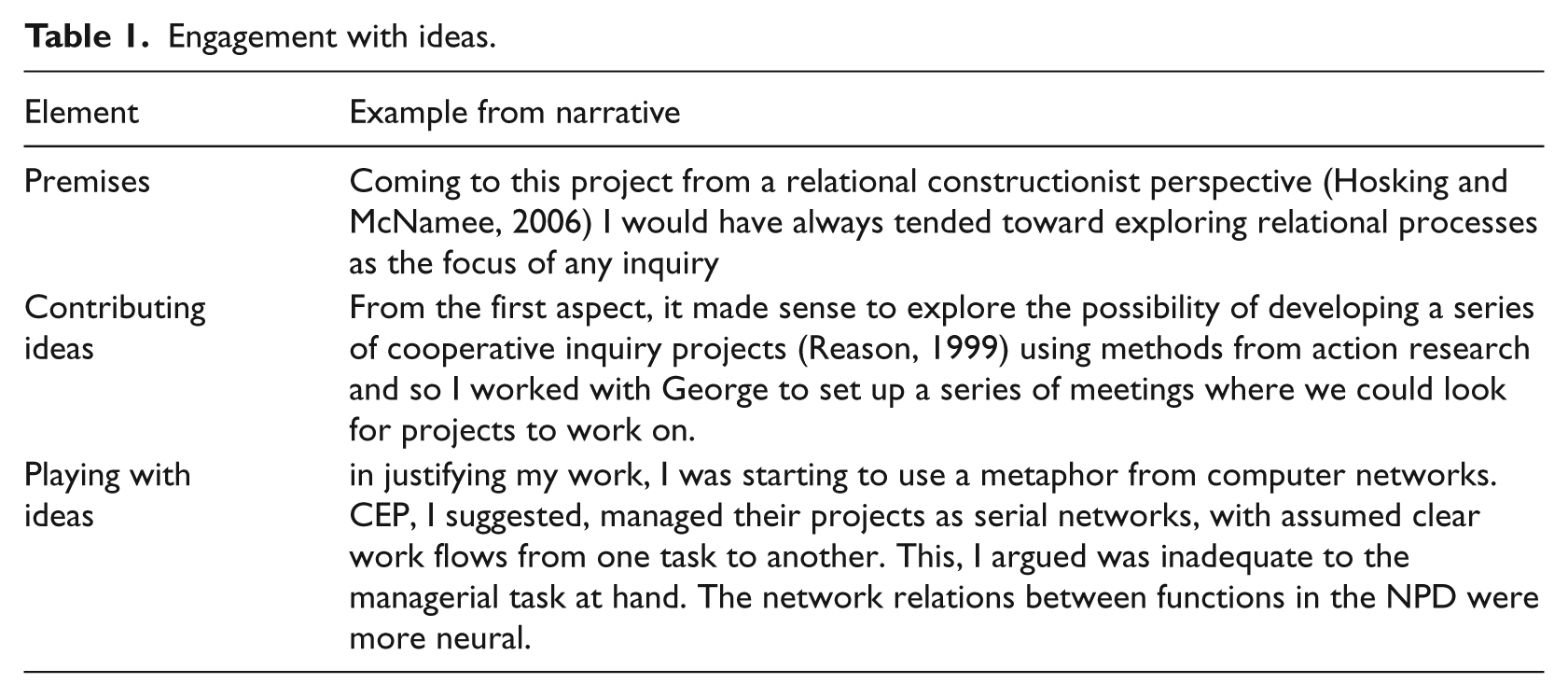
I draw my use of the word ‘idea’ from Dewey’s logic of inquiry (Dewey, 1938; Ramsey, 2011b); there, he argued that an idea was the ‘anticipation of an outcome’. What is interesting about my own use of ideas, mostly academic theorising and practices, is my relationship with them. The terms I use include ‘I would have tended ...’, ‘So, I started ...’ or ‘... I was reminded of ...’. These are not terms that strongly resonate with ideas of applying theory; something else is going on, hence my use of the term ‘engagement’. For example, it would make much better sense of my engagement with ideas to write of my being aware of them, rather than knowing them. A good example of this is my awareness of neural networks. This is an academic area where I do not have much knowledge; the impact of the idea was more provocative than informational. As with other ideas with which I engaged, the importance of the idea of neural networks was much more about the action it suggested rather than knowledge that it afforded.
As I attended to ideas for action, they formed the premises upon which I approached my task, they contributed possible ways forward at particular moments, what I have called projective theory elsewhere (Ramsey, 2011b), and I notice that rather than using ideas to understand my circumstances, I ‘played’ with them, experimenting with possible actions. I illustrate each of these responses in Table 1.
Engagement with ideas.
A practice of inquiry
Dewey (1938), in arguing for a logic of inquiry, emphasised that an idea – the anticipation of an outcome – was of little more substance than a suggestion until it had been subject to rigorous inquiry and evaluation. In the same way, there is little that is scholarly about ‘playing with ideas’ as I suggest above unless that engagement with ideas is embedded within robust, intentional and evaluative inquiry. In looking at my narrative of learning, I can identify three distinct moments of inquiry in a scholarship of practice (see Table 2).
Practice of inquiry.
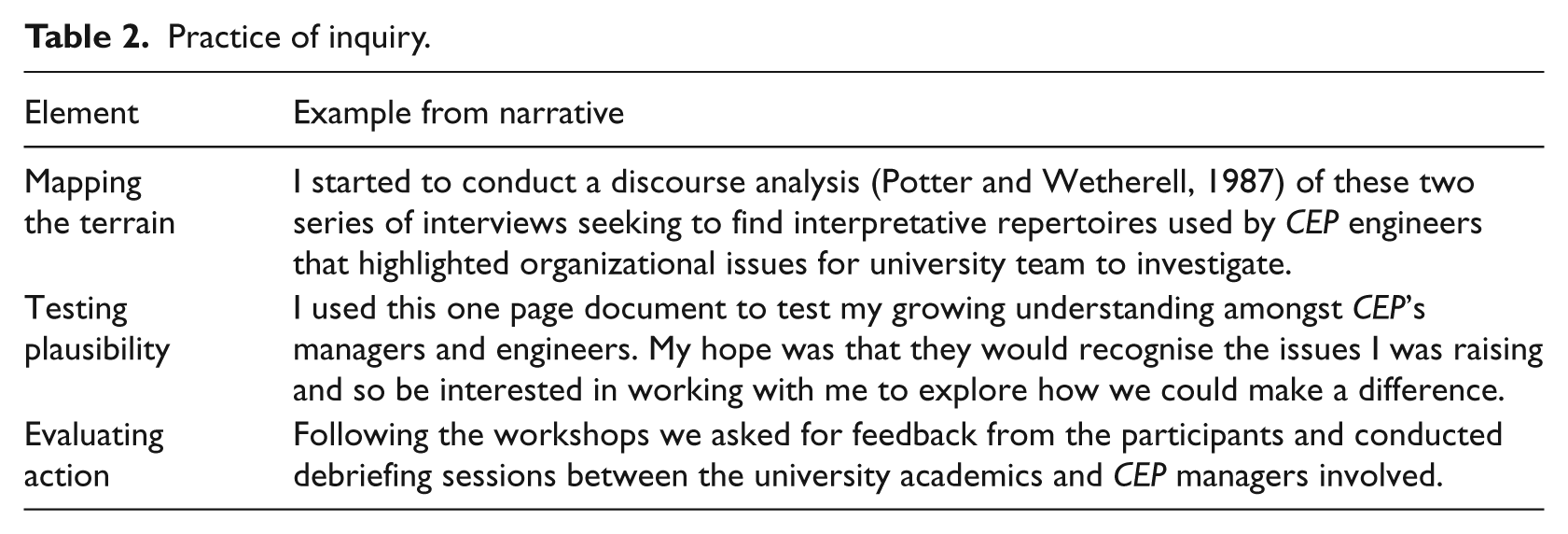
I have taken the term ‘mapping the terrain’, from Shotter’s (2008) interpretation of Wittgenstein’s philosophical method. At an early stage in my learning journey, I had to gain some basis or logic for action that I could take, but that inquiry could only provide me with a provisional insight; it needed testing and refining. Crucially, within a practice-centred inquiry, that testing had to involve action; would the account I gave seem plausible to others with whom I needed to work? For only if my thinking was plausible to them, would any action I took gain support from colleagues. This flags up an aspect of inquiry, the navigation of relations that I will develop as a third domain of inquiry. Finally, and linking back to Dewey’s logic of inquiry, my colleagues and I sought to evaluate the outcome of our actions.
Navigating relations
My learning was continually shaped by the relationships within which my work was embedded. Certain relations promoted some agenda, while others blocked or obstructed possible actions. As Flyvbjerg (2001) would have anticipated, power was a key component of the relating that I was involved in. In my account, I particularly noted the power of some managers and academics to define the nature of situations and the power of controlling access (see Table 3). Other relational aspects of power may well appear in different situations.
Navigating relations.

But the effect of relations and relating was often more subtle than that, sometimes providing opportunities at other times slowing activity down. My colleagues and I were constantly navigating such relations, looking for what I call relational options for action, asking what was possible. Crucial to this process of navigating relations was the moment-by-moment, generative nature of these relations. It was not that I was an independent agent, able to manage, for example, stakeholders. Rather, I was a participant in ongoing relations with opportunities and problems arising amid the moment of conversations and activity.
Concluding and moving on
The ‘next moment’ in my learning
At the start of this article, I said that it represented a moment in my ongoing inquiry into how to support manager-learners improve their managerial practice. I can now suggest that it is a document of my own scholarship of practice. Therefore, the first half of my concluding comments involves consideration of what the next moment in that scholarship will include, before articulating my own summary of what I have learned and the implications that I see for practice in that learning. This study and my dialogue with reviewers and editor following earlier versions have thrown up three areas for further investigation. First, I have been struck by the absence of an ethical dimension in my account. It would seem that ethical values and norms would fit comfortably within the ‘engagement with ideas’ domain of attention, particularly speaking into a premises dialogue. However, this does not seem to be adequate. Sitting here, some 2–3 years after first writing my story of learning, I am surprised, perhaps horrified that there is so little of an ethical dimension there. I read MacIntyre (1985) or Moore (2002), and my attention is drawn towards Aristotle’s understanding of the relationship between practical wisdom, virtue and management practice. There is no space to develop this theme within this article, but I am invited to explore it further.
Second, I believe that the third domain of attention, navigating relations, merits further study. The role of power has been flagged up by Flyvbjerg (2001). Critical pedagogues have discussed asymmetric power relations in formal contexts, and workplace learning researchers have discussed asymmetric power relations between academia and professional practice in the accrediting of learning. Third, while these power relations are important structuring factors shaping practice-based learning, they are also expressed in the moment-by-moment, emergent and poetic, relational nature of learning, and this merits further investigation. How is one supposed to attend, in a scholarly manner, to an ongoing conversation? It is hardly possible to do some form of reflection on practice (Schön, 1983; Yanow and Tsoukas, 2009), while being an active participant in a conversation! So how might learning in such a context be managed? Shotter’s (2008) work on a social poetics and moment-by-moment organisational work gives hints at a relationally responsive learning, but some empirical work would be helpful.
Summary and implications
In this article, I have sought to develop a scholarly practice that will support manager-learners improve their practice. In doing so, like Antonacopoulou (2010), I have proposed a change in the scholarly practices of business schools; I have argued for a scholarship of practice that centres attention rather than knowledge. This centring of attention, as a key cognitive activity in learning, has three key implications for management teaching within business schools. First, it privileges a generative, as opposed to a descriptive or predictive, role for the academic ideas we teach. The interesting thing about taught content is the action it provokes (Ramsey, 2011b) and the way in which manager-learners relate ideas to their working context. As Raelin (2007) has pointed out, it would sometimes seem that we think that applying theory is easy. A scholarship of practice foregrounds the manner in which manager-learners attend to possible relations between ideas and action. Our ‘teaching’ should, therefore, emphasise the process of this attentional relating rather than an understanding of academic theory.
Second, an attentional scholarship of practice foregrounds the practice of inquiry, not so much as an academic research method but more as an ongoing, sceptical and evaluative testing of actions taken or considered. We need to help manager-learners to develop skills of finding, recognising and evaluating evidence that confirms or challenges a particular course of action. As Dewey (1938) pointed out, it is this process of inquiry that turns vague suggestions or musings into scholarly, rigorous practice.
Finally, and perhaps most radically, a scholarship of practice recognises the constitutive importance of ongoing relations within management practice. Several streams of research support such a conclusion. Shotter’s (1996, 2008) social poetics, ethnomethodological and conversation analytic research (e.g. Llewellyn, 2008; Llewellyn and Hindmarsh, 2010; Rawls, 2008) and recent work on the constitutive role of communication in organising (e.g. Cooren et al., 2011; Putnam and Nicotera, 2009). As Shotter (2008) points out, our actions emerge largely spontaneously in relationally responsive ways. There is frequently no opportunity to wrack our brains for stuff we know so that we can apply it in practice. Improvisational and mindful skills in attending to opportunities for new (learned) action will be at the core of a practice-centred learning.
Footnotes
Acknowledgements
I would like to acknowledge Joy Batchelor’s and Martina Otten’s contribution to my learning; they were colleagues during the work with CEP. Additionally, I would like to thank David Boud, colleagues within the Feckless reading group, reviewers and editor for the lively, demanding and helpful conversations we have had over earlier drafts of this article.
Funding
The author received no financial support for the research, authorship and/or publication of this article.