



Abstract
Improvisation has been treated largely as if it were a conceptual monolith: all improvisations are similar. We challenge this theorizing by distinguishing forms of improvisation in organizations (semi-structured, episodic, subversive, resistive) and by exploring ways in which these forms interrelate in improvisational sequences. Improvisation is not just something individuals do; it is a learned capacity that organizations can manage. We introduce the dimension of improvisational formality and informality, adding a political dimension to the study of the topic. By combining forms in process sequences, we organize the existing literature under a systematic perspective facilitating theory development via an integrative understanding of how improvisation produces learning.
Keywords
Introduction
Organization, no matter the extent to which it is organized, cannot eradicate its other: improvisation. An organizational world without improvisation would be devoid of events: those unpredictable things that happen (Deroy and Clegg, 2011). While the expulsion of humanity and the deployment of autopoietic robots might achieve such a world, as imagined by artists and philosophers (Hall, 2010), nonetheless, where there are humans involved in action, we can expect improvisation to occur as a process that articulates creativity and spontaneity (Crossan et al., 2005). Improvisation permeates all rule-governed systems (Tsoukas and Dooley, 2011) as a form of reflection-in-action constitutive of organizing (Yanow and Tsoukas, 2009). It becomes more visible as part of competitive action and learning repertoires (Garud et al., 2008), as a crucial component of strategy (Goddard and Eccles, 2013), and as a potential source of organizational adaptation in fluid transient-advantage economies (McGrath, 2013). Improvisation combines perceived problems with existential constraints enabling organizations to be more liquid and flexible (D’Aveni and Lewin, 1996). It entails ‘ongoing adaptation and adjustment’ (Weick and Quinn, 1999: 361) with and within existing constraints. As McGrath (2010) put it, ‘insight, rapid experimentation and evolutionary learning’ are what characterize organizations equipped to improvise (p. 247). In organizational environments with hypercompetitive traits (D’Aveni, 1995; Wiggins and Ruefli, 2005), improvisation is increasingly valued (Bernstein and Barrett, 2011) because it assists strategizing and responding to ‘intractable crises’ (Gundel, 2005) as events unfold in unpredictable ways (Deroy and Clegg, 2011; Magni and Maruping, 2013; Webb and Chevreau, 2006) via real-time learning.
We contribute to the literature by systematizing existing research under an integrative perspective that establishes both the commonalities and the differences between forms of improvisational learning. Such systematization is necessary to facilitate theory development, understanding improvisation as a dynamic, complex and rich multiform process. Despite progress in recognizing the importance of improvisation, one predominant theoretical gap can be identified: how do organizations learn from improvisational processes? To answer this question, we structure the article around three core sections. First we introduce our focal concept to explain why the label ‘improvisation’ may be too generic to be useful for theory development. Second, we argue that improvisation is better understood as a multi-shaped, polymorphic process, manifest in several forms of learning over time and place (Lervik et al., 2010). There is a continuum of improvisational learning ranging from informal organization to the formally designed, characterizable as resistive, subversive, episodic and semi-structured processes. Next, we present avenues for further research on improvisational learning, which we define as the process of improving an organization’s action repertoire, in the perspective of perceiver, on the basis of responses to unexpected events that do not follow existing plans and routines. We elaborate the rest of our argument taking four core literatures into account. We consult extant research on improvisation as our topic of interest, which provides a relevant and growing body of knowledge on the process of finding creative solutions extemporaneously with the materials at hand (see Cunha et al., 1999 for a summary). We also consulted the literatures on learning, innovation and change in order to analyse how structures, tensions, and political constraints mould improvisation as a combination of creativity, spontaneity and constraint (Mumford et al., 2007). We considered the strategy literature and in particular the work on strategy as simple rules and as guided evolution (Eisenhardt and Sull, 2001; Lovas and Ghoshal, 2000), which provided important insights about the nature of improvisation.
Two main perspectives on improvisation
Improvisation, minimized in organization theory for most of the 20th century, was re-emphasized towards its close. The bulk of the theory of modern organization can be interpreted as reflecting a concerted focus on uncertainty reduction as the key task of organizational modernity (Clegg, 1990; Clegg et al., 2006), displaying an excess of concern with institutions and a lack of consideration of improvisation (Garud et al., 2008). Improvisation was marginalized to the peripheries of organizational theorizing. Predictability and routine constituted rationality as much as they constituted uncertainty – the lack of predictability and routine – as the alterity in these accounts. As Shenhav (1999) pointed out, mainstream organization theory viewed management as a force for rationalization: everything unpredictable should be removed and replaced by rationalized certainty. Improvisation was a case in point, being the antithesis of scientific management. In organizations that operate as coercive bureaucracies (Adler and Borys, 1996), improvisation becomes an undesired potential variation.
In the second perspective, improvisation is reinterpreted as constitutive of organization: not as something that happens to organizations but as integral to organizing itself, something that makes organizations (Langley et al., 2013). Given the inevitable limitation of planning and anticipation in the face of intractable and unpredictable events, improvisation participates in the fabric of organization as a response to the emergent and the unexpected (as well as a source of it). In this second perspective, organizations are organized because they constantly make adjustment efforts and deviate from routine to respond to deviation. In the first case, organization is viewed as improvisation reduction. In the second case, organization is enacted as an improvisational accomplishment.
Organization as improvisation reduction
Major modern management theories were fundamentally devoted to the creation of systematic organizations imagined according to a mechanistic, predictability-oriented, and highly regulated functioning: what Taylor (1911) called the ‘rule of thumb’ of pre-scientific management was to be firmly excluded. Organizations conceived as configurations of tried-and-tested routines (Weick and Westley, 1996) required the elimination of improvisation from formal organization, diminishing its political legitimacy and rendering it a potentially clandestine process. Scientific management and Fordism institutionalized this understanding, with management thinking converging on a central logic of uncertainty reduction (Tsoukas, 2005) that furthered the focus on operational efficiency, process standardization, certification, compliance, process improvement, Total Quality Management (TQM) and other ritual forms that led to the McDonaldization of society (Ritzer, 2004). Protection and buffering of the organizational core from contingencies and perturbations were at the basis for organizational order (Thompson, 1967). The completeness of organization minimized the space for improvisation and using the unexpected as an opportunity to learn. As Gelberg (1997) pointed out, ‘The hallmark of scientific management was to end improvisation by people throughout the organization and replace that improvisation with rules developed by management’ (p. 34). Viewed broadly, improvisation was a source of inefficiency, a nuisance to be eliminated. Its form deviated from the organizational template of scientific rationality threatening process management. Improvisation meant risky undesired variation.
Organization as improvisation acceptance
In a contrasting approach, opportunistic strategizing and spontaneous adjustment may prove superior to planning-based strategy-making modes (Bingham et al., 2011; Goddard and Eccles, 2013). Organizations need to facilitate learning efforts and leaders ‘capable of directing adaptive opportunistic adjustment in initial plans in a complex environment where multiple restrictions and contingencies must be taken into account’ (Mumford et al., 2007: 406). Examples abound. In commercial life, Honda’s triumph in the United States involved improvisation and adaptive learning, destroying rationalized competition through oblique and unplanned moves rich in improvisations (Kay, 2011; Pascale, 1996). In space, during the Apollo 13 mission, when the life-support system broke down, improvisation was carried out to make an urgent repair, using materials at hand in the spacecraft (Rerup, 2001). In war, dramatic battles, such as the Battle of Stalingrad in World War II, have been won with effective improvisational responses carried out within a hierarchical command and control structure and embedded in a strong ‘collective mind’ (Brady, 2011). Even in a coercive bureaucratic system, such as the Union of Soviet Socialist Republics (USSR), improvisation applied to ‘virtually every human activity’, including the running of the country’s ‘massive shadow economy’, the ‘sheer survival in the Gulag’ and the ‘very fulfilment of five-years plans’. According to Holden (2011):
Improvisation did indeed entail ‘networking in complex hierarchies’, the quest often being to identify a tolkach, a pusher, who could promptly unblock a supply chain, secure the appointment of someone with vitally needed skills from some remote part of the USSR, and, if necessary, push people around who created obstructions. (p. 351)
Process authors (Feldman, 2000; Jarzabkowski et al., 2012; Orlikowski, 1996; Tsoukas and Chia, 2002; Tyre and Von Hippel, 1997) capture how plans and routines are continuously re-enacted and modified as learning unfolds in response to necessary deviations from standard procedures. Organizations appreciative of the role of improvisation experiment with structures designed to accommodate spontaneous response. To specify the inherent incompleteness of structure and the need to reserve space for improvisation, Weick (1989) introduced the notion of the
minimal structure … imposed on improvisation by a melody [which] is not that much different from the minimal structure that is imposed on events when they are linked together by a causal loop which contains an odd number of negative signs. (p. 243)
The diffusion of improvisation metaphors challenged the machine-like predilections of practitioners and scholars, disturbing mechanistic representations by emphasizing how formal structures coexist with emergent improvisational learning. Structure is a necessity rather than an obstacle to learning (Weick, 1999); effective improvisation occurs when all the participants have substantial expertise, because collaborative improvisations require equal contribution and depend on shared mental models which make intersubjectivity possible (Sawyer, 2003, 2007).
Brown and Eisenhardt (1997) and Bingham and Eisenhardt (2011) confirm Weick’s prediction that a simple minimalist approach may initiate complex structuring. Incomplete guides to action may be more effective than exhaustive goal systems (Ethiraj and Levinthal, 2009), with improvisational learning facilitated by syntheses of control and freedom (Brown and Eisenhardt, 1997; Hamel, 2011). While improvisation helps organizations to adapt flexibly to frequent changes (Agarwal and Helfat, 2009; Eisenhardt, 2010; Eisenhardt and Piezunka, 2011), it can also produce irregular and unsustainable outcomes (Kyriakopoulos, 2011).
Forms of improvisation
Improvisation unfolds in distinct ways, characterized by organizational embeddedness and contextual sensitivity: necessarily responding to organizational contexts. Some organizations learned how to design work to protect improvisational spaces, whereas others discourage improvisation as deviation from established processes. Some improvisations are formally designed and accepted, whereas others are spontaneous responses to extraordinary and unpredictable events. Some improvisations are desired and appreciated; others may be unplanned but necessary, while still others may be unwanted or repressed. The organizational context in which improvisation occurs, as well as the reasons behind the actors’ decision to improvise, needs to be accommodated in theorizing improvisational learning.
By considering the formal versus informal and the desired versus undesired dimensions, four improvisational types can be identified: (1) the episodic impromptu reactions, central to the improvisational literature itself (informal but cultivated as desirable responses to organizational problems); (2) subversive improvisations well known in the innovation and learning literatures (informal, positive and tolerated if conducted with the organization’s benefit in mind); (3) resistive improvisations studied by change scholars (informal, undesired); and (4) semi-structured improvisations explored by strategy researchers (formal, desired). This typology offers one possibility of organizing the theme around its learning implications, but others may certainly be considered to increase conceptual texture to the analysis. For example, Chelariu et al. (2002) developed an alternative typology, based upon an information-processing perspective. Their cognitive typology is an important contribution, but, in line with most of the improvisation literature, it ignores the political side of improvisation (see also Patriotta, 2003). Future studies may consider other conceptual arrangements such as micro–macro and event-process perspectives. Our typology complements Chelariu et al.’s by explicitly considering the political dimension and its learning consequences.
Table 1 defines, summarizes and contrasts the different forms of improvisation. It is important to explain that the forms may exist independently. But one form may gradually metamorphose, becoming some other form. For example, in the context of semi-structures, some improvisations may be on–off, episodic, whereas others slowly become learned, habitual and routine. In this sense, an on–off routine may be later reinterpreted as the beginning of something more stable and habitual – a simple rule, a proto-routine. Given the process sensitivity to time (Langley et al., 2013), its slow progression and metamorphosis, its ontology as change and becoming (Orlikowski, 1996), and its paradoxical nature (Clegg et al., 2002), an improvisation may, at some process point, synthesize more than one type, that is, be more than one thing at the same time (as illustrated in MC Escher’s graphical process depictions), as it becomes. It is their inherent tension, ambiguity and contradiction that make improvisation an instance of dialectical change (Van de Ven and Poole, 1995). Containing improvisation forms inside one single type at a time may be conceptually convenient but misleading.
Improvisational forms.
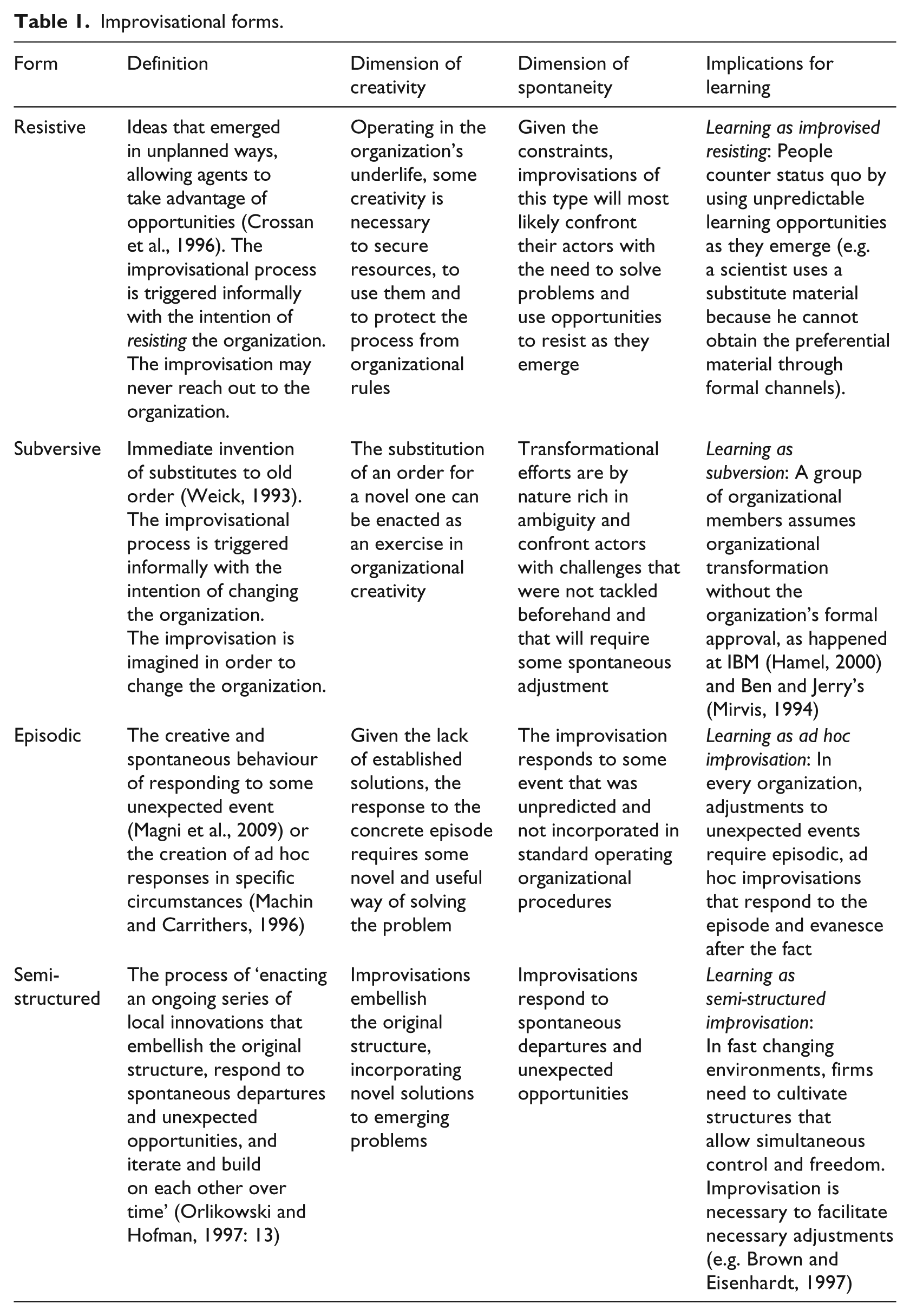
Before considering the different forms, it is necessary to introduce some clarifications. First, as highlighted above, forms are diverse but not mutually exclusive. Different forms may occur in the same context at the same time, making the same form difficult to catalogue as single or immutable. Forms may exist at varying levels of intensity, at all times: organizations do not display a fixed improvisational form. Second, as we discuss below, one improvisational form may metamorphose into another one, namely via the effect of learning. Third, it is more likely that some forms exist in some organizational contexts: some contexts may favour specific forms of improvisations, as we detail in the discussion. The differentiation of improvisational forms is relevant in the sense that it offers a subtler view of a process that has been enacted as indistinctly monolithic and reflects the diversity and dynamism of improvisation processes and their learning implications. We turn next to the analyses of four improvisational forms.
Resistive improvisations
Resistive improvisations are an inevitable outcome of organizations where goals are not shared (March and Simon, 1958). Employees may improvise when formalization and codification exert strong pressures against individual goals and when people hide their improvisations without the intention of formalizing them, or making them explicit or putting them at the organization’s service. These improvisations refer to ideas that emerged in unplanned ways, allowing agents to take advantage of unpredicted opportunities (Crossan et al., 1996). Improvisation emerges as a result of the initiative of individuals or small teams and is a direct response to the constraints introduced by the organization’s structure. People cover their improvisations because the formal design excludes their existence.
Evidence from ethnographic studies indicates that the elimination of improvisation may be more fiction than fact: while improvisation can be formally suppressed, it may not actually be extinguished (Burawoy, 1979). In organizations with a strong pressure for bureaucratic regulation, where deviations are not welcome, individuals may improvise in a covert way that grants them protection from the organization’s gaze. For example, in the USSR, improvisation was used to obtain resources, protection and favours from more powerful and influent people, to conceal incriminating evidence about being/seeming anti-Soviet, and to keep the Communist Party bosses ‘happy at any level’ (Holden, 2011: 351).
According to this line of research, improvisations are necessary to translate rules into local terms and conditions (De Certeau, 1984; Goffman, 1961), with improvisations being pushed into the organizations’ underlife (Goffman, 1961; Manning, 2008). People hide improvisations from the formal organization to cultivate deviations to directives in a subtle manner (Crozier and Friedberg, 1976). The underlife is a space in which informal liberties incubate for different reasons. The organizational design may be questioned: sometimes, this questioning will be constructively resistant, a loyal opposition to prevailing policy (Courpasson et al., 2012), rather than sabotage. Improvisation may be a potent force either for or against learning: not all improvisations favour adaptation.
The politics of improvisation have been largely neglected. Improvisation often opposes what is regulated and institutionalized. Organization structure offers not only formal opportunities but also informal occasions for improvisation (Crozier and Friedberg, 1976; De Certeau, 1984; Orr, 1996). Improvisers may use structure to leverage anti-structural activities when organizations tighten the iron cage, responding with creative ‘make do’s’ that open oblique, indirect opportunities for action. Scott (2010) describes improvisation in the guts of the organization offering the ‘sanctuary of a resistance culture’ (p. 217) in which reason and emotion, policy and politics, and learning and experimentation work in tandem.
Organizing, as a complex network of social relations, necessarily entails power even though systems designers might imagine the elimination of (what they deem) irrationality; however, such exclusion can never exceed the imaginations of those held only loosely captive in rationality’s bonds. People improvise not only because they are concerned with the organization’s performance (Courpasson et al., 2012) but also because they seek to realize more sectional and personal goals than their authorities might have had in mind, if only to reassure themselves of their ability to be able to do so. Erecting a façade of compliance with the institutionalized organization allows space for organization members’ improvisational escape attempts (Cohen and Taylor, 1976) from managerial scrutiny. People discover how to keep their learning out of the organization’s view.
Subversive improvisations
Individuals or small teams of improvisers may initiate spontaneous subversive improvisations, promoting a technology of foolishness (March, 1976) to counter technologies of reason (Statler et al., 2011). The use of the label ‘subversive’ comes from Hirshman (1995) and refers to the process of ‘questioning, modifying, qualifying and, in general complicating some […] earlier propositions about social change and development’ (p. 1). Subversive improvisations correspond to cases of productive resistance (Courpasson et al., 2012), that is, misalignments that include a positive consideration of the organization’s goals. They aim to change the organization from the inside by leaning to be surprised (Jordan, 2010). Subversive improvisers are those that ‘complicate’ organizational functioning by destabilizing an old order and inventing substitutes for it (Weick, 1993). Because of the risks of this type of complication, subversive improvisations are often clandestine, which does not render them less relevant. As Weick (1979) pointed out, organizations need to be complicated to maintain and update their capacity of response to environmental complexity. Staw and Boettger (1990) document how subversive initiatives in conformist situations may be critical for organizational learning. The cultivation of some elements of play and provocation is especially relevant in innovation work (Styhre, 2008). In this work, individuals decide to improvise innovative solutions from a desire to disrupt the status quo.
Subversive improvisations include serious play approaches to product innovation (Styhre, 2008), brainstorming (Sutton and Hargadon, 1996), free time for the conduct of personal experiments (Mainemelis and Ronson, 2006) and the airing of organizational problems to outsiders with fresh perspectives (Clegg et al., 2004). As a form of provocation, improvisation attempts to challenge the organization with the explicit purpose of dis-equilibrating and un-balancing what is habitually over-structured and taken-for-granted. Much as ‘jazz players’ in a well-drilled dance band, subversive improvisers ‘disturb’ and ‘pollute’ the organization in order and unfreeze the status quo of strict temp and predictable chord changes. Hamel (2000) illustrates this approach with the story of a ‘gang of unlikely rebels’ that transformed IBM with their subversive, insurrectional change initiatives conducted from the bottom-up as ‘skunkworks’ 1 in which learning is necessarily improvised given the impossibility of planning and defending a plan when working backstage.
Subversive initiatives often start under the organization’s radar, in some cases becoming visible as their initiators gain confidence both in the merits of their proposal and in the readiness of top management to view it favourably. As Miller and Wedell-Wedellsborg (2013) explained, deviating actions may sometimes have to unfold in a stealth mode, initially. Hargadon and Douglas (2001) confirmed that those attempting to introduce novelty ‘should choose their designs carefully to present some details as new, others as old, and hide still others from view altogether’ (p. 499). The creativity literature reinforces the point, showing that organizations may have a bias against radical deviations (Mainemelis, 2010) and that subversive improvisations may be useful to counter the habitual.
Episodic improvisations
Episodic improvisations can be defined as creative and spontaneous behaviour responding to some unexpected event (Magni et al., 2009) or the creation of ad hoc responses in specific circumstances (Machin and Carrithers, 1996). They occur when organizational members respond to an unscripted, unanticipated event, representing an on–off process. It may occur during a negotiation process (Wheeler, 2013), a ‘dance’ that may be ‘highly improvisational’ resembling the Brazilian capoeira (Young and Schlie, 2011). What makes episodic improvisations unique and salient is the fact that they are typically initiated when some event occurs and terminate when the event expires, leaving no traces of learning. They can be short, such as when a customer complaint is handled in a short period of time (Cunha et al., 2009); they can be extended, such as when a crisis takes time to solve, as in the case of the Chilean mine rescue where the operation took 69 days of simultaneous innovation and execution, in face of a pressing need to keep learning in real time (Rashid et al., 2013). They can be protracted as when Richard Holbrooke, the US envoy, forged the peace accord ending the bloody conflict in the former Yugoslavia (Wheeler, 2013).
Episodic improvisations can assume very different shapes. In luxury hotels, employees are expected to display ‘customer-handling skills, so that employees learn to listen to guests, understand their needs, and customize service or improvise to meet those needs’ (Deshpandé and Raina, 2011: 112, our italics). However, members of the same organization may have to improvise in a much more spontaneous and undesigned way in a crisis, as when Taj Mahal hotels were hit by a tsunami, as happened in the Seychelles, or were captured by a terrorist group, as in Mumbai. In this case, people’s reaction enacts a temporal synthesis of thinking/doing, disrupting familiar patterns of otherwise sequential processes of thinking/planning followed by action/execution.
Episodic improvisations have been defined as representing the temporal convergence of planning and execution (Moorman and Miner, 1998). They are particularly necessary when environments are hypercompetitive or when crises burst. Such improvisations aim to limit competitor choices (Perry, 1991), pre-empt market opportunities (Nault and Vandenbosch, 1996), respond to surprising events (Baker and Nelson, 2005; Day and Shoemaker, 2008), correct failures of planning (Ignatius, 2011; Pascale, 1996), fix operational deficiencies that require undelayed action (Cunha et al., 2003) or respond to critical emergencies (Beunza and Stark, 2003). The dramatic contingencies that sometimes activate episodic improvisations render them especially visible among all forms of improvisation.
Semi-structured improvisations
The need for flexible designs, those that accommodate organizational change rather than suppress it, leads to guided forms of improvisation that are structurally framed – those frames themselves resulting from learning that was partly improvised. Improvisation in this mode refers to the ongoing and distributed alignment of emergent activities with organizational core objectives (Chatterjee, 2013) through ‘straightforward guidelines’ (Sull and Eisenhardt, 2012) that offer a paradoxical combination of orientation and permission (Sonenshein, 2014). Semi-structured improvisations are mandated by the organization that designs processes supportive of local adaptations to specificities of the situation. Semi-structured organizations have been identified by Eisenhardt et al. in studies of Silicon Valley firms (Bingham and Eisenhardt, 2011; Brown and Eisenhardt, 1997; Eisenhardt, 2010) and by Sonenshein (2014) in his study of a fast growing retail firm that offers space for units to develop tailored solutions to their unique problems in the context of a shared strategic orientation. The author observed that the retail organization stimulated people to improvise and to assume that there are multiple answers to the specific problems of each unit, and that they therefore should select the best solutions for their particular case inside a ‘minimal structure’ (Sonenshein, 2014) made of standards but not of limiting and fixed ‘planograms’. These minimal or semi-structures are robust enough to create predictability and standardization, and incomplete enough to free space for autonomy, discretion and local learning (Kamoche and Cunha, 2001). Firms adopting these designs try to be both well organized and flexibly nimble, creating syntheses of structure and freedom that favour adaptation and consistency. Semi-structured organizations may be more fit to Schumpeterian environments than purely organic or mechanistic forms because they express the features that prevent them from either drifting or stalling.
Improvisational learning: searching for a research agenda
In this section, we proceed to articulate the improvisation and learning literatures. More specifically, we discuss how different forms of improvisation lead to different learning outcomes. Previous research offered important contributions on the relationship between the two themes of learning and improvisation (e.g. Chelariu et al., 2002; Miner et al., 2001) but some gaps have persisted. A structured and comprehensive analysis of improvisational learning, for example, is missing. We seek to fill that gap and explain how improvisation, in the various forms discussed in the previous sections, participates in organizational learning. Table 2 at the end of the section summarizes the implications of the different improvisational forms for the advance of organizational learning.
Improvisational learning: topics for a research agenda.

Learning from resistive improvisation
Organizations learn more than what is predicted or anticipated by the formal structure. The learning that takes place when people improvise in the underlife is ‘proprietary’. Such learning is specific to those who articulate the improvisations and who do not intend to pass it on to the organization. In fact, as previous research suggested (Kamoche and Cunha, 2008), people may wish to hide their improvisations from the organization’s gaze, in order to protect particular forms of know-how or for identity reasons. Thus, resistive improvisation can contribute to knowledge over the politics of learning (Coopey and Burgoyne, 2000; Lawrence et al., 2005).
Learning via improvisation in the underlife acts as a stimulus for employees to keep solutions to their local problems informal, feeding a culture of deviation and systematic veiled resistance, in which power, identity and improvisation disconnect the functioning of formal and informal organization. If this happens, a façade of formality is actively but subtly confronted by people engaging in local and invisible acts of improvisational learning, which may incubate unnoticed for long periods of time, in spite of their potentially corrosive effects (Harris and Ogbonna, 2006). The study of the learned and institutionalized underlife of systematic corruption in the New South Wales Police Service by Gordon (2007) is a case in point. Ingenious in the extreme, perhaps the high water mark of this ingenuity was the sale of multiple-choice answers to promotion exams to those police officers that were already known as corrupt by their superiors, so that when the corrupt were promoted, they were not likely to question or disturb established corrupt forms.
Research on management learning may benefit from the study of resistive improvisation to explore how some forms of learning incubate outside the organization’s scope of attention, how they respond to unplanned and unanticipated opportunities to reinforce the learning base so constructed, as well as how this learning is protected from the formal organization’s gaze. From an improvisation perspective, the study of how opportunities for action are anticipated and activated, hidden from formal scrutiny and finally transformed into embedded learning, seems relevant, as the resistive nature of the process implies that improvisations must be necessarily involved: given the impossibility of planning (Chelariu et al., 2002), resisting and protecting learned patterns of resistance from managerial interference must necessarily involve improvisational skills. This stream of research may explain how resistive improvisers may participate in an organization’s life by complying and resisting (McCabe, 2014). The way people improvise with and around opportunities to resist will certainly help to understand the process of resistance in a dialectical, nuanced way. An important form of resistance consists in choosing not to improvise when improvisation could actually be performed to the organization’s benefit. The study of how organizational members refrain from responding to opportunities for improvisation will certainly help to understand the politics of learning involved in improvisation.
Learning from subversive improvisations
Subversive forms of improvisation may be powerful drivers of learning, as indicated in several learning literatures, including those on learning in communities of practice and learning as a result of positive deviance (Brown and Duguid, 1991; Mainemelis, 2010). The organizational push towards routinization and institutionalization makes organizations vulnerable to the lack of exploratory actions (March, 1991). But these exploratory actions are often conducted in informal ways. Improvisers working in a subversive mode may be an antidote to centripetal forces: they subvert the organization’s rules by responding to local needs or opportunities. Their action may create organizational awareness to problems of ossification (Stacey, 1991) and provoke the organization’s status quo. Subversive improvisers act as learning agents by questioning assumptions (Bettis and Prahalad, 1995), challenging managerial decisions (Courpasson et al., 2012) and initiating courses of action that may later be incorporated in the organization’s action repertoire (Mirvis, 1994). An improvisational perspective on learning might be a fruitful way of exploring the events (Deroy and Clegg, 2011) that make subversion possible and even desirable. Subversion critically depends upon improvisations in the sense that many aspects of subversion cannot be planned, by definition.
Research on management learning may benefit from the study of subversive improvisations by answering questions such as the following: How do improvisers process the why’s, when’s and how’s of improvisations with a subversive feature? How do they accommodate their exploratory improvisations with the regular flow of organizational activities? and Do they use routines as structures for their improvisations? This stream of research may explain how subversive improvisers can be one of the most potent challengers of organization’s dominant habits by developing informal experiments with a strong improvisatory component.
Learning from episodic improvisation
People and organizations often learn from events (Hoffman and Stetzen, 1998). The way people respond to unplanned events via improvisation constituted the fulcrum of improvisation research – although not every case of event-based learning is improvisational. Research indicates that people may respond to the unexpected with improvisation but also that they may prefer inaction. Investigation on improvisational learning may explore how improvisation proficiency, contextual influences and dispositional factors may lead to a tendency to improvise or to avoid it, and in which circumstances. Research is also necessary to explore how growing proficiency with improvisation eventually translates into improvisational capabilities via consistent, repeated learning (Vera et al., 2014). In other words, research is necessary to illuminate how improvisatory learning accumulates over time and with what implications for organizations.
Research on management learning might benefit from the study episodic improvisation to answer questions such as the following: Why are some improvisations inscribed in the organization’s routine playbook, whereas others vanish? and How do improvisers learn about improvisation itself, and do they develop improvisational meta-capabilities? This stream of research may explain how improvisers may be one of the most potent mechanisms of organizational adjustment via their real-time learning and responding in favour of an organization’s needs and how isolated micro-responses may eventually give rise to organizational, macro-learning, improvisatory capabilities.
Learning from semi-structured improvisation
In contrast with the previous stream, the study of improvisations in the context of semi-structured organizations has been revelatory about the importance of improvisations that are well framed in an organization’s modus operandi. Research on semi-structuring and learning through improvisation, however, has been limited by a number of choices. For example, most research occurred in fast changing industries at the technological vanguard. More needs to be known about how improvisational experiments may shape an organization’s strategy and especially how learning from improvisation may impact strategizing processes in a wider diversity of sectors and organizations.
Research on management learning might benefit from the study semi-structured improvisations to answer questions such as the following: Is it possible to transfer improvisational learning acquired via semi-structuring to structures more traditional than the ones originally studied by Eisenhardt et al.? Can a preference for improvisational learning be developed? If so, what consequences are likely? and Do semi-structures facilitate the process of renewal and unlearning?
This stream of research may explain how the improvisers operating in the context of semi-structures may be an ongoing force of learning and renewal. Therefore, improvisation can bring relevant insights to the study of strategic learning, informing how organizations learn to strategize and also how improvisations help to unlearn outdated strategies (De Holan et al., 2004).
Discussion
The distinction of forms of improvisation offers relevant implications for the study of learning in organizations. It suggests that some improvisational forms are more likely in specific organizational settings, and that different management forms hold different management implications. Resistive improvisations, for instance, are more likely in coercive bureaucracies (Adler and Borys, 1996; Holden, 2011). These improvisations help individual members learn how to deal with aspects not formalized by the organization and play an important role: they introduce the space for local adjustments that cannot be predicted at the top. Managers may try to find in the inner parts of their organizations the ‘secret change agents’ (Pascale and Sternin, 2005) of improvisation by analysing the cases where local adaptations are especially valid. Then, they may transfer the lessons learned to other parts of the organization.
Subversive improvisations may be found in bureaucracies with some enabling component (Adler and Borys, 1996), characterized by a tolerance for positive deviation. They can be managed by stimulating some members to act as ‘wise fools’ (Kets de Vries, 1990). Technologies of foolishness can be used as antibodies to the excess of reason, and the creation of spaces and/or times where it is acceptable to challenge orthodoxies may be beneficial to facilitate learning. Semi-structured improvisations are more likely in companies that accommodate regular flows of change as an operational requirement. Improvisation here is managed via organizational design and incorporated in daily form. Finally, episodic improvisations potentially bloom in cultures that stimulate an appreciation of spontaneity and proactivity (either in minimally structured or in other types of organizations; Grant and Ashford, 2008). In this case, improvisation is not introduced by design (it is not semi-structured), but by proactive people ready to improvise if and when necessary (Deshpandé and Raina, 2011), accepting the challenge of real-time learning. Companies with goals of service or production excellence may have to prepare their members to get ready for action when the unexpected happens.
Improvisation may in turn contribute to facilitate strategic renewal and operational flexibility, without which strategic implementation is too rigid and unresponsive to contingencies (Charles and Dawson, 2011; Goddard and Eccles, 2013). The more the organization tolerates improvisations from its members by framing them with goals and social–organizational implications, the more it will be cultivating bottom-up creative spontaneity (Grant and Berry, 2011).
In terms of management learning, developing an awareness of the diverse types and roles of improvisation, there are many possibilities for cultivating improvisation. Connecting improvisation with change processes and with the action of positive and negative sceptics (Auster and Ruebottom, 2013), allowing them to unfold in various forms, while sensitive to the potential benefits of stealth (Miller and Wedell-Wedellsborg, 2013), distinguishing positive and negative deviance, and studying improvisations that worked in order to understand and to replicate them are all opportunities for management. For example, managers may cultivate positive improvisations by preventing the organization from punishing pro-organizational improvisations that failed, by diffusing stories about improvisations that worked, the organization’s tales of the unexpected (e.g. as ‘wow stories’ (Michelli, 2008)), by retrieving and studying common improvisations in the front line that normally do not fly above the organizational process radar, or by clearly communicating simple rules for organizational improvisers. All these practical implications offer promising lines of research on the form of improvisational learning. Researchers may explore the organizational narratives of improvisation (What stories circulate about improvisation? Who tells them to whom?), the nuances that distinguish positive, pro-organizational improvisations and those that signal resistance and active deviation from the organizational goals and routines.
Limitations and boundary conditions
Our theorizing is limited by a number of choices. First, we have built our argument from a diversity of contexts, research approaches and agendas. The research synthesizes an array of themes as diverse as immediate problem solving, strategic intent, opportunistic reaction, metaphorical musings and so on. While our conclusions possibly result from too much diversity, given the state of research, they may help to advance knowledge on improvisation through sketching theoretical possibilities in search of empirical validation.
It will be difficult, we predict, to build dynamic capability from episodic responses (Helfat and Winter, 2011). Improvisational skills may become part of the organization’s repertoire and performed consistently over time, and increasing comfort with mindful action in the absence of planning, and a predisposition to rapid action. Further research may distinguish recurrent and non-recurring sequences of improvisation, involving various forms (Abbott, 1995). Given that improvisation seems to be more relevant in hypercompetitive environments where advantages are temporary rather than sustained, and strategies need to retain a space for flexibility, the theoretical considerations should be further tested in terms of industry contingencies (Bingham et al., 2011) as well as considered in terms of intra-organizational contexts: clearly, some contexts will be far more circumscribed than others in the ability of their members to improvise.
Conclusion
We contribute to the organizational learning literature by highlighting four dimensions of improvisational learning. We conclude, first, that improvisation should not be treated as a conceptual monolith. It is a polymorphous process, assuming many forms. Improvisation can be conceptualized in terms of several forms, and these should not be confused or amalgamated in such a way that the rich diversity of improvisational form results in an inarticulate conceptual miscellany that prevents theoretical rigour and confounds empirical treatment.
The past study of improvisation, without separation of forms and their differential consequences, has impeded the holistic understanding of improvisation as a source of learning, limiting a better articulation of its implications for management learning. Considering the need of organizations to be flexible and nimble without drifting apart, the research avenues opened here are potentially significant. By discussing how different types of improvisation may be expressed and interact, and by exploring the varieties of improvisation, we open a black box in which the dynamics of organizational adaptation and learning have been concealed.
Footnotes
Acknowledgements
Miguel Cunha gratefully acknowledges support from Nova Forum. We are grateful to our Editor, Eugene Sadler-Smith, and the anonymous reviewers for their comments and suggestions. They have significantly helped us to improve the paper.
Funding
This paper is part of a larger project financially supported by FCT (PTDC/PSI-PSO/111606/2009).