



Abstract
Despite rich depictions of paradox navigation strategies, and the recognition that they are fraught with uncertainty, research reveals relatively little about how leaders navigate paradoxical tensions when improvising in the face of highly unpredictable and quickly evolving events. We conducted a narrative study of how French President Macron navigated the tension between the paradoxical poles of “saving lives” and “preserving life as usual” during the pandemic. Our article surfaces three central elements that form a model of improvised paradox navigation in stormy conditions: turning points, fog of uncertainty, and chaotic learning. Our model contributes to paradox theorizing by shedding light on paradox navigation in highly turbulent environments and has implications for management learning and improvisation.
I do not believe in the opposition between health and the economy that some would like to establish. There is no thriving economy in a degraded health situation with a virus that is actively circulating. And, I tell you very clearly, there is no health system that will hold up if there is not a strong economy to finance it. So, it is a fair balance that we must constantly seek.
Following the COVID-19 pandemic outbreak, societies and states have faced acute tensions. Governmental leaders have been confronted with difficult choices between seemingly opposite poles such as health versus the economy, life versus livelihood, and control versus freedom (Giustiniano et al., 2020; Sharma et al., 2021). All these tensions can be subsumed under the paradox of “saving lives” versus “preserving life as usual.” Paradoxes can be defined as “contradictory yet interrelated elements that exist simultaneously and persist over time” (Smith and Lewis, 2011: 382). In the context of the pandemic, these poles are opposed, as restrictive measures to save lives and preserve physical health (e.g. lockdowns, social distancing) often infringe on the fundamentals of everyday life in a modern society. They affect education and the economy and restrict basic human rights, such as freedom of movement, with consequences for our mental health (Pradies et al., 2021a). Both poles are interdependent as the pleasures and affordances provided by “life as usual” can only be enjoyed if people are alive and in good health. Conversely, the goal of “saving lives” only makes sense if associated costs (i.e. restrictions) do not exceed negative impacts on people’s overall well-being and life enjoyment. Finally, this tension is persistent as the pandemic, at the time of this writing, continues to spread and still attracts most governments’ attention.
Despite recognition that paradoxes arise in response to uncertainty and increasing complexity, researchers have mainly explored paradox navigation by leaders who work through the paradox over time, thereby reaching a form of “workable certainty” (Lüscher and Lewis, 2008: 230). Indeed, the strong focus on leaders’ paradox mindsets (Miron-Spektor et al., 2018) has focused our attention on how leaders master the art of understanding paradox, eclipsing considerations of how a quickly evolving and turbulent environment may impact subsequent endeavors and force them to improvise, thereby “dealing with the unforeseen without the benefit of preparation” (Hadida et al., 2015: 440).
Although paradox scholars suggest that leaders can learn to manage paradoxical tensions as time passes, and recognize that uncertainties fuel paradoxes, they have mainly examined how leaders work progressively through uncertainties across a seemingly stable or slowly evolving environment. As a result, they have overlooked paradox navigation in the face of uncertainty in its most volatile and turbulent form, which brings the need to improvise to the forefront. We thus ask: “How do leaders navigate paradoxical tensions when improvising in the face of highly unpredictable and quickly evolving events?” As Charles Handy said, “the more turbulent the times, the more complex the world, the more paradoxes there are” (quoted in Fairhurst, 2019: 6). It is important to understand leaders’ paradox navigation in the face of highly unpredictable and quickly evolving events because working through uncertainties requires additional skills when volatility comes into play.
In this qualitative study, we use narrative research, which emphasizes the importance of temporality (Vaara et al., 2016) and is well adapted to examining paradoxical tensions (Deye and Fairhurst, 2019). We examine how French President Macron navigated the tension between the paradoxical poles of “saving lives” and “preserving life as usual” through his narratives. By unpacking the environment’s highly turbulent nature and its impact on leaders’ improvised navigation, our article nuances previous accounts of paradox navigation, stressing the constraints posed by environmental uncertainty. Our model unpacks the chaos of paradox navigation, even for leaders equipped with a paradox mindset, suggesting that such a mindset may be seen as a meta-competence that must be constantly nourished and contextualized. This, in turn, has implications for management learning by revealing cautiousness as an ability that must be enriched with improvisational skills such as agility, adaptability, and resilience to enable leaders to sail through the storm.
Theoretical framework
Paradox navigation, leaders’ learning, and paradox mindset
Many studies have stressed how leaders’ paradoxical understanding of the situation lies at the heart of paradox navigation. Miron-Spektor et al. (2018: 27) emphasized how a paradox mindset that is, the tendency “to value, accept, and feel comfortable with tensions . . . see tensions as opportunities, [and] search for both/and strategies” is key for leaders. Hahn et al. (2014) suggested that the most successful leaders in sustainability attend cognitively to both business and social missions. From this perspective, such a paradox mindset allows leaders to leverage tensions with agility (Pradies et al., 2020), thereby improving their “in-role job performance and innovation” (Miron-Spektor et al., 2018: 26). In sum, being able to think paradoxically is a key skill for leaders to hone, because it enables them to go beyond traditional tensions and embrace novel solutions that reap benefits from opposing poles (Smith, 2014).
Not surprisingly, researchers have been particularly keen on exploring how such a mindset may be acquired. Indeed, welcoming and feeling energized by tensions (Miron-Spektor et al., 2018) is all the more important as contemporary environments become more dynamic and complex. Scholars have noted the progressive efforts that “learning to live with the paradox” (Lewis, 2000: 764) entails. For instance, managers learn to work through paradoxes (Lüscher and Lewis, 2008) as they engage in double-loop learning (Argyris, 1993) and progressively find a link between seemingly contradictory elements. In turn, they develop second-order thinking and pursue paradoxical solutions such as transcendence and synthesis, where either/or assumptions are altered so that opposites can be accommodated (Bednarek et al., 2016). As a result, leaders avoid mild compromises and find ways to optimize oppositional demands (Smith and Lewis, 2011).
Learning to embrace paradoxical tensions takes time, as leaders must integrate lessons from past experience. For example, as time passes, leaders learn to creatively bridge oppositions in their discourses of transcendence (Abdallah et al., 2011). Similarly, organizational actors defend the idea that “the capacity to encompass paradox can be learnt over time” (Bednarek et al., 2016: 13). With time, managers learn “to act in new ways,” thereby avoiding getting stuck in vicious circles and coming to recognize that both sides of a paradox are equally important (Jarzabkowski et al., 2013: 270).
Leaders’ learning to work through paradox, uncertainty, and improvisation
Such progressive learning can be challenged by uncertainties. Indeed, paradoxes are fundamentally full of uncertainties. Paradox scholars not only recognize that the uncertainty of change heightens paradox salience (Smith, 2014), but they also document the intrinsically uncertain nature of paradoxes (Smith and Lewis, 2011). The very “juxtaposition of competing demands creates uncertainty” (Smith and Besharov, 2019: 31), and when centered around core organizational goals produces “organizational instability” (Jay, 2013: 138). Overall, paradoxes “defy rational, linear logic, and in so doing create uncertainty and ambiguity that are both emotionally and cognitively threatening” (Pradies, 2022; Smith, 2014: 1594).
It is thus not surprising that prior research has stressed how leaders work through paradox and its associated uncertainties by progressively reaching a form of “workable certainty” (Lüscher and Lewis, 2008: 228). The literature portrays leaders who learn to live with the uncertainties inherent in paradoxes. For instance, as Lego underwent a radical restructuring, middle managers struggled through a messy process of paradox navigation to achieve a more “workable certainty” that would enable action (Lüscher and Lewis, 2008: 228). Such an effort is also visible in leaders’ actions as they progressively hit their stride while navigating paradoxical situations (Pradies, 2022). Indeed, Smith and Besharov (2019: 25) observed “leaders learning to manage tensions between their dual missions more effectively and efficiently.” The cycle of swinging between opposing poles becomes progressively shorter and less extreme as an organization bounces between the guardrails that it has set, following its own oscillating pace (Smith and Besharov, 2019). Members of a cooperative described balancing pragmatism and idealism as a “challenging task, and one which forces constant change as we grow and learn from our own, and others’ mistakes” (Ashforth and Reingen, 2014: 486). They referred to a quasi “planned uprising” (Ashforth and Reingen, 2014: 500) every few years, following a regular, quite predictable, pendulum movement. Similarly, Jay (2013: 150) described Cambridge Energy Alliance leaders’ efforts to address both public and private mission as a progressive “learning journey” that converged toward the optimization of opposite poles in a synthesis that extended beyond them.
While insightful, such accounts underplay how highly volatile events can call into question the progressive learning journey embraced by leaders. When mentioned, changing exogenous forces in the environment are presented in the literature as creating a window of opportunity that supports internal forces toward reaching a synthesis (Raisch et al., 2018). Overall, while scholars acknowledge the role of the environment in initially surfacing tensions, paradox scholarship does not explicitly focus on the (often fast paced) change in environmental conditions (Smith and Tracey, 2016). Cunha et al. (2020) highlighted an exception, stressing that organizations can appeal to improvisation, defined as “spontaneous action without preparation” (Hadida et al., 2015: 440) when facing unexpected paradoxical tensions: “Effective improvisation becomes especially important the more environments become unpredictable. . . . It can go beyond traditional resolutions of paradox such as segmentation or dialectics to approach sustained synthesis without replacing either element” (Cunha et al., 2020: 3). Yet how improvisational paradox navigation occurs in the midst of a crisis remains unclear. We thus ask: “How do leaders navigate paradoxical tensions when improvising in the face of highly unpredictable and quickly evolving events?”
Method
The narrative lens and temporality
A narrative can be defined as “a semiotic representation of a series of events meaningfully connected in a temporal and causal way” (Onega and García Landa, 2014: 3). For example, organizational actors make sense of unusual experiences by building narratives (Vaara et al., 2016; Vincent-Ponroy et al., 2019). A narrative lens is useful for addressing our research question, as it helps identify paradoxes that are “socially constructed through actors’ rhetoric and conversations” (Lewis, 2000: 771). By inviting reflection on both the past and the future, this lens orients our attention to the temporal dimension of both paradox navigation and learning (Vaara et al., 2016).
Research setting
We answered our research question by examining how French President Macron managed the tension between the paradoxical poles of “saving lives” and “preserving life as usual” through his narratives. As an unpredictable crisis developing at an unexpected pace and for which no government was prepared, the pandemic provided an ideal setting for examining improvisation. Furthermore, it made paradoxical tensions more salient as resources (e.g. time, hospital capacity) became scarce (Carmine et al., 2021; Keller et al., 2021). Finally, given its long duration and multiple phases, the crisis provided the perfect context to examine how paradoxical tensions are navigated over time.
Given the magnitude of the outbreak, political leaders have been the object of much academic scrutiny (Tourish, 2020), with recent work suggesting that a paradox mindset was key (Giustiniano et al., 2020). We focused on the narratives of French President Macron for two reasons. First, Macron’s propensity for paradoxical thinking was visible even before the COVID-19 crisis in his abundant use of paradox management concepts. These also figure in books and articles about him, which we collected using the Europresse and Factiva databases. Examples include his catchphrases such as “yet, at the same time,” his claims to be “both from the right and from the left” during his political campaign, and his explicit use of the words “paradox” and “transcend,” which journalists also emphasized to characterize his way of thinking. Second, France provides an interesting case in terms of timing, with the first wave of virus propagation arriving after Italy and before Germany, theoretically giving France some time to learn from the first case, but not enough to sufficiently plan in advance, thus forcing its leader to improvise.
Data collection
We collected data about all public interventions related to COVID-19, which President Macron implemented between January 2020 (when the first COVID cases in France were declared) and 31 May 2021. Public interventions include official speeches from the presidential palace (n = 8), press conferences and on-site visits (n = 15), spontaneous interviews and more informal forms of expression during field visits (n = 23), and other miscellaneous communications (n = 37) such as posts on social media (e.g. Tweets) or statements recounted indirectly in articles (e.g. a journalist retelling what the president said). The data were collected from various websites including the official sites of the presidency, the “Public life” database, which stores all discourses from French officials, and French newspapers, using keywords related to the pandemic. In addition, we examined President Macron’s social media accounts (Facebook, YouTube, Twitter, Instagram) to develop a holistic view of his narratives across all communication channels (Tuncalp and Lê, 2014). When official transcripts were unavailable, we transcribed the content, which totaled 214 pages. We also read the few academic articles written by Macron himself (Macron, 2000, 2011). Finally, we used additional data (newspaper articles and the official website of the French Health Authority) to establish a chronology about the COVID-19 situation in France.
Data analysis
We first built a chronology of events, paying particular attention to the broad changes in narratives as the contextual situation evolved (e.g. propagation of the virus resulting in Macron’s interventions). Living in France, both authors drew on their personal experiences to make sense of the data, resulting in a rough overview of the possible phases. We then coded Macron’s interventions through an iterative analysis (Deye and Fairhurst, 2019), which allowed us to pinpoint more precisely when the narratives shifted. First, we applied open coding to Macron’s discourse, listing a broad range of topics. While our approach was inductive, prior theoretical concepts can be used in part to guide narrative analysis (Vaara et al., 2016). Thus, in subsequent rounds of coding, we paid particular attention to improvisation, possible paradoxical tensions, as well as the learning related to this improvised paradox navigation. Concretely, we coded all instances of Macron’s discourse involving unplanned responses (e.g. ad hoc actions, expression of surprise), dualities (e.g. economy vs health, open vs closed), or learning (e.g. mentions of past failures, lessons, and comparison with other countries). This enabled us to identify the improvised navigation of the “saving lives” versus “preserving life as usual” paradox central to our study. The paradox is visible through nested tensions (Pradies et al., 2021b), where “saving lives” refers to health-oriented narratives (e.g. lockdowns to prevent the spread of COVID-19), whereas “preserving life as usual” refers to narratives that relate to various facets of normal social life, including cultural life (e.g. education, leisure) or economic considerations (e.g. employment, working conditions).
Between the data and the literature, we then inductively derived three core concepts around paradox navigation. For instance, we originally coded abrupt changes in the trajectory of paradox navigation as “turnarounds.” Later, we found that this idea resonated with the “turning points” associated with the narrative lens. Similarly, the difficulties of foreseeing the dynamics of the pandemic led us to uncover Von Clausewitz’s (1943) concept of “fog of uncertainty,” which directed our attention to hidden dynamics and prompted us to take a closer look at weak signals. As no pre-existing concept (e.g. improvisational or trial-and-error learning) adequately reflected the difficult, unstable, and nonlinear nature of the learning process we were observing, we developed our own label of “chaotic learning.” Finally, we brought these concepts back together, inscribing them in the temporal ordering of the narratives we initially identified into a model of improvised paradox navigation in stormy conditions, illustrated in Figure 1.
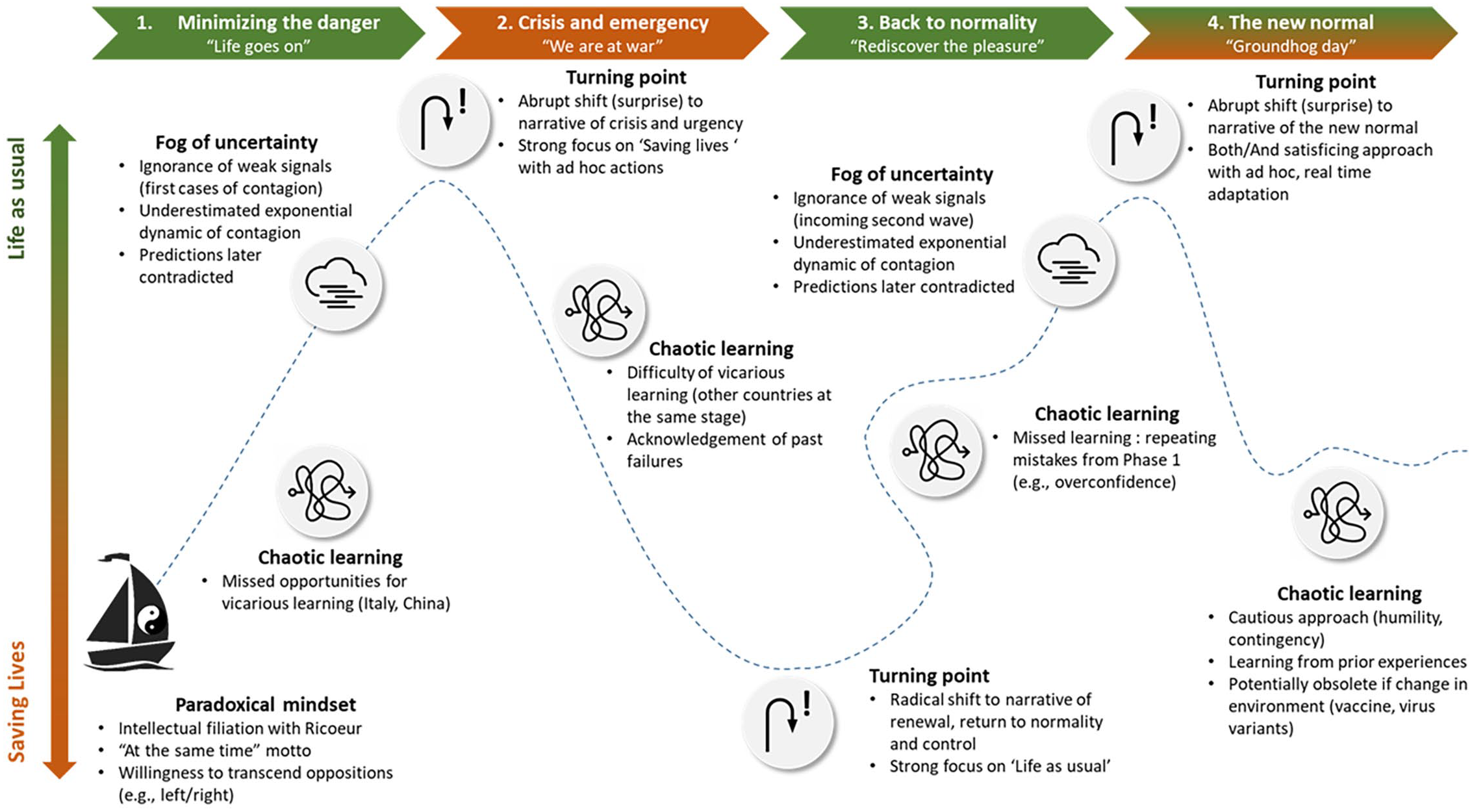
A model of improvised paradox navigation in stormy conditions.
Findings
Macron, a leader with a paradox mindset even before the pandemic outbreak
Before the onset of the pandemic, President Macron had become famous in France for embracing a “both/and” view of the world and was viewed by many as a leader with a paradox mindset, that is, one who values tensions and seeks both/and strategies (Miron-Spektor et al., 2018). Such a mindset is evident in his claim to transcend a deep-seated political divide that has been at the heart of the contemporary French political landscape: the left/right opposition. For instance, Macron stressed that his new party would be “both from the right and from the left” (Interview, 13 March 2017). His willingness to engage in both/and thinking is also apparent in his motto “at the same time,” reflecting his commitment to accommodating paradoxical demands: “I said ‘at the same time.’ I was told it’s a verbal tic. I will continue to say it in my sentences and in my thinking, because it means taking into account principles that seemed to be opposed” (Macron, during a political meeting, 17 April 2017).
Journalists and communication experts stressed that Macron’s motto “at the same time” refers to “a resolution of contradictions” that is “representative of a form of government” that seeks “a kind of synthesis” (Mongaillard, 2018). This “language tic makes it possible to link two things that appear logically irreconcilable,” a linguist points out, adding, “The expression gives the impression that synthesis is possible, by refusing to think about the conflict and to arbitrate it” (De Menthon, 2020). Furthermore, although his academic writings are scarce, Macron has offered a vision of political action imbued with a paradox mindset, stating that short- and long-term imperatives within political actions are opposite temporalities that remain deeply interrelated and require both/and actions while calling for the creation of an ideology that helps transcend opposites (Macron, 2011). He notes, Over the past twenty years, a hiatus has gradually developed between the emergence of long-term, complex, sometimes global, structural problems and economic emergencies whose immediate non-treatment is perceived as unbearable by public opinion [. . .] Political action is thus torn between these two temporalities: the long term, which condemns it . . . and the short term, which calls for imperfect and insufficient urgency. Because the State is expected to manage the immediate, for which there is little to be done, or the very long term, which alone is immortal. The aporia of contemporary political action is precisely linked to the fact that torn between these temporalities, politics does not seem to build a clean and durable action. (Macron, 2011: 107, 110)
Political analysts (Dosse, 2017; Mongin, 2017; Mongaillard, 2018) and Macron himself (Macron and Fottorino, 2017) have commented on this both/and perspective, attributing this mindset to Macron’s proclaimed intellectual filiation with French philosopher Ricoeur, who placed paradox at the center of his thinking (Ricoeur, 1957). Macron himself claimed that Ricoeur “was the person who marked [him] the most, [along] with [his] grandmother” (Mongin, 2017: 26) and he is well-versed in Ricoeur’s writing, as his review of one of Ricoeur’s book signals, which includes multiple references to “paradox” (Macron, 2000: 31). According to some analysts (Dosse, 2017), Ricoeur’s influence is visible in Macron’s willingness to transcend dualities: Macron’s motto “at the same time” refers to the demands of a tensive thinking that privileges the “and,” as Ricoeur does, seeking mediations to think together and articulate situations of double constraint, irreducible poles, incommensurable with each other. (p. 127)
Even scholars who questioned the compatibility of Ricoeur’s thought with Macron’s political stance acknowledged that Macron is a “man of synthesis, who tries to hold contradictory positions together” (Aeschimann, 2017). Applauded by some for his innovative attempts to transcend traditional divides, yet criticized by others for exploiting ambiguity, Macron exhibited a paradox mindset prior to the COVID-19 crisis.
When the COVID-19 crisis surfaced, Macron, like many other world leaders, addressed the population on many occasions, while navigating the paradox, with poles that we refer to as “saving lives” versus “preserving life as usual.” In Macron’s speeches, we identified four narratives reflecting contrasting ways of navigating paradox. While Macron had been recognized for his ability to think paradoxically before the crisis, our data suggest that in the face of this unprecedented crisis, he was forced to improvise. He would first engage each pole separately before striving for a more balanced trajectory between both poles, seeming to satisfice rather than optimize as he progressively learned to embrace the inherent uncertainty of the situation (Table 1).
Overview of the phases.
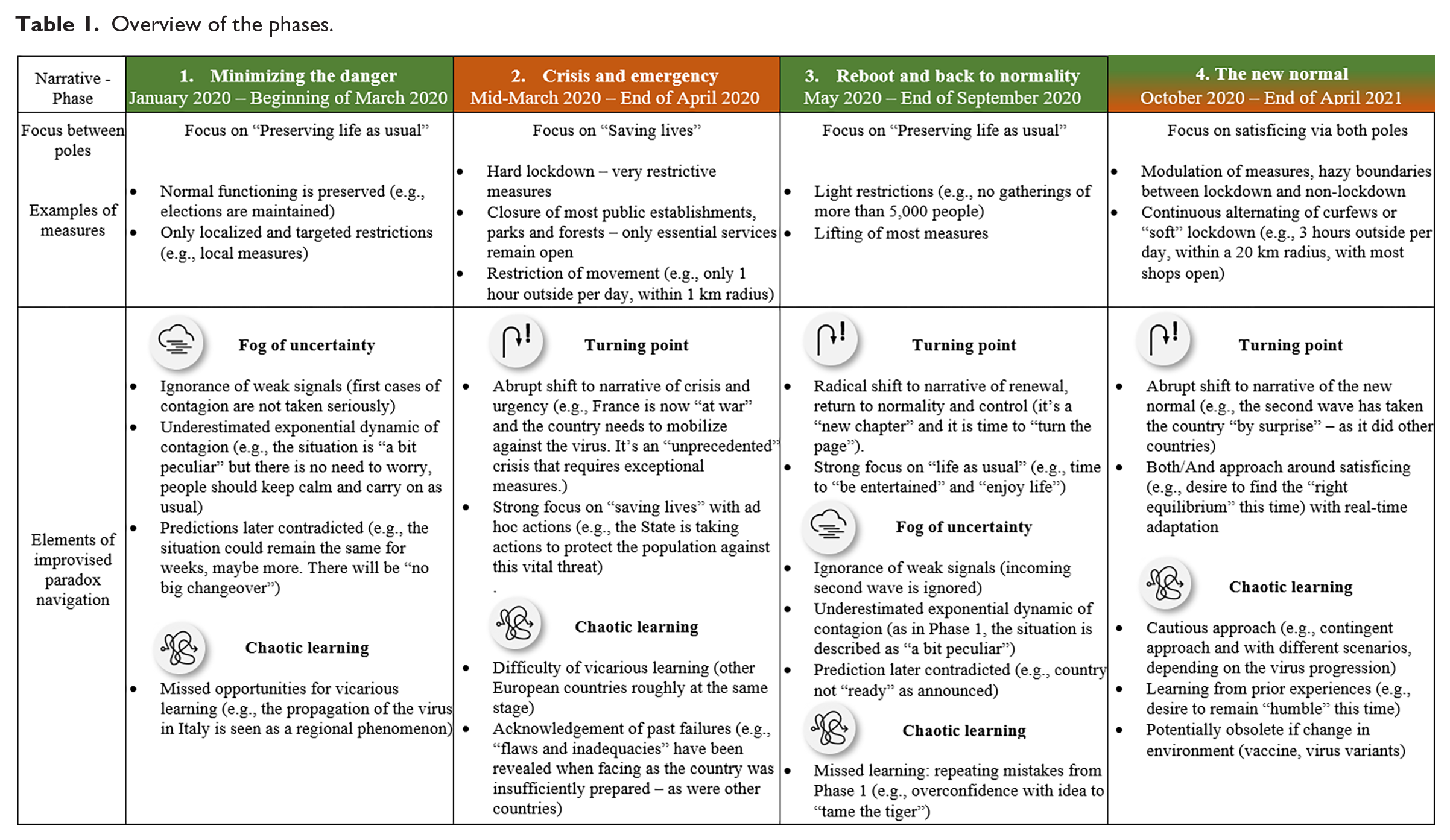

Four narratives that emerged throughout the crisis
Narrative 1: Minimize the danger: focus on life as usual (January 2020 to beginning of March 2020)
The first phase was characterized by a narrative focused on minimizing the danger while encouraging most people to continue their lives as usual. For instance, during an outing to the theater with his wife, Macron declared, “Life goes on, there is no reason, except for weakened population, to change our going-out habits” (6 March 2020).
The propagation of the virus in Italy, which had led to local lockdowns, was seen as a regional phenomenon, and Macron, during a visit to Naples, willingly greeted the Italian Prime Minister twice with kisses on the cheek. A picture was even taken during a press conference as he leaned over the Italian Premier to kiss him (27 February 2020). The press interpreted this as a willingness to show that the population should not fear any contamination from the neighboring country (Medichini, 2020).
Overall, Macron’s narrative strongly emphasized taking “proportionate measures” that would impact normal life as little as possible (e.g. local restrictions). For example, the municipal elections scheduled for 15 March across the country were not postponed. Macron explained that his decision was made in collaboration with scientists who felt that there was “nothing to prevent the French, even the most vulnerable, from going to the polls” (12 March 2020). This striking example illustrates how Macron, in alignment with many healthcare professionals at the time, downplayed the incoming danger. During a visit to a French hospital, Macron was filmed by journalists surrounded by hospital staff in a cramped room, a coffee cup in hand, casually describing the rapidly spreading virus as “a rather peculiar situation,” and expressing his desire to exchange ideas with the staff so that “things can be organized calmly.” Nobody was wearing mask, although some loud coughs could be distinctly heard (27 February 2020). Even as the virus spread, it was announced that no sudden changes would be implemented at the national level. Macron’s focus was on “adapt[ing] things,” for instance, “by closing some schools where the epidemic was most prevalent.” Macron said, “we should not consider that there is going to be a big changeover in our country at a given moment” (10 March 2020). Asked by a journalist about China’s and Italy’s “massive and coercive measures,” and whether France would take similar measures, Macron answered by stressing the difference in situations: “we have more proportionate measures . . . because the epidemic is not at the same level, because it didn’t seem necessary to us” (10 March 2020).
At the same time, Macron unpacked the peculiarity of the situation and how difficult it was to predict what was going to happen in the long term, although the duration of this situation was estimated mainly in weeks. He stated, “I don’t know how long it will last, but there will be several weeks for sure in this situation. And I don’t know how many” (6 March 2020). A few days before the first wave of the virus was detected, the dynamic of contagion was still heavily underestimated as Macron shared that those who thought that the government was “not going far enough,” yearning for the state to “shut everything down,” may “worry disproportionately sometimes” (12 March 2020).
In sum, in this first phase, akin to the calm before the storm and unbeknownst to Macron and many others in Europe, environmental dynamics were already threatening lives (i.e. the incoming first wave). As these remained unnoticed or underestimated, paradox navigation emphasized preserving life as usual.
Narrative 2: Crisis and emergency: focus on saving lives (mid-March 2020—end of April 2020)
The second phase marked a radical turnaround, with an abrupt shift in Macron’s narrative, both in content and in tone, reflecting a focus on saving lives at all costs as the first wave of virus contagion peaked. As cases suddenly reached extreme levels, Macron, taken by surprise, was forced to completely switch gears and improvise by taking radical measures to face the unexpected crisis. Although national addresses from the presidential palace are relatively rare, he organized two of them within a few days, one to announce the closure of schools, followed by one to announce a more general lockdown. Such ad hoc communication and measures signaled his haste. In a solemn tone, full of gravitas, he repeatedly hammered his point six times in a discourse: “We are at war.” He added, “The enemy is there, invisible, elusive, advancing. And this requires our general mobilization” (16 March 2020).
Concretely, a very restrictive lockdown was enforced, which involved severe restrictions on freedom of movement and the closure of most businesses. During this phase, Macron visited two facilities dedicated to crisis management (21 March 2020, 3 April 2020) and stressed the unparalleled nature of the situation: “Simply put, we are facing an unprecedented crisis, with organizational and logistical challenges, which are profoundly new but above all of a new magnitude, and which therefore require a reaction from the entire State” (21 March 2020). Logistics questions were also approached in a fashion akin to in wartime, as French workers and factories were urged to take part in the collective effort: “Production, as in times of war, has been set up: we have reopened lines to produce and we have requisitioned” (13 April 2020).
In sum, this phase was characterized by a sudden switch to crisis mode, with an exclusive focus on the immediate concern of saving lives. Yet as early as mid-March, Macron also acknowledged the potential to learn lessons for the future, urging his compatriots to focus on the end goal: “Let’s act forcefully but let’s remember this: the day after, when we’ve won, it won’t be a return to the day before . . . we will have learned, and I will also know with you how to draw all the consequences” (16 March 2020). He stressed the importance of learning from these mistakes: “But like you, I have seen failures, still too slow, useless procedures, weaknesses also in our logistics. We will draw all the conclusions, in due course, when it comes to reorganizing ourselves” (13 April 2020). Finally, Macron put his results in perspective by stressing the fact that other countries experienced the same issues as they weathered the same crisis: “Like every country in the world, we lacked gowns, gloves, hydro-alcoholic gel” (13 April 2020).
Overall, the transition from the first to the second phase was marked by an abrupt shift in the narrative characterized by ad hoc, last minute, improvised measures that signaled the country’s lack of preparation to address this unprecedented crisis.
Narrative 3: Reboot and back to normality: focus on life as usual (May 2020—end of September 2020)
Offering a striking contrast with the previous phase, Macron constructed a narrative around a return to life as usual, albeit slightly different from before the pandemic. The speed of this turnaround was slower as this change was voluntary. Still, Macron clearly marked the transition up front: On March 16th, we made the humanist choice to put health above the economy by asking you to stay home. This is why, together with you, with all the strengths of our country, with the fabric of our companies . . ., I will commit myself to this economic reconstruction. (14 June 2020)
He further emphasized this shift by invoking the metaphor of a new chapter in a story: “we will turn the page on the first act, in a way, of the crisis we have just gone through. . . . A new phase begins tomorrow” (14 June 2020). This metaphor allowed Macron to rejoice with his compatriots—albeit prudently—at the opportunity to rediscover some of the everyday pleasures that had been lost. The portrayal of a relatively carefree life contrasted strongly with the previous state of emergency as Macron announced, “we will therefore be able to rediscover the pleasure of being together, to return to work, but also to enjoy ourselves, to be entertained, to learn,” while recognizing that “the summer of 2020 will not be a summer like any other, and we will have to keep an eye on the evolution of the epidemic to prepare ourselves in case it comes back with more force” (14 June 2020).
Of course, Macron readily acknowledged that the danger was still present. However, the “war” metaphor gave way to the notion of “struggle” against the virus, reflecting a more long-lasting, though less intense fight. The message was that people needed to “learn to live with” the virus and even control it, as this quote illustrates: “We are now entering a period where we must, as it were, mount the tiger and tame it. The tiger will not disappear, it will be there and fear will be there in society” (6 May 2020). Interestingly, this phase exhibits some striking similarities with Phase 1: There was strong confidence in the government’s ability to control the virus, as the metaphor of taming the tiger illustrates, but an underestimation of its dynamics. For instance, Macron qualified the start of the school year by stressing its “peculiarity,” which is reminiscent of how he had described the situation immediately before the first wave of contagion: “Tomorrow is a little peculiar start to the school year. Because the virus is still there and you need to protect yourself” (31 August 2020). He also acknowledged learning points from the previous phase, showing the need to address and correct weaknesses: This ordeal also revealed flaws and fragilities: our dependence on other continents to obtain certain products, our cumbersome organization, our social and territorial inequalities. I want us to learn all the lessons from what we have experienced . . . Our strengths, we will reinforce them, our weaknesses, we will correct them quickly and strongly. (14 June 2020)
Overall, Phase 3 marked a desire to return to life as usual. Macron’s discourse reflected this focus while recognizing that some adaptations were necessary and some weaknesses needed to be addressed.
Narrative 4: The new normal: searching for a precarious balance between both poles (October 2020 to end of April 2021)
Despite the expectation of a second wave of the virus, once again, it took everyone—including other European countries—by surprise: “We are all, in Europe, surprised by the evolution of the virus” (28 October 2020). Macron compared the situation in France with that in Germany, Spain, and the Netherlands to provide some perspective, stressing the similarities: “It’s going up all over Europe as we speak” (14 October 2020). As a result, the narrative suddenly shifted, this time toward a response of balancing both poles. Macron explained that “it is a fair balance that we must constantly seek” between health and the economy (28 October 2020). The new lockdown—much less rigorous than the previous one, as the social and economic consequences had been deemed too harsh—was designed to find a better balance between saving lives and preserving life as usual: “Because we have learned from the spring events, this lockdown will be adapted on three main points: the schools will remain open, the work can continue, the retirement homes can be visited” (28 October 2020).
In this phase, and in contrast with all prior phases, the boundaries between lockdown and “normal” life (i.e. absence of lockdown) were much hazier. This adapted lockdown was apparent in the array of measures proposed, ranging from curfews (with hours changing depending on the level of virus propagation) to a “soft” lockdown (e.g. with much lighter restrictions than the first lockdown in Phase 2), thereby signaling the real-time adaptation of ad hoc measures to the evolving situation. Macron acknowledged the “weariness” caused by these decisions, comparing this phase to the movie “Groundhog Day” (28 October 2020) as restrictive measures were implemented once more, creating a sense of déjà vu. While not as restraining as during the first lockdown, restrictions were never totally lifted, thereby defining the new normal.
In contrast with previous phases, Macron now acknowledged more uncertainty when planning the future. He explained, “There are always a lot of uncertainties and we have to keep a lot of humility in this matter, this virus has taught us this” (28 October 2020). Concretely, his narrative stressed contingencies, with different possible scenarios rather than fixed predictions. “On December 15th, if we have arrived at around 5,000 cases per day and around 2,500 to 3,000 people in intensive care, we will be able to reach a new milestone. Then the lockdown can be lifted” (24 November 2020). More generally, the narrative of this phase included more figures (e.g. the number of tests conducted per week, the number of cases) signaling the increased ability of the government to measure the dynamic of the crisis, although estimates were given with extreme prudence, as this example illustrates: “We have detected between 40,000 and 50,000 daily cases, but without a doubt there may be twice as many in reality” (28 October 2020).
Overall, between his New Year’s greetings and the end of April 2021, Macron’s discourse remained the same, with only one solemn message at the end of March. As many European countries opted for a third strict lockdown in January–February 2021, Macron’s public speeches reflected his desire to continue blurring the boundaries between lockdown and normal life, with a balance reached through modest actions that allowed for both saving [some] lives and [somewhat] preserving life as usual: The second principle is balance: that is to say, taking into account the consequences of the restrictions on our children and their education, on the economy, on society, on the mental health of the youngest people in particular, taking care not to penalize the territories where the virus circulates less or little. (31 March 2021)
Macron further exhibited extreme caution and a strong reluctance to make predictions regarding the future evolution of the pandemic, given a growing uncertainty as new virus strains emerged. His approach can be qualified as both “humble and determinate” (31 March 2021). The narrative of the new normal was built around the motto of “Hanging on, together” (a campaign launched in the beginning of February 2021 on Macron’s Instagram and Twitter accounts) while vaccines were being developed and deployed.
In sum, this last phase could be characterized as an attempt to embrace both paradoxical poles, satisficing rather than optimizing them, with a discourse that gave way to a more cautious narrative, nuanced by shades of gray that finally acknowledged uncertainty, in contrast to the more black-and-white discourses of previous phases.
Coda: taking back control (May 2021)
At the end of April 2021, thanks to improvements in the wake of vaccine deployment, Macron announced the progressive reopening of cultural and economic infrastructures. This new discourse emphasized the planning of the vaccine deployment and signaled the end of improvisation; it was rooted in the idea that the vaccine would “allow us to contain the virus, to control it” (6 May 2021). On 23 May, a video showing Macron exchanging jokes with young YouTubers was published, thereby illustrating the return of insouciance and a carefree narrative.
A model of improvised paradox navigation in stormy conditions
Based on these observations, we inductively derived a model of improvised paradox navigation in stormy conditions centered around three core concepts: turning points, fog of uncertainty, and chaotic learning.
Turning points
While Macron was known for his ability to see opposites and bring them together in a both/and vision, our data suggest that the paradox of “saving lives” versus “preserving life as usual” in a time of crisis challenged such a vision. Indeed, the paradox navigation we described entailed brutal shifts in narratives akin to turning points, that is, “short, consequential shifts that redirect a process” which are often “abrupt” and “chaotic” (Abbott, 2010: 249, 258). These turning points represent profound changes in trajectories within a temporal sequence (Vaara et al., 2016). Specifically, they can result from sudden and unexpected incidents with potentially high societal impacts such as major crises and disasters, which force leaders to improvise (Mendonça et al., 2004). They mark the beginning and end of each phase and are characterized by strong contrasts and discontinuities that set radically different trajectories. The quiet normality of Phase 1 gave way to Phase 2, characterized by an abrupt shift to a war and crisis narrative. As the virus receded, the narrative of Phase 3 reinstated some form of normality, which again was disrupted by the return of the “second wave” in Phase 4 and the continuous blurring of boundaries between life as usual and saving lives. Turning points are also characterized by their abruptness, especially before each incoming virus wave. For instance, only a few days separated the Phase 1 narrative of normality from the discourse of emergency in Phase 2. Similarly, the second wave, even though anticipated as a possibility, emerged so quickly that it took Macron by surprise. The resulting radical shifts, taken at the last moment, is typical of improvised actions, requiring adaptation “in the moment rather than reflection beforehand” (Cunha et al., 2012: 268).
Fog of uncertainty
Our data suggest that paradox navigation was heavily hampered by a fog of uncertainty. This metaphor suggests that most actions in war “are wrapped in a fog of greater or lesser uncertainty” (Von Clausewitz, 1943: 32), making it difficult to develop situational awareness given the many unknowns (e.g. adversary capability, intentions, random events). Specifically, Clausewitz insisted on the unpredictability of war (Beyerchen, 1992). In our case, the fog of uncertainty prevented Macron from correctly predicting future trajectories, placing him in a situation where improvisation was required, because “the future cannot be ‘domesticated’ or reduced to logical continuity” (Cunha et al., 2012: 268). Indeed, predictions constantly ended up being contradicted by facts. To illustrate, the announcement before the first wave that there would not be any major sudden changes in terms of lockdown measures was contradicted by a hasty lockdown a few days later. Similarly, after the first wave, an announcement that the country would be ready for a potential second wave and that no national lockdown would take place was later contradicted by the facts. Another striking example is the evaluation of the duration of the crisis, initially estimated as lasting only a few weeks or months.
Clausewitz also insisted on the nonlinear nature of war with a “disproportionately large role of the least important of individuals and of minor, unforeseeable incidents” (Beyerchen, 1992: 77). In our case, the fog of uncertainty prevented Macron from correctly interpreting weak signals (Mendonça et al., 2004), which had exponential consequences later on. In Phase 1, as developments unfolded in Italy and the first few cases were detected in France, Macron’s stance was that life should still be conducted as usual. Similarly, the arrival of the second wave came as a surprise. In both cases, the nonlinear, exponential growth of the virus made paradoxical tensions hard to manage as previously hidden dynamics suddenly became apparent. The necessity to save lives appeared abruptly at the last moment, the same way a cliff may lurk in the fog before being spotted just before a fall. Thus, the fog of uncertainty explains why paradox navigation was characterized by abrupt turning points.
Chaotic learning
Our data suggest that Macron progressively learned to better navigate the paradox. However, rather than being built in an orderly fashion on solid ground, this learning was difficult, erratic; it shifted over time and remained prone to destabilization as the situation evolved. We thus characterize this learning as “chaotic,” thereby stressing its nonlinear nature and emphasizing the sensitivity of the entire system to small fluctuations (Van de Ven and Poole, 1995). The difficulty associated with integrating lessons from the past is manifest in repeated mistakes. In Phases 1 and 3, the situation was described as “a bit peculiar.” In both cases, these phases were followed by the rapid onset of new waves of the virus that took everyone by surprise (in Phase 2 and Phase 4). Such difficulty is typical of improvisational learning (Miner et al., 2001), which happens in the moment. Specifically, the episodic nature of the pandemic made it prone to foster unlearning between each wave, with lessons forgotten after the fact (Cunha et al., 2015).
Still, with time, Macron learned from past experience progressively. First, he repeatedly acknowledged past failures. For instance, in Phase 4, the chosen solution when facing the second wave was less extreme than in Phase 2. Macron explicitly justified his choice by invoking lessons learned from the past. He leaned more toward a both/and strategy of embracing both poles (Lewis, 2000), adopting a satisficing goal (Simon, 1957) rather than an optimizing one. Also, he began to rely much more on figures and data to justify his choices, signaling an accumulation of knowledge on the topic. Finally, he signaled a much more “humble” attitude: rather than setting up specific measures, he adopted a more contingent approach, with a narrative paving the way for multiple paths. Overall, such progress suggests a transition from improvisational to trial-and-error learning (Miner et al., 2001). However, in contrast to prior works suggesting an orderly sequence of learning (Bingham and Davis, 2012), the constantly fluctuating nature of the environment and its sensitivity to changes that may precipitate new dynamics—such as new virus strains—make any consolidation of knowledge difficult.
Finally, chaotic learning is characterized by the difficulty of engaging in vicarious learning. For example, in Phase 1, vicarious learning opportunities were missed as the case of Italy was discounted. More generally, the fact that other European countries weathered the same storm quasi-simultaneously made vicarious learning next to impossible, as illustrated in Macron’s mentions of other countries experiencing the same setbacks.
In sum, we observed a learning process that was slow and unstable, with setbacks and episodes of unlearning typical of situations with high improvisation (Cunha et al., 2015; Miner et al., 2001). Only when Macron was able to recognize the chaotic nature of the crisis and relinquish the illusion of being able to tame the virus and accurately predict the future—thereby acknowledging the fog of uncertainty—did we observe a more balanced navigation strategy; it was no longer marked by abrupt turning points, but was based on prudent, contingent fine-tuning aimed at satisficing both poles.
Discussion
Contributions to paradox theory
Sailing through the storm: environmental uncertainty—in its most turbulent form—as central in impacting paradox navigation
Prior paradox scholarship has acknowledged the intrinsic uncertain nature of paradoxes and highlights uncertainty as heightening paradox salience. Researchers often explore leaders’ paradox navigation as an act of working through uncertainties within the realm of organizations and as a process of progressively learning to reach a workable certainty (Lüscher and Lewis, 2008), if not a synthesis (Jay, 2013). In contrast, our study stresses how paradox navigation is impacted by uncertainty stemming from the environment, particularly when it is chaotic and unpredictable. We have unpacked the weathering of a paradox storm of “contradiction, confusion, and conflict versus relatively smoother sailing” (Jay, 2013: 155). Our study suggests that when facing highly unpredictable and fast-evolving events, paradox navigation must be improvised, which in turn affects its form. For instance, the turning points we identified, characterized by abrupt and repeated discontinuities, contrast with those described in prior research involving oscillations between paradoxical poles that are either much slower and more gradual (Ashforth and Reingen, 2014; Smith and Besharov, 2019) or fast, but far less consequential, as they do not radically redefine new trajectories, such as when managers dynamically shift their short-term micro-decisions (Smith, 2014; Smith and Lewis, 2011). In the last phase of our study, in contrast to eventually achieving transcendence (Bednarek et al., 2016) or a clean synthesis where both poles are maximized, our case exhibits what can be described as satisficing (Simon, 1957) both poles.
While these responses may appear modest, such results are in line with prior research showing that improvisation produces results with varying degrees of effectiveness (Crossan et al., 2005), with critical emergencies requiring ad hoc responses that often result in “irregular and unsustainable outcomes” (Cunha et al., 2015: 514). In our case, the COVID-19 crisis exposed the limits of current paradox navigation models (Sharma et al., 2021). When hitting reality (Abdallah et al., 2011), as in the extreme speed of the contagion and its dynamics, traditional solutions such as “the prescriptive ideal of simultaneous maximization of both poles . . . becomes harder to apply” (Lê and Pradies’s essay in Sharma et al., 2021: 127). Our article suggests that there may be times when satisficing rather than optimizing opposites may become the only way to navigate the paradox. Overall, our study suggests that the repertoire of improvised responses to paradoxical tensions in the context of highly unpredictable and quickly evolving events is different and more limited than in more stable environments. In future research, scholars could further explore how environmental conditions (e.g. degree of uncertainty, time pressure) impact responses to paradox, as research suggests that not all improvisations are equal (Crossan et al., 2005) and that at times improvised paradox navigation can be highly beneficial (Cunha et al., 2020).
Our model also unveils the importance of the fog of uncertainty in potentially leading to turning points. Leaders are enveloped in a fog that impedes their vision, making it difficult for them to grasp and interpret weak signals. Specifically, the rapidity of pandemic dynamics made missing such signals critical, as is typical for paradoxical systems which react in nonlinear ways and for which any imbalance may cause “exponential chain reactions” (Sharma et al., 2021: 127). According to improvisation scholars, scanning the environment and looking for “blind spots” enables the early detection of weak signals, which in turn improves improvisational effectiveness (Cunha et al., 2020: 7). Specifically, it has been argued that when dealing with “wild cards,” or sudden and unique historical events with high impacts and low probability of occurrence, improvisation should go hand in hand with a system for detecting weak signals (Mendonça et al., 2004: 202). These insights are in line with paradox scholarship that has insisted on the importance of detecting early warnings (Johnson, 2014) that would enable actors to deal with surprising events and avoid being stuck in vicious circles (Cunha et al., 2020). We thus invite scholars to unpack organizational sensing capabilities so that signals are spotted and not ignored, placing anticipation front and center in our understanding of paradox.
Finally, our focus on improvised paradox navigation in the face of volatile events enables us to highlight the specific context in which it unfolds, as improvisation is characterized by “embeddedness and contextual sensitivity” (Cunha et al., 2015: 514), with actors having to quickly adapt to paradoxical tensions “in situ” (Cunha et al., 2020: 3). The same way contextual elements such as power relations restrain actors’ agency (Berti and Simpson, 2021), our study suggests that the degree of environmental uncertainty and unpredictability may limit actors’ possible courses of action when dealing with paradoxical tensions. Our study complements prior research on the particular conditions that affect the dynamics of paradox navigation, such as decision-making context (Smith, 2014), interpretive context (Knight and Paroutis, 2017), or social-symbolic context (Pradies et al., 2021b), as well as the embeddedness of paradox in broader social and institutional contexts (Smith and Tracey, 2016). We thus answer calls from scholars to attend more to the fact that “paradoxes are local, embedded, and sensitive to time . . . and, therefore, aligned with particular circumstances,” in addition to their “ability to dis-organize, perturb, and dis-equilibrate” (Cunha and Putnam, 2019: 100).
Learning to navigate paradox as more than merely acquiring a paradox mindset
Prior research has portrayed the acquisition of a paradox mindset as central to paradox navigation. The focus is often on the progressive and messy development of this mindset, which is a form of double-loop learning (Argyris, 1993; Miron-Spektor et al., 2018). In general, external interventions and forms of opposition create jolts that help trigger learning (Pamphile, 2021). For example, sparring sessions with a researcher “facilitated double-loop learning by helping managers question their existing frames” (Lüscher and Lewis, 2008: 227), which ultimately enabled them to work through the paradoxical tensions they faced. Thanks to the support of others, actors may reach a synthesis (Jay, 2013) and escape being stuck in vicious circles (Pradies et al., 2021b) as they become aware of the necessity to embrace both poles of a paradox. In sum, these works tend to imply that learning to develop a paradox mindset is key to navigating paradox and that achieving that mindset hinges on making leaders progressively aware of their incorrect initial assumption of incompatibilities between paradoxical poles.
We nuance these views by showing that having a paradox mindset—as Macron had before the start of the pandemic—is by no means a guarantee to navigating paradoxical tensions successfully; indeed, it should be complemented by other forms of learning. We can advance several explanations as to why having a paradox mindset was not sufficient and required more learning. First, prior research has suggested that paradoxical frames are precarious, and that even when actors have acquired a paradox mindset, in the absence of periodic reactivation, they may revert back to old schemata when facing new tensions (Lüscher and Lewis, 2008). Furthermore, prior work has shown that even when leaders possess paradox mindsets, they may still oscillate between poles to the point where they bump up against guardrails before they progressively learn to navigate the paradox as their understanding of the risks of mission drift increases (Smith and Besharov, 2019). Another complementary explanation could be that the paradox mindset is a meta-competence 1 or a generic competence supporting the use of context-specific competences. While being generalizable and transferable across contexts, meta-competences need to be complemented by context- and task-specific situational knowledge (Brown, 1994). In our case, multiple factors specific to the situation might have prevented Macron from initially engaging in both/and thinking: the characteristics of the situation (unpredictable and chaotic), but also content-specific features: unusual paradoxical poles (“saving lives” vs “preserving life as usual”) or the very idiosyncratic nature of the crisis (a pandemic).
By focusing on a context of improvisation, our study also highlights particular qualities for paradox navigation in stormy conditions. Our model shows that when weathering adverse and turbulent conditions, learning becomes highly chaotic. Rather than depicting a smooth progression toward ever higher levels of understanding (Raisch et al., 2018), our study exhibits features more akin to improvisational learning (Miner et al., 2001) and even unlearning as past mistakes are repeated. This contrasts with prior works in paradox scholarship that often examine cases where organizations can test the waters by experimenting with small scale-projects (Smith and Besharov, 2019) and acting in a changing, but perhaps not so volatile environment. In contrast, leaders dealing with the pandemic have been compared to “fixing the plane while it flies” (Giustiniano et al., 2020: 1). Our metaphor of “sailing the storm” suggests that beyond the difficulty of learning while solving a pressing issue (Miner et al., 2001), environmental turbulence adds to the difficulty of finding a balance between poles that continuously fluctuate across time. Thus, rather than solely focusing on learning how to develop a paradox mindset (Fairhurst, 2019), we invite paradox researchers to build on improvisation scholarship—which has recurrently stressed the importance of agility, adaptability, and resilience for leadership (Cunha et al., 2012; Giustiniano et al., 2020; Miner et al., 2001)—and examine how these qualities could aid in navigating paradox when facing environmental turbulence.
Finally, our case also suggests that not all paradoxes can be alleviated through paradox navigation. The current crisis we studied is characterized by a quasi-perpetual state of uncertainty and may ultimately be solved by external forces (e.g. vaccine, epidemiologic conditions leading to a collective immunity) that partly escape the control of the leaders navigating the tension. In such situations, the leader’s role centers on steering the ship until the storm subsides. This sobering observation reminds us why the navigation metaphor has gained traction over the years in paradox research, whereby scholars stress that paradoxes are “navigated” (Jay, 2013) rather than “managed.” In a way, rather than focusing on the acceptance of the paradoxical nature of tensions as emphasized in prior work, our study invites scholars and practitioners to accept the possible impossibility of “taming” them, as some paradoxes will remain “wild” regardless of our efforts (Cunha and Putnam, 2019; Fairhurst, 2019).
Practical implications for management learning and improvisation
Our model also has implications for management learning and improvisation. Indeed, our work resonates with prior works showing that improvisation can lead to multiple forms of learning as it “may gradually metamorphose” (Cunha et al., 2015: 515). Chaotic learning suggests that progressing toward a more structured form of learning is possible (e.g. improvisational toward trial-and-error learning), but that this progression is fraught with difficulties and is constantly prone to setbacks, given the highly unstable and dynamic system within which it occurs (Van de Ven and Poole, 1995). As prior research suggests, “in highly interactive systems, individual improvisational actions have a greater chance of causing inconsistency” (Miner et al., 2001: 328). We believe that management learning and education thus could benefit greatly from further examining paradoxical systems, which by nature are highly interactive and even encourage leaders to consistently provide inconsistent responses (Smith, 2014).
As paradox scholars teach paradox navigation, they may highlight that in unstable systems in which paradoxes are extremely heightened, new forms of situated learnings emerge—learnings in which the here and now supersedes. Our study suggests that teaching students and managers to acquire a paradox mindset would be but a first step. Actors should not only be made aware of the risk of losing this mindset and thus be taught to continuously “refresh” their views (Lüscher and Lewis, 2008), they should also learn to ponder reflexively on their own ability to reactivate paradoxical thinking when facing new tensions in unusual, surprising situations. They should also be aware that they may need idiosyncratic knowledge and skills specific to a given context (Brown, 1994). Improvisation by nature is adapted to a specific context (Cunha et al., 2015, 2020), and in particular, improvisational skills such as adaptability and resilience are key in contexts characterized by high uncertainty and time pressure (Crossan et al., 2005). In addition, leaders need to learn to develop “real time foresight,” where planning is complemented by quasi-simultaneous immediate execution (Cunha et al., 2012: 268), for instance, by learning from both failed and successful previous improvisations (Cunha et al., 2015). In sum, our study confirms previous insights that leaders should learn to develop their peripheral vision—paradoxically looking wherever attention is lacking—and to scan the environment for weak signals, as well as to act swiftly when detecting them (Cunha et al., 2020; Mendonça et al., 2004). All in all, managers should be taught to embrace uncertainty as a complement to the traditional organizational focus on predictability and routines (Cunha et al., 2015).
Finally, we have revealed implications for improvisation by nuancing its paradoxical nature. Prior work has underlined the paradoxical quality of improvisation as it combines “order and chaos” and “planned and spur-of-the moment action” together (Tabesh and Vera, 2020: 2236). Our study builds on these insights and suggests that both preparing an intellectual structure (i.e. developing a general paradox mindset before the crisis) and responding extemporaneously (i.e. adapting freely to a specific, quickly evolving situation) go hand in hand in improvisation. Thus, paradoxically, leaders should be prepared to be unprepared and combine preparation (i.e. a paradox mindset) with embracing flexibility in the face of unpredictable events.
Conclusion
Having examined the extreme case of the pandemic—a “once in a hundred-year event”—it is legitimate to question the transferability of our results to other settings. We believe that our results apply not only to wild cards, that is, low probability events with serious consequences (Mendonça et al., 2004), but more generally to a range of crisis situations (Cunha et al., 2015), as they too are unpredictable and evolve quickly. This scope is extensive, as contemporary life is marked by instability, crises, and turmoil, such as financial crises, terror attacks, migration crises, and so on. At a more mundane level, even everyday organizational life may pose unexpected and surprising challenges that require improvised paradox navigation (Cunha et al., 2015). Thus, our study could be of interest to a broad audience, including crisis and change management scholars. We hope that it will also help leaders and organizations to avoid being caught off guard and be ready when the unexpected—in whatever form that may take—happens.
Footnotes
Acknowledgements
We would like to sincerely thank the special issue guest editorial team and in particular Ace Simpson, Stewart Clegg, Miguel Pina e Cunha and Marco Berti for their supportive guidance throughout the review process, as well as the three anonymous reviewers for their developmental feedback. We are also grateful for the advice from the EGOS 2021 Paradox Track participants who provided feedback as the paper was evolving.
Funding
The author(s) received no financial support for the research, authorship, and/or publication of this article.
