




Abstract
We investigate the case of the Economic Commission for Latin America in Brazil to discuss how modernization theory was mobilized to influence management education. The theories formulated by the Economic Commission for Latin America formed the basis of the courses it offered on development administration and management and the public administration schools it helped create. The theories from the Economic Commission for Latin America were contrary to US interests and to the modernization theory tenets developed by US scholars. The Alliance for Progress, launched in 1961 by US President J.F. Kennedy, was a project informed by modernization theory aimed to foster development in Latin America, and to contain the spread of Communism after the Cuban Revolution. The Alliance for Progress mobilized a network of US-controlled institutions that invested in management education and in an interpretation of development administration and management based on modernization theory that confronted the Economic Commission for Latin America. We make use of Burke’s Pentad to articulate the interactions among (asymmetrical) players at different levels of analysis and along the historical period investigated. We treat science as literature, and we present our analysis in a dramatistic narrative to promote reflexive management learning. We show that US-led investment in management education increased considerably after the launch of the Alliance for Progress, and that it lasted throughout the 1960s.
Keywords
Prologue
We “mobilize history as an approach to probe critical and reflexive management learning” (Durepos et al., 2018: 2). We present the case of the United Nations Economic Commission for Latin America (CEPAL, the acronym known in the region, or ECLAC in English), created in 1948, in Santiago, Chile. The history of CEPAL illustrates how Anglo-Saxon perspectives in management education have been hegemonic in the relationship between the United States and Latin America, but we concentrate our analysis in Brazil, our home country.
Many studies already discuss the influence of the Cold War in the production and dissemination of management and organization knowledge (MOK), especially, but not solely, in Western Europe (e.g. Cooke et al., 2005; Cooke and Alcadipani, 2015). After the World War II, the Marshall Plan was devised and became instrumental for the transfer of US management models to Europe (Bjarnar and Kipping, 1998). However, in Latin America, the Alliance for Progress (ALPRO) was the landmark US intervention. ALPRO infused modernization theory as a colonizing device to contain the potential spread of communism in Latin America after the Cuban Revolution. We show in this article that modernization and modernization theory are useful rationalizations that the status quo weaponizes to cover and marginalize local knowledge.
ALPRO was an aid program launched by President Kennedy, in 1961, to promote development in Latin America, inspired by the Marshall Plan and focused on the region (Field, 2014; Rabe, 2014; Sewell, 2016). Modernization theory was developed by US scholars to foster development in Third World countries, and formed the basis of ALPRO (Gilman, 2003, 2018; Latham, 1998). Modernization involved investment in the creation and expansion of management education institutions that affected MOK production and dissemination. Its effects are understudied.
Only after the launch of ALPRO did US organizations, such as the Ford Foundation (FF), fully commit resources to management education in the region (FF, 1962), and in particular to development administration and management (DAM). As suggested by Cooke (2004: 604), DAM is a subset of public administration, with the country as a unit for analysis, directed at “Third World countries requiring modernization.” From its inception, CEPAL theorized and disseminated a local version of DAM throughout Latin America. CEPAL activities in DAM are interconnected with the field of development studies (Love, 2018). However, in the 1960s, CEPAL faced fierce competition from the DAM version which was based on modernization theory and exported under the auspices of ALPRO. We narrate the (dis)encounter between these two versions of DAM.
We begin our analysis at the level of the US foreign policy that fostered ALPRO, and we end at the Brazilian management education institutions that were supported. To cope with the articulations among players at different levels of analysis along the historical period investigated, we used Burke’s Pentad (Burke, 1945). The Pentad is as an overarching analytical framework that avoids reductionism and promotes a “dramatistic understanding of the social” (Kärreman, 2001: 96). Moreover, the Pentad offers the possibility of “treating science as literature” (Czarniawska, 2004: 103). The dramatistic narrative we formulate permits us to articulate the interplay among different levels of analysis. It also highlights the asymmetries among players, thus, promoting reflexive management learning. This use of Burke’s Pentad is our theoretical-methodological contribution. Our empirical contribution is to provide the details of the funds invested by US-led entities in management education under ALPRO.
After this prologue, we introduce Burke’s Pentad to frame the past, and we explain how we arrived at the selection of terms we used, based on the data we selected. We then unfold our dramatistic narrative, which is followed by the epilogue.
Burke’s Pentad to frame the past
Burke’s interdisciplinary theories can barely be encapsulated under one label (Simons, 2004). Recently, Management Learning fostered engagement with one of Burke’s works, known as the Pendulum (Kofinas, 2017). Both Kärreman (2001) and Czarniawska (2004) have suggested the use of Burke’s Pentad in MOK. Burke presented the Pentad in The Grammar of Motives (1945): We shall use five terms as the generating principle of our investigation. They are: Act, Scene, Agent, Agency, and Purpose. In a rounded statement about motives, you must have some word that names the act (names what took place, in thought or deed), and another that names the scene (the background of the act, the situation in which it occurred); also, you must indicate what person or kind of person (agent) performed the act, what it means or the instruments he used (agency), and the purpose. (Burke, 1945: xv)
The relationship between the terms is another part of the Pentad theoretical-methodological approach (Kärreman, 2001). Burke (1945) believed that “certain formal interrelationships prevail among these terms” (p. xix). Furthermore, it is possible to reduce the terms of the Pentad to one, “deducing the other terms from it as its logical descendants” (Burke, 1945: xxi). This one term is the “causal ancestor” (Burke, 1945: xxi).
Each choice made in the nomination of each of the terms limits the possible combinations and “can have significant implications for our interpretations of motives” (Rountree, 1998: 5). The “specific dramatistic ratios” between the terms “restrict the ways particular specifications of the elements [. . .] can be combined” (Kärreman, 2001: 99). Therefore, the selection of each of the terms limits the possibility of generating infinite dramatistic narratives, which departs from the premise that science may be treated as literature (Czarniawska, 2004) and deploys the techniques described by Burke (1945).
Examples of the utilization of the Pentad in MOK reiterate the move from simplicity to complexity advocated by Burke (e.g. Conrad, 2004; O’Connor, 1995). For instance, O’Connor (1995) affirmed that “Burke’s Pentad provides a set of distinctions with which we can isolate the manner in which the texts produce, reproduce and promote a particular interpretation of change” (p. 778).
Data selection
The speech Kennedy gave in 1961 outlined his objectives for the program. We investigated manuscripts written by US representatives who took part in ALPRO (Galbraith, 1961; Gordon, 1962; Schlesinger, 1965), and a report by Rostow (1964) on a trip to Brazil. Finally, we used secondary sources on ALPRO, Cold War and modernization theory (Field, 2014; Gilman, 2003, 2018; Latham, 1998; Rabe, 2014; Sewell, 2016; Taffet, 2007; Weis, 2001).
With regard to CEPAL, the “Havana Manifesto” presented by Raúl Prebisch (1949) outlined its core ideas. The autobiography of the Brazilian economist Celso Furtado (1985), who worked at CEPAL, provided insights into the organization. Some other examples of literature on CEPAL are Pollock (1978), Wanderley (2015), and Love (2018). The reports produced by the Brazilian Development Bank (BNDE, 1960, 1965, 1967) contained information on the education activities promoted by CEPAL. They were complemented by the bulletin from the Brazilian Ministry of Education organ for higher education called Coordination of Superior Rank Staff Improvement (CAPES, 1959, 1964, 1965). Both BNDE and CAPES documents were also used in the Agency session regarding schools created under ALPRO.
The main source about the Inter-American Development Bank (IDB) was the testimony given by its first president (Herrera, 1985). Regarding the role of the FF in Latin America, the sources were its annual reports from 1959 to 1970, the literature on the activities of the foundation in the region (Chilcote, 2018; Fernández and Suprinyak, 2018; Holmes, 2013; Parmar, 2012) and its participation in management education (Cooke and Alcadipani, 2015), and two anniversary books from the FF (Brooke, 2002; Miceli, 1993).
We also refer to secondary sources on the history of management education in Brazil (Alcadipani and Bertero, 2014; Barros and Carrieri, 2013; Wanderley et al., 2018). We reviewed one document on the history of the São Paulo School of Management Education (EAESP; Sampaio, 1959). We observed information about the two schools created under the auspices of ALPRO that operated in DAM (Carvalho, 1981; IASPA, 1964; Machado, 1966).
Defining our terms in the Pentad
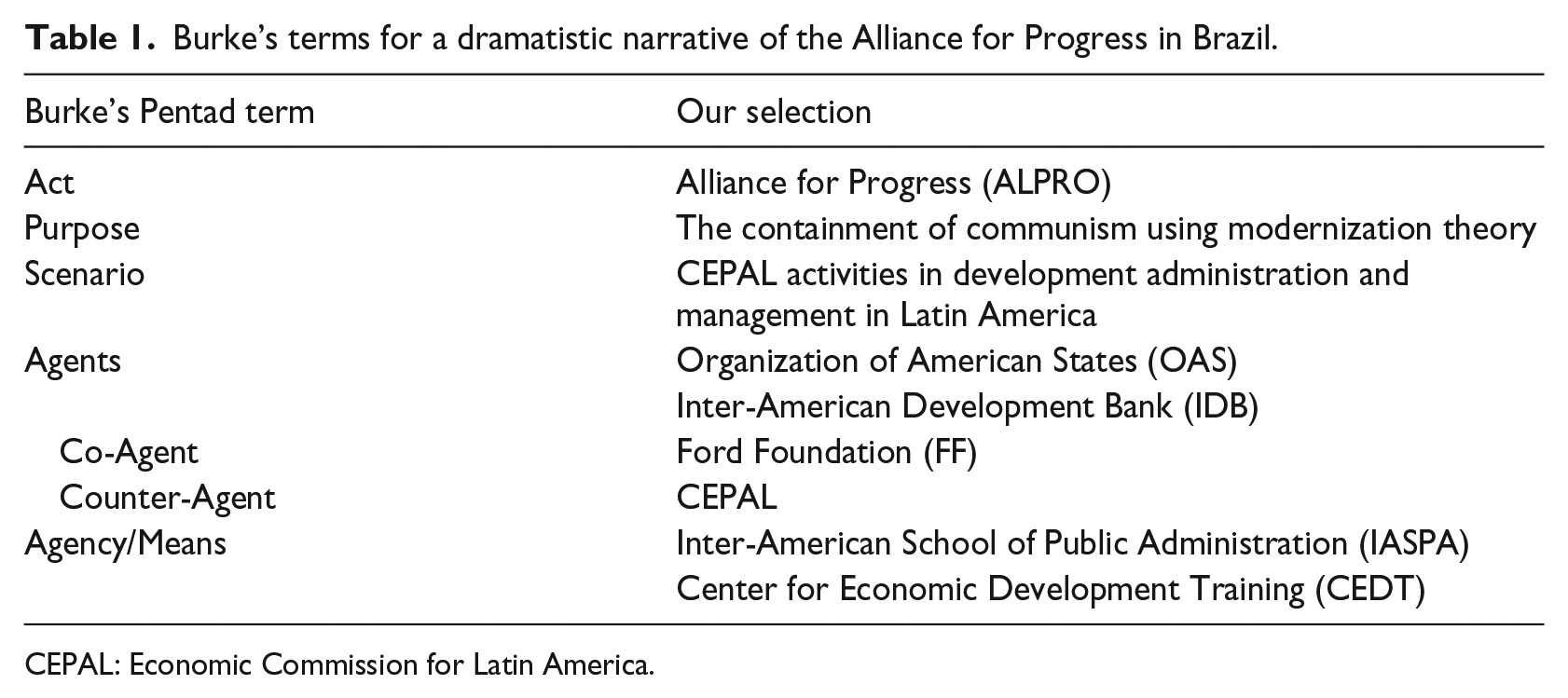
We tested a few combinations among Burke’s terms before we made our final selection, presented in Table 1.
Burke’s terms for a dramatistic narrative of the Alliance for Progress in Brazil.
CEPAL: Economic Commission for Latin America.
We considered ALPRO to be the “causal ancestor” of the selection of our terms. Hence, ALPRO, as the Act, has center stage. We were inspired by Burke’s statement that the Communist Manifesto was an act of propaganda. He posited that “implicit in such an act there is certainly the assumption that the ideas contained in it are social forces” (Burke, 1945: 207). We posit that ALPRO has affected the course of social forces in Latin America.
Thus, ALPRO is the Act, and Kennedy’s (1961) discourse its manifesto. The ideas contained in this manifesto influenced the network of US-led institutions and mobilized an intervention in management education in Brazil. We considered the Act-Purpose pair, ALPRO—the containment of Communism, the strongest relationship of all the terms.
The Agents mobilized by ALPRO to challenge CEPAL were Organization of American States (OAS) and IDB. These organizations engendered the creation of two schools dedicated to DAM that became the Agency/Means of our investigation: Inter-American School of Public Administration (IASPA) and Center for Economic Development Training (CEDT). This made CEPAL the Counter-Agent. We considered the FF as a Co-Agent: “an agent might have his act modified (hence, partly motivated) by friends (co-agents) or enemies (counter-agents)” (Burke, 1945: xix–xx). The FF operated in support of US foreign policy (Holmes, 2013; Parmar, 2012), and in Latin America, the foundation engaged with ALPRO and functioned as its motivator (FF, 1962).
Following Burke, our narrative “will be situated, contextual, contingent, perspectival — true for particular purposes; true under a given set of circumstances; true assuming the validity of taken-for-granted premises” (Simons, 2004: 161). We “are also products of particular historical and sociopolitical contexts” (Weatherbee, 2012: 206). Being cognizant of these facts is an exercise in reflexivity.
Act-Purpose: the ALPRO—the containment of communism using modernization theory
This session presents ALPRO as the causal ancestor of our Burkesean terms and why we see the strongest interrelationship among terms between Act and Purpose (Figure 1). We posit that ALPRO was a way to contain communism in Latin America based on modernization theory.

The Act: Kennedy’s “Manifesto” at the White House.
Kennedy’s discourse presented modernization theory as the catalyst toward development. However, it was mandatory to support the “training of those needed to man the economies” and to give “assistance to Latin American universities, graduate schools . . .” (Kennedy, 1961). The altruism and grandiosity of this manifesto, and its faith that “modernization would make the miraculous transformation a reality” (Latham, 1998: 211), is presented in the passage below: the living standards of every American family will be on the rise, basic education will be available to all, hunger will be a forgotten experience, the need for massive outside help will have passed, most nations will have entered a period of self-sustaining growth, and, although there will be still much to do, every American Republic will be the master of its own revolution and its own hope and progress. (Kennedy, 1961)
What is implicit is that modernization was conceived as the means to save Latin America from the communists (Schlesinger, 1965). Modernization theory was an important weapon in the Cold War (Field, 2014), which is why “The United States attempted to modernize and speed up the development process in Latin America through ALPRO . . . [whose] mission was to prevent the spread of Communism through the promotion of development” (Holmes, 2013: 40). The United States wanted to prevent another development like the 1959 Cuban Revolution which marked a point of inflection (Latham, 1998).
US foreign policy toward Latin America changed from the 1950s to the 1960s. The Eisenhower presidency (1953–1961, January) focused on foreign aid policies promoted by private investments. Eisenhower initiatives toward Latin America depended on the Point Four Program, managed by the International Cooperation Agency (ICA). The ICA coordinated loosely connected government funded foreign aid projects (Latham, 1998). Some authors recognize the Point Four Program as the first step toward the dissemination of management as an ideological tool (Alcadipani, 2017).
Under Eisenhower, development aid was concentrated on military support, but even that did not happen often in Latin America. During most of his term, Latin Americans complained about the lack of financial support from the United States (Latham, 1998). For instance, between 1945 and 1960, countries like Belgium, Netherlands, and Luxembourg “received more foreign aid from the US than had Latin America” (Rabe, 2014: 11).
This lack of US preoccupation with the region led to “some scholars even talking about an inter-American Cold War taking root that was of a markedly different hue to that in evidence elsewhere” (Sewell, 2016: 14). However, in 1954 a CIA intervention took place in Latin America. The United States covertly backed a coup overthrew the democratically elected president Jacobo Arbenz of Guatemala (Taffet, 2007). Along with Communism, nationalist governments that nationalized companies and compromised US interests worried US authorities (Latham, 1998).
The US attitude toward Latin America and CEPAL changed after Vice President Nixon encountered hostility during an official visit to the region, in 1958. At the end of the Eisenhower administration, the US government approved the suggestion by Brazilian President Juscelino Kubitschek to create a “Pan American Operation” (Herrera, 1985). Consequently, the “Bogotá Act” was signed in 1960 between the US and all Latin American countries except Cuba, and, subsequently, the IDB was created and it later operationalized the management of ALPRO resources (Herrera, 1985).
Under Kennedy, a new foreign policy emerged (Gilman, 2018). While still a senator, Kennedy approached a group of academics that had been working on development studies. These academics were from the “Charles River Group” and would later occupy important governmental positions, especially those related to Latin American affairs (Schlesinger, 1965).
The Charles River Group was composed of scholars from Harvard University — Lincoln Gordon, John Kenneth Galbraith, Richard Goodwin, and Arthur Schlesinger — and the Massachusetts Institute of Technology (MIT)—Max Milikan, Walt Rostow, and Rosenstein-Rodan (Schlesinger, 1965). Modernization theory was developed in the Department of Social Relations (DSR) at Harvard and at the Center for International Studies (CIS) at MIT (Gilman, 2003).
The origins of the CIS are linked to a secret CIA project known as the “Troy Project.” Later, the FF gave the Center USD8.25 million 1 in the mid-1950s, while the Carnegie and Rockefeller Foundations disbursed additional funds over the following decade (Gilman, 2003). By 1957, Milikan (ex-CIA director), chairman of CIS, and Rostow published their international development program, A Proposal: Key to More Effective Foreign Policy (Gilman, 2018). The idea was to move to a “Positive Development Plan” because they considered it necessary to advocate for a substantial change “in the whole view of economic development” (Galbraith, 1961: 444). In 1960, this program became a policy that was approved by the US Senate and, 1 year later, Kennedy created the US Agency for International Development (USAID) to substitute ICA and centralize all foreign development aid policy (Gilman, 2003).
Rostow was the most visible face. His book, The Stages of Economic Growth: a non-Communist Manifesto (Rostow, 1960), represented “the great synthetic text of Modernization Theory” (Gilman, 2003: 191). Rostow classified most underdeveloped countries as being in stage two of his five-stage scale which he considered most prone to communist intervention. Hence, a plan based on economic and social development as well as the export of US democracy was necessary to convince local authorities and populations to accept US intervention. Rostow occupied important positions in Latin American affairs under both Kennedy and Johnson (Gilman, 2018).
Lincoln Gordon became the most visible face of ALPRO in Brazil. He was responsible for ALPRO during his term as the Brazilian ambassador (1961–1966). He launched a book locally, Progress via the Alliance, stating that the training of managers, both private and public, were objectives of ALPRO (Gordon, 1962). Gordon had participated in the Marshall Plan and the Task Force that Kennedy organized to prepare ALPRO and visited Brazil in 1959 as an FF consultant (Taffet, 2007).
The basic assumption of modernization theory was that the United States, as imagined by the modernizers, was the model for every Third World country (Gilman, 2003). Rostow embraced a single economic understanding for developed and underdeveloped countries (Gilman, 2003). These premises are opposed to CEPAL theorizations (Wanderley, 2015).
However, modernization theorists agreed with CEPAL on the prerequisites to foster development. Both agreed about the role of state investment under a national development program to promote industrialization. CEPAL had been promoting such programs for over a decade. CEPAL and modernization theorists also agreed that the countries lacked the administration capacity in both government and private sectors. Thus, investment in qualified staff was a priority. In 1952, CEPAL already had courses in development planning techniques, teaching its version of DAM. CEPAL was involved in early debates on development studies, although diverging from the mainstream (Love, 2018).
Soon Kennedy’s staff realized that the social and economic reform objectives of ALPRO were difficult to achieve in practice. Moreover, it was difficult to reconcile democracy with maintaining stability. Following the assassination of Kennedy, in November 1963, Lyndon Johnson assumed the presidency. Johnson placed Thomas Mann as the head of ALPRO and as Assistant Secretary of State for Inter-American Affairs. The “Mann doctrine” emphasized that anticommunist measures and commercial interests would be placed ahead of democratization (Sewell, 2016).
ALPRO continued, but priorities shifted to more pragmatic positions, aiming to secure Latin America against communism. Among those practical positions were the investments in management education (FF, 1962; Miceli, 1993). ALPRO tried to reconcile the objectives of exporting “expressions of American identity” to promote a universal model of development throughout the Third World, maintain democracy, and contain communism (Latham, 1998: 202).
Finally, “political need trumped idealism” (Taffet, 2007: 58) and democracy was no longer a value to be exported. The military became the modernizing solution for Latin American troubles. A total of 16 coups took place during the 8 years of ALPRO. Brazil, in 1964, was the third coup, and US support has been duly documented (Sewell, 2016). Notwithstanding this shift in priorities, financing for management education remained, as we see in the Agency session.
Scene: CEPAL activities in DAM in Latin America
The scene contains the act. [. . .] the scene contains the agents. (Burke, 1945: 3)
Throughout the 1950s, Harvard and MIT scholars developed modernization theory at the shores of Charles River to save the underdeveloped world from communism. Concomitantly, a group of Latin American economists gathered at CEPAL to problematize the reasons behind the underdevelopment of the region. These theorizations by CEPAL became a challenge to modernization theorists. CEPAL influenced Brazil, especially via Celso Furtado. Furtado worked at CEPAL (1949–1957), and then became responsible for a governmental development agency inspired by CEPAL ideas and funded by ALPRO (Wanderley, 2015).
CEPAL introduced a framework based on the center-periphery analysis. It claimed the existence of an asymmetry in international trade which was disadvantageous to Latin America, an exporter of raw materials and a buyer of manufactured products (Prebisch, 1949). According to Prebisch (1949), this asymmetry led to a long-term tendency toward the deterioration of the trade terms detrimental to the periphery. CEPAL stated that development theories could not be imported wholesale to the periphery. Furtado believed that development from the center and underdevelopment from the periphery were entangled. Thus, underdevelopment is a consequence of development in the center not a previous stage (Wanderley, 2015).
Development and Underdevelopment was Furtado’s (1964) reply to Rostow (1960). The book was first published in Portuguese in 1961, the same year that Rostow’s Stages was translated into Portuguese. Furtado (1964) described underdevelopment as a “discrete historical process,” and not simply a reproduction of the development path of European countries (Love, 2018: 159). In Rostow’s model the beginning and the end were the developed countries.
Furtado met Rostow, in 1951, at the MIT. Furtado was on a tour as CEPAL director and tried to update their repertoire on development studies. Furtado recalled that Rostow gave him the draft of a book in which the “layout was elegant and attractive, but everything seemed too arranged, well graded. [. . .] its insistence on the invariance of economic development processes pointed in the opposite direction to the one that was forming in my spirit” (Furtado, 1985: 90). In 1952, Rostow launched The Process of Economic Growth, the book presented the first sketch of his stages theory (Gilman, 2018).
The opposing theories on development proposed by Rostow (1960) and Furtado (1964) mark the difference in DAM education that CEPAL propagated, and that preconized by the modernization theory exported by ALPRO from the 1960s. CEPAL development strategies meant restrictions on US trade with Latin America and “high taxes on foreign investment, fixed exchange rates, and laws restricting the repatriation of multinational corporation profits” (Parmar, 2012: 189).
CEPAL spread those ideas throughout Latin America in the 1950s, when the region was mostly spared from Cold War interventions (Sewell, 2016). CEPAL helped states design development policies, set up state-owned companies and educate public managers to act under this new logic, which informed the administration schools sponsored by CEPAL (Love, 2018). Moreover, CEPAL influenced the education of the first groups of managers, public and private, in Brazil (Alcadipani and Bertero, 2014). Hence, ultimately, CEPAL became the Counter-Agent to be outsmarted.
Surprisingly, under Kennedy, CEPAL propositions that had been rejected by US authorities during the 1950s became part of the agenda. However, they were framed under modernization theory tenets and were to be executed by the Agents controlled by the United States: OAS and IDB, and supported by Co-Agent: the FF: Agents: The hero (agent) with the help of a friend (co-agent) outwits the villain (counter-agent) by using a file (agency). (Burke, 1945: xx)
We consider OAS and IDB to be the Agents. They were multilateral bodies mobilized by ALPRO to command the development aid program. The role of OAS and IDB in promoting management education in Latin America is often overlooked. The FF is the Co-Agent since it backed US foreign policy. Consequently, CEPAL is the Counter-Agent since it was outwitted by the combined actions of the Agents and Co-Agent.
OAS came into being, in 1948, to revamp the “Monroe Doctrine” keeping the American continents under US influence. OAS affirmed that it aimed to promote, among state members, “their solidarity, to strengthen their collaboration, and to defend their sovereignty, their territorial integrity, and their independence” (OAS, 2019). When Kennedy took office, he “sought to reforge pan-Americanism and its political arm, the OAS, into a sword to use against him [Castro] and every other potential revolutionary” (Weis, 2001: 323).
The initial idea was to give ALPRO a multilateral appearance to avoid the perception of direct US intervention. Hence, OAS and IDB, together with CEPAL, were the supposed multilateral facets of the program. The United States proposed the composition of a tripartite panel of experts between CEPAL, OAS, and IDB. Their primary objective was to analyze the development plans of each country before releasing funds (Furtado, 1985). However, the United States sought to undermine CEPAL, which was “seen as too left,” and gave OAS the control of operations in Latin America and started funding schools which championed free-market economics (Parmar, 2012: 189).
IDB financing included “higher education and training,” with advanced “reforms in the organization of educational institutions as well as in teaching methods and scientific and technological research” (Herrera, 1985: 146). IDB objectives were aligned with ALPRO and modernization theory.
The same applies to the FF, which had focused its investments on higher education since the start of its operations in Latin America (Holmes, 2013). In the first decade, the FF focused on “the areas of economics and administration” (Miceli, 1993: 256). The FF was created in 1936 and its “Overseas development” projects were initiated, in 1951, operating in Asia and in the Near East. In 1959, Latin America was included in the “Overseas development” projects. That same year, the program “made a modest start” in the region with small grants to projects in Jamaica (FF, 1959: 80). A safe start in a British colony then, and close to Cuba.
The inclusion of Latin America in FF overseas projects shows that the shift occurred in tandem with US foreign policy in the region, and its initial operations “focused on funding to complement major bilateral donors such as USAID, on national politics and on elite universities” (Station and Welna, 2002: 390), which makes it clear that the FF operated as a Co-Agent.
Agency: US-led investment in management education in Brazil
In this section, we analyze how the intervention in DAM education took place in Brazil via the creation of two schools: the IASPA and the Center for Economic Development Training (CEDT). They were funded by IDB and executed by OAS, the Agents of our dramatistic narrative, and they were supported by Co-Agent: the FF.
ALPRO sponsorship of management education was a priority. Modernization theory understood the improvement of administrative structures and management education, both public and private, as key to the development process (Gordon, 1962). Galbraith (1961) mentioned “critical requirements without which there will be no progress” to create a “reliable apparatus of government and public administration.” Training people to “man a government” and preparing an “elite of substantial size” to manage private businesses were among the targets of ALPRO (Galbraith, 1961: 445). The investment in the education of government staff was what most directly confronted CEPAL activities in DAM.
We divided this part into three subsections. First, the intervention in management education, second the intervention in DAM that directly affected CEPAL, which is our main objective. Finally, we propose a metaphor for the two competing versions of DAM.
The intervention in management education
Since the Cold War did not hit Brazil hard during the 1950s (Sewell, 2016), management education in the country was also spared. Various non-degree courses had been created in different local institutions since the 1930s under developmentalism ideology to educate business employees, most of them inspired by US scientific management, but not directly supported by any US institution (Wanderley et al., 2018).
The first schools to provide undergraduate courses were the Faculty of Administration and Economic Sciences of the Federal University of Minas Gerais (FACE/UFMG) (Barros and Carrieri, 2013); and the Brazilian Public Administration School (EBAP) of the Getulio Vargas Foundation (FGV). EBAP was the first school in Latin America, and was created with UN support. In its first decade of operations, EBAP experimented to create a Brazilian version of management and public administration (Wanderley et al., 2018).
The only substantial investment in management education under Point Four up to 1959 had been in the implementation of FGV-EAESP. Its main program was a 13-week non-degree course in management that trained more than 500 people from 1954 to 1959, and, in 1958, the first concluding undergraduate class in management, which consisted of only 18 students (Sampaio, 1959). In spite of US support via Michigan State University, hybridization prevailed during institution building (Alcadipani and Bertero, 2014).
FACE, EBAP, and EAESP were the only schools with undergraduate courses in management; together, they educated 308 undergraduates until 1960. However, coinciding with the change in US foreign policy at the end of Eisenhower’s term the Brazilian Administration Program (PBA-1) was signed in March 1959. The PBA-1 established that through ICA the US government “will spend US$ 3,418,000 [adjusted USD 29.69 million] to execute the agreement, while the Brazilian government will participate with 170 million cruzeiros [equivalent to ICA funding]” (CAPES, 1959: 17), to be disbursed from 1959 to 1964.
The funds sponsored by ICA under PBA-1 were paid directly to the universities of Michigan and Southern California, which were responsible for sending academics to Brazil to teach both private and public management. These funds also covered scholarships to train Brazilian professors in the United States, and for the supply of teaching material and books to schools in Brazil, which were responsible for all local costs (CAPES, 1959). This was the same kind of support that ICA had given to EAESP since its inception, which was in fact the basis for the PBA-1 (Sampaio, 1959). Over the 1960s, ALPRO/USAID, IDB, and the FF handed grants to the Brazilian partner school which would manage the funds. Hence, after ALPRO we see a considerable increase in funds directed to management education, but also the kind of support given changed in tandem with US foreign policy.
Due to the strong US footprint of EAESP, it was chosen as the Agency/Means for business management education under PBA-1. EBAP was responsible for public management. These resources reinforced the programs in both schools and the implementation of undergraduate programs in two federal universities (Barros and Carrieri, 2013).
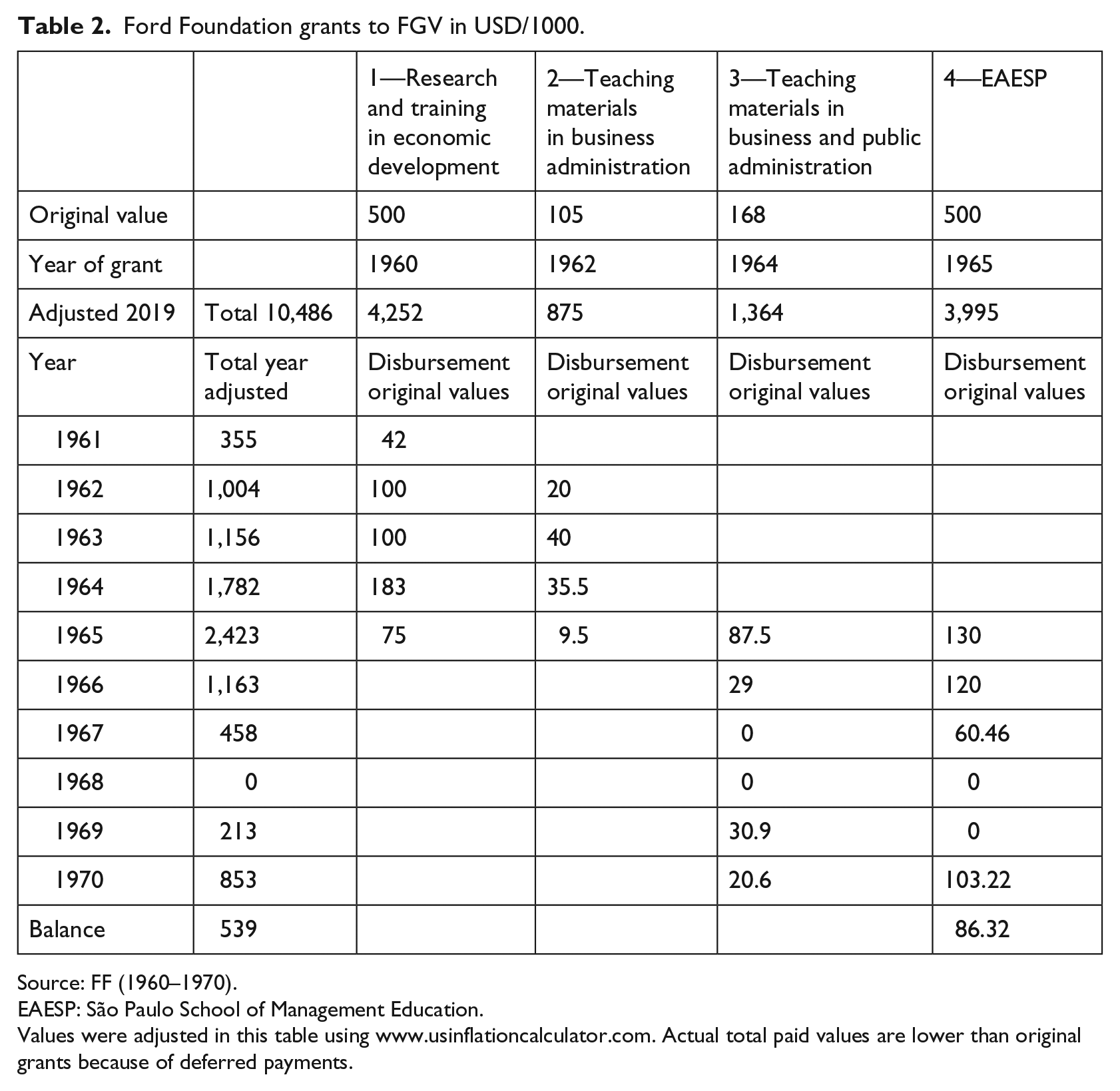
One year after PBA-1 was signed, Co-Agent the FF gave its first grant to FGV. The FF allotted USD4.25 million (grant 1 in Table 2) to “conduct applied research on Brazilian development problems and to train research economists for government and business” (FF, 1960: 85), or more specifically, “for a public administration training program” (Brooke, 2002: 245). In both cases, there was overlapping with topics focused by CEPAL and aimed to foster DAM and development studies. FGV schools were championing economic research and management courses in the country based on free-market economics, which were key under the tenets of modernization. Grant 1 from the FF was disbursed gradually from 1961 until 1965, which is in line with the chronology of PBA-1. The complimentary nature of FF funds is clear, but in this case, it was being managed by FGV.
Ford Foundation grants to FGV in USD/1000.
Source: FF (1960–1970).
EAESP: São Paulo School of Management Education.
Values were adjusted in this table using www.usinflationcalculator.com. Actual total paid values are lower than original grants because of deferred payments.
The FF (1962) made its alignment with US foreign policy and ALPRO clear. The “Overseas Development” budget was doubled from the previous year to USD333.4 million, as it reflected “the growing opportunity for private philanthropy to assist the economic and social growth of less-developed nations” (FF, 1962: 49), particularly in Latin America, where offices were opened in 1962. The report stated that “the new offices will enable the staff to discern new opportunities for assistance, including cooperation with the Alliance for Progress, where Foundation experience in the development of skilled manpower may be valuable” (FF, 1962: 62). FF first representative in Brazil was Reynold Carlson, who officially initiated in “October 1961” (Brooke, 2002: 281).
Cooke and Alcadipani (2015) investigated grants 2 and 4 to EAESP and showed that FF involvement in management education increased after US foreign policy toward Latin America shifted. In 1956, EAESP approached the FF for funding and its vice-president Thomas Carroll replied that EAESP would not be eligible for FF resources because “Brazil was not in the ‘danger zone’” (Cooke and Alcadipani, 2015: 488). The first visit of an FF representative to EAESP took place in May 1961 (Cooke and Alcadipani, 2015), 2 months after the launch of ALPRO. The funds were approved in 1962, which was grant number 2.
From the perception, in 1956, of being out of danger (Cooke and Alcadipani, 2015), US authorities then began to see Latin America as the “most dangerous area in the world” at the beginning of the 1960s (Rabe, 2014). Therefore, we can ascribe a particular Cold War periodization to Brazil. Until the end of World War II, Brazil enjoyed “special relationships” with the United States, but was left aside until the late 1950s (Sewell, 2016). The increase in US-led investments in management education during the 1960s corroborate this distinguished timing. The same took place in economics education where a combination of funds from USAID and the FF started in the early 1960s. Right through the decade “commitments in the area grew substantially in size, structure, and diversity, eventually turning into a full-fledged program for the social sciences in Brazil” (Fernández and Suprinyak, 2018: 6).
Grant number 2 (Table 2) to FGV was designated for “teaching materials in business administration” (FF, 1962: 152). We complement the analysis of Cooke and Alcadipani (2015) by providing a breakdown of the payments. When the last tranche of grant 2 was paid, an analogous project was started to produce “teaching materials in business and public administration” (FF, 1964: 139), grant number 3. With the addition of public administration, funds were geared to EBAP, where IASPA was created in 1964. Again, the FF acted as a Co-Agent. This grant comprised “the preparation of fifteen books, eighteen monographs and twenty-four cases” (Machado, 1966: 57; this book was part of the project).
In 1965, the FF approved grant 4 of circa USD4 million to EAESP, disbursed in installments until 1970 (FF, 1965–1970). Only a small balance was released before 1973, as in 1968 the FF rescheduled disbursements after suspending payments that year due to a disagreement with EAESP on the allocation of funds (Cooke and Alcadipani, 2015). The grant was supposed to “help the São Paulo School of Business Administration (also supported by the local business community) expand its program” (FF, 1965: 68). Grants 2 and 4 allowed EAESP to double in size (Cooke and Alcadipani, 2015).
FGV received funds from the FF all through the 1960s, concomitantly with the duration of ALPRO. The total amount donated by the FF to all projects in Brazil in the 1960s amounted to USD155.58 million, 70 percent of it to “Brazilian academic” institutions, of which FGV ranked as the third highest grantee (Brooke, 2002: 255). This confirms the FF option for higher education during its first decade in Brazil, in particular to management and economics (Miceli, 1993). In total, the FF donated USD10.5 million to FGV under the four projects listed in Table 2 (FF, 1960–1970). The role played by FGV would have elevated the FF to the position of an Agent in Burke’s Pentad, if we were narrating the history of FGV instead of CEPAL.
Table 2 illustrates another complementary role Co-Agent the FF played. In 1964 in a ceremony at EAESP, Niles Bond, US consul in São Paulo, “formalized the donation of USD27.86 million from ALPRO to FGV for the work” on FGV headquarters in Rio de Janeiro and the conclusion of its building in São Paulo, where EAESP is located (CAPES, 1965: 15). This amount is two and half times more than the four grants given by the FF and reiterates the fact that US funding for management education in Brazil considerably increased after ALPRO. It also confirms that ALPRO had opted to support FGV schools on management education.
The headquarters in Rio de Janeiro, a fully equipped 13-floor building, were inaugurated, in 1967. It allowed the school to grow from its previous modest three floor ancient house next door (Machado, 1966). Both buildings, in Rio and São Paulo, were inaugurated by Luis Simões Lopes, the founder of FGV and its first president (1944–1993). Lopes was also responsible for the International Committee of ALPRO in Brazil. This committee was connected to OAS and it supervised the allocation of funds in all areas, not only higher education (Natividade, 2018). The same committee signed Project number 105 with EAESP to create the Inter-American Center for Management Sciences, in July 1964, which was dedicated to research in DAM (FGV, 2014).
The connections between Lopes from FGV and the ALPRO network highlight the “University-Government-Foundation Nexus” (Chilcote, 2018: 10). This nexus appears in the similarities between the conclusions of modernization theory scholars and the objectives of US foreign policymakers (Gilman, 2018), in the alignment among US policymakers and the overseas objectives of the FF (Parmar, 2012). It is clear that “just as the US government used the ALPRO to enhance modernization the FF used education” (Holmes, 2013: 45). Hence, we emphasize that the logic that operated in the US was replicated in Brazil. FGV was the chosen partner to lead the efforts in promoting management education.
The intervention in DAM education
In Brazil, CEPAL was launched in 1953 through the CEPAL-BNDE Joint Group. Furtado led the initiative while he was development director at CEPAL. The group produced a development plan for the country, which became the base program of President Juscelino Kubitschek (1956–1960), “the most enthusiastic proponent of CEPAL recommendations” (Love, 2018: 158). CEPAL succeeded three US economic commissions to Brazil after World War II. US commissions failed to provide the funding for projects demanded by local authorities. It was a sign that the US–Brazil special relationship had ended, and that CEPAL would be exerting its influence throughout the 1950s (Wanderley, 2015).
The CEPAL-BNDE partnership evolved to the point where, in 1956, CEPAL started offering graduate courses in Rio, these were on development planning that included DAM. These programs had started in Chile, in 1952, and consolidated and disseminated the CEPAL doctrine, which “trained and indoctrinated middle-ranking Latin American personnel in central banks, development and finance ministries, and university faculties” (Love, 2018: 156).
Over 10 years, CEPAL educated more than 1000 public managers in Brazil, who worked mainly in regional development bodies. CEPAL prepared the content and its researchers were sent to teach. The CEPAL repertoire encompassed development techniques from different countries, including the Soviet Union (Wanderley, 2015), since many Latin Americans sought an independent path from the Cold War belligerents (Field, 2014).
The courses led to the creation of the CEPAL-BNDE Development Center, inaugurated in 1960, in Rio. The Center allowed CEPAL to expand the training programs, research in DAM, and the production of literature (BNDE, 1965). However, in 1967, the Center was abruptly closed (BNDE, 1967). That same year the FF allocated USD2,543,000 directly to BNDE to “management training and research” with an additional USD775,000 approved and disbursed in 1970 (FF, 1967: 119, 1970). Once again, Co-Agent the FF supported Agents in outwitting Counter-Agent CEPAL as, in 1965, IDB and USAID had signed an agreement with BNDE to fund development programs and project elaboration (Monteiro Filha and Modenesi, 2002).
The closure of the center is linked to the creation of IASPA on the premises of FGV- EBAP and the structuring of CEDT at the University of Ceará. Both were created in partnership with the OAS in the second half of 1964. IDB provided resources for both initiatives. CEPAL had a long-standing role in training local public managers and supposedly held a position within ALPRO. However, surprisingly, it did not participate at all in the initiatives.
The US strategy aimed to undermine CEPAL by giving control to OAS (Parmar, 2012). DAM education, prescribed by modernization theory, was the one to be disseminated. IASPA and CEDT aimed to offer the program in the “Administration for Development” course at the graduate level (Machado, 1966). We suggest that during the 1960s IDB sponsoring of the modernization theory version of DAM in Latin America anticipated the role later played by the World Bank in “the managing of the (third) world” as investigated by Cooke (2004: 603).
CEDT was created with the “endorsement of the agreement signed between the Brazilian government and the OAS corresponding to project no. 209 of the OAS Technical Cooperation Program” (CAPES, 1964: 19), headed by Simões Lopes (Natividade, 2018). OAS committed USD1,877,150 to the school. CEDT maintained four programs, and in its first year of operation, two programs were offered: Administration of Development and Economic Development (Machado, 1966). Although CEDT was not directly supported by the FF, the foundation issued different grants to the University of Ceará in the 1960s (FF, 1964–1970). The FF support to economics education at the University of Ceará has already been investigated, and a similar center for training economists was created around the same time (Fernández and Suprinyak, 2018).
The objective of IASPA was “staff training for the public sector in Latin America,” and it offered programs focused on “administration for development, administration and fiscal policy, and project management” (Carvalho, 1981: 147). An overlap with CEPAL programs, OAS organized the first Inter-American Meeting on Development Administration for the inauguration of IASPA. Although most Latin American representatives were invited, CEPAL was ignored. Reading through the annals of the conference, we noticed no references to CEPAL (IASPA, 1964). In turn, Rostow’s (1960) work was introduced, making clear which development ideas would be championed.
In Table 3, we present the budgets of the schools that confronted CEPAL. The asymmetry in funding was instrumental for the success of the version of DAM propagated by modernization theory. The funding for the CEPAL-BNDE Center was given exclusively by BNDE.
Institutional budget—asymmetry—USD/1000.

CEPAL: Economic Commission for Latin America; BNDE: Brazilian Development Bank; FF: Ford Foundation; IASPA: Inter-American School of Public Administration; FGV: Getulio Vargas Foundation; IDB: Inter-American Development Bank; MEC: Brazilian Education Ministry; CEDT: Center for Economic Development Training; OAS: Organization of American States.
To sum up our dramatistic narrative, the mechanisms for implementing the final act for undermining the version of DAM from the “Counter-Agent” CEPAL are made explicit: while the CEPAL-BNDE Center was slowly closed down by resource asphyxia, “Agency” was implemented by two new schools sponsored by the US—IASPA and CETD—and their administration was handed over to the “Agents,” OAS and IDB, which were controlled by the US under ALPRO—the “Act,” to contain Communism the “Purpose”—and had support from the “Co-Agent,” the FF.
Ultimately, CEPAL was actively ignored by US authorities, or left in “benign neglect” (Pollock, 1978: 72). However, it remains, theorizing on sustainable development until today. ALPRO was terminated in 1970 by President Nixon. IASPA closed down in 1988 when IDB grants were terminated. CETD is operative, but the OAS agreement ended in 1972, when it was reconfigured as a genuine Brazilian institution.
A metaphor before the epilogue
The (dis)encounter between Furtado and Rostow is the metaphor for the dramatistic narrative presented here between two competing versions of DAM. It is an example of how to generate reflexive management learning when we treat science as literature.
Furtado (1985) recalled the meeting with Rostow in his autobiography, back in 1951, when both of them were initiating their investigations on development studies, Rostow at MIT and Furtado at CEPAL, where they worked on their theories throughout the 1950s.
Incidentally, both Rostow and Furtado spent the year of 1958 at Cambridge University. Rostow in a “reflection year” sponsored by the Carnegie Corporation (Gilman, 2018: 138), and Furtado with a grant from the Rockefeller Foundation after he left CEPAL (Furtado, 1985). Upon their return, both published what is considered to be their respective masterpiece: Rostow (1960) investigated the economic history of the United Kingdom to foster a development theory for the Third World, while Furtado (1963; 1959 in Portuguese) investigated Brazilian economic history to search for explanations and solutions for its underdeveloped condition. In the early 1960s, both were government representatives and, in their respective positions, were supporters of ALPRO.
Rostow visited Brazil for 2 weeks in August 1964 as an official guest of the military regime that had taken over, 4 months earlier. Rostow (1964) affirmed that the country presented the preconditions for takeoff and that he foresaw a “historical turning point in the history of modern Brazil” (p. 10), confirming his faith in the efficiency of modernization theory. Rostow (1964) considered Dictator General Castelo Branco “a remarkable Latin American chief of state” (p. 1), even though a decree signed by Castelo 7 days after taking office denied political rights to various Brazilians public figures, including Celso Furtado. Furtado had to leave the country and went on to spend 20 years in exile, about the same time the military regime endured.
Epilogue
We investigated how the ALPRO dissemination of modernization theory—aiming to curb Communism in Latin America—led to an intervention in management education in Brazil. Modernizing meant influencing the conditions of government structures and management schools and, consequently, education in DAM was supported by US-led institutions to the detriment of CEPAL. The CEPAL case exhibits the political role of foreign aid and how the university-government-foundations nexus may be disruptive to local knowledge networks.
We unveiled this network of institutions deployed by ALPRO with the use of Burke’s Pentad. The Pentad permitted an articulation among different levels of analysis and framework to analyze the role of multiple actors in history. We encourage other researchers to investigate cases similar to CEPAL and to treat science as literature, following a dramatistic narrative based on Burke’s Pentad to promote reflexive learning.
The empirical evidence provided indicates that the US-led investment in management education increased considerably after the launch of ALPRO and lasted for its duration. This is also true for the grants from the FF. In the 1950s, US support was mostly restricted to the establishment of EAESP. After the launch of ALPRO the support increased in scope and scale, and local schools started directly managing resources.
Consequently, though the economic and social initiatives of ALPRO may have been short-lived, its commitment to modernizing management education in particular, and higher education in general, have lasted much longer. In June 1966, the Brazilian Education Ministry (MEC) and USAID signed an agreement for the modernization of the structure of universities (Alves, 1968). One of its clauses stated that it was to be publicized locally as “cooperation among ALPRO’s initiatives” (Alves, 1968: 52). USAID funded scholars from the universities of Michigan State and Wisconsin-Milwaukee, who spent 18 months in Brazil and made a report that led to a comprehensive restructuring of universities, in spite of protests from students and against public opinion (Alves, 1968).
Furthermore, the intervention in management education led by ALPRO indicates that a different Cold War chronology took place in Brazil. The main effects of the Cold War in the country started in the early 1960s and were felt all throughout that decade. Hence, if the Marshall Plan demarks the intervention in Europe, ALPRO is the corresponding landmark for Latin America. Recognizing this timing allows for better understanding of the roots of local management education prior to this intervention. Digging out these roots may help us find alternative paths to (re)construct management education and learning in all geographies.
Moreover, our dramatistic narrative suggests that we should not simply discard knowledge that comes from alternative geographies, nor should we impose “good science” as is done in many areas under foreign modernizing efforts. We should remain alert because “modernization theory never dies” (Gilman, 2018: 133).
