



Abstract
The effecting factors of soundscape perception and space experience have a very close relationship. This study aims to synthesize the diversity of soundscape classifications and schemes and unify such factorial variations in order to develop an integrated framework for soundscape perception and spatial experience within a systematic review of recent progress and by adapting post-occupancy evaluation methodology. First, factors under soundscape perception and space experience are reviewed in detail and merged to form conceptual classification models. Six soundscape perception factors are formed as (1) sonic, (2) spatial, (3) temporal, (4) psychological, (5) behavioural and (6) personal. Similarly, five space experience factors are formed as (1) user, (2) usage, (3) architectural design, (4) social context and (5) physical environment. All related items in the literature are presented and the sub-items under each factor are exemplified. Second, factors under the merged conceptual models are integrated by considering occupants’ experience of space regarding their variance in perception of soundscapes through acoustical post-occupancy evaluation. An adapted study design is proposed under indicative, investigative and diagnostic stages of the post-occupancy evaluation by presenting the methods, data types and factorial correlations for each stage.
Keywords
1. Introduction
Sound is a phenomenon that affects our experience in everyday life. It helps us to define our location and our direction. It links with the quality of life within a space.1–3 Soundscape is a newly emerging research field first presented in the 1970s by Murray Schafer. He claimed that the term soundscape, in other words, acoustic landscape, is a blend of the physical environment regarding acoustical experiential qualities of sound and social environment that is reflected in the user’s perception. Moreover, sound is considered to be a fundamental component of any space, and a perceived soundscape effects users overall experience. 4 Soundscape research is highly subjective as listening to sound sources is an activity that is arranged and comprehended by the human mind. Therefore, sounds interact and intervene in the connections of listeners and context; yet sounds are also influenced by physical, environmental and social elements. 5 This means that cross-related factorial approaches are definitely needed, to analyse soundscapes. 6 On the other hand, soundscape perception is higly subjective and could lead to specific emotional reactions such as, perceiving sounds as pleasent or not. 7 Therefore, this complementation between sound and space components, identifies the variances in the perception of soundscapes by humans. In addition to the spatial and sonic factors that affect soundscape perception, user-related variables that can show variance by health (auditory problems, viral infections, etc.) and disabilities should also be addressed.
Space can be identified as a conglomeration of shapes, forms, colours and appearances, which is appreciated dominantly by vision. Acoustic designers and researchers suggest that space consists also of sounds, smells, tastes and textures. These modalities operate in conjunction with each other in space experience. 8 The sense of being somewhere can be created by a soundscape, which compares very favourably with the experience of real places. 9 Soundscape compositions identify place by listening meaningfully precisely because of its schizophonic nature and its use of environmental sound sources. 10 The contribution of the perception of soundscape with the experience of space can be defined by the key element ‘user’ of the space. In order to evaluate this contribution, specific tools and methods are required. This article aims to explore this challenge.
Within the scope of this research, first, soundscape perception and space experience studies are reviewed in general and previously presented classification models and factors are presented. The unification of such classifications has led to merged categories of both fields. These proposals of merged factors are performed through the detailed review of recent progress in soundscape perception and space experience studies. In the final section, post-occupancy evaluation (POE) is explained and its methodological adaptation with soundscape perception and space experience factors is proposed as a study design. Within the scope of this study, critical literature review on the previously presented classification of soundscape research and space experience is also included. A distinct focus is on the integration of POE tools within soundscape and space experience analysis to propose an initial study methodology that aims to form a basic tool to be followed by future researchers in the fields of indoor soundscape evaluation and design. This study is part of an ongoing research. It presents the theoretical base of the research, which will be followed by case studies as future work.
2. Review on soundscape perception
In order to establish a common language in soundscape studies, sound classification and related criteria should be addressed. 11 Accordingly, many studies have been published in the field of soundscape evaluation, soundscape perception and soundscape classifications, and all of these terms include different factors that influence the research scope and objectives in varied dimensions. Therefore, it is important to identify soundscape factors in related multidisciplinary perspectives by involving not only physical attributes but also individual and social aspects. 12 Variables of spatial acoustics and perceptual factors have been evaluated and presented in the literature, which forms a crucial base regarding the psychological approach towards soundscape analysis. 13 Furthermore, space characteristics, functions and sound sources have been presented as factors that affect the perception of soundscapes within given contexts14,15 that concentrate more on the environmental aspects. These diverse research fields and findings contribute to the formation of a multidisciplinary soundscape perspective for future researchers.
2.1. Soundscape perception–related factors
In the latest ISO 12913-1:2014 16 international standard, the conceptual framework of a soundscape is structured according to three elements: person, activity and place in time and space. According to these elements, the term ‘soundscape’ is formed and defined as “the acoustic environment perceived or experienced and/or understood by a person or people, in context” 16 . In addition, the ‘elements in the perceptual construct of a soundscape’ are also presented by highlighting the integrated aspects, such as context, sound sources, acoustic environment, auditory sensation, perception, responses and outcome. 16
It is highlighted in the literature that soundscape perception studies need to investigate four factors, which are human behaviour, attention, sound information and individual differences. 17 Similarly, a conceptual model of environmental experience was presented based on three concepts, namely person, activity and place, all of which have interrelations with each other and affect the environmental experience. 18 Furthermore, dependent factors of soundscape perception are presented as physical properties of sound, psychological factor, socio-cultural factor and past experience.19–21 In another study on urban soundscapes, correlations are found between social/demographical factors and physical/behavioural/psychological factors in which the individual effects on sound preference are highlighted. 22 In addition, the perception of dominant sound sources that are related with the soundscape experience should also be identified. 23 As can be clearly seen, for soundscape studies, users are the focal point and the evaluation process is structured around it. Therefore, in soundscape evaluation, contextual conditions, attention, knowledge and past experience are all act as effectual factors. 24 In addition to such factors, it is emphasized in the literature that the perception of the sonic environment also depends heavily on auditory attention. 25
Soundscape perception is complex; it has positive and negative dimensions related to its aspects; therefore, it also depends on expectation, activities, mood and preferences.26,27 Nevertheless, perception most strongly depends on listener activity and what a person is doing while he is listening. Accordingly, there are three states of listening, the first of which is listening in search, which means that the listener is ready to listen to whatever they are hearing. Second, listening in readiness, which means that the listener is ready to listen but attention is oriented elsewhere. The third state is background listening, which occurs when the listener is engaged and concentrated on other activities. Consequently, a framework is established regarding soundscape perception related to various factors, such as demographical factors, activity, time of listening and space type. 28 This framework is supported by Craig, Moure and Knox, who postulate that the variation in perception of soundscape is attributable to the contextual issues that face the listener. 7
One other important variable that effects soundscape perception is expectation. The expectation of soundscape can be defined as “a strong belief that something will happen or to be the case in the future, or the series of events which are anticipated prior to an experience”. 29 To evaluate a sonic environment and how it is perceived, the expectation of users who were in touch with a physical environment should be understood. 30 Therefore, an integrative soundscape evaluation approach could be adapted, while analysing the contextual experience of users by concentrating on demographic data (individual characteristics and socio-cultural aspects), space usage (preference, frequency of usage and time spent) and psychological factors (expectation, perception and reaction). 31
In addition to psychological perspectives discussed above, sound evaluation also depends highly on the activities of the listener in a space. 32 Therefore, usage-related factors and detailed analyses should be integrated with the expectation analysis and psychological evaluations. The frequency of usage, time spent in a given space, activity level, spatial opportunities and limitations should all be addressed. The perception of soundscape deals with seven general concepts: context, sound sources, acoustic environment, auditory sensation, interpretation of auditory sensation, responses and results.33,34
Furthermore, interactions between acoustic and other physical environment factors should also be considered in the overall soundscape evaluation. Indoor environmental parameters such as lighting, thermal conditions, humidity and air quality are all affecting factors within the scope of soundscape studies. Aural–visual interactions have especially been intensively studied. There is a constant interaction between visual and auditory input, which affects the overall soundscape perception.35,36 The visual and sonic variables work as a pair, which means that they have an inverse relationship. It is reported in a related study that “the attention to the visual form reduced the conscious perception of sound, and vice versa”. 21 In another study, significant correlations were found between landscape and acoustic satisfaction, between visual and acoustic satisfaction, as well as between view and quietness. 14 Moreover, sounds affect the perception of a landscape and identify the contribution of acoustic and visual input. 37
In order to identify a soundscape, acoustic and non-acoustic variables should be considered together. 38 Through this perspective, the Juergen Bauer Waterford Institute in 2016 discussed the contribution of the triangulation idea of soundscape that is based on people, context and acoustic environment versus the idea of ‘program – context – idea’ that is proposed by the architectural/urban design process 39 . From this point of view, there are three premises that should be followed in the soundscape concept: first, the location being defined by the sound; second, a comparison of the location to other locations regarding sound quality ‘sound benchmarks’; and third, how to obtain feedback to help the development of the design concept. Similar to Juergen Bauer Waterford Institute’s scheme, this study presents an important insight into the applicability of an architectural approach in the field of soundscape design, which therefore acts as a base. This study and similar future studies would be beneficial to emphasize the ranging structure of the soundscape field of study and the importance of integrating architectural and design-related fields within this multidisciplinary content.
2.2. Merged model of soundscape perception factors
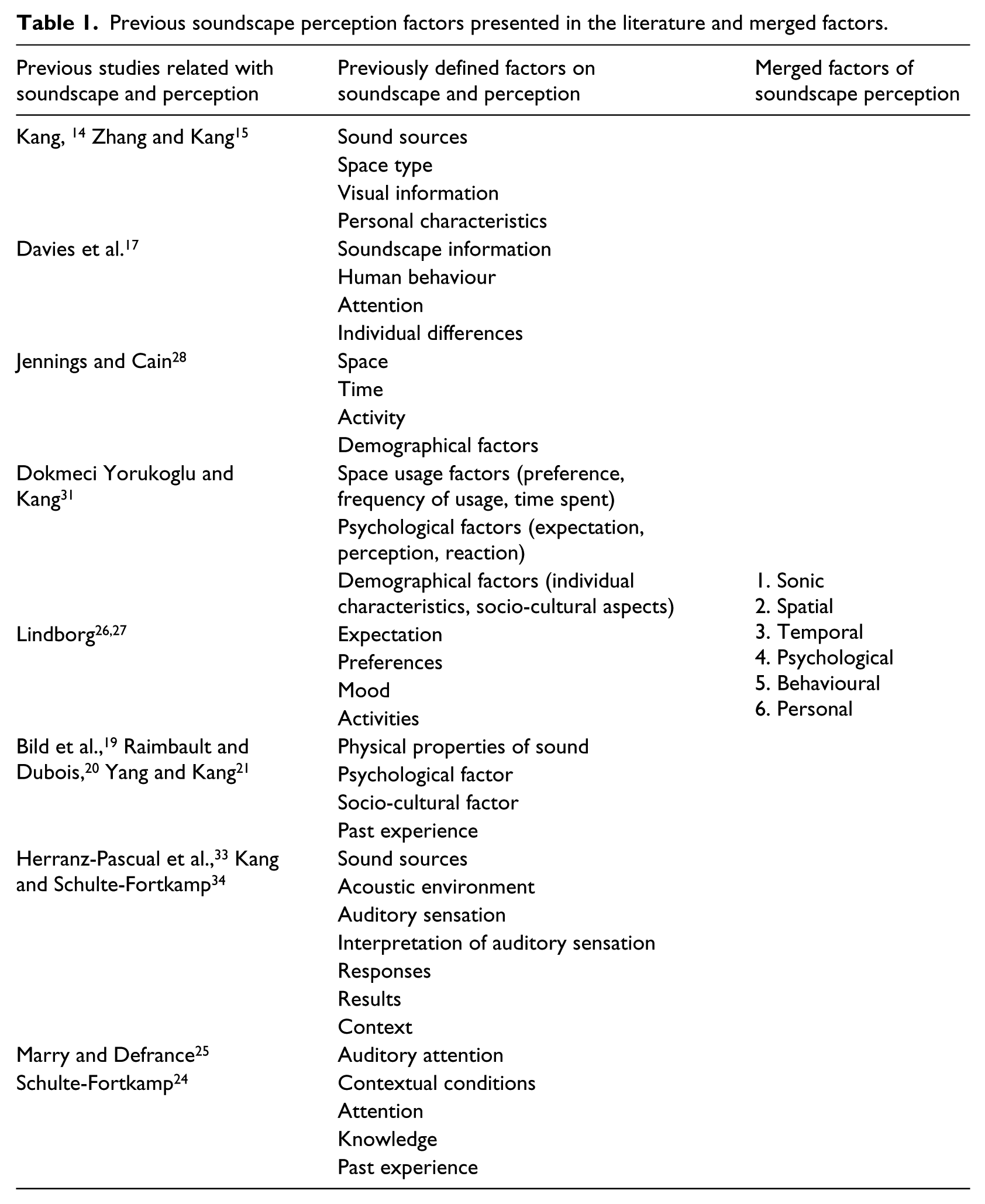
Through the detailed review of the studies in the literature, it has been noted that there is a difference in the levels of categorisation in the soundscape field according to the aim of the study and to the capability of the authors. 40 Therefore, in this research, and according to the soundscape-related studies, the scope of soundscape research and soundscape perception categorizations have been reviewed by the integration of different studies and unified to form a merged framework model. In order to establish this model, reviewed classifications are first presented in Table 1, by noting the previously defined soundscape and perception factors of each reviewed study. Second, factors are merged under six basic factors and detailed items are exemplified in Figure 1.
Previous soundscape perception factors presented in the literature and merged factors.
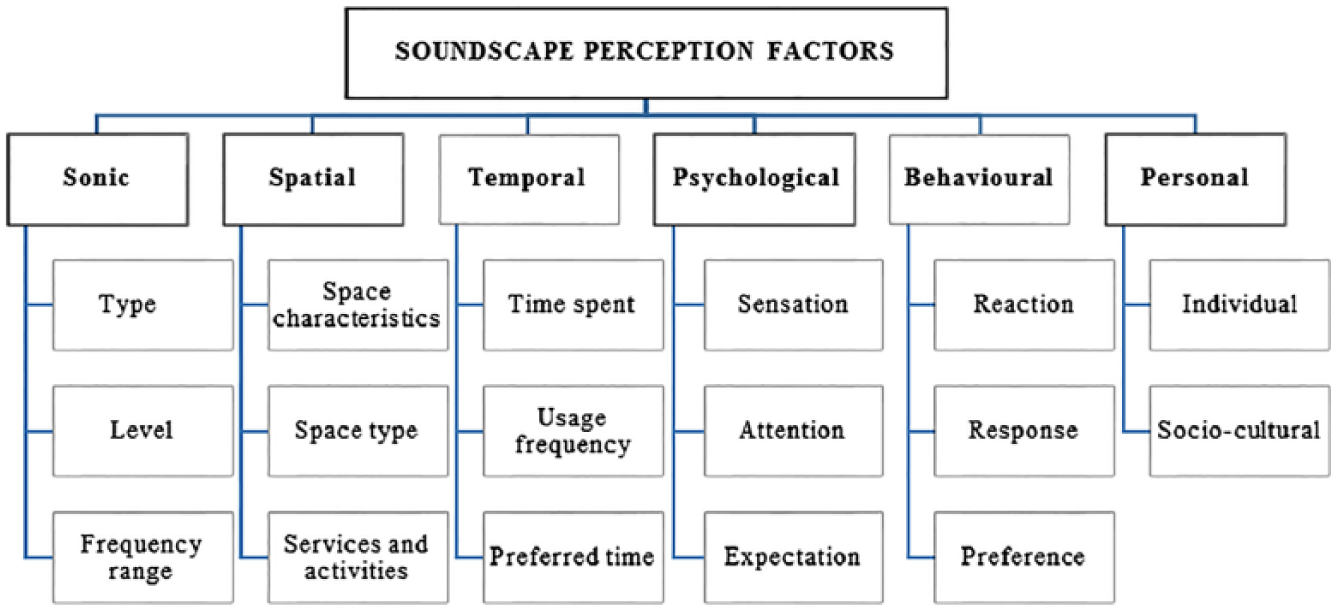
Merged and detailed factors of soundscape perception to be tested by acoustical post-occupancy evaluation.
3. Review on space experience
The combination of acoustic and visual images in the same space influences the perception of soundscape and space experience;21,41,42 yet through the use of all senses, spatial awareness is created and an overall space experience is built. Heidegger inspired a particular approach to understanding the social processes of space construction. He focuses our attention on the way in which places ‘are constructed in our memories’ and are affections through repeated encounters and complex associations. He emphasized how place experiences have time-dimensions and qualified by memories. 43 The perception and emotional responses to space are based on multi-sensory inputs embodied through visual and auditory data among the other interacting senses, in order to establish the sense of space. 44 Spatial experience can be distinguished by a compound of senses and they are thought to work in conjunction to create an experience.8,9,45
In spite of the fact that sense of place is to some extent an inalienable property of the environment, individuals encounter this sense through physical contact with the environment by occupying it. Moreover, from this perspective, sense of space portrays the significant features of the vicinity that people can sense through a personal ordeal of a space. 8 Most studies have been concerned with urban experience based on formal and structural measures of the visual image, while the sonic environment qualities play a secondary role in the experience of urban spaces. Visual sense is different from hearing sense such that visual attention focuses on an object which is influenced by the distance between the observer and the object. On the other hand, the hearing sense covers approximately 360° in all directions. Consequently, the sonic environment affects us more directly than other factors of the space experience. 35 Spatial capacity becomes spatial knowledge when developments and changes occur in the perceived area. This means that strolling through space creates the ability to acquire information from different events, such as looking at different images and way-finding. 45 Moreover, there is a combination between soundscape and space components such that any changes on space will also make changes in the soundscape perception. These changes can be measured by investigating the experience of the occupants in a space. 28
3.1. Space experience–related factors
Space experience is multi-sensory, yet there is still a considerable bias towards a visually centered analysis approach. This is related to the widespread acceptance of vision as the primary sense. 8 The assessment of space depends on aesthetics, global comfort and the functionality of space, 46 which are mostly concentrating on the overall usage and social importance of space. Moreover, it is presented that the overall experience of space is achieved through the integration of different social and psychological factors such as place satisfaction, previous experience, familiarity, expectation, space identity and information. 18 Therefore, in order to improve public spaces, the environmental variables integrated with the perception and expectation of space should be investigated 47 in combination with the social perspectives.
Furthermore, previously presented spatial experience factors, on social aspects (gender, age, past experience, etc.), space design aspects (architectural plan, furniture, materials, etc.), environmental aspects (temperature, noise, light, etc.) and space complexity aspects (triangulation points, shapes, colours, configurations, etc.) are crucial regarding the architectural evaluation perspective and user. 48 Within these four factors, temporal integration of complexity factor is especially highlighted. It is found that the perceived level of complexity decreases gradually with an increased time of spatial perception. 48 In addition to visually dominated physical environment factors, the sonic environment and related aspects are found to be effective on individuals’ experience of places. 49
Spatial experience and time are largely subconscious. Functioning within a certian time directly effects the sense of place for the user and can be seen as a resolution of tension. 45 Previous studies have considered the time spent as an essential variable, and it has been presumed that the length of time of stay directly affects the space experience. 50 In another comparative study, it was observed that time spent by users in the food court of a shopping centre demonstrated a huge positive correlation between noise annoyance and time spent. 51 These studies show that the time spent is an essential element which influences user experience and soundscape perception. 30
In addition to the user and usage-oriented classifications, the basic elements of architecture are also presented in the literature for architectural design, including light, colour, temperature, ventilation, sound, smell, texture and touch, scale and time. 52 Furthermore, the architectural design approach is explained in detail with basic aspects, such as plane and volume, form, space, organization, circulation, proportion and scale, and ordering principle. 53 Functional (purpose, services), spatial (formal organization, spatial relationships, circulation patterns, shapes and dimensions) and indoor environmental (air quality, lighting quality, acoustic quality, crowd level) factors under built entity variables of an indoor soundscape framework also highlight the importance of architectural evaluation in user-oriented studies. 31 These exemplified variables and factors together constitute the formulation of an architectural base and are therefore integrated in any analysis regarding space and spatial experiences.
3.2. Merged model of space experience factors
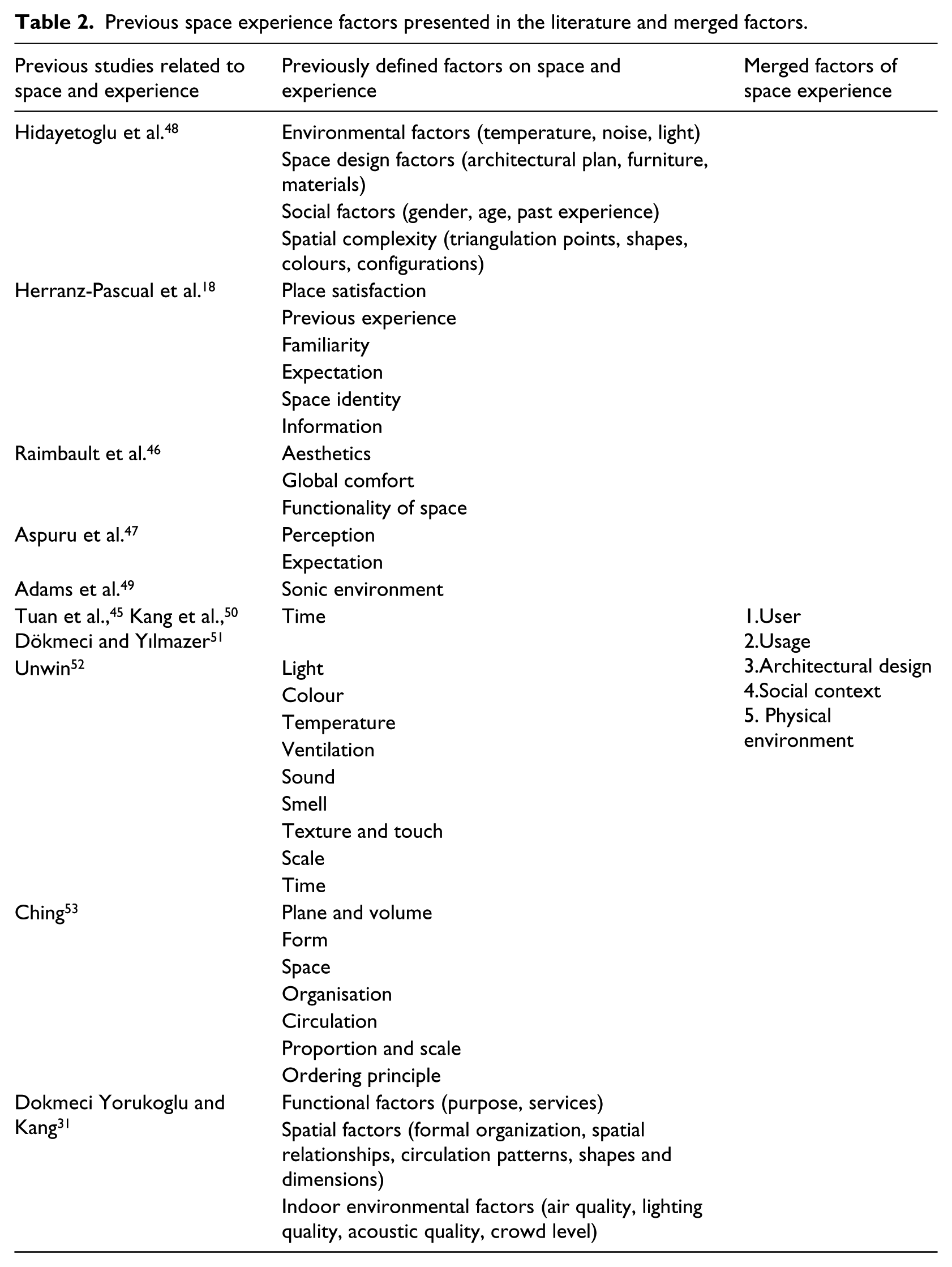
Accordingly with the previous studies on spatial experience, this study has presented the related merged factors chart. Therefore, in this research, space experience categorisations have been reviewed from different studies and unified to form a framework model. In order to do so, related classifications are first presented in Table 2 and the factors of soundscape perception are merged, as presented in Figure 2. The factors that have similar meanings relating to semantics or to its sub-factors were merged together. These sub-categories can help researchers to acquire more accurate results in evaluating the experience of space through the occupant’s point of view and help to facilitate a proper and efficient evaluation tool.
Previous space experience factors presented in the literature and merged factors.
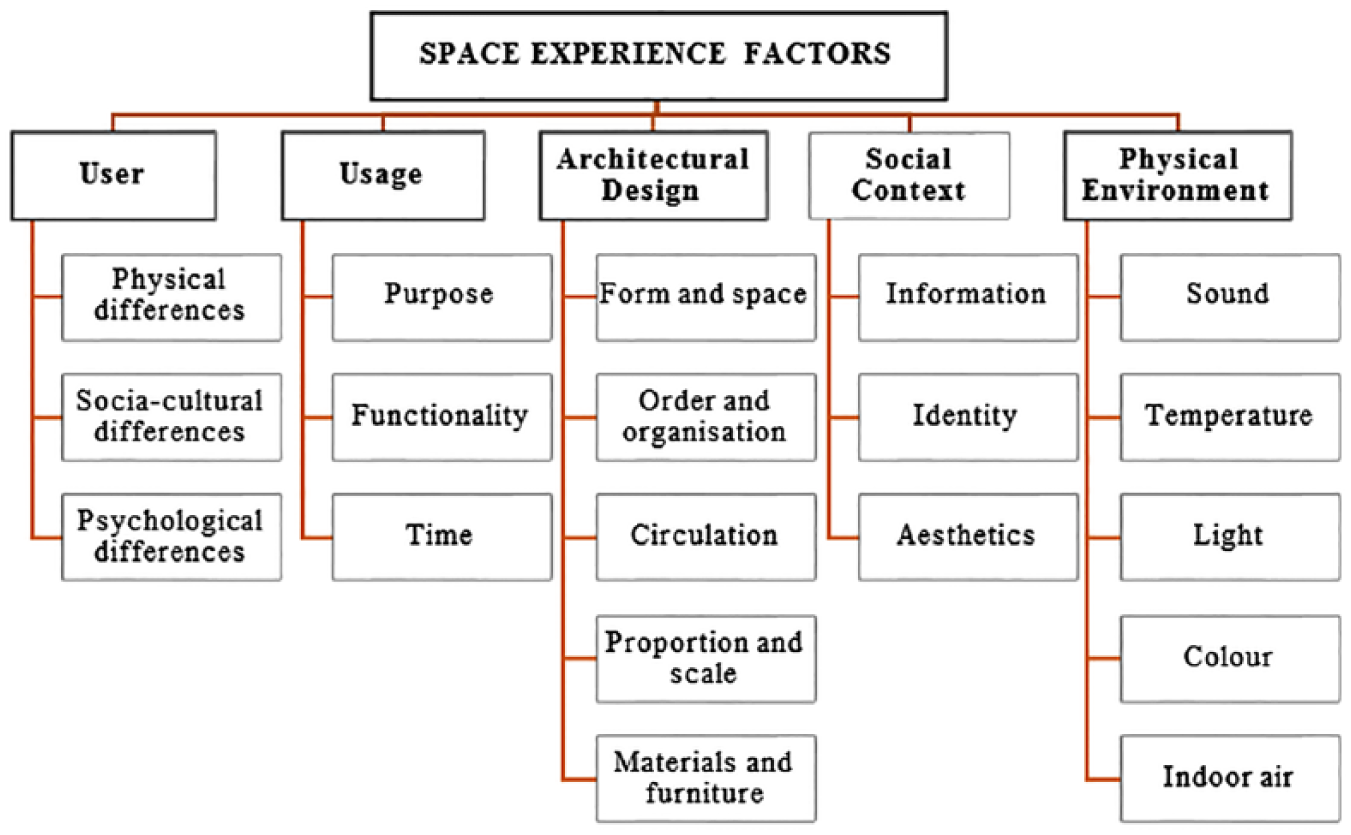
Merged and detailed factors of the space experience to be tested by acoustical post-occupancy evaluation.
4. Adapting POE to the soundscape research framework
Soundscape perception and spatial experience studies are closely related to user pleasantness and satisfaction, whereas the POE process is more concerned with user satisfaction and is intended to determine their qualitative feedback according to their experience with the sonic environment in space, in negative or positive aspects through diverse methods of data collection. 54 POE is normally used to assess building performance by considering a wide range of performance criteria. In order to evaluate the relationship between soundscape perception and an overall spatial experience, it is important to establish an integrated framework that concentrates on data collection and factorial evaluation.
In this study, a POE tool is proposed to construct a relationship between soundscape perception and spatial experience. Hence, the key element between POE and space characteristics is the user. Thereby, user decides whether a space and its components are suitable within the given context or not. In the early stages of design or spatial planning and programming, soundscaping should be included as a crucial design aspect. Therefore, in this study, soundscape perception and related factors are integrated with space experience. This formulates the acoustical post-occupancy study proposal.
As presented in Figure 3, an integration framework is proposed. This framework concentrates on the two different aspects mentioned in this study, which are soundscape perception and space experience. It is based on applying a proper tool to evaluate the relationship between the two concepts, namely perception and experience, in order to assess the relationship regarding the variation of physical elements and social differences that are considered under each variable. The crucial point in this framework is how to categorise the factors and how to collect data from the user and the environment in order to form an integrated evaluation that would feed back into future design projects.

Integrated conceptual framework model of acoustical POE.
Besides investigating space and usage characteristics, POE also deals with occupant behaviours and the needs of occupants in order to reveal results of building performance and the consequences of past design decisions. 55 The term acoustic POE was first used to evaluate buildings in tropical climates; 56 however, the approach has not been adapted to soundscape evaluation and it is used as a case-specific evaluation tool. Therefore, this study aims to propose a more applicable methodological design that could lead to an archive of comparable studies in the future.
The data collection process that is structured within POE is phased under three stages. These three stages are indicative, investigative and diagnostic, as presented in Figure 4. It is proposed that the indicative stage, which includes observations and measurements, would be the first phase to form the base of the study. The investigative stage, which includes interviews and architectural surveying, will follow as the second phase, where the occupants could be involved more through interactive communication in interviews. Architectural surveying would also act as a key method to collect reliable data on the architectural characteristics of spaces. These two phases are expected to lead to initial identifications on soundscape perception and space experience factors. The later stage on diagnostics includes questionnaires and soundwalks, which would lead to a final and more structured evaluation.

Acoustical POE phases and integrated methods for data collection.
In the design of these three phases, each phase builds upon one another by conveying information to the next phase from the collected data of the previous phase. Therefore, it is proposed that the data collected from the indicative phase will be evaluated and the information from the analysed data will be conveyed to the development of the interview content. Similarly, data collected from the interviews will be interpreted for the design of the questionnaires in the diagnostic stage.
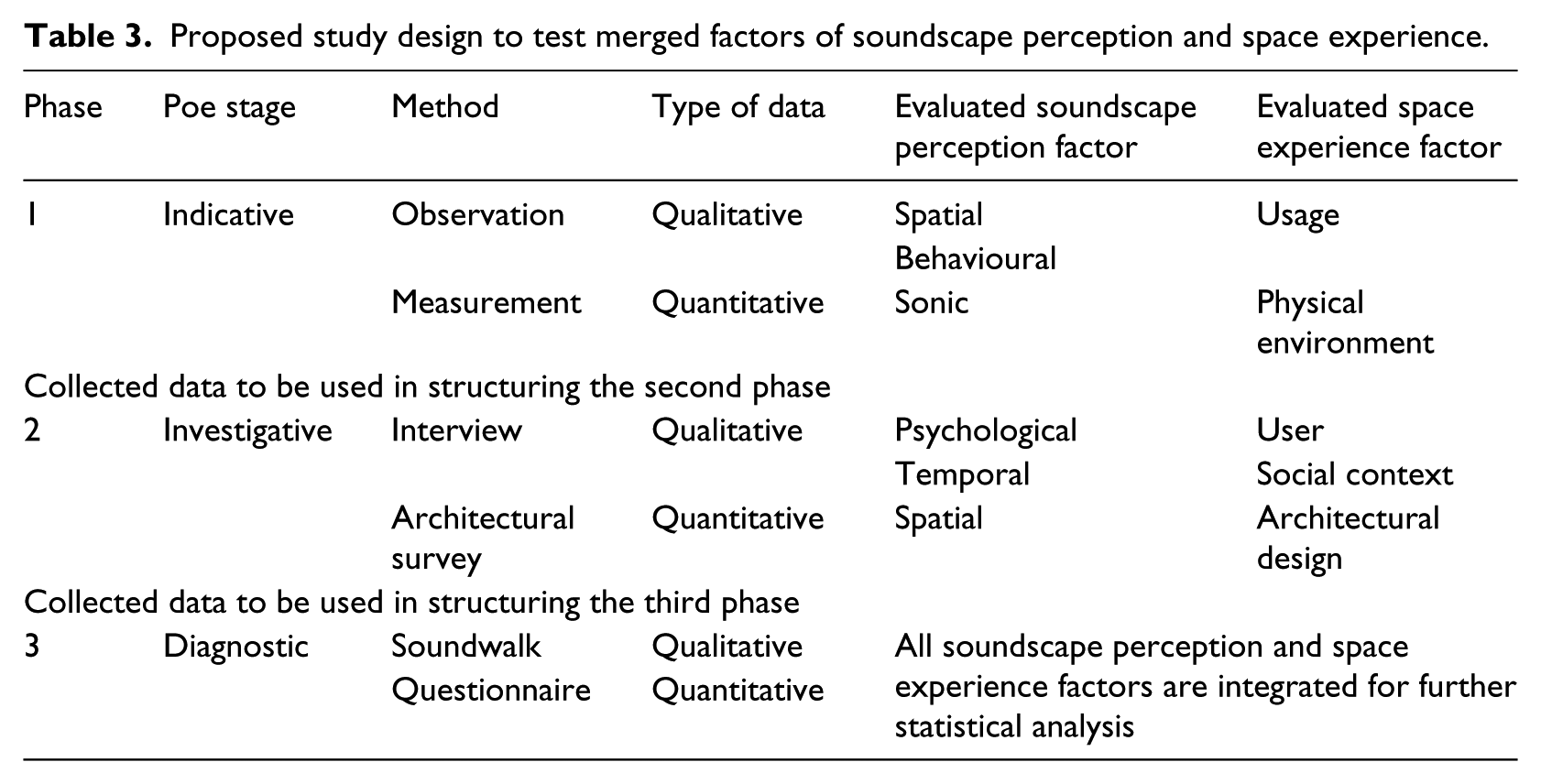
This proposed study design as presented in Table 3 is based on the occupant’s judgement of their surrounding environment and is aimed to test the proposed merged factors classified under soundscape perception and space experience. In the first indicative stage, an observation method is proposed to collect data on spatial, behavioural and usage-related factors. In addition, measurements on sonic characteristics and the physical environment are proposed to identify environmental conditions. In the second investigative stage, data on psychological and temporal factors in addition to user and social context–related factors are collected by means of interviews. Architectural surveying is also one major part of this stage to collect data on spatial factors and architectural design. In the final third phase of the diagnostic stage, overall evaluation of the previously mentioned factors are all integrated. Questionnaires and soundwalks are proposed to collect data, in order to understand the specific relationship between soundscape perception and space experience factors. It is important to highlight that any data collected from each phase should be used to structure the next phase so that each phase could be linked with each other and therefore feed one another.
Proposed study design to test merged factors of soundscape perception and space experience.
5. Conclusion
There is an urgent demand to find a universal tool to identify the factors that influence the perception of soundscapes and space experience. It has been reviewed that previous studies on soundscapes and space experience have developed varied classifications and have used different criteria. This study presented the differences in the semantic and linguistic usage in these previous studies. Related studies on soundscape perception have been reviewed, and merged factors are proposed. For soundscape perception analysis, six merged factors are proposed:
Sonic;
Spatial;
Temporal;
Psychological;
Behavioural;
Personal.
In addition, studies on space experience are also reviewed and five merged factors are proposed:
User;
Usage;
Architectural design;
Social context;
Physical environment.
The specific highlighted conclusion of this study is the integration of POE with a soundscape approach. Therefore, the POE stages are re-developed through applicable data collection methods and specific soundscape methods within each phase, including observations, measurements, interviews, architectural surveying, questionnaires and soundwalks. In addition, collected data types and evaluated factors are specified for each proposed method and structured under the proposed acoustical POE phases. The proposed study design is specifically structured to be followed in the indoor soundscape and space experience research fields.
The adapted POE methodology would be beneficial especially for indoor soundscape researchers who would aim to use the proposed study design in case evaluation studies. In addition, architects, interior architects and space designers would benefit from this approach by integrating acoustical POE to traditional POE evaluations that could feed the planning, programming and designing phases of future projects.
An initial conceptual framework on merged factors of soundscape perception and space experience, as well as a proposed acoustical POE study design are presented in this article. This study is an ongoing research in which future work will include the application of the acoustical POE study design through the identified methods by following the differentiated phases in order to test the presented merged factors classified under soundscape perception and space experience.
Footnotes
Declaration of conflicting interests
The author(s) declared no potential conflicts of interest with respect to the research, authorship and/or publication of this article.
Funding
The author(s) received no financial support for the research, authorship and/or publication of this article.
