




Abstract
The catacombs, burial sites for early Christians, were constructed during the Roman Empire until the Christian religion was recognized in 313 AD. The catacombs were cementeries, which were organized according to precise rules and were dug into the ground on several levels, to occupy as little space as possible. The catacombs became places of worship as martyrs were buried in them. The catacombs were then abandoned with the barbarian invasions and the consequent construction of churches inside cities. The catacombs were rediscovered during the Renaissance period and became a place of renewed worship. In the present work, the acoustic characteristics of the catacombs of San Callisto in Rome, San Gennaro in Naples, and Vigna Cassia in Syracuse are discussed. The three selected catacombs differ by type of excavation and geometry. In particular, the catacombs of San Callisto are made of narrow corridors and small rooms; the catacombs of San Gennaro consist of large rooms with niches; the catacombs of Vigna Cassia are partly excavated in the tuff and partially occupy a disused aqueduct. The acoustic measurements were performed using an impulsive sound source. The description of the acoustic characteristics focuses on the reverberation time and the Speech Transmission Index. The results show that the reverberation time was always shorter than 1 second, confirming the reduced reverberation of these environments. Finally, the speech listening characteristics are particularly good, ensuring the suitable conditions for the prayer in these spaces.
The origin of the Catacombs
The first Christian communities were founded between 50 and 100 AD, following the preaching of the Apostles. The Christians rejected the pagan custom of cremating the bodies and buried them in cemeteries because according to the resurrection, the soul and the body would be reunited. During the first centuries of Christianity, due to the lack of availability of land, catacombs were commonly built.1,2 The graves were sacred and inviolable, and it was not possible to bury new bodies in the place of the previous ones. The use of underground excavations solved this problem by increasing the availability of sites for new tombs. This choice ensured safety against acts of violation of the graves, and presented simplicity and cost-effectiveness.
The use of burying the dead in hypogea was already in use in the Mediterranean area. However, it is with Christianity that burial grounds became large and complex. The catacombs were built in easily to dig land, creating a negative architecture. The excavation of catacombs took place for a depth up to 10 m, over multiple levels of excavation, and expanded horizontally for more than 200 m. In these underground spaces, air ventilation and daylighting were ensured by vertical shafts.
In the catacombs, the dead were buried in different ways: the niches were dug along the walls of the gallery and were intended for the poorest Christians; the arcosoli were more complex tombs that involved the excavation of an arch; finally, the cubicles were sepulchral chambers. The catacombs were also used to celebrate funeral rites and the anniversaries of martyrs.
By the end of the second century AD, the catacombs were built increasingly by Pope Zephìrino (199–217) and Callistus (217–222). The etymology of the expression “ad catacumbas” means “near the cavities,” inspired by the established presence of a series of pozzolana quarries, from which the tufa blocks were extracted, used for the construction of buildings, although it is also believed that the word catacomb derives from the Latin “cata tumbas” (i.e. “among the tombs”). Only in the ninth century, the term catacombs extended to all underground Christian cemeteries.
Most of the catacombs are located in central Italy, a region known as Lazio. Other catacombs are found in Tuscany (Chiusi), Umbria (Todi), Abruzzo (Amiterno and L’Aquila), Campania (Naples and Avellino), Puglia (Canosa), Basilicata (Venosa), Sicily (Palermo, Siracusa, Marsala, and Agrigento), and Sardinia (Cagliari and S. Antioco). Many catacombs were created and developed around family tombs, whose owners also opened them to other Christians.
From 313 AD, with the edict of Milan, the persecutions of Christians ended, and the catacombs were transformed into sanctuaries of Christian martyrs. Around the tombs of the saints, a form of worship began to develop, so that the dead were buried as close as possible to the tombs of the martyrs. After 450 AD, the catacombs were abandoned and to avoid looting due to the barbarian invasions, the remains of the martyrs were transferred into churches built inside the city walls. Only at the end of the Renaissance, the catacombs began to be rediscovered and the excavations began for the study of the origin and evolution of these buildings. 3
Catacombs followed a long tradition across Europe of underground religious places. In France, prehistoric caves had such a function as proved also by the drawings of animals on their wall.4,5 In England, megalithic monuments of prehistoric times (3500 BC) have been found to have a shape and size with great effect on their acoustics.6,7 Whereas recent studies have shown that pre-Columbian societies in Central America, associated supernatural phenomena to the sound created in ancient architecture. For example, in the Castillo pyramid in Mexico, the echo generated by clapping at the foot of the stairway turns into a sound like the chirping of a bird of the forest.8,9 While there are some studies about the acoustic of natural caves 10 and the caves used for theatric shows,11,12 limited studies exist about the acoustics of catacombs. The present paper aims to investigate catacombs by performing acoustic measurements performed inside them. Not many things are known about the types of religious functions that took place in the catacombs during the period of the early Christians, as the use of musical instruments was not allowed during religious functions. 13 This study will try to see if the architecture of catacombs fit more to spoken language or songs.
Selected catacombs
Catacombs of San Callisto (Rome)
Rome has more than 60 catacombs along the consular roads, such as Via Appia, Via Ostiense, Via Labicana, Via Tiburtina, and Via Nomentana.14–16 The main complex of the Roman catacombs is that of San Callisto, which extends over a vast area between Via Appia Antica, Via Ardeatina, and Vicolo delle Sette Chiese. The complex is spread over four levels and is made up of several cemetery nuclei. The catacombs of San Callisto are known as the first official cemetery of the Christian community of Rome and take the name of the martyr pope San Callisto I (217–222). Originating from the fusion of some hypogea, called “regions,” each hypogeum had its own staircase and was made up of galleries and cubicles.
The crypt of the Popes, the crypt of Santa Cecilia, and the crypt of Lucina are located in the San Callisto complex. The crypt of the Popes originated as a private cubicle, which was later transformed into a crypt. It consists of two rooms and contains 12 loculi and four sarcophagi and a monumental tomb. The crypt has hosted the burial of nine popes until it became a small church with the funeral of Pope Damasus. Figure 1 shows the map of the catacombs of San Callisto in Rome with an indication of the most critical areas, while Figure 2 shows the internal view of the catacombs of San Callisto. Table 1 shows the average size of the most critical sectors of the catacombs of San Callisto in Rome.
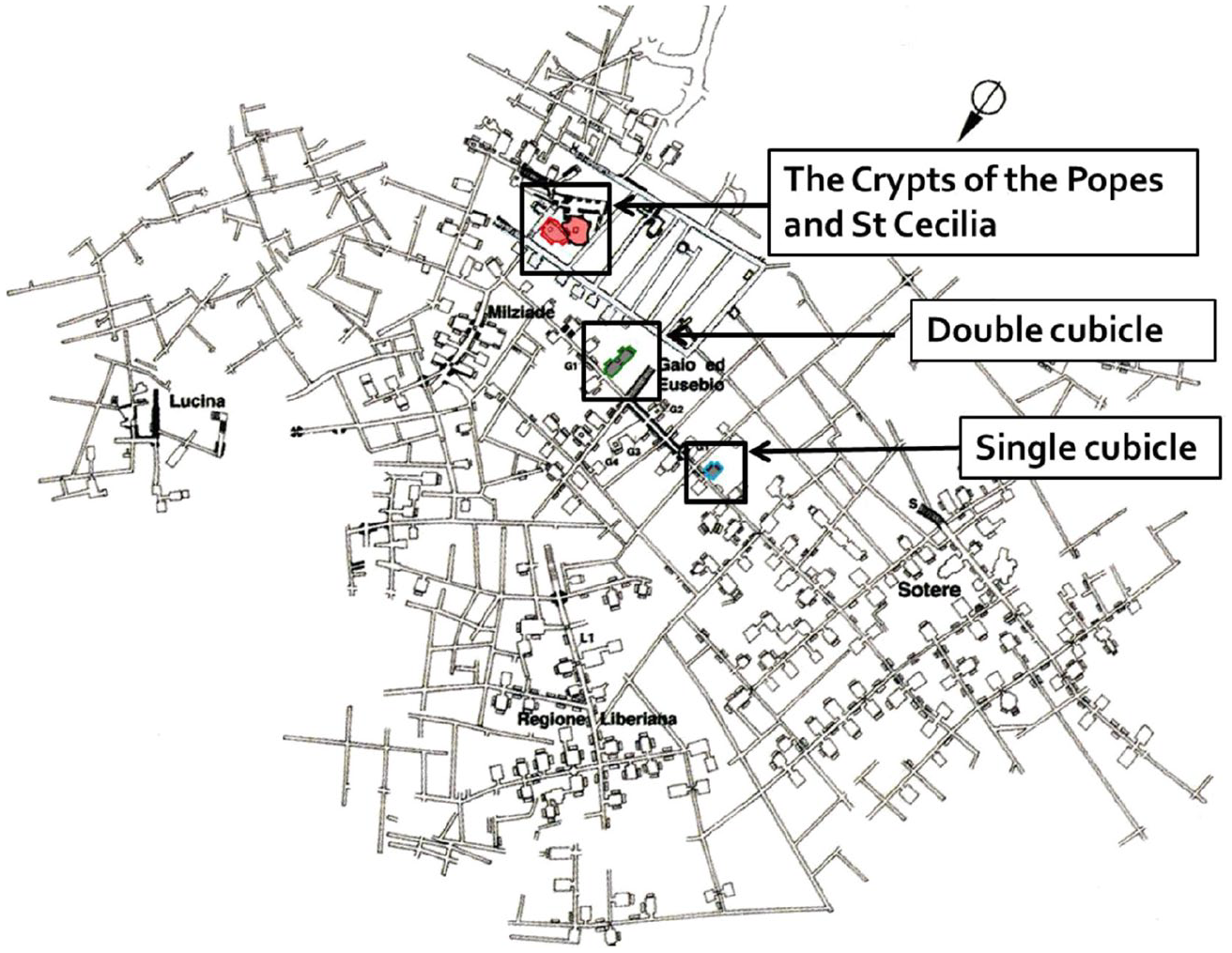
Map of the catacombs of San Callisto in Rome with indication of the most important areas.
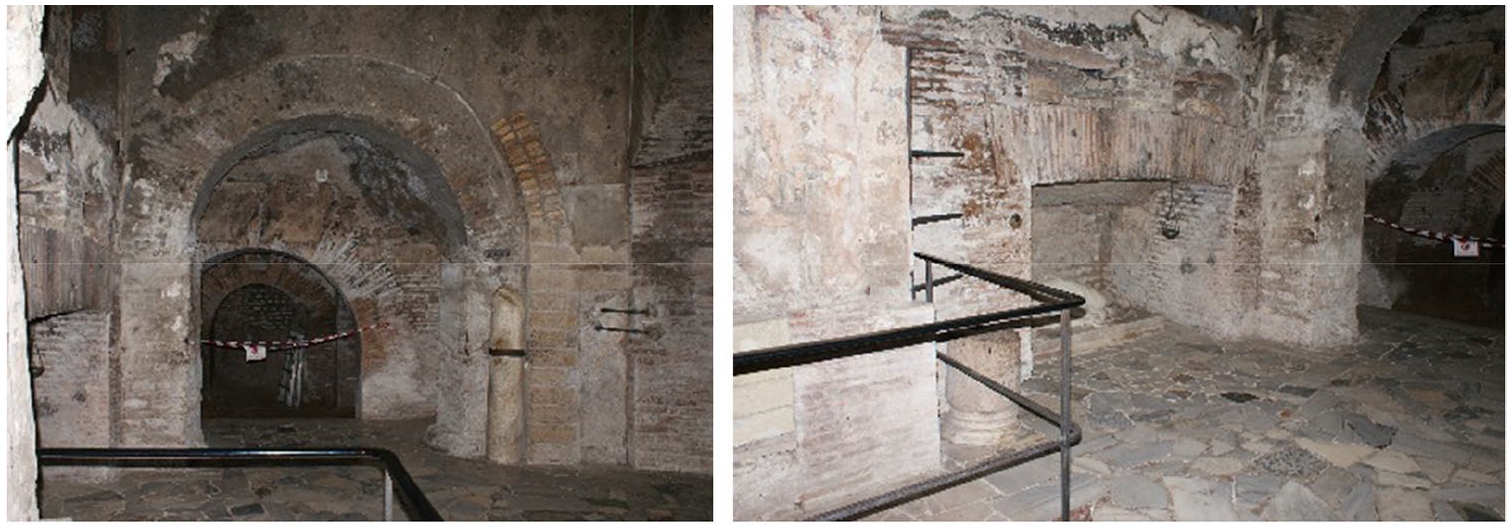
Internal view of the catacombs of San Callisto in Rome.
Average size of the most important portions of the catacombs of San Callisto in Rome.

Catacombs of San Gennaro (Naples)
The city of Naples proved to be particularly suitable to underground burials.17–21 The most relevant and accessible catacombs are the Catacombs of San Gaudioso, San Severo, the Fontanelle cemetery, and those of San Gennaro. These last are located on the hill of Capodimonte, below the temple of the Incoronata Madre del Buon Consiglio. The catacombs of San Gennaro present spacious rooms, architecturally well-preserved, illuminated by large openings on the side of the hill. They consist of two levels, only partially overlapping, to which the toponyms of the lower (first level) and upper (second level) catacombs have been attributed. The lower level is the oldest floor and comes from the enlargement of a tomb of a wealthy Roman family. It has a regular uniform structure, with ambulatories that branch out into small side rooms and cubicles. The upper level is composed of two squared rooms, originally separated by a tufa wall with a passage in the center, each of about 7 m on each side but with different levels of ground. The large passage with three arches was created when the “Basilica Maior” was built in honor of San Gennaro.
Figure 3 shows the map of the catacombs of San Gennaro. Figure 4 shows the lower level and main corridor in the upper level of the catacombs of San Gennaro. Table 2 shows the average size of the rooms of the catacombs of San Gennaro in Naples.
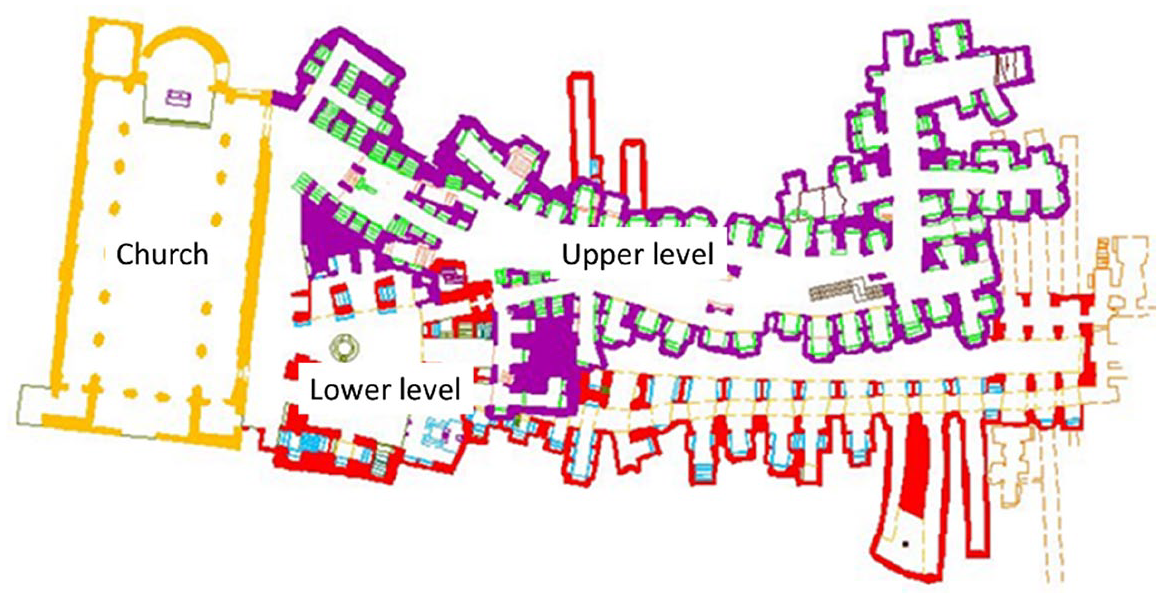
Map of the two levels of the catacombs of San Gennaro in Naples.

Lower level and main corridor of the catacombs of San Gennaro in Naples.
Average size of the rooms of the catacombs of San Gennaro in Naples.

Catacombs of Vigna Cassia (Siracusa)
Sicily hosted the first Christian communities, even if the spread of Christianity in this region only completed in the fifth century. The Siracusa cemeteries were built over the centuries by different generations and grew progressively over the centuries.22–27 At first, the underground caves were exploited as latomies in which stones were quarried; later, these spaces were abandoned, leaving ample space for the Christians, who decided to adapt them to create cemeteries. The catacombs of Siracusa appear very similar to the Roman ones, due to the presence of tombs and sarcophagi arranged along the corridors and in the cubicles. In Siracusa, the main catacombs are: Santa Lucia, San Giovanni, and Vigna Cassia. The catacombs of Vigna Cassia are among the largest ones in Sicily. Figure 5 shows the plan of these catacombs with an indication of the most important areas.

Plan of the catacombs of Vigna Cassia in Siracusa.
The site takes its name from the family that owned the vineyard above the cemetery area. The complex of the catacombs of Vigna Cassia is defined as a community cemetery, but also presents private spaces (cubicles) represented by small rounds obtained by the reuse of unused tanks, belonging to a previous water supply system of the city of Greek-Roman times. The funeral complex consisted of a community cemetery developed between the third and fourth centuries and five hypogea. The catacombs are divided into three regions: Santa Maria del Gesù, Maggiore or San Diego cemetery, Marcia cemetery. The cemetery of Santa Maria del Gesù is derived from the enlargement of a pre-existing Greek-Roman aqueduct, on whose side walls a series of loculi were dug. The cemetery of Marcia presents a more organic development, whose regularity of planting recalls that of the nearby cemetery of San Giovanni, the genesis of this region is attributable to the fourth century, with it still being used in the V century. Figure 6 shows some rooms of these catacombs. Table 3 reports the volumes (in m3) of the different places in the catacombs.

Rooms of the catacombs of Vigna Cassia in Syracuse.
Volumes (in m3) of the different rooms in the catacombs of Vigna Cassia in Syracuse.

Acoustic measurements
Given the complexity of the geometry and the large size of the rooms, the measurements of the acoustic characteristics were taken using the impulse response method. Due to the impossibility to connect to the electricity, balloons, inflated with air has been used as sound sources 28 ; the balloon explosion produced an impulse that excites the sound field. The background noise was very low due to the underground locations and the distance from anthropic noises, so also at the frequency of 63 Hz, the balloons gave a sufficient SNR ratio.
The impulse response was measured by the microphone connected to a 01 dB Symphony system. The sound impulses were elaborated and the monoaural acoustic parameters (STI, T30, EDT, C80, and D50) were analyzed, at frequencies from 63 to 4 kHz. The final values of the acoustic parameters were averaged in order to obtain the medium values at octave band frequencies in a range from 63 to 4 kHz. 29
The sound sources were positioned in different points of the catacombs, at the height of 1.6 m from the floor (the height of a potential orator), while microphone points were positioned at the height of 1.6 m from the floor in different positions of the walkable area. All the acoustic measurements were carried out without audience. This methodology was already adopted in others complex environments with good results, like the caves and theaters.30–33
Figures 7 to 9 show the measurement points in San Gennaro catacombs, San Callisto catacombs, and Vigna-Cassia catacombs, respectively.

Measurement points in the catacombs of San Gennaro in Naples.
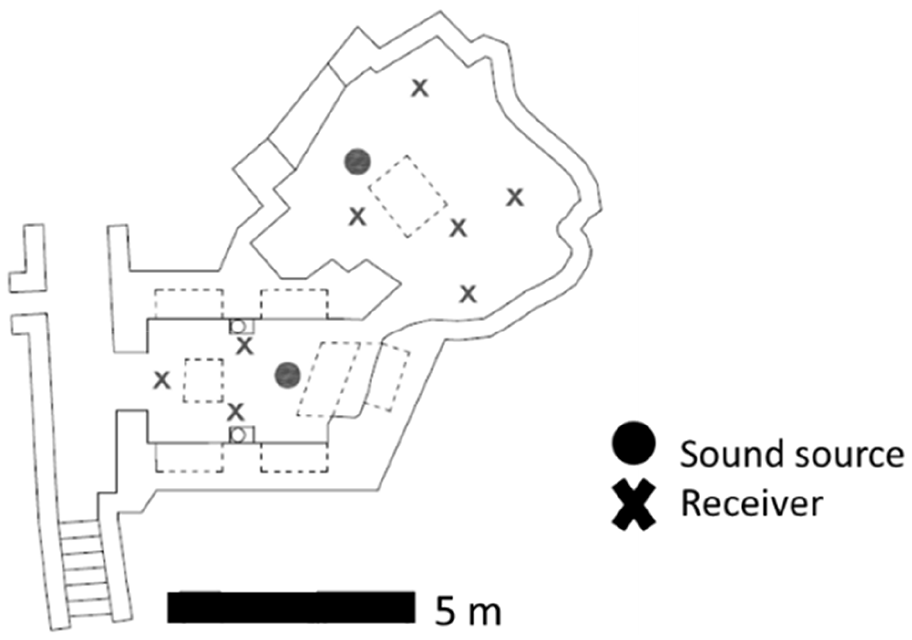
Measurement points in San Callisto catacombs in Rome.

Measurement points in Vigna-Cassia catacombs in Siracusa.
Results and discussion
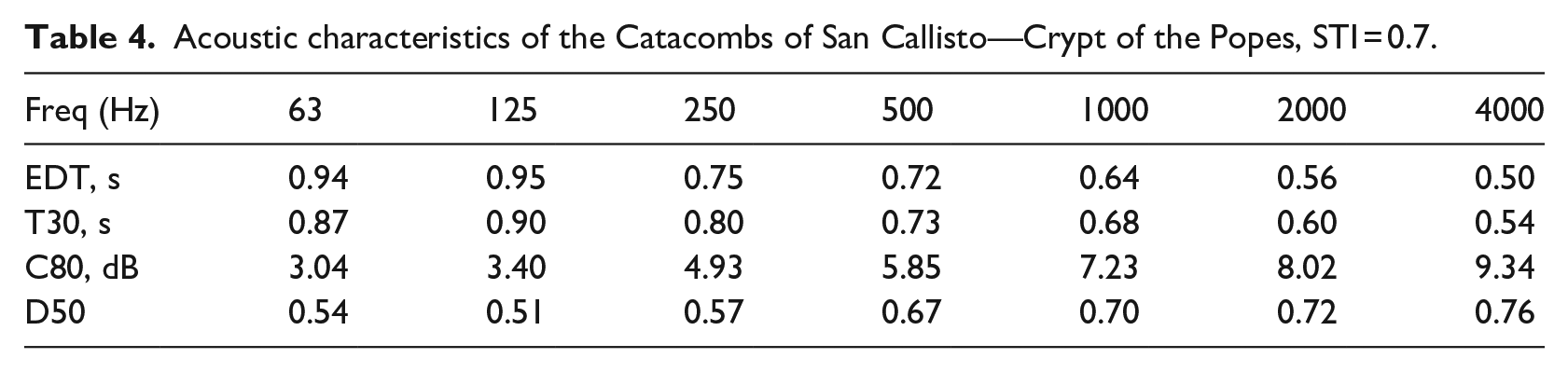
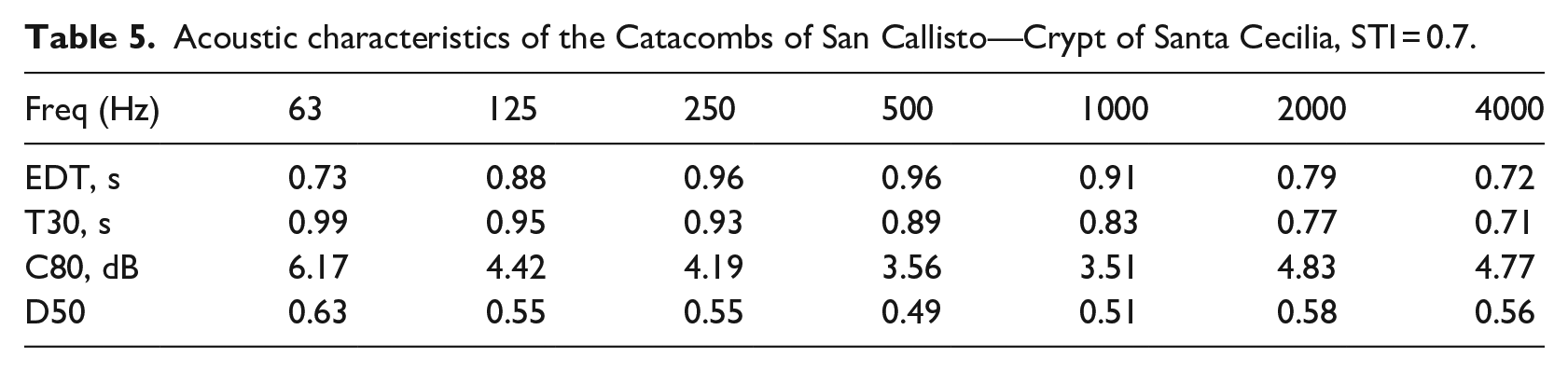
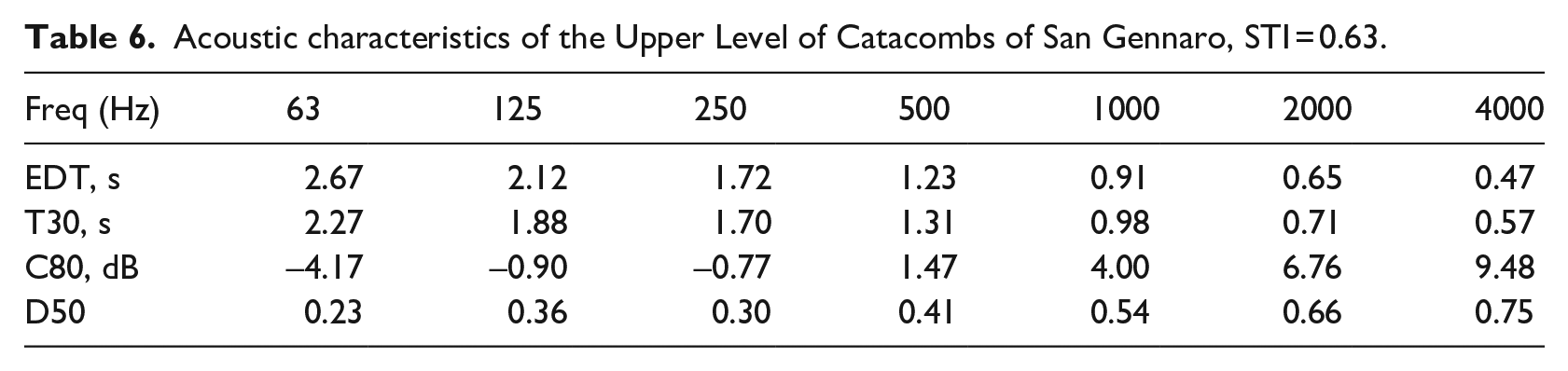
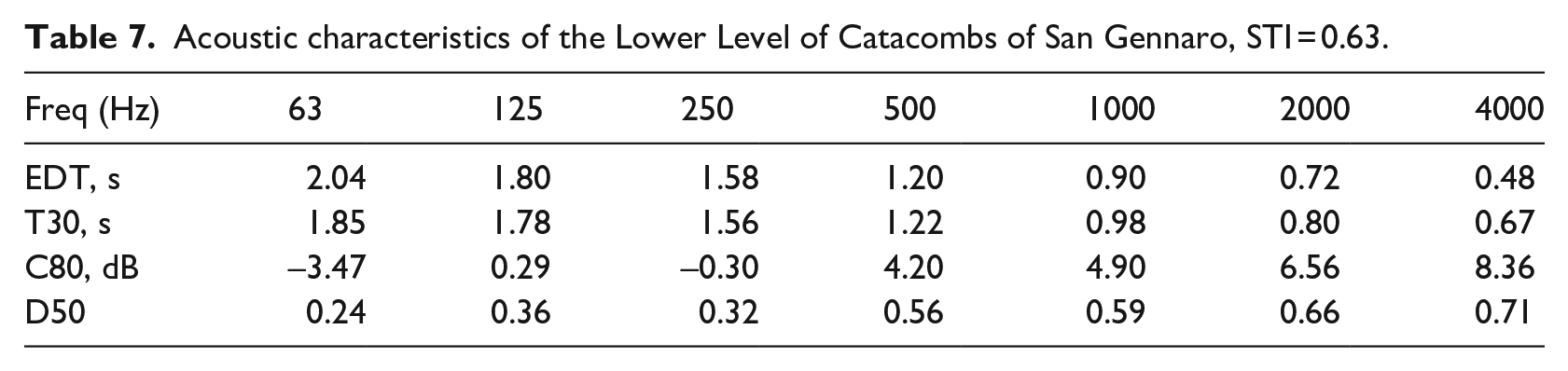
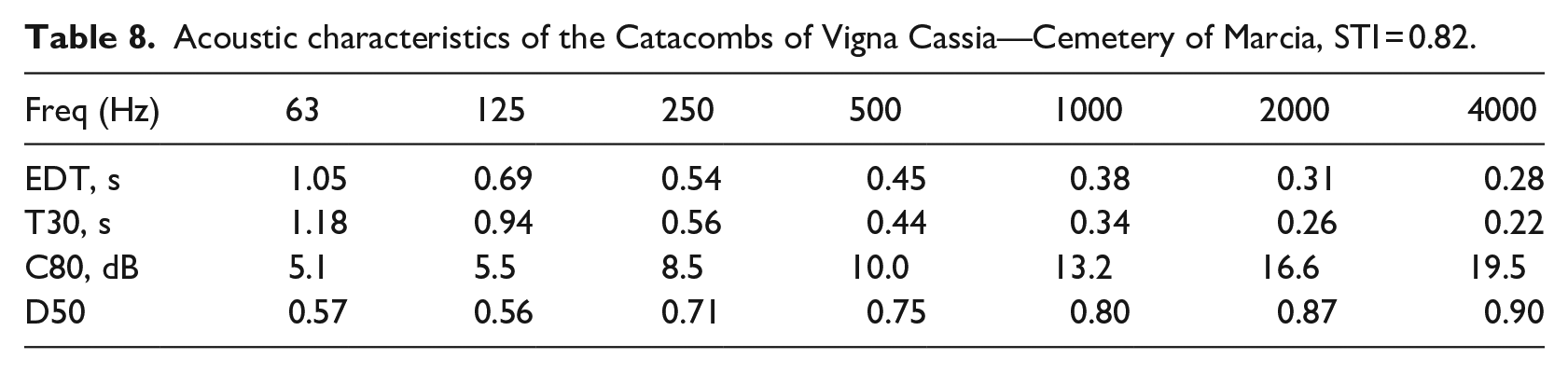
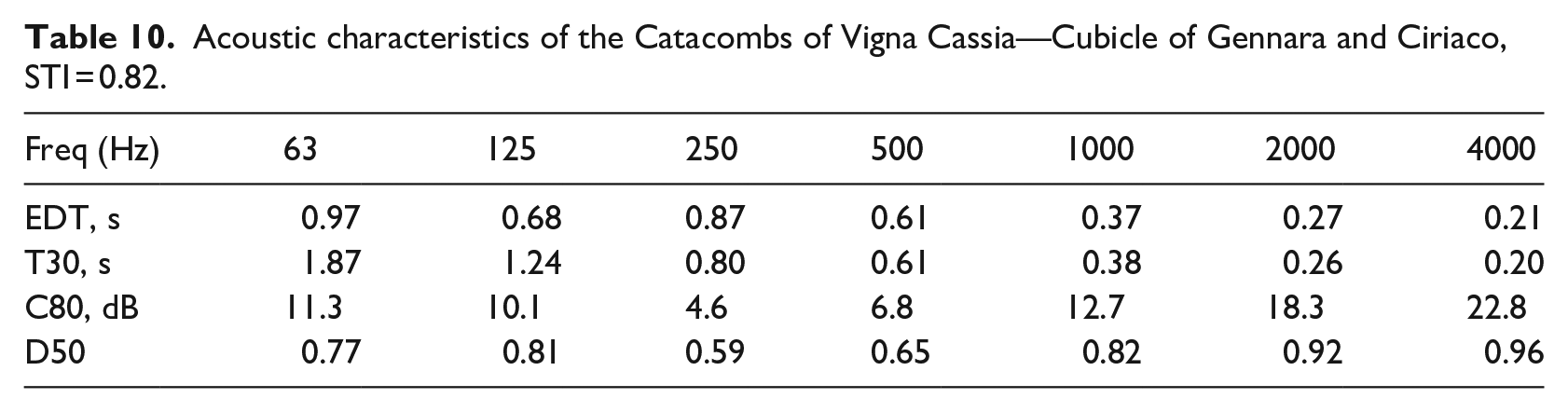
Some preliminary acoustic results about the catacombs in Rome and Naples were reported in Iannace et al., 34 which are here compared with the results taken in the catacombs of Vigna Cassia in Siracusa. Tables 4 to 11 show the average values, according to the frequency in octave bands, of the acoustic parameters T30, EDT, C80, D50, with the value of the STI being reported. In particular, Tables 4 and 5 report the acoustic characteristics inside the catacombs of San Callisto; Tables 6 and 7 report the acoustic characteristics inside the catacombs of San Gennaro; Tables 8 to 11 report the acoustic characteristics inside the catacombs of Vigna Cassia.
Acoustic characteristics of the Catacombs of San Callisto—Crypt of the Popes, STI = 0.7.
Acoustic characteristics of the Catacombs of San Callisto—Crypt of Santa Cecilia, STI = 0.7.
Acoustic characteristics of the Upper Level of Catacombs of San Gennaro, STI = 0.63.
Acoustic characteristics of the Lower Level of Catacombs of San Gennaro, STI = 0.63.
Acoustic characteristics of the Catacombs of Vigna Cassia—Cemetery of Marcia, STI = 0.82.
Acoustic characteristics of the Catacombs of Vigna Cassia—Cubicle of the well, STI = 0.83.

Acoustic characteristics of the Catacombs of Vigna Cassia—Cubicle of Gennara and Ciriaco, STI = 0.82.
Cemetery of Santa Maria del Gesù, STI = 0.78.
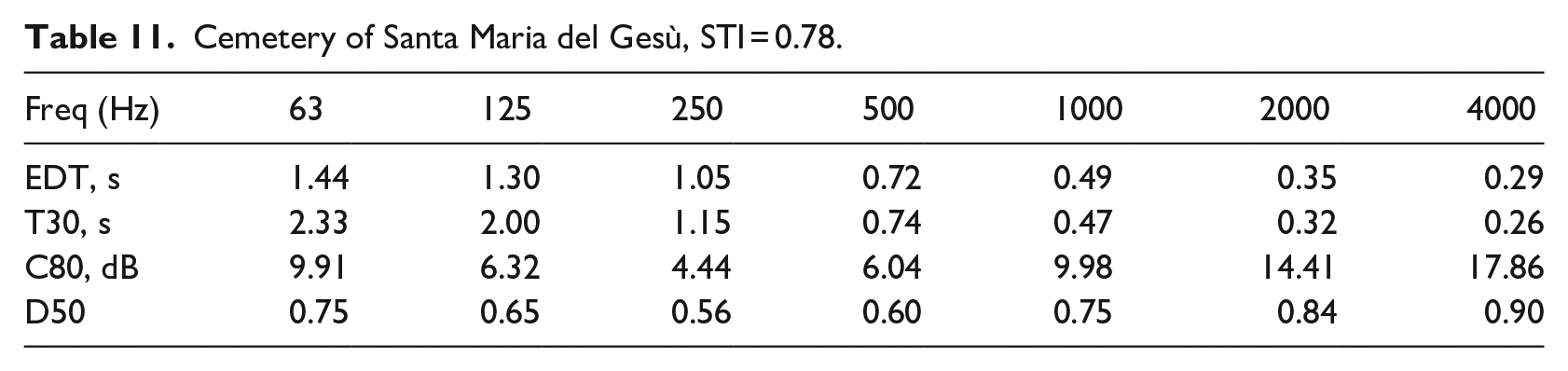
The catacombs of San Gennaro due to the large volume have a longer reverberation time than the others, and at low frequency (63 Hz) the reverberation time is over 2.0 s. For comparison, the catacombs of San Callisto has a the reverberation time of less than 1.0 s at all frequencies. For the catacombs of Vigna Cassia, the reverberation time is just over 0.5 s, due to the presence of small rooms and corridors in live tuff.
Despite the volumes of the environments considered and the relative interconnections between them, the measured monaural acoustic parameters provide an indication that, in these environments, the understanding of speech is good, that is, the words emitted by a potential speaker can be understood correctly by the listeners. The reverberation time at 1000 Hz is less than 1.0 s, the D50 value is higher than 0.50. The STI parameter exceeds the value 0.8 only for the Vigna Cassia catacombs.
The measured acoustic characteristics make it possible to establish that these environments could be used for sacred functions and moments of recollection and prayer, since the reverberation time is short. A sound propagation measure was not carried out between adjacent environments, that is, not verifying whether the sound emitted in an area is propagated and therefore heard in adjacent rooms.
Conclusion
This paper presents the results of acoustic measurements taken in the three different catacombs of San Callisto in Rome, San Gennaro in Naples, and Vigna Cassia in Siracusa. The catacombs were built in different periods, have different volumes and geometries. The mean values of the acoustic characteristics were analyzed, in of frequency function in octave bands from 63 to 4.0 kHz, while the monaural acoustic parameters analyzed are T30, EDT, C80, D50, and STI.
Despite the volumes of the environments considered, the measured acoustic parameters (short reverberation time and STI > 0.7) indicate that in the catacombs, the understanding of speech was particularly good. Consequently, the words of a potential speaker could be properly understood by listeners.
The acoustic characteristics allow establishing that these environments could be used for religious functions and moments of meditation and prayer, due to the short reverberation time.
Due to operational difficulties, it was not possible to perform a measurement of the sound propagation between the adjacent places, and it is not verified if the sound produced in a part of the catacombs could spread and be audible in the surrounding areas.
Footnotes
Declaration of conflicting interests
The author(s) declared no potential conflicts of interest with respect to the research, authorship, and/or publication of this article.
Funding
The author(s) received no financial support for the research, authorship, and/or publication of this article.
