



Abstract
This article develops a model for analysing international regime formation in the environmental domain. It is argued that current approaches to understanding how regimes emerge and develop are too narrow, and fail to account for the dynamic interplay between states and markets which induce the emergence of ‘tipping points’ leading to more extensive and stringent international institutions. The article demonstrates the central role of tipping points in regime formation using the example of international climate change.
Introduction
The proliferation of global environmental problems over recent decades has firmly placed the issue of ecological degradation at the centre of the international agenda. Indeed, transboundary environmental problems cannot be resolved unilaterally, but require unprecedented multilateral cooperation to establish institutions that can guide behaviour along the path of sustainable development (Clapp and Dauvergne, 2005; DeSombre, 2007; Haas et al., 1993: Hurrell and Kingsbury, 1992). While there are success stories of international rule-based cooperation, some pressing problems such as climate change remain unresolved, rendering the issue of how to realize effective international institutions ever more urgent.
This article examines how international environmental regimes emerge and develop. Previous literatures on regime formation come from a variety of traditions. When regime theory first developed in the 1980s and 1990s, scholars adopted a state-centric approach to explaining successful institutional bargaining, notably focusing on factors such as institutional design, the distribution of burden and commitments, hegemonic leadership and social learning (see Hasenclever et al., 1997). More recently, researchers have taken a broader approach to analysing regime formation, recognizing that in the face of globalization and increased non-state actor engagement in world politics, institutional analysis should reflect the shifting and increasingly complex relationship between state and non-state actors (see DeSombre, 2007; Grande and Pauly, 2005; Josselin and Wallace, 2001). Now, it is widely acknowledged that private actors, including multinational companies and business and industry associations, influence the negotiation and formation of international institutions, and that the traditional regime scholarship has failed to account for the importance of business engagement in international rule-making (Falkner, 2008; Fuchs, 2007; Levy and Newell, 2005; May, 2006). Yet, there have been few attempts to bridge the divide between the regime school and research on business power in regime formation.
This article develops a model for analysing environmental regime formation which emphasizes how the interplay between states and markets produces particular conditions for institutional change. The following section reviews relevant contributions from regime theory and its critiques. The article then examines the political and institutional drivers of corporate preferences, focusing on how embryonic, multi-level governance in the environmental domain has changed the premises for business conduct. In the next section, the article develops a framework for analysing the evolution of environmental regimes which focuses on the intersections between multi-level governance, business strategy and international regime formation. It is argued that the interplay between political and institutional change and corporate preferences over time is likely to generate ‘tipping points’ in business strategies from opposition to support for international regulation through regimes. In the next phase, emerging support from dominant business lobbies is likely to induce more favourable conditions for inter-state bargaining and thus the adoption of more extensive and rigorous international institutions. The tipping point model is illustrated using the example of the international ozone regime and is subsequently applied to a more detailed case study of the evolution of the international climate change regime from 1990 to 2009. The case demonstrates how a tipping point in business strategies became evident between 1997 and 2005, and argues that the adoption of the Copenhagen Accord in 2009 also indicates the emergence of a tipping point in the regime-formation process.
The formation of international environmental regimes
An important strand of the scholarship on inter-state cooperation to mitigate global environmental problems has centred on the study of how institutional arrangements emerge and develop. Institutions are commonly defined as connected sets of rules and practices that prescribe behavioural roles, constrain activity and shape expectations (Haas et al., 1993: 4–5). Institutions may refer to bureaucratic organizations, but the term is more often associated with the concept regimes, which do not necessarily have organizations attached. A consensus definition of regimes first appeared in a special issue of International Organization in 1982, which described regimes as sets of ‘implicit or explicit principles, norms, rules and decision-making procedures around which actors’ expectations converge in a given area of international relations’ (Krasner, 1983: 2). While there has been a lack of agreement regarding this definition and the meaning of the term regime — some arguing for a more precise definition of regimes as formal agreements (Breitmeier et al., 2006) ‘with explicit rules, agreed upon by governments, that pertain to particular sets of issues in international relations’ (Keohane, 1989: 4) — the regime school has developed into a comprehensive research programme which, for decades, provided the locus for theorizing international rule-based cooperation.
Central to this debate is the issue of international regime formation. How and why is it that states have succeeded in establishing effective institutions for dealing with some environmental problems, while for other seemingly pressing problems they have been unable to do so? These questions have spurred extensive debate among neoliberal, realist and cognitivist regime scholars, and resulted in the emergence of different streams of analysis seeking to explain the failures and successes of regime formation (Hasenclever et al., 1997). The most mainstream and comprehensive accounts have been provided by the neoliberal school and their so-called interest-based theories. According to the utilitarian, functionalists view, states — being utility-maximizing agents — are assumed to be successful in establishing regimes and institutions when these are ‘expected to increase the welfare of the creators’ (Keohane, 1984: 80). Actors offset the costs against the advantages expected from establishing a regime, and when advantages can be institutionalized through a mutually beneficial arrangement, regimes are likely to materialize (Hasenclever et al., 1997: 37). Another highly influential neoliberal account is the institutionalist model developed by Oran Young (1989, 1994; Young and Osherenko, 1993). Young criticizes the utilitarian school for failing to explain ‘the actual record of success and failure in efforts to form international regimes’ (Young, 1989: 352), and argues that a model of regime formation should more explicitly account for the factors that enable or deter efforts of utility-maximizing agents to realize feasible, joint gains through institutional arrangements. In his model, often referred to as the model of institutional bargaining, Young argues that regimes are most likely to materialize when the issues at hand ‘lend themselves to treatment in a contractarian mode’ (Young, 1994: 107). A contractual environment implies that actors bargain under a ‘veil of uncertainty’; because the distribution of the negative impacts is unknown, states will seek to realize an agreement that is fair to all, ‘in a sense that patterns of outcomes generated under such arrangements will be broadly acceptable, regardless of where the participant might be located in such outcomes’ (Young, 1994: 102). Hence, a veil of ‘good’ uncertainty is believed to facilitate efforts to reach agreement on provisions of institutional arrangements. Second, regimes are also most likely to form when institutional arrangements are perceived by all state parties to be equitable. Thus, a premise for consensus agreement is that the primary concerns of all states must be treated fairly (Young, 1994: 109). Third, the existence of certain change events, such as exogenous shocks or crises, salient solutions to the problem at hand, and/or clear-cut, reliable and effective compliance mechanisms, may also increase the probability of successful regime formation (Young, 1994: 110–112). Finally, Young believes that the absence of effective leadership, provided by states, international organizations or individuals, may severely hamper prospects of achieving an agreement (Young, 1994: 114).
Alternatives to the neoliberal models have also been proposed by both neorealists and cognitivist regime scholars. To neorealists, institutional arrangements emerge when the most powerful states make the effort to create them (Gilpin, 1987; Grieco, 1988), and some view the leadership of a hegemon as a necessary condition for regime formation (Hasenclever et al., 1997: 86). Cognitivists, on the other hand, suggest a more knowledge-based model, which underscores the centrality of belief systems, decision cultures or styles, and social learning in determining the success or failure of regime formation. Learning about the problems at hand and their appropriate responses may contribute to the development of consensual knowledge and thus agreement on suitable institutional arrangements to deal with the problem (see Haas EB, 1990; Haas P, 1992).
However, while the different streams of the regime scholarship together provide a rich description of how international regimes emerge and develop, they have also received extensive criticism for failing to account for the many functions played by non-governmental agents (Arts, 2000; Josselin and Wallace, 2001; Newell, 2000). More recent literature has established that private actors, including firms, business networks or industry NGOs, play a central role in processes of international rule-making (Cutler et al., 1999; Falkner, 2003; Hall and Biersteker, 2002). Indeed, an increasing field of empirical and more theoretically oriented studies has considered the various forms of business power in regimes, and demonstrated how private actors have influenced, watered down or even blocked inter-state negotiations (Falkner, 2005; Levy, 2005; Levy and Egan, 1998; Newell, 2000; Newell and Paterson, 1998; Rowlands, 2001).
The need for considering business power has been recognized by regime scholars, who note that ‘the emergence of various non-state actors as driving forces at the international or transnational level … are clearly important trends in this realm … [and that] these issues will undoubtedly warrant serious consideration during the next stage of regime analysis’ (Breitmeier et al., 2006). The literature on business power, on the other hand, to varying degrees acknowledges that states also continue to influence business actors, and that business preferences are not constructed in isolation but in response to broader structures of the global political economy (Falkner, 2008; Levy and Newell, 2005; Newell and Levy, 2006). To be sure, the issue of increased business engagement with international rule-based cooperation renders the issue of state and market actors’ interactions, and the effects of such interactions, an important field of enquiry. This article endeavours to develop our understanding of conditions for institutional change and successful regime formation using the intersections between states and markets as the point of departure.
A changing business context
All business organizations operate within a broader societal structure. Political and bureaucratic institutions, private and public laws, technological development, consumer preferences and trends, all constitute a part of a business’s external environment determining its operational and strategic premises. Thus corporations are not simply driven by short-term profit motives, but must also consider how expectations, demands and future trends in the external environment are likely to impinge on their organization when crafting mid- and long-term strategies (see Gunningham et al., 2006; Johnson et al., 2005).
Over recent decades, it has become increasingly recognized by corporate leaders that the emergence of a whole new set of pressures, expectations and demands from external business stakeholders to take environmental responsibility is changing the ‘rules of the game’ (Hoffman, 2000). Most Western governments have sought to curb environmentally hazardous industrial emissions since the 1960s and 1970s, while the pressure from consumers, non-governmental organizations (NGOs) and competitors to limit environmentally harmful activities have become more and more significant. Demands from NGOs who have sought to ‘name and shame’ corporations through media campaigns (Bendell, 2004) has heightened the risk of negative public disclosure, and a growing number of companies face market and value-chain pressures from buyers, suppliers, partners, competitors and consumers, which has increased demand for technologies, products and services that will help reduce their negative environmental impact. Indeed, the sum of these new pressures has forced many companies to rethink both their short- and long-term strategies, and has instigated a trend towards greener strategic management (Reinhardt, 2000; Vogel, 2006).
Perhaps the most important source of pressure on corporations to limit their negative environmental impact has been the emergence of multi-level, environmental regulation and governance systems (Gunningham et al., 2006; Hoffman, 2000; Rugman and Verbeke, 2000). Because environmental regulations often induce high compliance costs, they have a large impact on liable industries. Regulatory proposals and plans may therefore be considered one of the most influential determinants of corporate strategy and decision-making (Henriques and Sadorsky, 1995; Rugman and Verbeke, 1998a, 1998b).
A notable developments is the growing public and political momentum for regulating greenhouse gases (GHGs) which contribute to climate change. From a business perspective, governments are scaling up their efforts to curb GHGs from industry, and more regulations are on the horizon. Regulations that alter the price of carbon have been introduced at the local, national, regional and international levels, which affect energy pricing and availability, creating a ripple effect throughout the entire business value-chain (Hoffman and Woody, 2008: 5). This has significantly increased the regulatory threat, and signals the coming of a market transition in which the emission of GHGs will be a costly endeavour.
These growing pressures on industry constitute important drivers behind the apparent ‘greening’ of strategic business management over the past decade (Esty and Winston, 2006; Hoffman and Woody, 2008). 1 In the next section, the article takes a closer look at exactly how the relationship between these embryonic governance structures and business strategies may affect international regime formation in the environmental domain.
The interplay between environmental governance, business strategies and international regime formation: A model
History shows that proposals for new environmental regulation is likely to encounter antagonistic, organized opposition from liable industry groups (Falkner, 2008). Environmental regulations which mandates a curb on emissions of harmful substances from industrial activities usually impose large compliance costs on major emitters, if no substitute or technological solution is readily available or commercially viable. As such, proposals for new environmental legislation embody a major threat to the business model — and sometimes even survival — of those industries that rely heavily on the emission of the hazardous substances in question.
In global environmental politics, business opposition to new international regulation has been evident in a number of issue areas, including ozone protection, climate change, whaling, international trade in toxic wastes and fisheries, where powerful business lobbies have levelled considerable pressure on governments to prevent the adoption of mandatory targets and timetables (see Chasek et al., 2006: 86). Inter-state negotiations to establish international norms, rules and frameworks regulating environmentally harmful industrial activities is thus very likely to encounter considerable resistance from the business sectors most negatively affected.
However, business opposition to an international regime is likely to decrease, become more fragmented and shift towards regulatory support over time. Several interlinked dynamics and processes support this proposition. First, the establishment of an international regime in a particular issue area of environmental politics often marks a defining moment in time where the scientific evidence, salience and urgency of the environmental problem at hand has gained almost universal acceptance. Once a basic international framework is agreed upon and ratified by states, its basic provisions are likely to cascade down to the regional and national levels as states work to develop appropriate policies and regulations that will ensure compliance with their international commitment. To be sure, while there is no guarantee for compliance nor environmental efficacy, the establishment of international standards and a formal process for negotiating further commitments nevertheless indicates the proliferation of regional and national regulation in the future. Environmental regime formation is thus likely to increase perceptions of regulatory risk and uncertainty among liable industries. 2 Furthermore, when faced with a high probability or inevitability of regulation, industry will stop lobbying against regulations per se, and start pushing for rules that favour their strategic positioning (Hoffman and Woody, 2008: 20). At this point liable industry groups will seek to relocate themselves towards the greener end of the industrial spectrum, presenting themselves as solution-providers to gain influence over regulatory designs (Vormedal, 2008). As such, the increased regulatory threat and uncertainty associated with the initial phase of regime formation is likely to induce change in corporate strategies from opposition towards support for international regimes over time.
Second, while international environmental agreements ideally should cover all countries, negotiations may be stalled by countries seeking to free-ride on the actions of others. In the early phases of regime formation, the existing regulatory structure therefore often constitutes an uneven patchwork of different standards and measures at multiple and sometimes overlapping levels. This scenario in effect creates an uneven playing field for globally competitive industries. Those companies headquartered or operating in countries liable to an internationally agreed standard, that is part of a regional agreement and/or have implemented national regulatory measures, are rendered at a competitive disadvantage vis-a-vis companies situated in countries that have not implemented equivalent regulatory measures. At this point we can expect those industries that are disproportionally disadvantaged — by being forced to bear compliance costs that their competitors are exempt from — to start lobbying for an international regime that would ensure harmonization and level the playing field (DeSombre, 1995; Vogel, 1995). As such, the emergence of globally unharmonized, multi-level environmental governance may also induce change in corporate strategies from opposition to support for international regimes.
Third, where there are regulatory and thus economic uncertainties, there are business opportunities. Indeed, environmental regulation also creates new markets for — and spurs investment in — new, clean(er) technologies. Those companies who succeed in developing the right proactive strategy in response to this expected market shift, for example by investing in the development of technological substitutes, may find their strategic position improved vis-a-vis their competitors (Hoffman and Woody, 2008: 13). As Falkner (2008: 34) argues, ‘if market leaders can hope to lower the compliance costs relative to their competitors, then an increase in regulatory standards and compliance costs may shift the competitive balance in their favour, thus making regulation more acceptable to them’. Market opportunities generated by environmental governance therefore have the potential to instigate a strategic shift among technological and market frontrunners towards support for international regimes.
These propositions concerning the relationship between environmental governance and strategic business management can be illustrated using the example of ozone layer protection. When negotiations for an international regime to regulate ozone depleting substances (chlorofluorocarbons; CFCs) commenced in the 1980s, governments first encountered extensive opposition from liable industries, who disputed the scientific evidence on ozone depletion and argued that the hunt for CFC substitutes would be too costly, if not technologically unfeasible (Falkner, 2008: 55). Hitherto, the United States was the only country to have implemented domestic regulatory measures, first through the 1977 amendment to the US Clean Air Act, which requested the Environmental Protection Agency (EPA) to regulate ‘any substance … which in his judgement may reasonably be anticipated to affect the stratosphere’, 3 and later through an EPA prohibition of the use of CFCs for non-essential aerosols in 1978 (Benedick, 1991: 28). While US CFC producers had strongly opposed the implementation of these Federal standards, their preferences had begun to shift towards support for an international regime that would level the playing field between US, European and Japanese CFC producers. According to Benedick, it was the US CFC industry that persuaded the Reagan administration to sign the 1985 Vienna Convention for the Protection of the Ozone Layer, which recognized the scientific evidence and the need for action, but failed to establish legally binding reduction goals. In the year that followed, the US Congress called for unilateral domestic measures in the event that parties to the Vienna Convention would fail to negotiate a binding protocol (Benedick, 1991: 29). To the US CFC industry, the possibility that domestic regulations would be strengthened and the international process would stall represented a serious threat to their global competitive advantage. Already there was evidence of an emerging market shift from the US to Europe and Japan, as a result of the uneven playing field (Rowlands, 1995). In 1986, the world’s leading CFC producer, DuPont, officially announced that US CFC producers would support the adoption of a protocol at the upcoming meeting in Montreal, and engage constructively with governments to draft a regime that would effectively mitigate the ozone problem (Falkner, 2008: 72). This shift can partly be explained as the result of existing and feared domestic regulation in the US, which gave CFC producers the incentive to push for international harmonization to level the playing field (DeSombre, 1995: 8). It can also be partly explained by the technological leadership of DuPont, which had initiated research on substitutes in the early 1980s in the face of the growing regulatory threat (Falkner, 2008).
The 1986 Montreal Protocol’s legally binding goal of a 50 percent reduction in CFCs over a 10-year period thus enjoyed the full support of some of the world’s leading CFC producers. Significant investment and pooling of testing for CFC substitutes soon resulted in alternatives, such as HCFC-22 and fluorocarbons without the ozone-depleting substance chlorine, so-called hydrofluorocarbons (HFCs), entering the market. The user industries, too, which had initially opposed the protocol, found ozone-friendly alternatives and came out in support of the regime. Due to the speed of technological innovation, DuPont later announced that it would promote a total phase-out of CFCs in the treaty revision process. The commitment of CFC producers to this objective was reflected in the 1991 report by the UNEP Technology Assessment Panel, which predicted that virtually all CFC consumption could be eliminated between 1995 and 1997 due to the rate of private-sector technological innovation. In 1992, parties to the Montreal Protocol agreed to mandate a total phase-out of CFCs by 1996.
The ozone case constitutes a clear example of how the interplay between business strategies and multi-level governance, and, more specifically, how the growing regulatory threat, uneven playing fields, new market opportunities and technological development, caused business strategies to shift from opposition to support for an international regime.
The tipping point
Now, the strategic shift from opposition to support for an international environmental regime among dominant business lobbies may be conceptualized as the emergence of a ‘tipping point’. The concept of ‘tipping’ was first introduced in the late 1950s by sociologists studying segregation in American cities (see Grodzins, 1957; Mayer, 1960). Observing an all-white area surrounded by African-Americans, Mayer (1960) described how the racial ratio of neighbourhoods could ‘tip’:
A few houses were sold to Negroes in 1955. The selling of the third house convinced everyone that the neighbourhood was destined to become mixed. A year later 40 houses had been sold to Negroes; everyone defined the neighbourhood as mixed; and opinion varied on whether the neighbourhood would become completely Negro. In another two years the percentage had gone above 50% and the end result was no longer questioned. (Quoted in Schelling, 1971: 181)
A decade later, Schelling developed the concept further, and defined tipping as the point ‘when a recognisable new minority enters a neighbourhood in sufficient numbers to cause the earlier residents to begin evacuating’ (1971: 181). To Schelling, a tipping point is a point of discontinuity on a trajectory, a disruption that marks the beginning of a cumulative process of change deflecting from the previous path. The duration of this transformation may vary, depending on a number of factors such as exit options, available houses and perception/anticipation of future change. According to Granovetter (1978), the duration of change also depends on agents’ ‘thresholds’; that is, when the perceived benefits of doing X exceed the perceived costs for the involved agents (Granovetter, 1978). In this view tipping points occur when a recognizable number of agents with a high threshold (i.e. high cost of action) begin to change course.
More recently, Malcom Gladwell has popularized the notion of tipping points, using it to describe so-called ‘social epidemics’, including phenomena such as fashion trends, diseases or dramatic shifts in behaviour patterns such as crime. However, in contrast to the original use of the term, Gladwell defines tipping points differently, as ‘change [that] does not happen gradually but at one dramatic moment’ (Gladwell, 2000: 9).
This article departs not from Gladwell’s but from Schelling’s notion of a tipping point, defining it as the disruption of a trajectory marking the start of a cumulative process of change. The concept of a tipping point is employed here to develop a model for understanding processes of international regime formation in the environmental domain. The model posits that the emergence of multi-level environmental governance — by generating increased regulatory threats and uncertainties, uneven playing fields and new market opportunities — is likely to cause business preferences and strategies to ‘tip’ towards support for regulation.
Characteristic of a tipping point in business strategies is that a recognizable size of dominant business groups begins to lobby for the creation, broadening and/or strengthening of an international environmental regime. This shift from a ‘grey’ to ‘green’ approach in strategic management and lobbying (Vormedal, 2008) is likely to be cumulative, and the rate of change dependent on a number of interlinked factors. The extent, rate and form of emerging political and governance measures will influence business’s perceptions of regulatory risks, opportunities, time frames and the need to prepare for an associated market shift. The stronger the political and regulatory momentum, the faster the rate of strategic change. Furthermore, the more uneven the playing field within globally competitive sectors, the greater the efforts by industries left at a competitive disadvantage to pressure governments to harmonize rules. The pace is also likely to depend on available exit strategies, that is, rate of technological innovation and the commercial viability of non-environmentally hazardous alternatives. Finally, there is a certain psychology inherent in this dynamic. Recalling the example of African-Americans becoming dominant in a previously all-white neighbourhood, the preferences of white residents were assumed to reach a threshold not simply in response to the de facto number of African-American residents, but to an anticipated increase in the number (Schelling, 1971: 185). Similarly, a tipping point in business strategies is likely to materialize when a critical mass of dominant corporations start to predict the coming of a market shift and, in effect, re-evaluates and redefines their strategies to secure their position within the anticipated competitive landscape.
Empirically, the most functional indicator of a tipping point is arguably observed and detectable change over time in the strategies and goals of relevant business lobbies. The most prominent and powerful business lobbies in a particular issue area of environmental governance usually represent large and dominant market actors directly affected by the existing or proposed regulations. For example, in the ozone case the most active and influential lobby represented the world’s largest CFC producers, while in the case of climate change the dominant lobby in the 1990s represented the largest multinational producers of fossil fuels, including oil, gas and coal, and some of their key dependants such as automobiles and electric utilities. The operationalization of a tipping point in business strategies vis-a-vis environmental regimes can thus be achieved by distinguishing the landscape of major business lobbies and by tracking changes in constellations, positions and tactics over time to establish change.
It is important that studies of corporate responses to environmental governance consider as part of the analysis the extent to which an apparent change in rhetoric also translates into core business management and actual practices. However, for the purpose of empirically establishing tipping points as defined here, company-level data regarding actual environmental performance are largely superfluous. Assuming that corporations are largely rational agents, their lobbying positions and strategies function as indicators of the main variable, namely their interests and preferences vis-a-vis environmental regimes. Studying their actual environmental performance is thus not irrelevant, but unnecessary to empirically establish the manifestation of tipping points.
It should be noted that tipping points in business strategies are also likely to spur the creation of business and civil society coalitions that serve to fortify the pressure on regulators. This phenomenon has been described as coalitions of ‘Baptists and bootleggers’. In the analogy, both ‘Baptists and bootleggers favour prohibition or regulations on alcohol, the former for religious or moral reasons, the latter because of the profit they can make on illegal liquor’ (DeSombre, 1995: 54). As regards environmental standards, both civil society and business will prefer the creation or strengthening of an international regime, the former for intrinsic and moral reasons, and the latter to secure competitiveness and/or increase profits.
Now, one might also consider whether a tipping point in business strategies may, in the next phase, also spur the materialization of a second tipping point in the regime-formation process. When business strategies have tipped towards support for international regulation, more favourable conditions for inter-state, institutional bargaining are likely to emerge. The literature has demonstrated how business opposition — characteristic ofthe initial phase of regime formation — has severely hampered state efforts to adopt stringent and effective international agreements (see Levy and Egan, 1998; Newel and Paterson, 1998). It is therefore also likely that the dispersion of anti-regulatory business pressure and the scaling-up of lobbying for the creation or strengthening of an international regime may influence the process of inter-state bargaining positively. Indeed, a strategic shift among business lobbies may provide grounds for enhanced state action and spur change in the position towards international regulations among previously hesitant states (Dai, 2007). As such, tipping points in the regime-formation process may transpire in the aftermath of the materialization of a tipping point in business strategies.
The development of the international regime for mitigating ozone layer depletion also supports this proposition. Indeed, the tipping point in business strategies — which emerged in the run-up to the Montreal meeting in 1986 — facilitated inter-state agreement and spurred the adoption of the Montreal Protocol. Furthermore, during the treaty revision process that followed, it was the support from major CFC producers, and their time frame for introducing alternative technologies into the market, that enabled states to table a total phase-out of CFCs. Thus in the ozone case, the materialization of a tipping point in business strategies also generated a second tipping point in the regime-formation process, leading to the adoption of stringent international regulation to curb emissions of ozone depleting substances. The tipping point model is visually presented in Figure 1.
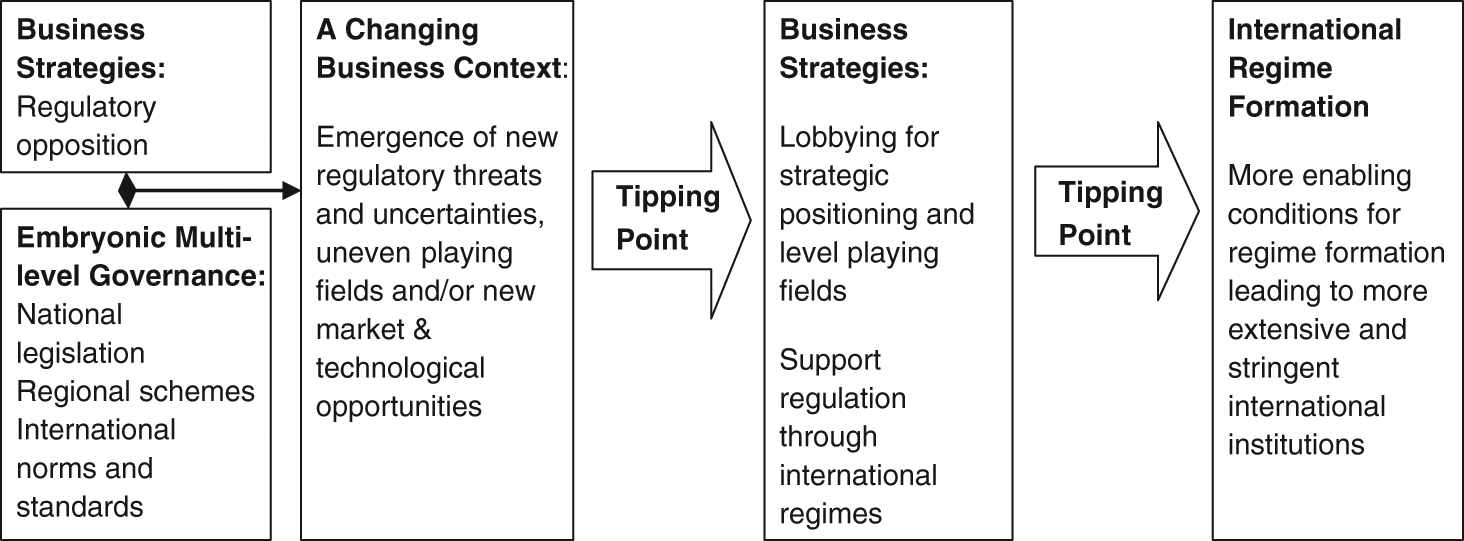
The tipping point model
This approach differs from the neo-Gramscian interpretation of regime formation, another notable model for analysing the intersections between business power and international regimes. While neo-Gramscians have rightly emphasized how the evolution of regimes should be seen as a product of both structure and agency — including macro-production relations and processes of bargaining over specific goals and rules between state, business and civil society actors (Levy and Newell, 2005: 48) — this account lacks a more precise notion of how the dynamic interplay between structures and actors’ preferences generates conditions for change. Indeed, regimes reflect the power, resources, preferences and strategies of state and non-state actors at particular points in time (Levy and Newell, 2005: 61), yet it is imperative that researchers investigate how these materialize and change over time in order to account for the conditions of political change. In focusing on the interplay between the structures of embryonic governance and business preferences as derived from perceptions of associated risks and opportunities, the tipping point model may improve our understanding of the process that underpins political and institutional change. Thus in contrast to the neo-Gramscian school — which views regime formation as a path-dependent progression embedded in structural conditions and relations of power (Levy and Newell, 2005: 62) — the tipping point framework emphasizes the conditions for trajectory change and progress in institutional formation.
It should also be noted that while the tipping point framework does not discount the role of ideologies and discourses in corporate preference formation producing shared understandings and values among firm managers (see Falkner, 2008: 36), it supports the notion that preferences and strategies should be seen as primarily driven by perceptions of economic, political and regulatory risks and opportunities.
The tipping point model also illustrates how traditional regime theory fails to account for conditions for change that emerge through the intersections between states and markets. Indeed, Young’s (1994) notion of equity, fairness and feasibility as central premises for successful regime formation is too narrow. For the formation process to succeed, the regime must not only be perceived as equitable, fair and feasible by participating states, it is also contingent upon the cooperation of liable industries who are ultimately responsible for implementing regulations and ensuring compliance. One might therefore posit that the support, or lack thereof, of major industrial lobbies represents an important premise for successful regime formation.
To be sure, the existence of other inhibiting factors may indeed slow or hinder the materialization of tipping points. If major provisions of an agreement such as burden sharing are perceived as fundamentally inequitable by parties (see Young, 1989, 1994), if negotiations lack the effective leadership of one or several major powers (Gilpin, 1987; Young, 1989, 1994), and/or if there is an absence of consensual knowledge regarding the nature and severity of the problem (see Hasenclever et al., 1997), a tipping point in business strategies may not be sufficient to cause the regime-formation process to tip as well.
In the next sections, the article gives a detailed account of the development of the international climate change regime, focusing on emerging governance structures, business strategies and international standards as the locus for explaining incremental change. Finally, the climate change regime is analysed within the tipping point framework.
The formation of an international regime to mitigate climate change
Climate change represents one of the most complex and pressing environmental problems facing mankind today. Since 1850, the global mean temperature has increased by 0.76°C, and scientists project that if appropriate action is not taken, the average surface temperature of the earth is likely to rise by a further 1.8–6.4°C in this century (IPCC, 2007b). Most of the warming that has occurred since the advent of the industrial era is very likely to have been caused by human activities, in particular the increasing combustion and consumption of fossil fuels, agriculture and land-use changes such as deforestation, which release carbon dioxide and other greenhouse gases (GHGs) into the earth’s atmosphere (HDR, 2007/8; IPCC, 2007a). If temperatures were to rise more than 2°C above pre-industrial levels, global warming is likely to bring about irreversible and potentially catastrophic changes in the climate system. Widespread melting of snow and ice will cause sea levels to rise between 18 and 59 cm — endangering low-lying costal areas and islands — and cause greater frequency and severity of extreme weather events, including droughts, floods and storms (IPCC, 2007c). As such, climate change is not only an environmental problem, but represents an all-encompassing threat to development, economic growth, human security, food supplies and health (Agder et al., 2003; HDR, 2007/8; O’Brien, 2006). To mitigate dangerous warming above 2°C, it is widely believed that man-made emissions of GHGs must be reduced by two-thirds within the first half of this century (HDR, 2007/8; Randers et al., 2006: 27).
Phase I: Business opposition to international climate governance
In response to the growing scientific evidence of anthropogenic warming during the 1970s and 1980s, the UN General Assembly convened the Intergovernmental Panel on Climate Change (IPCC) in 1988. The Panel’s mandate was to undertake a comprehensive review of the available scientific research on global warming, and to consider possible responses to limit or mitigate its adverse impact (IPCC, 2004). After the release of the historic First Assessment Report in 1990 — which concluded that emissions from human activities are enhancing the greenhouse effect, resulting on average in an additional warming of the earth’s surface (IPCC, 1990) — the UN began negotiations for an international convention to deal with the global warming problem.
The initial response of fossil-fuel-intensive industries was to launch a massive lobbying campaign against a binding treaty that would mandate states to curb carbon dioxide and other GHG emissions. The campaign was run mainly through the Global Climate Coalition (GCC), an organization representing some European, but predominantly US, businesses from the oil, coal, chemical manufacturing and automobile industries. The GCC denied the need for action, arguing that the theory of anthropogenic global warming was based on a series of scientific uncertainties, and that the observed rise in the average ocean and air temperature only reflected natural climate variability. The lobby also emphasized that the cost of GHG regulation would be too high and cause serious economic decline and loss of employment. The scientific and economic basis for action, the GCC maintained, was therefore too weak (Dunn, 2002; Kolk, 2001; Legget, 2001; Levy, 2005; Levy and Egan, 1998; Skodvin and Skjærseth, 2003). 4
The negotiations for an international treaty reached a conclusion at the Rio Earth Summit in 1992, where nearly all states signed the Framework Convention on Climate Change (UNFCCC). The Convention recognized the global warming threat and established a shared goal to stabilize GHG concentrations in the atmosphere at a level that would prevent dangerous anthropogenic interference with the climate system (Article 2). However, since the reduction objective was not made legally binding, the agreement represented a major success for the business lobby whose main goal had been to prevent the adoption of mandatory targets and timetables (Legget, 2001; Levy and Egan, 1998; Newell, 2000; Newell and Paterson, 1998). For now, fossil-fuel-intensive industries could proceed with business-as-usual.
The Convention included, however, a provision to negotiate further commitments under Article 17, stating ‘the COP may, at any ordinary session, adopt Protocols to the Convention’. Already at the next Conference of the Parties (COP) in Berlin in 1995, states adopted a mandate to settle quantified emissions limitations and reduction objectives for developed countries. Recognizing the principle of ‘common but differentiated responsibilities’ as contained in Article 7 of the Rio Declaration, states acknowledged that the largest share of historical and current GHG emissions originated from developed countries, that per capita emissions in developing countries remained relatively low, and that developing countries’ share of global emissions would thus need to grow in order to meet social and development needs. Therefore, the ‘Berlin Mandate’ exempted developing countries from mandatory emissions limitations, even through, collectively, the newly industrializing countries were expected to become the world’s largest emitters of GHGs in the next 15 years. 5
This was bad news for the business lobby. Not only did the provisions for binding targets represent a major setback, but a deal that did not include all major emitters would also create an uneven playing field in globally competitive, fossil-fuel-intensive sectors. The GCC therefore geared up their efforts to block the adoption of the envisaged Protocol. However, this time the lobby was unable to prevent states from moving forward. In 1997, parties signed the Kyoto Protocol, which imposed legally binding emissions reductions of an average 5.2% below 1990 levels for industrialized countries, so-called Annex 1 countries. 6 In the main, it set up a basic regulatory structure including three market mechanisms to facilitate implementation: (i) Emissions Trading (EM), (ii) Joint Implementation (JI) and (iii) the Clean Development Mechanism (CDM). 7 EM allows Parties to buy and sell emission permits (assigned amount units) between each other, while JI allows Annex 1 countries to obtain credits (emission reduction units) by funding emissions reductions projects in other Annex 1 countries, as an alternative to emissions reductions at home. The CDM allows Annex 1 countries to buy and sell credits acquired from emissions reductions projects in non-Annex 1 countries (certified emissions reductions) to meet their domestic reduction targets. While business could celebrate the Protocol’s use of market mechanisms, fossil-fuel-intensive industries situated in the developed world now faced tangible liabilities for their GHG emissions.
However, uncertainty as to whether the Protocol would actually enter into force persisted for many years. For the agreement to become operational, Annex 1 parties representing 55 percent of emissions would need to ratify the treaty. Also, in the US the GCC had relaunched their anti-climate lobbying campaign focusing on the scientific uncertainties, high costs of compliance and potential loss of competitiveness for US industry in the event of the adoption and ratification of an international Protocol (Levy and Egan, 1998). 8 Business lobbying against ratification and the growing unease with the Berlin mandate among, Republican Senators led to the adoption of the Byrd–Hagel resolution, which refuted any treaty that would exempt developing countries from undertaking legally binding commitments (see Levy, 2005; Levy and Egan, 1998; Newell, 2000; Newell and Paterson, 1998; Skodvin and Skjærseth, 2003). In Australia, too, powerful industry associations were successful in blocking ratification (Vormedal, 2008). While the Protocol did come into force in 2005 — following the long-awaited Russian ratification in 2004 — the withdrawal of the US and Australia had provided a major setback. Without their participation, Kyoto would only cover countries accounting for about 20 percent of global emissions.
Furthermore, in parallel to this ratification process, a number of different regional or sub-national climate policies and regulations proliferated outside of the Kyoto structure (see Koehn, 2008; Okereke and Bulkeley, 2007). In Europe, the EU Commission began preparations for a European Emissions Trading Scheme (ETS) in the early 2000s that would establish a common EU market for trading in GHG emissions, and ensure compliance with their international commitment. Despite the US Federal Government’s rejection of Kyoto, new GHG policy and legislation also emerged in a number of US states. California, which constitutes the world’s 10th-largest economy, has adopted new and rather progressive climate policies, 9 including targets to reduce GHG emissions by 11 percent by 2010, 25 percent by 2020 and 80 percent by 2050. 10 10 North-East and Mid-Atlantic states has also formed the ‘Regional Greenhouse Gas Initiative’ (RGGI) in 2005; a cap-and-trade scheme which aims to stabilize emissions from large power plants from 2009 to 2014, and subsequently to cap GHGs by 2.5 percent a year. 11
As such, in the period between the adoption of the Kyoto Protocol in 1997 and its coming into force in 2005, a multi-level governance structure including the Kyoto mechanisms and other regional and national schemes emerged, imposing new policy and legislation to curb GHG emissions from industry in the industrialized world.
Phase II: The tipping point in business strategies
Looking at the evolution of business lobbying, advocacy and engagement in the process of international rule-making, it is evident that during this period a tipping point in business strategies started to materialize. First, by the turn of the century, the decline of the antagonistic, fossil fuel lobby had become unmistakably evident. In 2002, the Coalition officially closed shop following the withdrawal of most of its key members, 12 who felt they could no longer be associated with the coalition’s aggressive, anti-climate stance (Skodvin and Skjærseth, 2003: 167). Second, the emergence and growth of a whole new field of more proactive business organizations, ranging from sector-specific interest groups to more generalist economy-wide and global associations, indicates an overall shift in how prominent business groups approached the issue of GHG regulation.
Under the umbrella of the International Emissions Trading Associations (IETA), a coalition of industries from a wide range of sectors established a platform for advocating market-based regulations and for influencing the design, functioning and performance of market mechanisms, including the Kyoto Protocol’s flexibility instruments and the EU ETS. Other interest groups have focused on promoting specific mitigation technologies and/or energy options, such as the World Coal Institute (WCI) and the International Petroleum Energy Conservation Association (IPIECA), which provide information and expertise related to carbon capture and storage (CCS) technologies and lobby policy-makers to promote the use of CCS as a mitigation option.
Most indicative of the shift in business strategies, however, is the growth of ‘green’ business organizations and networks representing carbon-liable industries that seek to position themselves as constructive partners in the effort to find solutions that can help mitigate climate change (see Vormedal, 2008: 40–42). These include the World Business Council for Sustainable Development (WBCSD), BusinessEurope, the 3C Business Leaders Initiative and Nippon Keidanren. 13 In contrast to the GCC, these ‘green’ business lobbies support an international, legally binding climate change treaty. The WBCSD, which represents over 200 companies from 35 countries and 20 major industrial sectors, has advocated international GHG regulation since 2005 (Timberlake, 2006), and has repeatedly called on governments to establish a post-2012, legally binding framework that would impose quantifiable, long-term GHG reduction targets on all major emitters. 14 The 3C Business Leaders Initiative and Nippon Keidanren have also pleaded with policy makers to replace the Kyoto structure with a truly global, legally binding regime that would ensure stabilization of GHG concentration below 550 ppmv, harmonize national rules and create a global price for carbon. 15
Another important development in the landscape of business organization is the growth of lobbies representing the renewable energy, clean-tech and financial investment sectors. These networks and organizations — including the International Council for Sustainable Energy (ICSE), 16 the International Carbon Investors Services, the Institutional Investors Group on Climate Change and the Investor Network on Climate Risk 17 — represent actors who view climate change as a business opportunity and seek to benefit from GHG regulation (Vormedal, 2008: 41–43). Since any increase in regulatory standards would augment the commercial viability of alternative, clean-energy options, international harmonization has not been a major concern for these groups, who have urged the UNFCCC to adopt a reduction target of 25–40 percent below 1990 levels by 2020, and 50–80 percent by 2050, for industrialized countries at a minimum. 18
Further indicative of a tipping point in business strategies is the recent emergence of business and civil society coalitions promoting climate change regulation. A notable initiative is the US Climate Action Partnership (USCAP), an alliance of prominent US businesses and environmental NGOs. 19 The USCAP advocates the adoption of a mandatory federal cap-and-trade programme in the US, and has called for the US to resume leadership in the UNFCCC and become a front-runner in clean-tech innovation which they believe will secure the long-term competitiveness of US industry. 20
The review of business engagement in the UNFCCC illustrates that in the aftermath of Kyoto in 1997, business opposition to GHG regulation decreased visibly, and that by 2005 business strategies had ‘tipped’ towards support and indeed advocacy for a international, legally binding regime to limit GHG emissions. Now, this cumulative process of strategic change can be explained by several interlinked factors.
First, the adoption and ratification of Kyoto and the parallel emergence of multi-level climate governance represents the manifestation of a growing regulatory threat during the 1990s, and for many fossil-fuel-intensive industries a high risk or probability of more extensive and stringent regulations. 21 This is likely to have contributed to the evident shift from lobbying against regulations per se, to lobbying for rules that favour a particular sector’s or industry’s strategic positioning.
Second, with the coming into force of the flexibility mechanisms and other regulatory schemes, carbon-liable industries have been forced to comply with a complex and globally uneven patchwork of regulations. The design of Kyoto, which exempted developing countries with large and/or fast-growing emissions like China, India and Brazil, and which by default did not include Australia or the US, rendered firms from countries having ratified Kyoto at a competitive disadvantage: they now faced standards and compliance costs from which many of their competitors were exempt. Many US companies, too, were increasingly confronted with an uneven playing field due to state-level regulatory schemes and standards or their operations in Europe and/or Japan. These industries’ preference for harmonized rules is also likely to have induced a shift in business strategies from opposition to support for an international climate regime.
Third, in response to the growing regulatory threat, many fossil-fuel-intensive industries have invested considerable time and resources into developing technologies that would enable their survival in a low-carbon economy. For example, Statoil and Total have emerged as front-runners in research and development of CCS technologies, while BP and Shell have diversified their portfolios by investing in renewables such as wind, solar, biomass and hydrogen. Automotive companies such as Ford and Toyota, furthermore, have paved the way in an emerging race to produce technologically and commercially viable low-emissions vehicles. Indeed, as low-carbon technologies mature over time, technological leaders would be relatively well suited to meet an increase in regulatory standards vis-a-vis their competitors. It is thus likely that the growth of economic opportunities and technological leaders in traditionally fossil-fuel-intensive sectors have contributed to inducing the strategic shift towards support for international GHG regulation.
Finally, the recent proliferation of policy, standards and regulation has also created new market opportunities and incentives for growth in clean-tech alternatives to fossil fuels. Indeed, private-sector investment in renewable energy and low-carbon technologies has increased substantially over the past decade (Boyle, 2004). Between 2002 and 2006, venture capital and private equity investment grew from $1 to $8.6 billion (Baue, 2008), and in 2007, the total sum of investment in clean-tech ventures reached $100 billion (Esty, 2008). These developments reflect the growth of business actors who may hope to emulate solid returns as GHG regulations expand and become more stringent (Labatt and White, 2007). 22 Furthermore, with the coming into force of Kyoto and the EU ETS, the value of the carbon market has grown rapidly from $22 billion in 2006 to $60 billion in 2007. 23 As the volume of trading has increased, many of the world’s largest banks have responded to the growing demand for financial and insurance instruments by developing new products and services that facilitate trading in emissions allowances, forward trade and hedge forward sales, and invest in emission reduction projects. The banks and institutions who provide financial and advisory services to support and enable trade in the carbon market thus have a vested interest in seeing an increase in regulatory standards, which would boost trading and demand for their products and services. As such, it is likely that new market opportunities related to low-carbon technologies, energy options and market activities have contributed to a shift in business lobbying towards support for market-based, GHG regulation.
There is thus ample evidence of the materialization of a tipping point in business strategies by the second half of this decade. The review of business engagement in the UNFCCC has illustrated how and why the preferences and strategies of a critical mass of industries have tipped from opposition to support for a legally binding international regime.
Phase III: A tipping point in international regime formation?
Recalling the conceptual model, its was argued that a tipping point in business strategies may also contribute to the commencement of a tipping point in regime formation. Looking at the history of the UNFCCC, it is apparent that there has been important progress over the past five years. When the Kyoto Protocol was signed in 1997, the principle of common but differentiated responsibilities — which provided the cornerstone for burden-sharing between developed- and developing-country parties — seemed almost unalterable. The principle was defended by environmentalists and developing countries alike, referring to the poorer nations’ lack of historical liability for global warming and their right to social and economic development. It became increasingly evident, however, that while the principle was based on legitimate equity and development concerns, it was not going to help solve the climate crisis. Indeed, developing countries, as a whole, were on a path to becoming the world’s largest emitters in the following decades. Moreover, the Kyoto framework for burden-sharing was causing serious competitiveness concerns in industrialized countries, leading to the withdrawal of the US and a system of grandfathering in Europe, 24 where industries have continued to threaten ‘carbon leakage’ to developing countries like China. These concerns and frustration with what many believed to be an ineffective and economically destructive legal framework were increasingly voiced by developed-country parties during the informal workshop ‘the Dialogue on long-term cooperative action to address climate change by enhancing implementation of the Convention’ (the Dialogue) initiated in Bonn 2006. At its concluding meeting during COP 13 in Bali, Japan tabled a proposal to continue the Dialogue in the form of official negotiations for a post-2012 deal, since the parallel negotiations for post-2012 targets under the Kyoto Protocol did not include the US or China. An effective international regime to mitigate global warming, it was argued, would have to include all major emitters. Despite US reluctance and stark opposition from G77/China, a compromise was reached in the final hours of the meeting, and resulted in the adoption of a mandate to negotiate a post-2012 treaty. The mandate stipulated commitments and actions to implement measurable, reportable and verifiable (MRV) emissions limitations for both developed- and developing-country parties, and set a deadline for negotiating the treaty by COP 15 in 2009. 25
Yet, already in the autumn of 2009, the UNFCCC Secretary and other heads of state announced that the road was too short and issues too complex for parties to deliver a comprehensive, legally binding treaty by COP 15 in Copenhagen. However, it was believed that an ambitious political agreement, which could later be turned into a legal treaty, was still within reach. Now, negotiations to establish binding emissions limitations post-2012 for Kyoto signatories had completely stalled on targets, as developed countries had grown increasingly unwilling to talk numbers without the participation of the US and emerging economies. Meanwhile, G77/China continued to maintain that a treaty mandating emissions limitations for developing countries was unjustified, in particular without significant developed-country funding of such emissions reductions. Building on previous bilateral consultations, 26 the result was a compromise agreement between President Obama and the Chinese Prime Minister Wen Jiabao. The US had announced that it would support and enable the establishment of a financial mechanism that would secure funding of developing-country mitigation actions and adaptation to climate change. In return, China would allow the financially supported emissions limitations to undergo international and independent monitoring, reporting and verification (MRV).
This compromise served as a basis for the drafting of the Copenhagen Accord. Most importantly, the Accord stipulates a commitment to ‘reduce global emissions so as to hold the increase in global temperature below 2 degrees Celsius’ (Article 2), and a provision to consider strengthening the long-term goal to a maximum temperature rise of 1.5 degrees Celsius (Article 12). Developed-country parties commit to implementing ‘economy-wide emissions targets for 2020 … [and will] thereby further strengthen the emissions reductions initiated by the Kyoto Protocol’ (Article 4). Developing-country parties, excluding the least developed countries (LDCs) and small island developing states (SIDS), also commit to implementing mitigation actions, and financially supported mitigation actions ‘will be subject to international measurement, reporting and verification in accordance with guidelines adopted by the COP’ (Article 5). Furthermore, developed countries commit to providing ‘scaled up, new and additional, predictable and adequate funding as well as improved access … approaching USD 30 billion for the period 2010–2012 with balanced allocation between adaptation and mitigation, [and] USD 100 billion dollars a year by 2020 to address the needs of developing countries’ (Article 8). Finally, the Accord establishes the Copenhagen Green Climate Fund to support projects, programmes, policies and other activities in developing countries (Article 10), and a Technology Mechanism to accelerate technology development and transfer in support of action on adaptation and mitigation (Article 11).
While the Copenhagen Accord has received extensive criticism for its failure to determine quantified reduction targets and a time frame for when the deal could be turned into a legally binding protocol, it nevertheless represents a major breakthrough in the history of the UNFCCC. For the first time, parties found a way out of the deadlock resulting from disagreement over burden-sharing by institutionalizing developed-country financing of developing-country mitigation and adaptation, resulting in an agreement mandating mitigation commitments and actions for all major emitters. And while the 2 degree goal is not yet made legally binding, it nevertheless represents the most stringent mitigation target to date.
As noted by the Earth Negotiations Bulletin, there has thus been substantial progress in the regime-formation process over the past five years:
Discussions have evolved from an informal one-day seminar for government experts in May 2005, through the Convention Dialogue and the Bali Roadmap, to the Copenhagen Conference, where, for the very first time, the majority of the world’s leaders gathered to frankly and seriously discuss climate change — now commonly recognised as a serious threat to humanity. Their discussions also covered a full range of formally ‘unmentionable’ issues, such as adaptation and mitigation by developing countries. Agreement was reached on mitigation actions by both developed and major developing countries, and billions of US dollars were pledged for short- and long-term finance. (Earth Negotiations Bulletin, 2009: 29)
As such, the Copenhagen Accord indicates the commencement of a tipping point in the formation of the international climate change regime. It is likely that after the shift in business lobbying, clearly evident from 2005, developed-country governments have increasingly sought to overthrow the Kyoto structure to establish a global regime including all major emitters in line with industry demands for international harmonization. Indeed, as this case study shows, these efforts were first evident in Bali and culminated at the COP 15 in Copenhagen. By illustration, the European business lobby ‘BusinessEurope’ sent a letter to the Swedish Prime Minister Reinfeldt, which argued that the EU should support and push for legally binding and equally strong emissions reduction commitments for all developed countries, a plan to introduce binding emissions targets for developing countries by 2020, and a universal regime for MRV. In the absence of a truly global agreement, it was argued, the EU should not increase its current 20 percent emissions reduction requirement. 27 Thus, industry lobbying, related competitiveness concerns and the threat of carbon leakage is likely to have induced developed-country governments to seek a compromise with G77/China and provide funding of developing-country mitigation and adaptation is provided in return for them taking on emissions limitation commitments.
Recalling Young’s model of institutional bargaining, it may be argued that it is the emergence of a deal perceived as fair and equitable that enabled parties to strengthen and expand the regime. However, it is the bargain over finance, with developed countries willing to pay the bulk of the bill for developing countries, that provides the major premise for the deal. It is unlikely that this bargain would have materialized without the support and indeed push from major industry lobbies.
Conclusion
This article has argued that current approaches to understanding international regime formation are too narrow, and has proposed an alternative framework for analysing regime formation in the environmental domain. The model posits that the intersections between states and markets, notably those between embryonic multi-level governance and business preference formation, are likely to generate a tipping point in business strategies from opposition to support for international regimes. It is argued that the shift in business strategies and lobbying may, in the next phase, also create more enabling conditions for inter-state bargaining and lead to the adoption of more extensive and stringent international institutions. The article has noted that the tipping point dynamic may provide a plausible account of the formation of an international regime to mitigate ozone layer depletion. Through a more detailed case analysis, it has been demonstrated that the tipping point model also provides a valid account of developments in the international climate change regime over time.