



Abstract
What are the consequences of increasing regime complexity and institutional proliferation on global governance? Does the growing density and overlaps among institutions facilitate or hinder the ability of states to manage transnational threats through cooperation? This article argues that the impact of regime complexity on the effectiveness of cooperation depends not only on the nature of spillovers among overlapping regimes, but also on the cross-institutional strategies of states and non-state actors. I distinguish between two types of strategies through which actors can take advantage of institutional overlaps: (1) “opportunistic” or non-cooperative attempts by states to bypass legal commitments, which tend to undermine the goals of cooperation; and (2) “cooperative” strategies by intergovernmental organizations, civil society organizations, and other principled actors. These actors also engage in regime shifting, forum linking, and other cross-forum strategies to promote their institutional mandates and normative agendas. To probe the plausibility of these theoretical claims, I focus on the case of the anti-trafficking in persons regime. The overlaps between anti-trafficking laws and the migration, labor, and human rights regimes illustrate the different ways in which intergovernmental organizations and their allies in society can exploit institutional overlaps to promote greater cooperation and expand the regime complex.
Keywords
Introduction
Recent times have witnessed an unprecedented expansion of institutionalized cooperation in world politics. The proliferation of overlapping agreements in various issue-areas has generated significant interest among scholars of International Relations (IR). Scholars have been particularly interested in the consequences of this growing complexity on the politics and effectiveness of global governance. How does the overlap among various institutions in a single issue-area affect the ability of states to manage transnational problems through cooperation? Under what conditions do regime overlaps facilitate or impair the goals of international cooperation? Also, to what extent and in what ways does regime complexity influence the strategies and choices of states and non-state actors?
A bourgeoning literature has made significant progress in elucidating the different causal mechanisms through which international regime complexity influences the patterns and dynamics of global governance. While some studies focus on the systemic level, emphasizing the spillovers and functional overlaps between institutions, others concentrate on the influence of regime complexity on actors’ strategies. Institutional overlaps provide state and non-state actors with opportunities for “forum shopping” and “regime shifting,” which they may exploit to circumvent costly commitments, or to promote more effective cooperation. In this sense, regime complexity may have both positive and negative effects on international cooperation.
While the early literature stressed how cross-regime strategies could enhance the effectiveness of cooperation, recent work has emphasized the adverse consequences of states’ opportunistic cross-forum behavior. In this article, I challenge the recent literature’s state-centric and pessimistic perspective, demonstrating how the cross-regime strategies of intergovernmental organizations (IGOs), civil society groups, and other non-state actors can contribute to the effectiveness and success of cooperation. Guided by shared values and other non-material considerations, these actors can take advantage of institutional overlaps to exchange information, create and reframe issues, diffuse norms, and even develop complementary legal instruments. Indeed, the cooperative strategies of these actors may offset the negative spillovers of overlapping institutions and the consequences of states’ non-cooperative behavior within the regime complex. Ultimately, the impact of regime complexity on global governance depends on the interplay between systemic spillovers and the types of strategies followed by state and non-state actors within overlapping regimes.
To illustrate these theoretical claims, I use evidence from international efforts to combat trafficking in persons (TIP). Growing international concern over human trafficking led to the signing in 2000 of the UN Protocol to Prevent, Suppress, and Punish the Traffic in Persons, especially Women and Children, as a supplement to the Transnational Organized Crime Convention. Apart from its political salience, the TIP case is particularly suited to engage in theory testing and building on regime complexes for a number of reasons. First, given the complex and multidimensional nature of the issue, the anti-trafficking regime overlaps in scope, focus, and membership with several other regimes, including agreements on human rights, migration, and labor standards. Second, in addition to states, the TIP issue intrinsically engages a varied range of IGOs and non-state actors, operating within and across different elemental regimes. Finally, because it lies at the intersection of politically and morally controversial issues, such as immigration, organized crime, and workers’ and women’s rights, the regulation of TIP touches upon both the material and moral considerations of state and non-state actors. It is therefore a useful case to explore the complementarity of rationalist and constructivist/sociological approaches to international cooperation.
The article is structured as follows. In the next section, I discuss the literature on regime complexes and international regime complexity (IRC), identifying the main hypothesized causal mechanisms linking institutional interactions with global governance outcomes. Building on these insights, I develop a typological framework that classifies regime complexes according to two dimensions: the nature of the systemic spillovers among elemental regimes; and the cross-institutional strategies of state and non-state actors operating within the complex. I then use three dyadic cases of institutional interaction — TIP and migration, TIP and human rights, and TIP and labor standards — to illustrate different types of regime overlaps: detrimental, constructive, and synergistic.
The evidence from the TIP case confirms that the impact of regime complexity hinges crucially on whether actors use legal overlaps to pursue cooperative or non-cooperative strategies. In the migration–TIP case, negative spillovers were exacerbated by states’ non-cooperative strategies, and, in particular, by their tendency to use TIP policies and rhetoric to contain irregular migration. By contrast, the two other cases show how actors’ cooperative cross-regime strategies can contribute to the effectiveness of global governance. In both cases, IGOs, in collaboration with non-governmental organizations (NGOs) and other non-state actors, led strategies of regime shifting and forum linking that contributed to broadening the focus of anti-TIP efforts. Indeed, the cases show the centrality of IGOs in issue framing, agenda setting, and rule making. Their cross-regime strategies had concrete legal outcomes, resulting in the development of a series of soft and binding legal instruments that complement anti-trafficking laws, expanding the regime complex and increasing its coherence.
The consequences of international regime complexity
The proliferation of overlapping agreements and institutions in a wide range of issue-areas of international relations has generated a bourgeoning body of theoretical and empirical research. Gradually, IR scholars came to recognize the inadequacy of prevailing assumptions in the earlier regime literature that international institutions were “self-contained” or stand-alone arrangements. In contrast, others began stressing the various linkages emerging among overlapping regimes in a single issue-area, and the ways in which such institutional interactions may condition their effectiveness (e.g. Aggarwal, 1998; Raustiala and Victor, 2004; Young, 1996, 2002).
The earlier work provided alternative ways of describing and classifying the different types of institutional interactions. Young (1996) differentiated among nested, embedded, clustered, and overlapping institutions. While some issue-specific arrangements are embedded or nested within broader institutional frameworks, overlapping regimes are characterized by intersections in their functional scope, membership, and/or specific rules and decision-making procedures. Others distinguished between vertical (or nested) and horizontal (or parallel) interactions, typically among arrangements at the same level of social organization (Aggarwal, 1998; Young, 1996). Overall, this literature was more concerned with identifying and explaining the emergence of different patterns of institutional linkages than with studying their consequences.
In a seminal contribution, Raustiala and Victor (2004) took the first steps toward developing a more systematic and theoretically grounded analysis of regime complexity and its effects. They introduced the concept of a “regime complex,” which they defined as “an array of partially overlapping and nonhierarchical institutions governing a particular issue-area” (Raustiala and Victor, 2004: 279). These “conglomerate” regimes, they argued, tend to be laden with legal inconsistencies because there is no explicit coordination between their overlapping rules. Using empirical evidence from the case of plant genetic resources, they derived a number of conjectures about the implications of regime complexity for the evolution of cooperation. Most importantly, they demonstrated that institutional density provides states with opportunities to engage in “forum-shopping,” selecting the venue where they hope to obtain the most favorable outcome (Raustiala and Victor, 2004).
Building on these insights, two recent bodies of literature have contributed to our understanding of the causal mechanisms through which institutional complexity influences international cooperation and global governance. The first, mainly concerned with international environmental agreements, focuses on dyads of regimes, investigating how and under what conditions one (“source”) institution influences the development and effectiveness of another (“target”) institution (Oberthür and Gehring, 2011; Stokke, 2001). A second body of scholarship concentrates not on specific cases of dyadic institutional interplay, but on the overall patterns resulting from complex interaction among several institutions. Alter and Meunier (2009), for example, look at “international regime complexity,” defined as “the presence of nested, partially overlapping and parallel international regimes that are not hierarchically ordered,” and its impact on the politics of international cooperation in several issue-areas. Along similar lines, Orsini et al. (2013: 29) focus on regime complexes, defined more broadly as “network[s] of three or more international regimes that relate to a common subject matter; exhibit overlapping membership; and generate substantive, normative or operative interactions.”
Despite their different units of analysis (dyadic versus complex interaction systems or “regime complexes”), both bodies of scholarship share the goal of shedding light on the consequences of increasing regime complexity and overlaps for global governance. In particular, this work seeks to explain how regime complexity affects the effectiveness of cooperation — whether it will make it “easier or harder to resolve or manage new transnational problems” (Orsini et al., 2013: 34). Moreover, both literatures concentrate on two main types of causal mechanisms. The first is primarily systemic, referring to causal relationships among institutions and bracketing the preferences and behavior of actors (Oberthür and Gehring, 2011). These systemic mechanisms include the spillovers or “functional linkages” that emerge between two (or more) institutions when the operation of one institution directly affects the effectiveness of another through shared activities (Young, 2002). According to Johnson and Urpelainen (2012: 646), there negative (positive) spillovers result when “cooperation in one issue area undermines (aids) the pursuit of objectives in another issue-area.”
Also focusing on the systemic level, the literature on IRC identifies the “unintentional reverberations” and “feedback effects” among overlapping and parallel institutions as one of the main pathways through which complexity may influence regime effectiveness (Alter and Meunier, 2009). For example, competition and the lack of coordination among different agencies working in a specific issue-area, such as economic development or humanitarian aid, may undermine their effectiveness (Hoffman, 2009; Kelley, 2009). In addition, developments in one institution could reverberate and have unintended adverse consequences across parallel institutions, as Betts (2009) shows happened in the case of the overlaps of the travel and refugees regimes. Much of the recent work has overemphasized the negative feedback effects of regime interplay. However, as the early literature on institutional interactions and regime complexity notes, spillovers could also be positive, leading to synergies and reinforced effectiveness among regimes. Ultimately, then, the two bodies of literature link systemic interactive effects among regimes with the effectiveness of cooperation.
By contrast, the second type of causal mechanism is actor-centered, mapping the influence of regime dynamics on actors’ preferences and choices, which, in turn, have consequences on the effectiveness of other regimes in the complex or dyad. In the dyadic approach, scholars examine how actors’ response to the commitments undertaken in one regime may limit their ability to comply with the rules in another institution. For example, under the World Trade Organization (WTO), states agree not to discriminate against goods produced in other countries with lower environmental standards. This commitment, however, prevents them from complying with the provisions of some international environment agreements that allow states to impose trade sanctions for environmental protection, such as the Montreal Protocol (Gehring and Oberthür, 2009).
The IRC literature, in turn, has examined the opportunities that regime complexity creates for states and non-state actors to engage in cross-institutional strategies, which affect not only the politics of international cooperation, but also its overall effectiveness. In the context of overlapping vertical or horizontal regimes, for example, actors can “forum-shop,” or select the venue where they believe they are more likely to obtain a favorable outcome. In addition, they can move negotiations and law-making activities from one venue to another so as to reshape the legal landscape and alter the constellation of actors involved in the process of decision-making — a strategy typically referred to as “regime shifting” (Helfer, 2004, 2009). Regime shifting also allows states and non-state actors to create “counter-regime norms,” or contradictory rules in a parallel regime, with the aim of challenging the established normative framework (Alter and Meunier, 2009; Morse and Keohane, 2014). In addition, states can exploit the rule ambiguity and legal fragmentation in some regime complexes to engage in a selective interpretation and implementation of their commitments (Helfer, 2009; Gehring and Faude, 2013).
The tendency in the recent literature has been to emphasize the detrimental effects of these self-interested strategies on the effectiveness of global governance. Forum shopping, regime shifting, and selective implementation and interpretation allow states to circumvent costly obligations, thus undermining compliance and creating inefficient competition among institutions. However, as Gehring and Faude (2014) argue, states belonging to more than one elemental regime in the complex also have an interest in preserving the overall institutional order and the collective goods that it provides. Given their mixed motives, therefore, these actors may push for a solution involving institutional adaptation and accommodation, possibly a division of labor among elemental regimes, which may ultimately result in “synergistic collaboration” (Gehring and Faude, 2013: 127; 2014). Incorporating these insights, therefore, one can expect actors within regime complexes to pursue cooperative or non-cooperative cross-institutional strategies. Ultimately, this will depend on the ways in which actors weigh incentives for regulatory arbitrage against their interest in preserving the collective goals of the regime complex.
IGOs, NGOs, and other non-state actors in regime complexes
From the start, scholars recognized that the increasing density of international institutions resulted in a more participatory process of global governance as “a growing array of national agencies, transnational organizations, and experts become engaged in decision making and implementation” (Raustiala and Victor, 2004: 277). Yet, in practice, much of the empirical work on regime complexity has concentrated on the role of states as the central actors within regime complexes. 1
This state-centric bias in the IRC literature is at odds with the more inclusive focus in the more recent work on global governance. Avant et al. (2010: 1), for example, show how a wide range of “global governors” — IGOs, professional associations, advocacy groups, corporations — have come to share different governance tasks, including: agenda setting and issue creation; rule-making; implementation and enforcement; and monitoring. Recent work has brought attention to the proliferation of “private transnational regulatory organizations” in global governance. These multi-stakeholder arrangements, comprising actors from civil society, business, and other sectors, also engage in various tasks of governance, including the adoption of standards of conduct for business and professionals, and monitoring and enforcing their implementation (Abbott et al., forthcoming).
These insights about the increasing plurality of actors in global governance can be applied to regime complexes. IGOs, NGOs, and other private actors interact with states within regime complexes. Just like states can engage in regulatory arbitrage to further their interests, IGOs and other non-state actors can take advantage of institutional overlaps to pursue their interests and their principled, non-material agendas. Recently, some scholars have examined the ways in which IGOs respond to states’ cross-institutional strategies in regime complexes (e.g. Betts, 2013; Pratt, 2015). However, this work remains primarily concerned with the material and strategic basis of state–IGO interactions. While this is a useful perspective, significant analytical leverage could be gained by incorporating insights from constructivist IR work on international organizations and transnational networks (e.g. Barnett and Finnemore, 2004; Finnemore, 1996; Keck and Sikkink, 1998).
From this perspective, IGOs are not just reflections of states’ power and interests, but autonomous actors that exercise authority in world politics through the rules they make. Moreover, this work recognizes that IGOs have both regulatory and “social constitutive” roles (Barnett and Finnemore, 2004). Apart from influencing the incentives and behavior of states through their regulatory and rule-making functions, IGOs use their knowledge and expertise to define meanings, create issues, and promote them as new norms. IGOs “teach” states new norms and models of behavior, helping to diffuse them internationally (Finnemore, 1993). Moreover, in performing these tasks, IGOs sometimes work with other non-state actors in the context of transnational advocacy networks (TANs) (Keck and Sikkink, 1998).
In sum, a better understanding of dynamics within regime complexes requires broadening our focus and paying greater attention to the role of other actors beyond states. In issues like trade or security, it may make sense to focus on self-interested states and their material incentives to use cross-institutional strategies to alter outcomes in their favor. In other realms of international affairs, however, non-cooperative tendencies of states may be at least partly offset by the principled or normative agendas of non-state actors and specialized IGOs. Guided not by narrow self-interest, but by principled beliefs, coalitions of IGOs and non-state actors may use cross-forum strategies to challenge a specific status quo in ways that contribute to the underlying goals of cooperation. Ultimately, whether regime complexes contribute to effective cooperation hinges upon the balance of spillovers among regimes, as well as the nature of strategies — cooperative or non-cooperative — pursued by states, IGOs and non-state actors.
A typology of regime complexes
With these qualifications in mind, I draw upon the existing work on institutional interactions and regime complexity to propose a typology of regime complexes (or overlaps) that takes into account the ways in which both types of causal mechanisms (see Figure 1) — systemic and actor-centered — interact to influence the overall impact of complexity on governance outcomes, and, in particular, on the effectiveness of cooperation. Moreover, as discussed earlier, I emphasize the role of states, IGOs, and non-state actors in pursuing cross-regime strategies within regime complexes.
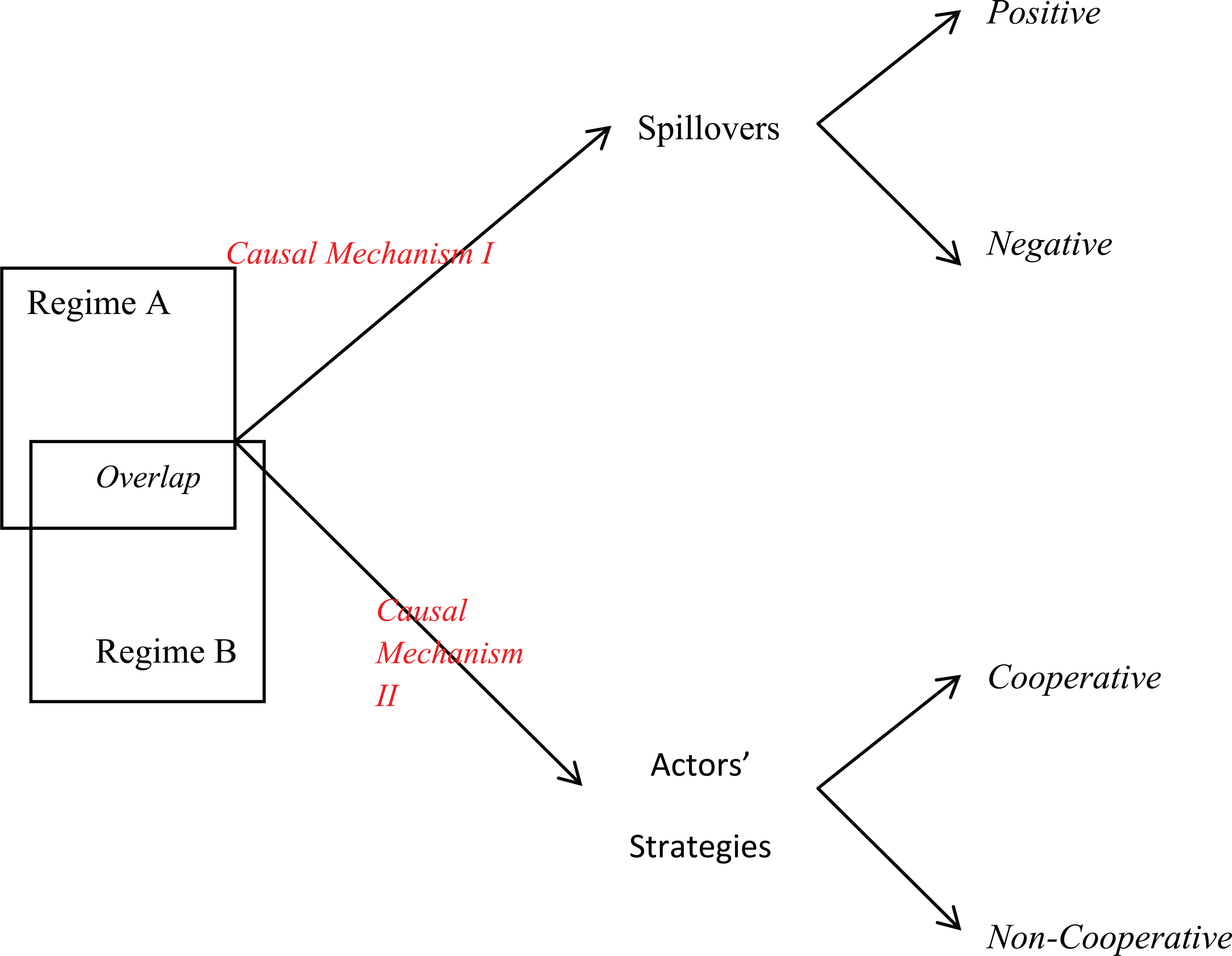
Causal mechanisms through which regime overlaps may influence global governance outcomes.
I assume a “regime complex” can be defined as a set of two or more institutions that overlap both in membership and regulatory scope, and that interact over substantive, normative, and operational considerations (Gehring and Faude, 2014). Following the early regime literature, I understand “effectiveness” in reference to the ability of institutions to: (1) reduce or solve the specific problems that they were created to address; and (2) influence the behavior and policy choices of member states (Levy et al., 1995; Young, 1999). I thus focus on the extent to which regime overlaps reinforce or undermine these problem-solving and behavioral effects of cooperation. Four hypothetical scenarios can be considered (see Figure 2).
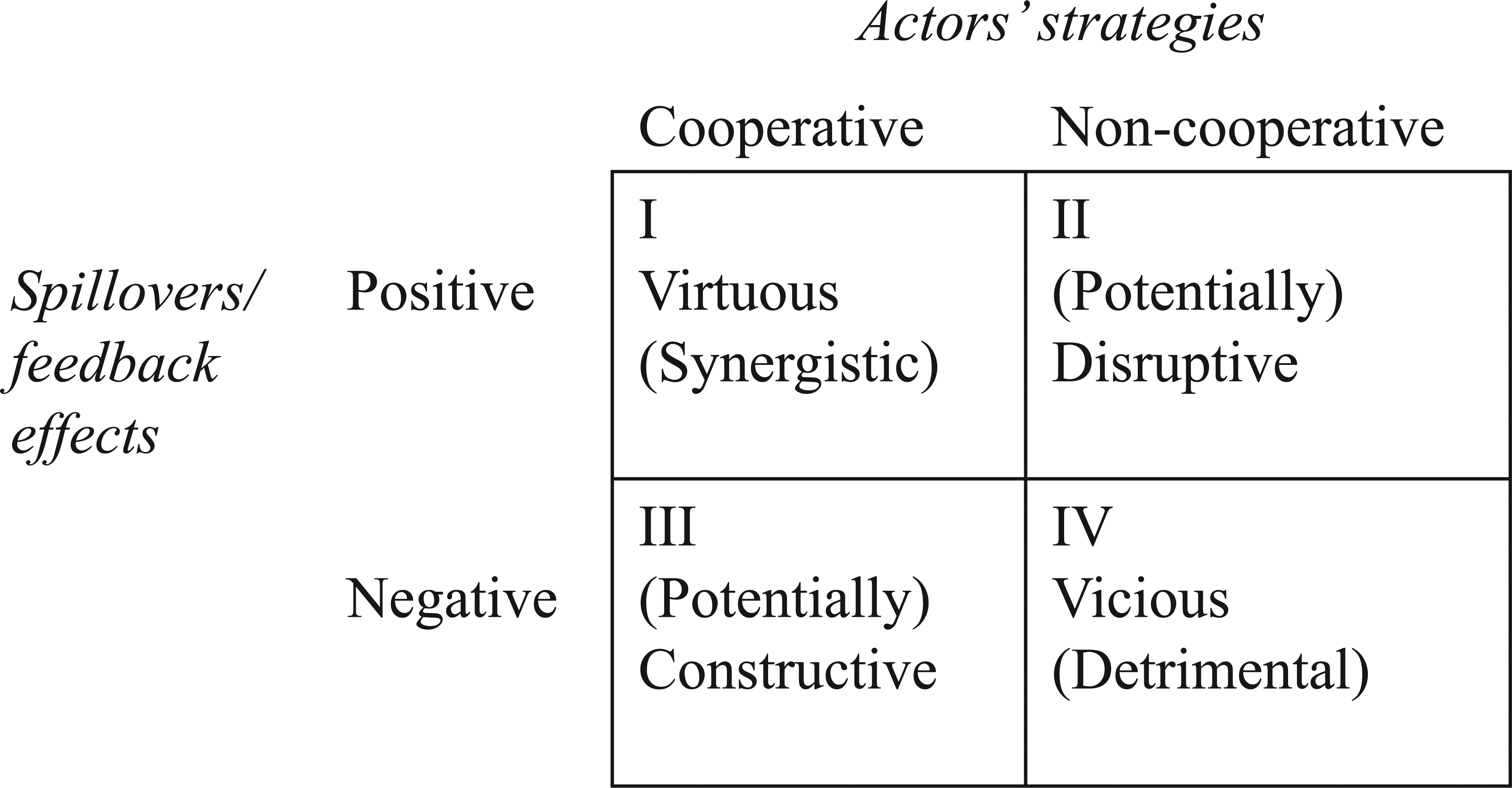
A typology of regime complexes.
In line with this framework, therefore, the impact of regime complexity on global governance outcomes depends on: (1) the nature of spillovers and feedback effects among overlapping regimes; and (2) the strategies of states, IGOs, and non-state actors operating within the regime complex (or dyad). While it may be hard, empirically, to find cases that perfectly conform to these ideal types, this framework may be used as a conceptual tool for clarifying and unpacking what is meant by “regime complexity” and for analyzing its consequences.
Regime complexity and the fight against TIP
In this section, I illustrate this framework’s usefulness using evidence from the global regime to combat TIP. Given the complexity and multidimensional nature of the issue, anti-TIP laws overlap substantively with other bodies of international law, including migration, human rights, and labor standards. In addition, the TIP issue engages a wide range of states and non-state actors from various international regimes, making it particularly suitable to study the role of the latter within regime complexes. Moreover, the various intersections of TIP with other regimes and issue-areas generate a number of dyadic sub-cases with variation across both of the dimensions of theoretical interest, namely, spillovers resulting from substantive overlaps and the types of strategies pursued by actors.
I begin by summarizing the main features of the contemporary anti-TIP regime, its evolution, and how it overlaps with other regimes in world politics. I then focus on three (sub-)cases of regime overlaps: TIP and migration, TIP and human rights, and TIP and labor standards (see Table 1). Each of these dyads represents a different configuration of the two causal mechanisms of interest, making them particularly useful to illustrate the different categories in the typology presented earlier. 2 In the first case, there are negative spillovers between the migration and TIP regimes, which are exacerbated by the non-cooperative behavior of states. In contrast, in the TIP–human rights case, despite predominantly negative spillovers, IGOs collaborated with NGOs to promote a rights-based approach to TIP and shift rule making to human rights fora. Finally, in the TIP–labor standards case, a coalition of IGOs and non-state actors built on positive spillovers to launch a strategy of regime shifting and forum linking that successfully advanced the goals of both regimes.
Case studies.
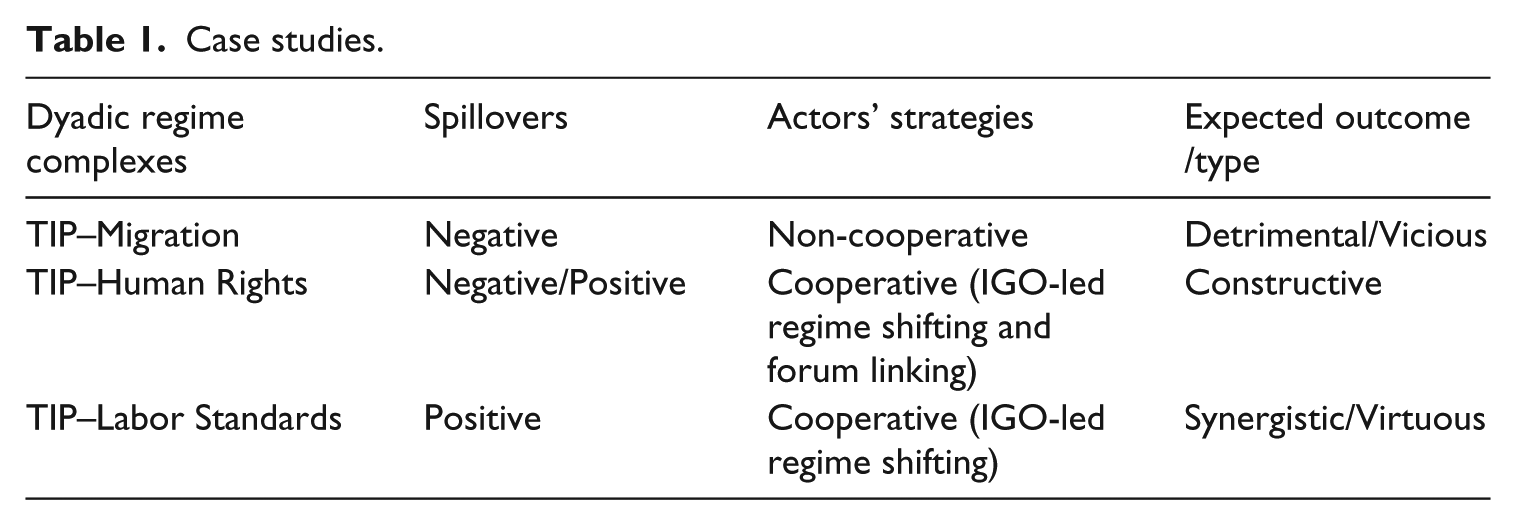
In each case, I look first at the nature of spillovers and feedback effects between the regimes, assessing the extent to which cooperation in one regime contributes or undermines the goals of the other. I then examine the cross-institutional strategies and behavior of states and non-state actors. In the final section, I summarize the findings from the case studies, analyzing the impact of each of the overlaps on the effectiveness of international cooperation against TIP.
The anti-TIP regime
International efforts to combat the trade in human beings are far from new. At least five international agreements on this topic were signed in the first half of the 1900s. These early instruments, which focused on the prostitution and sexual exploitation of women, were negotiated within the human rights system. By contrast, the agreement at the center of the current anti-human trafficking regime, the UN Trafficking Protocol, emerged in the context of broader global efforts to fight transnational organized crime (Bruch, 2004; Gallagher, 2010). A supplement to the UN Convention against Transnational Organized Crime (UNTOC), the Trafficking Protocol provided the first international definition of human trafficking. This definition goes beyond prostitution and sexual exploitation to include other forms of exploitation, such as slavery, forced labor, servitude, and the removal of organs. 3
The Protocol contains three sections, each focusing on a different aspect of its so-called “3P” (prosecution, protection, prevention) approach to trafficking. Part I contains specific provisions requiring states to adopt measures to criminalize trafficking (Article 5), yet limiting its scope to those offenses conducted by organized criminal groups, a requirement that reflects the framing of TIP as a criminal issue and a threat to state authority (Simmons et al., 2011). This approach to trafficking as a national security problem is also evident in the Protocol’s emphasis on border control measures and cooperation among national law enforcement authorities as strategies of prevention. Thus, Article 11 in Part III of the Protocol requires states to “strengthen … such border controls as may be necessary to prevent and detect trafficking in persons.”
In Part II, the Protocol also requires states to take action to protect and assist victims of trafficking. According to critics, however, the Protocol contains little “hard” or detailed obligations for states to protect victims. Article 6 establishes that each government “shall ensure” (emphasis added) that its domestic legal or administrative system provides victims with legal assistance, as well as the possibility of obtaining compensation for damages suffered. The treaty’s language is even softer when it refers to the legal status of victims in receiving states, establishing that parties “shall consider adopting legislative or other appropriate measures that permit victims … to remain in its territory, temporarily or permanently, in appropriate cases” (emphasis added).
The Protocol also distinguishes TIP from migrant smuggling, which is the subject of a separate instrument. The Protocol against the Smuggling of Migrants by Land, Sea, and Air (Smuggling Protocol) is also embedded within the UNTOC and places strong emphasis on criminalization and law enforcement. Smuggling is defined as “the procurement, in order to obtain, directly or indirectly, a financial or other material benefit, of the illegal entry of a person into a State Party of which the person is not a national or a permanent resident.” Signatories are obliged to take all necessary measures to punish smugglers and accomplices, but not necessarily migrants themselves. However, smuggled migrants, unlike trafficked people, are not considered “victims” of exploitation and are hence not entitled to special state protection or assistance.
Since the signing of the Trafficking Protocol in 2000, a comprehensive range of international, regional, and national anti-TIP laws have emerged around the world. In addition, given the complex and multidimensional nature of this issue, anti-trafficking laws intersect with international agreements in other issue-areas. First, there are overlaps between the TIP regime and international and national migration laws. Two international agreements concerning migrants, the Smuggling Protocol and the International Convention on the Protection of the Rights of Migrant Workers and Members of their Families (MWC), overlap functionally with the Trafficking Protocol. While the MWC does not specifically refer to trafficking, it is relevant to this issue given that a significant proportion of trafficking victims are “migrant workers,” defined as persons who engage in remunerated activity in a state of which they are not nationals. Evidence suggests that many of these migrants begin their journeys voluntarily, frequently relying on third parties or smugglers, but end up finding themselves in situations of exploitation. In practice, therefore, it is difficult to distinguish among the overlapping phenomena of voluntary migration, trafficking, and smuggling, making the boundaries between these three instruments unclear.
Second, there are overlaps between the TIP and the human rights regime. The 1948 Universal Declaration of Human Rights and the 1966 International Covenant on Civil and Political Rights (ICCPR) contain prohibitions on slavery, servitude, and the slave trade. TIP also violates key international agreements on women’s and children’s rights, such as the 1979 Convention on the Elimination of All Forms of Discrimination against Women (CEDAW) and the Convention on the Rights of the Child (CRC), which contain specific prohibitions on trafficking and the sexual exploitation of women and children. The 1951 Convention and Protocol Relating to the Status of Refugees, at the intersection of the human rights and migration regimes, also has relevance and applicability to trafficking situations (Piotrowicz, 2008).
Finally, the TIP regime intersects with international agreements over labor standards, and, in particular, with the International Labor Organization’s (ILO’s) 1930 Forced Labor Convention (No. 29) and the 1957 Abolition of Forced Labor Convention (No. 105). Convention No. 29 defines forced labor as “all work or service which is exacted from any person under the menace of any penalty, and for which the said person has not offered himself/herself voluntarily.” The Trafficking Protocol, in turn, lists forced labor as one of the end purposes of trafficking but leaves the term undefined, directly linking it to the definition in Convention No. 29. 4 The ILO’s Worst Forms of Child Labor Convention (No. 182) and its 1998 Declaration on Fundamental Principles and Rights at Work, both of which contain specific provisions on forced labor, are also relevant for anti-trafficking efforts.
In sum, as Figure 3 illustrates, multiple legal and substantive overlaps characterize what can be viewed as an anti-TIP regime complex. What are the consequences of these various institutional overlaps for the governance of TIP? Do they contribute to or undermine the main goals of TIP laws, namely, the prevention of trafficking, the prosecution of traffickers, and the protection of victims? The remainder of this article addresses these questions.
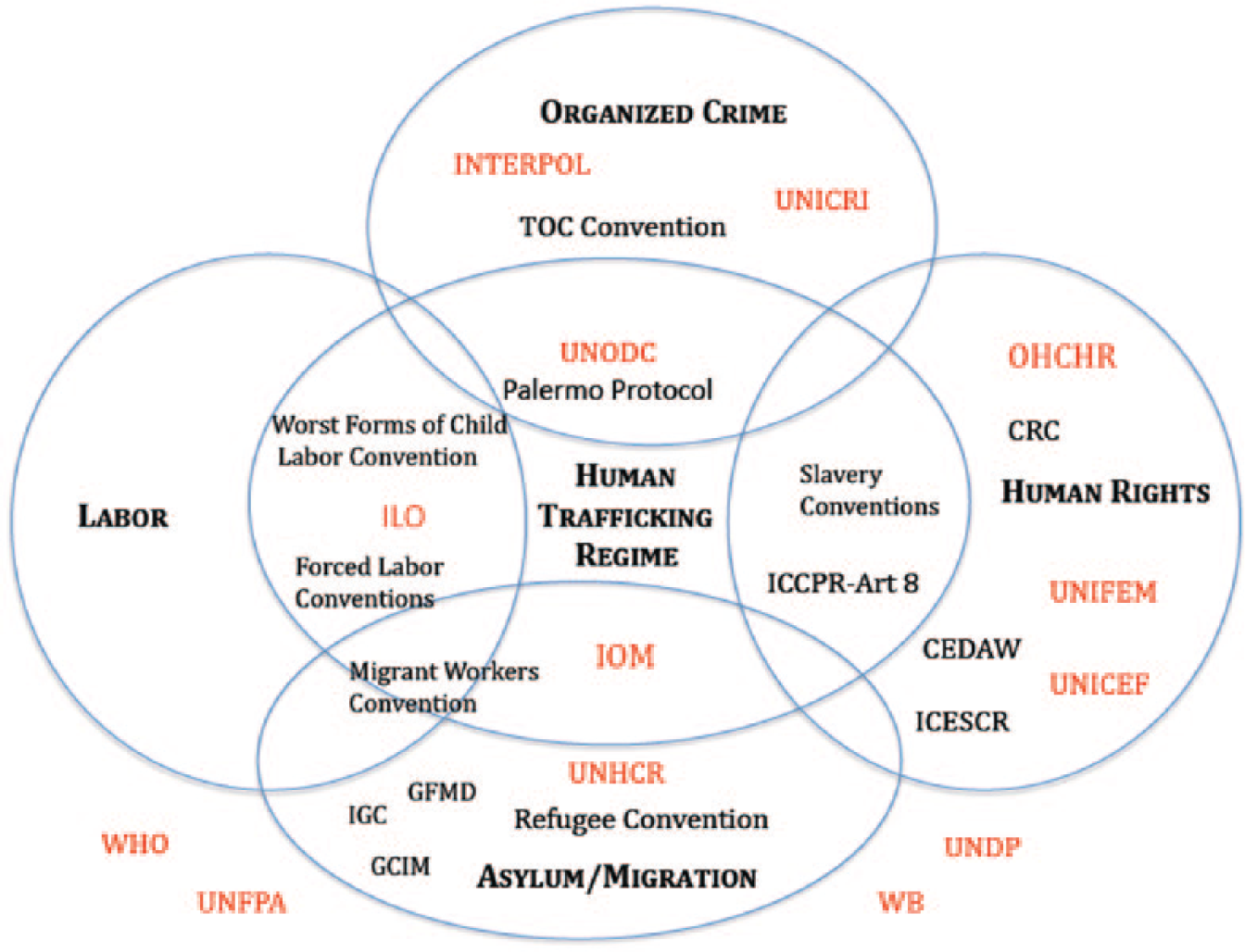
The TIP regime complex.
Vicious cycle: Migration and TIP
The overlaps between the TIP and migration regimes constitute a good example of a vicious or detrimental type of regime complex, combining negative spillovers and feedback effects with non-cooperative behavior by states. I first discuss how restrictive migration policies and weak cooperation in the protection of migrant workers undermine the goals of the TIP regime. I then turn to states’ behavior within the regime complex, arguing that their tendency to let migration concerns guide the implementation of anti-TIP policies has indirectly undercut the goals of the TIP regime.
Spillovers
There are various negative spillovers between the migration and TIP regimes. First, in contrast to many other issue-areas in international relations, migration is characterized by the absence of a formal multilateral regime and by limited and fragmented interstate cooperation. Whereas states have agreed to comprehensive rules for the liberalization of the flows of goods, services, and capital, no such consensus has emerged regarding the mobility of people. In fact, since the 1990s, most developed countries have tightened migration restrictions, while developing “illiberal international cooperation” schemes aimed at stopping irregular migration (Betts, 2013). Evidence suggests that by making it harder to migrate within legal channels, these strict border measures have the unintended effect of pushing more people toward illicit options, such as smuggling (GAATW, 2010). Smuggled migrants, moreover, tend to be at a greater risk of trafficking and exploitation both during the process of migration and upon arrival at destination countries (Amnesty International, 2014; ICHRP, 2010). Thus, restrictive unilateral migration policies undermine the goals of both the Trafficking and Smuggling Protocols.
Second, one would expect to see positive spillovers between the Trafficking Protocol and the MWC. Cooperation in the protection of migrant workers’ rights contributes to the goal of combating and preventing trafficking (and vice versa). However, the flip side of these positive spillovers is that the absence of cooperation in the protection of migrants exacerbates the problem of TIP. Developed countries have been reluctant to sign the MWC, which has only been ratified by 46 (sending) states (Pécoud and de Guchteneire, 2006). Instead, most destination countries prefer to offer temporary, “guest worker” programs to address seasonal increases in labor demand. As these temporary programs typically give employers excessive control over workers’ migratory status and have limited provisions on labor standards, they increase workers’ vulnerability to exploitation and trafficking (Chacón, 2010; Fussell, 2011; Loftus, 2011). 5
These negative feedback effects are reinforced by one aspect of the Trafficking Protocol itself, namely, its emphasis on border controls for TIP prevention. Addressing TIP through stricter border security has the unintended consequence of increasing migrant workers’ exposure to exploitation, thus undermining the goals of the Trafficking Protocol and of the MWC. A negative feedback loop results as restrictive national migration policies combine with a weak international migrant workers’ regime to increase smuggling and trafficking (see Figure 4).
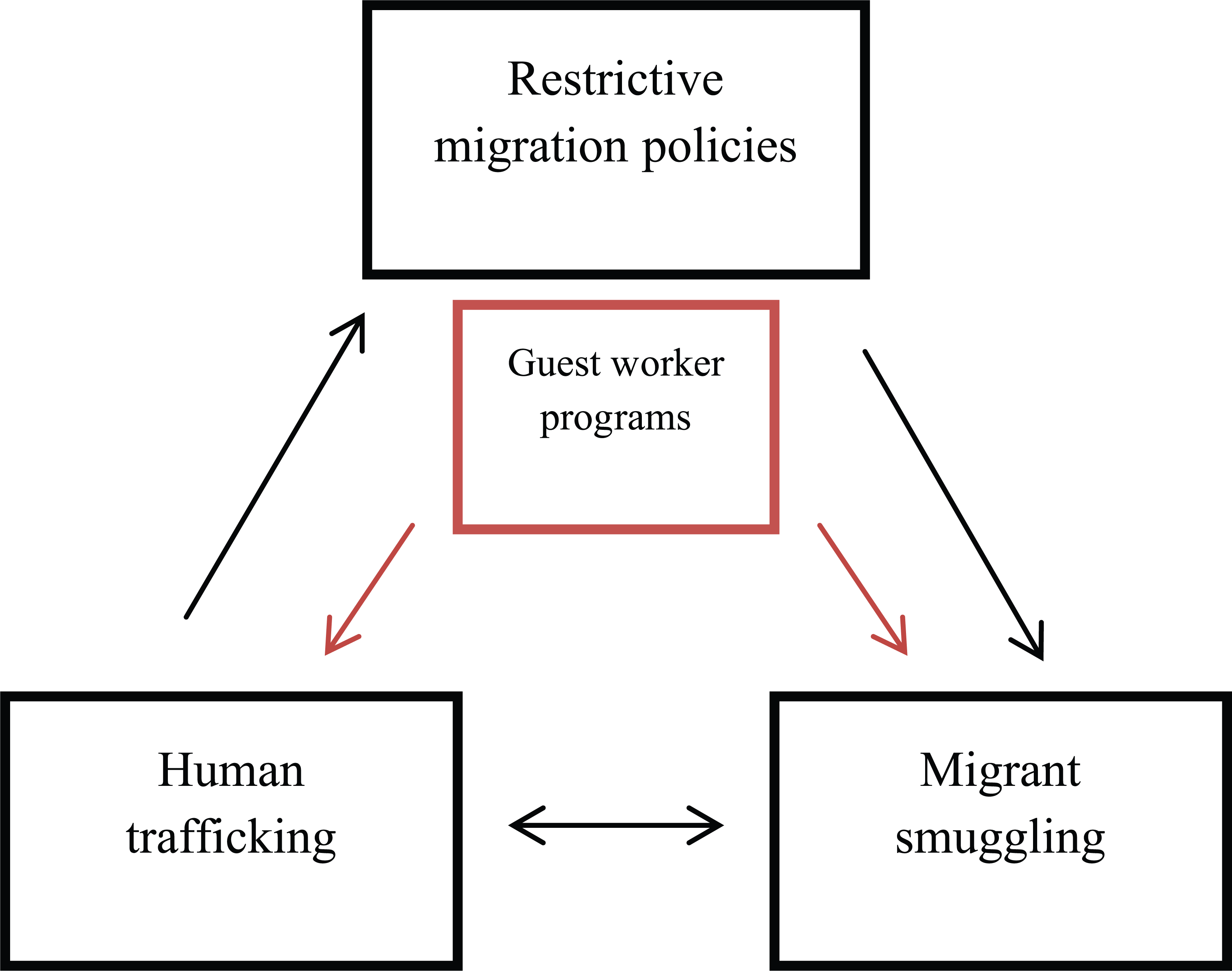
Negative loop between migration and anti-TIP policies.
Actors’ strategies
In addition to these negative spillovers, states appear to exploit regime overlaps in opportunistic ways, letting migration concerns influence their anti-TIP policies. At least two examples of such non-cooperative behavior can be identified: (1) the use of anti-TIP policies to affect migration outcomes; and (2) the tendency of states to take advantage of legal overlaps and vagueness to bypass commitments to protect and temporarily accommodate trafficking victims.
States use anti-TIP measures to contain migration
A frequent criticism of the current anti-trafficking regime is that states use anti-TIP instruments and rhetoric to affect migration outcomes, in particular, to justify attempts to restrict irregular migration (Chuang, 2006; Gallagher, 2001; Hathaway, 2008; Kneebone, 2010). In Hathaway’s (2008: 6) words: “the border control emphasis … has provided states with a reason — or at least a rationalization — for the intensification of broadly based efforts to prevent the arrival or entry of unauthorized non-citizens.” 6 States counter these claims by emphasizing the links between illegal migration and trafficking, or, put differently, they frame TIP as a security, migration-related threat, which calls for stricter border enforcement. Ample empirical evidence points to the ineffectiveness of stricter migration policies to contain both illegal entries and trafficking, suggesting that if not opportunistic, states’ policies are short-sighted. 7
A similar debate surrounds another tool that states have used to prevent TIP, namely, information campaigns by destination countries. Typically, these campaigns are implemented in sending countries and are used to promote the various types of risks — including detention — that migrants face upon arriving in destination countries. Activists and scholars argue that these campaigns are more concerned with discouraging migration at its roots than with preventing TIP (Nieuwenhuys and Pecoud, 2007).
States engage in selective implementation and interpretation
In addition, evidence suggests that states tend to take advantage of legal overlaps surrounding the phenomena of irregular migration, migrant smuggling, and human trafficking in order to bypass some of their anti-TIP commitments. Despite the blurred distinctions between these categories, the UN Trafficking and Smuggling Protocols treat them as separate and provide little guidance on potential identification problems that may arise in practice (Bravo, 2007; Chuang, 2006). In this context of legal and conceptual vagueness, government officials have incentives to identify migrants as either “irregular” or “smuggled” rather than as “trafficking victims” in order to avoid the higher level of obligation that they face under the Trafficking Protocol. Indeed, in many countries, whereas trafficking victims are entitled to temporary residency permits and other benefits, irregular and smuggled migrants are promptly repatriated and sometimes even criminalized. Research indicates that immigration authorities in the US and elsewhere, for example, tend to treat individuals falling in a “gray area” as cases of voluntary migrants who are not eligible for victim protections under national laws (Center for Social Justice, 2013; Chacón, 2010; Miller and Baumeister, 2013).
In recent years, awareness of the importance of protecting migrant workers from exploitation has grown. Activists, analysts, and academics have successfully raised awareness about the links between TIP and weakly regulated labor markets (Chacón, 2006, 2010; Freedom Network, 2012; Loftus, 2011; SPLC, 2013). In its 2011 annual report on TIP, the US Department of State also acknowledged the impact of “guest worker programs” on human trafficking (US DOS, 2011). In 2014, US lawmakers introduced a bill aimed at improving worker visa programs, with the explicit aim of preventing human trafficking. 8 These are steps in the right direction. However, breaking the vicious cycle in Figure 4 will require greater state commitment, both by engaging in international cooperation and by reforming national migration policies.
Constructive overlaps: Human rights and TIP
The human rights–TIP overlap, by contrast to the migration–TIP case, illustrates the ways in which other actors can take advantage of institutional overlaps to pursue cooperative strategies. I begin by discussing the negative human rights externalities of the TIP regime and then turn to the cross-regime strategies of human rights activists and IGOs.
Spillovers
Human trafficking constitutes a severe violation of human rights. By combating trafficking and protecting victims’ rights, the TIP regime clearly contributes to the objectives of various international human rights treaties. At the same time, greater respect for human rights erodes opportunities for individuals to be caught in situations of labor exploitation and human trafficking, reinforcing the positive spillovers between the two regimes.
However, as a supplement to the UNTOC and part of the international criminal law framework, the UN Trafficking Protocol puts forward a strong crime control approach to trafficking, placing more emphasis on the prosecution of perpetrators than on the protection of victims. Even more worryingly, the Protocol’s strong emphasis on prosecution, law enforcement, and border control has been viewed as having “negative human rights externalities,” thus undermining the regime’s own protection objectives (GAATW, 2010; Hathaway, 2008). In many countries, for example, trafficking victims are punished for crimes committed as a consequence of their trafficking. In others, benefits and protections are contingent on victims’ willingness to participate in prosecution efforts as witnesses. In addition, some of the measures taken to protect victims, such as detention and forced repatriations/deportations, violate their individual rights and freedoms and expose them to re-trafficking and reprisal risks. Finally, activists claim that some trafficking prevention policies undermine the rights of non-victims of TIP, such as sex workers, refugees, and women migrants (Center for Social Justice, 2013; GAATW, 2007; Gallagher and Pearson, 2010).
Actors’ strategies
While states were the dominant actors in the TIP–migration regime complex, other actors, particularly IGOs, had a central role in the TIP–human rights case. IGOs, with input from NGOs and other activists, were the main norm entrepreneurs, taking advantage of the overlaps between the TIP and human rights regimes to: (1) reframe trafficking as a human rights violation and promote a “rights-based approach” to the issue; and (2) develop (soft) legal instruments within the human rights regime that complement the criminal law approach of the UN Protocol.
IGOs, with inputs from NGOs, use forum linking to reframe the issue
Until the late 1990s, TIP was conceived exclusively as a human rights issue and the main legal instruments concerning trafficking were part of international human rights law. The decision to negotiate the Trafficking Protocol within the framework of the UN Organized Crime Convention thus marked a controversial shift, relocating trafficking “from the sacred chambers of the international human rights system to the area of the UN that dealt with drugs and crime” (Gallagher, 2010: 4). Nevertheless, a broad coalition of IGOs and civil society organizations concerned with human rights participated actively in the process of negotiations. Led by the “Inter-Agency Group,” this group sought to make the Protocol compatible with human rights instruments (UNODC, 2006). 9
After the signing of the Protocol, and in light of its weakness in terms of victims’ protection, this group continued to advocate for a rights-based approach to TIP (Jordan, 2002). NGOs were particularly active in disseminating information and raising awareness about trafficking as a human rights violation (Tzvetkova, 2002). Organizations like the Global Alliance Against Traffic in Women (GAATW), for example, published reports highlighting the negative human rights externalities of anti-TIP laws, and providing recommendations to government officials and other service providers on how to protect victims’ rights (GAATW, 2001, 2007). They participated in consultations with IGOs in the human rights regime, such as the Office of the UN High Commissioner for Human Rights (OHCHR) and the UN Children’s Fund (UNICEF), as well as with other multilateral and regional organizations, including the United Nations Office on Drugs and Crime (UNODC), the European Union (EU) and the Organization for Security and Cooperation in Europe (OSCE). 10
IGOs, especially UN agencies and European regional organizations, were even more central in spreading the human rights approach to TIP. In 2004, the UN Commission on Human Rights appointed the first Special Rapporteur (SR) on Trafficking in Human Beings, Especially Women and Children, “to focus on the human rights aspects of the victims of trafficking in persons.” 11 The SR produces country reports assessing the anti-TIP policies of member states, paying special attention to their protection dimension. 12 In 2003, moreover, the OSCE created the office of the Special Representative and Coordinator (SRC) for Combating Trafficking in Human Beings, which has consistently approached the issue “both as a security threat and a human rights issue” (OSCE, 2013). Since 2004, this office has coordinated the OSCE Alliance against Trafficking in Persons, a platform for information exchange between European organizations, UN agencies, and other TIP experts and activists.
IGOs shift rule making to human rights forums
However, beyond raising awareness and helping to spread the human rights approach to TIP, IGOs took advantage of regime overlaps and shifted rule making on TIP from the criminal law to the human rights regime. The OHCHR took the lead, initiating a process of consultations with experts, practitioners, representatives of UN agencies, and civil society organizations in 2000. These discussions led to the adoption in 2002 of the Recommended Principles and Guidelines on Human Rights and Human Trafficking. The document provides “practical, rights-based guidance” in the implementation of national and international anti-trafficking laws (Robinson, 2002: 62). Going beyond the UN Protocol, it also calls for governments to ensure that trafficking victims are not prosecuted for violations of immigration law or for activities that they may participate in as a result of their being trafficked. The Principles is thus the first legal document to recognize that the non-criminalization of victims is essential to their protection (Hoshi, 2013).
Building on the Principles, other UN agencies subsequently developed their own guidelines and recommendations for protecting the rights of the specific populations they serve in trafficking situations. In 2006, the UN High Commissioner for Refugees (UNHCR, 2006) adopted its Guidelines on International Protection, focusing on the rights of trafficking victims to apply for asylum and refugee status. That same year, UNICEF also published guidelines calling for the protection of trafficked children during the process of identification, recovery, and reintegration of trafficking victims (UNICEF, 2006).
The principle of non-punishment, seen as the core of the rights-based approach to TIP (Hoshi, 2013), was also endorsed by UN member states and incorporated in a number of General Assembly resolutions and in the 2010 UN Global Plan of Action to Combat TIP. More interestingly, the non-punishment provision migrated back to the criminal law regime and was included in the UNODC Model Law, developed in 2009 to provide guidance for states in their process of national implementation of the Trafficking Protocol. 13 Although not legally binding, these instruments served to clarify the relationship between TIP commitments and their human rights obligations, thus facilitating state learning on how to manage overlapping regulations.
They also informed the design of European-level binding instruments, most notably, the 2005 Council of Europe (COE) Convention on Trafficking in Human Beings. Consistent with the COE’s historical focus on human rights, the European Convention places more emphasis on victims’ protection than the UN Trafficking Protocol. 14 Indeed, in its preamble, the Convention recognizes that TIP constitutes a violation of human rights and identifies the protection of victims as “a paramount objective.” According to several activists and policymakers interviewed, moreover, the Convention’s text directly influenced the design of the 2011 EU Directive on Trafficking in Human Beings, 15 which has been viewed as the most progressive so far in terms of victim protection (OSCE, 2013).
In sum, the cross-regime cooperative strategies of the human rights coalition were effective in raising awareness and facilitating learning about the complementarities between the TIP and human rights regimes. The growing number of anti-TIP rules and initiatives that include the non-punishment principle (see Figure 5) is evidence that, while the crime framing of TIP may still be dominant (Charnysh et al., 2015), the rights-based approach has been spreading, particularly in Europe.
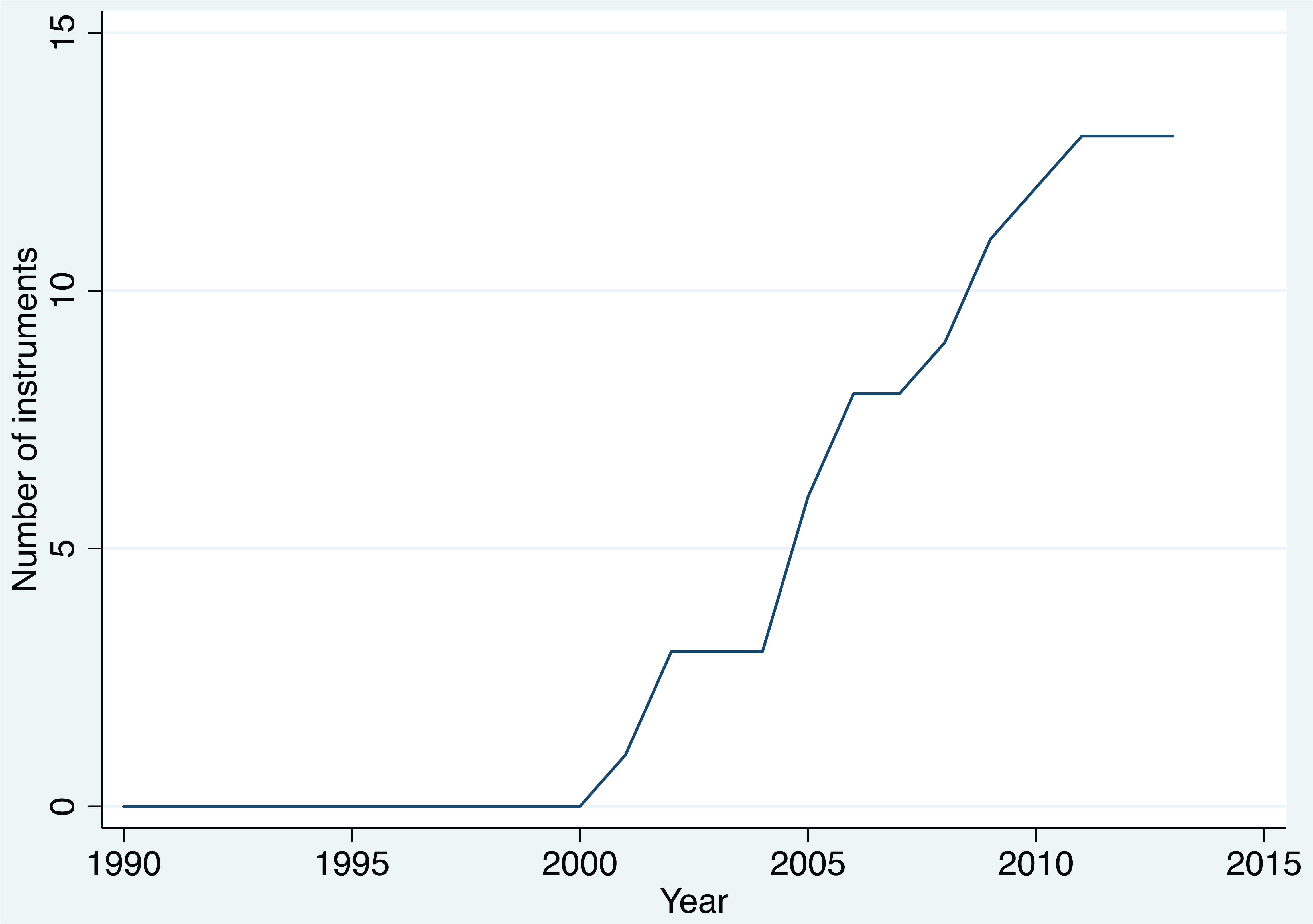
Anti-TIP instruments that include the non-punishment of victims principle.
Virtuous cycle: Labor standards and TIP
The labor standards–TIP case illustrates the best possible scenario — one in which both dimensions of theoretical interest point toward more and more effective cooperation. Complementarities and positive spillovers between the two regimes were reinforced by the cooperative strategies of IGOs and other non-state actors. In fact, while IGOs still have a pivotal role, the labor standards–TIP overlap engages a broader set of actors, including not only NGOs, but also trade unions, workers’ organizations, and recently also businesses.
Spillovers
There are significant overlaps and complementarities between TIP laws and international labor standards, and, in particular, forced labor laws. The Trafficking Protocol lists forced labor as one of several end purposes of human trafficking. While the term “forced labor” is not defined in the Protocol, previous drafts of the instrument explicitly referred to the definition provided by ILO Conventions No. 29 and No. 105. None of the ILO Conventions refer specifically to human trafficking. However, the ILO’s Special Action Programme to Combat Forced Labor treats trafficking as one among several other “modern” forms of forced labor. 16
These slight differences in terminology notwithstanding, there are positive spillovers between the two regimes. Human trafficking constitutes a violation not only of international laws on forced (and child) labor, but also of other labor standards concerning decent working conditions and fundamental rights at work. Combating and preventing trafficking contributes to a reduction of coercive labor practices. Similarly, the implementation and enforcement of international labor standards reduces the opportunities for trafficking situations.
Yet, these positive feedbacks between the two regimes have not been fully realized. This is because, despite the broad legal definition of TIP, in practice, much of the focus in the anti-trafficking campaign has been on the sex trafficking of women and children, with less attention paid to the exploitation of workers in other sectors (Chuang, 2010; McCarthy, 2014). In fact, in some countries, national laws exclude trafficking for labor exploitation from the definition of TIP. As discussed later, recently, states have broadened the focus of their anti-trafficking efforts, contributing positively to the goals of both regimes.
Actors’ strategies
Actors’ cooperative cross-institutional strategies reinforced the positive spillovers between the two regimes, contributing to their effectiveness. An increasingly broad coalition comprising IGOs, NGOs, workers’ organizations, and trade unions used forum linking and regime shifting to redirect the focus of anti-trafficking efforts away from sexual exploitation and toward labor trafficking. Three steps in this process are discussed in the following, each of which entails a broadening of relevant actors within the regime complex: (1) IGOs’ reliance on forum linking to raise “labor trafficking” as an issue and place it on the agenda; (2) IGO–civil society collaboration in raising awareness of trafficking in supply chains and of the responsibility of business in addressing it; and (3) the interaction of states, IGOs, and other non-state actors in the development of binding and non-binding instruments that complement existing TIP laws.
IGOs use forum linking in issue creation and agenda setting
The ILO was a central norm entrepreneur, leading the process by which labor trafficking emerged as an issue, and it came to occupy an important place in both the anti-TIP and forced labor agendas. Although not as actively involved in the negotiation of the Protocol, this organization gradually increased its participation in global anti-trafficking efforts (Bruch, 2004). Initially focusing on the trafficking and forced labor of children, the ILO soon became aware of the overlap and complementarity between forced labor conventions and TIP laws and broadened the scope of its activities to address the human trafficking of adults. While most other agencies and NGOs concentrated on sexual trafficking, the ILO realized that it could build upon its close links to workers’ and employers’ organizations to lead the fight against trafficking for forced labor in other sectors. 17
The first step in this strategy was to raise awareness of the severity of trafficking for forced labor in the global economy. With this aim, in 2001, the ILO (2001) published a report, Stopping Forced Labor, bringing attention to the persistence of labor exploitation in numerous sectors of the private economy and identifying labor trafficking as one among several types of these exploitative practices (Plant, 2012). As a follow-up to the document, in 2002, the ILO created the Special Action Programme to Combat Forced Labor, which identified TIP as one of its areas of focus. Around the same time, international NGOs like Human Rights Watch, Free the Slaves and Verité also began raising awareness of and mobilizing support against forced labor and labor trafficking. 18
The second step was to mobilize international support against labor trafficking from a broader range of stakeholders. In a report published in 2005, A Global Coalition Against Forced Labor, the ILO (2005) called for the establishment of global and local partnerships among employers’ and workers’ organizations, the academic and policy communities, civil society organizations, UN bodies, and other multilateral agencies. The goal was to move beyond the disagreements surrounding trafficking and to “zoom out to focus on something that everyone agrees is a problem: the exploitation of migrant workers.” 19 Accordingly, the ILO partnered with other IGOs, becoming a member of the steering committee of the UN Global Initiative to Fight Trafficking (UN.GIFT), which has given extensive attention to labor trafficking. 20 The International Trade Union Confederation (ITUC) and other sectoral trade unions and workers’ organizations also became important partners. 21
IGOs collaborate with civil society to broaden the issue further
This expanding network then directed its efforts to engaging business in the fight against labor trafficking. This was not an easy task. It required, first of all, persuading business managers that they were responsible not only for their labor and hiring practices, but also for those of their suppliers and other partners in global value chains. Apart from using moral arguments, activists emphasized material incentives for businesses to act. For example, in one of the first publications on TIP and business, UN.GIFT (2010: 6) stressed that trafficking entails both legal risks and “a threat to brand or company reputation.”
Increasingly, attempts to make businesses accountable for labor trafficking have taken place within the context of multi-stakeholder initiatives, in which IGOs and NGOs collaborate with firms and consumers to promote “supply chain transparency.” Once again, NGOs have been crucial sources of information both for corporations and consumers in monitoring the trafficking risk or “slavery footprint” of goods produced within complex global value chains. 22 Some organizations like Oxfam and Free 2 Work rate the performance of corporations according to their transparency and efforts to maintain clean supply chains. In other initiatives, such as the Fair Labor Association (FLA), the International Cocoa Initiative, and the Global Social Compliance Program (GSCP), NGOs and labor unions work with companies to promote information exchanges on good practices (Copulsky et al., 2014; Linich, 2014).
States, IGOs, and non-state actors engage in rule making
The efforts of the labor trafficking network gradually began to pay off. In the past few years, labor trafficking has acquired increasing salience on the international policy agenda. The concept of supply chain transparency, although not specific to labor trafficking and forced labor debates, has also generated growing attention. 23 However, in addition, the past five years have witnessed important normative and legal developments, with the emergence of both soft instruments and binding international and national laws at the intersection of the TIP and the forced labor regimes.
First of all, there has been a proliferation of voluntary codes in which businesses pledge to combat labor trafficking and ensure supply chain transparency. While some older initiatives on business and human rights, such as the UN Global Compact, and the Organisation for Economic Co-operation and Development (OECD) Guidelines for Multinational Enterprises (MNEs), made reference to labor rights, they did not specifically mention human trafficking (OSCE, 2014). By contrast, the codes emerging in the past decade emphasize labor trafficking, acknowledging the responsibility of companies to monitor their supply chain. Some of these codes, such as the Athens Ethical Principles, are multi-sectoral and negotiated within the context of multi-stakeholder initiatives. Others are sector-specific, such as those developed by sectoral associations representing the clothing, tobacco, and electronic industries. 24 In addition, some individual companies have developed their own anti-trafficking guidelines and codes of conduct. 25
Second, states have taken concrete steps toward the establishment of international and national laws focusing specifically on labor trafficking, and creating obligations for businesses in ensuring trafficking-free supply chains. In 2010, the US state of California introduced the Supply Chain Transparency Act, requiring retail sellers and manufacturers to disclose the concrete efforts they take to monitor trafficking and forced labor in their supply chains. Efforts to expand this legislation at the federal level led to the introduction in 2014 of the Business Supply Chain Transparency on Trafficking and Slavery Act, which is still under consideration. In 2012/2013, the UK Parliament considered a similar law, the Transparency in the UK Companies Supply Chains Bill. Although this bill failed to pass, a provision on supply chain transparency was subsequently added to the 2015 Modern Day Slavery Act.
At the international level, in 2014, ILO members adopted a new Protocol to the Forced Labor Convention No. 29. This binding instrument specifically addresses trafficking for labor exploitation, updating and extending the reach of the Convention to reflect the changing nature of labor exploitation. Apart from updating ILO forced labor laws, the Protocol enhances the complementarities between the latter and the TIP regime.
Summary
What does the case of TIP tell us about regime overlaps and their impact on global governance? Do regime overlaps facilitate or impair the effectiveness of international institutions and cooperative initiatives? The three sub-cases show that the impact of regime complexity on cooperation depends not only on the substantive overlaps and spillover effects among institutions, but also, and crucially, on whether actors use legal overlaps to pursue cooperative or non-cooperative strategies (see Figure 6).
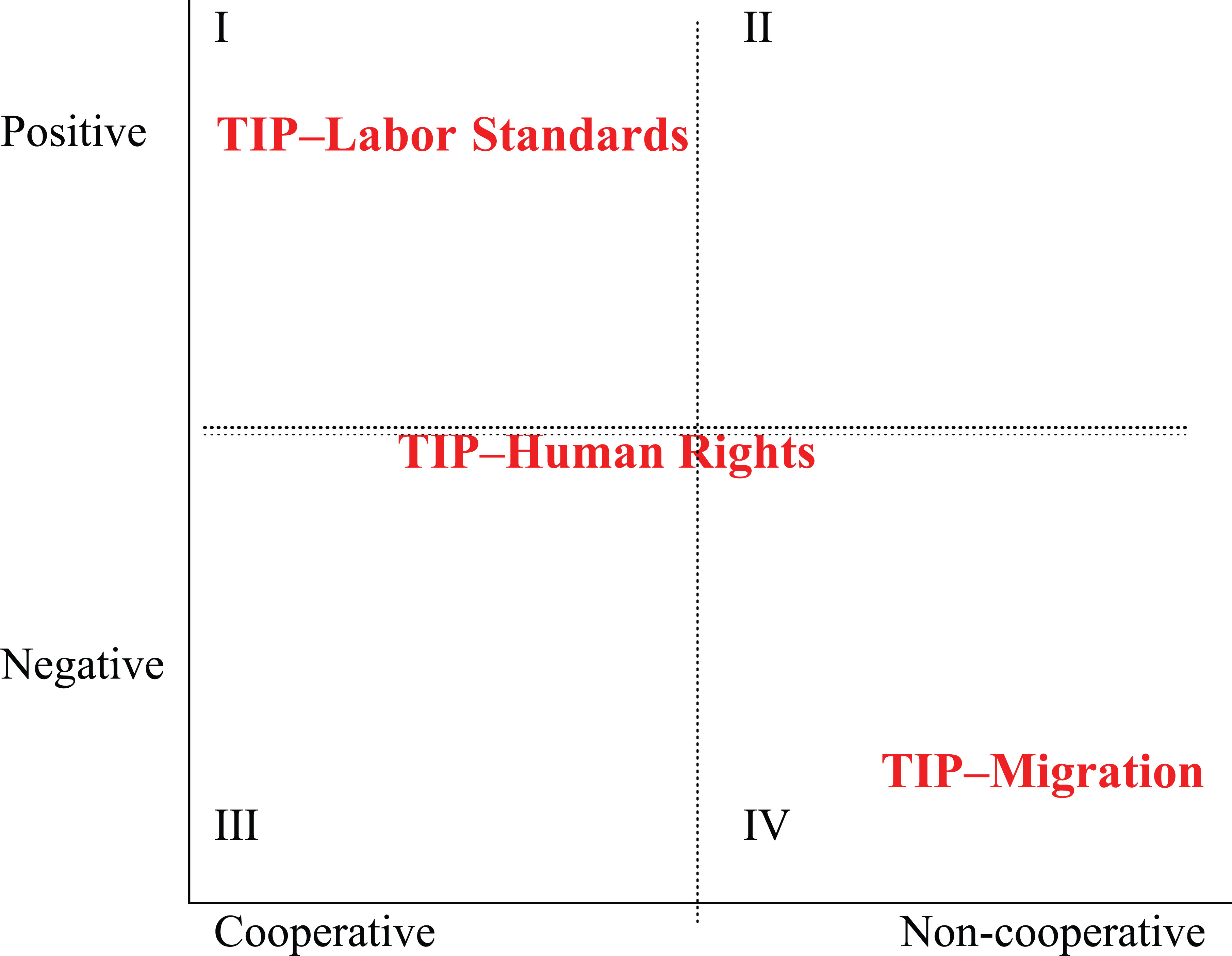
Three types of regime complexes.
The TIP–migration case may be viewed as an example of a “detrimental” regime overlap in which both causal mechanisms worked to undercut the goals of the anti-TIP regime. A negative feedback loop among restrictive national migration policies, a weak migrant labor protection regime, and a TIP regime stressing border controls for prevention increases the vulnerability of migrants to trafficking and exploitation. The tendency of states to let migration concerns influence their anti-TIP policies exacerbates these negative spillovers. This is not to say that states deliberately seek to undermine cooperation in the TIP regime. Rather, the ways in which governments respond to TIP–migration overlaps, for example, by using anti-TIP policies to contain irregular migration and taking advantage of legal vagueness to avoid commitments on victim protection, have had that unintended effect.
By contrast, the other two sub-cases illuminate how complexity can result in more, not less, cooperation. In both cases, IGOs and non-state actors exploited institutional and substantive overlaps to engage in cooperative strategies. IGOs were pivotal norm entrepreneurs, relying on forum linking and regime shifting to broaden the focus of anti-TIP efforts. In the human rights–TIP case, UN agencies collaborated with activists to reframe TIP as a human rights violation and to promote a rights-based approach. In the labor standards–TIP case, in turn, IGOs successfully linked the TIP and forced labor agendas, creating “labor trafficking” as an increasingly salient issue. IGOs then collaborated with other non-state actors in further broadening the issue to emphasize the role and responsibility of business actors in preventing trafficking for forced labor in supply chains.
In the two cases, moreover, IGO-led cooperative strategies led to the development of new rules and norms, which complement the UN Protocol in important ways. Indeed, by incorporating the principles of the non-punishment of victims and of supply chain transparency — both absent from the Trafficking Protocol — these soft and binding legal instruments contribute to filling normative gaps in the anti-TIP regime (see Figure 7). At the same time, by enhancing the complementarity between elemental regimes, these new instruments not only expand the anti-TIP regime complex, but also increase its coherency.
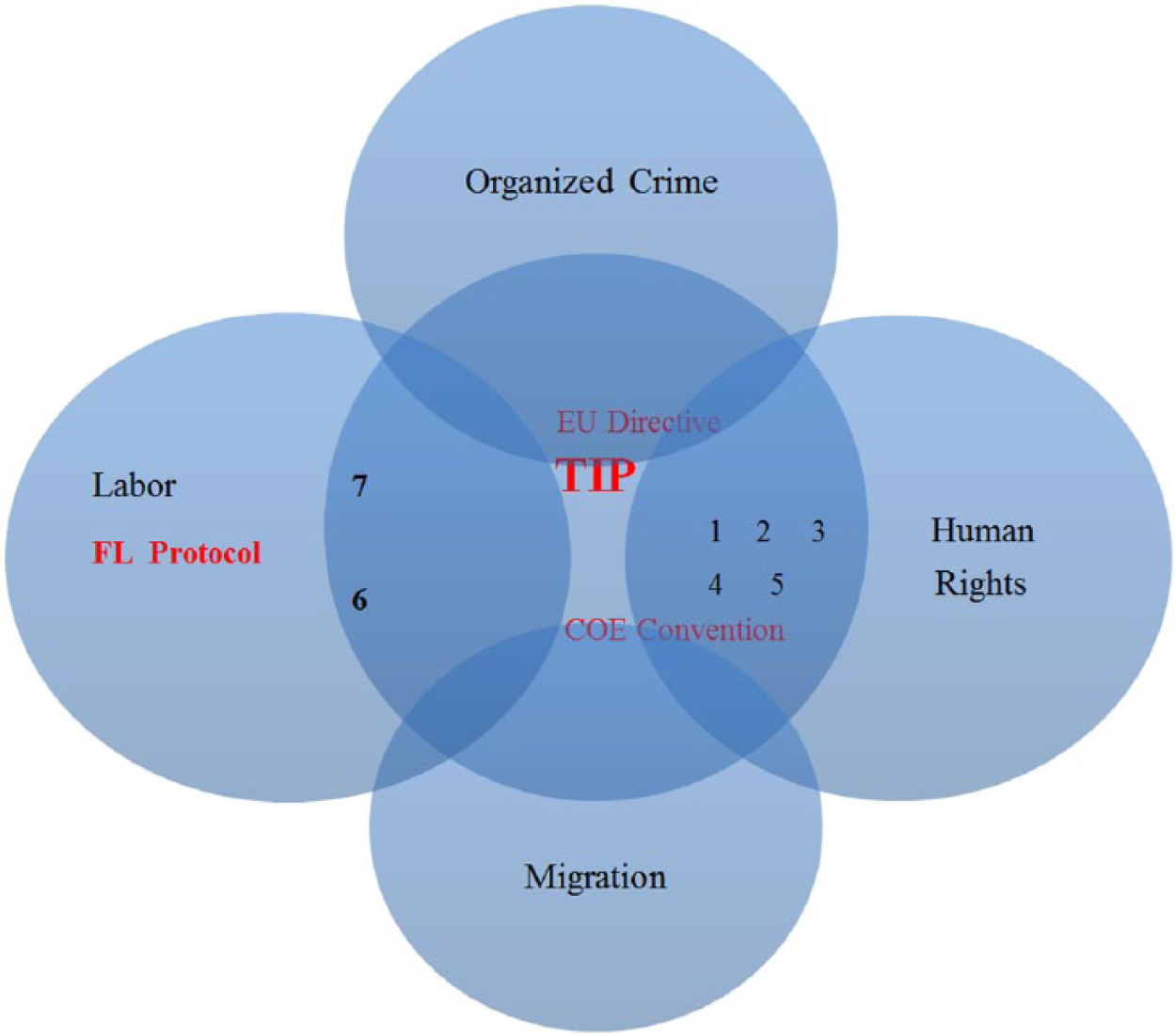
Expanded regime complex.
It may be too soon to assess the actual impact of these new instruments and the extent to which they enhance the effectiveness of the TIP regime. Yet, by signaling the commitment of states and non-state actors to address previously neglected issues such as the non-punishment and protection of victims and labor trafficking, they constitute a step in the right direction. If implemented, the new rules will contribute to the three objectives of the TIP regime, namely, protection, prevention, and prosecution. Indeed, data on the evolution of anti-trafficking policies in Europe, where the spread of the rights-based approach has been clearer, shows an improvement in the protection and assistance offered to victims, especially in terms of the number of granted residence permits. 26 The increase in the number of labor trafficking cases prosecuted and convicted in the last few years is also evidence of the positive effects of the labor trafficking campaign.
Conclusions
This article explores the consequences of regime complexity on global governance outcomes. Drawing upon evidence from the case of TIP, it argues that by facilitating the cooperative strategies of IGOs, activists, and other principled actors, regime complexes can contribute to more effective global governance.
How do we know that regime complexes really matter though? Empirically demonstrating the causal relevance of regimes has been a significant challenge for IR scholars. Regime complexes present an even harder task in this respect — they require showing that the overlaps among institutions had an independent causal impact on outcomes. One useful exercise is to consider the counterfactual: what would global anti-trafficking efforts be like if the TIP regime complex did not exist or if it had been characterized by less overlaps?
The evidence from the TIP case is consistent with previous findings in the IRC literature. It suggests that regime complexes broaden the options for states and non-state actors as they pursue their material and non-material goals. Of course, states are still central actors in international cooperation. However, overlapping rules in a regime complex influence the strategies, choices, and even preferences of these state actors. For example, in the migration–TIP overlaps, had the distinctions and overlaps between the different categories of migrants — smuggled, trafficked, irregular — been more clearly spelled out in legal instruments or had the latter contained more specific guidelines on how to handle overlaps and identification challenges, then states would have had less scope to selectively apply these norms.
Similarly, as discussed earlier, the existence of sturdier international commitments on migration and migrant workers’ protection would have lessened the legal contradictions and negative spillovers between the two regimes. In particular, a stronger intergovernmental agency at the center of the migration regime could have collaborated with anti-TIP and migrant rights activists to push for complementary norms, thus enhancing the compatibility of migration and anti-TIP rules. Indeed, the evidence from the case studies underscores the centrality of IGOs as norm entrepreneurs and rule-makers. Their legitimacy, expertise, and close connections with states and non-state actors allowed UN agencies like the OHCHR and ILO to play a pivotal role within the TIP regime complex.
The evidence from the two other sub-cases, on the other hand, highlights the ways in which regime overlaps matter for IGOs, activists, and other private actors. Regime complexes broaden the options available to these actors at each stage in the global governance process: issue creation and framing, agenda setting, rule making, and enforcement. In the TIP case, regime overlaps provided NGOs and other activists with multiple interlocutors and entry points into the policy process. They facilitated the exchange of information and collaboration with actors in other regimes, as illustrated by the creation of the OSCE Anti-Trafficking Alliance and other cross-regime initiatives. These interactions enabled the exchange and spread of frames across regimes. Had these not taken place, perhaps the spread of the non-punishment principle to a growing number of soft and binding anti-TIP laws, including the UNODC Model Law, would not have materialized. Thus, far from being mere “talk shops,” regime overlaps increased the reach and effectiveness of activists and contributed to concrete legal outcomes.
This research also has important implications for the literature on regime complexes and global governance. Apart from pointing to the proliferation of overlapping institutions and regimes, scholars acknowledge the increasingly wide variety of actors involved in global governance. The literature on regime complexes, however, has remained primarily focused on the role and strategies of states. This article highlights the usefulness of broadening our focus to explore the role of IGOs, activists, and other non-state actors in regime complexes. It shows how these actors can use regime overlaps to pursue cooperative strategies that ultimately contribute to governance effectiveness. In addition, the article sheds light on the importance of going beyond a purely rationalist framework and incorporating insights from constructivist work on IGOs and TANs and their role in creating and diffusing norms.
While the empirical analysis in this article focuses on dyadic cases of functionally overlapping regimes, the framework presented can be applied to larger regime complexes in other issue-areas of international relations. The emphasis on the role of IGOs, non-state actors, and the strategies they follow within regime complexes is particularly useful when looking at issues such as asylum, public health, gender, and the environment, which are also characterized by significant complexity and the active engagement of a wide variety of states and non-state actors.
At the same time, the analysis here points to the usefulness of thinking about how regime complexity matters in different types of cooperation problems. Specifically, a central question that arises from the typological approach developed in the article is under what conditions actors’ cooperative cross-institutional strategies will prevail over non-cooperative ones. The TIP case is close to a dilemma of common aversion, where states may not all prefer the same outcomes, but do share an interest in avoiding one in particular, namely, the trafficking of persons. 27 In such situations, where incentives for state defection are low, it may be easier for non-state actors and IGOs to engage in cooperative cross-regime tactics, contributing to greater interstate coordination. Under situations resembling dilemmas of common interests, however, regime overlaps may exacerbate incentives for actors to behave opportunistically and non-cooperatively across forums. While beyond the scope of this article, future research and theorizing about regime complexes should pay greater attention to their effects across different cooperation problem structures.
Footnotes
Acknowledgements
For commenting on earlier versions of this article, I am grateful to my colleagues in the Department of Political Science at the University of Miami, especially Bill Smith, Joe Parent, and Merike Blofield, and to Susan Sell and Jean-Frédéric Morin. I also thank the editors of EJIR and two anonymous reviewers for their very constructive comments and suggestions.
Funding
This research received no specific grant from any funding agency in the public, commercial, or not-for-profit sectors.