



Abstract
Why do countries liberalize capital controls? The literature identifies a range of possible reasons. Yet, despite considerable advances, the impact of international non-governmental organizations has yet to be considered. In fact, surprisingly, systematic analysis of the role of international non-governmental organizations in the diffusion of economic openness, financial or otherwise, has not been pursued previously. We offer the first such analysis by advancing the idea of ‘climatic mimesis,’ which refers to the cultural climate for policymaking that results from country ties to international non-governmental organizations. International non-governmental organizations shape capital account regulation by altering the cultural climate in a country such that liberalization becomes a more problematic policy choice. Our statistical analysis of data from developing countries reveals that international non-governmental organization ties inhibited liberalization, as did relatively high public debt and concentrated domestic banking sectors. The presence of an International Monetary Fund program and liberalization by economic competitors encouraged it. We suggest that these findings have important implications for understanding the potential for convergence and divergence in an era of globalization.
Keywords
Introduction
The recent global financial crisis spread rapidly to developing countries, dramatizing the risks and political importance of liberalizing restrictions on cross-border capital flows — a process known as capital account liberalization. Despite the risks associated with the sharp reversal of capital flows that accompanied previous crises in the 1980s and 1990s, financial globalization has proceeded across much of the developing world. With these risks in mind, we investigate one group of actors — international non-governmental organizations (INGOs) — that might inhibit liberalization.
A large literature has emerged to address why governments have moved toward varying degrees of capital account openness. 1 Economists have focused mainly on macroeconomic determinants that may lead governments to liberalize (Eichengreen, 2001). Political scientists have identified a range of factors, largely focusing on international developments, such as technological innovations that made controls increasingly costly and ineffective (Andrews, 1994), and domestic factors, such as the role of interest groups affected by liberalization and institutions that channeled their demands (Brooks and Kurtz, 2007; Frieden, 1991; Mukherjee et al., 2013; Pepinsky, 2013; Quinn and Inclán, 1997). Others have explored transnational mechanisms and processes related to the interdependent nature of government policy decisions across nations (Brooks and Kurtz, 2012; Simmons and Elkins, 2004), the influence of the International Monetary Fund (IMF) (Chwieroth, 2007b; Mukherjee and Singer, 2010), or foreign-trained economists (Chwieroth, 2007a). Here, we stress influences of this last, transnational, diffusion-related sort, most especially the influences of INGOs, which we see as shaping the policymaking climates of their host nations.
Drawing on literatures from political science and sociology, we offer the first such analysis of the influence of INGOs on capital account liberalization, by advancing the idea of ‘climatic mimesis,’ which refers to the cultural climate for policymaking that results from country ties to INGOs. In developing a connection to DiMaggio and Powell’s (1991) concept of mimetic isomorphism, our theoretical argument suggests that stronger country ties to the INGO environment result in a stronger inclination on the part of policymakers to conform to the norms and practices prevalent in it. We find the dominant norms in the INGO environment to be critical of neoliberalism and financial openness. INGOs do not engage in lobbying, at least not in this specific issue, nor do their norms permeate through policymakers. Rather, our argument suggests that INGOs have strong motivations and capabilities to mobilize and condition public opinion, which in turn heightens public skepticism of liberalization and, it follows, affects policymaker decisions. Thus, we expect strong country ties to INGOs to inhibit capital account liberalization.
We test our argument using data on INGO country ties to developing countries, together with a battery of control variables found in the literature. To preview the key results of this investigation, we find that country ties to INGOs inhibit liberalization and that IMF programs encourage it. We attribute this result to the influence that INGOs have on the policy climate in which policymaking is made, and to the influence the IMF has in supporting domestic reformers. We suggest that these findings have important implications for how we understand the potential for divergent as well as convergent international pressures on national policy in an era of globalization.
Theoretical framing
Theoretical background
We take as our point of departure transnational mechanisms and processes, which are linked to forms of isomorphism, or policy convergent diffusion, which sociological institutionalists DiMaggio and Powell (1991) have termed coercive, normative, and mimetic. 2 Despite considerable advances, the literature stressing the effect of these transnational mechanisms has not yet considered the impact of INGOs. Given the extraordinary growth of INGOs in the last 30 years, their effect on government policy choices appears as an important question. Yet, systematic cross-national analysis of the role of INGOs in the diffusion of economic openness, financial or otherwise, has not been pursued previously (Edwards, 2010). We offer such an analysis of the INGO impact on capital account liberalization as our foremost contribution to the literature on financial globalization. As we document below, INGOs representing a broad array of concerns have tended to be critical of financial globalization and worked to inhibit it.
There is a growing literature within political science and sociology on the policy effects of INGOs. INGOs have been viewed as influencing government institutions and policies (Boli and Thomas, 1999a), as well as their political environments (Smith and Wiest, 2011). Their policy effects have been theoretically addressed in the literatures on transnational advocacy networks (Keck and Sikkink, 1998; Risse and Ropp, 1999), transnational civil society (Keane, 2003), global social movements (Smith and Wiest, 2011), the world polity (Boli and Thomas, 1999a), and global new institutionalism (Henisz et al., 2005; Ingram et al., 2005). Although a substantial literature exists on the effects of INGOs on government policies, this principally focuses on the roles that INGOs play in empowering reform movements via the provision of international linkages and allies (Keck and Sikkink, 1998; Smith and Wiest, 2011) and in the transmission of norms that shape such inward-looking government policies as repression, environmental stewardship, health spending, and human rights (Boli and Thomas, 1999a; Keane, 2003; Murdie and Davis, 2012; Murdie and Hicks, 2013).
Drawing on literatures from political science and sociology, we advance the idea of ‘climatic mimesis’ — a variant of the mimetic isomorphism found in the typology of DiMaggio and Powell (1991). It refers to the effect that INGOs have on the culture of policymaking in countries in which they operate. We suggest the influence of INGOs has more to do with the atmospherics surrounding policymakers than with pointed appeals to them through the like of lobbying. INGOs shape capital account policymaking by altering the cultural climate such that, say, market deregulation in general, and, thus, capital account liberalization in particular, becomes a more problematical policy choice than it would be otherwise (see also Murdie and Hicks, 2013).
Sociological institutionalism
The process by which organizations such as states or firms adopt similar practices is the central concern for scholars of policy diffusion (Gilardi, 2012; Simmons et al., 2008). In a landmark contribution to sociological institutionalism, DiMaggio and Powell (1991) stressed the ecological concept of isomorphism to explain how organizations become more similarly structured over time by incorporating institutional rules into their own structures. Such convergence, they argue, is driven by three distinct isomorphic mechanisms: mimetic, normative, and coercive — which also map well on to alternative typologies of diffusion mechanisms developed by political scientists (Simmons et al., 2008).
Mimetic isomorphism arises in response to uncertainty when organizations imitate ‘similar organizations in their field that they perceive to be more legitimate or successful’; for example, thriving competitors and cultural models (DiMaggio and Powell, 1991: 67, 69). This mechanism relates to emulation and learning approaches to policy diffusion, which view countries as adopting policies that seem to work for other countries (Dobbin et al., 2007; Weyland, 2007). Normative isomorphism focuses on how professionals, in particular, bring new norms, and innovations implicit in them, when they enter organizations (Babb, 2001; Chwieroth, 2007a; Dezalay and Garth, 2002; DiMaggio and Powell, 1991: 67; Fourcade-Gourinchas and Babb, 2002). Coercive isomorphism sees organizations adopt structures or procedures because of their dependence on external actors (DiMaggio and Powell, 1991: 65–66). Coercion essentially involves the manipulation of incentives by powerful external actors to encourage others to adopt their preferred policies.
Our argument’s connection to DiMaggio and Powell’s framework leads us to deploy this sociological institutionalist typology as a way of framing our analysis of transnational mechanisms shaping capital account policy decisions. We especially focus on INGOs because they are a critical and yet virtually unstudied influence on economic policymaking. However, we also address normative and coercive mechanisms. In discussing the three mechanisms, we examine their operation in the transnational agency of INGOs, foreign-trained economists, and the IMF.
Climatic mimesis: The role of INGOs
To the best of our knowledge, there are no existing cross-national studies examining the impact of INGOs on economic openness, financial or otherwise. There is, of course, a larger existing literature on the effects of INGOs on government policies that centers on three distinctly theorized sources of policy-relevant action. The world polity approach sees INGOs as important disseminators of global cultural standards (Boli and Thomas, 1999a, 1999b; Smith and Wiest, 2011). This approach stresses a ‘world polity’ of ‘cultural models, standards, discourses and principles’ that constitutes state political actors (Boli and Thomas, 1999a: 7–8; see also Boli and Thomas, 1999b; Finnemore, 1996; Meyer et al., 1997). It views this culture as both constituted by and constituting a series of transnationally operative organizations, INGOs in particular (Boli and Thomas, 1999a: 3–7; 1999b: 13–17). Although marked by a strain toward identifying a cultural consensus in the world polity (Boli and Thomas, 1999a: 3–5), this theory warns against seeing ‘the process whereby world governance is constructed’ as ‘smooth, harmonious or functionally beneficial in any unambiguous sense’ (Boli, 1999: 298). Rather, ‘conflicting voices’ and ‘disagreements, conflicts and struggles are endemic’ to the process (Boli, 1999: 292, 298), a view documented by Smith and Wiest (2011: 142–150).
Transnational advocacy network (TAN) theorists (Keck and Sikkink, 1998; Price, 2003) conceptualize INGOs somewhat differently than world polity theorists. For example, rather than stress an ‘embeddedness of INGOs, IGOs and state in the global cultural and moral order’ (Boli, 1999: 294), they underscore an embeddedness of INGOs in national society and in specific national issue sectors wherein they often operate in conjunction with domestic non-governmental organizations (NGOs). What TAN scholars perhaps most stress is a ‘boomerang effect’ whereby domestic NGOs link up with INGOs and other transnational allies via advocacy networks to press for policy change at home. These domestic INGOs may affect policy via sundry channels varying from policy cultures to the activation of domestic protests.
Scholars of transnational civil society (TCS) stress INGO influence on the formation of civic society’s climate of public opinion (Keane, 2003: xi, 6; Porter, 2005). In Keane’s (2003: 10–92) account, such atmospheric forces are marked by dissensus and by certain foci of conflict and controversy. Controversy is especially intense around what Keane terms ‘turbocapitalism’ (2003: 57–65). This is a conception of free market capitalism as a dynamic yet, for some, disruptive system (Keane, 2003: 57–65). TCS scholars offer a crisis-prone view of financial globalization and criticize it for endangering the environment, engendering inequality and poverty, excluding ‘bottom-up’ participation, and retrenching social policy (Chiriboga, 2002; Keane, 2003; Powell, 2007).
When the policy effects of INGOs are considered, world polity scholars, like TCS scholars, also stress the effects of INGO construction of the cultural climate for policymaking rather more than they focus on direct persuasion of policymakers (Boli, 1999). Only TAN scholars, who stress INGO alliance with domestic advocacy efforts, arguably consider direct INGO influence (‘arguably’ because INGOs are viewed more as backups to, or resources of, domestic NGOs). As there is little evidence of INGO influence efforts directly swaying policymakers — indeed, none for the case of capital account liberalization — we dub INGO influences on such policy ‘climatic mimesis’ (see also Murdie and Hicks, 2013). This is influence on policymakers conveyed via shaping the policy atmospherics or ‘climates’ in which the policymakers are immersed. It is more likely to operate in an indirect fashion by shaping policymaking discourse, opinions, and options that frame policy decisions than by directly influencing policymakers (Murdie and Hicks, 2013). Like Murdie and Hicks, we see the norms of INGOs as likely to ripple through the policymaking culture of their host countries, providing alternative policy models and reshaping normative policymaking predispositions. The mass public and policymakers, in turn, may be more likely to act in accordance with these alternative policy models and norms because of general cultural changes.
This view of INGOs altering a country’s policymaking atmospherics fits with the larger literature on INGOs and policy diffusion. INGOs can act as carriers of new ideas into a country and link its citizens to those in the outside world (Dobbin et al., 2007; Keck and Sikkink, 1998). Like the constructivist and learning approaches to policy diffusion, this suggests policymakers and citizens may be more inclined to pursue a policy used elsewhere because of general cultural shifts and views toward this approach (Dobbin et al., 2007; Weyland, 2007). Indeed, Murdie and Hicks (2013) document the play of such INGO influence on health spending through what they call ‘climatic conditioning.’ 3 Other processes resembling ‘climatic mimesis’ but not rooted in INGOs have been formulated, such as those focusing on mimicry among economically competing countries (Henisz et al., 2005; Polillo and Guillén, 2005) and on shared connections to intergovernmental organizations (Cao, 2010; Greenhill, 2010; Ingram et al., 2005).
With regard to INGO climatic mimesis in the developing world, Chiriboga (2002) documents a rise in the 1990s of Latin America-tied INGOs like Asociación Latinoamericana de Organizaciones de Promoción (ALOP) and Association of World Council of Churches Related Development Organisations (APRODEV), as well as globally active Latin American NGO networks like Red Mexicana de Acción Frente al Libre Comercio (RMALC) and Rede Brasileira Pela Integração dos Povos (REBRIP) critical of financial globalization and supportive of policies to restrain it. Others identify similar INGO resistance to capital account liberalization in other parts of the developing world (Bello et al., 2000; Porter, 2005: 145–146).
Importantly, notwithstanding some heterogeneity, INGO opposition to financial globalization often comes from a broad coalition of actors representing an array of interests. The aforementioned REBRIP, for example, is a network of INGOs which includes OXFAM, the Brazilian branch of the Association for the Taxation of Financial Transactions for the Aid of Citizens (ATTAC Brasil), ActionAid Brasil, and Doctors Without Borders, with the explicit goal of ‘seeking alternatives of hemispheric integration that are opposed to the logics of commercial and financial liberalization that dominate current economic treaties’ (translated from Rede Brasileira Pela Integração dos Povos, 2009). The organizations participating in it address a range of issues, including the environment, health, race and gender, unions, and labor conditions; but they are all engaged in the struggle to define an alternative form of global and regional integration. Indeed, a general leaning of INGOs toward resistance to capital account liberalization is suggested by the prominence of INGOs critical of neoliberalism, for example, environmental ones, as a share of the global INGO population (see Keane, 2003: chs 3–4; Keck and Sikkink, 1999: 10–12; Powell, 2007; Smith and Wiest, 2011: 150–162).
Still, as Boli (1999: 297–299) among others suggest, INGOs tend to have heterogeneous orientations (Beckfield, 2008; Boli and Thomas, 1999b). Alongside the likes of INGOs such as ALOP are ones whose advocacy aligns more closely with market-oriented norms. Freedom House, for instance, campaigns not only for political freedom, but also for economic freedom defined in terms of property rights and unfettered free markets (Freedom House, 1996). We therefore do not assume one or the other INGO orientation toward dissent on capital account liberalization. However, we do find evidence in relevant literature of a net anti-liberalizing tilt to INGO influence in the developing world. Given this evidence, we expect strong country ties to INGOs to heighten public skepticism of financial openness and, in turn, affect policymaker decisions by inhibiting liberalization. As such, we hypothesize that: (1) countries with more INGO ties will have a greater propensity to resist liberalization of international capital flows.
Normative isomorphism: The role of foreign-trained economists
As regards normative mechanisms, we stress the role and spread of foreign-trained neoliberal economists, which have contributed to the rise of financial globalization (Chwieroth, 2007a; Peck, 2004). Indeed, much of the economics profession became increasingly neoliberal and well situated in policymaking positions in the 1980s and 1990s — in particular, in the developing world (Babb, 2001; Dezalay and Garth, 2002; Fourcade-Gourinchas and Babb, 2002). Following Chwieroth (2007a, 2007b, 2010), we see a neoliberal consensus emerging within the economics profession, centered on the long-run desirability of liberalization, though with debates persisting about its pace and form. We thus hypothesize that: (2) countries with more neoliberal economists in key policymaking positions will have a greater propensity to liberalize international capital flows.
Coercive isomorphism: The role of the IMF
Much research on coercive isomorphism examines international organizations (IOs), like the IMF, which control financial resources and bestow ‘seals of approval’ that countries might need for good economic performance or to enhance their legitimacy (Henisz et al., 2005; Polillo and Guillén, 2005; Simmons et al., 2008). Although the IMF emerged during the 1980s as a leading advocate of capital account liberalization, statistical tests of its effect on government policy have proven inconclusive (Tomz, 2012). While we suggest the importance of material dependence on the IMF for financial resources and its seal of approval, we also recognize that this influence may overlap with mimetic and normative mechanisms. 4 Indeed, DiMaggio and Powell (1991: 67) suggest that these mechanisms are ‘analytical’ and ‘not always empirically distinct.’ For example, mimetic influence of the IMF might have occurred during the 1980s and 1990s to the extent that IMF advocacy of capital account liberalization shaped cultural expectations and orientations toward policymaking (see Chwieroth, 2007b, 2010).
Since the IMF was legally prohibited from requiring capital account liberalization as a formal condition for loans, its ability to influence policymaker beliefs about liberalization gained importance. Yet, IMF persuasion typically took place under the shadow of financial dependence. This shadow tends to enhance the impact of IMF policy advice, even in areas where there is no formal conditionality (e.g. Independent Evaluation Office, 2007).
There are a few reasons for this tendency. For one, some recalcitrant governments may initiate IMF-supported policy changes in order to ingratiate IMF officials and gain their material and symbolic support (Chwieroth, 2010: 200; Woods, 2006). Other governments may have sought the IMF ‘seal of approval’ to gain credibility with financial markets or to unlock financial resources (Edwards, 2005; Mody and Saravia, 2003). In other instances, the IMF may have offered financial and rhetorical support to domestic initiatives to liberalize capital so as to tip the domestic power balance toward reformers (Mukherjee and Singer, 2010; Vreeland, 2003).
All this suggests that DiMaggio and Powell’s ‘invitation(s) to join in collusion’ can arise in the context of IMF programs (Woods, 2006). Thus, IMF pressures on policymakers may obtain compliance by supporting reformers and convincing listeners, as well as by the brunt of material incentives. Overall, we hypothesize that: (3) countries participating in IMF programs will have a greater propensity to liberalize international capital flows. 5
Data and methods
We test our hypotheses using a sample comprised of annual data from 73 developing countries from 1975 to 2001. 6 Our dependent variable is openness to international capital movements. To measure it, we stress Chinn and Ito’s (2008) KAOPEN, a widely used index. This measure is based on information documented in the IMF’s Annual Report on Exchange Arrangements and Exchange Restrictions (AREAER). 7 Specifically, KAOPEN is an index composed of the scores of the first principal component of three indicators that summarize regulation — restrictions on the current account, multiple exchange rates, and the compulsory surrender of export receipts — plus a five-year moving average of a summary indicator for capital account regulation that is included to tap implementation lags in the essentially de jure underlying indicator and thus augment the de facto quality of KAOPEN. KAOPEN ranges from –1.81 to 2.54, with higher values indicating greater openness.
Although the Chinn–Ito index is the most commonly used measure of capital account openness, a number of alternatives have been developed (Quinn et al., 2011). However, most of these measures fail to provide a continuous measure of openness, cover only a small number of countries for a short time period, or both. One notable exception is Quinn’s capital account liberalization index, which also uses information documented in the AREAER, but ranges from 0 to 100, with higher values indicating greater openness. We use an updated version of this index to assess the robustness of our results.
Our central hypotheses focus on the effects of various transnational mechanisms and processes and we seek to capture these processes in the following manner. Our principal theoretical argument highlights the importance of stronger ties to the dominant norms of the INGO community itself rather than to the INGO community as a vehicle for linking countries to one another. As such, unlike some recent policy diffusion studies of shared ties to intergovernmental organizations (Cao, 2009; Greenhill, 2010), our measure does not seek to capture the relational aspect of INGO membership. Instead, we follow other empirical studies of INGO influence, which capture the effect of the dominant norms of the INGO community, whether comprehensive or sector-specific, by using the number of a country’s ties to the INGO population. We thus follow Frank and others by employing the number of INGOs that have any membership among the citizens of a particular country (Frank and McEneaney, 1999; Frank et al., 2000). 8 Specifically, we normalize by population size and use the per capita number of INGO ties.
We also attend to possible heterogeneous orientations among INGOs. We principally address this issue using data from Smith and Wiest (2012). With this, we disaggregated INGO types into seven different categories: human rights, peace, women’s rights, development, environmental, democracy, and global justice. Using counts of each type of INGO in our models yields results similar to our models with an overall INGO count (see electronic appendix). 9 This indicated to us that there was little to be gained by disaggregating INGO types and that we could be fairly confident that INGOs had a net anti-liberalizing orientation. 10
To measure normative isomorphism, we use a measure from Chwieroth (2007a) of the professional training characteristics of the finance minister and the head of the central bank to code for the presence of neoliberal economists (where 100 = present, 0 = otherwise). Following the lead of Chwieroth (2007b, 2010), where the validity of the measure is assessed, we define such economists as those individuals who received professional training in economics in select academic departments where neoliberal norms were probably transmitted to graduate students. Scores for the variable Neoliberal Policy Team express the proportion of finance ministers and heads of central banks with ‘neoliberal-training.’ To assess the role of the IMF, we use a dichotomous indicator of program participation (where 1 = program participation, 0 = otherwise) taken from Vreeland (2003).
Evidence for capital account liberalization based on emulation, learning, and competition has been broadly supported in recent empirical work (Brooks and Kurtz, 2012; Henisz et al., 2005; Polillo and Guillén, 2005; Simmons and Elkins, 2004). We most specifically assess the influence of non-INGO-based, culturally embedded, foreign- sourced diffusion, what Henisz et al. (2005) and Polillo and Guillén (2005) call ‘normative’ or ‘role emulation’ and ‘competitive mimicry’ or ‘role competition,’ by following their operational definitions and data using the capital account policy precedents of a country’s trading partners and those of countries with similar export product profiles. We create two spatial measures, Policy of Trade Partners and Policy of Trade Competitors, that tap into information flows and incentives associated with emulation, learning, and competition. These measures capture the extent of capital account liberalization among a focal country’s trading partners and among the country’s export product competitors (as weighted by the country’s trading ties to partners and the similarity of the focal country’s export sectors to those of each of over 80 countries). 11
We also include a standard set of control variables from the literature on capital account liberalization in the analysis. On the political side, we look at several measures. We take into account the role of partisanship and legislative fragmentation. Left governments, as a result of pressures from their core constituents (labor) and basic ideological conviction, should be less likely to liberalize. Leftist parties are also likely to espouse and thus tap into greater anti-capitalist sentiment among citizens, which may serve to inhibit capital account liberalization (Quinn and Toyoda, 2007). A binary measure of leftist partisanship of the chief of government is taken from the Database of Political Institutions (DPI) (Beck et al., 2001). Following Brooks and Kurtz (2007), we look at legislative fragmentation, which may also affect the potential for liberalization. Their argument is that uncertainty surrounding the benefits and risks of liberalization makes politicians more likely to pursue it in cases where legislative fragmentation enables political responsibility to be spread more widely should the economy experience a downturn. We measure legislative fragmentation using the Herfindahl index provided by the DPI. This index, which runs from 0 to 1, takes on lower values for maximum fragmentation and takes on higher values for complete unity.
We also consider the possibility that domestic interests might shape policy outcomes. Liberalization may potentially threaten the interests of once-protected trade and banking interests (Brooks and Kurtz, 2007, 2012; Frieden, 1991). 12 We proxy these interests using trade as a proportion of gross domestic product (GDP) and the Herfindahl index of market concentration of private-sector banks (where higher values indicate greater concentration). These data are from the World Development Indicators (WDI) (World Bank, 2012) and Mukherjee et al. (2013), respectively.
On the economic side, we take into account a number of conditions. Because the risk of financial crisis is greatest when the macroeconomic environment is weak, politicians will tend to liberalize capital in good times; that is, when the economy is strong and vulnerability to speculative attack and financial crisis is low. We assess vulnerability to speculative attack and capital flight using the natural log of public and publicly guaranteed debt as a proportion of GDP, which should mitigate financial opening in the short run. We also control for the level of development (GDP per capita in thousands of constant $US of 2000). All of these data are from the WDI. We also include annual global foreign borrowing measured in $US billion to proxy the role of international developments, such as advances in communication and information technologies, that may have rendered capital controls increasingly costly and ineffective. These data are taken from the Organisation for Economic Co-operation and Development’s International Capital Market Statistics. 13 All economic variables are lagged one year to curtail any problems of endogeneity. Summary statistics for our variables are provided in the electronic appendix.
This article relies on time-series cross-sectional data. Accordingly, we undertake several steps to deal with the issues of heteroskedasticity, contemporaneous correlation, temporal dependence, and unmeasured heterogeneity. 14 In assessing the influence of neoliberal policy teams and IMF programs, we also take into account the endogenous and non-random nature of cabinet appointments and IMF program participation (Chwieroth, 2007a; Vreeland, 2003). Cabinet appointments and IMF program participation are potentially a choice variable reflecting preferences about capital account liberalization, and hence possibly endogenous. Moreover, the sample of countries appointing neoliberal economists and participating in IMF programs may be systematically different from the overall population, and we therefore must also address the issue of non-random selection. To safeguard against bias, we use the methods of Heckman’s treatment effects model described in Maddala (1983) and Amemiya (1985) to control for endogeneity and non-random selection.
We specify separate selection model specifications for IMF program participation and central bank and finance minister appointments. The electronic appendix provides a detailed overview of the model specification, data, and findings. We then calculate the inverse Mills ratio, described in Maddala (1983) and Amemiya (1985), from each specification to serve as instruments in the second-stage policy outcome equation and to control for the potential endogenous and non-random nature of cabinet appointments and program participation.
Turning to the outcome equation, we include a time trend and country fixed effects. 15 We use panel-corrected standard errors to avert heteroskedasticity and used AR1 procedures to allay autocorrelation (see Beck and Katz, 2011), though, as we detail below, our results are consistent when we use other methods.
Results and discussion
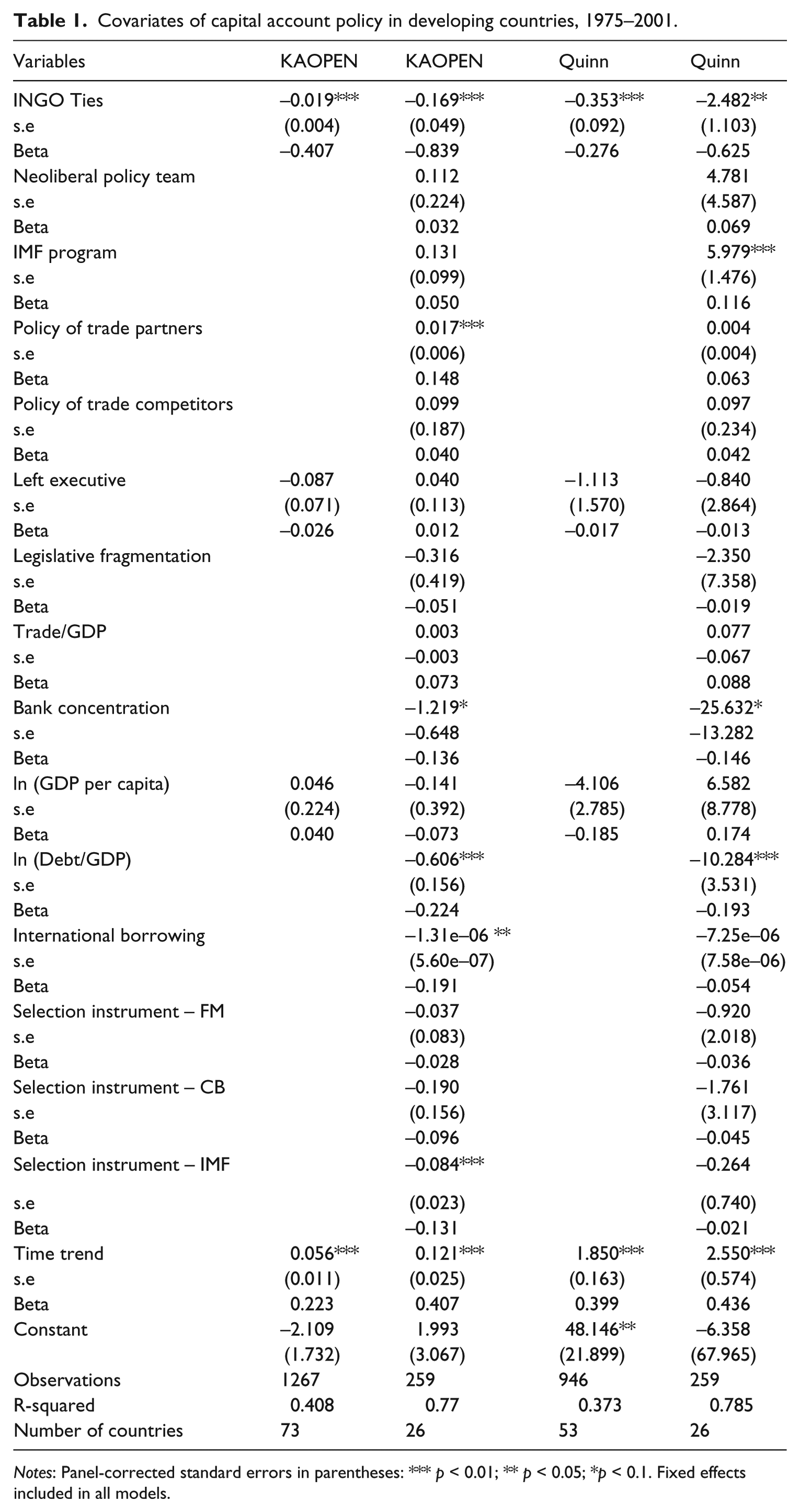
Table 1 presents the results. Following Achen (2005), we first estimate two reduced-form specifications that include only two control variables that express fundamental political and economic features of countries discussed in the literature. These specifications enable us to maximize the number of observations in our sample and to minimize multicollinearity. We then proceed with more extensive specifications.
Covariates of capital account policy in developing countries, 1975–2001.
Notes: Panel-corrected standard errors in parentheses: *** p < 0.01; ** p < 0.05; *p < 0.1. Fixed effects included in all models.
We find strong support for transnational mechanisms shaping decisions about capital account policy, though they operate in opposite directions. We find robust evidence of strong effects for our novel consideration of the consequences of INGO ties for capital account policy. Specifically, we find support for hypothesis 1 in that total ties to INGOs induce less openness. The results are consistently negative and significant in all models. As the standardized estimates from the more extensive specifications in Table 1 indicate, a 1 standard deviation increase in INGO ties induces a decrease of 0.83 standard deviations in the KAOPEN index and a decrease of 0.62 standard deviations in the Quinn index. These standardized coefficients are larger than those for all other variables that attain statistical significance in both specifications.
We also find some evidence for the hypothesized positive influence of IMF programs (hypothesis 2). The effects of IMF programs are predictably positive, though only statistically significant when we employ the Quinn index. Substantively, the findings indicate the IMF was particularly influential, with program participation (an increase of 2.04 standard deviations) inducing a 5.9 increase (0.23 standard deviations) in the Quinn index.
Surprisingly, these results suggest no significant impact for the influence of neoliberal economists. We do, however, find some evidence for ‘competitive mimicry’ or ‘role competition’ among trade competitors, though this is not consistently significant across models (barely yielding a z = 1.0 for the Quinn model).
In addition, the results from both models reveal that banking sector concentration and large public sector debt burdens tend to inhibit liberalization. There are also indications using the KAOPEN that growth in annual global foreign borrowing is associated with greater closure, which is consistent with Leblang’s (1997) finding that the opportunity costs of maintaining controls tend to be lower in the developing world than in advanced market economies. The remaining variables fail to attain statistical significance in either model.
The robustness of the results for our central hypotheses is confirmed by several additional analyses, which we report in the electronic appendix. The divergent and significant effect of INGOs and IMF programs remains unchanged when we use an alternative measure of capital account openness developed by Karcher and Steinberg (2013). Our main result concerning the influence of INGOs is also robust to: (1) consideration of regional policy precedents; and (2) use of alternative estimation methods, including an Arellano–Bond dynamic panel estimator (Arellano and Bond, 1991) and a generalized estimating equation model (Zorn, 2001).
Our argument suggests that resistance to liberalization arises from INGOs mobilizing and influencing public opinion, which in turn heightens policymaker decisions. Yet, the reverse is also plausible in that INGO ties may reflect rather than influence mass attitudes about policy. Citizens may join organizations on issues they feel passionate about. Our measure of INGO ties may capture these pre-existing mass attitudes rather than the capacity of INGOs to mobilize or condition public opinion.
We also recognize that the motivations of INGOs are not fully ‘principled’ and reflect in part strategic action for donor funds and time from volunteers (Cooley and Ron, 2002). INGOs may therefore devote the greatest effort to countries with strong likely donor or activist bases or countries in which local policies can be used to mount international campaigns for donations or volunteer time that will secure maximal press coverage. In short, they strategically choose precisely those countries to enter that will be least at risk from capital account liberalization. Entering countries where liberalization has occurred and is institutionalized or accepted by the masses may yield few domestic donations and volunteers and even less international press, volunteers, or donations. By contrast, entering a country where the domestic adoption is contested, or a potential adoption is contested, may yield both domestic and international donations and volunteers, as well as media coverage.
We seek to account for these possibilities in the following manner. First, we address factors that may capture pre-existing public opinion against market-oriented policies. Our initial models partially addressed this issue by controlling for leftist partisanship of the executive. If pre-existing public opinion is against market-oriented policies, then leftist governments represent one avenue to express this preference.
As a further check on the robustness of our results, we introduce additional variables (counts of the number of general strikes, riots, and anti-government demonstrations) taken from Banks and Wilson (2012) that partially capture other avenues through which underlying public opinion within society may be expressed. Following Quinn and Toyoda (2007), we also consider how public opinion may also reflect global ideological trends. Quinn and Toyoda find that when global ideology, as measured by share of voters around the globe for communist parties, runs against international capitalism, governments that restrict capital flows enjoy greater policy legitimacy domestically. We thus also take into account this vote share.
Ideally, while we would have also liked to consider the relationship between INGOs and domestic NGOs, data on domestic NGOs in developing countries tend to be sparse. Yet, to the extent that INGOs and domestic NGOs share similar preferences, these additional variables should capture some of the latter’s influence and help us to disentangle it from that of the former. As an alternative, we also consider Schofer and Longhofer’s (2011) cross-national longitudinal measure of the cumulative number of voluntary associations active each year based on the Encyclopedia of Associations (Gale, 2010). To the best of our knowledge, it is the only publicly available cross-national longitudinal data on the density of domestic civil society. However, it has some drawbacks, most notably, a bias toward larger, wealthier, and more mainstream associations active in the public sphere. As a result, these data are best able to capture large membership associations and politically active advocacy groups, which are precisely the sorts of actors that may also shape domestic public opinion.
We use these data to construct a measure of Domestic NGO ties, which follows our operationalization of INGO ties. Not surprisingly, these variables are highly correlated (.74) and diagnostic tests reveal that multicollinearity is a cause for some concern when we use the full model specifications. 16 While the statistical significance of both variables remains unchanged when the full model specification is used, the coefficients and standard errors are inflated. We thus report the results from the reduced-form specifications where diagnostic tests indicate multicollinearity does not raise serious concern.
If INGO influence reflects rather than shapes domestic sentiments and public opinion, then the inclusion of these additional variables should overturn our results. Or, if the direction of causality ran from public opinion to INGO ties, then we would expect these indicators to have some measureable policy impact when we exclude INGO ties from the model. Yet, the coefficient and significance on the INGO ties variable remains essentially unchanged in models where these additional variables are included. We also explored the possibility of a ‘boomerang effect’ by including an interaction of INGO ties and Domestic NGO ties. While we find both constituent variables of the interaction to remain significant, we found the interaction itself to be of no statistical or substantive importance. 17 Moreover, with the exception of the negative effect of Domestic NGO ties, we find that none of these additional variables is significant when we exclude INGO ties from the model, which suggests that INGO ties are an important part of the causal story.
As an alternative approach, we also explored instrumental variable estimation. We instrument for INGO ties using two variables from Banks and Wilson (2012): one that measures a country’s number of air transport passengers carried; and another that measures a country’s number of telephone lines per 1000 people. The exclusion restriction of instrumental variable estimation requires that the instrument be related to the endogenous variable, but that, conditional on other variables, does not affect the dependent variable. We might expect that INGO operations are facilitated in countries with greater access to air transport and telephones, but that such factors, conditional on other variables in our model, are not associated with capital account liberalization. The diagnostic tests of the model, which we report in the online appendix, show that the instruments are valid and strong. More importantly, our finding about INGO ties is robust to the use of instrumentation. Lastly, in ancillary analysis, we explored regional sub samples from Latin America, the Middle East and North Africa, sub-Saharan Africa, and Asia, but found almost no variation in the sign or significance of the INGO ties coefficient. 18
Having linked stronger INGOs ties to less openness, we now turn to supplemental tests of this hypothesis to assess the causal mechanism at work. Climatic mimesis implies that INGOs decrease public support for financial globalization and that these policy atmospherics inhibit liberalization. Brooks and Kurtz (2007) claim capital account liberalization has low salience among the mass public and thus focus on how legislative fragmentation leads to liberalization by spreading blame for policy reform. While we recognize that citizens are unlikely to fully grasp the technical complexity of the policy issue, citizens do tend to have attitudes that broadly relate to it, which, when conditioned by INGOs, could influence policy outcomes.
To assess this claim, we searched for survey measures of public opinion about openness to cross-border capital flows. Unfortunately, with the exception of the Latinobarometer public opinion survey, we were unable to find surveys in developing countries that addressed policy issues related to financial globalization during the time frame of this analysis. 19 While the Latinobarometer does not ask a question about capital account liberalization per se, it does ask individuals whether they ‘consider that foreign investment, in general, is beneficial or is harmful to the economic development of the country.’ Individuals may respond that it is either ‘beneficial’ or ‘harmful.’ This measure, albeit an imperfect indicator, does tap into one important dimension through which the mass public is likely to understand a complex policy like capital account liberalization.
The Latinobarometer posed this question in only two survey waves (1995 and 1998) and thus we are left with 24 observations. Given such a small number of observations, we use a t-test for difference in means and OLS regression for both the first-stage mechanism linking INGOs to public opinion and the second-stage mechanism linking the effect these atmospherics have on future changes in capital account policy. In exploring the first-stage mechanism, for the t-test, we divide our sample into two groups: those countries below the mean in INGO presence and those above the mean. For the OLS regression, we regress the proportion that answered the survey question affirmatively on our measure of INGO ties while controlling for regime type and GDP per capita. We present the results in the electronic appendix.
Both tests are supportive for the first-stage mechanism. The t-test shows a statistically significant difference across the groups, indicating countries with stronger INGO ties have a smaller proportion of people who agree foreign investment is beneficial for development. The same result is found in the OLS regression: increases in INGO ties are associated with more widespread negative views about foreign investment.
We then extend this approach to exploring the second-stage mechanism linking these climatically conditioned atmospherics to changes in capital account policy. The results are provided in the electronic appendix. We again divide our sample into two groups: those below and those above the mean proportion that answered the survey question affirmatively. A t-test yields moderate support for changes in capital account policy to be of a smaller magnitude in countries where higher proportions of the population see foreign investment as harmful. For the OLS specification, we regress changes in capital account policy on the proportion that answered the survey question affirmatively while accounting for GDP per capita and legislative fragmentation. We find decreases in this proportion are related to greater restrictions on capital flows.
Data limitations prevent us from assessing the full model specifications examined earlier. Yet, the results from this limited examination provide some support for our claim, at least in Latin America. INGOs shape public opinion on foreign investment and this opinion matters for changes in capital account policy. To be sure, policymakers can influence public opinion and policies at the same time. Yet, the literature on the effects of public opinion on policy suggests the argument we offer is a reasonable one. A seminal contribution from Page and Shapiro (1983) shows considerable congruence between changes in public opinion and in policies across a range of issue areas. More recent work on trade liberalization also leads us to expect that public opinion might be influential on policy choices. Rodrik (1995) points out that mass attitudes about trade are an important input in the political decision process and shape actual policy choices. Other research shows that public opinion on trade plays a key role in shaping the policy positions of public officials (Fordham and McKeown, 2003; Kono, 2008; see also Jäkel and Smolka, 2013: 740–742). As in trade, a fuller understanding of the political economy of capital account liberalization must account for the preferences of the mass public. We now turn to the case of Brazil to provide an illustration of this argument, as well as the operation of other transnational mechanisms of policy diffusion, particularly the IMF.
A Brazilian illustration
Since the Great Depression, Brazil has had a restrictive set of capital account regulations (Franco and Neto, 2004). However, reforms were undertaken to liberalize restrictions starting in the early and late 1990s. First, the Plano Real, a set of monetary, capital account, and exchange policies, introduced in 1994, sought to curtail inflation and to liberalize the economy by deregulating the process through which non-residents could remove funds from Brazil (Goldfajn and Minella, 2007). Shortly after, the Russian and East Asian crises in the late 1990s prompted the Brazilian government, which had failed to resolve large fiscal imbalances, to allow the exchange rate to float, removing the crawling currency peg in place until then. These reforms, which occurred partially under the auspices of an IMF program, were supported by IMF technical assistance to the central bank director, Arminio Fraga, a Princeton-trained economist appointed in January 1999, who had requested advice on how to set a floating exchange rate regime anchored by an inflation-targeting regime (Boughton, 2012: 12). As part of the IMF program, the Brazilian government also accepted an obligation to become, ‘in the near future,’ fully compliant with Article 8 of the Articles of Agreement of the IMF (Franco and Neto, 1994; Independent Evaluation Office, 2003). This included provisions requiring ‘avoidance of discriminatory currency practices’ and ‘convertibility of foreign held balances.’
Reaction to these waves of reforms, including capital account liberalization, came mostly from social movements, most visibly, ones closely associated with INGOs. One example is the role played by ATTAC Brasil. ATTAC Brasil was one of the co-sponsors and co-creators of the World Social Forum (Fisher and Ponniah, 2003), an event explicitly created as a protest to financial globalization. ATTAC Brasil participated as an organizer of large national protests against the IMF program outlined above, including an unofficial public plebiscite where over 5 million people voted against it (over 90% of the vote). More importantly, during the Cardoso government, which introduced the reforms, it worked closely with economists generally linked to the Left opposition to Cardoso, the Workers Party (Partido dos Trabalhadores — PT). It sponsored talks and conferences by prominent skeptics of market-oriented reforms, including Maria da Conceição Tavares (economist and congresswoman for PT) and Celso Furtado (one of the key figures in the formation of the Economic Commission for Latin America and the Caribbean — ECLAC), and published volumes critical of financial deregulation (see references in Genro, 2000).
Based partly on the legacy of a dependencia interpretation of modern capitalism, one might have expected these efforts to simply add to an already deep-rooted mass public hostility to financial openness. Yet, the 1995 Latinobarometer survey, even though it was administered as Brazil and countries in the Southern Cone experienced contagion and capital flow volatility associated with the fallout from the Mexican peso crisis, indicates that Brazilians held a surprisingly favorable view of foreign investment, with over 70 percent agreeing that it was beneficial. However, during the reform period, the INGO ties score for Brazil increased by 17 percent, as these transnational actors became increasingly active in the country (Chiriboga, 2002). To the extent that domestic NGOs played a role, it was by their involvement with INGOs, in that their mobilization as a concrete movement with specific policy models and normative predispositions was largely an outgrowth of interactions with these transnational actors (Milani and Laniado, 2007).
The efforts of these actors helped to condition a policy culture or climate within Brazil that inhibited and delayed liberalization, most notably, that oriented toward capital outflows. By the time of the 1998 survey wave, the proportion of the Brazilian mass public who agreed financial investment is beneficial had fallen by 10 percent. Today, public opinion in Brazil continues to associate capital transfers abroad with illicit and unpatriotic practices (Goldfajn and Minella, 2007: 376). 20 These findings, which are consistent with the observable implications of our argument, are supportive of the underlying climatic mimesis mechanism.
Conclusion
Many treat the decision to liberalize cross-border capital flows with a stress on such decisions as international or domestic political developments, but we treat such decisions foremostly as consequences of processes driven by transnational mechanisms of policy diffusion, perhaps most strikingly by a previously little studied one whereby INGOs shape the policy culture or climate in which capital account policy is made. We find strong evidence for INGO influence. In terms of our sociological institutionalist framing, this finding is consistent with a ‘mimetic’ response to a policymaking climate partly shaped by INGO presence. There is also some evidence to suggest that the mimetic influence of INGOs appears to be complemented by the transnational ‘coercive’ influence of IMF loan programs, whereby the IMF seeks to provide incentives and persuasion to liberalize.
Processes of ‘climatic’ mimesis brought in upon INGO winds appear to inhibit or delay capital account liberalization. This contrasts with the market-oriented valence of both pressures from IMF programs and foreign-trained economists; and it runs counter to the overall trend in capital account policy in developing countries, although it is consistent with much literature on transnational civil society and social movements (Keane, 2003; Smith and Wiest, 2011) and some strands of world polity writing (Boli, 1999: 292).
INGO conclusions merit pride of place here for a few reasons. One is the novelty of bringing systematic quantitative evidence to bear on the study of INGO influence on economic policy. A second involves theoretical implications of an inhibiting INGO ties impact — especially when viewed in the context of liberalizing IMF effects. These will be important to world polity scholars who tend to strongly stress convergence, as well as participants in the broader literature on policy diffusion. Indeed, one defining feature of the policy diffusion literature has been its narrow focus on the spread of policies, with little attention to features, agents, and mechanisms associated with what Solingen (2012) calls ‘firewalls’ that may limit widespread adoption. Our analysis suggests that INGOs serve as one important firewall in limiting the spread of capital account liberalization.
The divergence of the impact of INGOs from that of IMF programs has implications not only for the study of policy diffusion. It has implications for the broader conceptions of globalization. Although work on policy diffusion is not typically regarded as very politically engaged, previous work from Henisz et al. (2005) and Kogut and Macpherson (2008) has provided evidence for the politically charged view that market-oriented norms, such as privatization, have proceeded as part of a political project advanced by IOs (Evans, 2005). The current finding that INGOs have inhibited liberalization affirms claims for the left-of-center reformist, transnational politics put forward by theorists of TCS, global social movements, and counter-hegemonic globalization (Huber and Bogliaccini, 2010). More detailed inquiry into domestic agents of the politics of hegemonic and counter-hegemonic globalization is warranted (Evans, 2005; Lee, 2007). This is especially so in light of the rise of such agents in the developing world, such as Latin America’s ‘Bolivarian’ regimes and Brazil’s PT (Powell, 2007). Attention to new modes of state outward-looking economic policy is also needed (Schrank and Kurtz, 2005).
Scholars should also turn to the political economic forces behind transnational founts of diffusion. For example, they might identify the politics of economic interests, financial powers, and professional factions behind changes in economic theory (on the etiology and export of the ‘Chicago School,’ see, e.g., Dezalay and Garth, 2002). They might address the great state and banking powers behind policies of IOs (Abdelal, 2007; Babb, 2009; Chwieroth, 2010).
Causes of openness may vary in intensity and even presence across countries. Scholars should join global reach to local sensitivity to better identify what is universal and what context-specific in the origins and development of market openness. What is clear is that this analysis of capital account liberalization extends evidence for the theoretical relevance of transnational mechanisms for global policy change, evidence for the influence of INGOs in the late 20th-century developing world most particularly. Moreover, the time may have come for the kind of transnational analog to domestic interest groups stressed by theorists of transnational advocacy networks and transnational civil society to assume no less prominent a place in political analysis than that long served by the domestic civil society of domestic interest groups.
Footnotes
Funding
This research received no specific grant from any funding agency in the public, commercial, or not-for-profit sectors.