



Abstract
What is the role of international law in foreign-policy decision-making? In particular, why do leaders justify policy decisions with appeals to international law and why do these appeals make the references that they do? This paper combines scholarship on the role of justifications and the permissive power of international law, theorizing that decisionmakers will seek out international legal justifications over justifications that reference non-legal claims. These justifications are seen as particularly important in the contemporary world, reflecting the legalized nature of international relations today. In particular, decision-makers will especially prefer to reference codified international agreements over customary international law, seeing a particular value to referencing a written text even if it is not as directly connected to the issue at hand. These more general justifications are, in turn, preferred over non-legal justifications. This reflects the importance of international law in international relations—in a deeply legalized system actors feel compelled to portray their behaviors as legal, even if these justifications are tenuous or if pursuing them is time and resource consuming. The United Kingdom’s 1956 intervention in the Suez and the United States’ 1983 intervention in Grenada—are used to test these assumptions. Both cases support the theory: decision-makers prefer legal justifications, pursuing these over other options. In addition, decision-makers appear to prefer legal arguments built on codified law, keeping with the theoretical predictions. These findings deepen our understanding of how actors understand and use international law, its role in justifications, and the legalized nature of international relations today.
Introduction
What is the place of international law (IL) in foreign-policy decision-making? Over centuries, IL has developed a robust system of rules regulating state behavior. Especially since the end of the Second World War there has been a concerted effort to legalize international relations (Hathaway and Shapiro, 2019). While there may be theoretical disagreement within international relations about the degree to which IL shapes foreign policy, or how, it cannot be denied that IL is frequently used to justify policies, including the use military force. Research has long examined the role of justification in politics, including in foreign policy, showing that leaders justify policies to reduce the costs of pursuing them by either building support or heading off criticism (Anderson, 1981; Kornprobst, 2014). Scholars have highlighted the use of IL in these justifications, showing that decisionmakers use the language of IL to justify their policy decisions when justifying their policy decisions (Hurd, 2019; Peevers, 2013).
Indeed, scholars have noted that IL has a permissive (Hurd, 2016; Sanders, 2011: 606, 2018: 13) and productive (Kinsella, 2005, 2011) role in international relations—it provides actors a language that they may use to pursue their goals and legitimate their actions. These justifications reflect the place of legalism—the “practice of using law and legal arguments to explain, justify, or contest acts and policies (Hurd, 2018: 266)”—in international politics. International law, in particular, offers an important language of these claims—it is often seen as a “particularly legitimate” (Bower, 2020: 137) language in international politics, one which cannot be easily substituted by other types of claims (Hurd, 2018: 269). Furthermore, in using these claims, actors reshape the law meaning that states who engage in making legal justifications are not only justifying their immediate political choices but are also shaping how the law will evolve and be used in the future (Byers, 1999: 37; Hurd, 2016: 9; Ross, 2021: 3). How do decisionmakers understand these legal claims, though, and how important are they seen in the foreign policy process? Are IL justifications a language of convenience or are legal justifications deeply embedded within the decision-making process? Understanding how and why states make the justifications that they do may help us better understand the role of these justifications in IR—especially their use as a tool by powerful states, their relationship to the development of IL, and the place of IL in the foreign making process.
This paper builds on scholarship on justifications, legalism, and the permissive capacity of IL to explore the decision-making processes that underpin its use and address exactly these questions. How do actors pursue legal justifications? And why do these justifications often depend on complex claims and references to multiple bodies and types of law? I argue that decisionmakers attempt to create the most specific justifications that they can, drawing on codified legal references where possible in order to legitimate their behavior with references to shared written standards, as these may be seen as particularly strong justificatory references (Bower, 2015, 2020; Rapp, 2020). Actors cannot infinitely reinterpret the law, there are limits to what claims may be accepted (Hurd, 2016: 14), and codified texts may help decisionmakers connect their justifications to accepted, or at least contestable, legal justifications.
In exploring these tensions, this paper further illuminates the depths of international legalism in international politics. It shows how, in many cases, “law provides legitimation to state choices” (Hurd, 2016: 2), and deepens our understanding of this phenomena by showing the lengths to which states will go to employ these justifications. In doing so, it challenges the idea of international law as a constraining force in international relations, showing that—while it may often restrain military action (Lees, 2021: 17)—it also serves a permissive role. It is not just that states may pursue legal justifications or that legal justifications can be an effective tool of justification. Instead, this paper demonstrates just how deeply ingrained international legalism is and the importance that policymakers attach to developing legal justifications.
These propositions are examined in two cases—the United Kingdom’s (UK) 1956 intervention in Egypt and the United States’ (US) 1983 invasion of Grenada—cases where democratic states with considerable material capacity used military force to fulfill a foreign policy objective. Focusing on such cases shows that these concerns are not limited to materially lacking states. Even militarily strong states, or those that believe themselves to be such, find themselves needing to draw on IL to justify their uses of force. Observable implications are developed highlighting what kind of evidence would support or disconfirm the proposition that decisionmakers see IL as an important, even necessary, justificatory tool. Archival documentation provides unique insights into why and for whom actors developed these justifications. 1 The argument is supported in both cases as decision-makers—including senior political leaders—recognized international legal justifications as particularly important and pursued them accordingly. By focusing on the role of law as a tool of foreign policy justifications, this paper emphasizes the utilitarian and strategic value of legal rhetoric, building on important work on the permissive and justificatory power of law, and showing the lengths to which decisionmakers will go to develop and advance these justifications.
Justifications and international law in foreign policy
Legalism and International Relations
There is a rich literature on legalism, justifications, and the role of IL in foreign policy. Justifications—legal or otherwise—accompany policy decisions “as a matter of course (Anderson, 1981: 758)” and are intended to portray the action as legitimate and to reduce possible opposition by highlighting the possible illegitimacy of rival plans (Kornprobst, 2014). This means that justifications are important for overt actions where opposition may be anticipated. Furthermore, a state’s desire to maintain a reputation for compliance or appropriate behavior may further increase the importance of justifications (Guzman, 2008). However, states may also prioritize strong justifications if they foresee possible material costs or direct opposition to their policies. From a realist perspective, then, legal justifications may be a way for actors to try to avoid being seen as lawbreaking out of a concern for possible consequences (Trachtman, 2009).
Historically, legal, political, or philosophical claims have accompanied the use of force for this purpose (Chang, 2017; Hathaway et al., 2018). Legal justifications in the post-1945 era continue these patterns. Justifications draw on the legitimate, socially accepted rhetoric of their time. For example, justifications in early modern Europe often combined developing notions of jus ad bellum with classical conceptions of just war—ideas that were appropriate then but that would be inappropriate today (Lesaffer, 2006).
This prioritization of legal justifications, over moral, political, or religious claims, reflects the increasing legalization of international relations (Goldstein et al., 2000; Hurd, 2018; Nuñez-Mietz, 2018). Legalism is a practice that sees law and legal arguments as uniquely appropriate or acceptable in politics (Hurd, 2018: 266, 269). The legalist view of law as reflecting a rational-legal authority imbeds it with a particular form of legitimacy in international politics (Bower, 2020: 137). This stems, at least in part, from its status as a mutually constructed system (Brunnee and Toope, 2010: 24–25) where rules are, in rhetoric if not application, the result of rule-making between sovereign equals. Drawing on IL, then, allows actors to legitimate their claims with reference to shared standards that may be harder for opponents to reject since they represent supposedly shared, theoretically apolitical, commitments (Bower, 2015; Mantilla, 2018). Indeed, it is not only that IL is a language for justifications, in such a deeply legalized system it is the language by which actors can justify their action—other types of rhetoric are seen as inappropriate and cannot be substituted for it (Hurd, 2018). This means that actors must ground their justifications in claims of law, even if this depends on questionable legal interpretations (Búzás, 2017), and cannot draw on the types of moral or political arguments that may have been acceptable in less legalized settings. Failing that, actors may be forced to change or hide their behaviors, unable to justify the action in a legal framework (Poznansky, 2019), emphasizing the depth of legalism and the extent that actors will go to not to be seen as acting illegally.
The permissive power of international law
Legalism’s prioritization of law and legal claims above other types of rhetoric highlights, and indeed deepens, law’s permissive power. While law may often be thought of as a constraining what an actor may do, reducing uncertainty in international relations and exercising a restraining effect on the use of military force—as the English School often theorizes (James, 1973; Navari, 2011: 622–623), scholarship has emphasized the use of law to permit, or even constitute, a range of behaviors. Legal claims may be used to legitimate behaviors, even those that are supposedly restrained by the law itself. The law on the use of force, for example, is used to legitimate military action (Bjola, 2005; Hurd, 2016, 2019; Irani, 2018; Ross, 2021: 2–3) while human rights law is invoked to justify abuses (Sanders, 2011, 2018). These justifications allow an actor to manage the tensions between their political desires and the social constraints of the law and to head off potential criticism (Sanders, 2018: 12–13). In doing so, justifications transform a prohibited behavior into something lawful (Ross, 2021: 3). This is important given the reach of legalism in modern international relations—actors are unable to avoid or substitute the overarching structures of IL and instead must work within it. At the same time, however, IL provides immense permissive power, at least for some in the international system.
This is possible since law is ambiguous and requires interpretation allowing for multiple interpretations of the same standard (Byers, 2004: 173) and reflects deliberate choices on the part of law’s drafters (Byers, 2004, 2021). For example, the United Nation (UN) Charter’s prohibition on the use of force—which underpins the modern prohibition on the use of force—is not the “last word” on the question (Hurd, 2016: 8). Instead, claims of self-defense are used to justify military action, framing the intervention as compatible with the law (Hurd, 2019: 73) Similarly, US officials drew on international human right and humanitarian law to rationalize repressive, and often rights-violating, policies (Sanders, 2011). Of course, this ambiguity does not mean that an actor can interpret the law however they would like and legal claims are often contested (Hurd, 2016: 14). This limits actors to claims that may be at least somewhat acceptable, otherwise the claim would fail at its purpose of legitimating the behavior (Bower, 2015: 338; Johnstone, 2011: 34; Kratochwil, 1989: 38–39; Nuñez-Mietz, 2018: 3–5).
These examples call attention to the productive power of law. Law not only permits behavior, it constructs categories that place a behavior outside the prohibition (Hamidi, 2019; Kinsella, 2005, 2011). The use of military force, for example, is permitted by justifying it within the concept of self-defense– a legal category that permits the use of military force that would otherwise be prohibited (Hurd, 2019: 73; Slaughter, 2013: 925). The nuclear nonproliferation regime, similarly, constructs nuclear and non-nuclear weapons states, legal constructs that determine if the prohibition applies. For nuclear weapons states the law constructs a right for some that it simultaneously denies for others (Hamidi, 2019). Kinsella has noted a similar role for international humanitarian law, where the law constructs the category of civilian—who is owed protections– and combatant—who may be lawfully targeted (Kinsella, 2005, 2011). These categories—combatant or noncombatant, nuclear or non-nuclear, self-defense or unlawful attack—are not just abstract legal concepts. They are ways that the discursive power of law is used to construct behaviors as legitimate or not. In short, IL does not apply neutrally to the world, it “actively produces, protects, and privileges particular identities and agenda” (Kinsella and Mantilla, 2020: 4) shaping what may be done, by whom, and to whom. IL, then, provides actors a framework that they may invoke, contest, and reinterpret, to construct a world of meanings that may better suit their interests and goals. International law’s place in international relations, then, goes beyond restraint and instead its interpretations and uses constitute many factors of international politics. Legalism pervades global politics, providing a structuring language for politics and interactions. This power is unique—legal claims allow actors to claim an oughtness (Byers, 1999: 6–7)—and law’s place in modern, legalized, politics cannot be easily replicated by other forms of rhetoric (Goldstein et al., 2000; Hurd, 2018). Policymakers, then, draw on IL to justify their policies in a language that is socially acceptable and legitimating (Hurd, 2018: 2; Johnstone, 2003: 441–443; Scott, 1994). In doing so, these actors further shape the meaning of IL (Bjola, 2005; Byers, 2004: 173; Hurd, 2018: 14), with legal justifications playing an important role in the development of IL.
Important work has noted the use of these justifications, the conditions under which they are employed, and the breadth of legalism in international relations. However, the question remains—why do leaders make the legal justifications that they do? How do they choose which laws to reference and when are these decisions made? Even more fundamentally, how important are these justifications in the policymaking process and how is the law understood when making foreign policy in such a legalized environment? In addressing these questions this paper clarifies the permissive power of IL and its instrumental role in international relations, emphasizing the depth of legalism in international relations, the processes by which actors construct legal justifications, and the ways in which major powers may reinterpret and invoke the law as a tool for extending and legitimating their power.
Theory and expectations
Drawing on theories of rhetoric and IL in international relations, I argue that a desire to provide IL justifications permeates decision-making surrounding the use of military force and that the structure of IL will motivate actors to pursue specific types of justifications. This builds on literature on the permissive power of IL and its use as a language of justification. Where previous work has highlighted the use of these justifications and the role of IL, this analysis focuses in on the decision-making processes create these justifications and the structure of the justifications themselves.
I expect that decision-makers will value law as a particularly effective language for justifying the use of force and that IL justifications will be prioritized over other types of justifications. IL, as has been discussed, occupies a unique place in a highly legalized world (Brunnee and Toope, 2010; Goldstein et al., 2000; Hurd, 2018). IL cannot be substituted with other claims (Hurd, 2018: 269), holding a privileged place in global politics (Bower, 2020: 137). This means that, by using IL, actors are able to build justifications that other states may be more likely to find acceptable, or at least find harder to reject (Bower, 2015, 2020; Hurd, 2018; Mantilla, 2018, 2013, 2013, 2013; Peevers, 2013). Law’s nature as a mutually constructed system regulating behavior is put on display here (Brunnee and Toope, 2010: 24–25)—the fact that IL is, at least in rhetoric if not its practice, the result of rule-making between sovereign equals—gives particular meaning and importance to it. Affixing justifications to these rules leverages this legal nature to strengthen them in the face of anticipated criticism. In doing so, decisionmakers draw on IL’s permissive power, using legal justifications to manage the tension between their political desires and the restraining power of the law (Sanders, 2018: 12–13). Decisionmakers, then, use IL as a way to maintain social respect or to empower themselves over other actors by showing that their claims and behaviors are permissible under IL (Slaughter, 2013: 920–921). Invoking legal claims may constrain opponents, making it harder for rivals to contest a justification by limiting their counterarguments to legal references (Krebs and Jackson, 2007; Petrova, 2016). For example, national security or political justifications may be acceptable to a domestic audience but are more easily rejected as inappropriate in the legalized arena of international relations (Goldstein et al., 2000; Hurd, 2018).
This does not mean that the actor is convinced about the law’s legitimacy– it may be invoked for entirely self-serving purposes. Indeed, actors—especially powerful ones—may reinterpret the law to suit their interests (Byers, 2004: 167–170; Hurd, 2016: 14, 2019). Through these politically motivated interpretations, powerful states may reshape the meaning of the law in the long term (Byers, 1999: 37; Irani, 2018: 120–121). What matters is not that the actor engages with the law in good faith but that they actor believes that IL is an effective rhetoric for their justifications. In using law, however, an actor limits the range of justifications they may offer—giving up on a legal justification and moving to a non-legal justification may show that the actor knows their action is illegal, incurring the social costs that such an admission may incur and weakening the legitimacy of their claims in a deeply legalized world.
While rational choice scholars’ credit this to the value of IL as a tool for solving commitment issues, research on the social nature of IL has highlighted its independent rhetorical value. When making a justification, a state intends to win support or acquiescence from the international community, which also acts as the audience and judges a claims acceptability. This may range from material support to silence, allowing the state to pursue its goal without criticism, social costs, or material sanctions. A successful justification does not have to be persuasive—it may succeed if opponents cannot challenge it, regardless of if they accept the claims. What matters is that the justifications are framed on references that are harder to dispute (Krebs and Jackson, 2007: 44–47). This value extends beyond coordination or credibility signaling. Actors are able to employ legal language strategically to “win” support for a policy—whether or not their justifications are seen as entirely credible.
While actors may dispute interpretations, or argue about which laws are most relevant, they remain bound to legal claims for their justifications. Meanwhile, opening a justification with a non-legal foundation exposes an actor to criticism on legal grounds—criticism that may be hard to overcome for the same reasons that give IL justifications their value. These two assumptions—that justifications have an important political value, building support or compelling acquiescence to the policy, from other international actors—and that IL has a particular rhetorical value in contemporary international relations, leads to my first hypothesis.
In studying how decisionmakers pursue IL justifications, this paper also examines the content of these justifications, theorizing why actors justify their policies with codified legal references—in contrast to customary international law—even when the legal interpretations for these justifications may seem tenuous. As discussed, justifications do not need to persuade if they deny opponents the ability to make sustainable counterarguments. Unsustainable responses are those that contradict previous statements, opening the claimant to social costs from the audience—the groups connected to the topic being debated who 'judge' the arguments and claims made in it. In the case of international legal justifications, this may principally be the diplomats and foreign leaders who may contest the justification. An unacceptable claim will fail as it can be rejected wholesale. Actors, instead, are limited to what is considered acceptable in the situation. This drives actors to create justifications with acceptable frames and references, as these are less likely to be rejected, forcing opponents to respond with similarly acceptable counterarguments.
IL is well suited to this task, 2 given the depth of legalization in international politics. Since other actors have, at least tacitly, accepted its language and standards they may find it harder to challenge (Bower, 2015: 343; Reus-Smit, 2003). In addition, the structure of IL—with various codified and uncodified standards of different scope and specificity—provides decisionmakers with a range of references to use when building a justification (Bower, 2015). Decision-makers may desire the support or acquiescence of these groups and employ the IL as a language that they believe is considered appropriate in this sphere. These audiences, in turn, are likely to be aware of IL and its standards and can adjudicate and interpret justifications, deciding if the offered justification aligns with their understanding of IL.
Decisionmakers are also aware that not all legal justifications may be equally useful. Instead, specific legal claims—those referencing codified legal standards, particularly those that are substantively connected to the debate—may be more effective (Rapp, 2020). These written sources may provide more stable meanings that are less open to interpretation by rivals. General legal claims—appeals to uncodified international legal ideas and customary international law—still offer a useful rhetorical source and should be preferred over non-legal claims. However, these general claims are not expected to be the first choice for international justifications (Bower, 2015; Rapp, 2020).
This is not arguing that codified law is “more law.” The value of codified standards is in their written nature, where they may be harder for rivals to reinterpret or contest since the language of the rule is clearly set in a reference text. While customary IL may, for example, have commentaries, these are not binding legal documents and an actor who draws on one commentary may be countered with an appeal to another. While commentaries may have broad acceptance actors are not required to accept those interpretations and their meaning, indeed their legitimacy, may be contested. Indeed, actors may have more flexibility in contesting the meaning of uncodified law, reducing its potential effectiveness as a rhetorical tool. 3 Table 1 outlines, in order of preference, the differences between specific, general, and non-legal justifications by highlighting the types of references required to categorize a justification as such.
Types of justifications (DV).
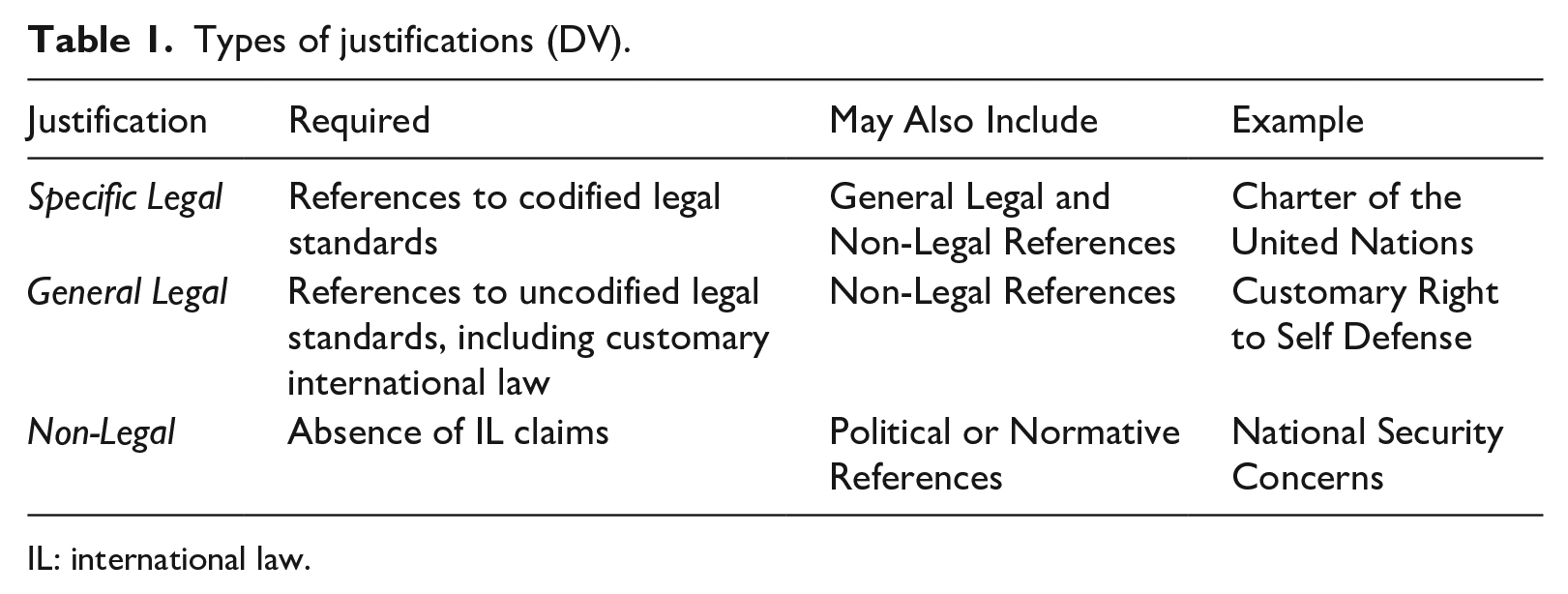
IL: international law.
These assumptions about the relative usefulness of different legal references for policy justification leads to the second set of hypotheses considered in this paper.
This preference for law-based justifications does not mean that other arguments will not be made too. Indeed, states are likely to put forth a range of claims to support their actions, including security and political based claims. However, if an actor is intending to justify their action to an international audience, it is expected that they will prefer to make as specific of a legal claim as possible and that other claims will play a supporting role.
Case selection and methodology
Two cases—the UK’s 1956 intervention in Egypt and the US’ 1983 intervention in Grenada—are used to examine this theory. 4 These may be understood as pathway cases where the cause—a desire to use military force—and an outcome—the creation of a policy justification—are already known. What is of interest, then, is in how and why the outcome came to be. This type of case is also known as an “illustrative” case—the goal of the project is to see if they previously discussed theory is plausible, even if the final outcome cannot rule-out other possible theories (Gerring, 2016: 105) Given this, and the conditions of each case, it cannot be said that they prove or disprove the theory. They may, however, provide support for the theory by illustrating the causal processes proposed by the theory and illustrating how international law was understood and used by policymakers in two cases. If decision-makers felt compelled to develop legal justifications, despite having the material capacity to act without them, it may demonstrate a particular role of IL and the depths of legalism in foreign policy. At the same time, this may also reflect the use of IL as a tool by powerful states, a point that has been raised in previous scholarship (Hurd, 2018: 14; Irani, 2018). Given this, it is important to consider what motivates materially powerful states to pursue IL justifications and how they use legal claims to protect and extend their power.
Both cases are also democracies, where the need for justifications may be especially important to build and maintain public support for the intervention. Similarly, both are Western states that played a major role in shaping the development of IL. Work on legalism has highlighted that IL is often used by Western states against non-Western states, with important implications for who law is, or is not, for (Irani, 2018: 122). As pathway cases, both interventions studied here may provide insights into the processes by which Western states employ IL against their rivals, helping to deepen our understanding of the ways in which Western states leverage and use IL (Hurd, 2018: 275; Irani, 2018: 122). Future scholarship should, however, further consider if and how the use of legal justifications by non-Western as well as non-democratic states as well as the ways in which these states respond to invocations and reinterpretations of legal rules. It is also important to note that both cases deal with international armed conflicts and that they cannot speak to the importance or role of legal justifications for internal armed conflicts. As Reynolds noted, for example, the UK treated international law very differently during the Kenya Emergency and which dealt with international human rights law instead of questions jus ad bellum (Reynolds, 2018).
Both cases occur after 1945 in the modern international legal order, typified by the UN Charter’s prohibition on the use of force (Hurd, 2019: 61). Although IL historically had a role in foreign policy and the legalization process began in the interwar period, the post-1945 legal order was categorically different than in prior centuries (Hathaway and Shapiro, 2019; Hathaway et al., 2018). This order is based on three interrelated principles—that military force should not be a tool of foreign policy, that war is generally forbidden, and that self-defense or UN Security Council approval are the only legal exception to these rules. The existence of this system is an important scope condition– in a less legalized system it is likely that different types of justifications would be prioritized. And while new IL standards may have developed between the two cases, this does not undermine the core claims of the theory. Both cases faced the same principle legal challenges, and a growth of legal instruments would only change the rhetorical sources for creating justifications, not the fundamental legal issues or the need for creating IL justifications. Furthermore, while it is clear that the Suez Crisis sparked greater international concern than the Grenada invasion, this variation offers the benefit of testing the theory in situations where international reactions differs. It may be expected that the US, facing less international pressure, would be even less compelled to create international law justifications.
Finally, the use of historical cases is important for the degree of archival access that it permits. Understanding the reasoning behind justifications requires considerable access to the decision-making process. Historical cases, like these two, provide greater access to archival materials as documents are declassified. These documents, which can reflect and record debates at the highest levels of government, allow for a careful analysis of high-level, previously secret, decision-making. With this it is possible then to start to understand how and why legal justifications were developed.
Since this theory focuses on a causal mechanism, which cannot be observed directly, it is necessary to develop observable implications to see if the proposed mechanisms are present in the cases. Observable implications (Table 2) are what we may expect to see if an unobservable process is occurring (Bennett and Checkel, 2015: 12). For example, while a preference for IL justifications is not itself visible, decision makers may make statements indicating their preferences. Alternatively, a lack of such statements, or contradicting statements, may support rival hypotheses (Jacobs, 2015: 56–65). They are not universal laws but statements of necessity or sufficiency conditional to the scope conditions.
Observable implications.
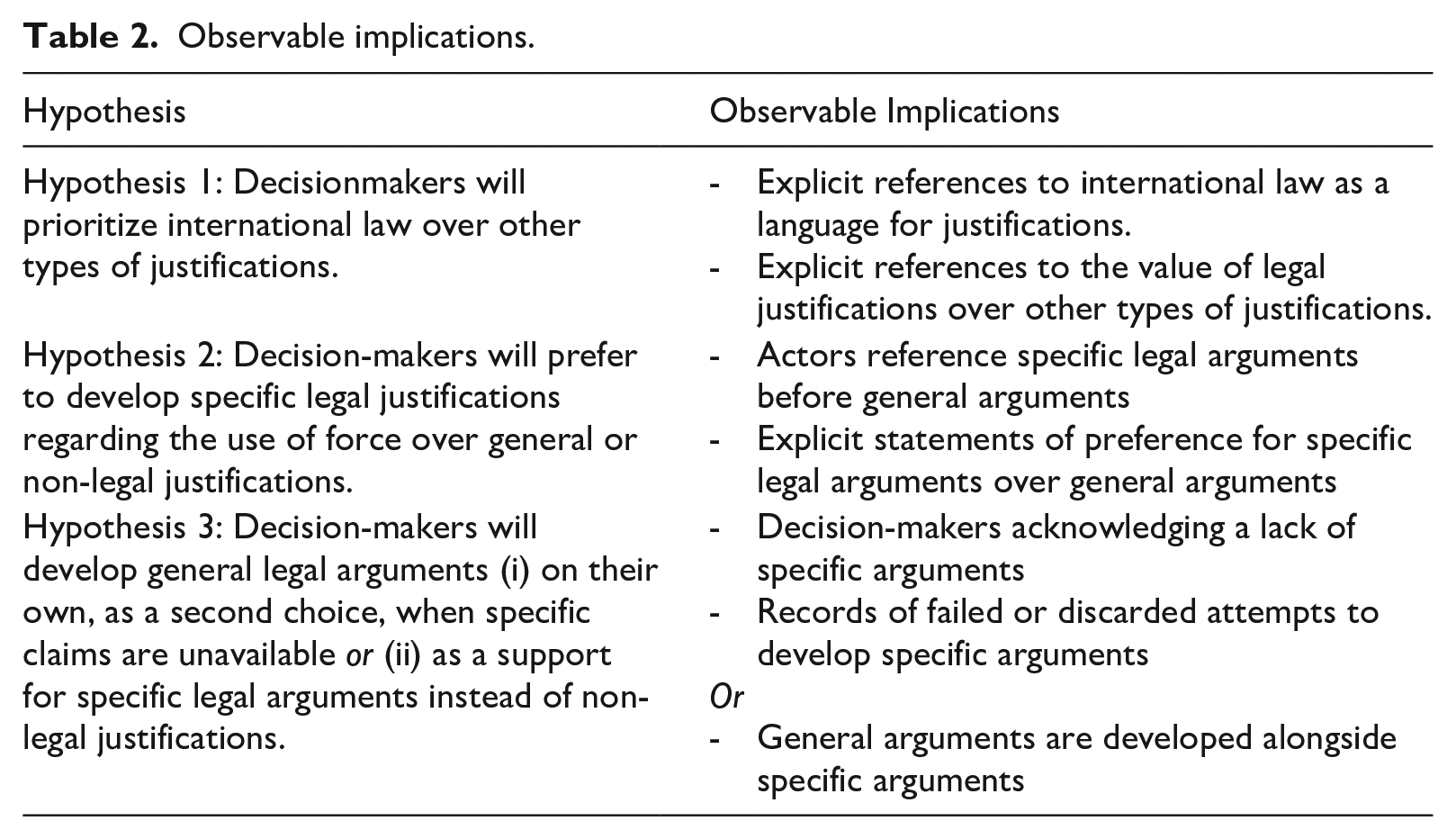
A specific legal justification invokes a treaty or codified interstate agreement. General legal justifications are identified by appeals couched in a language of rights or references to customary international law. For example, decision-makers in both cases claimed a right to protect nationals abroad. While not codified, this idea has a long history in IL and may be considered a general legal principle. The context is also worth considering. Sovereignty claims, for example, may be political when given in a public address by an executive but are more legal in nature when made by a legal advisor in a policy memorandum. In short, “rules never exclude alternatives” and the same claim may be invoked in multiple situations, with different meanings, for different effects (Krasner, 1999: 237).
Requiring explicit references strengthens their probative value. Without these statements, there is little to indicate that IL mattered in the decision-making process. However, requiring that the statements be explicit increases their value, reducing the chance of misinterpretation (Jacobs, 2015: 55). The sequence and timing of statements is also considered, and it is expected that decision-makers will begin with preferring the most specific IL justification. However, if they are unable to develop such a justification, they will settle for a general IL justification. It there is no discernible preference between codified and uncodified references this may challenge theories of rhetorical contestation that assume a particular value of codified references.
This paper uses “hoop tests” which establish a necessary condition, within the scope conditions, for a hypothesis to be supported (Collier, 2011: 826–827; Mahoney, 2015: 207–209). Passing a hoop test indicates support for the hypothesis and somewhat weakens the plausibility of rival hypotheses, even though it cannot prove a hypothesis (Collier, 2011: 826; Mahoney, 2015: 207; Zaks, 2017). The hypothesis must “jump through the hoop” to remain under consideration (Collier, 2011: 826) and the hoop might be “tightened,” increasing the inferential value of the hoop test, by requiring rarer or more frequent evidence and therefore making it more likely that a hypothesis may fail the test. Importantly, these tests do not establish universal laws but conditions that should be met within the limits and scope conditions of a theory and set of cases, providing useful benchmarks for illustrating the causal processes proposed by the theory. The level of support depends on the difficulty of the test. An easy test uses common or expected evidence while a harder test requires less common evidence (Mahoney, 2015: 208). Satisfying a harder test indicates a more counter-intuitive result, offering greater support to the hypothesis since the hypothesis has satisfied a more difficult to prove necessary condition. Evidentiary value is a combination of rarity—the expectation that a source would make the statement—and frequency—the rate at which the statement occurs.
Finally, while this paper primarily applies hoop tests, smoking gun tests are also worth noting. These tests are sufficient to prove a hypothesis—for example, a clear statement of reasons why a justification was made and who it was for—but are not necessary for the hypothesis to be true (Bennett and Checkel, 2015: 17). In contrast to hoop tests, smoking gun tests establish a sufficient—but not necessary—condition for the hypothesis to be true. A common example is a smoking gun in a murder investigation—finding a suspect at the scene of a crime holding the murder weapon may be sufficient to establish guilt but it is not necessary as other evidence could lead to the same conclusion (Collier, 2011: 827). This paper uses both tests—the observable implications establish hoop tests for each hypothesis, highlighting the observable implications that should be present if each hypothesis is supported. If these are not found, then the hypotheses fails, and the theory does not find support. Passing each hoop test, in contrast, may strengthen our support for the theory and somewhat weaken any rival hypotheses. At the same time, it may be possible to find a “smoking gun” in relation to any of the cases, evidence that clearly indicates support for the hypothesis in an unambiguous way.
This analysis uses archival documentation, with weight given to private documentation and records. 5 While public statements are insightful, confidential private documents—like those making up most of this analysis—provide greater insight into why decision-makers took certain actions. Decision-makers are less likely to lie about IL preferences since they do not have to worry as much about public scrutiny when discussing these questions in a private setting, knowing that their comments will likely not be shared with the public for some time (Jacobs, 2015: 52.) This privacy may allow decisionmakers to discuss their legal concerns—or their ambivalence toward legal questions—in a more forthright manner. While a leader might hesitate to discuss law as a strategic tool in public, especially in a democratic context where they may fear that doing so may cost them public support, they may be more willing to in private. Private statements, and especially those made in the policy making context, may be a more accurate reflection of what a decisionmaker believes or values. In short, there may be less risk of them saying one thing and doing another. Secondary materials are useful but in a supporting role with the greatest weight given to decision-making records. This is done to help avoid possible biases in the historical record and allow more direct insight into the decision-making process(Levy, 2008: 9).
Cases
The United Kingdom and the 1956 Suez Canal crisis
The Suez Canal Crisis began on July 26, 1956, when Egyptian President Nasser announced Egypt’s nationalization of the Suez Canal, which had previously been managed by the Suez Canal Company (Gorst and Johnman, 1997: 53–55). UK Prime Minister Eden saw nationalization as a direct challenge to British power and influence (Frankel, 1975: 133; Gorst and Johnman, 1997: 36–55). In particular, the seizure was seen as a threat to oil imports and the UK’s influence east of the Mediterranean (Eden, 1960: 472–478). Perhaps just as significant was Eden’s perception of President Nasser, who he repeatedly compared to Mussolini, believing that acquiescence would risk further destabilizing acts across the region (Glennon and Noring, 1990, Document 64; Gorst and Johnman, 1997: 69).
Almost as soon as the UK became aware of the nationalization, international legal concerns rose to the surface. In its first meeting after the seizure, the Cabinet made a point of addressing IL, particularly the need to “sustain and justify international opinion (Gorst and Johnman, 1997: 144),” supporting the assumption that IL was seen as an important justificatory language. The Cabinet noted that the UK would be on “weak grounds” claiming that President Nasser acted illegally. Instead, facing a situation where specific legal claims seemed weak, Cabinet pursued justification on "wider international grounds" including the obligations of maintaining the canal and the rights to transit international waterways (Gorst and Johnman, 1997: 144).
However, even while making these general legal arguments, the UK continued to refer to the 1888 Constantinople Convention which had previously regulated the canal when communicating with other international actors (Glennon and Noring, 1990: Document 21; PREM 11/1100, n.d., 20 August 1956), emphasizing the value of specific legal justifications. In discussions with President Eisenhower, Eden was quick to reference the importance of international agreements regulating the canal, the broader international obligations inherent to the canal’s management, and the importance of “not becoming involved in legal quibbles about the rights of the Egyptian Government to nationalise what is technically an Egyptian company (Glennon and Noring, 1990: Document 5)”—presumably, since he doubted the strength of such arguments (Frankel, 1975: 147; Rothwell, 1992: 211).
As the crisis progressed, IL continued to feature in the decision-making process, delaying the UK from intervening despite a strong desire on the part of Eden. Early in the crisis, Eden recognized the constraining nature of the UN (Gorst and Johnman, 1997: 144)later noting that “As signatories of the Charter of the United Nations, we were bound first to seek redress by peaceful means (Eden, 1960: 479).” While Eden’s sincerity may be questioned—Foreign Secretary Lloyd noted that he believed Eden would act without authorization and in doing so render the intervention “unjustifiable” (Glennon and Noring, 1990, Document 126). This again reinforces the idea that decisionmakers saw IL as an important, and perhaps the most important, language in which they could justify their use of military force.—It seems clear that the UN Charter’s legal obligations exercised some restraining effect on the decision-making process (LO 2/825, 15 October 1956), calling attention to the depth of IL’s involvement in the decision-making process and the scope of legalization in politics. .
In addition to discussions during Cabinet meetings and the Egypt Committee, legal concerns were discussed across the UK government. Focusing on creating a legal justification (LCO 2/5760, 7 September 1956; LO 2/825, 4 November 1956), the process of creating and disseminating a legal justification was largely managed by Viscount Kilmuir, the Lord High Chancellor, although Selwyn Lloyd, the Foreign Secretary; Norman Brook, the Cabinet Secretary; and the law officers from the Foreign Office were also involved. In particular, the law officers repeatedly noted that failing to provide a legal justification would be a mistake. Writing to the Lord Chamberlain, one law officer noted that: Whatever the political and economic justifications for using force in Egypt may be, I believe that we shall be making a very serious mistake for which we shall pay heavily in the future, if we use force without adequate legal justification, or at least without an overwhelmingly strong moral justification so clear and evident as to compensate for any legal deficiencies (LCO 2/5760, n.d., 6 September 1956).
It is clear here that the UK saw a legal justification as necessary, viewing other justificatory languages as insufficient on their own (FO 800/748, n.d., 17 August 1956, 13 August 1956; LO 2/825). This highlights a point that scholars of legalism have previously noted—the language of law cannot be easily substituted, actors are limited by it and forced to find justifications within it even if they are skeptical of the strength of their own claims (Hurd, 2018). In addition, if a specific legal argument could not be developed it was decided that the government would instead pursue a justification on moral and normative grounds, while still appealing to broader legal claims about the “intentions that underlie the [UN] Charter (LO 2/825, 1 November 1956),” rather than appealing directly to concerns of national interest or the flow of oil. This directly mirrors the proposed theory that general legal arguments would be a second choice if specific arguments were not available. Faced with the inability to create a sustainable legal justification, this is the course the UK would take, justifying its decision on "policy, not law (PREM 11/1129, 15 November 1956).”
As the crisis continued, the UK—alongside France—pursued a series of diplomatic options, despite Eden’s preference for a military solution (Gorst and Johnman, 1997: 121). Chief among these was the London Conference of Maritime Nations, a meeting of 18 nations to issue a series of proposed solutions to the Egyptian government (Gorst and Johnman, 1997: 72–78), which had not been invited to attend. Here, the UK made a point of referencing specific legal claims to “put as good a face on our legal case as possible (FO 800/748, 17 August 1956),” a task made difficult by the admitted weakness of the UK’s legal position and the lack of sustainable justifications available under the 1888 Convention, which decision-makers saw as the most pertinent treaty, demonstrating the preference for specific sources over a more general one (PREM 11/1100, 6 September 1956).
Eden's decision to pursue diplomatic options seems to have been motivated in large part by President Eisenhower’s insistence on pursuing a peaceful resolution (Gorst and Johnman, 1997: 74). This shows that, while Eden may have been confident in the British and French abilities to conduct the intervention without military support from the US, he still felt it necessary to constrain his policy choices and pursue a diplomatic resolution first. When the Eighteen Nations Proposal was rejected, the UK next went to the UN Security Council—again recognizing the importance of pursuing, in good faith or not, at least the veneer of having appealed to the proper international organizations. In fact, a note from the Foreign Secretary to the Prime Minister noted that “moderate opinion at home and abroad would be outraged if we were to attack Egypt without first having made some gesture toward the United Nations (PREM 11/1100, 27 August 1956).” Again, this policy was taken under the belief that it was necessary for international support—despite doubts about its likelihood of success (CAB 21/3314, n.d.), emphasizing the value placed in legal justifications in particular.
International concerns featured prominently, motivated by the US’ continued calls for a peaceful resolution (Eden, 1960: 476, 512–515; Gorst and Johnman, 1997: 84) and US preference, shared by other international actors including members of the Commonwealth, for the UK to pursue a UN resolution (CAB 21/4113, n.d., 9 August 1956, 15 August 1956, 16 August 1956; LO 2/825, 14 September 1956). Even after the UK’s position at the UN was defeated and the UK, alongside France and Israel, executed a plan to intervene in Egypt, IL continued to feature in the decision-making process (Glennon and Noring, 1990 Documents 406, 416 and 437) as it was seen as undesirable to justify the decision with other claims, even if the legal claims were seen as tenuous.. At the point of intervention, the UK ultimately did use IL to justify the intervention, informing its embassies throughout the Middle East that the government had been: advised on the highest legal authority that they are entitled under the Charter to take every measure open to them within and without the United Nations to stop the fighting and to protect their nationals and interests which are threatened by these hostilities (PREM 11/1129, n.d., 30 October 1956).
While ultimately, these claims would become the focus of dispute across the UK government (LCO 2/5760, 4 November 1956), they indicate that, at the time, it felt it necessary to offer a legal justification.
The United States 1983 invasion of Grenada
On 25 October 1983 the US, alongside several Caribbean states, 6 invaded the Republic of Grenada following a coup in the Caribbean state. By 1983, Grenada had been independent for nine years, although it retained a Governor-General. The Prime Minister of Grenada was overthrown in March 1979 in a “largely bloodless coup (Moore, 1984: 6)” which saw the New Jewel Movement (NJM), under the leadership of Maurice Bishop, take power over the People’s Revolutionary Government (PRG). The PRG pursued a Marxist agenda (Nardin and Pritchard, 1990: 2) which included close ties with members of the Communist bloc, including Cuba and the Soviet Union (Seabury and McDougall, 1984). Although controversial, Bishop’s government was recognized by the members of the Caribbean Community and the broader international community (Gilmore, 1984: 19–25). However, this changed after October 13, 1983, when Bishop was arrested by a dissident faction of the NJM which aimed to pursue more hardline Leninist policies (Beck, 1993: 5–22; Gilmore, 1984: 11–36).
The NJM and the People’s Revolutionary Army (PRA), in response to protests over the arrest of Bishop, announced a curfew and deployed military forces. Ultimately, PRA forces engaged the protestors and executed Bishop and several of his allies (Beck, 1993: 5–17). In response to Bishop’s execution and the announcement of a Revolutionary Military Council to rule Grenada, the Organization of East Caribbean States (OECS) broke individual diplomatic relations with Grenada, suspended Grenada’s OECS membership, and recommending military action against Grenada (Gilmore, 1984: 92; Organization of Eastern Caribbean States Position on Crisis in Grenada (26 October 1983) in Lewis and Mathews, 1984; Moore, 1984: 8–9).
When news of the situation reached the US, planning began to evacuate US medical students in Grenada. On October 18th US Secretary of State Shultz contacted the Prime Minister of Dominica in response to a request for US military assistance, asking that the OECS send an official request for US intervention (Beck, 1993: 93–99). A formal request was wanted so that an intervention would be “consistent with our interests and with international law (Quoted from ‘Turmoil and Triumph: My Years as Secretary of State’ by Shultz (1995) in Beck, 1993: 99).” This indicates that US decisionmakers, even in the often IL-skeptical Reagan administration (Gamble, 1990), saw a particular value in justifying their use of force with legal claims.
Without an invitation, the US would only be able to justify its action on the lack of an accountable government in Grenada and the need to protect American nationals in the country or on political or other grounds. While these arguments were also made (Lewis and Mathews, 1984: 17–18, 19–26), the Reagan administration was reluctant to justify intervention solely on those more general grounds. Instead, the US worked to develop a multilateral response, which including pursuing invitations from the OECS and the Governor-General (Executive Office of the President, 1983).
Accordingly, the US pursued specific legal references for its justification. Both the OECS and Governor-General were seen as areas where a legal justification could be found (Beck, 1993: 138). Ultimately, the US did not intervene until receiving invitations from both. First, the Governor-General of Grenada submitted a formal request to the US and the OECS requesting an intervention to “facilitate a rapid return to peace and tranquility (Moore, 1984: 87).” In addition, the US received a formal invitation from the OECS (Organization of Eastern Caribbean States Position on Crisis in Grenada (26 October 1983) in Lewis and Mathews, 1984). When justifying the intervention, Reagan referred to both of these communications in addition to the previously stated goal of protecting American nationals in Grenada (Text of United States President Ronald Reagan’s Announcement of the Invasion of Grenada" in Lewis and Mathews, 1984). With the OECS invitation, the US was also able to justify its intervention on the grounds of Article 8 of the OECS Charter which allowed member states to take coercive action for the common defense (Moore, 1984: 109–123). Indeed, these specific references were central to how the US justified its intervention internationally—the OECS invitation was the lead talking point provided by the State Department to its embassies abroad (Department of State, 1983)—when US and OECS forces landed in Grenada on 25 October. The US, even with its overwhelming military strength in this situation, appeared motivated to justify its use of force with IL claims instead of political or strategic claims. Indeed, US decisionmakers held off on intervening until they could justify the intervention with reference to multiple specific treaties, as well as the general legal principles that they had identified early in the decision-making process. These patterns call attention to the depth of legalism in international affairs—even an IL-skeptical government saw value in using legal claims—as well as the particular value that decisionmakers appear to place on specific types of legal claims.
Discussion
Throughout both cases, there is significant evidence supporting hypothesis 1—IL is referenced throughout the decision-making processes as a preferred justificatory language. For example, UK decisionmakers—from law officers to senior members of government including the Prime Minister—emphasized the importance of providing a legal justification for intervening in Egypt. In the first Cabinet meeting, IL was mentioned with particular reference to the need to "sustain and justify to international opinion” (Gorst and Johnman, 1997: 144). In addition, the frequent correspondence between the UK and the US, and the evident willingness of the UK to genuflect toward IL to justify its actions to the US, further support the hypothesis that international legal arguments will be developed to justify the use of force to international actors. Other options for justifications were repeatedly deemed insufficient and a particular value was placed on situating the intervention in IL, emphasizing the depth of which legalism pervaded the decision-making process. In a highly legalized world, other languages were seen as insufficient or inappropriate and decisionmakers instead had to seek out law-based justifications. In the Grenada case, there are repeated references to IL, including the OECS Charter and the role of the Governor-General and the importance of justifying the intervention with legal claims. As noted, the State Department saw the OECS invitation as central to how it could justify the intervention internationally (Department of State, 1983). While US officials noted that they could justify the intervention on broader grounds, including general legal references, they displayed a preference for developing strong legal justifications, indicating that they placed a particular value in legal claims.
These archival records seem more than adequate to address the hoop tests (Table 3). In the first hypothesis—that IL would be the preferred language for justifying force—the evidence is strong and varied, including from unlikely sources such as senior political figures, increasing its probative value Prime Minister Eden’s statement that an IL justification was necessary to "sustain and justify international opinion” (Gorst and Johnman, 1997: 144), indicates the perceived importance of legal justifications. An IL justification was not something that was preferred or desired—it was necessary. Similarly, there are numerous points at which legal advisers and Foreign Office staff emphasized IL justifications as being vital (FO 800/748, 13 August 1956, 17 August 1956; LO 2/825, 6 September 1956). Paired with the fact that such concerns were raised at the highest levels of government stresses their significance (Glennon and Noring, 1990, Document 126; LO 2/825, n.d., 15 October 1956), addressing possible rarity concerns. While criticism might be made that legal advisers would be expected to value legal justifications, senior government members such as the Lord Chancellor and Prime Minister, whose institutional roles do not require them to address IL, are under no such constraints. Instead, their statements offer rarer and more direct support for the hypothesis and indicate the importance that was placed on developing a legal justification.
Results.
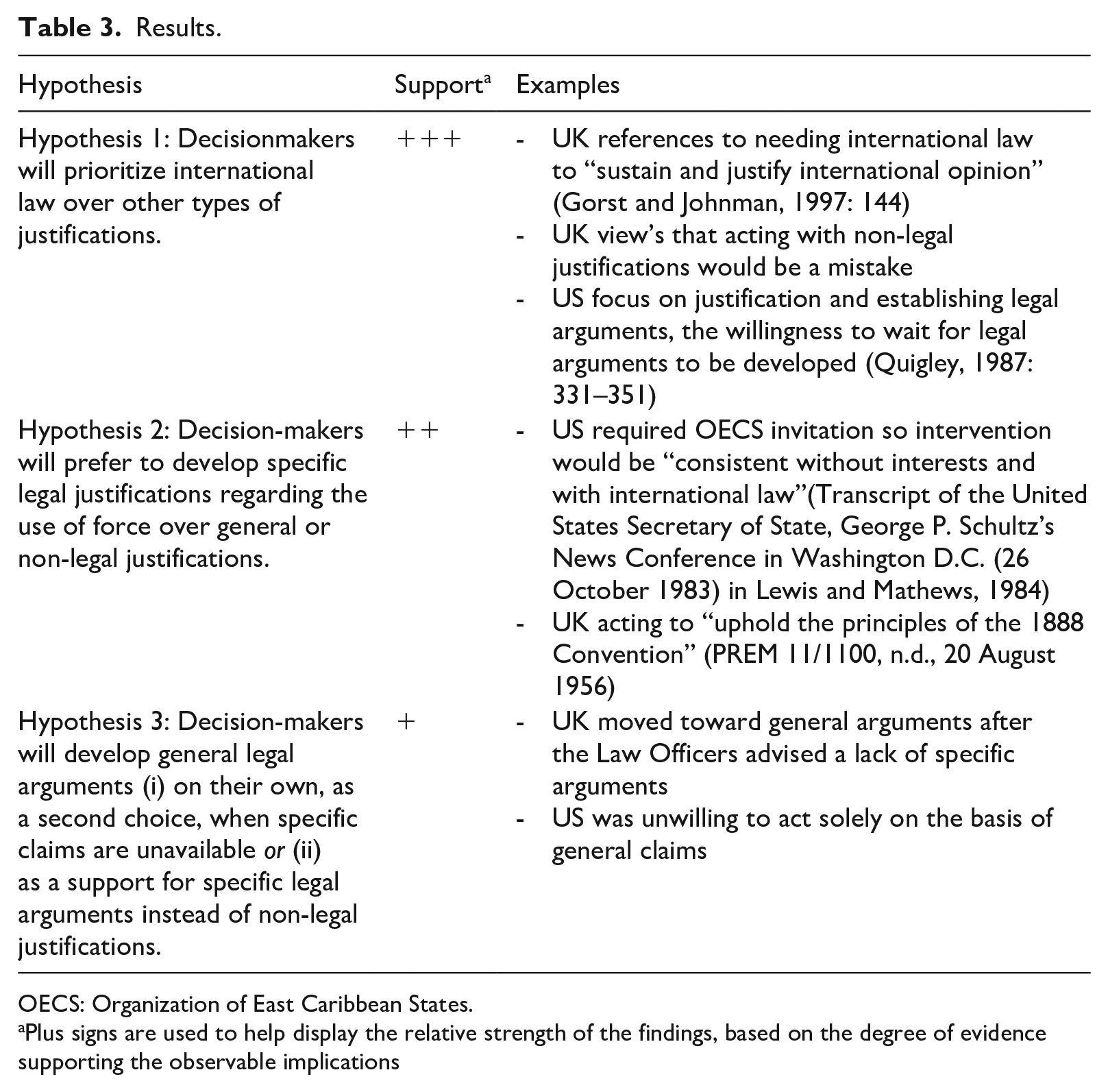
OECS: Organization of East Caribbean States.
Plus signs are used to help display the relative strength of the findings, based on the degree of evidence supporting the observable implications
The second and third hypotheses, dealing with specific and general justifications find sufficient evidence to pass their “hoop tests.” Decision-makers showed a desire to create specific legal arguments (hypothesis 2) as UK decision-makers appealed to the 1888 Constantinople Convention and US decision-makers related their intervention to the legal authority of the OECS and the Governor-General. The Grenada case in particular offers support for hypothesis 2 as US leaders were unwilling to justify the use of force solely on the general legal grounds of protecting the lives of their nationals, instead pushing for invitations from both the Governor-General and the OECS (Organization of Eastern Caribbean States Position on Crisis in Grenada (26 October 1983) in Lewis and Mathews, 1984; Moore, 1984: 87). This evidence shows that hypothesis 2 “cleared” the hoop—decisionmakers expressed a preference for specific legal claims that, while not ruling out other reasons, supports the argument that specific references are seen as particularly valuable in justifications.
The expected weakness of general legal arguments, part of hypothesis 3 which would explain the preference for pursuing specific legal arguments, is also supported. As noted, the US was unwilling to act solely on the general legal claim of protecting nationals abroad. The US, in this case, appeared to recognize that specific legal references were needed to buttress their justification. It was not enough to justify the intervention with legal claims—those claims had to be built with references to written agreements. In this case, both hypotheses 2 and 3 appear to pass their hoop tests. Decisionmakers expressed a preference for specific references that we would expect to see if these references are indeed seen as being more important or valuable in crafting a justification. Similarly, the decision to situate general legal references as a second-best option supports the argument that general legal references, while perhaps still useful in a justification, are not seen as conferring the same benefits as more specific references. Interestingly—and with importance for the question of rarity—the authority of the Governor-General to provide this letter was, and remains, disputed (Beck, 1993). The fact that the Reagan administration was willing to go to such lengths to gain legal references may indicate the value placed on being able to make such justifications.
Further supporting hypothesis 3 is Eden’s desire to avoid discussing the legal grounds for intervention in favor of broader political and normative arguments (Glennon and Noring, 1990, Document 5). Eden’s attempt to pivot the discussion away from specific legal grounds to general legal and normative grounds aligns with the expectation that actors will only advance general arguments without specific arguments if they are unable to develop specific arguments. Also, the UK case demonstrates the great lengths states may go through to develop IL justifications with as much specificity as possible, even over the protests of their legal advisers. While other factors featured in both decision-making processes—including security concerns and political considerations—it appears that IL did play an important role in both decisions to use force.
Finally, it is important to note that the decision to pursue these legal justifications had an impact on the eventual invasions. While it is impossible to know if the absence of an IL justification would have deterred intervention, these justifications shaped the cost of using force and the process of creating these justifications may have shaped the nature of the intervention itself. For example, UK military planners noted that delaying the operation past mid-September increased the likely cost of an operation by giving Egypt more time to organize a defense—indeed, military officials raised concerns about delaying an operation past September 15th (CAB 21/4113, 16 August 1956). However, the pursuit of an international justification delayed the invasion far past this deadline and decision-makers assumed the heightened risk, valuing justification over some degree of military efficiency.
It is worth noting some of the conditions that may shape the importance of legal justifications. In both cases, justifications were necessary as the UK and US intended to carry out overt operations, increasing the likelihood of international response. Research shows that states are more likely to pursue covert operations when they are unable to find international legal support for their policy (Poznansky, 2019). In cases where states intend to pursue their goals covertly, as—for example—the US did in Nicaragua, legal justification may be less important since it is hoped that the operation itself will not become public knowledge. Relatedly, the UK—faced with the realization that its legal justifications would be tenuous at best—moved toward a covert plan with Israel and France as part of their decision to use force. It is also important to consider the counterfactual of acting without an IL justification. In Grenada, for example, the US faced considerable criticism in the UN and other international forums, including accusations that it had fabricated parts of its justification (Quigley, 1987). However, the question may be, would this have been worse if the US did not provide its legal justifications, supported by OECS member-states, which provided cover for its allies to voice support or minimize their criticisms?
Conclusion
Throughout both cases, IL permeates the decision-making process surrounding the use of force as decisionmakers placed a particular value on crafting legal justifications for their actions. Indeed, discussions of IL shaped both the decision-making processes and the decisions that were made, as both the US and UK delayed intervening until a legal argument could be presented, even if delaying imposed political costs. Indeed, the UK delayed intervention in favor of developing its IL justification, even as doing so increased the military risks associated with intervening. The perceived value of a legal justification appears to have outweighed, at least in this case, some questions of military expediency. This reinforces what previous scholarship has noted, that international relations are often deeply legalized and that the language of law is central to many forms of international politics, while providing unique insights into how legalization is understood in the foreign policy process. This desire to justify the policy to international audiences further shaped the content of the justifications as decisionmakers saw codified legal standards as particularly valuable for this task, developing general legal justifications only as a supplement or as a second choice when a codified justification did not appear tenable.
These findings help deepen our understanding of the motivations behind IL-based justifications for foreign policy decisions. Decisionmakers placed IL at the forefront of their attempts to justify military force, reflecting the depth of legalization in modern international politics. Legal claims were not treated as secondary or as something that could be easily cast aside if they proved challenging to develop. Instead, decisionmakers emphasized the importance of developing these claims, showing that there is an expectation that states will justify their actions with IL and that other justifications may not fulfill the same purpose. Within these legal justifications, decisionmakers prioritized justifications which reference codified legal standards, seeing these references as particularly useful for a justification. While uncodified legal standards are referenced, it appears that these references as seen as supplementary to codified references, or for cases when a codified justification cannot be credibly developed.
This deepens our understanding of the processes—and motivations—underpinning the legalization of international relations and the use of force. IL justifications, made for political reasons, play an important role in shaping the development of IL and its use—and place—in international politics. Actors may—intentionally or not—reshape legal standards as accepted justifications may deepen the acceptance of some standards while rejected justifications may undermine or challenge IL. It is important to consider the ways in which this behavior, often led by powerful states acting out of political self-interest (Hurd, 2016: 275, 2018: 14; Irani, 2018), shapes the meaning and application of international law. Future research should consider how these politically motivated uses of IL reshape the law’s meaning and place in an increasingly legalized world.
These justifications may be seen as a continuation of a historical pattern of war justifications, which now draw on international legal texts as the language of international relations has changed. These findings stress the need for further research on the use of IL as a tool of justification. While much IL work focuses on its role as a restrictive tool this article highlights another aspect—its potential to justify actions that may even appear contrary to its intended legal purpose. IL’s distinctive rhetorical nature—recognized by decisionmakers who draw on it to discuss, decide on, and justify policies—is central to its role in international politics.
Footnotes
Acknowledgements
I would like to thank Wayne Sandholtz, Patrick James, Jonathan Markowitz, Kelebogile Zvobgo, Edward Gonzalez, Sebastian Dellepiane-Avellaneda, Kendall Stiles and the participants of the Spring Seminar in Global History and International Law, the USC CIS Working Paper Series, the USC/UCLA International Law/International Relations Workshop, the UT-Austin Graduate Public Law Conference, the International Studies Association (West) 2018 Meeting, and the 2018 Essex Summer School in Social Science Data Analysis (Case Studies) for their helpful comments.
Funding
The author received no financial support for the research, authorship, and/or publication of this article.
