



Abstract
Speaking a language is a socially and historically situated action through which speakers define themselves in relation to others. Using interviews collected from 15 Latina women attending an ESL program, this study examined how gender and ethnicity frame students’ practices related to the study of English as a second language. Positioning analysis was used to identify the multiple roles the speakers enact in their immigrant and host communities, and describe how they strategically manage and combine these positionings to achieve multiple goals. The results show that ESL study serves disparate and sometimes contradictory purposes in the lives of immigrant students, depending on processes through which agency and vulnerability is achieved. Linking Peirce’s conceptualization of student motivation as “investment” to socio-cultural theory, this study fosters a broader view of the dynamics shaping individual language use and language acquisition. By examining second language study as a cultural tool, students’ motivation can be understood with a view to immigrants’ social settings and power relations that define them.
In recent years, the academic disciplines of psychology and language studies have found themselves in increasing proximity. This development has become evident through the establishment of several cross-disciplinary approaches centering on the intersections of social relations and language: discourse analytic theory, examining conversation practices as a source of constructing subjects in relation to others; and sociolinguistics, focusing on strategies of language use as they reinforce and challenge existing relations in society. The underlying assumption connecting these fields is the irreducibility of linguistic behavior to the structural properties of language or to the attributes of the speaker. Instead, speaking a language is recognized as a socially and historically situated action through which speakers define themselves in relation to others (Bourhis, El-Geledi, & Sachdev, 2007; Jackson, 2008; Lantolf & Thorne, 2006; Mayes, 2010; Norton & Toohey, 2002).
The present study examines how Latina women living in a multi-cultural, bilingual context of US immigration negotiate gender and cultural identity demands through their practice of studying English as a second language (ESL). This analysis reflects calls to develop context-specific ESL and language pedagogy that respects the goals of immigrant speakers (Menard-Warwick, 2005), and empowers users of minority language varieties (Godley & Minnici, 2008; Jaspal & Coyle, 2010). A common accusation directed at immigrants cites their presumed unwillingness to learn English, yet studies assessing English learning among immigrant children reveal an unequivocal preference for English across immigrant communities (Portes, 1996). We argue that an analysis of second language learning sensitive to the complexity of immigrant lives can importantly clarify the connections between the socio-political contexts of immigration and the goals these contexts foster on the part of immigrants. At the same time, it can shift the focus on immigrants’ “motives” into a larger socio-historical space and away from individual success or blame.
Language learning in a social context
Originating with research on minority language varieties (Labov, 1972), scholars have paid increasing attention to the social dimensions of speaking. What makes individuals adopt a particular way of speaking and reject others? Why do minority languages persist in the face of dominant, more prestigious varieties maintained by others within the same society? And, from the perspective of language instructors, why do some students master a language with ease while others fail, sometimes barring their access to educational and economic opportunity?
To understand language acquisition, it is necessary to differentiate between the student of a first language (e.g., a child under the age of 3), the student of a second language within a native language setting (e.g., studying a foreign language in one’s country of origin), and the student of a second language in settings where this language is the dominant language (e.g., in the context of immigration). Only in the last instance is language fundamentally linked to intergroup relationships and power dynamics (Saville-Troike, 1997).
In immigrant contexts, it becomes apparent that the dominant language is not merely a vehicle of communication but becomes a condition of one’s participation within the host community, upon which social status, opportunities and, sometimes, self-worth, may be dependent.
Linguistic behavior closely mimics the identification choices immigrants make upon arriving to the United States, and linguistic choices can become a part of an immigrant’s strategy to negotiate between identity demands. Prior studies in the social psychology of language explored the connections between identity and language behavior by examining, for example, the processes guiding language maintenance and loss (ethnolinguistic vitality theory; Giles, Bourhis, & Taylor, 1977) and what functions language norms serve in negotiating a bicultural identity (Jaspal & Coyle, 2010). Importantly, these studies address language beliefs and practices as strategies used to cope with a stigmatized minority identity (Breakwell, 1986).
Similarly, in the field of second language acquisition, investigations have moved away from considerations of speakers’ motivation to socio-culturally situated accounts of speakers’ identities (Dörnyei & Ushioda, 2011). Original theories of second language learning identified motivation as a strong determinant of second language success (Gardner & Clément, 1990). The motivation of the language student has been defined as a combination of desire and effort to achieve a learning goal, and can assume the form of either instrumental or integrative motivation. Instrumental motivation refers to a status that the speaker may acquire with the knowledge of the second language, including status based on access to career opportunities. Integrative motivation refers to a solidarity function, i.e., the positive attitude towards second language speakers, and it was found to be a superior predictor of second language success because of its identity-related function.
However, critics point out that seeking explanations of second language success at the level of individual motives leaves out an important piece of information: the shaping of the motives that guide speakers in attaining linguistic success. In efforts to address this issue, Dörnyei’s L2 motivational self-system theory describes an ideal L2 self that serves as a link between self and motivation, applying the theory of “possible selves” (Markus & Nurius, 1986) to L2 study (Dörnyei, 2009). However, like traditional theories of motivation, the L2 motivational self-system presumes an unproblematic character of the intergroup context, focusing largely on the dynamics of the classroom.
Peirce (1995) proposed a concept of student “investment” to replace the restrictive assumptions underlying the concept of motivation. Sometimes, investment in learning a second language may help students establish a positive identity as they become proficient in the language; at other times, the goals inherent in the learning process and the needs of students may become incompatible (McKay & Wong, 1996). Thus, the concept of investment allows us to explicitly acknowledge the interconnections between language use and power (Saville-Troike, 1997). When we view speakers as intentional agents seeking access to power by selecting specific practices, linguistic or non-linguistic, we also foster an appreciation of difference rather than deficit when describing the language learner. By capturing the “local particularities” of the speaker, “individual motivation” becomes “emergent motivation” (Ushioda, 2009), characterizing speakers who act as intentional agents shaping their own lives.
Language as a multi-faceted tool
Socio-cultural theories of learning, although not specifically concerned with linguistic behavior (for an exception, see Lantolf & Thorne, 2006), offer another useful framework for understanding how speakers relate to languages spoken in a particular cultural setting. Following Vygotsky (1987), Wertsch (1998) proposed that the link between individual action and culture can be studied through the examination of agents acting with tools that are specific to the cultural setting. Only by examining culturally defined properties of a tool and the ways in which a person appropriates it can we understand the dynamics of human action without reducing the frame of explanation to social or individual factors. The study of language acquisition in socially diverse settings illustrates the main points of Wertsch’s theory. The relationship between an agent and a tool is characterized by conflict introduced by the often discrepant purposes for which the tool is produced and later employed. In case of second language acquisition by immigrant speakers, the dominant language—created as a vehicle of communication within the host community—serves different functions: it becomes a condition of access to the host community accompanied by potential socio-economic advantage, or it may position the immigrant unfavorably, by conferring a minority position vis-a-vis native L2 speakers or through the loss of one’s L1 community (Jackson, 2008). The primacy of context guiding the active management of cultural tools is further evidenced by the immigrant who must monitor multiple dialects in a process often referred to as code-switching (Auer, 1995; Gumperz, 1982; Heller, 1988). For example, in an ethnographic study of Puerto-Rican immigrants in New York, Zentella (1997) described how the roles occupied by men and women promoted beliefs about language use that further defined the participants’ roles within these communities.
Wertsch distinguishes between mastery of a tool and its appropriation. Mastering a tool can be understood as learning the rules of its use; appropriation is a way of making the tool one’s own or using the tool as a vehicle to achieve one’s goals. The two ways of relating to a tool parallel Peirce’s distinction between students’ motivation to speak a language and their investment in it. In the former instance, students are seen as passively receiving a skill; in the latter, the learning is characterized by an active negotiation of its use (Peirce, 1995). By examining how second language study serves the purposes of immigrant speakers, students’ motivation can be understood with a view to the particular social settings and power relations within and between the L1 and L2 communities. Only by identifying specific discourses that operate in these communities can we understand how immigrants access power by appropriating particular language practices.
Towards a narrative theory of second language investment
Psychology has turned its attention to narratives as a means of meaning-making, underlying the organization of the mind (Bruner, 1986; De Fina, Schiffrin, & Bamberg, 2006). Wertsch (1998) identified narratives as powerful cultural tools of socialization. As with any tools, however, narratives both constrain and empower the individuals who use them, necessitating a production of counter narratives that co-exist in an ever-shifting space of narrative positionings (Bamberg & Andrews, 2004; Harré & Van Langenhove, 1991; Hermans, 2001). Fundamentally, narratives are tools of constructing one’s self in relation to a particular cultural setting, or sites of self-development, characterized by continual negotiation of the belief systems that characterize these settings (Daiute & Lightfoot, 2004).
More recently, the activity-based nature of narratives has been described in the theory of socio-biography, where narrative activities enact the dynamic tensions between cultural imperatives and responses to these imperatives (Daiute, 2004, 2010). Approaches to narrative analysis that are consistent with this theory, like the one employed in the study reported here, are optimal for engaging diversity within and between individuals. In contrast, more general qualitative approaches tend to treat discourse as a vehicle for stable inner meanings rather than as relational performances in actual settings.
Through the study of narratives, research examining identity processes in immigrants challenges the traditional view of minority membership as a simple reaction to the conditions of lesser privilege and further highlights the agentic role of narrative self-construction. Minority status, reflecting both a group's unique cultural history and the history of the group's immigration, forms a narrative context through which immigrants define their specific positions in the new country, and the power these positions carry. Verkuyten (1997), in his analysis of Turkish immigrants’ narratives, showed that the distinctions made between types of immigrants in Dutch society, and meanings of gender, were used to articulate positions of power. Similarly, in a study of ESL students in California, McKay and Wong (1996) examined narratives of Asian students with disparate cultural and immigrant histories. The narratives drew on the traditional discourses of Asian culture, the discourse of Asian Americans defining themselves as a “model minority” in the United States, and the gendered discourses of American youth. The particular constructions the students made of these available identities produced language investments that sometimes enhanced educational outcomes, but at other times thwarted them.
These studies illustrate that speakers use objective and symbolic features of their social context to selectively construct a type of self-narrative, or identity, through the articulation of meanings more or less empowering to the narrator. When examining immigrants’ lives, such an approach is useful in recognizing the sources of immigrants’ agency. From a socio-cultural point of view, agency is relationally constructed in social contexts, rather than an individual property or trait (Van Lier, 2008). We further argue that agency is produced through narratives that define the speaker’s position in available narrative/identity contexts which in turn shape speakers’ investment into practices such as ESL study. For example, the students’ narratives examined by McKay and Wong (1996) illustrated how acceptance in the new society, an immigrant’s position of agency, might be achieved through disparate strategies, with academic success in the study of English being only one of the tools of choice.
Latina women’s agency in the contexts of gender and ethnicity
This study explores the narrative formation of agency in the lives of Latina ESL speakers, and how their narratives contribute to investment in ESL study. Because Latina immigrant women’s lives are strongly shaped by the meanings ascribed to their gender and ethnicity (Barajas & Pierce, 2001), these two contexts were selected as frames for narrating agency and lack of agency, defined as vulnerability, that in turn shape the Latinas’ investment in the study of ESL. The study was guided by the following questions: What were the sources of the Latinas’ accounts of agency? How were subject positions articulated to achieve accounts of agency in contexts that frequently restrict it? What goals and obstacles characterized Latina ESL students’ gendered and ethnic worlds, and how did the women negotiate them? Finally, what means did learning English as a second language serve in the women’s lives? What were the costs and benefits of Latinas’ investment into ESL study?
Positioning analysis (Bamberg, 1997) connects considerations of audience to the meanings generated in spoken or imagined exchanges, serving as a useful tool in examining constructions of agency and investment in second language learning. This technique identifies the multiple roles that speakers enact within the various layers of their social worlds, for example, the roles of students, mothers, and wives, immigrants, or Latinas, and the ways in which these roles may be combined into specific “positionings” to achieve conversational and identity goals. We utilized this strategy in order to contrast the two salient identity contexts, gender and ethnicity.
Given these assumptions of positioning analysis, no specific definitions regarding gender identity and speakers’ agency were formed at the outset of the study. The only method used to elicit “gender” or “ethnicity” narrative relied on asking our participants general questions about “what it means to be a Latina woman.” This technique framed a detailed investigation into the narrative construction of each position with a view to the multiple audiences located in the speakers’ L1 and L2 ethnolinguistic communities. Next, the participants’ framing of issues related to gender, second language learning, and ethnicity by interviewees was analyzed systematically to determine whether and how agency was achieved in the specific gender and ethnicity narrative identity locations. One of the contributions of a discourse analysis is precisely the opportunity for gender and other assumed categories to emerge as (quasi-) dependent variables.
Method
Sample and procedure
Participants were 12 Latina students attending ESL courses at a public university serving a large Hispanic population in New York City. The participants were between 18 and 57 years old (M = 30) and had resided in the US for 1 to 37 years (M = 11). Seven participants were born in the Dominican Republic, 2 in Puerto Rico, and 1 each in El Salvador, Honduras, and Guatemala. Spanish was their first language and they spoke no other languages except for English. Seven participants were attending an intermediate-level ESL course and five were attending advanced-level ESL courses. Three participants were married and seven had children.
The interviews were conducted in English or Spanish, based on participants’ preference. Participants were asked about their understanding of themselves as women, as ethnic women (using participants’ preferred ethnic self-identification label, e.g., a “Dominican woman”), and whether for them the definitions of ethnicity and gendered ethnicity differed in their meaning. Next, participants were asked to relate their experiences of studying English in view of their gendered and ethnic self-definitions.
The interviews were conducted by two female immigrant interviewers: one from the Czech Republic proficient in English, and another from Puerto Rico, proficient in both English and Spanish. The first interviewer conducted 4 interviews in English and the second interviewer conducted 5 interviews in Spanish and 3 in English. All interviews were tape-recorded and transcribed. Interviews conducted in Spanish were translated into English by the Spanish-speaking interviewer.
Positioning analysis
Positioning analysis starts from the assumption that speakers have choices in how they construct themselves through narratives and that their choices are signposts with regard to how they want to be understood (Bamberg, 1997; Barkhuizen, 2010). The process of positioning can take place at three different levels: (1) how the characters are positioned in relation to one another within the reported events; (2) how the speaker positions him- or herself to the audience; and (3) how speakers position themselves to themselves (Bamberg, 1997).
Level 1: Positions of agency and vulnerability
The first level of positioning focuses on how characters (including the narrator) are depicted in relationships to one another in the story, by stating, for example, who is in control of the action and who is the recipient of it (Bamberg, 1997). To identify speakers’ positions at this level, we distinguished among narratives in which women posed as agents (agency codes) and those in which they identified themselves as victims of others’ actions (vulnerability codes). Agency positions refer to individuals acting in contexts characterized by affordances that translate into a psychological “action potential,” or ability to affect one’s environment (Lasky, 2005). Vulnerability positions, on the other hand, refer to actors facing restrictions in their contexts that generate emotional states of powerlessness, defenselessness, anxiety, and other negative states that typically inhibit action (Lasky, 2005).
Within these broad positioning categories, we identified three types of agency positions and two types of vulnerability positions:
Relational Agency (RA) was articulated through one’s relationships with others, either by supporting others (e.g., children, parents, other members of one’s ethnic group) or by receiving support from them. Example: “I want [to go to college] for me but I want that … for my mom… It was her dreams, so I’m going to do it for her.” Individual Agency (IA) was articulated in terms of one’s own goals and desires, for example, stating one’s success as a distinct goal or speaking about the realization of one’s dreams. Example: “I am in college and probably soon I go to get the graduation. And probably, if I can, I go to another two years. I want to go to John Jay College.” Oppositional Agency (OA) was formulated as a reaction to a challenge, for example, stating the need to overcome difficulties, to avoid being a burden to others, or to avoid negative feelings associated with a particular situation. Example: “I didn’t know English … They wanted to offend me, but I wasn’t offended. I continued to talk. I thought, just as they learned to speak English, I can too.” Psychological Vulnerability (PV) referred to descriptions of negative psychological states, such as feelings of inadequacy or sadness. Example: “I felt uncomfortable, so uncomfortable to say what I eat when they [non-Hispanics] eat something so different … I think that they would take it like, ‘You eat THAT? Oh my God!’” Political Vulnerability (PoV) referred to formulations of one’s lack of power resulting from political and social oppression. These narratives described disadvantages of being stereotyped or labeled as a result of nationality or gender. Example: “It is much more difficult for one to be a Hispanic here than for a woman in her own country. One comes to a new country, from another race, another language, another culture, and it is more difficult for the Hispanic woman here in this country.”
Strategies: Paired codes analysis
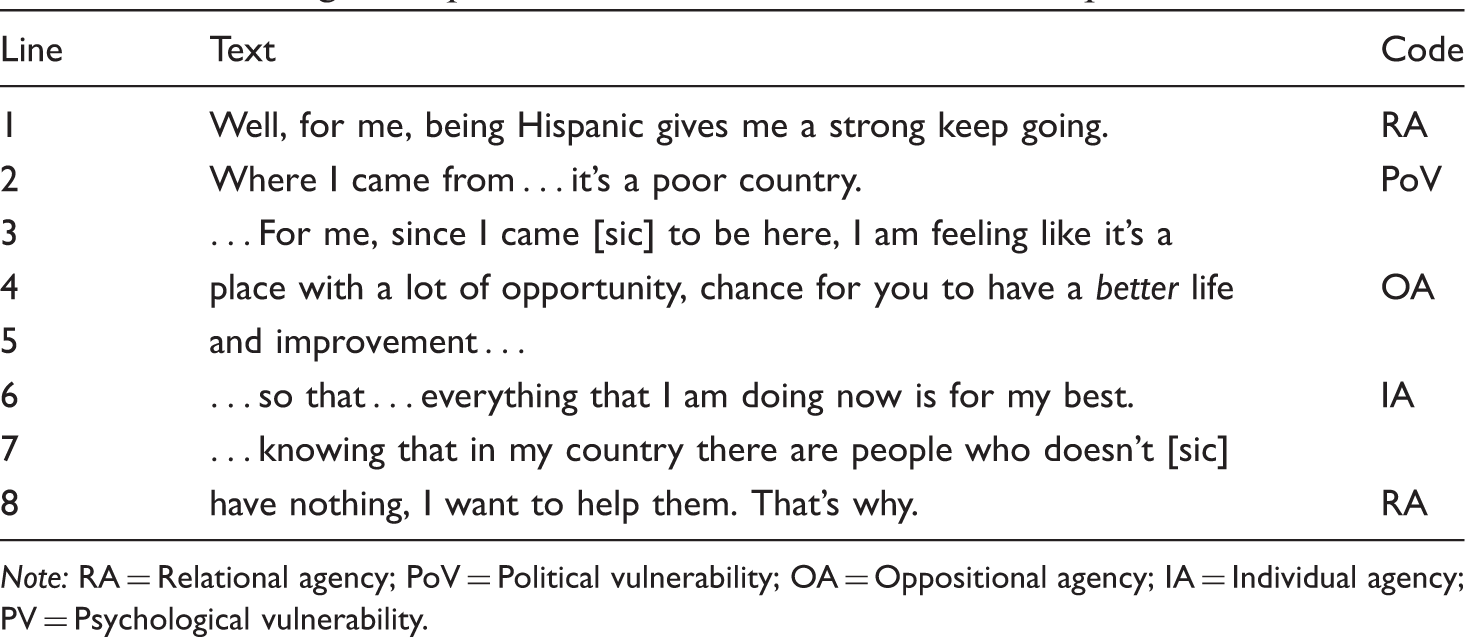
Note: RA = Relational agency; PoV = Political vulnerability; OA = Oppositional agency; IA = Individual agency; PV = Psychological vulnerability.
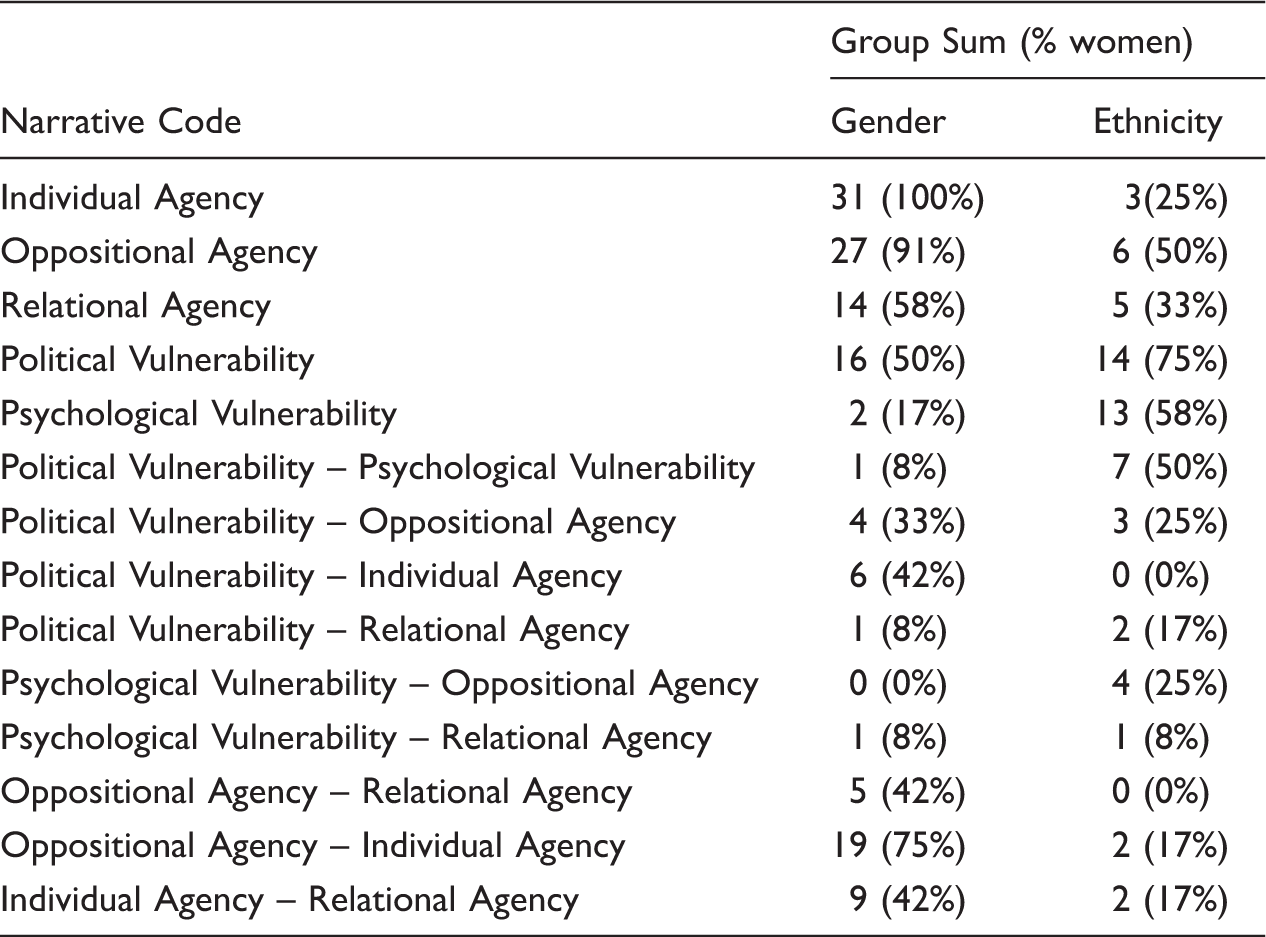
Group sums of agency and vulnerability codes and sequential code pairs in contexts of gender and ethnicity.
Level 2: Relationships between narrator and audience
The second level of positioning concerns the pragmatics of telling a story to one’s audience. This level identifies how the story the narrator chooses to tell is shaped by real or imagined audiences, revealing the interactive effects of narrative content and structure (Barkhuizen, 2010). In the case of narrative interviews, the role of the interviewer is mostly that of a “prompter” or “supporter.” Therefore, for the purposes of this analysis, we focused on the dynamic shaping of the participants’ stories by the interviewer’s questions about their gendered and ethnic experiences and contrasted the emerging stories in terms of identity claims made by the participants.
Level 3: Constructing a story about oneself: Defining the role of ESL in women’s gender and ethnicity narratives
The third level addresses the question of how speakers, by articulating their positions through storytelling, make claims about their identities. At this level, the orientations of oneself to others in the story and to one’s interlocutors result in an answer to a more general question of “Who am I?” that is relevant beyond the local conversational situation (Bamberg, 1997). In addition, claims at this level provide comments on master narratives, or ideologies, that participants negotiate in their daily lives.
Women’s positionings at Level 3 were analyzed by contrasting frequencies of coding pairs elicited across the two identity contexts and identifying what role ESL played in articulating various identity claims. As an example, one woman articulated her views on learning ESL in terms of oppositional agency, or overcoming obstacles in her life: “Speaking just one language, Spanish, in my case, you are like in a cage. You cannot move from there … but when you speak English … in this country, you can move. You can have more space.”
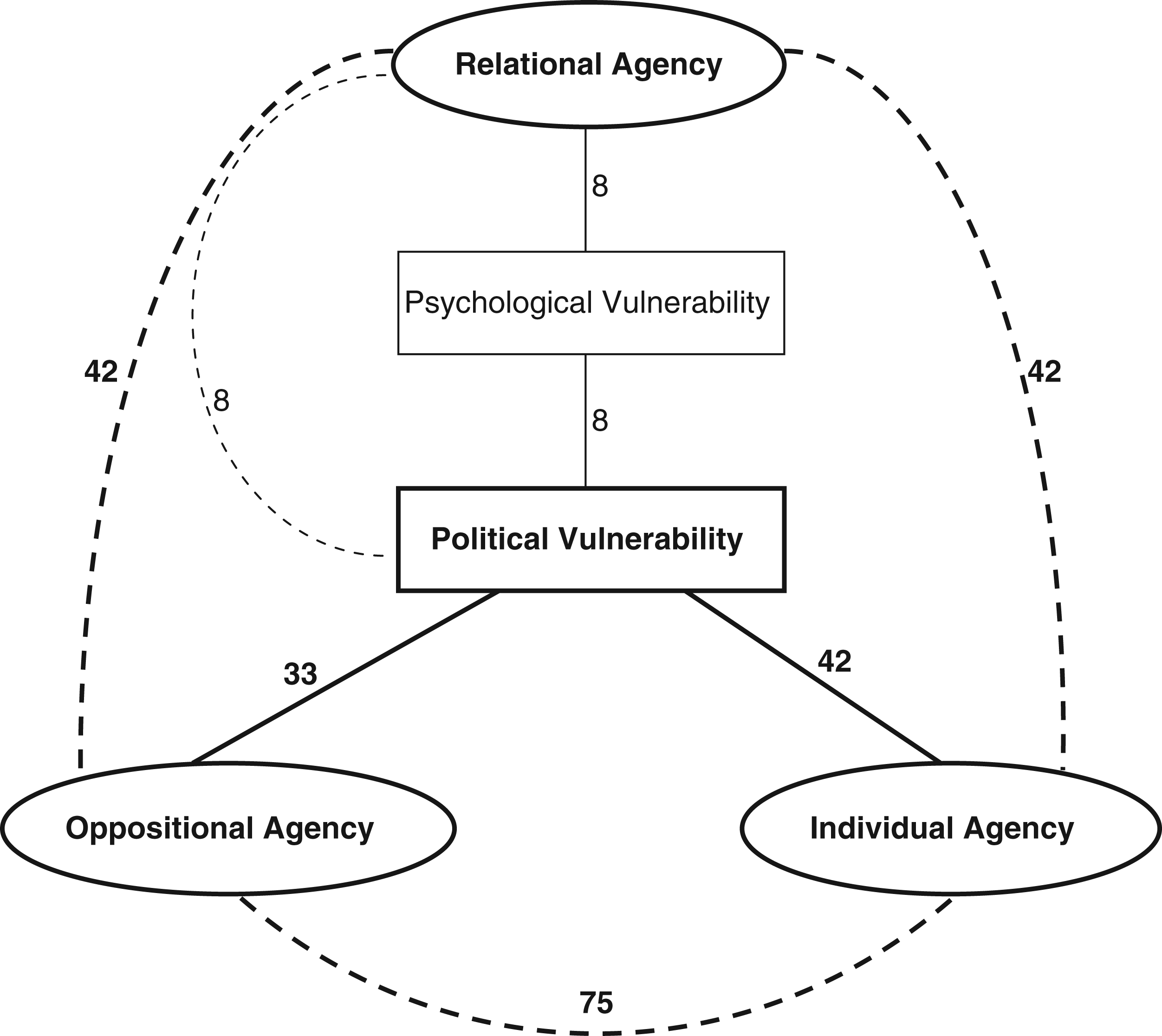
Finally, diagrams of each identity context were created to illustrate “meta-narratives” that guided the participants’ investment into ESL shaped by imagined audiences in the contexts of gender and ethnicity (see Figures 1 and 2).
Hispanic identity. This figure represents a summary of narrative positionings with central meaning clusters outlined in bold, and solid lines representing high pairing frequency. Gender identity. This figure represents a summary of narrative positionings with central meaning clusters outlined in bold, and solid lines representing high pairing frequency.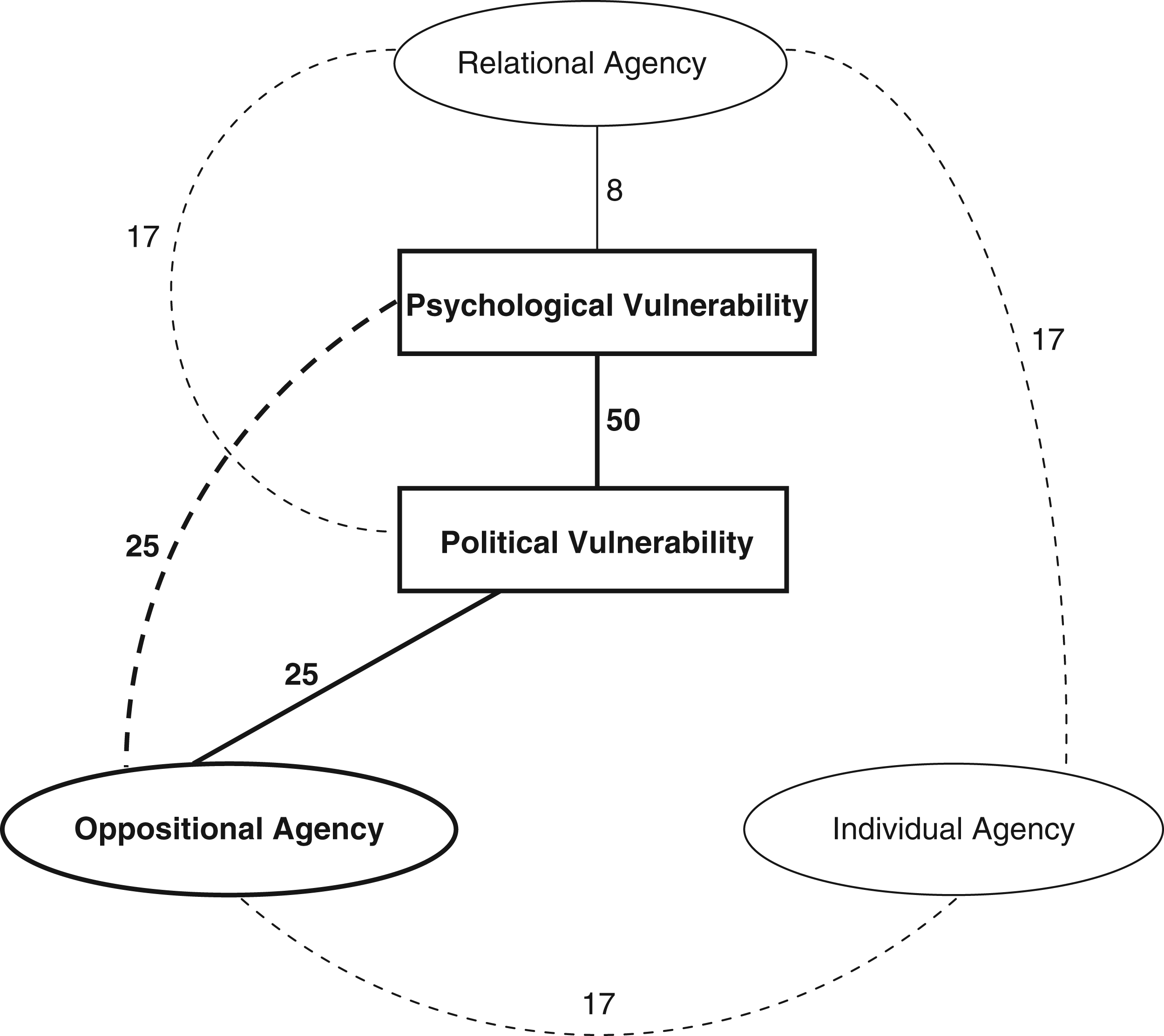
Results
The sums of Level 1 codes are depicted in Table 1, reflecting aggregated counts of agency and vulnerability codes for the entire group of participants within narrative contexts. Percentages show how many women in the sample employed the particular codes (use frequency). Similarly, all subsequent analyses employ a group-level analysis varied by narrative contexts (ethnicity and gender; Level 2 positioning), and adding a referent analysis describing the meanings of ESL study within each context characterized by unique identity claims (Level 3 positioning).
The three most prevalent codes show that a common obstacle our group of participants identified was political oppression (PoV, N = 30). In face of this obstacle, the women manifested high levels of oppositional agency (OA, N = 33), indicating willingness to overcome conditions that denied their agency. A high prevalence of individual agency (IA, N = 34) showed that the women relied primarily on individual rather than collective or relational resources (RA, N = 19) in reaching their goals.
Figures 1 and 2 summarize the meta-narratives produced by the group of women when they spoke of themselves in the contexts of gender and ethnicity (Level 2 positioning). The most prevalent codes are bolded and solid lines represent high frequency of pairings; dotted lines refer to codes paired less often. The purpose of the figures is to describe main strategies characterizing each identity context that in turn present a coherent map of concerns and solutions that the participants used in their respective roles as women and Hispanics.
Agency in the context of ethnicity
In the part of the interview where participants described their experiences in the context of Hispanic identity, the women spoke most frequently of political oppression and its negative effects on their lives (PoV-PV, N = 7). This suggests that when positioning themselves as Hispanics, the women were vulnerable to the damaging effects of their immigrant status and ethnic discrimination in the US. The imagined audiences to which the participants oriented themselves were typically native-born American citizens, often in positions of authority, such as employers and government officials.
The following example illustrates some of the obstacles with which the women struggled upon their arrival to the US and the emotions with which they responded: Sonia: “It’s different when you come here. There [in the Dominican Republic], you are in your country. You say, ‘Ay, I’m going to New York.’ Estas ilusionada [You are enthusiastic]. But when you come …” Interviewer: “So you’re feeling a bit disillusioned?” Sonia: “Yes, especially when I no work. When you try to get a job and they say, ‘Do you speak English?’ and you say, ‘a little.’”
The types of agency elicited in this context, functioning as strategies used to face political oppression and its negative psychological impact, were narratives of oppositional agency (PoV-OA, N = 3; PV-OA, N = 4). In the context of Hispanic identity, oppositional agency allowed the women to resist a marginalized place in society. However, the prevalence of this strategy suggests that the women’s agency was largely centered on countering negative social conditions as compared to defining and pursuing goals of their own.
One woman, after having encountered discrimination, used the opportunity to articulate her opposition: Muriel: “The first thing that happens is that you see yourself and are treated different in society. You get to a place that is quite desperate. I felt, in that particular situation, that I would be resolute. I knew they [government officials] were trying to manipulate me because I didn’t understand how the system functioned. I thought to myself: ‘They are not going to send me anywhere. The answer is no. I’m not going, I haven’t done anything wrong.’”
Although having the ability to identify and reject discrimination, this woman was not spared negative feelings related to her ethnic identity as a result of her experiences: “I felt rejected. As a Dominican I felt fine. I just felt rejected because I was Dominican.”
Narratives of individual agency were less frequent: two women spoke of the need to oppose discrimination in connection with their independent goals (OA-IA, N = 2), whereas others described their goals when speaking of helping, or receiving help, from others in their community (IA-RA, N = 2).
Agency in the context of gender
In the context of gender identity, the most prevalent subject positions were those that connected the women’s own goals with the fight against conditions that blocked the path to their achievement. Narrative pairs of individual agency and oppositional agency occurred most frequently during this part of the interview (IA-OA, N = 19). The following example illustrates the use of this narrative strategy by which participants defined their experiences as Hispanic women: Interviewer: “It must be difficult to be married, tend to your marriage, tend to your children, and attend college classes …” Senabia: “Well, for me, it is a challenge. It is a goal that I have assigned to myself because even if I am a mother and I have to attend to my home—cooking, cleaning—for me, it is a goal to continue my studies. Every Hispanic woman must evolve in this country. She must show the world that we can do anything in life, not just taking care of a home and a husband. We also have to develop ourselves intellectually, and show men, especially, that woman can be just as competent as a man.”
In this quote, Senabia responds to an obstacle in her life (tending home while being in school) with a strong agentic voice, by clearly defining her goals in this country (“it is a goal to continue my studies;” IA), and using stereotypical images of Hispanic women as a springboard for action (“show men, especially, that woman can be just as competent as a man;” OA).
Similarly, another participant, Maria, articulated the hopes with which Hispanic women looked to their new country as a context for assuming more equal gender roles: “An American man treats his woman like a queen. Hispanic men are not like that … I feel more liberated here … I plan on going out to work, having the same rights.”
Why have the women found such a strong voice, evidenced by frequent articulations of agency, when speaking of their rights in the context of gender while their narratives of ethnicity were largely defined by a lack of such voice? To answer this question, we analyzed the interviews to better understand what obstacles the women described in the context of the two identities. When speaking of themselves as Hispanics, the women defined political conditions as a source of their struggle. All participants who expressed psychological vulnerability when positioned as Hispanics have identified the lack of opportunities following immigration to the US coupled with ethnic discrimination as sources of vulnerability in their lives. In contrast, when speaking of their lives as women, the participants depicted traditional women’s roles as a most prevalent obstacle followed by difficulties resulting from pressures of a life of struggle (e.g., raising children as single mothers, attending school after work). These findings suggest that articulating agency is a function of a particular context and its accompanying barriers that a person is faced with: in case of politically based discrimination, Latina women were more likely to suffer from negative self-image than when facing the stereotypes of a traditional women’s role. Further, identifying the two sets of obstacles points to the importance of considering within-group concerns (e.g., sex discrimination in Latino communities) together with intergroup concerns (stereotyping of Latinos in the US).
Negotiating the costs and opportunities of Hispanic womanhood
Contrasting women’s claims across the two contexts allowed for a broader commentary on pervasive social discourses, in this case, the disadvantages brought about by immigration, through lowered socio-economic status and stigmatizing stereotypes, and the discourse portraying Latina women as traditional homemakers unwilling or unable to compete with men. To understand how the two forms of oppression created opportunities or obstacles in the participants’ lives, it is important to consider that most women in our sample of immigrant college students have already successfully battled Latina-based gender stereotypes.
The following quote provides evidence that some women arrived to the United States as a means of escaping stereotypical female roles: Maria: “I have noticed that men from other cultures help their women more. Hispanic men are not like that with their women. They are the ones who make orders and rules, they are the ones who decide everything … I have always had liberal ideas. I’m not one of those individuals who plans on staying home, cooking and tending after children, no. I plan on going out to work, having the same rights.” Interviewer: “Would you have the same beliefs if you were in Santo Domingo?” Maria: “Yes, because I arrived here with these ideas and thoughts.”
In a different part of the interview, however, this participant expressed feelings of alienation as a result of her status of an immigrant: “You feel like you don’t know anything about this country. You feel like you don’t belong here.” (PV)
Although the participants were aware of the possibilities the United States provided for their development of independent female roles, our analysis suggests that immigration sometimes created another set of restrictions replacing the barriers of gender inequality. Some of the new barriers participants named were lowered socio-economic status, the need to rely on welfare, and a stigmatized minority identity. One way of facing these new obstacles was to join forces with family members and Latina friends, frequently expressed in this context through relational agency. Because many of our participants had families, their motivation to achieve was typically connected to the goals they set for their children as well as for themselves. Expressions of relational agency were frequently joined with expressions of individual agency or oppositional agency (RA-IA, N = 9; RA-OA, N = 5). Although caring for a family and attending college proved difficult for some participants, many derived additional strength from their determination to prepare a better future for their children: Nery: “ … to be someone so you can feel better about yourself. You not living from Welfare, you have your career, you work. So I think … you show your kids you can be someone. Show them that they need to be someone too. Because they see you in the house and they say, ‘You don’t go to school, Mommy?’ So they don’t want to go to school, so I think [going to school] is a good motivation for the mother and for the kids.”
The role of English as a second language
Through the narratives of agency and vulnerability, women spoke of how their knowledge—or the lack of knowledge—of the English language contributed to their struggles or achievements as Hispanic immigrants and as women. In the context of Hispanic identity, women perceived the inability to speak English as a major source of struggle. When speaking of political and economical difficulties facing immigrants in this country, 6 women (50%) produced narratives of vulnerability that identified the lack of English proficiency as an obstacle to one’s goals. Two expressions of oppositional agency (33.3%) explicitly stated the need to study English to counter the disadvantages of an immigrant status. One woman described her transition into an English-speaking school and her resolution to study English to overcome social rejection: Cesarina: “When I came here, to the United States, I didn’t know English. I went to school and all the girls I was in school with knew and spoke English. They wanted to offend me, put me down, but I wasn’t offended. I continued to talk. I thought, just as they learned to speak English, I can too. They had the advantage of knowing English. I told them, ‘I may not know English, but I am going to learn, and you who are so concerned with only speaking English will not learn Spanish.’”
In the context of gender identity, only two narratives of vulnerability (14.2%) were associated with English. The main conflict in these narratives was located in relations between Hispanic women and men and language generally did not constitute a barrier to the women’s goals. In fact, the study of English was often used to remove oneself from conditions of diminished opportunities for women and used as a bridge to achieving independent goals. Ten out of twelve women (83.3%), when asked whether learning English contributed to their sense of themselves as women, stated that English was a very important part of reaching their goals. The following example illustrates how English, in the context of gender identity, was used not only to integrate oneself within the new culture, but also as a tool of reaching independence from unequal gender roles within one’s own community. Sonia: “When I came here, I noticed there are so many things that you have to learn … English teach me so many things about other people’s lives. I think English helps me express more what I want, what I need.” Interviewer: “And as a woman, would you say that it has allowed you …” Sonia: “As a woman, it help me demonstrate to others that I could do it. I am not a woman that doesn’t know nothing … Almost all Dominicans think that women are … for cooking. And women, they want to make their dream come true. That’s what I want to demonstrate with that.”
When speaking of their lives as women, the participants often expressed their strength by relating to others, either those who relied on them, such as children, or those who provided resources and support. Similarly, when describing the role of English, their motivation to study English was seen as a way to achieve not only individual but also collective goals: Interviewer: “How does speaking or learning English contribute to your sense of being a woman?” Milagros: “Well, it makes a big contribution in the sense that I live in this country, and perhaps I can help those individuals that come to me looking for services where I work. I can offer a better service when I speak the language. It is important to be Hispanic in this country and be able to communicate effectively. It is good for your family and countrymen and for you.”
The examination of the role of English in the two identity contexts revealed different meanings assigned to the knowledge and study of English. In their lives as Hispanic immigrants, women defined their insufficient knowledge of English as a persistent obstacle that contributed to their feelings of self-inadequacy, as attested to by the frequent linking of political and psychological vulnerability narratives. The determination to study English was used to overcome these negative feelings; however, it was not connected to the women’s personal goals. This indicates that obstacles encountered in the women’s experiences as immigrants, including their lack of English proficiency, may have contributed to the women’s greater sense of vulnerability.
In the context of gender identity, the motivation to study English was used to support the clearly defined personal goals of the women. Connected to the narratives of individual agency, English was seen as a tool of achieving liberation from unequal gender roles through providing opportunities of integration into a less gender-biased society. This suggests that women’s gendered self-positions, but not their ethnic positions, may serve as a source of motivation and success in pursuing the study of English as a second language upon immigration to the US.
Discussion
This study examined relationships between identity, socio-cultural contexts, and the study of English by immigrant Latina women. By analyzing narratives of the women’s experiences from their viewpoints as Hispanics and Hispanic women, our study offers insights into the processes that promote or hinder speakers’ investment into the study of English with a broader view to the particular contexts in which learning occurs. Additionally, this study contributes to the body of research examining the utility of studying narratives as acts of self-definition. Specifically, the results illustrate the dynamic processes of self-construction through which agency and vulnerability are achieved, pointing to the active role of the speakers as they accept or resist stereotypical views of themselves and others. In turn, the ability to “speak back,” or to create “counter-narratives,” evidenced in this study through expressions of oppositional agency, may create important possibilities for individual and social change (De Fina, Schiffrin, & Bamberg, 2006).
In turn, the positions of agency or vulnerability help shape the investment the participants make into their study of English as a second language. In the lives of our Latina participants, different social contexts were characterized by sets of goals and obstacles in which ESL played disparate, and sometimes contradictory, roles. In the context of ethnicity, English language constituted a source of struggle, as it formed part of a minority immigrant position in the American society. The lack of English proficiency separated the women from achieving the goals of their immigration to the United States, namely, securing of economic resources through employment and social integration into the American society.
Although the participants showed determination to master the English language and were largely successful (as evidenced by the ability of most to relate their experiences in English-speaking interviews), their accounts revealed that the obstacles of immigration were overcome at a great psychological cost compared to narratives of gender that allowed for more agency and viewing ESL as an investment rather than a cost.
What accounts for the discrepancy of successful outcomes articulated in the two identity positions? One explanation may be the relative progress the women have made in achieving their goals within these contexts. As Hispanics, the participants were still in the process of acquiring basic skills (English) that would open the door to the achievement of the American Dream. At this stage of their transition, the women possessed neither the means of social integration by the ability to fluently communicate in English, nor the economic equality by acquiring jobs equivalent to those held by English speakers. In contrast, in their positions as Latina women, the participants were not only fully established members of their communities, they also successfully negotiated aspects of that membership. By endorsing the gender equality beliefs of their new cultural setting, they were actively pursuing goals that were often deemed unacceptable in their places of origin, such as the right to education and economic independence.
Another explanation addresses the realities of immigration and the way in which they impact both real and perceived opportunities of immigrants. A vast literature (e.g., Daiute & Lucic, 2010; Deaux, 2006; Suárez-Orozco, C., Suárez-Orozco, M., & Todorova, 2008) documents the systematic ways in which immigrants are disadvantaged and stigmatized in their receiving communities. Wertsch’s theory of action mediated by tools (Wertsch, 1998) helps illustrate the interplay between immigrant settings and their impact in terms of affording particular meanings to emerge. In this theory, three elements define the nature of the relationship between the subject and a tool: the subject’s characteristics, the characteristics of the tools and the characteristics of the setting in which the tool is employed. In this study, the setting of Hispanic ethnicity is characterized by lack of opportunities and negative stereotypes about the abilities of minority members to succeed. As narrators describing these conditions, the participants are at risk for losing agency, affecting their investment into the study of English. In contrast, in the context of gender, framed by American beliefs of gender equality, Latinas successfully remove barriers encountered in their communities of origin and in turn, define their study of English as a road to personal success, and even a possible exit strategy from a stigmatized Latina identity.
This dynamic process of shifting subject positions, such as by articulating one’s experiences through the lens of ethnicity or gender, importantly affects the ability to define and achieve one’s goals, or to develop a voice (Gilligan, 1982). Identity scholars have long recognized that negotiations of ethnic definitions are important to immigrants’ well-being and success (Waters, 1996). Similarly, we argue that exploring disparate gender meanings existing in immigrant communities could create further opportunities for increasingly empowering self-narratives. As this research has shown, such shifts in meaning-making underlie constructions of ethnolinguistic identity that affect speakers’ language choice (Jaspal & Coyle, 2010), with important implications for second language success.
With these understandings, future studies should examine the relevant contexts of ESL learning and the varieties of subject positions they allow for students to form in connection to their learning outcomes. Such studies may importantly inform second language pedagogy and scholarship. In contrast to earlier conceptualizations of ESL students’ motivation as either intrinsic or extrinsic (Gardner, 1985), recent calls for language awareness and critical language pedagogy emphasize a relational understanding of language variation (Godley & Minnici, 2008). Examining how speakers continually explore, display, and contest their identities through narratives may increase our understanding of immigrant speakers’ success, in part by defining ESL practices using the perspectives of both second language communities and second language students.
Footnotes
Funding
This research received no specific grant from any funding agency in the public, commercial, or not-for-profit sectors.
Acknowledgements
We thank Dr. Cynthia Lightfoot for feedback on a previous version of this paper. Portions of this research were presented at The Annual Convention of the Eastern Psychological Association, Pittsburgh, PA, March 6, 2009.