



Abstract
People travel for tourism, for working, for escaping from the home country, for missionary reasons or for exploring new lands. By so doing, they cross borders which make their own identity different from the previous state becoming a migrant, an exiled, a tourist, a helper or a conqueror. Border shows its difficulties in being unambiguously defined. For instance, to which of the contiguous areas it belongs? Neither one of the single-bounded regions is sufficient for that. Border is not just a non-place, but is a space with its own characteristics that makes living there very specific, regulating the dynamic with the surroundings and even the way of thinking, acting and feeling. Living in a borderland makes the identity of the inhabitants and their meaning-making process very peculiar. The way in which the border residents perceive the relationship between the self, the others and the environment, as well as their process of meaning-making is unavoidably linked with the existence of the border itself, with all its ambivalent theoretical features and practical implications in settling the daily activities and the human psychological functioning.
Borders are ubiquitous. They set, organize and regulate our social and psychological existence. However, there are specific places, events or conditions that make evident how borders actually work and all the complexity of the borders’ process.
In my recent trip to Luxembourg, I have experienced the borders in a very peculiar way. The particular geographical configuration of that area allowed me to move in and out of Luxembourg, France and Germany in few minutes.
Schengen, is right there. It is a small village located at the triplex border of Luxembourg–Germany–France, where an agreement was signed in 1985 to eliminate border controls within the European Union. The so-called “Schengen Area” became a symbol of freedom of travel and of the elimination of borders in Europe. All the emphasis on the positive ideology of the European integration is very present there and promoted by some kind of cultural initiative like the European Museum of Schengen, which reinforces the socio-political message that, through a contractual agreement, the elimination of borders within the European Union signals recognition of the fact that the citizens of the participating states belong to the same space and share the same identity.
Yet, only few kilometers far from Schengen, at the border between France and Germany, I found an unmistakable symbol of national identity (Figure 1).
Tour Eiffel miniature in Apach (France).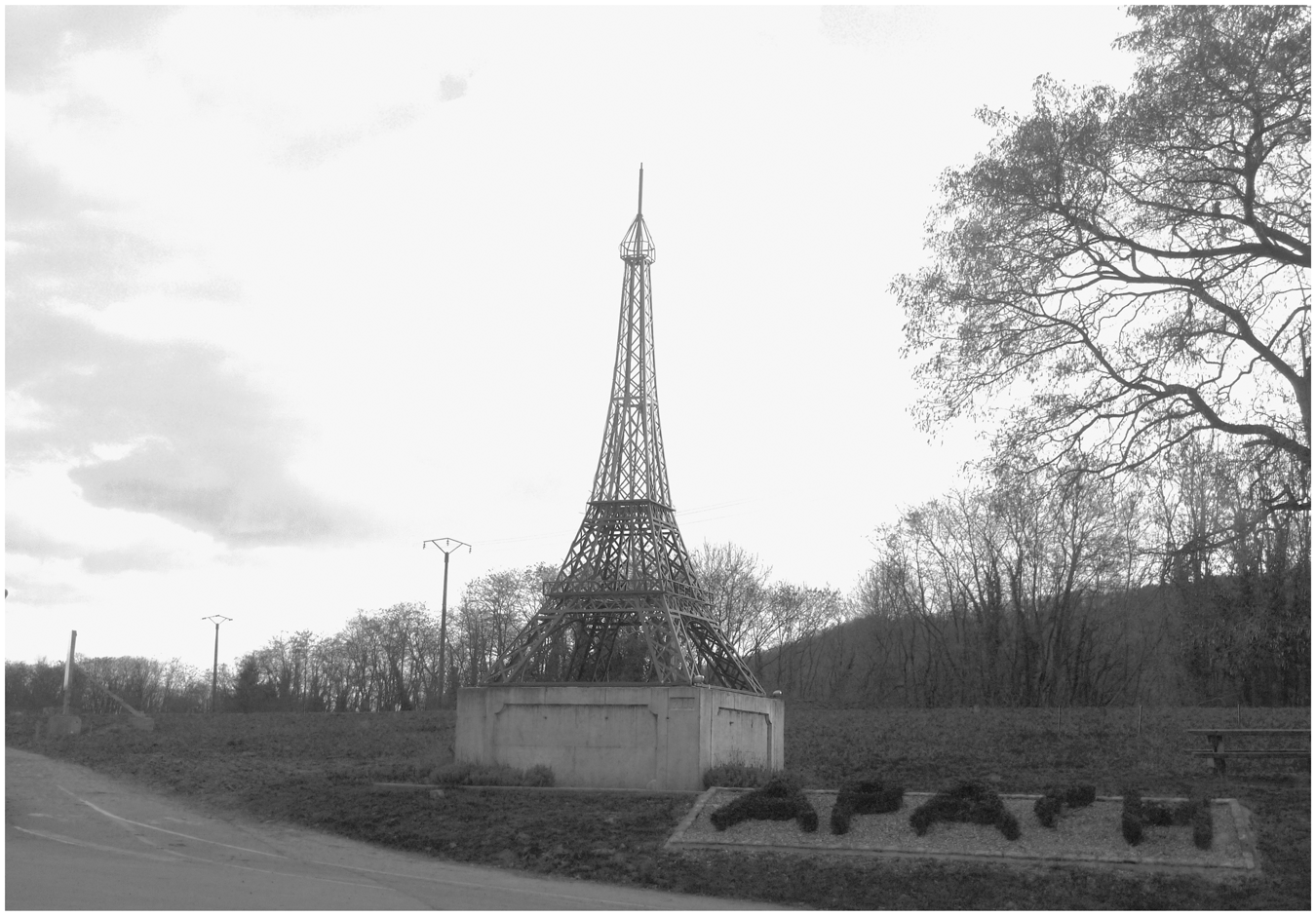
Apach is a small French village at the border with Luxembourg and Germany, where, on the very last square meters before the German territory, lies a miniature of the Eiffel Tower.
What is the reason for that? Why in the midst of the apology of European unification trough the elimination of borders, the demarcation still exists? Borders unite and divide at the same time, and this is the first axiomatic standpoint we need to keep in mind for understanding the borders phenomena (Marsico, 2013).
Another event which makes evident the complexity of the borders process is that presented by Cubero, Contreras and Cubero (2016). The authors asked 48 people from Matamoros (State of Tamaulipas, Mèxico) and 48 people from Brownsville (Texas, USA) with different educational level how they define the term borders and how they describe who lives in the border area.
All of the participants were born in those cities and/or they have lived there for the last 20 years. They were border residents to whom it was asked to illustrate what does it mean to live on a border. Why this question is so intriguing? It would be equally interesting to ask two groups of people living in a countryside one hundred meters far each other what does it mean living there? Maybe not.
What does it make living on a border such a peculiar condition at point to be elevated to the “glory” of the scientific inquiry? Borders are very paradoxical topic in their essence: they simultaneously belong to two parts, while being defined by neither one entirely. This is the second axiomatic standpoint we need to keep in mind (Marsico, 2013).
In addition, the research carried out by Cubero et al. (2016) showed two very curious findings. On the one hand, Mexican participants (compared to Americans) used, more frequently and independently from the educational level, a functional concept of border, mostly related to their personal experiences. On the other hand, Americans apparently did not recognize themselves as citizens of the borders. How it would be possible? Ultimately, both are border residents. Why do they show these differences in conceptualizing and accounting for borders and the notion of border’s citizen? Border has a contradictory characteristic: it works in lessening the ambiguity while heightening ambiguity and this is the third axiomatic standpoint to keep in mind for understanding the borders phenomena (Marsico, Cabell, Valsiner, & Kharlamov, 2013).
Borders in contemporary theory of cultural psychology
Border is a problematic object from the psychological point of view. What is it? How it works and how it is perceived? Border is the developmental conceptual place that accounts for processes of continuity and discontinuity, conflict and negotiation, innovation and reproduction in living open systems. Borders deal with both the modification of the environments where we live and with our identities and psychological functioning.
Border is a place of tension and pacification, of meeting and possible clash. A border demarcates what is possible to know, to do or to say and what is not allowed to. A border defines what is crossable and what is not even approachable. It divides the order on the one side and the chaos on the other.
Traditionally, a border is understood as something in between two or more sites. In this sense, the border evokes the idea of differences and possible difficulties in interaction between contexts. Even if the border implies the idea of separation, it is also “the point of contact” of different settings. The borders divide and connect simultaneously, and this ambivalent nature allows to cope with intrinsic continuity/discontinuity dynamics among social places.
According to Herbst’s co-genetic logic (1993), the phenomenon and its context cannot be separated. They emerge, exist and vanish together. When we draw a circle on a piece of paper, we create a triplet {outside<>border<>inside} and not one single thing (what we commonly label circle by focusing only on the inside of the figure). In this triplet, all of the parts come into being at the same time and disappear simultaneously when we eliminate the border. The “outside” is the inevitable context for the “inside”, and the border is what both separates and unifies them (Valsiner, 2014). Borders create discontinuity and connection between two related fields that acquire their signification through their relationships.
This double function of borders is a crucial feature for treating the notion of “context-boundedness” in Cultural Psychology (Marsico, Dazzani, Ristum, & Bastos, 2015).
At the most abstract level, we can assert the possibility of various conceptualizations of the borders between different discernible contexts, from a complete separation to permeable contact (in analogy with the cell membrane), to the existence of a zone in between of co-existence and co-development in time—while sharing significant mutualities (Marsico et al., 2013).
Exploring the borderland
I must admit that, while reading the Cubero et al. (2016) paper, I was getting more and more curious so I tried to complement what they discussed with some additional notion about that specific border’s context, so I diligently collected some very basic notions.
Metamoros is located south of the city of Brownsville, which is situated at the southernmost tip of Texas. The Rio Grande River separates United States and Mexico in that area. It would be possible to define this area as a borderland where there are two adjacent areas divided (and simultaneously connected) by a river. I have also learnt that there exist three international bridges crossing the USA–Mexico border between the two cities, allowing the daily transit from one side to the other. Those few additional information offer some clues for enlarging Cubero et al.’s (2016) contribution, by focusing more on the theoretical properties and processes of border-making and border-maintaining.
Cubero et al. (2016) are mainly interested in describing the role played by schooling and cultural origins in the formation of the concepts of “border” and “citizen of the border”. In doing that, the authors discussed the difference between everyday and scientific concepts. Then, they introduced notions as activity settings, discourse modes, and types of thinking. The results of their empirical investigation are consistent with the psychological literature (Bruner, 1990, 1996, 2001; Luria, 1976; Tulviste, 1999; Vygotsky, 1986) that showed that different levels of education and socio-cultural settings have an impact on the performance of the people. Undoubtedly, Cubero et al.’s research sheds a light on the effect border context has on the formation of the cognitive processes. But what is missed is an explanation of how it happens. In order to answer this question we need to take into account the specificity of borders’ notion, moving from how people talk about borders to how borders regulate their psychological life.
As Cubero et al. (2016) show, Mexicans are more personally involved into all the aspects related to the border. For many of them, the border organizes their lives under different points of view: from the professional aspects (i.e. getting a job in USA) to the intimacy of the family relations (i.e. the everyday life in the domestic context).
Mexicans cross the borders and the act of crossing borders makes them different (Marsico, 2013, 2014). They are involved in a daily or periodic migration more than Americans, because they need to find better life conditions “out there”, on the other side of the river. For them, the border is asymmetric but permeable (Marsico, 2011). This condition is incorporated in the Mexican way of life. They are conscious to be inhabitants of a borderland. Nevertheless border – and border crossing – makes evident the cultural discontinuity in the continuity of their life and calls for a kind of narrative argumentations (instead of a scientific concepts) which is the most fitting mode of thinking, since it is able to account for both the situatedness and the subjectivity of the person at the border (Bruner, 1991, 2004).The narrative thinking reverberates all the borders’ human drama.
Yet, borders could acquire different meaning for the people who live in the two contiguous areas. Cubero et al. (2016) show that, despite the American participants are citizens of the borderland, they do not recognize the border as having two parts. This is because they do not cross the border, and they do not need to search for better living conditions “over there”. They do not feel, even temporarily, the sense of estrangement, uncertainty and foreignness.
The shift in people’s place means primarily entering a new symbolic realm, and encountering a new cultural texture where different social norms, moral values and religious orientations are in place. Crossing borders entails a remake of your identity – as a migrant, exiled, explorer, tourist or commuter. For the American participants, border is asymmetric but non-permeable. Border is a place for keeping distance and marking the differences. They basically consider the border in oppositional terms (inside vs. outside), while Mexicans’ way of living on border incorporates the inside and the outside.
Emphasizing the border’s function of demarcation a differentiation, Americans try to reduce or negate the inherent ambivalence of border which simultaneously unites and divides, and in doing that, they reinforce the insideness, rather than the outsideness or the betweeness (Marsico et al., 2015).
Still on the border
All these complex phenomena lead to the theoretical problem – that was also one of our initial axioms – to which of the parts the border belongs: to one part, to both parts, to neither Border is not entirely definable by only one part, but it is intrinsically dialogical (Varzi, 2013). After all, Matamoros and Browsville exist with their own peculiarities exactly because they are part of the borderland. In other words, they exist as they are because of the border. Following Herbst’s co-genetic logic (1993), they emerge, exist and, eventually, disappear together. What would happen if an agreement between Mexico and USA governments redraws the political map annexing Brownsville to the Mexican territory? This borderland constituted by two different cities and a border (the river) in between would lose its socio-cultural configuration, with many relevant effects on people’s daily life there (sufficient is to think to all the sort of legal problems regarding the border entrance and the border control that might be eliminated).
It does not automatically mean the emergence of the sense of we-ness, as the example of the Tour Eifel in Apach (Figure 1) or, in an opposite vein, the fall of the Berlin wall clearly shows. Besides, redrawing the border somewhere else would recreate the same Inside<>Outside dynamic configuration. This is due to the theoretical properties and processes of border-making and border-maintaining. The human capability of creating borders serves the function to turn what is chaotic and continuous into what is (at least temporarily) stable and discrete.
The border construction is based on three sub-processes: meaning-making, distinction-making and value-adding. Through this three-phase psychological process, individuals try to articulate, differentiate and hierarchically organize the relationship with the others and the environments. Thus, borders are artifacts constructed by human beings to modulate the relationship with the fluid, dynamic and ambiguous environment (Marsico et al., 2013), but in so doing all the intricate theoretical issues of what the border is and what the border entails become terrifically evident.
This increased ambiguity of the borderland, or what can be called “the space in between” (Marsico, 2011), leads to the paradoxical characteristic of borders and border-construction (that was also another of our initial axioms): building a border to lessen ambiguity in the fluid and dynamic world, but heightening ambiguity in the construction and imposition of the border through the unknown (and rarely investigated) qualities of the borderland.
An investigation into the borderland has resulted in three contradictory characteristics (which were also the three axiomatic standpoints from the very beginning): (1) the border separates while unifying, (2) the border increases ambiguity while decreasing ambiguity and (3) the qualities of the borderland are determined not by the parts but by the borders that make the parts mutually related. 1
Interestingly enough, these theoretical features of borders work both in case of a natural border or an artificial one. While the former, also called in mereotopological terms
2
bona fide – are based on some objective discontinuity or qualitative heterogeneity, the latter – or fiat – is the result of conventional demarcations, of political, social and administrative agreements (Smith, 1997; Smith & Varzi, 2000; Varzi, 1997, 1998, 2013). An example of the first kind is exactly the Rio Grande river that separates (and connects) Matamoros and Brownsville (Figure 2) while a fiat border is, for instance, the imaginary line in the middle of the Mediterranean Sea which runs the border between Italy and Africa. Although artificially produced by human action and invisible in the landscape, it has practical effects in the management of our individual and collective existence (think to the borders control in preventing the illegal immigration).
Map of Matamoros–Bronwsville borders.1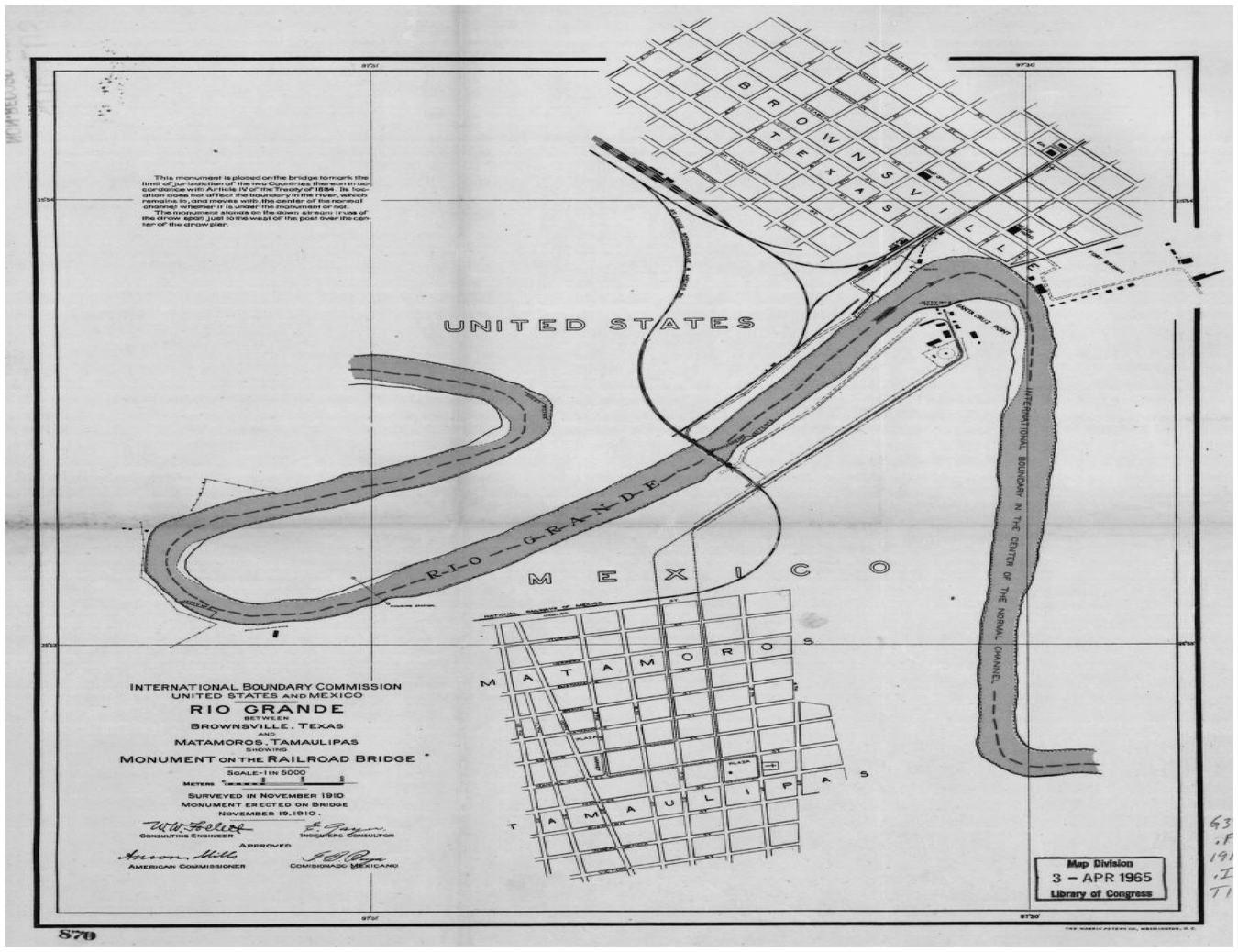
Despite the negotiated feature of the fiat border, its power is not less binding than a natural border. This is even more evident in the case of the referred “Schengen Area,” which is the result of a contractual agreement with the consequence of creating free movement of people within European countries, but also new external borders. The triplet Outside <>Border<> Inside (Herbst, 1993) is replaced with great impact at very many different levels: from the subjective or affective ways of experiencing that phenomenon (who and where the foreigner is?) to the societal level (entry procedures, visa controls, new European agencies for borders control, etc.).
All this shows the sophisticated capability of humans in border-making. Once personal and collective borders are constructed they begin to mediate the relationship between the person and the environment, and meaningfully guide behavior and mental functioning (Valsiner, 1999, 2007).
Concluding remarks
People travel for tourism, for working, for escaping from the home country, for missionary reasons or for exploring new lands. By so doing, they cross borders which makes their own identity different from the previous state – becoming a migrant, an exiled, a tourist, a helper or a conqueror.
Border shows its difficulties in being unambiguously defined. For instance, to whose of the contiguous areas it belongs? Neither one of the single-bounded region is sufficient for that. Border is not just a non-place (Augè, 1992), but is a space with its own characteristics that make living there very specific, regulating the dynamic with the surroundings and even the way of thinking (Cubero et al., 2016), acting and feeling.
Living in a borderland makes the identity of the inhabitants and their meaning-making process very peculiar. The way in which the border residents perceive the relationship between the self, the others and the environment (Tateo, 2014; Tateo & Marsico, 2013), as well as their process of meaning-making (De Luca Picione & Freda, 2015) is unavoidably linked with the existence of the border itself, with all its ambivalent theoretical features and practical implications in settling the daily activities and the human psychological functioning.
In this article, I have tried to argue about the profound and constitutive role played by borders and border construction in regulating the relationships in the human psyche and societies.
Yet, the heuristic power of border is still to be totally displayed.
Footnotes
Declaration of Conflicting Interests
The author(s) declared no potential conflicts of interest with respect to the research, authorship, and/or publication of this article.
Funding
The author(s) received no financial support for the research, authorship, and/or publication of this article.
Acknowledgments
In the last months, the Mediterranean Sea has been the stage of the umpteen sorrowful tragedies of migrants from Africa to the Italian cost. They cross the borderland of the sea with the greatest sense of uncertainty not only for what it will be the final landing place, but for their own lives while crossing. In their attempt to reach the outpost of the Europe, they strive for getting a better living condition. Very often the sea swallows up their dreams. All the hopes and the desperation of those thousand of humans are deeply acknowledged here.