



Abstract
Based on his broad survey on a selection of the literature dealing with indigenous psychology, Jahoda raised a series of questions about various ways indigenous psychologists (IPists) around the world have answered important issues related to the development of indigenous psychology and found a striking lack of consensus in their proposals. He concluded that: “it is questionable whether any indigenous psychologies actually exist”, “the fact help to explain the subsequent decline of the movement” (p. 169). Nevertheless, because his selection of literature was incomprehensive and biased, his comments on definitions of indigenous psychology, the goals of indigenous psychology, ways for building indigenous psychology, as well as the objective of a universal/global psychology are too hash to drew such a conclusion. Conceiving his viewpoints on those issues in the context of my approach for developing indigenous psychology, we may get an opposite conclusion that indigenous psychology will soon rehabilitate from its apparent disorder if and only if we can find appropriate ways to solve its difficult problems from the perspective of philosophy of science.
In this article, I will present my approach for resolving difficult problems encountered in the development of indigenous psychology (IP) in response to Jahoda’s (2016) criticism. At the very beginning of his article, Jahoda (2016) mentioned two reasons for the rise of IP movement. First, some IPists had a mentality of anticolonialization. They argued that the wholesale importation of western psychology represents a form of cultural imperialism (e.g. Enriquez, 1993; Ho, 1998). Second, western psychology is not appropriate for Asian and other cultures to effectively deal with their problems. It seems to me that these two reasons are interrelated. Jahoda (2016) criticized the first reason as “emotionally rather than rationally based,” while the second one is “generally taken as self-evident,” “the absence of evidence is of course inconclusive.” So he asked for “some empirical demonstrations of such inadequacies” (p. 170).
Empirical demonstrations? I certainly can provide a lot at least from my field of expertise. Michael Bond is a pioneer psychologist who published the first English book on Chinese psychology (Bond, 1986), followed by two volumes of Handbook of Chinese Psychology (Bond, 1996, 2010), which successfully brought the term Chinese Psychology to the attention of the international psychological community. Oxford Handbook of Chinese Psychology is the third book addressing Chinese psychology edited by Bond (2010). It contains 41 chapters by 87 authors who had intensively reviewed previous works on a variety of topics related to Chinese psychology.
Nonetheless, with his careful review of this book, Lee (2011) indicated that he: Was somewhat puzzled and bothered by the fact that the book does not have a clear structure … It is thus difficult for readers to learn quickly about what is included in the book and to identify the chapter on a specific topic unless they go through the whole table of contents carefully. There is a general lack of theory in the whole handbook … The topic-oriented chapters have done a great job in reviewing and reporting extensively empirical findings in the field regarding the Chinese people However, very few chapters offer indigenous theories of Chinese psychology (e.g. the chapter of Hwang and Han). Most of them stay at the level of confirming/disconfirming Western findings, referring to well-known cultural dimensions such as collectivism and power distance to explain the variation found, despite the openly stated effort to push for indigenous research. Moreover, most of the studies cited in the book simply dichotomized their findings as Chinese vs. Western, failing to capture the much more refined complexity of the world. (pp. 271–272)
From the perspective of scientific revolution (Kuhn, 1969), when Western paradigms of psychology are transplanted to non-Western countries and encountered anomalies which cannot be explained by any imported theories, the pre-existing theories are in a state of crisis awaiting scientific revolution. In order to initiate a scientific revolution against Western mainstream psychological theories, it is necessary to construct alternative theories to compete with preexisting Western psychological theories. It seems to me that the rise of IPs is very rational, not only emotional.
Definitions of IP
Jahoda (2016, pp. 172–173) cited a sample of definitions of IP provided by IPists and indicated that there are divergent notions of what is meant by “scientific.” Not all writers believe that IPs need to be scientific. But most of them are expecting to explain the psychological and behavioral activities in their native context in terms of “culturally derived categories and theories” (Yang, 2000, p. 246). But how can we construct “culturally derived theories”? Jahoda criticized Yang’s proposal: Yang states that both natural science and human science models are acceptable for this purpose. In this connection, it should be noted that in the literature generally the expression ‘human science’ tends to be employed in an elastic manner, which serves to justify the claim that IP is scientific. (p. 173)
It seems to me that it is a matter of course that IPists tend to employ the expression “human science” in an elastic manner, because they are facing the most difficult problematic situation left by the founder of scientific psychology, Wilhelm Wundt (1832–1920).
Science in Germany has traditionally been classified as Naturwissenschaft (natural science) and Geisteswissenschaft (spiritual science) by their academic community. Naturwissenschaft studies the law of the physical world, while Geisteswissenschaft concerns the cultural world created by human beings in history, enabling us to understand laws that guide human life, human development, and human history.
Wundt’s cultural psychology
Wilhelm Wundt, the first Western psychologist who advocated for using experimental method to study psychological phenomena, well understood the difference between these two kinds of science. He believed that the subject of psychological research is individual’s direct experience toward the physical world rather than his/her indirect experience or higher level explanation of experience. Since one’s experience can be observed only by oneself, introspection or self-observation should be the method of psychological research. If psychology intends to be an empirical science, subjects’ introspection on states of their consciousness should be studied precisely just like the way physical objects are analyzed by natural scientists.
For this reason, Wundt (1874/1904) believed that scientific psychology should be a combination of physiology and psychology. The former provides phenomena of organism that can be observed by our sensory experiences; the latter enables individuals to know oneself from inside. Therefore, he called his experimental psychology “physiological psychology,” and his first book on experimental psychology was entitled Principles of Physiological Psychology.
In addition to using experimental methods of physiological psychology to study fundamental psychological processes, Wundt also advocated for the usage of historical method to study high-level mental processes. Because these processes have prominent effects on history and society, they require another kind of scientific study. Experimental methods are adequate for natural science, while historical methods are adequate for social science. On the basis of this reason, he began to write Völker Psychologie to analyze the psychological processes manifested in language, myth, and custom during German progress in the 1900s.
Wundt’s scientific psychology has inspired the bottom-up approach of psychological research. But it is very difficult for non-Western psychologists to write publishable scientific articles by following his historical methods of Völker Psychologie to analyze their own cultures.
Bottom-up model
Regarding this historical problematic situation, most IPists are relatively conservative in talking about “culturally derived theories.” Many of them have advocated a “bottom-up model building paradigm” (Kim, 2000, p. 265) to promote “the study of human behavior and mental processes within a cultural context that relies on values, concepts, belief systems, methodologies, and other resources” (Ho, 1998, p. 94), and that treats people “as interactive and proactive agents of their own actions” that occur in a meaningful context (Kim et al., 2000, p. 71). They perform a “scientific study of human behavior (or the mind) that is native, that is not transported from other regions, and that is designed for its peoples” (Kim & Berry, 1993, p. 2) in order to develop a “cultural appropriate psychology” (Azuma, 1984, p. 53), “a psychology based on and responsive to indigenous culture and indigenous realities” (Enriquez, 1993, p. 158), or a psychology whose “concepts, problems, hypothesis, methods, and tests emanate from, adequately represent, and reflect upon the cultural context in which the behavior is observed” (Adair et al., 1993, p. 149).
In other words, most IPists are actually pursuing “culturally derived categories” rather than “culturally derived theories.” This is the reason why Jahoda (2016) said: When one reads the contributions of IP, the bulk of them consists of reports of empirical studies. These are generally excellent and include rich accounts of the cultural background. Yet none of them can be described as IPs in the sense of coherent systems of knowledge. (p. 172)
For two reasons, I don’t agree with Jahoda’s assertion that “none of them can be described as IPs in the sense of coherent systems of knowledge.” First, it is very hard for anyone who assumes a Eurocentric mentality to see “coherent system of knowledge” from the bulk of empirical studies. Second, as I am going to demonstrate in the following section of this article, IPs actually have published some coherent systems of knowledge which were obviously neglected by Jahoda.
The objective of a universal/global psychology
Encouraged by the flourishing bulk of empirical researches on IPs, some leading figures of this movement claimed that the final goal of IP movement is to develop an Asian psychology (Ho, 1988), a global psychology (Enriquez, 1993), a universal psychology (Kim & Berry, 1993), or a human psychology (Yang, 1993). To achieve this goal, they have proposed several research methods or approaches, including the derived etic approach (Berry, 1989), the metatheory method (Ho, 1998), the cross-indigenous method (Enriquez, 1977), as well as the cross-cultural IP (Yang, 1997).
Unfortunately, insofar as I know, none of such psychology has been developed by IPists with any of those methods. But, before he has examined all the tentative proposals for solving this problem, it is still too early for Jahoda (2016, p. 177) to say that “the procedures envisaged for combining IPs are unworkable.” In the Retrospect section of his article, Jahoda (2016, p. 177) said: The problem for the advocates of IPs is that practically all of them, including those from majority non-western cultures, had been trained in western academic institutions in a tradition they now wanted to largely reject. It is not surprising that this led to ambivalence if not actual conflict. This comes out most clearly in the treatment of ‘science’. The dilemma was that of wanting IPs to share the prestige of science, while at the same time displaying a reluctance to be shackled by the demands of rigour; it tended to result in more flexible re-definitions of ‘science’.
The above assertion contains too much idle speculations about the advocates of the IPs. What means by “more flexible re-definitions of ‘science’”? On what basis could Jahoda say that “all of them … had been trained in western academic institutions in a tradition they now wanted to reject”? How could he know that IPs are “displaying a reluctance to be shackled by the demands of rigour”?
Epistemological goal of IP
For the sake of helping Chinese IPists to overcome the major difficulties encountered in developing IP, I published a book entitled The Logics of Social Sciences (Hwang, 2001), which systematically introduces the ontology, epistemology, and methodology proposed by 17 major Western philosophers during the 20th century. Its content is divided into five major parts: (1) positivism, (2) postpositivism, (3) structuralism, (4) hermeneutics, and (5) critical theory. The positivism and postpositivism introduced in the first two parts of the book are philosophies applicable to natural science. Because most psychologists have defined psychology as a science, both of these philosophies have frequently been used by psychologists. The paradigms of structuralism, hermeneutics, and critical theory as discussed in the latter three parts have often been adopted by social scientists.
Viewing from the perspective of this book, it is all right for IPists to pursue the goal of universal/global psychology. But they are unlikely to attain this goal by the bottom-up inductive approach of empiricism. In order to attain the goal of Asian psychology, global psychology, universal psychology, or human psychology, it seems to me that indigenous psychologists have to construct “culture-inclusive theories of psychology” in accordance with a principle proposed by cultural psychologists: “one mind, many mentalities” (Shweder et al., 1998). This goal can be attained if and only if an indigenous psychologist is well indoctrinated with Western philosophy of science and can use the so-called multiple philosophical paradigms to overcome various difficulties facing the task of theoretical construction left by Wundt (Hwang, 2013).
In other words, IPists are not reluctant “to be shackled” by the rigorous demands of science, nor do they want to reject western academic tradition. On the contrary, they had been restricted by various scientific methodologies of empiricism without paying enough attention to the paradigm shifts in Western philosophy of science.
Critical realism
I can elaborate my argument with the assistance of the philosophy of critical realism proposed by Bhaskar (1975, 1978), which was added in the third edition of my book (Hwang, 2013). Bhaskar (1975) classified Western philosophies of science into three broad categories (Figure 1). Classical empiricism was originally proposed by David Hume (1711–1776). It regards atomic facts as the ultimate objects of knowledge; their combinations constitute all the events which are objective to us in recognizing the external world. The logical structure of an elementary proposition stating relationships among names of objects is supposed to be isomorphic with that of the atomic fact in the objective world. Radical empiricists conceptualize scientific knowledge as an individual’s behavioral responses to the stimuli of outside events. Though logical positivists do not accept such approach of behaviorism as the only method for producing valid scientific knowledge, they still insist that the valid content of science must be reduced to such empirical facts and their combinations.
Philosophies for scientific discovery (adopted from Bhaskar (1975, p. 174)).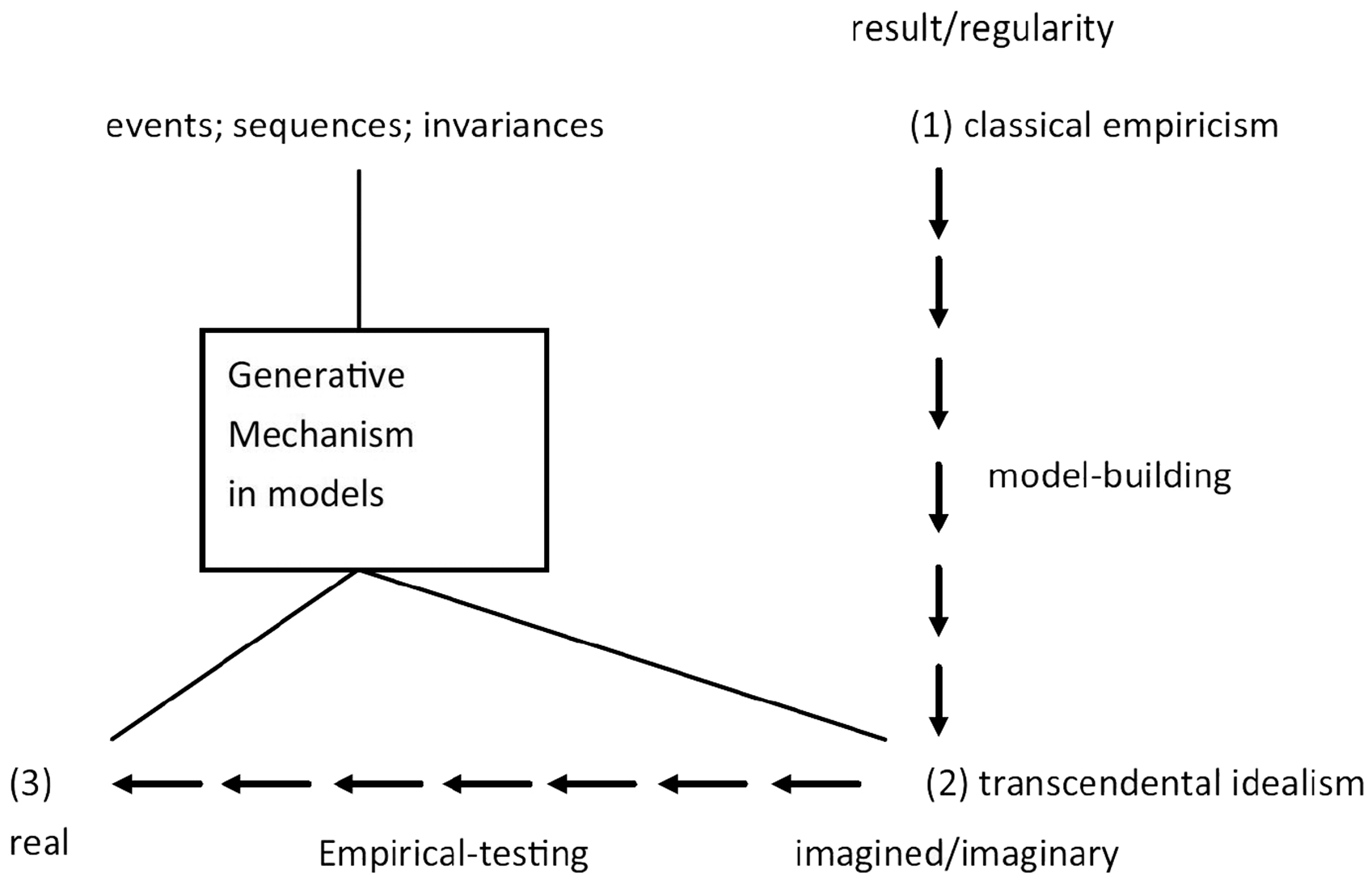
The second category consists of transcendental idealism proposed by Kant and the various versions derived from it. According to this school, the goal of scientific activities is the construction of theoretical models to depict the natural order. Hence theoretical models are constructed by scientists, though they might be independent from any particular individual, they cannot be independent from the scientific community. According to this school, scientific research aims to find the underlying structure from its manifested phenomena, the constant association among events is the necessary but not sufficient condition for deriving natural law. Knowledge about the natural world becomes a construction of human minds. The modern version of this school argues that scientific knowledge is constructed by the whole science community.
The third school of transcendental realism argues that scientific activities aim to find the mechanism for producing the phenomena. The objects of scientific research are neither the phenomena (empiricism) nor the constructs imposed on the phenomena (idealism), but the real structures which exist and operate independently from our knowledge. According to this perspective, the world exists independently from our knowledge about it. Both the world and our knowledge about it have their own structures which can be differentiated and are changing constantly. Science is not an epiphenomenon of nature, and nature is not a product manufactured by human beings.
Transcendental theory
Bhaskar’s (1975) epistemology was named “transcendental realism.” The term “transcendental” was used to denote the fact that his philosophy is supported by the so-called transcendental argument, which means the inference from an observed phenomenon to a lasting structure, or the inference from a particular real event to a more basic or a more fundamental mechanism that makes the event possible. In terms of Bhaskar’s (1975, pp. 30–36) philosophy, transcendental argument is a kind of retroactive argument which requires a scientist to retroact the “structure on the condition for originating a phenomenon” from a “description of that phenomenon.”
For non-Western psychologists, it is rather easy to learn the philosophy of radical empiricism or positivism, but it is very hard to comprehend the philosophy of transcendental idealism or transcendental realism, which should be traced to the Greek tradition of seeking being behind becoming. Following such a tradition, Kant argued that thing-in-itself (or noumenon) is transcendent, while our knowledge about the thing is constituted by transcendental ideas behind the phenomenon.
Though both transcendental idealism and transcendental realism grant the presupposition that thing-in-itself or noumenon is transcendent, transcendental idealism recognizes that scientists are proposing tentative solution or tentative theory to explain the phenomena (Popper, 1963, 1972). A tentative theory might be elaborated as mechanism in some cases, or be refined as hard core and protective belt in some situations (Lakatos, 1978); only Bhaskar’s (1975, 1978) critical realism highlights the importance of generative mechanism. His ontological position of transcendental realism also accepts Kant’s argument that human beings can construct knowledge to understand only phenomenon but not thing-in-itself; his transcendental realism posits that the generative mechanisms constructed by scientists must deal with some real objects. The domain of reality comprises whatever exists, be it natural or social in nature, and independent of whether or not we have sufficient knowledge about their nature.
Conceiving in terms of critical realism, most IPists have followed either the paradigm of empiricism (positivism) or that of transcendental idealism, but they have not paid enough attention to transcendental realism. This is the reason why IPs have abundant “culturally derived categories (ideas),” but they have very few “culturally derived theories.”
How could an IP be produced?
Jahoda (2016, pp. 174–175) indicated that there are two main ways for building up an IP. One is “starting by importing western theories and methods which are gradually indigenized.” I have discussed this approach in the aforementioned sections of this article. The second kind of proposal suggests that Asian IPs should mainly be based on their own cultural traditions such as Buddhist, Confucian, and Hindu religions and philosophies. Jahoda (2016, pp. 276–277) cited works of several major contributors to Hindu psychology, including Chakkarath (2005, 2012), Paranjpe (2002), and Sinha (1997). He noted that “Indian writers usually focus on similarities” between Western and Eastern formulations of psychology, while Chinese, Japanese and Korean ones tend to stress differences. Confucian, Taoist and Buddhist cultures are said to be basically what they call ‘relational’, in contrast to western individualism. They seem to think that that is specifically Asian, yet it applies to many majority (of the world population) cultures. Thus, Nsamenang (2006, p. 295) dealing with developmental issues in Africa, writes: ‘The social ontogenetic paradigm is premised not on an independent or autonomous frame; its foundational principle is an interdependent or relational script’. (p. 176)
This is a generally correct but superfacial observation, hence his conclusion “the kinds of empirical studies undertaken towards that end hold out little promise of eventually arriving at an IP,” provides us no way to get out of the massive situation.
In contrast to this kind of useless complains, I proposed the strategy of cultural system approach to compete or compensate with the widely used pan-cultural dimensional approach (Hwang, 2015a). I also constructed a Mandala Model of Self and a Face and Favor model for social interaction (Hwang, 2015b). In accordance with this line of thinking, both of them are supposed to be universal models and can be used as frameworks for analyzing any given cultural system.
Foundations of Chinese psychology
Due to the limitation of length for a journal article, I will leave my discourse on Mandala Model of Self for another article. Here I will concentrate my discussion on Face and Favor model first.
In Chapter 4 of my book, Foundations of Chinese Psychology (Hwang, 2012), I reviewed critically Western theories of social exchange, equity, and justice, and constructed the theoretical model of Face and Favor. The theoretical model thus constructed may represent the deep structure of universal human mind in interpersonal relationships.
In my theoretical model of Face and Favor (Hwang, 1987), the dyad involved in social interaction was defined as petitioner and resource allocator. When the resource allocator is asked to allocate a social resource to benefit the petitioner, the resource allocator will first consider: “What is the guanxi (relationship) between us?”
In Figure 2, within the box denoting the psychological processes of the resource allocator, the shaded rectangle represents various personal ties. It is first divided into two parts by a diagonal. The shaded part stands for the affective component of interpersonal relationships, while the unshaded part represents the instrumental component.
A theoretical model of Face and Favor (adopted from Hwang (1987, p. 948)).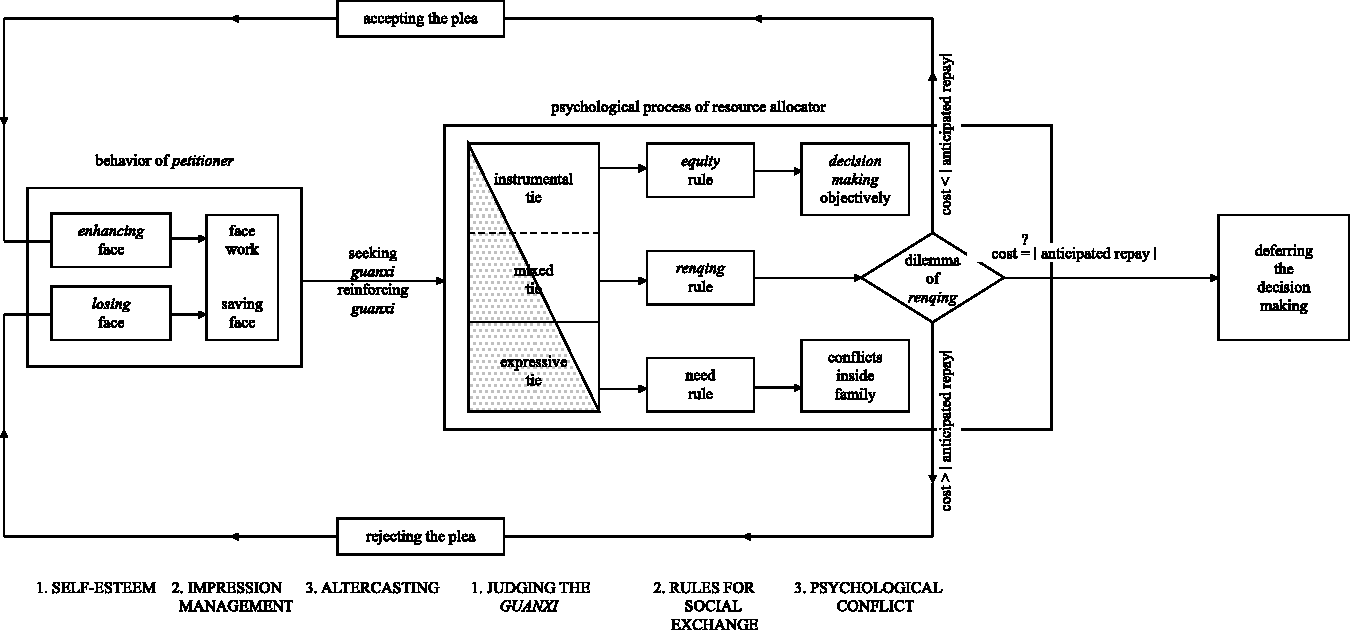
The same rectangle denoting guanxi (interpersonal relationships) is also divided into three parts (expressive ties, mixed ties, and instrumental ties) by a solid line and a dotted line. These parts are proportional to the expressive component. The solid line separating expressive ties within the family and mixed ties outside the family indicates a relatively impenetrable psychological boundary between family members and people outside the family. Different distributive justice or exchange rules are applicable to these two types of relationships during social interactions. In expressive ties, the need rule for social exchange should be adhered to and people should try their best to satisfy the other party with all available resources. In mixed ties, following the renqing rule, when individuals want to acquire a particular resource from someone with whom they have instrumental ties, they tend to follow the equity rule and use instrumental rationality.
Universal model for social interaction
In my article Face and favor: Chinese power game (Hwang, 1987), I intensively elaborated the meaning of the renqing rule in Chinese society. It can be conceptualized as a special case of equality rule which emphasizes that once an individual has received favor from another, s/he is obligated to reciprocate in the future.
Comparing the four kinds of interpersonal relationship (expressive ties, mixed ties, instrumental ties, and the relationship between petitioner and resource allocator) with the four elementary forms of social relationship (communal sharing, equality matching, market pricing, and authority ranking) found by Fiske (1991) in his intensive review on pervious literature of anthropology, psychology, and sociology, Sundararajan (2015) indicated that my Face and Favor model can be viewed as a universal model which can be applied to different cultures. Gergen (2015) claimed that all humans (including Westerners) are relational beings. All those works, together with my two articles (Hwang, 2015a, 2015b), had been published in the same special issue of Journal for the Theory of Social Behaviour. It is very hard to understand why Jahoda (2016) could draw such a strange conclusion: Sundararajan (2015) seeks to assess the adequacy of cultural models by the extent to which they fit indigenous categories, and criticizes the conventional cross-cultural approach. Liu (2015) proposes that an East Asian style of ‘relationism’ could serve to ‘globalize’ IP. Both have little in common with the previous drift in IP writings. (p. 178)
His comment on Liu’s (2015) works is correct, but his recognition of Sundararajan’s (2015) works is distorted, and his conclusion that “both have little in common with the previous drift in IP writings” is unbelievable!
Cultural system approach
In Chapter 5 of my book Foundations of Chinese Psychology (Hwang, 2012), I used the Face and Favor model as a framework for analyzing the inner structure of Confucianism. My analysis is the corpus of sayings by pre-Qin Confucianists. Analyzing the inner structure of Confucian thoughts by using the theoretical model of Face and Favor as a framework of reference enables us to construct a series of culture-inclusive theories to represent the culture system or morphostasis of pre-Qin Confucianism as advocated by the philosophy of analytical dualism (Archer, 1995), while the sayings or speeches made by pre-Qin Confucianists may activate the Confucian ethics and morality (Hwang, 2016). From the theoretical model of Face and Favor, we can see the universal human mind for dealing with interpersonal relationships. From the Confucian ethics and morality, we can understand the specific mentality of people living in Confucian society.
The Confucian ethics and morality are transcendental formal structure for sustaining life worlds of Chinese people (Hwang, 2016). They had been used as hard core for constructing a series of theories to integrate findings of empirical researches on the topics of social exchange, face, achievement motivation, organizational behaviors, and conflict resolution in Confucian society (Hwang, 2012).
Because my Mandala Model of Self and Face and Favor model are supposed to be universal, both of them can be used to analyze other cultural system (Hwang, 2015a, 2015b). In contrast with the pan-cultural dimensional approach of studying non-Western people in terms of Western theoretical models, my cultural system approach may dedicate to the enhancement of the cultural self-conception of humankind.
Conclusion
In consideration of my previous works, it is debatable for us to read Jahoda’s (2016) conclusion: Another novelty is the application of the concepts ‘indigenous’ and ‘indigenization’ in historiography, whereby indigenization is perceived as having occurred within the West. Danziger (2006), after briefly outlining the concept of IZP, states that apart from the label it is nothing new in the history of psychology. (p. 178)
As a historian of psychology, Danziger’s (2006) statement is acceptable because it was made 10 years ago. But, as an Emeritus professor who has written on historical and theoretical topics, Jahoda’s (2016) conclusion is unacceptable even if he cited Danziger’s (2006) 10-year-old argument. I am particularly dissatisfied with his claim that: One is a slogan going back from Triandis (1997) to Marsella (2013) which says ‘All psychologies are IPs’. At first sight that looks like a mere truism, since all psychologies inevitably have their origin within a particular cultural setting; there is, however, more to it. When employed by western psychologists, as in the two cases above, it probably constitutes a disclaimer of any western superiority. It also seems to imply that any psychology is as good as any other, which is a rather curious stance at odds with the frequently trumpeted view (shared, as shown above, by many proponents of IP) of psychology as a science. (p. 178)
I strongly agree the saying that “All psychologists are IPs.” Prof. Marsella was my mentor when I worked for my PhD degree in University of Hawaii during the period from 1972 to 1976. I have long been inspired and encouraged by his teachings. I do believe that his saying is neither a “disclaimer of western superiority” nor a “claimer of eastern superiority.” To me, it says that a full understanding of universal/global psychology should be a combination of both Eastern and Western perspectives. Jahoda (2016, p. 178) reminded us a critic on William McDougall's An Introduction to Social Psychology wrote by himself: “He seems to do a great deal of packing in preparation for a journey which never starts.” I do believe that the preparation of IP movement has already made their journey to universal/global psychology start. Now we are expecting to see its rise in the future!
Footnotes
Declaration of conflicting interests
The author(s) declared no potential conflicts of interest with respect to the research, authorship, and/or publication of this article.
Funding
The author(s) received no financial support for the research, authorship, and/or publication of this article.