



Abstract
In this article, we use the theoretical framework of affective logic to discuss the underlying cultural psychological aspects of racial signifying practices. We provide an analysis of the controversies around the music video “Vai Malandra,” by Brazilian pop singer Anitta, as a case study. Departing from the theoretical assumption that our primary relationship with the phenomenal world is affective (though culturally mediated), we argue that our personal trajectories and emotional reords provide our experiences with an affective dimension that both precedes and influences any logical assessment of reality and that makes our sense-making processes unique. Thus, we suggest that, in the arena of racial signifying practices, we must always look beyond the person’s ability to critically position themselves racially to consider the affective dimension of the relationship between the personal and the cultural as a fundamental element in the production of racial discourse.
Keywords
Introduction
The realm of culture is the realm of the production and exchange of meanings. Culture depends on more or less stable, shared interpretations of reality among members of a given social group, thus, to say that two people belong to the same culture is to say that they interpret and make sense of what is happening around them in broadly similar ways. In turn, the meanings that circulate within a particular culture orient social practices and conducts and produce real practical effects in people’s lives (Hall, 2016).
One of the implications of the interpretive nature of culture is that, as meaning-making agents, we never experience things per se, but we always “see things” as “something” under specific contexts (Tateo, 2018). Elements of the phenomenal world rarely (if ever) have one single, fixed, and unalterable meaning, even among members of the same culture. Accordingly, different perceptions of the phenomenal world are related to different ways of feeling into and responding to it. For instance, that which is called a “wild animal” in some English-speaking cultures (conventionally defined as any animal living in a state of nature; not tamed or domesticated) is sometimes called a Yarori by the Yanomami people of the northern Amazon and is understood as an avatar of their mythical ancestors (Leite, 2013). Thus, an urban European and a Yanomami who happen to come across a jaguar in the middle of the Amazon forest, regardless of the potential imminent danger of the situation, will perceive, feel, and act differently due to the different meanings that their respective cultures associate with such creature.
The same principle, at stake in the relationships between humans and non-humans, also works in human-to-human relationships, for instance, the different racial meanings attributed to different physical types. Meaning is impermanent, situated, enacted, and historicized (Hall, 2016). So, how do we know that, when “looking” at something or someone, two or more people are actually “seeing” the same “thing”? What is the relationship between person and culture in the production of culturally shared meanings? Where do we draw the line between culturally constructed consensus and personal experience of the phenomenal world? In the following pages, we address these questions within the scope of racial signifying practices.
Racial signifying practices
Racial identities are always socially and historically situated, and so are the meanings attributed to them. Hence, there is no ontological truth or essence upon which they can rely that is not itself a product of culture (Hall, 2016).
From a sociological perspective, the act of identifying a person or group racially is to locate them within a socially and historically demarcated set of demographic and cultural boundaries, state activities, life opportunities, and tropes of identity/difference (Omi & Winant, 2015). Nonetheless, the objective reality produced by race is intrinsically related to the symbolic associations that feed the racial imaginary and that potentiate the social practices that give substantiality and reality to racial identities. From this perspective, we understand racial signifying practices as the socially and historically situated meaning-making behaviors in which people engage following conventions or rules of racial construction and interpretation, which includes those symbolic associations between specific sets of attributes and specific physical types that substantiate different racial identities.
Ever since what has been called the “discursive turn” in the social sciences, sociopsychological research on race shifted from being largely dominated by quantitative and experimental methods to include qualitative and particularly discursive approaches (Whitehead, 2017). As pointed out by Whitehead (2017), discursive approaches to race generally share a focus on language as a vehicle for social practices and actions and on how it functions to construct, maintain, and legitimate (as well as subvert or resist) racial and/or racist ideologies and social structures. Accordingly, race has been often understood as the result of a set of discursive practices from which racial meanings are produced, thus resulting in the non-discursive fields (actions, explicit or implicit behaviors, etc.) that give concreteness to different racial identities (Schucman & Martins, 2017).
The fact that race is not a reality in itself, but the effect of a culturally constructed process, is something with which we agree. However, this is only one dimension of the problem. The other is the unique processes, equally constructed, that appear in the person and that leads them to attribute to others (or to themselves) particular racial meanings. These processes are as important for the cultural construction of race as are the discursive practices from which racial identities gain significance since we understand these two dimensions of human experience (i.e., the cultural and the personal) to be mutually constructed.
Based on the idea that psyche is a semiotic process and that human experience is mediated by signs (Valsiner, 2014), cultural psychology of semiotic dynamics can provide useful theoretical frameworks for understanding some of the psychological aspects involved at the personal level of racial signifying practices. One of these frameworks is the theory of affective logic.
Affective logic
Our immediate experience with the phenomenal world, as meaning-making creatures, is mediated by the signs produced within and by the cultures we participate in. Signs produce social suggestions that affect us by promoting specific conducts and feelings that we are expected to experience in each situation while inhibiting other conducts that might be considered inappropriate. However, there is always an unshareable dimension to our immediate personal experiences that transcends any shared cultural meaning. Such a dimension emerges as Einfühlung (feeling into) reality (Valsiner, 2020) and progressively builds the emotional records produced throughout our trajectories. Thus, what makes our immediate personal experiences unique is the negotiations between the social suggestions to culturally consistent meanings and our personal preferences and idiosyncrasies (Tateo, 2018). This is what we call the affective dimension of human experience.
Affective logic departs from the premise that human primary relationship with the world is affective, though culturally mediated. We do not perceive in an atomized form a summative of qualia. Qualia are instead only apprehended as physiognomies. The immediate apprehension of things comes as a whole-part configuration offering some insight into their characters. The experience of the world is also egocentric, in the sense that personal preferences are the starting point of experiencing the phenomenal world. “Feeling into” is the source for primary distinction in the flow of experience: “I feel, then there must be something.” Idiosyncratic feeling leads to the emergence of distinctions: if there are different feelings, there must be different things. Hence, the sign system provides the tools for a categorical distinction to be created: from the feelings, we enter the realm of categories that is the realm of culture. Thus, our relationship with the world is also ethnocentric, in the sense that cultural mediation channels the organization of distinctions toward a preferential direction. One of the main features of culture is indeed to provide social suggestions orienting feelings (Tateo, 2018).
As a system of interpretation and understanding of the relationship between events of psychological experience, the theoretical framework of affective logic is grounded on five basic concepts: 1. Semiotic relationships: to which the fundamental process of psyche is the production, maintenance, and destruction of meaning through an infinite semiotic activity (Tateo, 2018); 2. Cogenetic logic: to which the primary conceptual unity of distinction is represented as a triad of distinguishable undefined components that are definable in terms of one another (Herbst, 1976); 3. Binding and unbinding: the idea that human meaning-making works through forms of “inclusive separation” (Valsiner, 1987),that is, every time we create a meaningful distinction, we also create a meaningful totality; 4. Gegenstand: as we invest an object with our intentionality, we provide it with some sort of active agency as it acquires the capacity of promoting or inhibiting some specific conduct (Valsiner, 2014); 5. Seeing-as: we do not just “see” a thing, we always see a thing “as” something, actively selecting some properties and neglecting others, relating to it by the light of our preferences, affects, and idiosyncrasies (Tateo, 2018).
A systematic contextualization of these concepts into the field of racial signifying practices is provided below. By using affective logic as a theoretical tool to investigate the cultural psychological aspects of racial signifying practices, we hope to offer new ways of understanding more basic levels of racial discourse and identification, as much as the conducts, attitudes, and practical effects produced by the symbolic associations that substantiate racial identities.
The semiotic dimension of racial identities
An understanding of the semiotic dimension of racial identities must begin with a reconceptualization of the human body as a racial sign. That implies coming to terms with the fact that, in modern western culture, any human body represents the embodiment of a racial identity for a particular person in a particular socio-historical context. Even if someone is not completely sure of how to racially categorize a particular human body in a given situation, it is always assumed that that particular human body must belong to a particular racial group. In other words, when we come across another human being, we cannot help but associate that person’s physical appearance (among other markers such as their mannerisms or the way they dress) to a particular racial group, despite the possibility of our judgment be completely wrong. By saying this, we are not trying to disregard the personal choice of those who identify as biracial, multiracial, “aracial,” or that are emotionally committed to the myth of colorblindness (people have the right to identify as they wish and to choose the way they consider best suited to cope with issues of race and racial identity). Our point here is that as much as some of us try to avoid it (or deny it), we all struggle, consciously or unconsciously, with the symbolic associations between one’s physical appearance and the set of attributes socially and historically ascribed to members of a particular racial group. As members of cultures in which concepts of race and racial identities have always been part of their meaning-making repertoire, we all have been culturally “trained” to make such associations, whether or not we are aware of it and regardless of how we feel about it.
In semiotic terms, a sign can be briefly described as any object that stands for something else for someone in some respect or capacity (Tateo, 2018). Any phenomenal instance can thus become a sign. The human body can also work as a racial sign to the extent that it represents the embodiment of racial meanings to a particular person in a given situation. As such, the racialized body should be understood in terms of a triadic structure composed of (1) a particular human body, (2) the racial meanings which that human body supposedly personifies to a given person, and (3) the conduct produced in the person who engages with it.
In Black Skin White Masks, Fanon (2008) provided a rather poetic glance into his own experience as a Black man living in France during the first half of the 20th century: My body was given back to me sprawled out, distorted, recolored, clad in mourning in that white winter day. The Negro is an animal, the Negro is bad, the Negro is mean, the Negro is ugly; look, a nigger, it’s cold, the nigger is shivering, the nigger is shivering because he is cold, the little boy is trembling because he is afraid of the nigger, the nigger is shivering with cold, that cold that goes through your bones, the handsome little boy is trembling because he thinks that the nigger is quivering with rage, the little white boy throws himself into his mother’s arms: Mama, the nigger’s going to eat me up (p. 86).
In the above example, Fanon’s body works as a racial sign in relation to a White boy, who sees it as the body of a “Negro” (the embodiment of a particular racial identity). In other words, when the White boy comes across Fanon’s body, immediately a semiotic object comes to mind (“look, a nigger”). Here, the object contains the meanings culturally associated with a particular racial identity: “the Negro is an animal, the Negro is bad, the Negro is mean, the Negro is ugly.” Once the White boy has racially identified Fanon’s body as being the one of a Negro (or a “nigger,” in the boy’s words), a correspondent conduct is produced in relation to the racialized body: “the little white boy throws himself into his mother’s arms: Mama, the nigger’s going to eat me up.”
What interests us most in the above scenario is the affective reaction produced in the White boy by the semiotic process that was triggered by his encounter with Fanon. From an affective logic perspective, the racialization of Fanon’s body (or its reconceptualization as a racial sign) cannot be completed without a correspondent conduct by the White boy. Since our primary relationship with the world is affective, the semiotic process depends on the feelings produced in the boy by his immediate apprehension of Fanon’s outward appearance, taken as offering some insight into its character.
As mentioned earlier, feeling into is the source for primary distinction in the flow of experience. As an idiosyncratic phenomenon, the feelings produced in the White boy are ultimately what makes his experience unique. However, such feelings are also oriented by social suggestions, which makes the boy’s experience both ego and ethnocentric. As the boy enters the realm of categories, the options available are always determined by his previous cultural experiences. Here, social suggestions are manifested as culturally produced symbolic associations between certain physical features and a specific racial identity, which leads the boy to identify Fanon as a “Negro.” This also includes a repertoire of meanings culturally associated with a “Negro” identity. In this particular case, these meanings seem to reflect the hegemonic discourses from which a certain idea of blackness has been culturally produced in a particular society during a particular historical period (i.e., France during the first half of the 20th century).
The boy’s immediate apprehension of Fanon’s outward appearance triggers a multidimensional semiotic process in which a culturally mediated affective response channels the organization of racial distinction toward a preferential direction that orients both a logical assessment of the situation (“the nigger’s going to eat me up”) and a correspondent conduct (“throwing himself into his mother’s arms”). Arguably, such a process is not much different from that which leads a White American police officer to fire multiple times at an unarmed suspect for merely “feeling threatened” by the presence of a young Black male.
Nonetheless, the process we have just described provides not only the meaning of the sign but also the necessary degree of uncertainty to allow any form of development, for it implies the possibility of disagreement, misunderstanding, misinterpretation, negotiation, and even deception (Tateo, 2018). The cultural dimension of the semiotic process determines that we never experience things per se, but always “as something” under “some conditions.” That is precisely what makes racial identities historically and socially situated constructions, which also means that the bases on which they stand are subject to a great deal of trembling once human bodies are displaced from the cultural contexts in which those identities were forged. For instance, it is not rare that White Brazilians living in the United States are forced to face the fact that they no longer enjoy the same racial privileges they did back home (a rude awakening for someone whose perception of reality was constructed based on the privilege of being socially perceived as White). Conversely, some light-skinned Black Americans in Brazil may experience certain racial privileges due to the ways their racialized bodies are socially perceived in the Brazilian context, while, for the same reason, they could have their blackness challenged. 1
The proliferation of human arenas in contemporary societies increases the variety of social suggestions that contribute to enlarge the window of possibilities produced by such encounters but that also weakens the specific social suggestions of a given community, introducing further complexity in the negotiation between the person and the context in the unfolding of one’s trajectory (Tateo, 2018).
An affective logic approach to the semiotic process through which signs are produced helps us to understand the dialectical unity between the personal and the cultural in the signifying practices that convert human bodies into personifications of specific racial meanings and identities. Such an understanding of racial signifying practices implies that we can neither start from the internal world (personal) nor the external world (cultural). Person and culture constitute each other without necessarily being one and the same.
The cogenetic logic of racial differences
Racial identities do not exist in isolation. They are invariably immersed in relationships of distinction and comparison. Every time we define a racial identity, we create, by comparison, a distinction between that identity and everything that does not fit its definition. As in the case of semiosis, cogenetic logic understands the primary production of distinction in terms of triadic structures (Tateo, 2016, 2018): for example, Triadic set of primary distinction.
However, the representation of distinction in terms of a triadic structure, in which a distinguishable element
Unfortunately, racist ideology has instilled us with the tendency of understanding racial identities in terms of dichotomies and conceptual oppositions, being the relation “White<>Black” the most prominent example. Take, for instance, Fanon’s account of his encounter with the little White boy. By describing the scene from a double perspective (the boy’s and his own), Fanon denounces a social construction of blackness as a fixed state of the “Other”; hence, a classificatory label to which value becomes attached (Negro = animal, bad, mean, ugly, etc.) is thus constructed in contrast to a White “Me” (White = human, good, kind, beautiful, etc.). Yet, while this construction may guarantee a qualitative relationship between the opposites, it can only accommodate transitions between the opposite themselves, thus not allowing for the emergence of more complex forms of racial signification (de Abreu, 2020). Such a perception of racial otherness reflects an inability to recognize racial differences beyond the constraints of racist ideology. In Bhabha (1997) words: What is denied the colonial subject, both as colonizer and colonized, is that form of negation which gives access to the recognition of difference. It is that possibility of difference and circulation which would liberate the signifier of skin/culture from the fixations of racial typology, the analytics of blood, ideologies of racial and cultural dominance or degeneration. ‘Wherever he goes,’ Fanon despairs, ‘the Negro remains a Negro’—his race becomes the ineradicable sign of negative difference in colonial discourses. For the stereotype impedes the circulation and articulation of the signifier of ‘race’ as anything other than its fixity as racism. We always already know that blacks are licentious, Asiatics duplicitous… (p. 299).
To think of the primary production of racial distinction in terms of a triadic structure, in which the definition of a racial identity Triadic set of racial distinction.
It is the boundary, however, that mediates the meanings of the subparts of the whole since meanings are here understood as socio-historical constructions that culturally organize and shape human psychological functioning in relation to the intelligible world (Marsico & Varzi, 2016). From this perspective, we could say that racial boundaries stand for the cultural psychological processes by which racial meanings are produced and racial identities are defined, and which makes these identities socially and historically situated constructions. In a certain sense, racial identities are nothing more than the boundaries that stand between them.
The inclusive separation of racial identities
The concept of “inclusive separation” (Valsiner, 1987), understood in the context of racial signifying practices, has to do with the fact that the boundary that defines a particular racial identity separates and unites two parts of what was previously a single instance. That is because while we are all distinguishable from each other as people, as members of a particular society we can only be racially defined by the boundaries that set us apart from others as (perceived) members of a supposed racial group. In other words, by creating a boundary between two people (or two groups of people) to designate them as racially different from one another, we connect them in our consciousness by relating them to each other as members of a higher level totality, be it a crowd of people, a particular society, the inhabitants of a continent, or even the whole of humanity.
Racial identities as Gegenstanden
One of cultural psychology’s theoretical assumptions is that any psychological activity (thinking, feeling, knowing, etc.) has the character of being directed to something, which, in turn, becomes an object of cognition or volition. But every time we invest an object with our intentionality, it obtains some specific relational properties with respect to us as it acquires the capacity of promoting or inhibiting some specific conduct. The object thus becomes a Gegenstand (Valsiner, 2014; Tateo, 2018).
How does the concept of Gegenstand can help us better understand some of the cultural psychological processes involved in racial signifying practices? Let us begin by agreeing that to be a “human being” one must possess a “human body.” Now think for instance of that which we call a “human body” just as a mere “something” existing in the physical world. By investing this “something” with our intentionality, it becomes an object of cognition. However, this object of cognition can only be “transformed” into a “human body” after it becomes the object of culturally channeled signifying practices, which include not only the elaboration of a concept of “human body,” and the ideas associated with it, but also the type of treatment dispensed to this particular type of body as a result of these ideas. This newly conceived “human body” thus exerts a grip on us by promoting or inhibiting some specific conduct (e.g., human bodies must be treated with dignity), but it also “stand against” us by “refusing” to correspond to the culturally situated ideas associated with the very concept of “human body” (e.g., the idea that human bodies must always be dressed in public only makes sense in specific cultural contexts).
Now let us take a step further and think of what it meant to be a human being in the times of the transatlantic slave trade. During that period, the very idea of humanness coexisted with the fact that certain types of people, due to their cultural and physical characteristics, were not seen as complete humans by the very people who came up with the idea of humanness, but as some sort of sub-human species, or quasi-humans so to speak. On a cultural psychological level, once Europeans directed such projections onto the “Black” bodies of Africans, they attributed to those bodies some sort of active agency by providing them with the ability to promote or inhibit specific conduct within Europeans themselves (e.g., the commodification of “Black” bodies, or the inhibition of certain social and personal interactions between Black and White bodies). In that sense, the Black body began to exert some type of grip on the Europeans as a result of having become the object of their racist ideology. This cultural psychological process is part of the larger process that made possible the social transformation of African bodies into Black bodies and European bodies into White bodies.
By that same token, once Africans and their descendants projected onto their bodies the very notion of humanness created by the Europeans, a new Gegenstand was produced: their “Black” bodies became the object of a resignified and expanded idea of humanity. This new meaning-making process rejected the European conceptualization of the Black body as a synonym for racial inferiority or sub-humanity to resignify it in terms of human diversity, substantiating the psychosocial resistance of Africans and their descendants. In the words of Fanon (2008): “If the white man challenges my humanity, I will impose my whole weight as a man on his life and show him that I am not that sho’ good eatin’ that he persists in imagining” (p.178).
Every time we associate racial meanings with a particular human body, that body becomes a Gegenstand as it acquires some specific relational properties in relation to us. It should also be noted that the psychological process by which a Gegenstand emerges is always the same, regardless of the ontological status of the object (Tateo, 2018). That is to say that even as abstract concepts, racial identities such as “Black” or “White” can still be the object of thoughts, feelings, and desires, which makes their “reality” in psychological terms undeniable (even though to be Black or White means different things in different cultural contexts).
“Seeing-as”: Racial identities in the eyes of the beholder
We never “see” things as they really “are.” There is no simple relation of mirroring or direct correspondence between the things of the physical world and the mental representations we produce of them. From this perspective, mental representations of things should be understood as a crucial part of a larger process through which meanings and values are produced and shared among members of a particular culture through language (Hall, 2016). Thus, we not only do not “see” things as they really “are” but we learn to “see” them as “something.”
“Seeing-as” is a meaning-making process that affects and transforms altogether the agent, the object, and their relationship, even if just temporarily. When we are “seeing” things “as” something, we are, to some extent, conforming to culturally constructed consensus, but we are also relating to it in accordance with our preferences, affects, and idiosyncrasies by actively selecting some properties while neglecting others. We take a position toward that “thing” (we “stand against” it), and in return, the “thing” becomes a Gegenstand (it stands against us). By selecting some properties and neglecting others, we afford different potential courses of action upon the object that will trigger different forms of resistance (Tateo, 2018).
“Seeing-as” has to do with the ways our affective relationship with the world is shaped by culture and produces a certain perception of reality, which in turn provides both a repertoire of analogies and a repertoire of conducts. Nonetheless, cultural contexts provide so many variable, contradictory and ambivalent repertoires that, in many cases, it can be quite difficult to predict which one will be meaningful for any specific person (Tateo, 2018). Daily life is filled with events in which we have to engage in complex negotiations between seeing a person (e.g., a dark-skinned man wearing a jumper, running on the streets of a wealthy part of the city), seeing him as something (e.g., a suspect of some wrongdoing, or someone jogging in his neighborhood), and deciding different courses of action (e.g., calling the police, or ignoring our own racist bias and moving on with our lives). In the realm of racial identities, to “see” someone as “something” might be an assessment of reality that may be true only to the eyes of the beholder.
The Vai Malandra controversy: A case study
Ever since the release of the music video, Vai Malandra, in 2017, Brazilian pop star, Anitta, has been placed at the center of Internet debates around racial identity and cultural appropriation. Born to a White mother and a Black father, in a humble household, Anitta has been accused of combining elements of Black culture to favela imagery with the intent of (conveniently) personifying a racial identity to which she has never self-ascribed. The discomfort produced by the video amongst some Black activists can also be explained by the singer’s history of always adopting a “White look” on previous works and public appearances, despite being “racially mixed.”
Two accounts of Anitta’s case—respectively given by journalist, Kauê Vieira, and columnist, Stephanie Ribeiro, both Black activists—illustrate the divergence of opinions concerning the singer’s racial identity. According to Kauê, “Anitta is not White,” but a “light skin Black woman.” Therefore, she cannot be accused of cultural appropriation, since Kauê defines cultural appropriation as the act of promoting and profiting from a certain culture while excluding those who represent the ethnic-racial group in which that culture was forged: “A fashion show of Nigerian clothes starring non-Black models, or a debate about Black culture without the participation of Black people, this is cultural appropriation” (Vieira, 2017, our translation), argues Kauê.
Stephanie, by her turn, proposes shifting the discussion from that of cultural appropriation to one about “racial convenience.” To the columnist, mixed-race people, such as Anitta, have the privilege of getting to choose their own racial identity—something denied to those whose physical appearance determines that they cannot be anything other than Black. Thus, the fact that Anitta has a Black father does not necessarily mean she is socially perceived as a Black person; neither that would be sufficient to grant her a Black identity. To Stephanie, Anitta’s lack of “racial consciousness” is what keeps her from identifying (and being identified) as a Black woman, while having no shame of using blackness as a mere accessory for a music video whenever convenient: To me, as a Black feminist, it makes no sense to grant blackness to those who have already chosen that it is better not to be Black. […] To be Black is to adopt a collective consciousness. Either you are or you are not. There’s no going back, for it’s a matter of connecting consciousness to identity. […] It’s our consciousness that makes us see ourselves as Blacks (Ribeiro, 2017, our translation).
What is interesting about this case is that Kauê and Stephanie express significantly different perceptions of Anitta’s racial identity, despite both having the same nationality, self-identifying as Black, and being politically engaged in the fight against racism in Brazil. Obviously, we do not expect Black activists in Brazil to always agree on issues of race and identity. Neither we are interested in analyzing the validity of their arguments. What we suggest, however, is that there is more to their different perceptions of Anitta’s racial identity than what is expressed by their elaborated opinions. Our objective here is to use affective logic to understand the underlying cultural psychological processes that lead Stephanie and Kauê to be differently affected by Anitta’s “Black look” in Vai Malandra, thus resulting in racial signifying practices that induced them to differently identify the singer racially (Figure 3). Top left: Still of the music video Vai Malandra, 2017 (Reproduction: AgNews); Top right: Anitta as “Sabrina” in the soap opera Amor de Mãe, 2020 (Reproduction: Instagram); Bottom left: Anitta in a Renault advertising, 2018 (Reproduction: AE); Bottom right: Still of the music video Muito Calor, 2019 (Reproduction: Instagram).
As a cultural psychological construct, affective logic departs from the premise that psychological phenomena are socially and historically situated processes (as are the theoretical schemes created to understand them). Thus, any attempt to understand a psychological phenomenon requires an understanding of the cultural context in which the phenomenon is situated and from which it emerges. To provide a cultural psychological assessment of the above scenario, we must first try to understand what the idea of a “Black identity” means to both Kauê and Stephanie.
Three major race/color categories have featured in almost every Brazilian Census up to date, namely: branco, preto, and pardo (Anjos, 2013). While branco and preto are, respectively, translated as the colors white and black, the term pardo is defined as a color that varies between yellow and dark brown, or that sits between white and black, according to the Michaelis Dictionary (2020). In racial terms, those who self-identify as brancos often see themselves as representing the lighter end of the race/color spectrum, while those who self-identify as pretos tend to see themselves occupying the opposite end. As to the term pardo, it is commonly understood as a residual category, designed to include those who see themselves as neither branco nor preto, but as something in-between (Campos, 2013).
Historically, racial identification in Brazil has been oriented by social and personal perceptions of phenotypical differences; thus, the affiliation to one of the above categories is predominantly determined by one’s physical appearance. That also means that the threshold between the types attributed to the different racial groups is indefinite, subjectively variable, context-sensitive, and influenced by other factors such as class and gender (Bailey & Telles, 2006; Nogueira, 2007). For instance, to be branco in Brazil does not exclude those with “African blood,” as long as they have light skin, a predominance of “European facial features,” and straight hair, or the combination of two of those three elements (Sovik, 2009). Conversely, the greater the combination of dark skin, tightly curled hair, wide nose, and full lips, the greater the chances of one being identified as preto. The pardo identity, by its turn, generally embodies the idea of racial indeterminacy, and although it is also associated with physical appearance, the term is commonly used on birth certificates to identify the offspring of interracial couples (Silva & Leão, 2012).
Although these categories have been preserved as conceptual references over the years, at the end of the 1970s, innovative research concerning the relationship between race and socioeconomic inequality resulted in new forms of racial identification that ultimately influenced the ways Brazilians perceive these identities. These studies revealed that people who identified as pretos or pardos shared a socioeconomic reality that set them in a significantly inferior position to those who identified as brancos. Additionally, the chances of upward social mobility were twice as high to brancos in comparison to pretos and pardos, even when they all shared similar levels of income and education (Campos, 2013; Maio & Santos, 2005; Silva & Leão, 2012).
As a result, researchers opted for including pretos and pardos in the same statistical category of não-brancos (non-Whites), a methodological strategy replicated by the majority of subsequent studies. On the other hand, Black activists argued that pretos and pardos should be identified as Negros since these studies proved that people who identify as pardos are victims of racism just as much as those who identify as pretos. The term Negro would thus work as a non-White umbrella category unifying pretos and pardos based on socioeconomic experience, “racial consciousness,” and self-affirmation (Campos, 2013). In general, to self-identify as Negro (here translated as Black) is commonly understood as an acknowledgment of one’s African ancestry while being conscious of the fact that this African ancestry is precisely what makes oneself a victim of racism.
Both Stephanie and Kauê use the term Negro as a racial/political category when referring to a “Black identity.” This means that they both agree that a Black identity may include all of those with Black parentage and distinguishable traces of African ancestry, regardless of skin tone or the predominance of these features (i.e., both pretos and pardos can be considered Black). Paradoxically, their divergence of opinion regarding Anitta’s racial identity stems from a shared perception of the singer’s outward appearance: although they disagree about whether Anitta is Black, they both “see” her as a mixed-race woman. On the one hand, Stephanie places a strong emphasis on “racial consciousness” as a symbolic boundary separating Blacks from non-Blacks. In that sense, she seems to be negatively affected by Anitta’s ability to deliberately transit between Black and non-Black identities; something she describes as “a convenience that is only possible because she [Anitta] is mixed-race” (Vieira, 2017, our translation). On the other hand, to Kauê, the fact that Anitta has distinguishable traces of African heritage is enough to grant her blackness. To him, the singer’s supposed lack of “racial consciousness” should be understood as a product of Brazilian racism, something for which she should not be blamed: Whether or not Anitta recognizes herself as Black is just a result of Brazilian racism. How many of us Blacks go through moments of a complete absence of racial consciousness? Anitta, as I said, is a light-skinned Black woman. Because of Brazilian colorism, she enjoys certain privileges that are not granted to dark-skinned women. That’s the explicit perversity of this type of discrimination. Instead of excluding or accusing her, why don’t we include the singer in the discussions about race? (Vieira, 2017, our translation).
From a cogenetic perspective, the negational dimension of racial identities always represents an open set in a cultural psychological sense, which also implies the possibility of disagreements, misunderstandings, misinterpretations, negotiations, deception, and even boundary-crossing. For instance, in the Brazilian context, some of those who used to be seen as “non-Black” (e.g., pardos, morenos, mulatos, brancos, and indígenas) can become, over time, or under certain social or political circumstances, included in the “Black” category, as in the case of the inclusion of pardos into the category Negro. As Stephanie’s discourse suggests, “mixed-race people” can be considered Black, as long as they demonstrate “racial consciousness.” As for Kauê, those same people should be seen as Black as long as they have distinguishable traces of Black parentage, regardless of how they self-identify. Both perceptions are only possible due to the emergence of a new repertoire of racial meanings associated with the phenomenon of miscegenation in Brazil as a result of the political struggle for social justice by anti-racist activists, which resulted in the redefinition of a Black identity (i.e., the inclusion of pardos into the Negro category based on African ancestry).
We should also note that both Stephanie’s and Kauê’s perceptions of Anitta as “mixed-race” are determined by the semiotic dimension of the singer’s racialized body. That is to say that they racially perceive Anitta as a mixed-race woman not because she has both White and Black parentage but because her body is semiotically read as such. In other words, Anitta’s body is reconceptualized as a racial sign that indicates racial mixture, thus producing a perception of her racial identity that is overdetermined by her outward appearance. Had the singer been born with a strong predominance of “African features,” the fact that she has a White mother would be of minor relevance. In this case, there would probably be no disagreement regarding her racial identity: she would most likely be “seen as” Black by both Kauê and Stephanie. The same would be true if the situation was inverted: a strong predominance of “European features” would probably make them both “see” the singer “as” a White woman, even though she has a Black father. 2
The reconceptualization of Anitta’s body as a racial sign that stands for racial mixture puts the singer in a symbolic buffer zone where both the rules for separation and the rules for permeable borders between a Black identity and its negational dimension (non-Black) are simultaneously established. Because Anitta is seen as a mixed-race person, she can be (under certain circumstances and to some people) included in the Black category. Paradoxically, her mixed-race appearance is precisely what allows her to (under other circumstances and to the eyes of other people) be also seen as non-Black. The relationship Black<>non-Black, which at first glance appears to be an oppositional pair, reveals, at a closer look, to be a complementary one in which Black and non-Black dynamically co-define each other in a process of “inclusive separation (Figure 4).” Inclusive separation Black <>non-Black.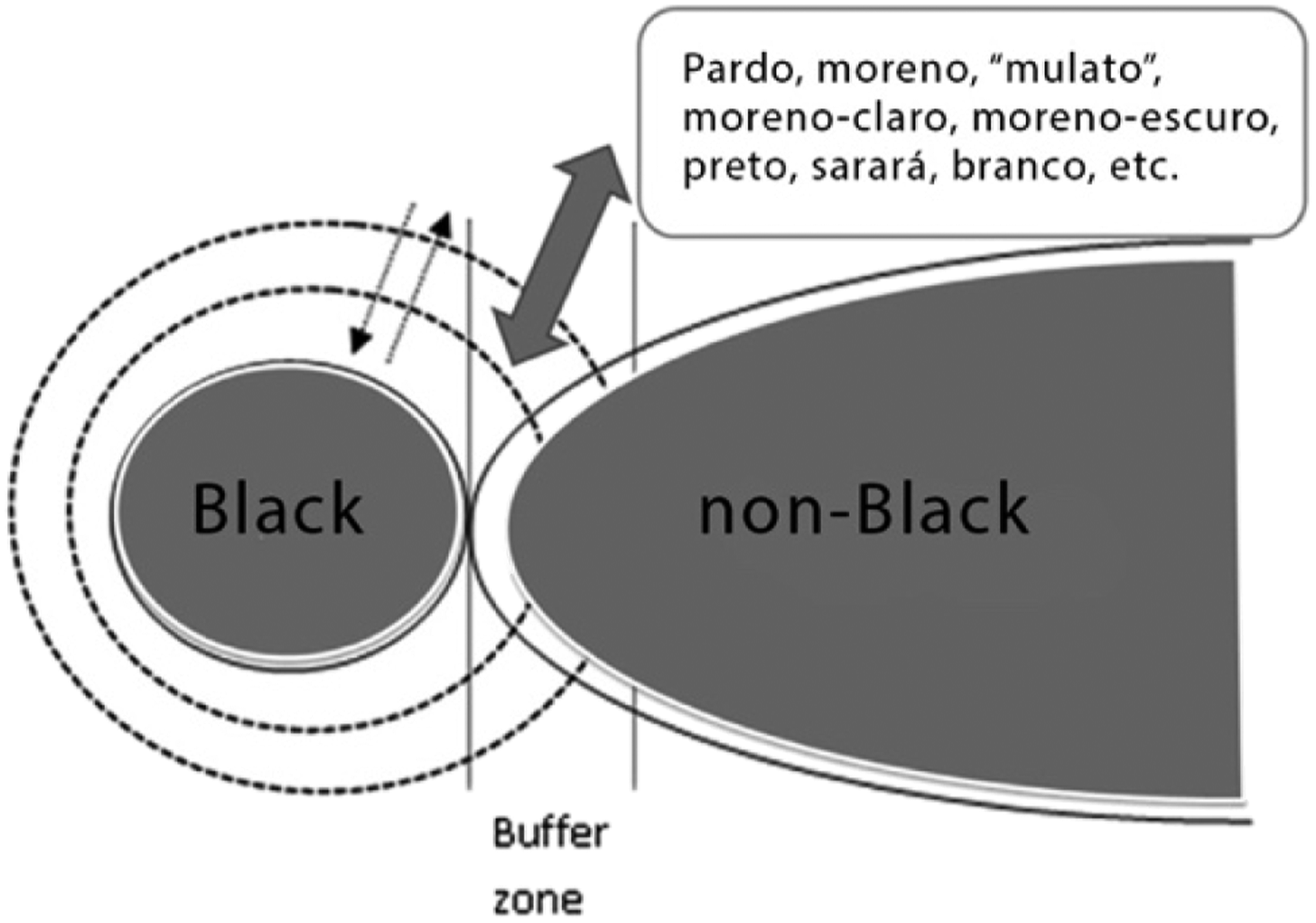
However, it is not Anitta’s outward appearance that ultimately determines her racial identity, or even her ability to cross racial boundaries. To believe that is to believe in a preexisting and objective visual reality that superimposes the social construction of race. This is not an observation of minor importance, since it implies that if racial identities are socially and historically constructed, so is our sight. We see a particular human body as the personification of a particular racial identity not because it is but because we were culturally trained to “see” it that way. In that sense, to believe that there is something about Anitta’s body that incontestably indicates racial mixture is the same as reifying the biological discourse about race. We see Anitta’s body as the one of a mixed-race person not because it is but because we have learned to see certain combinations of physical features as indicators of racial mixing. From this perspective, the act of “seeing” is always a cultural psychological phenomenon, and not just a mere visual apprehension of the phenomenal world.
Nevertheless, if our perceptions of reality are shaped by culturally constructed social suggestions, where is the root of the disagreement between Stephanie and Kauê regarding Anitta’s racial identity? Stephanie and Kauê express different perceptions of Anitta’s racial identity not because they come from distinct racial and cultural backgrounds or have irreconcilable political views (none of those is the case) but because what primarily determined their perceptions was the affective reaction produced by their experience of watching Anitta present herself as a Black woman in the Vai Malandra video, which resulted in feelings of empathy and acceptance (in Kauê’s case) and repulse and rejection (in Stephanie’s case).
The emotional states that emerged while watching Anitta’s music video demanded some kind of sense-making from Kauê and Stephanie, thus resulting in the arguments they used to support their political positionings regarding to how racially identify the singer. But no matter how elaborate and convincing their arguments may sound, underlying their rationalizations are the feelings of empathy and repulse that, in the first case, lead Kauê to “see” Anitta “as” an innocent victim of racism and, in the second case, lead Stephanie to “see” the singer “as” an opportunist impostor. Thus, the feelings produced by the immediate apprehension of Anitta’s appearance in the video were oriented not only by the social suggestions related to miscegenation and Black identity in Brazil, or by their previous knowledge of Anitta’s racial history, but also by Stephanie’s and Kauê’s personal preferences and idiosyncrasies, which, as a product of their personal trajectories, can only be indirectly accessed (an opportunity which, if granted, would have further enriched the present analysis).
From this perspective, affects should be understood as an unshareable dimension of human experience that reflects both the social suggestions of a given culture and the uniqueness of the emotional records that constitute our personal trajectories and who we are in our personal uniqueness. However difficult it may be to access the latter, an affective logic approach to racial signifying practices helps to highlight the person as a fundamental subjective positioning in the quality of his/her experiences by acknowledging that our realities have unique emotional expressions that lead us to feel, imagine, and think beyond any shared context.
Conclusion
Cultural psychology argues that we can look at the human psyche as both a product and a producer of culture (Eom & Kim, 2015). If the realm of culture is the realm of the production and exchange of meanings, the person (in one’s personal uniqueness) and the cultural world are always related to each other in a mutually constructive process of constant “internalization,” “reconstruction,” and “externalization” of these meanings (Valsiner, 2007).
The main objective of this article was to introduce the framework of affective logic as a theoretical tool for exploring the underlying cultural psychological processes involved in racial signifying practices. We aimed to demonstrate how the signifying practices that convert human bodies into personifications of racial meanings and identities emerge from the dialectical unity between the personal and cultural as two mutually constituted dimensions of human experience. From this perspective, racial identities could be understood as discursive expressions of a multidimensional semiotic system of racial interpretation through which internalized collective-cultural racial meanings are negotiated with one’s preferences and idiosyncrasies and transformed into personal–cultural systems of racial sense. By their turn, these personal/cultural systems of racial sense are externalized by the person, thus contributing to the reconstruction of racial meanings in a given cultural context.
We also argued that our primary relationship with the phenomenal world is affective (though culturally mediated). That is to say that our personal trajectories and emotional records provide our experiences with an affective dimension that both precedes and influences any logical assessment of reality, and that makes our sense-making processes unique. As such, in the arena of racial signifying practices, we must look beyond the person’s ability to critically position themselves racially, within a given socio-historical context, to consider the affective dimension of the relationship between the personal and the cultural as a fundamental element in the production of racial discourse.
With that said, we believe affective logic could be a useful and interesting theoretical resource to be explored in both qualitative research and clinical analysis of the psychological effects of race and racism as it highlights the person as a fundamental subjective positioning in the quality of his/her experiences. Furthermore, we hope that, by understanding these processes, we might be able to create opportunities for conscious evaluations of the affects that the apprehension of racial difference produces in each of us, thus opening space for new ways of recognizing racial differences that would hopefully take us beyond the constraints of racial prejudice and racist ideology.
Footnotes
Declaration of Conflicting Interests
The author(s) declared no potential conflicts of interest with respect to the research, authorship, and/or publication of this article.
Funding
The author(s) received no financial support for the research, authorship, and/or publication of this article.
