



Abstract
In this article we investigate how parties ‘close out the electoral market’ by monopolizing the channels of upward mobility for aspiring politicians (by reducing the number of independents). We analyse data from (1228) single-member constituency elections from three sub-Saharan African countries (Ghana, Malawi and Zambia) and six national legislative elections. We find that level of incumbent governing party support is the strongest predictor in explaining the likelihood that independent candidates would run for office at the constituency level across all three cases'
Introduction
E. E. Schattscheider (1942: 1) once wrote that ‘modern democracy is unthinkable save in terms of the parties'. Indeed, parties perform functions that are crucial to the development and maintenance of democracy, such as representation, integration of voters into the political system, and recruiting and training leaders. Furthermore, political parties hold the government accountable while articulating opposition and dissent (Aldrich, 1995; Diamond and Gunther, 2001; Randall and Svasand, 2002). Others have argued that political parties play a key role in integrating diverse populations and in creating a common political identity (Apter, 1971; Coleman and Rosberg, 1964; Huntington, 1968).
However, as many scholars point out, political parties in systems in transition do not perform these functions very well. Parties in such countries often lack coherent ideological programmes and are unable to offer voters clear sets of choices. The programmes that are offered are largely detached from citizens concerns (Kitschelt and Smyth, 2002) and corruption is seen as widespread in parties (Basedau et al., 2007; Salih, 2003). Parties are also not sufficiently rooted in societies, resulting in high levels of electoral volatility (Kuenzi and Lambright, 2005; Mainwaring, 1998; Mainwaring and Scully, 1995; Shabad and Slomczynski, 2004; Thames, 2007).
Recent studies of parties in new democracies (Fish, 2000; Hale, 2007) note that parties have notably failed to ‘close out’ the electoral market and establish a monopoly over the channels of elite participation in politics. Indeed, Hale (2007) argues that parties in new democracies have failed to monopolize the provision of political capital – thus non-party organizations remain viable alternative channels for elite participation in politics. In this sense, parties in many new democracies have failed to monopolize a fundamental function ascribed to them in the literature – leadership recruitment. Although there are multiple ways in which major parties may ‘close out’ an electoral market, we examine one critical aspect – the extent to which parties affect whether candidates choose to run as independents.
Indeed, large numbers of independents are generally indicative of weak political parties (Brancati, 2008: 649). Furthermore, independents are seen as lowering voter turnout by dampening the public’s interest in politics, failing to present voters with actual policy alternatives (Golosov, 2003; Moser, 1999). Independents are also seen as drawing away from the ability of viable challengers from defeating incumbents, and increasing the importance of race and ethnicity in electoral competition (Lacy and Burden, 1999; Sherrill, 1998). They also reduce government accountability, largely because they weaken the ability of parties to structure and stabilize legislative decision-making (Mainwaring and Scully, 1995; Sherrill, 1998). Thus, large numbers of independents running for office are seen as a failure of party democracy (Hale, 2007).
Although there have been some recent studies of independents, these have focused on institutional effects on whether independents enter electoral competition (Brancati, 2008; Carothers, 2006; Moser, 1999). What is missing from much of this literature is the examination of how different kinds of parties affect whether independents run for office. This, in our view, would be a more direct way to examine whether parties themselves impact on the closing out of the electoral market (as opposed to electoral systems or other features of the constitutional order).
In this article we investigate how the parties deter politicians from seeking to run as independent candidates. Using constituency level data, we analyse the results from three sub-Saharan African countries (Ghana, Malawi and Zambia) across six national legislative elections (the 2000 and 2004 election in Ghana, the 1999 and 2004 election in Malawi and the 2002 and 2006 elections in Zambia). All of these elections were generally considered ‘free and fair’ by external observers (see van de Walle, 2003). Furthermore, none were ‘founding’ or ‘transitional’ elections, which are qualitatively different compared to ‘normal’ elections (see Bermeo, 1987; Meiklejohn Terry, 1993; Welsh, 1994). The cases were also selected because they share political institutional features that allow a focus on the role of parties in independent entrance into the constituency level elections. Each country employs single mandate plurality elections and are non-federal systems. Furthermore, all three are presidential systems, which is an important incentive for political independence and for depressing the ability of parties to close out the electoral market (Hale, 2007).
Political parties and the electoral market
Much of the past literature on political parties in Africa has centred on their formation in the shadow of decolonization and the early years of independence (Collier, 1982; Decalo, 1990; Young, 1965). Nonetheless, the state of party research in Africa has been underdeveloped (Erdmann, 2007). Several reasons help explain this: first, there was the relatively unreasonable (and empirically untrue) standard of the mass party that was held up as the example of a ‘real party’ (Emerson, 1966; LaPalombara and Weiner, 1966). Too quickly parties in new democracies were dismissed as not ‘real parties', since they did not meet this imaginary standard. Second, conducting research on political parties in Africa was an inherently difficult proposition, particularly given that formal institutions play a minor role in the social and political processes within African parties. The ‘fluidity’ of African politics furthermore had strong inimical effects on the ‘stuff’ of political parties.
Only recently have scholars taken up again the study of political parties on the continent (Erdmann, 2007: 34–5) However, most of these recent works have focused on the development of party systems rather than on parties per se (Bogaards, 2004; Kuenzi and Lambright, 2001; Mozaffar et al., 2003; Mozaffar and Scarritt, 2005; van de Walle, 2003). Some have examined the electoral performance of individual parties (Vengroff, 1993). Others have concentrated on the evolution of voter partisan preferences (Lindberg and Morrison, 2004) and the extent of voter support for parties (Bratton, 2003) or have examined the capacity of political parties as aggregative organizations (Dibie and Uwazie, 2001; McMahon, 2003).
What is missing from the literature on African political parties is the examination of the impact of parties on candidates. The lack of scholarly attention to this function is surprising given that many scholars have noted that African political parties tend to be organizations that are essentially vehicles for ambitious politicians (Decalo, 1998: 297; Erdmann, 2007).
Why would aspiring political elites associate with political parties as opposed to running as independents? In general, parties are the organizational conduit that links political entrepreneurs with the market of voters and political elites. Parties provide organizational resources to aspiring political elites that assist in their effort to gain office. These resources include two different kinds of capital – ideational and administrative. Ideational capital is the identity and values that attract voters to particular party symbols, such as sympathy for the party’s platform and proposed policies. Administrative capital is more material – it includes the offices and power that can be doled out to ambitious politicians.
Generally, different kinds of parties offer different appeals. The major parties, or those that have access to state resources, often focus on the provision of administrative capital, or a combination of administrative and ideational capital. Minor parties, which have less access to state resources, are likely to rely more on ideational appeals (Hale, 2007). Furthermore, through their communication function, parties are able to offer to aspiring candidates a convenient ‘cue’ to voters, making affiliation with a party attractive to candidates with little in the way of independent name recognition. It is through this control of political capital and political communication that parties are able to monopolize the channels of upward political mobility.
We would expect that different kinds of parties (depending on whether they focus on administrative or ideational capital) would have different effects on electoral competition in the constituencies. Indeed, whether independents choose to run (and whether voters choose to support them) is a function of the characteristics of the major parties that compete in constituency elections. Two types of party merit special consideration in the African context. First, there are those parties that have direct access to patronage resources, or the governing party. Governing parties have much greater access to administrative capital or at least have the credibility to promise such resources to voters. As Nicolas van de Walle puts it ‘perhaps the most common electoral promise made by African politicians, particularly as they venture out of the capital, is that they will provide better roads and social services to populations who vote for them. Indeed, citizens often fear that they will be deprived of these services if they do not vote for the winning candidate’ (van de Walle, 2003: 313). This incentive to affiliate with the candidate with the best chance of winning, which in many cases is the candidate of the governing party, is also a powerful inducement for aspiring politicians to eschew running as an independent.
Second, there are ethnic parties, or those that strive to become the ‘one political organization dominant in representing the demands of the ethnic group against its rivals' (Brass, 1991: 106). Given that African elections often amount to ethnic ‘censuses', ethnic parties can be expected to exert a powerful ‘squeezing out’ effect, particularly in electoral competitions where ethnicity is politically salient. Ethnic parties emphasize ‘solidarity’ and community, which are forms of ideational capital. This is not to say that candidates and voters who affiliate with ethnic parties are not motivated by the desire for access to administrative benefits. Rather, administrative benefits are more likely to result from demonstrating solidarity with the community, or the sense ‘that only a member of their own ethnic group may end up defending the interests of the ethnic group as a whole, and that voting for a member of another ethnic group will certainly not do so’ (van de Walle, 2003: 313).
Theory
The extent to which parties ‘close out’ an electoral market depends upon whether parties can deter independents from entering an electoral competition, or how parties affect the calculation of prospective candidates. As Dawn Brancati (2008: 650) has noted, there is a variety of different motivations on the part of prospective candidates to run as an independent. Some independents are political outsiders who are drawn into the political arena because of an issue about which they are passionate. On the other hand, some are previous government insiders who split from their original parties because of disputes or because of a failure to secure a place on the party’s ballot (Brancati, 2008).
In either case, whether a prospective independent candidate is motivated by issues or by political ambition, they seek to maximize the vote they receive in an electoral competition. For prospective candidates motivated by the desire to highlight a particular issue, doing well electorally helps highlight that the issue is important to the constituency. On the other hand, former politicians eager to re-enter the political arena are motivated to win as many votes as possible to demonstrate their relevance (and demonstrate that they are potential viable candidates that can be recruited by the parties later).
Based on the assumption that independent candidates seek to maximize their share of the vote, we begin with a simple model where prospective individual candidates estimate the likelihood of whether they will do well electorally if they run in a local competition. The decision to run is based on their estimate that they will attain a greater expected utility by running as an independent as opposed to affiliating with a party, or:

where EUenter is the expected utility of entering an electoral competition as an independent candidate and EUaff is the expected utility of entering an electoral competition by affiliating with a party. Generally, EUenter comprises the following elements:

where UV is the expected payoff from doing well in the election, PV is the probability of doing well in the election, UD is the expected cost of not doing well in the election, (1-PV) is the probability of not doing well in the election, Cti is the rate at which the costs of competing accrue from the present (t = 0) to that time in the future when the election is held (tV). In addition, there are estimated benefits of independent candidacy (such as the ability to make direct side deals for access to patronage) as well as the costs of not associating with other parties (such as loss of access to patronage resources offered by affiliation with the governing party, or potential punishment and ostracism by other parties). These costs are represented by Uorg or the costs of lost access to selective material incentives generated by affiliation with parties and (Usel), the costs of lost ‘solidary’ or identity benefits (Uid) by affiliating with a party. Thus,

On the other hand, the expected utility of affiliating with a party involves generally all the components above, except the costs of not affiliating with a party. However, there are also additional costs associated with perceived loss of independence for the candidate by affiliating with a party, which constrains the ability of the candidate to make independent free-agent ‘deals'.

In general, the costs of not affiliating with a party are different for different kinds of parties, and higher depending upon how well a party performs. Indeed, not only can parties help defray the costs accrued over time during the campaign (which provides a positive benefit to running under a party label) but not affiliating with a party also invites other costs. For instance, certain parties are able to generate significant selective incentives (such as access to patronage resources) more than others. Governing parties in Africa have greater access to such resources than most of their competitors. Thus, not affiliating with a governing party carries costs generally, but these costs are much higher in governing party strongholds. Other types of party, particularly parties that are based on identity (such as ethnic parties) can levy other costs, such as ostracism or exclusion from a community, particularly in constituencies where ethnic parties do well and where the level of ethnic polarization is greater. Furthermore, if a party can demonstrate that it is the ‘only game in town’ in a constituency election then the costs facing a potential independent candidate by not running under a party label are much higher. In sum, two hypotheses can be derived from the above theoretical models:
Control variables
Although different kinds of parties may theoretically ‘close out’ constituency elections in different ways, there are other factors to consider. Much of the literature that has examined the reasons political candidates choose not to run under a partisan label has focused on institutional factors, in particular the existence of a powerful presidency, a district-based winner-take-all district-based electoral system, and governmental decentralization (Brancati, 2008; Fish, 2000; Hale, 2007) However, for our purposes, we control for these factors by examining the three cases (Ghana, Malawi and Zambia) that share these systemic features in common.
There are a number of constituency characteristics that also affect decisions regarding the entrance of independent candidates. For instance, Stein Rokkan (1970) contends that political parties begin primarily as urban formations, and in the early stages of democratic transition parties are likely to concentrate their activities in the urban areas. There are a number of reasons cited, but perhaps the most important is that the primary constituencies upon which the parties recruit their leadership are located in urban sectors of the population – such as the intelligentsia. In addition, the mass base for the parties is initially recruited from the urban entrepreneurial and working classes (Rokkan, 1970: 254–5). Moreover, local elites in rural areas often prefer to remain outside political parties, in part because doing so allows them to build coalitions based around traditional affective ties (Erdmann, 2007). Thus:
However, there are other reasons why political elites may or may not affiliate with a major political party. Parties, as mentioned earlier, generate both ideational and administrative capital; however, the ideational attraction of parties presumes that prospective candidates see some utility in affiliating with a party based on ideas, i.e. that appeals based on ideational solidarity will attract votes. In the African context, this may work differently from elsewhere in the world. The relatively low levels of literacy may militate against appeals based on ideals and encourage appeals based on personal affiliation. In other words:
Another feature of African politics that relates to the concept of ideational capital is the importance of ethnicity and identity. As several scholars have argued, ethnicity is often used as a political cue for voters, and this is also the case in most of Africa (Lindberg, 2006; Posner, 2005). As Dowd and Dreissen (2008: 3) have noted in Africa ‘political parties have been distinguished from each other largely based on who they represent rather than by what they represent. Citizens have generally voted in ethnic blocks for parties led by co-ethnics'. Nicolas van de Walle (2003: 297) points out that in Africa ‘party cleavages have been overwhelmingly ethno-linguistic in nature, while ideological and programmatic debates have been muted and rare’. Indeed, the general consensus in the existing scholarship has been that ethnicity has provided the basis for party solidarity – ethnic bases of parties provide incentive for cohesion and identity (Erdmann, 2007: 45).
Thus, parties may offer more ideational appeal in constituencies that are more ethnically polarized, where ethnicity provides easy cues for voters to distinguish between different parties – and hence provides less incentive for independents to run for elected office. Indeed, as Paul Brass (1991) has argued, the more homogeneous a district, the greater the likelihood that ethnic identity becomes less important as an ideational resource, as parties and candidates compete on issues other than ethnic identity. Thus:
Much of the literature on political parties emphasizes their role in disbursing material rewards or patronage resources (Aldrich, 1995; Hale, 2007; Katz and Mair, 1995). This certainly has been true in Africa, largely because (in the risky and uncertain environment characteristic of low-income societies) there has been a great reliance on exchange of gifts, patronage and other ‘courtier’ practices (van de Walle, 2003: 311). At the local level, political elites are thus more likely to seek affiliation with political parties where they see opportunities for access to administrative or material rewards, particularly in constituencies where there is little in the way of alternative opportunities for material advancement outside of affiliating with a party. At the constituency level this would suggest that:
Analysis
To test the hypotheses identified above we collected data from three countries for six national legislative elections. All three countries are former British colonies in Africa, and employ a Single Mandate District Plurality (SMDP) electoral system, and are presidential systems, and none have a federal structure. Thus, there is very little institutional variation comparing the three countries, at least in terms of basic systemic features of the countries.
The countries are also similar in terms of laws governing candidates. In Ghana and Malawi, candidates for the legislature must be at least 21 years old, whereas in Zambia they must be at least 25. In each country, the candidate must pay a nominal candidate registration fee. The nomination threshold to get on the ballot for candidates is fairly low in Ghana, Malawi and Zambia. The prospective candidate must be endorsed by 20 registered voters in Ghana, 10 in Malawi and 9 in Zambia to gain access to the ballot. In terms of candidate funding, there are no limits regulating the source of funds or the amount raised from private contributions in Ghana, Malawi or Zambia. Public funding of individual candidates is provided for in Ghana and to parties in Malawi; however, no public funding is provided to parties or candidates in Zambia. 1
Given the laws governing nomination and funding candidates, independent candidates should have the greatest financial disincentive to enter the political market in Zambia, because no public funding is available (and campaigns are expensive). In Malawi, there should also be a disincentive facing independent candidacies, given that public funding is provided to parties based on their electoral performance in the previous legislative election (in Malawi parties are eligible for funds if they received at least 10 percent of the vote). Ghana, which has both public funding and no private funding limits, should have the lowest financial barriers for independent candidacies.
Data and variables
National legislative electoral data were collected for each electoral constituency for two elections to the unicameral assembly for the three countries. These included the 2000 and 2004 elections for Ghana, the 1999 and 2004 elections in Malawi and the 2002 and 2006 elections in Zambia. Excluding cancelled constituency elections, data were collected for 1248 constituency elections. 2
We collected data on the electoral performances of the identified ethnic party and the incumbent governing party. Second, to measure the extent to which parties were ‘ethnic’ we use the criteria employed by Cheeseman and Ford (2007). Defining an ethnic party as one which ‘derives its support overwhelmingly from an identifiable ethnic group (or cluster of groups) and serves the interests of that group’ and using data from the Afrobarometer they devise a measure that estimates the ethnic ‘homogeneity’ or ‘diversity’ of a party’s support. They examine the extent to which political parties are ‘ethnic’ by examining the proportion of a party’s voter support base that is provided by the largest ethnic group. Parties that receive 85 to 100 percent of their support from one ethnic group are classified as ‘ethnic’, and parties that receive less than 85 percent but more than 66.6 percent of their support from one ethnic group as ‘potentially ethnic’ parties (Cheeseman and Ford, 2007: 12; see also Scarritt, 2006). Such ‘potentially ethnic’ parties, although not entirely dependent on the support of a single ethnic group, are nonetheless not ‘independent enough of the support of the group that the party leadership can risk alienating this support base’ (Cheeseman and Ford, 2007, 13). Such parties thus must cultivate the identity of the party to fit the general interests of the ethnic group that supports it, even though they do not rely entirely on the support of one group.
Thus, we code ‘ethnic’ parties as all parties that derived more than 66.6 percent of their voter support base from a single ethnic group. The only three parties identified by Cheeseman and Ford (2007) that fit these criteria were the New Patriotic Party (NPP) in Ghana, 3 the Malawi Congress Party (MCP) 4 in Malawi and the Patriotic Front (PF) 5 in Zambia. Based on the 2006 Afrobarometer data, of all Ghanian parties, the NPP relied most heavily on a single group, the Akan – 69.7 perent of NPP supporters were from that group. Similarly, the MCP in Malawi was the most dependent on the support of a single group – 72.1 percent of its support came from the Chewa. In Zambia, 73.3 percent of the support for the PF came from the Bemba. Although not all of their support came from one group, of all the parties listed in these three countries these were clearly the most ‘ethnic’ in terms of reliance on their political support. One of these parties, the NPP, was also the incumbent governing party (in the 2004 election).
In general, although the Cheeseman and Ford measure for an ethnic party is imperfect in as much as it is based on survey data (rather than on actual voter results), it is a useful measure nonetheless. Furthermore, it is important to note that the electoral performance of these parties tended to be higher in regions dominated by the groups which each of these parties purported to represent – the MCP in Central Malawi, the NPP among Akan majority regions in Ghana and the PF in North and Copperbelt regions of Zambia (see Boafo-Arthur, 2007; Elischer, 2008; Kaspin, 1995, 1997; Morrison and Hong, 2006; Posner, 1995; Scarritt, 2006). Thus, this prima facie evidence supports the idea that the Cheeseman and Ford measure is of use for our purposes.
We coded as the incumbent governing party that party which held the presidency in each of the three countries as the party in power just prior to the election. For Ghana in 2000, this was the National Democratic Congress (NDC) and in 2004 the NPP. For the Malawian case, for both elections the governing incumbent was the United Democratic Front (UDF). For both the Zambian 2001 and 2006 elections the incumbent governing party was the Movement for Multiparty Democracy (MMD).
To distinguish between primarily rural versus ‘non rural’ (towns and cities) constituencies, we identified the largest community in each of the 1228 constituencies. Since the classification of a community as a town or city varied across the countries because of different national populations, we used the classification criteria employed by the countries themselves. If the largest community in the constituency was over 20,000 in Ghana, this was considered a town or city – for Malawi and for Zambia the figure was 10,000 and above. 6
As far as poverty, literacy and ethnic composition of constituencies are concerned, although data for the independent variables should ideally come from the constituency level, such data are not generally available. As a rough surrogate, we use the smallest geographic unit for which such population data were commonly available (i.e. across all three countries), which was the regional level. Poverty and literacy rates were measured by the officially reported poverty and literacy rates for each country in the most recent census data. 7
Furthermore, we measured the extent to which a constituency was linguistically divided by calculating the proportion of the second largest group over the proportion of the population made up by the largest language group. As Horowitz (1985) points out, ethnic tensions are greatest in countries where a large ethnic minority faces an ethnic majority group. Most common measures of ethnic fractionalization, however, do not capture this tension. Thus, to capture this level of ‘polarization’ we measure the proportion of the population of a region of the second largest ethno-linguistic group over the population of the largest ethno-linguistic group. If the resulting value tends toward 1 this would represent greater polarization, whereas ‘0’ would represent complete ethno-linguistic homogeneity. 8
Results
The tables illustrate the results of our analysis. Table 1 summarizes the number and percentage of constituencies in which independent candidates ran for election, by country. Malawi had the largest proportion of constituencies in which independent candidates ran for election (62.8 percent of the constituencies across the two elections). Zambia followed with 52.9 percent of the constituencies with Ghana at 30.8 percent. The results from Table 1 do not support the expectation that Zambia would have far fewer independents running for office than either Malawi or Ghana (because of the lack of public funding for independent candidates). Although Zambia had fewer constituencies in which independents ran for office than Malawi, it had far more than in Ghana, where public funding of candidates is more widely available. Yet Ghana had far fewer independent candidacies than in Malawi or Zambia. Thus, differences in terms of campaign financing appear to have had little impact on independent candidacies.
Number and percentage of independent candidates who ran for election by country.
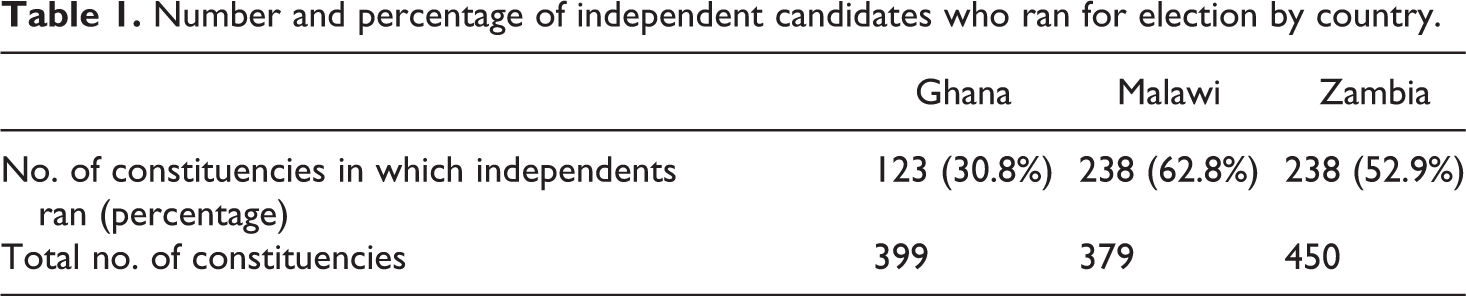
Table 2 illustrates the results of a binary logit analysis where the dependent variable (whether an independent candidate ran for election in a constituency) was regressed against seven independent variables: (1) the performance of the incumbent governing party (which tests hypothesis 1); (2) the electoral performance of the ethnic party in a region which was ethnically polarized (an ethnically polarized region was identified if the ratio of the second largest ethnic group over the largest ethnic group was greater than or equal to 0.50, which tests hypothesis 2); (3) a dummy variable to check the effect of whether the ethnic party was also the governing party; (4) the regional literacy rate; (5) the regional poverty rate; (6) a rural/town dummy for the constituency; (7) the ratio of the proportion of the population of the second largest ethno-linguistic group in the region over the population of the largest group in the region. The table reports the coefficient estimates and the robust standard errors, the exponent of the coefficient (Exp[B]) to assess the magnitude of the effect of the independent variables, as well as the Variance Inflation Factor (VIF) scores as a check for multicollinearity in the model.
Did an Independent run in district? Pooled logit regression results for Ghana, Malawi and Zambia.

Pseudo r2 = 0.09.
N = 1228.
*p ≤ 0.10, **p < 0.05, ***p ≤ 0.01, ****p ≤ 0.001.
As to our primary hypotheses, the performance of the governing party in a constituency election significantly reduced the likelihood that an independent candidate would run for election. Furthermore, a better performance of the ethnic parties in ethnically polarized regions significantly reduced the likelihood that independent candidates would run in such districts. These findings support hypotheses 1 and 2, which held that the activities of both incumbent governing parties generally and ethnic parties in polarized regions would act as a disincentive for the entrance of independent candidates in the constituency competitions.
As to the control variables; the results from Table 2, whether the constituency was rural or non-rural, were unrelated to whether an independent candidate stood for election (contrary to hypothesis 2). Furthermore, the literacy rate was significantly related to whether an independent candidate ran for election, but the sign of the relationship was the opposite of what was expected above (contrary to hypothesis 4). Rather than less literate areas presenting a more conducive environment for independent candidates, higher literacy rates in a region were more conducive. Interestingly, the level of ethnic polarization in a region increased the likelihood of independents running for office (contrary to hypothesis 5). However, as the results above demonstrated, when ethnic parties performed well where there was high polarization, they tended to squeeze out independent candidacies. This would strengthen the notion that ethnic parties play an important role in areas which are ethnically polarized, but not in all areas.
However, whether the governing party was also an ethnic party had little deterrent effect on individual candidacies (which really only relates to the NPP in Ghana). However, as pointed out above, ethnic parties are likely to have a deterrent effect in districts where the party’s ethnic identity is salient (i.e. in districts where they perform well and which are ethnically polarized, i.e. not in all districts). Hence, this result is not particularly surprising, contrary to the expectation (and hypothesis 6) generated by some of the classic literature on party development. The local poverty rate was also unrelated to whether an independent candidate ran for election in a constituency.
Generally, from the VIF scores, too, there appear to be no problems with multicollinearity (given that all of the values are well under 4; Fox, 1991).
Table 3 reports the disaggregated results by country, excluding the cross-national control variable (i.e. the ethnic party/incumbent governing party dummy) to determine whether or not individual country results had a disproportionate effect on the results. As indicated, the effect of ethnic party performance on reducing the likelihood of entrance by an independent candidate is clearly driven by Malawi, where the performance of the MCP significantly reduced the probability of the presence of independent candidacies in ethnically polarized regions. However, this relationship did not hold for either Ghana or Zambia. The one consistent and statistically significant effect across all three cases was the reductive effect of the performance of the incumbent governing party. These results offer additional support for the contention that the incumbent governing party’s performance provides a disincentive for independents to run in constituency elections. 9
Did an Independent run in district? Disaggregated logit regression results for Ghana, Malawi and Zambia.
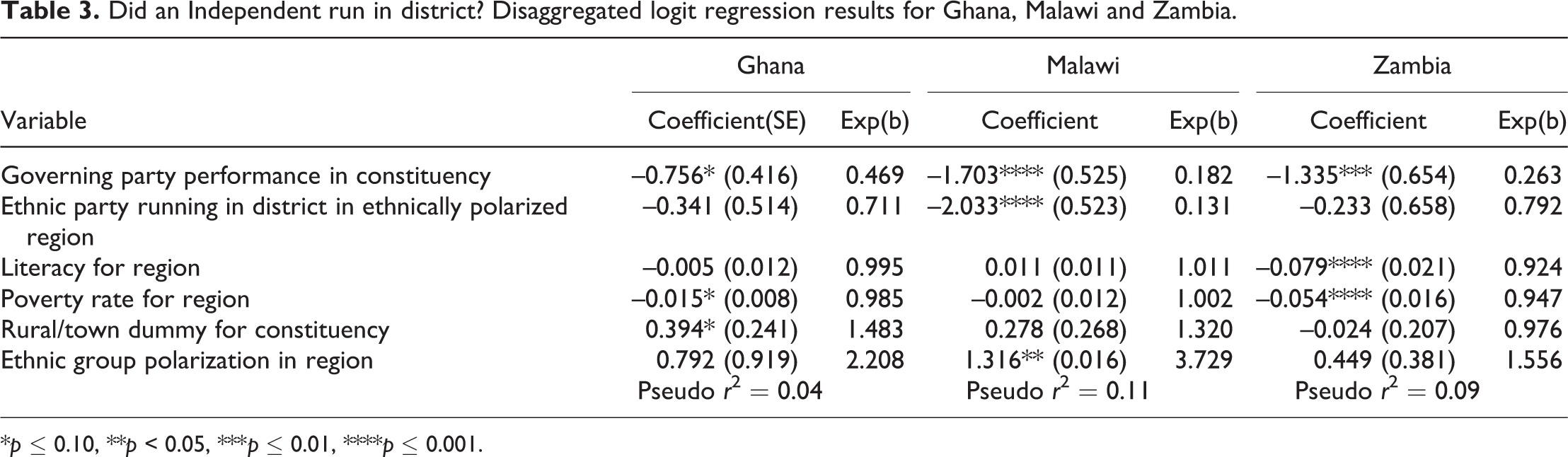
*p ≤ 0.10, **p < 0.05, ***p ≤ 0.01, ****p ≤ 0.001.
Finally, in Table 4 we examine an additional control factor that may also explain why an independent would choose to run in an electoral competition – the estimated probability of doing well in the election (or PV in our theoretical model). This is a function of how well independent candidates performed in that particular district in previous election competitions. Table 4 illustrates the results when we include the performance of independent candidates in the district in the previous election. As indicated, again the governing party’s electoral performance has a significant dampening effect on the entrance of independent candidacies, However, ethnic party performance in districts in regions that were ethnically polarized no longer has a reductive effect on the entrance of independent candidates (strengthening our observation above that the effect of ethnic parties may be limited both to one country, Malawi, and one election). An interesting, and now significant, relationship is that between the ‘governing party is ethnic party’ dummy variable (referring to the NPP which was the governing party in the 2004 election), which now has a strong dampening effect on independent candidacies. This is likely due to the nature of the Ghanian election in 2004, which was highly contentious, particularly the presidential election, and competition broke along ethnic lines (squeezing out independent legislative candidacies). However, again this is probably a time-dependent finding (i.e. particular to the 2004 election).
Did the percent independents received in prior elections in a district affect whether an Independent ran in the subsequent election? Pooled logit regression results for Ghana, Malawi and Zambia.
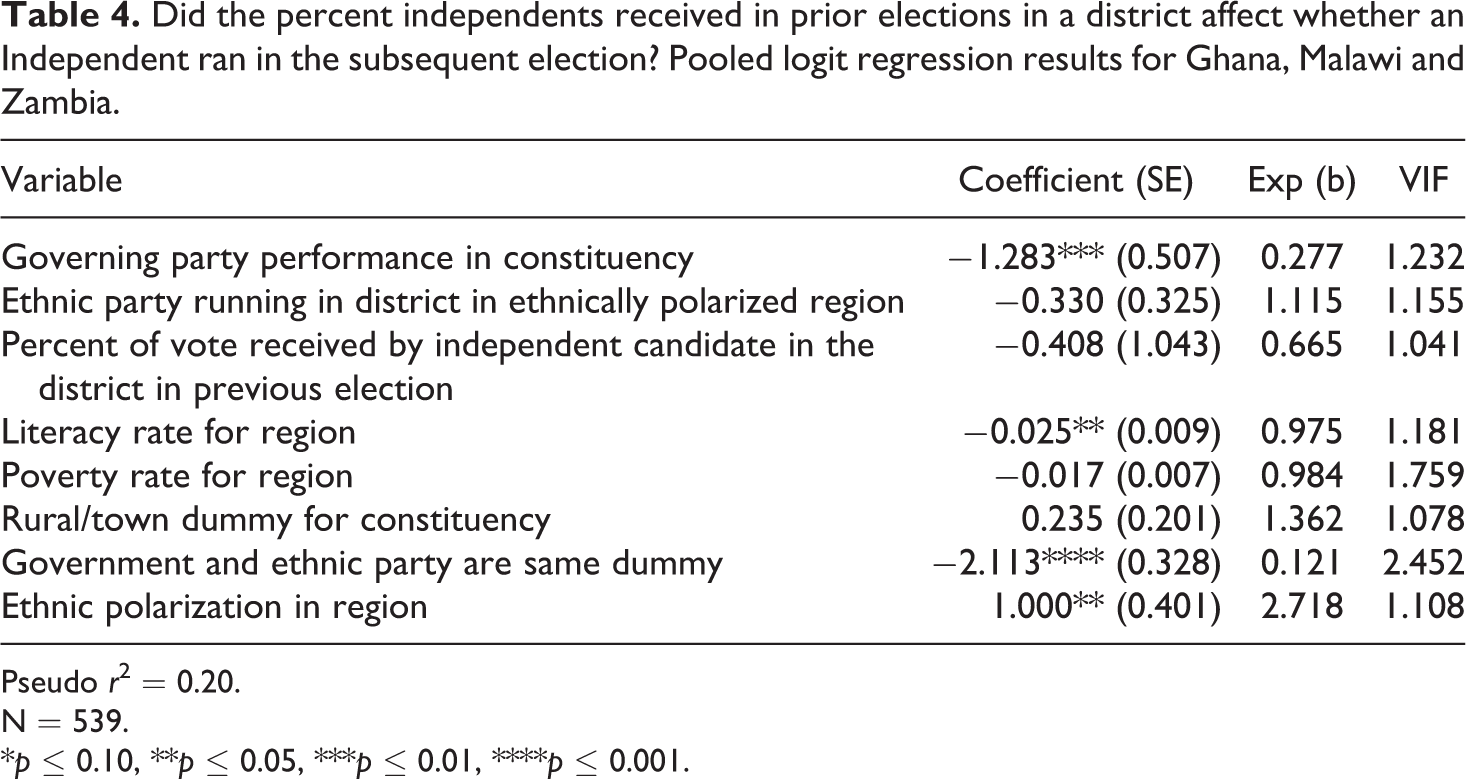
Pseudo r 2 = 0.20.
N = 539.
*p ≤ 0.10, **p ≤ 0.05, ***p ≤ 0.01, ****p ≤ 0.001.
Conclusions
The article has addressed the factors that explain where parties were unable to close out the competitive field within countries, or, in other words, where independent candidates ran for office. Furthermore, it has demonstrated that different kinds of parties (incumbent governing parties and ethnic parties) close out the electoral market in different ways. Incumbent governing parties squeeze out independent candidates. To explain this, as we noted above, political parties attract candidates (and for that matter voters) because they provide two different types of capital – administrative and ideational. Generally speaking, although all parties provide both, parties rely on one or the other to attract candidates and voters.
The one consistent finding across all models was that incumbent governing party performance has a strong dampening effect on the entrance of independent candidates into a political competition. The incumbent governing party (which presumably has greater access to administrative capital) has a greater impact on squeezing out independent candidates (and voters for independent candidates) because it offers inducements for political elites NOT to run as independents. The results reported above support these expectations. The performance of incumbent governing parties was associated with a reduced likelihood of the appearance of independent candidates (as predicted by hypothesis 1).
These findings suggest that incumbent governing parties (particularly those that are not ethnic parties) tend to reduce independent candidacies, perhaps by offering administrative capital incentives which attract political elites and voters.
Although there has been an expansion of interest in the role played by political parties in building democracy in Africa, much remains to be done. If we are to gain greater insight into how parties contribute to democratic development (or not), we will need to better ascertain how parties as organizations perform the functions so crucial to democratic development – particularly political recruitment. This would be an important avenue for future research, especially regarding the question as to whether political parties have become an indispensible part of democracy in sub-Saharan Africa.
Footnotes
Funding
No specific grant from any funding agency in the public, commercial or not-for-profit sectors was received for this research.