




Abstract
High levels of party voting cohesion are common in modern legislatures. Current explanations divide into sociological (based on norms and roles) and rational choice (based on systems of punishment and reward). The latter approach dominates, but cannot explain cohesion in systems with weak disciplinary sanctions, such as the British House of Lords. Social psychology has provided a great deal of insight into conformity in groups, but this has rarely been deployed in studying parties. Neuroscience now also allows us better to understand the physiological mechanisms underlying responses such as need to belong and fear of ostracism. This article outlines key theories and findings from psychology relevant to parliamentary party cohesion, and then explores these using survey data from the relatively ‘discipline free’ House of Lords. It is suggested that psychological factors such as social identity are important to the operation of party groups, and stronger interdisciplinary links are proposed between political science and psychology.
Introduction
Many modern parliaments are characterized by strong political parties and highly cohesive party voting. Existing explanations of political party cohesion can be divided into sociological and rational choice approaches (Hazan, 2003; Saalfeld, 1998). The more dominant of these is the rational choice approach, which holds that party representatives base decisions on costs and benefits to themselves, concluding that it is in their interests to toe the party line. This is because party leaders often possess significant powers to punish and reward legislators, for example through withholding re-selection and promising promotion or financial resources.
This article takes a novel approach to explaining parliamentary party cohesion, proposing that political science can learn much from theories in psychology. Long-established findings in social psychology, more recently backed up by results from neuroscience, suggest that group cohesion – even in the absence of a system of punishment and reward – should be the norm. One example from legislative studies of the largely ‘discipline-free’ environment of the British House of Lords (Norton, 2003: 58) suggests that this may in fact be the case.
The article is structured in four main sections. First, it summarizes existing explanations for parliamentary party cohesion from the political science literature. 1 Next, after a brief review of the anomalous case of the House of Lords, it sets out alternative explanations for cohesion drawn from theories and findings in psychology. It then examines new data from the House of Lords to explore more deeply members’ attitudes to loyal and disloyal voting and to their party groups. These findings support predictions from psychology. The final section of the article reflects upon what these theoretical and empirical findings imply, both for the discipline of political science and for the management of legislatures. The article concludes that there could be great benefits in greater interdisciplinary connections between psychologists and political scientists over the study of political parties, both inside and outside the legislature.
Political party cohesion: Political science views
An obvious starting point when considering parliamentary party cohesion is the classic work of Ozbudun (1970), who not only considered the causes of cohesion but also provided the definitions that generally frame contemporary debate. Even within political science, language is used somewhat inconsistently, while terms such as ‘cohesion’ are used differently within psychology. Here, we adopt Ozbudun’s definitions. He defined parliamentary party group cohesion as ‘the extent to which, in a given situation, group members can be observed to work together for the group’s goal in one and the same way’ (1970: 305). The most obvious and visible sign of such cohesion comes through members of the group voting as a unified bloc, rather than splitting, when the legislature takes formal decisions on legislation and other policy matters.
The standard measure of party voting cohesion is the Rice Index (Rice, 1925). For any vote this is the absolute value of the proportion of a party’s representatives voting one way minus the proportion voting the other. So if the group votes entirely cohesively the Rice Index will be 100, whereas if it is split equally the index will be zero. The voting cohesion of a party over time is simply calculated by averaging the Rice Index for individual votes. This measure has been used to show that many political party groups are highly cohesive. For example, in the 1990s the Index for parties in the New Zealand parliament averaged almost 95 percent, in Norway and Sweden it exceeded 96 percent, and in the lower houses of Australia and the UK it exceeded 99 percent (Sieberer, 2006).
Various factors are associated with party group cohesion in legislatures (Bowler et al., 1999; Carey, 2007; Owens, 2003; Sieberer, 2006). For example, cohesion is generally assumed to be higher in parliamentary than presidential systems, since executives in the former depend on legislative confidence for their survival. Other system-level factors that may be relevant include the level of state decentralization (as parties with more federal structures may be more disparate), the electoral system (and particularly whether this encourages intra-party competition), and the structure and stability of the party system. Party-level factors include the size of the party, its ideology and whether it is in government or opposition. Testing the effect of these factors is extremely difficult, however, given the almost uniformly high levels of voting cohesion in many parliaments, the potentially large number of independent variables and the significant differences in legislative voting rules and procedures between countries (Hug, 2009; Owens, 2003; Sieberer, 2006).
A fundamental question is what drives the high levels of voting cohesion seen in many legislative parties. One possible explanation of course would be near-uniform levels of policy agreement among party representatives; but this does not find support in empirical studies, which demonstrate that members hold diverse opinions not reflected in their voting behaviour (Kam, 2001, 2009). Hence scholars conclude that ‘[p]arty unified voting in parliament seems a much more common phenomenon than is policy agreement amongst party deputies’ (Olson, 2003: 172).
If cohesion does not result from policy unanimity, there must obviously be other explanations. One likely contributor is party discipline. According to Ozbudun (1970: 305) this ‘refers either to a special type of cohesion achieved by enforcing obedience or to a system of sanctions by which such enforced cohesion is obtained’. There are various mechanisms available to party leaders and whips in order to enforce discipline, which are sometimes supplemented by parliamentary (or even constitutional) rules. Common features include leaders’ ability to promise (or withhold) representatives’ re-selection, promotion, funding, committee seats or speaking time. In some countries (e.g. Australia), members casting a single dissenting vote may be expelled from the party group, or even (as in India) from parliament itself. While cohesion may exist without discipline, it therefore seems likely to be reinforced by it. As Hazan (2003: 3) says, ‘discipline starts where cohesion falters’.
Theoretical perspectives on causes of high voting cohesion divide principally between sociological and rational choice approaches (Hazan, 2003; Saalfeld, 1998). The sociological approach holds that politicians’ behaviour is shaped by norms and the adoption of predetermined social roles, which become internalized to some extent by individuals (Searing, 1994; Wahlke et al., 1962). In terms of determinants of voting cohesion, this approach focuses largely on factors operating before members enter the legislature: including prior socialization in political parties, engrained loyalty and demographic homogeneity among party representatives (Hazan, 2003; Olson, 2003). But in general the sociological approach has fallen out of favour in legislative studies, to be replaced by the rational choice approach. This is seen both as more parsimonious and as having stronger predictive power (Saalfeld, 1998; Strøm, 1997). In contrast to the sociological approach, rational choice proponents present legislators as ‘goal-seeking men or women who choose their behaviour to fit the destinations they have in mind’ (Strøm, 1997: 158). Rather than falling prey to norms, legislators will respond to the incentives available to them as individuals, seeking to maximize opportunities for re-selection, re-election, higher political office and other benefits. In making decisions about voting, members will therefore be highly responsive to systems of punishment and reward, i.e. to party discipline. Since the tools of punishment and reward available to leaders in many systems are so extensive, it is easy to assume that these are responsible for the high levels of voting cohesion which are widely seen.
The strange case of the House of Lords
One case, however, casts doubt on the importance of discipline to creating and maintaining party cohesion. This is the British House of Lords, as highlighted in a study by Norton. Norton suggests that the Lords is essentially a ‘discipline-free environment’ (2003: 58). Members of the chamber are appointed for life, and therefore do not face re-selection or re-election. Senior ministers are not drawn from the chamber, and it thus offers little opportunity for career advancement. In any case, most members are appointed towards the end of their careers and have already achieved significant status. They receive no salary, and their relatively limited allowances are paid automatically by the parliamentary authorities with no involvement from party groups. Neither is there any party control over speaking time. In short ‘leaders and whips – and the party organisation outside the house – lack the sticks and carrots that form the basis of discipline’ (Norton, 2003: 60). Instead, ‘in so far as the whips in the Lords have sanctions, they are best characterised as twigs rather than sticks’ (ibid., p. 62). A member rebelling against the party can at best be sent a ‘sorrowful note’ by their party whip expressing regret at the action taken (ibid.).
The expectation, therefore, would be for party cohesion in the House of Lords to be relatively low. But Norton finds that the reverse is true. Using data from three parliamentary sessions, 1999–2002, he shows that the Rice Index is similar to that in the British House of Commons, at around 99 percent. His figures, broken down by session and the three main parties in the chamber, are reproduced in Table 1.
Party cohesion (Rice Index) in the House of Lords 1999–2002.

Reproduced from Norton (2003), Table 4.
This clearly demonstrates that there is very little voting dissent in the Lords. The chamber contains approximately 200 Labour members, 200 Conservative members and 70 Liberal Democrats, and over this period there were 380 separate votes (or ‘divisions’) held. In the great majority of these, no dissenting votes were cast. Where there was dissent, this usually comprised only one member, and only a relatively small number of members ever cast dissenting votes. This pattern was largely uniform across the three main parties. Norton concludes that these results offer no support to the rational choice explanation of party cohesion. He suggests that ‘peers vote with their party not because they feel they have to, or … because they have rationally thought through the issues on which they vote … peers vote loyally with their party because they want to’ (ibid., p. 69).
However, the sociological model does not fit the Lords comfortably either. The chamber does include many former MPs, who might be expected to adhere to a norm of cohesive voting learned in the House of Commons. But numerous other party representatives have had little history of activism in their parties before being appointed, and have built up impressive independent careers in other fields. Given the almost complete lack of dissenting votes, these members seem equally likely to toe the party line. Thus while Norton’s findings do much to demolish the rational choice approach, and could have profound implications for parliamentary organization (as discussed below), they also leave us with a conundrum. If cohesion is not generated by discipline, what is it caused by? Here, this article suggests, psychology has much to teach political science.
Group cohesion: Approaches from psychology
It is surprising that there have been very few previous attempts to apply theories from psychology to parliamentary party groups, including to voting cohesion. 2 The relationship between individuals and groups has been described as social psychology’s ‘master problem’ (Allport, 1962: 3), and some of the discipline’s key findings – as discussed below – relate to the sometimes surprising behaviour of individuals when organized in groups. There is now a well-developed subfield of social psychology on group behaviour and intergroup relations, including a journal by the same name. Social psychology findings in this area are now supported increasingly by findings from neuroscience, though little of this has yet fed through to the study of politics (Lieberman et al., 2003). An interdisciplinary subfield of political psychology does exist, but gives relatively little attention to political parties and almost none to parliaments. A recent review, based on articles in the journal Political Psychology, concluded that the study of ‘organisations and groups’ was small and declining within the field. Political psychologists are far more likely to focus on mass behaviour, leaders’ personality traits and international relations (Monroe et al., 2009).
Some of social psychology’s earliest and most important findings focused on conformity in groups. For example, the classic experiments of Asch (1951) found that subjects gave obviously incorrect answers in order to be consistent with a group of strangers (who were stooges of the experimenter) to which they had just been recruited. Sherif et al. (1961) randomly allocated participants to groups that were put in competition with each other, and found that hostility between the groups quickly escalated, as did bonding within each group. From these early findings came the notion of the ‘minimal group’, with which participants rapidly form a bond of loyalty, despite initial random allocation of membership (Diehl, 1990; Tajfel, 1970).
Many social psychologists thus reject reasoning of the rational choice kind, which is based on individual decision-making. Instead they suggest that ‘although groups are comprised of individuals, understanding group behaviour cannot be attained from an understanding of individual behaviour’ alone (Cottam et al., 2004: 63). Asch drew a chemical analogy with water, which is much more than the sum of hydrogen and oxygen, instead being a new substance with different properties from both (cited in Brown, 2000). Psychologists therefore suggest that ‘effects of self-interest need to be disentangled from those of group interests, which could be more powerful’ (Huddy, 2003: 518).
It is well established that human beings often use others’ behaviour to work out what is the appropriate behaviour to pursue themselves (Festinger, 1954). This may be for informational reasons (because we are not sure what is the correct thing to do), or normative reasons (when we are concerned about fitting in) (Hornsey et al., 2003). Both are potentially at play among party representatives in parliamentary settings. Psychologists note that to a large extent such mimicry is automated and unconscious, rather than reasoned and conscious, as automated processes allow decisions to be taken far more efficiently and quickly (Kunda, 1999). In drawing parallels between human and animal group behaviour, Miller notes that ‘[p]aying close attention to others can be a handy decision-making shortcut during moments of uncertainty … but it can also tempt us to follow the crowd uncritically’ (2010: 264). 3
The default in any social situation may therefore be to follow the group, while a decision to break from the group can be significantly more effortful and difficult. To a social psychologist, in other words, group cohesion is the norm. But while most of us belong concurrently to numerous groups (e.g. through our race, religion, local community, profession, work team, hobbies, etc.), some are seen by psychologists as more ‘groupish’ than others, and more liable to be cohesive. While parliamentary party groups have not figured in their experiments, the factors that psychologists have found to be associated with cohesion could hardly match such groups more closely. As Rupert Brown indicates:
Cohesion has been observed to be associated with such factors as physical proximity, frequency of interaction, similarity among group members and, most importantly, a commitment to the group’s goals. Intergroup conflict [in addition] usually leads to increased cohesion within each of the competing groups. (Brown, 2000: 64)
What do psychologists believe are the factors underlying groups’ strong tendency to cohesion and conformity? Within social psychology, the dominant perspective is that of social identity theory (Tajfel and Turner, 1979). 4 This holds that there are two elements to a person’s self-concept: personal identity and social identity. Our social identity is determined by the groups to which we belong, and we maintain it by intergroup comparison, to distinguish ourselves from others. Our membership of groups is therefore key to our sense of identity; we define ourselves, to a large extent, through the groups to which we belong. In order to maintain both positive personal identity and positive social identity, we are thus inclined to view our ‘ingroup’ positively in comparison with other ‘outgroups’. As Brown suggests, ‘one of the major consequences of becoming a member of a group is a change in the way we see ourselves. Joining a group often requires us to redefine who we are’ (2000: 28).
As a consequence of group attachment, and of looking to others when judging how to behave, people also tend to adopt beliefs which are consistent with their group. Hence it is suggested that beliefs cannot be separated from their social meaning (Haidt, 2001). This has been tested, with some powerful results, in a political setting (Cohen, 2003). Here, participants were asked in an experiment to carefully study a policy and list arguments for and against it. Some were also told that the political party with which they identified either supported or opposed the policy. Despite their careful study and argumentation, a large majority of participants claimed to support the policy when told that it was favoured by their party, while a large majority opposed it when told the reverse. Rather than using party allegiance as a shortcut (or heuristic) when deciding what to think, the experimenter concluded that participants had identified the arguments correctly, but placed emphasis on those that appeared to back their party’s position. Participants were – it should be emphasized – ordinary voters. We might expect the effects among party activists or representatives, with stronger attachment to their parties, to be stronger still.
Such results are consistent with another classic theory from social psychology: that of cognitive dissonance (Festinger, 1957). This holds that we feel mental discomfort when our beliefs are inconsistent with our actions, and that to resolve this dissonance we will often (this being our only option after the event) respond by changing our beliefs. From this we might expect that parliamentarians who vote against their own policy preferences would come to adjust their preferences in order to make them more consistent with their votes.
While there are positive factors that drive people to cohere to their groups, based on group attraction and loyalty, motivations can also come from the negative factors associated with divergence from the group. Powerful among these is the fear of ostracism. This is now considered to be an evolutionarily adaptive response, traceable to dependence on the group in early human societies (Williams, 2007; Wright, 1995). Hence human beings have developed a response of ‘social pain’ when excluded from their group, which studies show is neurologically similar to physical pain (Eisenberger, et al., 2003; MacDonald and Leary, 2005). Here, an additional factor with clear resonance in political settings is the well-established black sheep effect, which describes how group members reject dissidents from within the ingroup even more strongly than they reject members of the outgroup. In social identity terms, dissident ingroup behaviour is seen as creating a threat to self-identity (Marques and Paez, 1994). In political settings, for example, extreme left-wingers are found to be more negative about the mainstream left than they are about the right (Hornsey and Jetten, 2004).
As well as those factors already identified above, various other pertinent characteristics of groups are associated with greater or lesser cohesion. For example, ‘Dunbar’s number’ suggests that groups find it difficult to function beyond 150 members, which is the maximum number of individuals with whom we can realistically maintain direct personal contact. Beyond this size, groups are likely to break down into factions (Christakis and Fowler, 2009; Dunbar, 1993). Related to this is the psychological concept of ‘optimal distinctiveness’, whereby humans try to balance between their need to belong and their need for uniqueness. As the author of this theory suggests, ‘effective groups cannot be too large or too heterogeneous. Groups that become overly inclusive or ill-defined lose the loyalty of their membership or break into factions or splinter groups’ (Brewer, 1991: 478). 5 Few parliamentary parties exceed 150 members, but the tendency for parties to contain factions is of course well established.
Other factors identified by psychologists which similarly seem relevant in party settings include the extent of discussion within the group and whether dissent is to be expressed in public or in private. Studies show that ingroup critics are more accepted by the group, and more likely to speak out, when discussion takes place privately (Hornsey, 2005; Hornsey et al., 2003; Van Leeuwen et al., 2010). This suggests that party groups may be able to generate cohesion through systems of internal democracy. Hornsey proposes that in order to avoid a potentially damaging ‘spiral of silence’ (Noelle-Neumann, 1974), groups should work to ‘create a norm that encourages dissent and offers people permission to speak their mind without fear of consequences’ (Hornsey, 2005: 324). From the point of view of party managers this may also have the advantage of minimizing public dissent.
This short overview indicates that there is much in psychology that helps explain party group cohesion, most of which has thus far gone unnoticed by political scientists. The remainder of this article explores some of these propositions from psychology using data from the same largely ‘discipline-free environment’ as Norton (2003: 58), i.e. the British House of Lords.
Methods and sources
The findings that follow are based on a postal questionnaire survey circulated to members of the House of Lords in spring 2007 as part of a larger project on the chamber and its work. The Lords has over 700 members, and this number is subject to constant minor fluctuations owing to deaths and new appointments. 6 Responses were received from 381 members, i.e. over 50 percent. Respondents were broadly representative, in terms of party, length of service and peerage type. Here we report responses only from members of the three main political parties, as the chamber also includes around 200 members who represent no party. 7 Party-political respondents totalled 258, from a possible population at the time of 493 (52 percent).
Many of the questions on the survey related to other matters, such as the powers of the chamber and options for its reform. However, these were interspersed with a number of questions about party cohesion, some based on studies by psychologists, as detailed below.
Data are also publicly available on voting in the House of Lords, but we do not make use of these here. As Norton demonstrated, there is little variance in party members’ recorded votes, and few dissenting votes are cast. This remained the case during our period of study (Russell and Sciara, 2007). 8 Where members do not vote loyally they are far more likely to abstain rather than actively vote against the party whip. This abstention is not recorded, however, so is virtually impossible to measure. Members are not required to attend the chamber, do not receive a salary and many are either elderly or have other occupations outside parliament. As further discussed below, our findings are therefore largely based on members’ self-reporting of their voting behaviour, and on their attitudes to voting cohesion and their party groups.
Findings on cohesion in the House of Lords
It is worth noting at this point that the House of Lords has a reputation for its members’ relative independence from the party whip, in particular compared to the House of Commons. There are various ways in which this independence can be expressed, including through members making speeches as well as abstaining or voting against the whip. Norton demonstrated that the last of these actions is rare. But our analysis suggests that members are unaware of this, and that they take some pride in party independence in the chamber.
Table 2 gives the proportions of members in each party group agreeing with four statements about party loyalty and voting cohesion. As can be seen, it is widely believed among members that peers behave more independently than MPs. It is also widely seen as justified to vote against the party line, and particularly to abstain, when disagreeing with frontbench policy. There is some difference between the parties, with Labour members (i.e. those supporting the governing party at the time) less likely to think it justified to vote against the party, and more likely to perceive peers as loyal when compared to MPs.
Members’ support for statements about party loyalty and disloyal voting behaviour (%).

N = 256 (Lab 101, Con 109–11, Lib Dem 45). Figures show percentage saying ‘agree’ or ‘agree strongly’ on a 5-point Likert scale.
Members were also asked about the incidence of disloyal voting or abstention in the chamber and how common it was for members to vote with their party even when they disagreed with its position. The responses to these questions are given in Table 3. Again this demonstrates that members considered independent behaviour to be relatively common: in particular with respect to abstention, but also to a lesser extent in terms of voting against the party line. But explicitly party loyal voting was also perceived as common. A large majority of members believed that peers often voted with their parties even when they disagreed with the party line.
Members’ reports of how often loyal and disloyal voting occurs (% responding ‘very often’/‘often’).

N = 243–253 (Lab 97–100, Con 101–108, Lib Dem 44–45). The precise question was: ‘In terms of voting in the Lords, how often would you say each of these occur?’ Responses were recorded on a 4-point Likert scale: other options were ‘not very often’ and ‘not at all’.
Members’ concerns if voting against the whip (%).

N = 247–248. The precise question was: ‘To what extent would you be concerned about the following factors if you voted against your party group?’
When asked to report on their own behaviour, however, a rather different picture emerged. 9 Very few members confessed to voting against their party’s position themselves. At less than 10 percent in each party group, these figures are consistent with the voting record as analysed by Norton (2003) and others (Russell and Sciara, 2007). The number of members admitting to abstaining when they disagreed with their party’s line was markedly higher, although still far below peers’ expectations about the chamber as a whole (most notably in the case of the Liberal Democrats). Finally, many members were themselves prepared to admit regularly voting with their parties despite disagreeing with the party line. Predictably, this was far more common among members of the governing party. The frankness of responses on this last question surprised us. They clearly demonstrate that high levels of voting cohesion in the House of Lords cannot be accounted for by policy unanimity alone.
These figures further underline, as discussed above, the need for other explanations of peers’ cohesive voting behaviour. The great majority of members believe that it is justified to vote against the party line, and that such behaviour is relatively frequent, but most do not behave in this way themselves. Indeed, many confess to regularly voting against their beliefs in order to support their parties. The key question remains, why does this occur?
We asked members this question directly, and their responses are given in Table 4 (which omits party information, as responses from the three parties were similar). The first two statements in the table (that the whips would act against the member and that their career prospects would be threatened) reflect standard rational choice assumptions that cohesion is connected to discipline. As the table shows, only a tiny proportion of members were concerned about these effects. This strongly supports Norton’s claim that cohesion in the Lords does not result from discipline. The other two statements begin to probe alternative explanations and receive far more positive responses. Around three-quarters of members felt that voting against their party might ‘damage’ the party group, while just under half expressed concern that they might ‘upset’ other group members. These results clearly suggest support for psychological (or indeed sociological) motivations for party cohesion, rather than motivations based on members’ instrumental rationality. The responses indicate that cohesive voting is instead connected to feelings of loyalty and affection towards party groups.
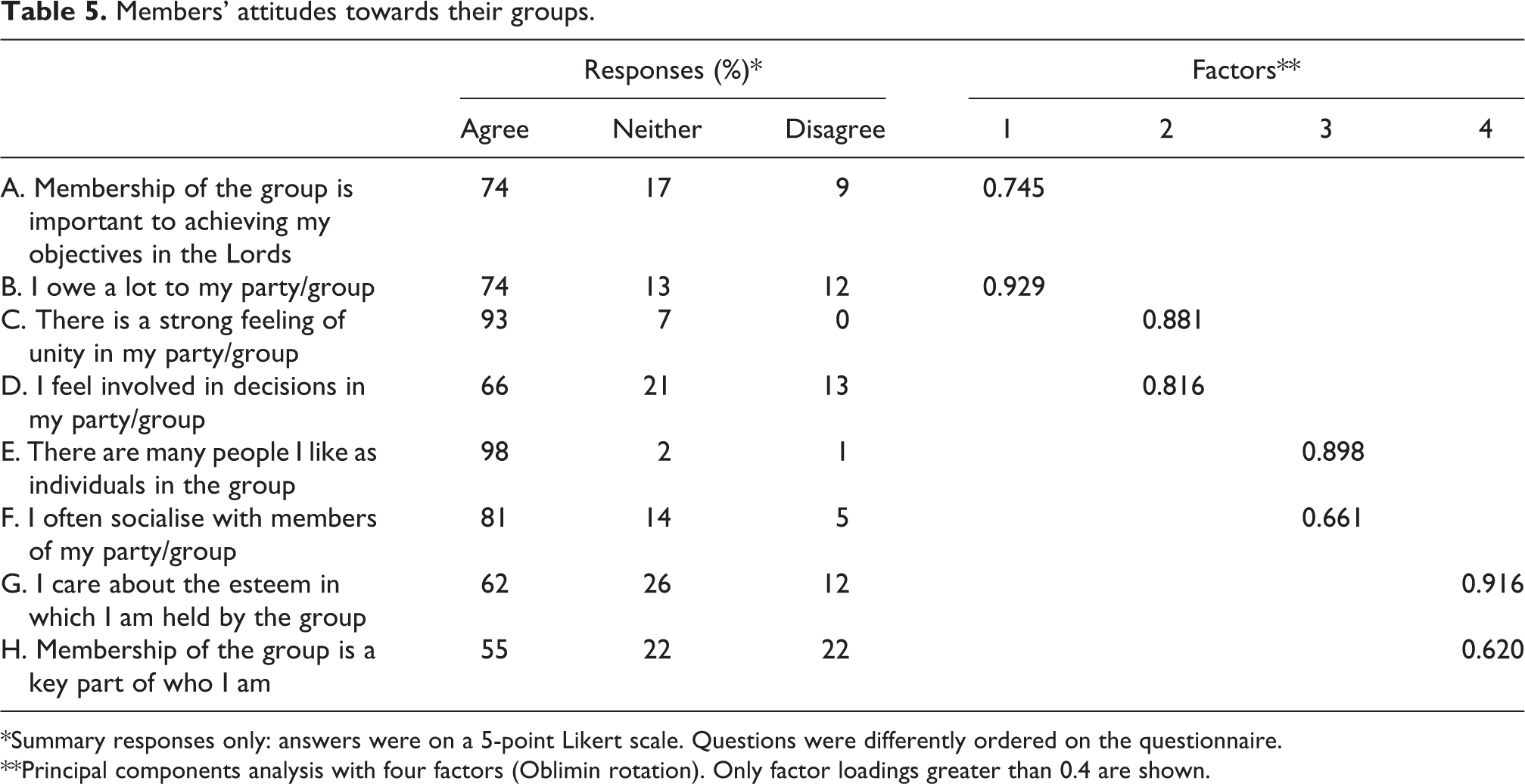
To investigate this further, we included a set of eight more questions probing members’ attitudes to their groups, as given in Table 5. These questions were based on previous studies in psychology, particularly regarding social identity. 10 Questions A and B relate to the instrumental usefulness of the group and come closest to rational choice explanations. 11 Questions C and D instead seek to capture whether members feel that there is a sense of shared decision-making and purpose in their group. These build on previous questions by social psychologists on attraction within groups. 12 Questions E and F explore the social ties which bind members together, and draw on ideas in psychology of intra-group attraction. 13 Finally, questions G and H directly tap notions of social identity. 14 In each case there was a high degree of agreement with the statements.
Members’ attitudes towards their groups.
*Summary responses only: answers were on a 5-point Likert scale. Questions were differently ordered on the questionnaire.
**Principal components analysis with four factors (Oblimin rotation). Only factor loadings greater than 0.4 are shown.
These questions clearly seek to capture attitudes that are likely to be interrelated. An initial correlation matrix based on the responses finds several coefficients at above 0.5, and most at above 0.3. Bartlett’s test of sphericity is significant at p < 0.001. The next appropriate step is therefore to conduct a factor analysis in order to identify underlying factors. The results of a principal components analysis to extract four factors, using Oblimin rotation (given the interrelated nature of the underlying factors) are shown on the right-hand side of Table 5. 15 This confirms that each pair of questions identified above loads heavily on one factor. We may call the factors instrumentalism (questions A and B), involvement (questions C and D), sociability (questions E and F) and social identity (questions G and H).
Our final stage of analysis is an exploratory multivariate regression to investigate relationships between these four dimensions and members’ voting decisions. Here, there are several important caveats. First, as already noted, there is insufficient variance in members’ disloyal voting to use votes against the party (actual or reported) as a dependent variable. We can, however, use members’ self-reporting of abstention and voting with their party despite opposing the party line. But of course members’ reports may not be entirely reliable. Second, the data on members’ attitudes are clearly skewed in the ‘agree’ direction, although there is more variation than given in Table 4, as answers were on a five-point scale with considerable additional variation between ‘agree’ and ‘strongly agree’ responses to all eight questions. Third, and crucially, our fundamental interest here is not in fact testing individual differences between members. A search for the personality traits associated with the ‘rebellious member’ would clearly be futile, given that few members actually rebel. We are looking to a large extent for traits which are shared by all members, and which may therefore help explain the almost uniformly cohesive behaviour observed. We cannot therefore expect to see very strong effects in our models.
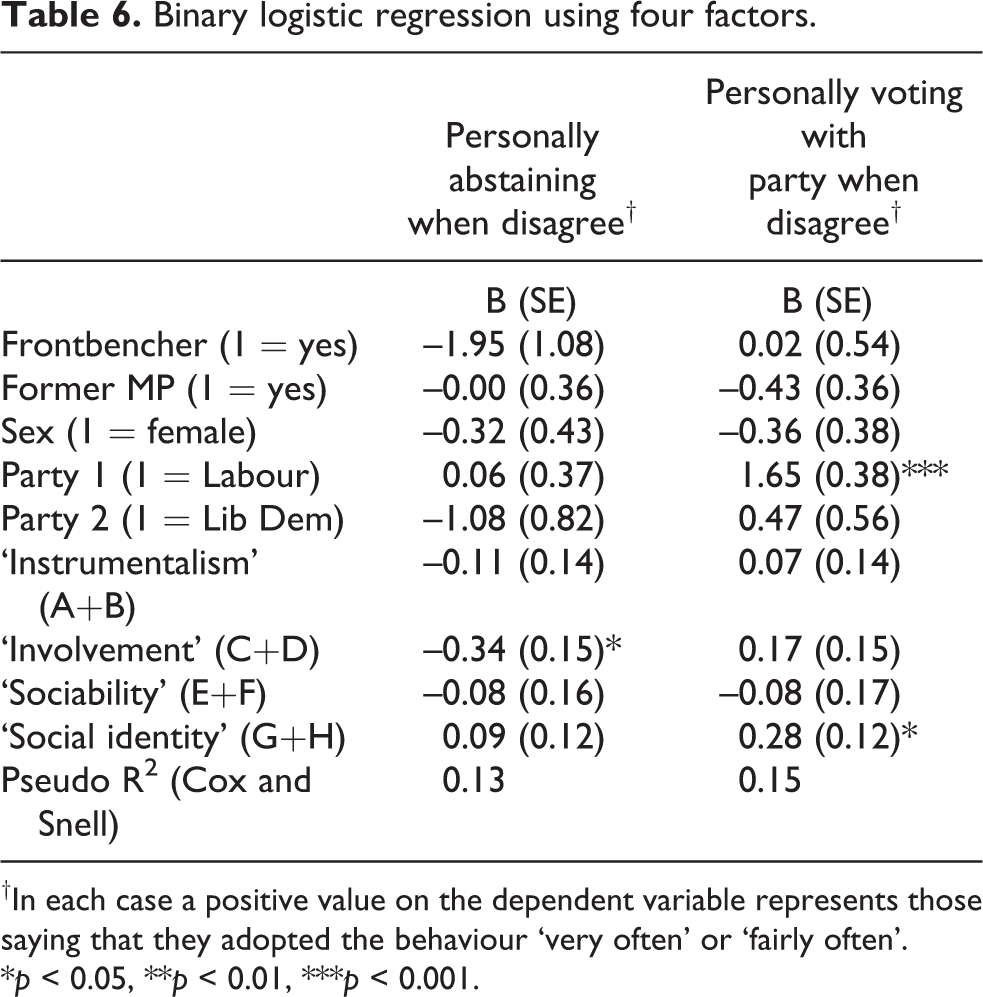
The results of a binary logistic regression on each of the two dependent variables is shown in Table 6. The main independent variables of interest are the four dimensions identified above, which are operationalized as sums of the four pairs of questions. 16 These are tested alongside five control variables (all dummy variables): sex, political party (Labour and Liberal Democrat), plus whether the member held a front-bench position (important as front-benchers are expected always to follow the party line) and whether the member was a former MP. The last of these enabled us to test the more sociological expectation that those with prior socialization in the House of Commons would adopt more cohesive voting behaviour.
Binary logistic regression using four factors.
†In each case a positive value on the dependent variable represents those saying that they adopted the behaviour ‘very often’ or ‘fairly often’.
*p < 0.05, **p < 0.01, ***p < 0.001.
These are all tentative results, given the caveats above. But they do give some interesting indications. Among the control variables, only Labour Party membership proves to be (highly) significant, and this only with respect to voting loyally while disagreeing with the party line. This was expected, given the clear party difference seen above in Table 3. The direction of some other coefficients is as expected, but none are statistically significant. Notably, former MPs are no more likely than others to adhere to the party line, offering no support for a hypothesis that some peers are socialized into this behaviour in the House of Commons. Regarding the four key dimensions, ‘instrumentalism’ proves not to be significant in either model, offering no support to rational choice explanations. The ‘sociability’ dimension also shows no significant effect. However, members who rated ‘involvement’ more highly were significantly less likely to say that they abstained when they disagreed with party policy. This is in line with the indication above from psychology studies that allowing dissent to be expressed behind the scenes can boost group cohesion in public. It makes instinctive sense that members who feel they have been involved in formulating a collective decision should be more likely to stick by it. In addition, members scoring more highly on ‘social identity’ were significantly more likely to admit to voting loyally when they disagreed with the party line.
Conclusions
Findings in psychology on the tendency to cohesion and/or conformity in groups provide powerful potential explanations for voting cohesion in parliamentary parties. Our results on the House of Lords lend some support to these explanations, which certainly find more support than do rational choice explanations of cohesion. The House of Lords is characterized by high levels of party voting cohesion, and low levels of dissent, despite party leaders having few ‘punishment and reward’ mechanisms at their disposal. Our survey found that only 4 percent of members feared action by party whips should they cast dissenting votes. In contrast, large numbers were concerned that such behaviour would ‘upset’ other members of the party group, or ‘damage’ the group. They were thus far more influenced by bonds of loyalty than fear of disciplinary sanctions. Furthermore, members’ perceptions of the instrumental usefulness of their party group to achieving their objectives was not a significant determinant of their voting behaviour. In contrast, those who felt more involved in decision-making (even once membership of the party frontbench had been controlled for) were more likely to vote loyally. And those whose group membership was important to their sense of identity were more likely to admit to voting with the party even when they disagreed with the party line.
It is worth noting that there are other results from psychology which are also in line with common parliamentary party group behaviour. For example, psychologists find that conformity expectations are reversed when dealing with issues that have a strong moral basis. While in most cases people are more attracted to an argument when told that it is a majority view, on issues that are strongly morally based they are more likely to speak out when told that they are in the minority (Hornsey et al., 2003). In other words, it will be much more difficult for party managers to get representatives to conform on such issues. This is wholly consistent with the existence of ‘conscience votes’ in many parliaments, where the whip is lifted on issues such as abortion and euthanasia (Cowley, 1998).
A psychological approach therefore has much to offer in explaining parliamentary party group behaviour, and indeed both parliamentary and party behaviour more widely. These are underexplored areas where stronger interdisciplinary connections could fruitfully be made. Just as economics is learning from psychology in the new subfield of ‘behavioural economics’ (Wilkinson, 2008), there are significant potential gains for mainstream political science in importing methods and theories from psychology. Indeed, given that rational choice approaches were originally imported from economics, but that many economists are now turning away from these and building more complex models of human behaviour drawing from psychology, there are strong arguments for political science to do the same.
There are real-world implications of such new understandings, as well as scholarly academic ones. Most obviously, if the House of Lords can function and maintain highly cohesive party voting despite little use of punishment and reward, a question arises over whether such systems are unnecessary in other legislatures. Might political party cohesion be routinely maintained without them?
Here psychology again holds insights. First, the primary effect of mechanisms of party discipline (particularly in less collegiate settings than the House of Lords) is suppression of individual acts of defiance, which could easily spiral out of control. While experiments in psychology demonstrate that human beings have strong tendencies to conformity, they also show that minority influence can be effective in breaking group unity. That is, only a small handful of dissidents need to speak out before others in the group feel confident to join them (Moscovici, 1976). Like conformity, and fear of ostracism, sensitivity to minority influence makes evolutionary sense in terms of sensitivity to danger signals from within the group; animal studies demonstrate remarkably similar results on minority influence to human studies (Miller, 2010). Hence discipline may not be necessary to control most members most of the time, but it may nonetheless have an important role in stifling the beginnings of dangerous dissent.
However, the degree of cohesion in the House of Lords suggests that the kind of sanctions in operation in many legislatures may go well beyond what is necessary to maintain party unity. Political party members will have a natural inclination to behave cohesively, even if they disagree on policy detail. And beyond a certain point, systems of discipline may in fact prove counter-productive. Another important finding from psychology is that intrinsic commitment to a cause can be ‘crowded out’ if those participating feel that they are being coerced (Frey and Jegen, 2001). That is, people tend to forget that they originally supported the cause, and instead become resentful that they are being controlled, which in turn reduces their commitment. Economists are now starting to model the effects of social identity, and enlightened companies are recognizing that loyalty from employees may flow more readily from enhancing shared identity, rather than as a result of crude punishment and reward (Akerlof and Kranton, 2005). Political parties could perhaps benefit from similar approaches.
The sociological approach to political behaviour was previously discredited for lacking a clear scientific basis and predictive power. But this article has shown that theories from psychology, which are well grounded in rigorous experimental studies, may help to explain political behaviour in more accurate and nuanced ways. Politics is, of course, almost by definition a group activity; hence inclusion of reasoning from social psychology is an obvious step. This should be welcomed in particular by those who find models of politics as a competitive game among selfish individuals unconvincing. A better interdisciplinary understanding may therefore lead both to better theories and to better real-world management of political institutions.
Footnotes
Acknowledgement
I thank Yael Reiss for research assistance. I am also grateful to the School of Politics and International Relations at the Australian National University (and particularly to Professor Keith Dowding), where I was a Visiting Fellow during part of this research.
Funding
This work was supported by ESRC grant RES-063-27-0163.