




Abstract
This article revisits one historical event that has been repeatedly discussed in the literature on democratic breakdown: the rise and fall of Argentine democracy between 1916 and 1930. First, we demonstrate why the claim that demands for drastic redistribution led to democratic breakdown is not a convincing explanation for the 1930 coup. Instead, we contend that the coup was the product of a polarizing political realignment that led to a legitimacy crisis. We evaluate this argument using estimates of Argentine legislators’ latent preferences (ideal points) between 1916 and 1930. Our roll-call data analysis suggests that disputes over socio-economic issues did not precipitate the breakdown of the regime. What mattered was the allocation of political power. These findings support the view that stable democracy requires that all major groups in society have a sufficiently large chance of being in power.
Introduction
Understanding what makes democracies fragile and more likely to break down has generated a great deal of scholarly interest in the field of comparative politics. In the past decade alone, several important works in political economy have focused on whether economic development and income inequality affect the stability of democracy. However, despite this recent surge of research, the proximate causes of democratic breakdown remain elusive. Two major limitations have affected the study of this phenomenon. First, many recent contributions tend to ‘paint with too broad a brush’. Searching for greater degrees of generality, these studies often rely on models that are too simplistic to explain the problem at hand. The second limitation has been the tendency of country-level studies to emphasize unsystematic or exceptional factors as the main drivers behind democratic breakdown.
This article addresses these limitations. We provide an empirical evaluation of an historical event that has been discussed in the literature on democratization: the rise and fall of democracy in Argentina between 1916 and 1930. By focusing on this case, we can anchor the analysis in a concrete historical incident; we also take into account the general aspects that have been discussed in the relevant literature. First, we demonstrate that socio-economic factors do not offer a convincing account of the downfall of Argentine democracy. Next, we examine an alternative explanation. Specifically, we investigate the link between political polarization and democratic breakdown. Employing estimates of Argentine legislators’ latent preferences, we find that the progressive polarization of political conflict was not driven by particular policies, or by ideological concerns, but rather by the hegemonic tendency in the allocation of political power that polarized Argentine politics trampling democratic consolidation.
This article is closely related to Smith’s (1974a) seminal analysis of the failure of democracy in Argentina, as well as to Rosenthal and Voeten (2004) and Hansen and Debus (2011), who use roll-call votes to examine the collapse of the French Fourth Republic, and the fall of the Weimar Republic, respectively. It is also associated with a growing literature relying on roll-call data to examine inter-party dynamics in Argentina; for example, Jones and Hwang (2005, 2006), Jones et al. (2009) and Alemán et al. (2009). More generally, the article relates to the aforementioned debate regarding the link between socio-economic conditions and democratic survival.
The remainder of this article is organized as follows: First, we discuss the alternative views regarding democratic breakdown and then present our main empirical findings. A brief final section concludes.
The road to democratic breakdown
Democratic transition in Argentina begins after the passage of the Sáenz Peña Law in 1912, which established the secret ballot and obligatory male suffrage. This reform ended a long period of oligarchic republicanism. It first went into effect with mid-term elections in 1914, and then in 1916 for presidential and congressional posts. The Radical Civic Union (UCR) won the three presidential elections held during this period (1916, 1922 and 1928). The third Radical administration was interrupted by a military coup on 6 September 1930. Below, we summarize the two different perspectives that seek to explain democratic breakdown.
The redistributive struggle view
The redistributive struggle perspective emphasizes the importance of class struggle over income redistribution in explaining democratic breakdown. The argument starts by assuming that in a democracy citizens determine the amount of income redistribution – a choice that can trigger elite efforts to mount a coup. When income inequality is high, elites have more to fear from democracy than when income inequality is low (Acemoglu and Robinson, 2001; Boix, 2003; Rosendorff, 2001). Because salient disparities of income are intended to lead to demands for drastic redistribution, elites resist democratization or undermine democratic consolidation.
According to Acemoglu and Robinson (2006), Argentina in the 20th century represents the case of an unconsolidated democracy, where high ‘levels of inequality still lead to democratization, but democracy does not consolidate because coups are attractive’ (p. 38). In their view, the rise to power of the Radical party severely threatened the economic interests of the upper classes. In consequence, the elite ‘continuously worked to undermine democracy’ (p. 7). 1
The presumed links between inequality, redistributive demands and democracy are questionable, though. For example, the redistributive struggle perspective presumes that the tax rate reflects the ideal policy of the median voter. From this perspective, higher taxes are associated with an asymmetric distribution of income. 2 However, as Roemer (2001) demonstrates, with an alternative model where each political party represents its ‘average member’, this conclusion is generally false. He shows through a series of examples that increases in inequality can often decrease the expected tax rate (Roemer, 2001: 93). 3 Moreover, in models that incorporate party positions, uncertainty, valence or other dimensions, the expectations of the median-voter model are generally not applicable (Schofield, 2008).
The argument that democratization depends on inequality and fears of income redistribution also appears incompatible with the evidence. As Keefer (2009) underscores, the recent experiences with regime change show little evidence that redistributive conflicts motivate democratization; new democracies are not characterized by redistributive struggles between rich and poor; and stable democracies are only slightly more equal in terms of income distribution than poorer less stable democracies. Reenock et al. (2007) also cast doubt on the argument that links inequality with democratic stability. Their study indicates that no obvious association between Gini coefficients and regime breakdown exists. 4 The empirical evidence notwithstanding, Acemoglu and Robinson (2006) claim that democracies tend to promote equality and polices designed to favour the poor. In contrast, according to them, non-democratic governments tend to promote the inequality that the rich prefer.
In Figure 1, we present a series of social and economic indicators for the period between 1913 and 1943. These include (in clockwise direction): social inequality (measured by the Gini coefficient); real wages; stock market price index; and the rate of return on capital in the agricultural sector. The top left panel of Figure 1 reproduces the data included in Acemoglu and Robinson (2006: 74). 5 The historical series does not appear to support the redistributive threat hypothesis championed by Acemoglu and Robinson (2006). Inequality decreased in Argentina after the 1916 transitions to democracy, but as the graph clearly demonstrates there was not a significant reversal in this trend in the 13 years following the coup. This is important because this era, commonly known as the ‘infamous decade’, was marked by the restoration of the conservatives to power and who continually used electoral fraud to maintain power. In consequence, the claim that the 1930 coup was ‘…motivated by a desire to reverse [pro-poor]…policies’ (Acemoglu and Robinson, 2006: 75) does not square well with the historical evidence.
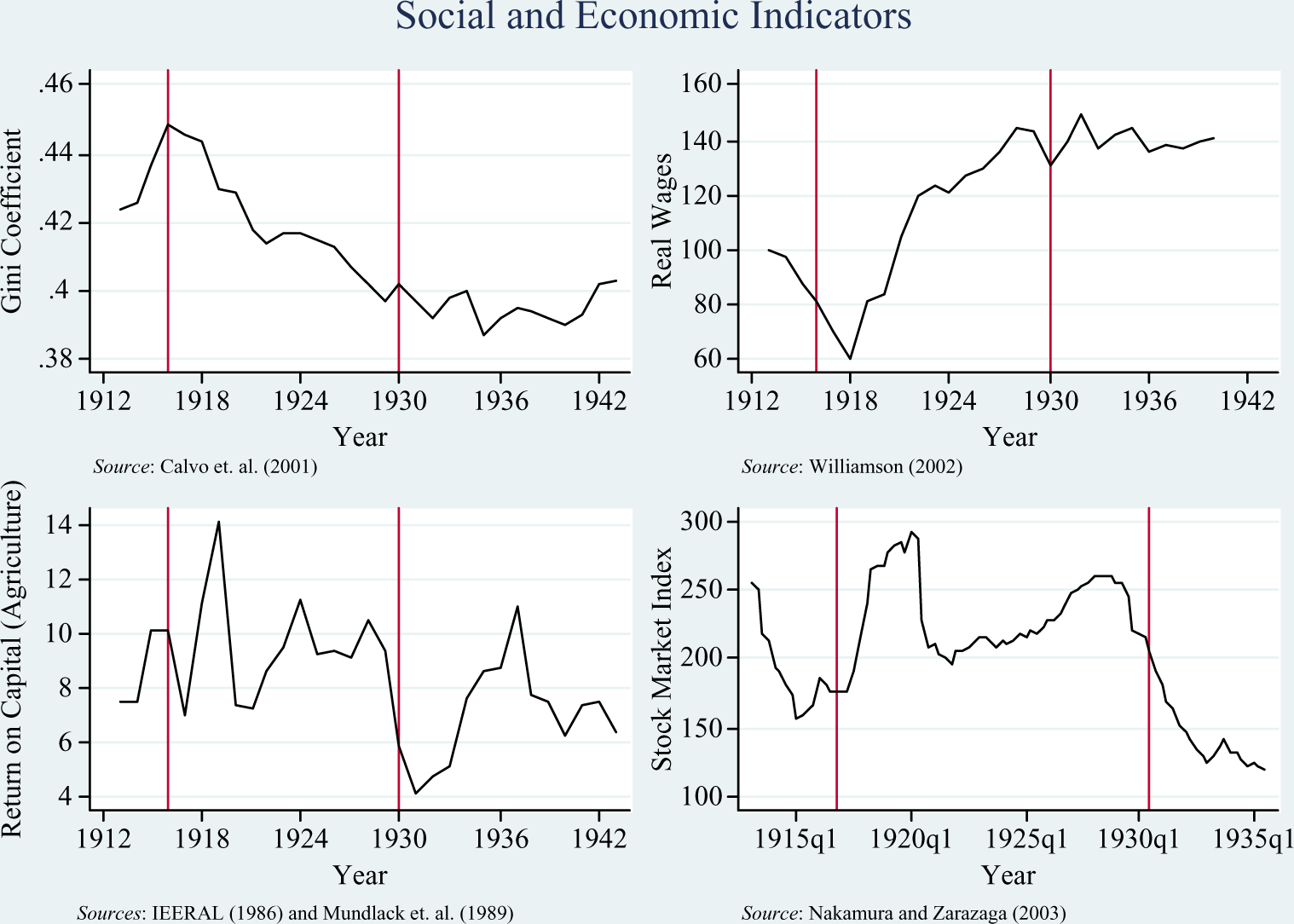
Social and economic indicators, Argentina (1913–1943).
Another way to scrutinize Acemoglu and Robinson’s claim that the restoration of conservative rule would entail a reversal in the fortunes of the less well-off is to examine the evolution of real wages throughout the 1913–1943 period. As the top right panel of Figure 1 indicates, real wages increased during the Radical administrations of Yrigoyen and Alvear. Yet, no significant reversal occurred in the years following the 1930 coup.
Acemoglu and Robinson (2006) discuss yet another possible test of their argument. In their words, ‘… to the extent that democracy leads to redistribution and taxation of the assets of the rich (land and capital), we would expect the prices of these assets to fall with democracy and rise after a coup …’ (p. 72). They illustrate this proposition with data from Chile’s stock market. To assess whether this implication squares with the Argentine data, the bottom right panel of Figure 1 shows the values of the stock market index for the period 1913 to 1935. 6 Contrary to the expectations of Acemoglu and Robinson (2006), democratization in 1916 did not bring about a fall in the stock market, and dictatorship did not provide relief (at least for the five years following the coup). In fact, the period encompassing the Radical presidencies shows market gains even in the face of external shocks. Noticeably, in 1930 the stock market was still above its level in the first half of the decade.
It could be argued, though, that the stock market is not a very good indicator of the wealth and prosperity of the elite in the 1920s. As Rocchi (2005) notes, few companies were represented and it was seldom the source of capitalization for industrial firms. More importantly, the Argentine upper class was primarily agrarian. The remaining panel in Figure 1 shows the rate of return to capital in the agricultural sector. Once again, it is quite clear that agriculture was as profitable before and after the Radical administrations of Yrigoyen and Alvear. If anything, the data suggest that effects of the Great Depression rather than particular policies adopted in Argentina affected the rate of return associated with agricultural production.
In sum, the empirical evidence does not support the view that, after 1916, the rich were assaulted by redistributive demands from a democratic government catering to the newly enfranchised poor. The evidence is also inconsistent with the notion that Radical presidents implemented drastic economic policies to the detriment of the economic elites. While inequality decreased and wages increased for the poor, the wealthy also enjoyed the benefits of economic growth, which was substantial during the time period 1916–1930.
In fact, as Solberg (1973) notes, landed interests held powerful influence in the Radical party and within the Yrigoyen government. After all, the president himself was a landowner, and several cabinet ministers were members of the Sociedad Rural, the aristocratic cattleman’s association. Yet, there were significant social divisions between the prior rulers and the newly elected politicians. Many legislators of the Radical Party were working class or lower middle class professional politicians who were often referred to as rabble or chusma by the elite. The conservatives certainly distrusted this new class of politicians, and vice versa; but the problem was political and not the presumed economic squeezing of the elite by the Radicals.
The political polarization perspective
The argument linking political polarization to democratic breakdown is based on the premise that stable democracy requires that all major groups, including the previous elites, have a sufficiently large chance of being in power (Przeworski, 1991). Hence, political institutions must limit the ability of those in power to subvert the system to prevent those in the opposition from winning the next election (Weingast, 1997). The seminal contributions by Dahl (1971) and Linz (1978) provide additional insight on the relationship between legitimacy and democratic consolidation.
Dahl (1971) argues that democracy requires both legitimacy of public contestation as well as legitimacy of public participation. The first demands a belief in fair competition between opposing organizations and toleration of the opposition, while the second requires a commitment to inclusive electoral participation. It is possible to commit to one and not the other, and the rejection of either one by relevant political actors harms democratic consolidation. In Linz’s view, legitimacy – the popular and elitist belief in the right of those in power to rule – constrains a regime in terms of their ability to activate supporters in the face of threats. As such, those governing new democracies are more vulnerable if, after having achieved power through elections, no basic consensus emerges on their constitutional right to rule.
Weingast (1997) links social values to the incentives of political actors to obey constitutional restrictions. From this perspective, democratic stability emerges when citizens and elites construct a focal solution that resolves their coordination dilemmas about the appropriate limits on the state. This focal solution leads to mass behaviours that create a consensus on certain democratic values. Absent a basic consensus about the appropriate limits on public officials, incumbents may have the opportunity to use state resources to perpetuate themselves in power and exclude the opposition.
This set of propositions regarding democratic stability provides a different framework to understand the events leading to Argentina’s democratic breakdown in 1930. As Dahl (1971), Smith (1978) and Potter (1979) argue, socio-economic factors did not drive the coup. Instead, the government’s weakness stemmed mainly from its eroding legitimacy. Prior to the 1912 electoral reform, the conservatives disregarded constitutional and electoral laws for decades. In doing so, they failed to promote a belief in the legitimacy of democratic institutions, particularly the notion that elections were the rightful way of displacing political leaders (Dahl, 1971: 136). And, after the transition, Radicals would not do much better in fostering a belief in democratic institutions: Yrigoyen and his followers did show a commitment to electoral inclusion, but their commitment to the legitimacy of contestation eventually faltered.
Yrigoyenistas accumulated power and challenged institutional rules, fostering their hegemonic position while significantly raising the stakes of political competition. Leveraging on his electoral dominance, Yrigoyen used his authority to exclude the political opposition and take away their remaining bases of power. The practice of federal intervention is a case in point. 7 A total of 20 federal interventions (15 by decree) took place during Yrigoyen’s first term in office. The immediate goal of these interventions was to create ‘… local carpet-bagger regimes subservient to the president, which would be in a position to control elections to the National Senate…’ (Rock, 1975: 114 f.). During Alvear’s administration, Yrigoyen’s supporters started to define themselves publicly as personalistas, highlighting their allegiance to the caudillo. And, after his return to the presidency, the confrontations between Yrigoyen and his opponents exacerbated.
By centralizing power in the presidency and marginalizing all other arenas in which Conservatives were present, Yrigoyen and his followers made the presidency the only viable prize of Argentine politics (Gibson, 1996). Over time, the distinction between the ‘ins’ and ‘outs’ became fixed because, as Remmer notes, ‘…no party other than the [Radicals] stood any real chance of controlling the national government’ (1984: 94). While there was some possibility in 1916 that the newly elected Radical government could work in harmony with the old-line Conservatives on matters of mutual interest, the possibility of cooperation ceased after the Conservatives saw their provincial bases of power systematically attacked and destroyed (Potter, 1979). 8
To sum up, electoral hegemony and few limits on government officials raised the stake of politics. The political bargain that led to the 1912 reform was supposed to bind Conservatives and Radicals to support both inclusion and competition in democratic politics. After achieving electoral dominance, however, the Yrigoyenistas used their governmental authority to exclude the political opposition and take away their remaining bases of power. These actions escalated the confrontation between the government and the opposition, heightening political polarization and weakening whatever original commitment the elites had to inclusive democratic politics. As, Dahl (1971), Smith (1978) and Potter (1979) argue, by the second presidency of Yrigoyen a legitimacy crisis had weakened support for the nascent democracy.
The polarizing realignment in congress
The Argentine Congress played a significant role during this early democratic experiment. It was a key arena for the articulation of policy alternatives and a stepping stone for politicians who went on to make executive decisions. It was also the main institution incorporating the relevant political groups that competed for governmental power (Smith, 1974a: xix). As such, it constitutes an ideal setting for further examining the view that the 1930 coup was the product of a polarizing political realignment that led to a crisis of legitimacy (Miller and Schofield, 2003; Schofield, 2008).
We focus on two propositions derived from the previous discussion. First, we do not expect the main dimension of political conflict in the Argentine Congress to reflect socio-economic (left-to-right) divisions, as the redistributive threat perspective implies. Instead, we expect the main dimension of conflict during this period to capture the divisive impact of Yrigoyen, which is consistent with the political polarization perspective. Second, we expect to find evidence of a polarizing realignment of congressional forces, centred on the legitimacy of contestation issue, rather than socio-economic disputes.
In addition, as argued above, the failure of consensual democratic politics built progressively as opportunism eroded the political bargain of 1912. This implies that, at the onset, the new Yrigoyenista versus anti-Yrigoyenista dimension should have coexisted with a substantive policy dimension, allowing for some cross-cutting consensus on relevant policy issues. The escalation of conflict between Yrigoyenistas and the opposition occurred from the mid-1920s onwards, leading to a further repositioning of partisan actors. This change implies the disappearance of cross-cutting tendencies and the establishment of a pattern of political conflict in which the major dimension is coterminous with the Yrigoyenista–Anti-Yrigoyenista schism.
Dimensions of conflict in the Argentine Chamber of Deputies (1916–1930)
In this section, we use roll-call data to examine the dimensionality of the policy space, the alignment of parties and the positions of individual legislators in key votes. This analysis allows us to make inferences about political conflict during this volatile era.
Data and estimation
Two different types of roll-call votes exist in Argentina. Votes of the first type are used to elect the assembly’s authorities. The other kind involves substantive as well as procedural issues. Our analysis employs roll-call votes on substantive/procedural issues taken in the Argentine Chamber of Deputies between 19 May 1916 and 27 December 1929. These data represent seven two-year legislative periods, corresponding to the biennial partial renovations of the Chamber (1916–1917, 1918–1919, 1920–1921, 1922–1923, 1924–1925, 1926–1927, 1928–1929). 9 All roll-call vote data and delegation affiliation were obtained from Smith (1974b).
The initial sample included 378 substantive/procedural roll-call votes held between 1916 and 1929. In order to avoid convergence problems stemming from unanimous votes, we excluded all lopsided votes in which fewer than 0.5 percent of the deputies were on the losing side. After discarding these votes, the resulting sample contains 368 votes (97 percent of the roll-call data included in the original sample). To recover reliable estimates of legislators’ ideal points, it is necessary to exclude legislators who cast ballots on a small number of votes. Following standard practice, we excluded from the analysis those legislators who cast fewer than 10 votes in a legislative session. This resulted in a reduction in the number of scaled legislators from 1042 to 963 (by roughly 7.5 percent of the legislators in the original sample).
Table 1 provides details on the composition of our roll-call vote data. Two points are of principal note. First, the number of valid roll-call votes varies across the different periods of analysis from lows in the 30s to highs of more than 60. Second, the number of participant legislators also varies, including a minimum of 82 percent in the 1918–1919 session and a maximum of 97 percent in the following two-year period. Overall, roughly 7,396 individual voting decisions in each of the seven two-year legislative periods are modelled.
Roll-call votes in Argentina, 1916–1929.
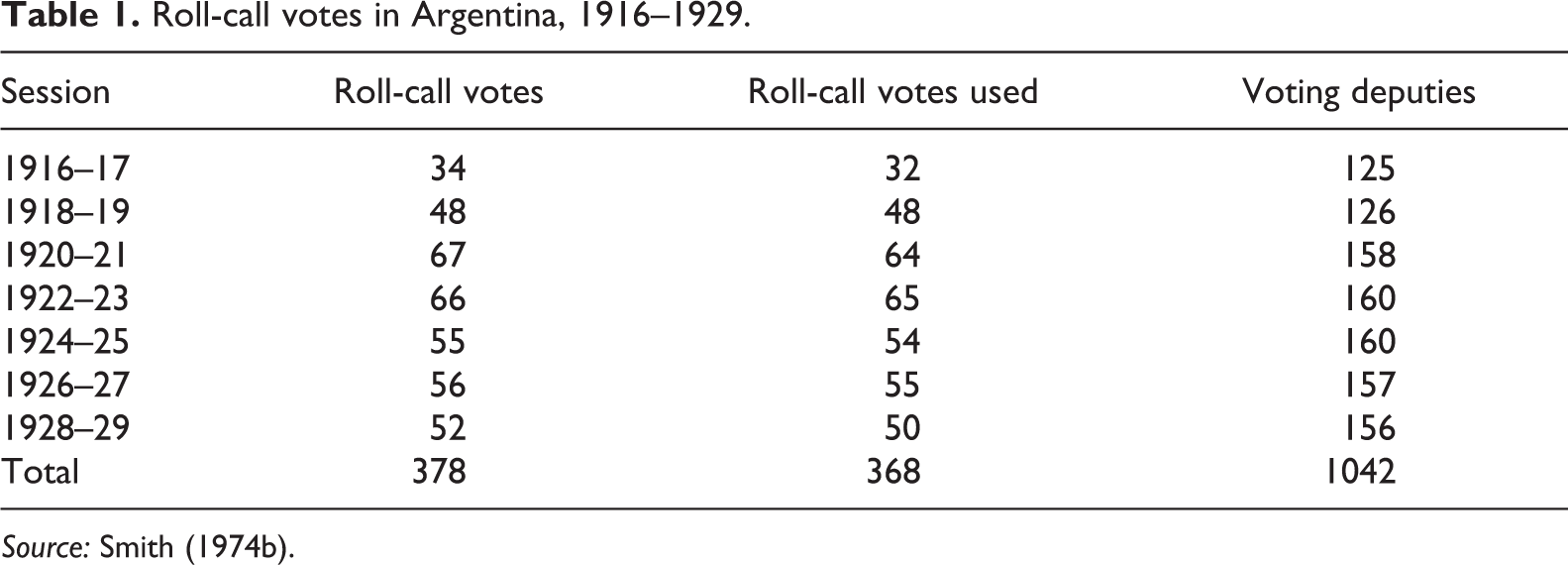
Source: Smith (1974b).
We analyse the roll-call data using Optimal Classification (OC), a scaling procedure that performs non-parametric unfolding of binary choice data (Poole, 2005). Given a matrix of binary choices by individuals (for example, ‘aye’ or ‘nay’) over a series of legislative votes, OC produces a configuration of legislators and cutting lines/planes that maximize the correct classification of the choices. The main advantage of using this method is that no assumptions are made about the parametric form of the legislators’ ‘true’ preference functions other than that they are symmetric and single-peaked (Poole, 2005; Rosenthal and Voeten, 2004).
The unfolding solution to the roll-call voting problem provided by OC is characterized by two sets of parameters. The first is the set of legislators’ ideal points. Second, for each roll-call there is an associated separating line
Main findings
Our estimates indicate that the ideological location of Argentina’s main political actors between 1916 and 1930 can be accurately represented by a low-dimensional space. The addition of a second dimension improves the fit of the models at the beginning of the period under study. After 1926, however, a one-dimensional model classifies almost as well as a two-dimensional one. As such, these findings can be considered as evidence of realignment and issue change. We address this change in more detail below, where we examine the substantive content of the space.
Did Argentine legislators predominantly align themselves along a traditional left–right dimension; or did they stand apart along a legitimacy of contestation divide? In order to answer these questions, we graphically explore legislators’ locations throughout the period 1916–1930. We further examine the issue by focusing on a number of key votes that were taken in the Chamber of Deputies. These votes can be clearly classified as pertaining to each of the dimensions under scrutiny (i.e. the allocation of authority or the policy dimension), thus facilitating the task of interpreting the underlying recovered dimensions.
Figure 2 presents a spatial map from our OC scaling of the 1916–1917 session of the Argentine Chamber of Deputies. The R tokens represent the Radicals; the C tokens are the Conservatives; the P tokens are the Progressive Democrats; and the S tokens are the Socialists. The horizontal axis appears to capture the division between the government and the opposition. The Radicals (in control of the presidency) are positioned to the left, whereas the members of all the other opposition parties are placed to the right. The fact that both the Conservatives and the Socialists, two parties with radically different worldviews, are located on the same side of the axis is a good indication that this dimension should not be interpreted as an ideological left-to-right divide but rather as a government vs. opposition divide.
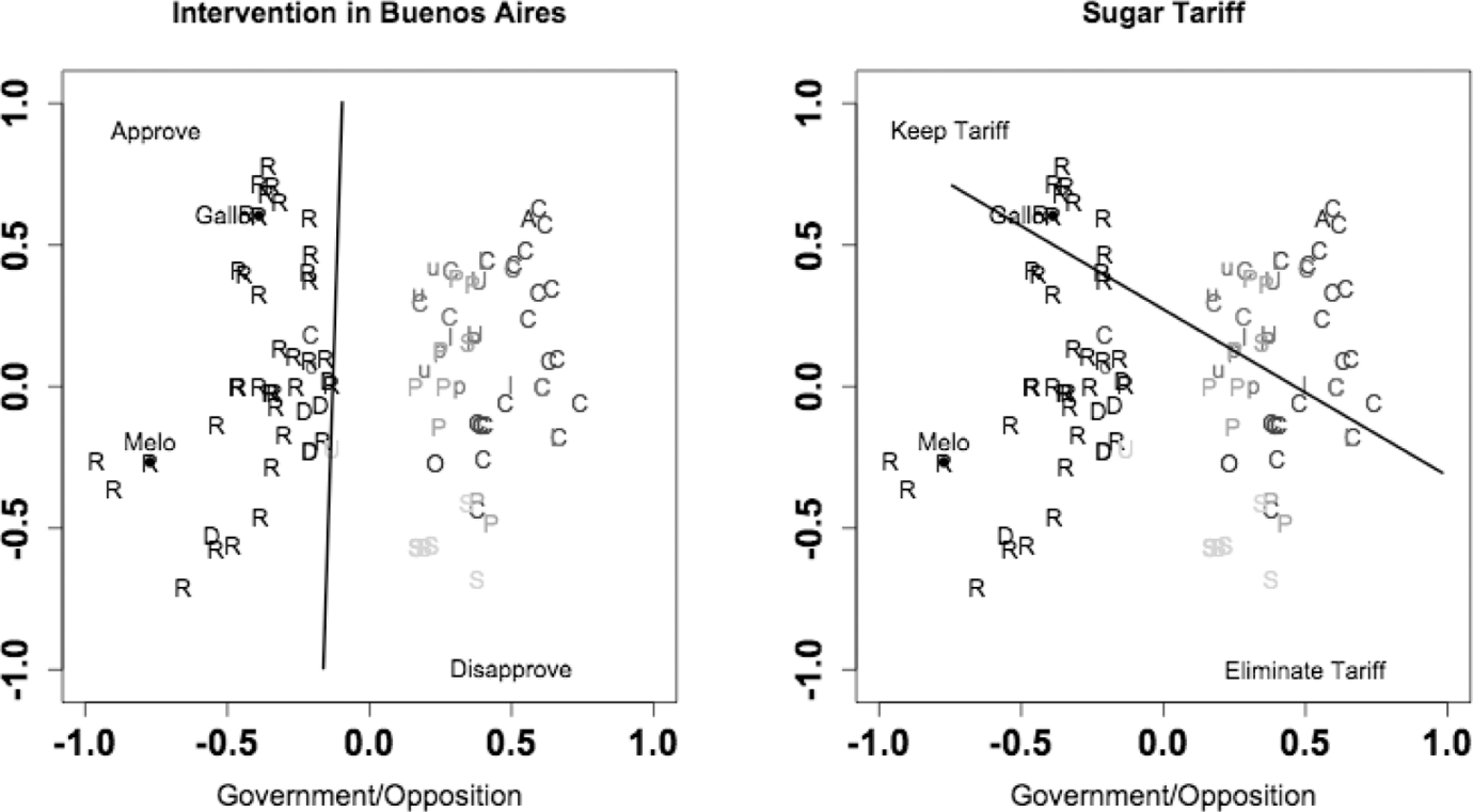
Legislator’s ideal points during Yirigoyen’s first term 1916–1917 session.
The policy differences between the Socialists and the Conservatives become apparent when we focus on the vertical axis of our spatial map. As Figure 2 shows, Socialist legislators are located at the bottom of the axis, while the Conservatives tend to be placed at the top. In the case of the members of the Radical party, distinctions along this particular dimension also clearly exist. It seems, however, that most Radicals are located in the middle of the axis denoting a somewhat moderate position. Given legislators’ placements along this axis, it is safe to assume that the second dimension is picking up differences that are distinctive from the government–opposition divide. This evidence also indicates that, in order to obtain a good description of the structure of conflict in the Argentine legislature, a second dimension is needed. 11
A key question, then, concerns the substantive interpretation of this second dimension. One hint regarding its possible content is given by the disparate location of the Socialists and Conservatives. Yet, to further analyse the nature of the division captured by this second dimension it is useful to focus on some key votes that were taken in the 1916–1917 session of the Argentine Chamber of Deputies. In particular, given the arguments presented above, it would be necessary to identify whether the partisan divisions depicted in Figure 2 actually respond to the ‘legitimacy of contestation’ (i.e. allocation of authority) and/or the ‘redistributive struggle’ (policy) issues.
To identify institutional versus policy divisions, we selected votes that explicitly required Argentine deputies to take a position in each of these dimensions. For example, on the left panel of Figure 2 we examine a critical vote regarding the 1917 federal intervention of the province of Buenos Aires. Radicals claimed that the intervention was necessary to prevent Conservatives from continuing to use electoral fraud, but, as discussed above, Yrigoyen often used federal interventions to destroy the provincial bases of Conservative political power. 12 Hence, legislators’ votes on this particular issue should reflect their positions regarding the appropriate limits of presidential authority. The right panel of Figure 2 presents a vote regarding tariffs for sugar imports. This is the kind of issue that is typically associated with a conflict of interest between urban consumers and rural producers. The first group favoured low (or no) tariffs on imported sugar in order to lower its price, while local producers, which were predominantly concentrated in the province of Tucuman, sought to keep high tariffs on imported sugar to protect their industry.
To illustrate how votes on issues that tap the two dimensions under consideration produce different voting coalitions, we present on both panels of Figure 2 the cutting line associated with each particular vote. This line (indicated in black in both graphs) is the perpendicular bisector of the line joining two alternatives, and separates the Yea and Nay voters (Poole and Rosenthal, 1997). In both panels, we superimpose the cutting line on a given vote on the spatial map of the legislative session (obtained using all the roll-call votes taken in that session). Hence, while the location of the legislators does not vary in the underlying spatial map, it is possible to ascertain how their overall position compares with the divide created by the issue under consideration.
As mentioned above, the left panel of Figure 2 shows the positions of individual deputies in both dimensions and the cutting line associated with a vote on a ‘legitimacy of contestation’ issue. Buenos Aires, the most important Argentine province, was Yrigoyen’s first target for intervention. On 24 April 1917, a week before Congress was to convene for its regular sessions, Yrigoyen declared the federal intervention of the province (Walter, 1985: 44). The sitting governor, Conservative Marcelino Ugarte, agreed to leave office but pledged to fight the intervention on the floors of the national Congress. Following a series of debates that occurred during May–June 1917, the Chamber of Deputies voted to repeal the intervention.
The bill denouncing the intervention was opposed by all 36 Radicals and supported by a coalition of Conservatives, Progressive Democrats and Socialists. The decision made by the Chamber of Deputies is illustrated in Figure 2: the Yea voters are located to the right of the cutting line and Nay voters to the left. In the end, Yrigoyen ignored the resolution and persisted with the intervention; hence, the vote only seemed to have had symbolic importance. Later events would show that the intervention permitted the Radicals to lay the foundations for their own 12-year domination of Buenos Aires (Walter, 1985).
Moving onto the second dimension, the right panel of Figure 2 displays the cutting line separating the Yea and Nay voters on the sugar tariff vote that took place on 2 August 1917. Facing a rise in the domestic price of sugar, the Yrigoyen administration sought to modify law 8877 to lower its import tariff. Consumers were poorly organized, and thus few interest groups actively opposed protectionism. Still, urban masses remained restless about the high cost of living and they possessed an effective political ally in Argentina’s Socialist Party, a staunch defender of free trade.
With the support of the Socialists, the government sent to Congress a proposal to eliminate import tariffs on sugar if the domestic price of sugar exceeded a certain price. A particularly contentious issue was the determination of the exact price that would trigger the tariff elimination. Article 1 of the bill establishing the product retail’s price at 0.40 pesos moneda nacional per kilo passed with 41 votes in favour and 30 against. It received the support of all the Socialists and a few Conservatives and Progressive Democrats; but, unlike Buenos Aires’ intervention, the Radical party cast a split vote. Among those who supported the proposal were some of Yrigoyen’s strongest supporters (for example, Carlos F. Melo and Celestino Marco). Nonetheless, some prominent members of the party, such as Vicente C. Gallo, challenged Yirigoyen’s orders and voted with most of the Conservatives against the bill.
Moving onto the next legislative period, Figure 3 depicts a spatial map of the 1918–1919 session. As before, the horizontal axis reflects a clear divide between the governing Radicals and legislators of all the other parties. In terms of the second dimension, the Conservatives and most Radicals can be found on top, whereas all Socialists and a few Radicals are located on the lower part of the graph.
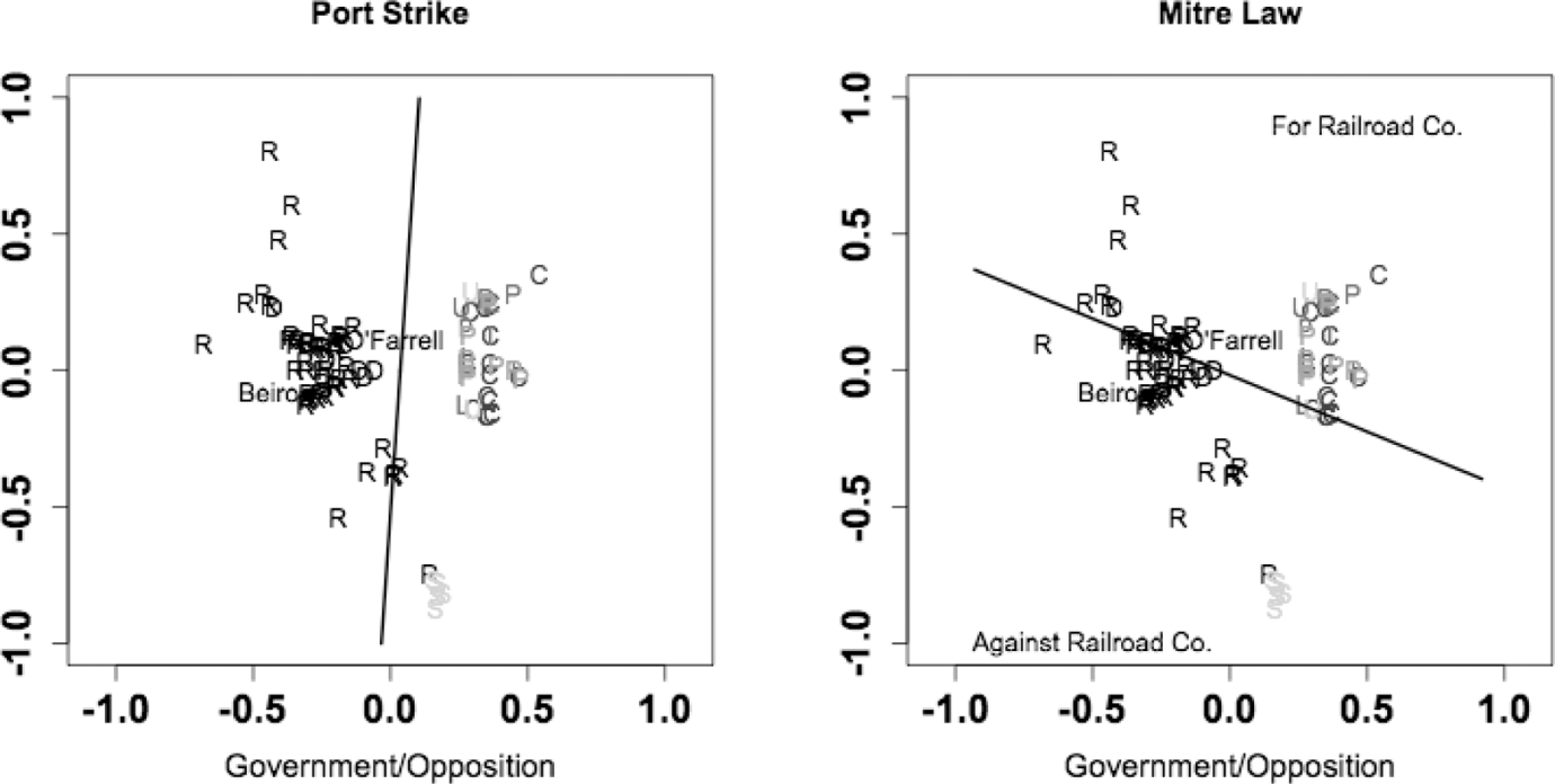
Legislator’s ideal points during Yirigoyen’s first term 1918–1919 session.
Regarding the interpretation of these dimensions, we focus as before on the issues under scrutiny. The left panel of Figure 3 shows the cutting line of a vote on a ‘legitimacy of contestation’ issue. The proposal under consideration called for a condemnation of Yrigoyen’s action in a labour dispute that took place on 20 March 1919 in the port of Buenos Aires. The vote came at the heels of the event known as the ‘Tragic Week’ (la Semana Trágica), when more than 100 protesters died after a general strike was quashed with machine guns by the army and by employers’ vigilante groups. These confrontations dealt a severe blow to Yrigoyen’s labour policies.
In the aftermath of the Semana Trágica, the government attempted to recover its position among the working class (Horowitz, 2008). The first opportunity came during the negotiations to resolve the strike in the maritime shipping industry. On 24 January, the government helped to arrange an agreement between the unions and the shipowners. The latter offered an increase in wages in return for the workers’ organizations abandoning the use of boycotts. To associate the government with a union victory, the minister of Marine insisted that the clause restricting the use of boycotts be kept secret (Rock, 1975). However, the ploy failed as the shipowners eventually decided not only to reject the agreement, but also to make it public.
As the March legislative elections approached, the Conservative members of Congress seized the opportunity to discredit the government. In the words of Matías Sánchez Sorondo, a leading Conservative deputy, the ordeal was evidence of ‘… culpable inaction and even complicity on the part of the executive with the labor agitators….’ 13 Hence, as Rock (1975) notes, the shipping dispute should be considered a legitimacy of contestation conflict, as it stemmed from the political rivalries between Yrigoyen and his opponents. As depicted in Figure 3, the proposal was opposed by most Radicals (located to the left of the cutting line) and supported by Conservatives, Progressive Democrats and Socialists (located to the right of the cutting line).
In contrast, the vote that took place on 13 August 1919 reflects policy differences rather than political contestation. This time the bill under consideration called for a revision of the tax exemptions granted to the railroad companies. Facing decreased commerce (due to World War I) and increased costs of operation, British-owned railways had demanded favourable concessions from the government. In so doing, the companies became involved in a prolonged conflict with the Yrigoyen administration (Wright, 1974). The controversy centred on the ambiguity of the law regulating the railroad industry (known as the Mitre Law). 14 According to the companies’ interpretation of the law, their low profits entitled them to raise their rates without government permission.
Yrigoyen did not react to this issue on purely commercial grounds; instead, he assumed a popular anti-foreign stance (Wright, 1974). However, his plan to carry out a sustained drive against the foreign-owned railways did not succeed. His failure, as Wright (1967) notes, can be attributed, in part, to the heterogeneous nature of the Radical party itself. As the cutting line presented in the right panel of Figure 3 indicates, the vote created a split within the Radical party. Many UCR legislators took Yrigoyen’s position, which was hostile to the railway companies’ interests. This group of loyalists (located below the cutting line) included the likes of Francisco Beiro, one of Yrigoyen’s closest collaborators (Rock, 1975). However, many other Radicals – those located above the cutting line in the right panel of Figure 3 – broke ranks and joined the opposition. Juan Adrián O’Farrell, a Radical who supported the position of the railway companies, is a case in point. O’Farrell was a long-standing member of the Radical Party. Yet, he also had a personal connection with the railway companies. His eldest brother, Santiago G. O’Farrell, was the chairman of the local board of directors of the Buenos Aires–Pacific Railway.
Overall, Figures 3 and 4 present similar patterns in legislators’ positions during the periods 1916–1917 and 1918–1919. The first dimension accurately captures the government–opposition division. On one side of the dimension are the Radical deputies and on the other all the members of the opposition, from Socialists to Progressive Democrats to Conservatives. The four votes examined in more detail suggest that the first dimension coexisted with a second ‘policy’ dimension. The votes on sugar tariffs and on tax exemptions to foreign railways’ companies suggest that the second dimension represents, at least partially, divisions over the administration’s economic policies.

Legislator’s ideal points during Alvear’s term 1922–1923 session.
The transformation of the government–opposition dimension into the more personalistic schism between Yrigoyenistas and anti-Yrigoyenistas began with the Presidential inauguration of Marcelo T. de Alvear. Figure 4 shows a spatial map of the 1922–1923 session of the Argentine Chamber of Deputies. The map looks similar to those of the previous sessions: the horizontal axis capturing the government versus opposition divide, and the vertical axis the policy dimension. The analysis of the substantive dimensions of conflict, however, reveals some important differences. Specifically, while ‘legitimacy of contestation’ issues generated a clear-cut division between the Radicals and the opposition in previous legislatures, this pattern of conflict mutated under the Alvear presidency.
The left panel of Figure 4 shows the cutting line associated with a key vote regarding the approval of the elections in the province of San Juan. 15 The controversial 1923 election of Federico Cantoni, a Radical of the Bloquista faction to the governorship of San Juan exposed the rifts within the UCR. At the time of his election, Cantoni was facing the possibility of serving a lifetime prison sentence for presumably masterminding the assassination of Amable Jones, a personal friend of Yrigoyen and then governor of San Juan. Despite the animosities between the two opposing Radical factions, President Alvear recognized Cantoni as the legal governor of the province. Hard-core Yrigoyenistas in Congress, reluctant to forgive the Jones incident, dissented with the president. As the left panel of Figure 4 demonstrates, when certification of the San Juan elections was brought to a vote on the floor of the Chamber of Deputies, many Radical legislators opposed it (these are the legislators located to the left of the cutting line). This reflected Yrigoyen’s position, but not that of president Alvear. Yet, the schism between the Radicals was still in its early stages. As the left panel of Figure 4 indicates, many Radicals (including moderates such as Horacio Oyhanarte, who was a close associate of Yrigoyen) joined the members of the opposition and followed Alvear’s lead (these legislators are located to the right of the cutting line).
The right panel of Figure 4 displays the cutting line on a vote regarding import tariffs, which was held on 8 November 1923. Alvear had started to assert his independence by ending the politically inspired provincial interventions that characterized Yrigoyen’s presidency. He had also resolved to establish his own basis of support among the urban population, and to that end sought massive tariff reductions (Solberg, 1973). The extent of Alvear’s policy switch was crystallized when the Chamber of Deputies met to consider the tariff legislation. A coalition of Progressive Democrats and Socialists together with some Radicals opposed a 60 percent general increase in import duties proposed by the Conservative-dominated Senate. However, given the constitutional rules in place, they needed a two-thirds majority in order to override the Senate. The strongest supporter of higher tariffs was Argentina’s most powerful interest group: the Sociedad Rural. The Sociedad Rural, composed of large landowners and dominated by cattle fatteners, had actively embraced industries that used cattle by-products (Solberg, 1973). Radical deputies were deeply divided over the tariff issue. In the end, most legislators from urban areas, like the Federal Capital, voted for repealing the tariff increase (located below the cutting line in the graph), while representatives from the interior of the country, as well as every Conservative, voted to keep the amendment in place (located above the cutting line in the graph). Hence, despite the administration’s opposition to higher tariffs, the protectionists won the day.
The analysis of roll-call votes during President Alvear’s administration suggests that the first dimension of conflict had turned into an Yrigoyenista vs. anti-Yrigoyenista divide, despite the fact that the Radical caudillo was no longer in the executive office. As before, the second dimension appears to capture policy differences, such as the conflict between consumers and producers over tariffs. There were undoubtedly some traces of Yrigoyenistas in the protectionist camp (as witnessed by Oyhanarte’s vote). But the Radical party did not behave as a monolithic entity beholden to Yrigoyen’s wishes.
The two-dimensional structure that characterized the early years of the Alvear administration was short lived. During his last two years in office, the second policy dimension would collapse and be absorbed by the main Yrigoyenista vs. anti-Yrigoyenista dimension.
Figure 5 shows the pivotal 1926–1927 legislature. The horizontal axis still captures differences between the Radicals and the opposition parties. The locations of a significant number of members of the former group, however, tend to overlap with those of the opposition. Regarding the second dimension, the ‘spread’ of the Radicals’ locations along the vertical axis is much more compressed. Something similar can be observed among the Conservatives. The only group that stands apart from both Radicals and Conservatives in the second dimension is the one comprised by the Socialists and Progressive Democrats. This pattern stands in contrast to the previous three sessions examined above and suggests that the second dimension is less relevant to the structure of conflict in the Argentine legislature after 1925.
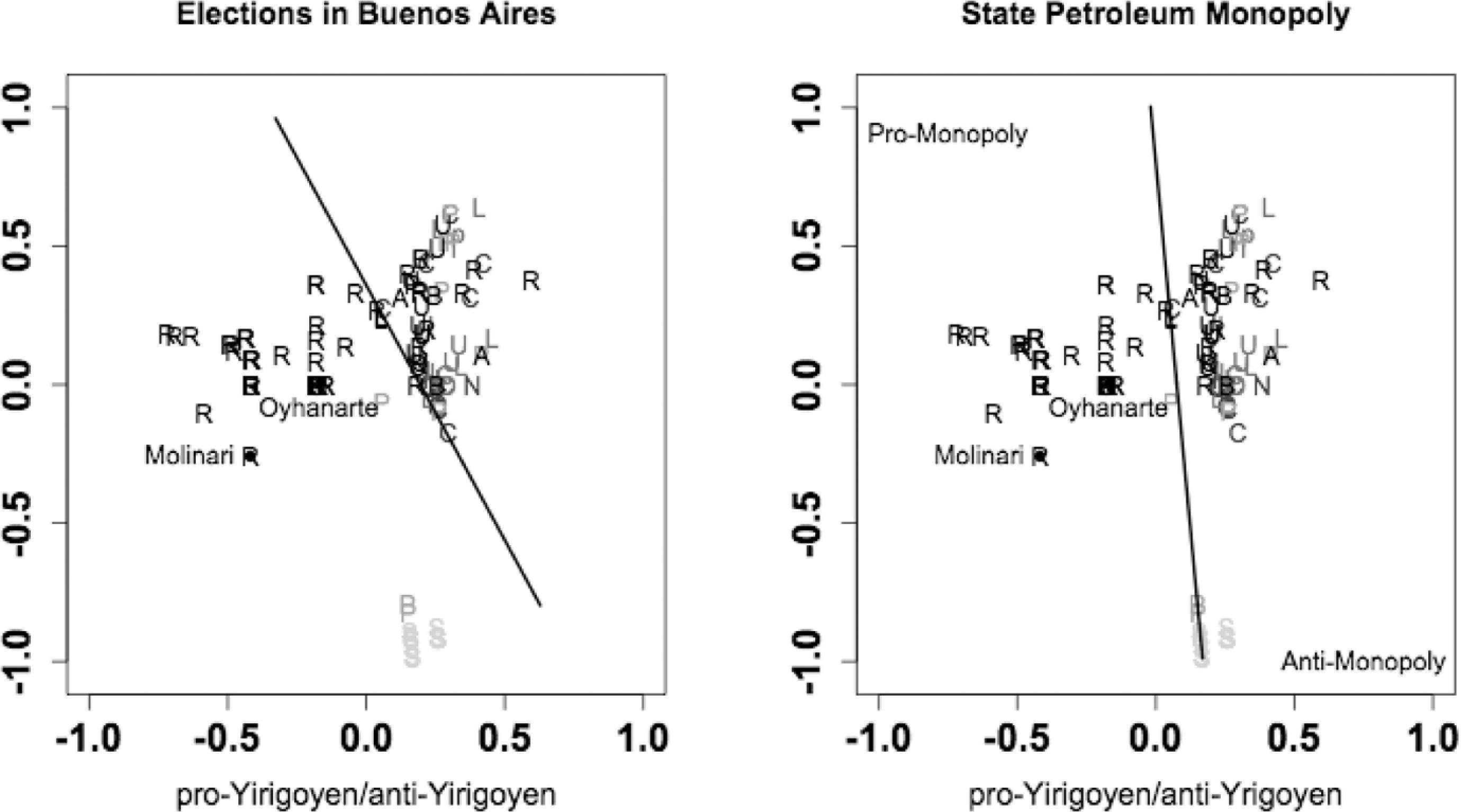
Legislator’s ideal points during Alvear’s term 1926–1927 session.
The left panel of Figure 5 depicts the cutting line dividing the Yea and Nay votes in the 14 June vote seeking to certify the 1926 elections in the province of Buenos Aires. Throughout the 1920s, this province was the main battleground in the fight between the two Radical factions: Yrigoyen’s personalistas and the anti-personalistas. 16 The Yea voters are located to the left of the cutting line and Nay voters to the right. The bill passed with 68 votes in favour and 44 against, with Yrigoyenistas, Socialists and Progressive Democrats supporting the bill; and the so-called contubernio, an anti-Yrigoyen alliance of Conservatives and anti-personalist Radicals, voting against it.
A crucial showdown between the Yrigoyen and his opponents occurred during the congressional debates on oil policy that took place in 1927. President Alvear’s plan, which essentially gave private investors the right to participate in the oil industry, enjoyed support among the anti-personalistas Radicals, some Socialist deputies and Conservatives from the littoral provinces. Yrigoyen, in contrast, instructed his followers to formulate an alternative plan that would nationalize the petroleum industry and create a state monopoly (Solberg, 1979).
The right panel of Figure 5 presents the cutting line associated with the critical vote regarding the nationalization of the oil industry. Legislators voted 65 to 55 in favour of the bill (those voting Yea are located to the left of the cutting line and those voting Nay to its right). 17 The vote closely corresponded with the Yrigoyenista vs. anti-Yrigoyenista alignment. The followers of the Radical leader voted heavily in favour of the proposal, while the anti-personalista Radicals, Conservatives and Progressive Democrats voted just as strongly against it. Socialist deputies were divided over the issue. A schism, resulting primarily from personal disputes among the leadership, had led to the formation of two Socialist parties in August of 1927. The newly created Independent Socialist Party (PSI) supplied the Yrigoyenistas the winning margin in this crucial vote.
The analysis of these two key votes reveals the extent to which the Yrigoyenista/anti-Yrigoyenista divide came to dominate the political landscape. The realignment appeared to be sealed after the passage of the petroleum legislation in the lower chamber. The support for petroleum nationalization emerged as the most important single issue in Yrigoyen’s successful 1928 re-election bid. A crucial question, though, is whether this vote reflects divisions along the socio-economic dimension rather than along the Yrigoyenista/anti-Yrigoyenista divide. While it is tempting to conclude that the vote to nationalize the oil industry reflected well-defined ideological poles (a left-wing one a right-wing one), the historical record does not support this view. As Solberg (1979) notes, Yrigoyen did not conceive the nationalization of the oil industry as part of a larger developmentalist scheme but rather as an opportunity to expand patronage and government control. He presented himself to the electorate as a champion of patriotism and relied on anti-imperialist and populist rhetoric to rally the electorate behind his petroleum plan (Solberg, 1979). This strategy of framing the election as a contest between ‘us’ versus ‘them’ further polarized Argentine politics.
The 1928 presidential election was mostly a competition between two factions of the Radical party (which hardly represented a pro-redistribution versus anti-redistribution divide). Indeed, the ‘fraternal’ nature of the dispute resulted in a very peculiar composition of the legislature following the 1928 electoral contest. Figure 6 shows the spatial configuration of the 1928–1929 session of the Argentine Chamber of Deputies. By then, the conflict was so intense that the two-dimensional structure of legislative voting disappeared: the APRE for the one-dimensional model is 0.995 and no gap between the APRE for the one- and two-dimensional models exists. Thus, it is appropriate to represent legislators’ positions during this session as one-dimensional: the coordinates indicate legislators’ ranking (horizontal axis) and their ideal points (vertical axis).
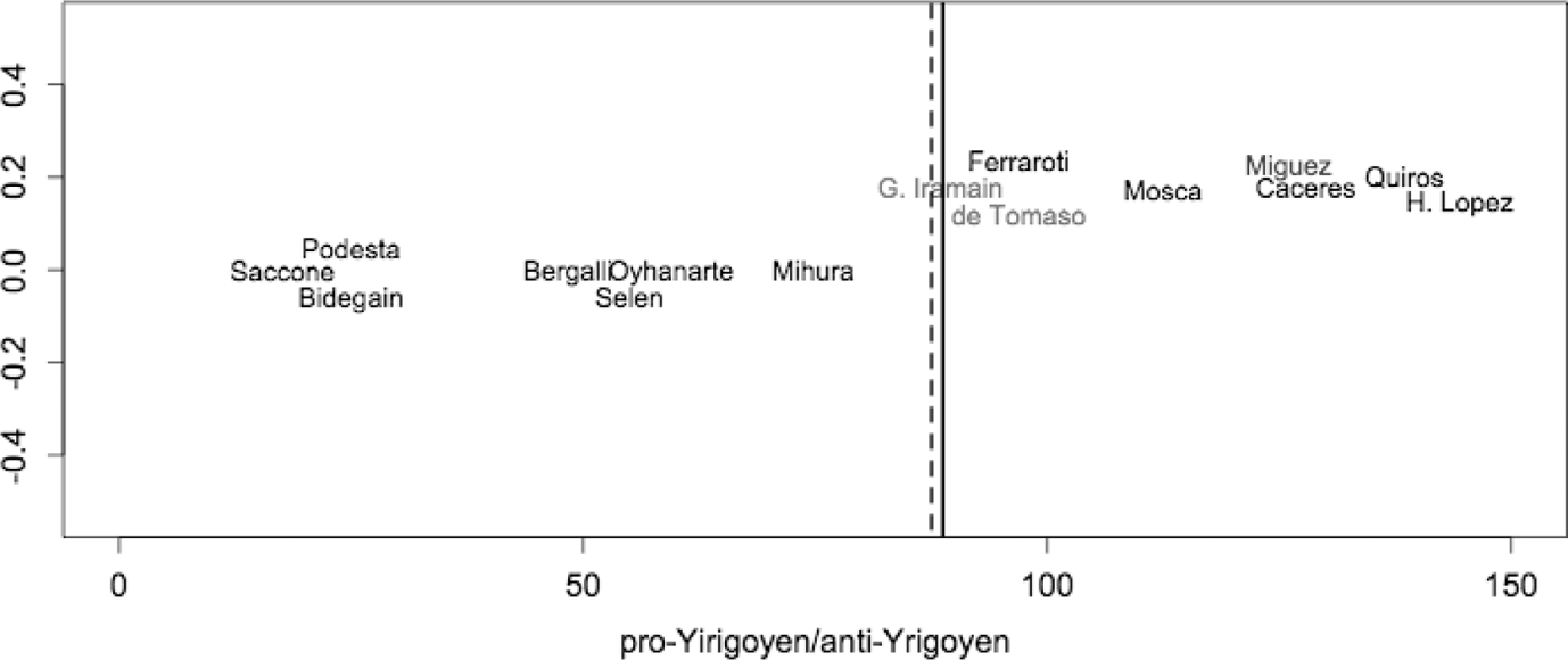
Legislator’s ideal points during Yirigoyen’s second term 1928–1929 session.
The locations of several prominent Yrigoyenista and anti-Yrigoyenista members of the Chamber are presented in Figure 6. The former included party officials and ward bosses, such as David Saccone, Pedro Podesta, Pedro Bidegain, Hector Bergalli and Nicolas Selen. The anti-Yrigoyenistas comprised disgruntled radicals, including Juan Luis Ferraroti, Enrique Mosca, Manuel C. Cáceres, as well as Conservative deputy Edgardo Miguez, and independent Socialists Héctor González Iramain and Antonio de Tomaso.
Invigorated by Yrigoyen’s presidential victory, personalista legislators sought to expand the scope of their petroleum policy in 1928. Eventually they introduced new legislation enabling the president to expropriate the assets of existing private oil companies (Solberg, 1979). The proposal was met with vigorous protest, and provoked a bitter political divide. On 17 September the expropriation legislation was approved by a 79 to 17 vote. Demoralized by the Yrigoyenista majority, few opposition deputies appeared for the balloting (Solberg, 1979). The solid line in Figure 6 depicts the cutting line that maximizes the correct classification of legislators’ choices in this particular vote (legislators to its left supported the proposal and those to its right opposed it).
Once again, it could be argued that, given the content of this particular piece of legislation, the political sides were polarized over the extent of the government’s involvement in the economy rather that between those who supported Yrigoyen and those who did not. Yet, the record shows that all the opposition parties, regardless of their ideological orientation, rejected the proposal. Indeed, its main consequence was to unite all the opposition parties. Even the Independent Socialist Party abandoned the Yrigoyenistas, claiming that the expropriation legislation was financially irresponsible (Solberg, 1979). Therefore, the divide does not appear to capture traditional left-to-right divisions. Instead, some sort of ‘extremes-against-the-middle’ dynamic seemed to have occurred. 18
Additional evidence indicating that the debate over the nationalization of oil reflected the ‘legitimacy of contestation’ issue rather than a redistributive issue is provided by Yrigoyen’s political calculations regarding the proposal. When the legislation reached the Senate, the anti-Yrigoyenista majority voted to postpone consideration pending further study of the issue. As Solberg (1979) notes, Yrigoyen was aware that the Senate would reject his plan. But the President hoped that the Senate’s action would discredit its members and open the way to the election of pliant senators – through provincial intervention if necessary (Solberg, 1979). Hence, the oil issue and federal interventions became intertwined: in order to have sufficient power to pass his oil legislation, Yrigoyen had to gain control over the Senate and in order to change the Senate’s composition, he needed to dislodge the opposition parties by federal interventions (Rock, 1975; Solberg, 1979). Determined to alter the composition of the Senate, Yrigoyen deepened his strategy of using provincial interventions. Between 1928 and 1929, he took over by executive decree the provinces of San Juan, Mendoza, Corrientes and Santa Fé. The opposition parties responded with accusations that he planned to impose a dictatorship.
Finally, another piece of evidence indicating that the nationalization of the petroleum industry was seen as a political power-grab by Yrigoyen rather than a redistributive policy is given by the opposition’s reaction to a purely ‘legitimacy of contestation’ issue. The dashed line in Figure 6 shows the cutting line in a key vote held on 30 September 1928 to ratify the intervention in San Juan. Once again, the Yrigoyenistas carried the day, and won by an 82–46 margin. As the cutting line demonstrates, voting on the bill occurred along personal loyalty lines: the Yrigoyenistas supported the bill and all the members of the opposition rejected it.
Put together, the evidence supports the view that Yrigoyen’s return to office in 1928 sealed the political realignment. By the end of the 1920s, the primary political divide had been clearly established. The Yrigoyenistas and their opponents were consistently voting against one another. Cross-cutting issues had disappeared from the plenary floor. Moreover, the dominant political cleavage had acquired a perceptible institutional overtone, as the main issue in dispute concerned Yrigoyen’s compliance with constitutional restrictions.
The tension between the president and the opposition peaked at the onset of the 1930 legislative session. Badly outnumbered, opposition parties attempted to resist Yrigoyen’s machine by boycotting sessions in an effort to prevent quorum. In addition, debates over the electoral credentials of deputies consumed an enormous amount of time. In this context, the legislature spent little time on the actual passage of laws (Smith, 1978). Socialist deputy Nicolás Repetto used the plenary floor to strongly condemn the blatant electoral fraud committed by Yrigoyenista forces in the province of San Juan after the federal intervention. He sentenced, ‘…this is extremely serious because it demonstrates that if Yrigoyen cannot win elections following the law, he is ready to win them by any means necessary…’ (Repetto, 1956: 318). On 9 August 1930, legislators from the opposition parties published the ‘Manifesto of the Forty-Four’, protesting Yrigoyen’s ‘arbitrary and despotic’ rule (Smith, 1978). Several of the legislators included in Figure 6, such as Conservative deputy Edgardo Miguez and independent Socialists Héctor González Iramain and Antonio de Tomaso, were among the signers of the manifesto. A few days later, on 20 August, all Radical deputies from the anti-personalista faction publicly announced a very similar document. The signers included Juan Luis Ferraroti, Enrique Mosca, Manuel C. Cáceres and Enrique Mihura (Sarobe, 1957). The latter, as Figure 6 shows, was the Yrigoyenista legislator positioned closest to the centre during the 1928–1929 legislative session.
The end was near. On 6 September General José F. Uriburu deposed Yrigoyen. It was not the first time that Yrigoyen faced the prospect of a military revolt. In January of 1919, in the midst of the Semana Trágica, General Luis F. Dellepiane descended with his forces on the federal capital to defend the governmental palace. Being confronted by Dellepiane and his forces, Yrigoyen allegedly offered his resignation in the belief that they were with the coup plotters. But Dellepiane, a sympathizer of the Radical cause, had no intention of bringing the government down, and had only acted after a group of military men had approached him with the intention of staging a military revolt. A key difference between the attempted coup of 1919 and the one of 1930 was the extent of political polarization stemming from the Yrigoyen–anti-Yrigoyen divide.
Concluding remarks
Explanations for the breakdown of Argentine democracy in 1930 can be grouped into two camps. The redistributive struggle perspective emphasizes the effect of income inequality, particularly the redistributive threat faced by the oligarchic classes, who were the main political players during the prior period of restricted electoral competition (1868–1912). This view fits well with some recent works in political economy. The polarization perspective emphasizes how the problem in Argentina was political, particularly the bitter conflict between a dominant faction in control of government and excluded groups in the opposition. Such a perspective is in line with accounts that see dispersion of power, which makes it impossible for any single leader or group to overpower all others, as a key factor for the consolidation of democracy. Overall, the analysis presented in this article casts serious doubts on the validity of the redistributive struggle perspective, while lending support to the alternative view of political polarization.
Using roll-call vote data, this study has examined the evolution of political conflict in the Argentine Chamber of Deputies between 1916 and 1930. The empirical evidence provides several important insights on the fall of Argentine democracy. First, the socio-economic division implied by the redistributive threat perspective was not the principal dimension of political conflict between 1916 and 1930. Instead, the main cleavage in the Argentine Congress reflected the divisive impact of Yrigoyen. What mattered was the distribution of power, which is consistent with the political polarization perspective. During the second half of the 1920s most cross-cutting policy issues had vanished from congress, or had been re-cast along the main dimension of conflict. Petroleum policy, discussed above, is a case in point. The fact that all the opposition parties, regardless of their ideological orientation, united against the proposal suggests that an ‘extremes-against-the-middle’ dynamic rather than an ideological division over the extent of the government’s involvement in the economy prevailed. Indeed, the evidence presented in this article indicates that the expropriation issue, federal interventions and the conflict between the executive branch and the Senate were all part of the wider problem created by the increasingly hegemonic allocation of political power.
Second, the analysis reveals that, after the 1928 presidential election a pattern of fluid party allegiances was replaced by forceful partisan struggles. This realignment did not occur because economic redistribution suddenly emerged as a new and destabilizing dimension of conflict. Legislators’ alignments changed because the previously salient policy issues waned in the face of the overwhelming animosity between the Yrigoyenistas in power and their opponents. The latter was composed of an ideologically diverse group of parties, which in the present context appeared to have little chance of accessing power through elections.
In terms of the broader debate regarding democratization, a key implication of our main findings is that, rather than needing a specific distribution of wealth, democratic consolidation requires that all major groups in society have a sufficiently large chance of being in power. This is particularly important for other transition countries in South America, Eastern Europe, Africa and Asia. Our analysis of legislative behaviour indicates that, in order to succeed, new democracies need both legitimacy of public contestation as well as legitimacy of public participation.
Footnotes
Funding
This research received no specific grant from any funding agency in the public, commercial or not-for-profit sectors.