Abstract
European radical left parties (RLPs) are gradually receiving greater attention. Yet, to date, what has received insufficient focus is why such parties have maintained residues of electoral support after the collapse of the USSR and why this support varies so widely. This article is the first to subject RLPs to large-n quantitative analysis, focusing on 39 parties in 34 European countries from 1990 to 2008. It uses the ‘supply and demand’ conceptual framework developed for radical right parties to identify a number of socio-economic, political-cultural and party-system variables in the external environment that might potentially affect RLP support. The article finds the most persuasive variables to include political culture (past party success), the level of unemployment, Euroscepticism and anti-globalization sentiment, the electoral threshold and competition from Green and radical right parties. The findings suggest several avenues for future research and provide a framework that can be adapted to explain the electoral success of other party families.
Introduction
Although the collapse of communist regimes in 1989–1991 was regarded as heralding the death-knell for radical left parties (RLPs) (March and Mudde, 2005), the picture is far murkier today. A variety of RLPs have attained electoral visibility across Europe, often becoming direct challengers to the mainstream centre-left (e.g. Lavelle, 2008).
There are four principal reasons why RLPs deserve attention. First, although most academic/policy attention has undoubtedly focused on populist/extreme/radical right parties (RRPs) as the key ‘anti-political establishment parties’ (APEs) (e.g. Abedi, 2004; Backes and Moreau, 2012; Mudde, 2007), electoral support for European RLPs and RRPs is approximately equivalent. For instance, in 2000–2011, the average support of parliamentary RLPs Europe-wide was 8.3 percent, that of RRPs 9.6 percent. 1 In many countries, RLP support was stable or increasing even prior to the international financial-economic crisis. Second, RLP influence on European governments is increasing (e.g. Bale and Dunphy, 2011; Olsen et al., 2010). Whereas prior to 1989 RLP government participation was very rare, in 1990–2012, 17 RLPs joined or gave legislative support to governments. In early 2012, RLPs were in national coalition in five European states (Denmark, Finland, Iceland, Norway and Ukraine) and in single-party government in Cyprus. The governmental participation of parties that at best propose significant revisions to neo-liberal economic policies and at worst lack executive experience and have problematic pasts associated with populism and/or extremism poses increasing policy challenges for national and European elites.
Third, although the post-2008 crisis has not yet fundamentally changed dominant economic or political paradigms, it arguably provides a fertile environment for RLPs. ‘Far left’ sentiment is not negligible: In a recent Eurobarometer survey (74.1, 2010) of all EU member states, 7.16 percent of respondents identified themselves as ‘far left’, whereas only 5.64 self-defined as ‘far right’. Moreover, public spending cuts and welfare-state retrenchment promised by the ‘age of austerity’, together with rising unemployment and social inequality, are phenomena RLPs have trenchantly opposed. That RLPs can benefit from ‘austerity fatigue’ was dramatically shown in 2012, when the Greek Syriza’s vote increased from 4.6 to 26.9 percent. Opinion polls in the Netherlands and Czech Republic in 2012 have also shown buoyant RLP support. Given the prevailing economic winds, can such support do anything but grow?
Finally, although RLPs are finally beginning to receive the academic attention they have long merited, there are still significant lacunae. 2 Specifically, most works written about RLPs are single-case studies (e.g. Bowyer and Vail, 2011; Hough et al., 2007; Sperber, 2010; Vail, 2009); most comparative studies focus on discrete elements of RLP activity such as attitudes to Europe or government participation (e.g. Dunphy, 2004; Olsen et al., 2010). Most others are compilations of historical-institutional cases rather than truly comparative analyses (e.g. Backes and Moreau, 2008; Hudson, 2012). Such studies indirectly attest RLPs’ ability to flourish in diverse socio-economic and political environments. However, very little attention has focused on explaining precisely why some RLPs are electorally successful and others have failed to flourish.
Accordingly, this study proposes to make a threefold contribution to the existing literature. First, it produces a more systematic analysis of the determinants for RLP electoral success than hitherto that tests some causal relationships that have to date only been suggested. Second, it provides considerable temporal and spatial coverage (34 European countries from 1990 to 2008). Finally, it develops novel independent variables that, we argue, systematically explain the electoral fortunes of RLPs across Europe (since RLPs have been important both inside and outside the EU, we define ‘European’ in terms of geography not EU membership).
Our first section rationalizes our case selection. Following this, we draw on both existing RLP and APE literature to identify hypotheses potentially explaining RLP electoral support. We group these into ‘demand’ and ‘supply’-side explanations, an approach increasingly used to analyse RRPs (e.g. Eatwell, 2003; Mudde, 2007), but rarely other party families (principal exceptions include Redding and Viterna (1999) and Nachtwey and Spier (2007)). ‘Demand-side’ explanations focus on the socio-economic and socio-cultural ‘breeding ground’ for parties. ‘Supply-side’ explanations concentrate on party agency and competition: they include political-institutional and party-system factors as well as parties’ own strategies. Supply and demand-side explanations can be further sub-divided: macro-level (national and international); meso-level (local and group) and micro-level (individual attitudes). For reasons of practicality and clarity, this article concentrates on macro-level demand-side and supply-side (i.e. the national-level external reasons for RLP success).
The second section addresses econometric issues. A tobit regression is employed to test the hypotheses. We conclude that the main demand-side factors benefiting RLPs are: political-cultural legacy, high unemployment, high societal Euroscepticism and anti-globalization sentiments. Supply-side factors such as competition from Greens and RRPs, and high electoral thresholds negatively impact on RLP success. Taken together, these indicate that RLPs will generally face improving external environments in the near future, and can benefit if they can capitalize on their opportunities.
Case selection
Choosing which RLPs to focus on is relatively unproblematic. Unlike the ‘war of words’ about defining the extreme right (Mudde, 1996), there is a consensus that (despite significant intra-family cleavages over issues like attitudes to the EU) the contemporary radical left possesses enough ideological and policy coherence to justify being conceptualized as a single party family (Bale and Dunphy, 2011; Dunphy, 2004; March, 2011; March and Mudde, 2005; Olsen et al., 2010).
Contemporary RLPs can be termed ‘radical’, first because they reject the underlying socio-economic structures, values and practices of contemporary capitalism. Second, they advocate ‘root and branch’ transformation of capitalism in order to take power from existing political and economic elites (Dunphy and Bale, 2011; March, 2011). They are ‘left’ above all in their identification of economic inequality as the basis of existing political and social arrangements, and their espousal of collective economic and social rights as their principal agenda.
Certainly there are further nuances, divisions and sub-sets (cf. Backes and Moreau, 2008; March, 2011). These parties emerge from antagonistic traditions with persistent legacies (e.g. Leninist, Trotskyist and New Left). Their radicalism varies widely. Some, like the Greek Communist Party (KKE), are genuinely ‘extreme’ (anti-system parties who espouse ‘revolutionary’ opposition to capitalism and liberal democracy). However, the vast majority of electorally relevant parties are radical in claiming to support deepening economic and political democracy via ‘root and branch’ transformation of ‘neo-liberal’ globalized capitalism. Their anti-capitalism may go little beyond neo-Keynesian rejection of consumerism; it may reject private property and profit outright. Overall, however, RLPs have consciously attempted to overcome their divisions through electoral alliances and international contacts particularly via such networks as the European Left Party and have achieved a certain ‘unity in diversity’ (Dunphy and March, 2011).
Accordingly, we chose our cases based primarily on whether they fulfilled the qualitative criteria identified by existing authors. As such, we are taking a ‘party family’ approach, which conceptualizes parties as defined fundamentally by ideological affinity rather than name or functional equivalence (Mair and Mudde, 1998). Second, we cross-referenced these parties with membership in radical left transnational networks (e.g. the New European Left Forum or European Left Party), which have been instrumental in consolidating party family identity. Third, we further cross-referenced them with their position on an aggregate left–right index provided by ParlGov. 3 We found that the vast majority of parties identified in the available literature are also members of a left transnational network and, as expected, are located between 0 and 3 on a 0–10 left–right scale. 4
An objection might be that the meaning of ‘left’ varies markedly between Western and post-Leninist Eastern Europe. Certainly, for historical reasons the left–right polarity in the East tends to be broader, encompassing moral/cultural/historical as well as socio-economic cleavages (e.g. Sitter, 2003
Another complication is that although the core of the party family is well defined, the periphery is fuzzier. The principal ‘fuzzy’ parties are ‘social populists’ (March, 2011); some of these have developed radical anti-neo-liberal stances and left-wing policies, even if they are idiosyncratic and do not consistently fit the ideological criteria already identified (e.g. Sinn Féin or the Association of Slovak Workers). Having run our data with various party permutations and found differences insignificant, we chose to include such parties if they either participated in a radical left international network, were placed between 1 and 3 on an aggregate left–right scale, or if qualitative studies suggest sufficient grounds to include them. 5 Absence of data meant that some countries (e.g. Albania and Serbia) were excluded. Our concentration on legislative elections meant that the commonly analysed French Trotskyists, who have never won parliamentary seats, were not included (Appendix 1 contains the full list of parties).
Demand and supply: Determinants of RLP success
RLPs are hardly the only party family whose electoral success has been insufficiently analysed via large-n comparative studies. According to Luther and Müller-Rommel (2005: 7), ‘political science has not yet produced a “party theory” …able to…predict party failure and/or success’. Data and linguistic problems and parties’ changing goals, structures and cultures make them often-awkward objects for generalization. Symptomatically, Bartolini (2000: 5) laments that most academic literature on social democrats is nationally focused and eschews genuine comparison. The same could be said of other party family studies, the main exception being the radical right. It is especially true of non-ruling communists before 1990 (although see Tannahill, 1978).
From where, then, to derive hypotheses? Using the supply and demand conceptual framework developed in RRP literature is advantageous because, unlike the majority of studies that focus on socio-economic or institutional factors in isolation (see Mudde, 2007), it recognizes that party success cannot be mono-causal, but helps isolate de facto overlapping explanations and thereby clarifies classic political science questions of structure vs. agency (Eatwell, 2003). As such, there is nothing preventing this framework being used to organize competing theories of any party family’s success. In general, there is no a priori reason why (some) theories used for explaining RRPs cannot be tested on RLPs – since both are (generally) anti-political establishment party families, they may indeed have much in common.
Therefore, in the ensuing section we use the supply/demand framework to organize a number of competing (but not necessarily mutually exclusive) explanations drawing on several literatures. These explanations are not exhaustive. For instance, absence of sufficient comparative data means that we have excluded some potentially relevant demand-side factors (e.g. relating to inequality and trade union density). Nevertheless, with 34 countries, 180 observations and 10 independent variables, our study offers a comparatively complete investigation into the dynamics of RLP success, a feature that eventually maximizes inferential leverage.
Here we concentrate on the external factors influencing RLP success, both demand-side and what Mudde (2007) calls external supply-side factors (political-institutional and party-system factors), as opposed to internal supply-side factors (party/leaders’ strategies). Parties’ inner life is ‘extremely difficult to study’ (ibid., p. 267). Parties are secretive organizations with internal organizational data regularly inaccessible. Potentially relevant factors like ‘leadership’, ‘charisma’ and ‘factionalism’ are difficult to operationalize quantitatively and render in-depth qualitative comparison a better approach to the internal supply side.
Nevertheless, our analysis should emphatically not be taken to argue that RLPs are passive actors responding mechanically to external environments. Paraphrasing Marx, parties make their own history, but not in circumstances of their own choosing. A party’s own choices will heavily condition the degree to which it can respond to the external factors we identify. Indeed, in the Soviet era, RLPs often gave priority to introverted policy-seeking goals and deliberately avoided responding to external electoral incentives in ‘bourgeois’ society (McInnes, 1975). While some research (Bale and Dunphy, 2011) suggests that this is decreasingly so, it reinforces that the external environment is only one side of the equation.
The demand side
‘Euroscepticism’
Among the most salient contemporary electoral issues, we expect popular support for the European Union (EU) to affect RLPs’ electoral fortunes. Several analysts have shown that parties and electorates to the Right and Left ‘extreme’ are the most ‘Eurosceptic’, above all for ideological reasons: RRPs oppose European integration by defending national sovereignty and identity, RLPs oppose the neo-liberal character of integration and cue voters against the EU on the basis of economic insecurity arguments (e.g. De Vries and Edwards, 2009; Hooghe et al., 2002). It’s actually simplistic to describe RLPs as ‘Eurosceptic’: some advocate withdrawal from the EU, others want to reform it from within (Conti and Memoli, 2012; Dunphy, 2004). Nevertheless, all oppose the ‘really existing EU’ and so public distrust with the EU will arguably increase RLPs’ mobilization potential, especially since the centre-left’s pragmatic adaptation to the EU’s market-integration policies has hitherto allowed RLPs to adopt opposition to the EU as an identity marker vis-à-vis social democracy (Moschonas, 2009: 17).
Economic distress
The next demand-side factor is perhaps the most obvious. The proposition that economic conditions shape electoral outcomes is supported by numerous empirical studies (e.g. Lewis-Beck and Paldam, 2000). Given that left-leaning parties emphasize economic and job-security issues particularly affecting lower-status and working-class constituencies, there is every reason to expect them to perform better in conditions of economic distress. Certainly, historically, communist parties thrived in less-developed countries with socio-economic problems (e.g. Bartolini, 2000). Moreover, several case studies have identified economic insecurity as a significant factor in individual RLP success (e.g. Bowyer and Vail, 2011; Sperber, 2010; Vail, 2009). Since rising unemployment is the politically most sensitive economic indicator, we expect this to help RLPs perform strongly (Bohrer and Tan, 2000).
Legacy
Another common-sense explanation argues that parties will perform better in the present when they have a tradition of strong past support (cf. Abedi, 2004). Most basically, this simply reflects the retrospective nature of voting: unless a party has made an unexpected breakthrough, its electoral performance will reflect evaluation of its past record. Given that many RLPs are either long-standing parties (e.g. the Greek KKE founded in 1924) or recent re-compositions of older organizations (such as the German Left Party), longer-standing political–cultural traditions will matter. In particular, we expect there to be marked differences between Eastern and Western Europe, reflecting the societal anchorage of communist thought in the former. Although the communist legacy is highly contentious in many former communist states, if an RLP has a political–cultural ‘usable past’ (e.g. communist-era welfarism), this might help RLP electoral success there relative to the West, whose non-ruling parties were largely treated as pariahs during the Cold War (Grzymała-Busse, 2002).
External supply side
Much of the literature on the external supply-side draws on arguments about the political opportunity structure (POS) developed from social movement literature (e.g. Eatwell, 2003; Tarrow, 1994). The POS literature focuses on external institutions and actors that help the insurgent party mobilize and has two main emphases: First, the openness (or ‘permissiveness’) of political institutions to political parties; second, the degree to which the actions of competitor parties help the insurgent party.
Political institutions
The main institutions identified by the POS literature are electoral systems, which constrain voters’ choices and shape their party preferences. More ‘permissive’ electoral systems are considered propitious for new and/or niche parties to emerge and persist: by implication we would suspect a positive relationship between the permissiveness of electoral institutions and the electoral success of RLPs. Key indications of a permissive system are high proportionality and a low threshold of representation. However, given that the vast majority of European electoral systems are PR systems, it is probable that the threshold is the more influential variable (Müller-Rommel, 1998). Existing literature disputes the threshold’s role. For example, Harmel and Robertson (1985) found a significant relationship between the threshold and the rise of new parties, while Hug (2000) finds no such significance.
Party system competition
For political parties, the key supply-side context is competition within the party system (Mudde, 2007: 237). This competition matters both horizontally (RLPs’ relationship to direct competitors for their electorate) and vertically (their relationship to establishment parties). For sure, elections are a zero-sum game, and if RLPs do well it will always be at other parties’ expense. However, there are several key competitors whose performance will most directly affect RLPs. Historically, the main competitors were social democrats: many RLPs originally emerged as their scions, each competed for working-class voters, and in the inter-war period they had an inverse relationship, dividing the overall left’s electoral strength (Tannahill, 1978). However, since class cleavages have declined, such an inverse relationship has proved less obvious (Bartolini, 2000). Yet, since the emergence of ‘third way’ social democracy, some have proposed the so-called ‘vacuum thesis’, claiming that the neo-liberalization of social democracy has provided a large niche for RLPs to flourish (e.g. Bowyer and Vail, 2011; Lavelle, 2008). Literature on APEs similarly argues that they benefit from the ideological convergence of the mainstream parties (most evident in increasing left–right policy consensus and ‘grand coalitions’) (e.g. Abedi, 2004; Mudde, 2007). 6
However, today, Green parties and RRPs may be equivalent or greater competitors. After all, Green parties, RRPs and RLPs can all be seen as benefiting from a ‘modernization crisis’: the breakdown of class politics, post-war social democracy and the emergence of new forms of protest associated with globalization (Betz, 1994; March, 2011). Although initially the Greens saw themselves as ‘neither right, nor left but ahead’, most Green parties can be placed on the libertarian left owing to the egalitarianism of their ideology, the self-placement of their supporters and their alliances with other left-wing parties (Richardson and Rootes, 1995). Some case studies (e.g. Finland, where the Green and Left Alliances compete) indicate that Greens remain strong rivals for RLP support among the white-collar electorate (Dunphy, 2004).
That the radical right and radical left electorates also overlap is no paradox. Particularly since the 1990s, many RRPs have become ‘proletarianized’ and attempted to mobilize formerly left-voting unskilled working class and welfare-dependent strata (Arzheimer, 2012; Oesch, 2008). Although RRPs often have cross-class support, they compete with RLPs to exploit both the general modernization crisis and specific socio-economic malaise by combining defence of national identity, anti-immigration and ‘welfare chauvinism’ (protecting welfare states for the native population) (Mudde, 2007: 130 f.). 7
There are a number of other important variables that might affect RLP success. One is the partisanship of the government. For instance, both Kitschelt (1988) and Redding and Viterna (1999) argue that left parties in opposition adopt new issues in order to maximize their appeal, but once in government no longer have incentives to incorporate them. Although their argument stresses that governing left parties will strengthen Green challengers, this effect could conceivably also apply to RLPs, either because a governing social democratic party bolsters the electoral appeal of the left overall, or because the RLP successfully exploits disappointment with the mainstream centre-left. Conversely, a right-wing executive may negatively affect RLP success, either because it increases the electoral appeal of right-wing values and diminishes RLPs’ protest appeal, or because other parties (especially social democrats who, as in Italy in 2008, appeal for a ‘useful vote’ against the right) gain protest votes.
Another indication of the ‘permissiveness’ of a political system is openness of overall party system competition to smaller parties. Literature on APEs is contradictory on this score: on the one hand, it suggests that when the party system is fragmented or polarized this will open the political space and give such parties greater electoral possibilities than if two or three parliamentary parties dominate the landscape (Ignazi, 1992). On the other, it suggests that when there is consolidation/convergence of the party system, in particular when establishment parties are prone to cartelization (monopolization of party competition and excluding political challengers) this helps APEs to mobilize resentment through populist anti-elite appeals (Katz and Mair, 1995; Kitschelt and McGann, 1995).
One final relevant variable is voter turnout. The conventional wisdom (e.g. Pacek and Radcliff, 2003) is that increased turnout benefits left parties, since ‘lower-status’ citizens who form their traditional core tend to vote less consistently than higher-status counterparts. Increased turnout therefore primarily involves increases in turnout among left-leaning ‘lower-status’ voters. Nevertheless, this thesis has been challenged (e.g. Fisher, 2007). However, most contemporary RLPs continue to derive support from the ‘relatively deprived’ (Striethorst, 2011). Therefore, if this thesis has any validity, RLPs will prove it.
Methodology
The dependent variables
Studying electoral success is subject to numerous pitfalls. Existing studies put forward markedly different measurements of party electoral success, depending on focus of analysis, party type and data availability. For example, Golder (2003) measures electoral success by percentage of national electoral support, Mattila and Raunio (2004) record it as being in government and Maeda (2010) uses change in vote-share.
An additional complication for us is that there are a number of countries where more than RLP gets votes, and sometimes more than one is relatively successful (e.g. Greece and Portugal). In these cases focusing merely on one party risks understating RLP success. Accordingly, we need to consider not just the strongest party but overall RLP performance. Therefore we have two dependent variables to indicate electoral success: first, the aggregate of the total percentage of votes gained by all RLPs represented in the legislature (LEGA); second, the total percentage of votes gained by the electorally strongest RLP represented therein (LEGST). By looking at percentage of votes gained, we understand RLP success to be a nuanced phenomenon which, in order to avoid unnecessary simplification, is preferably not treated as a binary or categorical outcome. We do not use change in vote-share as many RLPs emerged or reorganized (particularly in former communist countries) during the time span of our analysis.
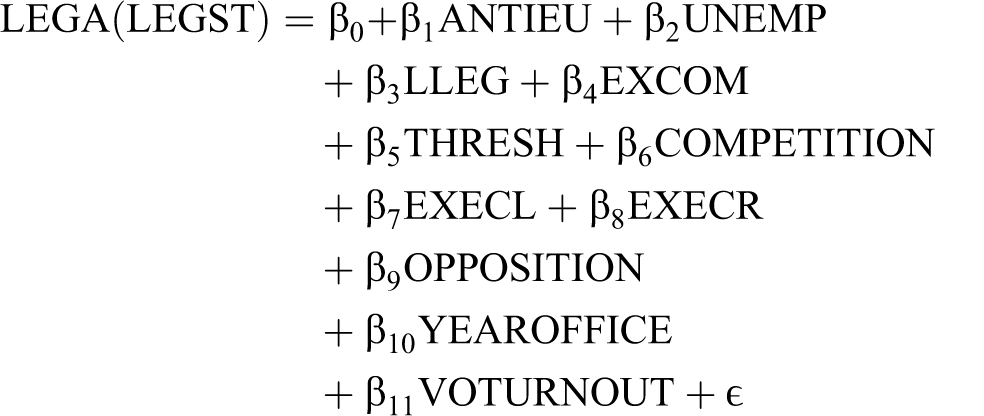
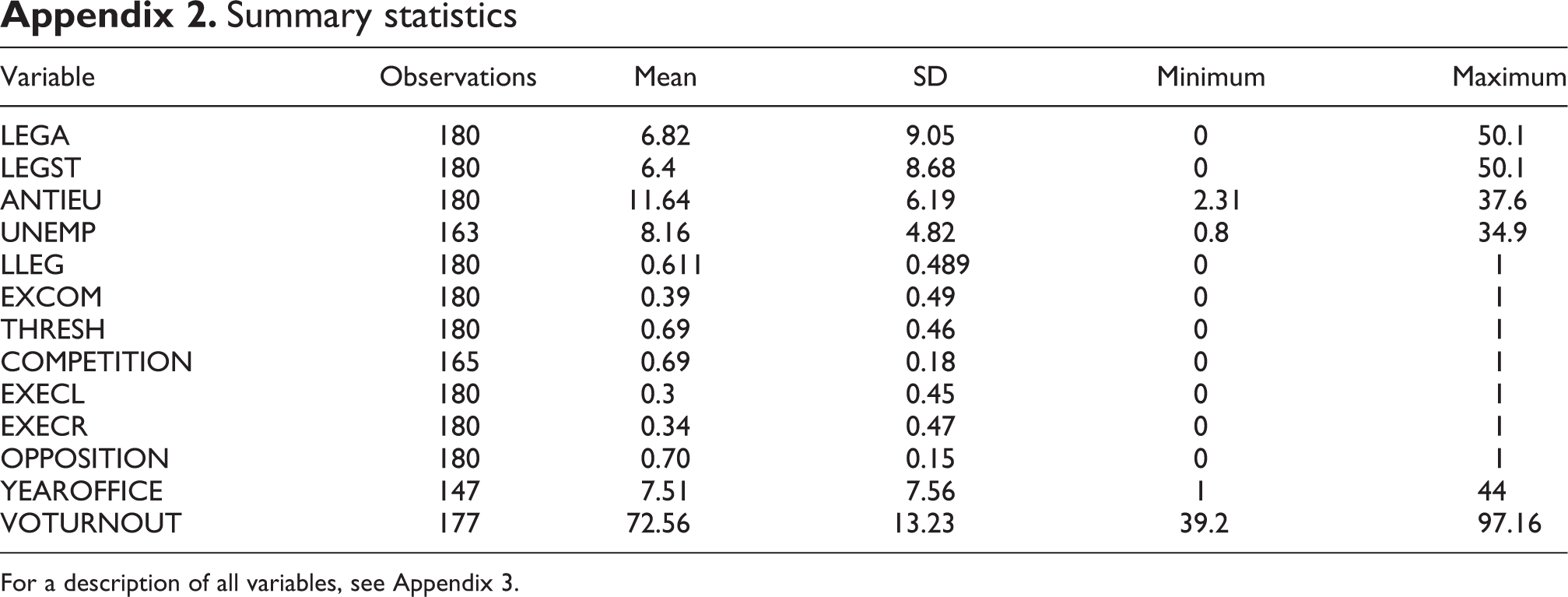
Both our dependent variables are observed only in some instances – in 41 percent of the cases in our sample there is no vote-share for RLPs recorded. In other words, our sample is a mixture of observations with zero and positive values. It would be misleading to code the electoral support of these parties as zero since it assumes that variables such as unemployment and electoral system had no effect on RLP support in these countries and since it ignores radical left support in countries without an electorally organized RLP. Yet it is fairly safe to assume that potential electoral support for RLP parties exists in every country. We therefore retain all election years in the analysis and employ an estimator that accommodates the limited nature of the dependent variable while retaining the variation in its uncensored component (as for instance a probit model would not). Following Jackman and Volpert (1996) we employ a tobit model that utilizes a maximum likelihood estimator for censored variables in our analysis. The coefficients estimated represent the marginal effect of the regressors on the underlying electoral support for RLPs (see Appendix 2 for details).
We run the tobit regression with two dependent variables; LEGA, and LEGST. The complete model specification reads as follows (the independent variables are presented in the next section, taking each hypothesis in turn):
The independent variables
While analysing the impact of Euroscepticism (H1), we suspected that support for EU membership captures more than meets the eye. The vast majority of EU policies have a market-making bias. Indeed the usual complaints against European integration, whether for posing a cosmopolitan threat to national identity, for favouring market integration over regulation, or for destroying the traditional welfare state, are also widespread charges brought against globalization more generally, including by RLPs. Arguably, then, what might be dubbed ‘globalization anxiety’ and Euroscepticism is highly endogenous: unfavourable evaluations of the EU might lead individuals to be sceptical of the benign consequences of globalization; conversely, could anti-globalization sentiment be the precursor of anti-EU stances?
This multidirectional causality of EU and globalization anxiety hampers investigation into the relationship of both sentiments and poses a fundamental challenge for empirical evaluation. Nevertheless, it is possible to make inferences as to the correlation of EU membership and globalization support by relying on tetrachoric correlation. The data we use to evaluate the relationship between a host of measurements for globalization anxiety and EU membership stem from an individual-level Eurobarometer (72.4). Using 2009 data has the advantage of including the largest country sample (27 EU member states) available in the context of Eurobarometer surveys. Table 1 shows the partial correlation between support for EU membership and three indicators for globalization anxiety, providing a full definition of the variables.
EU membership opposition and globalization anxiety (partial correlations).
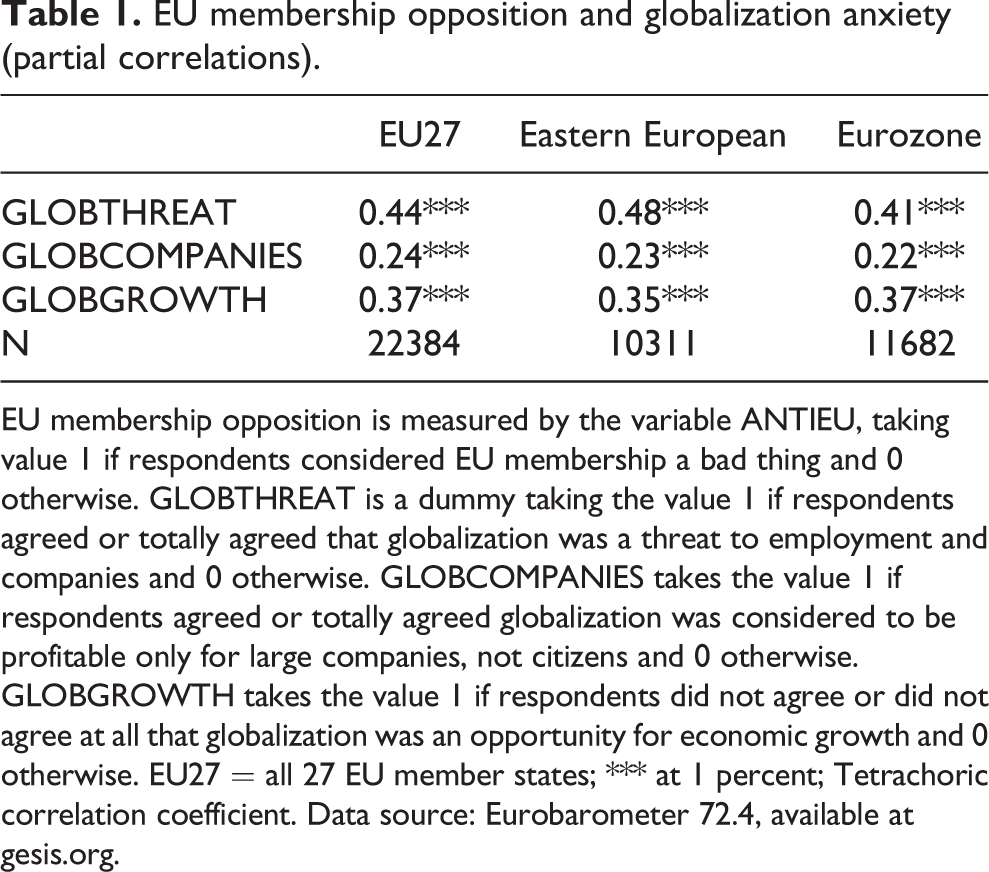
EU membership opposition is measured by the variable ANTIEU, taking value 1 if respondents considered EU membership a bad thing and 0 otherwise. GLOBTHREAT is a dummy taking the value 1 if respondents agreed or totally agreed that globalization was a threat to employment and companies and 0 otherwise. GLOBCOMPANIES takes the value 1 if respondents agreed or totally agreed globalization was considered to be profitable only for large companies, not citizens and 0 otherwise. GLOBGROWTH takes the value 1 if respondents did not agree or did not agree at all that globalization was an opportunity for economic growth and 0 otherwise. EU27 = all 27 EU member states; *** at 1 percent; Tetrachoric correlation coefficient. Data source: Eurobarometer 72.4, available at gesis.org.
For all three measurements, the relationship between globalization anxiety and opposition to EU membership is positive and the coefficients highly significant; this suggests that anti-EU membership sentiment and globalization opposition are highly correlated. To provide more context on anti-EU sentiment we use a measurement for the political affiliation of respondents found in the same Eurobarometer including variables for ‘radical left’ and ‘radical right’ self-placement. Interestingly, only the ‘radical left’ placement of the respondents is positively linked to EU membership opposition (r(29,415)= 0.1), whereas ‘radical right’ is negative and not significant. This individual-level view confirms our suspicion that individuals on the radical left are hostile towards the EU and gives further reason to suppose that high EU hostility in the population is likely to be associated with higher electoral success for RLPs.
To empirically test the latter we include the variable ANTIEU (based on various issues of the Standard and Central and Eastern European Eurobarometers) in our tobit analysis. This variable takes the lagged percentage of respondents in a country who considered EU membership a bad thing. The lag is taken in order to avoid endogeneity, since the electoral success of RLPs could in turn impact on EU hostility. 8
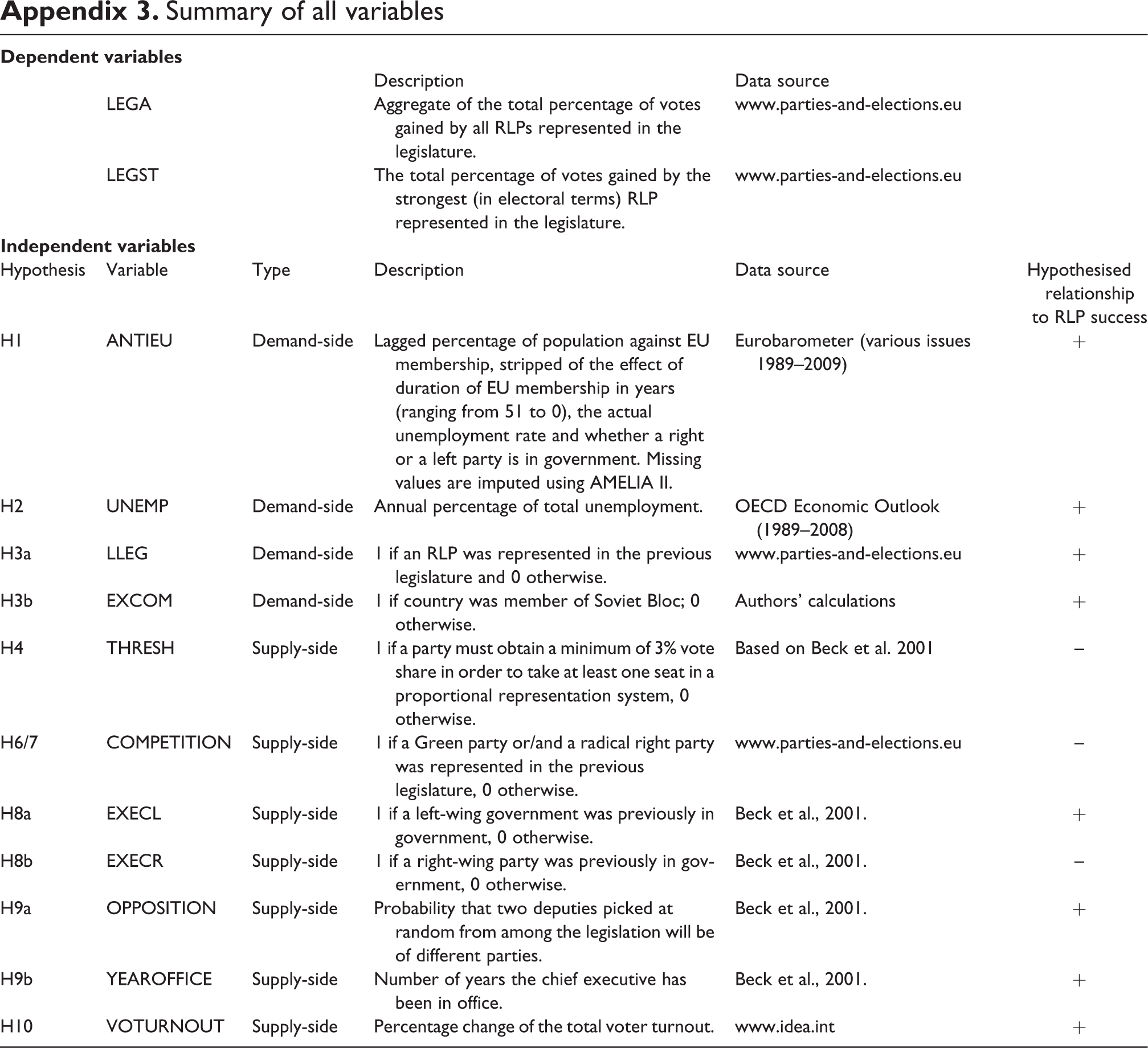
Testing H2, we control for the macro-economic climate by including a variable measuring the annual percentage unemployment rate. To measure party legacy, the dummy LLEG controls for the presumably positive effect of previously successful RLPs (H3a); it takes the value 1 if an RLP has been in the previous legislature and 0 otherwise. This variable can obviously only measure RLPs’ short-term legacy since the late 1980s. However, various correlations of LEGA with measurements for RLPs’ historical success reveal longer-term legacy effects. For instance, we correlated LEGA with the average percentage of votes gained by RLPs between 1970 and 1990 and found a strong positive correlation between the two variables (r(99)=0.728). 9 Yet, as these data exclude former communist countries, we do not include this variable in our main model (on grounds of comparative equivalence as well as mere data availability). We further use the dummy EXCOM taking the value 1 for members of former communist states to capture potential differences between Eastern and Western Europe (H3b).
Turning to the supply side, we use the dummy THRESH to capture the effect of the threshold of representation (H4); THRESH takes the value 1 if a party must obtain a minimum of 3 percent vote-share in order to take at least one in seat in a proportional representation system. 10 We measure party competition effects of Greens and RRPs (H6/7) by the variable COMPETITION, taking value 1 if a Green party and/or an RRP was represented in the previous legislature and 0 otherwise. The lagged legislature was used to circumvent the endogeneity problem.
However, electoral competition provided by social democratic parties (H5), while intuitively plausible, is far more difficult to measure. Unlike Greens and RRPs, social democrats are ubiquitous in European legislatures, so including a dummy similar to COMPETITION to measure the presence of a social democratic party in the outgoing legislature yields expectedly insignificant results as there is almost no variation in this variable. Instead, we tested for the relationship between RLPs and the success of social democratic parties using Spearman’s rho, a non-parametric test that converts scores to rank orders. Specifically, we used two variables for both party types measuring the average vote-share between 1990 and 2011 and taking the value 1 if the party had less than 10 percent of votes, 2 if the party had 10–30 percent of votes and 3 if the party had more than 30 percent of votes. Correlating these results of both the strongest RLPs and the strongest social democratic parties, we find a negative correlation of –0.27, significant at the 1 percent level (N=34). This suggests that social democratic parties are indeed an important source of competition for RLPs, whose electoral chances decline as social democratic parties’ increase.
However, the effect of the incumbent government is easier to measure. We controlled for partisanship of the executive in power with respect to economic policy (traditionally an issue of major interest to RLPs). EXECL is a dummy taking the value 1 if the outgoing government is defined as left-wing and 0 otherwise (H8a). Furthermore, this variable can (in part) shed light onto H5 and act as a proxy for the effect of social democratic parties, since if the government is left wing this generally indicates a strong centre–left competitor for RLPs. Similarly, EXECR is a dummy taking the value 1 if the outgoing government is defined as right wing (conservative, Christian democratic, etc.) and 0 otherwise (H8b).
We include two variables to capture fragmentation/consolidation of the party system (H9a/b). First, OPPOSITION indicates the probability that two deputies picked at random from among the legislature will be of different parties. 11 The higher this score, the more fragmented the political landscape (H9a). Second, the number of years the chief executive has been in office, YEAROFFICE, is used as a proxy for the monopoly potential of a country’s government (cartelization) (H9b). Finally, we introduce the variable, VOTURNOUT to measure the percentage change of the total voter turnout (H10). All variables finally used in the main tobit model, along with data sources are summarized in Appendix 3.
Results
Empirical results using both LEGA and LEGST as dependent variables are presented in Table 2. The first specification presents estimates with only the variables pertaining to the demand-side hypotheses (H1–3), the second specification adds the variables testing the external supply-side hypotheses (H4–10). Discussion below focuses on the full model specification.
Determinants of electoral success for RLPs.

Tobit regression, columns show coefficients with their standard errors in parentheses, *significant at 10 percent; **at 5 percent; ***at 1 percent.
Already at first glance the variable LLEG can be identified as the most crucial factor in explaining RLP electoral success. If an RLP was in parliament in the previous inter-election period, its vote is more than 20 percentage points higher than if absent. Interestingly, it is this past legislative success that is decisive, not whether an RLP has been in the previous government. A corresponding dummy, LEX (taking the value 1 if an RLP has been in government and 0 otherwise) is not significant at any of the conventional levels. Although in almost 14 percent of our observations RLPs participated in government, this has no bearing on their legislative success as already a weak correlation of LEGA/LEGST with the aforementioned dummy LEX suggested (r (180)= 0.056 and 0.065, respectively).
Unsurprisingly, this is evidence for strong autoregressive dynamics in electoral fortunes. Certainly, there are numerous examples of RLPs making ‘credibility breakthroughs’ into parliament and then improving their vote dramatically at the following election (e.g. the Dutch Socialist Party in 1994/8). This indicates that once an RLP has established electoral favour it is likely to keep its position (particularly with good leadership). Moreover, the insignificant impact of governmental participation is corroboration of Bale and Dunphy’s findings (2011) that RLPs are commonly small coalition partners who struggle to demonstrate positive governing achievements.
Yet, as indicated earlier, this variable might also be a proxy for longer-term political–cultural legacies. Certainly, the coefficient EXCOM indicates this. EXCOM is significant at the 5 percent level, and shows that RLPs perform better in former communist countries. This corroborates the ‘successor party’ literature’s claims that communist legacies can translate into post-communist success (e.g. Bozóki and Ishiyama, 2002). Together, these factors indicate historically determined limits to RLP success: they perform better with a past tradition to draw on and they are unlikely to make dramatic national breakthroughs in countries without this tradition.
Progressing down the table, we see that the variable ANTIEU expectedly demonstrates that Euroscepticism has a positive effect on RLP electoral success. 12 This indicates both that opposition to the EU has indeed become a significant RLP identity marker and further corroborates the thesis that RLPs benefit from globalization anxiety and the ‘modernization crisis’. Also as expected, the coefficient of the annual unemployment rate is positive and significant. This suggests that RLPs thrive better in worse economic climates.
Together, these results indicate that RLP success is strongly rooted in demand-side factors. However, many supply-side factors are relevant. THRESH shows that an electoral threshold of 3 percent or higher reduces RLPs’ vote-share by more than 5 percentage points, expectedly, given the number of RLPs with single-figure votes for whom electoral thresholds prove formidable barriers. As predicted, the variable COMPETITION is significant and its coefficient positive. We furthermore test the difference between the competition effects exerted by Green and RRPs separately by including dummies measuring their previous electoral successes individually. The margin of reduction is virtually identical for the individual measurements.
At first glance it appears that only a right-wing executive (EXECR), not a left-wing one (EXECL) matters for RLP electoral performance. Yet a test of joint significance reveals that these factors are significant at the 5 percent and 10 percent level for both our dependent variables. Contrary to expectations (H8a/b), a left-wing executive reduces RLP vote-share, whereas a right-wing one raises RLP vote-share. This appears to indicate that RLPs generally succeed best when they are a repository of anti-right protest, but (further corroborating the inverse, competitive, relationship between social democrats and RLPs) have difficulty mobilizing when the left is already in power, even to exploit disappointment with the mainstream centre-left.
The variables OPPOSITION and YEAROFFICE are neither individually nor jointly significant, indicating that neither electoral fragmentation nor ‘cartelization’ have identifiable effects. 13 This contradicts the (admittedly contested) expectations from the literature on APEs. Plausible explanations are that, relative to Greens and RRPs, many RLPs are not ‘new’ parties and, given the influence of past heritage, they are less dependent on exploiting current fragmentation or consolidation dynamics among the mainstream parliamentary parties. Moreover, unlike RRPs who often mobilize populist protest against the establishment in general, for RLPs (as EXECL and EXECR indicate) the partisanship of the establishment is important. One example is the Dutch Socialist Party, which, despite long attacking the Dutch Labour Party for joining the ‘establishment’, gained its greatest success to date (16.6 percent in 2006) when Labour had actually not governed for four years.
Finally, the variable VOTURNOUT is insignificant. Our analysis finds no support for the claim that higher voter turnout benefits RLPs. Possible explanations are that in Eastern Europe RLPs are ‘successor parties’ to the forming ruling parties whose core electorate tends to remain disciplined and stable: low turnout might actually benefit such parties (White and McAllister, 2007). Moreover, in the West, despite their rooting among the relatively deprived, a number of RLPs (e.g. most Nordic parties, the Portuguese Left Bloc and Dutch Socialist Party) have attracted a more left-libertarian (younger and highly educated) electorate (Striethorst, 2011). Left-libertarian constituencies are disproportionately more likely to vote (Finseraas and Vernby, 2011). Nevertheless, these inferences deserve more research.
Conclusion
Several key findings emerge from our data. We have shown that RLP success is strongly rooted in demand-side factors such as poor economic conditions, high societal Euroscepticism and, above all, a legacy of past RLP success. Furthermore, we find an intrinsic linkage between anti-EU and anti-globalization sentiment, indicating that RLP support increases where globalization has perceived negative socio-economic impacts.
We have also shown that supply-side factors are influential: high electoral thresholds and competition from Greens and RRPs dampen RLP support significantly. Unanticipated results were the negative effect of left-wing executives and the non-significance for the variables of voter turnout, party system fragmentation and cartelization. Our large dataset, spanning 34 countries and 128 elections between 1990 and 2008, avoids the selection bias that mars many small-n studies and allows us to generalize these conclusions with a high degree of confidence.
Our work has several implications. For policy-makers, it indicates that RLPs are likely to be a durable part of the European party landscape. Indeed, given that anti-EU, anti-globalization sentiments and economic distress have long been prevalent in Europe, it is probable that RLPs’ mobilization potential is greater than their electoral results. This mobilization potential could clearly increase if the crisis is not quickly overcome (for instance, according to Standard Eurobarometer 76, positive images of the EU dropped from 50 to 34 percent between September 2008 and August 2011) (Eurobarometer, 2011). This will clearly impact on competitor parties (particularly social democrats) and wider political life, given these parties’ opposition to the ‘really existing EU’ and the current austerity agenda. However, the major constraining factor is that it is difficult to see RLPs making quick credibility breakthroughs where they lack an existing tradition and have long been infinitesimal, or where they face entrenched Green or RRP competitors (e.g. in the UK, Austria or Belgium). However, as the most recent elections show, existing parties are certainly capable of dramatic increases in their vote. 14
Furthermore, our work suggests an emerging re search agenda. Further quantitative analysis is useful in the following directions: (i) using smaller-n samples to analyse the socio-economic demand-side characteristics that data problems prevented us examining (e.g. impact of socio-economic structure, income inequality and trade union density); (ii) focusing further on the relationship between RLPs and voter turnout; (iii) focusing more on meso- or micro-level explanations. For instance, there is simply little comparative work done on the social constituencies of contemporary RLPs. Such a voter-based focus would complement our explanations and help indicate how such issues as class and post-materialist values, disillusion with democracy or protest-voting interact with the anti-globalization and anti-EU sentiments we have outlined.
Our work can also usefully be integrated with qualitative studies focusing on the internal supply side (party strategies), which quantitative approaches cannot fully evaluate. For instance, further work is needed on: (i) how individual RLPs exploit the external incentives identified here (in particular, how individual parties’ divergent conceptualizations of the EU help them mobilize anti-EU sentiment); (ii) how other party behaviour expands or constricts RLPs’ electoral space. For instance, how precisely do changes in social democratic, Green or RRP policy positions impact on RLP behaviour (and vice versa)?
Finally, our work has more general implications for studying party politics. First, since many of the demand-side preconditions for RLP success are omnipresent in European countries, this suggests that, exactly like RRPs, RLPs should be regarded not as marginal aberrancies of contemporary democracy, but rather as actors who express in radical form mainstream concerns (such as globalization anxiety and economic insecurity) and are therefore integral to today’s politics. As such, the key question is not why such parties have survived the fall of the USSR, but why so few have since exploited fertile ground (cf. Mudde, 2010). Second, we have adapted a conceptual framework previously used almost exclusively for RRPs to the study of RLPs and produced a number of eminently testable variables. Neither the framework nor many of the variables are specific to the radical right, radical left or indeed niche parties. There is no reason why such a framework cannot be adapted to augment the scant comparative analysis of why other party families, individually or collectively, succeed or fail.
Footnotes
Funding
We thank Ailsa Henderson and Pontus Odmalm for comments on earlier versions. The School of Social and Political Science Strategic Research Support Fund supported research for this article.
Notes
Appendix 1.
Countries and parties examined Key: (a) These parties are renamings/mergers of each other; (b) Harmony Centre is an electoral coalition of the Socialist Party of Latvia and the Social Democratic Party ‘Harmony’; (c) in 2001 the SPU applied to join the Socialist International and is thereafter considered a social democratic party. Source of left–right scale: www.parlgov.org. Source of electoral data: www.parties-and-elections.eu.
Country
Party
L-R score
Average vote 1990–2008
Austria
n/a
0
Belgium
n/a
0
Bulgaria
n/a
0
Croatia
n/a
0
Cyprus
Progressive Party of the Working People (AKEL)
2.6
32.3
Czech Republic
Communist Party of Bohemia and Moravia (KSČM)
0.7
13.3
Denmark
Red–Green Alliance (EL)
1.0
2.6
Socialist People’s Party (SF)
2.2
8.1
Estonia
Estonian United People’s Party/Constitution Party/Estonian United Left Party (EÜRP) (a)
1.1
2.8
Finland
Left Alliance (VAS)
2.4
10.2
France
Communist Party (PCF)
1.4
7.1
Germany
Left Party (LP)/Party of Democratic Socialism (PDS)
1.2
4.9
Greece
Coalition of the Left (SYN/SYRIZA)
2.8
5.0
Communist Party (KKE)
0.7
6.7
Democratic Social Movement (DIKKI)
2.4
2.9
Hungary
n/a
0
Iceland
People's Alliance (AB)
2.2
14.3
Left–Green Movement (VG)
1.4
10.7
Ireland
Democratic Left (DL)
1.9
2.7
Socialist Party (SP)
1.3
0.7
Sinn Féin
2.0
4.4
Italy
Party of Communist Refoundation (PRC)
1.0
5.7
Party of Italian Communists (PdCI)
0.9
2.4
Latvia
Socialist Party of Latvia (LSP)/Harmony Centre (b)
1.3/3.0
12.1
Lithuania
n/a
0
Luxembourg
Communist Party (KPL)
n/a
1.3
The Left (Déi Lénk)
0.9
2.6
Malta
n/a
0
Moldova
Electoral Bloc Fatherland (BePR)
n/a
7.3
Party of Communists of the Republic of Moldova (PCRM)
1.7
42.1
Netherlands
Socialist Party (SP)
1.2
6.7
Norway
Socialist Left Party (SV)
1.4
8.1
Poland
n/a
0
Portugal
Communist Party (PCP)
2.9
8.2
Left Bloc (BE)
2.0
3.9
Romania
n/a
0
Russia
Communist Party of the Russian Federation (KPRF)
1.3
16.6
Motherland
2.1
9.0
Slovakia
Association of Slovak Workers (ZRS)
n/a
2.4
Communist Party of Slovakia (KSS)
0.6
3.3
Slovenia
n/a
0
Spain
United Left/Communist Party of Spain (IU/PCE)
2.1
7.3
Sweden
Left Party (V)
1.6
7.4
Switzerland
Labour Party of Switzerland (PdA)
0.6
0.9
Solidarities (S)
n/a
0.5
Ukraine
Communist Party of Ukraine (KPU)
3.0
13.3
Progressive Socialist Party of Ukraine (PSPU)
1.1
3.4
Socialist Party of Ukraine (SPU) (1990s only) (c)
1.8
5.9
UK
Respect
n/a
0.2
Mean (all parties)
7.7
Mean (all countries)
8.8

Appendix 2.
Summary statistics For a description of all variables, see Appendix 3.
Variable
Observations
Mean
SD
Minimum
Maximum
LEGA
180
6.82
9.05
0
50.1
LEGST
180
6.4
8.68
0
50.1
ANTIEU
180
11.64
6.19
2.31
37.6
UNEMP
163
8.16
4.82
0.8
34.9
LLEG
180
0.611
0.489
0
1
EXCOM
180
0.39
0.49
0
1
THRESH
180
0.69
0.46
0
1
COMPETITION
165
0.69
0.18
0
1
EXECL
180
0.3
0.45
0
1
EXECR
180
0.34
0.47
0
1
OPPOSITION
180
0.70
0.15
0
1
YEAROFFICE
147
7.51
7.56
1
44
VOTURNOUT
177
72.56
13.23
39.2
97.16
Appendix 3.
Summary of all variables
Description
Data source
LEGA
Aggregate of the total percentage of votes gained by all RLPs represented in the legislature.
www.parties-and-elections.eu
LEGST
The total percentage of votes gained by the strongest (in electoral terms) RLP represented in the legislature.
www.parties-and-elections.eu
Hypothesis
Variable
Type
Description
Data source
Hypothesised relationship to RLP success
H1
ANTIEU
Demand-side
Lagged percentage of population against EU membership, stripped of the effect of duration of EU membership in years (ranging from 51 to 0), the actual unemployment rate and whether a right or a left party is in government. Missing values are imputed using AMELIA II.
Eurobarometer (various issues 1989–2009)
+
H2
UNEMP
Demand-side
Annual percentage of total unemployment.
OECD Economic Outlook (1989–2008)
+
H3a
LLEG
Demand-side
1 if an RLP was represented in the previous legislature and 0 otherwise.
www.parties-and-elections.eu
+
H3b
EXCOM
Demand-side
1 if country was member of Soviet Bloc; 0 otherwise.
Authors’ calculations
+
H4
THRESH
Supply-side
1 if a party must obtain a minimum of 3% vote share in order to take at least one seat in a proportional representation system, 0 otherwise.
Based on Beck et al. 2001
–
H6/7
COMPETITION
Supply-side
1 if a Green party or/and a radical right party was represented in the previous legislature, 0 otherwise.
www.parties-and-elections.eu
–
H8a
EXECL
Supply-side
1 if a left-wing government was previously in government, 0 otherwise.
Beck et al., 2001.
+
H8b
EXECR
Supply-side
1 if a right-wing party was previously in government, 0 otherwise.
Beck et al., 2001.
–
H9a
OPPOSITION
Supply-side
Probability that two deputies picked at random from among the legislation will be of different parties.
Beck et al., 2001.
+
H9b
YEAROFFICE
Supply-side
Number of years the chief executive has been in office.
Beck et al., 2001.
+
H10
VOTURNOUT
Supply-side
Percentage change of the total voter turnout.
www.idea.int
+