



Abstract
This article takes a closer look at how presidential elections affect the fragmentation of the legislative party system. It reviews the theory and conventional empirical modelling strategy; identifies some drawbacks to this strategy and suggests solutions; and then conducts an empirical investigation of the implications of this critique by combining replication data from Golder (2006) with new data on the key variables measuring the presidential coattails. Fortuitously, the literature’s findings about the shadow cast by presidential elections, usually known as the presidential coattails, are relatively robust. However, important differences emerge on the margins, such as regarding the effect of midterm elections. Moreover, this article demonstrates that subsequent presidential elections, like concurrent and preceding ones, cast shadows, too. It also demonstrates that the conventional modelling strategy underestimates the presidential coattails.
Introduction
The electoral system is not the only political institution that shapes the party system in legislative elections: the system of government, otherwise known as the regime type, also plays an important role. Particularly, many scholars have asked how presidentialism affects the fragmentation (size) of the legislative party system (e.g. Amorim Neto and Cox, 1997; Clark and Golder, 2006; Cox, 1997; Golder, 2006; Hicken, 2009; Hicken and Stoll, 2011, 2013; Jones, 1994, 1999; Mozaffar et al., 2003; Samuels, 2002, 2003; Shugart, 1995; Shugart and Carey, 1992).
Early scholarly work compared presidential and parliamentary regimes, finding that presidential regimes had smaller, less fragmented party systems (e.g. Lijphart, 1994). Most recent studies have taken a more nuanced approach (e.g. Amorim Neto and Cox, 1997; Cox, 1997; Golder, 2006; Hicken and Stoll, 2011, 2013). The effect of presidentialism, which has been called the presidential coattails, has been found to depend upon two variables: the presidential party system and the electoral cycle, i.e. the temporal proximity of presidential and legislative elections. Specifically, scholars have found that presidential elections held in temporal proximity to legislative elections reduce the fragmentation of the legislative party system when there are few presidential candidates (the deflationary effect), but increase it when there are many presidential candidates (the inflationary effect).
Yet the quantitative empirical evidence regarding the presidential coattails relies on some potentially problematic modelling choices, as Hicken and Stoll (2011, 2013) have pointed out in their recent work. For one, many studies treat all legislative and presidential elections held in the same year as concurrent. This fails to distinguish between truly simultaneous elections and those separated by anywhere from a few weeks to almost twelve months. For another, legislative elections in presidential regimes held at the presidential midterm are equated with legislative elections in pure parliamentary regimes. But surely actors face different incentive structures in these very different institutional settings. Last but not least, if presidential elections are not held concurrently with legislative elections, only presidential elections held prior to legislative elections are allowed to have coattails. This ignores the possibility that presidential elections held subsequent to legislative elections might have coattails, too. What are the implications of these modelling choices for the empirical findings about the presidential coattails?
In this article, I attempt to answer this question. I first review the conventional modelling approach of the quantitative empirical literature. I then discuss the problematic aspects of this approach. For each of the three major problems identified, I then propose solutions. Finally, I undertake a sensitivity analysis using Golder’s (2006) replication dataset, combined with original data on the independent variables that model the presidential coattails. Fortuitously, I find that the literature’s overall conclusions about the coattails of presidential elections are robust to alternative modelling choices. The primary area in which sensitivity is found concerns the coattails effect when legislative elections are held at the presidential midterm. Moreover, I find that the conventional modelling strategy underestimates the presidential coattails. For example, presidential elections held subsequent to legislative elections in fact have larger coattails than preceding presidential elections do.
Modelling presidential coattails
Political scientists and constitutional engineers have long believed that elections for popularly elected national presidents cast a shadow over legislative elections. This shadow or ‘coattails’ takes the form of fewer legislative parties when there are few viable presidential candidates, and more legislative parties when there are many viable presidential candidates. Moreover, the more temporally proximate presidential elections are to a legislative election, the greater the coattails will be (e.g. Cox, 1997; Shugart, 1995). Given this hypothesis, the quantitative literature has empirically modelled the presidential coattails as an interaction between two variables: the fragmentation of the presidential party system and the temporal proximity of presidential and legislative elections. Below, I review each component of this approach.
Measuring presidential party system fragmentation
Following Amorim Neto and Cox (1997) and Cox (1997), scholars empirically exploring the presidential coattails have focused on the fragmentation of the national presidential race. This abstract concept has conventionally been operationalized as the effective number of (electoral) presidential candidates (Laakso and Taagepera, 1979):
Measuring temporal proximity
The temporal proximity of presidential and legislative elections has been conceptualized as a continuum ranging from minimally to maximally proximate.
1
As alluded to above, the maximally proximate presidential election is one that is held concurrently with a legislative election. By way of contrast, when a legislative election is held at the presidential midterm, the presidential election is minimally proximate. Henceforth, the latter will be referred to as a midterm election. The most common way of operationalizing proximity was originally proposed by Amorim Neto and Cox (1997):
The empirical model
The hypothesis is that the presidential coattails are an interactive function of the temporal proximity of presidential elections, on the one hand, and the fragmentation of the presidential party system, on the other. Accordingly, scholars have estimated the following interaction model (see, for example, Golder, 2006):
2

In this equation, the dependent variable, ‘ENEP’, is the effective number of electoral parties in a legislative election. It is calculated in a similar manner to the effective number of presidential candidates, where the presidential candidates’ vote-shares are replaced by the legislative parties’ vote-shares. Of the independent variables, ‘Proximity’ is the temporal proximity of the presidential election, calculated as described above; ‘ENPRES’ is the effective number of presidential candidates, also calculated as described above; ‘Ethnic’ is the effective number of ethnic groups; and ‘Log Magnitude’ is the logged average district magnitude. Hence, this model also controls for an interaction between the ethnic heterogeneity of the country and the restrictiveness of its legislative electoral system.
Drawbacks and solutions
But are there drawbacks to this modelling strategy? In this section, I argue that there are. My first task is to identify these drawbacks. My second is to suggest solutions.
Calculating proximity with years as the unit
One criticism of the operationalization of temporal proximity developed by Amorim Neto and Cox (1997) is that it may result in legislative and presidential elections that are held in the same year, but not on the same day, being treated as concurrent. This is a function of which units are used in the formula: days (i.e. actual election dates) or years. Amorim Neto and Cox seem to use days. 3 However, Golder (2006) explicitly uses years, and subsequent studies have followed suit (e.g. Hicken and Stoll, 2011).
This seemingly subtle matter has important substantive implications. When using days as the unit, only presidential and legislative elections held on exactly the same day are classified as concurrent. However, when years serve as the unit, all presidential and legislative elections held in the same calendar year are classified as concurrent. For example, this approach treats a presidential election in January as being held concurrently with a legislative election in December of the same year. But in actuality, eleven months, almost an entire year, separate these two elections. Is it really plausible to think that this presidential election’s coattails are the same as the coattails of a presidential election held on the same day as the legislative election, ceteris paribus? By using years as the unit, this is what is assumed. This measurement strategy accordingly overestimates the temporal proximity of presidential elections held in the same year as, but not on the same day as, a legislative election. The observed effect of the presidential coattails is likely to be attenuated as a result. Note that this is not simply a technical concern: there are many real world examples of such presidential and legislative elections. 4 More generally, information is lost by ignoring when elections occur within a given calendar year.
To avoid these problems, there is an obvious solution: use days (i.e. actual election dates) instead of years as the unit in the Amorim Neto and Cox (1997) formula for temporal proximity.
Equating midterm elections with elections in pure parliamentary regimes
Another criticism of the standard operationalization of temporal proximity concerns the treatment of midterm elections. One might argue that these elections are equated with legislative elections held in pure parliamentary regimes, i.e. regimes where there is not a popularly elected president, because both types of elections receive a value of zero on the temporal proximity variable.
Certainly, it seems plausible to object to this assumed equality. 5 Presidential elections might still shape legislative electoral coordination when legislative elections are held at the presidential midterm. Golder (2006: 36) explicitly hypothesizes that this might be the case by distinguishing between what he calls the ‘short’ and the ‘long’ presidential coattails. The short coattails hypothesis, which has attracted the most attention, holds that only temporally proximate presidential elections shape legislative electoral coordination. The long coattails hypothesis, by way of contrast, holds that even non-temporally proximate presidential elections (i.e. when a legislative election is midterm) shape legislative electoral coordination. Hicken and Stoll (2010) more specifically hypothesize that there should be less electoral coordination in legislative elections when the regime is presidential and presidential elections are not temporally proximate enough to cast a shadow: the existence of the popularly elected president decreases the size of the legislative prize, which in turn decreases the incentives for strategic coordination in legislative elections.
One seemingly obvious solution to this problem is to exclude elections in pure parliamentary regimes from the analysis (e.g. Hicken and Stoll, 2011). 6 However, if the core research question is the difference between parliamentary and presidential regimes, which it has been for most scholars, this is actually a non-solution for the reasons laid out by Hicken and Stoll (2013). 7 To borrow the language of experimental designs, the experimental ‘treatment’ is the existence of presidential elections (simplifying for the sake of argument). Legislative elections in pure parliamentary regimes therefore serve as the control group to which the treatment group, legislative elections in presidential regimes, is compared –which means that pure parliamentary regimes must be included in the analysis.
A better solution is to fully exploit the interaction model. While it may seem that the testing of hypotheses about the long presidential coattails is precluded by the conventional operationalization of temporal proximity, this is actually not the case. In Equation 1,
Another solution is to increment the value of temporal proximity calculated using the Amorim Neto and Cox (1997) formula. For example, consider adding 1. For legislative elections in presidential regimes, proximity will then range between 1 (midterm elections) and 2 (concurrent elections) instead of between zero and 1. By continuing to code legislative elections in pure parliamentary regimes as zero, a clear distinction is made between the two types of elections. The drawback to this approach, though, is the strong assumption it makes regarding the difference between parliamentary regimes and midterm elections.
Only allowing concurrent or preceding presidential elections to cast a shadow
Last but not least, there is the issue of which presidential election should be able to cast a shadow over a legislative election. This issue has obvious implications for the measurement of both key independent variables: it determines for which presidential race the effective number of presidential candidates is calculated and which dates are used to calculate the temporal proximity.
If a presidential election is held concurrently with a legislative election, it is the natural candidate to have coattails. But if there is not a concurrent presidential election, why are preceding and not subsequent presidential elections allowed to have coattails? One good argument for only allowing preceding presidential elections to cast a shadow is to ensure that the arrow of causality runs from the presidential to the legislative election. This is the likely reason for the focus on preceding presidential elections to date. 9 Yet the same endogeneity issue plagues concurrent elections, if less severely. For both concurrent and subsequent presidential elections, it is the prominence of the presidential race that leads it to cast a shadow over the legislative race, instead of the other way round. With the presidency ‘nearly always the most important prize in a presidential regime’ (Golder, 2006: 35), the presidential campaign draws attention from the national media, legislative candidates, other political elites, and – of course – voters. 10 In the same way that voters use a preceding presidential campaign as an information shortcut to guide their choice of legislative candidates, the anticipation of which leads legislative candidates to engage in strategic entry and exit, so too may actors behave strategically in response to a presidential campaign that is ongoing at the time of a legislative election. 11 This is particularly likely when, as is usually the case, the subsequent presidential election follows closely on the heels of the legislative election.
Many examples can be provided that bolster the case for allowing subsequent presidential elections to have coattails. Consider, for one, the March 2002 Colombian legislative election, calculating proximity using days instead of years. In May of that same year, i.e. three months later, a presidential election was held. The closest preceding presidential election, however, was in June of 1998 – almost four years earlier. Here, the subsequent presidential election seems more likely to have coattails than the preceding one. 12 Now consider the October 1995 legislative election in Portugal. The closest preceding presidential election was in January 1991, whereas the closest subsequent presidential election was in January 1996. Which of these presidential elections is more likely to cast a shadow over the legislative race – the one almost five years earlier, or the upcoming (three months hence) one, for which campaigning should already have been well underway? The answer seems clear, yet regardless of whether days or years are used to calculate proximity in this case, the conventional approach would consider only the 1991 presidential election to have coattails in the 1995 legislative election.
Accordingly, I hypothesize that presidential elections held subsequent and prior to a legislative election should have similar coattails, ceteris paribus, with one caveat discussed below. In fact, all else being equal, if a subsequent presidential election is more temporally proximate to a legislative election than a preceding presidential election is, it is the more likely one to have coattails. This suggests that if there is not a concurrent presidential election, it is the temporally closest preceding or subsequent presidential election that should be allowed to have coattails. 13 The caveat to this hypothesis, though, is that the preceding presidential election should be privileged. This means two things: first, if the legislative election is a midterm election, it is the preceding presidential election that should cast a shadow; second, if the subsequent presidential election is more than two years from the legislative election, even if it is temporally closest to the legislative election, it is again the preceding election that should cast a shadow. Behind this caveat are the endogeneity issues discussed above, as well as the empirical reality that presidential campaigns usually do not begin more than two years in advance of a presidential election. Like measuring proximity in years instead of in days, ignoring more temporally proximate subsequent presidential elections in favour of less temporally proximate preceding presidential elections is likely to underestimate the shadow cast by presidential elections.
Empirically testing this hypothesis requires only straightforward modifications to existing variable operationalizations. To calculate the temporal proximity between a legislative election and subsequent presidential election, the numerator in the Amorim Neto and Cox (1997) formula is replaced with
Results from a sensitivity analysis: How robust are the findings about the coattails of presidential elections?
So are the literature’s findings about the presidential coattails sensitive to these different ways of modelling them? In this section of the article, I explore the issue, providing the most rigorous empirical estimates of the presidential coattails to date.
To do so, I conduct an empirical analysis using Golder’s (2006) replication dataset. 15 The cases are all minimally democratic legislative elections from 1946 through 2000, a total of 603 elections in 84 countries, such as Albania and the United States. 16 Data are taken directly from Golder for the dependent variable (the effective number of electoral parties in a legislative election) and the control variables (the effective number of ethnic groups and the logged average lower tier district magnitude). For all legislative elections in presidential regimes, which are those that possess a popularly elected chief executive (president), 17 I compile original data for the key independent variables measuring the presidential coattails (the temporal proximity and the effective number of presidential candidates), given the obvious need to go beyond the conventional measures of these variables appearing in Golder’s replication dataset. This is done by drawing upon a variety of secondary (e.g. Golder, 2005) and primary sources. These new measures are discussed in more detail below.
To assess the presidential coattails, I then use these data to estimate Equation 1. Estimation is by OLS with robust (country-clustered) standard errors. Table 1 presents the results from the seven versions of this model estimated, each of which varies the modelling of the presidential coattails in some way.
Coefficient estimates and robust (country-clustered) standard errors in parentheses for Models 1—7, replications of Golder’s (2006) model of presidential coattails using new measures of temporal proximity and the effective number of presidential candidates (ENPRES). The dependent variable is the effective number of electoral parties in a legislative election. Significance codes are for two-sided tests, all calculated prior to rounding to two significant digits: 0.01***; 0.05**; 0.10*.

The first of these models (Model 1) is a strict replication of Golder (2006: 39). This model is estimated to show that the same conclusions are drawn using my original data. The variables of temporal proximity and the effective number of presidential candidates are calculated as Golder calculated them, as is standard, with only one minor a priori departure: an adjustment for interruptions in the normal presidential electoral cycle. 18 Accordingly, only the data effectively differ. In other words, in Model 1, it is the concurrent (if there is one) or preceding (if there is not) presidential election that is allowed to cast a shadow, and temporal proximity is calculated using the Amorim Neto and Cox (1997) formula with years as the unit of analysis. Table 1 shows that the results are very similar to Golder’s (2006: 39) pooled analysis of his entire sample.
The second of these models (Model 2) employs a different operationalization of temporal proximity. In this model, days (i.e. actual election dates) serve as the unit for calculating the temporal proximity using the Amorim Neto and Cox (1997) formula. An examination of Table 1 reveals that these results are similar to the results obtained using the more conventional years as the unit (Model 1). To elaborate, the estimated coefficients all have the same signs, are of similar magnitudes, and have similar statistical significances. The only minor differences of note are that in Model 2 the magnitudes of
The third model (Model 3) continues to use days to calculate the temporal proximity, given the clear advantages of this measurement strategy, but now additionally increments the value by 1. This allows the measure of proximity to discriminate between legislative elections in pure parliamentary regimes and midterm elections. The third column of Table 1 presents these results. Two observations jump out. First, the magnitudes of the coefficients on the terms involving proximity (
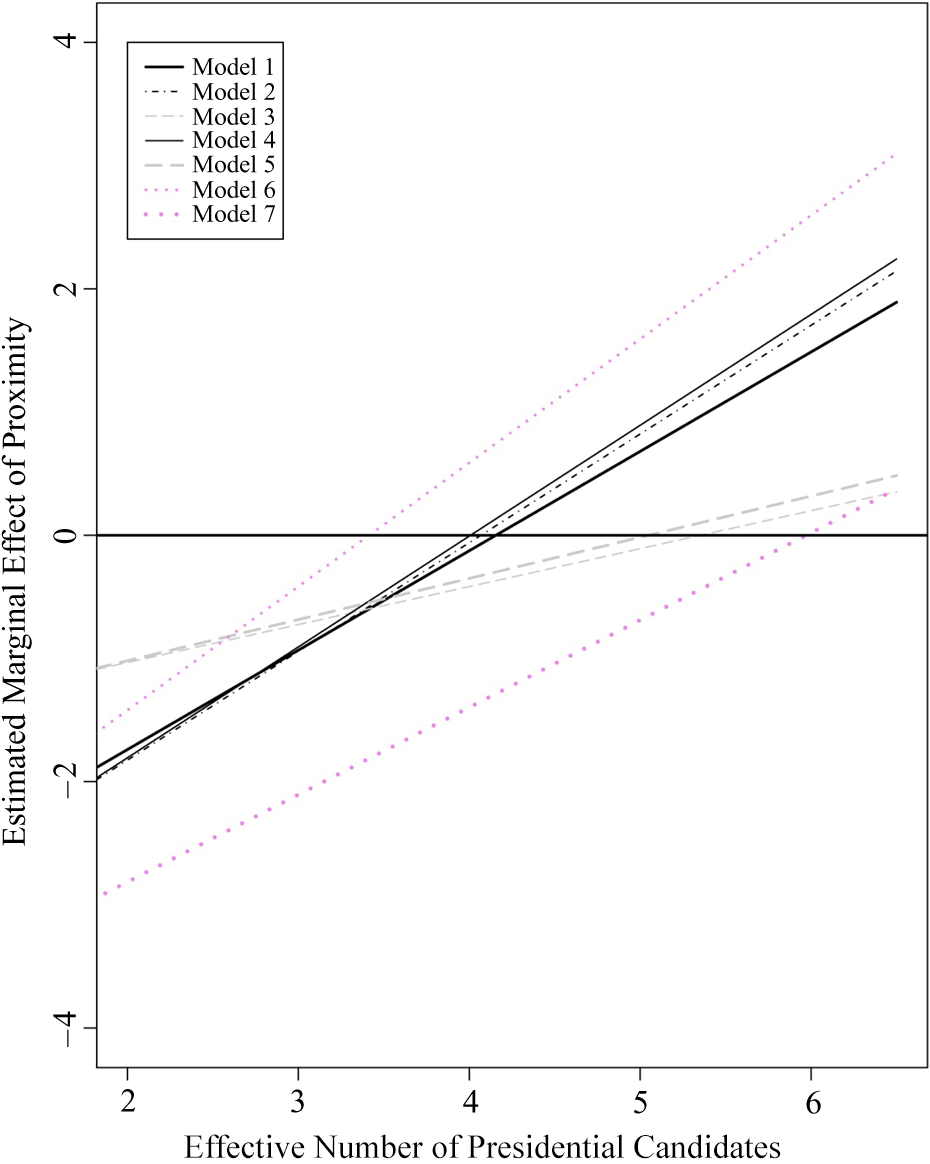
The estimated marginal effect of proximity from Models 1 to 7, all shown for the observed range of the effective number of presidential candidates.
However, there is a simple explanation for this: the range of the measure has changed. The coefficients and marginal effects have been halved, but the range of proximity has doubled, which makes for similar predictions. Second, the magnitude of
A better way to see how the two models differ regarding their findings about the short and long presidential coattails is to calculate the predicted effective number of electoral parties in legislative elections for each model. These predictions can be made for different values of proximity and the effective number of presidential candidates, holding the effective number of ethnic groups and the logged average lower tier legislative district magnitude constant at their means. 20 For each of the seven models estimated, Table 2 specifically presents predictions for pure parliamentary regimes (proximity = 0.0/0.0); 21 presidential regimes with midterm legislative elections (proximity = 0.0/1.0); presidential regimes with legislative elections one quarter of the way into the presidential term (proximity = 0.5/1.5); 22 and presidential regimes with concurrent legislative elections (proximity = 1.0/2.0).
The predicted number of electoral parties in legislative elections from Models 1 to 7 for a pure parliamentary regime and for presidential regimes with presidential elections of varying temporal proximity. For the presidential regimes, predictions are made for two presidential party systems: one with few presidential candidates (effective number of presidential candidates = 2), and one with many (effective number of presidential candidates = 6). The effective number of ethnic groups and the average lower tier legislative district magnitude are held at their means. The two values of proximity listed refer to the non-incremented (original) and incremented versions of the measure, respectively.
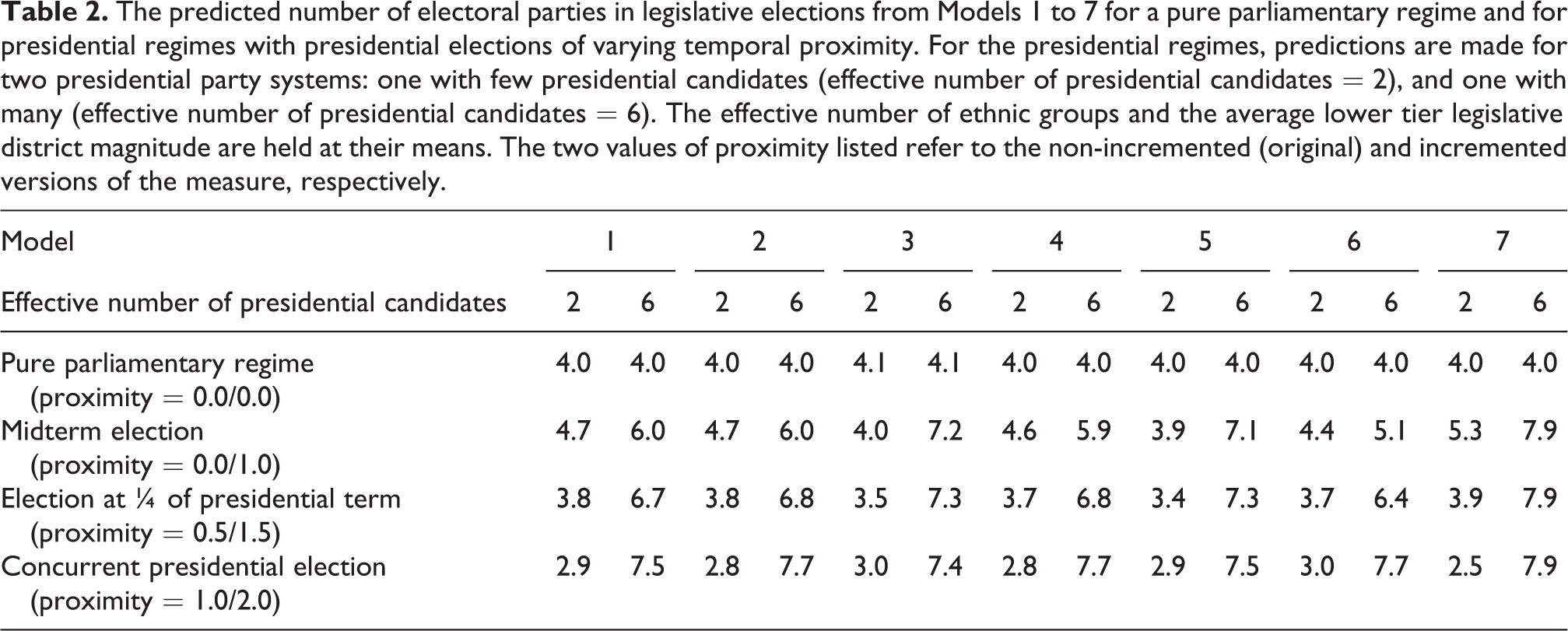
For the presidential regimes, two types of presidential party systems are considered: presidential elections with few presidential candidates (the effective number of presidential candidates equal to 2), and presidential elections with many presidential candidates (the effective number of presidential candidates equal to 6). 23
From this table, one can see that the models make similar predictions for pure parliamentary regimes: the effective number of electoral parties equal to about four. The real story concerns the predicted effect of presidentialism. Perhaps not surprisingly, Model 2 and Model 3’s findings regarding the long presidential coattails diverge in important ways. With few presidential candidates, Model 2 finds an inflationary effect, consistent with the hypothesis of Hicken and Stoll (2010), whereas Model 3 finds no effect at all. With many presidential candidates, both find an inflationary effect, although there is some difference in its estimated magnitude. Accordingly, the empirical findings regarding the long coattails of presidential elections do depend on how the operationalization of temporal proximity treats midterm elections. But what about more temporally proximate presidential elections? In this case, the short coattails combine with the long coattails to produce the overall presidential coattails. As the table shows, with few presidential candidates, the deflationary effect of concurrent presidential elections is clearly observed in that the effective number of electoral parties in legislative elections is predicted to drop to approximately three. Conversely, with many presidential candidates, the inflationary effect of concurrent presidential elections leads to a predicted jump in the effective number of electoral parties to seven and a half. A similar story holds for the less proximate legislative elections held one-quarter of the way into the presidential term, although the magnitudes of the deflationary and inflationary effects are attenuated, as hypothesized. Hence, leaving aside minor disagreements about the magnitudes of these effects (a difference of about 0.50 in the effective number of electoral parties), the empirical findings regarding the short coattails of presidential elections are not sensitive to the treatment of midterm elections.
Models 4 and 5 are estimated in the same way as Models 2 and 3, respectively, except that they allow subsequent presidential elections to have coattails. That is, if there is not a concurrent presidential election, either the preceding or subsequent presidential election is treated as capable of casting a shadow, depending on which one is more temporally proximate. Employing this alternative approach affects the operationalization of both temporal proximity and the effective number of presidential candidates, as discussed earlier. Accordingly, to the extent that the results from Model 4 resemble those of Model 2, and the results from Model 5 resemble those of Model 3, the empirical results are not sensitive to whether subsequent presidential elections are allowed to have coattails.
When not incrementing proximity but allowing subsequent presidential elections to have coattails (Model 4), I obtain very similar results. The same is largely true when incrementing proximity (Model 5). One minor difference in the latter case is that the coefficient on the effective number of presidential candidates (
Finally, Models 6 and 7 attempt to isolate the shadows of preceding and subsequent presidential elections, respectively. This is done by comparing a subset of the ‘treatment’ legislative elections in presidential regimes to the ‘control’ legislative elections in non-presidential regimes. In Model 6, legislative elections in non-presidential regimes are compared to legislative elections in presidential regimes where the temporally closest presidential election was the preceding one; in Model 7, by way of contrast, the comparison is to legislative elections in presidential regimes where the temporally closest presidential election was the subsequent one. Legislative elections held at the presidential midterm and legislative elections held concurrently with a presidential election are excluded from the analysis. 24 The non-incremented version of temporal proximity calculated using days serves as the measure of proximity. To the extent that the results from these two models are similar, preceding and subsequent presidential elections do indeed cast similar shadows.
Table 1 shows that the signs of the coefficients are the same in the two models. But while the substantive magnitudes are in the same ballpark, there are important differences. With respect to the long coattails, subsequent elections are much more inflationary. In Table 1, this can be seen by comparing the estimated coefficients on the effective number of presidential candidates main effect term (
With respect to the short coattails, the most direct comparison of the models comes from calculating the marginal effects of proximity. The larger coefficient on the interaction term (
The overall effects of these two types of presidential elections, which take into account both the short and long coattails, are shown in Table 2. When presidential elections are not temporally proximate to legislative elections, subsequent presidential elections are predicted to lead to a larger effective number of electoral parties in the legislative race than preceding presidential elections. Conversely, when presidential elections are temporally proximate, subsequent presidential elections are predicted to lead to fewer parties in the legislative race than preceding presidential elections if the presidential party system is consolidated, while leading to only slightly more parties in the legislative race if the presidential party system is fragmented.
These findings about the short coattails of the two types of presidential elections likely reflect both the greater uncertainty of the outcome of and the greater prominence of subsequent presidential elections. Regarding the uncertainty of the outcome, the presidential election results are obviously not yet known, with the uncertainty increasing as the proximity of the subsequent presidential election decreases. 26 Yet the effect of this uncertainty will depend on the fragmentation of the presidential race. If the presidential party system is consolidated, uncertainty will matter less because actors know which candidates to strategically coordinate around: the two front-runners. If the presidential party system is fragmented, however, voters, legislative candidates and other political elites may not have a good sense of which presidential candidate to back. This prohibits the dynamics of the presidential race from travelling down the ticket and leaves subsequent presidential elections without much of a short inflationary shadow. Regarding the greater prominence, at the time of a legislative election, an upcoming presidential election is still attracting significant attention from all actors, whereas a presidential election that has already happened rapidly fades from the limelight. 27 Hence, subsequent presidential elections have a greater short deflationary shadow. And the greater prominence of subsequent presidential elections can also explain their more inflationary long shadows: the more prominent the presidential election, the smaller the size of the legislative prize, à la Hicken and Stoll (2010).
Conclusion
To understand why the number of political parties in legislative elections varies across both space and time, scholars have increasingly looked beyond the legislative electoral system. Legislative elections do not happen in a vacuum: they are affected by elections for different levels of government, such as supra-national legislative bodies (e.g. the European Parliament), and different institutional actors, such as popularly elected presidents. This article addresses the latter, contributing to the long-running debate about how the system of government, and particularly the existence of a popularly elected president, affects the fragmentation (size) of the legislative party system. In this article, I have explored the sensitivity of existing empirical findings about this effect, which is usually called the presidential coattails.
My findings diverge from existing studies in important ways. For one, I presented evidence that presidential elections held subsequent to a legislative election have coattails. This stands in contrast to the literature to date, which has focused on concurrent or preceding presidential elections. In fact, I found that presidential elections with few presidential candidates held subsequent to a legislative election cast a larger deflationary shadow over the legislative party system than similar presidential elections held prior to a legislative election. For another, turning from the short to the long coattails of presidentialism, I found some evidence that the shadow cast by presidential elections not held in temporal proximity to legislative elections, i.e. when legislative elections are held at the presidential midterm, depends upon how the variables are measured. This sensitivity included whether presidentialism has a deflationary or an inflationary effect, as well as what the magnitude of the inflationary effect is. Moreover, I presented evidence that calculating the temporal proximity of presidential and legislative elections using years instead of days as the unit, as is common, underestimates the presidential coattails.
Yet overall, my finding is that the conclusions drawn about the presidential coattails seem robust to a variety of different modelling choices. Calculating the temporal proximity of presidential and legislative elections using days instead of years; allowing subsequent presidential elections to cast a shadow; and even treating midterm elections differently from pure parliamentary elections, measurement strategies that all seem preferable, do not alter the basic empirical findings. Specifically, the evidence generally suggests that when presidential elections are not temporally proximate to legislative elections, the legislative party system will be more fragmented, as both Golder (2006) and Hicken and Stoll (2010) predict. Furthermore, the evidence suggests that when presidential elections are temporally proximate to legislative elections and there are few presidential candidates, a deflationary shadow will be cast, reducing the fragmentation of the legislative party system; by way of contrast, when presidential elections are temporally proximate to legislative elections and there are many presidential candidates, either an inflationary shadow will be cast, increasing the fragmentation of the legislative party system, or there will be no shadow.
Accordingly, if presidentialism is to be used to discourage the fragmentation of the legislative party system, the electoral cycle must be such that presidential elections are held in temporal proximity to legislative elections, and the presidential electoral system must be such that the presidential party system itself is not fragmented. These reassuring findings are good news for scholars concerned with the effect of political institutions such as the regime type, and particularly for constitutional engineers.
Footnotes
Acknowledgements
Earlier versions of this article were presented at the 2011 Southern California Political Institutions Conference, University of California, Los Angeles, 16 September, and the 2011 National Conference of the Midwest Political Science Association, Chicago, IL, 31 March–3 April. Thanks go to Allen Hicken; Ethan Scheiner; Matthew Shugart; Ernesto Calvo; Michelle Taylor; Christian Grose; conference participants; and many other colleagues (including anonymous reviewers of my joint work with Hicken) for conversations related to the issues explored in this article. Molly Cohn provided excellent research assistance. All errors of course remain my responsibility. The supplemental article is available on my website  .
.
Funding
This research received no specific grant from any funding agency in the public, commercial or not for-profit sectors.