




Abstract
The method of candidate selection used by parties can influence a number of outcomes related to party organization and representation. In the past decade, Japan’s political parties have increasingly experimented with an ‘open recruitment’ system for selecting new candidates for national elections, but the degree of centralization in the process varies by party. We use candidate and voter survey data to assess whether the new system of recruitment has resulted in intraparty differences in the policy positions of candidates, and their distance from party supporters and the median voter. We find evidence that the new candidate selection method has resulted in the nomination of more centrist and urban-inclined candidates, an indication of greater responsiveness to voters, and that they exhibit higher levels of policy cohesion than their counterparts selected through traditional methods. However, these differences depend on the degree of party centralization in the process.
Introduction
The comparative literature on candidate selection suggests that variation in the methods used by parties can have an impact on political outcomes, even beyond the well-studied influence of electoral systems (Gallagher and Marsh, 1988; Hazan and Rahat, 2010; Lundell, 2004). For example, Gallagher (1988: 12) suggests that the influence of candidate selection institutions might be reflected in candidate characteristics and behavior, and even party cohesion. In short, how a party selects its candidates, and who in the party decides, can have an impact on the types of candidates who are ultimately nominated, the ideological positions they take, and their behavior as candidates and legislators.
In the past decade, Japan’s two main parties, the conservative Liberal Democratic Party (LDP) and the center-left Democratic Party of Japan (DPJ), as well as some of the more recently founded smaller parties, have increasingly experimented with an ‘open recruitment’ system (known as kōbo), which allows for political outsiders to directly apply to the party for consideration for a nomination, typically after a screening process involving interviews with a committee of party elites. 1 The system has helped the LDP and DPJ attract new and diverse personnel and has simultaneously augmented the role played by the central party organization in candidate selection (Smith et al., 2013; Tsutsumi, 2012).
However, there is considerable variation in the application of this system within and between the two parties. In the case of the DPJ, open recruitment contests are conducted at the national level and overseen by the central party organization. Would-be candidates apply directly to the national party organization, which decides who to nominate, and in which district. In contrast, the LDP’s open recruitment contests take place at the local level for specific districts, with the central party leadership exercising oversight and granting final approval of the decisions taken by local selection committees. At the same time, many new candidates in both parties are still selected in the absence of an open recruitment contest, most often by party elites at the local (district or prefectural) level, which was the norm for the LDP and the Japanese Socialist Party – a key predecessor of the DPJ – throughout most of postwar democracy (Fukui, 1997; Shiratori, 1988).
In this study, we use candidate and voter survey data from the 2005 and 2009 House of Representatives (HR) elections to examine the effect that different methods of candidate selection have on policy representation and cohesion within the LDP and DPJ. By policy representation, we mean the degree to which candidates’ policy positions are congruent with the positions of voters in the electorate or among party supporters. Dynamically, this concept also represents policy responsiveness to voters. By policy cohesion, we mean the degree to which candidates’ positions are similar to other candidates in their party. 2 The ‘open’ nature of the new recruitment process has the potential to usher in candidates whose policy positions are more congruent with those of voters. However, the differing levels of centralization in the two parties may also affect the outcome of the process.
Our analysis reveals that the new system has indeed produced candidates whose policy positions differ significantly from those of other candidates in their parties. We find evidence that open recruitment has resulted in the nomination of more centrist and urban-inclined candidates, an indication of greater policy responsiveness to voters, and that these candidates exhibit higher levels of policy cohesion than their counterparts selected through traditional methods. However, these differences are less significant in the decentralized LDP than the centralized DPJ. In the next section, we review the comparative literature on candidate selection methods and their potential effects. We then describe the process of the open recruitment system in Japan and posit several hypotheses for the system’s differential effects, followed by a presentation of our data and the results of our statistical analysis, and then our conclusions.
Candidate selection methods and policy positions
A growing body of literature indicates that the method of candidate selection used by parties can influence a number of outcomes related to party organization and representation (e.g. Gallagher and Marsh, 1988; Hazan and Rahat, 2010; Norris, 1997; Spies and Kaiser, 2014). Rahat and Hazan (2001) provide a useful conceptual framework for analyzing different candidate selection methods and their potential effects. Their framework is based on four distinct dimensions: candidacy (Who is eligible?), the selectorate (Who decides the nomination?), the appointment or voting system (Is there a vote? If so, what type of voting rules?), and lastly decentralization (Is the decision made centrally or locally?).
The eligibility for candidacy within parties can range from being more inclusive (anyone can run) to more exclusive (e.g. party membership or signature requirements). Naturally, a more inclusive candidate pool can be expected to produce a more diverse range of candidates, both in terms of descriptive representation (candidate characteristics and backgrounds) and policy representation. If parties end up choosing a more diverse range of candidates as a result of a more inclusive candidate pool, then the overall character of the party will also be affected.
The selectorate can also be more inclusive (primary elections with all party members, or even all voters, involved) or more exclusive (small party nominating committees or even a single party leader). Additionally, the selectorate’s decision may be based on a vote, and this vote may take different forms (e.g. majoritarian versus proportional allocation rules). Rahat and Hazan (2001: 307) note that voting systems tend to be more common in more inclusive selectorates, but that the two dimensions do not necessarily overlap. When in comes to representation, Rahat and Hazan (2001) argue that more exclusive selectorates might actually increase diversity, because it might be easier for less politically-connected aspirants to approach a smaller number of decision makers. When it comes to behavior, candidates and legislators who must appeal to a smaller party selectorate, rather than a wider, more inclusive selectorate, can be expected to be more faithful party agents. Some comparative studies on party defections and the introduction of private member bills support this assertion (e.g. Faas, 2003; Hix, 2004). Spies and Kaiser (2014) find that parties with more inclusive selectorates tend to display policy positions in their manifestoes that are less representative and responsive to the policy preferences of voters.
Lastly, the degree of centralization can also have an impact, given that a local selectorate might be expected to prioritize local concerns or background characteristics, such as birthplace or residence in the district, than might national party leaders. If candidates are selected in local constituencies, they may thus be expected to reflect that process in terms of their characteristics (e.g. local ties to the constituency) and behavior (e.g. support for policies that benefit the local area). On the other hand, if the (re)nomination of candidates depends on the favor of a national-level party leader, then local connections may be a less important criterion for selection, and selected candidates might be expected to pursue the more nationally-oriented policy goals of the party.
The comparative literature on candidate selection reforms, especially the ‘democratization’ of the process – i.e. expanding the inclusiveness of either the candidacy or selectorate dimensions – tends to focus on established parties that are faced with new electoral challenges (Barnea and Rahat, 2007; Cross and Katz, 2013; Mair et al., 2004). In recent years, parties in many democracies have suffered from declining membership due to a deteriorating connection with social groups. Rather than simply mobilizing existing members and supporters, many parties must now attract votes from an increasing number of unattached, or ‘floating’ voters. In order to gain new members and reinvigorate existing members’ participation, parties have begun to give members greater say in determining candidate nominations (Bille, 2001; Scarrow et al., 2000).
Within established parties, a change in the candidate selection method can also sometimes result from internal power struggles. For example, when candidate selection is undertaken at the local level, the process may be dominated by a small number of local party activists. However, such activists may have more extreme ideological policy positions or more geographically narrow goals than national party leaders. Including rank-and-file members or general voters in candidate selection can lower the influence of activists, and at the same time empower party leaders to set the party’s agenda (Katz, 2001). In highly factionalized parties such as Japan’s LDP (Krauss and Pekkanen, 2011; Nemoto et al., 2014), candidate selection decisions can have an even greater impact on the balance of power within parties. Thus a decision to centralize the process, or to democratize it to allow for greater input of rank-and-file party members or voters, could be used to decrease the influence of factions in the party.
A separate stream in the literature is concerned with the degree to which the policy positions of national-level politicians diverge from those of local-level politicians and voters. May (1973) posits what he terms the ‘Special Law of Curvilinear Disparity’, which predicts that sub-national party leaders (local-level politicians, convention delegates, etc.) will hold more extreme positions (on a left–right dimension) than the median voter. National-level party leaders will display positions somewhere in between, because they are more motivated to cater to the median voter in order to win elections. Comparative empirical investigations of May’s Law have been mixed (Kitschelt, 1989; Norris, 1995; Taniguchi, 2006), finding in many cases that national-level leaders are as extreme or more extreme in their policy positions than local leaders.
Nevertheless, previous examinations of May’s Law have not considered the effect that a difference in the intensity of policy positions between national leaders and local leaders might have when candidates are selected at those levels. To the extent that local leaders hold different views from national leaders, these differences might be expected to appear between candidates selected either locally or nationally. In an analysis using Eurobarometer data on voter attitudes and a survey of candidates for the European Parliament, Dalton (1985) finds that parties with more nationally centralized candidate selection processes tend to be more representative (hold positions closer to those of their supporters) than parties with decentralized processes. More recently, however, Spies and Kaiser (2014) find no support for this hypothesis, although they look only at national-level party policy manifestoes, rather than candidate-level or legislator-level policy positions.
Our main contribution in this study is to connect the logic of May’s Law to the candidate selection process, and evaluate how differences in the process, even within parties and at the same time, can result in significant differences in the policy representativeness of candidates, and overall policy cohesion. As we will describe in the next section, the case of Japan’s open recruitment system provides an opportunity to evaluate differences across the conceptual dimensions of candidacy and centralization. First and foremost, the open recruitment system opens up the selection process to a wider (more inclusive) pool of candidates. Second, there is variation between the parties when it comes to the degree of centralization of the process. Although open recruitment in the DPJ has been centralized, the LDP has opted for a more decentralized process, with prefectural party branches taking charge. Moreover, in many nomination decisions in both parties, the process remains exclusive and largely decentralized. 3
If the more inclusive system results in the selection of political outsiders, such individuals might be expected to hold policy positions that are closer to the mean positions of their voters and follow more closely the movements of national public opinion. However, this might also depend on whether the process is centralized (as in the DPJ) or decentralized (as in the LDP). To the extent that party leaders take a more active role in vetting candidates selected through the open recruitment process, such candidates may in all cases display policy viewpoints or ideologies closer to those of the leaders in power at the time of their selection. In addition, since many outsider candidates have limited personal resources or name recognition, they might rely more on the party’s resources and align themselves more closely with the national party’s image and policies. We might therefore expect that candidates selected through open recruitment would emphasize the policy viewpoints of the party platform and party leaders – who may be more likely than local politicians to make policy appeals that are responsive to the national median voter. In the next section, we describe the details of the open recruitment process in each party and posit hypotheses for the expected impact on nominated candidates’ policy positions.
Open recruitment in Japan’s parties
The first party to hold an open recruitment contest for a national election was the Japan New Party (JNP) in advance of the 1993 HR election. The JNP dissolved in 1994, and many of its members joined the New Frontier Party (NFP). For the 1996 election, the first election held under Japan’s mixed-member majoritarian (MMM) electoral system combing single-member districts (SMD) and proportional representation (PR), 4 the NFP also held an open recruitment contest to find candidates.
After the break-up of the NFP in 1998, the DPJ absorbed many of the former NFP members, but was still a weak party – holding fewer than 100 HR seats. 5 Having only been recently founded in 1996, the party’s presence in local legislatures was also weak (Scheiner, 2006; Uekami and Tsutsumi, 2011; Weiner, 2011) and so it lacked a pool of experienced local-level candidates from which to recruit new national-level candidates. Taking a cue from the experiences of the JNP and NFP, party leaders decided to implement a national open recruitment contest in 1999 to fill the party’s nominations for the upcoming 2000 election. In addition, they held a special round of open recruitment aimed specifically at attracting more female candidates (Gaunder, 2013; Shoji, 2012; Smith et al., 2013). The DPJ’s open recruitment system helped the party grow, and many candidates recruited through the system were even successful at getting elected, most especially in the 2009 election (Smith et al., 2013).
In the 2003 election the DPJ made significant gains on the long-ruling LDP, winning 40 new seats and outpolling the LDP in the PR tier of the electoral system. Party leaders in the LDP noticed that many of the DPJ’s new winners had been chosen through the open recruitment system, sometimes after having been refused a nomination by the LDP (Asano, 2006; Seko, 2006). The LDP’s leaders thus decided to adopt an open recruitment process as well, beginning with a by-election in 2004. 6 The winner of that first open recruitment contest surprisingly went on to win the seat over an incumbent from the DPJ’s PR list, which gave encouragement to the party to use the new system to fill several empty nominations in subsequent elections in 2005 and 2009.
After the LDP’s devastating defeat by the DPJ in the 2009 election, the party decided to make the open recruitment process a more systematic requirement for nominations as part of a reignited effort to introduce internal party reforms (Smith, 2013). Beginning with the 2010 House of Councillors (HC) election, the LDP began to utilize the system heavily (Tsutsumi, 2012), and for the 2012 HR election, the party mandated (with a few exceptions) that an open recruitment contest be held to determine the nomination of any new candidate, as well as any returning candidate who lost his or her SMD contest in 2009 with less than 70% of the winning candidate’s vote (a calculation known as the ‘best-loser ratio’) (Smith 2013).
In all, the DPJ has used its open recruitment system to recruit 98 (27%) of its new HR SMD candidates since 1999, while the LDP has used its system to recruit 117 (43%) of its new candidates (Table 1). For the HC, both parties have used the process less frequently, though the LDP began to apply it in earnest in 2010 and 2013 (Tsutsumi, 2012). Here we focus on SMD candidates to the HR, and there are some important differences between the DPJ and LDP when it comes to the actual process and execution of the open recruitment system.
Open recruitment for new SMD candidates for the House of Representatives, 2000–2012.

Sources: DPJ and LDP election strategy bureaus and various newspapers.
Notes: Percentages are the ratio of new candidates selected through open recruitment to all new candidates in each party. By-election candidates are grouped with the previous general election. LDP data prior to 2004 and DPJ data for 2012 are based on newspaper accounts only.
The DPJ: National execution with local approval
In the DPJ, the open recruitment process for SMD nominations has been primarily ‘top-down’, with the national party leadership exercising considerable control (Shoji, 2012; Smith, 2012). As Smith et al. (2013) describe in detail, the process consists of three main steps: (1) interested applicants submit a form to the national party headquarters with their biographical information, a photo, their preferred electoral district(s), and a short essay describing their motivations or responding to a pre-determined theme; (2) qualified applicants are then interviewed by a small selectorate committee that includes current elected members and party organization staff, and ranked; and, lastly, (3) approved candidates are paired with a district that matches their preferences and the party’s needs.
Apart from a few exceptions, party headquarters controls the entire process. In contrast, candidates who are selected without having to compete in an open recruitment contest typically emerge from the local prefectural branches of the party, which are responsible for providing recommendations for nominations to the national headquarters. The open recruitment system is only used when a qualified candidate cannot be found or settled upon by the local party organization.
The LDP: Local execution with national approval
The basic application process of the LDP’s open recruitment system is similar to that of the DPJ, except that it is administered at the local level by the prefectural branch organization of the party, with the open recruitment announcement specifying the targeted district(s) in advance. Would-be candidates apply directly to a specific district’s open recruitment contest, which is executed at the local level with national oversight and approval, thus making the LDP system more ‘bottom-up’ in nature.
7
Selectorate committees typically include elected members from neighboring districts in the prefecture, as well as prominent local party leaders. The winning candidate is decided locally, and the decision is then sent to the national headquarters for approval, which is nearly always granted.
8
The adoption of open recruitment has thus made the LDP candidate pool more inclusive than in the past, but the decentralized nature of the process may mitigate some of the expected effects.
The differences in the two parties’ processes reflect their evolution as parties. In the case of the LDP, party leaders in the mid-2000s were faced with an increasing number of floating voters in the electorate, and increasing competition from the DPJ to attract those voters. At the same time, entrenched interests and factions in the party resisted internal reforms. In the past, outgoing incumbents and their personal support groups (kōenkai) at the district level exercised considerable influence over new nominations (Ishibashi and Reed, 1992; Reed, 2009). As a result, new nominations favored candidates who were closely connected to the outgoing incumbents, such as their children (so-called ‘hereditary candidates’) or their political secretaries (Fukui, 1997; Shiratori, 1988). Many of the LDP incumbents who opposed the adoption of open recruitment had sons to whom they hoped to ‘bequeath’ their seats when they retired (Smith, 2012). Thus, the adoption of open recruitment by the LDP can be considered (1) a reform aimed at responding to a changing electorate; and, at the same time, (2) a tool for concentrating greater control over nominations in the central party leadership – in part in order to effectively execute the reform, but also in part to consolidate the power of party leaders. The fact that the process that ultimately emerged was more ‘bottom-up’ than that of the DPJ underscores both the established organization of the party at the local level, and the entrenched influence of local politicians and incumbents in the party.
Data and results
To explore the possibility that candidates selected through the open recruitment system differ systematically from other candidates in terms of ideology, we compare the policy positions of SMD candidates as reported in pre-election surveys jointly conducted by Masaki Taniguchi of the Graduate Schools for Law and Politics at the University of Tokyo and the Asahi Shimbun (The UTokyo-Asahi Survey, henceforth UTAS). 9 We restrict our sample to the 2005 and 2009 HR elections, in which both parties utilized open recruitment. We exclude the 2012 election because the LDP required local branches to select candidates through open recruitment in that election (therefore many traditional candidates who would not normally have been subjected to an open recruitment contest were nominated through the process), and because the DPJ only used the system in a few races. We focus on first-time candidates since the effect of candidate selection methods on policy positions may diminish over time for incumbent legislators.
The surveys were conducted in the weeks before the election for all candidates, with a response rate higher than 90%. In each survey, candidates were given policy statements (13 in the 2005 election, 25 in the 2009 election) and asked to choose one of five options from ‘agree’, ‘mostly agree’, ‘neither agree nor disagree’, ‘mostly disagree’ and ‘disagree’, which we code on a 1-5 scale, in that order. For an additional ten questions in the 2009 election survey, candidates were given two opposed statements about an issue and required to answer which statement (A or B) was closer to their beliefs, or if neither of them was close. For these questions, we code ‘A’ responses as 1, ‘B’ responses as 5, and ‘neither’ as 3. Voters in the 2009 election were asked similar questions to those given to candidates. Data on the recruitment method used come from the election strategy committees of the LDP and DPJ party organizations, as well as local newspaper reports.
Candidate positions on individual policy issues
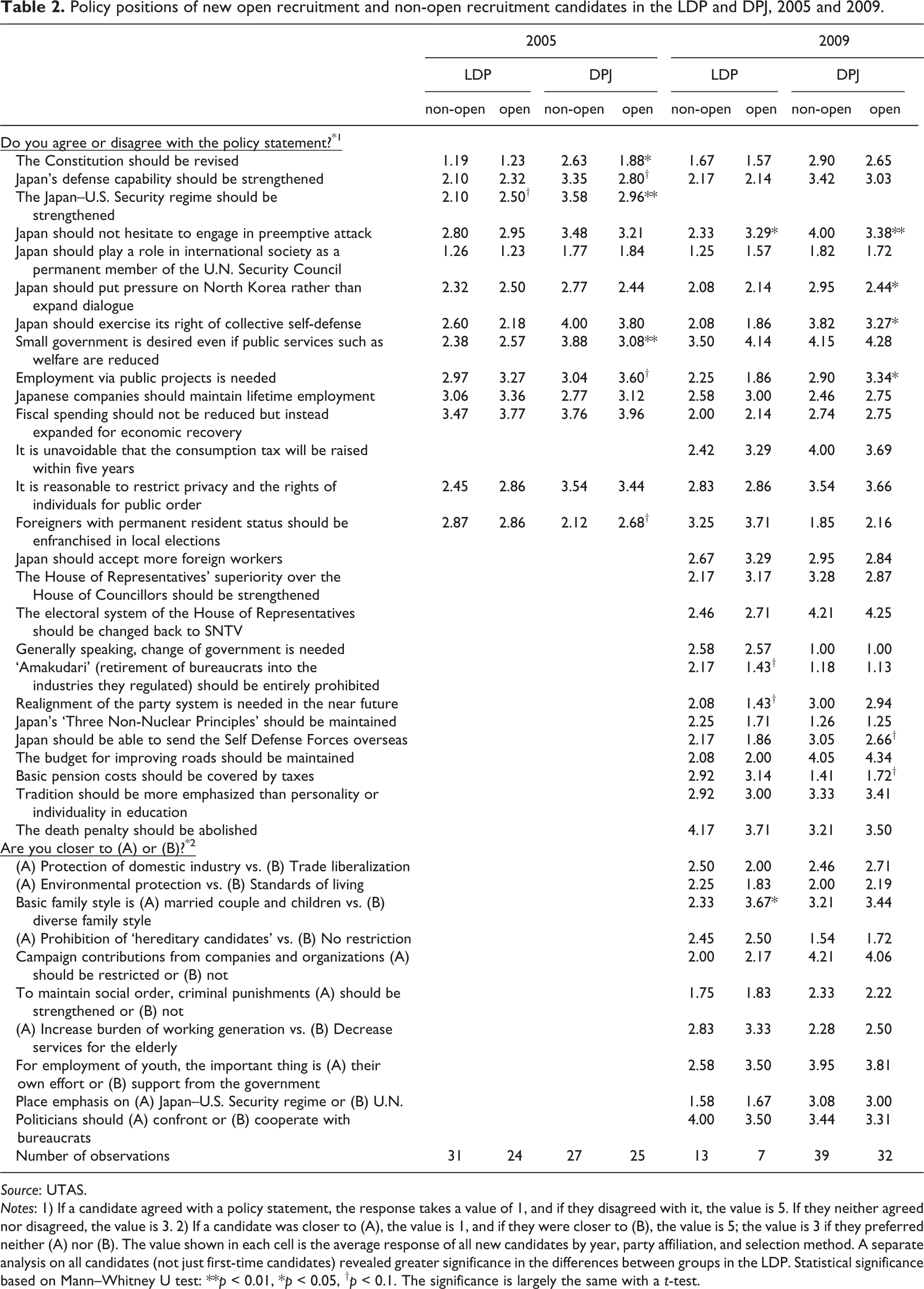
Table 2 shows the full range of survey questions and the mean positions of new open recruitment and non-open recruitment candidates for the LDP and DPJ. Both in 2005 and in 2009, LDP candidates who had been selected through open recruitment had a tendency to take a less ‘conservative’ attitude toward diplomacy and security policy than other candidates. For instance, they did not think that Japan should strengthen the US–Japan security regime in 2005, and hesitated to support the idea of preemptive attack in 2009. On a range of issues, open recruitment candidates from the LDP preferred more centrist positions than their co-partisans, and were more inclined to prefer reforms to the existing Japanese economic system (such as lifetime employment), policy stances that were in line with those of Prime Minister Junichiro Koizumi in 2005. 10 These tendencies weakened in the 2009 election after the 2008 world financial crisis, although candidates selected through open recruitment still tended to be more ‘reformist’ on some economic issues than other candidates.
Policy positions of new open recruitment and non-open recruitment candidates in the LDP and DPJ, 2005 and 2009.
Source: UTAS.
Notes: 1) If a candidate agreed with a policy statement, the response takes a value of 1, and if they disagreed with it, the value is 5. If they neither agreed nor disagreed, the value is 3. 2) If a candidate was closer to (A), the value is 1, and if they were closer to (B), the value is 5; the value is 3 if they preferred neither (A) nor (B). The value shown in each cell is the average response of all new candidates by year, party affiliation, and selection method. A separate analysis on all candidates (not just first-time candidates) revealed greater significance in the differences between groups in the LDP. Statistical significance based on Mann–Whitney U test: **p < 0.01, *p < 0.05, †p < 0.1. The significance is largely the same with a t-test.
Roughly speaking, candidates in the DPJ exhibited similar differences. In both elections, DPJ candidates selected through the open recruitment system were more ‘reformist’ economically (e.g. they tended to disagree with creating employment via public projects), and more conservative (e.g. they were permissive toward the exercise of collective defense and strengthening defense capabilities) than their counterparts. These observed differences corroborate the results of Tsutsumi (2012), who similarly finds that open recruitment candidates for the 2010 HC election from both parties were more ‘reformist’.
Candidate positions on policy dimensions
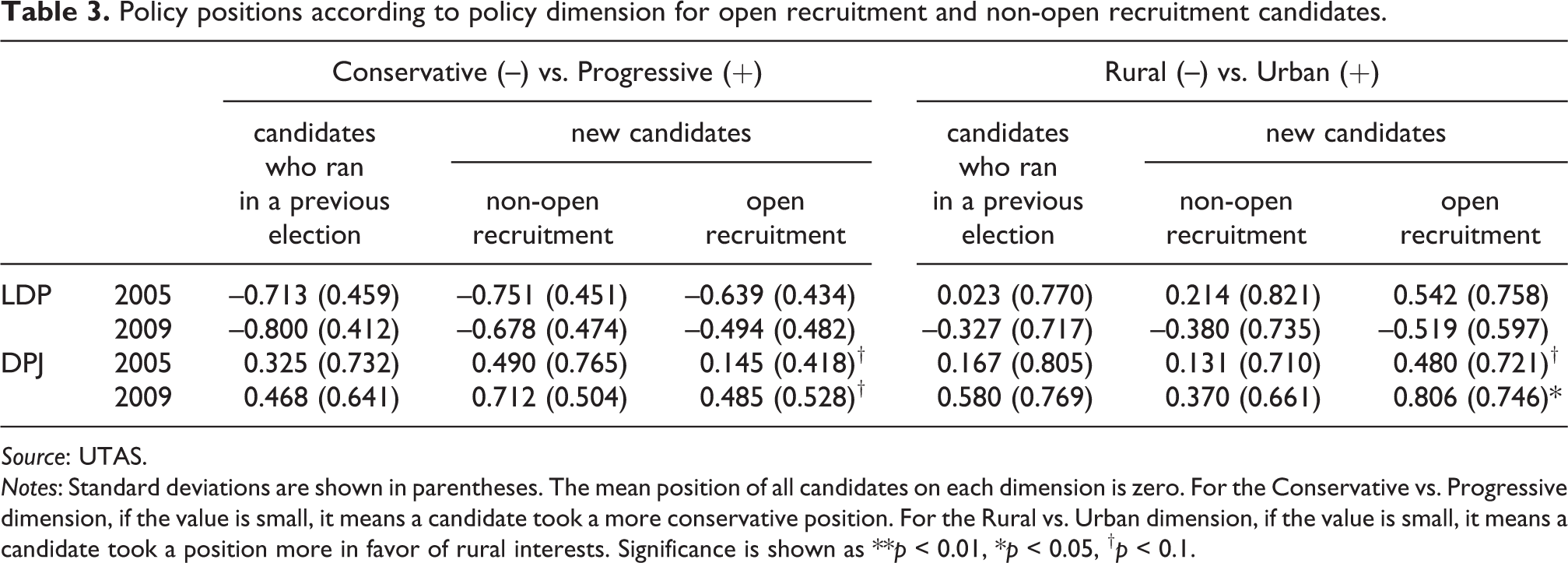
A factor analysis of candidate answers to the UTAS questions in the 2005 and 2009 elections further reveals the differences between candidates selected through open recruitment and their peers. 11 We used all survey questions for this analysis, with the exception of three that were considerably partisan, such as the ‘need for a change of government’. In both elections, two common policy dimensions can be identified from the responses, 1) a ‘Conservative vs. Progressive’ dimension, and 2) a ‘Rural vs. Urban’ dimension, and we generated factor scores to represent candidates' positions on these two dimensions. (details in the appendix). The ‘Conservative vs. Progressive’ dimension is essentially related to diplomacy, security, and social policy, and the ‘Rural vs. Urban’ dimension is related to attitudes toward government spending and economic policy. Table 3 shows the mean positions and variance of the LDP and DPJ’s open recruitment and non-open recruitment candidates on these two dimensions in each election.
Policy positions according to policy dimension for open recruitment and non-open recruitment candidates.
Source: UTAS.
Notes: Standard deviations are shown in parentheses. The mean position of all candidates on each dimension is zero. For the Conservative vs. Progressive dimension, if the value is small, it means a candidate took a more conservative position. For the Rural vs. Urban dimension, if the value is small, it means a candidate took a position more in favor of rural interests. Significance is shown as **p < 0.01, *p < 0.05, †p < 0.1.
Regarding the ‘Conservative vs. Progressive’ dimension, LDP candidates selected though open recruitment appeared to be somewhat closer to the center, while candidates selected through a traditional method were somewhat more conservative. Similarly, the mean position of DPJ candidates selected through open recruitment is more conservative than that of their counterparts, meaning they were closer to the center on this dimension. Additionally, the variance among open recruitment candidates in the DPJ tends to be smaller than that among other candidates, indicating that they are a more cohesive group in terms of policy preferences. This is an important change for the DPJ, which has suffered from ideological disunity since absorbing several disparate parties between 1996 and 2003 (Smith et al., 2013).
On the ‘Rural vs. Urban’ dimension, open recruitment candidates of both parties in 2005 took positions that are generally preferred by voters living in more urban areas. LDP candidates, regardless of their selection process, ‘corrected’ their position from leaning ‘urban’ with then-Prime Minister Koizumi’s reforms in 2005, back toward ‘rural’ in 2009 after the popularity of Koizumi’s reforms declined, and after the 2008 world financial crisis, but the change was most dramatic among open recruitment candidates. It could be that open recruitment candidates are more sensitive to changes in public opinion, though this interpretation should be embraced with caution due to the small number of new open recruitment candidates in the LDP in the 2009 election. On the other hand, for the DPJ in 2009, open recruitment candidates remained oriented toward a more ‘urban’ position than their counterparts. The variance among open recruitment candidates’ positions and that among non-open recruitment candidates’ positions is not considerably different. This suggests that, in addition to each candidate’s selection process and the specific trends of the election, other variables like district characteristics or personal backgrounds are likely to be important determinants of individual candidates’ policy positions on this dimension.
The 2009 UTAS also asked a national sample of voters for their attitudes regarding 23 of the 35 policy statements on which candidates were questioned, which allows us to compare the candidates’ policy positions with the mean position of their party’s voters, and the median position of all voters (at the national level, not in the district). Given the assumptions of May’s Law and the hypotheses we posited above, we would expect that open recruitment candidates should hold positions that are closer to those of voters, and that this tendency should be stronger in the DPJ, where the process is dominated by central party leaders, than in the LDP, where local leaders play a larger role. To test this hypothesis, we conducted a second factor analysis using candidate answers to the questions which voters were also asked and obtained two dimensions which can similarly be interpreted as ‘Conservative vs. Progressive’ and ‘Rural vs. Urban’, although they are not identical to the dimensions obtained from the previous analysis using all 32 non-partisan policy issues (see appendix for details). We then calculated the mean score of LDP and DPJ voters, in addition to the median score for all respondents who intended to vote. Figure 1 shows these positions on each policy dimension for new candidates selected through open recruitment, non-open recruitment new candidates, and voters in each party. The vertical dashed line denotes the overall median position of national voters on each dimension.

Positions of voters and new candidates on two policy dimensions in 2009.
On the ‘Conservative vs. Progressive’ dimension, the results illustrate that candidates in both parties took more extreme positions than their voters. However, for each party, candidates selected through the open recruitment system were (only slightly for the LDP) closer to their party’s voters, and to the center, than candidates selected through a traditional, decentralized and exclusive method. This result provides some support for the hypothesis that policy differences between local and national party leaders, as expected by May’s Law, are also reflected in the outcomes of candidate selection when the degree of party centralization in the process varies across candidates.
On the ‘Rural vs. Urban’ dimension, the results are nearly reversed. For the LDP, open recruitment candidates occupied a policy position more distant from the party’s voters than non-open recruitment candidates. However, as shown in Table 3, new open recruitment candidates in the LDP in 2005 were more likely to be ‘reformist’ and urban-inclined than their counterparts. Thus, it would be incorrect to understand that LDP open recruitment candidates always have a tendency to prefer rural-leaning positions. New DPJ candidates selected through open recruitment were also further away from both the mean position of national voters, and the party’s voters, than their peers. Combined with the results shown in Table 3, it is more clearly evident that DPJ candidates selected through the open recruitment system had a tendency to advocate pro-urban policies.
Multivariate analysis
The results presented thus far suggest that the open recruitment system has generated candidates who tend to be more centrist and ideologically cohesive than others in their parties and exhibit a more ‘reformist’, or urban-inclined orientation. However, our analysis up to this point does not control for the influence of other crucial variables related to candidate and district characteristics. These are important, because the adoption of open recruitment is not random: certain districts may be more likely to employ the system and be more likely in general to produce certain types of candidates. For example, if open recruitment is only utilized in urban districts, it should not be surprising that the candidates selected would hold pro-urban policy positions. We now turn to a multivariate analysis to examine the effect of the system on policy positions controlling for the influence of these variables.
Our dependent variables are the policy positions of the LDP and DPJ candidates on the ‘Conservative vs. Progressive’ and ‘Rural vs. Urban’ dimensions from the previous factor analysis. 12 Since a more conservative candidate represents a more extreme candidate in the case of the LDP, but a more moderate one in the case of the DPJ, and since the open recruitment processes are not identical in each party, we analyze each party separately. Our key explanatory variable is a dummy variable for whether the candidate was recruited through an open recruitment contest or not. We control for the year when the election was held with a dummy variable for the 2009 election. In addition, we add interaction terms for selection method and year to address the possibility that the effect of open recruitment might differ election by election.
We additionally control for the level of urbanization in the district. Traditionally, rural areas have been inclined to be conservative and have needed subsidies and protectionist policies from the central government. We use the proportion of residents who live in census-defined ‘densely inhabited districts’ within the SMD as an indicator of urbanization. We also include dummy variable controls for whether a candidate was born in the prefecture containing the district, and whether he or she had prior experience in local politics or the HC. Candidates who were born in the area might be expected to have stronger connections to the district, and might therefore be influenced by the local party branch and traditional supporters. That can also be said about candidates who have experience in local politics. Lastly, we include the candidates’ (logged) age to control for any ‘generation gap’ within each party (Kabashima and Takenaka, 2012), and a dummy variable for gender (female).
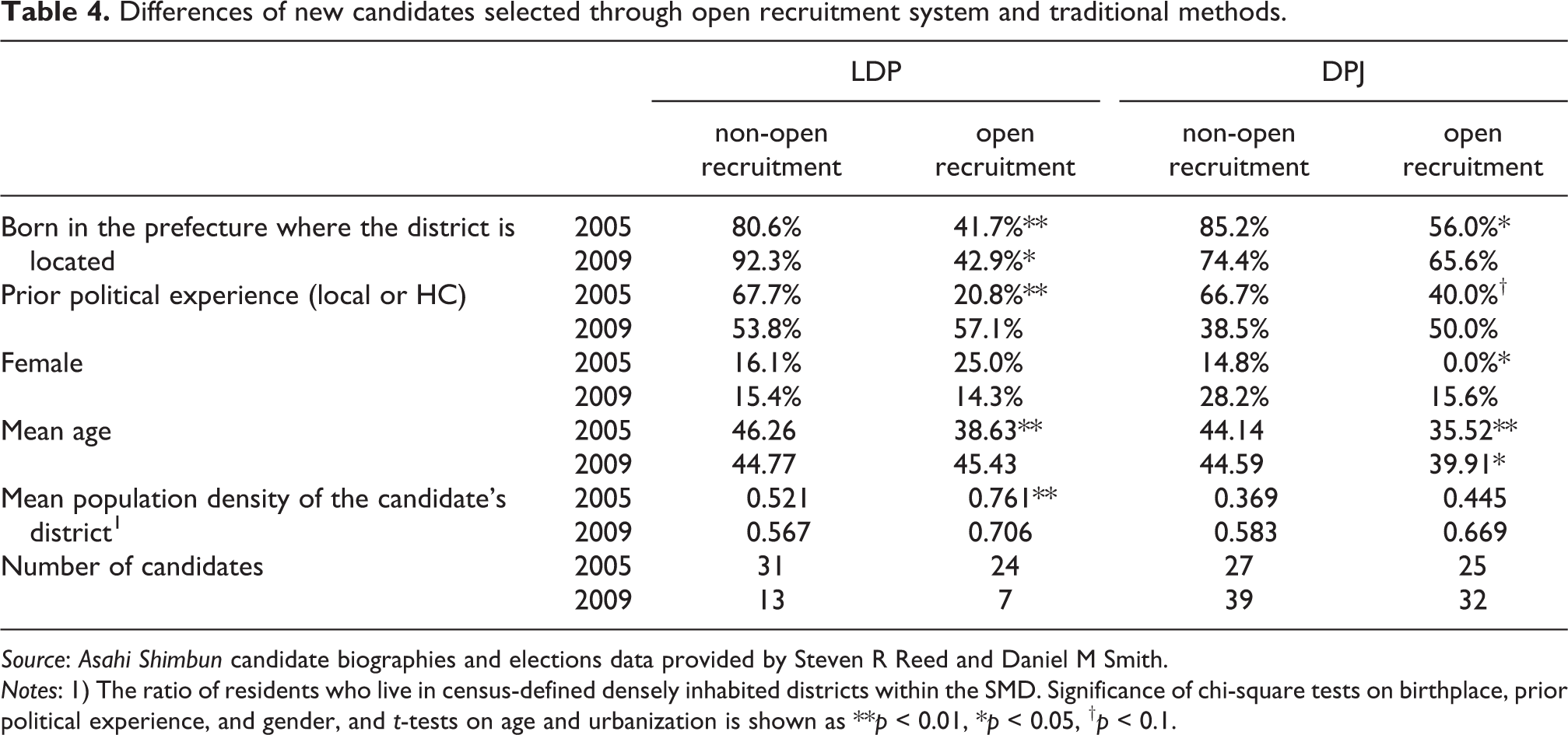
We use OLS regression to test three models. Model 1 includes only our key explanatory variable (open recruitment), election year, the interaction of open recruitment and election year, and urbanization of the district. Model 2 adds age and gender, and in Model 3 all control variables are included. As shown in Table 4, the open recruitment system has a tendency to select candidates who are different from those selected through traditional methods. For both parties, many candidates selected through this system were outsiders to the district, young and less experienced (except in 2009). As mentioned previously, the open recruitment system in the DPJ was initially adopted as a means to solve a shortage of qualified candidates. For the LDP, the system was primarily a way to find new types of candidates to project a reformist image. Thus, it can be understood that the open recruitment system selected ‘outsiders’ in the sense of political inexperience, youth and lack of ties to the district, and the effects of these candidates’ characteristics on policy positions should be considered part of the effect of the open recruitment system. 13
Differences of new candidates selected through open recruitment system and traditional methods.
Source: Asahi Shimbun candidate biographies and elections data provided by Steven R Reed and Daniel M Smith.
Notes: 1) The ratio of residents who live in census-defined densely inhabited districts within the SMD. Significance of chi-square tests on birthplace, prior political experience, and gender, and t-tests on age and urbanization is shown as **p < 0.01, *p < 0.05, †p < 0.1.
However, the potential effects of personal attributes (age and gender) are somewhat different from local ties to the district (local political experience and birth). The latter might directly influence a candidate’s campaign strategy (whether to appeal to the party’s traditional supporters or to floating voters) while the former does not explicitly matter to the district. Therefore, in Model 1 we include only year and district urbanization controls; in Model 2, we add controls for personal attributes (age and gender); and then in Model 3 we add the variables regarding local ties to the district.
Regression analysis results are shown in Table 5. On the ‘Conservative vs. Progressive’ dimension, our model does not explain the policy positions of LDP candidates well, except in the case of gender in Model 2. With regard to the candidate selection method, LDP candidates selected through the open recruitment system adopted slightly (though not statistically significant) less conservative positions than others in the party. For the DPJ, the results indicate that older and female candidates were inclined to be more progressive than younger or male candidates. This suggests that there is a generation and gender gap regarding traditional ideological issues within the DPJ. In addition, selection through open recruitment is significantly related to DPJ candidates’ policy positions on this dimension, especially in the 2005 election, though the significance of this variable declines with the addition of other control variables in Models 2 and 3. As with the LDP, DPJ candidates selected though open recruitment are located closer to the center ideologically.
Results of multivariate regression analysis explaining new candidates’ positions on two policy dimensions.

Notes: **p < 0.01, *p < 0.05, †p < 0.1. Standard errors are clustered by prefecture.
On the ‘Rural vs. Urban’ dimension, for the LDP we find that new candidates in 2009 differed remarkably from those in 2005. We also find that female and locally-born candidates were more likely to take pro-rural positions, while the open recruitment system did not significantly affect their positions. Though not statistically significant, it is interesting that the effect of open recruitment was different between the two elections – new open recruitment candidates in 2005 preferred pro-urban positions, while those in 2009 took more pro-rural positions. For the DPJ, district urbanization was a crucial determinant of the candidates’ positions. DPJ candidates who ran in rural districts advocated for the transfer of resources from the central government to local governments, or from urban areas to rural areas. Candidates selected through open recruitment had a tendency to take more urban-leaning positions than their counterparts, and this effect is somewhat larger in 2009 than in 2005. However, the size of the effect declines when we control for the influence of other variables, as with the ‘Conservative vs. Progressive’ dimension. This means that the open recruitment system indirectly affects candidates’ policy positions, and we can infer that the system produces candidates who are less favorable to pro-rural policies and are ideologically more moderate. Interestingly, candidates selected through open recruitment in both parties weakened their inclination toward pro-urban policies in 2009, though those of the DPJ still preferred pro-urban policies more so than their counterparts. Considering the issue contexts of the 2005 election, which revolved around the reform initiatives of then-Prime Minister Koizumi, and the 2009 election, which occurred after the world financial crisis, these findings suggest that candidates selected through the open recruitment system display greater responsiveness to changes in public opinion.
In sum, the introduction of the open recruitment system has had a significant effect on candidates’ policy positions for the DPJ, while the effect has been less clear for the LDP, on both policy dimensions. While this is in part due to the low number of observations in the LDP, it can also be understood as a result of the difference in the centralization of the candidate selection processes of the two parties. That is, the DPJ’s centralized open recruitment system results in national party leaders’ vote-seeking preferences being reflected to a larger extent in the policy positions of selected candidates. As a result, DPJ candidates selected through open recruitment tend to hold policy positions that are more in line with national public opinion. The LDP’s open recruitment system, which is implemented by local branches, mitigates these effects – despite the more inclusive candidate pool in both parties’ systems. In other words, the ‘open’ nature of the new recruitment system increases parties’ options in candidate selection, which may affect candidate characteristics and backgrounds, but the degree of centralization in the process appears to have a greater impact on determining the outcome in terms of policy representation.
Conclusion
In the past few decades, there has been an increased awareness and interest among scholars and practitioners of politics about how methods of candidate selection can have an impact on parties and representation. Changes in the electorate and new demands on parties have resulted in dramatic reforms to the way in which candidates are recruited and selected. In Japan, established parties faced with new electoral challenges, as well as new parties attempting to upend the existing party system, have increasingly turned to open recruitment as the preferred method of candidate selection. However, the impact of this trend has been largely unexplored.
In this paper, we have examined the effect of the open recruitment system on the policy positions taken by new candidates in the LDP and DPJ in the 2005 and 2009 HR elections. The open recruitment system makes the pool of eligible candidates more inclusive in both parties, which should be expected to produce candidates whose policy positions are more representative of voters’ positions and who are more responsive to changes in national public opinion. At the same time, the system strengthens the control of party leaders, allowing them more opportunity to shape the nature of the party in order to attract these voters. However, the levels of centralization in the LDP and DPJ differ, with the national party leadership of the DPJ playing a greater role than that of the LDP.
As with many past studies of May’s Law and the effect of candidate selection methods on policy positions, our findings are mixed. On the one hand, the system has, in general, produced candidates in both parties whose policy positions are more representative of ‘urban’ preferences; on the other hand, the evidence for an effect on traditional conservative vs. progressive issues is weaker. On the whole, candidates selected through open recruitment appear to hold positions closer to those of voters, but the difference is partly a result of where open recruitment contests have been held. The effect is stronger in the DPJ’s centralized process than in the LDP’s decentralized process, which suggests that between candidacy and decentralization – two key dimensions of potential variation in candidate selection methods (Rahat and Hazan, 2001) – decentralization would seem to have the greater impact on policy representation in Japan.
We also see some evidence that candidates selected through open recruitment exhibit less variance in policy positions than their counterparts. Here, the impact of open recruitment may potentially prove more enduring. If the open recruitment system results in more cohesive parties, then its increased use over time might help to mitigate the internecine policy conflicts that have plagued Japanese parties in recent years. 14 However, this will depend on the extent to which the system is used within parties. For example, although our findings indicate that DPJ candidates selected through the centralized open recruitment process are closer to each other ideologically, they differ from their non-open recruitment counterparts, so overall policy cohesion among new candidates in the DPJ is still weak. The results of our analysis here of the initial effects of open recruitment on candidate policy positions make us optimistic that greater policy cohesion and greater responsiveness to voter preferences by Japanese parties may be encouraged with the continued and more universal use of the new method for candidate selection.
Footnotes
Acknowledgements
Author’s contributions are equal. We thank three anonymous reviewers, Kenneth McElwain, Amy Catalinac, Kyohei Yamada, and several other workshop and conference participants for helpful comments. All remaining errors are our own. Replication data are available on request.
Declaration of Conflicting Interests
The author(s) declared no potential conflicts of interest with respect to the research, authorship, and/or publication of this article.
Funding
The author(s) disclosed receipt of the following financial support for the research, authorship, and/or publication of this article: This work was partially supported by Japan Society for the Promotion of Science (grant no 24730119).
Notes
Appendix
To infer the dimensions that capture the variation in positions on each policy issue, we conducted a factor analysis using candidates’ attitudes toward various policy issues in UTAS for the 2005 and 2009 elections. In addition to the analysis using all issues, we also conducted a factor analysis using the issues in 2009 about which voters were also questioned, in order to generate Figure 1. The factor analysis results are as follows. We interpreted factor 1 as being a “Conservative vs. Progressive” dimension, and factor 2 as being a “Rural vs. Urban” dimension. For our dependent variable, we estimated a regression based factor score for each candidate that represents his or her overall position on each dimension in each year (factor scores are standardized to a mean of zero).