




Abstract
This research note analyses the role that party manifestos play in El Salvador and Guatemala, two newer democracies. In recent elections, the importance of manifestos has increased in both systems. This study examines this development. It explores the ‘why’s’ (purpose) and ‘how’s’ (the method of production) of party manifestos to learn more about the internal workings of parties and their relationship with society. The findings from this study suggest that in new democracies, international party assistance programmes can play a crucial role in making manifestos relevant. Whether manifestos enhance democracy in the long term, however, depends on party system institutionalization. These results point to an opportunity for research in new and younger party systems.
Introduction
The literature on newer party systems has, for the most part, not used manifestos in its analysis. Parties in these systems do, however, create these documents. Often, they generate them even when they are not required to do so. This is the case in El Salvador and Guatemala.
In a recent development, parties in both countries began to treat manifestos as necessary documents. This decision merits our attention. Why did political parties decide to invest in manifestos? How do parties create them? Lastly, have manifestos enhanced democracy? By answering these questions, we can learn about the internal workings of parties and their relationship with society (Harmel, in this issue).
The study fins that as Harmel, in this issue, hypothesized, ‘“purpose” impacts “process”‘ (10; italics in original), providing further evidence that the method of production of manifestos is worth studying (Harmel, in this issue; Weinberg, 1977). Furthermore, international organizations can be important in making manifestos relevant. As a result, however, manifestos do not automatically strengthen democracy, although they are more likely to do so in stable systems.
Studying manifestos in newer party systems
With little research on the role of manifestos in newer democracies, what might explain the ‘why’ or ‘how’ of these documents is less clear. Previous studies do point to some potential explanatory factors. I explore four.
Party system institutionalization (PSI), especially the stability of electoral competition and strength of partisan organizations, influences the policymaking process in newer democracies (Jones, 2005). This suggests that PSI might shape the purpose and production of manifestos and that manifestos are more likely to contribute to accountability in institutionalized systems.
Another trait particular to newer systems, international party assistance programmes, which seek to promote the development of responsive parties, could be important to the development of manifestos (Burnell and Gerrits, 2010: 1069–1070).
An examination of the literature on older systems suggests that ideology and party–society linkages might also affect the why and how of manifestos (Bara, 2005: 585, 596; Kavanagh, 1981; Weinberg, 1977: 13). 1
Manifestos in El Salvador and Guatemala
In El Salvador and Guatemala, manifestos have recently become important. Differences between the two systems provide an opportunity to study this change. El Salvador transitioned to democracy in 1994 and Guatemala in 1999. Since then, the two regimes developed very differently. In 2016, Freedom House ranked El Salvador as 2.5 and Guatemala as 4 on a scale from 1 to 7, where 1 is most free and 7 least free.
This difference is clear in the party systems. El Salvador is one of Latin America’s most stable systems and Guatemala is one of its most inchoate ones (Alcántara Sáez, 2012). A closer look at electoral volatility highlights this (see Figure 1). After the inclusion of the ex-guerrilla movement, the ‘Frente Farabundo Martí para la Liberación Nacional’ (FMLN), in the 1994 Salvadoran election, volatility has remained low. In Guatemala, the inclusion of the ex-guerrilla movement in 1999 did not have a similar effect.

Electoral volatility in legislative elections. Sources: Author’s calculations based on data from Payne et al. (2007) and the Supreme Electoral Tribunals. Regional average is calculated with data from Alcántara Sáez (2012); it includes 16 Latin American countries (1990–2011).
A second characteristic of PSI, strong partisan organizations, also highlights differences between the two systems. During the dual transition, the Salvadoran conservative elite faced a well-organized opposition from the centre and the left. 2 This created an incentive to invest in a partisan organization (España-Nájera, 2009). Today, the two central parties benefit from their organizations. On average, the ‘Alianza Republicana Nationalista’ (ARENA) and the FMLN receive a majority of votes, about 74% in legislative elections (1994–2015; see Table 1). With the ARENA and the FMLN monopolizing each one side of the ideological spectrum, new parties struggle to compete, averaging about 7.3% of votes (1994–2015).
El Salvador’s strong legislative winners.

Note: *Marks when the party held the presidency; FMLN: Frente Farabundo Martí para la Liberación Nacional; ARENA: Alianza Republicana Nationalista.
Source: Author’s calculations based on data from Payne et al. (2007) and the Supreme Electoral Tribunal.
In Guatemala, there is no need for strong partisan organizations. Instead, politicians have an incentive to compete in new parties. On average, these receive 27.8% of votes in legislative elections (1999–2015). It takes a successful Guatemalan party about two electoral cycles to win the presidency and a similar period of time to slide into irrelevancy (see Table 2). This instability is also present in the membership of parties. For instance, in the 2007–2011 legislature, more than 50% of its members switched parties, some more than once (Blanco, 2011). A consequence of Guatemala’s inchoate system is that international party assistance programmes remain active, while they are less important in El Salvador (interview with Alvarez de Goitia et al., 2013).
Guatemala’s weak legislative winners.
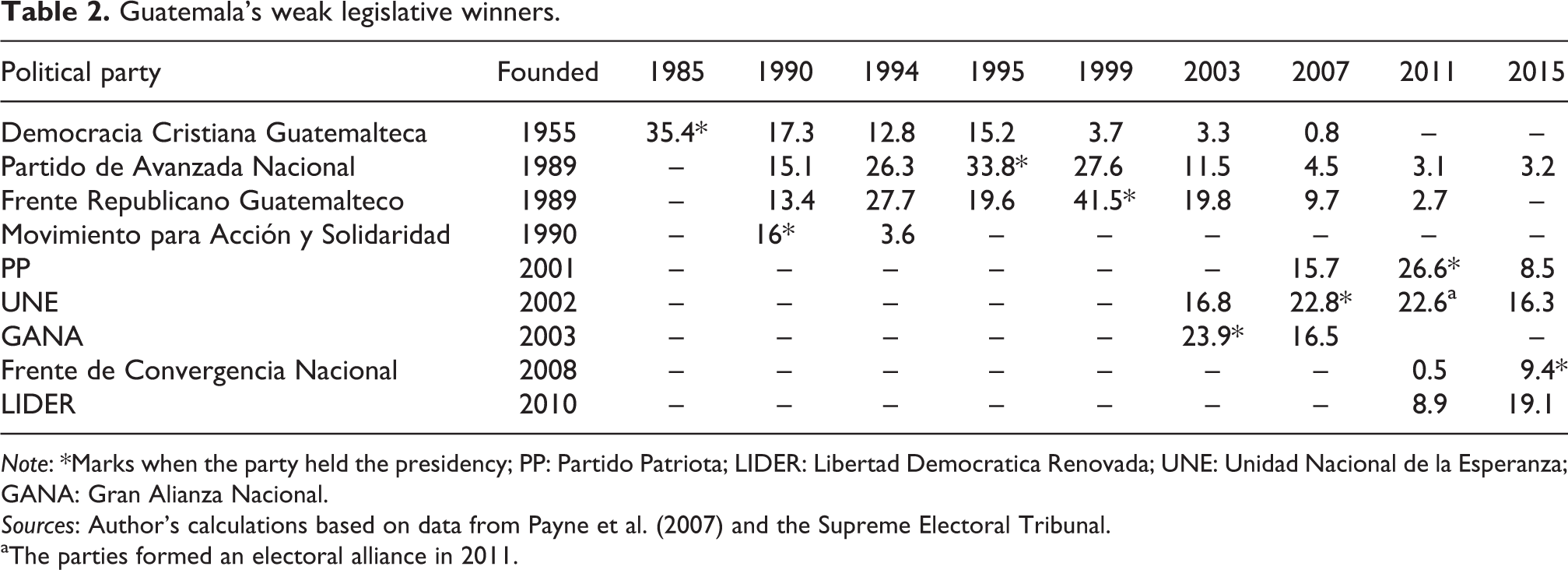
Note: *Marks when the party held the presidency; PP: Partido Patriota; LIDER: Libertad Democratica Renovada; UNE: Unidad Nacional de la Esperanza; GANA: Gran Alianza Nacional.
Sources: Author’s calculations based on data from Payne et al. (2007) and the Supreme Electoral Tribunal.
aThe parties formed an electoral alliance in 2011.
There are also differences in ideology and party–society linkages between the two systems. El Salvador has a high level of polarization, with parties across the spectrum. The majority of Guatemalan parties tend to be conservative (Alcántara Sáez, 2012). Additionally, while clientelism is important in both systems (Artiga González, 2014; España-Nájera, 2009), in El Salvador, programmatic linkages also exist (Lucas, 2015).
To study manifestos in these diverse systems, I examined the 2014 and 2011 presidential elections in El Salvador and Guatemala, respectively. I conducted elite interviews in June and July of 2013, with follow-up interviews in July of 2015 in Guatemala. I met with individuals charged with the creation of the manifestos, participants in the process and legislators. I also talked with political analysts from the major think tanks and representatives of social movements, who evaluated the programmes. 3 Lastly, I interviewed representatives of international party assistance programmes. 4
In each country, I studied the three parties with the largest vote share. In El Salvador, these were the FMLN, the ARENA and the ‘Gran Alianza por la Unidad Nacional’ (GANA). In Guatemala, I studied the ‘Partido Patriota’, the ‘Libertad Democrática Renovada’ and the electoral alliance between the ‘Unidad Nacional de la Esperanza’ (UNE) and the ‘Gran Alianza Nacional’ (GANA). I also included the 2011 leftist coalition, ‘Frente Amplio’, although it only received 3.3% of the vote.
Strengthening party democracy in El Salvador, one step forward
Prior to 2009, Salvadoran parties developed policy documents that described their positions. The parties, however, did not distribute them widely. In the case of the FMLN, the national leadership was responsible for elaborating the documents. Once ready, the party distributed them to lower ranking leaders in its numerous party groups, for example, farmers or women groups, as well as its departmental and municipal-level leaders (interviews with Fernandez, 2013; Rodríguez, 2013b). ARENA, in the late 1980s and early 1990s, relied – informally – on the Salvadoran Foundation for Economic and Social Development, a think tank, to elaborate its policy positions. After this, the party held internal consultations, but these were limited and not publicized (interviews with Miranda, 2013; Simán, 2013; Ulloa, 2013).
In 2009, there was an opening up of this process. The Foundation for Dr Guillermo Manuel Ungo and the Friedrich-Ebert-Stiftung Foundation (FES) sponsored meetings that invited parties and important actors to participate in a national dialogue. The FES’ goal was to encourage the elaboration of party programmes. It directly supported the FMLN, and a smaller centre-left party, providing training on the elaboration process (interview with Alvarez de Goitia et al., 2013). The FMLN’s presidential candidate, a non-party member, supported the dialogue and benefited from the attention it generated (interview with Alvarez de Goitia et al., 2013). As a result of this dialogue, civil society and the media began to actively seek party manifestos (Rodríguez, 2013a). The other parties responded by replicating the process. ARENA, for instance, quickly moved to include its base more publicly in its deliberations (interviews with Miranda, 2013; Reyes, 2013).
In 2014, all parties increased the level of participation. Once again, the FMLN took the lead. It decided to hold a substantial consultation process, but this time, only with its members. The party chose Marcos Rodríguez, a historical leader, to coordinate the process. In 2013, he organized working groups throughout the country (interview with Rodríguez, 2013b). The FES supported the process, but in a more limited way, providing support for some workshops at the request of the FMLN (interview with Alvarez de Goitia et al., 2013).
Other parties followed the FMLN’s lead, perhaps by necessity because of the positive attention it was receiving. ARENA asked Miguel Angel Simán, a respected member of the economic elite, with strong ties to ARENA’s leadership, to coordinate its process. He too organized meetings with the party’s base across the country, with the goal of hearing what Salvadorans ‘needed’ (interview with Simán, 2013). GANA adopted the same process, but at a much smaller scale (interview with Barreras, 2013).
This was the first time Salvadoran parties adopted an extensive, internal consultation process for the purpose of writing manifestos (interviews with Rodríguez, 2013b; Simán, 2013). 5 Local analysts attribute this development, partially at least, to changing demographics. They argued that a younger, more moderate population wants clearer ideas, not polarized ideologies. This, coupled with the FMLN’s historic presidential win in 2009, they noted, changed the tone of political discourse away from fear mongering (interviews with Miranda, 2013; Rodríguez, 2013a; Ulloa, 2013).
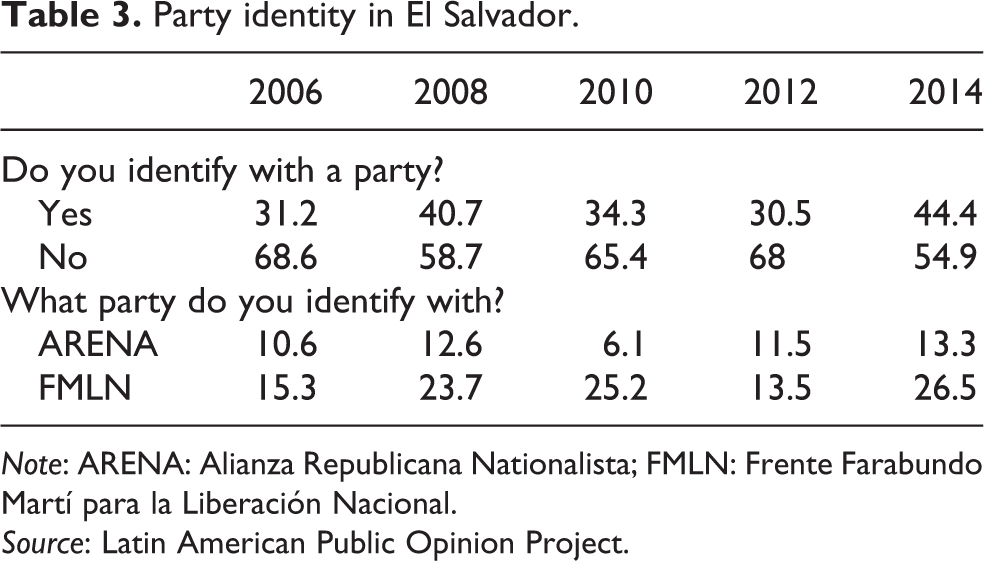
Artiga González (2014) finds some of these changes in his analysis, identifying a slight shift of the electorate to the centre (250–251). A look at data from the AmericasBarometer surveys also shows a changing citizenry. The percentage of Salvadorans who identify with a party decreased between 2008 and 2012 (see Table 3). The FMLN has also experienced fluctuations in the percentage of individuals who identify as ‘efemelenistas’. Perhaps reflecting this change, FMLN interviewees mentioned a need to energize its base when explaining its new method of production (interviews with Fernandez, 2013; Rodríguez, 2013a).
Party identity in El Salvador.
Note: ARENA: Alianza Republicana Nationalista; FMLN: Frente Farabundo Martí para la Liberación Nacional.
Source: Latin American Public Opinion Project.
This brief review of developments in El Salvador reveals that in the last few years, parties have come to see manifestos as important tools. They used the elaboration process to mobilize their members. As Alvarez de Goita from the FES argued, this is a positive development for democracy, generating higher levels of participation. Additionally, starting in 2009, think tanks have evaluated the programmes, presenting their conclusions to voters. While the extent to which these analyses influence voters is not clear, the evaluations are seen as a step forward for democracy.
Strengthening democracy in Guatemala, one step forward two steps back
Guatemalan parties have sporadically presented manifestos since the 1980s. Whether a party elaborated such a document, however, depended on the preferences of its presidential candidate. These documents received attention from civil society, but the expectation that parties had to deliver manifestos only formed in 2007 (interviews with Castillo, 2013; Godoy, 2013; Sáenz de Tejada, 2013). During this election, civil society asked to see manifestos after the UNE presented a well-developed document. Its existence increased the demand for manifestos in that election and the subsequent one (interview with Nuñez, 2015).
In the 2011 election, politicians, the media and analysts agreed that politically parties had to have a manifesto. Although the documents did not ‘pull votes’, parties had to generate the documents to demonstrate competence to a small, urban group, with a high socio-economic status. 6 This group, made up of think tanks, journalists and a small group of citizens, is important because it shapes public opinion and provides resources to campaigns (interviews with Castillo, 2013; Gaitan, 2013; Godoy, 2013; Lavarreda, 2013; Menkos, 2013; Nuñez, 2013; Sanabria, 2013; Zapata, 2013).
Some of those interviewed also identified the international community as being responsible for generating a demand for manifestos. Pressure from this actor is not overt but is constant. Its discourse about how parties should behave has created expectations among small sectors of Guatemalan society (interviews with Castillo, 2013; Sanabria, 2013). In their interactions with parties, international assistance programmes also seek to shape their behaviour. Programmes work with parties, individually and as a group, offering training and help in defining positions (interviews with Burrión, 2013; Nuñez, 2013; Sáenz de Tejada, 2013). The FES, for example, worked with UNE in 2007 to help it develop its manifesto (interview with Sáenz de Tejada, 2013).
In both 2007 and 2011, all parties followed the same elaboration process. 7 Candidates asked trusted individuals from their personal networks to produce the document. These individuals worked independently from the partisan organization. They created working groups and open forums where the general public presented their needs and ideas. The leftist alliance followed the same process, but with fewer and smaller forums because of limited resources (Mora, 2013; Velásquez, 2013). In 2011, think tanks and social movements also attended some meetings to provide their expertise (interviews with Menkos, 2013; Nuñez, 2013; Zapata, 2013). Across the system, the party base did not participate substantially in the elaboration process (interviews with Argeta, 2013; Callejos, 2013; Herrera, 2013; Seidner, 2013). Not even those members who took part in the international community’s workshops were included (interviews with Burrión, 2013; Callejos, 2013; Seidner, 2013; Velásquez, 2013). In the capital, parties did use the process to reach out to professionals. They were invited because of their expertise, and because they could – if the party succeeded – form part of the government (interviews with Castillo, 2013; Godoy, 2013; Herrera, 2013; Seidner, 2013).
Once completed, the parties used their manifestos to reach voters and interest groups through the media. In both 2007 and 2011, parties released their programmes in large, public events. Media interest in manifestos throughout both elections also meant that candidates had to discuss their content and the team that would implement it, if elected (interview with Godoy, 2013).
Parties used the process of elaboration to strengthen clientelistic linkages and campaign, while delivering a document to the group of actors that wanted to see it (interviews with Argeta, 2013; Callejos, 2013; Herrera, 2013). This approach is logical, because a majority of voters, 83% between 2003 and 2014, do not identify with parties (see Table 4). 8 The lack of consultation with the party base limits how much manifestos enhance democracy, but their presence in recent elections had positive consequences. Parties held consultation processes organized around important themes, raising the level of discussion beyond clientelistic politics. As well, the major think tanks and some social movements and non-governmental organizations (NGOs) evaluated the documents. These reports were available to the public. One of the NGOs, the Institute for Agricultural, National Resources, and the Environment, went so far as to publish its report in the country’s largest newspaper (interview with Maas, 2013). Additionally, the media gave a lot of attention to manifestos and these reports (interviews with Castillo, 2013; Gaitan, 2013; Godoy, 2013; Lavarreda, 2013; Maas, 2013; Menkos, 2013). While none of those interviewed believed that these changes influenced the majority of voters, the discourse was a positive development.
Party identity in Guatemala.

Source: Latin American Public Opinion Project.
In a party system where little is institutionalized, however, the dynamics of an election can easily affect the importance of manifestos. In the 2015 election, a series of crises and corruption scandals plagued the government and political class. In this environment, no one paid any attention to manifestos. Three months before the election, only two parties had presented theirs. Media attention of them was minimal, and when think tanks asked for the documents, they often received no answer (interview with Menkos, 2015). The focus of an active civil society was on the removal of a widely discredited political class. There was no interest in reading proposals from organizations with no credibility (interview with Nuñez, 2015). In that context, Guatemalans elected an outsider as president, someone with no party organization or clear policy positions.
Conclusion
This brief review of the purpose and method of production of manifestos revealed some interesting findings. In both countries, the international community helped to make manifestos a campaign requirement. The long-lasting effect of this change appears to hinge, however, on PSI.
In both countries, the international community worked with willing partners to initiate an opening in the elaboration process. The result was a demand for manifestos from civil society. Parties responded using the process to serve their needs. In El Salvador, they sought to energize their base through the elaboration process. In Guatemala, parties used the process to reach independent voters. Despite this important difference, both changes were arguably positive for democracy. In the unstable system, however, the increasing influence of manifestos appears also to be unstable.
Future work needs to analyse the importance of PSI and international party assistance programmes beyond these cases. If they matter in other systems, then it seems that although such programmes can shape the discussion around manifestos, their ability to strengthen democracy in the long term will depend on the characteristics of the party system. 9
Footnotes
Acknowledgements
I would like to thank Bob Harmel and Lars Svåsand for their valuable comments and suggestions, which tremendously benefited this article, as well as the participants of the How’s and Why’s of Party Manifestos group at the Southern Political Science Association Conference 2015 in New Orleans for their comments. I would also like to thank the anonymous reviewers of Party Politics for their helpful recommendations.
Declaration of Conflicting Interests
The author(s) declared no potential conflicts of interest with respect to the research, authorship and/or publication of this article.
Funding
The author(s) received no financial support for the research, authorship and/or publication of this article.