




Abstract
Party-councillor ideological congruence reinforces party linkages with local voters and credibility of councillors as future party elites. This contribution examines the role of career motivations and selective incentives, as well as party branch characteristics in forming party-councillor congruence. The empirical analysis draws on the original survey of Croatian local councillors. The results find councillors with progressive ambition and those exposed to intra-branch competition reporting higher levels of ideological congruence with their parties, while no effect was found for holders of upper level party positions. Branch power has the opposite effect from expected. Party grassroots shape ideologically congruent professional politicians, but this function is challenged by shrinking supply of candidates.
Introduction
The credibility of political parties as crucial links within the chain of delegation in parliamentary democracies depends on their cohesion, which fosters representation and accountability (Carey, 2007: 93; Müller, 2000: 311). Beyond strengthening the accountability mechanisms, party cohesion facilitates party governance function by enabling coalition formation (Giannetti and Benoit, 2009: 4) and securing smooth operation of legislative processes (Andeweg and Thomassen, 2010: 655). In most severe cases, lack of intra-party cohesion may endanger the survival of a political party itself.
Traditionally, party members play a prominent role in each of these party functions, particularly amid increasing levels of intra-party democracy, and are expected to be congruent with the ideological position of their national party. Generally speaking, party membership is beneficial for a party in two directions: in the direction of voters (electoral) and the party (recruitment). First, party members represent their party among the electorate, spearheading the mobilization efforts of the party during electoral campaigns and serving as the transmitters of the “party brand” within their communities at the grassroots level (André and Depauw, 2016; Hooghe and Dassonneville, 2014; Pedersen et al., 2004; Scarrow, 2000: 84; Whiteley, 2011: 26). The second major advantage of membership relates to the membership as a pool of potential candidates for party and public offices (Pedersen et al., 2004: 378; Scarrow, 1994: 49). To avoid adverse selection of candidates, party leaders often reach into party membership, which allows them to train and prescreen the candidates before they can advance to higher offices within the party and the state.
Against this background, incongruence between individual members’ ideological position with the ideological position of their national party has reputation costs for the party, as the “party brand” becomes more vague (Scarrow and Gezgor, 2010: 827), thus endangering the profile that a party is aiming to build among the voters. Ideological incongruence of individual members also casts doubt on the success of the recruitment and socialization mechanisms at the party grassroots, to the possible detriment of congruence of the future party elite.
This study investigates the degree and particularly the factors behind member-party ideological congruence, as individual-level manifestation of party cohesion. These issues have been covered in the extant literature (Kölln and Polk, 2017; Lisi and Cancela, 2017; Van Haute and Carty, 2012), but the present study narrows down the focus to local officeholders (local councillors). Belonging to mid-level party elite, local councillors have great importance within party organization, both in electoral and particularly in recruitment terms. Furthermore, party mid-level elite impact on party policy and strategy was brought to attention in a major European research project (Pierre, 1986; Reif et al., 1980) and continues to inspire theoretical and empirical work (Müller and Strøm, 1999; Van Holsteyn et al., 2017), all of which renders party-councillor ideological congruence worthy of scholarly attention.
Seeking to explain the level of local councillors’ ideological incongruence, I propose councillors’ incentive structure and characteristics of their local party branches as important factors. First, local councillors have varying motivations to participate in politics, as some councillors are willing to pursue their political career in higher level offices (professionals), while others are not (laymen). The variation in incentive structure among local councillors should have a bearing on the levels of their ideological congruence with their national party. The expectation is that more professional councillors are likely to align their ideological position with that of their national party. Secondly, councillors from certain local party branches are expected to have more freedom to pursue personal policy interests or those of their local communities. In particular, politicians from more powerful party branches supply their national party with important resources, and for that reason, they are less pressured to follow the party line. Additionally, low levels of intra-branch competition require local party selectorates to select candidates who do not necessarily follow the party line.
These arguments are tested on the sample of Croatian local councillors, using the original data from a representative survey of local councillors carried out in Autumn 2016. The case of Croatia is suitable for this analysis, as there are three tiers of government, offering many opportunities for career advancement of councillors within state and party organization. Furthermore, political preferences of Croatian electorate are significantly territorially clustered, which increases the likelihood of some councillors drifting away from the ideological position of their national party. In brief, the results confirm the importance of progressive ambition and intra-party competition in reducing ideological incongruence of councillors, while holding a higher level party position makes no difference. Surprisingly, councillors from more powerful local branches report more and not less congruence, as previously expected.
The next section lays out the theoretical expectations, derived from the literatures on May’s Law and organizational aspect of intra-party politics, and emphasizes the contributions of this work to these literatures. The methods section outlines the rationale behind case selection, describes the source of data, operationalization, as well as a statistical model applied. The section on analysis first provides the results of the statistical models and continues to discuss them in light of the theoretical mechanisms proposed. The concluding section wraps up, discusses wider implications of these results, and proposes several avenues for future research.
Theoretical framework
Lacking substantial and conclusive empirical evidence, little is known about the profile of party members incongruent with the ideological platform of their national party. The existing research has sought to explain the levels of incongruence from different theoretical angles, such as socioeconomic characteristics of individuals (Van Haute and Carty, 2012) or cognitive mobilization theory (Kölln and Polk, 2017). This study draws from another prominent theoretical tradition in the research on congruence, incentive structure of party members, arguing that members’ disposition toward congruence depends on their political ambition and occupation of party office. Additionally, party members are rooted in their local party branches, and variance in branch power and degree of internal competitiveness shape the degree to which members can diverge ideologically from their party.
Incentive structure of membership and its effect on intra-party conflict is central to May’s Law of Special Curvilinear Disparity (1973). According to May, party organizations are composed of three hierarchical strata, each characterized by a particular incentive structure to participate in politics. Party leaders, who fill national elective offices, are interested in reelection and selective incentives, compelling them to approach centrally located median voter. Party subleaders, including local party elites (local officeholders and activists), do not hold national party office and seek only collective incentives, that is, fulfillment of their ideological principles. As only the most committed to the party ideology will engage into time-consuming voluntary party activities (maintaining party organization, campaigning), ideological extremists are likely to crowd out more moderate party subleaders. At the lowest level of the hierarchy, May placed the stratum of nonleaders, which consists of passive party voters and loyalists (1973: 135–136).
Subsequent empirical research on multiparty systems failed to support the May’s Law (Narud and Skare, 1999; Norris, 1995; Van Holsteyn et al., 2017), with Van Holsteyn and colleagues renaming the idea into “May’s Myth.” Norris attributes this failure to a fuzzy incentive structure of party members, which hold both electoral and ideological incentives: “We can conclude from this evidence that party leaders and subleaders have mixed incentives, both ideological and electoralist, to participate in politics” (Norris, 1995: 43). In other words, the category of subleaders was defined too broadly, including various party groups with very heterogeneous incentive structures (Narud and Skare, 1999: 48; Pierre, 1986: 475). In defense of such a broad conceptualization of mid-level stratum, Van Holsteyn and colleagues argue that more activist party members, at least in the Dutch case, hardly differ from their less active colleagues in terms of attitudes (Van Holsteyn et al., 2017).
Dropping this assumption of invariant incentive structure within membership strata, this study focuses on individual-level incentive structure among mid-level party elites, enabling a direct test of May’s assumption that office motivations and selective incentives lead to more ideological congruence with national party. Party membership within this stratum is the most heterogeneous, as some members have electoralist motivations, while others have purely ideological motivations. Few authors question that ordinary members have any motivations but ideological for participation in politics, which renders this group less useful in studying the effect of incentive structure on ideological congruence. In contrast, local officeholders (local councillors) arguably have electoralist incentives and value selective incentives, yet the extent to which they do so varies greatly. Verhelst and others differentiate between laymen and professional local councillors (Verhelst et al., 2013: 275). For laymen local councillors, their service in local council is the first and the last political career step, denying intention of climbing up the ladder within the party or state hierarchy. Professional councillors, on the other hand, affirm their ambition to further develop their political career, making them more responsive to selective incentives.
An indirect and direct mechanism underlie the relationship between incentive structure and ideological congruence. Local councillors driven by electoralist motivations are compelled to moderate their ideological position, thus broadening their electoral appeal, and similarly to their party leaders, converge toward the median voter. Additionally, professional councillors are inclined to intentionally adopt the ideological position of their national party, hoping to profit electorally from party “brand” (Müller, 2000: 313) or reaffirming their loyalty to the party (Andeweg and Thomassen, 2010: 10–13). The most appropriate indicator for the voluntary (indirect) mechanism is political ambition. Ambitious local councillors are not exposed to pressures to toe the party line but are compelled to voluntarily align their ideology with national party leadership. To conceptualize political ambition, I rely on Schlesinger’s classification (1991: 39–40), where councillors with static ambition seek reelection to the local council, those with discrete ambition plan to leave politics after the ongoing term, and lastly, councillors with progressive ambition aim for a higher elected office at the local, regional, or national level. Drawing on the theoretical discussion, councillors with progressive ambition are expected to be most congruent with ideological position of their national party.
The indirect mechanism, however, does not imply any interaction between party leaders and professional local councillors, which is unlikely given the fact that leaderships of Croatian national parties holds the keys to higher level elected offices (Čular, 2005: 45). The direct mechanism acknowledges active leadership role in shaping the ideological position of professional local councillors, by controlling the resources and processes on which councillors depend for developing their political careers. One of these resources (selective incentives) is upper level party office, which brings twofold benefit for local councillors. First, these offices are highly valued by politicians, bringing the necessary visibility and resources for the pursuit of an elected office. Second, unlike the offices within the structure of the state, which are competitive and not always controlled by party leaders, upper level party offices are under the reign of party leaders and can be distributed among local councillors. Being vulnerable to removal from party office, as well as through exposure to socialization (Zittel, 2012: 104), holders of these offices are expected to align their ideological position with that of their national party.
All major Croatian parties, with the exception of Istrian and Slavonian regionalists, aim at organizational presence throughout the territory of the state. The sole fact of parties being territorially dispersed increases internal ideological conflict. Through their position, local councillors develop a sense of issues relevant to their local community and represent these communities at higher party and state levels. Pursuing particular preferences of their localities, locally rooted officeholders often enter into conflict with the policy direction of the national party leadership, act more independently in parliament, and develop name recognition among voters shielding them from party sanctions (Martin, 2011: 473; Tavits, 2009). Considering the strong territorial segmentation of political preferences in Croatia (Glaurdić and Vuković, 2016: 140; Grdešić, 2013: 192), the strong urban–rural divide and the electoral pressure from regionalist parties, the existence of policy incongruence between councillors and national party leadership is not surprising.
The study by Tavits (2011) reports that party dissent is exacerbated among MPs from more powerful local party branches. As powerful branches supply political parties with important resources, party leadership is likely to turn a blind eye to these councillors’ pursuit of local and personal preferences (Ennser Jedenastik and Hansen, 2013: 779; Kjaer and Elklit, 2010: 340). First, powerful branches enhance party visibility within their local community, while local party activists add to the voter mobilization efforts by maintaining personal contact with voters and hosting motivational and leisure party activities. During electoral campaigns, local branches provide committed and costless labor force. Second, successful branches demonstrate party’s governing capacity and offer a firm anchor during difficult times for the national party (Tavits, 2011: 925). Thirdly, successful branches secure perks of local office, such as public service jobs (Marčetić and Lopižić, 2017) and allocation of funds and projects to loyal vote- or resource-rich groups and businesses (Ateljević and Budak, 2010: 391–392). Finally, parties might even promote rebels, knowing that under certain circumstances, they enhance the electoral success of the party (Crisp et al., 2013; Kam, 2009; Thijssen, 2013). Local party branch power is conceptualized through electoral success at local elections, which reflects organizational strength, personal appeal of its candidates, and resonating policy platform. Withdrawal of support or even outright rebellion by powerful party branches has repercussions for party electoral standing and undermines the authority of party leadership within the party. Consequentially, national party leadership likely grants more maneuvering space to councillors from powerful branches.
Another local party branch characteristic which may influence councillors’ policy congruence is intra-branch competition. The trend of decreasing party membership (Scarrow and Gezgor, 2010; Van Biezen et al., 2012; Van Biezen and Poguntke, 2014; Whiteley, 2011) is particularly affecting local branches, which are being drained of their crucial resources, namely activists and mid-level elites. For these reasons, local branches find it increasingly difficult to recruit local election candidates, a finding reported for several European states (Boogers and Voerman, 2010: 86; Ryšavý and Bernard, 2013: 836). An interview with a councillor of a Croatian town illustrates these challenges: “I cannot say that there is a great degree of competition…It might be important to somebody who is planning a parliamentary career, but in principle, there is no scramble” (Croatia, Interview 1). Shortage of candidates implies decreasing intra-branch competition. In response, local parties lower candidate selection criteria and patch electoral lists with a wider scope of members, despite some of them lacking party experience and socialization into party procedures and policy goals. Uncompetitive candidate selection processes are more likely to yield more independent candidates, and particularly so when notable extra-party candidates are recruited. In competitive selection procedures, the closed-list proportional representation system adopted in Croatian municipalities further incentivizes candidates to champion party interests, as their electoral fortunes depend on support from their parties (Carey and Shugart, 1995).
The analysis controls for several confounding sociodemographic variables. Concerning the effect of education, higher degree of education implies higher resources and expertise, and in line with the cognitive mobilization theory, more educated councillors are less likely to strictly follow the position of their national party (Van Haute and Carty, 2012: 892). Further controls include gender and age, as some studies found male and elderly party members to be less congruent with their parties, and being in general less partisan (Dudzińska et al., 2014: 32; Kölln and Polk, 2017: 23).
Data and operationalization
Case selection
Croatia is a particularly suitable case for testing the arguments laid out in the theoretical framework. The existence of three tiers of government provides ample opportunities for councillors to advance their political career at any of the three levels. Above the highly fragmented municipal level, consisting of 556 municipalities, there is an equally fragmented system of regional government, consisting of 20 counties and the City of Zagreb. Elections for these tiers are simultaneous and take place every 4 years. The mayors are elected directly, together with one vice-mayor in smaller municipalities and two-vice mayors in larger municipalities. Similarly, county governors and their two vice-governors are elected directly, together with large county assemblies. Such inflation of elected positions in Croatian local and regional government has been widely criticized (Marčetić and Lopižić, 2017) but provides an important background to the present study. The structure of Croatian local and regional government is reflected in organizational structure of all major national parties, and maintenance of municipal and county branches requires a substantial number of party officers.
Croatian parties adopt strongly centralized policy formulation procedures, with national party leaders enjoying a wide degree of formal and informal autonomy in decision-making (Ćelap and Nikić Čakar, 2017). It is therefore unlikely that local councillors or their party branches have an opportunity to steer the policy direction of their national party. For that reason, the highly regionalized structure of political preferences in Croatia reported earlier may create ideological tensions between the party on the ground and national party leaders. Given the existence of these tensions, the extent to which local branch characteristics give freedom to local councillors is particularly worthwhile studying. Finally, political competition in Croatia is structured along the value dimension (Henjak, 2007) of political competition, with two major camps divided on the persisting issues of Croatia’s role in the World War II and the orientation toward its communist past (Čular and Gregurić, 2007), as well as a range of “new politics” issues, such as gay marriage, abortion, artificial insemination, church–state relations, and so on. On the other hand, considerations of economic policy do not in any meaningful way structure Croatian political competition (Dolenec, 2014). The predominance of the value cleavage suggests that councillors likely refer to the value dimension of Croatian political competition when positioning themselves and their parties on the left-right ideological scale. But for the reasons stated later in the article, the exact meaning of the left-right scale in the Croatian context is less relevant for this analysis.
Local councillors’ survey
The empirical analysis rests on the data from the survey of local councillors in Croatia, administered in Autumn 2016. Local councillor surveys have been carried out in the past, also in Croatia (Egner et al., 2013), but are seldom applied in studying intra-party politics. Compared to general party membership surveys, surveying councillors focuses on a specific group of members, who represent the party in local councils, spearhead overall party activity on the ground and exhibit some electoralist motivation. Furthermore, the population of local councillors is well defined. For the purpose of this survey, the exhaustive sampling frame of 7496 Croatian councillors was created, containing names, home addresses and sometimes email addresses of councillors. Information on individual councillors allowed for probability sampling of 1000 councillors, and the stratified sampling design with unequal probabilities of selection was applied. The mode of the survey was mixed between postal and online mode, with 940 councillors receiving survey package by post, and remaining 60 councillors receiving an email invitation to participate in the online survey. The two questionnaires were harmonized as much as possible to avoid potential mode effects.
The response rate was 17.1%, which is low by the common standards, and admittedly raises concerns of the project suffering from selection bias. The largest concern is the motivation of retiring councillors (in “lame duck” period) to respond to the survey, as they might feel fed up with politics and refuse to answer the survey. The lack of motivation among retiring councillors would result in overrepresentation of councillors who wish to stay in politics (and perhaps move up the political ladder), thus introducing selection bias. While I cannot compare the respondents and the full sample on their political ambition to test for this possibility, the age, as well as gender, partisanship, and geographical distribution of the whole sample are known. Particularly, political ambition is strongly related to age, as older councillors are more likely to retire. Indeed, Meserve and colleagues (2009: 1018) adopt age as the proxy for political ambition of members of European Parliament (MEP’s). Therefore, if there is underrepresentation of retiring councillors in my sample, this should be reflected in the respondents being on average younger than the full sample. As shown in the Table 1, this is not the case, as the average age of the respondents is even higher than that of the full sample. Nevertheless, I acknowledge that the response bias might creep into other key variables but less likely than in the case of political ambition.
Full sample and respondents compared.

The respondents are also fairly representative of the targeted sample in terms of gender, partisanship, and geographic distribution (Table 1). There is a slight overrepresentation of councillors from continental Croatia, driven particularly by greater responsiveness of councillors from Koprivnica-Križevci and Osijek-Baranja counties, and lower responsiveness of councillors in Split-Dalmatia county. Preelectoral coalitions are common in Croatia, but coalition candidate lists do not report party membership of individual councillors, which hinders comparing full sample and respondents on party affiliation. But distribution of respondents in terms of party membership does not strongly deviate from expected. As expected, response rates were higher among councillors who received the paper questionnaire compared to those receiving online questionnaire. The survey also included councillors not affiliated to any national party, and upon their exclusion, 142 partisan councillors remain in the analysis.
Operationalization of variables
The measure of party-councillor ideological congruence is based on the survey item asking councillors to place themselves and their national party on the general left-right ideology scale, ranging from 0 to 10 (Q23). There are different approaches to extracting the measure of ideological congruence from this item, one being calculating the absolute distance of councillor position from the position they assigned to their party (Kölln and Polk, 2017; Lisi and Cancela, 2017; Polk and Kölln, 2018), and the other distinguishing between ideologically congruent councillors and ideological “misfits” (Van Haute and Carty, 2012: 889). I adopt the former approach, as it yields a more fine-grained measure and avoids deciding on a cut-off point. Higher values of this variable thus indicate more ideological incongruence. Arguably, councillors’ estimates might not capture the “real” position of their national party on the left-right scale, as councillors may adapt party position to reflect their expectation or “wishful thinking” (Belchior, 2014: 407–409). However, there is a consensus in the literature that the measure of ideological congruence applied here captures the intention of local councillors to place themselves at the same or diverging position with their national party (Kölln and Polk, 2017: 21; Van Haute and Carty, 2012: 887), which is exactly the concept needed in the present study.
Political ambition (Q36) was operationalized as a stated ambition (Høyland et al., 2017), asking councillors whether they seek reelection as local councillors (static ambition), continuation of their political career at a higher local, regional, or national office (progressive ambition), or plan to retire from politics (discrete ambition). Upper level party office is a binary measure indicating whether a councillor reported ever holding such an office (Q33). Both questions tapping the two indicators of incentive structure were in the questionnaire placed after the question on ideological self-placement, thus lowering the probability that councillors intentionally reported (dis)agreement with the ideology of their national party in light of their responses to the questions on incentive structure. The danger of “desirable” response to ideological placement question, however, cannot be completely eliminated by question order, as postal questionnaires allow respondents to review the entire questionnaire before filling in their responses (Schwarz and Hippler, 1995).
The data on branch vote share at 2013 local elections (in percentages) were obtained from the website of the Croatian State Electoral Commission 1 and matched to individual councillors as a measure of local party branch power. Alternatively, one might conceive of local branch power not in continuous but in binary terms, with the crucial distinction between parties that support and parties that oppose the mayor. Party branches holding a mayorship or branches taking part in mayor’s coalition have full access to the perks of the local office, while other parties, despite their vote share, might be left with a minimum influence in municipal politics. To test this alternative conceptualization, the model will be refitted with the binary measure of whether a councillor is a member of a branch supporting the mayor (1) or not (0). The level of intra-party competition a councillor was exposed to during candidate selection for the 2013 local elections is measured at the individual level, where councillors indicated whether any alternatives for their list position were proposed. The measure was dichotomized, taking the value “1” if any alternatives existed, and “0” in absence of alternatives. Educational attainment is operationalized as a binary variable, distinguishing between councillors who completed university (1), and those with lower level of educational attainment (0). Gender is also a binary variable, while age is measured in years. Table 2 presents the descriptive statistics for the dependent and the independent variables.
Descriptive statistics (valid proportions/means).

Method of data analysis
Given the nature of the dependent variable, Ordinary Least Squares (OLS) regression model is fitted, estimating the absolute level of ideological incongruence between local councillors and their national parties. Since the data were collected at a single point in time, one of the potential problems in the study is presence of reversed causality, and the attention of this possibility is raised during the discussion of results. Variation in the levels of ideological incongruence across parties is restricted, but there is nevertheless some likelihood that individual observations are not independent of each other, but that councillors from the same party are more similar to each other, than to councillors from other parties. For that reason, robust standard errors are calculated, to correct for possible party clustering of individual responses. I refrain from multilevel modeling, as the number of parties in the analysis is small, and there is a high percentage of single observations per party. Since the sampling design for the Croatian survey was stratified with unequal probabilities of selection, design weights are applied in the model to correct for the imbalance caused by the sampling design.
Findings and discussion
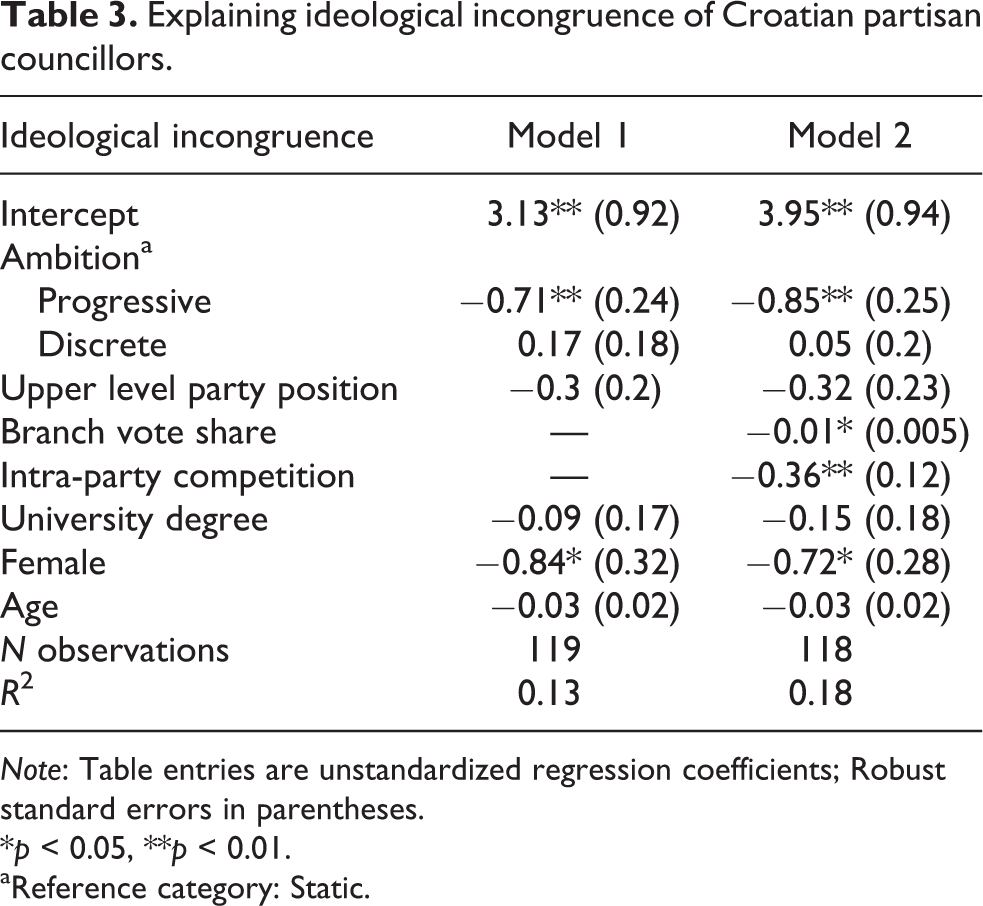
Table 3 presents the results of the analysis. Model 1 includes the two indicators of incentive structure and the relevant controls, while the Model 2 adds local party branch characteristics. Overall, the fit of the models is satisfactory, given the limited number of predictors (due to low sample size), and the fact that the analysis is carried out at the individual level. Model 1 offers only partial support for the related hypotheses. Compared to councillors holding a static ambition, councillors with progressive ambition have significantly lower levels of incongruence with the ideological position of their national party.
Explaining ideological incongruence of Croatian partisan councillors.
Note: Table entries are unstandardized regression coefficients; Robust standard errors in parentheses.
*p < 0.05, **p < 0.01.
aReference category: Static.
With the addition of the two local branch characteristics in Model 2, the effect of progressive political ambition is amplified, with the coefficient switching from –0.71 to –0.85. Modeling the two branch characteristics separately uncovers that it is the branch vote share that lies behind this amplification. The result reflects the negative correlation between ambition and vote share, as significantly greater propensity toward progressive ambition is found among councillors from less electorally successful local party branches. Councillors from more electorally successful branches are more likely to satisfy their political career goals at the local level, while councillors from less successful branches might be inclined to move upward in seeking new avenues for their political career. Nevertheless, Model 2 further supports H1, and Figure 1 visualizes the effect of political ambition on the level of ideological incongruence.
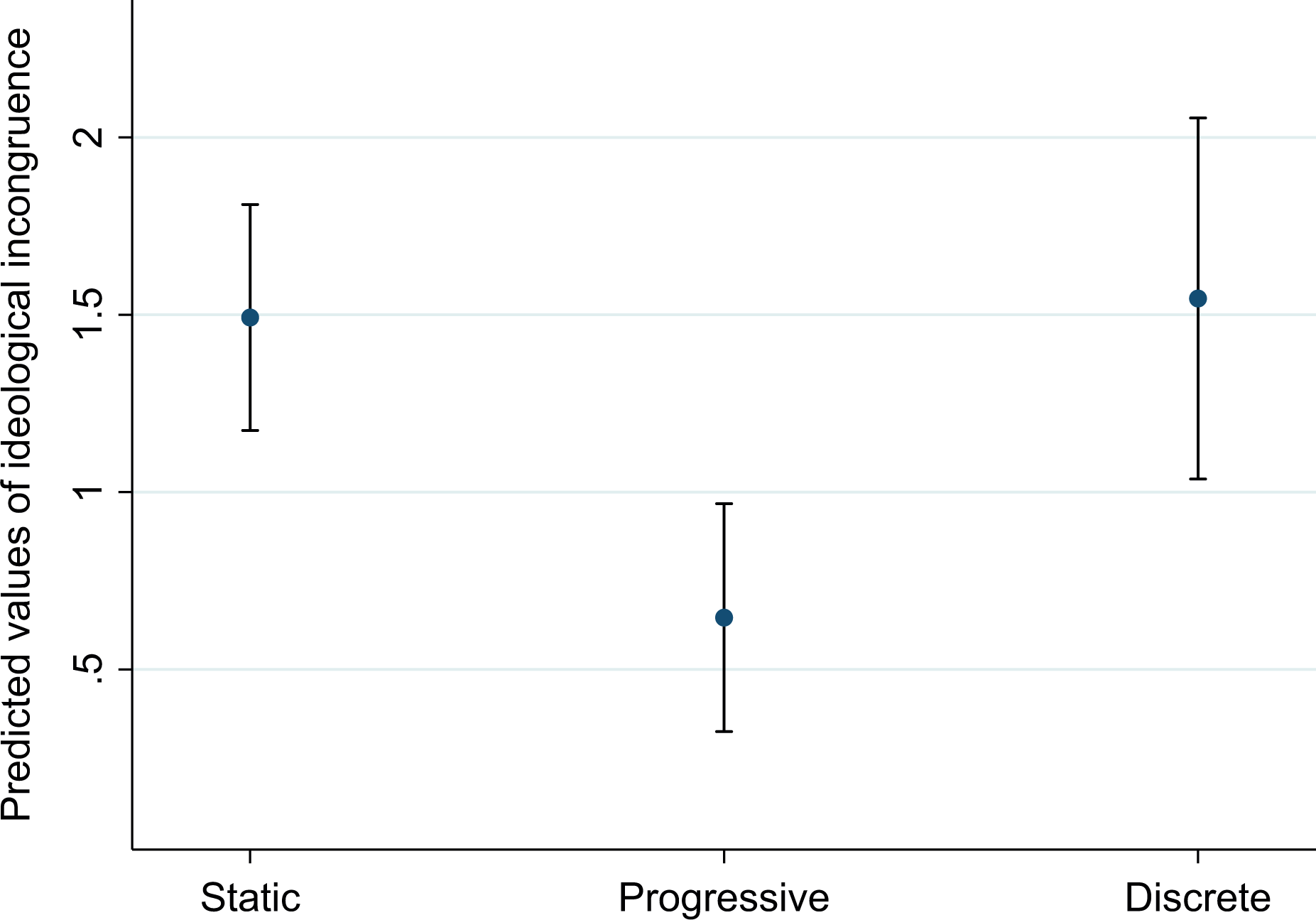
Effect of political ambition on ideological in congruence.
The finding lends credence to the more voluntary and indirect path, which places local councillors outside of the sphere of influence of party leaders. Given their incentives to occupy a higher level office, ambitious local councillors tend to approach the median voter and relinquish their personal or local preferences in favor of their electability. Even more plausible are the explanations derived from the literature on intra-party career advancement. The support of national party leaders is the key of advancement to higher level political offices, and an obvious strategy in seeking support of party leaders is staying close to their ideological preferences. Furthermore, councillors willing to assume elected office at the higher level strategically align themselves with the ideological position of their national party. In doing so, they hope to protect and reap benefits of the “party brand,” a cheap and effective tool to inform and lure voters. The cross-sectional research design of this study, however, cannot exclude reversed causality, as councillors who find themselves at odds with the ideology of their party may be reluctant to represent the party in a higher level office. Breaking with the assumption of uniform incentive structure among specific membership strata (Narud and Skare, 1999: 48), and bringing the analysis to the individual level, this study vindicates the micro-logic of May’s Law and motivates further research along these lines in other contexts.
H2 is rejected by both models, as councillors who held upper level party office do not significantly differ with respect to congruence from councillors who never held such office. There are several tentative explanations for the lack of the predicted effect. First, after assuming upper level party office, councillors might feel more at ease to express their true attitudes then while pursuing this office. Having acquired contacts, experience, and recognizability, these councillors likely find it easier to shake off party dependence (Gendźwiłł and Żółtak, 2014: 1131). Second, it could well be that I overestimated the degree of party leadership control over the recruitment to upper level party offices. The trend of intra-party democratization might have opened alternative channels of recruitment into the higher positions within the party, which dilutes leadership control over the holders of these positions and leads to more incongruence on the part of these officeholders. Future studies should pay more attention to openness of recruitment processes in specific parties, thus uncovering opportunity structures for members with incongruent ideological stances to climb up the ranks of their party. Third, more ambitious councillors should, theoretically, be more likely to assume upper level office within their party’s organization, raising the suspicion of multicollinearity being the reason behind the absence of the effect. Running models without the ambition variable, however, does not substantially alter neither the sign nor the significance of the effect of selective incentives as measured by holding an upper level party office.
The Model 2 adds the indicators of local party branch characteristics, namely branch vote share and intra-party competition. The explained variance in ideological incongruence increases to 18%, suggesting that two party branch characteristics substantially contribute to explaining councillors’ incongruence with ideological position of national party. Among the control variables, only the effect of gender is statistically significant. Female councillors appear to be less ideologically incongruent with their national parties, compared to their male counterparts.
While significant, the coefficient of branch vote share is negative. The more votes did the local branch or its coalition win at the 2013 local elections, the lower is the level of ideological incongruence of local branch members with the national party. The graph of predicted values of incongruence across branch vote shares (Figure 2) facilitates interpretation of the effect magnitude. As vote shares are positively skewed, interpretation using quartiles is more appropriate. For instance, the change from second (17% vote share) to third (44% vote share) quartile of vote share distribution decreases the predicted value of incongruence by 0.4 units on the 0–10 ideological scale (from 1.45 to 1.05), suggesting its substantive contribution to explaining congruence. Rerunning the model with the binary indicator of supporting a mayor yields a similar result, but significant only at 90% confidence level.
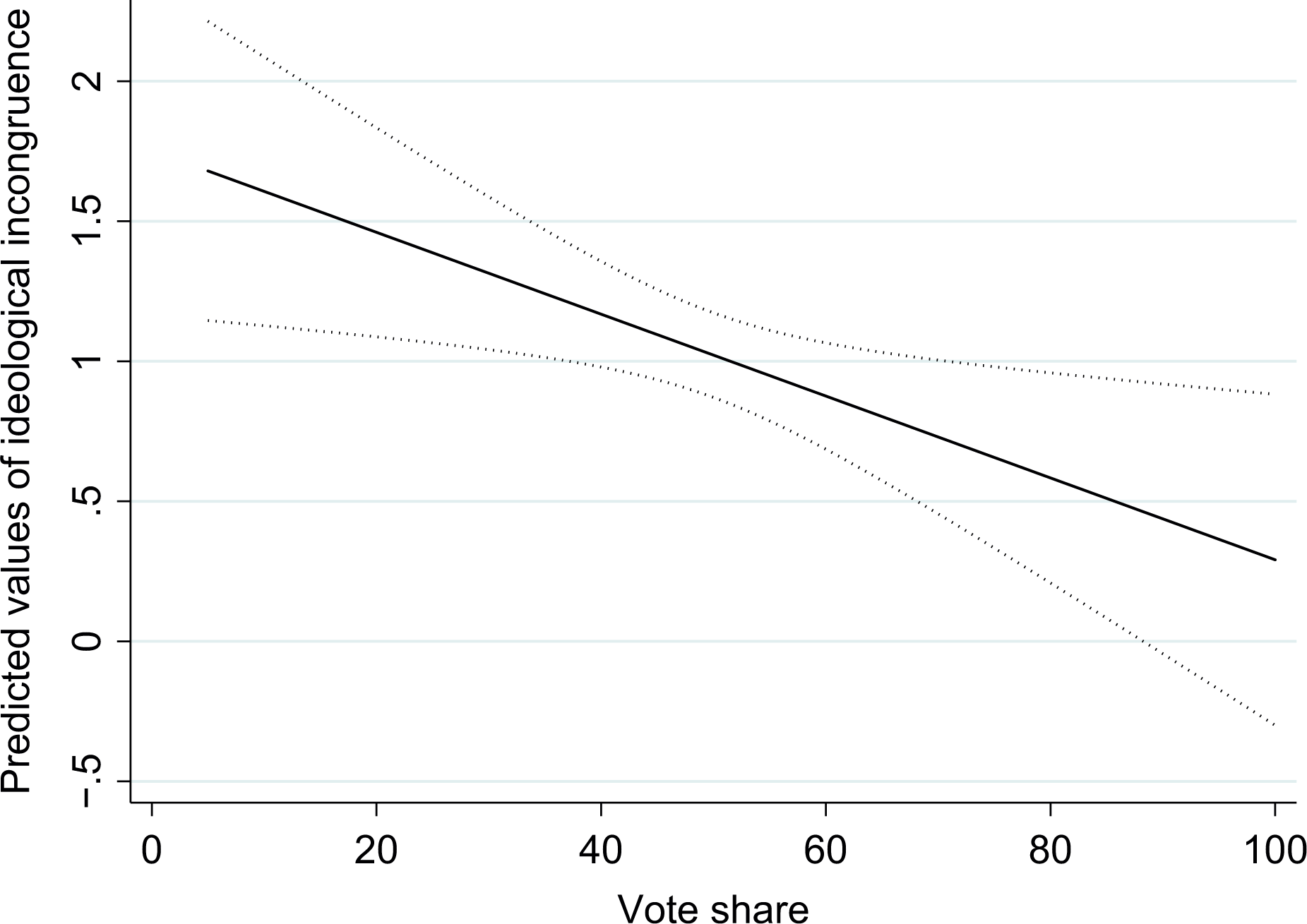
Linear effect of branch vote share on ideological incongruence.
Searching for the explanations of the opposite effect, the degree of municipal ideological homogeneity is a possible confounder and should receive more attention in future research. As commonly witnessed in small Croatian municipalities affected by the war of early 1990s (Glaurdić and Vuković, 2016: 140), when the median municipal voter occupies a moderate-right ideological position, and variance around that median is relatively restricted, a right-wing party (such as HDZ) is likely to perform well at the elections. Other competitors, particularly from the left, stand less chances of a good electoral result, being far from the median voter and with few voters on the left wing. On the side of councillors, the restricted variance in voters’ ideological position will constrain movement of right-wing local councillors across the ideological spectrum, bringing them closer to the position of their national party. Leftist councillors, whose branches are less electorally successful in this context, need to depart substantially from the ideological position of their national party, if they are to approach the municipal median voter.
Switching to the effect of intra-party competition, the Model 2 supports the H4. Compared to the councillors who were the only candidates for their list position, councillors facing intra-party competition are ideologically less incongruent with their national parties. Having controlled for branch vote shares, this finding suggests that even larger and more successful parties face difficulties maintaining competition among their candidates for local offices. As a consequence, uncompetitive list positions are often filled with ideologically incongruent candidates. Figure 3 plots the predicted probabilities of ideological incongruence for competition-free and competitive candidate selection processes. Substantively, as already indicated in the table, incongruence drops by −0.36 units when some intra-party competition is present in the local branch. The repercussions of declining intra-party competition might also be felt at higher party levels, as recent evidence finds less ideologically committed mid-level elites being less engaged in party organizational and campaign activities (Lisi and Cancela, 2017).

Effect of intra-party competition on ideological incongruence.
Conclusion
Cohesive parties appear more convincing to voters, giving voters clearer understanding of party policy, implying higher level of party accountability and electoral rewards. Cohesive parties also face less internal turmoil in attempting to push legislation through the national decision-making process. Achieving party cohesion requires party members to comply with the ideological position of the national party leadership. However, there has been little understanding of how ideological congruence of party members is developed among party elites at the grassroots level, which is the primary arena of party membership socialization. In this contribution, I draw on the incentive structure argument rooted in May’s Law (May, 1973), and on findings of Tavits (2011) concerning the characteristics of local party branches. Two research design features allow for original insights into this question. First, it relies on survey data, thus being able to capture the ambition and selective incentives of individual members, an improvement over comparing aggregate party organizational strata and only assuming heterogeneity in their incentive structures. Second, studying local councillors as a subset of party members with a certain level of interest in political career allows for a more balanced ratio of professional–laymen party members compared to studying party membership at large.
The results underline the relevance of councillor progressive ambition as an incentive lowering ideological incongruence, while the effect of holding upper level party offices is not found. This finding suggests that voluntary mechanisms link councillors’ incentive structure to their ideological congruence, rather than congruence being a result of deliberate choices of national party leaders. Overall, there is some indication that incentive structures of party members do indeed affect their ideological congruence with national parties, as suggested by the long tradition of research derived from arguments of John May (May, 1973; Norris, 1995; Van Holsteyn et al., 2017). With regard to local branch characteristics, a surprising finding of a negative effect of local branch power on councillors’ incongruence challenges the previously established argument of powerful and disobedient local party elites and their branches (Tavits, 2011). This finding is reassuring for the leaders of Croatian parties, as they have little reason to fear a “rebellion from the ground,” at least on ideological basis.
More worrying is the finding that uncompetitive candidate selection processes yield ideologically incongruent councillors. The literature has long debated the ways and the extent to which decreasing membership threatens political parties, with some authors pointing to the fact that parties may no longer need large membership due to shifts in campaign strategy (Farrell and Webb, 2000), while others cite evidence of continuing party reliance on membership (André and Depauw, 2016; Whiteley, 2011). To the extent that the latter argument applies, decreasing party membership is worrying for parties, as it narrows the pool of councillors willing to take up higher level offices. This trend implies less competitive pressure on the part of councillors to adapt their ideological position to that of their national party.
Even though the finding on greater ideological incongruence among councillors not exposed to intra-party competition should be a warning sign about repercussions of decreasing party membership, party leaders might use this development to their advantage. Highly ideologically cohesive membership is a major barrier to policy shifts of national party leadership (Scarrow, 1994: 45; Schumacher et al., 2013: 465). In addition, Croatian party leaders have found the ways to trim the power of mid-level party elites, predominantly through concentration of power and direct election of party leaders, to the detriment of intra-party democracy (Ćelap and Nikić Čakar, 2017). The national elections of 2016 demonstrated how easy it was for Social Democratic Party to turn rightwards, and for the new leadership of HDZ to switch from right-wing to a more moderate center-right ideological position.
While testing the micro-assumption of May’s Law, a comparison of ideological positions of party leaders, mid-level elites, ordinary members, and party voters would offer a more direct test of May’s Law. On the dependent variable, this study neglects the direction of disagreement of individual local councillors, which would better capture their ideological extremeness and provide an even more precise test of May’s Law. In addition, directional specification of the dependent variable opens wider possibilities for studying patterns of incongruence across geographical space. As suggested, social democratic councillors in right-leaning municipalities might adopt a more rightist ideological stance compared to their national party. The highly regionalized voting behavior in Croatia (Grdešić, 2013) indeed points to likelihood of such an effect, which should be explored in future research.
Footnotes
Acknowledgements
The author would like to thank the editors of the special issue, participants of the workshop on party cohesion at 2017 ECPR Joint Sessions in Nottingham and two anonymous reviewers for their helpful comments.
Declaration of Conflicting Interests
The author(s) declared no potential conflicts of interest with respect to the research, authorship, and/or publication of this article.
Funding
The author received financial support for local councillors' survey from Berlin Graduate School of Social Sciences, Humboldt University in Berlin.
