



Abstract
While the literature on mass society and social capital assumes a negative relationship between civic associationalism, political participation, social trust and populist radical right (PRR) voting, more recent studies provide more mixed evidence that fringe parties can mobilize support and consolidate by relying on complex networks of civil society organizations. However, these studies focus on supply-side explanations; there is little systematic evidence that includes demand-side evidence on PRR voting and civil society cross-nationally. Using survey data from two waves of the International Social Survey Programme, this article engages with demand-side explanations of PRR voting in five Central and Eastern Europe countries. The results show lower levels of associational membership and social trust but higher political participation among PRR voters when compared to voters of other parties. The article highlights the importance of taking into account demand-side explanations of fringe party politics.
Keywords
Introduction
A growing literature documents the electoral successes of populist radical right (PRR) parties in Central and Eastern Europe (CEE) (for overviews, see Bustikova, 2018; Minkenberg, 2017; Mudde, 2017; Pytlas, 2018). However, taking stock of the literature on PRR parties, Minkenberg (2017:12) has recently criticized that this scholarship tends to lack a broader theoretical framework or a comparative approach and neglects the extra-parliamentary dimension (see alsoVeugelers and Menard, 2018: 288), such as interactions between parties and their social and political environment. Some of these questions have been addressed in recent work (Bustikova, 2014; Mareš and Havlík, 2016; Minkenberg, 2015; Minkenberg, 2017; Pirro, 2014; 2015; Pytlas, 2015; Werkmann and Gherghina, 2018). Comparing PRR parties in CEE and Western Europe, studies underline the importance of left-wing economic orientation among CEE PRR parties (Bustikova, 2018; Pirro, 2017; Varga, 2018), the role of historical legacies and of territorial revisionism (de Lange and Guerra, 2009; Minkenberg, 2017; Pytlas, 2013) or the prominence of perceived threats from autochthonous ethnic minorities (Bustikova, 2014) as important characteristics of electoral mobilization. Issues concerning migration that played an important role for the rise of PRR parties in Western Europe have remained less prominent in CEE for more than two decades after 1989 (but see Rovny, 2014).
Most of the mentioned studies focus on supply-side explanations of PRR success. Werkmann and Gherghina (2018) concentrate on determinants of party competition, such as ideology, leadership and party organizational features. When contrasting far-right Jobbik’s success in Hungary with its regional peers, Mareš and Havlík (2016) find a number of supply-side factors, such as traditions of extreme right political movements, a cleavage structure shaped by ‘morals rather than socioeconomics’ (i.e. the low importance of the left–right cleavage), specific electoral geographies, party styles and, finally, PRR party reaction to the crisis of traditional democratic parties to make the difference. Much less is known about the demand-side – that is, about the determinants of PRR vote and the role of the social and political environment mentioned by Minkenberg (2017). Studies using national election surveys provide here some evidence, but their comparability remains limited (Mikuš et al., 2016; Rudas, 2010). As a rare exception, Minkenberg and Pytlas (2012: 221) combine national electoral studies to show that there is no clear pattern in how class composition and PRR voting relate in the region. At the same time, they show that particularly in Hungary there has been as shift from the archetypal ‘globalization losers’ to younger, better-educated white-collar PRR electorates.
The neglect of demand-side analyses is a general tendency among scholars focusing on CEE countries. It stands in contrast to the rich scholarship on parties and studies connecting parties and voters in this region (Gherghina, 2014; Tavits, 2013) but also to the prominence of such studies in Western Europe (Ramiro, 2016; Rooduijn, 2017). Linking the literature on mobilization, social movements and radical vote, scholars of Western European political behavior have started analyzing the role of associationalism and social capital (Rydgren, 2009; Van der Brug and Fennema, 2007), rediscovered the literature on movement-parties (Kitschelt, 2006) and suggested new ways of looking at the relationship between PRR movements and parties (Caiani and della Porta, 2018; Caiani and Císař, 2018; Muis and Immerzeel, 2017).
Building on the above literature, and closing the gap in the literature on CEE, this contribution interrogates the relationship between PRR voting and different aspects of civic activism, political participation and trust in CEE. Following Tocqueville, associational life is regularly seen as a ‘school of democracy’. During the 1990’s analysts have linked the weakness of democracy to weak civil societies in the region (Howard, 2003). Others have pointed to the existence of ‘bad civil society’ in the region, that is, extremist groups or movements challenging democratizing political systems (Kopecky and Mudde, 2005). While the ‘weak civil society’ thesis has been severely criticized both concerning the past and the present (Ekiert and Kubik, 1999; 2014; Ost, 2005), the ‘bad civil society’ argument has received new attention in recent analyses highlighting the existence of vibrant civic networks forming the sociocultural backbone of PRR parties. This is said to be the case for a new generation of PRR parties that have emerged in the region by replacing the first generation of traditional PRR parties of the 1990s (Mareš and Havlík, 2016). Jobbik in Hungary is certainly the electorally most successful representant of this novel party type. Its emergence shows not only the role of successful political communication that is based on the use of new social media but also the deep societal embedding of the party, which managed to establish a parallel microcosm by embracing a broad range of fringe movements and organizations. These include vigilant militias, local heritage clubs, esoteric neo-paganist associations, biker fraternities or the so-called ‘national rock’ movement (Buzogány, 2011; Kürti, 2012; Karl, 2017; Molnár, 2016; Pirro and Róna, 2018; Pirro et al., 2021). Similarly, when describing the Bulgaria’s Ataka as a movement-party transcending radical left and PRR discourses, Ganev (2017) mentions that over the last decade, Ataka has evolved into a ‘broader social movement’ by relying on a dense network of affiliated organizations. Connections between parliamentary and extra-parliamentary wings of PRR have been reported also in Slovakia, where Ľudová strana Naše Slovensko (ĽSNS) not only has emerged from the Slovak Brotherhood (Slovenská Pospolitosť) but also continued to maintain intensive ties after entering parliament (Nociar, 2012). Russia’s radical right movement, which includes skinhead organizations or the Movement Against Illegal Immigration (Dvizhenie protiv nelegal’noi immigratsii (DPNI)), has also established close links to multiple political parties (Tipaldou and Uba, 2018; Varga, 2017).
This article offers a nuanced comparative analysis of this phenomenon by looking at the demand-side of PRR vote. Taking issue with the emergence of new types of PRR parties, fringe activism and political participation in CEE (see also Ekman et al., 2016, Gherghina and Fagan, 2021; Guasti, 2016), it argues that distinguishing between different aspects of civic engagement can provide a more comprehensive view on PRR parties and their voters. Regarding associational membership or social trust, PRR voters in the CEE countries are on average still less endowed with social capital than voters casting their votes for other parties. However, when it comes to other aspects of political participation – such as signing petitions or taking part in boycotts – PRR voters are clearly among the more active ones. Using data from the 2004 and 2014 waves of International Social Survey Programme (ISSP) in five CEE countries shows that on average, these differences became more accentuated in the decade covered by the survey.
The article makes two contributions to the literature, one on PRR voting in general and one on fringe party politics in CEE more in particular. First, it addresses the discussion about the nexus between social capital and PRR vote (Rydgren, 2009; Van der Brug and Fennema, 2007) by providing an empirical analysis of Eastern European countries, which were often overlooked but are particularly salient because of the assumed overall historical weakness of civil society and social capital in the region (Howard, 2003; Letki, 2004). Second, the article highlights that to understand fringe party politics in CEE, we need to widen the analytical grasp from PRR party strategies to demand-side explanations of PRR vote. In partial contrast to the earlier literature, the evidence provided here suggests that PRR voters in CEE are not the typical ‘globalization losers’ but increasingly resemble median voters in many of their socioeconomic traits. Importantly, this suggests that socioeconomic differences are not at the center of PRR political contestation in the CEE region anymore (Bustikova and Kitschelt, 2009; Kriesi and Bornschier, 2012).
The following section introduces the discussion on demand-side theories by focusing on explanatory factors of PRR vote and formulates testable hypotheses. The third section describes research design and variable operationalization. The results are presented in the forth section. The conclusion summarizes the key findings, discusses the implications of this analysis and draws attention to possible avenues for further research.
Demand-side explanations of PRR vote
Using the electoral market metaphor, approaches used to understand PRR vote are usually grouped into demand- or supply-side explanations (Eatwell, 2003; Golder, 2016). Supply-side explanations focus on system level factors, including electoral institutions or structures of party competition as well as the strategies and characteristics of PRR parties or movements as political entrepreneurs.
Demand-side explanations of PRR vote, in contrast, emphasize voter characteristics. One of the most influential arguments developed about the emergence of PRR parties relates to the social consequences of modernization (Flecker, 2007). Particularly, the crisis of the welfare state in the 1970s has made traditional parties’ failure to accommodate transition losers more than obvious. This argument can be traced back to the 1930s when the emergence of fascist and communist movements was linked to the weakening of traditional social ties and the atomization of society. Such modernization-related arguments receive support from normative theories of democracy. Tocqueville’s classic work on the role of civil society as a ‘school of democracy’ regards voluntary associations as the necessary ingredient both to achieve democracy and to make it work (Rydgren, 2009). Neo-Tocquevilleans, such as Robert Putnam, have argued centuries later that the social networks created through interactions within voluntary organizations are crucial for the development of generalizable social trust in societies. Putnam’s famous study comparing civic traditions in Northern and Southern Italy has been central for cementing a positive relationship between civil society and democracy (Putnam et al., 1994). His argument, which is conceptualized in the rich social capital literature, can also be turned around to argue that the lack of civil society promotes non-democratic values. Thus, while theories of democracy regularly underscore the importance of a vibrant civil society and of citizen participation to make democracy work, explanations of PRR parties’ emergence tend to agree that the opposite – namely that weak civil society increases anti-democratic extremism – is also true to understand the successes of non-democratic forces.
However, neo-Tocquevillean arguments linking weak social capital with anti-democratic extremism, or, more specifically, PRR voting, did not remain unchallenged. Historical studies focusing on interbellum fascist regimes in Europe have found that a vibrant associational life and high levels of participation have encouraged the development of such regimes (Satyanath et al., 2017). Berman’s seminal study on Weimar Germany (1997) has shown how intimately the Nazi party was interwoven with different civil society organizations and how these have facilitated the rapid spread of its ideology. The networks fostered through the German middle classes’ vibrant associational life provided the Nazis with activist cadres holding the necessary skills to mobilize voters (Berman, 1997). Such insights are not limited to Weimar Germany. Research on three different types of fascist regimes in Spain, Italy and Romania also shows that fascist parties received political support especially in regions with strong civil societies (Riley, 2010). Thus, against the expectations of social capital theory and corresponding with Lipset’s ‘extremism of the middle’ thesis, it was not so much the passive, but rather the active part of society that stood at the centre of right-wing mobilization.
Similar questions are addressed also in analyses of contemporary PRR voting (Van der Brug and Fennema, 2007: 483), but the overall evidence remains inconclusive. Coffé et al. (2007) have shown that Belgian municipalities with weak networks of voluntary associations are more likely to cast a vote for extreme right parties. Vanhoutte and Hooghe (2013) found that PRR voters in Flanders to be more isolated than others, while Berning and Ziller (2017) showed that high-level social trust decreases PRR preferences in the Netherlands. Lower levels of social trust were also found among populist voters in the Nordic counties, even though a study by Koivula et al. (2017) indicates that this does not apply to Finland, where this group is not as isolated as it is elsewhere.
Other studies remain sceptical of the link between social capital and PRR voting. Work on Belgian voting behaviour shows that only membership in political organizations determines vote choice, while membership in non-political associations has no impact on voting for PRR parties (David et al., 2014). Focusing on Front National voters, Veugelers et al. (2015) show that organized pied noir voters in France are more likely to support this party than those who are unorganized. In addition, comparative studies of extreme right voting in Western Europe fail to find clear evidence that participation in civic organizations would reduce the vote share of PRR parties (Rydgren, 2009). Comparing right-wing voters to abstainers in Western Europe, Zhirkov (2014) rebuts the claim that social integration or social trust are positively predictive of PRR voting and shows that PRR voters do not differ in their levels of social integration from voters of other parties (see also Allen, 2017).
Summarizing the above: While the literature on social capital assumes a negative relationship between civic associationalism, civil society activism, social trust and PRR vote, more recent studies provide more mixed evidence (Rydgren, 2009). Case studies that focus on the emergence of a new wave of CEE PRR parties also show that at least some of these successfully employ bottom-up mobilization strategies and establish ties with civil society organizations. However, as most of these studies focus on supply-side explanations, there is little systematic evidence which would include demand-side evidence on PRR voting and civil society and do so cross-nationally.
To provide remedy, the article builds on previous work by Rydgren (2009) and derives four testable hypotheses from the above-mentioned theoretical literature. While Rydgren argues that the jury is still out on how civic engagement and PRR vote interrelate and provides evidence in support of a middle-of-the-road ‘non-effect’, the following hypotheses are formulated based on the ‘negative’ view of this relationship. They converge around the observation that PRR voters are typically weakly endowed with social capital, are less social, do not engage in political participation and show low levels of interpersonal trust.
The first hypothesis focuses on the role of Associational Membership. As mentioned above, the social capital literature suggests that particularly voluntary associations function as ‘schools of democracy’. Associational membership is seen not only to increase trust in members of the community, but associations are also teaching citizens democratic values. At the same time, effects of associational memberships might differ. While trade unions are historically related to left-wing voting, church membership is often seen to promote right-wing voting (Arzheimer and Carter, 2009) and might be a viable strategy for PRR parties in CEE as well given the fragmentation of right-wing parties and the incompatibility of religiousness and voting for post-communist successor parties. However, these relationships have been tested mostly in Western European contexts and we know little about their accurateness in the CEE context. Our expectation is that low levels of associational membership are positively associated with PRR vote (hypothesis 1).
A second hypothesis relates to Political Participation and PRR vote. Both mass society theory and contemporary analyses of voting behavior suggest that the deprived, non-trusting and atomized persons might withdraw from political participation altogether. While research has focused on electoral participation (Immerzeel and Pickup, 2015), other, non-institutionalized forms of political participation might also be affected. Thus, we expect low levels of political participation to be positively associated with PRR vote (hypothesis 2).
The third hypothesis that can be formulated focuses on the role of Social Trust. As the literature on social capital conveys, associational membership might produce interpersonal trust. However, social trust might function also beyond the ‘mechanical effect’ (Allen, 2017) of group membership by shaping of individuals’ attitudes in relationship to authoritarian positions. The psychological effect here relies on dynamics of outgroup prejudice which was found to be predictive of PRR positions (Rydgren, 2009). We thus expect low levels of social trust to be positively associated with PRR vote (hypothesis 3).
In addition to these three hypotheses present in the literature, empirical examples concerning the emergence of new types of PRR parties in CEE discussed in the Introduction leave us to expect that over the last decade, the profile of PRR voters has changed towards more civic engagement and more participation (hypothesis 4). Using two survey waves (2004 and 2014), our research design allows for testing indirectly for the effect of the global financial crisis of 2008/2009 which had particularly severe effects in CEE and is often seen in the literature to be one of the underlying reasons for the populist right’s rise (Appel and Orenstein, 2018; Buzogány and Varga, 2018).
The article also includes a number of control variables derived from the extensive literature on PRR voting. Research on demand-side explanations in Western Europe show the importance of socioeconomic variables, including employment status, education, place of living, age or gender. While this literature usually finds that poorly educated young males potentially facing unemployment or ethnic outbidding on the job market might be more likely to cast their vote for PRR parties, there were recently numerous analyses pointing to differences regarding status, place of living or gender between Western Europe and CEE (Allen, 2015; Harteveld et al., 2015).
Research design
To test the above hypotheses, this study uses the ISSP’s two Citizenship modules, which were fielded in 2004 and 2014, respectively (ISSP, 2012a,b). In contrast to the well-established European Social Survey, which most comparative studies of PRR voting use as it includes a large number of European countries over a long period of time, the two ISSP modules come with the benefit of providing more accurate information on associational membership and on political activism. 1 Because of the availability of this kind of data, the ISSP has been more frequently used by researchers interested in social capital (Vráblíková and van Deth, 2017), which is related with this contribution’s focus.
This article focuses on five CEE countries: the so-called Visegrad Four (Poland, Hungary, Czechia and Slovakia) as well as Slovenia, all of which were EU members when the surveys were taken and had comparable levels of democracy and economic development, even though Hungary already witnessed a steep decline in its democracy ratings after 2010. Both ISSP surveys from these five countries 2 include at least one PRR party. The parties were identified based on the literature on the PRR party family and recent comparative studies (Allen, 2015; Bustikova, 2018: 579; Bustikova, 2014; Mudde, 2017). Table 1 provides an overview of the parties included. 3 None of the included parties was a part of governing coalitions or supported incumbent governments based on a formal agreement. The dependent variable of interest is the self-declared individual PRR vote, which was coded 1 while votes for other parties were coded 0.
Overview of parties included and share of PRR parties compared to all survey respondents.

Note: PRR: populist radical right; ISSP: International Social Survey Programme.
The main explanatory variables relate to hypotheses 1–3. The ISSP battery on Associational Membership includes information whether a respondent is a member (active or passive) of several types of organizations. The list includes business or professional associations, church or religious organizations, sports, leisure or cultural groups or voluntary associations. Variables for each type of association were coded dichotomously (membership = 1). In similar vein, the variables summarized as Political Participation cover the following political activities carried out by the respondents during the last year or in the past: signing a petition; taking part in a demonstration; attending a political meeting or rally; contacting a politician or a civil servant to express one’s views; donating money or raising funds for a social or political activity; boycotting or deliberately buying certain products; contacting or appearing in the media to express one’s views. As in the case of associational membership, dichotomous variables were coded if the respondent was active in carrying out that activity during the last year (participation = 1). The variable on Social Trust was coded from the question ‘Generally speaking, would you say that people can be trusted or that you can’t be too careful in dealing with people?’ If the respondents said that people can usually/or almost always be trusted, the variable was coded 1. The Political Discussion variable interrogates the frequency of political discussions with friends and was dichotomously coded if the respondent was often/sometimes involved in political discussions.
A number of control variables were included that proved influential in previous studies of PRR voting. These concern the place of living, education, employment status, self-perceived social rank, age and gender. Research on PRR voting in CEE suggests that many of PRR voters live in the countryside. We include dummies on different places of living, with large towns as the reference category. As mentioned, PRR voters are usually thought to be young males with low education levels, low income or unemployed. Dummies are included for unemployment status. Education levels are measured using the “highest completed degree” variable which was recoded to primary, secondary and tertiary education; primary education is used as reference.
One of the methodological challenges faced when analyzing the data is that PRR voting remains a rare event and is regularly underestimated in surveys due to social acceptability considerations. To avoid the problems related to the small size of PRR votes, the article uses data pooled by ISSP wave. As the outcome is dichotomous, logistic regression models with country clustered standard errors are run to analyse the data. Following Allen (2015), country variables for each country in the sample are included to account for the respondents being nested within countries. The reported coefficients are odds ratios; observations are weighted to account for differences in population size by using the standard weights provided by ISSP.
Results and analysis
Table 2 displays the logistic regressions for the data from 2004 and 2014, respectively. Models 1–4 analyze the 2004 wave, while models 5–8 focus on the 2014 data. Model 1 includes only variables related to Associational Membership; model 2 those on Political Participation; and model 3 those concerning Social Capital. Model 4 is the full model; it combines models 1–3 and adds the control variables. Models 5–8 follow the same logic for the 2014 wave of the ISSP data.
Logistic regression models.
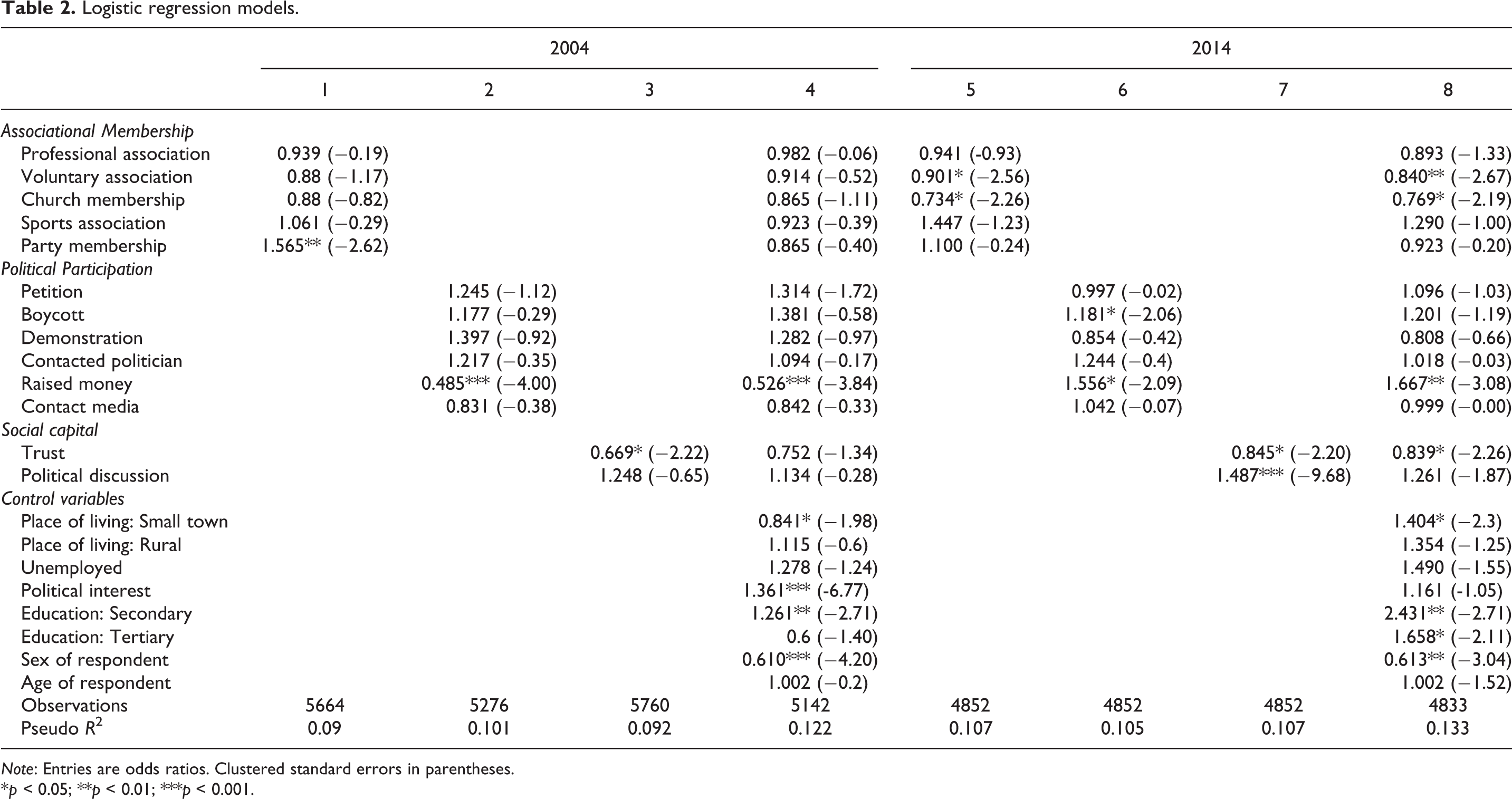
Note: Entries are odds ratios. Clustered standard errors in parentheses.
*p < 0.05; **p < 0.01; ***p < 0.001.
The results show that while the lack of associational membership and trust are associated with PRR voting in CEE, levels of political participation are high among voters of these parties when compared to those of other parties. The socioeconomic variables show, in partial contrast with Western European PRR voters, that CEE PRR voters are better educated and tend be to be equally distributed among different age groups. At the same time, like in Western Europe, PRR voters are predominantly male and live most often in small towns or the countryside.
Considering the civic engagement hypothesis discussed above (hypothesis 1), the results show that membership in professional organizations (such as business associations and trade unions), in voluntary organizations and among active members of churches are negatively associated with PRR vote. While the effect of professional organizations does not reach statistical significance, keeping everything else constant, being active in a voluntary organization or the church reduces the likelihood of PRR vote by factor 1.25 (at significance level 0.01) and 1.26 (significant at the 0.05 level), respectively (see modell 8). Based on this results, we can assume that membership in professional associations, such as trade unions, but also voluntary or religious organizations might be already politically biased and therefore a difficult to penetrate for new PRR parties. These organizations come closest to the ideal type that Neo-Tocquevilleans scholarship might describe as ‘schools of democracy’. Confirming ideas about democracy-strengthening effect of associational life, membership in these type organizations have a negative effect on PRR vote also in CEE.
In contrast to the expectations formulated in hypothesis 2, PRR voters in CEE are more likely to engage with certain forms of political activities than other voters are. While only ‘raising money’ is a significant predictor (OR 1.667 at 0.01 level) and petitioning, boycotting, contacting politicians do not show significant effects, PRR voters tend to be surprisingly politically active. These findings contradict the image of politically passive PRR voters in the literature and show constant engagement concerning some forms of non-institutionalized political participation.
Hypothesis 3 concerning the effect of social capital receives support in showing that higher levels of interpersonal trust are significantly correlated with not voting for PRR parties (OR 0.839 at 0.05 level). The results show that while PRR votes might be less trusting other people, in general, they are nevertheless more likely to become regularly involved in political discussions. Over time, the trust variable suggests that in 2014, PRR voters seem to have become more trusting compared to 2004, showing that PRR voters in 2014 are somehow more akin to other parties’ voters.
From the control variables gender, education and the place of living hold strong predictive power. Supporting earlier findings, women and inhabitants of the capital and the capital region are found less likely to cast their vote for PRR parties. Surprisingly, the effect on educational levels is different than most of the literature on Western Europe would expect: having secondary education (OR 2.431, significant at the 0.01 level) or even tertiary education (OR 1.658, significant at the 0.05 level) increases the likelihood to cast a vote for PRR parties.
What can we say about the development of PRR voting over time (hypothesis 4)? There is no clear evidence for a development towards the more ‘civic’ PRR voter base in the region which was observed in some current studies of PRR parties in the region. Most of the variables relating to associational membership, political participation or social capital have not changed much. What has changed, however, are the sociodemographic control variables. While living in small towns was significantly predictive of voting against in PRR in 2004, by 2014, these parties have important electorates votes here. Also, higher education levels (secondary and tertiary) are much stronger predictive of PRR vote in 2014 than they were in 2004. Interestingly, the role of unemployment has remained statistically insignificant despite the strong assumed impact of the global financial crisis of 2008/2009 on the rise of PRR parties in CEE.
Using the 2014 wave of ISSP, Figure 1 provides a graphical overview about country-level differences regarding associational membership which remained hidden in the aggregate analysis. Figure 1 shows that membership in professional, voluntary and religious organizations is in general negatively predictive of PRR vote. The country variation also shows, however, that particularly in Hungary, membership in professional organizations is significantly predictive of voting for Jobbik, which supports findings from qualitative case studies suggesting Jobbik’s embeddedness into established structures and its popularity among higher educated professionals.

Associational Membership and PRR vote. Source: ISSP, 2012b.
Discussion and conclusion
While the literature on PRR suggests a negative relationship between extremist anti-democratic attitudes and different attributes of social capital – such as associational membership, political activism, interpersonal trust or social integration – more recently the accurateness of this relationship has been put into question by using both historical and contemporary examples. Some examples suggest that PRR parties or social movements increasingly rely on specific social capital, foster interpersonal trust and have dense associational interlinkages. Recent examples from CEE suggested the emergence and potential success of this ‘new type’ of PRR parties also in CEE. Building on their societal embeddedness, these parties can rely on dense networks of affiliated or at least sympathetic organizations which help them establishing a parallel microcosm.
While the discussion on social capital, civil society and PRR voting has mainly remained focused on Western Europe, this contribution shows that evidence for this conjunction remains weak in CEE countries. Focusing on PRR party voters in five CEE EU member countries in 2004 and 2014, the article finds no clear signs of increased civic engagement among the voters of PRR parties in CEE and suggests low levels of associational membership and social trust among PRR voters.
The main findings of the contribution suggest that the lack of trust relations nurtures political extremism. Trust relations can be seen to be based on two components. Civic trust can be established in taking part in associational life, while interpersonal trust is a result of more informal relations. The analysis shows that the lack of both civic and interpersonal trust contributes to PRR vote in CEE. At the same time, as the deviant case of Jobbik’s voters in Hungary shows, voters of new generation of PRR parties in CEE can have relatively high levels of civic trust.
Second, while most of the literature tends to describe PRR voters as being politically passive, the results do not show particularly low levels of political participation among CEE PRR voters. This supports earlier findings about the ‘normalcy’ of PRR voters concerning political participation in Western Europe (Rydgren, 2009; Zhirkov, 2014) for Eastern Europe. The results indicate that PRR voters are even less socially isolated and do more actively exchange political views with their close peers. This might further suggest the existence of specific “social bubbles” in which PRR voters interact more informally than can be captured by associational membership variables only.
Finally, the contribution also talks to discussions in the comparative literature on emergence and factors of PRR vote. Whereas socio-economic factors, such as unemployment, are often suggested to drive PRR vote and have been described to trigger PRR vote after the global financial crisis of 2008/2009 in CEE as well, the results presented here show rather constant and insignificant effects of unemployment. This supports the view in current research that PRR contestation is less centered on classic distributional conflicts but more on ideational ones (Pytlas, 2018).
While studies of fringe parties in CEE and elsewhere have vested much energy to understand the rise, success and decline of PRR parties, this contribution suggests that to better apprehend the political changes they might cause, we should not merely focus on the electoral supply side but should also include demand-side perspectives of PRR vote. Further research could comparatively test the relevance of trust relations on PRR vote in both Western and Eastern Europe. Researcher are well advised to include borderline parties such as Fidesz in Hungary and Law and Justice in Poland, which have embraced particularly harsh PRR rhetorics following ‘the long summer of migration’ in 2015. While studies on the impact of PRR parties shows increased attention to the impact of these parties on mainstream ones (Zaslove and Wolinetz, 2018), such research could respond to the strategically important question of how right-ward swings of mainstream conservative parties affect PRR parties’s voter bases.
Footnotes
Acknowledgements
Earlier versions of the article were presented at workshops or research seminars at the Herder Institute for Historical Research on East Central Europe in Marburg, the University of Vienna, Freie Universität Berlin’s Institute of East European Studies and the School of Politics and International Relations at Queen Mary University of London. For helpful comments, I thank participants of these workshops, especially Katharina Bluhm, Ulf Brunnbauer, Dieter Segert, Sofia Tipaldou, Mihai Varga, Philipp Karl, Petra Stykow, Stijn van Kessel, Fabian Habersack, Vassilis Petsinis, Adam Fagan and Dragomir Stoyanov. Detailed written comments by Sergiu Ghergina, Bartek Pytlas and the anonymous reviewers of this Journal are thankfully acknowledged.
Declaration of Conflicting Interests
The author(s) declared no potential conflicts of interest with respect to the research, authorship, and/or publication of this article.
Funding
The author(s) received no financial support for the research, authorship, and/or publication of this article.
