




Abstract
Using a new data set of state political party bylaws and demographics of state party chairs, I evaluate whether women were more likely to run for Congress during the 2018 midterm elections from parties with higher levels of gender diversity. I construct three measures of gender diversity, whether each party was chaired by a woman, granted committee membership to an allied women’s group, and required gender parity among their committee members. Democratic parties are more likely to be chaired by a woman and to require gender parity among their members, but Republican parties are more likely to grant membership to allied women’s groups. Considering the implications of these rules, I find Democratic women were more likely to run for Congress representing parties that grant membership to an allied women’s group and parties chaired by a woman.
Introduction
In February 2019, Jessica Patterson was elected chair of the California Republican Party, making her the first woman to hold the position (Mai-Duc et al., 2019). While campaigning for party chair, Patterson emphasized the need for inclusivity and made the argument anyone who identifies as a Republican should be welcomed to the party (Mai-Duc et al., 2019). Similarly, after being elected chair of the Missouri Democratic Party in 2018, incoming party chair Jean Peters Baker pronounced the party was welcoming of all Missourians (Thomas, 2018). Shortly after Peters Baker’s election, Kay Hoflander was elected chair of the Missouri Republican Party marking the first time both major state parties were led by women at the same time (Dial, 2019).
Despite these recent examples of women advancing to the top-level leadership positions of state political parties, like most levels of government in the United States, women remain underrepresented among the leaders of state political parties. Moreover, the lack of descriptive representation among state party chairs is particularly concerning because past research finds the underrepresentation of women in party leadership positions contributes to fewer women running for elected office (Lawless and Fox, 2010).
This article evaluates the theory that greater gender diversity among political parties and elites increases the number of women willing to run for elected office. Using a new data set of provisions in state political party bylaws and demographics of state party chairs in the lead up to the 2018 midterm elections, I evaluate whether women are more likely to run for Congress representing state political parties with higher levels of gender diversity among their state central committee membership and leadership. 1 I find during the 2018 midterms, Democratic women were more likely to run for the House of Representatives in states where the state Democratic party granted committee membership to an allied women’s organization and in states where the state party was chaired by a women. In contrast, the emergence of Republican women was not influenced by the degree of gender diversity among the committee membership and leadership of state Republican parties. Ultimately, this article contributes to our knowledge of political parties, representation, and candidate emergence. First, it provides a new data set which can be used to measure levels of descriptive representation among the committee membership and leadership of state political parties. Moreover, this article provides additional evidence that the demographic makeup of political parties can have significant implications on who runs for office.
The underrepresentation of women in politics
The discipline is divided over whether electoral discrimination is a primary cause of women being underrepresented in government. Empirically, women are no less likely than similarly qualified men to win elections (Burrell, 1994; Darcy et al., 1994; Lawless and Pearson, 2008). Moreover, men and women run similar campaigns and, in many cases, have similar electoral resources available to them (Burrell, 2014; Dabelko and Herrnson, 1997; Hayes and Lawless, 2016). 2 However, others argue these assessments do not show a complete picture. Since bias and discrimination may not appear in vote totals and not all women who run for office are the same, it has been suggested that existing empirical research has not fully considered variations in candidate and incumbent quality (Fulton, 2012; Murray, 2015). 3 As a result, many successful women candidates are more qualified than traditional measures suggest. Just as not all women candidates are the same, some states and districts are more accepting of women candidates than others (Palmer and Simon, 2012; Windett, 2011) meaning some women face tougher electoral challenges. Additionally, women candidates, even incumbents, are often seen as vulnerable and face more competition than men in both primary and general elections (Lawless and Pearson, 2008; Palmer and Simon, 2005). Republican women are particularly disadvantaged by the recent trend of fewer moderates running for Congress (Thomsen, 2017) and the perception they are too liberal (King and Matland, 2003).
Beyond the electoral hurdles women face, a lack of women candidates contributes to the underrepresentation of women. Women are less likely than similarly qualified men to express interest in running for elected office (Lawless and Fox, 2010), and this gender gap in political ambition develops at an early age (Fox and Lawless, 2014; Shames, 2017). Overall, women are more sensitive to the potential costs associated with running for office (Carroll and Sanbonmatsu, 2013; Fulton et al., 2006) and are more likely to consider their own qualifications and experiences, as well as others’ opinions, when deciding whether to run (Bledsoe and Herring, 1990; Carroll and Sanbonmatsu, 2013). 4
The role of parties and elites
The gender gap in political ambition is directly linked to candidate recruitment. A growing consensus finds one reason women remain underrepresented in government is they are less likely to be recruited to run for office (Carroll and Sanbonmatsu, 2013; Lawless and Fox, 2010; Niven, 1998). This is especially true when political parties and elites recruit candidates from traditional party networks and local offices (Crowder-Meyer, 2013; Lawless and Fox, 2010) where women are underrepresented and seen as being part of the out-group (Niven, 1998). This problem hurts Republican women disproportionately because there are many more women in the pool of potential Democratic candidates compared to the pool of potential Republican candidates (Crowder-Meyer and Lauderdale, 2014). Moreover, Democratic women have greater access to successful candidate training programs and PACs (Political Action Committees) than do Republican women (Kreitzer and Osborn, 2019). Beyond recruitment, elites can also partake in gatekeeping by dissuading certain candidates from running and when they do, men are normally advantaged over women (Sanbonmatsu, 2006). While this bias may be implicit, opposed to explicit, it is still influential because political elites prioritize candidate recruitment efforts for most levels of government (Broockman, 2014).
Even when women, especially Republican women, are recruited to run for office, they are less likely than men to respond positively (Preece and Stoddard, 2015; Preece et al., 2016). Driven by the perception party elites will offer greater assistance to men (Butler and Preece, 2016; Niven, 1998) and the fact women are more likely than men to be discouraged to run for office, some women may not run even if asked (Carroll and Sanbonmatsu, 2013).
Theory
The theory that diverse political parties will be represented by more diverse candidates is well supported. In fact, promoting women to positions of power within political parties has been offered as a potential solution to the problem of women being underrepresented in government (Niven, 1998). The argument behind this relationship is threefold. First, when political parties and elites become more diverse, they will be less likely to discriminate against historically nontraditional candidates. Second, diverse parties are more likely to recruit women to run for office and are more successful in doing so. Finally, women in positions of power, such as party leadership, may inspire future generations of women to become involved in politics.
As stated previously, women are less likely to be recruited to run for office because they are often seen as belonging to an out-group (Niven, 1998). However, as political parties become more diverse, this bias should be weakened, if not eliminated, because it will become more difficult to distinguish out-group members from in-group members. In the context of this study, this means political parties with diverse committee memberships should be less likely to bias their recruitment efforts against women and more likely to recruit women to run for office. Existing research supports this notion. First, women are more likely to recruit other women to run for office (Crowder-Meyer, 2013; Niven, 1998). In one particular study with a similar research design to the one utilized here, Cheng and Tavits (2011) find that during the 2004 and 2006 Canadian national elections, women were more likely to be nominated for office from major parties when the local party president was a woman. 5 Moreover, recent research finds women are more likely to respond to recruitment efforts made by other women opposed to men (Pruysers and Blais, 2019). This means not only are parties comprised of women, and led by women, more likely to recruit women candidates, they are more likely to be successful in their efforts.
It should be acknowledged not all candidates are recruited to run for office. However, even if state parties are not actively recruiting candidates in every district, this does not mean the composition of a party’s state central committee has no influence on the candidate emergence process. First, when party organizations, at both the national and local levels, do actively recruit candidates, they are often successful in their efforts (Maisel and Stone, 2014). Moreover, many self-starters having existing contacts with party organizations, or at least have some form of contact with a party organization prior to deciding to run (Kazee and Thornberry, 1990). Overall, since party organizations can also dissuade candidates, and there is a perception men will receive greater assistance from elites than women, gender diverse parties will positively influence the electoral calculations of potential women candidates even if they are not actively recruiting women.
Finally, diverse political parties should inspire more women to run for office. A growing body of literature argues women in positions of power can inspire other women to become politically active (Bonneau and Kanthak 2018; Campbell and Wolbrecht, 2006). For example, Ladam et al. (2018) examine whether women governors and senators have the ability to encourage more women to run for the state legislature by acting as symbolic role models and/or by recruiting more women to run for office from their positions of power. They find better support for the symbolic representation argument. Specifically, they find women with no ability to recruit other candidates, senators and governors from neighboring states, and women with a limited ability to recruit other women, losing women candidates for U.S. Senate and governor, both have positive effects on more women running for the state legislature. If losing women candidates for governor and senator, and women governors and senators in neighboring states, can motivate more women to run for office, the same is probably true of women serving on state party committees, particularly women in leadership positions. 6 What is more, in comparison with governors and senators, who may lack the opportunity to directly recruit more women (Ladam et al., 2018), past research acknowledges political parties play an important role in candidate recruitment. Overall, diverse political parties are more likely to be represented by women candidates because they limit the potential for biased recruitment, actually recruit more women, and inspire more women to run for political office.
Methodology
Having explained why diverse political parties should lead to more diverse candidates, I now outline my methodology for testing this theory. The dependent variable is the number of nonincumbent women candidates running for the House of Representatives in each Democratic and Republican primary. 7 Figure 1 shows the number of nonincumbent women candidates in all 2018 primary elections for the House of Representatives. Despite 2018 being dubbed a second “Year of the Woman,” a majority of both party’s primary elections saw no women candidates. Overall, 350 of 435 Republican primaries, 80.5%, and 240 of 435 Democratic primaries, 55.2%, had no nonincumbent women candidates. Not surprisingly, when women did run for the House of Representatives, they were more likely to run in Democratic primaries. Of the 85 Republican primaries that featured at least 1 nonincumbent woman, only 13 primaries had more than 1 woman and 9 of these primaries saw only 2 women. On the Democratic side, of the 195 primaries with at least 1 nonincumbent woman, 71 primaries featured more than 1 woman. Since less than 10% of all primaries in 2018 saw more than one nonincumbent woman candidate, I use a binary measure of candidate emergence where each primary is coded 0 if no nonincumbent women candidates ran for the House of Representatives and 1 if at least one nonincumbent women candidate emerged. I use the candidate file in Brooking’s 2018 primary election data set to determine the number of candidates, and their gender, running in each primary (Kamarck and Podkul, 2018). 8
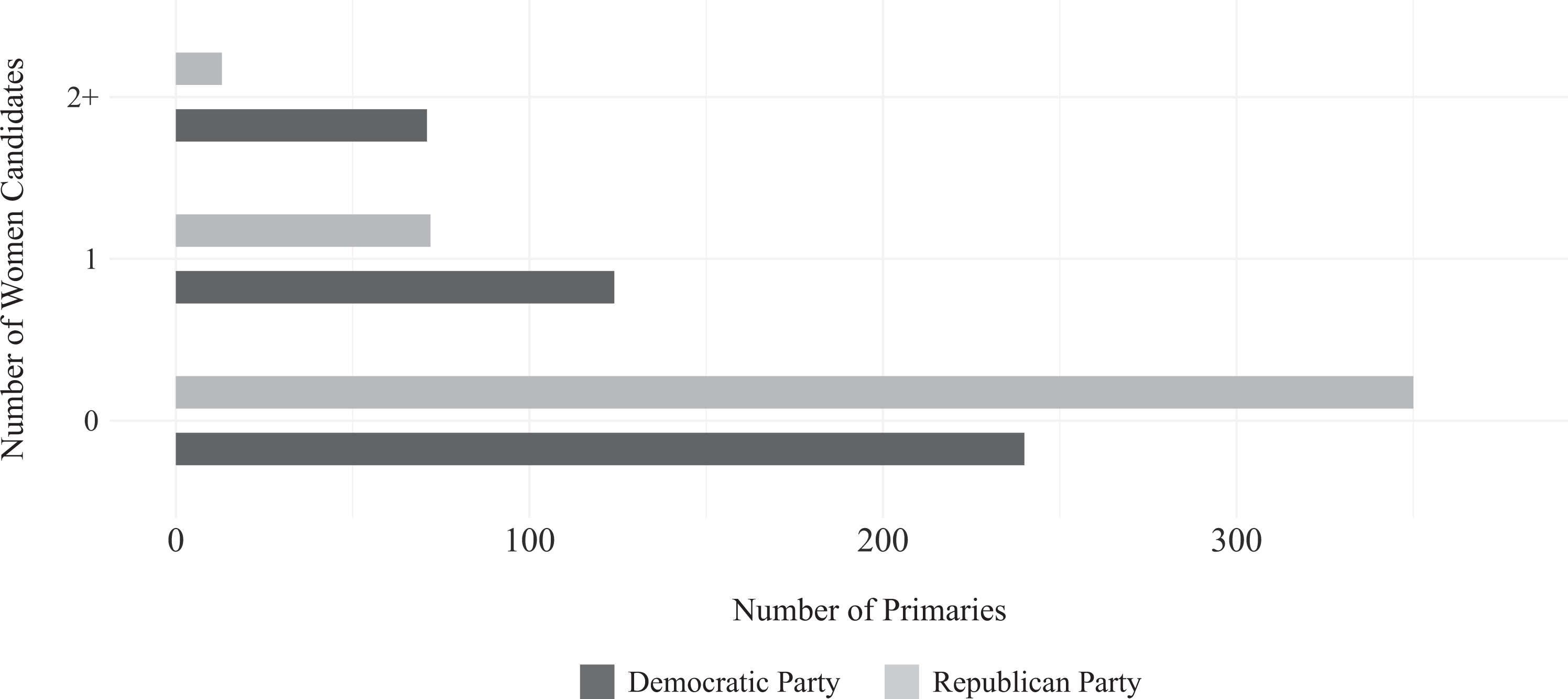
Women primary candidates. Note: This figure displays the number of nonincumbent women candidates in 2018 primary elections for the House of Representatives.
My main independent variables of interest, which will be discussed in the next section, are measures of gender diversity in the membership of each party’s state central committee, but it is also necessary to consider other variables that influence whether women run for office. First, I use Trump’s 2016 district-level vote share in order to account for the ideological leanings of each district (Nir, 2012). Next, I consider whether an incumbent is seeking reelection in each primary due to the sizable advantages incumbents hold over their opponents and the fact women are more likely to run for open seats (Ondercin and Welch, 2009). For each primary, I code whether there is a party incumbent in the district, an opponent party incumbent in the district, or whether the district has an open seat. I also control for the type of primary being held in each state according to the National Conference on State Legislatures since candidates likely consider which voters are eligible to vote before deciding to run (National Conference of State Legislatures, 2016). In order to control for a pool of women potentially willing to run for Congress in each state, I include the percentage of women serving in each state legislature in 2018 (Center for American Women and Politics, 2018). Additionally, I control for the degree of legislative professionalism in each state (Squire, 2017).
Representation of women in state political parties
There are several ways to measure gender diversity in state party committees. The most obvious way is to compare the proportion of party committee members who are women to the proportion of committee members who are men. Beyond considering the number of women holding formal membership in each state party committee, it is also necessary to consider if women hold party leadership positions. Finally, it is possible a party aligns itself with a women’s group or organization, such as the Arizona Federation of Democratic Women, whose goals among other things, may be to represent specific group(s) of women or to work toward the advancement of women in politics, by granting them party committee membership.
These three constructs of gender diversity are theoretically straight forward, but measurement is not. Similar to how there is a lack of consistent data on women’s representation in local politics (Holman, 2017), it is difficult to collect data on the committee membership of state and local political parties. While some parties provide a membership roster on their website, many do not. My solution is to collect membership information from the bylaws of each state party. Unlike committee membership rosters, with only a few exceptions, almost all parties provide a copy of their bylaws on their website. Overall, I was able to collect the bylaws governing each state Democratic and Republican party at the time of each state’s filing deadline for 2018. By reading and coding each party’s bylaws, I was able to measure all three of my constructs of gender diversity and thus create three independent variables. 9 First, I differentiate whether each political party grants committee membership to an allied women’s group. 10 Second, I create a binary variable that differentiates whether each party was chaired by a woman or man at the time of the state’s filing deadline. 11 Last, I create a binary variable that differentiates between parties that require gender parity among their committee members and parties that do not. 12
Figure 2 shows the descriptive representation of women in state Democratic and Republican parties in the lead up to the 2018 midterm elections along the three dimensions just discussed. First, it displays the number of parties that grant committee membership to an allied women’s group. This is the most common form of representation guaranteed to women in Republican parties and the only form of women’s representation more common in Republican parties compared to Democratic parties. Overall, 35 state Republican parties and 23 state Democratic parties grant some form of party committee representation to an aligned women’s group. A partnership with an allied women’s group should help state parties to recruit more women to run for office by helping them to identify a larger pool of potential women candidates. First, members of these groups may personally have political ambitions. In this case, the formal alliance between their organization and the state party would help them to make connections with elites and to potentially become a visible member of the larger party network. Additionally, through the course of their work, women’s organizations are likely better able to identify potential women candidates than are party organizations, since they might be less reliant on traditional party networks, where women remain underrepresented (Crowder-Meyer, 2013).

Representation of women in state politics parties. Note: This figure displays three measures of women’s representation in state party committees: whether a women’s group is granted representation in the party committee, whether the party is led by a woman, and whether the party requires gender party among its committee members. Among the parties granting committee membership to a women’s group, one Democratic party and four Republican parties only grant nonvoting membership to these organizations.
It should be noted that not all women’s groups have the same aims and goals since the Democratic and Republican parties view their relationship with these groups differently. The Democratic Party views their constituency groups as a way to exercise power, with constituency groups advocating for their interests within the party, while the Republican Party views their affiliated groups as extensions of the party, who work toward party goals (Freeman, 1986). These competing views of constituency groups likely mean the influence of granting party committee membership to an allied women’s group on the number of women running for Congress varies across party.
Next, Figure 2 shows the number of state parties chaired by a woman. In the lead up to the 2018 midterm elections, only 31 of the 100 state-level Democratic or Republican parties were led by women. Women were more likely to hold the position of chair in Democratic parties. Specifically, 20 state Democratic parties were led by a woman, but only 11 state Republican parties were led by a woman. Since party leaders are more visible than other party members, parties chaired by a woman probably have the best opportunity to symbolically inspire more women to run for office.
Finally, Figure 2 shows the number of state parties with rules in place attempting to ensure gender parity in party committee membership. 13 While it is more common for both Democratic and Republican parties to require gender parity in their party committee membership than it is for either party to have a woman serve in the position of chair, state Democratic parties are more than twice as likely as state Republican parties to have provisions in their bylaws requiring gender parity. Specifically, 47 state Democrat parties, compared to only 21 state Republican parties, make a clear attempt to achieve gender parity through provisions in their bylaws. 14 Requiring gender parity will lead to more women running for office since it is likely the best way to mitigate the out-group bias against potential women candidates since by definition women will have equal representation within the party. 15
Using bylaws to collect measures of gender diversity is not without potential drawbacks. One drawback is it restricts my analysis to one election cycle, since historical state party bylaws are not easily accessible, but this can be remedied by maintaining my data set of bylaws into the future. Second, there is potential that a party’s bylaws could differ from their actual practices. For example, a party may not have a formal rule requiring that each county is represented by one man and one woman but may have a norm or tradition of doing so. This drawback is without a clear solution; however, I argue formal rules are more important than traditions or norms because they are harder to amend or eliminate. Within their bylaws, each party has requirements and procedures for amending party rules, but this is not the case for traditions or norms. 16 Despite these potential drawbacks, I believe party bylaws are the best source of data for measuring a party’s commitment to gender diversity since not all parties maintain publicly available membership rosters and using bylaws does not require the use of elite surveys.
Results
Table 1 lists the results of six logistic regression models estimating the influence of state political party gender diversity on the emergence of women in primary elections for the House of Representatives during the 2018 midterm elections. The first model analyzes all primary elections, with a variable that differentiates between Democratic and Republican primaries, and the second and third models consider Democratic and Republican primaries independently. This is necessary because women face different paths to elected office in each party (Sanbonmatsu, 2002). Models 3 through 6 replicate this analysis but remove primary elections for open seats to better consider variations in any potential incumbency advantage. In these three models, I consider two additional elements of incumbency that might influence the emergence of women in congressional elections. First, I control for the gender of each incumbent since women are more likely to run against other women, which means they typically face more primary competition (Lawless and Pearson, 2008; Palmer and Simon 2005). Second, I control for each incumbent’s cash on hand at the beginning of the FEC’s (Federal Election Commission) 2-year reporting period for 2017/2018 since women are more likely than men to cite the need to raise money as a reason not to run (Lawless and Fox, 2010).
Nonincumbent women candidates in primary elections.

Note: Reference categories = party incumbent, closed primary.
AIC = Akaike's information criterion, BIC = Bayesian information criterion.
†p < 0.10; *p < 0.05; **p < 0.01; ***p < 0.001.
In terms of the influence of state party gender diversity, there are stark differences between Democratic and Republican primaries. The degree of gender representation in Republican state party committees appears to have no significant influence on the emergence of nonincumbent women candidates in congressional elections. Specifically, nonincumbent Republican women were no more likely to run for office when their party granted committee membership to an allied woman’s group, when their party required gender parity among their committee membership, or when their party was chaired by a woman. In contrast, nonincumbent Democratic women were more likely to run for the House of Representatives when their party granted committee membership to an allied women’s group and when their party was chaired by a woman. Moreover, these relationships were present regardless of whether primaries for open seats were included in the analysis.
Beyond gender diversity in state party committees, nonincumbent women were more likely to run in open seat elections compared to elections where an incumbent was seeking reelection. Additionally, when an incumbent was seeking reelection, Democratic women were more likely to run when the incumbent represented the opposing party compared to their own party. From a theoretical perspective, these findings are unsurprising. Most potential candidates view open seats as more winnable since none of the candidates benefit from incumbency and if a candidate was going to challenge an incumbent, they have greater incentives to defeat someone from the opposing party than someone from their own party. None of the other variables significantly influenced the emergence of nonincumbent Republican women. However, nonincumbent Democratic women were more likely to run in states utilizing partially open primaries opposed to closed primaries and in states with higher levels of legislative professionalism but were less likely to run in districts where Trump performed well in 2016. Additionally, in incumbent races, nonincumbent Democratic women were more likely to run in states where unaffiliated voters were allowed to participate in the Democratic primary but were less likely to run in states using blanket primaries. Finally, elements of the incumbency advantage seemed to have little influence on nonincumbent women running for Congress. Women incumbents did not face additional women challengers and nonincumbent women were not deterred from running for Congress when incumbents had large campaign war chests.
Figure 3 shows predicted probabilities of at least one nonincumbent women running for the House of Representatives broken down by political party and varying levels of gender diversity in a state party committee. The top panel displays predictions for Democratic primaries. In 2018, just under 45% of Democratic primaries had at least one nonincumbent women candidate, but Figure 3 shows state Democratic parties can potentially increase the number of women in congressional primaries by granting an allied women’s group party committee membership and by electing a woman chair. A state Democratic party that requires gender parity among their elected members, as mandated by the DNC, but does not grant party committee membership to an allied women’s group and is chaired by a man has about a 0.50 probability (0.32–0.67) of having at least one nonincumbent women run for the House of Representatives. In comparison, a state Democratic party that requires gender parity and grants party committee membership to an allied women’s group has 0.84 probability (0.72–0.92) of having at least one nonincumbent woman run. Similarly, a state Democratic party that requires gender parity and is chaired by a woman has a 0.72 probability (0.49–0.87) of having at least one nonincumbent woman run for Congress. While the confidence intervals on the woman chair estimate overlap with the gender parity only estimate, Table 1 reveals both of these relationships are statistically significant. Moreover, Figure 3 shows they are substantively significant since electing a woman chair or granting party committee membership to an allied women’s group increases the probability of having at least one nonincumbent woman candidate by about 0.20 and 0.35, respectively.

Predicted probability of a nonincumbent woman candidate by gender diversity in state party committees. Note: This figure displays the predicted probabilities and 95% confidence intervals, of at least one nonincumbent woman running for the House broken down by party and varying levels of gender diversity in a state party committee. Predictions are calculated using models 5 and 6 from Table 1 with all other variables set to their median or mode values corresponding to each model. The Democratic predictions are based on a state party requiring gender parity, but the Republican predictions are not since these are the modal characteristics of each party.
The bottom panel of Figure 3 displays similar predictions for Republican primaries. In 2018, just under 20% of Republican primaries had at least one nonincumbent woman candidate. Since nothing other than open seats seem to influence the emergence of Republican women, the predictions in Figure 3 mirror the results of the 2018 elections. There is about a 0.19 probability (0.08–0.40) of at least one nonincumbent woman running when a state Republican party does not mandate any form of gender diversity. In comparison, when a state Republican party grants committee membership to an allied women’s group, there is a 0.17 probability (0.07–0.35) of having at least one nonincumbent woman run and when a state Republican party is led by a woman, there is a 0.21 probability (0.06–0.52) of having at least one nonincumbent woman run for the House. Overall, increased gender diversity of state Republican party committees has neither a statistically nor substantively significant influence on nonincumbent women running for Congress.
Discussion
In the lead up to the 2018 elections, state Democratic parties were more likely to be chaired by a woman and more likely to require gender parity among their committee members, but state Republican parties were more likely to grant party committee membership to an allied women’s group. Ultimately, these demographics of state political parties play a role in the candidate emergence process at least among Democrats. Specifically, nonincumbent Democratic women are more likely to run for the House of Representatives in states where the state Democratic party grants committee membership to an allied women’s group and in states where the Democratic party is chaired by a woman. These findings are meaningful because they reveal a potential path for increasing the number of women in Congress. If the Democratic Party continues to commit efforts toward increasing the diversity of their state and local party committees, not only will state political parties be more reflective of the populations they represent, but in time Congress, and perhaps other political offices, will also become more diverse. However, these results also present a concerning trend, mainly that levels of gender diversity in state Republican parties had no influence on the emergence of nonincumbent Republican women. The most likely explanations for this are Republican women face a more challenging partisan environment (Thomsen, 2019), Republicans are less likely than Democrats to embrace identity politics (Crowder-Meyer and Cooperman, 2018), and the Republican Party views their affiliated organizations as party actors opposed to allies with independent goals (Freeman, 1986). Overall, as long as only one of the two major political parties is taking steps to increase the number of women in government, true gender parity among elected officials is unlikely to be achieved.
While this project only examines one election cycle, the 2018 midterm elections provide a stringent test of the theory. A record number of women ran for Congress in 2018 (Zhou, 2018). If anything, this means women were more motivated than usual to run for office and the influence of the mechanisms that traditionally influence when and why women run for office, such as political party diversity, may have been diminished in 2018. Despite this, state political party diversity was still related to women running for Congress. Nonetheless, future research should test this theory across future election cycles and other types of elections, which would add to the external validity of these findings. Overall, this research contributes to the fields of political parties, representation, and candidate emergence by providing a new test of existing theory and by providing a new data set which can be used to measure and track levels of descriptive representation within state political parties.
Supplemental material
Supplemental Material, sj-pdf-1-ppq-10.1177_1354068820921491 - Women running the party and women running for Congress: An examination of state party diversity and candidate emergence in the 2018 midterm elections
Supplemental Material, sj-pdf-1-ppq-10.1177_1354068820921491 for Women running the party and women running for Congress: An examination of state party diversity and candidate emergence in the 2018 midterm elections by Matthew J Geras in Party Politics
Footnotes
Declaration of conflicting interests
The author(s) declared no potential conflicts of interest with respect to the research, authorship, and/or publication of this article.
Funding
The author(s) received no financial support for the research, authorship, and/or publication of this article.

Supplemental material
Supplemental material for this article is available online.
Notes
Author biography
References
Supplementary Material
Please find the following supplemental material available below.
For Open Access articles published under a Creative Commons License, all supplemental material carries the same license as the article it is associated with.
For non-Open Access articles published, all supplemental material carries a non-exclusive license, and permission requests for re-use of supplemental material or any part of supplemental material shall be sent directly to the copyright owner as specified in the copyright notice associated with the article.
