



Abstract
Students of legislative politics are divided over the relationship between electoral vulnerability and the type of “home style” members of Congress adopt in terms of their district staffing decisions. The conventional wisdom asserts that an increase in electoral vulnerability corresponds with a legislator increasing the number of district staffers. However, another body of works implies that the inverse relationship should occur. To settle these competing claims, we explore the staffing decisions of legislators serving in the House of Representatives between the 101st and 113th Congress. We find that an increase in electoral vulnerability is associated with a decrease in district staffers. These results cast doubt on the widely held view that a legislator’s electoral vulnerability results in an increase in district attentiveness at least in terms of their district staff. Additionally, our findings provide several insights into the relationship between elections and representation.
In his seminal book on Congress, Richard Fenno develops the notion of “home style” or the way in which a legislator interacts with her constituency. To help their reelection prospects, congressional members adopt a home style that is compatible with their district. According to Fenno, one important component of a member’s home style is the way they choose to allocate their staff resources. While at first glance congressional district staffers may appear to have limited political implications, there are countless examples highlighting how they can amplify a constituent’s voice. For instance, one news article stressed that “besides attending meetings to stay abreast of issues,” district staffers diligently “help constituents resolve problems with various federal agencies, listen to concerns about health care reform and other legislation, and travel the region to work with communities and businesses pursuing grants and other federal opportunities.” The article goes on to provide several astute observations into how congressional staffers help to facilitate representation within the United States (Spence, 2009). In another prominent example, several congressional staffers visited an Illinois farm to stay informed on agriculture related issues (Spitler, 2017). After the visit, one of the farmers candidly disclosed, “The people I was talking to were actually the ones who write the laws…[s]o by teaching them something about agriculture, it’s bound to give us a heads up.” Additionally, legislative staffers for Representative Virginia Foxx (NC-R) played a vital role in helping to reform the tax system for veterans after hearing alarming concerns from a distressed constituent (Bland, 2014).
Given that legislative staffers potentially boost a legislator’s political career (Parker and Goodman 2009) and enhance representation (Abernathy, 2019; Maestas, 2000), we would expect members of Congress to employ as many district staffers as possible to help their reelection prospects. However, there is considerable variation in the amount of district staffers and offices among the members of Congress. For instance, at the start of the 115th Congress, Representative Trent Kelly (MS-R) maintained ten of his seventeen staffers in the district. 1 His district staff included a district director, a communications director, and eight constituency service staffers. Conversely, Representative Ami Bera (CA-D) had just six of his sixteen staffers remain in the district with Representative Bera employing a district director and five constituency service staffers within the district. 2 This discussion raises the following question: what political factors might explain the variation of staff and resource allocation decisions among the members of Congress?
According to Fenno (1978), electoral considerations could be a significant factor explaining a legislator’s resource allocation decisions. Electoral pressures should compel members of Congress to adopt home styles that are constituency centered, thus, influencing their staffing decisions. However, within the congressional literature, there are two competing perspectives on the relationship between a member’s electoral vulnerability and their staffing decisions. The conventional wisdom asserts that electorally vulnerable members should have more district staff relative to their more electorally safe counterparts (Ashworth & Bueno de Mesquita, 2006; Cain, Ferejohn, and Fiorina 1987; Miller 2010). According to this literature, district staffers assist legislators by ensuring that they are attentive to issues salient with the voters, and district staffers also help to funnel electorally valuable federal dollars to the district (Sellers, 1997). Nevertheless, other scholars have suggested that electorally vulnerable members might perceive that it is in their political interest to shift their staff and resources away from their district and to the nation’s capital (e.g., Cahill & Stone, 2018; Crosson et al. 2020b; Hardin, 2015; Rocca & Gordon, 2010). In an attempt to reconcile these competing perspectives, we analyze legislators’ staffing decisions between the 101st and 113th Congress. Specifically, for each member of Congress, we analyze the percentage of district staff that each member maintained. We find that for elected officials serving in the House of Representatives, that an increase in electoral security corresponds with increasing the number of staffers in their district. We also find that the effect of electoral vulnerability has on the number of district staffers varies based on the district’s socioeconomic status.
Our findings provide numerous insights into the implications that electoral pressures have on legislative institutions. First, these findings cast doubt on the conventional wisdom that an increase in electoral vulnerability is associated with a legislator increasing the number of staffers in their district. Instead, our findings suggest that electorally vulnerable legislators are associated with a decrease in district staff, opting to allocate more staffers in the nation’s capital. Second, legislative scholars have noted a decline in legislative productivity, with Congress dramatically decreasing funds for committee staff (Bolton & Thrower, 2016; Grant & Kelly, 2008). Consequently, some experts have pondered whether Congress has the capacity to tackle complex problems and policies. Our findings suggest that electorally vulnerable legislators could potentially fill this void because they are more likely to allocate their staff in the nation’s capital, where the attention is focused on more policy-related issues. Third, in recent years, several scholars have observed a lack of electoral competition in House races (Jacobson & Carson, 2019). Our findings suggest, at least for low socioeconomic districts, an increase in electoral security can improve some aspects of representation. Finally, district staffers are considered an important link between constituents and politicians (Fenno, 1978). Our findings suggest that electoral pressures could cause them to employ fewer district staffers and possibly weaken this linkage. Taken together, our findings shed additional insights into the implications that elections have on legislative politics.
Members of Congress and Their Staff
Polsby’s (1968) groundbreaking analysis on the institutionalization of Congress is one of the earliest studies on legislative staffers. He observes that an increase in legislative staffers is associated with an increase in congressional professionalization. Polsby’s research became a catalyst for a blooming body of works that explores the origins and consequences of congressional staffers (i.e., Crosson et al. 2020a; Fenno, 1973; Hertel-Fernandez, Mildenberger, and Stokes 2019; Kaslovsky, 2021; LaPira & Thomas, 2017; Mayhew, 1974a; McCrain, 2018; Montgomery & Nyhan, 2017; Romzek & Utter, 1997; Salisbury & Shepsle, 1981). For instance, Montgomery and Nyhan (2017) find that a staffer’s policy and institutional expertise can influence a member’s legislative effectiveness and voting record. In another prominent example, Crosson et al. (2020a) provide evidence which demonstrates that an increase in partisan competition tends to reduce legislative capacity. We seek to build upon this impressive body of literature by exploring how electoral considerations influence a lawmaker’s decision-making regarding the allocation of staff and other resources.
In terms of a legislators’ personal staff, there are around 18 different positions for members in the House of Representatives. Germane to our research question, the positions can be grouped by staffers working in the district and staffers that reside in Washington, D.C. (e.g., Fenno, 1978; Parker and Goodman 2009; Petersen 2012). Generally, district staffers are responsible for connecting with the representative’s constituents, within the district, and ensuring that their concerns are alleviated. For instance, a “constituent services representative” typically responds to inquiries from constituents and is the liaison between a representative’s constituents and federal agencies. Another example of a district staffer is a “district scheduler,” which help to coordinate the representative’s visits and activities within the district. Finally, some members have a “grant coordinator” on staff, who assist constituents in securing scarce federal funds. Taken together, the main responsibilities of district staffers tend to focus more on constituency-related issues.
Alternatively, staffers in the District of Columbia perform fundamentally different tasks. For example, a member’s “chief of staff” is their primary political and policy advisor. Further, a “legislative assistant” briefs the member on hearings, votes, bills, and amendments. Furthermore, they prepare written statements describing the policy positions of the representative. As a final example of a non-district staffer, the “press secretary” manages the legislator’s communication strategy, speaks to reporters, crafts press releases, writes speeches, and helps to prepare the legislator for interviews. As noted above, for members to successfully interact with their constituents and be effective lawmakers, the duties and responsibilities of a member’s district and D.C. staff tend to be vastly different.
In order to ensure that all members are able to effectively secure staffers, members receive representational allowances (i.e., Members’ Representational Allowance or MRA), which are meant to cover the cost of staffers and district offices. 3 The monetary value of the Member’s Representational Allowance (MRA) varies over time and by member, but the budget for personnel is similar for most members (Brudnick, 2019). Of course, legislators serving in leadership positions do have additional opportunities to obtain more staffers based on their needs. Furthermore, there are few constraints placed on the members pertaining to how they choose to allocate their funds for congressional staff. Additionally, members are given the discretion to decide which staff positions they wish to hire. Outside of the MRA and the limited constraints that it provides, the chamber does provide members with constraints on the total number of staffers that a member’s office can employ, which have increased and decreased over time. Fenno (1978) asserts that a legislator’s resource allocation decisions are based on their personal, political, and constituents’ needs.
There is considerable variation among members in deciding how to allocate their staff resources. For instance, Representative Rob Andrews (NJ-D) frequently had 15 or more staffers in his district – with around 11 staffers focusing on constituency service, a chief counsel, a scheduler, two receptionists, and his chief of staff. Conversely, Representative Andrews surrounded himself with a much smaller group of staffers in his Washington, D.C. office – where he had only five legislative staffers. This is a stark contrast to Representative Raul Ruiz (CA-D) who maintained 7 staffers in the District of Columbia, but only 2 staffers in his Southern California congressional district. Representative Ruiz generally supports four legislative staffers, a scheduler, a press secretary, and his chief of staff in Washington, while only having a district director and deputy director in his district office. This variation, in resource allocation, raises the question: what political factors might explain different staffing decisions? We suggest that electoral politics could be a factor that might explain these different staffing decisions by the members. For example, Representative Ruiz is frequently reelected with less than 60% in his district, whereas Representative Andrews has received well over 70% in most of his reelection campaigns. In the following section, we outline the different studies that connect elections to a legislator’s decisions regarding staffing and resource allocation.
The Electoral Influence on the Allocation of Staff and District Resources
At the heart of a democratic system is representation (Dahl, 1961). In Richard Fenno’s (1978) seminal book on congressional representation, he developed the notion that each member develops a “home style,” or a member’s specific behavior within their district, that is responsive to their constituents. A member’s home style is a critical form of representation. By cultivating a representational style that is pleasing to her voters, this should increase a legislator’s reelection prospects. According to Fenno, a member’s home style can be described by three components: allocation of staff resources, self-presentation, and the explanation of Washington activities.
Within the home style literature, conflicting claims have been offered as it pertains to the impact that electoral vulnerability has on a member’s decisions regarding staff and resource allocation. Electorally vulnerable members should be more conscientious about developing a home style that is more aligned with their district. Further, legislators who utilize their district staff in order to learn about their constituent’s concerns, may potentially develop a “personal vote” within their district. One set of studies argues that vulnerable members should be more likely to allocate their staff and resources to their district, in order to cultivate a close relationship with their constituents (e.g., Cain, Ferejohn, and Fiorina 1987; Miller 2010). Another vein of research implies that the inverse relationship occurs (e.g., Arnold 1990; Rocca & Gordon, 2010). In this section, we will outline each perspective and their implications in terms of a member’s home style.
The conventional wisdom among several scholars of congressional politics is that electorally vulnerable members should develop a home style that amplifies their attentiveness towards their constituents (Ashworth & Bueno de Mesquita, 2006; Bernhard and Tracy 2018; Cain, Ferejohn, and Fiorina 1987; Epstein & Frankovic, 1982; Fenno, 1978, 1978; Fiorina 1977; Freeman and Richardson 1996; Miler, 2010; Serra, 1994). This literature suggests that it would be politically wise for electorally vulnerable members to be hyper responsive to their district as a way to improve their reputation with the voters (Bond, 1985; Fenno, 1978; Fiorina 1977). Consequently, members of Congress who are in electoral peril should choose to allocate more staffers to their district. According to this approach, electorally secure representatives have the luxury to focus on other goals such as good public policy (Fenno, 1973). 4 Since electorally secure representatives have weaker incentives to keep their staffer in the district, they can send their staffers to the Hill to help craft sound policy and complex legislation.
This perspective, at first glance, is intuitive since staffers in the district are responsible for responding to casework inquiries from constituents (Petersen 2012). District staffers are also responsible for updating the representative on local issues that are salient to the district and the voters. Both legislative activities, in theory, are potentially electorally rewarding for an incumbent (Cain, Ferejohn, and Fiorina 1987; Dropp & Peskowitz, 2012; Fenno, 1978; Freeman and Richardson 1996; Romero, 2006; Serra, 1994; Sulkin, Testa, and Usry 2015). Moreover, district staffers organize the representative’s trips to the district, which is a vital task as research shows that a member of Congress’s traveling activities can greatly impact their standing with voters (e.g., Fenno, 1978; Parker and Goodman 2009; 2013; Rosenson, 2009). Finally, district staffers play a critical role in securing federal grants or congressional pork for the district. Congressional pork can enhance a legislator’s electoral prospects as it provides an opportunity to engage in the politically beneficial activity known as credit-claiming (Grimmer, 2013a, 2013b; Grimmer, Messing, and Westwood 2012; Sellers, 1997). Taken together, the traditional perspective implies that electorally insecure members should choose to allocate their resources to their districts rather than in D.C.
However, there are several reasons to question this perspective. Recent research indicates that casework and parochial attention are not salient with most voters (Binder, Maltzman, and Sigelman 1998; Johannes & McAdams, 1981; Lapinski et al., 2016). Instead, the representative’s policy positions tend to be a larger factor in a citizen’s approval of their elected officials (Grose, Malhotra, and Parks Van Houweling 2015; Hardin, 2015; Hassell & Quin Monson, 2016). Thus, legislators are potentially disincentivized to focus on district issues. Further, Johannes (1983) asserts that constituency demand is a more prominent factor in a member’s calculus in deciding to focus on casework. Similarly, Parker and Parker (1985) find limited evidence of electoral forces influencing district attentiveness. Instead, the distance from Washington, D.C. and constituency demographics are more prominent factors that shape a legislator’s attentiveness.
A few students of congressional politics have indirectly challenged this conventional wisdom by suggesting that members could reasonably perceive greater electoral gains by focusing their attention on the nation’s capital. A section of the literature finds that there are indirect electoral benefits, members receive, by focusing on their legislative agendas (Atkinson & Windett, 2019; Box-Steffensmeier and Grant 1999; Hardin, 2015; Hibbing, 1993; Rocca & Gordon, 2010). For instance, Rocca and Gordon (2010) find that bill sponsorship is a politically advantageous activity. They argue sponsoring legislation is an opportunity for savvy politicians to engage in position-taking and offer pleasing positions to their constituents (Mayhew, 1974a). Consequently, their results demonstrate that interest groups are more likely to contribute to legislators who sponsor bills that are supportive of their cause. Similarly, Box-Steffensmeier and Grant (1999) find that members who are more effective in passing their legislative agenda are associated with an increase in campaign funds. Hardin (2015) examines the representational responsiveness of legislators, using survey experiments with voters, and finds a wealth of variation within the types of responsiveness (i.e., constituent versus policy) that constituents expect from their representatives, with support being offered for the notion that voters value policy representation. Finally, Atkinson and Windett (2019) find that, for some members, large legislative agendas can potentially scare off challengers. Given this potential electoral gain, and that the allocation of staffers is a zero-sum situation, it is not surprising to see some electorally vulnerable members of Congress adopting home styles in which they hire more D.C. staffers, at the expense of district staffers, in order to focus on their legislative activity. 5
There are several examples that suggest members use their legislative agenda, which must be maintained by D.C. staffers, to help their reelection efforts. For instance, Representative John Garamendi (CA-D) frequently wins his congressional elections by narrow margins. In a December 2020 press release, Representative Garamendi boasted that his proposal to secure millions of dollars for special districts was placed in the coronavirus relief bill. Representative Garamendi proclaimed “To the first responders, peaceoffiers, firefighters, and public health professionals … know that federal help is on the way with this breakthrough. I will always fight to ensure our communities have the federal resources, funding, and support they need to provide the services that will help us beat COVID-19.“ 6 This legislative proposal has the potential to be electorally rewarding (Grimmer et al., 2012; Mayhew, 1974a), and it can be more easily enacted with a large staff on the Hill.
Members of Congress who frequently experience close elections might be incentivized to build valuable personal reputations that can only be created in the District of Columbia. More staffers in the nation’s capital can help the legislator stay up-to-date and informed on important issues relevant to their district, thus, becoming policy experts (Crosson et al. 2020b). Members who become experts on issues salient to their constituents can also more effectively engage in credit-claiming and position-taking (Hibbing, 1993; Katz and Sala 1996). This aligns with Parker and Goodman’s (2009) research on home styles which demonstrates that voters are more likely to hold negative evaluations of their legislator’s policy expertise if they tend to prioritize district staffers. Thus, electorally vulnerable members may choose a home style in which they have more staffers in D.C. in order to develop a politically valuable reputation on issues that are important to their constituents at the expense of district staffers.
There is a well-develop body of works which shows that electorally vulnerable members are concerned about being perceived as incompetent or shirking their responsibilities, thus, they devote greater attention to their legislative duties (e.g., Arnold 1990; Byers and Shay 2019; Cahill & Stone, 2018). For instance, Rocca and Sanchez (2008) and Harward and Moffett (2010) show that electorally vulnerable members are more likely to cosponsor legislation relative to their more secure counterparts. In another prominent example, Byers and Shay (2019) find that electorally vulnerable members are less likely to abstain on roll call votes. This vein of research argues that vulnerable members focus on their lawmaking duties in Washington D.C. because they do not wish to be perceived by their constituents as shirking their legislative responsibilities. Afterall, a challenger could potentially raise this issue on the campaign trail and dampen their electoral prospects (Arnold 1990). Thus, we might see vulnerable members allocating more of their resources to staffers in the nation’s capital.
This perspective would also recognize that representatives who have more electoral security may feel the need to engage in behavior that helps their reelection chances such as keeping a larger share of their staff on the Hill. Thus, even the most electorally secure legislator cannot completely ignore the tasks and activities necessary to stay in office. However, as a representative becomes increasingly electorally secure, they might be less concerned about the potential electoral repercussions from not maintaining a large share of staffers in Washington, D.C. Instead, they can focus on other goals. For instance, many members of Congress view casework as more of an ethical obligation they should carry out for their constituents, rather than a necessary task (Thompson, 2000). 7 If a legislator feels less pressured to focus on their reelection efforts, then they can devote more resources to district staffers who can engage in activities that they perceive as not critical to their reelection efforts.
Member’s staffing decisions are still fairly misunderstood within the literature. As we have demonstrated, there are vastly different explanations for this crucial aspect of legislating and constituency representation, but systematic evidence pertaining to this decision making by members remains elusive. To our knowledge, only a handful of scholars have directly explored this research area (Fenno, 1978; McCrain, 2019). Fenno (1978) examines how electoral vulnerability impacts a member’s home style in terms of staff allocation. He finds little evidence that supports a relationship between the two variables. However, his analysis only examines one year, and it was during unique political circumstances, therefore, it is unclear whether we can generalize from his findings. 8
Additionally, McCrain (2019) examines a similar, but distinct, research question in which he explores how district characteristics and political factors influence a legislator’s resource allocation as it pertains to staffer decisions (e.g., a “policy staffer” or a “constituency service staffer”). Utilizing an impressive new dataset, he finds that legislators allocate staffing resources based on both partisan pressures and the unique demands of their constituents. McCrain demonstrates that socioeconomic characteristics, specifically as it pertains to wealthier districts, influence members to focus their resources on policy-oriented staffers compared to those districts with lower socioeconomically advantaged constituents. Similarly, he finds that members in more politically homogenous districts allocate greater resources towards policy-oriented staffers as compared to those in more heterogeneous districts. These findings suggest that both the characteristics of a member’s constituency and the partisan dynamics of the district work in tandem to influence resource allocation decisions. Ultimately, McCrain argues that politically aligned members with more socioeconomically advantaged constituents will allocate more resources towards policy-oriented staffers in order to provide their constituents with specific policy outcomes, which serves to further benefit the member. These findings provide great insight into the relationship between constituency characteristics and the political dynamics of a district, as it pertains to resource allocation for staffer decisions. While our research question builds upon McCrain’s groundbreaking findings, it differs in multiple ways. First, we are interested in examining a member’s geographic resource allocation decisions (i.e., Hill staffers versus district staffers) rather than the type of staffer (i.e., a “policy staffer” versus “constituency staffer”) they employ. Thus, our research question is more closely related to Fenno’s analysis on district staffers. Second, our study focuses on the effect of election returns rather than the partisanship within the district, which are distinct concepts (see Shufeldt and Flavin 2012).
Taken together, the literature presents us with two different portrayals of the implications that electoral politics has on a member’s home style via congressional staff allocation. The traditional perspective asserts that electorally vulnerable members should allocate more staff to their district in the hopes of developing a personal vote with their constituents. Another set of studies suggest there are more potential electoral rewards for members who turn their attention towards their “hill style” or their Washington, D.C. activities. Since the allocation of staffers is a zero-sum situation, vulnerable members might be forced to have fewer staffers in their district. We build on this research by examining staffing decisions for members serving in the House of Representatives from the 101st to 113th Congress. If we do find evidence linking a member’s electoral context to their staffing decisions, this would go a long way towards demonstrating how elections can influence a member’s home style.
Data and Methods
To reconcile these competing perspectives on a legislator’s home style via staffing decisions, we analyze data on congressional staff for each member of Congress for the 101st to the 113th Congress. For the 101st through the 110th Congress, the data pertaining to member staffing decisions was obtained from Bernhard and Tracy (2018). For the 111th to the 113th Congress, the data was collected from The Official United States House of Representatives Telephone Directory. 9 For each member of Congress, the telephone directories contain the name of each congressional aide on staff and where the staffer is located (i.e., a district staffer or a D.C. staffer). To accurately capture how elections might impact a member’s decision-making, we code the number of staffers that are employed at the start of a new Congress, or immediately after an election. 10
For our analysis, the dependent variable we analyze is the
Determinants of District Staffers, 101st-113th Congress.
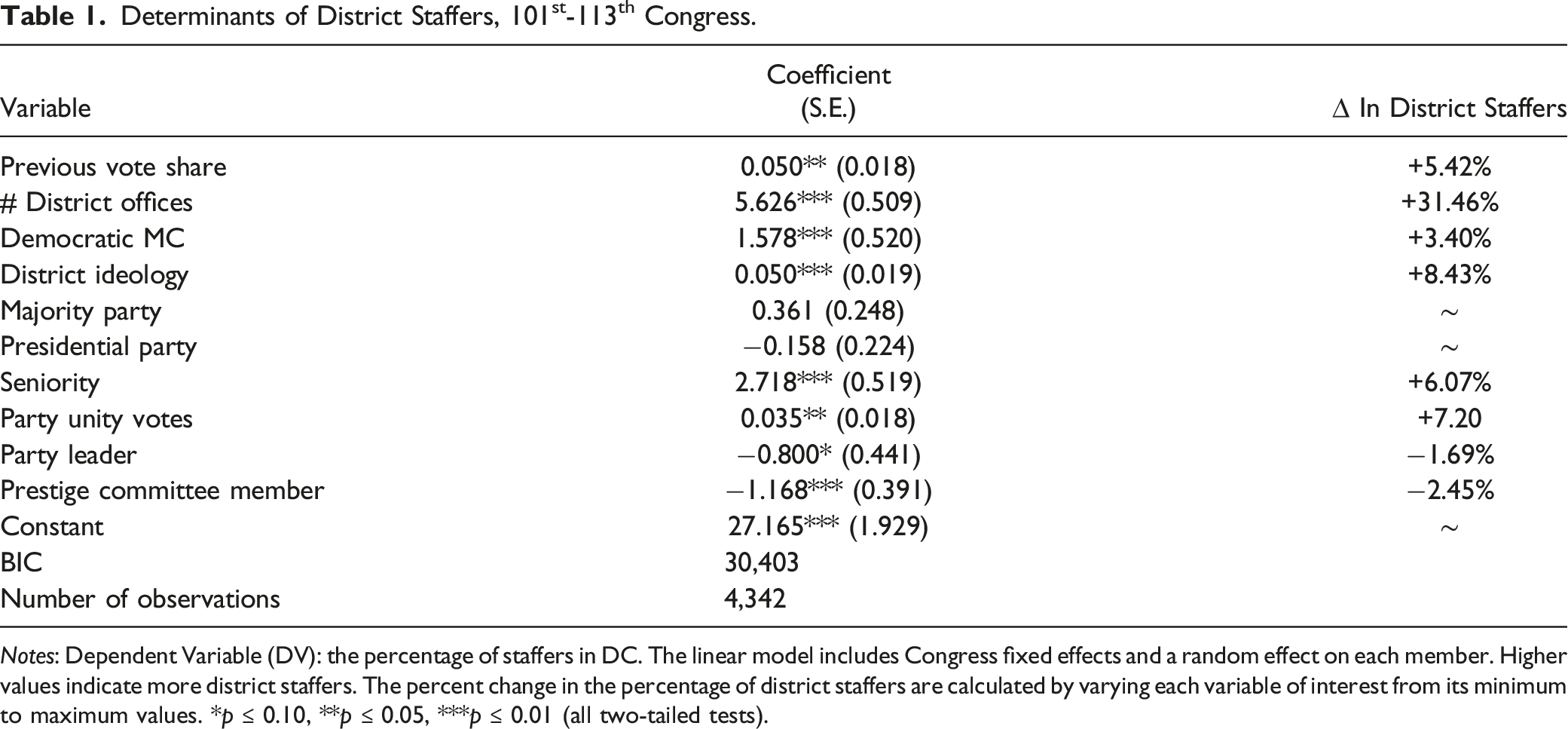
Notes: Dependent Variable (DV): the percentage of staffers in DC. The linear model includes Congress fixed effects and a random effect on each member. Higher values indicate more district staffers. The percent change in the percentage of district staffers are calculated by varying each variable of interest from its minimum to maximum values. *p ≤ 0.10, **p ≤ 0.05, ***p ≤ 0.01 (all two-tailed tests).
Our independent variable of interest,
In both of our models, we include additional explanatory variables that could influence a member of Congress’s decisions related to staffing.
12
Geographically speaking, larger districts might force a legislator to open additional offices to serve their constituents. Multiple district offices should result in a member hiring more district staffers. Therefore, we include a control variable that captures the
Partisan factors could influence staffing choices. Research from Cain, Ferejohn, and Fiorina (1987) implies that Democratic politicians might invest more in district staffers because their voters are more sympathetic to government programs which is a core responsibility of district staffers. The
Previous research finds that more liberal constituents are more likely to rely on government programs that district staffers can assist in securing. Therefore, we include the
Additionally, we control for a host of other institutional variables. Members of Congress who sit on
Findings
In Table 1, we present the results showing the relationship between electoral vulnerability and district staffers. 15 We find that the previous vote share variable is significant, and the coefficient is positively signed. This indicates that electorally secure members are associated with an increase in district staffers. 16
Substantively, for all significant explanatory variables, we calculate the percentage change in district staff by varying the variable of interest from its minimum to maximum value. We find a minimum to maximum increase in the previous vote share variable, holding all else constant, is associated with a 5% increase in the number of district staffers. The effect of the previous vote share variable is similar to other prominent factors. For instance, the percentage of staffers remaining in the district for legislators representing the most liberal districts tends to be 8% higher than among members representing the most conservative districts. Likewise, members in the Democratic Party have 3% more staffers in their district than members in the Republican Party. Therefore, it appears that not only is the effect of electoral forces statistically significant, but it is substantively significant as well.
Several of the control variables in Table 1 are also statistically significant. It appears that legislators with more district offices, belonging to the Democratic Party, representing more liberal districts, not holding a leadership position, senior members, casting partisan votes, and legislators not sitting on a prestige committee are associated with an increase in district staffers. The remaining explanatory variables do not appear to significantly impact a legislator’s staffing decisions.
Robustness Test: Controlling for District Factors
The preceding analysis indicates that electorally secure members are more likely to keep more staffers in their district. One potential concern with these estimates is that we do not account for additional factors that could be correlated with a member’s congressional district. For instance, it is possible that members with larger districts, in terms of land mass, could have additional district offices and staffers. To address this important issue, we estimate a model with district and Congress fixed effects. Specifically, we create a unique ID for each congressional district in between redistricting periods. The district fixed effects should account for any factors that are correlated with the district-including the district’s land mass size, demographics, and its distance from the capital. This is similar to approach adopted by Dynes and Huber (2015). In total, we create 1676 unique district IDs. As previously mentioned, we have estimated a model with legislator fixed effects, and the results are substantively similar to those presented here (see Appendix C).
Alternative Model Specification with Congressional District Fixed Effects.
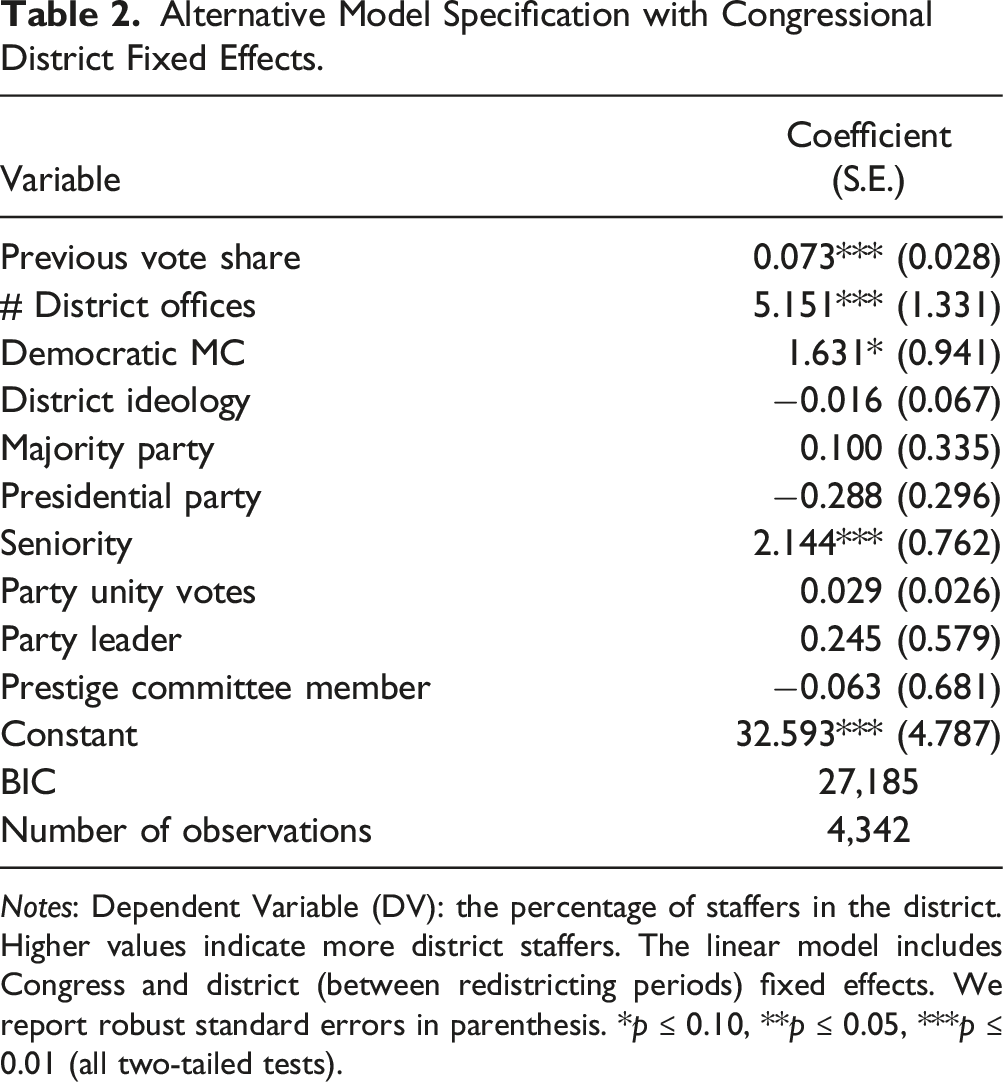
Notes: Dependent Variable (DV): the percentage of staffers in the district. Higher values indicate more district staffers. The linear model includes Congress and district (between redistricting periods) fixed effects. We report robust standard errors in parenthesis. *p ≤ 0.10, **p ≤ 0.05, ***p ≤ 0.01 (all two-tailed tests).
Alternative Measure of Electorally Security
In the previous analyses, we used a continuous measure of electoral considerations. Previous research has utilized a dichotomous measure of electoral vulnerability (Jacobson, 1987; Jones 2010; Mayhew, 1974b). In this section, we estimate a model with the
Alternative Measure of Electoral Security.
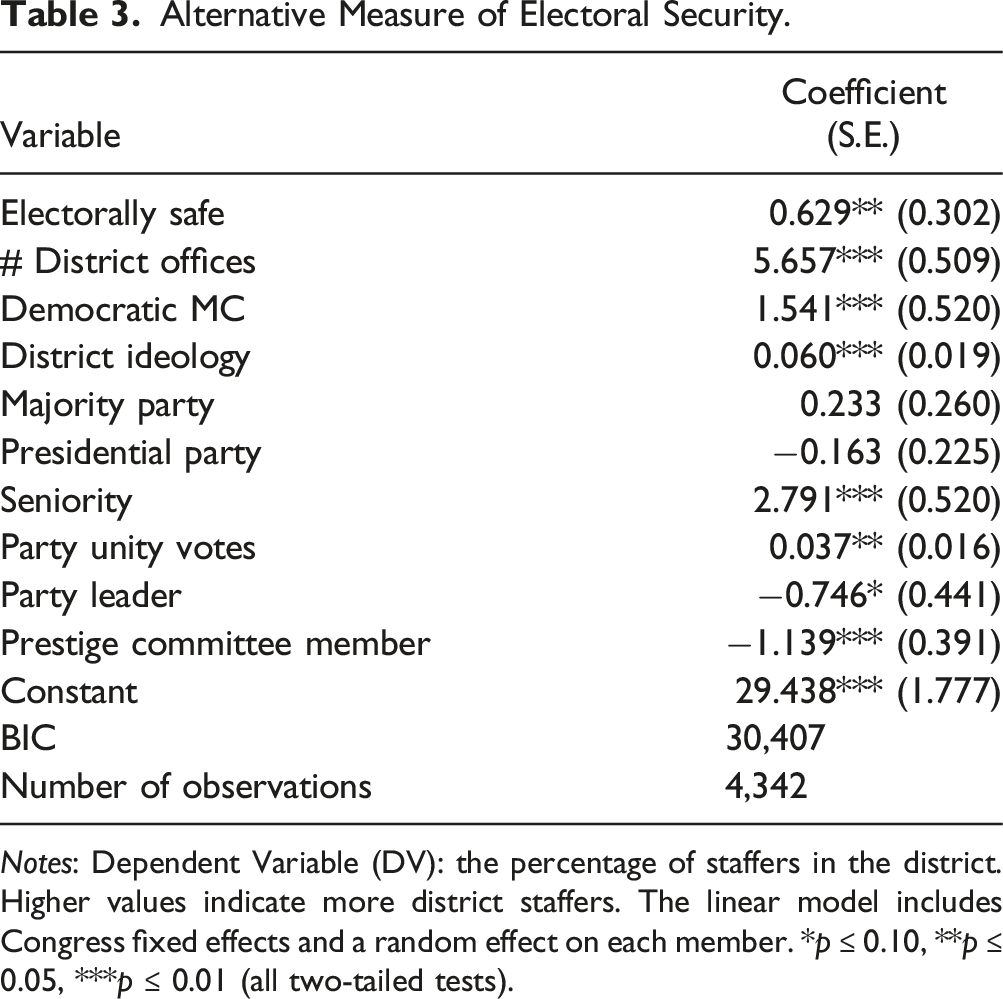
Notes: Dependent Variable (DV): the percentage of staffers in the district. Higher values indicate more district staffers. The linear model includes Congress fixed effects and a random effect on each member. *p ≤ 0.10, **p ≤ 0.05, ***p ≤ 0.01 (all two-tailed tests).
Different Home Styles for Different Types of Constituents
In Fenno’s (1978) seminal piece on home styles, he argues that the type of home style a member of Congress adopts depends on factors correlated with their district and constituents. The impact that electoral considerations have on a member’s home style, via district staffing decisions, should vary based on characteristics associated with their constituents in their district. We suggest that one important characteristic is the average constituent’s socio-economic status. 18
We suggest that an increase in electoral security should correspond to diverging home styles contingent on the district’s socioeconomic status. For districts with larger portions of constituents who are lower socioeconomic status, we expect that an increase in electoral safety should correspond with more district staffers. Conversely, more vulnerable legislators with these types of constituents cannot completely devote their resources to their district staff. Instead, they may need to focus on securing reelection through other means such as developing a valuable reputation in a salient policy area (Crosson et al. 2020b) or engage in position-taking (Rocca & Gordon, 2010) that can only be done in Washington D.C. and with staff near the capital.
For districts with more constituents who are of higher socioeconomic status, we expect that an increase in electoral vulnerability should be associated with more district staffers. Electorally vulnerable legislators with this type of constituency may increase their district staffers because they may feel the need to equally divide their staff between their district and D.C. Conversely, legislators who are more electorally secure and represent more wealthy and highly educated districts should allocate fewer staffers to their district. Unlike their counterparts who are electorally secure and with constituents with lower income and education levels, there is less demand for the work to be completed by district staffers (Johannes, 1983). Additionally, since the representatives in this context are more politically safe, they do not need to expand their coalition through activities conducted by district staffers. Thus, we expect the effect of electoral vulnerability to vary based on a district’s socioeconomic status.
However, we suggest the conditional effect of electoral vulnerability and a district’s socioeconomic status to only occur for members of Congress belonging to the majority party. A large body of work finds that the effect of electoral vulnerability tends to be stronger for members of the majority party (Cox and McCubbins 2005; Jones 2010; McDermott & Jones, 2003). This pattern occurs for several reasons. First, the majority party has greater visibility among the public because of the size of their coalition and the leadership positions they hold. Because of their party’s prominence among the public, electorally vulnerable majority party members tend to be conscious of certain legislative activities relative to their counterparts belonging to the minority party. Second, majority party representatives are more likely to tie themselves to Congress as an institution than minority party members and this varies by their electoral vulnerability. For example, Lipinski, Bianco, and Work (2003) analyze newsletters sent to constituents and demonstrate that majority party members, conditioned on their electoral context, are more likely to laud actions by Congress than minority party members. Thus, we expect that the interactive effect that occurs between electoral vulnerability and the type of constituents in a district (i.e., socioeconomic status) to only occur among majority party members.
To test our theoretical expectations, we include the
The Effect of Electoral Vulnerability by District Socioeconomic Status.
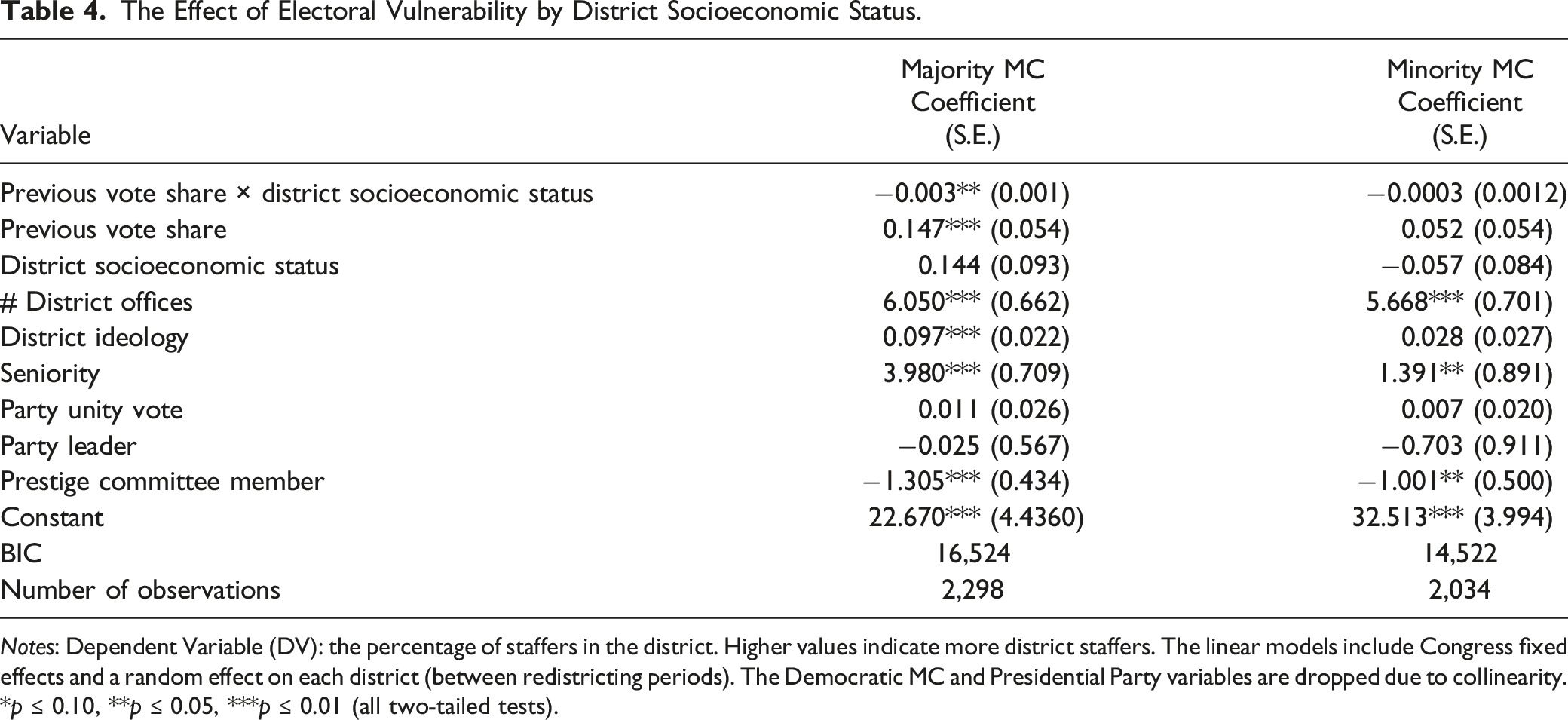
Notes: Dependent Variable (DV): the percentage of staffers in the district. Higher values indicate more district staffers. The linear models include Congress fixed effects and a random effect on each district (between redistricting periods). The Democratic MC and Presidential Party variables are dropped due to collinearity. *p ≤ 0.10, **p ≤ 0.05, ***p ≤ 0.01 (all two-tailed tests).
Most importantly for our immediate purposes in this article, our interactive Previous Vote Share × District Socioeconomic Status variable is significant and negatively signed. This indicates with an increase in the district socioeconomic variable we observe electorally secure and vulnerable members reaching very different staffing decisions.
The impact of our interactive measure can be seen graphically in Figure 1. Figure 1 show the predicted district staffers over a range of previous vote share variable. The “Low District SES” is when the district socioeconomic status variable is at its minimum value (i.e., 2) and is represented by the solid line. The “High District SES” is when the district socioeconomic status variable is at its maximum value (i.e., 100) and is represented by the dashed line. For Low District SES, holding all else constant, we see that the most vulnerable legislator tends to have around 47% of their staff in their district. For the most electorally secure representative, we see the share of district staffers rise to 54%. Conversely, for High District SES, holding all else constant, the most electorally insecure representative tends to keep around 45% of their staff in the district. For the most electorally safe representative, this falls to 36%. It should also be noted that the difference in district staffers for the more vulnerable representatives in Low District SES and High District SES is not statistically significant. The Effect of Electoral Vulnerability for Majority Party MC by District Socioeconomic Status Notes: The predicted district staffers are estimated from the model with only major party representatives from Table 4. The “Low District SES” is when the district socioeconomic status variable equals 2. The “High District SES” is when the district socioeconomic status variable equals 100. All control variables are held constant. The shaded areas represent the 95% confidence intervals.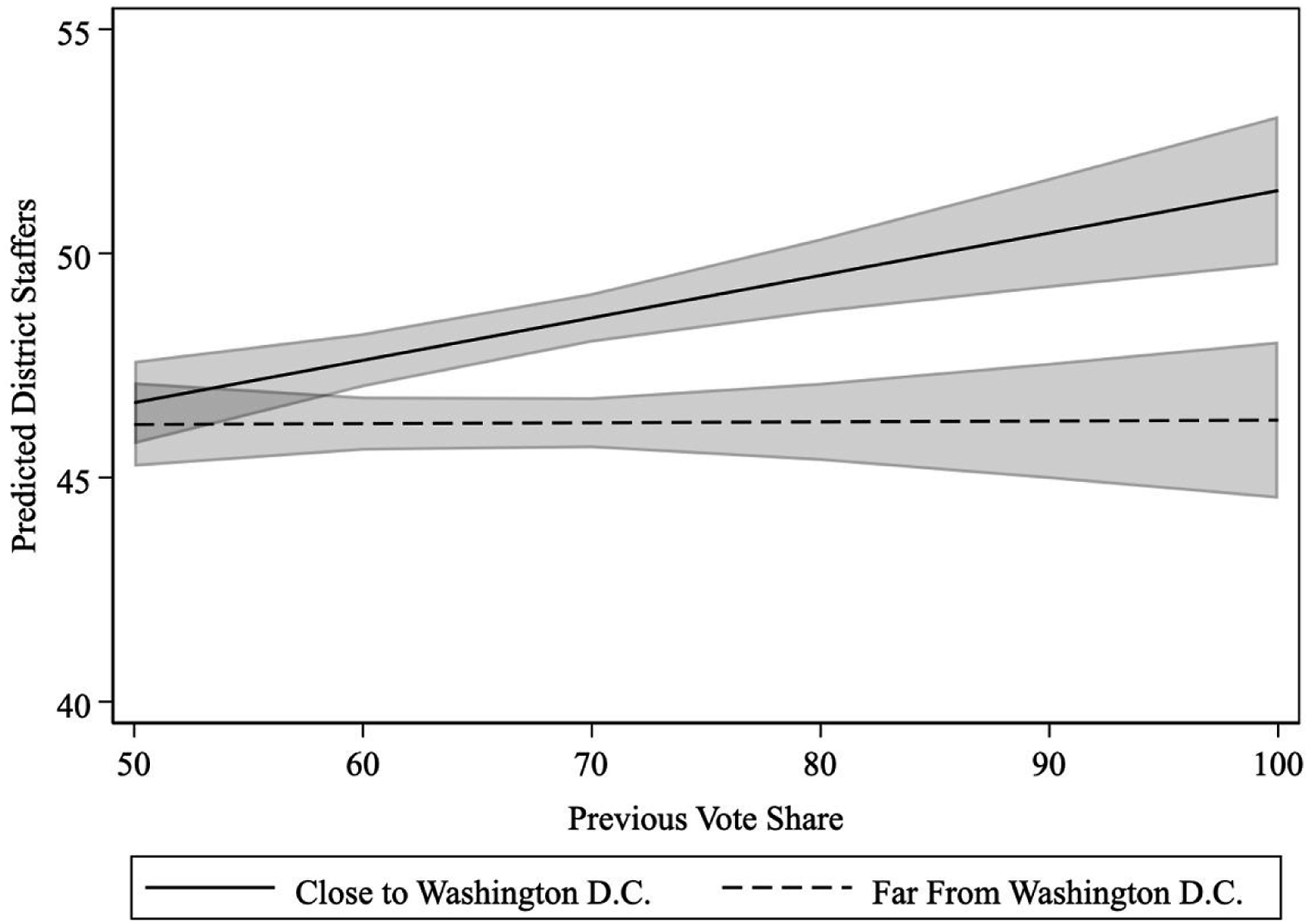
We will now interpret the results for the model with only minority party members. The Previous Vote Share × District Socioeconomic Status interactive variable is not statistically significant. This indicates there is little evidence that the effect of electoral vulnerability varies based on a constituent’s income and education level for minority party members, at least once other factors are taken into account.
Implications and Conclusion
“[U]pon being sworn into Congress, Cox closed the congressional office in Hanford that so many residents in and around Kings County relied on for years” a California county politician furiously wrote in The Fresno Bee (Verboon, 2020). The editorial goes on to disparage Representative T.J. Cox (CA-D) for cutting district staff and offices because “every constituent in each town in the 21st District is important and deserves to be heard by their congressman. It is malpractice that Cox would so blatantly neglect the heart of his district.” Our findings suggest that Representative Cox’s decision to cut his district staff and resources is part of a larger and systemic trend. In 2018, Representative Cox narrowly won his competitive election by a margin of 0.76%. We assert this pattern emerges because there are several political incentives for electorally vulnerable members to allocate their resources away from their local district and towards the nation’s capital.
Within the congressional literature, there are two competing perspectives on the relationship between electoral vulnerability and their home style via district staffing decisions. The conventional wisdom contends that members of Congress with heightened electoral vulnerability are more likely to leave their staff in the district (Ashworth & Bueno de Mesquita, 2006; Cain, Ferejohn, and Fiorina 1987; Miller 2010). This approach claims that securing valuable federal funds and aggressively engaging in constituency service should help a legislator to cultivate the personal vote within their district. However, another body of works implies that electorally vulnerable legislators should allocate more of their staff and resources towards the capital (Arnold 1990; Box-Steffensmeier and Grant 1999; Katz and Sala 1996).
To reconcile these conflicting claims in the literature, we analyze the staffing decisions for legislators serving in the House of Representatives in the 101st to the 113th Congress. We find that an increase in electoral vulnerability is associated with fewer district staffers. This finding is robust to the inclusion of congressional district fixed effects. These findings cast doubt on the conventional wisdom that legislators who face competitive elections are more likely to adopt a home style that involves increasing the number of staffers in their district. 21
These findings contribute to our understanding of legislative politics in several ways. First, the number of policy-related staffers have been slashed by Congress in recent decades (Bolton & Thrower, 2016). Several scholars have expressed deep concerns that this action could undermine Congress’s ability to tackle complex policies. Our findings suggest that an increase in competitive elections could potentially assuage this concern because electorally vulnerable legislators are more likely to employ staffers that focus on policy, at least relative to district staffers. Second, competing claims have been offered about the relationship between electoral vulnerability and the type of home style a member adopts. Few scholars have devoted attention to this issue with the main exception being Fenno (1978) who finds no evidence of a relationship. Our findings provide support for a body of works which implies that electoral vulnerability incentivizes a member to keep their staff near the capital. Third, previous scholarship suggests that the growing lack of competition in House races (Jacobson & Carson, 2019) may undermine representation (Fiorina 1977, p. 479). Our findings suggest, at least for low socioeconomic districts, an increase in electoral security can improve some aspects of representation. Finally, as implied by The Fresno Bee editorial, district staffers are considered an important mechanism linking a representative to their constituents. These findings imply that the connection between constituents and members of Congress could be dampened for the legislators in competitive elections. Taken together, these findings provide numerous insights into the implications that electoral politics has on representation. 22
Supplemental Material
Supplemental Material - What Explains a Representative’s Staffing “Style”? Exploring the Relationship between Congressional Staffing Decisions and Electoral Considerations
Supplemental Material for What Explains a Representative’s Staffing “Style”? Exploring the Relationship between Congressional Staffing Decisions and Electoral Considerations by Jason S. Byers, Laine P. Shay in American Politics Research
Footnotes
Declaration of Conflicting Interests
The author(s) declared no potential conflicts of interest with respect to the research, authorship, and/or publication of this article.
Funding
The author(s) received no financial support for the research, authorship, and/or publication of this article.

Supplemental Material
Supplemental material for this article is available online.
Notes
Author Biographies
References
Supplementary Material
Please find the following supplemental material available below.
For Open Access articles published under a Creative Commons License, all supplemental material carries the same license as the article it is associated with.
For non-Open Access articles published, all supplemental material carries a non-exclusive license, and permission requests for re-use of supplemental material or any part of supplemental material shall be sent directly to the copyright owner as specified in the copyright notice associated with the article.
