




Abstract
Intra-party democratic innovations are on the rise around the world and burgeoning strands of research provide an institutional understanding of how political parties approach them. However, we still know little about how party members view democratic innovations and the benefits they can bring to the party. This article addresses this gap in the literature by mapping party members’ views on intra-party democratic innovations, and by identifying the areas where these innovations are welcome. It draws on semi-structured interviews with party members of parliamentary political parties in Romania. The results of our thematic analysis indicate that party members show considerably stronger support for deliberative practices compared to direct democracy. There is broad consensus across parties that deliberation can be used mainly for organization development and as electoral strategies but may be also suitable for internal communication and problem solving. Direct democracy is seen as contributing to organization development and as appropriate for internal communication.
Introduction
In the past two decades, more and more political parties have adopted or used intra-party democratic innovations, particularly direct democracy and deliberative practices. These innovations are a contemporary form of intra-party democracy allowing members to influence decision-making beyond the use of primaries or other decentralized and inclusive forms. In this study, direct democracy means internal referendums - since these are the most common form used within political parties – in which party members vote on a specific policy or direction for action, and a majority decision is reached. In line with the classic principles of deliberation outlined (Chambers, 2003; Habermas, 1996), internal deliberative practices are those activities done by party members driven by informed dialogue that features reason, openness, persuasion, arguments, points of view, and the pursuit of a public good. 1 Earlier studies identify which parties adopt democratic innovations, and explain why they use them, how these innovations work, and with what consequences (Barberà and Rodríguez-Teruel, 2020; Font and Motos, 2023; Gherghina, 2024; Gherghina et al., 2020; Junius et al., 2023; Wolkenstein, 2016). This burgeoning body of research provides an extensive institutional understanding of the complex relationship between political parties and democratic innovations. However, we still know little about how party members view democratic innovations, the benefits they can bring to the party, and the areas where members want innovations to occur.
Understanding members’ views on intra-party democratic innovations is relevant for three reasons. First, the users’ perspective is missing from the broader picture. Party members can encourage adoption, or where democratic innovations have already been adopted by the party, use them. Their views may shed light on their openness towards such decision-making procedures, and on the prospects for (or survival of) democratic innovations within parties, and could inform us about parties’ degree of legitimacy. Second, members remain valuable assets for political parties despite patterns of organizational change and generally declining membership rolls since the beginning of the 21st century. Members are key resources during and between elections as they perform volunteer work, provide financial support, represent candidate pools, develop networks within the electorate, and symbolize party support in society (Scarrow, 2015; Van Haute and Gauja, 2015; Webb et al., 2017). If members are given opportunities to decide directly on policy or personnel questions, then they may feel more rewarded, which could stimulate their sense of party-specific political efficacy (Wuttke et al., 2019). Third, knowing more about members’ views on democratic innovations would complement the literature on citizens’ and politicians’ support for these alternative decision-making models (Bedock and Pilet, 2020; Christensen and Von Schoultz, 2019; Gherghina and Geissel, 2019; Niessen, 2023; Pilet et al., 2024; Rangoni et al., 2023; Rojon and Rijken, 2021). Thus, we learn what a specific segment in society thinks about democratic innovations within a specific political institution as opposed to the entire political system, which has been extensively investigated to date.
This article addresses this gap in the literature and has a twofold goal: to map party members’ views on intra-party democratic innovations, and to identify the areas where these innovations are welcome. It draws on 41 semi-structured interviews with party members of four parliamentary political parties in Romania. The country was selected as a representative case (see research design). The interviews were conducted in January 2024 and we use deductive thematic analysis to interpret their meaning. We build a theoretical framework comprising four key areas that can account for variation in the members’ views about democratic innovations: internal communication, party organization, electoral strategy, and internal problems.
The paper proceeds as follows. The next section introduces the analytical framework. The third section describes the empirical case used to identify party members’ views on democratic innovations. We then present the general views of party members on democratic innovations. The sixth section sets out the results of our analysis. We conclude by discussing the main implications of our findings for assessing the use of democratic innovations in political parties.
Analytical framework
Before proceeding, it is necessary to make two conceptual clarifications about the key terms of this article: party members, and democratic innovations. In general, we refer to formal members who pay dues, have rights and obligations, often engage in party activities, and are highly ideologically committed (Webb et al., 2017). Nevertheless, in some instances we build arguments using works about light or cyber members, supporters or sympathizers. We follow the general view in the literature that democratic innovations are complementary to (rather than a replacement for) the mechanisms of political representation or internal party organization. This understanding is also reflected in the interview guide (Appendix 1).
In developing an analytical framework that could allow members’ views about democratic innovations to be grasped, we combine several theoretical approaches toward intra-party democracy, politicians’ views about deliberative practices, and parties’ motivations for using democratic innovations. The framework includes four elements that are presented clockwise in Figure 1: internal communication, organizational gains, electoral strategy, and problem solving. These elements unpack what the literature on intra-party democracy has usually labelled as organizational structure and decision-making (Van Haute and Gauja, 2015; von dem Berge and Poguntke, 2017). These four elements cover some of the interests, ideas, and institution-oriented factors from the typology used to explain politicians’ views about citizen assemblies (Niessen, 2023) and emphasize both internal and external strategic motivations that help understand why political parties use deliberative practices (Gherghina and Jacquet, 2023). The following lines discuss how each of these four elements can enhance or inhibit intra-party democracy. The analytical framework.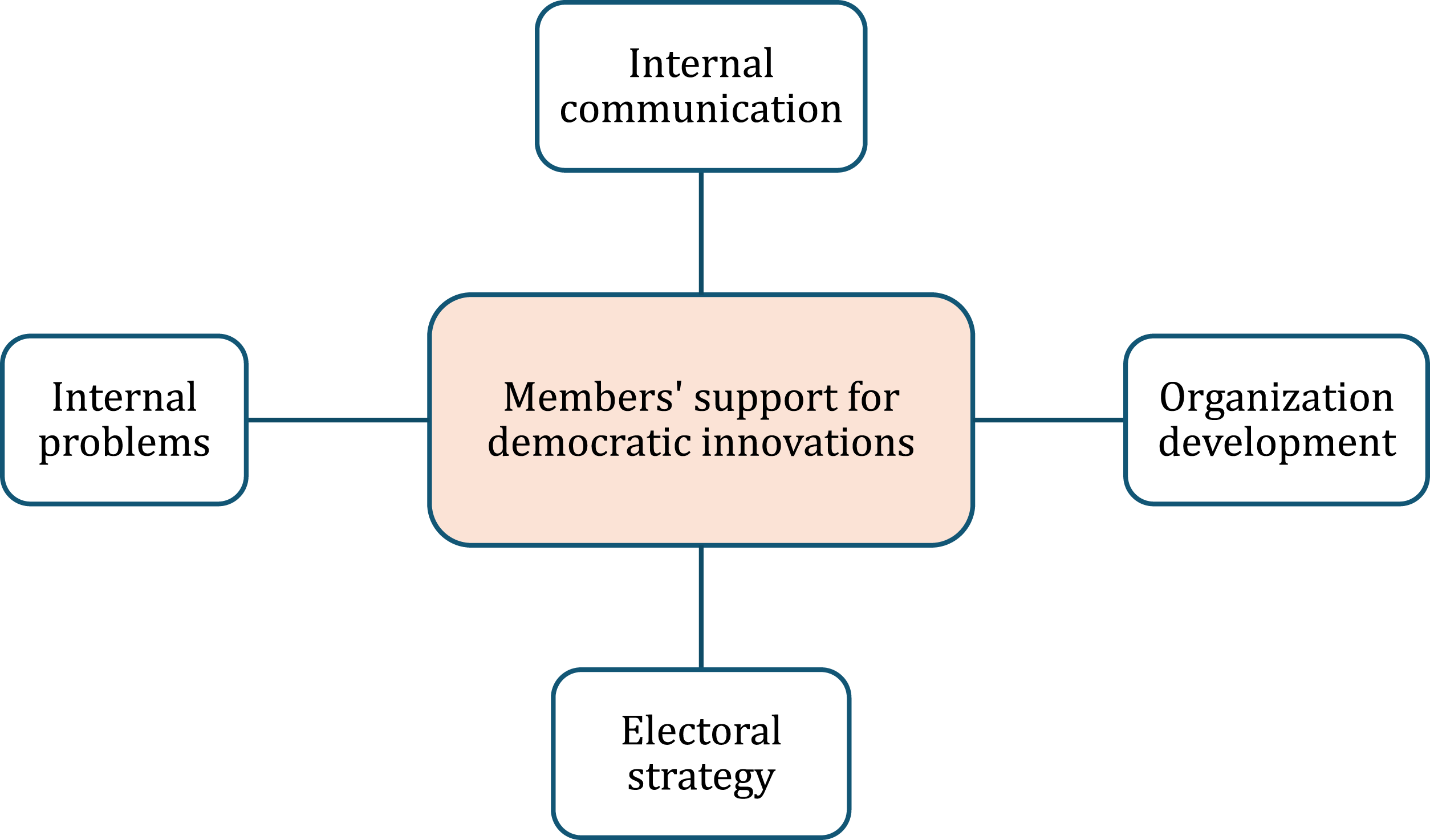
Internal communication can be improved by democratic innovations via feeding members’ desire for influence and participation in party life and by narrowing the gap between leadership and the grassroots. Contemporary politics is characterized by high degrees of personalization in which individual politicians gain prominence at the expense of collective actors such as political parties (Rahat and Kenig, 2018). A leader-centered way of functioning means that the units of political parties and their members rarely matter in the decision-making process. Moreover, there are differences in policy views between leadership and grassroots members (Kölln and Polk, 2017). Intra-party democratic innovations can foster leaders’ responsiveness and increase issue congruence between leaders and party members. by aligning party decisions more closely with the members’ preferences. Intra-party referendums allow members to make binding decisions that reflect their preferences and push the leaders to accept them (Wuttke et al., 2019). Deliberative practices may be used to discuss manifestos before electoral campaigns, collect members’ input on policies, gather insights from them about coalition formation or parliamentary voting, and/or give voice to under-represented groups in the candidate selection process (Junius et al., 2023; Stoiciu and Gherghina, 2021; Vodová and Voda, 2020; Wolkenstein, 2016). Democratic innovations foster vertical communication in hierarchical organizations between rank-and-file members or local units and leaders or central units, as well as horizontal communication in stratarchical organizations between rank-and-file members when they engage in decision-making through direct and deliberative practices even if some of these procedures are consultative (Oross and Tap, 2023).
At the same time, the use of democratic innovations can hinder intra-party communication because they can be instrumentalized by the political elites to strengthen their position or their frequent use can. For example, party leaders may organize referendums that reflect their positions, which is a way to weaken members’ ability to mount coordinated opposition to the leaders’ priorities (Scarrow et al., 2022). Intra-party deliberation can hinder communication due to group splits, defection, and polarizing tendencies within party groups, which can disrupt constructive dialogue and reduce the effectiveness of deliberation (Wolkenstein, 2019).
Democratic innovations may improve organization development through a boost of legitimacy and appeal to (new) members, greater trust among the members, enhance the party’s democratic credentials and build grassroots support. Intra-party referendums can provide legitimacy to decisions and reduce members’ perceptions of elite domination (Ignazi, 2020; Scarrow et al., 2022). Intra-party deliberation enhances a party’s democratic legitimacy and serves as a counterbalance to the risk of elite control. Deliberative practices are essential to resisting agenda capture and ensuring that a party’s decisions reflect the views of the broader membership (Bagg and Bhatia, 2022). Inclusive and consent-based deliberation can effectively manage the internal organization of political parties, especially when they are relatively small (Junius et al., 2023; Vodová and Voda, 2020). Both referendums and deliberative practices allow members to demand that party elites justify their decisions, to hold leaders accountable, and to increase transparency in the decision-making process (Bagg and Bhatia, 2022; Wolkenstein, 2018; Wuttke et al., 2019). Nevertheless, democratic innovations may also harm organizational development. for example, intra-party referendums can negatively impact organization development by fostering factionalism, internal divisions and polarizing tendencies since they push members into different camps. All these reduce parties; abilities to coordinate and function between and during elections.
Third, intra-party democratic innovations can be used to enhance electoral visibility and votes. Such internal reforms increase inclusiveness, transparency, and member engagement in decision-making. They are often publicized to signal the party’s openness, responsiveness, and renewal to the broader electorate (Barberà and Rodríguez-Teruel, 2020; Gherghina and Jacquet, 2023). Such signals increase party visibility by generating media coverage, and can differentiate the party from its competitors. Political parties use internal deliberation strategically to increase their visibility, seek votes, augment policy influence, and enhance their legitimacy (Oross and Tap, 2023). For example, a party in Romania gained visibility in the media and a positive image, at least for a while, using internal deliberative processes for candidate selection (Gherghina and Stoiciu, 2020). However, democratic innovations could also hinder their electoral appeal by limiting the party’s flexibility in managing issue ambiguity or even shift its median position, among other effects. 2 For example, a study about the Czech Pirate Party shows that some party members consider deliberation as harmful for public image (Voda and Vodová, 2024).
Finally, democratic innovations can address internal can heal internal divisions by providing a transparent and legitimate process for addressing contentious issues, thus making it easier for all party units and members to accept the outcomes of members’ votes (Sussman, 2007). Intra-party deliberation provides a platform for resolving internal disagreements, fosters party unity, reconciles diverse viewpoints, and helps to develop more informed and representative policies (Junius et al., 2023; Wolkenstein, 2018). However, there are times when inclusive deliberation may transform the party organization - but at the cost of sparking divisions and raising tensions within the party (Barberà and Rodríguez-Teruel, 2020). Similarly, intra-party referendums can undermine shared values by giving voice to and intensifying disputes over party priorities, can erode party loyalty, and can encourage dissent by giving voice to various factions (Scarrow, 2021). They can stir intra-party controversies, potentially reveal dysfunctions and highlight latent internal conflicts.
Research design
Our analysis focuses on Romania, which is a representative case for multi-party systems in new democracies from Central and Eastern Europe. Its party system is dynamic, especially in the most recent 15 years, with several entries and exits from the parliamentary arena that are due to electoral volatility. Political parties are characterized by organizational fluidity, limited engagement of party members, and often centralized and rarely inclusive decision-making processes. Political parties have relatively limited experience with democratic innovations: only one party used intra-party referendums, while intra-party deliberation occurred in a marginal party (Stoiciu and Gherghina, 2021). In fact, deliberation is rare within the country: the first citizens’ assembly took place in 2024 in a medium-sized city (Mitru, 2025) after we conducted our interviews.
We compare the attitudes of members of four parliamentary parties: the social democrats (PSD), the national liberals (PNL), Save Romania Union (USR), and Alliance for the Union of Romanians (AUR). At the time of the interviews, the Romanian parliamentary party system included five political parties out of which one has specific characteristics. The Democratic Alliance of Hungarians in Romania is not labelled as a political party and operates as an alliance that includes various associations, foundations, and professional groups in addition to its political structures. This specific internal organization and targeted electoral appeal make it different than the other parties.
The four parties vary on several dimensions that may influence their members’ views about direct and deliberative practices. The first two have been established in 1990 either as successors of the communists – the social democrats – or as revived for after interrupted existence during communism: the liberals. The other two parties are newly formed and with limited (USR, formed in 2015) or no (AUR, formed in 2019) government experience. Party age is relevant to variations in members’ support for democratic innovations since newer parties may be more oriented towards deliberative practices. Similarly, there are some differences between the government and opposition parties in Europe in terms of their rhetoric support for deliberation (Gherghina and Mitru, 2025). There are further differences between these parties in terms of organizational development (e.g., members, paid staff, territorial coverage), electoral appeal, and ideological stance. The latter was used as a selection criterion here because ideology often influences preferences for democratic innovations (Font and Motos, 2023; Gherghina and Mitru, 2025).
We use qualitative analysis to investigate the support for direct and deliberative democracy within these Romanian parties. We conducted 41 semi-structured interviews with party members from all three parts of the party (Katz and Mair, 1993): the party in public office, the party in central office, and the party on the ground. We aimed for an equal number of interviewees for each party, and our initial list was considerably larger, with 20 individuals per party. We reached saturation point (Hennink et al., 2020) at around the 8th or 9th person interviewed for each party. We then conducted one or two extra interviews to make sure that this was indeed the saturation point. As such, we ended with 10 interviews each for AUR, PSD, and PNL, and 11 interviews for USR.
An overview of interviewees’ profiles.
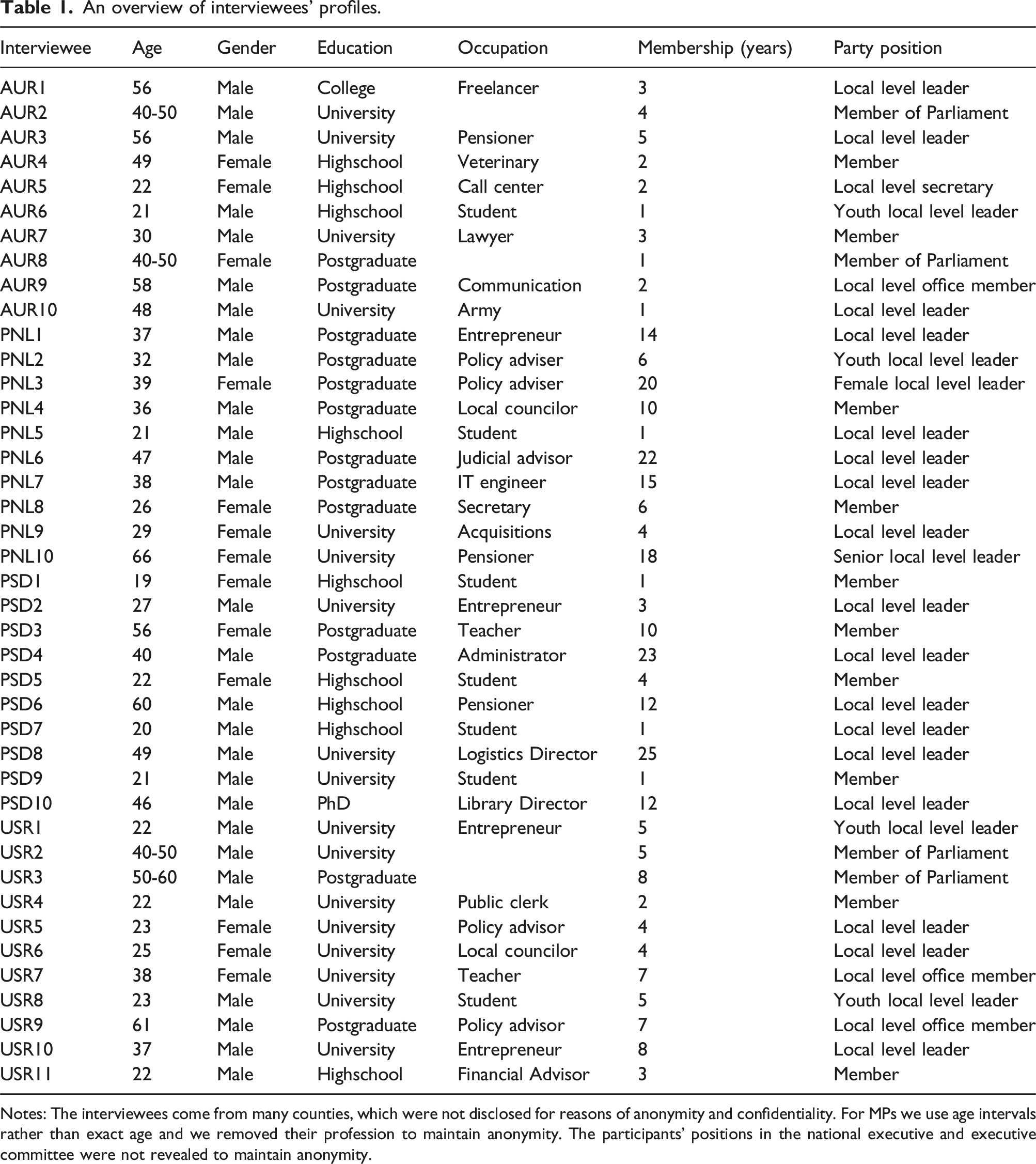
Notes: The interviewees come from many counties, which were not disclosed for reasons of anonymity and confidentiality. For MPs we use age intervals rather than exact age and we removed their profession to maintain anonymity. The participants’ positions in the national executive and executive committee were not revealed to maintain anonymity.
All the participants were over the age of 18 and lived in Romania at the time of the interview. We used an interview guide (Appendix 1) reflecting the themes from the analytical framework. The interviews had an average duration of 25 minutes. Due to the broad geographic coverage, which is not reported for anonymity and confidentiality purposes (i.e., some interviewees may have been identifiable if we mentioned their county, the highest level of territorial administrative division), we used video and voice calls. The interviews took place in Romanian, we received consent to record from all participants, and we destroyed the recordings after transcription. Ethical approval for the interview guide was received from one of the authors’ university research committee. Since deliberative practices are only used at the local level in Romania, the interview guide included a detailed explanation of what these deliberative practices are. This explanation followed the definition used in this article, but in layman’s terms: “By deliberative practices, we mean bringing citizens together in discussion groups on topics specific to their communities with the aim of identifying solutions, which are then recommended to decision-makers. Deliberative practices involves arguments, rationality, and information”. For clarity purposes, we provided the participants with examples of deliberative practices used broadly in society, which have been covered also by the Romanian media so that they can relate to them.
We used deductive thematic analysis (Braun and Clarke, 2021) that enables the investigation of the perspectives of our interviewees and groups their similar points into common themes derived from the literature (see Figure 1). We read all the answers and assigned sentences to themes following a three-stage process. First, we familiarized ourselves with the answers and tried to understand the general picture that could be derived from them. Second, we developed a coding manual including the label, definition, and description of theme occurrence. Third, we validated and tested the codes on a sample of 200 sentences with the help of three fellow researchers. The percentage of agreement between the five coders – the two co-authors and three independent researchers – was 91.2%.
Romanian parties, members’ involvement and practices
The Social Democratic Party (PSD) is the successor of the communists and has dominated domestic politics for more than three decades, winning all but one popular vote in the post-communist legislative elections. It has been part of many governments, usually in coalitions. The party is supported by an average of one third of the electorate. The National Liberal Party (PNL) was revived in 1990 as the successor of a party established in the late 19th century that had ceased to exist during communism. It has had a continuous presence in parliament since 1996 and been part of many coalition governments. In 2012 and 2021, it joined forces with the PSD to govern, the latter arrangement involving an unprecedented rotation of prime ministers. The party is supported by an average of one fifth of the electorate.
The Save Romania Union (USR) was formed just before the 2016 national legislative elections and was soon in a coalition government with the PNL between December 2020 and August 2021. The party has the support of roughly 10% of the electorate. Its strong pro-European, anti-clerical and liberal stances are combined with a populist appeal due to its attacks on the establishment (Dragoman, 2021). The Alliance for the Union of Romanians (AUR) is a radical-right populist party formed in 2019 that gained 9% electoral support at the 2020 legislative elections. It combines a strong nationalist message with religious appeal and conservative values (Soare and Tufiş, 2023).
Romanian political parties, especially the major ones PSD and PNL, are characterized by strong central leadership, relatively centralized decision-making structures, and a limited inclusion of members in intra-party decisions (Gherghina, 2014; Iancu and Soare, 2020). The interviewees confirmed the findings in the literature. For example, PNL7 explained that the organizational practices concentrate power in the hands of national elites, with local branches and members following what they are told: The key decisions are confined to two-three leaders at either the national or the local level. It is a form of protecting the power that the leadership holds. The party has one or two father figures who take responsibility for decisions and make policies that go to the local or national executive to be implemented. Decisions are made in a small circle, with purely formal or non-existent membership consultation.
In spite of the limited possibilities for members’ engagement in the intra-party decision-making process, the interviewees referred to three categories of members: highly involved, moderately involved, and little involved. These categories are valid for each of the four parties covered here, with no visible differences between them. Highly involved members attend meetings regularly, express opinions, and build arguments (PNL2, PNL4, PSD5, USR6, USR3, USR9), meet with citizens to identify community problems (PNL1, PSD3, PSD8), and also tend to participate in civic acts such as blood donation or waste collection (AUR9, PSD9). Moderately engaged members belong to those party organizations that allow space for debate and dialogue at the local level, although decisions are made at the central level without consulting the members (AUR2, PNL6, PNL5, PSD1, USR5). Less involved party members are those who belong to organizations where the space for debate or consultation is more formal, and decisions are always imposed from top to bottom (PNL3, PSD4, PSD6, AUR5).
Intra-party democratic innovations
USR is the only political party in Romania using intra-party referendums. One took place in the summer of 2017 and asked the party members to vote on whether the party should take a stance in the national referendum on including a definition of the traditional/heterosexual family in Romania’s Constitution (USR, 2017). Another was initiated by the party leader and took place in early 2020. It asked party members to agree on the consolidation of a center-right ideological positioning of their party (G4Media, 2020). These referendums were explicitly mentioned by the USR party members during the interviews conducted for this paper. For example, on the 2020 referendum, one member of Parliament recalled that “it was a big debate within the party, quite intense, it generated tensions and upsets. Nevertheless, people were able to have their say” (USR2). Despite these internal tensions, another member of Parliament noticed that “imposing the notion of an internal referendum in the party’s first statute proved useful and was not overused” (USR3).
Several PSD and PNL members argued that there are intra-party referendums, but their answers are either vague, indicate a misunderstanding of what a referendum is, and/or are contradicted by other members. For example, PSD4 considered discussions held at the level of the party’s local branch to nominate candidates for public office as referendums. Many other members explicitly argued that their party uses no intra-party referendums (PSD1, PSD2, PSD6, PSD9, PSD10). In fact, the PSD statute adopted in August 2024, roughly half a year after our interviews, introduced for the first time the possibility to conduct intra-party consultative referendums. Meanwhile, three PNL members explicitly referred to the use of intra-party referendums but did not provide further explanations even when we asked follow-up questions (PNL4, PNL8 and PNL9). Their statements were also contradicted by other party members. For example, PNL6 explained that “there is no mechanism to consult the party members in the statute. My party operates according to a procedure through which the members elect their governing bodies, and all the decisions are taken by those bodies”, which was confirmed by several other party members. The AUR members were consistent in their answers, clearly stating that their party does not use intra-party referendums.
There was broad disagreement between the members of the same party regarding the internal use of deliberation. For example, some members claimed that their parties use deliberation (AUR6, AUR8, PSD1, PSD2, PSD10) while others were confident that their parties use neither referendum nor deliberation (AUR5, AUR9, PNL7, PSD6, PSD9). This contradiction stems mainly from a distorted understanding of deliberation, despite the definition and explanations that we provided during the interview, especially in follow-up questions. Many interviewees confused discussions during party meetings, the ways in which local party elites take decisions in small committees, and instances when the local party leaders asked the opinions of ordinary members on specific issues, with deliberation.
Members and intra-party democratic innovations: An overview
Most interviewees referred more to referendums than to deliberative practices (Figure 2) and considered them important to the functioning of (representative) democracy. Their views referred both to a symbolic and to a practical dimension. The symbolic dimension builds on the idea that referendums awaken the democratic spirit and a greater appetite for political involvement; they are ways to make the voices of party members heard (AUR6, AUR9, USR5). The practical connection rests on the principles of consultation, resolving deadlocks, and increasing the legitimacy of decisions (PNL3, PSD3, PSD7, USR1, USR4, USR10). The most common words in the interviewees’ answers.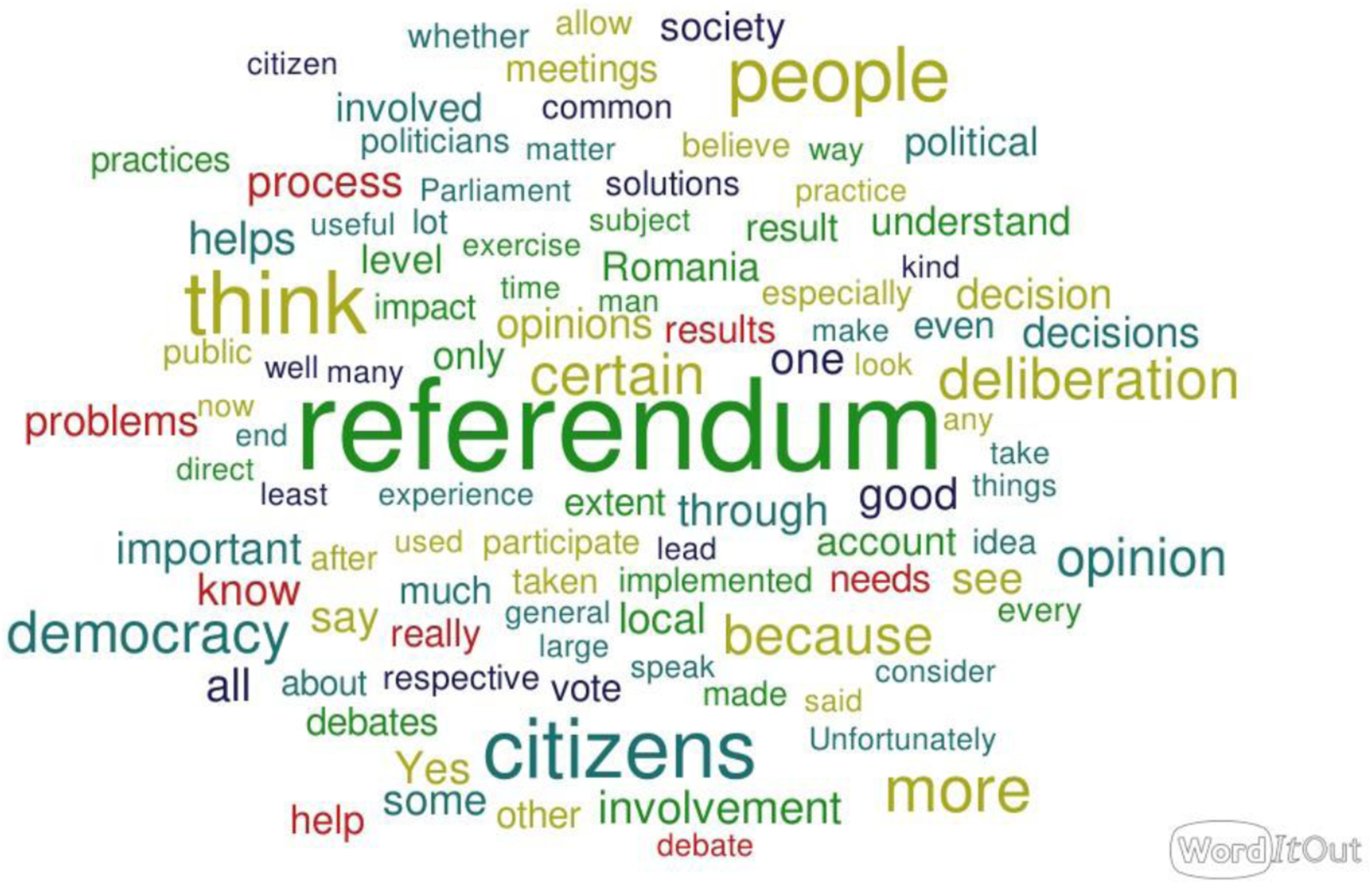
The members’ views on deliberative democracy were broadly favorable. Several interviewees argued that deliberation was characterized by three main elements: it is a form of communication, it involves consensus, and it optimizes solutions (AUR6, AUR9, PNL2, PSD2). Deliberation provokes discussions that can generate solutions or help discover common ideas (AUR9, PNL5, PSD5, USR5). According to many participants, deliberation is a win-win process through which party members can express their opinions on certain issues and identify solutions (AUR2, PNL3, PSD3, USR3, USR8). Some members identified difficulties about the use of internal deliberation because party elites can discourage debates and disregard their results (AUR8, PSD7, USR2), some members lack education to engage in meaningful discussions, there is a limited community-oriented approach across the party members, and there may not be much appetite for debate within the party because the party congress covers that area (AUR8, PNL6, PNL7, PNL10).
Most interviewees explained that referendums and deliberative practices should be used within their parties because they could bring benefits in terms of representativeness, legitimacy, and decision-making transparency (AUR3, AUR5, AUR9, AUR10, PNL1, PNL3, PNL6, PSD6, PSD7). One interviewee eloquently summarized their contribution to party life: Yes, absolutely, because the decisions would be more relevant and closer to the party's values, closer to the directions that the party has assumed. It would actually show both good and bad, what the party’s view is concerning one subject or another. Today, when decisions are taken by a narrow circle of people, they do not reflect the vision of the entire party (PNL7).
Deliberation can augment the quality of decisions, while referendums can mobilize the party members if they are organized on salient issues: “the topics you submit to such an exercise should be very serious and relevant topics. Otherwise, if we do referendums on less important topics, we risk boring the active party members” (PSD8). Most interviewees considered that party members have a more developed political culture than the broader public, and that they have a better understanding of how democracy works. Such characteristics reduce the risk of polarization or the manipulation of opinions (PNL2, PNL5, PSD8, USR5, USR9). The manipulation of opinions can be avoided through the efficient organization of referendums and a correct information process (PNL1, PSD3, PSD4, PSD7, PSD9, USR10). At the same time, one argued that “better measures can be taken, even if it is a little harder and slower” (USR2) when referring to deliberation.
Similarities and differences
Similarities and differences of Member’s attitudes.
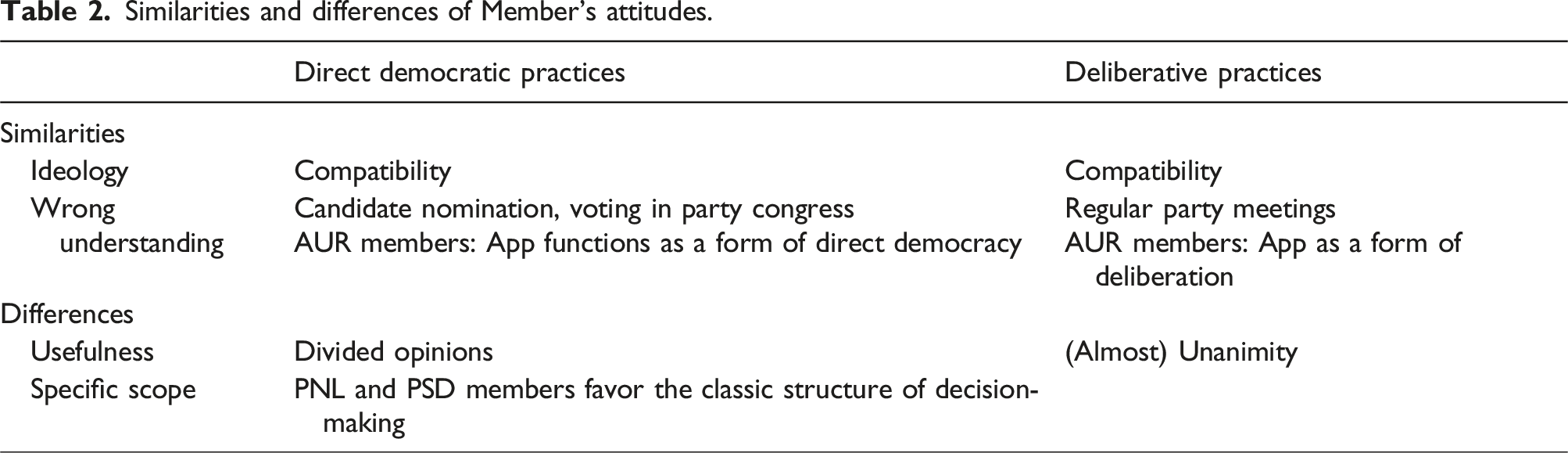
Two main differences emerged between the party members. First, the usefulness of direct democracy was contested by several party members in each of the four political parties. Most of their arguments against internal direct democracy matched the findings of previous research about the flaws of referendums, such as potential for conflict and division, polarizing camps, uninformed decisions, and bypassing party units (Gherghina, 2019; Morel and Qvortrup, 2018; Reilly, 2018). The USR party members were the most sceptical about the usefulness of internal referendums. One possible explanation for their critical stance could be that the use of internal referendums made them understand the downsides of the process. Across the board, the vast majority of interviewees considered intra-party deliberative democracy to be useful.
Second, the most articulated critiques against the excessive use of referendums were put forward by the PSD and the PNL members. They referred to the importance of internal party elections and the right of the elected leadership to decide. To them, direct democracy can be used if it has a specific scope. Otherwise, party structures should fulfil their functions, and the party should maintain a hierarchical chain of command as explicitly argued by a leader of the local organization (PSD10).
Why intra-party referendums and deliberation matter
A summary of members’ views on democratic innovations.
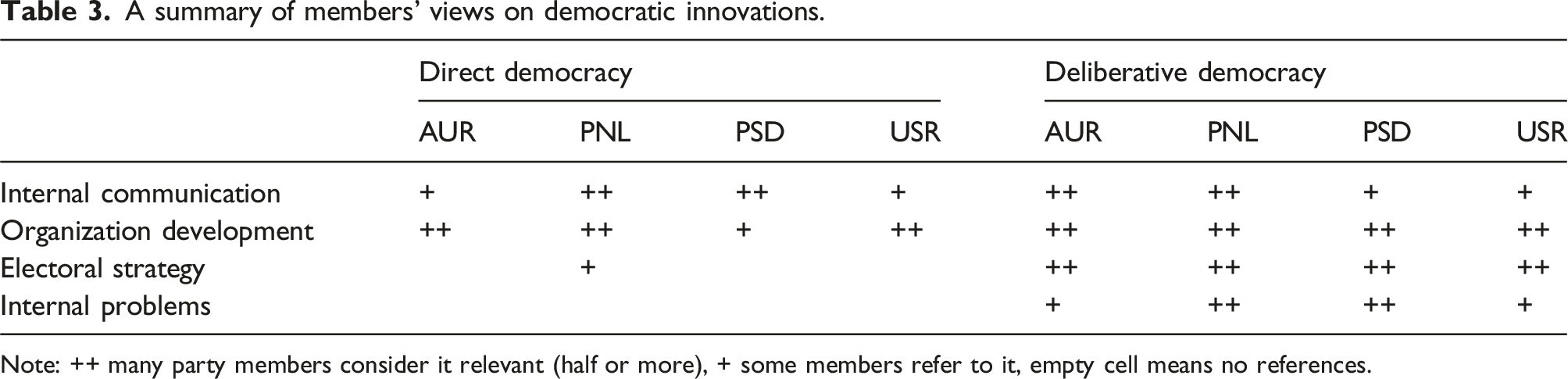
Note: ++ many party members consider it relevant (half or more), + some members refer to it, empty cell means no references.
Parties’ internal communication is mainly top-down because all the organizations are hierarchical: messages circulate from the central office to the local branches, with the county-level branches as intermediaries (AUR8, AUR9, PNL7, PNL10, PSD4, USR9). Some isolated instances were mentioned in which the communication takes place bottom-up (USR2, USR10). Traditional channels like face-to-face meetings (AUR5, PNL2, PNL5, PNL8, PSD9) are complemented by digital channels such as WhatsApp, social media, or specific apps (AUR10, PNL3).
According to many interviewees, referendums help with internal communication when they concern topics of major interest for the party which have an impact on society (PNL1, PSD2, PSD8, USR4, USR8, USR10, AUR2). Referendums can help to promote collective visions (AUR3, USR11) and can be used by the party leadership to communicate with, and elicit the vote of, the local branches about what can be improved in the party (AUR5). Two interviewees from the same party argued that referendums are “ways to communicate with most members and sympathizers” (PNL4) and “could certainly provide a map of preferences, of views in the territory, depending on each organization. This would somehow create more debate and strengthen the connection between the central organization and local branches” (PNL7). A member of a different party explained that “There are instances in which referendums should be used. For example, when decisions are required about the party organization and everyone in the country must be informed. The information is faster and more efficient through a referendum” (PSD8). However, several party members argued that referendums cannot contribute to the efficiency of communication between the party’s central organization and structures across the country. Some considered them a waste of time and did not see their role in internal communication (AUR6, USR1, USR9).
Deliberation was perceived as a process that gives consistency to the dialogue between the central organization and the structures in the territory of the political parties. For example, one interviewee explained that “deliberation can improve the communication between the party units because it allows those who are affected by decisions to understand what the consequences are through discussion. They can engage if they understand and communicate” (AUR2). PSD2 stated that “without deliberation within the party we would not be able to have a constant and coherent voice at the national level”, a view PNL7 supported: “deliberation at (county level) would mandate the county leaders much more strongly in the communication that they have with the national leaders”. Several interviewees rated intra-party deliberation as more important than referendums for the parties’ internal communication process (PNL6, PSD3, and PSD10). Internal deliberation plays an important role for leaders at the national level in shaping their perceptions of problems in the country so that they are as close as possible to reality: Deliberation is clearly helping because it can only add value and gather as many opinions, and perspectives and see exactly what you are up against or find an idea there, where maybe you as a higher body, failed to find a solution or even think that there would be a problem in that direction (PNL4)
All interviewees agreed that organizational development in general and the recruitment of new members in particular could be facilitated by the use of referendums or deliberation within the party, as long as this was promoted among the politically disengaged population. Both direct and deliberative democracy may contribute to attracting new members, because they illustrate that the party is taking its members’ opinions into account. The idea of openness would thus be visible to people who are not politically involved, who might understand that their voice could be heard within the party (AUR3, AUR5, AUR8, AUR10, PNL4, PNL6, PSD6, USR1, USR4, USR5, USR6, USR8, USR10). One participant nuanced the picture, referring to the potential of referendums to build the party’s credibility as an organization if it is used for a longer period (PSD7). PSD2 argued that the promotion of referendums and deliberation would induce the idea of transparency and that citizens could thereby be encouraged to join the party: This should be a starting point, party-wide deliberation and referendum should be made public to see transparency and decision-making by party members. If you see transparency and decision-making by all members, then those who have ideas or those who want to get involved are also encouraged to enter the party.
A somewhat stronger preference towards the use of deliberation was evident, which is not surprising given the very positive attitudes towards it presented in the previous section. One participant described deliberation as an ideal avenue to integrate the newcomers: “new members who attend these deliberative practices would understand the party values, its stances, and other members’ ideas” (AUR2). The possibilities provided by deliberation such as expressing thoughts freely, building arguments, and engaging in dialogue with other people were listed by other members as reasons why deliberation can be a powerful recruitment tool for new members (AUR3, AUR6, AUR8, PNL1, PNL3). Thinking more broadly, another party member pinpointed how the practice of deliberation could inspire new members to join up: Democracy is not a computer program. It is a living organism that must be promoted by political elites in society. If political parties implement deliberative practices in which the people are actively engaged, then the people will start believing that their voice could make an impact (PSD9).
Internal referendums were rarely seen by party members as having the potential to increase electoral support because they convey messages about the party’s openness, transparency and responsiveness (PNL2, PNL5). The main arguments against such referendums relate to limitations in how arguments and information are presented (AUR5, AUR10, PNL3, PNL7) and the intensive use of resources (PSD2, PSD4. PSD6, USR8, USR9). For example, several party members explicitly argued that deliberation is more thorough and requires fewer resources (AUR1, PNL8, USR4). In the eyes of other members, referendums would not contribute to increasing participation because they would only be a cause of polarization among the party members (AUR3, PSD9). USR6 also did not see a direct connection between the use of intra-party referendums and the electoral support the party enjoys. Referendums were also considered to be too simplistic and to cultivate fear among the members (AUR6, AUR8).
Instead, all the party members interviewed believed that intra-party deliberation could be used as a strategy to increase citizens’ electoral support. When a party is seen as open and involving its members in decision-making processes, electoral support for it may increase (PNL1, PNL3). PSD6 strengthened the idea: “I think that PSD would have received more votes if people knew that there are such mechanisms inside the party (…) it shows that we care about people”. Other interviewees argued that deliberation can bring electoral benefits to their party because it may signpost to voters that the party has internal democratic practices and that decisions are not imposed by the leadership (AUR6, AUR10, PNL5). One party member explained how, after a deliberation for candidate nomination in his local party branch, the party succeeded in attracting new members because they saw the party as suited to them (USR1).
The party members did not identify direct democracy as a tool to address intra-party problems. Many participants referred to referendums as unable to solve such issues, because their roots and development over time are too complex to be solved with “yes” or “no” answers (AUR9, PSD10, PNL6, USR11). In the words of one interviewee: “Many problems cannot be addressed through referendums” (PNL7). Others explained that there are too many problems for each to be put to a referendum, and that the party members may not understand what is required from them (AUR4, AUR6, PNL4, PSD2).
Many interviewees held the belief that deliberation can be useful in managing the current problems of the political system in Romania. Some saw deliberation as much more effective than referendums in finding solutions to current problems because dialogue produces meaningful change, increases rationality and reduces emotionality, and uses fewer resources (AUR2, PNL6, PNL8, PSD7, PSD10, USR8). PNL7 expressed greater belief in deliberation than referendums, because “it avoids emotion and there a political decision is polished much better, even if the participation is more limited”. Some argued that deliberation is easier to apply at the local level than at the national level (PNL4, PSD4, USR3), as in their view, fewer people are needed to get involved in the process. One interviewee explained that deliberative democracy is useful both within the party and at the national level because it ensures progress: Deliberative democracy is good in both ways and could solve a lot of things both in the party and in the country. I benefit from deliberative democracy inside the party, and I observe how many decisions are made and how much the party advances in different areas. I sit and think on a national scale, how much good it would do (PSD5).
Conclusion
This article mapped the party members’ views on intra-party democratic innovations and identified the areas where these innovations are welcome. Our results indicate that party members show considerably stronger support for deliberative practices compared to direct democracy across the investigated political parties. There is a broad consensus that deliberative democracy can be used for organization development and as electoral strategies. To a somewhat lesser extent, deliberative practices are suitable for better internal communication and to solve internal problems. Most participants agreed that internal direct democracy can bring organizational gains and be also suitable for internal communication. These views are consistent across parties (Table 3) despite their diverse ideological profiles, time of formation or experience with democratic innovations.
Our article advances the literature on political parties and internal democratic innovations in two ways. First, it provides an analytical framework that identifies areas in which members could see democratic innovations as helping the party in its development and electoral appeal. Although derived from the analysis of a single case study, the framework is not context sensitive. We find evidence in a case that could be considered representative for a broader set of new democracies in Europe. Second, we illustrate users’ perspectives about democratic innovations, thus moving beyond the existing approaches on parties as institutions, political elites or the electorate. Members’ views may shed light on their openness towards such decision-making procedures, on the prospects for the use of democratic innovations within parties, and about parties’ degree of internal legitimacy. Our comparative approach proved a fruitful strategy to illustrate a range of similarities and differences in what party members’ outlook on democratic innovations and their applicability to party politics.
One limitation of this study is that it could not isolate party members’ views from the broader context or previous experiences such as the national level referendums organized in Romania over time, which could have influenced them consciously or unconsciously. Another limitation is the relatively general level of analysis that did not delve into issues related to how members refer to who initiates proposals for referendums or discussions for deliberation, the rules and procedures used, the topics and policies subjected to voting or to discussions, and the formats or platforms involved. Moreover, our study covered only party members belonging to parliamentary parties without accounting for the views of those in extra-parliamentary parties. Their views are relevant especially given the challenges that many of these parties in terms of internal organization and electoral appeal.
Our exploratory study could form the basis for future research. One possibility is to investigate what motivates the party members’ views on democratic innovations. This may indicate whether there is a genuine desire for party reform/renewal or they are reactions to personalized or centralized organization. Another possibility is to investigate how members’ views on democratic innovations vary across parties from different political systems. This would allow testing the effects of inter-party competition, challenges to representative democracy in the country, conflicts in society, or the emergence of new parties.
Footnotes
Acknowledgments
This article is based upon work from the COST Action CA22149 Research Network for Interdisciplinary Studies of Transhistorical Deliberative Democracy (CHANGECODE), supported by COST (European Cooperation in Science and Technology).
Declaration of conflicting interests
The authors declared no potential conflicts of interest with respect to the research, authorship, and/or publication of this article.
Funding
The authors disclosed receipt of the following financial support for the research, authorship, and/or publication of this article: Unitatea Executiva pentru Finantarea Invatamantului Superior, a Cercetarii, Dezvoltarii si Inovarii (PN-IV-P1-PCE-2023-0070).
