




Abstract
Topics such as the relationship between tourism and economic impact, its potential benefits and negative externalities are characterized by both vastness and heterogeneity of contents. Therefore, it can be complex to pinpoint the seminal works of each area of study. To extract the backbones of the research tradition, we applied the dynamic literature review method called ‘Systematic Literature Network Analysis’, which combines systematic literature review and bibliographic network analysis. Additionally, this methodology can help to provide a panorama of the most developed areas of study concerning tourism, supporting newcomers to target specific topics and therefore to link to them.
Keywords
Introduction
Over the past decades, both the flow of international tourists and the significance of tourism industry for the economy of many countries have steadily increased. In 2015, world leaders agreed on a new agenda towards 2030 and tourism is now included at least in 3 of the 17 universal goals: goal 8 on decent work and economic growth, goal 12 on responsible consumption and goal 14 on life below water. Moreover, in 2015, the United Nation General Assembly declared 2017 as the International Year of Sustainable Tourism for Development, recognizing the potential of tourism sector to lead ‘economic growth, social inclusion and cultural and environmental preservation’ (Annual Report 2016, World Tourism Organisation, UNWTO). Briefly recalling Marin (1992), tourism receipts can boost the economic growth of a country through their positive influence on the economy as a whole. Ghali (1976) and Lanza and Pigliaru (2000) were the first to investigate from an empirical point of view the relationship between tourism and growth. Then, starting from the first paper published in 2002 by Balaguer and Cantavella-Jordà, the so-called ‘tourism-led growth hypothesis’ (TLGH) and its reciprocal ‘economic-led tourism hypothesis’ (ELTH) have become two most predominant topics in tourism literature, with a proliferation of empirical studies (Perles-Ribes et al., 2017). Pablo-Romero and Molina (2013) performed a chronological analysis of the empirical research, classifying papers according to the methodology applied (time series, panel data and cross-sectional data). The results of this work mostly confirm the relationship between tourism and growth; from a sample of 87 studies, 55 found a univocal relationship, 16 identified a bi-univocal relationship and 9 indicated that the connection goes from economic growth to tourism and only 4 did not find any kind of linkage. TLGH and ELTH were directly derived from the export-led growth hypothesis, according to which economic growth can be generated not only by increasing the amount of labour and capital within the economy but also by expanding the export (Brida et al., 2016). Foreign exchange of earnings from tourism can be used to import capital and then to produce goods and services in situ, leading to economic growth (McKinnon, 1964) and improving at the same time the balance of payments (Oh, 2005). This idea has been revisited by Nowak et al. (2007) who introduced the so-called ‘TKIG hypothesis’ (tourism → capital good imports → growth): following a specific path, tourism export leads capital goods import and finally growth. Sometimes TLG and TKIG work together but findings are mixed. For example, supportive evidence has been found for Spain (Nowak et al., 2007), but only a short-run TKIG mechanism for Tunisia (Cortés-Jiménez et al., 2011). In addition to this, tourism can lead to other benefits for economy, such as an increase of tax revenues, employment creation and provision of additional sources of income (Archer, 1995; Belisle and Hoy, 1980; Davis et al., 1988; Durbarry, 2002; Khan et al., 1990; Uysal and Gitelson, 1994; West, 1993). Similarly, also mega-events such as Soccer World Cup and Olympic Games can boost the economies of hosting nations. Several authors sought to examine the impact of such events, placing great emphasis on the economic benefits derived from tax revenues, employment, investments and infrastructure development (e.g. Bohlmann and van Heerden, 2008; Kim et al., 2006; Lee and Taylor, 2005; Li and Jago, 2013) and investigating residents’ opinions and perceptions (e.g. Kim and Petrick, 2005).
However, tourism could also have a negative effect on the economy. Its boom may lead to a deindustrialization in other sectors (Copeland, 1991); this phenomenon is often called ‘Dutch Disease effect’. Despite contractions of the manufacturing sector are not found in the long-run period, the authors warn that the danger of this effect could still be valid in either short or medium run (Song et al., 2012). Furthermore, some prior studies brought to light other types of negative externalities driven by massive tourist arrivals, such as over-exploitation of natural resources (e.g. Capó et al., 2007; Holzner, 2005), increased cost of living and asset bubbles (e.g. Copeland, 1991; Sheng, 2016a; Sheng and Tsui, 2009a), environmental externalities (e.g. Briassoulis, 2002; Brohman, 1996; Saenz-de-Miera and Rosselló, 2014; Sheng and Tsui, 2009b) and social externalities (Castells, 1978; Harvey, 2008; Sheng, 2016b).
Given both the vastness and the heterogeneity of all the aforementioned topics addressing the linkage between tourism and its economic impact, we believe that it can be useful to apply an approach which can allow to easily pinpoint the seminal works of each area of study. Citations are commonly used as a proxy of relevance (Strozzi et al., 2017). However, this is not a faultless methodology; papers recently published cannot achieve a large number of citations and if their content is important, the risk of their exclusion could arise. Related to this, Dawson et al. (2014) previously suggested that a high number of citations is not a necessary synonym of high-quality research.
To achieve our goal, we decided then to apply the dynamic literature review method called ‘Systematic Literature Network Analysis’ (SLNA) introduced by Colicchia and Strozzi (2012), which combines systematic literature review (SLR) and bibliographic network analysis (BNA). More in detail, a particular step of analysis of this methodology (the so-called main path) seems to be very useful in this circumstance. Each main path constitutes the backbone of the research tradition (De Nooy et al., 2011; Lucio-Arias and Leydesdorff, 2008), highlighting the articles that act as hubs in reference to later works (Strozzi et al., 2017).
The successful adoption of this innovative approach to other contexts, for example, Kim et al. (2016) and Strozzi et al. (2017), proves its potential value as a tool to identify research trends and evolutionary trajectories.
In addition, a structured literature review like this could also provide a panorama of the most developed areas of study concerning tourism, supporting newcomers to target specific topics and allowing them to adopt or to link to those themes.
With these aims, this article is structured as follows. In the second section, we briefly describe material and methodology applied. In third and fourth sections, we present and discuss, respectively, the results of the first and second phase of the SLNA method. Finally, the last section includes final remarks and suggestions.
Material and methods
The preliminary data used in this SLNA were collected from Scopus database, which is, together with Web of Science (WoS), the most commonly used scholar citation database for field delineation (Strozzi et al., 2017). The main advantage is that Scopus coverage is nearly 60% larger than the one of WoS (Zhao and Strotmann, 2015).
SLNA consists of two phases: SLR and BNA. The first phase (SLR) includes three main steps: definition of the scope of the analysis in order to draw the boundary lines of the study; locating studies of ‘keywords, time, type of documents, language’; and study selection and evaluation to isolate the most relevant papers. Papers screened and selected during the first phase constitute then the starting point of the second phase (BNA). In particular, in this work, we will perform both a citation network analysis (CNA) and a keywords network analysis, integrating them with complementary analyses of the most cited documents.
To build networks, several software packages are available. Preliminary analysis had been conducted using VOSviewer (http://www.vosviewer.com/), especially for network visualization and a more in-depth co-word network analysis. Furthermore, it helped us to create the input file for Pajek (http://mrvar.fdv.uni-lj.si/pajek/), the software required to extract the main path of the topic. The former is complementary to the latter in the sense that it offers more varied formats of network layouts, such as citation density maps (Strozzi et al., 2014). Finally, a third software package had been adopted: Sci2 Tool (http://cns.iu.indiana.edu). It is a modular toolset designed for the study of science which supports the temporal, geospatial, topical and network analysis and visualization of data sets (Strozzi et al., 2017). Specifically, it allowed us to implement the process of normalization of the keywords, preparatory to the author keywords analysis and the keyword bursts analysis.
First phase of SLNA methodology: SLR
Scope of the analysis
As already mentioned before, the dynamics of tourism as an activity and as an industry call for continuous efforts in seeking new approaches, tools and perspectives in order to acquire new knowledge and a greater understanding of the discipline (Song et al., 2012). From a macroeconomic perspective, tourism contributes to local, national and international economic developments as well as destination competitiveness. Many economies, especially less developed ones, have recently increased the specific weight of tourism in their gross domestic product (GDP); as a result, the relationship between tourism and economic growth has become one of the main research themes in recent literature. At the same time, overgrowth of tourism may lead to negative effects in host communities. A structured literature review could provide a panorama of the most developed areas of study concerning tourism, supporting newcomers to target specific topics and allowing them to adopt or to link to those themes.
Locating study
Once we defined the scope of this analysis, the second step is the delineation of a set of search strings, based on keywords, concepts or topics. The enquiry was performed as follows: using Scopus, we looked for ‘tourism’ AND (‘economic growth’ OR ‘economic development’ OR ‘economic impact’ OR ‘GDP’), in ‘article title, abstract, keywords’. This stage of the analysis is very critical, and results may radically change if different inputs are used. We chose the keywords according to our prior experience and referring to the most common ones that are possible to find reading articles inherent to this field of study. Furthermore, we deliberately decided not to include any keyword related to statistical methodologies, due to the fact that the purpose of the study is providing a panorama of the most developed areas of study concerning tourism, without focusing exclusively on the empirical point of view.
Study selection and evaluation
The search was performed in January 2018. Without any restriction of the time window, we focused only on papers already published in the subject areas of ‘Business, Management and Accounting’ together with ‘Economics, Econometrics and Finance’, as consequences of our intention to perform an SLNA from an economic perspective. Moreover, we concentrate only on documents written in English. Therefore, the chosen set of keywords grants the possibility to point out specific concepts and related issues and trends through the application of the adopted methodology and its bibliographic analysis tools, in compliance with the objective of this work. This led to obtain 1999 works as a search outcome.
Second phase of SLNA methodology: BNA
Citation network analysis
A citation network is ‘a network where the nodes are papers and the links are citations’ (Strozzi et al., 2017). The arrows go from cited to citing papers that is like saying from the oldest to the newest ones; this represents the flow of knowledge. Not all the 1999 papers resulting from the SLR process are expected to be connected. Required step of the CNA is then the exclusion of all the isolated nodes, so of all the papers that are neither cited nor citing others in the network: basically, their relevance in the flow of knowledge is quite small. Only 1234 of 1999 papers resulted to be connected. We performed then the second phase of SLNA methodology focusing only on the connected components which can be defined as ‘a set of nodes connect by links, i.e. citations’ (Strozzi et al., 2017). Considering that this field of study has many subareas, it is also appropriate to group the papers in communities, using the Louvain method of Pajek, an algorithm which optimizes the modularity. According to this analysis, six are the resulting clusters: cluster 1 includes 444 papers, followed by the second (379 papers) and the third (373 papers); the remaining three communities are undoubtedly small, with 17, 14 and 3 papers, respectively. Given this huge size of the first three identified communities, it can be useful to extract the so-called main path (Lucio-Arias and Leydesdorff, 2008), which can be useful if a discipline has many subareas. Liu and Lu (2012) proposed to relax some constraints of the process to build the main path by generating the so-called key route, through the main path algorithm of the software Pajek. Each main path constitutes the backbone of the research tradition (De Nooy et al., 2011; Lucio-Arias and Leydesdorff, 2008), highlighting the articles that act as hubs in reference to later works (Strozzi et al., 2017). Two are the main steps to be followed in this analysis: Quantification of the citation traversal weights, using the search path count methodology of Pajek. This step allows to weight each citation, according to the ratio between the number of paths including the citation and the total number of paths between sources (i.e. articles that do not cite any others) and sinks (i.e. articles that are not cited by any others). Extraction of the main path component. In this work, we used a cut-off value of 0.5 (the default one of the software Pajek) to remove all arcs in the original citation network with a lower value of transversal weight.
We decided to perform this kind of analysis only for the three largest clusters, which together cover about 97% of all the connected nodes.
Cluster 1
The largest cluster among the six contains 444 papers. Both this and the third cluster analyse the relationship between tourism and economic growth mainly from an empirical point of view but adopting different methodologies. Twenty-four papers were extracted using the main path algorithm of the software Pajek (Figure 1); they largely share the same methodological approach or one of its evolutions (e.g. input–output (I/O) models and/or computable general equilibrium (CGE) models). Generally speaking, the main purpose of this stream of literature is the exploration of the interdependencies between tourism and different branches of national and/or regional economies but also the quantification of both direct and indirect externalities due to the expansion of tourism sector.
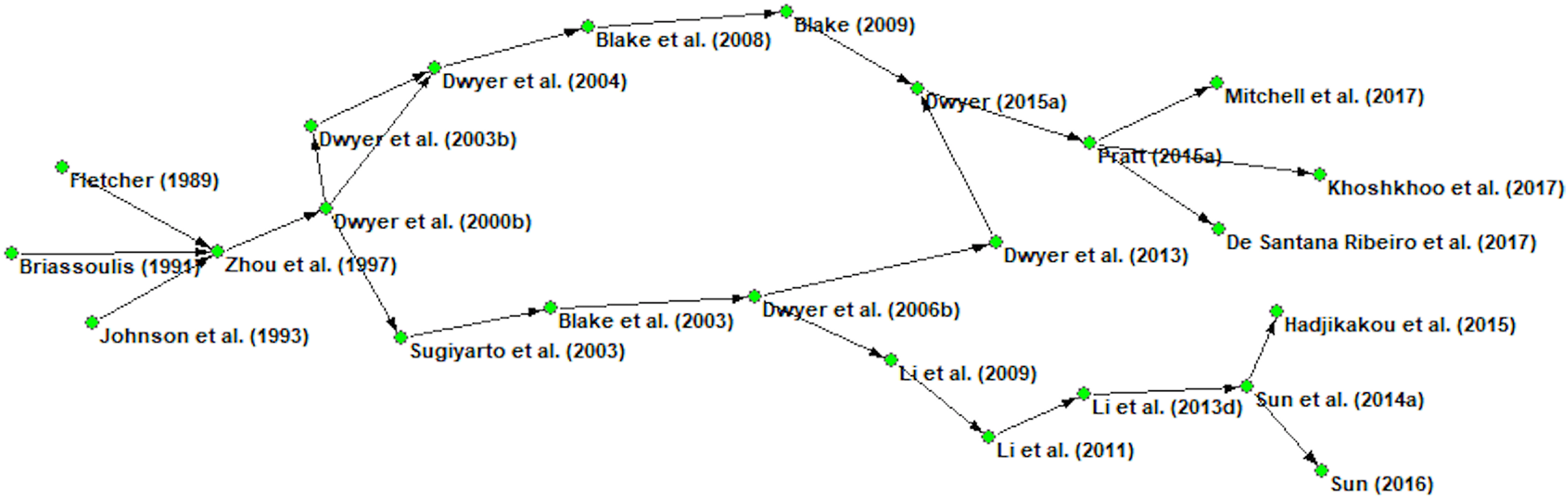
Main path of cluster 1.
Fletcher (1989), Briassoulis (1991) and Johnson and Moore (1993) showed the usefulness of the I/O analysis in the examination of the economic impact of tourism, a methodology widely applied during that period. However, they also brought to light some serious limitations (such as seasonality problems, intangible social and environmental impacts or more generic methodological issues not limited to tourism field), overcame by Zhou et al. (1997), who introduced in this field of study a new and alternative technique, the CGE. The comparison between the I/O analysis and the new methodology applied to Hawaii’s economy showed a greater power of the CGE to account for inter-sectoral resource flows and, therefore, a greater reliability. Generally speaking, a CGE model specifies all the economic relationships in mathematical terms and put them together in a form that allows the model to predict the change in variables such as prices, output and economic welfare resulting from a change in economic policies, given information about technology (the inputs required to produce a unit of output), policies and consumer preferences (Hertel et al., 2011). This is an important turning point of this stream of literature because starting from now the majority of the researchers adopted this new technique. Dwyer et al. (2000) looked at the applications of CGE modelling to tourism growth in both nations and regions, praising the capacity of this new methodology to take into account also economy-wide effects, such as the reduction of the demand for traditional exports and import industries due to the competition with an expanding tourism industry. In correspondence of this article, the main path splits into two branches. In the upper branch, Dwyer et al. (2003) argued that the effects of tourism growth on destination income and employment cannot be anticipated a priori. Thanks to the incorporation of a realistic set of economy-wide constraints in a CGE model, it is possible to predict scenarios, supporting the destination management organizations in their decision processes. Once again, this methodology was seen to be the preferred technique in analysing the economic impacts of tourism compared to the traditional I/O models (Dwyer, 2015; Dwyer et al., 2004) not only in a static way but also including dynamic elements (Blake, 2009). Through several channels, tourism may bring poverty relief in a broader context of economic growth (Blake et al., 2008); for many countries, tourism development may represent a good prospect for poverty reduction, despite governments do not take necessarily tourism seriously, failing to support a direct connection with the economic growth (Croes and Vanegas, 2008). Tourism is seen as a vital sector of economies also for small island developing states (SIDS); researchers (e.g. Mitchell and Li, 2017; Pratt, 2015) started to investigate this connection especially from 2014 when United Nations declared the Year of SIDS. However, few studies have evaluated the impact of tourism on the local economies of such countries and potential poverty reduction (Mitchell and Li, 2017), preferring instead the estimation of expenditures impact on income, employment and regional inequalities (e.g. De Santana Ribeiro et al., 2017; Khoshkhoo et al., 2017). In the other branch of the main path, Sugiyarto et al. (2003) used a CGE model to examine the effects of globalization on the Indonesian economy, showing how tourism growth amplifies the positive effects of globalization shrinking conversely the adverse ones. Blake et al. (2003) applied the same methodology to test the consequences of an exogenous shock on the tourism expenditure. More in detail, the authors showed how the outbreak of the foot and mouth disease in 2001 had an adverse effect on GDP of United Kingdom through the reductions in tourism expenditure more than through other effects. Dwyer et al. (2006b) explored the use of the CGE analysis in the evaluation of the economic impacts of special events; the article showed how this methodology is flexible enough to be adapted to estimate fiscal impacts, intraregional effects, event subsidies, multistate and displacement effects of such events. Proceeding along this branch of the main path, Li and Blake (2009) introduced the ‘Olympic-related investment and expenditure framework’ in order to analyse the economic impact of this type of event and its distributional effects between the host city and the rest of an economy, with reference specifically to the Beijing 2008 Olympics. Using this framework and applying the CGE methodology, Li et al. (2011) forecasted the economic contribution of tourism generated by the Beijing Olympics, including both ex ante and ex post estimations. Furthermore, Li et al. (2013) implemented the prior model analysing the data under the condition of imperfect competition, an approach widespread in another context, such as international trade. Finally, Sun and Pratt (2014), Hadjikakou et al. (2015) and Sun (2016) investigated the environmental consequences of tourism. Using the calculation approach of the environmentally extended input–output (EEIO) model together with scenario analysis of CGE model and/or tourism satellite account (TSA) methodology, they developed frameworks in order to quantify both direct and indirect economic impact of tourism on water consumption and greenhouse gas emissions and to identify the dynamics between economic growth, technological efficiency and environmental externalities. As already mentioned before, the United Nation General Assembly declared 2017 as the International Year of Sustainable Tourism for Development, underlining the importance of the environmental preservation beside the merely economic growth. As a result, the examination of selected environmental effects of tourism consumption may have a universal relevance for tourism policymakers (Jones and Munday, 2007). At the same time, the imposition of form of taxations to offer social and economic benefits (such as the Carbon Tax) may determine a significant contraction of tourism industry (Dwyer et al., 2013) and, as a result, negative consequences on employment and economic growth.
To sum up, researchers employ several types of analyses to make estimates of the economic impact of changes in tourism expenditure; I/O and EEIO analysis, CGE analysis and TSA seem to be the most widespread.
Each method shows advantages and disadvantages; for this reason, they have to be considered as complementary and not exclusive. For example, according to Jones and Munday (2008), TSAs can be ideally used as a basis for CGE modelling, which is perceived to be the most complete and comprehensive one (Song et al., 2012).
The development of TSA is of a great importance in order to accurately measure the impact of tourism phenomenon, which should be regarded as being made up of many different industrial sectors (Hara, 2008); as a result, the contribution of the tourism to the economy as a whole cannot be fully quantified without the implementation of a TSA (Khoshkhoo et al., 2017). In fact, this approach allows the measurement of the direct economic contributions of tourism activities to a national economy (Frechtling, 2010) which is seen to be comparable across countries, consistent over time and compatible with the standard measures of national economy (Frechtling, 1999). Furthermore, in order to provide a common reference framework to be used in the compilation of tourism statistics, in March 2008, the United Nations Statistical Commission adopted the International Recommendations for Tourism Statistics 2008 (IRTS, 2008), which presents a system of definitions, concepts, classifications and indicators that facilitate the link to the conceptual frameworks of the TSA (Frechtling, 2010). Jointly, CGE method has been implemented to overcome some of the restrictive assumption that I/O analysis has, such as a perfectly elastic aggregate supply curve, and infinitive or zero substitution effects and no price mechanism (Dwyer et al., 2004). As a result, they are extensively used to estimate economic impacts of a wide variety of changes and policies across most sectors (Dwyer et al., 2004).
Cluster 2
A total of 379 documents is included in this second cluster. Generally speaking, authors of this cluster are concerned about the assessment of intangible social and environmental impacts, such as tourism sustainability or the coexistence of tourists and host communities’ inhabitants. Pajek’s algorithm extracted two main paths (chains A and B) which will be described separately.
Chain A (Figure 2) consists of 10 papers which mainly focus on resident perceptions of tourism impact within host communities. Long et al. (1990) and Johnson et al. (1994) concentrated on rural areas. Both these papers achieved similar conclusions. Residents initially show high expectations for tourism development and their predisposition to accept tourists increase; however, at certain point, their attitudes become less favourable, decreasing over time after the achievement of a threshold level. Snepenger et al. (1995) found that travel-stimulated entrepreneurial migration contributes to business formation and diversity of firms competing in the Greater Yellowstone Ecosystem. Then, Snepenger et al. (1998) investigated the perceived impacts of tourism development on downtown in a rural community, formulating a ‘downtown tourism life cycle model’ based on five stages which are intended to illustrate how downtown evolves together with the increase of the number of tourists. However, a generalization of such type of frameworks is not simple due to the fact that nature of the relationship between host communities’ attitudes and support for tourism development differs across communities (Andereck and Vogt, 2000). Generally speaking, residents are able to recognize both positive and negative consequences of the tourism industry; broad-based education and awareness campaigns may be useful tools to increase the predisposition to accept a greater number of tourists (Andereck et al., 2005). Diedrich and García-Buades (2009) successfully explored the possibility to use local perceptions of tourism as indicators of destination decline, applying to the Belizean communities a tourism area life cycle derived from social science literature. Haddock-Fraser and Hampton (2012) and Daldeniz and Hampton (2013) investigated the economic impacts and the environmental sustainability of dive tourism industry at host sites; similar examples are also included in the chain B of this cluster. They pointed out the existence of different interest groups, often conflicting and polarized within communities, widening the field of study of social externalities as consequence of tourism. Finally, Hampton et al. (2018) highlighted how the growth of labour market as a result of tourism sector may lead to more vulnerability, uncertainty and contingency, especially among ethnic minorities.

Main path (chain A) of cluster 2.
Among the 12 papers of chain B (Figure 3), Rodenburg (1980) and Joppe (1996) emphasized the possibility that goals of different economic players are not always convergent: objectives and social and/or economic effects of large enterprises, small enterprises and craft tourism may diverge, as well as government and communities’ interests. Other authors principally focused from a qualitative point of view on many facets of tourism and its potential to boost the economic growth (Booth, 1990; Hall, 1987) especially during the transition from a manufacturing to a service economy. The existence of large attractions, such as heritage sites, may generate benefits for the local communities without forgetting related costs (Hampton, 2005). Hampton (1998) and Scheyvens (2002) showed how particular typologies of tourism, in this case, backpacker, may alleviate some of the excesses of international mass flows and reduce negative externalities. Awareness to sustainability has increased over time. Another trend topic that we have already seen in cluster 1 from a quantitative point of view is the nexus tourism poverty. Several authors of this community have been investigated this connection (e.g. Hummel and van der Duim, 2011; Scheyvens, 2007; Truong, 2013), emphasizing the possibility to alleviate poverty through suitable policies. More in general, the global boom of tourism industry has proved to be an engine not only for developed countries but also for developing ones; even single regions within them may benefit from investment in this sector. Spatial spillover and spatial heterogeneity between neighbouring regions (Yang and Fik, 2014b) and strong inter-sectoral linkages (Thomas-Francois et al., 2017) have been identified as a crucial driver of regional tourism growth.
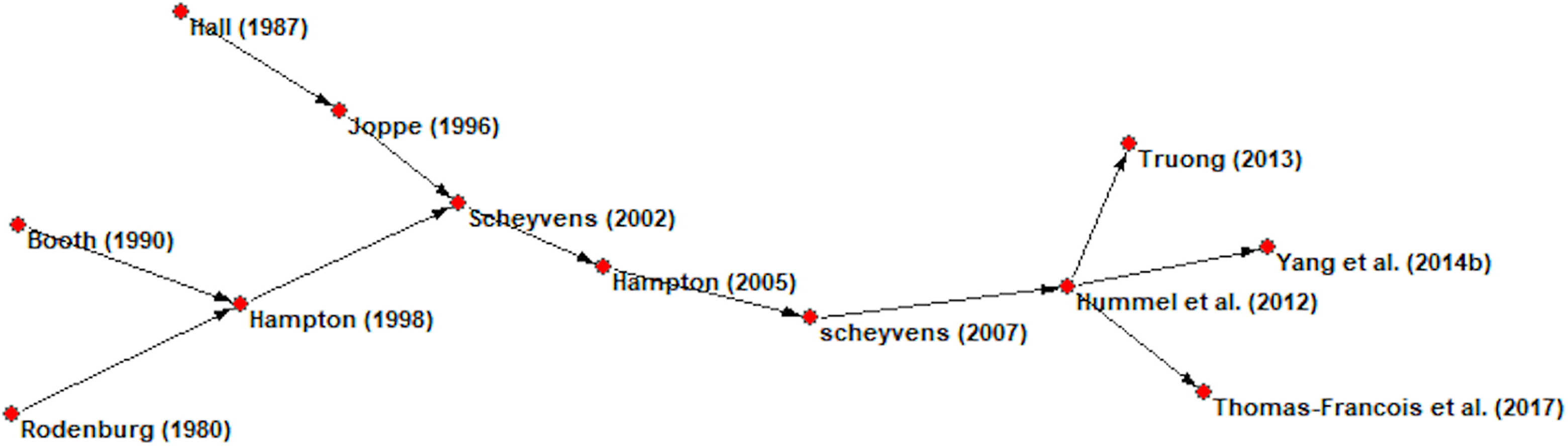
Main path (chain B) of cluster 2.
Cluster 3
A large body of literature has been devoted to validating the assumption of economic-driven tourism growth; related to this topic, in cluster 3, we can find several papers which have been already detected in the chronological analysis of the empirical research performed by Pablo-Romero and Molina (2013). All these papers share the same methodological approach, which can be divided into three groups: time series, panel data and cross-sectional data. Figure 4 shows the result of the main path extraction through Pajek algorithm.

Main path of cluster 3.
Tourism expenditure drives the host country’s economy in three ways: direct-multiplier effect (through direct expenditures of visiting tourists), indirect-multiplier effect (through the money spent by the recipients of direct expenditures) and induced-multiplier effect (through the purchases of goods and services done by beneficiaries of the two previous effects). Khan et al. (1995) demonstrated the tourism’s contribution to Singapore’s economy via the three multiplier effects aforementioned and its increase over time. Lim and Mcaleer (2000) and Payne and Mervar (2002) deepened the seasonal pattern of the tourist arrivals phenomenon, focusing, respectively, on Australia and Croatia. Furthermore, Payne and Mervar (2002) brought to light the fact that political instability may have an adverse effect on tourism revenues. Thanks to the paper of Balaguer and Cantavella-Jordà (2002), the ‘TLGH’ became one of the most relevant topics in tourism literature. More in detail, through integration and causality test, they demonstrated the existence of a connection between international tourism and economic expansion, at least in the Spanish market. Starting from now, several authors investigated the validity of such connection in different countries all over the world, with mixed findings. Dritsakis (2004) focused on the Greek economy, demonstrating the existence of a ‘strong Granger causal’ relationship between international earnings and economic growth. This connection was seen to be unidirectional from tourism and real exchange to GDP in Chile (Brida and Risso, 2009) and bidirectional in Taiwan (Kim et al., 2006) and Tunisia (Belloumi, 2010) which is likely to say economic growth contributes to the sectoral development of tourism but also vice versa. More recently, TLGH has been empirically confirmed in Lebanon (Tang and Abosedra, 2014), Malaysia (Tang and Tan, 2015) and Madagascar (Rakotondramaro and Andriamasy, 2016). On the contrary, Oh (2005) using an Engle and Granger two-stage approach and a bivariate vector autoregression model did not find any confirmation of the TLGH in the long-run period for South Korea. Conflicting conclusions may be reached even analysing the same country. Gunduz and Hatemi (2005) and Ongan and Demiroz (2005) found, respectively, a unidirectional and bidirectional relationship between the development of tourism and economic growth in Turkey. However, few years later, Katircioglu (2009) rejected the TLGH for the Turkish economy since no cointegration was found in the long term. Nowak et al. (2007) revisited the ‘TKIG hypothesis’ (tourism, capital goods import and growth); inbound tourism may be seen as an alternative form of capital import which can potentially sustain economic growth of a country. Sometimes, TLG and TKIG work together but findings are mixed. For example, supportive evidence has been found for Spain (Nowak et al., 2007), but only a short-run TKIG mechanism for Tunisia (Cortés-Jiménez et al., 2011).
Together with the above-mentioned time series analyses, several papers have been published using panel data econometric techniques, which allow dealing with a larger data sample. Lee and Chang (2008) applied a panel cointegration for Organisation for Economic Co-operation and Development (OECD) and non-OECD countries, finding a unidirectional causality relationship between tourism and GDP in the former group of nations and a bidirectional relationship (and more powerful) in the latter. Furthermore, Asian countries showed a weaker link between the two variables; on the contrary, the impact was greater in Sub-Sahara African area. Qureshi et al. (2017) validated the TLGH using a generalized method of moment estimator in a panel of 80 international tourist destination cities. They add to the model other variables, such as energy demand, health expenditure and carbon dioxide (CO2) emissions, to take into consideration also other externalities related to the tourism besides the merely economic growth. Through the quantile-on-quantile methodology recently introduced by Sim and Zhou (2015), Shahzad et al. (2017) found a positive relation between tourism and economic growth in the top 10 tourism destinations in the world (China, France, Germany, Italy, Mexico, Russia, Turkey, the United Kingdom and the United States), showing also a weaker links in those countries in which the importance of tourism sector is lower. Finally, Nimanussornkul and Do (2017) highlighted the volatility of international tourism receipts and their vulnerability to possible exogenous shocks, such as the fluctuation of the foreign exchange rate, the inflation ratio and the crude oil price. Moreover, low expected international tourism receipts are caused by the high risk on international tourism receipts.
GCS analysis
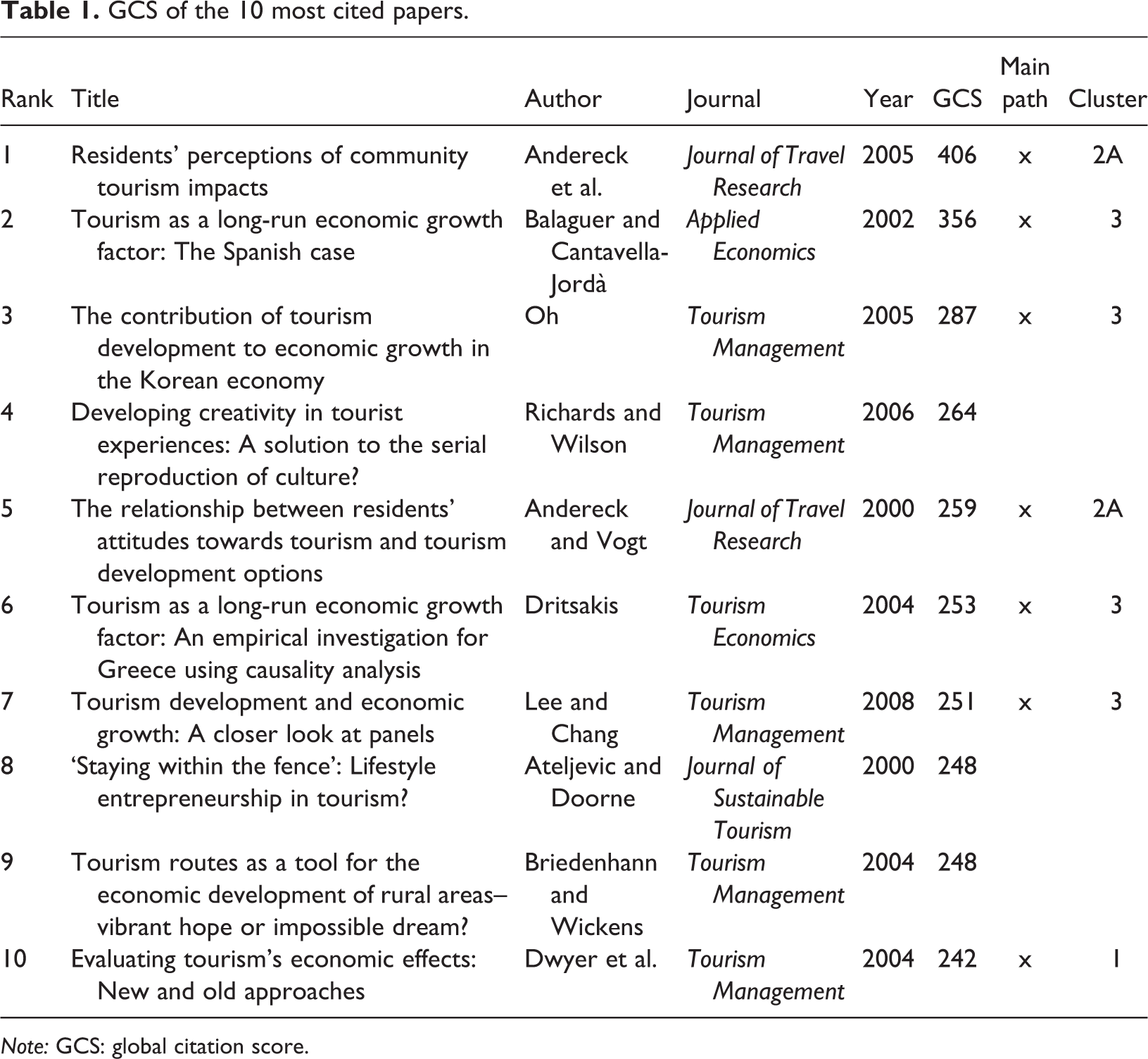
GCS of the 10 most cited papers.
Note: GCS: global citation score.
Through the comparison between the GCS and the CNA, it is possible to identify seminal works that are not included in the citation network but with a considerable amount of citations in the whole Scopus database. Table 1 confirms how some of the papers inserted in the main paths are indeed relevant works in their field, and not only within the citation network. Moreover, only three additional papers not included in any of the main paths (rank numbers 4, 8 and 9) have been found, demonstrating the capability of the CNA in the detection of the most relevant works. These three papers corroborate the relevance of tourism as a trending topic, confirming themes already discussed before, such as the importance of tourism for the development of rural and marginalized areas (Briedenhann and Wickens, 2004), but also pointing out the existence of other issues. For example, Richards and Wilson (2006) highlighted the need for creativity in developing new products and services also in the tourism industry to attract more tourists in this competition-driven market. The creation and the introduction of innovative products often come from entrepreneurs who invest in tourism sector not for economic purposes but as ‘lifestyle’ (Atelijevic and Doorne, 2000).
Author keywords analysis
The CNA already performed together with the GCS analysis is certainly powerful instrument for the exploration of the state of the art of a topic. However, additional investigations can be useful in order to identify the most recent trends shared among all the papers. In this paragraph, we explore also the author keywords network (Ding et al., 2001) of the whole set of papers resulting from the SLR process; this allows us to include in our analysis also the isolated nodes of the connected component, which is like saying all the papers that are neither cited nor citing others in the network (765 of 1999 papers).
Co-occurrence analysis of authors’ keywords
The main assumption of a co-occurrence (or co-word) analysis is that authors’ keywords constitute an adequate proxy of the papers’ content or of the relationship that the paper establishes among investigated problems (Strozzi et al., 2017). The co-occurrences around the same word of a pair of words may correspond to a research theme, suggesting the existence of patterns and trends in a specific discipline (Ding et al., 2001). To perform a co-occurrence analysis of authors’ keywords, two steps are needed. First of all, we extracted the authors’ keywords of the same 1999 papers selected in Scopus for the SLR phase. Then, a co-word network was built and analysed using VOSviewer software (Van Eck and Waltman, 2010). VOS mapping determines the locations of items in a map by minimizing a function depending on a similarity measures (ASij) between items defined as

Where cij is the measure of the occurrence of the keywords i and j in the same document and ci and cj are the expected numbers of co-occurrences of i and j under the assumption that the co-occurrences of i and j are statistically independent (Van Eck and Waltman, 2009).
Figure 5 shows the results obtained analysing the author keywords of the 1999 papers extracted from Scopus. Starting from a total of 4419 author keywords, the VOS algorithm detected three main clusters, which reflect the three clusters previously analysed through the CNA. As a parameter, we chose a minimum number of occurrences of keywords equal to 25. A value too small does not give enough significance to the analysis, leading to the inclusion also of keywords not relevant; a value too high is not optimal as well because it will determine the exclusion of the most recent keywords, which do not have yet enough co-occurrences. A minimum number of 25 looks adequate, considering both our prior knowledge about the topic and the methodology. Size of each circle is determined by the number of repetition of the keyword (or set of keywords) among all the papers: the larger is the circle, the more common is the keyword (or set of keywords). Furthermore, the weight of each link shows the total strength of a keyword in comparison with others: the thicker is the line, the stronger is the link.

Co-occurrence network of author keywords.
‘Tourism’ is the centrepiece keyword of cluster 1, and if we consider the circle’s size, it is also the most important keyword of the net as a whole. ‘I/O analysis’ (and its evolutions such as EEIO, CGE and TSA) is one of the widest techniques used in this field of study, as already described in the CNA aforementioned. ‘Economic impacts’ and ‘climate change’ are some of the possible applications of such methodologies, in order to test the interdependencies between tourism and different branches of national and/or regional economies but also the quantification of both direct and indirect externalities due to the expansion of tourism sector. Cluster 2 is certainly the most heterogeneous among all. Keywords’ net suggests a connection between ‘economic development’ and ‘tourism development’ and potential negative externalities which governments have to take into account whenever they decide to invest in the tourism sector to boost the economic growth of their countries. As already mentioned before, the United Nation General Assembly declared 2017 as the International Year of Sustainable Tourism for Development and in fact, in this cluster, we can find keywords such as ‘sustainable tourism’, ‘sustainable development’, ‘sustainability’ and ‘ecotourism’. For many developing countries (Croes and Vanegas, 2008) and rural and marginalized areas (Briedenhann and Wickens, 2004), tourism may also represent a good prospect for poverty reduction and economic growth (‘rural tourism’). The keyword ‘tourism’ of cluster 1 is directly connected with ‘economic growth’, which is the most relevant pair of keywords of cluster 3. ‘Cointegration’ and ‘Granger causality’ are two of the favourite methodologies by researchers to verify the existence of the so-called ‘TLGH’, introduced for the first time with the paper of Balaguer and Cantavella-Jordà (2002). From a geographical point of view, Asia and Pacific regions are the most examined by researchers (32 studies have been found by Brida et al. in a literature review performed in 2016); as a result, ‘Malaysia’ is one of the most common keywords of this cluster.
Kleinberg’s burst detection algorithm
A helpful tool for the analysis of the evolution over time of author keywords network is the so-called Kleinberg’s burst detection algorithm. A ‘burst of activity’ is often the signal of the appearance of a new topic in a document stream (Strozzi et al., 2017) and it allows them to identify the increase in the frequency of use of certain keywords by authors (Kleinberg, 2003).
The output of Kleinberg’s algorithm is a list of the word bursts, ranked according to the burst weight, together with the time in which these bursts took place. Due to the fact that the methodology is case-sensitive, it is necessary to start from normalized keywords. The process of normalization implemented in Sci2 separates the text into token words, normalizes in lowercase, removes the ‘s’ at the end of words and the dots from acronyms (if any) and deletes stop words. At this point, using the software Sci2, the Kleinberg’s algorithm was applied to the normalized keywords (as in Strozzi et al., 2014, 2017).
The results of the implementation of the burst detection algorithm are shown in Figure 6. The main bursts took place between 2004 and 2008; ‘impact’, ‘sport’ and ‘event’ are the three most relevant normalized keywords detected by the algorithm. This is an additional confirmation of the CNA earlier described. In fact, several papers of cluster 1 aforementioned focused on the potentiality of mega-events (such as Soccer World Cup and Olympic Games) to boost the economies of hosting nations, through the increase of the number of tourists, advertising and tax revenues, employment, investments and infrastructure development. The second group of bursts stood out between 2010 and 2015, focusing mainly on the development of a sustainable tourism and taking into consideration also negative externalities of the touristic phenomenon (such as climate change) beside the merely economic growth. An evolution of this trajectory emerged with a third burst in 2016; the normalized keywords ‘energi’ and ‘emiss’ suggest that in the last few years, researchers have paid attention to topics related to over-exploitation of natural resources and environmental externalities, such as energy consumption and emissions of CO2. These two last bursts almost confirm both the co-occurrence analysis of authors’ keywords and the CNA; several studies concerning the environmental preservation have emerged, also in accordance with the designation of 2017 as the International Year of Sustainable Tourism for Development by the United Nation General Assembly and more in general with a greater awareness about global warming, considered now one of the most important environmental issues ever to confront humanity.
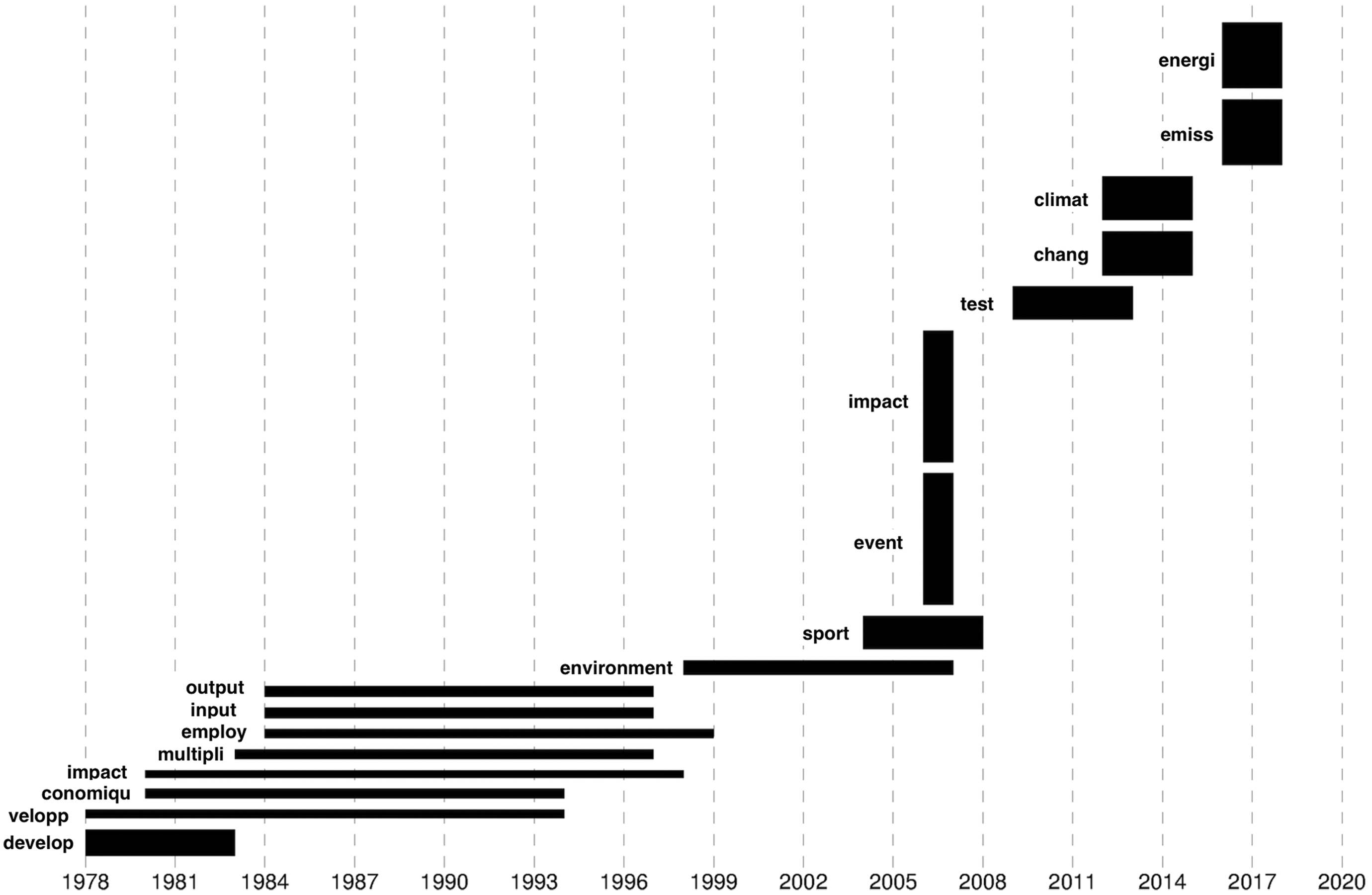
Kleinberg’s burst detection algorithm.
Conclusions
In this literature review, a quantitative bibliometric analysis has been performed, relying on both algorithms and software tools which allowed us to carry out a dynamic representation of the flow of knowledge evolution over time. We combined the outcomes of such analyses to provide an overall view of the state of the art and of the research trajectories of the knowledge on tourism and its economic impact. Furthermore, given the vastness and the heterogeneity of all the related topics, the main path analysis demonstrated considerable usefulness to localize the seminal works of each field of study. In fact, the main path constitutes the backbone of the research tradition (De Nooy et al., 2011; Lucio-Arias and Leydesdorff, 2008), highlighting the articles that act as hubs in reference to later works (Strozzi et al., 2017). Lastly, the identified fields of study allow drawing some consideration about some directions in an agenda for future research, supporting newcomers to target specific topics and helping them to link to those themes. As a summary, Table 2 shows the main findings of this SLNA, including also some potential future research directions.
Main summaries of the CNA, author keywords analysis, burst detection algorithm and future research directions.

Note: CNA: citation network analysis; I/O: input–output; TLGH: tourism-led growth hypothesis; ELTH: economic-led tourism hypothesis; CGE: computable general equilibrium; TSA: tourism satellite account; EEIO: environmentally extended input–output; SIDS: small island developing states.
Generally speaking, tourism is seen to be as a way for boosting countries’ economic growth, thanks to its positive influence on the economy as a whole. Several authors of cluster 1 explored the interdependencies between tourism and different branches of national and/or regional economies together with the quantification of both direct and indirect externalities due to the expansion of tourism sector, mainly using CGE and I/O models. A particular niche of study concentrates on the impact of large sport events, such as Olympic Games (e.g. Li and Blake, 2009; Li et al., 2011, 2013) or Soccer World Cup (e.g. Kim et al., 2006; Lee and Taylor, 2005); results of the Kleinberg’s burst detection algorithm provide an additional evidence of this, with an increase in the frequency of use of keywords event and sport, especially from 2004 to 2008. In a broader sense, CGE modelling has influenced many debates in international development, such as trade policy, migration, climate change, carbon trading, food prices and pro-poor economic growth policies (Devarajan and Robinson, 2002). We can say that all these techniques have commonly entered the arsenal of applied economic policy analysis in tourism field of study. However, despite being a very powerful tool, they are not empirical in the sense of econometric modelling (Hertel et al., 2011). To overcome such limitations, a large body of literature (cluster 3) has been devoted to validating from an econometric point of view the economic-driven tourism growth, mainly using time series and panel data but only in few cases cross-sectional data. Starting from the first paper published by Balaguer and Cantavella-Jordà (2002), the so-called TLGH and its reciprocal ELTH have become two most predominant topics in tourism literature, with a proliferation of empirical studies (Perles-Ribes et al., 2017). Several authors investigated the validity of such connection in different countries all over the world, almost finding a confirmation of this mechanism (e.g. Belloumi, 2010; Brida and Risso, 2009; Dritsakis, 2004; Kim et al., 2006; Oh, 2005; Rakotondramaro and Andriamasy, 2016; Shahzad et al., 2017; Tang and Abosedra, 2014; Tang and Tan, 2015), but also with mixed findings even analysing the same country, as in the case of Turkey (Gunduz and Hatemi, 2005; Katircioglu, 2009; Ongan and Demiroz, 2005). Nowak et al. (2007) revisited the ‘TKIG hypothesis’ (tourism, capital goods import and growth); inbound tourism may be seen as an alternative form of capital import which can potentially sustain economic growth of a country. Sometimes TLGH and TKIG work together but findings are mixed. For example, supportive evidence has been found for Spain (Nowak et al., 2007), but only a short-run TKIG mechanism for Tunisia (Cortés-Jiménez et al., 2011). More recently, Qureshi et al. (2017) validated the TLGH adding to the model other variables, such as energy demand, health expenditure and CO2 emissions, to take into consideration also other externalities related to the tourism besides the merely economic growth. Generally speaking, authors of cluster 2 are concerned about the assessment of intangible impacts of tourism. As a matter of fact, several studies brought to light a large number of potential negative externalities driven by massive tourist arrivals, such as over-exploitation of natural resources (e.g. Capó et al., 2007; Holzner, 2005), increased cost of living and asset bubbles (e.g. Copeland, 1991; Sheng, 2016a; Sheng and Tsui, 2009a), environmental externalities (e.g. Briassoulis, 2002; Brohman, 1996; Saenz-de-Miera and Rosselló, 2014; Sheng and Tsui, 2009b) and social externalities (Castells, 1978; Harvey, 2008; Sheng, 2016b), included resident perceptions of tourism impact (e.g. Andereck and Vogt, 2000; Andereck et al., 2005; Johnson et al., 1994; Long et al., 1990). Last but not less important, the global boom of the tourism industry has proved to be an engine not only for developed countries but also for developing ones. Several authors across all the three clusters have been investigated this connection (e.g. Blake et al., 2008; Croes and Vanegas, 2008; Hummel and van der Duim, 2011; Scheyvens, 2007; Truong, 2013), emphasizing the possibility to alleviate poverty through suitable policies.
Besides the description of the literature’s development, this methodology allowed us also to drawing some consideration about potential future research directions; in fact, through the main path algorithm, it is possible to pinpoint the most recent seminal works which have not reached a significant number of citations yet. Across all the three clusters, we found a growing concern about the sustainability of tourism and leisure activities, partly due to the impulse coming from the United Nation General Assembly. From cluster 1 arose the need for the development of more sophisticated EEIO models, which allows capturing at the same time both environmental and economic impacts of tourism (Sun and Pratt, 2014). Furthermore, in order to overcome the already mentioned limitations of I/O models, the implementation of more complex CGE methodologies is strongly suggested, together with the development of tourist satellite accounts (TSA) to better quantify the contribution of tourism (Khoshkhoo et al., 2017).
Research of cluster 2 is generally more concerned about the assessment of intangible social and environmental impacts of tourism (e.g. Hampton et al., 2018; Thomas-Francois et al., 2017). More in deep studies connected to sustainable development themes (such as local participation, value chain, inter-sectoral linkages and private sector participation) is strongly recommended. Moreover, worker sustainability, labour precariousness and empowerment of local communities have to be included in further researches, especially due to the fact that tourism is seen as a potential engine of a broad-based development of developing countries, which are more vulnerable to such issues.
Authors of cluster 3 mostly call for a deeper investigation of the connection between the TLGH and the development of a sustainable tourism. As already highlighted in prior literature reviews (e.g. Brida et al., 2016; Pablo-Romero and Molina, 2013), the implementation of nonlinear empirical methodologies may confirm or not the results already obtained through classic techniques, by expanding the field of study at subnational level and by including the relationship between tourism specialization and other economic sectors.
In conclusion, the methodology applied in this article has also some limitations. The main criticism is that citation data are retrieved from Scopus database that includes only a fraction of scientific publications; nevertheless, its coverage is 60% larger than the one of WoS (Zhao and Strotmann, 2015). Another issue is the so-called ‘Matthew effect’ (i.e. the rich get richer and the poor get poorer); researchers tend to cite papers which have already received a high number of citations because they are considered a more reliable source of information. On the contrary, thanks to additional analysis (i.e. author keywords analysis and GCS analysis), we overcame the problem of relying exclusively on the number of citations, which may not be completely informative about the real contribution of a paper to the flow of knowledge. Despite the discussed limitations, this structured literature review could provide a panorama of the most developed areas of study related to tourism, supporting newcomers to target specific topics and allowing them to adopt or to link to those themes. Furthermore, once the main communities have been detected (clusters 1, 2 and 3 aforementioned in the CNA), by changing the set of search strings based on keywords, concepts or topics (i.e. the ‘locating study’), it could be possible to concentrate exclusively on a specific area of research. For example, a common denominator often emerged in this literature review is the methodology applied by researchers; we deliberately decided not to include any indication to empirical techniques in order to perform a broader analysis, but it could be possible to implement an SLNA focusing primarily on the applied techniques. Finally, from a general point of view, the interesting output of this study is the demonstration that SLNA can be exploited as a research tool to support dynamic analyses for drawing agendas for future research in the tourism fields of study.
Footnotes
Declaration of conflicting interests
The author(s) declared no potential conflicts of interest with respect to the research, authorship, and/or publication of this article.
Funding
The author(s) received no financial support for the research, authorship, and/or publication of this article.
