



Abstract
This study evaluates whether college students change their beliefs about the social, economic, and environmental effects of tourism activities after receiving educational training. In particular, our goal is to examine if economic instruction affects their views about the impacts of cruise tourism development. We conduct an experiment with students majoring in tourism enrolled in a compulsory course on tourism and transport at the University of Las Palmas de Gran Canaria (Spain). We administer a survey before and after the course in three academic years that involve the pre-pandemic and pandemic periods. We find that students become more concerned about the negative impacts of cruise tourism, with significant shifts in their agreement with the environmental externalities and price surges associated with cruise tourism. Furthermore, they become more supportive of the setting of a tourism tax per passenger, but agree less with the idea that governments should economically incentivise the arrival of more ships.
Introduction
Tourism is one of the most important industries around the world, representing about 10% of the global GDP and accounting directly or indirectly for 25% of all new jobs created worldwide in 2019 (WTTC, 2022). Several studies have shown that the tourism sector is an important driver of economic growth for regional areas (Bronzini et al., 2022; Faber and Gaubert, 2019). The pandemic caused by COVID-19 has highlighted the relevance of this sector among economists, since the shutdown of leisure, tourism, transportation, and related services led to a sharp drop in income and employment, particularly in tourism-led growth economies (Mariolis et al., 2021).
Despite its economic relevance, the development of tourism does not come without costs. Tourism imposes several negative externalities on local economies in the form of price surges (Tkalec and Vikek, 2016), economic and environmental overexploitation (Pintassilgo and Silva, 2007), air pollution (Tichavska and Tovar, 2015a, 2015b), increased crime (Biagi and Delotto, 2014), reduced housing affordability (Mikulic et al., 2021), and lower quality-of-life perceptions (Biagi et al., 2020). In this regard, there is public debate about whether the benefits of tourism development outweigh its caveats, especially under the threat of the so-called Dutch disease (Inchausti-Sintes, 2015). Moreover, residents have exhibited mixed feelings about tourism development, with some studies reporting important differences in tourism tolerance between those who earn income from tourism and those who do not (Garau-Vadell et al., 2019; McGehee and Andereck, 2004).
The economic, environmental, and sociocultural effects of tourism activities are far from properly understood among the general public. Some popular views about the tourism industry are at odds with empirical evidence and economic theory, leading to important misconceptions about the need for policy regulations, taxing schemes, or quantity limitations in this industry. These misconceptions are of particular relevance because required political interventions might not be implemented by public authorities if they do not have citizens’ support (Dal Bó et al., 2018). Host communities can be regarded as composite stakeholders that face a trade-off between the maximisation of tourism profits as producers and utility as local consumers (Meleddu, 2014). In equilibrium, they should choose the combinations that maximise positive externalities while minimising negative ones. For this purpose, it is compulsory that people properly understand market functioning and dynamics, existing externalities, and the (un)intended effects of political economy interventions. It is thus necessary to examine whether economic training has the capacity to improve citizens’ understanding about the effects of tourism on the economy.
This paper studies the role of formal education training on citizens’ attitudes and support for tourism activities. We design and implement a field experiment with college students enrolled in an undergraduate course (Tourism and Transport) to examine the effects that receiving formal instruction about the positive and negative externalities of cruise tourism has on their support for these activities. Tourism and Transport is a compulsory one-semester course whose syllabus explicitly covers the economic, social, and environmental impacts of cruise tourism, both globally and on local economies. Some evidence shows that providing people an expert opinion about a topic does not change their prior beliefs (Sapienza and Zingales, 2013). Therefore, we test whether teaching economic theory and factual evidence about the linkages between transportation and tourism to undergraduate students induces a belief change in their support for cruise tourism.
The study is performed with a sample of 141 undergraduate second-year students majoring in tourism at the University of Las Palmas de Gran Canaria (ULPGC) (Canary Islands, Spain), a region for which tourism is a major economic driver (Baños-Pino and Tovar, 2019, 2021; Santana-Gallego et al., 2011). Importantly, by selecting students enrolled in a tourism bachelor’s programme, we avoid the common problems of self-selection and lack of representativeness when using economic students (Caplan, 2002; Jacob et al., 2011; Sapienza and Zingales, 2013). Considering that at the beginning of the course they lack any specific knowledge about how the cruise industry works and its economic impacts, their opinions likely resemble those held among the general public.
In line with related works in the education economics literature (Busom et al., 2017; Hammlock et al., 2016), students answer a questionnaire about their beliefs and attitudes towards the economic, environmental, and sociocultural effects of cruise tourism before and after taking course sessions devoted to the cruise sector. This is done in three different academic courses: 2019–2020, 2020–2021, and 2021–2022. As such, we exploit the fact that the study involves pre- and post-pandemic outbreak cohorts to examine potential heterogeneous belief changes associated with the pandemic. Methodologically, we use a fixed-effects identification strategy by which the effect of formal instruction on beliefs is identified as the within-subject change in opinions between the beginning and the end of the cruise sessions.
The paper contributes to two strands of literature that have been developed independently. On the one hand, research in economic education has evaluated the effect of instruction on students’ economic views about the market (Brandts et al., 2022; Busom et al., 2017). However, most previous literature focuses on attitudes towards generic economic aspects. We instead study students’ belief change about the impacts of a specific industry (cruise tourism) in a region where it has gained economic relevance due to its sustained growth since 2000. Accordingly, the salience of prior beliefs and the personal interest in the topics covered is expected to be higher than in other settings. On the other hand, the paper adds new insights about citizen’s support for tourism activities. However, previous works have evaluated the differences between those who economically benefit from tourism and those who do not (McGehee and Andereck, 2004), the relationship between support and quality of life (Biagi et al., 2020), or the influence of political orientation (Litvin et al., 2020), this paper presents the first empirical evidence of the capacity of formal education training to change citizens’ views about the positive and negative impacts of tourism. To the best of our knowledge, we are the first to identify how applied economic theory can shape people’s opinions about the tourism sector.
The remainder of the paper is structured as follows. Section 2 reviews the related literature. Section 3 describes the case study and research design and reports some descriptive statistics. Section 4 explains the identification strategy and econometric modelling. Section 5 presents and discusses the main results together with some robustness checks. Finally, Section 6 concludes with a summary of the main findings and the implications of the paper.
Literature review
This section briefly reviews the state of the art about citizens’ attitudes towards tourism in general and about cruise tourism in particular. Next, we provide a summary of the body of research in education economics that has evaluated the effects of educational training on students’ beliefs, misconceptions, and opinions about economic topics.
Citizens’ attitudes towards tourism
Despite the positive economic effects of tourism development for local areas (e.g. Bronzini et al., 2022; Faber and Gaubert, 2019), the touristification phenomenon (i.e. a process of massive development of tourism) also imposes several negative externalities in the form of congestion, noise, waste, increased crime, or reduced housing affordability. All this damages the welfare of residents, which causes them to hold negative attitudes towards tourism.
A large body of research has examined residents’ perceptions and opinions about tourism development. This literature has shown that citizens acknowledge the positive economic impact of tourism overall but exhibit some concerns about the environmental effects of mass tourism (Garau-Vadell et al., 2014). Some studies reveal that residents perceive that tourism deteriorates their quality of life since it generates greater costs than benefits (Biagi et al., 2020). Those who perceive that tourism damages their quality of life exhibit lower emotional solidarity with tourists and are less likely to be sympathetic with them (Lai et al., 2021). Political orientation (Litvin et al., 2020), proximity to heritage (Adie and Falk, 2021), and sociodemographic factors like age (Huh and Vogt, 2008) are other factors that the literature has identified as predictors of residents’ beliefs about the suitability of tourism development.
A key aspect for residents’ support for tourism activities is whether they earn income from tourism (Concu and Atzeni, 2012). Consistent with social exchange theory (Ap, 1992), personal benefits from the industry make residents more prone to hosting additional tourists (Garau-Vadell et al., 2019; Latková and Vogt, 2012; McGehee and Andereck, 2004). Another relevant predictor is the state of the local economy; the impacts of tourism are more positively valued during economic downturns (Hateftabar and Chapuis, 2020), plausibly because amid economic stagnation people believe that tourism development is a promising strategy for their community to recover economic activity. Recent evidence from the COVID-19 crisis indicates that residents in tourist areas are willing to assume a higher risk of infection through social interactions in exchange for tourism revenues (Kamata, 2022).
With regard to residents’ attitudes towards cruise tourism, residents in ports of call positively value the economic and sociocultural benefits (e.g. social interactions, revalorisation of traditions) of cruise tourism (Brida et al., 2014). Support for further developments in this form of tourism is higher among middle-aged people, those with high education, and those who interact intensively with tourists (Del Chiappa and Abbate, 2016). Marked differences have also been found based on geographical proximity to the tourist area (Del Chiappa et al., 2018). However, similar to what happens with other forms of tourism, residents exhibit concerns about its environmental impacts (Brida et al., 2011).
For the case of the Canary Islands, Martín et al. (2020) report that although the economic impact of tourism arrivals is widely accepted, residents have the perception that tourism development is responsible for high price levels. They also identify two clear profiles of local residents: extreme and moderate lovers and haters. López-del-Pino et al. (2021) investigate residents’ support for tourism taxes using both survey data and experimental methods. They report that, although there is a greater percentage of people against than in favour, the support for a room tax is twice as large as for those with knowledge or experience about such taxes. Moreover, most respondents declare the room taxes should be invested in protecting the environment and preserving the cultural and architectonic heritage of the islands. Focussing on cruise tourism, Tovar et al. (2020) show that residents have positive perceptions of its socioeconomic impact and do not support the potential establishment of limits to the arrivals of cruise ships or tourist taxes. Nonetheless, they exhibit some worries about air pollution and the accumulation of dirt.
Belief change among college students after factual information and economic theory
Several studies have documented important divergences between general people’s beliefs about certain topics and academic consensus in economics (Caplan, 2002; Jacob et al., 2011; Sapienza and Zingales, 2013). These misconceptions are of great relevance because they might lead citizens to support and demand policy interventions that have harmful net effects due to their failure to anticipate the equilibrium effects of new policies (Dal Bó et al., 2018). Some evidence shows that, when presented with factual information, not all individuals update their beliefs accordingly. In settings that involve economic policies associated with political views, people only partially process the information provided and tend to sustain their initial positions (Achtziger et al., 2014). In this vein, misconceptions are hard to remove; this is partly due to factors like political orientations (Gentzkow and Shapiro, 2010), confirmation-seeking behaviour by which they look for information sources that sustain their prior beliefs (Charness et al., 2021), or cognitive biases (Enke and Zimmermann, 2019). In addition, misconceptions also prevail because of weak incentives to hold accurate beliefs (Nyhan, 2020).
A large body of research has used introductory economics courses as natural experiments for testing the effect of formal training about economic principles and the market functioning on students’ beliefs and opinions about economic aspects. Early works on this in the 1970s and 1980s have shown that introductory courses in economics induce students to become more conservative (Jackstadt et al., 1985; Luker and Proctor, 1981; Scott and Rothman, 1975) and to change their attitudes towards income distribution in an egalitarian direction (Sosin and McConnell, 1979). Whaples (1995) studies how attitudes about fairness change as students learn the supply-and-demand model. This author finds that economic classes induce a change in their perceptions about the fairness of the market. In particular, learning economics makes them more likely to believe that market outcomes are equitable. Exploiting data for more than 80,000 college students from 450 American colleges and universities, Hammock et al. (2016) find that studying economics is associated with increased beliefs in favour of individual freedom and against government intervention. Specifically, economics students become less willing to support high taxes on the wealthy at graduation as compared to their beliefs at matriculation. Similar results are presented by Fischer et al. (2017), who document that, by the time of graduation, economics students are 6.2% points more likely than they were when they entered the university to agree with free-market policy positions.
These works suggest that economic training instruction has the capacity to change people’s views about certain topics. However, this is not always the case; Busom et al. (2017) report that most first-year students kept their beliefs about the suitability of rent controls for making housing accessible to more people following a standard one-semester course on economic principles. Leaving aside differences in instruction methods and cultural differences across students, students do not always integrate the newly learned reasoning tools into their way of thinking about the economy. These authors argue that preconceptions and cognitive biases like confirmation bias are partially responsible for the persistence of economic misconceptions. Brandts et al. (2022) conduct two experimental studies to examine whether presenting information in a refutational way affects students’ beliefs about the harmful effects of rent controls. Their findings show that providing information moderates misconception to some extent, but it does not fully eliminate it. Moreover, the way the information is presented does not make a difference. This implies that how people update their belief after being presented theory and evidence still deserves closer examination.
Data
The Canary Islands as a case study
The Canary Islands form a Spanish archipelago composed of eight islands located in the Macaronesia tropical region. They are the southernmost of the Spanish autonomous communities and one of the outermost regions of Europe. The Canaries enjoy a mild climate during the whole year, which likely explains why the Canary Islands nowadays stand as one of the major tourist destinations worldwide, receiving around 15,589,290 tourists in 2019 (ISTAC, 2020). Gran Canaria is the third largest island of the Canaries and, together with Fuerteventura, Lanzarote, and La Graciosa, belongs to the province of Las Palmas. The rest of the islands belong to the province of Santa Cruz de Tenerife.
The regional economy is primarily based on tourism. In the pre-pandemic years, the tourism sector represented around 33% of its GDP and 36.5% of employment (Exceltur and Gobierno de Canarias, 2020). The cruise industry in the Canary Islands began to develop at the end of the last century, later than in the rest of Europe. Its positive evolution and consolidation in recent years are explained by the availability of large port facilities, excellent airline connections with the whole word (and therefore with the main cruiser source countries), and a variety of high-quality tourist services and facilities.
1
Figure 1 presents the time evolution of the number of cruise passengers in the Canary Islands. As can be seen, the cruise sector has exhibited a positive trend since 2000, reaching 2,500,000 passengers in 2019. Evolution of cruise passengers in the Canary Islands (number).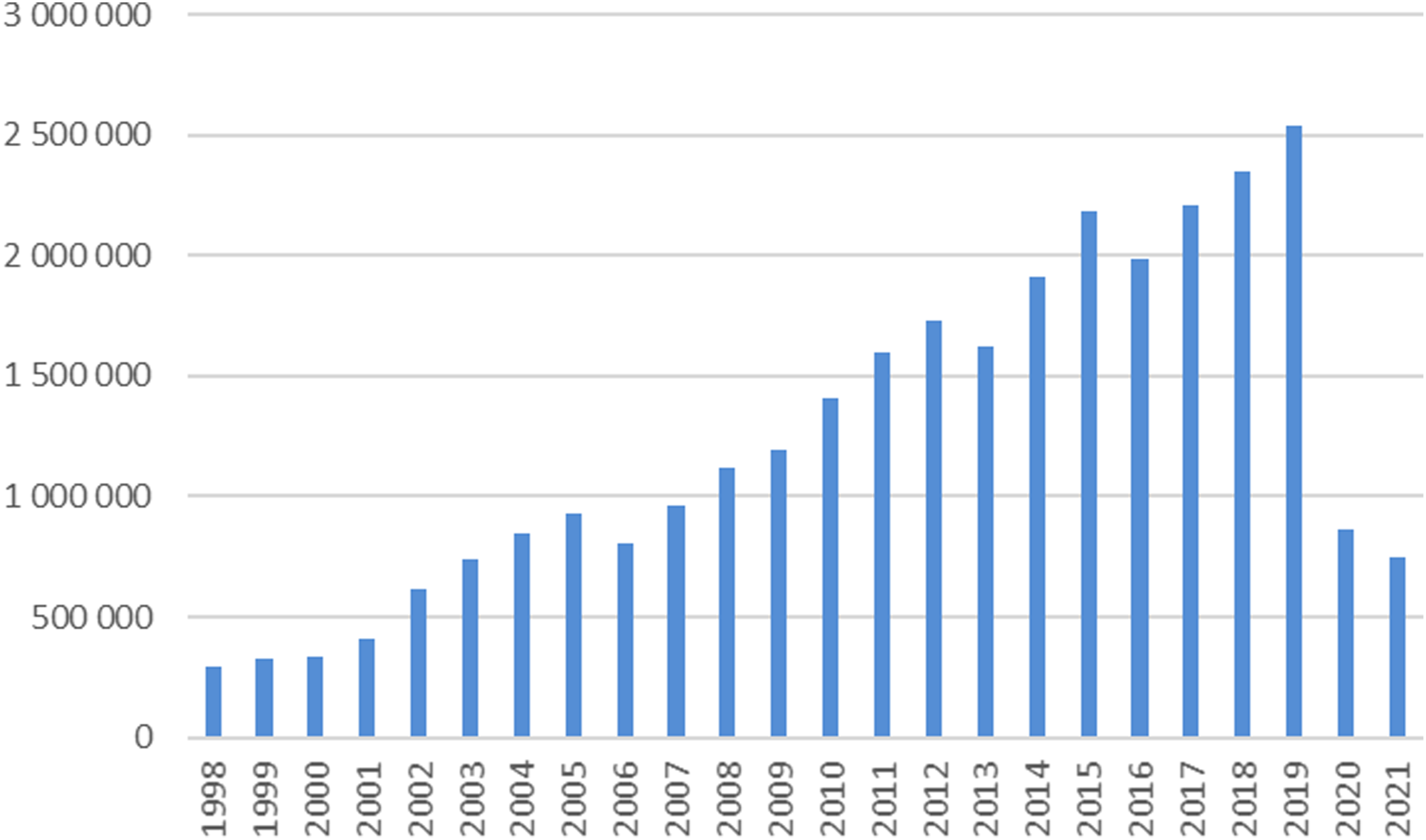
The COVID-19 pandemic was a major shock for the region: in 2020, the tourism industry reduced its contribution to the Canarian economy to just 17.8% of its GDP (Exceltur and Gobierno de Canarias, 2020), with the corresponding negative effects on economic revenues and employment rates for the archipelago. The cruise industry was also seriously affected by the pandemic due to its complete stoppage during the hardest phase (March–November 2020). The development of safety protocols, hygiene measures, and the collaboration between shipping companies and port authorities made it possible to restart cruise tourism by the end of 2020, when the high cruise season normally begins in the islands. Las Palmas was the first Spanish port to restart cruise operations after the nationwide lockdown in the spring of 2020. Although the region suffered a large drop in the number of cruise passengers hosted in 2020 (−66.6% relative to 2019), the decline was lower than in other Spanish ports.
Participants and questionnaire
The study was conducted at ULPGC, which is located in the city of Las Palmas de Gran Canaria (LPGC), the capital city of Gran Canaria Island. The bachelor’s degree in tourism at ULPGC (adapted to the European Higher Education Area) educates professionals aimed to specialise in the tourism field about business management and how to make the most out of natural and cultural resources in relation to tourism. It also provides them with overall knowledge of other closely related areas and the ability to lead and develop projects in an environment that is constantly changing.
Tourism and Transport is a second-year compulsory course for all students majoring in the bachelor’s in tourism that takes place in the first semester of each academic year. Before taking the course, students already had some previous background on economic theory, as they had been taught economic concepts like supply and demand, market equilibrium, externalities, and the welfare effect of policy interventions in the first year of their bachelor’s degree programme. The syllabus of Tourism and Transport goes beyond basic principles and covers the analysis of the relationship between tourism and transportation from an economic perspective. It teaches students foundations about transportation and its influence on the tourism sector, such as transport network analyses, route design, travel demand and supply, and travel prices. Moreover, the cruise and air carrier sectors are analysed in depth. Some environmental issues are also covered in relation to the link between transportation, tourism, and sustainability goals.
Lectures are combined with practical sessions to solve applied problems, and class sizes range between 50 and 80 students. The contents and the professor in charge of the sessions devoted to the cruise sector are the same for all cohorts. A textbook and complementary materials are provided through the online campus. Moreover, real updated cruise sector information is provided each year through web links to institutions, including the International Maritime Organisation, the World Tourism Organisation and United Nations, and the Cruise Lines International Association, among others. Course performance is assessed through midterm exercises and a final exam.
We take advantage of the questionnaire designed by Tovar et al. (2020) aimed at analysing the perceptions and attitudes of the residents of LPGC with respect to cruise tourism in Gran Canaria (Spain). The questionnaire includes 21 statements intended to capture students’ beliefs about several economic, environmental, and social effects (positive and negative) of cruise tourism in the Canary Islands. The survey was administered at the beginning and at the end of the set of sessions devoted to the cruise sector to all college students enrolled in the course. The temporal frame between the two survey rounds was around 1 month. Students were informed that we were running a voluntary opinion survey and that the questionnaire was not intended to assess their economic knowledge or to evaluate course performance. This closely follows Busom et al. (2017) and Brandts et al. (2022).
In both the before (before taking the course) and after (after taking the course) surveys, respondents were asked to rate their degree of agreement with each statement on a 1–5 Likert scale (1 = strongly disagree, 2 = disagree, 3 = do not have a clear opinion/do not know, 4 = agree, 5 = strongly agree). Standard sociodemographic characteristics like gender, family income, and household size, and other relevant information like whether he/she lives in LPGC, whether they have been on a cruise trip before, or whether they know someone who works for the cruise industry were also collected (see below).
The study involves three cohorts of students corresponding to three consecutive enrolment years (2019–2010, 2020–2021, and 2021–2022). A total of 246 individuals answered the questionnaire (84 in 2019, 88 in 2020, and 74 in 2021); 225 individuals took the first wave of the survey and 181 the second wave. The questions were administered in the same order and included the same items for the three cohorts. 2 The lower number of responses at the end of the course is explained by non-attendance at the end of the semester, in line with the studies by Busom et al. (2017) and Brandts et al. (2022). Therefore, only 141 individuals provided complete responses to all the survey items in the two rounds of the survey. Since our goal is to identify the change in beliefs about the impacts of cruise tourism on the region caused by formal training, in what follows, we only work with this subsample (282 observations). As presented in Table A1 in the Appendix, there are no significant differences in survey responses between those who completed the two waves and those who only completed the first. 3 Therefore, potential selection bias from attrition is unlikely to represent a major threat. 4
Most related studies use undergraduate students majoring in economics as the subject pool. However, because of self-selection effects, economics students tend to be more selfish and donate less (Bauman and Rose, 2011), are less likely to favour equality (Faravelli, 2007), behave less cooperatively along different dimensions (Frank et al., 1993), exhibit a greater tendency to maximise profits and to think in mathematical terms (Rubinstein, 2006), are more likely to become corrupt than others (Frank and Schulze, 2000), and are less concerned about the morality of tax (non)compliance as compared to other major fields (Cullis et al., 2006). We believe the choice of undergraduate students from a bachelor’s programme in tourism offers the advantage of examining the effect of formal training on attitudes on a sample of individuals who are closer to the general population.
Descriptive analysis
Summary statistics of responses to statements before and after taking the course.

Note: N = 141, observations = 282; answers are recorded on a 1–5 Likert scale where 1 means ‘I strongly disagree’ and five means ‘I strongly agree’.
***p < 0.01, **p < 0.05, *p < 0.1.
Interestingly, the mean equality tests indicate that, after receiving formal instruction, students agree significantly more with statements about the negative externalities of cruise tourism. Specifically, there is higher overall agreement with the statements that cruise tourism causes a general price increase (S2), the opening of shops on Sundays is detrimental for other shops (S5), LPGC is dirtier (S8), there is more pollution when cruises arrive (S9), cruise ships generate a lot of noise (S11), and it is uncomfortable to go to certain places (S16) and enjoy certain services due to overcrowding (S17). In addition, students agree significantly more with the statement that urban infrastructures are better thanks to cruise tourism (S7) and that a tourist tax for each cruise passenger should be collected (S20). The latter falls in line with the study by López-del-Pino et al. (2021), which shows that support for tourism taxes is higher among informed people. On the contrary, they exhibit lower support for the statements that governments should economically incentivise the arrival of cruise ships (S19), that it is positive that shops open on holidays (S14), and that seeing cruise ships docked in the port produces a positive feeling in them (S6). For the rest of the items, there are no significant differences, on average.
Although merely descriptive, this evidence tentatively suggests that students exhibit more concern about the negative effects of cruise tourism after the course sessions. Therefore, this could indicate that formal knowledge about the externalities of cruise activities changes the idyllic image traditionally held about cruise tourism. Figures A1–A3 in the Appendix depict boxplots of pre- and post-course survey responses by academic course. For some statements, we observe differences in the distribution of responses depending on the period. This likely reflects the distinct socioeconomic context during 2020 and 2021 associated with the COVID-19 pandemic.
Descriptive statistics of students’ personal characteristics (N = 141).
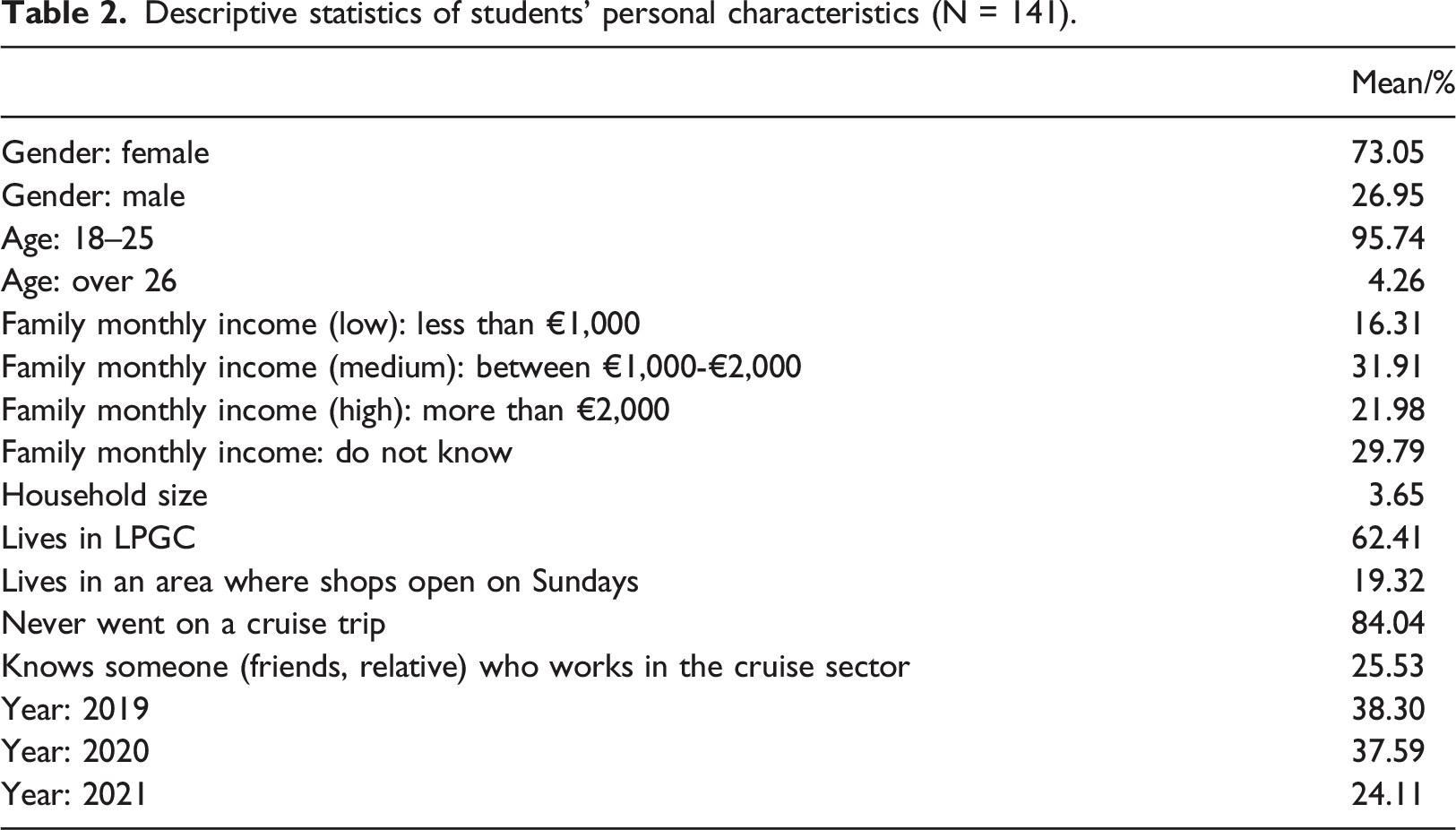
Next, we inspected the correlation between students’ pre-course degree of agreement with the 21 statements and their sociodemographic characteristics by running cross-sectional OLS regressions for the pre-course survey responses. To save space, the estimates are presented in Table A4 in the Appendix. In general terms, there is no clear connection between beliefs and the observed personal characteristics. We only detect significant correlations in the following cases: (i) family income and disagreement with statements about the creation of jobs (S3), that cruises cause price increases (S2), and the generation of negative externalities in the form of dirt (S8), air pollution (S9), water contamination (S10), noise (S11), and overcrowding (S16 and S17); (ii) household size and agreement with water and air pollution (S9 and S10); (iii) being a female and agreement with greater generation of dirt (S8 and S10), the need for setting limits on the arrival of cruise ships (S18), and the establishment of a tourist tax (S20); and (iv) living in LPGC and agreement with the positive effects for the economy (S1) and the generation of jobs (S3) but disagreement with the generation of noise (S11). 6 Interestingly, previous experience as a cruise passenger and knowing someone in the industry are not found to be associated with agreement/disagreement with any statement at a 95% confidence level. Nonetheless, we detect significant differences in pre-course views about the impacts of cruise tourism by academic course. For instance, students are more likely to agree with statements 3, 6, 7, 12, and 15 about some positive effects of cruise tourism but less with statement 18 on the need to limit the arrival of cruise ships after the pandemic outbreak (2020 and 2021 cohorts).
Identification strategy
Some works have warned that individuals have different internal interpretations of Likert-type ordered scales (scale perception bias) when making subjective evaluations (e.g. Araña and León, 2013; Bond and Lang, 2019). To properly identify the belief change in support for cruise tourism caused by formal training, it is therefore necessary to control for individual-specific differences in scale interpretation. Since we have pre- and post-treatment responses to the survey statements, we use a panel fixed-effects regression specification as follows
where
However, there might be relevant heterogeneity in the belief update associated with the formal instruction by academic course. The pandemic caused an important drop in the inflow of tourists and cruise passengers to Gran Canaria Island during 2020 and 2021, which likely affected perceptions about its economic, social, and environmental impacts. To examine this, we expand the model in (1) with interaction terms between the Post indicator and the dummy indicators for academic year as follows
where
We acknowledge that one threat for identification is that a common shock independent of formal training could alter students’ attitudes towards cruise tourism in the after survey. However, the short time span between the before and after surveys (around 1 month) minimises this potential source of bias. This concern would be eliminated if we had a control group of students who did not receive formal instruction (i.e. difference-in-differences research design). However, this was not possible due to (i) the impossibility of offering different instruction to students due to ethical concerns and (ii) the likely occurrence of contagion and spillover effects in case we did so because students of the same cohort easily meet and communicate.
The model specifications in (1) and (2) are estimated by OLS using the within-transformation. Treating answers to the Likert scale as cardinal follows the practice of Busom et al. (2017) and Brandts et al. (2022). Nonetheless, ordered probit regression is used as a robustness check.
Results
Main results
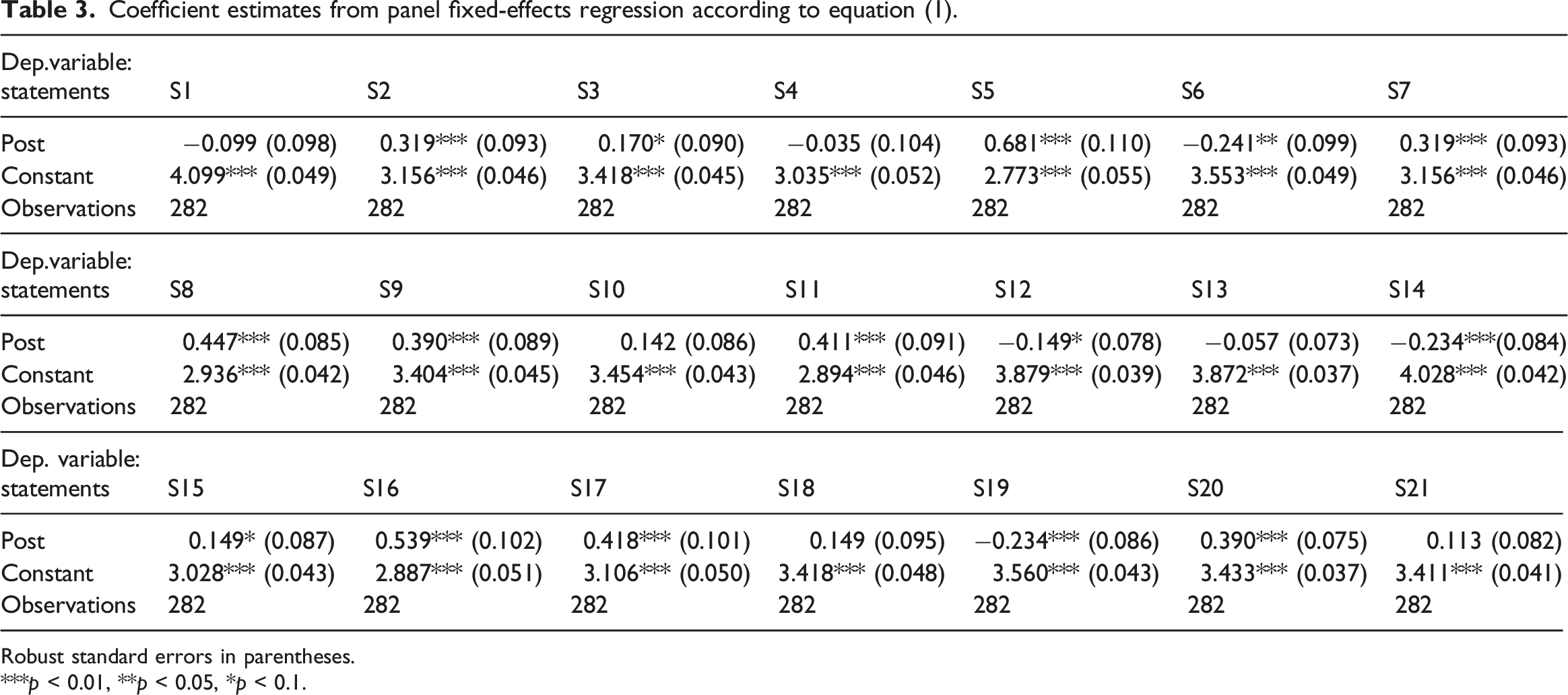
Coefficient estimates from panel fixed-effects regression according to equation (1).
Robust standard errors in parentheses.
***p < 0.01, **p < 0.05, *p < 0.1.
The results presented in Table 3 point to similar conclusions to those of the descriptive analysis in Table 1. Formal educational training induces significant positive shifts in agreement with statements about the negative impacts of cruise tourism. Students agree more with the statements that cruise tourism causes a general price increase (S2), the opening of shops on Sundays is detrimental for other shops (S5), LPGC is dirtier and there is more pollution when cruises arrive (S8 and S9), cruise ships generate a lot of noise (S11), and it is uncomfortable to go to certain places and enjoy certain services due to overcrowding (S16 and S17). Students also agree significantly more with urban infrastructures being better thanks to cruise tourism (S7) and that a tourist tax for each cruise passenger should be collected (S20). They exhibit less support, though, for the statement that governments should economically incentivise the arrival of cruise ships (S19), it is positive that shops open on holidays (S14), and seeing cruise ships docked in the port produces a positive feeling in them (S6).
Coefficient estimates from panel fixed-effects regression expanded with interaction terms according to equation (2).

Robust standard errors in parentheses.
***p < 0.01, **p < 0.05, *p < 0.1.
Robustness checks
We performed some robustness checks. First, because of the ordered nature of the dependent variables, the model specifications in (1) and (2) were estimated using a fixed-effects ordered logit regression. 9 The coefficient estimates and average marginal effects (AMEs) are presented in Tables A5 and A6 in the Appendix. Tests for the parallel regression assumption (Williams, 2006) are shown in Table A7 in the Appendix. The results are robust and keep their sign and statistical significance. Nevertheless, we prefer to use linear regressions in the main analysis since the ordered logit is likely to suffer from incidental parameter bias in short panels (Greene, 2004). One interesting insight from the ordered logit regression is the possibility of examining the differences in the AMEs of Post on each of the five possible values of the dependent variables. As such, this could inform about whether a given potential positive shift takes place, for instance, from 1 to 2 or from 4 to 5. We see that the effects of formal instruction about the cruise sector are highly asymmetric depending on the statement considered. In some cases, training could induce a large belief change: students shift from disagree and strongly disagree to agree and strongly agree (S5, S9, S16, S17). In others, students mainly move away from extreme disagreement (S6, S7, S11, S18, S20, S21) to any of the remaining options, including the mild one of ‘do not know’.
Second, we regressed a first-difference version of the model in (1) expanded with the set of personal characteristics presented in Table 2. 10 Overall, aside from the differences by academic course documented before, most variables are not significant for explaining the change in support for each statement (see Appendix, Table A8), suggesting that the treatment does not vary with observed students’ characteristics. This lack of significance is not due to collinearity problems based on the variance inflation factor (=1.15). We only find that (i) students who live in LPGC become significantly more likely to agree with the statements that cruise tourism causes a general price increase (S2) and that seeing cruise ships in the port produces a positive feeling in them (S6); (ii) students in middle-income families agree less with the statement that governments should economically incentivise the arrival of cruise ships (S19) but more with the statement that it is sometimes uncomfortable to go to certain places due to the high number of cruise passengers (S16); and (iii) females tend to value less the social and global impacts of tourism after the economic instruction.
Feeling and uncertainty in ordinal responses
Recent developments in the analysis of ordinal rating data from Likert scales have shown that individual judgement is likely to be influenced by feeling and uncertainty (Piccolo and Simone, 2019a, 2019b). That is, responses are affected by attraction, perception, awareness, and full understanding of the item considered (‘feeling’), on one hand, and indecision, limited information, personal engagement with the topic, and fuzziness, on the other (‘uncertainty’). To examine this, we use the combination of uniform and binomial models (CUB) originally developed by Piccolo (2003) for ordinal variables following practical guidelines by Cerulli et al. (2022). Figure 2 presents a scatterplot of the maximum likelihood estimates (logit-transformed) of the feeling and uncertainty parameters after a CUB (0,0) model. The point estimates are shown in Table A9 in the Appendix. The reader is referred to Cerulli et al. (2022) for technical details. Some statements are missing due to convergence problems. We see that the highest ‘feeling’ is expressed for statement 1 on the economic contribution of cruise tourism, whereas the lowest corresponds to agreement with statements 5, 11, and 15. For the case of ‘uncertainty’, statement 16 on crowding effects due to cruise tourism exhibits the largest value, whereas statement 11 on noise externalities exhibits the lowest. Scatter plot of CUB (0,0) feeling and uncertainty parameters.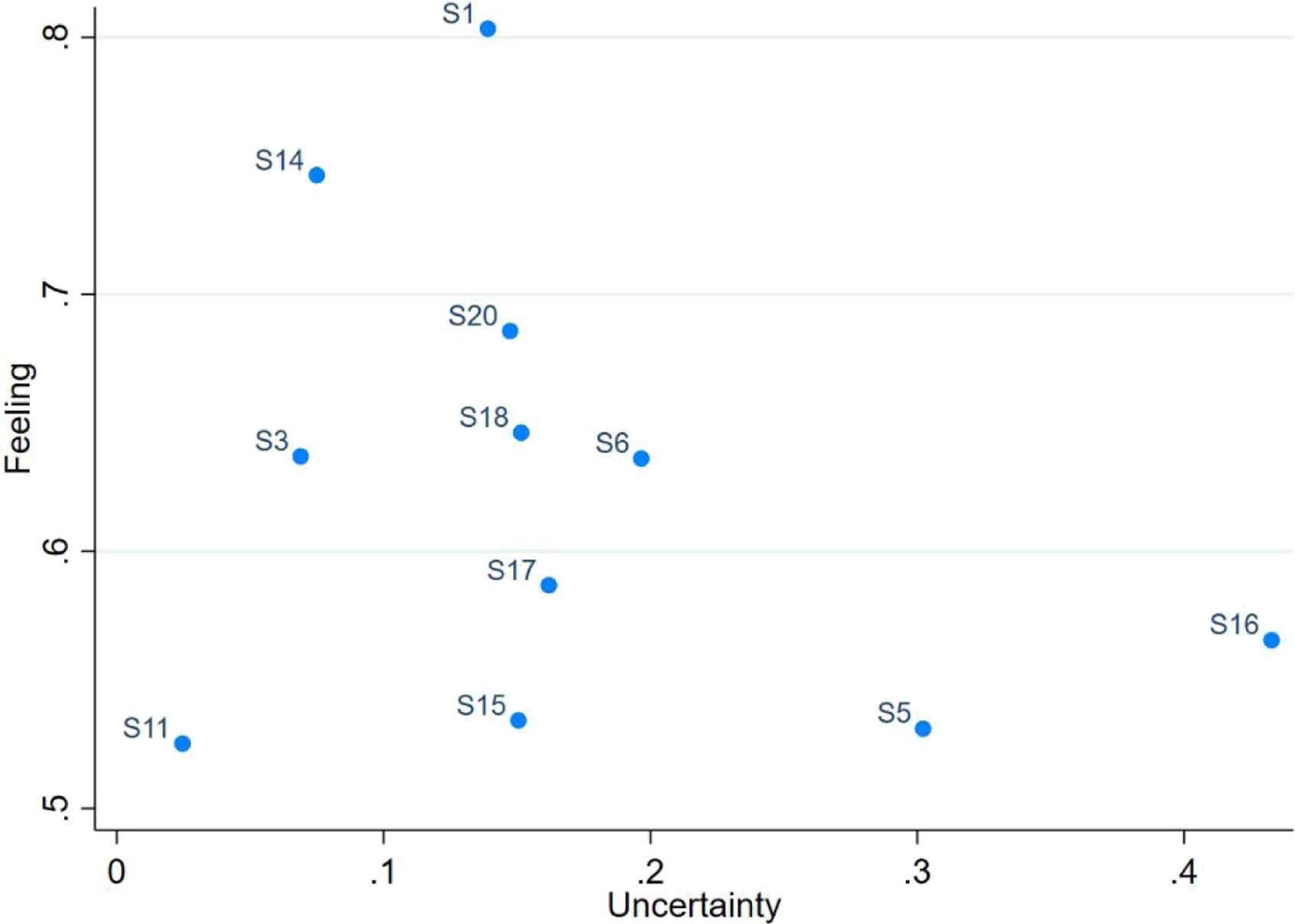
To delve further into this, we included the indicators for academic course as explanatory variables of the ‘feeling’ and ‘uncertainty’ about each statement. The rationale is that, as discussed before, the pandemic context might have affected both perceptions about items and fuzziness. Table A10 in the Appendix reports the estimation results. In general, there is no evidence of shifts in the feeling and uncertainty about each statement across academic-year cohorts. 11 The only exception is the ‘feeling’ component in statements 6, 15, 18, and 20. Specifically, we detect that students exhibit a greater feeling with liking cruise ships docked in the port and cruise tourism contributing to preserve traditions during 2020 and 2021 relative to 2019. On the contrary, the feeling is comparatively lower in 2020 for the need to limit the arrival of cruise ships and the need to collect a tourist tax. 12
Discussion and conclusions
This paper has studied for the first time the effects of educational training on support for tourism activities. While several works have investigated residents’ support for tourism (Adie and Falk, 2021; Biagi et al., 2020; Garau-Vadell et al., 2014; Huh and Vogt, 2008; Martín et al., 2020) and cruise development (Brida et al., 2011, 2014; Del Chiappa and Abbate, 2016; Del Chiappa et al., 2018; Tovar et al., 2020), this work expands the literature by investigating whether formal instruction on the impacts (social, economic, and environmental) of cruise tourism development on local economies influences students’ perceptions and opinions. We have implemented an experiment using college students majoring in tourism enrolled in a compulsory course on the linkages between transportation and tourism during three academic years. This has been done in Gran Canaria, an island for which cruise tourism is a consolidated sector with growing importance.
Based on a within-subject experimental design and panel fixed-effects regressions, we have shown that students become more concerned about the negative impacts of tourism after the course. In particular, students agree more with statements about increased pollution, noise and overcrowding, and price surges associated with cruise tourism. In addition, students become more supportive of the setting of a tourism tax per cruise passenger and that urban infrastructures are better thanks to cruise tourism. Interestingly, they become less prone to the idea that governments should economically incentivise the arrival of more ships.
Our findings have relevant implications for public authorities in communities that are highly dependent on the cruise industry. MacNeill and Wozniak (2018) have shown that the local economic benefits of cruise tourism fail to materialise when cruise tourism is developed without appropriate investments to compensate for the high environmental costs and the involvement of destination communities. Public interventions like investments, the promotion of the industry, restrictions on the number of cruise ships, or the setting of taxes for cruise passengers in some extreme circumstances must be undertaken after appropriate economic analyses of costs and benefits depending on each port’s conditions. The successful implementation of such measures must receive public support (Dal Bó et al., 2018), so citizens’ views about social, economic, and environmental effects of the sector play a major role. Since formal training has been shown to be an effective mechanism to change students’ opinions about cruise tourism based on scientific research and economic theory, the main takeaway from the study is that public knowledge about the effects of cruise tourism could be welfare-enhancing. Voters might not support some policies that are socially efficient because of a lack of specific knowledge, so appropriate communication campaigns about the need for implementing a given policy based on scientific knowledge, economic theory, and factual evidence could be a promising strategy to gain citizens’ support. All in all, public policies aimed at fostering the positive impacts (economic) and reducing the negative ones (social or environmental) are predicted to be easier to implement if voters are well informed regarding those impacts.
Although framed in the context of cruise tourism, we believe that our findings could be extrapolated to other settings and areas where the tourism industry contributes to local economies while producing some negative externalities to residents. In this sense, it would be worthwhile to replicate our analysis with students enrolled in a tourism bachelor’s degree programme in areas that are experiencing congestion or gentrification problems associated with peer-to-peer markets, cultural heritage, or natural amenities. Uncovering the support for policy interventions among students from different backgrounds and residing in different areas would complement our results.
The main weakness of this study is the relatively small sample size. Nonetheless, the dataset covers several years, which let us evaluate the possible impact of the pandemic on the change of students' beliefs after receiving educational training. Another limitation of this study is that only students from ULPGC were considered. Therefore, future studies could expand our study and test whether our results for the cruise sector hold if considering students from universities located in other port cities where the cruise industry’s circumstances are different in terms of economic, social, and environmental impacts (e.g. Barcelona, Venice). Furthermore, the analysis is based on agreement with predetermined statements. A valuable avenue for future work could be to complement our analysis with qualitative data and open responses.
Supplemental Material
Supplemental Material - Meeting externalities: The effects of educational training on support for tourism activities
Supplemental Material for Meeting externalities: The effects of educational training on support for tourism activities by Beatriz Tovar, David Boto-García, and José Francisco Baños Pino in Tourism Economics
Footnotes
Declaration of conflicting interests
The author(s) declared no potential conflicts of interest with respect to the research, authorship, and/or publication of this article.
Funding
The author(s) disclosed receipt of the following financial support for the research, authorship, and/or publication of this article: This work was supported by Spanish Ministry of Science and Innovation [grant PID2020-119639RB-I00].
Supplemental Material
Supplemental material for this article is available online.
Notes
Author biographies
 ) is Full Professor at Las Palmas University, and member of the University Institute for Tourism and Sustainable Economic Development. Her main areas of research are the analysis of efficiency and productivity, and transport, energy and tourism economics. She has published in several international journals and is member of editorial board of Transportation Research PartE.
References
Supplementary Material
Please find the following supplemental material available below.
For Open Access articles published under a Creative Commons License, all supplemental material carries the same license as the article it is associated with.
For non-Open Access articles published, all supplemental material carries a non-exclusive license, and permission requests for re-use of supplemental material or any part of supplemental material shall be sent directly to the copyright owner as specified in the copyright notice associated with the article.
