



Abstract
This study examines the relationship between the production efficiency of a region and tourism flows. We use stochastic frontier production models with spatial effects based on data from 46 regions in southwestern China, most of which are economically underdeveloped. The results show that tourist flows (TFs) into a region are significantly related to the region’s production efficiency. The TFs in the neighboring regions also correlate with the production efficiency of a region. This study validates the tourism-led efficiency enhancement proposition at the regional level and has rich implications for practice.
Keywords
Introduction
Researchers and many other experts consider tourism development an effective way for regions to improve their local economies. Many studies support the tourism-led growth hypothesis, including those by Balaguer and Cantavella-Jorda (2002), Brida and Risso (2009), and Figini and Vici (2010). The tourism-led hypothesis suggests a causal relationship between tourism and the growth of regional economies. According to the literature, the primary mechanisms that explain how tourism helps regional economies include employment creation (Durbarry, 2002), revenue creation (Durbarry, 2004; Sinclair, 1998), and the multiplier effect (Singh, 2008). Marrocu and Paci (2011), however, regard tourist flows (TFs) in a region as an important source of knowledge and information, proposing that local businesses can extract valuable intellectual input from tourists. Consequently, regional corporate innovation may increase and regional production efficiency may improve. Marrocu and Paci’s (2011) proposition is referred to as tourism-led efficiency enhancement (TLE).
This proposition deserves attention from researchers because it has broad implications for practice. Following Marrocu and Paci (2011), no research explores this issue further. To address this deficit, this study investigates the association between tourism and regional production efficiency using economically underdeveloped regions as the analysis objects. The study uses 46 cities (or 46 regions) in southwestern China as research samples, the majority of which are economically poor.
This study contributes to the literature as follows: first, it is the first empirical work utilizing the panel data of underdeveloped regions to demonstrate that tourism plays a significantly positive role in the enhancement of regional production efficiency. For underdeveloped regions, the tourism-led efficiency proposition is particularly relevant because these regions generally lack alternative ways, such as intensive research and development (R&D) activity, training, education, and foreign direct investment (FDI), to lift their production efficiency.
Second, this study demonstrates the spatial effect of tourism reflected in regional production efficiency, which suggests that TFs to neighboring regions result in production-efficiency enhancement for a given region. This type of spatial effect refers to a new rationale for interregional tourism cooperation.
Third, this study has merit in its research methodology. To test the tourism-led efficiency proposition, Marrocu and Paci (2011) use total factor productivity to measure the production efficiency of a region, an approach that relies on an unrealistic assumption that the production of a region is always conducted in the most effective way. In contrast to Marrocu and Paci (2011), this study adopts the stochastic frontier production approach, a method commonly used for measuring production efficiency (Filippini et al., 2008). In the stochastic frontier production approach, the gap between the current level and the frontier level of production serves as an indicator of inefficiency, and regional tourism is included as one variable to determine regional inefficiency scores whereby the impact of tourism is revealed. To the best of our knowledge, this study represents the first application of the stochastic frontier production approach in explaining the link between regional tourism and regional production efficiency.
Literature review
The link between tourism and regional productivity is rooted in trade theory because regional tourism is a type of trade across regions. Traditionally, the trade literature emphasizes that trade may result in many significant outcomes, such as production specialization (Young, 1991) and increased market size (Helpman and Krugman, 1985), which both help to boost regional productivity.
Recently, the trade literature has conducted analyses from the perspective of knowledge transfer, recognized as a critical factor in the endogenous growth of a modern economy (Marrocu and Paci, 2011; Navaretti and Tarr, 2000). In an economic system, trading products and service always entails knowledge transmission. Navaretti and Tarr (2000) emphasize that the productivity of a region is greater when trade provides access to more sophisticated technologies or knowledge. Many empirical studies validate trade as a channel of learning that leads to increased total factor productivity for a region, especially when an underdeveloped region trades with more developed regions with large stocks of knowledge (Kim et al., 2007).
For regional tourism, the following logic supports the tourist-led efficiency proposition.
Knowledge transfer by tourist/local interactions
As a result of regional tourism development, more tourists flow into a region, bringing valuable knowledge and information that may stimulate product innovation and productivity improvement in the region’s firms. The knowledge transfer that occurs in tourist interactions with locals becomes more valuable when a destination is less developed. Compared to local people in a poor region, arriving tourists often possess more advanced knowledge and information. Face-to-face communication with tourists or close observation of tourist behavior can be important ways for local people to understand better what is happening outside their area. As Navaretti and Tarr (2000) point out, there are alternative channels for local people to acquire knowledge and information, including schooling and education, intensive R&D activities, and FDI. But these alternative channels cannot function effectively in poor regions due to the lack of funding for schooling, education, and R&D activities, and the lack of needed conditions to attract FDI. Under these circumstances, the channel value of tourism becomes especially critical, as the following example from China clearly demonstrates.
WeChat Payment is a high-efficiency payment platform for businesses that saves on cash management expenses and enhances the operational efficiency of firms. Initially, WeChat Payment was widely used in restaurants, accommodations, taxis, and other service industries in eastern China, while business operators in western China (where underdeveloped regions predominate) had no knowledge of the system. When tourists traveled from eastern to western China, they frequently asked to settle bills via WeChat. Managers in western China thus gained awareness of WeChat Payment’s usefulness and gradually adopted it. As a result of adopting WeChat, the operational efficiency of service industries in western China has improved (Wu and Lee, 2017).
The externalities of tourism
The impact of tourism may extend across the actual boundaries of the tourism industry in a region. This cross-boundary effect constitutes the externalities of tourism.
For regional productivity, the first type of externality may be local firms’ access to the knowledge imported into a region by tourists. Much management literature highlights the role of contiguity between firms and customers for innovation. Von Hippel (1978) proposes a customer-active paradigm where firms collect ideas from customers to generate new industrial products. Foxall and Johnston (1987) also emphasize the importance of customer knowledge on product innovation. Similarly, Joshi and Sharma (2004) propose that access to customer knowledge, including customer preferences, promotes the success of new products. Marrocu and Paci (2011) state that tourists who visit a destination are generally customers or potential customers of local firms. These firms are able to increase their contacts with these customers at no additional cost while often improving production efficiency (Baek and Lee, 2018).
The second type of externality, which is related to regional production efficiency, may lie in the immigration and investment regional tourism stimulates. Feng and Page (2000) analyze the probability that tourists will make a decision to immigrate into a visited destination. Herein, we take Lijiang city, Yunnan province (one research sample in this study) as a case example. A few decades ago, Lijiang city initiated the development of tourism industry. As the tourism industry boomed, many visitors from developed regions in China (including Zhejiang and Guangdong provinces) chose to immigrate to Lijiang city to run various types of businesses and live as Lijiang residents. The valuable knowledge and ideas these new immigrants brought to the city served as resources that Lijiang city was able to exploit to innovate and improve production efficiency. Additionally, tourists may be potential investors for a destination (Fereidouni and Al-mulali, 2014) and their investments may have a positive impact on regional production efficiency.
The third type of externality relates to the infrastructure (especially for transportation) and capital (including human capital) a region acquires from tourism industry development. The tourism industry of a region may share the infrastructure built in connection with its development with other industries within the same region. What benefits tourists can concurrently benefit local firms at no additional cost. For example, as one critical piece of infrastructure, transport capacity may initially be constructed to ensure mobility for tourists, but the same capacity can later be leveraged by other regional industries, as when the local manufacturing sector takes advantage of improved roads to reach new markets. Many empirical studies demonstrate how transportation infrastructure significantly improves regional production efficiency (Aschauer, 1989; Bonaglia et al., 2000). Tourism development also supports the accumulation of human capital. By servicing the tourism industry, local people may improve their experience and competency in service, communication, team-collaboration skills, and commercial awareness, all of which can be transferred to other industries or sectors, contributing to productivity improvement outside the tourism sector (Kireyeva et al., 2018).
Given that knowledge or information is easily transportable, the positive effect of tourism on regional productivity is not limited to a certain geography range. A given region also benefits from tourism development in its neighboring regions in terms of productivity, establishing the spatial effect of tourism on regional productivity.
Although the literature supports the tourism-led efficiency proposition, it still seems reasonable to put forward an opposing proposition that regional tourism cannot contribute to regional production efficiency. The reasoning is: unlike the high-tech industry, the tourism industry is typically of low productivity and generally does not require a labor force with a high-level skill or advanced knowledge. When the economy of a region relies on the tourism industry, it is possible that its productivity may be locked at a low level (Lee and Syah, 2018).
Given this opposing proposition, we need to conduct empirical studies to test the relationship between tourism and regional productivity. Marrocu and Paci (2011) use data from 15 European Union countries to validate a positive relationship between tourism and regional productivity, but their research is incomplete since they did not take into account the spatial effect of tourism. Their conclusions are based solely on examining developed regions, whereas the tourism-led efficiency proposition is most appropriate for underdeveloped regions.
Research methods
Study area
Economic development at the regional level in China is largely unbalanced. Unlike eastern China (the most developed area in China) or China as a whole, southwestern China suffers from widespread poverty and has exhibited a low level of economic growth over a long term. Due to its harsh geographical environment and remoteness, southwestern China is isolated from the outside world for long stretches of time. Residents in this region have difficulty accessing knowledge or information from the outer world, which explains in large part why this area is economically backward. Figure 1 illustrates a huge gap between southwestern China and eastern China and China as a whole in terms of annual gross domestic product (GDP) over the research period.
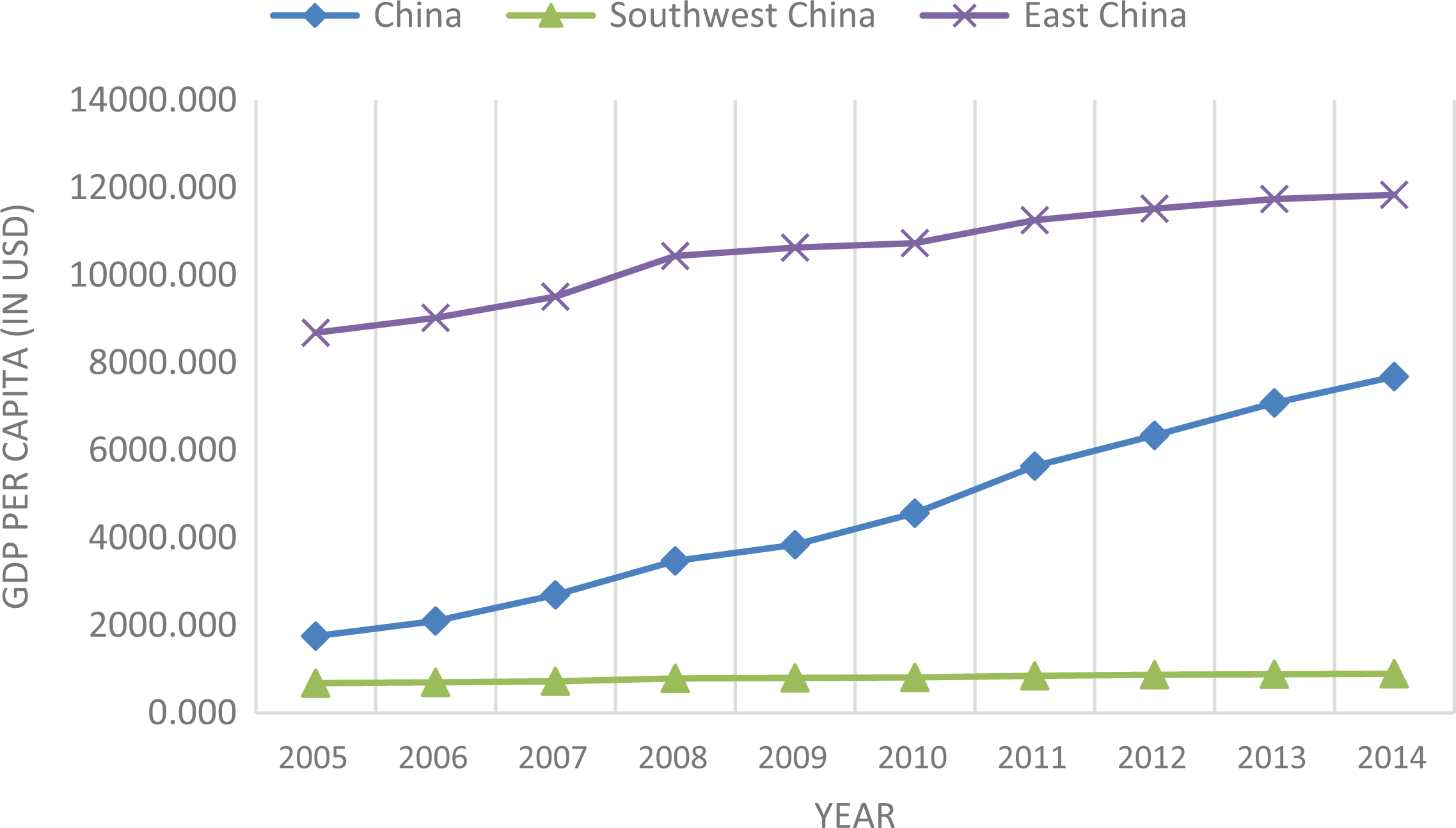
Comparison of regional economy development. East China, including Zhejiang province, Jiangsu province, Anhui province, and Shanghai city, represents the most economically developed region in China. The curve of GDP per capita of China indicates the average level of economic development in China over the research time period of this study. GDP: gross domestic product.
However, southwestern China boasts rich natural resources and a diverse cultural heritage, both of which may be exploited to attract tourists. Due to its remoteness, the natural environment of southwestern China has been well preserved and remains in its primitive condition. Its cultural heritage is rooted in the rich and unique culture of its local minority nationalities. There are nearly 30 minority nationalities living in different regions in southwestern China, including the Tibetan, Mongol, Li, Tujia, Jingpo, and Naxi peoples. Relying on such unique resource advantages, local governments throughout southwestern China frequently put tourism development among the top priorities for boosting regional economic activity. As a result, many regions in southwestern China have experienced a rapid expansion of their tourism industries, including Lijiang city in Yunnan province and Leshan city in Sichuan province.
We chose cities in southwestern China affiliated with Yunnan, Sichuan, and Guizhou provinces as our research samples. Chongqing municipality was historically a part of Sichuan province but has been administrated directly by the central government of China since 1997. We do not include cities in Chongqing municipality because they are highly industrialized. Chengdu, Kunming, and Guiyang (the capitals of Sichuan, Yunnan, and Guizhou, respectively) have highly developed economies. We include these capitals to ensure the geographical completeness of the research area, allowing us to estimate the spatial effects of tourism. In total, we have 46 cities as research samples, the locations of which are indicated in Figure 2.

Study area and sample cities. We have 21 sample cities in Sichuan province, 16 sample cities in Yunan province, and 9 sample cities in Guizhou province. In total, we have 46 sample cities.
Table 1 reports the dynamic development of tourism for all sample cities, indicating a trend of continually rising tourist arrivals and tourism revenue (TR). Total tourist arrivals in all our sample cities in 2014 exceeded 1.3 billion persons, about eight times the total population in these regions. In 2014, in the research area, the contribution of TR to annual GDP was up to 19%, demonstrating that tourism plays a critical role for regional development in Southwest China.
Dynamics of tourist arrivals and TR in the research area.
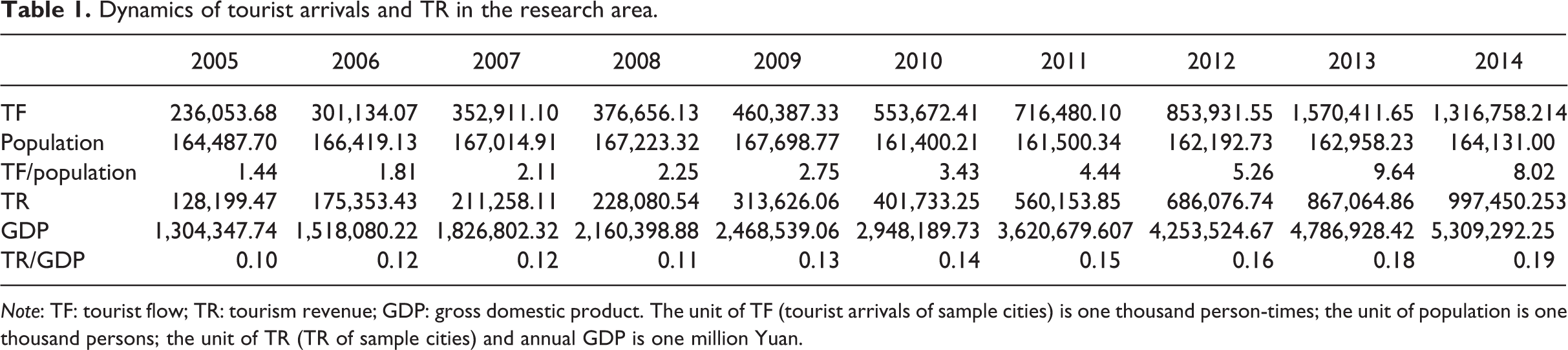
Note: TF: tourist flow; TR: tourism revenue; GDP: gross domestic product. The unit of TF (tourist arrivals of sample cities) is one thousand person-times; the unit of population is one thousand persons; the unit of TR (TR of sample cities) and annual GDP is one million Yuan.
Econometric models
The stochastic frontier approach is one of the primary methods used for measuring efficiency, including production efficiency and cost efficiency at the firm or regional levels. The stochastic frontier approach holds an advantage over the data enveloping analysis approach (another method for assessing efficiency) since it isolates the influence of factors other than inefficient behaviors, correcting the possible upward bias of inefficiency from the deterministic model (Chen, 2007).
According to the stochastic frontier approach, the production efficiency of a firm (or region) reflects how well a firm (or region) processes inputs to achieve its outputs, compared to the level of maximum potential indicated by the frontier of production possibility (Bernini and Guizzardi, 2010; Wu, 2000). Aigner et al. (1977) initially proposed the stochastic frontier approach, and there are some studies in the tourism literature that use this approach to investigate efficiency issues in the tourism industry (Arbelo et al., 2017; Assaf et al., 2016; Bernini and Guizzardi, 2010; Chen, 2007; Oliveira et al., 2014).
In line with Wang and Schmidt (2002) and Bernini and Guizzardi (2010), we define a stochastic frontier production function as follows

In equation (1),

Compared with a traditional Cobb–Douglas production function, a trans-log production function has many distinct advantages. In a trans-log production function, there is no a priori restriction regarding the internal scale return of capital and labor, and hence the marginal contributions of inputs are flexible. The other flexibility inherent in a trans-log production function lies in that the marginal contribution of one input partly depends on the level of another input.
Accordingly, the following definitions are adopted



Equation (5) is an inefficiency function (Deprins and Simar, 1989), where
The basic inefficiency function is defined as follows

In equation (6), TF (
The extended inefficiency function, which takes into account the spatial effect of tourism, is defined as follows

In equation (7), the spatially lagged dependent variable,
In equations (6) and (7), the
As a next step, we extend the specification of the production function and inefficiency equation by the time trend or time effects, as proposed by Bernini and Guizzardi (2010). The production function is augmented as follows

Meanwhile, we add nine year-dummies as D2005–D2013 into the inefficiency function to capture the time trend. The duration of sampled data is from 2005 through 2014, and 2014 is set as a benchmark time in the inefficiency function.
The variance of the composite disturbance term is
Two different approaches apply to estimating models: the two-stage approach and the one-stage approach. In the former, we first estimate the inefficiency score of each unit, utilizing a stochastic frontier production function, and then establish a separate econometric model to estimate which factors determine the inefficiency score. In the second approach, the factors determining regional inefficiency are still included into an inefficiency function as in the two-stage approach. However, the inefficiency function is incorporated directly into the process of MLE and estimated simultaneously. Simar et al. (1994) propose the one-stage approach, which Battese and Coelli (1995) extended to the case of panel data. Wang and Schmidt (2002) demonstrate that the one-stage approach improves the estimate of the frontier parameters, and is superior to the two-stage approach. Therefore, this study uses the one-stage approach to estimate the model.
Data source and descriptive statistics
Table 2 shows detailed definitions of variables and database sources. Limited by data availability, the research period is restricted to 2005–2014. In several of those years, the data for patent application numbers for a few cities in Guizhou province were missing and we assume a stable growth rate for patent applications in these cities. We estimate the growth rate based on historical data, and then use the growth rate to make up the missing data. As a result, we obtain a panel data set with a total of 460 observations.
Definition of variables and data sources.
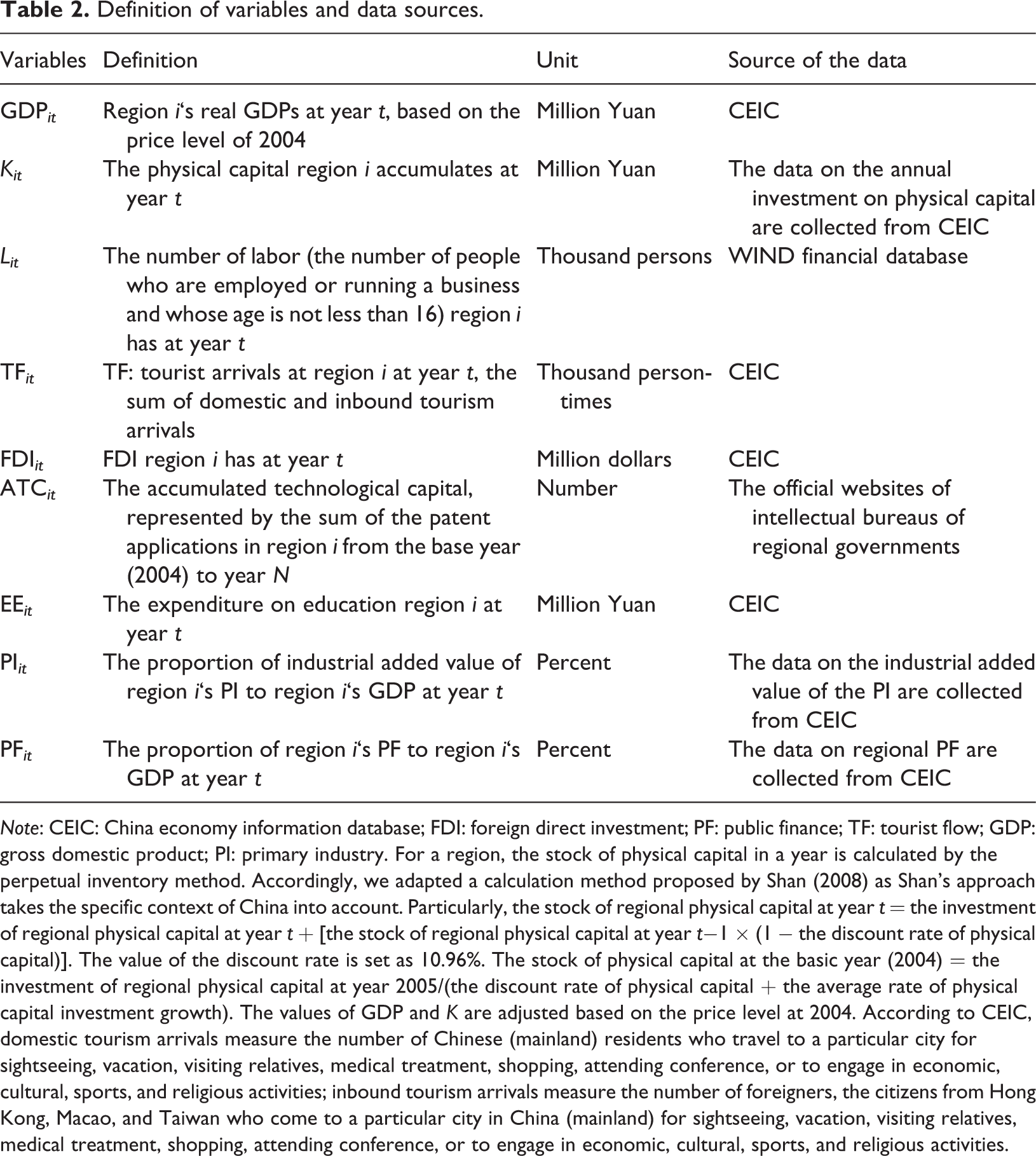
Note: CEIC: China economy information database; FDI: foreign direct investment; PF: public finance; TF: tourist flow; GDP: gross domestic product; PI: primary industry. For a region, the stock of physical capital in a year is calculated by the perpetual inventory method. Accordingly, we adapted a calculation method proposed by Shan (2008) as Shan’s approach takes the specific context of China into account. Particularly, the stock of regional physical capital at year t = the investment of regional physical capital at year t + [the stock of regional physical capital at year t−1
Table 3 summarizes descriptive statistics. The big standard deviations of GDP, K and L, indicate a hugely unbalanced distribution of GDP, physical capital, and labor among the sample regions. The low levels of economic development in the sample regions are reflected by the low mean value and minimum of GDP, as well as by the high values of PI, which suggest that the regional economies of the sample regions depend heavily on their PIs. The maximum PF (1.54) comes from Aba, a Tibetan autonomous prefecture in Sichuan province, from the year 2010. Please note that in China’s administration system, an autonomous prefecture is an administrative region whose level is the same as that of a city. In some years, the PF values of Ganzi, another Tibetan autonomous prefecture in Sichuan province, were also higher than 1, which shows that in some years, regional GDP was too small to fund the operation of that region, or suggests that, without financial assistance from the central government or from other financial organizations, the local government could not function normally.
Summary of descriptive statistics.
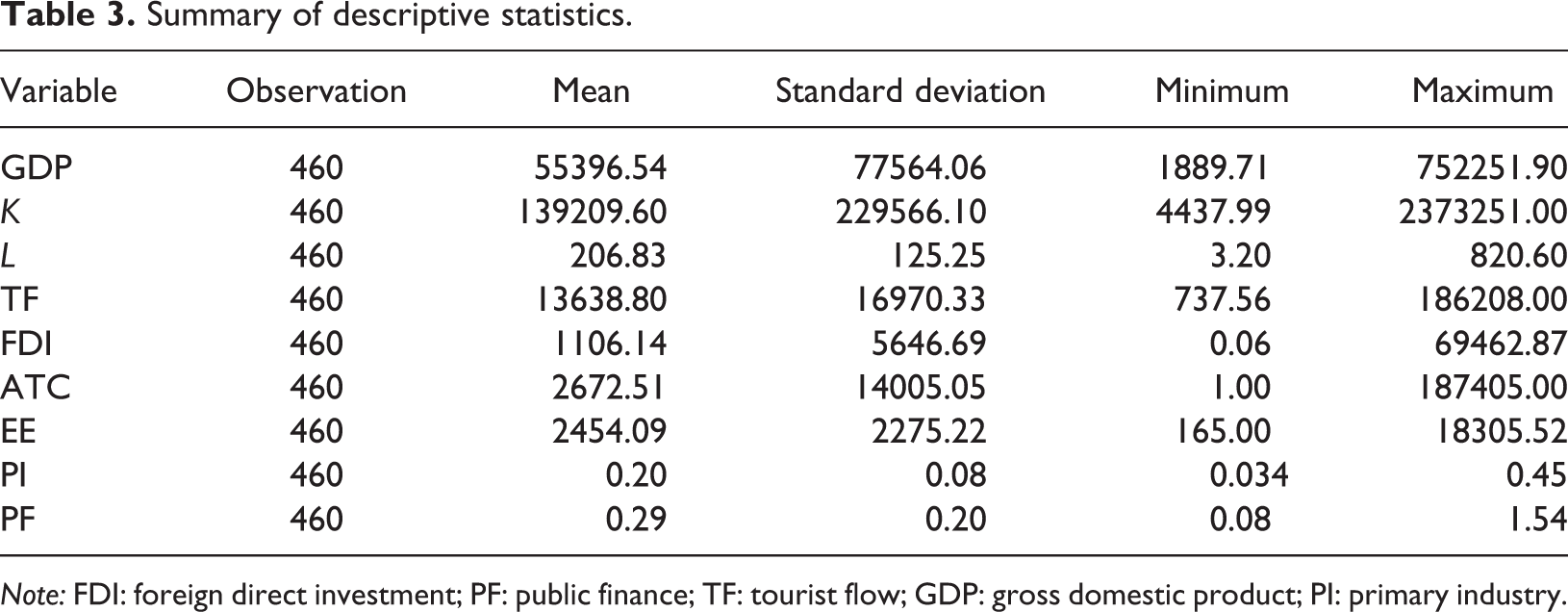
Note: FDI: foreign direct investment; PF: public finance; TF: tourist flow; GDP: gross domestic product; PI: primary industry.
Results
The econometric models in this study are estimated using the FRONTIER 4.1 program. FRONTIER 4.1, developed by Coelli (1996), specializes in estimating stochastic frontier models and has been used extensively to deal with panel data in the literature, as Barros and Matias (2006), Hu et al. (2010), Bernini and Guizzardi (2010), and Kim (2011) demonstrate. FRONTIER 4.1 takes the MLE to obtain its results.
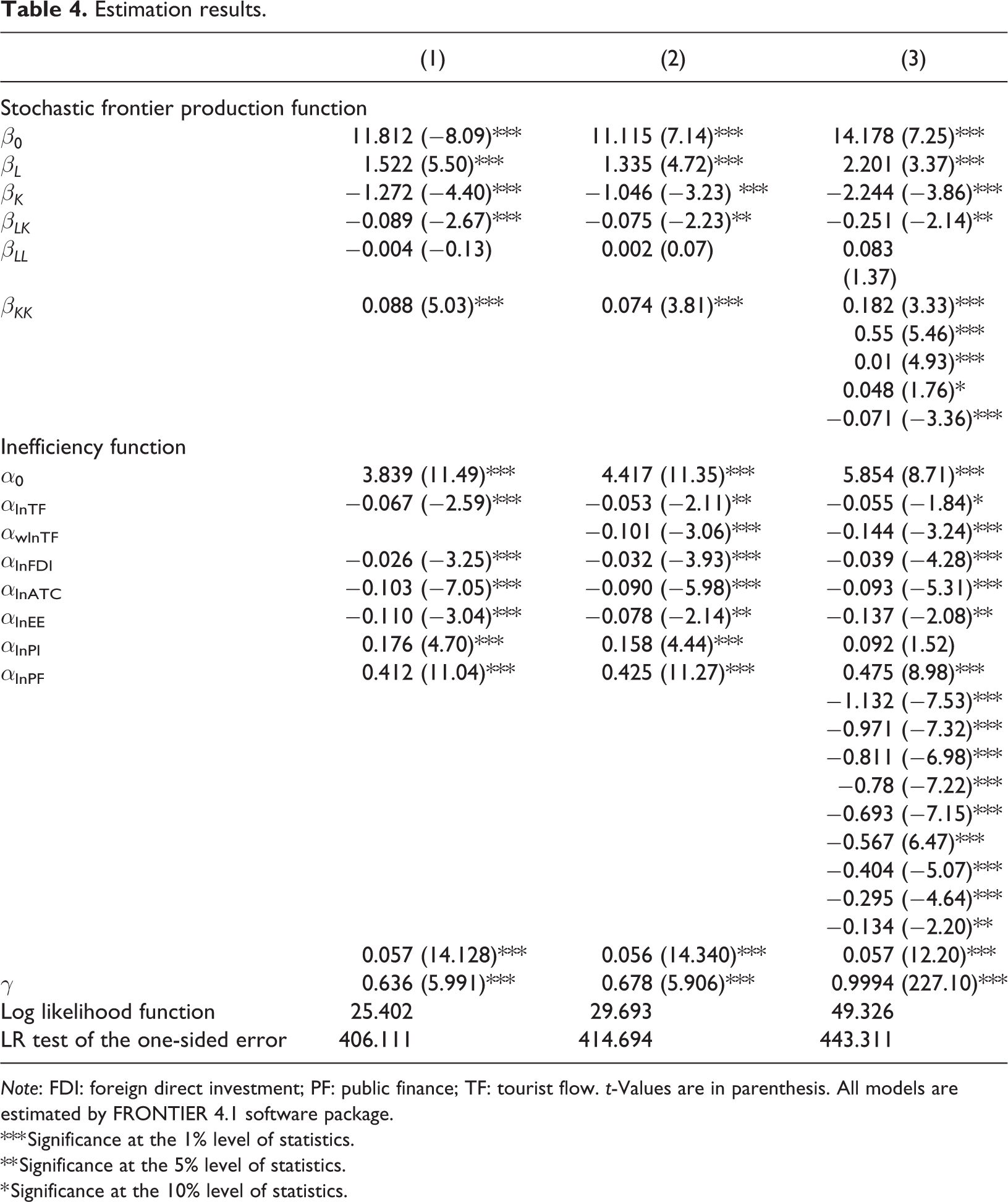
In Table 4, model (1) works as a benchmark for our analysis. For the production function, model (1) concludes with flexible output elasticity for the labor force and regional capital stock.
Estimation results.
Note: FDI: foreign direct investment; PF: public finance; TF: tourist flow. t-Values are in parenthesis. All models are estimated by FRONTIER 4.1 software package.
*** Significance at the 1% level of statistics.
** Significance at the 5% level of statistics.
* Significance at the 10% level of statistics.
According to the inefficiency function in model (1),
The statistical significance of
Model (2) includes the variable
As an extension, we redesign the function specifications as model (3) to include time impacts or time trends. In model (3), the statistically significant coefficients of
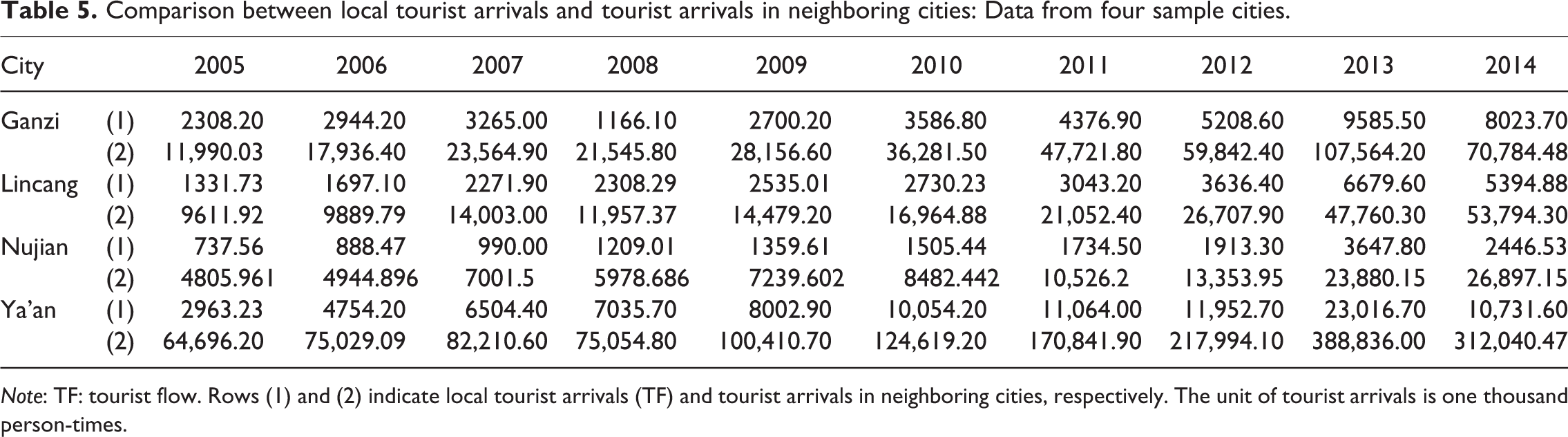
According to models (2) and (3), the absolute value of
Comparison between local tourist arrivals and tourist arrivals in neighboring cities: Data from four sample cities.
Note: TF: tourist flow. Rows (1) and (2) indicate local tourist arrivals (TF) and tourist arrivals in neighboring cities, respectively. The unit of tourist arrivals is one thousand person-times.
We calculate the efficiency scores of sample cities based on model (3), which controls well for both spatial effect and time trend. Table 6 reports the efficiency scores of sample cities in some years during the research period. It is clear that obvious heterogeneity in terms of efficiency scores among sample cities exists. On average, Kunming, Yuxi, South GZ, Chengdu, and Deyang reflect high levels of production efficiencies, whereas Nujiang, Tongren, and Ganzi show the lowest levels of production efficiencies. Table 6 indicates a decline trend for efficiency scores of many sample cities, which is in line with Wang and Tao (2010). The reason may lie in that during the research time period, many people with high-level skills or advanced knowledge in southeastern China chose to immigrate into the developed regions in China such as Zhejiang and Guangdong provinces, so that the average quality of human capital in southeastern China declines, and in turn the efficiency scores for the sample cities fall.
The efficiency scores of sample cities—based on the results of model (3).

Note: Due to the space limitation, the data of year 2007–2008 and 2011–2012 are dropped.
Conclusion and implications
To test the TLE proposition, this study employs panel data for 46 cities in southwestern China and then applies stochastic frontier production models with trans-log production specification to determine the relationship between tourism and regional production efficiency. This study concludes with the following empirical results: For the sample cities in southwestern China, regional tourism, represented by the number of tourist arrivals, plays a positive role in lifting regional production efficiency. To ensure accurate estimations, we control for other determinants of regional production efficiency such as FDI, the accumulated technique capital, education investment, regional industrial structure, and the behavior paradigm of government. The impacts of other determinants are as expected. There is a significant spatial effect of tourism on regional efficiency, which indicates that TFs in neighboring regions contribute to improvements in the production efficiency of a given region.
As for practical implications, this study suggests that regional organizations and governments in underdeveloped regions need to view regional tourism as an important chance to develop their economies. Underdeveloped regions should consider the enhancing production efficiency as a strategic value of tourism development since they usually lack alternative sources for adding new information or knowledge.
To take full advantage of regional tourism’s positive effects, local people and firms need to communicate and interact frequently and effectively with tourists visiting their regions, and regional leaders or business operators should proactively request tourists to provide feedback on services and products, and encourage tourists to invest in or migrate to the destination.
This study is also a call for interregional tourism cooperation, taking into account the positive spatial effect of tourism on regional production efficiency. In most cases, regions face limitations when building supply chains to ensure rich travel experiences. Tourism product cooperation among neighboring regions may guarantee a better experience for tourists and stimulate larger scale tourism. Consequently, tourism’s positive impacts on production efficiency may become more significant.
This study has certain limitations. Some variables affecting regional production efficiency are not included due to a lack of available data. These untested variables may result in endogenous issues in our empirical models. If data are available, it would be worthwhile to investigate whether the magnitude of tourism’s impact on regional productivity varies depending on the type of tourists. When data do become available, exploring tourism impacts on firms’ production efficiency can move forward. Such investigations at the firm level may make TLE proposition even more credible. Finally, although this study adopts the random effect technique to obtain results, future studies may consider the fixed effects variant and compare results.
Footnotes
Declaration of conflicting interests
The author(s) declared no potential conflicts of interest with respect to the research, authorship, and/or publication of this article.
Funding
The author(s) disclosed receipt of the following financial support for the research, authorship, and/or publication of this article: This work was supported by the Natural Science Foundation of China (NSFC) under project numbers 71773101 and 71172048.