




Abstract
In this article, an assessment of efficiency and productivity of Chinese hotels at the provincial level in relation to their star rating is proposed. This heterogeneity is considered by using a hierarchical structure. The drivers of productivity and its components are studied through various and innovative environmental and contextual factors. This study shows that Chinese star-rated hotels experienced a slight productivity deterioration in the last decade. Furthermore, several contextual and environmental factors explain significant differences in productivity rankings of the Chinese provinces. These findings reveal important patterns that are useful for both hotel managers and policymakers.
Introduction
Since the reform and opening up, China’s hospitality industry has experienced a rapid expansion of scale. However, as market competition has intensified, the risk of simply relying on expanding investment scale to obtain new benefits is increasing. According to Ministry of Culture and Tourism of China (2017), the total fixed asset in hospitality industry in China constantly rose in the past decade (from US$64.9 billion in 2009 to US$76.44 billion in 2017), while the total profits have fluctuated a lot. The whole industry even operates under deficit for certain years (2009, 2013, 2014, and 2015). Comparing to its volatile earnings with growing investments, it is obvious that hotels in China do not perform satisfyingly during those periods. Meanwhile, a particularity of the Chinese hotel sector is the dominance of the star-rated hotels. The performance of star rating hotels can accurately reflect the development of hotel sectors as well as the tourism industry (Walheer and Zhang, 2018). At the same time, several problems for star-rated hotels, such as insufficient new products, excess capacity, mismatched supply and demand, interference with institutional mechanisms, knowledge management-related issues, vicious price competition, slow technical progress, weak technical spillovers, and high investments with relatively low occupancy rate have been pointed out by previous studies (Mao and Yang, 2016; Pan, 2017; Walheer and Zhang, 2018; Wong et al., 2016; Yang and Cai, 2016; Yang et al., 2017). As such, techniques for performance measurement of tourism, specifically the hospitality sector, received much attention from the literature at the international level (Assaf et al., 2012; Ohe and Peypoch, 2016; Zhang et al., 2016). However, applications to the Chinese sector are restricted to few (Huang et al., 2012) and the recent contributions only differ mainly in sample choices, methodology, and their attempts to explain hotel efficiency by means of different specific determinants (Chaabouni, 2019; Liu and Tsai, 2018; Walheer and Zhang, 2018; Yang et al., 2017). Furthermore, “hotel development is heavily dependent on local factors” (Yang et al., 2017: 12). Then, it is recommended to analyze the hotel performance by including these local factors that may have influence on hotel productivity.
In this article, our research focuses on two dimensions of the performance of star-rated hotels in China: make a hierarchical analysis by considering hotels’ heterogeneity to identify technological advancement in this sector and study the drivers of the productivity improvement through various and innovative environmental and contextual factors. 1 Indeed, the number of stars is directly connected to the hotel investor profile, ownership status, and the technologies they dispose (Mao and Yang, 2016; Pranic et al., 2012; Zhu, 2014), which leads them to make distinct production choices for even the same output. As a result, their performance should be measured with different technological frontiers. In this article, the heterogeneity of star-rated hotels in Chinese provinces is incorporated in the analysis via the hierarchical category structure proposed by Tone (1997) in the data envelopment analysis (DEA) framework. This contribution differs from the study by Yang et al. (2017) where star-rated hotels were treated separately and where all external factors were included in the production technology. By using a hierarchical structure, this article adopts an alternative way in order to account for heterogeneity.
In studies devoted to tourism efficiency and productivity analysis, the environmental variables are ignored (Assaf and Josiassen, 2012). For instance, the determinants of hotel performance, such as destination characteristics, should also be included in the research (Assaf et al., 2017). In this article, we aim to extend this stream of research by examining the impact of several environmental variables on regional hotel productivity. In our knowledge, most of these variables are used for the first time in the tourism context.
The rest of this article unfolds as follows. The second section is devoted to the literature review about tourism efficiency and productivity in China. In the third section, the methodology in two stages is presented. The findings of this study are presented in the fourth section. The fifth section proposes a discussion of the policy implications of these findings. Finally, the last section concludes the article.
Research gaps in tourism efficiency and productivity literature in China
Scholars around the world have done investigations in hotel benchmarking to evaluate the overall hotel market performance at a micro and/or a macro level. Seminal works started in the nineties with studies devoted to the United States by Morey and Dittman (1995) and Anderson et al. (1999). During the two last decades, many contributions can be found in the literature and different literature reviews are available on hospitality performance. In this article, we refer the reader to Assaf et al. (2012) and Assaf and Josiassen (2016) for complete literature reviews of contributions applied to different regions around the world and we focus with a specific look on papers applied to mainland China.
Chaabouni (2019) analyzed 31 Chinese provinces from 2008 to 2013 by using a two-stage DEA method (DEA at each time period and bootstrap for contextual variables). This study reveals that eastern provinces are relatively more efficient and that trade, climate, and competition contribute positively to efficiency. Walheer and Zhang (2018) applied profit Luenberger and Malmquist-Luenberger indexes from 2005 to 2015 on 30 Chinese provinces. The main findings are star-rated hotels present better performances over time in China, but not for every activity they offered. Liu and Tsai (2018) studied the total factor productivity growth (TFP) of Chinese provinces with the Hicks-Moorsteen index approach. They found that TFP is mainly due to growth in operational efficiency. Yang et al. (2017) focused on Chinese provinces for the year 2012 to study the star-rated hotel performance with a superefficiency version of the slacks-based measure (SBM) model. They find mixed findings depending on the regions and hotel segments. Zhou et al. (2008) analyzed 31 Chinese provinces for the year 2005 and find that western regions are relatively more efficient. Tsai (2009) evaluated the cross-efficiency of the 31 Chinese provinces from 2002 to 2006 and showed the interest of DEA based on multi-output production technologies compared to single productivity indicators. Huang et al. (2012) used a window DEA model to the 31 Chinese provinces from 2001 to 2006 with a dynamic Tobit regression in second-stage analysis. They obtained a high average efficiency with a significant impact of several macro socioeconomic factors on efficiency. Luo et al. (2014) analyzed hospitality in major Chinese cities from 2001 to 2011. By using a Malmquist productivity index (MPI) and regression analysis in second stage, they find that productivity changes are mainly due to efficiency variations and that governance is a driver of efficiency change (EFFCH).
A detailed look on both tourism efficiency and productivity literature and specific contributions to China shows that several aspects seem to have been neglected by most of the research.
First, it has been stated in the literature (Assaf et al., 2012) that there are limited studies focusing on dynamic analysis of hotel benchmarking. Intertemporal and dynamic analysis of efficiency and productivity is useful in order to identify the evolution of the hotel industry through the time. However, there is inadequate investigation relevant to the dynamic analysis of hospitality benchmarking in mainland China. Most of the literature on this topic investigates only EFFCHs over the time (Chaabouni, 2019) without considering productivity changes and its decompositions.
Second, another important factor that has been neglected in the literature is the heterogeneity problem in the tourism and hospitality sector. Recently, Assaf and Tsionas (2018: 133) stated that: “It would be hard to believe that the technology used to produce tourism in different tourism destinations is the same. If it differs the frontier technology of best practices, simply does not exist.” Hotels with different star rating have different production processes and then distinct production technologies. As a consequence, heterogeneity issue arises that hotels with different stars may have different efficient frontiers and should be measured separately (Corne, 2015). By following Assaf and Agbola (2011), technical efficiency would grow as the number of stars increases. Therefore, when measuring hotel efficiency, it is necessary to include this heterogeneity in the analysis. However, few tourism scholars investigated this issue about heterogeneity (Assaf and Tsionas, 2018).
Third, the understanding and the explanation of the efficiency level and its sources is also missed in the main research stream of hospitality performance measurement. Indeed, most of the studies don’t include a second-stage analysis into the DEA framework. Few studies have been made to investigate the influence of environmental variables on EFFCHs in this sector (Assaf and Josiassen, 2012; Sellers-Rubio and Casado-Díaz, 2018; Yang et al., 2017). Assaf and Josiassen (2012: 395) concluded that: “Undoubtedly, future studies might…include and test if possible other determinants of tourism performance.”
Finally, regarding the specific case of mainland China, except Luo et al. (2014) for the first decade of the 21th century, none of the studies have considered an overall performance analysis with both intertemporal aspect and environmental variables as explaining factors.
Therefore, this article is trying to fill these gaps in the literature. This study proposes an intertemporal productivity evaluation of star-rated hotels in Chinese provinces by considering heterogeneity and new contextual factors.
Methodology
Hierarchical MPI
The methodology used in this article comes from different sources into the DEA framework. First, an intertemporal analysis is proposed by using the MPI (Färe et al., 1994). In order to take into account the heterogeneity due to the differences in star-rated hotels, a hierarchical structure by category (Tone, 1997) is adopted. It is important to note that, in our knowledge, such hierarchical structure has been used only in the basic DEA context with one time period but not in the case of productivity changes across different time periods. In the DEA framework, the hierarchical category DEA model introduced by Tone (1997) has been applied in tourism (Corne, 2015) and education (Guironnet and Peypoch, 2018).
The production technology transforms inputs x in outputs y. Let
The production technology GR is

According to production frontier theory, GR satisfies different axioms (see Färe and Grosskopf, 1996). In the rest of this section, we denote the input-output vector
By following Varian (1984) and Banker and Maindiratta (1988), the nonparametric technology at the time period t is

The choices regarding the use of production frontier theory are the following. On the one hand, this study supposes constant returns to scale (CRS) for the production technology. This choice is motivated by the fact that the competition in the Chinese hospitality sector is growing and that the heterogeneity from the star rating will be characterized by a hierarchical structure by category (Tone, 1997). On the other hand, in tourism efficiency and productivity analysis, the models are generally output oriented (Assaf and Josiassen, 2016; Peypoch and Solonandrasana, 2006). This article follows this assumption as the objective is to deploy the resources endowment from an efficient way in order to maximize the results.
At the time period t, the output distance function (Shephard, 1970)

The output distance function is the inverse of the Farrell’s (1957) measure. Under weak free disposability, the output distance function permits a full characterization of the production technology

The MPI (Färe et al., 1994) can be defined as follows

A key benefit of the MPI is its decomposition into two components which are, respectively, EFFCH and technological change (TECH)

The first component (EFFCH) represents the changes in resources management, whereas the second component (TECH) characterizes shifts in technology due for instance to investments or innovations.
Each distance function is calculated by linear programming (LP). For instance, the LP for
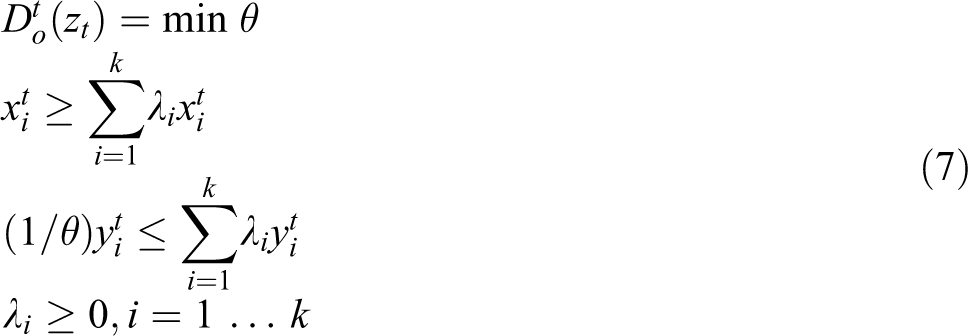
This article considers also the possible scale effects in the productivity changes. Then, the decomposition suggested by Ray and Desli (1997) and recently applied for the first time in the hotel sector by Cordero and Tzeremes (2017) is adopted. The MPI can be rewritten as (Cooper et al., 2006: 215)

where the subscripts c and v indicate, respectively, CRS and variable returns to scale (VRS).
The two first components are, respectively, the pure efficiency change (PEFFCH) and the pure technological change (PTECH). The last component is the scale change factor (SCH) and is the geometric mean of scale EFFCHs (Cooper et al., 2006: 216).
In order to consider the hierarchical structure introduced by Tone (1997) in the DEA framework, a step-by-step procedure is implemented. We suppose that the two-star hotels are the less advantaged. This assumption is in line with previous works that clearly indicate that for hotels, the performance is an increasing function of the category or star rating (Corne, 2015: 92). Furthermore, two-star hotels are the basic layer for different reasons. Firstly, the number of low-end hotels dropped rapidly while, at the meantime, an intense construction of high-end hotels was observed (Yang et al., 2017). Secondly, high-end hotels are, in general, associated with higher service quality and better managerial skills which make that two-star hotels are the least technologically advantaged (Subramanian et al., 2016). Then two-star hotels are evaluated separately, only within the same category. After that the three-star hotels are added in the sample with the two-star hotels for the estimation but only the productivity scores of the three-star hotels are extracted. The procedure continues until the most advantaged hotels are the five-star hotels in this study. Compared to a virtual analysis with the whole sample, the results for each hotel category cannot be worse. The heterogeneity characterized by the star rating effect is lessened.
Analysis of contextual factors on productivity
For the second-stage analysis, we check whether there is a statistical dependence relationship between a group effect and the ranking in terms of productivity. The Mann–Whitney test (1947), which is a nonparametric test based on rank order, is adopted for this purpose when two groups are considered. The null hypothesis is:

where m and q are the size of the two groups or categories and S is the sum of the ranks of the first group. At a given level of confidence, the null hypothesis is rejected if
For the research hypotheses which require more than two groups, the Kruskal–Wallis test (1952) is adopted (Corne, 2015; Goncalves, 2013). The statistic H is calculated by

where k is the number of units. ki
is the number of units of each group i,
Data and results
In this article, we have applied the hierarchical analysis to star-rated hotels in China. Chinese hotels are officially classified from one to five stars corresponding to their size, facilities, and other characteristics. This study is in line with the work by Yang and Cai (2016) and excludes one-star hotels from the analysis due to a poor documentation. Then, only two-, three-, four-, and five-star hotels will be considered. Due to data availability, 30 Chinese provinces in the mainland are considered for each star rating over the period 2009–2015. 2 By following Tone’ study (1997), the estimation with a hierarchical structure is the following. Performance evaluation of the two-star hotels is obtained from a sample of 30 units. Performance evaluation of the three-star hotels is extracted from a sample of 60 units (the sample contains two- and three-star hotels for the 30 provinces). By following the same procedure step by step, performance evaluation of the four-star hotels is obtained from a sample of 90 units and the findings for the five-star hotels come from a sample of 119 units. Also, as mentioned before, contextual factors (regional specific environmental variables) can indeed influence hotels’ performance. Next, we will introduce these variables to investigate their influence on the productivity, efficiency, and technology changes for star-rated hotels in China.
In what follows, we first discuss the specificities of the data set used. Subsequently, we present the results of our empirical analysis.
Data and variables selection
The choice of inputs and outputs in tourism production technologies follows recent studies on this topic (Assaf et al., 2012; Assaf and Josiassen, 2016) and the constraint of data availability. Furthermore, the recommendation by Olesen et al. (2017) is also considered which means that proportion data are not used in the production technology. Then, the variables selected are the following. The number of rooms sold and total revenue, which are common measures of hotel profitability, have been selected as the outputs. As for the inputs side, three variables will be considered: number of employees, number of rooms, and total fixed asset. The number of employees is used as the indispensable labor factor in the service production of the hotels; the number of rooms and total fixed assets represent capital factors of the hotels and are related to capacity and investment.
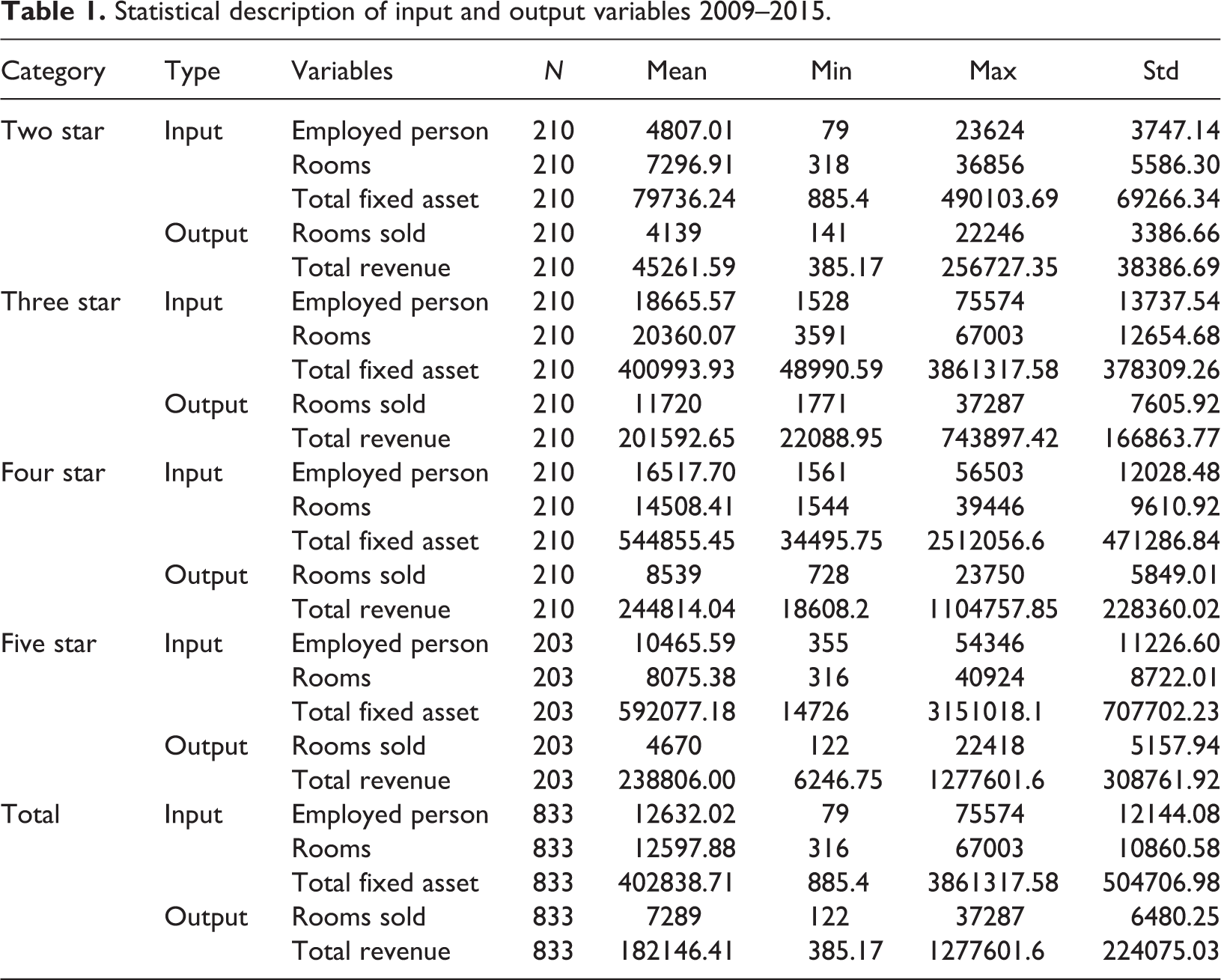
The data for the inputs and the outputs are extracted from the Wind Database and Supplement of China Tourism Statistic Year Books. A sample of 30 Chinese provinces in mainland China is considered and the data cover a period from 2009 to 2015. Descriptive statistics of variables used in the first step are represented in Table 1.
Statistical description of input and output variables 2009–2015.
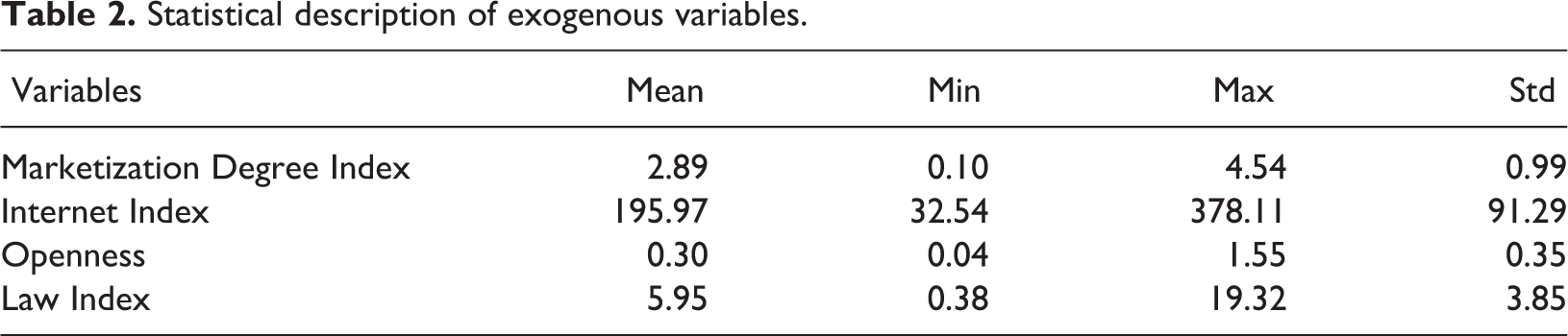
Regarding the contextual factors for the second-stage analysis, extensive literature reviews are available and derived from the seminal contribution by Ritchie and Crouch (2003). At the international level, recent contributions on this topic can be found in Assaf and Josiassen (2012) and Assaf et al. (2015, 2017). Yang and Cai (2016) propose an interesting focus on China. By following these previous works and according to data availability, five exogenous variables are selected: Marketization Degree Index: The index is derived from the seminal contribution by Fan et al. (2003) and is collected and calculated by the National Economic Research Institute, aiming at evaluating the overall progress and also progresses in different aspects of the market-oriented reform in China’s provinces, autonomous regions, and municipalities (hereinafter referred to as the provinces directly under the Central Government). It reflects the relative ranking of marketization for the 30 Chinese provinces analyzed between 2009 and 2015. The larger the index is, the less the local government’s intervention there is, the greater the role the market plays in the economy. Internet Index: The index is developed by scholars in Peking University. The missing years are filled with trend analysis. The larger the Internet Index is, the more developed it is in terms of transaction, coverage, frequency, breadth, depth, convenience, and credit reporting. Law Index: The index is also developed by the National Economic Research Institute (see Fan et al., 2003). It measures the development of market intermediary organizations and the legal environment of the market. The larger this index is, the better the legal system is in the province. Openness: It is a measurement of trade openness (TO) for each province calculated by the following formula: Location: The effects of factors related to location on tourism performance have been studied in various forms. Geographical aspects can be considered as city size (Corne, 2015), sea and mountains (Barros et al., 2011), or other qualitative locational (Assaf et al., 2015). This study follows a recent contribution by Liu and Tsai (2018) and considers the possible relationship between the regional aspects of China (eastern, central, and western regions) and the productivity of star-rated hotels.
Table 2 illustrates the data descriptions of the contextual variables used in second stage. Concerning the research hypothesis about location, the three regions are divided by following Liu and Tsai (2018).
Statistical description of exogenous variables.
Results
The findings of the MPI with a hierarchical structure to the provincial data in Chinese hotels are presented in Table 3. In order to ensure the robustness of our findings, all the productivity scores and their components are bootstrapped by following the procedure by Simar and Wilson (1999) with 2000 iterations. To avoid repetition, we refer the reader to Simar and Wilson (1999) for the detailed procedure or Tortosa-Ausina et al. (2008) for an example of application to the bank sector. The first analysis investigates the performance distinction between hotels with different stars and will be mainly devoted on the MPI and its decompositions: EFFCH and TECH under CRS, PEFFCH, PTECH, and SCH under VRS. The second analysis will focus on the study of the influence of environmental variables on hotels’ performance. In the following subsections, the empirical results will be presented.
Average performance of Chinese star-rated hotels.
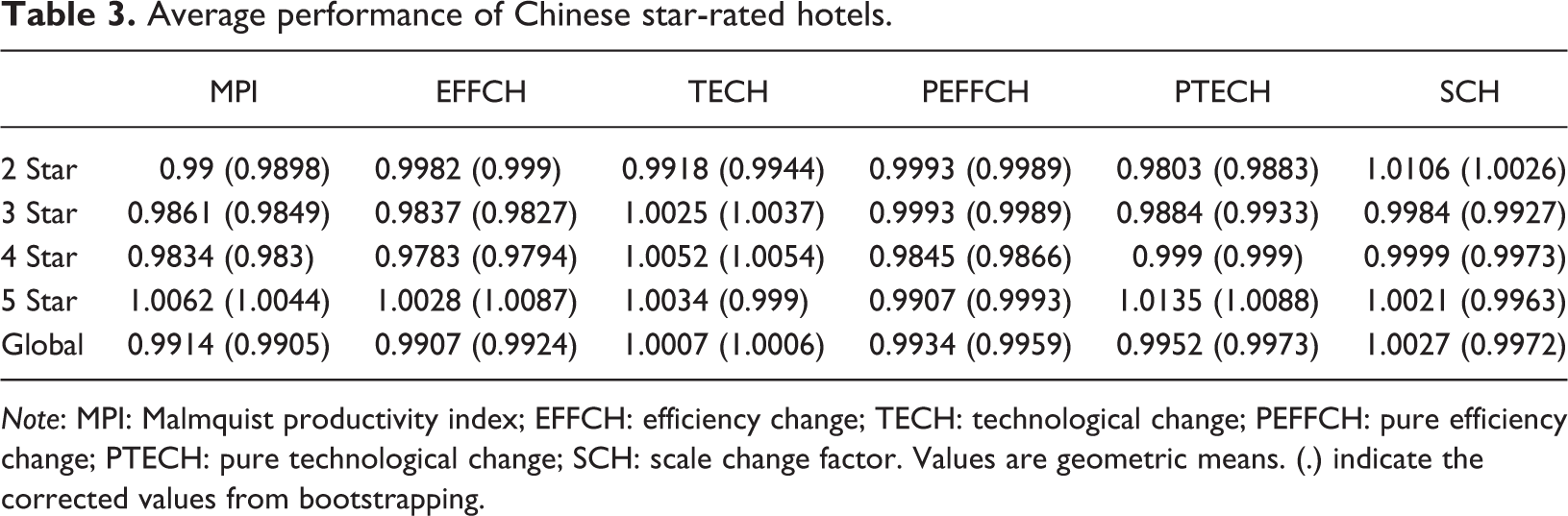
Note: MPI: Malmquist productivity index; EFFCH: efficiency change; TECH: technological change; PEFFCH: pure efficiency change; PTECH: pure technological change; SCH: scale change factor. Values are geometric means. (.) indicate the corrected values from bootstrapping.
Intertemporal productivity of Chinese hotels
Table 3 shows the overall performance of star-rated hotels in China over the period from 2009 to 2015. The bias corrected results for the indexes in Table 3 generally support the statements made by the initial estimation. Concerning the global productivity, the MPI is smaller than unity, showing a productivity regression over time for the whole hospitality industry in China. But we have noticed that in average, the overall productivity change stays relatively neutral with a decrease less than 1% over the period analyzed. The decline in productivity was mainly caused by the decline in efficiency (−0.76%), whereas TECH was positive (+0.06%). However, the pattern for the growth is different for different star hotels. With the catch-up effect (EFFCH) greater than unity, but frontier effect (TECH) smaller than unity, the bias corrected results show that five-star hotels actually depend on efficiency improvement to keep its productivity progress, while they are suffering from a slight technological deterioration. Meanwhile, all the other three hotel categories (two-, three-, and four-star hotels) are showing a backslide of productivity, and all of them are showing a decline in resources management, while three- and four-star hotels are showing some technological progresses. The possible explanation is that China is experiencing a new booming of tourists. Along with the improvement of living standard, the tourism attitude had changed for residents. As a new consumption trend, tourism industry is experiencing an extending market in the economic level. There by, the high-end hotels started to attract enormous investigation. By learning the management skill from foreign hotel groups, even though five-star hotels show a deterioration in its TECH, three- and four-star hotels are benefiting from technological improvement. Concerning the two-star hotels, Chinese domestic hotel groups expanded their scales and emerged loads of large hotel chain. They are providing the similar services to a relatively fixed customer base. Thus, the competition they are facing is mainly based on the improvement of efficiency. Regarding the findings under VRS, the overall scores suggest that the decline in PEFFCH, pure technical change, as well as sale change factor together drove the productivity deterioration of the Chinese hotel sector. However, once again, different star-rated hotels show different patterns. The SCH component reflects a positive contribution of scale efficiencies for the two-star hotels, since these hotels have to optimize their operating scale considering the fierce competition they face in this submarket.
In order to check the significance of the MPI and its components, the recent permutation tests proposed by Asmild et al. (2018) are used. 3 The results of these tests over the period analyzed reveal that the productivity change (MPI) between 2009 and 2015 is significant at 5% level for the three-star hotels (Prob = 0.0311) and at 1% level for the four- and five-star hotels (respectively, Prob = 0.0005 and Prob = 0.0004). Productivity change is nonsignificant for the two-star hotels. However, for all the hotel categories, none of the components are significant. Hence, the tests are unable to indicate the sources of productivity change.
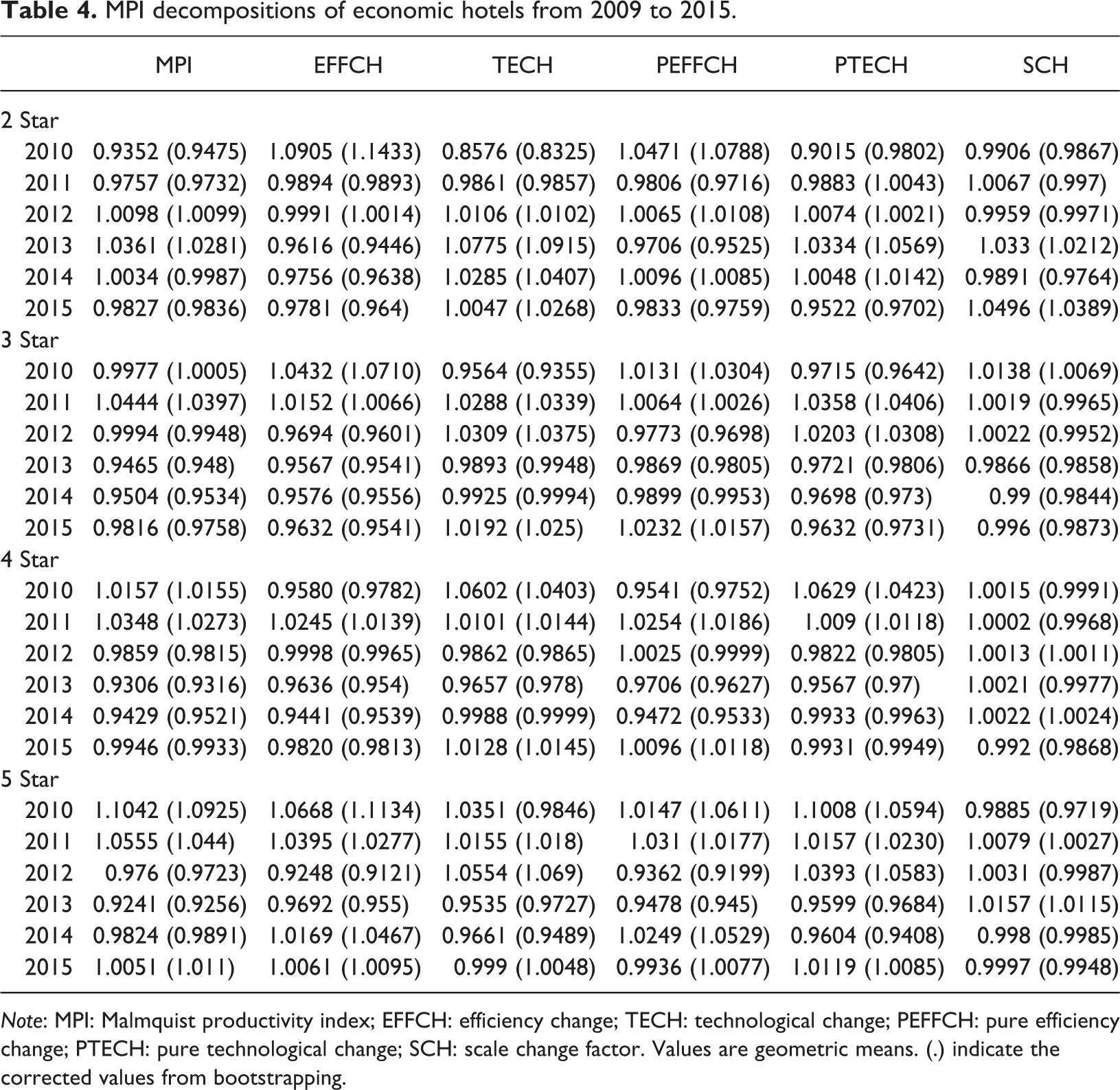
Turning to the dynamic analysis, the bias corrected results once again generally support statements made by the initial estimation. Table 4 illustrates the dynamics and the decompositions of the productivity growth over the period analyzed. After 2011, the whole industry, except two-star hotels, experienced a decline of the productivity growth. In most of the cases, the main reason is the obvious efficiency deterioration which can be observed under both CRS and VRS assumptions. On the one hand, this is due to the global and Chinese economic slowdown. And in the meantime, the Chinese government has also implemented diligence and thrift. In 2012, Chinese government has introduced “Eight-point rules” and “Six bans restricting” and restricted “Three public expenses” (buy and use government cars, official receptions, official trips). Those policies limited government expenditures in luxury hotels, which result in changes in the domestic market structure. On the other hand, in Chinese hotel market, domestic-funded hotels occupy a dominant position in the field of budget hotels. Those budget hotels have benefited from the technology spillover from the foreign investments that has been made to the four- and five-star hotels. With economic recovering, policies have been implemented to boost the hospitality sector, specifically the luxury hotels (Walheer and Zhang, 2018), and we have noticed a productivity growth for five-star hotels after 2014. All in all, as the income of Chinese consumers continues to increase, the number and frequency of tourists are gradually increasing. But at this stage, most domestic tourists still choose budget hotels, which leads to the migration of consumers from high-end to low-end hotels. As a consequence, the whole industry shows a decline in terms of productivity change. Regarding the findings of the SCH, two observations can be made. First, the bias corrected results are more contradictory compared to initial estimation than for the other components and indexes. Second, most of the findings are very close to the unity, then the scale effect seems neutral. From a methodological viewpoint, a possible explanation is the hierarchical structure adopted in the estimation but more research is needed on this aspect.
MPI decompositions of economic hotels from 2009 to 2015.
Note: MPI: Malmquist productivity index; EFFCH: efficiency change; TECH: technological change; PEFFCH: pure efficiency change; PTECH: pure technological change; SCH: scale change factor. Values are geometric means. (.) indicate the corrected values from bootstrapping.
Regional development of hotel efficiency during the period
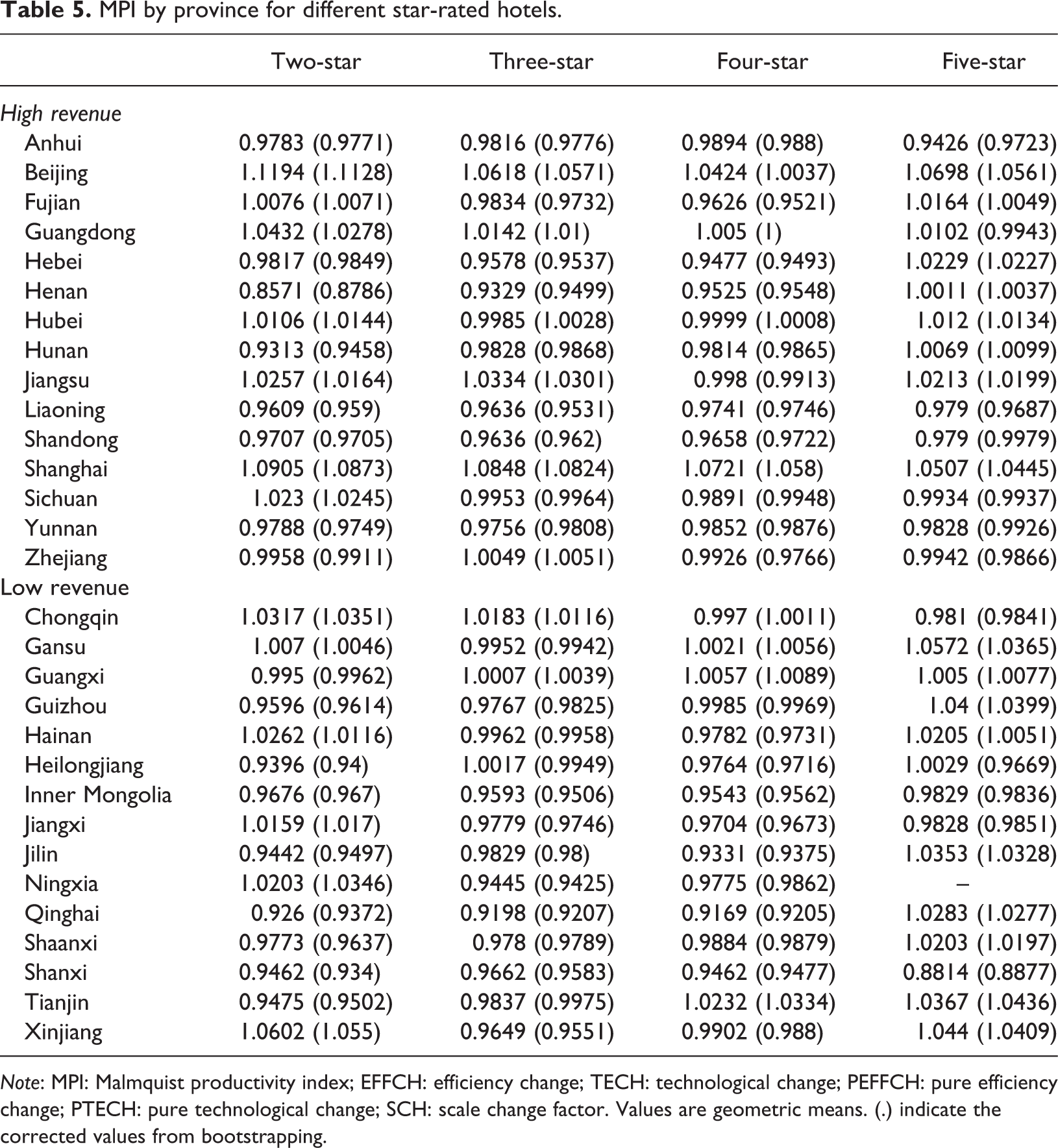
Based on average amount of hotel revenue, the 30 provinces are divided into two groups: high revenue provinces and low revenue provinces. Table 5 illustrates the performance of the star-rated hotels for each income group during the period 2009–2015. The bias corrected results are generally consistent with the initial estimation. The only exception is for certain provinces. For instance, for Guangdong and Heilongjiang provinces, the high-end hotels have showed a deterioration in their productivity instead of an improvement. It is shown that in both income groups, five-star-rated hotels performed better with a higher MPI. However, the productivity growth rate denotes different features with respect to the income groups. Except for five-star-rated hotels, all the other hotels perform better in high revenue provinces. The reason is that the economy in the high revenue provinces is already more developed with accumulated wealth. In 2017, their gross domestic product was US$9.52 trillion, accounting for 75.85% of the country. The more developed level of economy provides a relatively complete macro environment for the development of the hotels industry, which may significantly enhanced hotel’s ability to use and transform resources. Also, tourists who visit these areas have a more adequate budget. Therefore, the expansion from the demand enormously helps the development of local hotel industry. As for the low revenue provinces, the hospitality industry is still in the form of extensive capital investment growth mode. Some economically underdeveloped provinces regard the introduction of five-star-rated hotels as one of the main means of attracting foreign investment to develop the local tourism industry. Therefore, the local government provides many policy advantages to help these hotels settle down in the region (Walheer and Zhang, 2018), which help the productivity growth of five-star-rated hotels in these provinces.
MPI by province for different star-rated hotels.
Note: MPI: Malmquist productivity index; EFFCH: efficiency change; TECH: technological change; PEFFCH: pure efficiency change; PTECH: pure technological change; SCH: scale change factor. Values are geometric means. (.) indicate the corrected values from bootstrapping.
Analysis of contextual factors on productivity
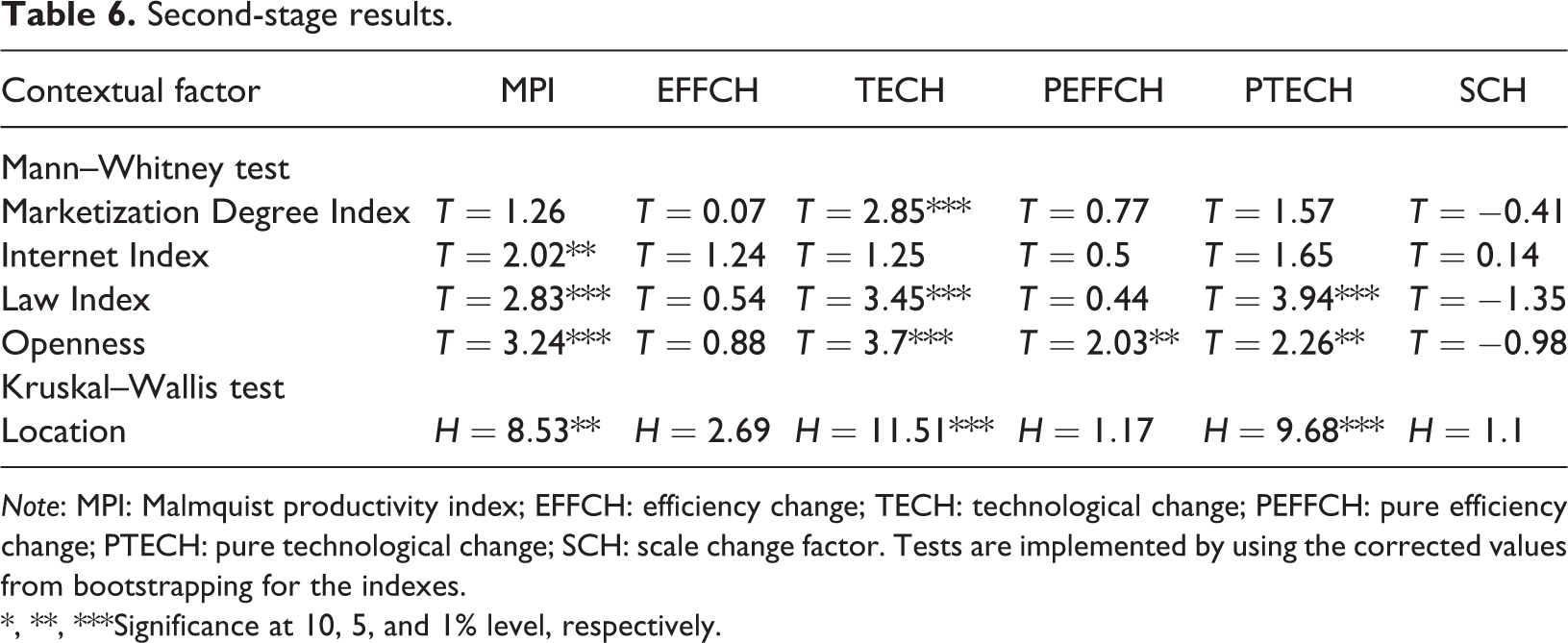
The results of the second-stage analysis are presented in Table 6. By following Goncalves (2013), the possible dependence between the contextual factor and the ranking is tested for the MPI and its components.
Second-stage results.
Note: MPI: Malmquist productivity index; EFFCH: efficiency change; TECH: technological change; PEFFCH: pure efficiency change; PTECH: pure technological change; SCH: scale change factor. Tests are implemented by using the corrected values from bootstrapping for the indexes.
*, **, ***Significance at 10, 5, and 1% level, respectively.
For the overall productivity change (MPI), the results of the Mann–Whitney test indicate that the null hypothesis is rejected for three contextual factors. The productivity change is linked to law index and openness trade (significant at the 1% level) and the internet index (significant at the 5% level). However, the marketization degree index has no effect on productivity. The Kruskal–Wallis rejects also the null hypothesis at a 5% level which means that location affects productivity. This means the maturity of the market itself has no significant impact on the overall productivity for China’s tourism industry. However, the impact of Internet infrastructure, legal norms, and market openness is remarkable. An explanation is that, up to now, the planning and use of tourism resources are still mainly following a government-led schema in China. Although market-oriented operation mechanism is gradually introduced, the degree of market-oriented marketing is not high in this industry.
The tests on the components EFFCH and TECH provide useful insights. The Marketization Degree Index, Law Index, Openness, and Location all contribute to the TECH for the tourism industry. However, the EFFCH seems not be related to these contextual factors. This means firstly that the contextual factors don’t involve the resource management in the industry. Secondly, even if the maturity of the market has no influence on productivity, it contributes to the technical advancement. This finding cannot be confirmed regarding the component PTECH under VRS. Then, more research is needed in order to clearly establish the link between the market mechanism in the TECH in the tourism industry in China. However, the findings are similar for the contextual factors related to the law index, openness, and location. Concerning the resources management, the results of the tests for PEFFCH confirm that there is no link with the contextual factors except for the openness. Finally, SCH is not linked to the contextual factors. Again a possible explanation is that scale efficiencies are captured by the hierarchical structure of the model in the estimation.
Discussion and policy implications
The results of this study underline complementarities and differences regarding the existing empirical literature.
The use of the hierarchical MPI shows that tourism productivity increased in China over the period 2009–2015. This result is innovative because even if tourism performance in China is largely investigated, few contributions focus on productivity changes. Another key result is that the slight productivity deterioration is compensated by the technological improvement. This component of productivity reflects investment and innovation and underlines the Chinese tourism policy strategies. The EFFCH was stable and relatively weak which is conforms to a recent result by Chaabouni (2019).
Regarding the determinants of productivity, the analysis of contextual factors provides useful insights. By using another methodology, this study is in line with a result by Yang and Cai (2016) where the authors also confirm that TO plays an important role on tourism performance. More precisely, their results reveal that there is a relationship between a high level of TO in the Chinese provinces and the productivity change, EFFCH, and TECH. This finding is in line with both international literature and those devoted to tourism in China (Chaabouni, 2019). The present findings are interesting and innovative because they are derived with an intertemporal dimension. In most of the studies devoted to the Chinese tourism and hospitality sectors, the second-stage analysis was restricted to the efficiency measurement in the DEA framework year by year. Furthermore, this study encompasses previous contributions on the same topic where the results were controversial. For instance, Chaabouni (2019) found a positive and significant impact of TO on hospitality efficiency in Chinese provinces on a year-by-year study from 2008 to 2013. Huang et al. (2012) showed that this contextual factor had a negative and nonsignificant impact on the same sector over the period 2001–2006. However, it is difficult to compare directly these two studies for two reasons. First, the DEA model used is different. Huang et al. (2012) used a window DEA model and Chaabouni (2019) the standard DEA model. Second, the methods used for the second-stage analysis also differ, dynamic Tobit for the former, and a bootstrap truncated for the latter. Given the current debate about second-stage regression in the DEA framework (Simar and Wilson, 2011), this study adopts and recommends the use of more flexible tools like the nonparametric statistical tests based on the ranks.
The Internet index contributes to productivity changes, confirming that digital tools are a determinant of tourism performance in China (Zhang and Cai, 2016), while it’s not the case for all destinations (Assaf et al., 2015). However, our finding regarding the marketization degree index contradicts the literature about international destinations (Assaf et al., 2015).
Besides empirical contributions, our findings have rich policy implications as well. The policy recommendations can be summarized in three main points: First, data show that generally, policymakers could be tempted to focus their policy implementations on high-end hotels only (Zhang and Gao, 2017). Our results show that the intense capital investment made on five-star hotels seems worthwhile. Only five-star hotels show a productivity improvement over the period, while two-, three-, and four-star hotels present a slow performance regression. However, productivity change pattern is different among the hotels. More resource managerial skill is needed for three- and four-star hotels, while more technological innovation is also needed for two-star hotels. Thus, policy implementations should be designed for the sector in general, while taking the specificities of each hotel category into consideration. Second, the performance of different star-rated hotels in different regions is not the same. Provinces with higher revenue have high maturity in the development of the hospitality industry. In the future, they can concentrate on high-end leisure and holiday hotel products. At the same time, they can also cooperate with foreign investment to provide a convenient, high-quality economic chain hotel product and focus on development strategies. As for the provinces with low revenue, they can learn from the advanced technology from other regions, effectively improve the utilization rate of existing capital, nature, and other resources. Third, the protection of a well-run legal system, the use of the Internet, and the effect of other environmental variables on the Chinese hotel industry have become more prominent. Indeed, a mature market operation mechanism with a sound legal system can guarantee the healthy competition and development of the hospitality industry. Furthermore, in 2015, Premier Li Keqiang first included “Internet +” concept in the government work report. Since then, the tourism hotel industry has gradually embarked on a development model combining with the Internet. Therefore, we suggest that policymakers should further open up the hotel industry market and seize the development opportunities in the context of the “Internet +” era. They can make full use of the Internet technology platform, welcome and guide consumers to actualize the rational allocation of supply and demand, thereby improving the management efficiency and realizing the transformation and innovation of the hotel industry.
Conclusion
This article proposed a productivity analysis of the Chinese hospitality industry at the provincial level for the period 2009–2015. The contributions of this study are multiple. First, heterogeneity of the hotels on their star rating basis is considered in the analysis by using an MPI with a hierarchical structure (Tone, 1997). Second, the determinants of productivity and its components are studied by considering innovative contextual factors related to the tourism economic theory and the specificity of the Chinese market. Third, the main finding is that Chinese productivity experienced a slight deterioration. Under CRS, a compensation between a negative change in efficiency and a positive TECH is observed whereas, under VRS, these changes are negative. This provides a new insight in this literature devoted to Chinese tourism performance. Furthermore, this study underlines mixed results concerning the contextual factors. Marketization does not show a direct impact on the industry’s performance. However, TO and law system clearly contribute to the productivity change of star-rated hotels in China. The role and nature of the TECH in the Chinese tourism productivity has been largely ignored by scholars and this study recommends to further investigate this point. More research is needed about the impact of investments and innovation in the Chinese hospitality industry. Finally, policy and economic recommendations suggest that decision makers should pay attention to the entire sector as well as the digitalization of the hospitality industry.
Footnotes
Acknowledgements
The authors thank two anonymous reviewers for helpful comments which greatly improved the exposition of this article. Any remaining errors are solely due to the authors.
Declaration of conflicting interests
The author(s) declared no potential conflicts of interest with respect to the research, authorship, and/or publication of this article.
Funding
The author(s) disclosed receipt of the following financial support for the research, authorship, and/or publication of this article: This work is supported by the National Social Science Fund of China under Grant No 14BYY084 and the Research Development Fund of Xi’an Jiaotong-Liverpool University under Grant No RDF-18-01-01.
