



Abstract
While hosting mega sporting events brings various benefits to the host regions from the increased number of tourists, one of the main factors that deters tourists is the various types of risks associated with international travels. The sport tourism literature has highlighted terrorism risk and political instability as major concerns that impact travel intentions. This study examined and compared the influence of tourists’ risk perceptions on travel intentions across mega sporting event host destinations with different levels (i.e. apparent risks, less imminent risks, and unidentified risks) of such risks. Data were collected from 571 potential tourists via an online survey software and analyzed using a structural equation modeling technique. The results indicated that perceived terrorism risk significantly influenced the tourists’ travel intentions. Tourists’ terrorism risk perceptions toward South Korea (apparent risks) most significantly impacted their travel intentions, followed by general destinations outside of the United States (unidentified risks), while political instability was not significantly related to travel intentions. These findings offer practical implications for mega sporting event organizers.
Introduction
The hosting of a mega sporting event has the potential to achieve a number of benefits (or positive event legacies) for the host regions. The Olympic Games and the Federation Internationale de Football Association (FIFA) World Cup, for example, can result in the revitalization of local areas, renewed urban planning, the development of sports infrastructure, and enhanced tourism (Getz, 1989; Gratton and Taylor, 2000; Horne and Manzenreiter, 2013; Malfas et al., 2004; Nauright, 2004). In addition, these events often draw global media attention and interest in the host nations, which in turn can spawn an influx of visitors and tourists (Lee and Taylor, 2005). The 2002 Salt Lake City Winter Olympic Games, for instance, generated approximately US$4.8 billion in economic impacts from inbound tourists (Porter and Fletcher, 2008). More recently, from hosting the 2018 PyeongChang Winter Games, South Korea expected to gain an estimated US$29 billion in tourism economic impact (e.g. investment, consumers expenditures, increased tourists) within the first 10 years following the event (Park and Ju, 2011).
Controversies, however, often arise with regard to the measurement of actual legacies from the hosting of these events (Horne, 2007; Matheson and Baade, 2004; Whitson and Horne, 2006). For example, hosting can cost a tremendous amount of money, often public funds, because of the need to build new facilities or renovate existing ones. When South Korea and Japan hosted 2002 FIFA World Cup, the countries spent more than US$6 billion combined (US$2 billion for South Korea and more than US$4 billion for Japan) to build new stadiums or substantially renovate existing ones in preparation for the event (Matheson and Baade, 2004). In addition to the construction costs, host nations must also bear high operating costs such as security, transportation, and accommodations. More specifically, Salt Lake City spent more than US$300 million on security above and beyond the US$1.7 billion that was allocated for other operating costs (Matheson and Baade, 2004). Previous research also confirmed the existence of the gap between the forecast and actual economic impact of mega sporting events indicating that new facilities incur operating losses for local government or municipalities after the events (Whitson and Horne, 2006).
To maximize the return on investments and to minimize criticism and/or skepticism from the public regarding the use of public funding on various costs associated with the events, governments and/or municipalities must find viable ways to justify the funds being spent on the hosting of mega sporting events. As evidenced by previous research (George and Swart, 2015; Kaplanidou, 2006), one possible way to increase benefits that derive from the hosting of mega sporting events would be attracting more tourists before, during, and after the events. Economic impact focuses on economic benefits attributed to an event that would have not occurred otherwise (Brown et al., 2016). Accordingly, new spending from visitors and tourists outside of the host nation will help increase revenue for local areas, which will ultimately create a ripple effect throughout the host region (Lee and Taylor, 2005).
However, one of the main factors that deters tourists from visiting during the hosting of a mega sporting event is the various types of risks associated with international travel (e.g. health, financial, terrorism, political instability, etc.). Historically, numerous fatal incidents or accidents have occurred around the hosting of mega sporting events. For instance, there have been regular deadly terrorist attacks before or during the Olympic Games since 1970, namely the Munich massacre in 1972, a bombing during the 1996 Atlanta Olympic Games, and the 9/11 attacks 1 year prior to the 2002 Salt Lake Winter Olympics (Taylor, 2016). Previous research verified that the number of international visitors to the United States (U.S.) was drastically decreased after 9/11 and both domestic and foreign travel spending also experienced a sharp decrease of more than US$40 billion from 2000 (pre-9/11 incident) to 2002 (post-9/11 and during the 2002 Winter Olympics; Bonham et al., 2006). In addition to terrorism, volatile political and economic conditions have also critically impacted tourism. In terms of the 2016 Rio Olympic Games, selling event tickets and attracting international tourists were considerable concerns for the organizing committee (The Guardian, 2015). Indeed, due to political turmoil (e.g. domestic protests against the Brazilian government and corruption scandals), severe economic recession, and even the threat of the Zika virus, the event ticket sales were slow and the number of international visitors were lower than the organizing committee’s original expectation (CNN, 2016; Duignan, 2016).
Consequently, numerous studies have investigated the influence of risk perceptions of tourists on their travel intentions (Desivilya et al., 2015; Lepp and Gibson, 2003; Reisinger and Mavondo, 2005; Teitler-Regev et al., 2014). More specifically, the sport tourism literature has highlighted terrorism risks and political instability as major factors that impact travel decisions (Kozak et al., 2007), and many studies have also confirmed these concerns in the mega sporting event context (Qi et al., 2009; Taylor and Toohey, 2007). Nonetheless, a gap remains within the mega sporting event context with regard to host countries with different levels of terrorism and political instability risks. Furthermore, it is unclear whether potential tourists perceive risks differently across host countries, and how they respond to such distinctions. As risk is a critical factor that dictates tourists’ decisions for international travel (Sönmez and Graefe, 1998a), assessing the underlying dynamics of risk perceptions would be necessary for organizing committees to help ensure overall event hosting goals (e.g. increase tourism post-event).
The purpose of this study, therefore, was to examine and compare the impact of potential tourists’ risk perceptions on travel intention across mega event host destinations with different levels of risk. The research questions that guide this investigation are as follows: (1) Does perceived terrorism risk and political instability influence tourists’ travel intentions to Olympic Games host countries? and (2) How do potential tourists respond to different levels of risks when traveling to these host destinations? To answer these questions, this study focused on three sets of destinations: South Korea (the host country of the 2018 PyeongChang Winter Olympics) where apparent risks of terrorism and political instability exist, future Olympic host countries with less imminent risks (Japan, China, and France), and general travel abroad with unidentified risks.
Conceptual framework
Risk perception in sport tourism
Although mega sporting events can provide positive economic impacts to the tourism industry of a host country, various types of unforeseen risks could hinder tourists’ travel intentions. Risk perception of destinations refers to the tourists’ attitudes toward perceptions of the risk associated with travel to specific destinations (Morakabati et al., 2012; Roehl and Fesenmaier, 1992; Schroeder et al., 2013). Risk perceptions may vary destination to destination because of the tourists’ personal background (i.e. cultural and social characteristics), preference, and past experiences (Desivilya et al., 2015; Short, 1984; Slovic, 1987), and such differences might explain differences in perceptions of risk (Lepp and Gibson, 2003). Risk perception is closely linked with perceived safety and security, and potential tourists and tourism industry investors tend to recognize that the safety and security of a destination is of great importance when making travel-related decisions or investments (Issa and Altinay, 2006; Pizam and Smith, 2000). Consequently, a destination with a heightened perceived risk could experience a decrease in tourism, which would eventually demand host regions to better understand perceived risk from potential tourists’ standpoints (Schroeder et al., 2013; Sönmez et al., 1999).
The various types of hazards that affect tourists’ perceptions of risk have been identified in the existing tourism literature. Schiffman and Kanuk (1991) initially identified seven specific risk categories (i.e. financial, functional and performance, physical, psychological, satisfaction, social, and time) related to consumer behavior. This early risk typology, however, has been utilized and further broadened by scholars in tourism (e.g. Maser and Weiermair, 1998; Sönmez and Graefe, 1998a). For example, in addition to the seven risk categories, Sönmez and Graefe (1998a) further highlighted terrorism risks, political instability, and health risks as significant considerations that are associated with international travel. For the Olympic tourism context, Qi et al. (2009) identified four unique risk factors: personal safety, cultural (i.e. political orientation), sociopsychological, and violence.
Terrorism in tourism
Among the various types of risks, terrorism has become one of the most critical risks perceived by tourists recently, replacing nuclear power at the top of the list (Slovic and Peters, 2006). Radu (2002: 275) defined terrorism as “any attack, or threat of attack, against unarmed targets, intended to influence, change, or divert major political decisions” and due to its targeting on unarmed civilians with the purpose of generating great fear among them, threats of terrorism may aggravate the magnitude of risk that is perceived by prospective tourists. In the case of Egypt, the tourism industry has been harmed by several terrorist attacks, and negative media coverage on the issues has aggravated a pessimistic image as a tourist destination among travelers (Mansfeld, 1999; Sönmez et al., 1999). One of the most noted consequences of the exacerbated image has been an unstable tourist demand due to negative perceptions regarding safety and security (Issa and Altinay, 2006). More recently, Teitler-Regev et al. (2014) investigated how terrorism incidents in tourists’ country of origin influenced their risk perceptions. The findings revealed that terrorism incidents in the tourists’ country of origin could potentially influence their risk perceptions and negatively affect intention to travel abroad (Adam, 2015; Deng and Ritchie, 2018).
Mass media has facilitated acts of terrorism to gain premier power and efficiency as a political weapon by drawing immediate public attention through dramatic media coverage (Buckley and Klemm, 1993). Such media coverage has had an exacerbating impact on the sense of insecurity and perceived risk of travelers toward a destination where terrorism has occurred (Mawby, 2000; Sönmez, 1998). For instance, Hall (2002) examined the impact of the 9/11 terrorist attacks in association with the impact of the media on influencing tourists’ travel behavior and the government’s tourism policy in the U.S. In his study, the media was found to have a strong influence on public opinion and perception as well as on travel behavior and tourism policy.
The Olympic Games have become an attractive target for terrorist activities due to the heightened interest of the international media on the event (Toohey and Taylor, 2008). Between 1972 and 2004, a total of 168 terrorist attacks associated with the Olympic Games occurred worldwide (Zekulin, 2009), and many scholars have noted terrorism as one of the most critical perceived risks when hosting mega sporting events (e.g. Kim and Chalip, 2004; Taylor and Toohey, 2005; Toohey et al., 2003). For instance, Black September, a Palestinian group, carried out an attack which resulted in the death of 11 Israeli athletes during the Munich Olympic Games in 1972. Sönmez and Graefe (1998a: 116) noted that such terrorist action was regarded as “a catalyst that turned terrorism into a cost-effective tool of communication, and a style of communication which became a ‘legitimate’ method of intimidation” because the news coverage on the Black September’s attack reached nearly 800 million audiences across the world instantly (Schmid and De Graaf, 1982).
Currently, several studies have examined the impact of tourists’ terrorism risk perceptions on travel intention to mega sporting event destinations (e.g., Gibson et al., 2008; Schroeder et al., 2013). However, how prospective tourists perceive mega sporting event destinations with different levels of risk and the extent to which their risk perception influences travel intention are unclear. While terrorism risk seems to be one of the most grievous risks perceived by tourists, and in fact it has had some significant negative impacts on tourism of the destination regions, understanding how prospective tourists perceive different levels of terrorism risk and how this perception affects their travel intentions could have certain practical applications for event host countries.
Political instability in tourism
Another critical risk factor associated with tourism is political instability, in which its impact and existence are multidimensional in various regions due to the complex backgrounds of each region (Seddighi et al., 2001). Research has shown that the implications of political instability on tourism are significant (Hall, 1994; Issa and Altinay, 2006). In a broad sense, politically unstable regions may face some problems with cash flow, investment from foreign investors, perceptions about hostility, public image, and safety and security issues (Clements and Georgiou, 1998). In terms of tourism, anticipated political instability issues may cause negative chain reactions as perceived political instability could impair the image of the host region and produce a range of prejudices and stereotypes and negatively influence tourism in the area (Solberg and Preuss, 2007). Some scholars argued that political instability is not as blatant as terrorism in terms of risk and does not cause serious fears unless accompanied by terroristic actions (Sönmez, 1998). Nevertheless, political instability is still an appalling barrier to international tourism by aggravating the tourists’ perception of risk of a destination (Sönmez and Graefe, 1998b).
In Olympic tourism, previous research has highlighted that tourists’ perceptions of political instability influence travel intentions to an Olympic host country differently compared to general tourism destinations (Neirotti and Hilliard, 2006; Taylor and Toohey, 2007). One of the central reasons for tourists to visit the Olympic host region is the uniqueness of the event, which is a rare and perhaps a once-in-a-lifetime opportunity (Taylor and Toohey, 2007). Moreover, because the Olympic Games are held in predetermined locations once every 2 years (i.e. Summer and Winter Games), the tourists who intend to attend the Olympics do not have any safer alternative at least over the short term (Neirotti and Hillard, 2006). Similar to the influence of terrorism risk on travel intentions, how different levels of political instability risk perception impact travel intention to a mega sporting event host region is unclear. Since every hosting region has a different level of risk in terms of political instability, a study that examines and compares the impact of prospective tourist risk perceptions on travel intention across destinations with varying levels of political instability would present practical advantages.
Based on the existing literature and research findings, the following hypotheses were developed:
Methods
Research context
Three destination types with different levels of risks were selected to examine the influence of tourists’ risk perceptions on travel intentions, namely South Korea, future Olympic host countries (Japan, China, and France), and other countries in general. South Korea was selected as the country with apparent risks because the country experienced both international and domestic political violence prior to hosting the 2018 Winter Olympic Games. In particular, North Korea conducted nuclear tests and launched test missiles which exacerbated the relationship between the two Koreas and other surrounding countries. In turn, some of the Winter Olympic Games powerhouses such as Austria, France, and Germany considered withdrawing from the Games if security concerns remained unsolved (Adu, 2017). South Korea also experienced a domestic political turbulence (i.e. impeachment of the President) before the Games, and historically, the country experienced several terrorist incidents before hosting the 1988 Summer Olympics and the 2002 FIFA World Cup Korea/Japan (e.g. flight bombing attacks in 1988 and battles of the Korean West Sea in 2002).
In the case of future host countries (i.e. Japan, China, and France), no serious terrorist attacks have been reported in such countries especially when hosting mega sporting events. Japan has no recent history of terrorism, while China has experienced several regional terrorism activities as well as political violence in the Xinjiang province and in the Tibet region. Although there were several protests before, during, and after the 2008 Beijing Summer Olympics, no serious violence was reported (CNN, 2012). Indeed, China brings in a steady influx of foreign tourists with a total of 141 million in 2018 and 139 million in 2017, respectively (The State Council of the People’s Republic of China, 2019).
France, on the other hand, has had numerous terrorist attacks (e.g. November 2015 Paris attacks and 2016 Nice truck attack) as well as political protests (e.g. youth protests in 2006 and nationwide “yellow-vest” protests in 2018; BBC, 2019) in recent years. However, no terrorist attack or protests/riots were reported when France hosted a variety of mega sporting events such as the 1992 Winter Olympics and 1998 FIFA World Cup. Despite several tragedies, France, especially the greater Paris area, hosted more than 23 million tourists in 2017 with an increase of 11% compared to the previous year (The Paris Convention and Visitors Bureau, 2018). Moreover, foreign visitors accounted for 12 million with a 15% increase from 2016, reinforcing the fact that Paris is still considered one of the most popular travel destinations in the world regardless of its recent terrorist activities or nationwide protests (The Paris Convention and Visitors Bureau, 2018). Accordingly, future Olympic host countries (Japan, China, and France) were selected as destinations with a low level of risks when compared to South Korea. Finally, other general destinations outside the U.S. were included to capture respondents’ general perceptions toward travel abroad for comparison with destinations with apparent risks and less imminent risks.
Sample and procedure
A convenience sampling method was used to collect the data from college students in the southeast region of the U.S. using an online survey provider (i.e. Qualtrics.com). Survey participants were recruited by their course instructors and were incentivized with bonus course credit for their voluntary participation. The final sample consisted of 571 respondents resulting in a 96% response rate. Demographically, the majority of the respondents were female (62.1%) with an average age of 21 (M = 21.12, SD = 2.05) and the bulk of them identified as Caucasian (73.6%). The survey was distributed to participants in January 2018, approximately 1 month before the 2018 Winter Olympics. An informed consent form was included at the beginning of the survey in compliance with the Institutional Review Board’s protocol. The survey included items measuring perceptions of two travel risks (terrorism and political instability) and travel intentions to three travel destinations (i.e. South Korea, future Olympic Games host countries, and general travel destinations) and demographic questions.
Instrumentation and data analysis
To measure the two travel perception risks (i.e. terrorism risk and political instability), six items measuring terrorism risk perception were adapted and modified from Floyd et al. (2004) and Qi et al. (2009), and three items measuring political instability were modified from Qi et al. (2009) and Seddighi et al. (2001). Finally, three items were added from Chalip et al. (1998) research to measure potential tourists’ travel intentions to multiple destinations. All items were measured with a seven-point Likert-type scale that ranged from (1) strongly disagree to (7) strongly agree. After the creation of an initial questionnaire, it was sent to a panel of experts for the purpose of content validity (DeVellis, 2016).
Once the data were obtained, descriptive statistics were first employed using the latest version of the Statistical Package for the Social Sciences (SPSS). Then, a series of confirmatory factor analyses (CFAs) were applied to evaluate the goodness of fit of the measurement model with the maximum likelihood estimation using the latest version of AMOS software. Normed chi-square (
Results
Descriptive results yielded several notable findings. In terms of terrorism risk perception, South Korea showed the highest mean scores (M = 3.35–3.78 with the overall mean of 3.63) among the three destinations while the other two scored below the midpoint (future host M = 2.97–3.36 with the overall mean of 3.16; general destination M = 2.61–3.51 with the overall mean of 3.12), indicating that respondents perceived South Korea as a destination with a higher level of terrorism risk than other locations. On the other hand, all political instability perceptions across the three destinations scored far above the midpoint (South Korea overall M = 4.25; future host M = 4.16; general destination M = 4.61), meaning that unlike terrorism risk, people perceived that all destinations have high levels of political instability. Most notably, respondents demonstrated high levels of travel intentions to general destinations outside of U.S. (overall mean of 5.50) while the overall mean of future Olympic host countries and that of South Korea scored below midpoint (overall M = 3.21 and overall M = 2.47, respectively), suggesting that people are least likely to travel to South Korea among other destinations.
Following the descriptive analyses, a series of CFAs was employed to evaluate the measurement models for the three destinations. Initially, three separate CFAs with a total of 12 items for each destination showed poor fit to the data (South Korea:
Summary of fit indices for confirmatory factor analyses.
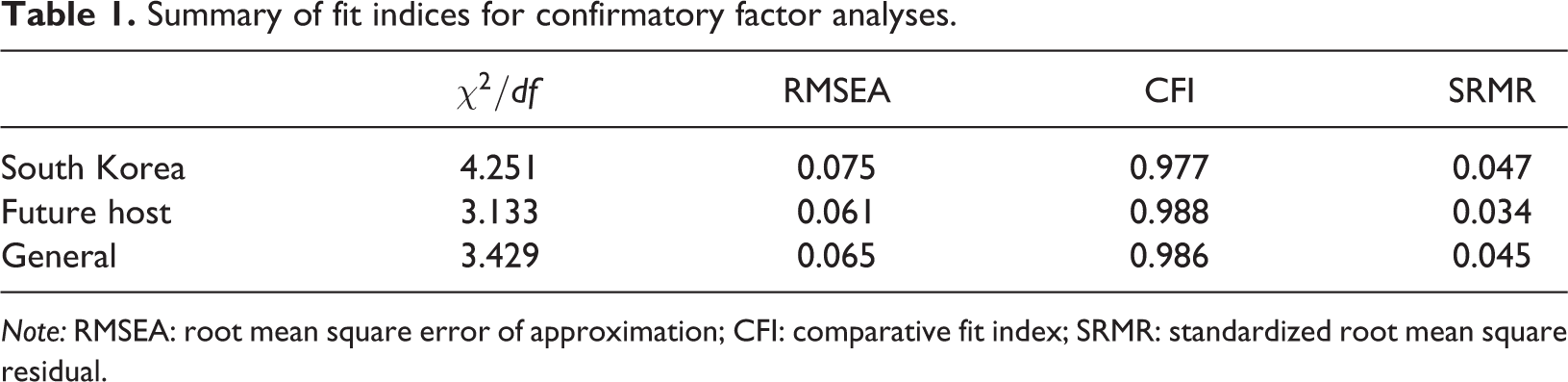
Note: RMSEA: root mean square error of approximation; CFI: comparative fit index; SRMR: standardized root mean square residual.
A series of SEM analyses were conducted after assessing the psychometric properties of the measurement models to investigate the influence of risk perceptions on travel intentions. The structural models for the three destination types indicated a satisfactory fit to the data (South Korea:

Structural equation modeling results.
Factor loadings, Cronbach’s α scores, composite reliability estimates, and average variance extracted values.
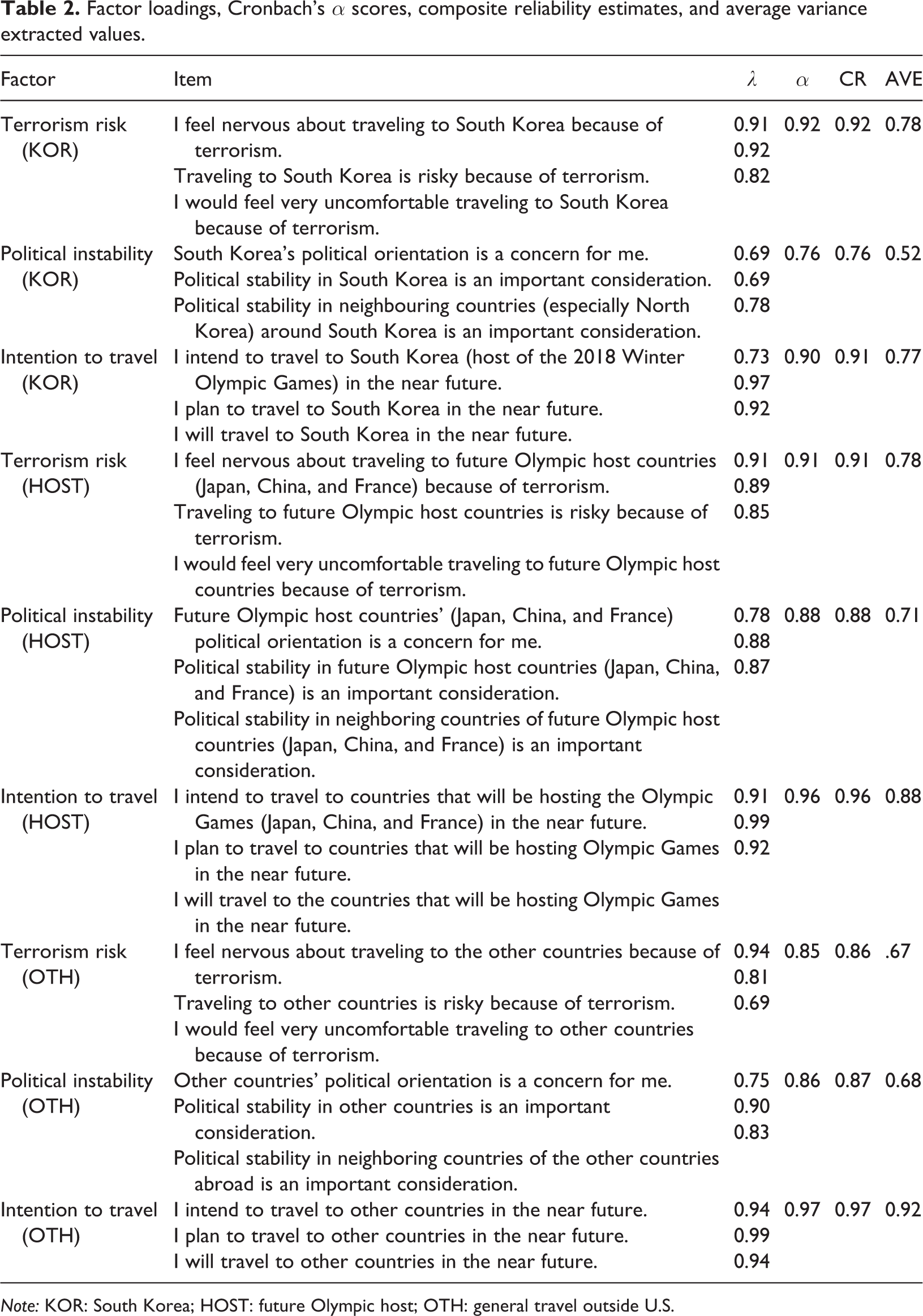
Note: KOR: South Korea; HOST: future Olympic host; OTH: general travel outside U.S.
Factor correlation matrix.
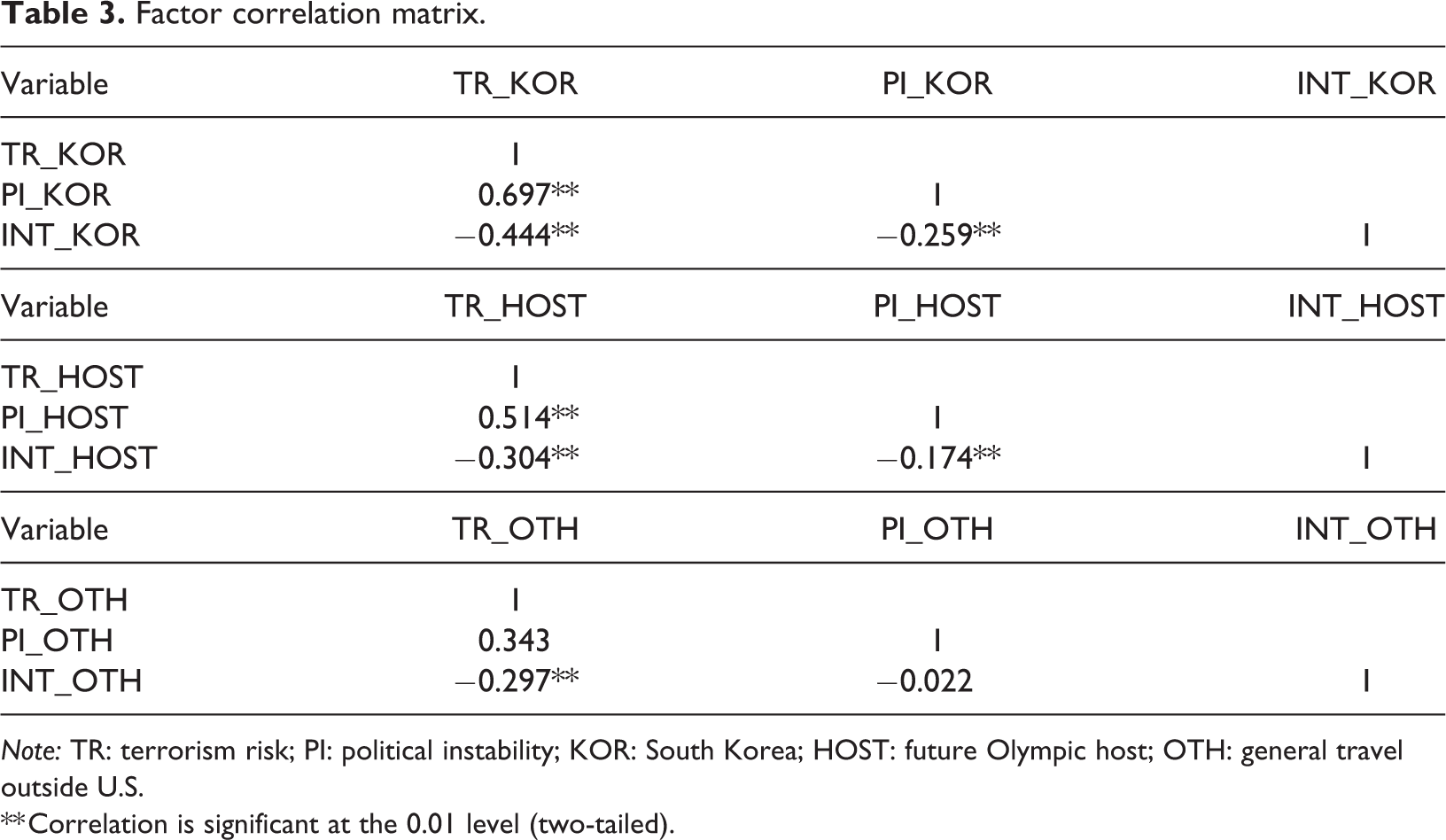
Note: TR: terrorism risk; PI: political instability; KOR: South Korea; HOST: future Olympic host; OTH: general travel outside U.S.
** Correlation is significant at the 0.01 level (two-tailed).
Discussion
This study examined and compared the impacts of potential tourists’ risk perceptions on travel intentions across Olympic host destinations with different perceived levels of risk. To do so, the influences of perceived terrorism risk and political instability on tourists’ travel intentions to the destinations and the response of the potential tourists to a different level of risks when traveling were considered. The results indicated that perceived terrorism risk significantly influenced the tourists’ travel intentions to the destinations. Particularly, potential tourists’ terrorism risk perceptions toward South Korea most significantly impacted their level of travel intentions, which was followed by general destinations outside of the U.S. However, rather surprisingly, political instability was not significantly related to travel intentions.
The most notable finding was that while the tourists’ travel intentions to all destinations were significantly influenced by perceived terrorism risk, South Korea was the most expressively impacted destination. South Korea, due to its historical ties with its neighbor North Korea, is considered to be the destination with an apparent and high level of terrorism risk. This result seems consistent with existing literature which asserted tourists’ perceived risk of terrorism would develop into travel concerns to a certain extent (e.g. Kim and Chalip, 2004; Sönmez and Graefe, 1998a; Toohey et al., 2003). Sönmez and Graefe (1998a) analyzed the influences of past international travel experience and argued that 57% of respondents confirmed that the possibility of terrorism could discourage them from traveling abroad. More specifically, Kim and Chalip (2004) found that potential tourists to the 2002 FIFA World Cup in Korea expressed less desire to attend the event if the perception of risk were higher. As such, given South Korea was the destination with the most apparent terrorism risk, the findings cast a result that is congruent with previous research.
Another prominent finding was that the respondents of the study perceived future Olympic host countries as destinations with lower levels of terrorism risk when compared to other general travel destinations. Such a perception may seem ambivalent when considering respondents’ responses to their perceived risk and travel intentions regarding South Korea. Despite the potential of future host regions being the target of terrorism, the respondents valued the special meaning (i.e. once-in-a-lifetime experience for both tourists and host regions) of the Olympic Games. In a study that analyzed the influence of terrorism-related safety concerns on event attendees’ decision-making (2003 Rugby World Cup), Taylor and Toohey (2006) found that the perceived risk of terrorism had minimal impact on event attendees’ intentions to visit. However, it must be noted that the respondents in this study were the event attendees who had already made their travel decisions. Toohey et al.’s (2003) study examined the extent to which the terrorism-related issues affected potential spectators’ intentions to visit Korea for the 2002 FIFA World Cup Korea/Japan and confirmed the findings of our study.
While most respondents were anxious and nervous about attending major events and even felt less likely to travel to destinations which they perceived as risky due to terrorism, their level of enjoyment from attending the mega event was high due to the fact that this was a once-in-a-lifetime experience. Neirotti et al. (2001) suggested that mega sporting events (i.e. Olympic Games and FIFA World Cup) provide special experiences and are regarded as lucrative destinations and, as a result, can attract tourists regardless of the risks they may possess. Thus, naturally, acceptance of risks that are associated with the events could be rationalized. As supported in previous studies, the Olympic Games’ uniqueness may support such ambivalent result in terms of the influence of potential tourists’ perceived terrorism risk on their intentions to travel to various destinations with different levels of risk. Nonetheless, the Olympics’ unique and once-in-a-lifetime experience opportunities did not have a strong impact on the perceived risk of a destination with an evidently high level of terrorism risk; as a result, the perceived terrorism risk of South Korea was a major concern for prospective tourists’ intentions to travel to that destination.
While perceived terrorism risk significantly influenced prospective tourists’ travel intentions to the destination, the risk associated with political instability was not perceived to be a great concern for the tourists. Tourists may consider political instability less threatening unless accompanied by visible actions, such as terrorism or violence. A similar conclusion was reached by previous literature as Cook (1990) argued that political instability is not as conspicuous as terrorism in terms of risk and, as a result, does not cause serious fear unless accompanied by violent actions. Moreover, visitors who attend mega sporting events, such as the Olympic Games, are considered to be persons who may trivialize the risks (Neirotti and Hilliard, 2006; Taylor and Toohey, 2006). Most of these visitors are lacking previous experience with any serious risks associated with political instability, and, as a result, they are unlikely to change their attitudes or adopt protective measures. Hence, prospective tourists’ intentions to visit Olympic host regions that have potential political instability risks may not be discouraged.
Implications
Although the economic impact of mega sporting events on the host countries and the host destinations’ strategies to attract tourists were identified in previous research (e.g., Chalip and McGuirty, 2004; Fourie and Santana-Gallego, 2011), the current study also provides several notable implications for both researchers and practitioners. The findings of this research provide a better understanding of the degree of impact of different levels of terrorism and political instability risk on travel intentions. This study confirmed that potential tourists’ terrorism risk perceptions of general destinations outside of the U.S. influenced their travel intentions more than that of the future Olympic host countries, namely Japan, China, and France; however, they perceived the terrorism risk of South Korea, a host country with apparent risks, most significantly.
From a theoretical perspective, the extent of the impact that the Olympics’ unique setting has on prospective tourists’ risk perceptions and travel intentions provides a notable implication. The Olympic Games’ once-in-a-lifetime opportunity to travel to the Olympic host region offers an attractive experience so that the tourists tend to be more willing to accept or even trivialize risks that are associated with the host regions. The so-called “Olympic effect” (e.g. Neirotti and Hillard, 2006; Schroeder et al., 2013) was confirmed in this study. Furthermore, by examining and comparing the three destinations with different levels of risks, this study also suggested that even the “Olympic effect” could not affect prospective tourists’ intention to travel to a destination with an evidently high level of terrorism risk (i.e. South Korea). Such an approach is notable in the sport event tourism literature as the results suggest that the “Olympic effect” certainly causes prospective tourists to perceive the Olympic host countries as less vulnerable to the risk of terrorism but even that effect has a limitation.
Along with theoretical implications, the results of this study revealed several notable practical implications for future event organizing committees. Although the influences of risk factors on tourists’ international travel intentions are not new, event organizing committees must put considerable effort into the creation of safe environment surrounding the event, especially for countries with highly visible risks across the globe. To do so, the organizing committee must ensure the government and political authorities alleviate unfavorable conditions and if international political conflicts emerge or become worse before the event. Building mutual trust between or among adversaries are not always easy (Kelman, 2005), however, conflict resolutions can be made with help from various nongovernmental organizations (NGOs), especially through the United Nations (UN). As the UN provides peace and security programs in terms of preventing and/or resolving international conflicts (e.g. Security Council, General Assembly, etc.; United Nations, n.d.), receiving such external support could facilitate the reconciliation process between or among conflicting countries. The International Olympic Committee (IOC) can also serve as a mediator especially when hosting Olympic Games since they encourage participating countries to agree to an Olympic Truce prior to the event (IOC, n.d.). In turn, the event organizing committees should work closely with such agencies to make the event safer and risk-free.
It is not only important for the event organizing committee to involve various stakeholders both in and outside of the host country, but it is also necessary to develop comprehensive risk and crisis management plans and procedures. According to the 2018 Global Terrorism Index (Institute for Economics & Peace, 2018), the majority of terrorism-related activity occurred in Middle East countries; however, terrorist attacks are still widespread across the globe and are unpredictable in nature. As such, developing a thorough plan of action in adverse situations seems necessary. For instance, host countries could increase security guards at the airports, event sites, and other attractions; conduct multiple emergency training drills; store emergency supplies; and/or prepare a map with evacuation routes in multiple places in order for tourists to feel safe. Having comprehensive risk and crisis management plans would not only potentially help bidding countries with the likelihood of winning the bid but also aid future host countries with an enhanced perceived image by potential tourists. Finally, heavy worldwide promotional activities highlighting the safety of the host country (e.g. advertisement using various media outlets, press conferences, etc.) must be followed. Such activities will enhance the image of the host country and make potential tourists feel safe, which could eventually lead to increased tourism revenue. The risks from terrorism and political instability are beyond the control of the event organizing committee and the regional tourism division. However, these organizations must first understand how potential tourists perceive the risks that the host regions possess and prepare strategies that could maximize the profit from hosting the events and minimize the loss from risks.
Limitations and future research
By demonstrating a strong connection between risk perceptions (i.e. terrorism risk and political instability) and travel intentions, this study confirmed findings from the existing sport tourism literature while providing researchers with different factors to be further considered in the mega sporting event setting. However, some limitations should also be noted in the current study. First, the data were collected from a group of college students in the U.S., implying the possibility of homogeneous sampling. Although the homogeneity of research participants would help control possible extraneous variables on the relationship between risk perceptions and travel intentions, the generalizability of the results is somewhat limited. Moreover, college students usually have low disposable income for international travels. However, as students may have some disposable income once they graduate and have jobs, they can be regarded as potential international travelers (Deng and Ritchie, 2018). Thus, while a student sample does not necessarily represent the general population, they may travel outside the U.S. to attend mega sporting events. Consequently, future studies should consider examining broader populations with diverse sociodemographic backgrounds for the purpose of enhanced generalizability.
In addition, there could be other intervening variables on the relationship between tourists’ risk perceptions and their travel intentions. Indeed, nationality, life-stage, and education levels were shown to have significant impacts on tourists’ perceived risks (Lepp and Gibson, 2003, 2008), and other factors such as awareness of and interest in international politics, travel motivation, and/or personality could also affect perceived risks and travel intentions. Furthermore, as evidenced by prior research (Desivilya et al., 2015; Short, 1984; Slovic, 1987), previous travel experiences, especially the amount of international travel, could be another important driving force behind travel decisions. While natural disasters were not a primary focus of this research, previous studies highlight the importance of disaster management and its influence on the tourism industry (e.g. Huan et al., 2004; Ritchie, 2004). In turn, natural disasters can be another risk factor that could affect travel intentions, along with terrorism and political instability. This leads to the call for future studies to consider developing a more comprehensive conceptual model with more intervening variables to better understand underlying dynamics in the mega sporting event tourism context.
Finally, as the international political landscape does not always remain stable, data collection periods might yield different results. In other words, changes in the political landscape could alter the degree of risks, which could ultimately affect tourists’ risk perceptions toward a certain destination. Accordingly, future studies should conduct a longitudinal analysis by obtaining data for different time periods to better capture how tourists’ risk perceptions change over time and how such change influences their travel intentions.
The current study sheds light on the importance of understanding risk perceptions for mega sporting event destinations. Prospective tourists do possess a certain level of risk perception regardless of the destination. However, the results indicate that a destination with apparent terrorism risk has the strongest negative impact on travel intention. Event hosting organizations must put more effort into providing a safe atmosphere for prospective tourists, especially in countries that historically have experienced terrorism and violence. In sum, previous and prospective event host countries should aim to find viable ways to maintain positive and safe destination images to attract tourists successfully.
Footnotes
Declaration of conflicting interests
The author(s) declared no potential conflicts of interest with respect to the research, authorship, and/or publication of this article.
Funding
The author(s) received no financial support for the research, authorship, and/or publication of this article.
