



Abstract
Mega-sporting events often contribute to both financial and nonfinancial aspects of a destination. Nonetheless, several problematic issues (e.g. risk/safety issues, high travel costs, and online broadcasting) require a hosting destination focusing more on marketing and promotion strategies to boost event attendance. As such, this study aims to understand the optimal bundling package strategy for a mega-sporting event by investigating the effect of customers’ life cycle stage on their preferences in purchasing an event-related package. Several event package features used in this study are important determinants of mega-sporting event participation. More important, respondents in different family life cycle stages showed different levels of sensitivity to each package attribute, thereby constructing different preferences. The result of this study would be useful information for designing more attractive mega-sporting event packages and/or target marketing strategies focusing on different life stages.
Introduction
In recent years, hosting a mega-sporting event has been criticized for many reasons. The most obvious is the potential financial loss and considerable investment that often lead to controversy and discontent among residents. Indeed, the city of Montreal, Canada, took 40 years to pay off the debt incurred by hosting the 1976 Montreal Games. Besides, hosting a mega-sporting event can no longer guarantee substantial financial profits. For example, the 2016 Rio Olympics sold 88% of the total available tickets, marking a decrease from the 96% sales for the previous two Olympic Games in London and Beijing (Ansari, 2016). To overcome the low attendance issue, the International Olympic Committee (IOC) and the local hosting organization have actively collaborated with media companies to employ media-related marketing and promotional strategies (Choe et al., 2019; Kariyawasam and Tsai, 2017). These strategies have increased media exposure and awareness among potential spectators; at the same time, however, more broadcasting opportunities, in combination with external factors such as increased travel costs, crowdedness, and safety and security concerns (Lee et al., 2014; Preuss, 2011; Schroeder et al., 2013), would decrease the need to physically attend the event or visit a destination during the event period. As such, the local hosting organization and IOC need to employ various marketing efforts to attract more sports tourists, particularly domestic attendees.
Product bundling is one of the most common marketing practices. A bundled offering helps service providers develop the competitiveness and attractiveness of their products and provide diverse experiences to their customers by combining both tangible and intangible components (Marcoz et al., 2016). Such strategies help not only companies to reduce its selling costs especially when individual products are complementary rather than substitution each other but also consumers to save their money by purchasing a bundled product instead of two individual products (Estelami, 1999). In practice, with the popularity of online travel agencies, tourists can easily purchase a bundled product (i.e. travel package) that includes a hotel, flight, rental car, and some complimentary items together in a single package at a range of prices (Kim et al., 2019). Moreover, tourism destinations often implement the bundling strategy by combining several attractions and activities based on enhanced cooperation with surrounding regions/local businesses (Huang et al., 2016; Hwang and Fesenmaier, 2003). In the context of the event and festival, a host destination and/or an event organizer combine the event with attractions and activities offered in or near the destination. Doing so both brings more tourists into the area and maximizes the positive impact of the event by sharing its competitive products with other industries in nearby regions (Chalip and McGuirty, 2004).
A mega-sporting event is a periodic occurrence that attracts tourists to a destination. Thus, a well-organized and optimized event bundling package is required to increase the number of attendees during the event period. Nonetheless, relatively little research has been conducted to understand how mega-sporting event attendees formulate their preferences toward event packages. Lyu and Han (2017) found that event-related attributes are the most important decision factors for sports tourists when deciding whether to buy a certain event-related travel package. As such, the current study focuses more on product attributes/options relating to the mega-sporting event itself rather than all possible factors influencing individual’s trip-related decisions (e.g. transportation and accommodation). Indeed, the high price of transportation and accommodation during the Olympic period made local tourists to visit on-site venue for just a day trip or stay at different cities. To reflect the real-world situation, choice attributes used in this study included only event-related attributes/products. For the analytic framework, we use a discrete choice experiment (DCE) to estimate trade-offs among product attributes and levels using hypothetical event-related packages specifically designed for the 2018 PyeongChang Winter Olympic Games. Our findings contribute to the existing literature by providing a formulation of consumers’ preferences regarding sport event-related packages in a mega-sporting context.
Several studies have confirmed that domestic and international travelers have different travel patterns (e.g. destination choice and behaviors within the destination; Boo and Gu, 2010; Carr, 2002; Ortega and Rodriguez, 2007). With this in mind, the current study focuses solely on domestic travelers who considered visiting the PyeongChang Olympic Games during the event period. We had several reasons for choosing domestic travelers only for the current study. First, such travelers could have been well aware of the Olympic Games but may not make their final decision yet at the time of conducting this study (i.e. 50 days prior to the opening ceremony), whereas international tourists might have already made their final decision on whether they wanted to visit. The organizers of PyeongChang 2018 struggled to sell tickets before the event, and indeed, nearly 40% of tickets were not purchased until 6 weeks before the opening ceremony. To overcome this issue, the Korean government and local organizing committee made a considerable effort to spread positive feelings about the Olympics among Koreans in the last 3 months before the event (Choi and Kim, 2017). Second, the focus of this study is primarily on preferences concerning an event-related package in a mega-sporting event context. However, international visitors would be hugely influenced by many external factors (e.g. airfare, level of interest, safety, and distance) simultaneously (Lee et al., 2014; Preuss, 2011; Schroeder et al., 2013) rather than the effect caused by event itself or himself/herself. Under these circumstances, we believe that focusing solely on domestic tourists would be more suitable for providing clear practical and theoretical implications based on the study’s findings.
We also incorporated the concept of the family life cycle (FLC) stage as an essential decision factor for mega-sporting event tourists into our research framework to further investigate the differences and changes in preferences between different life stages. Indeed, FLC has been repeatedly proven as a sound conceptual framework to understand changes in preferences and decision-making based on the individuals’ progression through life events (Fodness, 1992; Frash et al., 2008; Oppermann, 1995; Wilkes, 1995). For example, individuals might give up on event participation due to the higher cost of attending with their children, whereas others may still manage to attend because they have more disposable income. Accordingly, we aim here to capture any potential heterogeneity in consumer preferences regarding mega-sporting event packages between different life cycle groups in an exploratory manner. The findings will help policymakers and tourism marketers prepare better event travel packages and an effective target marketing and promotion strategy.
Literature review
Mega-sporting event participation
Given that many mega-sporting events are only held every few years, the hosting of events has been used by destinations as an effective strategy for both attracting more tourists and developing the hosting region (Getz and Page, 2016). Given that the actual attendance during the event is of primary interest to event organizers and destination marketers (e.g. Choe et al., 2019), many earlier studies in tourism and event literature have been focused on the understanding of why and how sports tourists visit the host destination during the event (Alexandris et al., 2009; Funk et al., 2009; Kim and Chalip, 2004; Neirotti et al., 2001). Most of these researchers have argued that mega-sporting event participation may be induced by either a single factor or a combination of various factors, such as the event itself (e.g. popularity, size, and type of event), destination (e.g. attractiveness), and a person’s own motivation (e.g. achievement and interest). Funk et al. (2009) showed that the event interest motive even ameliorates a potential constraint of attending the Olympics (e.g. unfamiliarity). These results support our fundamental argument that the mega-sporting event per se has become an important tourist attraction.
Possible attributes for a mega-sporting event package
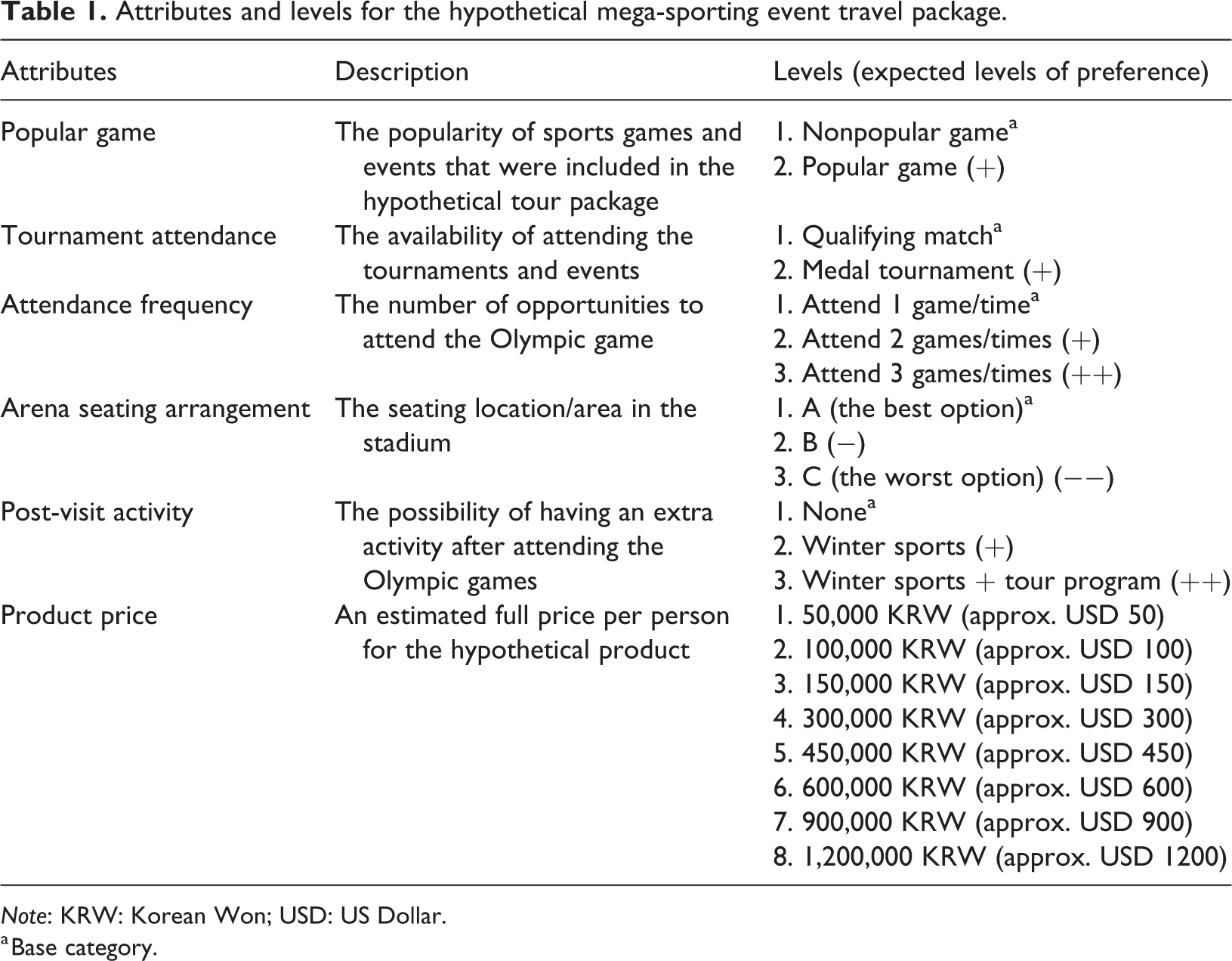
This study first identified possible factors and event attributes that influence event attendees’ decision-making process to construct hypothetical event package products. Among many factors in previous studies, we identified six attributes relevant theoretically and practically to a mega-sporting event travel package. Table 1 lists the information on its attributes and levels.
Attributes and levels for the hypothetical mega-sporting event travel package.
Note: KRW: Korean Won; USD: US Dollar.
a Base category.
The mega-sporting event package designed for this study has four distinct sets of attributes. The first set of attributes focuses on the type of games that the respondents will attend. This study includes the popularity of the game and tournament attendance as two important game-related attributes in our mega-sporting event-related package. These attributes are derived from a theoretical perspective. Lyu and Han (2017) showed that the popularity of games they attend has a significant influence on potential spectators’ preferences. In sports management literature, many studies (e.g. Caruso et al., 2019; Schreyer et al., 2017) posit that close game caused by game outcome uncertainty, the so-called uncertainty of outcome hypothesis, would bring more attendees or increase TV demand. Therefore, this study includes two possible levels: nonpopular and popular games. We expected the respondents to be more likely to value the popular game higher than the nonpopular game. In addition, this study includes the tournament game as another attribute related to the type of game. Similar to the popular game attribute, sports fans usually have a higher demand or viewership when a game/match involves high-skilled teams, a prestigious title, or a medal (Caruso et al., 2019). Schreyer et al. (2017) also revealed that the tournament attracts more audiences as compared to a friendly match or World Cup qualifier match. Therefore, for this study, we considered either qualifying matches or medal tournaments as a level of the attribute. Intuitively, we expected the main match (or the game that determines the medalist) to be valued higher than qualifying matches.
The second set of product attributes consists of two ticket-related attributes, that is, attendance frequency and seat arrangement. These attributes are more for practical purposes and would help event organizers design an optimal ticket arrangement for the packaged product. To make our hypothetical product more realistic, the levels of these attributes were designed based on the actual information for the 2018 PyeongChang Olympic Games. First, based on economic rationality, people usually prefer a choice having more opportunity, implying that more visit opportunities will have a higher value. Salaga and Winfree (2015) also proposed the theoretical model describing the value of the personal seat license as a function of the number of games a ticket holder can attend. In our study, we have three possible options: one time/game, two times/games, and three times/games. We assumed the respondents would value a product having more opportunities to attend the games over that of less opportunity. Second, the arena seating arrangement refers to the seat location in the stadium/arena. Many earlier studies in sports marketing and management (e.g. Diehl et al., 2016; Salaga and Winfree, 2015) have confirmed repeatedly the importance of seat location for sports spectators when they purchase a sports ticket. To be realistic, this study adopts the real situation for the 2018 PyeongChang Olympic Games and includes three options (A, B, and C) for our package design. We expected the respondents would perceive a higher value if the seat is close to the athletes, that is, A > B > C.
As for the third set of product attributes, we considered a post-visit activity for the additional component of the event-related package. Additional activities beyond the event participation are also an important motivation attracting event spectators (Geus et al., 2016; Kaplanidou and Vogt, 2010). Destination marketers often use a product bundling strategy by mixing the event and several attractions within the destination (Chalip and McGuirty, 2004; Kim et al., 2019). In our study, post-visit activity is defined as the possibility of joining additional programs/activities after attending the Olympic Games. We created two options for additional programs: winter sports activity and tour program. The three possible options were (a) none, (b) only winter sports activity participation, and (c) both winter sports activity and tour program. Consequently, we assumed some attendees would like to participate in additional travel activity during and after their visit to the Olympic Games.
The fourth set of package attributes is the price of the package. In our study, product price refers to the price of the event-related package for attending the 2018 PyeongChang Winter Olympic Games. We clearly informed our respondents that the package did not include accommodation and transportation fees and that it covered only on-site activities. In this way, the results of this study would be focused more on the actual preference induced by the travel bundle/package without any negative bias caused by increased cost and price inflation. To determine a realistic product price, we first considered the price of the official tickets for the Olympics. Then, we conducted a pretest with experts in tourism management, mega-sporting events, and tourism economics. These efforts allowed us to set eight price levels that event attendees could expect to pay. Based on the economic rationality, we expected that a lower priced product would be more attractive to participants than a higher-priced product.
Based on previous literature and practical importance, this study forms the following research question to understand the effect of mega-sporting event-related package attributes on the preference:
Effect of FLC on tourist behaviors
The concept of FLC, originated from sociology, has been studied over the decades to understand societal changes reflected in consumer consumption behavior. The concept posits that the roles, relationships, and decision-making processes among family members vary based on individual progressions of life events and changes in circumstances (Frash et al., 2008; Wilkes, 1995). An example of a predictable event progression is early marriage, childbirth, child-rearing, empty nesting, death of a spouse, and retirement. Indeed, some earlier studies in tourism literature have found repeatedly the contributions of those factors (i.e. age, family situation, and socioeconomic status) to different travel- and leisure-related decisions—i.e. both facilitating and constraining (Backer and Lynch, 2017; Bernini and Cracolici, 2015; Choi et al., 2010; Fodness, 1992; Hong et al., 2005; Oppermann, 1995; Sun et al., 2015). According to the life cycle theory, the members of a family rationalize their decision-making process and behaviors based only on the resources available to them at the time of their decision (Bernini and Cracolici, 2015; Laszloffy, 2002).
With its efficiency and simple conceptualization, FLC has been considered one of the most established concepts in market segmentation (Frash et al., 2008). FLC classifies families into several categories based on a multidimensional construct that combines the age of household members, marriage, the presence of children, and shifts in household income (Fodness, 1992; Lawson, 1991; Oppermann, 1995). Wells and Gubar (1966) suggested that FLC would be a more appropriate segmenting technique than age or other demographic variables with which to understand customers’ decision-making processes and predict their consumption behaviors (e.g. food, durables, and vacation). As such, a reasonable argument would be that people in different life cycle stages would have different preferences regarding mega-sporting event packages.
Among many scholars, Wells and Gubar (1966) proposed six well-known separate stages of the FLC model by incorporating age, marital status, age of the youngest child, and employment of the head of the household. Wells and Gubar’s (1966) FLC model has been still considered to be one of the most effective conceptual foundations for explaining the effect of family structure on tourist behaviors, patterns, and expenditures over time (Backer and Lynch, 2017; Lawson, 1991). The majority of recently advanced models are certainly more sophisticated and include more specified life cycle groups emerging from societal change (e.g. single-parent house, possibility of couples not having a child, and newly married couples who are not necessarily young; Backer, 2012; Backer and Lynch, 2017; Weaver and Lawton, 2010). Considering the exploratory nature of the current study, we follow the simple yet still effective FLC model proposed by Wells and Gubar (1966) for our study design to explore the different preferences regarding mega-sporting event-related products depending on different life cycle stages.
Following findings from numerous FLC research, this study argues that different life cycles would follow different trip-related decision-making processes (e.g. Fodness, 1992; Oppermann, 1995), which in turn, ultimately create heterogeneous preferences toward an event travel package. Changes in marital status, financial circumstances, demographic characteristics, and family structure certainly affect the preferences of family members for various trip-related activities (Hong et al., 2005; Laszloffy, 2002). Although no empirical study has been conducted to identify the heterogeneity of preferences among different FLC stages in the mega-sporting event context, many earlier studies have shown indirect empirical evidence that helps us anticipate the differences in domestic spectators’ preference depending on FLC stages. Certainly, for example, parents with a child often utilize their family trip to educate their child by showing something beyond their ordinary lives, that is, attending a mega-sporting event (Park et al., 2020). However, traveling with a young child (or children) restricts available time, resources, and travel activities for the family travel (Li et al., 2017), which alter individual preferences on post-visit activities (e.g. post-trip and winter sports participation). A family with the older generation would prefer various experiences with the motivation of sensation-seeking, pleasure-seeking, and escape because age and perceived remaining lifetime influence travel motivation and intention (Lu et al., 2016). Alternatively, age and occupation determine levels of disposable income, which, in turn, ultimately influence demand for leisure- and travel-related activities. In general, those who have a higher level of disposable income would be able to spend more money on their trip-related activity, making them insensitive to a higher price. As explained in the popular term YOLO (You only live once), the younger generation prefers experiential components while traveling but, importantly, with their own meaningful interpretation (Robinson and Schäzel, 2019). The implication is that the younger generation does not simply attend an event because of its popularity but because of their own experiences they can imagine. Lastly but not the least, an individual’s decision-making process usually focuses on the maximization of his or her utilities based on their subjective judgment and external circumstances such as income, age, life cycle, and experience (Albaladejo and Díaz, 2009). Based on this evidence, this study forms the following research question describing the effect of FLC on preferences:
Discrete choice experiment
In this study, we employed a DCE as the main research method to analyze individual preference and estimate willingness to pay (WTP) for mega-sporting event-related packages. DCE has been widely used in academia for its advantage of allowing researchers to elicit respondents’ implicit preferences using a hypothetical situation (Correia et al., 2007; Hensher et al., 2005). In this study, we asked respondents to indicate their anticipated preferred event-related packages for attending the PyeongChang Olympic Games. Then each observed choice and corresponding product attributes were included in the analytic framework based on random utility theory (RUT; McFadden, 1974). The underlying assumption of RUT is utility maximization and heterogeneity in the decision-making process; that is, an individual would select the best option that maximizes his or her perceived utility (Albaladejo and Díaz, 2009). As such, the perceived utility of the given choices can be derived from the options selected by the respondents in the situation.
According to RUT, an individual’s utility to choose a given product alternative can be expressed as two separate components: (a) an observed component (i.e. desired level of attributes) and (b) an unobserved random component (Louviere et al., 2000). As such, individuals’ overall preference for a chosen product is a function of the perceived utility, including both their own preferences and attitude toward the alternatives and their unobserved heterogeneity in decision-making. Accordingly, the utility of a mega-sporting event-related package j for individual i in the choice situation can be expressed as follows (Hanley et al., 2001; Louviere et al., 2000):

where Uij indicates the perceived utility that individual i acquires when choosing alternative j event-related package. In the above equation, the utility consists of two parts: Vij is an observable utility that can be determined with

If random components (i.e.

where μ is a scale parameter that is inversely related to the variance of the error term and often set to 1 for parameter estimation. For the estimation of the logit model, Vij is rewritten as follows:

where Vij is a chosen alternative; ASC is an alternative-specific constant (ASC) that represents the “no purchase option” (Adamowicz et al., 1998); i represents observation; and β and γ are coefficients to be estimated for product attributes and demographic factors, respectively. The implicit price would be calculated using the following equation:

Method
Study context: The 2018 PyeongChang Winter Olympic Games
This study was designed to understand the effect of consumers’ life cycle stage on their preferences regarding mega-sporting event-related packages. The 2018 PyeongChang Winter Olympic Games is used as the study context. The 2018 PyeongChang Winter Olympic Games was the third mega-sporting event to take place in Korea, following the 1988 Seoul Summer Olympic Games and the 2002 FIFA World Cup held in both Korea and Japan. Although PyeongChang was finally chosen as the hosting destination for the 2018 Winter Olympic Games, it lost the bid twice, the first time to Vancouver and the second time to Sochi. The 2018 PyeongChang Olympics had the largest economic impact on the national and regional economies (i.e. approximately US$37 billion) among all mega-sporting events held in South Korea, and it also had social and cultural impacts such as regional development, the promotion of Korean culture, and, most importantly, the promotion of peace via the collaboration between South and North Korea (Lee, 2018). Taking the 2018 PyeongChang Winter Olympic Games as a study context, the aim of the present study is to understand the optimal tourism package products as a marketing strategy connected to the Olympic Games by identifying domestic tourists’ preferences regarding a mega-sporting event-related package.
Study design and implementation
The survey questionnaire was based on a comprehensive review of previous studies on mega-sporting events, a travel package design, and a choice experiment (e.g. Garcia, 2001; Kim and Chalip, 2004; Lee et al., 2016; Lyu and Han, 2017; Oh, 2013; Weidenfeld and Leask, 2013). A thorough review and study design process allows the creation of realistic and effective choice settings (i.e. attributes and levels) that capture the unique situation and the proposed hypothetical products (Hensher et al., 2005). Then we conducted a pre-study with experts in events and tourism economics fields to determine whether our design of event-related packages (e.g. six attributes and price range) were realistic. Based on their feedback, certain questions, attributes, and levels were reworded or revised before the actual data collection. Finally, we confirmed six attributes that comprise a mega-sporting event tourism package product—i.e. type of games (popular vs. nonpopular and tournament vs. regular match), levels of attendance (attendance frequency and seat arrangement), post-visit activity, and the ticket price.
On the basis of attributes and levels, a full factorial design requires unmanageable choice sets for respondents (2 × 2 × 3 × 3 × 3 × 8 = 864 possible sets). As such, for this study, we used a fractional factorial design with main effects. The fractional factorial design is the experimental design that reduces a few possible combinations by using the orthogonal feature of the full factorial strategy to minimize the loss of information (e.g. variance; Louviere et al., 2000). By taking this approach, we generated a total of 12 paired choice sets and then divided these into two different questionnaire versions. Consequently, each survey participant was asked to respond to six different paired choice sets consisting of two choices and a no-choice option. We coded a series of dummy variables for all attributes except product price and also included the ASC to capture the unobserved attributes that were not included in the model. By doing so, the results could capture the average effect of choosing a no-choice option. We used the conditional logit model to estimate each parameter in the research model. Moreover, we included several sociodemographic variables to avoid violating independence from irrelevant alternatives (Bennett and Blamey, 2001). After estimating the parameter using the entire group of respondents, we attempted to investigate any potential heterogeneity in consumers’ preference depending on the FLC. Ultimately, we estimated the parameters for each individual life cycle group separately and then compared parameters among life cycle groups.
Data collection
We collected customers’ choice data using an online survey. The respondents were recruited in December 2018 through the largest Internet survey company in South Korea (Embrain, www.embrain.com). The survey was distributed around 50 days before the opening ceremony of the 2018 Winter Olympics, which was held on February 9, 2018. The timing of the data collection was carefully decided based on the real-world situation. The country experienced difficulty attracting spectators based on the unpredictability of North Korea and last-minute diplomatic breakthroughs—e.g. participation of North Korea and a unified team of South and North Korea (Qin, 2018). For this reason, the Korean government and broadcasting companies exerted considerable effort to boost ticket sales by promoting the Olympic Games around 3 months (or 100 days) before the official opening event. As such, the timing of the data collection would be well-matched with the significant efforts made by the Korean government and the local Olympic organizing committee.
For this study, we used a quota sampling method based on the distribution of gender and age from the official statistics to ensure our survey populations’ representativeness of the entire Korean population. Given the equation for determining the sample size
Results
Study sample
Table 2 presents the characteristics of the survey respondents. Of the 400, half were male (51.0%), and the average age of the respondents was 42.22 (standard deviation: 11.95), which is similar to the Korean population (male: 50.3%, average age: 42.1). The monthly household income was distributed evenly in each category, and approximately half of the respondents had a monthly household income of at least Korean Won 4,000,000 (equivalent to US$3800). Two-thirds of the respondents (65%) were married, and slightly more than half (60.3%) had a child in their family. In terms of their FLC, full nest 2 (educating a child or children) accounted for the highest proportion (28.3%), followed by bachelor (before marriage, 25.3%) and empty nest (children living on their own, 22.0%).
Sample characteristics.

Note: KRW: Korean Won; USD: US Dollar.
Aggregate model estimation
We first employed a conditional logit regression to estimate the parameters for the overall aggregated model. The conditional logit estimates for the overall sample are reported in Table 3. The inclusion of ASC in the model was aimed at capturing possible omitted or alternative attributes that are not reflected in the model. However, the insignificant ASC indicated that the respondents did not show any preference between the presented event-related package products for the 2018 PyeongChang Winter Olympic Games and a no-choice option. The negative and significant coefficient of product price attribute revealed that respondents preferred a lower-priced tour product, which is consistent with a basic economic assumption, that is, the negative relationship between price and demand. Among five event-related package attributes, all attributes except for seating arrangement were statistically significant at 0.01. As expected, the attractiveness of the game/match tourist can attend had a positive effect on the preference or WTP. For example, the possibility of attending a popular game had a WTP significantly higher than that of a nonpopular game (β = 1.59, p < 0.001, MWTP: 59.54, 95% CI = [52.94, 67.42]). A tournament match had a higher WTP than a qualifying match (β = 0.55, p < 0.001, MWTP: 20.52, 95% CI = [15.61, 25.94]). With regard to the number of attended games, we found that including additional games had a nonlinear effect. For example, if a respondent could attend two games/times, the MWTP was 13.58 (β = 0.36, p < 0.001, MWTP 95% CI = [7.26, 20.10]), whereas one additional game attendance (three games/times) would increase the MWTP to 19.49 (β = 0.52, p < 0.001, MWTP 95% CI = [12.95, 26.46]). Finally, the post-visit activity had a positive MWTP only if the respondent could participate in both a winter sports activity and a tour programs (β = 0.25, p < 0.01, MWTP: 9.34, 95% CI = [3.15, 15.75]). Two interaction variables between ASC and both age and gender were at least marginally significant at the 0.10 significance level, indicating that younger and male respondents were more interested in purchasing an event-related package for attending the 2018 PyeongChang Winter Olympics.
Results of aggregate model estimation.a

Note: MWTP: marginal willingness to pay; ASC: alternative-specific constant; SE: standard error.
a No. of respondents: 400, no. of choice sets: 2400, and no. of total products presented: 7200.
b Estimated by the Krinsky–Robb method with 2000 draws. Unit: 1000 KRW
c Reference category.
†p < 0.10, *p < 0.05; **p < 0.01; ***p < 0.001; Log likelihood: −2024.87; Pseudo R2: 0.16.
Life cycle model estimation
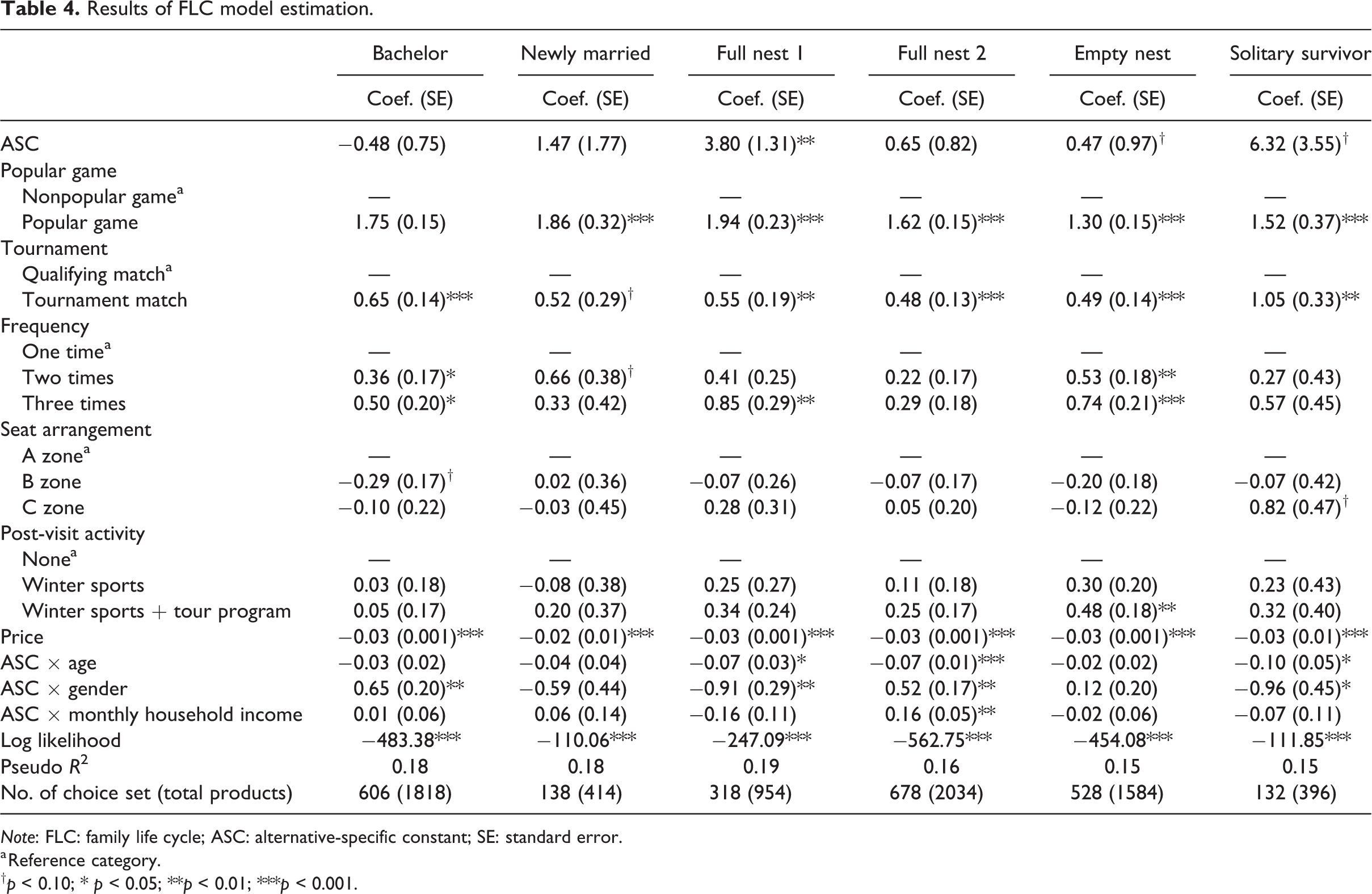
To evaluate the hypothesis that FLC could be a decisive factor in the choice of a mega-sporting event-related package, we analyzed consumers’ preferences across the six life cycle categories. The conditional logit estimates for subsamples of the six life cycle groups are reported in Table 4. Consistent with the aggregated model, the life cycle model results showed that popularity, tournament attendance, attendance frequency, post-visit activity, and price were statistically significantly associated with the choice of a given tour product at 5% significance levels. Nonetheless, we found significant heterogeneity in consumers’ preference depending on the FLC. First, although all six models had a negative coefficient for the event-related package price, the price sensitivity (i.e. the degree of coefficient) for each group was different across the group (see Figure 1(a)). The younger generations, which were in earlier life cycle groups (bachelor: −0.026 and newly married: −0.025), tended to be less sensitive to the price of tour products, whereas the older generation (e.g. empty nest: −0.031 and solitary survivor: −0.030) had a relatively higher absolute value of price coefficient. The interaction term between ASC and monthly household income was not statistically significant for most of the models in our study, except for the full nest 2 group, thereby proving that heterogeneous price sensitivity existed among respondents depending on life cycle.

Graphical comparisons among FLC groups. (a) Coefficient of PRICE; (b) MWTP for the popular game attribute; (c) MWTP for the tournament attribute; and (d) MWTP for the frequency attributes. FLC: family life cycle; MWTP: marginal willingness to pay; KRW: Korean Won. †p < 0.10; *p < 0.05; **p < 0.01; ***p < 0.001. Unit: KRW 1000.
Results of FLC model estimation.
Note: FLC: family life cycle; ASC: alternative-specific constant; SE: standard error.
a Reference category.
†p < 0.10; * p < 0.05; **p < 0.01; ***p < 0.001.
Second, the possibility of attending popular games showed a similar pattern, with a more favorable preference among earlier life cycle groups than later life cycle groups. Although the bachelor group did not significantly prefer popular over nonpopular games, all five other groups showed significant coefficients of popular games. As can be seen in Figure 1(b), the newly married group (β = 1.86, p < 0.001, MWTP = 75.10, 95% CI = [46.11, 134.18]) and full nest 1 group (β = 1.94, p < 0.001, MWTP = 72.49, 95% CI = [54.21, 102.11]) had a relatively higher MWTP than other groups, while empty nest (β = 1.30, p < 0.001, MWTP = 42.68, 95% CI = [32.68, 54.75]) and solitary survivor (β = 1.52, p < 0.001, MWTP = 50.72, 95% CI = [27.20, 90.29]) showed a lower MWTP. Similar to the price sensitivity, earlier life cycle groups would pay a premium to attend popular games.
Third, the importance of the attended game (i.e. qualifying match or final medal competition) affected consumers’ preferences for attending the mega-sporting event. Although all groups except the newly married group had a significant effect at a 5% significance level, their MWTP was slightly different across life cycle groups. Particularly, the solitary survivor group showed the highest MWTP (β = 1.05, p < 0.01, MWTP = 35.05, 95% CI = [14.40, 71.01]) among the six groups. No statistical differences were found with other groups.
Fourth, the attendance frequency had a different effect on consumers’ preferences depending on life cycle models. Two groups (bachelor and empty nest) had significant effects of both two- and three-game attendances compared with one-game attendance, whereas full nest 2 and solitary survivor had no effect at all. However, the additional monetary value of the extra visit for bachelor (two times: β = 0.36, p < 0.05, MWTP = 14.17, 95% CI = [1.14, 28.12]; three times: β = 0.50, p < 0.05, MWTP = 19.73, 95% CI = [5.21, 34.20]) and empty nest (two times: β = 0.53, p < 0.01, MWTP = 17.50, 95% CI = [6.63, 29.76]; three times: β = 0.74, p < 0.001, MWTP = 24.20, 95% CI = [11.33, 37.12]) was not significantly higher from two games to three games as compared with those from one game to two games. For the full nest 1 group, three-game attendances (β = 0.85, p < 0.01, MWTP = 31.87, 95% CI = [11.88, 53.14]) showed a significantly higher value than one-game attendance but not two-game attendance.
Finally, the findings of this study also showed several differences among life cycle models. We found a significant effect of the extra program—that is, winter sports and tour program—from the empty nest group only (β = 0.45, p < 0.01, MWTP = 15.63, 95% CI = [4.54, 29.07]). Moreover, the interaction variables between ASC and sociodemographic variables (i.e. age, gender, and monthly household income) had different effects across the six models. First, interaction with age was significantly associated with consumers’ preference for full nest 1, full nest 2, and solitary survivor. Even within each group, younger respondents had a higher preference for attending a mega-sporting event compared with older respondents. Second, interaction with gender was statistically significant in bachelor, full nest 1, full nest 2, and solitary survivor. However, for bachelor and full nest 2, female respondents had a higher preference, whereas for full nest 1 and solitary survivor, male respondents had a higher preference than others. Finally, monthly household income was the only important factor in full nest 2; in other words, higher-income respondents had greater preference than lower-income respondents. The detailed results are presented in Table 4 and Figure 1. Figure 1 showed only four product attributes that are different across groups.
Conclusion and directions for future research
The hosting organizations of mega-sporting events have been struggling to attract more event attendees to a destination and stadiums for many reasons (i.e. risk/safety issues, high travel cost, and development of mobile broadcasting devices). To tackle this real-world challenge, we aimed in this study to develop an optimal marketing tactic and an event travel product bundling strategy for a mega-sporting event by investigating the effect of customers’ life cycle stage on their preferences for purchasing a mega-sporting event package. We used a choice experiment technique to elicit customers’ preferences in response to hypothetical event-related packages.
Through the empirical analysis, we reached the following conclusions. For overall samples, the attributes that appeared to have an effect on consumers’ preferences regarding mega-sporting event participation were the popularity of sports games, the possibility of attending important games, the number of games attended, the specific type of post-visit activity (if any), and the price of the event-related package. The six stages of FLC showed different degrees of tour product attributes’ influence on preferences. Thus, the preference concerning mega-sporting event participation depends not only on the event-related package and its features but also on individuals’ sociodemographic and related situations (e.g. FLC).
Based on these results, the current study would provide the following theoretical implications. First, this study contributes to the literature on bundling strategies for travel and hospitality products. In general, the respondents in this study preferred to purchase the hypothetical products, thereby indicating the possibility of attracting more tourists by offering different event travel packages as part of a target-oriented marketing and promotion strategy. Obviously, a careful design and composition of the event travel package are the most important factors in increasing the attractiveness of the event travel package. Indeed, a few event/product attributes and levels were statistically significant in our sample. Thus these results support earlier studies in the tourism and hospitality industries (e.g. Chalip and McGuirty, 2004; Kim et al., 2019), which proved the benefits of a product bundling strategy.
Second, the findings of this study suggest the importance of patriotism and emotional connection in domestic spectators’ decision-making process. In our study, respondents are willing to pay more if they can attend important or popular games, that is, tournament games or any games in which their national teams will participate and/or have a higher chance of winning. Notably, the price coefficients in all analytic models in our study were negatively associated with the product choice, indicating that our respondents follow the fundamental economic rationality regarding the price of the package and its choice. However, our samples might not follow the economic rationality while considering the type of game they can attend. Consistent with earlier studies (Brown et al., 2016; Choe et al., 2019; Lyu and Han, 2017), patriotism and emotional connection could explain why and how domestic spectators support their nations by attending any important match if they expect their representatives to have a higher chance of winning.
Third, our findings can be also linked to the importance of experiential (or emotional) appealing in designing an event travel package. Previous studies (e.g. Geus et al., 2016; Kaplanidou and Vogt, 2010) have argued that sport event experience is formed by not only direct event experiences (e.g. physical and environment aspect) but also indirect cognitive or affective experiences/engagements (e.g. price, enjoyment, and novelty). In our study, higher levels of WTP for several event-related attributes such as an important or popular game and post-visit activity would reflect the importance of those attributes for domestic event attendees. Specifically, our respondents would like to experience the feeling of pride and belongingness by attending a meaningful event in their own country. Additionally, this explanation may apply to the null finding of the seat arrangement in the stadium in our study. For domestic spectators, seat arrangement is an unnecessary decision factor for an event package if they can attend the game and experience the “once-in-a-lifetime” moment.
This study focused primarily on domestic event attendees to address the real-world problem (i.e. lower interest from abroad, less attendance, in general, and high cost during the event period). Thus, our findings suggest managerial and practical implications specifically focusing on domestic marketing. First, the results can be used to develop target marketing strategies for domestic mega-sporting event attendees. Event organizers and marketing companies can attempt to mix more and less popular games together with affordable price ranges to attract more domestic spectators. The appropriate use of a bundling strategy would increase the perceived value of event travel packages in general and further attract multiple segments by satisfying different needs and preferences simultaneously (Harrison-Hill and Chalip, 2005; Weidenfeld and Leask, 2013). It also helps ensure a minimum number of spectators in less popular sports or less important matchups by combining those events/games with a popular game as a bundle package.
Second, we found several differential effects of package attributes across life cycle groups, which can be useful tools to identify target segments for the effective promotion of mega-sporting event. As their price sensitivity would vary across life cycle stages, the prices of event travel packages could be carefully designed to avoid any negative consequences (e.g. price fairness perception) and to boost ticket sales within a limited event period. Furthermore, a special discount program and/or advertisements based on life cycle stages might be another feasible marketing tool to increase the popularity of mega-sporting events. Of course, the composition of event travel packages would be still very important to make domestic event attendees to purchase those products. Designing more attractive and optimized event travel packages for each target market would increase satisfaction, enhance the destination’s brand and image, and, more importantly, increase revenue through the event.
Third, event organizers could use product bundling strategies to increase the economic benefits and spread out beyond the hosting destination effectively. In our study, post-event activity was a significant factor for mega-sport event participation. It is worth noting that post-event activity is a particularly important product attribute for empty-nest groups, which are less sensitive to the price. From the destination marketing perspective, event organizers and the hosting destination can provide more diverse event travel packages at different levels of prices depending on post-event activities. By doing so, event organizers and the hosting destination can maximize the economic benefits of a mega-sporting event across the area within the community ecosystem. This approach requires a close and harmonious collaboration among tourism attractions in nearby destinations and among event organizers to develop a highly competitive and attractive event travel package (Jago et al., 2003; Lyu and Han, 2017).
Finally, event organizers and their ticket sales teams may need to focus on product customization. In the consumer psychology literature, some researchers (e.g. Norton et al., 2012; Sarstedt et al., 2016) have argued that people show higher WTP when they actively participate in the assembly or design of the product based on their psychological ownership. Event marketers would do much better to prepare the function of product customization, which allows customers more flexibility to change some options as far as possible (e.g. post-event activity and game ticket). By simply gaining the option of customizing, customers would be less price-sensitive and perceive higher value in the purchased product. Although customization is highly beneficial to event organizers, marketers and product developers require an effective mechanism to adopt this strategy. In recent years, customers may no longer merely desire more choice options or cheaper options, rather they would like to focus more on a unique experience and their preference. Ideally, event organizers need to prepare a basic/standard event travel package that includes core components and allows customers to choose some additional product attributes (e.g. type of games they can attend). The differences found in our study also support this suggestion. For example, earlier life cycle groups focus more on the popularity of the games, while later life cycle groups would prefer big-match games or post-event activity.
Limitations and future research
Based on the several limitations of this study, possible areas of future research lie in the further development of theoretical accounts of consumer preference, purchasing behavior during a mega-sporting event and its bundled packages, and integration of conceptual work with other relevant fields. First, future researchers should elaborate on individual factors such as personal preference or interest in winter sports. In the sport and leisure literature, leisure/sport specialization, sports involvement, and sports interest (Brown et al., 2016; Funk et al., 2009; Scott and Shafer, 2001) are important influencers of sports and sporting event participation. Preferences for event travel packages could be changed depending on people’s level of interest or experience in sports. The focus of this study was more on the general public who would potentially attend the mega-sporting event, thereby making the exclusion of sports interest and specialization a minor issue. However, future researchers could include those factors as a moderator or influencing factor in the model across different types of sporting events, such as marathon running and triathlon races. Second, a multitude of situational factors, such as many different types of travel constraint including time, companion, money, or distance to the event venue (Funk et al., 2009; Wood and Danylchuk, 2012), may collectively contribute to consumers’ preferences for and participation in mega-sporting events. A productive step would be to further differentiate not only between the contexts in which consumer behavior occurs but also between various kinds of behavior that may be affected (e.g. event participation, ticket purchase, and travel package purchase). The understanding of these behaviors against the types of travel constraints in the mega-sporting event will allow for a systematic analysis of the influencers and factors of consumer preference. A further empirical test is needed to reveal the effect of those factors on not only consumers’ preferences but also their behaviors, which would help in designing a better event travel package product. Third, some issues in our study design may have affected the results. Types of post-event activity and a wide range of product prices may have influenced consumer preferences while responding to the survey. For example, this study did not fully reflect the importance of the tour program for event attendees as a post-visit activity (Arnegger and Herz, 2016; Cheung et al., 2016). A future study could specify the various type of post-visit travel activities such as sightseeing, shopping, and so on. Thus, future researchers should carefully design the choice attributes (e.g. product attributes and level) and use more advanced research framework and analytic tools.
Footnotes
Declaration of conflicting interests
The author(s) declared no potential conflicts of interest with respect to the research, authorship, and/or publication of this article.
Funding
The author(s) received no financial support for the research, authorship, and/or publication of this article.
