



Abstract
Some cities strategically plan multiple small and medium-size sport events on different dates in their annual calendar of activities and avoid focusing on a single event of great magnitude. This is how the concept of a sport-event portfolio arises. This article aims to present a method to quantify the injection of sports-tourism money into a city from a portfolio of events. This methodology is applied to the portfolio of a small town with a policy oriented toward the promotion of tourism through the organization of sport events. The income generated by sports tourists in the 2017–2018 biennium is estimated using 1123 surveys conducted from four events included in the town’s portfolio. The research findings of this article are pioneers in the quantitative field of the study of event portfolios. This provides new opportunities for planning a strategy to attract tourism revenues.
Introduction
Mega-events have been used as a means for the economic and touristic development of destinations (Davies, 2002; O’Brien and Chalip, 2007; Van, 2017). The works of Burgan and Mules (1992), Crompton (1995, 2006), Gratton et al. (2006), Huang et al. (2014), Maharaj (2015), Li and Jago (2013), Lin and Lu (2018), and Preuss (2005) analyze the economic repercussions of this type of event in detail.
Some papers present a critical view on impact studies. Crompton (1995), one of the first authors to point out the problem with impact studies, detailed the most common mistakes made in estimating the economic impact of professional teams and sporting events. He mentions five mistakes, which include using sales instead of household-income multipliers, the misrepresentation of employment multipliers, using incremental instead of normal multiplier coefficients, the use of “fudged” multiplier coefficients, and confusion of turnover and multiplier. Another important aspect that he comments on is the failure to define the area of interest accurately. As far as the estimate of attendees is concerned, a common mistake is the inclusion of local spectators and not excluding “time-switchers” and “casuals.” Other mistakes reported by Crompton include focusing on total instead of marginal economic benefits, the omission of opportunity of costs, and the measurement only of benefits (omitting costs).
Mules and Faulkner (1996) also stressed that the organization of a sport event implies an indisputable benefit for the host city. In this line, Crompton (2006) carried out a compilation of economic impact studies of events that make mistakes in their methodology, thus overestimating the impact of the events. Other studies have focused on public investment in the construction of stadiums for professional teams. On many occasions, these investments were justified by stating that professional sport is an important catalyst for economic growth (Baade, 1994). In this sense, Baade and Dye (1990), Baade et al. (2005, 2008), Coates and Humphreys (1999, 2001, 2003a, 2003b), and Hudson (2001) show that the economic impact of a professional team is not enough to justify the construction of a new sports facility.
More recently, attention has centered on medium-sized events. Thus, Gelan (2003), Gibson et al. (2003), Matheson (2006), and Taks et al. (2011, 2013) present evidence of the economic and touristic impact of the organization of medium-sized events. Coates and Depken (2009, 2011) find that college football games have a positive impact on local host city tax revenues and taxable sales. Other works, such as Depken and Stephenson (2018), examine the effect of sporting events on the market for lodging of the host city.
Medium-sized events are capable of attracting benefits to the host city because they are more manageable, require less public investment, and can use existing infrastructures (Veltri et al., 2009; Wilson, 2006; Ziakas and Costa, 2011a). Some cities opt for the organization of several medium-sized sport events on different dates in their annual calendar of activities, thereby forming a portfolio of events. As indicated by Viol et al. (2018), the development and maintenance of a portfolio of events is considered a good strategy in the planning of tourist destinations and events. Kelly and Fairley (2018) indicates that a portfolio of events promotes synergies between events and stakeholders.
This article is based on the portfolio-of-events concept. Taking a medium-sized city as a reference, it seeks a twofold objective. In the first place, it proposes a methodology for quantifying the injection of sports-tourism money into a city from a portfolio of events. As a second objective, it applies this methodology to a city with touristic planning through the organization of sport events. Pontevedra (Spain) meets the population size requirements, and it has opted for a citywide marketing strategy based on the organization of sport events.
The rest of the work is structured as follows. First, it presents the theoretical background based on the review of literature. Next, it proposes a method to estimate the injection of money into a city from a sport-event portfolio. Third, it presents the results obtained from the portfolio under study. Finally, it discusses and compares the results with existing studies and draws relevant conclusions.
Theoretical background
Small and medium-size sports events and city marketing
Sports events are increasingly used in the marketing of cities (Dos Santos, 2014; Green, 2002; Malchrowicz-Mośko and Poczta, 2018). These events represent the chance to create, improve, or reposition the image of the destination (Kaplanidou and Vogt, 2007). In this sense, medium- and small-sized events represent an opportunity to develop a citywide marketing strategy and promote city tourism (Csobán and Serra, 2014; Veltri et al., 2009). As indicated by Agha and Taks (2015), cities can organize several medium- and small-sized sport events to generate benefits well beyond those of a single event. Agha and Taks (2015), Kwiatkowski and Oklevik (2017), and Malchrowicz-Mośko and Poczta (2018) point out that a large part of research has focused on the economic impact of mega-events. Specifically, Agha (2015) indicates that attention is shifting toward medium- and small-sized events. On the other hand, Malchrowicz-Mośko and Poczta (2018) indicate a shortage of knowledge related to the expenditures of the event’s attendees and the economic repercussions it has for the cities, which is especially significant in smaller scale events.
Medium-sized and small events offer some benefits as compared to mega-events. Small-scale sports-tourism events can be a viable form of sustainable tourism for a local community (Csobán and Serra, 2014; Duglio and Beltramo, 2017; Gibson et al., 2012). Gibson et al. (2012) explain that sustainable tourism is comprised of three pillars: economic, social, and environmental. They highlight that medium- and small-sized events may imply a lesser negative effect on the environment in addition to making local community residents more integrated and satisfied.
Events of a medium and small size have great potential in the social sphere, and they contribute to creating or totally changing the image of a place and promoting its tourism (Malchrowicz-Mośko and Poczta, 2018). As explained by Csobán and Serra (2014), this type of event is more consistent with local cultural and human capital. In this sense, Chalip and McGuirty (2004) indicate that events compatible with the image of the local community are more successful.
Another positive aspect of medium- and small-sized events is the use of existing infrastructures. These types of events generally require no construction of infrastructures. However, mega-events involve expensive investments that are not always recovered. On the other hand, not needing to build new infrastructures decreases the environmental impact (Gibson et al., 2012). Besides, smaller events have fewer negative effects on an ecological level and a lower impact on the generation of waste and noise than do mega-events (Malchrowicz-Mośko and Poczta, 2018).
In economic terms, medium- and small-sized events do not require large amounts of public funds (Higham, 1999; Jago and Shaw, 1998; Malchrowicz-Mośko and Poczta, 2018; Ziakas and Costa, 2011a). It is also more affordable to manage and organize them as well as to control crowds and overcrowding (Malchrowicz-Mośko and Poczta, 2018). Moreover, the organization of medium- and small-sized events usually generates a positive economic impact (Gibson et al., 2012; Matheson, 2009; Taks et al., 2013; Veltri et al., 2009; Wilson, 2006).
Sports-event portfolio
Touristic, economic, and social development strategies using smaller sport events imply the development of a portfolio of events. Agha and Taks (2015), Chalip and McGuirty (2004), and Ziakas and Costa (2011a) argue that multiple medium and/or small events can be more beneficial than a single large event exceeding city resources. This is based on the portfolio-of-events concept, which implies organizing a set of events on a regular basis to ensure a constant flow of tourists and expenses (O’Brien and Chalip, 2007). Ziakas and Costa (2011b: 409) define an event portfolio as “a system that assembles different event stakeholders in a network and serves multiple purposes.”
Studies on sport-event portfolios have mainly focused on the qualitative aspects of these portfolios. Kelly and Fairley (2018) and Ziakas and Costa (2011a) explain that organizing a group of events throughout the year is insufficient. A portfolio of events must result from conscientiously planning activities that allow for the development of synergies within the local community. Ziakas and Costa (2011a) analyze the implementation of a portfolio of events in the rural community of Fort Stockton (Texas, USA). They identify the need to generate joint organization mechanisms between different events to make management more efficient and improve overall results.
On the other hand, Kelly and Fairley (2018) use relational marketing techniques to study the relationship between event stakeholders. “Establishing an event portfolio requires diverse network of stakeholders who may have competing agendas, necessitating considerable coordination” (Kelly and Fairley, 2018: 262). They also highlight the importance of developing strategic objectives for portfolio management as well as for the allocation of funds.
Along the same line, Clark and Misener (2015) analyze the development of a portfolio of events for a medium-sized city in Ontario (Canada). They find similarities with the challenges faced by portfolio management as defined by Ziakas and Costa (2011a). This issue focuses on three aspects: the capacity to create and maintain relationships and networks; conflicting interests and a lack of connection among the arts, culture, and sports; and incoherent strategic objectives. Clark and Misener (2015) add two more objectives: political relationships that sometimes prevent the development of the event portfolio; and the sequencing of events, that is, the correct distribution of events throughout the year within the community. On the other hand, a more recent work by Ziakas (2019) delimits the four main portfolio-management issues: portfolio configurations, leveraging, sustainability, and community capacity-building.
Work developed in the qualitative field confirms the idea of Ziakas and Costa (2010, 2011a, 2011b) and Ziakas (2013). These authors provide further reasons for the need to develop a common strategy among events to achieve sustainable development through the portfolio. Ziakas (2019) explains that the growth of event portfolios requires a change in the way sports tourism is managed.
However, portfolios of events have scarcely been studied from a quantitative point of view. One of the few works on the subject is that of Buning et al. (2016). They study the determinants of spending in a portfolio of cycling events in a northeastern US city. Event portfolios are therefore a relatively new concept. Research mainly focuses on qualitative analysis. However, to the best of our knowledge, no studies in the literature estimate the implicit economic impact of the development of a sport-event portfolio on a medium- or small-sized city. Thus, this study aims to propose a tool for cities to use to analyze how they can improve the economic impact generated by event portfolios.
Methodological aspects: Quantifying the injection of money from a portfolio of sport events into the local economy
Buning et al. (2016) and Frechtling (2006) define the initial injection into the economy as the new money generated by visitors in the territory hosting the event. This article proposes a methodology for estimating the injection of initial money from a sport-event portfolio. Sport events included in a portfolio have common elements that allow for the grouping of these events according to their characteristics. Likewise, estimates and plans can be made on future editions based on the results of tourism’s impact and expenditure obtained across different past editions of the same event, as shown in the works of Barajas et al. (2016) and Hamilton et al. (2015).
On the other hand, conducting an economic impact study for each event included in the portfolio is rather unfeasible and costly in terms of economic and human resources. It is therefore more convenient to make a selection of impact studies to be carried out among the events of the portfolio. This selection must explain the behavior of a high proportion of the events that make up the portfolio. An adequate selection of impact studies of the portfolio will allow for an extrapolation of information to estimate the initial injection of money into the economy from the portfolio’s events.
The identification of comparable events—given their similar characteristics—makes it possible to use a well-known and easily implemented assessment technique. Brealey et al. (2011) discuss valuation by comparables and explain that the valuation of a company may be performed by identifying a sample of similar firms. Berk et al. (2012) explain the method of comparables or “comps.” Damodaran (2002) presents a wider vision introducing relative valuation, which looks at the pricing of “comparable” assets. This article somehow uses this technique to estimate the injection of money from tourism into a city. To this end, the method must identify comparable events with values that will later help estimate the money attracted by each of the events in the portfolio.
The four steps of the proposed methodology are listed below and subsequently explained in detail: Describing and classifying portfolio events. Selecting comparable events. Obtaining the necessary data from each event for the extrapolation. Estimating the initial injection of money from the portfolio.
Description and classification of portfolio events
The first step is to identify the characteristics of the portfolio. Different classification proposals for events identified in the literature can be used to this end. It is important to bear in mind that reference is made to classifications that consider the economic and touristic aspect of the events, not only the sport aspect. The works of Agha and Rascher (2016), Agha and Taks (2015), Barajas et al. (2012), Gratton et al. (2000), and Wilson (2006) provide the basic structure for the proposal of this article.
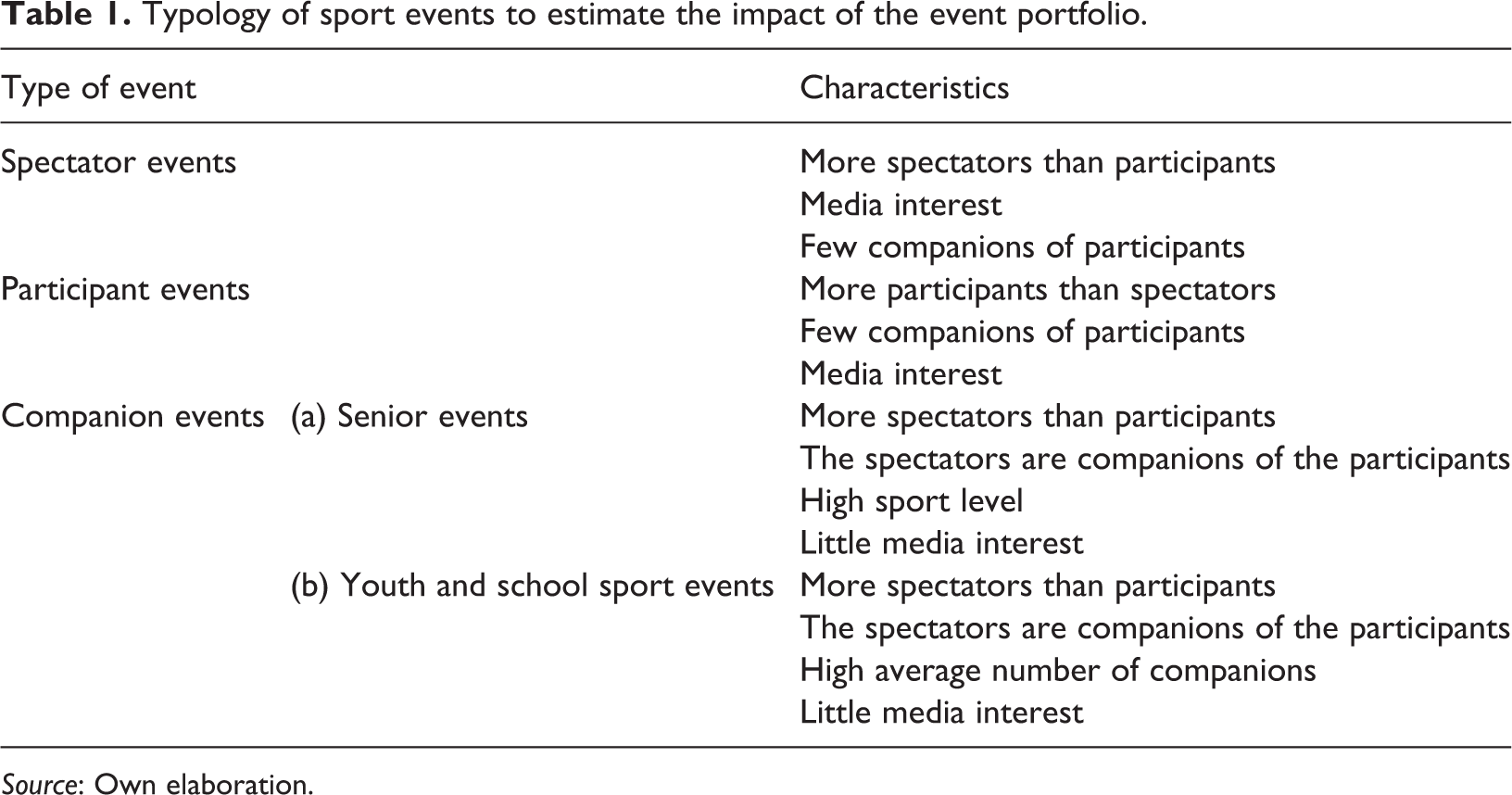
In addition, a new classification criterion is included to allow for a division of the event portfolio into three large groups. This criterion considers the key data required to extrapolate the economic impact of the events. As explained by Barajas et al. (2016), two of the critical key elements in estimating the economic impact are the number of spectators and their average expenditure. Thus, one of the key elements in the estimate is the average number of companions per participant. These data are used to estimate the number of spectators. Another key element is the average expenditure per visitors, which is used as a reference in tourism spending estimates in several of the portfolio events. Table 1 presents the three types of events that can be considered.
Typology of sport events to estimate the impact of the event portfolio.
Source: Own elaboration.
Selection of comparable events
Once the events in the portfolio have been classified, we select those for which to estimate the economic impact. The selected events are called “comparable events,” a term analogous to that of Damodaran (2002), Brealey et al. (2011), and Berk et al. (2012).
Once the comparable events have been chosen, a study of the economic impact of an event of each group is carried out. If the companion events are identified as senior events and youth and school sport events, it would be advisable to analyze one of each type. Thus, a maximum of four impact studies would be performed if all categories and subcategories were identified in the event portfolio.
Obtaining the necessary data for extrapolation
Once the economic impact studies of comparable events have been carried out, it is necessary to gather information from the rest of the events in the portfolio. The following information is required in each case.
Comparable events: Confidence interval of daily expenditure per person attending the event. Average days of stay in the territory for the event. Proportion of attendees with impact. This requires identifying resident and nonresident attendees. Time-switchers and casuals must also be identified within the group of nonresidents. Average number of nonparticipants attending the event.
Portfolio events: Spectator events: number of nonresident participants, estimated number of spectators in the event, and event duration (in days). Participant events or companion events: number of participants and days of event duration.
The variables related to expenditure are random variables. In that sense, it would be better to work with confidence intervals in order to reflect the uncertainty of these variables. Here, total expenditures for each event have been taken to estimate the confidence interval. Later, the interval for daily expenditure will be obtained, and from this value, the values for the portfolio events will be determined.
It is important to remark that the variables expenditure, number of companions, and days of stay are skewed to the left. In that sense, it is not possible to work with standard deviations in order to determine the confidence interval. The bootstrap technique proposed by Efron (1979) generates confident intervals that take into account the distribution of the data. The article will present the estimation of the minimum and maximum amount of money expected with 95% probability.
Estimation of the initial injection of money from the portfolio
Here, we present the formulas and the necessary steps to estimate the confidence interval of the initial injection of money using available data according to each type of portfolio event.

a. Estimation of the number of attendees with impact:
a.1. Participant or companion events:


a.2. Spectator events:

b. Average estimated days per stay:

where CE = comparable event.
To calculate the initial injection, equations (3) and (5) are replaced in equation (1) in the case of participant or companion events. The number of companions is estimated with formula (2). For spectator events, equations (4) and (5) are inserted into equation (1). The data for the average number of companions, the percentage of participants, and average daily expenditure correspond to the comparable event. In the case of spectator events, it is necessary to estimate the total number of spectators for the event.
The sum of the estimated injection of money from each event will allow us to identify the range of values of the total data for the portfolio.
Case study and empirical analysis
The methodology proposed in the previous section applies to the portfolio of events in the city of Pontevedra. This city has a population of 82,802 inhabitants, 1 and it has implemented a tourism and economic development strategy through the organization of sport events.
Using comparable events, this section estimates the initial injection of money into the economy for a population obtained with the biennium 2017–2018 event portfolio. The analyzed portfolio consists of 45 sport events (20 in 2017 and 25 in 2018). The process is explained as follows.
First step: Description and classification of portfolio events
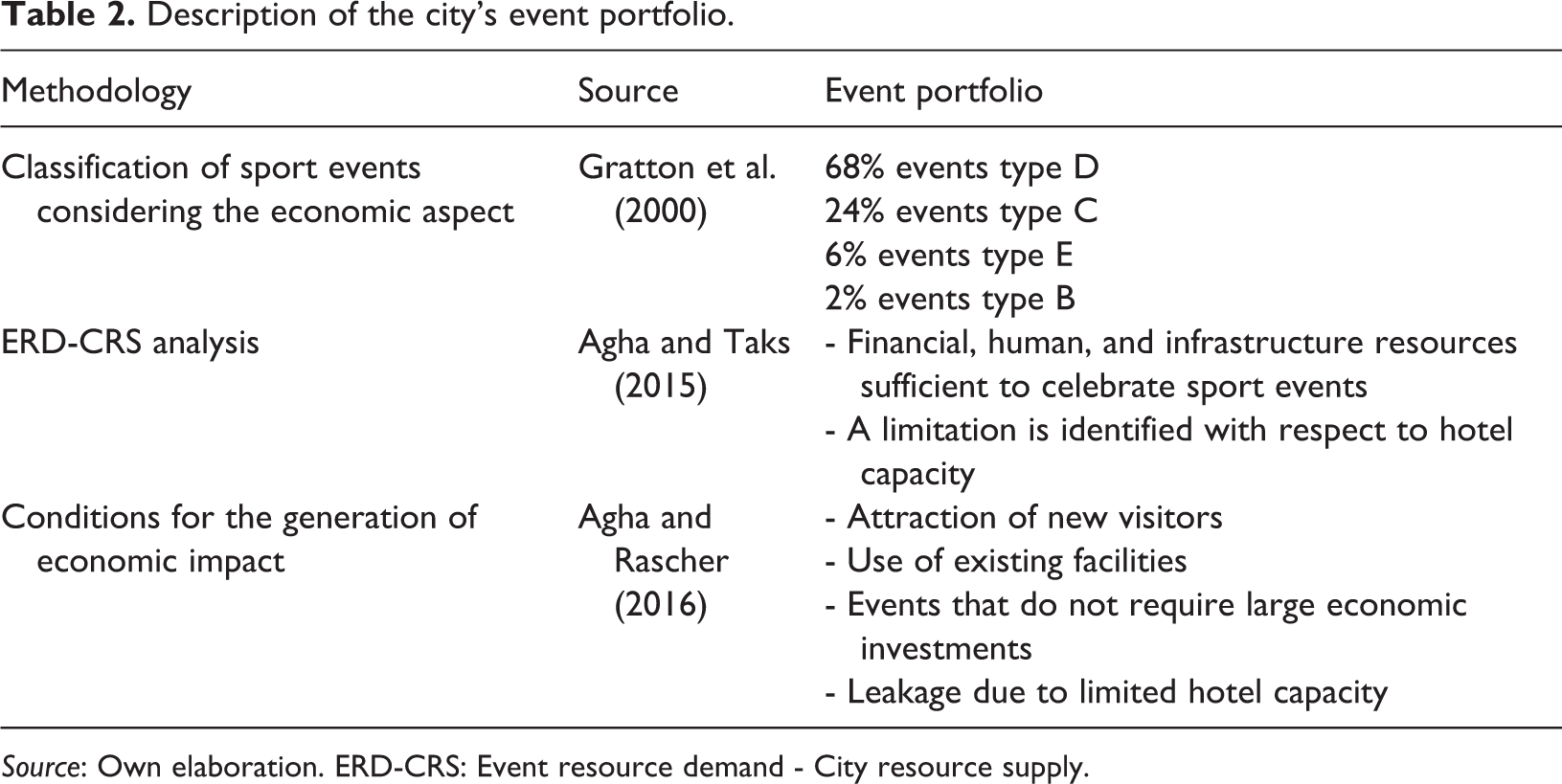
The majority (68%) of the events in the city’s portfolio belong to type D, 2 according to the Gratton et al. (2000) classification with the changes proposed by Barajas et al. (2012) and Wilson (2006). Type C events represent 24% of the portfolio, including championships, tournaments, and/or final international-league matches. Six percent of the portfolio consists of events at the regional or local level (type E) with less capacity to attract attendees and participants, and whose organizational objective is unassociated with the injection of money into the territory. The portfolio of events for a city of this size rarely includes type A and B events because these require large investments and are usually held in large cities. However, in this case of the Vuelta a España—a type B event—it passed through the city and represented 2% of the events in the portfolio.
Using the theoretical approach of Agha and Rascher (2016) and Agha and Taks (2015), we analyze the conditions that influence the economic impact of the city’s event portfolio (see Table 2). Once the portfolio is analyzed, we conclude that it complies with the conditions established in both articles, except for the case of income leakage. A part of the new income received on occasion of the event can be lost. This represents a deficiency in the city’s resources, specifically in the city’s hotel capacity. In this case, lodging options in the nearest cities have made the organization of the events possible. However, a leakage effect is generated from the part of the resources arising from attendees and nonresident participants. Some of these resources will remain in nearby cities, which have not had to assume any costs with respect to the organization of the event.
Description of the city’s event portfolio.
Source: Own elaboration. ERD-CRS: Event resource demand - City resource supply.
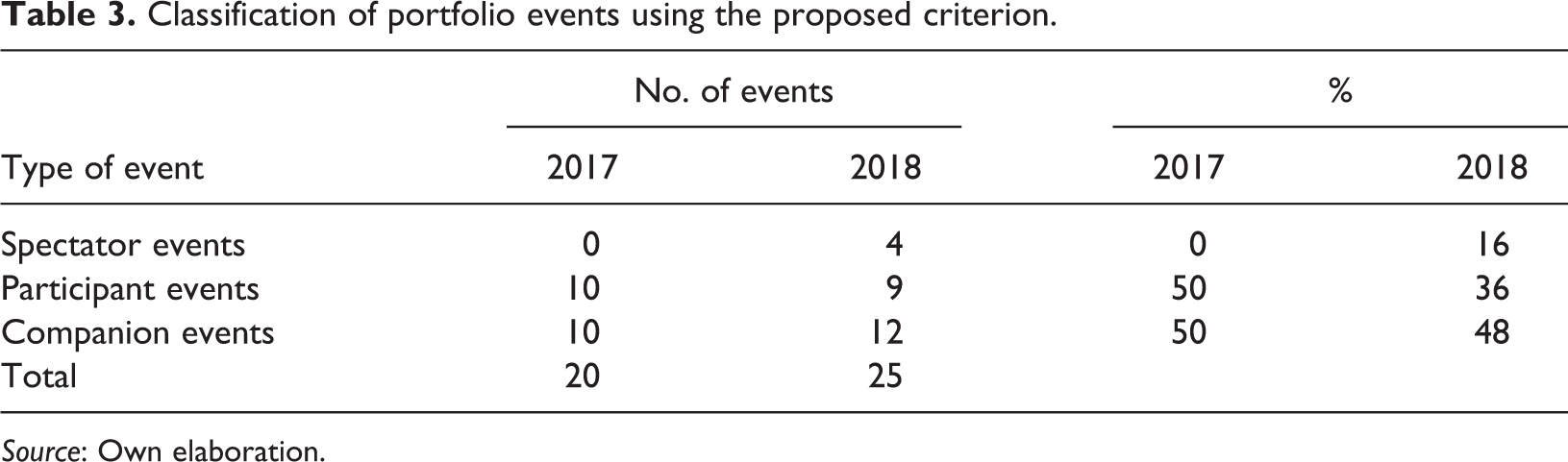
Once the characteristics of the portfolio are described, they are classified according to the groups summarized in Table 1. In this case, most of the events are companion events, followed by participant events (see Table 3). Spectator events, none of which were organized in 2017, take place to a lesser extent. In particular, the event portfolio included four final one-day tournaments or competitions in 2018.
Classification of portfolio events using the proposed criterion.
Source: Own elaboration.
Second step: Selection of comparable events
Three events are selected in the case under study to carry out impact studies. They are selected based on the proportion of the different types of events in the portfolio. An additional previous analysis of the Spanish Swimming Championship held in 2015 provides greater explanatory capacity to the study. No spectator events are studied because they have a secondary representation in the portfolio and their contribution to the overall impact of the portfolio is minimal.
Thus, four events are selected and economic impact studies are conducted for each of them. Based on the data obtained in these economic impact studies, we may estimate the initial economic impact of 84% of the events that the portfolio consists of. The four comparable events are described below:
– Spanish Master Swimming Championship (hereafter, Master Championship): a master category national championship (25 years old and older), spanning 4 days with a high number of participants. The average number of companions per person is lower than it is for youth and school category events.
– Spanish Senior Swimming Championship (hereafter, Senior Championship): a highly competitive event, spanning 4 days. Most of the spectators are relatives and friends of the participants. The average number of companions is lower than it is for the youth and school categories.
– Spanish Kickboxing Championship (hereafter, Kickboxing Championship): a multi-category event spanning 3 days. It attracts nonresident spectators, mainly the parents and relatives of the participants. The average number of companions is high.
– Spanish Regional Schools Basketball Championship (hereafter, Basketball Championship): an eliminatory event of a basic category, spanning 7 days. Attracts nonresident spectators, mainly participants’ family members. The average number of companions is high.
Regarding the data, 1123 surveys were conducted to study the income-generating capacity of the four events. Information was obtained concerning the expenditure made by those attending the event, as well as sociodemographic and tourism data. Based on these data, extrapolation was performed to estimate the injection of money from all of the events of the portfolio.
Third step: Obtaining the necessary extrapolation data
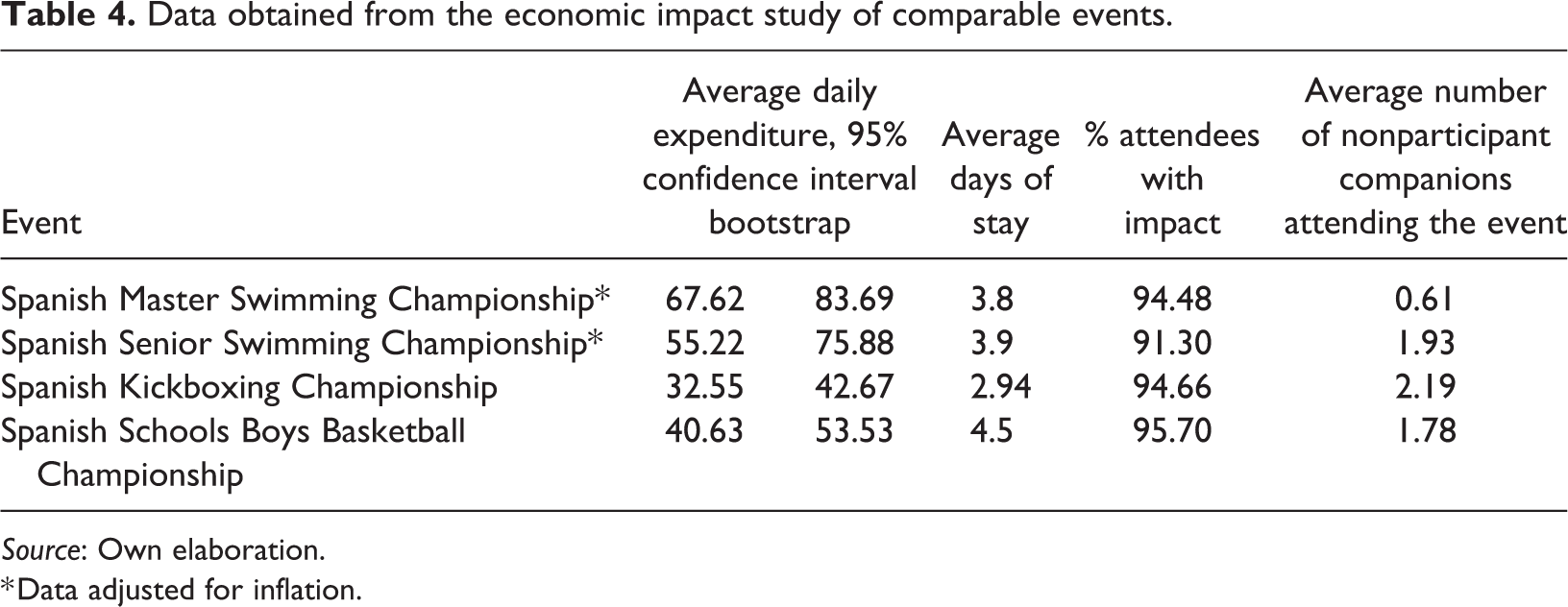
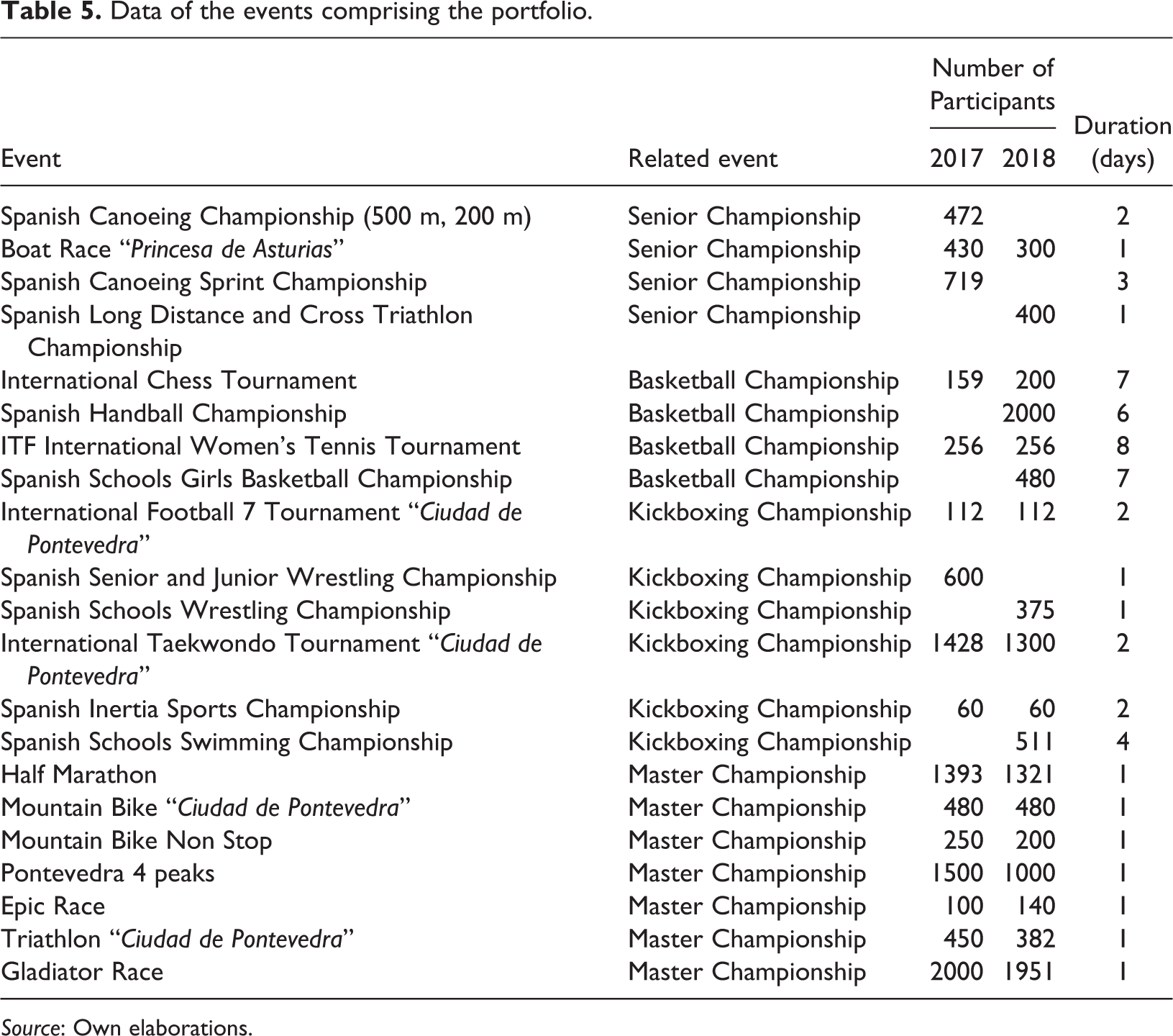
Following the proposed model, Table 4 shows the data obtained from the comparable events as well as the events of the portfolio (see Table 5).
Data obtained from the economic impact study of comparable events.
Source: Own elaboration.
* Data adjusted for inflation.
Data of the events comprising the portfolio.
Source: Own elaborations.
Fourth step: Estimating the injection of money
The number of event participants is used to estimate the range of money that can be attracted by the event portfolio. This figure is multiplied by the average number of companions for the comparable event, which allows for an estimation of the total number of companions. The sum of the number of participants plus companions is multiplied by the proportion of attendees with economic impact in the comparable event. Finally, the number of attendees is multiplied by the average expenditure of the comparable event and by the number of days according to the case.
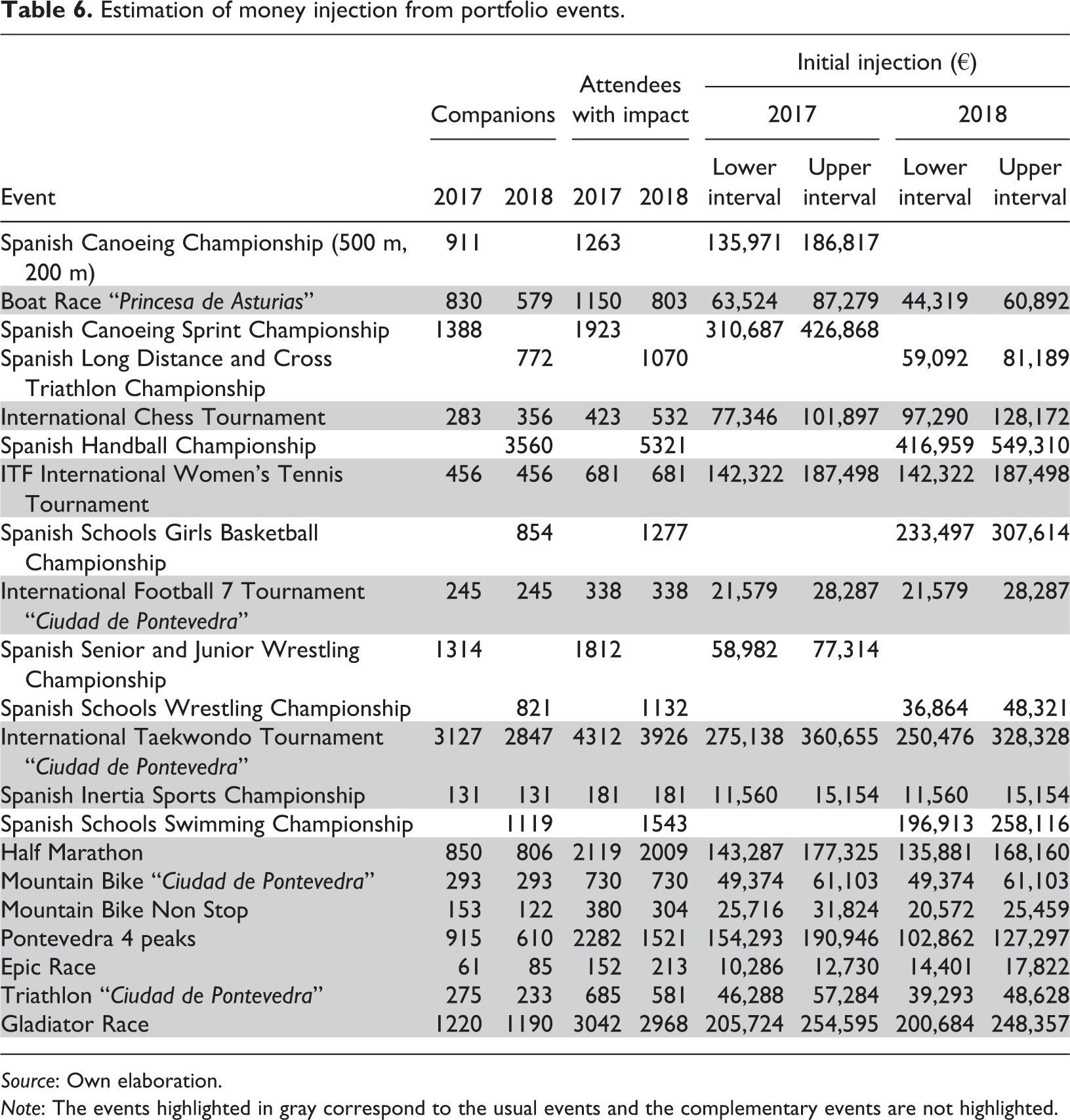
Table 6 presents the results of the interval for the initial money injection estimated for each event that makes up the portfolio. The first column shows the estimated data for the number of companions. These data added to the number of participants (data whose values are observed and thus are known with certainty) reflect the number of attendees with impact (shown in the second column). Finally, the results of the initial injection of money for each year (2017 and 2018) presented by spending intervals can be observed.
Estimation of money injection from portfolio events.
Source: Own elaboration.
Note: The events highlighted in gray correspond to the usual events and the complementary events are not highlighted.
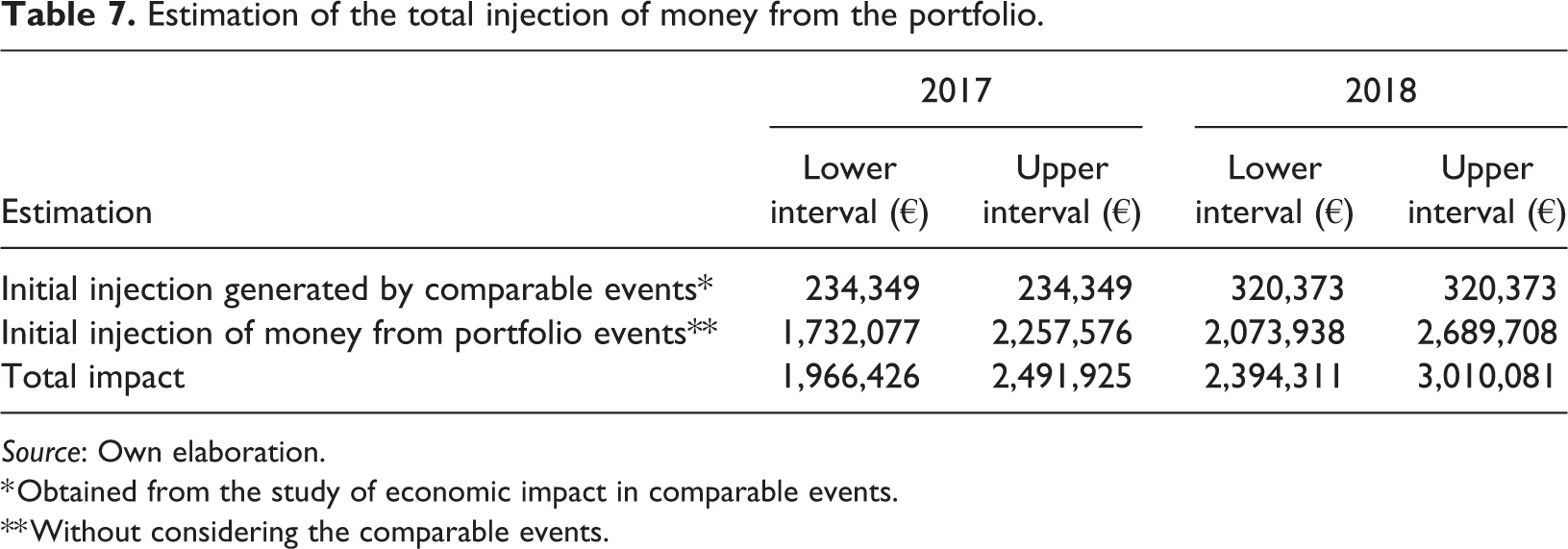
Table 7 presents the data corresponding to the sum of all the events included in the portfolio. In the first row, the initial injection of money generated by comparable events is included. These are data obtained from previous studies carried out on these events (the Spanish Senior Swimming Championship in 2017 and the Spanish Kickboxing Championship and the Spanish Schools Boys Basketball Championship in 2018). The second row of Table 7 shows the interval of initial money for the events portfolio. The injection of money generated by all events in 2017 can be estimated as between 2 and 2.5 million euros. On the other hand, in 2018, the estimation ranges between 2.4 and 3 million euros. The International Taekwondo Tournament City of Pontevedra and the Spanish Regional Handball Championship were the events that generated the highest money injection in 2017 and 2018, respectively.
Estimation of the total injection of money from the portfolio.
Source: Own elaboration.
* Obtained from the study of economic impact in comparable events.
** Without considering the comparable events.
Regarding the analysis of the results, it is interesting to identify events organized over the course of several years that may be considered habitual. These events account for 70% of the economic impact of the portfolio in 2017 and 54% in 2018. On the other hand, complementary events are those of a specific type that change venue. The usual events allow for direct revenue between 2.4 and 3 million euros (Table 6 events highlighted in gray). Complementary events generated direct revenue between 1.4 and 2 million euros across the analyzed period (Table 6 events not highlighted).
The city of Pontevedra ensures stable income by organizing a set of events consolidated on its calendar. It additionally opts for attracting complementary events that increase economic impact and draw new sports tourists into the area.
Although no previous studies have been carried out to estimate the economic impact of portfolios of events, some studies make estimates for medium-sized individual events. In this sense, it is increasingly common to use the Cost Benefit Analysis (CBA) methodology to estimate the economic impact of this type of event. Authors such as Porter and Fletcher (2008) and Taks et al. (2011, 2015) defend the application of that methodology because it allows for an estimation of the net benefit of the event for the host territory. Taks et al. (2011) use the CBA method to estimate the economic impact of the Pan-American Junior Athletic Championship. That event presented a total of 1694 attendees with impact, with an average day of attendance of 1.79 and an initial injection of money of 971,759 US dollars. Considering the type of event and the number of attendees with impact, it is comparable to events in the Pontevedra portfolio such as the Spanish Schools Swimming Championship or the Spanish Schools Girls Basketball Championship. Jimenez-Naranjo et al. (2016) estimated the economic impact of the World Paddle Tour 2013 in Cáceres, finding an initial injection of money generated by participants and attendees of 774,152.44 euros. This event can be comparable to the Spanish Handball Championship in relation to its ability to generate an injection of money into the host city.
Conclusions
This article conceptualizes sport-event portfolios and proposes a methodology to estimate the injection of initial money they can provide as a marketing tool to attract tourism to a city. It makes three contributions to the literature. First, the designed methodology simplifies the estimation of the generation of tourism income from the events of a portfolio. Secondly, it demonstrates its applicability in a real case, obtaining valuable information for local managers and event organizers. Finally, it performs an in-depth quantitative study of event portfolios, an aspect scarcely studied in the literature, and it provides novel findings.
A crucial component of the proposal is the development of an ad hoc event classification that includes three categories (spectator events, participant events, and companion events). This classification is based on the key elements for calculating the economic impact of the events. It allows us to estimate the economic impact of the events comprising the portfolio based on economic impact studies of a maximum of four sport events. This greatly simplifies the estimation of the economic impact of a portfolio, especially in the case of medium-size and small cities that lack the human or economic resources to carry out these types of estimations.
Another noteworthy distinction identified in the study is the interaction between usual portfolio events and complementary events. The portfolio is made up of a set of annual events that take place in the city and that are integrated into the calendar. These events have a stable economic impact. They are associated with the city brand (some events make use of the name of the city) and involve citizens in their development (volunteering). On the other hand, the portfolio is complemented by events attracted in a timely manner to the city. Seeking to attract new sports tourists, these types of events also aim to promote and increase the popularity of the city brand. This distinction responds to the proposal made by Ziakas (2014), who explains that all the events in the portfolio should reflect the diversity of gender, size, and season to attract a range of target markets.
Likewise, Buning et al. (2016), Daniels and Norman (2003), Downward and Lumsdon (2004), and Sato et al. (2014) identify elements of an event that significantly influence spending, such as the type of event, the number of participants, the size of the group, or the duration of the event. This reaffirms the importance of developing a classification that considers these particularities to extrapolate the economic effects obtained in one event to another event of similar characteristics.
In the case under study, the monetary injection of tourism revenues is estimated from the event portfolio in the city of Pontevedra throughout the 2017–2018 biennium. The total impact of the portfolio is estimated as between 2 and 2.5 million euros in 2017 and 2.4 and 3 million euros in 2018. In 2017, the event that generates the greatest money injection is a usual event of the portfolio (International Taekwondo Tournament City of Pontevedra), while in 2018 a complementary event surpasses the rest in its economic effects (the Spanish Regional Handball Championship). One limitation of this study is it is unable to calculate the direct economic impact because it has no data on the outflows of money produced by the different portfolio events. However, the most relevant data for the event organizers or local authorities are the income that is attracted, given that they control cash outflow.
It is a common practice in studies on the impact of sports events to consider just the average values, without considering uncertainty. In that sense, this article also contributes to the literature by considering confidence intervals instead of average values.
A series of conclusions may be drawn for the city under study. In line with what was pointed out by Buning et al. (2016), it is noteworthy to point out that portfolio events with a longer duration have generated a greater injection of money. This is especially the case of events with a high number of participants along with a high companion ratio. Another aspect that is identified in the estimation is that senior events have a lower average expenditure than master type or youth and school sport events. Buning et al. (2016), Chalip and McGuirty (2004), and Robinson and Gammon (2004) show that participants with a high level of competition (experienced amateur athletes and/or senior athletes) focus on the sport event and are less involved in complementary and touristic activities.
The previous analysis of the portfolio allows us to identify a limitation in the hotel capacity of the city, which generates flight leakage. The city assumes all the expenses of the event, but part of the economic benefits escape to surrounding areas. Daniels (2007) had already reflected this problem, explaining that the possibility of a leakage effect is greater in small territories. When surrounding cities organize sport events, they suffer the same leakage effect. For this reason, a short-term solution implies an increase in cooperation and coordination between cities that would permit them to work with an annual event portfolio to maintain active tourist spending throughout the year. In addition, coordination between cities could prevent overlapping events and thus improve the management of hotel availability.
Another noteworthy point concerning the portfolio is the lack of events of greater interest to the media. These types of events respond to the characteristics of spectator events. The presence of this category is minimal in the case of a city’s event portfolio. Moreover, they are one-day events that hardly attract nonresident spectators. A good option involves adding the participation of local first-division teams to the portfolio. This includes broadcasting the matches and the presence of the city brand in the media.
To the best of our knowledge, no previous work in the literature estimates the economic impact of event portfolios. This shortcoming influences strategic portfolio planning. In this sense, qualitative analyses highlight that the main strategic challenges of event portfolios include the ability to maintain relationships and networks (Kelly and Fairley, 2018); conflicting interests and a lack of connection of the arts, culture, and sport (Clark and Misener, 2015); and incoherent strategic objectives and/or the absence of strategic planning (Van, 2017; Ziakas and Costa, 2011a). Establishing appropriate strategies requires knowledge about the economic resources generated by events. This, in turn, provides essential data for planning for such issues as the outflow of resources to other territories, knowledge on tourists’ spending behavior, the identification of the most efficient types of events, or the generation of negative effects (leakage of money and the crowding out effect).
The concepts and estimates of the study provide tools for tourism managers and promoters of events to strategically plan the configuration of portfolios. It allows us to estimate and analyze the tourist expenditure of visitors. Thus, it becomes valuable information to improve the management and organization of events. In addition, it is useful in establishing control measures because we may now compare the impact of different events and identify the most efficient ones.
Footnotes
Declaration of conflicting interests
The author(s) declared no potential conflicts of interest with respect to the research, authorship, and/or publication of this article.
Funding
The author(s) disclosed receipt of the following financial support for the research, authorship, and/or publication of this article: This article is an output of a research project implemented as part of the Basic Research Program at the National Research University Higher School of Economics (HSE).
