



Abstract
This study revisits the question of whether tourism development is an additional determinant of income or works through other standard income determinants. Both a panel data analysis from 2006 to 2015 and a cross-sectional country average analysis reveal that the incremental effect of tourism is significantly positive, suggesting that tourism is an additional determinant of income. Further analyses show that the income effect of tourism is contingent on some country characteristics: the positive income effect of tourism mainly appears in countries with weak policies or institutions for environmental sustainability or with better quality of overall infrastructure. These findings help enhance the understanding of the significant contribution of international tourism to the economic growth worldwide. The implication is that the governments of destination countries should fully support tourism development.
Introduction
Regarding the relationship between tourism and economic growth, the tourism-led growth (TLG) hypothesis (TLGH) argues that there is a positive association between tourism expansion and economic growth. Most empirical evidence is consistent with the TLG hypothesis (Fayissa et al., 2008; Ivanov and Webster, 2007; Marsiglio, 2015; Narayan et al., 2010; Payne and Mervar, 2010; see alsorefer to Brida et al., 2016; Pablo-Romero and Molina, 2013 for relevant literature review). Recently, Du et al. (2016, p. 455 ) raised the concern that the model in the previous literature only “helps estimate the association between tourism development and economic growth, but does not help in understanding the economic mechanism underlying the association.”
Specifically, according to economics theory, economic growth is driven by standard income determinants such as capital accumulation. Thus, research on the relationship between tourism and growth should clarify whether tourism is an additional income determinant of economic growth or affects economic growth through the existing standard income determinants. Du et al. (2016) propose a model including both standard income determinants and tourism to examine whether tourism is an additional income determinant. However, their investigation using country average data over the period from 1995 to 2011 did not find significant results. Therefore, the conclusion is that tourism is not an additional income determinant and tourism’s contribution to economic growth comes through the standard income determinant of capital formation.
The question raised by Du et al. (2016) is important as the answer will lead to different policy indications. For example, if tourism is an additional income determinant, governments should set policies to encourage the expansion of the tourism industry without any reservations (Dritsakis, 2012). Otherwise, if the effect of tourism on economic growth works through other standard income determinants, governments’ support to tourism industry should aim at improvements in other standard income factors (Du et al., 2016). Therefore, the question deserves further attention. In addition, with globalization, technology development, and tourism expansion, the time might be ripe to further explore the income role of tourism.
The export-led growth hypothesis (ELGH) postulates that expanding exports can lead to economic growth if other factors remain constant, for example, the amount of labor and capital within an economy (Balassa, 1978). The revenues generated by tourists from abroad can be considered equivalent to enhancing exports (Balaguer and Cantavella-Jorda, 2002). Therefore, this study conjectures that international travel and tourism expansion can play a similar role as expanding exports and should contribute to economic growth in addition to other standard income determinants within the economy.
To empirically test this conjecture, this study follows the model in Du et al. (2016), which adopted a generalized model originally introduced by Solow (1956). Both a panel data analysis from 2006 to 2015 and a cross-sectional country average analysis revealed that the incremental effect of tourism is statistically positive, indicating that tourism directly contributes to per capita gross domestic product (GDP) in addition to other standard income determinants.
The extant literature also suggests that the effect of tourism on economic growth is contingent on country characteristics (Antonakakis et al., 2019; Tang and Tan, 2017). The further analyses in this study examine whether and how certain country characteristics moderate the income effect of tourism. The results show that the income effect of tourism is contingent on policies or institutions for environmental sustainability and overall infrastructure.
The rest of this article is organized as follows. The second section reviews literature on TLG hypothesis. The third section introduces main factors and the baseline model in this study. The fourth section describes the data and reports the analysis results. The final section concludes this article with discussions and policy implications.
TLG hypothesis
The literature documents that export-oriented policies provide identical incentives to sales in both domestic and foreign markets and thus lead to more efficient resource allocation. More efficient resource allocation allows for greater capacity utilization and permits the exploitation of economies of scale. In addition, international competition can stimulate technological improvements, and the incremental demand for export products can help increase employment. Based on these observations, Balassa (1978, p. 181) hypothesizes “that export-oriented policies lead to better growth performance than policies favoring import substitution.” This hypothesis is called the ELGH.
In cross-border tourism, the destination economies sell domestic products and services to foreign tourists, which can be considered equivalent to exports of products and services (Durbarry 2004). Therefore, as a special case or an analogy to the ELGH, the TLGH claims that tourism development has a positive impact on economic growth (Balaguer and Cantavella-Jorda, 2002; Lanza and Pigliaru, 2000).
The importance of testing the TLGH has attracted considerable research, and reputable academic journals had published more than 100 empirical articles by 2013 (Brida et al., 2016). The majority of these studies found a positive association between tourism development and economic growth. Among them are individual country or regional studies, for example, the study of Greece (Dritsakis, 2004), Spain (Balaguer and Cantavella-Jorda, 2002; Perles-Ribes et al., 2017), Taiwan (Kim et al., 2006), Hong Kong (short-run but not long run, Jin, 2011), Malaysia (Tang and Tan, 2015), Turkey (Gunduz and Hatemi-J, 2005; Ongan and Demiroz, 2005), and Kenya (Njoya and Seetaram, 2018); or cross-country (regional) studies, for example, the study of the 4 Pacific Island countries (Narayan et al., 2010), 23 OECD countries, and 32 non-OECD countries (Chao et al., 2019; Lee and Chang, 2008), the top 10 tourist destinations (Shahzad et al., 2017), 7 major Mediterranean countries (Dritsakis, 2012), 21 Latin American countries (Eugenio-Martin et al., 2004), 144 countries (Cárdenas-García, Sánchez-Rivero, and Pulido-Fernández, 2013), and multiple regions in China (Wu and Wu, 2018; Zuo and Huang, 2018).
There are some recent extensions to the TLGH-related studies. For example, some studies try to clarify the causality between tourism development and economic growth (e.g. Dogru and Bulut, 2018; Sokhanvar et al., 2018; Wu and Wu, 2019), and some explore the moderating effects of certain country-level characteristics, such as income and political stability, on the association between tourism and economic growth (e.g. Tang and Tan, 2017). Du et al. (2016) extend the TLGH literature to a new direction by investigating whether tourism development is an additional determinant of income in the presence of standard income determinants. This study moves along the direction of Du et al. (2016) and also incorporates several important country-level characteristics not researched in the previous literature.
Model description and main factors
In Solow’s long-run growth model (1956), growth is realized by two factors of production, that is, capital and labor, and available technology that determines the economic output per worker. The Cobb–Douglas production function uses the following equation (1) to describe the relationship

where GDP i is the GDP of the country i, CAP i is its capital, POP i is its population, Ai is its productivity, and υ i is a random disturbance term. As in Du et al. (2016), productivity is a function determined by educational attainment (Hall and Jones, 1999) and research and development (Romer, 1990). Straightforward mathematical treatment and substitutions produce the following model

Equation (2) can test the direct effect of the standard income determinants such as capital formation and technical progress. To empirically test the direct contribution of tourism to economic growth, this study follows Du et al. (2016) and uses a generalized model as follows:

Measurement of education, R&D, and tourism
Years of schooling, investment in education, and literacy are used in the literature to measure educational development (Brint and Clotfelter, 2016; Duncan and Murnane, 2016; Lleras-Muney and Shertzer, 2015). Years of schooling or investment in education measures the input to education, while literacy measures the output of education. Since the input to education might be affected by various factors in the process of education, it is the output of education rather than the input to education that contributes directly to productivity. Becker and Woessmann (2009, p. 547) study the impact of human capital on economic prosperity and suggest that “[a]s a measure of educational outcome, literacy may be a more informative measure of accumulated human capital than standard enrollment data, which may partly capture years in school that did not lead to effective educational outcomes.” Other studies (Black et al., 2015; Dinkelman and Mariotti, 2016; Ferrant, 2015; Margo, 1986) also adopt literacy to capture educational achievement. Therefore, this study uses the adult literacy rate as a proxy for educational attainment.
The literature uses both research input (R&D) and output (patent) to measure innovation. The results from the two measures are different as the ratio of research input to output (the patent-R&D ratio) has changed substantially (Kortum, 1993). A number of studies use successful patent applications to measure the output of innovation (Ang and Madsen, 2015; Cui et al., 2017; Czarnitzki and Toole, 2011; Lampe and Moser, 2013; Moser, 2005; Wei et al., 2017). Following these reports, this study uses the number of successful patent applications to measure the output of research and innovation as a proxy for technology.
As in the previous literature (Alderighi and Gaggero, 2018; Carmignani and Moyle, 2019; Chen, 2016; Du et al., 2016; Gao et al., 2019; Gunduz and Hatemi-J, 2005; Nepal et al., 2019; Santana-Gallego et al., forthcoming; Yang et al., 2019), this study uses the number of international tourist arrivals as the measure of tourism activity. Although some studies also use international tourism receipts (current US$) to measure tourism activity, international tourism receipts might be less informative than international tourist arrivals because international tourists can create non-dollar or intangible effects. International tourism receipts might also have a multicollinearity problem with other variables such as capital formation. Moreover, tourist arrivals are robust measures and easier to ascertain than tourism receipts (Khalid et al., 2019). In addition, the data on international tourist arrivals are available for a larger number of countries over the sample period. Therefore, this study adopts international tourist arrivals to measure tourism activity.
“Tourism development grows not independently but in conjunction with other economic policies.” “It is dependent on efficient infrastructure…and it is dependent on a government and civil society that supports places that attract people both as residents and tourists” (Du et al. 2016, p. 460). For example, a well-developed highway system will benefit tourism development, economic growth, and the income effect of tourism. It is natural to ask whether tourism has a similar impact on economic growth in countries with well-developed highway systems versus countries with poorly developed highway systems. In other words, it is necessary to examine the moderating effect of some country-specific characteristics. The further analysis section examines three moderating factors, namely policies or institutions for environmental sustainability, overall infrastructure, and corporate ethical behaviors. These factors are considered because they are closely related to the development of the travel and tourism industry and have attracted recent interest from researchers and practitioners in this area. The detailed discussions are presented below.
Policies and institutions for environmental sustainability
The U.N. World Commission on Environment and Development (1987, p. 814) defines sustainable development as “meeting the needs of the present without compromising the ability of future generations to meet their own needs.” Sustainable development would be a “process of change in which the exploitation of resources, the direction of investments, the orientation of technological development, and institutional changes are made consistent with future as well as present needs (Brundtland report, 1987, p. 25).”
In general, tourism industries in various countries are positively responding to sustainable development (D’Amore, 1993). The destination image is identified as an important determinant of sustainable tourism (Line et al., 2018). Recent studies provide various suggestions and practice solutions to enhance destination images and promote sustainable tourism (Dansa and Gonzálezb, 2019; Dolnicar et al., 2019; Garay et al., 2019; Ivanov et al., 2018; Su and Swanson, 2017). He et al. (2019) also suggest that governmental support is important for sustainable tourism.
Infrastructure
The literature documents that public infrastructure is a determinant of economic growth and productive performance, but the magnitude and significance of this contribution are controversial (Holtz-Eakin, 1994; Hulten and Schwab, 1984; Nadiri and Mamuneas, 1994). Transport infrastructure affects the attractiveness of a country to international tourists (Eugenio-Martin, 2016; Provenzano, 2015; Seetanah and Khadaroo, 2009), and public transport connectivity attracts tourists from different travel distances (Yang et al., 2019). Roehl et al. (1993) also find that areas with highly developed highway systems obtain more revenues from tourists.
Corporate ethics/ethical behaviors of firms
Ethical behavior is defined by Sims (1992, p. 506) as behavior “which is morally accepted as ‘good’ and ‘right’ as opposed to ‘bad’ or ‘wrong’ in a particular setting.” Ethical behaviors of firms are affected by firm-level factors such as personal and organizational values and are also strongly affected by country-level factors, including the social, cultural, legal, political, and institutional environment (Bartels, 1967; Ekici and Onsel, 2013; Vitell et al., 1993).
The literature suggests that ethical behaviors lead to the best results for all internal and external stakeholders (Malloy and Fennel, 1998; Nguyen et al., 2019; Su and Swanson, 2019). Empirical evidence suggests that ethical behaviors can enhance a company’s image (e.g. Kim et al., 2017; Lee et al., 2018; Power et al., 2017), improve the quality of life within host communities (e.g. Choi et al., 2016; Kim and Ham, 2016; Tolkach et al., 2017), and facilitate the development of tourism, responsible-sustainable tourism in particular (e.g. Arnaudov and Koseska, 2012; Jovičić and Sinosich, 2012; Mihalic, 2016). Recently, tourism policies in many countries have started to include ethical behavior toward nonhuman animals, which is thought to benefit a destination’s sustainable economy (e.g. Sheppard and Fennell, 2019).
Data and empirical results
The data used in this study are from the World Development Indicator database or the Global Competitive Index (GCI) database (refer to the Online Appendix for a detailed description of variables and data sources).
This study analyzes unbalanced panel data from 2006 to 2015. The sample period is based on the data availability because some data from the GCI only starts from 2006. The panel data analysis can control for both country effect and time effect (Narayan et al., 2010; Petersen, 2009). The baseline model is specified as follows

where ln GDP is the natural logarithm of the per capita GDP, ln Tour is the natural logarithm of the number of international tourist arrivals, ln Capital is the natural logarithm of the per capita gross capital formation, ln Patent is the natural logarithm of the number of patent applications, and ln Literacy is the natural logarithm of the adult literacy rate (% of people ages 15 and above).
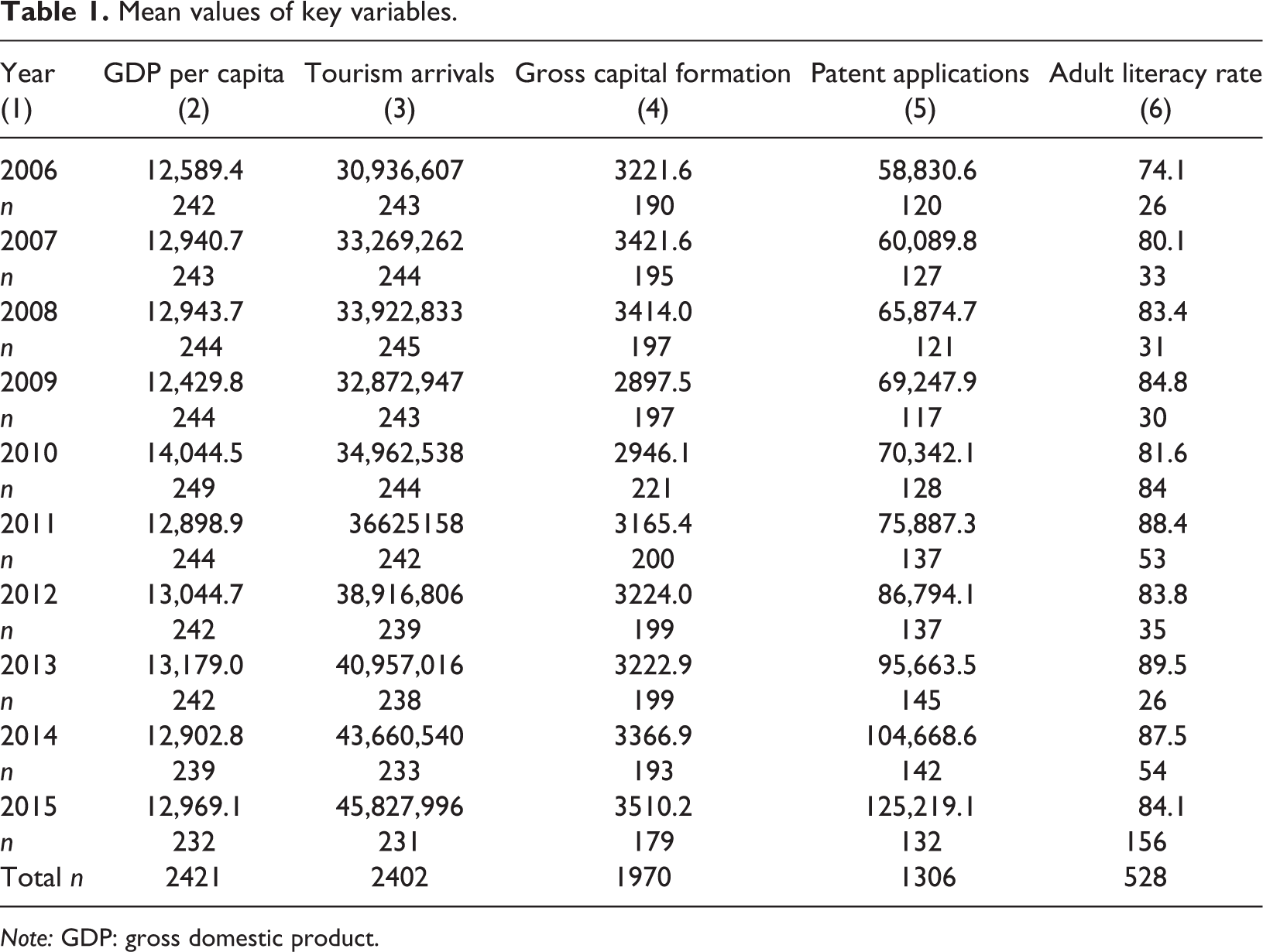
Table 1 presents the mean values of the key variables over the sample period in this study. In general, the number of international tourism arrivals shows an increasing trend over the sample period. This suggests that more people are willing to travel internationally and the tourism industry is growing over time. The last row reports the total number of observations for each variable over the sample period. The analyses below exclude the country–years with missing data for certain variables.
Mean values of key variables.
Note: GDP: gross domestic product.
Table 2 presents the countries examined in this study and the mean scores of the possible moderating factors over the sample period for each country. The countries with missing data are excluded from some of the analyses.
Country and average scores of environmental sustainability, overall infrastructure and corporate ethics.

Columns (1) and (2) in Table 3 report the estimation results controlling for both country fixed effect and year fixed effect in the panel data from 2006 to 2015. The model in column (1) has an adjusted R 2 of 95.95% and all of the independent variables are significant at the 1% level, indicating that the model is well-defined with a high explanatory power. The positive coefficient of ln Tour suggests that tourism has an incremental income effect on the per capita GDP even when the standard income determinant of capital formation is present. The model in column (2) includes all of the variables, but the number of observations decreases dramatically due to the small number of observations for the adult literacy rate variable (see Table 1 for details). All of the variables remain significant at the 5% or 1% level and the coefficient of ln Tour remains positive. Column (3) reports the ordinary least square (OLS) estimation results using the cross-sectional data averaged over the sample period. All of the variables remain significant and the signs of the coefficients are the same as in column (2). 1
Regression results.

Note: The regression in model (1) and model (2) are estimated using unbalanced panel data for countries from 2006 to 2015. Numbers in parentheses in model (1) and model (2) represent t-statistics that are adjusted using standard errors corrected for country fixed effect and year fixed effect. Model (3) is cross-sectional regression using the country average data over the period of 2006–2015. Numbers in parentheses in model (3) represent t-statistics corrected for heteroskedasticity.
*** Statistical significance at the 1% level.
** Statistical significance at the 5% level.
* Statistical significance at the 10% level.
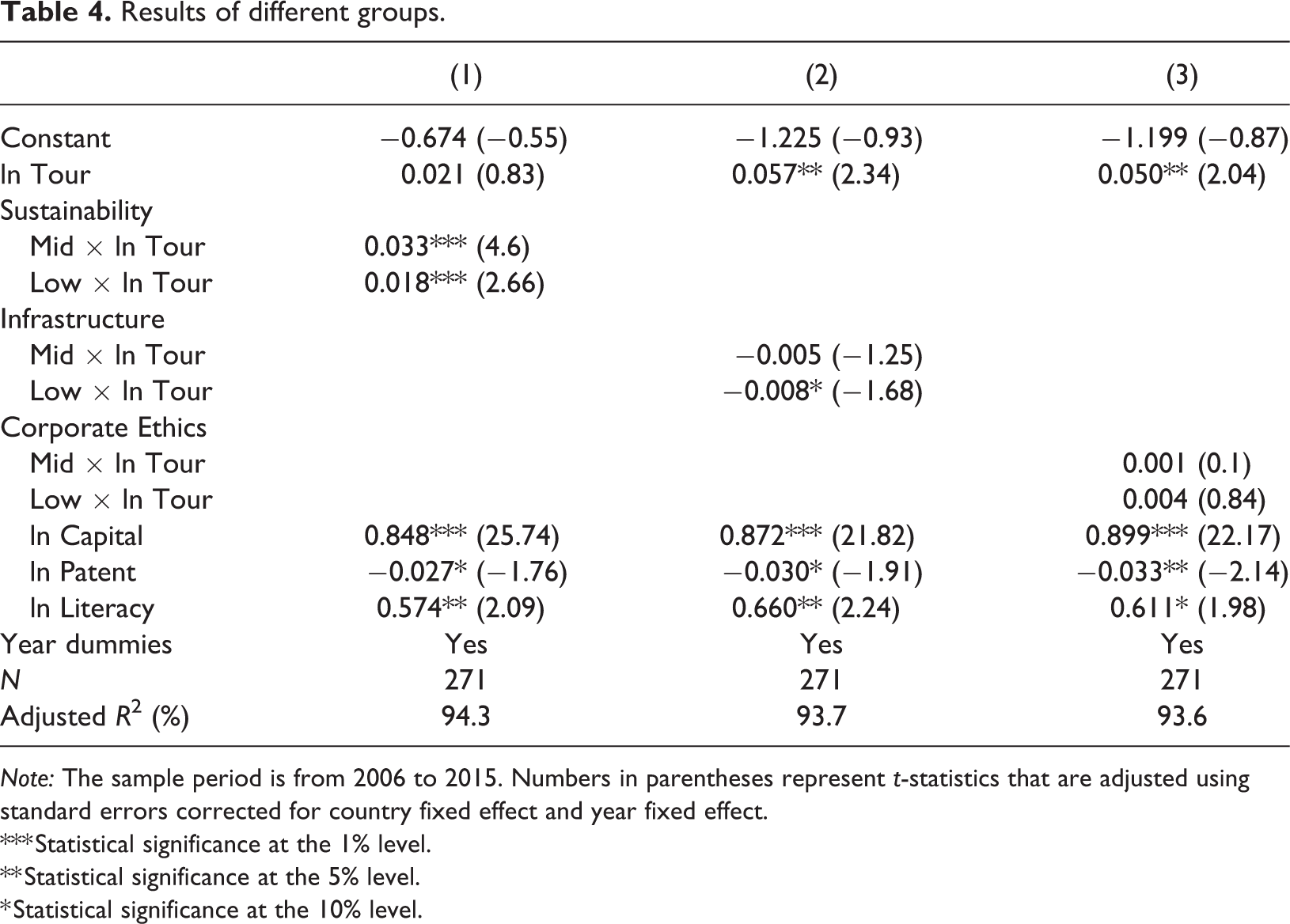
To examine the possible moderating effect of policies or institutions on environmental sustainability, overall infrastructure, and corporate ethical behaviors, this study follows the methodology in Tang and Tan (2017) and uses dummy variables to classify countries into groups of (a) low, middle, and high sustainability; (b) low, middle, and high infrastructure; and (c) low, middle, and high ethics. The sample countries are first ranked in descending order. The high (low) group consists of the top (bottom) 25% and the remaining 50% lie in the middle group. Then we add the interaction between these group dummy variables and the tourism variable into the baseline model of equation (4) and estimate the following regression

where Mid (Low) is a dummy variable that equals 1 if a country lies in the middle (low) group in terms of policies or institutions for environmental sustainability, overall infrastructure, and corporate ethical behaviors alternatively, and 0 otherwise. All of the other variables are as defined in the baseline model.
Column (1) in Table 4 shows that the coefficients of the two interaction terms (or the mid/low-sustainability groups) are significantly positive but the coefficient of the ln Tour variable or the reference group (high-sustainability group) is not significant. This indicates that the positive income effect of tourism mainly comes from countries with less strict or weak policies or institutions for environmental sustainability. In column (2), the coefficient of the interaction term (Low × ln Tour) is significantly negative at the 10% level and the coefficient of the ln Tour variable or reference group (high-infrastructure group) remains significantly positive. This suggests that the positive income effect of tourism mainly comes from countries with better infrastructure quality. In column (3), the coefficients of the two interaction terms (or the mid/low groups) are not significant, but the coefficient of the ln Tour variable or the reference group (high group) is significantly positive. This indicates that the effect of tourism on economic growth is not sensitive to business ethics. In other words, business ethics does not seem to be a significant moderating factor on the income impact of tourism.
Results of different groups.
Note: The sample period is from 2006 to 2015. Numbers in parentheses represent t-statistics that are adjusted using standard errors corrected for country fixed effect and year fixed effect.
*** Statistical significance at the 1% level.
** Statistical significance at the 5% level.
* Statistical significance at the 10% level.
Discussion and conclusions
This study attempts to empirically test the important question raised by Du et al. (2016, p. 454): “if tourism development is an additional determinant of income in the presence of the standard income determinants (such as capital accumulation), or if the effects of tourism development on economic growth work through the standard income determinants?” This study finds that international tourism has a significantly incremental effect on per capita GDP while controlling for other standard income determinants on growth. These findings answer Du et al.’s (2016) question affirmatively and help enhance the understanding of the significant contribution of travel and tourism to economic growth as summarized below: Travel & Tourism as one of the world’s largest economic sectors, supporting one in 10 jobs (319 million) worldwide and generating 10.4% (US$8.8 trillion) of world GDP. In 2018, the Travel & Tourism industry also experienced 3.9% growth, compared to the global economy (3.2%). One in five new jobs were created by the industry over the last five years.(WTTC, 2018)
Along the direction in some studies (Antonakakis et al., 2019; Tang and Tan, 2017), this study also investigates whether and how some important country-level characteristics moderate the association between tourism development and economic growth. Further analyses find that the positive additional income effect of tourism mainly occurs in countries with less strict policies or institutions for environmental sustainability or with better quality of overall infrastructure. These findings contribute to the literature on tourism and economic growth by providing new empirical evidence that the association between tourism and economic growth, especially tourism as an additional determinant, is contingent on country-level features.
This study aims to provide several implications and suggestions to policy makers and practitioners in the travel and tourism industry. First, international tourism can directly contribute to GDP in addition to other economic activities in the production-oriented sectors within an economy. Or to put it in another way, governments’ direct commitment to help the tourism industry can serve as a new engine to boost GDP. This view can be the theoretical foundation for policy makers. For example, tourism is one of the most important sectors in Hong Kong’s economy and the majority of tourists are from Mainland China or entering Hong Kong across some cities in Mainland China. To facilitate travel between Hong Kong and Mainland China, a bridge connecting Hong Kong and Mainland China has been built even though the bridge cost billions of dollars. From the perspective that tourism can be an extra engine to boost Hong Kong’s economy, the investment in the bridge may be a wise decision for the long-run growth of Hong Kong’s economy.
Second, the direct effect of tourism on economic growth may enhance governments’ or local authorities’ willingness to allocate more resources to the tourism industry. Subsequently, how to maximize the income effect of tourism would be a necessary and imminent task on the agenda of governments across the world. The findings of this study shed light on potential approaches to efficient resource allocation in tourism. For example, to attract more international tourists and effectively induce the income effect of tourism, the governments of destination countries should strengthen investment in transport infrastructure. A well-developed transportation system in destination countries is definitely an advantage.
Third, this study finds that tourism has no significant impact on economic growth in countries with strict policies or institutions for environmental sustainability, while tourism has a positive impact on economic growth in countries with middle or weak policies or institutions for environmental sustainability. This finding suggests that environmentally sustainable development is a long-term mission and may conflict with the short-term goal of tourism development and economic growth. Tourism activities may adversely affect the environment due to overcrowding, waste generation, depletion of wildlife, damage to vegetation, and unfair trade practices (Su and Swanson, 2017). Governments and tourism industries in many countries promote green tourism, and researchers and practitioners also endeavor to find effective ways to develop pro-environmental tourism (Dolnicar et al., 2019). For example, destination image, destination social responsibility, various marketing strategies, and communication with tourists contribute to tourists’ environmentally responsible engagement (e.g. Line et al., 2018; Ivanov et al., 2018; Su and Swanson, 2017). Countries with strong tourism industries are also able to perform well in environmental protection (Bojanic and Warnick, 2019).
In countries with stricter policies or institutions for environmental sustainability, governments and practitioners in tourism tend to invest more resources in developing green, sustainable, and environmentally friendly tourism, and thus their environment and other tourism resources will be well-protected and developed. Therefore, tourism as additional driver will contribute more to the long-run economic growth in these countries. How sustainable tourism affects long-run economic growth remains an avenue for further research.
This study provides a preliminary step toward understanding the additional impact of tourism on economic growth but has unavoidable limitations. For example, some measures are not adopted because the data are not available for some countries. The scope of this study is limited to cross-country investigation of several country-level characteristics. Individual country (regional) investigations and other country (regional) factors/characteristics may deserve future attention.
Supplemental Material
Supplemtnary-Appendix - Revisiting tourism’s additional impact on income
Supplemtnary-Appendix for Revisiting tourism’s additional impact on income by Tina T He and Wilson XB Li in Tourism Economics
Footnotes
Acknowledgements
We are very grateful to Albert Assaf (Editor) and the three anonymous reviewers for the constructive comments and insights. All remaining errors are our own.
Declaration of conflicting interests
The author(s) declared no potential conflicts of interest with respect to the research, authorship, and/or publication of this article.
Funding
The author(s) received no financial support for the research, authorship, and/or publication of this article.

Supplemental material
Supplemental material for this article is available online.
Note
References
Supplementary Material
Please find the following supplemental material available below.
For Open Access articles published under a Creative Commons License, all supplemental material carries the same license as the article it is associated with.
For non-Open Access articles published, all supplemental material carries a non-exclusive license, and permission requests for re-use of supplemental material or any part of supplemental material shall be sent directly to the copyright owner as specified in the copyright notice associated with the article.
