



Abstract
Tourism growth is on the rise in Africa, and yet limited empirical evidence exists that explores the factors that drive this important contributor of economic growth on the continent. Previous literature focuses mainly on developed countries. This study weighs in on the recent debate on African tourism by providing evidence on the role that economic uncertainties have on tourist arrivals. Using panel data from 1996 to 2017, we find that economic uncertainties reduce tourist arrivals in Africa in comparison to other global regions, such as Europe. Further disaggregation by African regions reveals that economic uncertainties in West and North African regions drive these adverse results. These regions have been the hardest hit by political instability and social unrest during the period under review, which may have acted as a deterrent to tourists.
Introduction
Over the past decades, tourism has been gaining more relevance in both developed and developing countries as its contributions to economic growth become more evident. According to Brida and Pulina (2010), tourism can stimulate investments in new infrastructure and human capital, stimulate productivity in other economic industries through direct or indirect spill-over effects, create employment opportunities and cause positive economies of scale for hotels. Evidence also suggests that small economies are fast growing when they specialise in tourism activity (Brau et al., 2007). However, economic and political crises, such as financial crises, partisan disputes and social unrest in countries can also raise concerns about the transmission of policy uncertainties in several key sectors of the economy, including tourism.
While tourism may already be fully established in many developed countries, its potential is only starting to gain momentum in Africa. The tourism industry plays an increasingly important role in Africa, with close to 67 million tourists visiting the continent. Yet, in comparison to the rest of the world, Africa’s 2018 market share of tourist arrivals at 5% remains considerably small. Furthermore, only 1% of the US$1.7 trillion earnings in the tourism industry is attributed to Africa (Kimeria, 2019). Given the numerous development benefits that tourism can bring to a country, it is necessary to understand the economic, political and social dynamics that can progress or delay growth in the tourism industry.
This study relates to two strands of the literature. The first is related to the determinants affecting tourism demand (Dragouni et al., 2016; Lim, 1997; Seetaram et al., 2016; Song et al., 2012), and the second weighs in on the recent debate on African tourism by providing evidence on the role that economic uncertainties can play on tourism (Balli et al., 2018; Ghosh, 2019; Gozgor and Demir, 2018). Using a panel of 143 countries over the period 1996–2017, we make two contributions: (i) we conduct a comparative analysis of Africa with other global regions to identify the regions that are most affected by economic uncertainties and (ii) we focus on a within comparative analysis to identify the regions that may be contributing to Africa’s tourism challenges. We find that globally, economic uncertainty in Africa is significant in reducing the number of tourist arrivals, while the effect is positive in European regions. Within Africa, we find that uncertainty in West and North African regions reduces tourist arrivals, while uncertainty in the central and east regions has positive outcomes. The findings suggest that economic uncertainty in Africa may be a deterrent to tourists which can have serious economic implications in destination countries that rely on tourism revenues.
The rest of the article is organised as follows. We summarise the related literature in the second section and position our study within the existing literature. We discuss the data and methodology in the third section and report the results in the fourth section. We conclude with some recommendations in the fifth section.
Related literature
Tourism is acknowledged as having positive effects on long-run economic growth through various channels. Revenues from tourism increase foreign exchange earnings which can subsequently be used to pay for imports used in local production processes (Brida and Pulina, 2010). Tourism also facilitates the transfer of skills through business tourists seeking opportunities in the destination country. Moreover, tourism activities can stimulate other industries, for example, increased flow of holiday tourists can incentivise local government to improve infrastructure and security to encourage more tourists. Apart from revenue generation, other benefits that accrue from the tourism industry include employment creation, private sector growth for small to medium local enterprises and increased supply of goods and services needed by tourism-related businesses (Lee and Chang, 2008). Tourism has also become an important contributor to economic development in developing countries by providing a more steady income stream, through low-skilled and labour-intensive tourism services, than the revenues from natural resource extraction (Levantis and Gani, 2000). Nevertheless, such benefits to the country are threatened when economic policy uncertainties arise in the economy.
The literature widely concurs that economic uncertainties in countries can have adverse effects on the tourism industry by discouraging tourists, thereby reducing national income and investment. For example, increases in economic uncertainty can affect consumer spending behaviour by making people reluctant to travel abroad and discouraging businesses from investing in the affected destination country (Gozgor and Demir, 2018). Using multiple and partial wavelet analysis on a sample of Organisation for Economic Co-operation and Economic Development (OECD) countries from 1997 to 2017, Balli et al. (2018) find that the impact of global economic uncertainty on tourism flows is stronger during the peak periods of economic uncertainty such as the 9/11 attacks or the global financial crisis in 2008. The authors further observe that domestic economic uncertainty in these countries has significant negative effects on tourist inflows. Evidence from Gozgor and Demir (2018) for 17 countries between 1995 and 2015 shows that people are inclined to decrease their expenditures abroad when they experience an increase in uncertainty-related economic policies. According to Ghosh (2019), both political and economic uncertainty adversely affected the tourism industry in France, Greece and the United States during the period 1995 to 2016. Moreover, Tekin (2015) finds that the tourism industry in Russia was negatively affected by the political instability between the European Union (EU) and Russia in 2014 and 2015. Interestingly, Marsiglio (2016) conducts an analysis on the implications of crowding aversion and tourism aversion in the face of uncertain tourist inflows. The author finds that when people are crowd-averse (crowd-lovers), uncertainty leads to deterioration (improvement) in economic performance of tourism destinations.
Another strand of literature examines the interrelation between risk and uncertainty in tourism. Risk-averse tourists tend to visit well-known, highly developed destinations with a history of strong tourist flows and low levels of uncertainty, while tourists with high-risk affinity will consider destinations less travelled by other tourists with high levels of uncertainty involved (Karl, 2018; Roehl and Fesenmaier, 1992). These risks can be financial, for example, tourists may choose less expensive destinations during economic hardship (Raaij and Francken, 1984); or social, for example, tourist destinations in Europe are perceived safer compared to Africa (Carter, 1998); or physical, for example, risk from violence (Sönmez and Graefe, 1998); or health-related, for example, risks linked to foreign foods abroad or spread of disease (Carter, 1998; Larsen et al., 2007). Similarly, Gholipour and Tajaddini (2014) find that uncertainty avoidance, among other cultural dimensions, affect the spending behaviour of tourists.
Survey results from Quintal et al. (2010) show that the Japanese sample of tourists had less uncertainty in visiting Australia than the Chinese and South Korean sample, mostly because the Japanese sample of tourists had greater travel experience, were less risk-averse and came from a more individualist culture. Furthermore, a survey on visitors to Cape Town’s Table Mountain National Park finds that the uncertainty of revisiting the tourist attraction associated with the risk of crime increased with visitor’s age but varied with the purpose of visit (George, 2010). Visitors that were either on holiday or conducting business in Cape Town perceived the Park as safer than those that were visiting friends and relatives, most likely because the relatives or friends would have pre-warned their visitors about the crime incidences.
Despite the available evidence in the literature on economic uncertainties and tourism, several gaps are identified. First, most of the empirical literature focuses on developed countries with limited evidence on developing countries, especially in Africa which is experiencing increasing tourism growth. Second, the empirical analysis reviewed makes use of the economic policy uncertainty index by Baker et al. (2016) which only covers 21 countries to date, none of which are from Africa. Third, with the increasing interest in Africa as a tourism destination, more attention needs to be drawn to understanding the potential tourism risks and uncertainties that may affect people’s decisions to travel abroad, and hence impact on economic development in Africa. In this regard, we address these gaps by taking a regional perspective on tourism in Africa and assessing the effects of economic uncertainty on tourist arrivals, using a relatively new measure on world uncertainty by Ahir et al. (2018). This focus remains an underexplored theme in the African tourism context.
Data and methodology
We use a panel of 143 countries over the period 1996 to 2017 to estimate the following model:

where Y is either the number of tourist arrivals in a country or international tourist receipts at current US$. Both variables are provided by the World Development Indicators. The main explanatory variable uncertainty is the world uncertainty index developed by Ahir et al. (2018). The index is computed by counting the frequency of the word uncertainty (or its variant) in the Economist Intelligence Unit (EIU) country reports. The EIU reports discuss major political and economic developments in each country, along with analysis and forecasts of political, policy and economic conditions. The index is normalised by total number of words and rescaled by multiplying by 1000. A higher number means higher uncertainty. We convert the quarterly indices to annual data.
The variable X is a vector of control variables which includes income per capita and population obtained from the World Development Indicators. We also include a globalisation index for openness compiled by Dreher (2006) and updated by Dreher et al. (2008). The globalisation index combines three key components of globalisation (political, economic and social globalisation) into a weighted index ranging from 0 to 100. The index captures international flows of goods, capital, businesses, people, technology, information and the presence of international organisations. A final control variable captures political instability in a country through conflict. The conflict variable is taken from the Major Episodes of Political Violence (MEPV) and Conflict Regions (Marshall et al., 2018) and measures the intensity of conflicts based on number of directly related deaths. Episodes are scaled from 1 (low intensity) to 10 (high intensity). 1 All variables are logged except the uncertainty and conflict indices.
Country and year fixed effects are captured by the α and δ, respectively. We use the fixed effects (FE) method that has been suggested in literature for estimating heterogeneous panels that are large in cross section and large in time series. The FE method gives more efficient estimates because it allows for unobserved country and time differences through individual specific effects, such as historical and colonial background, ethnic and religious composition, thus minimising economic and statistical endogeneity. The method pools the time-series data for each group and allows the intercepts to differ across the groups. We also use robust standard errors to deal with potential presence of heteroscedasticity and serial correlation which can result in biased estimates and inferences.
To further reduce the potential bias that may come from economic endogeneity in the form of reverse causality, we estimate a model with lagged explanatory variables. The lagged terms also allow us to model a delay in the responsiveness of tourist arrivals or receipts to changes in the determinants during the period under review. While we acknowledge that uncertainty is surrounded by epistemic issues related to tourism other than arrivals and receipts, we are limited by the availability of annual data and suitable modelling approaches to pursue these issues. For example, this research relies mostly on econometric modelling that is based on the inherent randomness of a given phenomena. However, uncertainty could also refer to vagueness or imprecision of speech, and other modelling approaches would be required, such as fuzzy logic.
A descriptive overview of the data in Figure 1 reveals some interesting trends across the regions. Despite the Asian financial crisis in the late 1990s and the global financial crisis in 2008, economic uncertainty in Asia has been relatively stable with a steady increase in tourist arrivals. Uncertainty in Africa has been on the rise with a sharp spike from 2010 as a result of the Arab Spring in North Africa and increasing civil unrest from terrorist organisations in West Africa. The number of tourist arrivals in Africa, though increasing over time, also seem to have slowed down during this same period of high economic uncertainty. Tourism in Europe recovered from the 2008 global financial crisis and has been on the rise, even with the recent Brexit deal contributing to increased economic uncertainty in the region. The economic uncertainties in the American region took a sharp turn for the worse with the 2001 September 11 attacks, as well as the 2008 global financial crisis. Similarly, the tourist arrivals also decreased during these periods of instability. However, the tourist arrivals have been increasing over time. Economic uncertainty in the Middle East increased drastically between 2011 and 2015 mainly due to the Syrian civil war spilling over into Lebanon, and the Iraqi civil war. We also observe an associated decrease in tourist arrivals during this period.
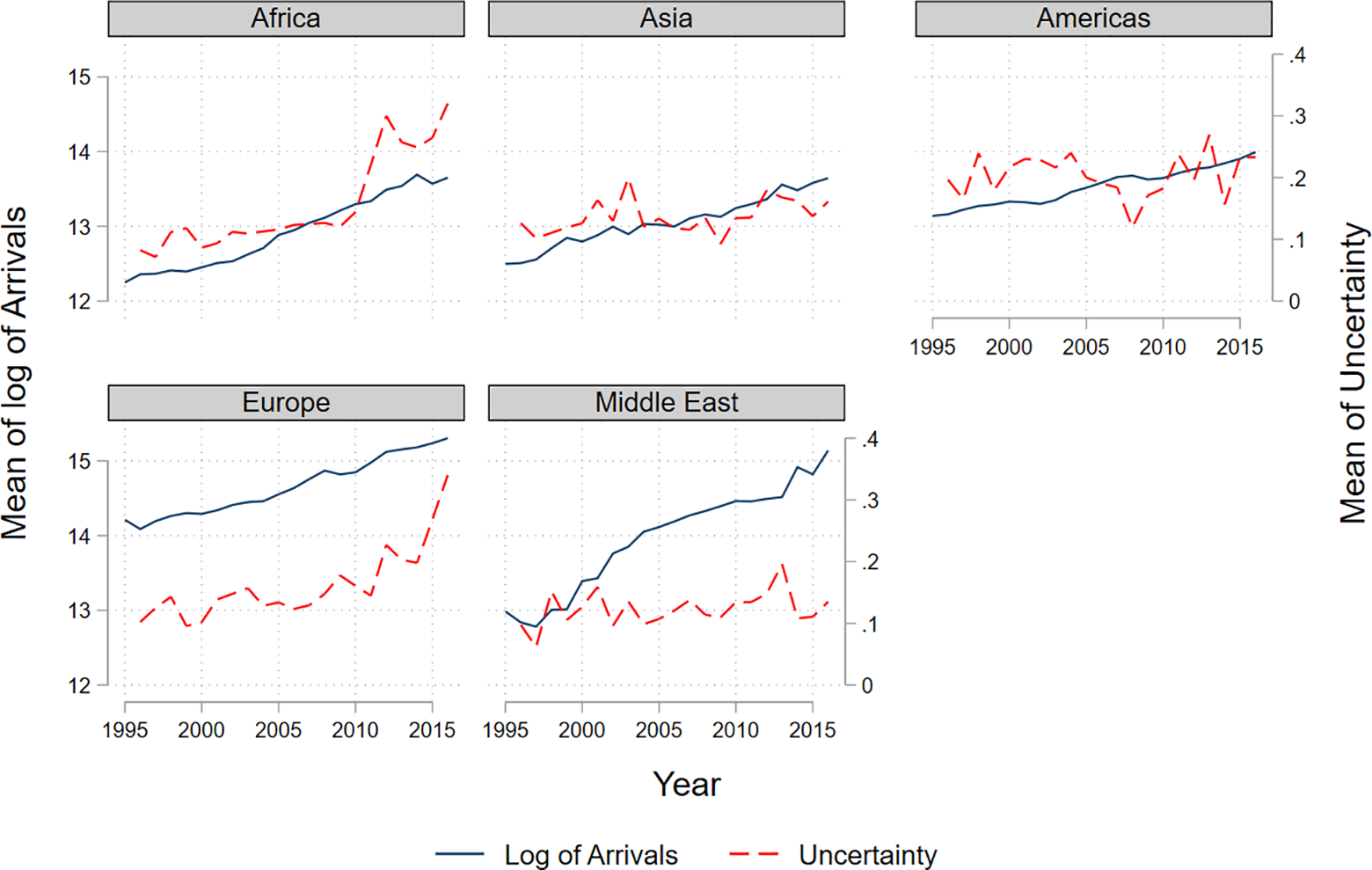
Regional Tourist Arrivals and Uncertainty.
Results
Baseline analysis
The results in Table 1 show the effect of uncertainty on tourist arrivals. Column 1 reports that the average outcome of uncertainty on tourist arrivals is negative for the world, but it is not significant. The results in Column 2 compare Africa with other regions by interacting the uncertainty measure with the different global regions. 2 The effect of uncertainty is compared across regions using the interactions with the Americas as the reference region. For example, the interaction term for Africa is the differential effect of uncertainty on tourist arrivals for Africa relative to the Americas. We find some heterogeneity across regions for the effect of uncertainty on tourist arrivals relative to the Americas: (1) Europe is positive and significant at a 10% significance level, (2) Middle East is positive but not significant and (3) Asia and African regions are both negative and significant at a 10% and 1% level, respectively.
Tourist arrivals: Global regions comparisons and within Africa regions comparisons.

Note: FE: fixed effect. Coefficients reported. Robust standard errors in parentheses. Results for interaction terms in Column 2 are in comparison to the Americas region and results in Column 4 are in comparison to North Africa region.
*p < .10, **p < .05, ***p < .01.
The positive effect for Europe suggests that this region is a commonly visited irrespective of the economic uncertainty. As of 2016, 51% of the international tourist arrivals and 36% of the international tourism receipts were recorded in Europe (Maria-Irina, 2017). The continuous flow of visitors to Europe could be driven by the integration of European countries (EU) that makes movement within Europe easier with a common visa and currency as well as reducing intra-European travel costs with cheaper regional flights. The 2019 World Economic Forum report also notes that Europe remains the most competitive global region in terms of leading travel infrastructure and price competitiveness (Calderwood and Soshkin, 2019). Moreover, apart from key big players in the European tourist industry, such as Spain, Italy, France, the United Kingdom and Germany, 3 the small Mediterranean islands around Europe are also major tourist attractions (e.g. Madeira Portugal, Ibiza Spain, Santorini Greece, Hvar Croatia, to name a few). According to Schubert et al. (2011), small islands rank high in contributions of tourism activity in their economies.
According to Choy (1998), disparities within the Asia-Pacific region exist making growth in tourism uneven. For example, while improved non-stop flights have made it easier for business travellers to travel to Asia, previous gateways, such as Bangkok, Hong Kong, Japan and Singapore may become bypassed as inconvenient stop-overs thus reducing tourist receipts from business travellers. The region also faces challenges in environmental sustainability with several countries, such as Mongolia, China and Cambodia, suffering from high air pollution, low levels of wastewater treatment, endangered wildlife and forest loss (Calderwood and Soshkin, 2019). In addition, increased visa requirements in Sri Lanka, Singapore and Taiwan, as well as low safety and security in Pakistan have contributed to a decrease in tourist arrivals and receipts in the Asia-Pacific region (Calderwood and Soshkin, 2019).
There are several factors that attract tourists to certain destinations, such as natural resources, the environment and the historical and cultural heritage. Although these attractions are abundant in Africa, they appear not to be enough to offset the adverse effects of economic uncertainty on tourism in African destinations. The interacted term in Column 2 shows that uncertainty significantly reduces tourist arrivals in Africa. Economic uncertainty in Africa is usually associated with some form of political instability which may explain tourists’ reluctance to visit the region during the period under review. According to the 2019 World Economic Forum report, Africa has shown improvement in the average travel and tourism competitiveness index since 2017. However, North Africa still faces challenges with terrorist-related safety and security. Similarly, sub-Saharan Africa continues to face difficulties in poor infrastructure, poor health and hygiene (Calderwood and Soshkin, 2019), and uncompetitive pricing in flight tickets and airport charges. 4
Given the negative results for Africa, we focus our attention on the continent in Columns 3 and 4 of Table 1. The African sample comprises of 42 countries. The results in Column 3 confirm our previous findings from the global interactions that economic uncertainty reduces tourist arrivals in Africa. In Column 4, we compare the effect of economic uncertainty across the regions in Africa. We find that economic uncertainty in Central and East Africa increases tourist arrivals at a 1% significance level relative to North Africa (the reference region), while the results for West and Southern Africa are positive but not significant. The eastern region has embarked on extensive publicity campaigns to improve the image of the region with Kenya, Tanzania, Uganda and Rwanda in the forefront of tourism development. 5 The unique tourist attractions, such as the wildlife in numerous national parks and game reserves (e.g. the renowned Serengeti National Park in Tanzania), are also big drawing cards in Central and East Africa.
Table 2 reports the effects of economic uncertainty on tourist receipts. The findings remain similar to Table 1. The average outcome of uncertainty on tourist receipts is negative for the world and significant at a 1% level in Column 1. Economic uncertainty also significantly increases tourist receipts in Europe at a 10% level but significantly decreases tourist receipts in Africa at a 1% level and Asia at a 10% level relative to the Americas. Moreover, we find that economic uncertainty reduces tourist receipts in Africa at a 5% level of significance. Within Africa, the outcomes for Central and East Africa remain positive and significant at a 1% level relative to North Africa, while the effect of economic uncertainty on tourist receipts is now significant at a 5% level for West and Southern Africa, though the coefficients are relatively smaller compared to the other two regions. According to the 2019 World Economic Forum report, East Africa’s advantages over West and Southern Africa in sub-Saharan Africa come from natural resources and better travel and port infrastructure. Poor tourist services infrastructure and worsening health conditions have contributed to lower tourism competitiveness in West and Southern, Africa respectively (Calderwood and Soshkin, 2019). 6
Tourist receipts: Global regions comparisons and within Africa regions comparisons.
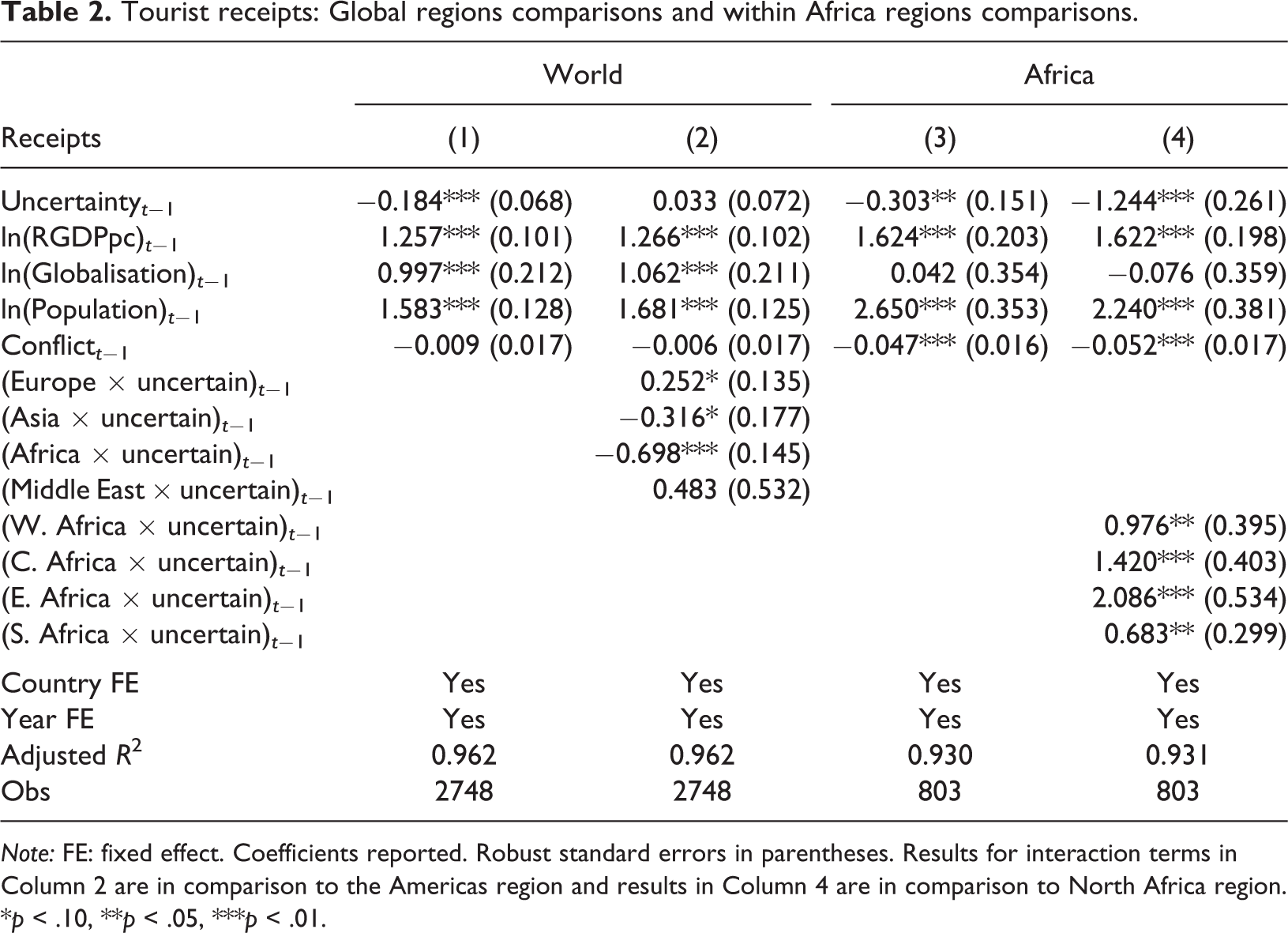
Note: FE: fixed effect. Coefficients reported. Robust standard errors in parentheses. Results for interaction terms in Column 2 are in comparison to the Americas region and results in Column 4 are in comparison to North Africa region.
*p < .10, **p < .05, ***p < .01.
Several implications can be drawn from these findings. The first is that global regions can be characterised by different types of economic uncertainties, and as a result are perceived differently by tourists. In Europe, the economic uncertainty is usually financially driven which may affect relative prices making goods cheaper in Europe, or travelling to Europe less expensive, and hence increase tourism. For example, the depreciation of the Russian Ruble was expected to decrease tourist flows to European destinations that were more expensive to visit between 2014 and 2015 (European Travel Commission, 2014). In Africa, economic uncertainty is usually institutional (e.g. related to political instability) making tourists wary of travelling there due to security issues. Despite a destination being frequented often, violence against tourists can have detrimental effects on tourism, as Egypt experienced in the 1990s (Neumayer, 2004). According to Carter (1998), tourists’ responses from interviews on travel destinations revealed Africa as a risky place to visit due to health concerns, in particular the lack of good health care, as well as a perceived lack of social stability. Similarly, Asia was seen as a risky tourist destination due to cultural differences and health concerns from consumption of food or water. Europe was however defined as a safe place with a low risk of danger (Carter, 1998).
Another implication is that economic uncertainty in one country can have different spill-over effects to neighbouring countries. On the one hand, Tekin (2015) provides evidence that the political tension between the EU and Russia created opportunities for tourism in Turkey in 2014. On the other hand, Balli et al. (2018) notes that the recent uncertainty surrounding the Brexit deal has raised concern about tourism flows to the United Kingdom. In Africa, Maphanga and Henama (2019) show that the emergence of the Ebola virus in West Africa was associated with the entire continent and decreased the competitiveness of Africa as a tourist destination during that period. The ongoing instability in the Middle East has affected not only the countries in conflict (e.g. Syria, Israel) but also those countries that never actively participated in the conflicts (e.g. Cyprus, Greece) (Mansfeld, 1994).
The results for the control variables in both tables indicate consistent significant findings. Income per capita, globalisation and population increase both tourist arrivals and receipts, while conflict negatively affects tourism. Development in the tourism industry is associated with national income expansion (Ghosh, 2019; Gozgor and Demir, 2018; Vietze, 2011). Richer countries can invest more in their tourism industry, such as improving infrastructure, which attracts tourists. Evidence by Vietze (2011) also shows that people from countries with higher incomes per capita spend more money on outbound tourism.
Globalisation has benefited the tourism industry through increased foreign direct investment flows, workforce migration and transfer of skills from business tourists (Brida and Pulina, 2010; Vietze, 2011). Not only is globalisation associated with openness to trade goods and services but also openness to different cultures and people. As such, countries with more open societies attract more tourists. Tourism demand is also driven by population growth, particularly by elderly people who have more leisure time (Brida and Pulina, 2010). According to the World Tourism Organization, population growth is expected to generate substantial expansion in international travel (World Tourism Organization and European Travel Commission, 2010).
Conflict is a deterrent to tourists as it signals poor quality of institutions (i.e. legitimacy of government is undermined), raises security concerns, disrupts service delivery in tourism-related industries, causes destruction of infrastructure and attraction sites and creates inflationary prices and negative exchange rates. Basically, conflicts mitigate the positive effects of tourism on economic growth. In addition, the negative image of a tourist destination due to incidences of violence can persist long after the conflict has passed (Neumayer, 2004). On the other hand, Vietze (2011) finds that people who live in democratic countries will spend a higher share of income on travelling abroad because they are confident that their property and relatives will still be safe on their return.
Robustness analysis
As a robustness check, the sample of countries was split into regional subsamples. Table 3 reports the individual results of the global regional subsamples. Table 4 reports the African regional subsamples. We find that the results and overall conclusion for Africa remain relatively consistent with the initial results where economic uncertainty in Africa is negatively and significantly associated with tourist arrivals at a 1% level of significance.
Tourist arrivals: Subsamples for global regions comparisons.
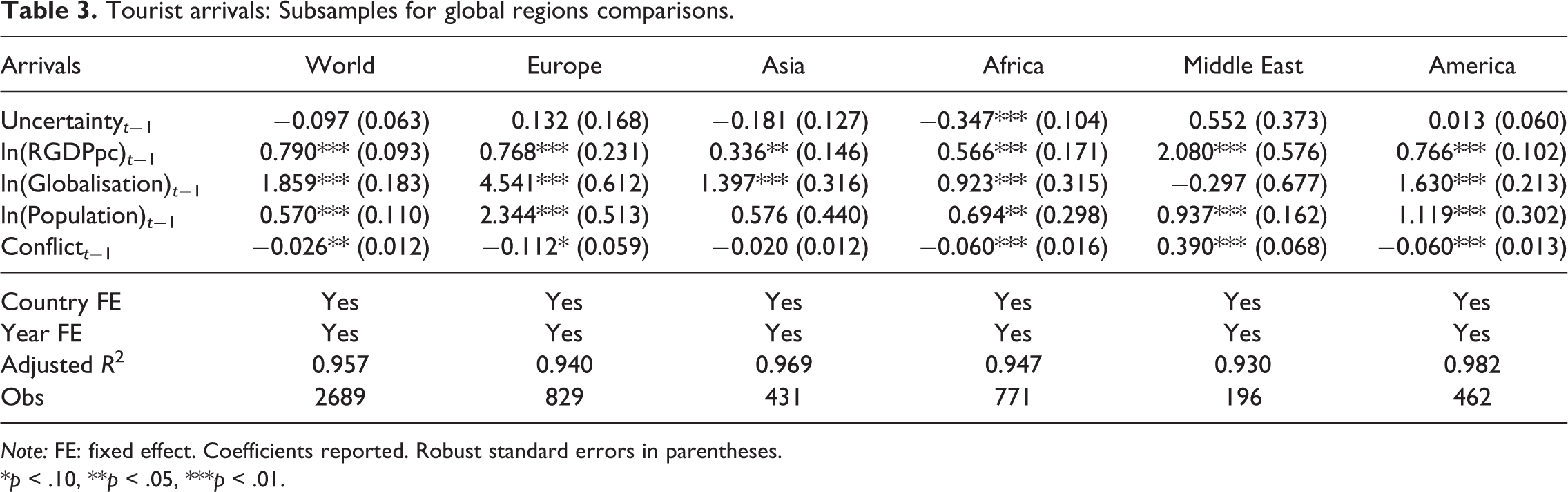
Note: FE: fixed effect. Coefficients reported. Robust standard errors in parentheses.
*p < .10, **p < .05, ***p < .01.
Tourist arrivals: Subsamples for within Africa regions comparisons.
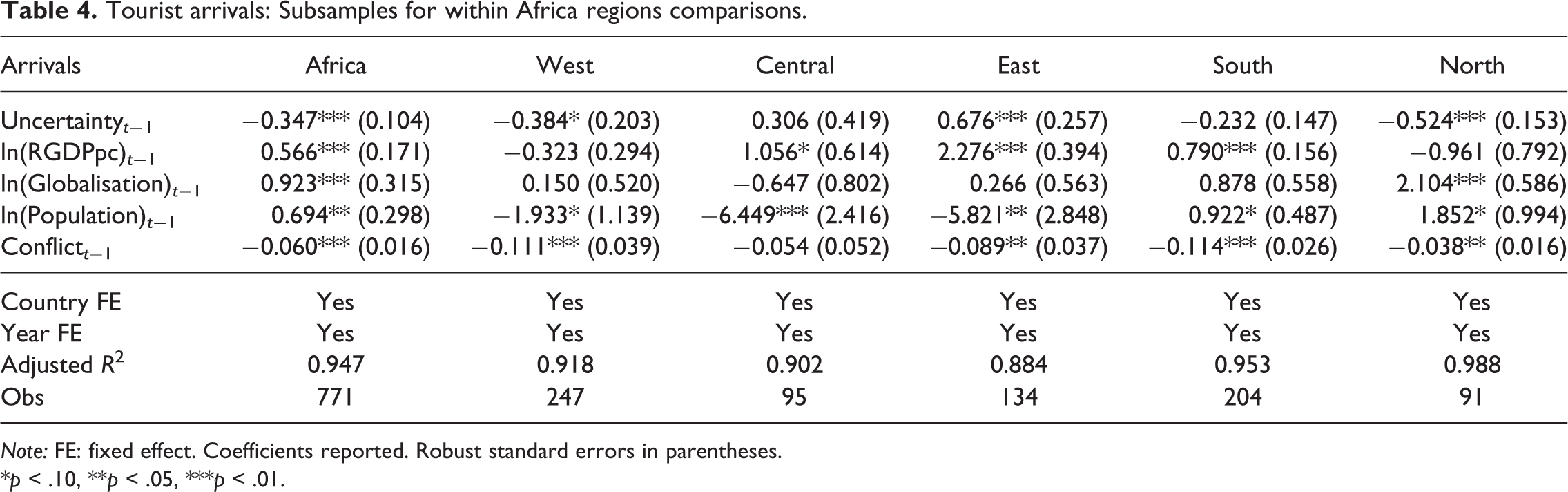
Note: FE: fixed effect. Coefficients reported. Robust standard errors in parentheses.
*p < .10, **p < .05, ***p < .01.
In Table 4, we find that economic uncertainty in East Africa significantly increases tourist arrivals at 1%, while uncertainty in North and West Africa significantly decreases tourist arrivals at a 1% and 10% level significantly. Given the period under review, countries in North and West Africa have experienced several shocks that have affected the countries. Some of these shocks include (1) the Ebola virus which negatively affected the tourism industry in West Africa between 2014 and 2016 (Maphanga and Henama, 2019); (2) the Boko Haram crisis in Nigeria which spilled over into neighbouring countries, Niger and Cameroon, decreasing tourist flows to the region; and (3) the Arab Spring protests which affected most North African countries (Tunisia, Libya, Egypt, Morocco and Algeria) contributing to increased economic uncertainty and a drop in tourist arrivals. According to Dragouni et al. (2016), spill-over effects of shocks to sentiments and mood can affect people’s decisions to travel to certain countries with economic uncertainty. 7
Conclusion
While previous literature points predominantly to adverse effects in the tourism industry arising from uncertainty, similar analysis is surprisingly lacking for developing regions, specifically Africa. We address this gap by examining the effects of economic uncertainty on tourist arrivals with a focus on Africa. The findings show that uncertainty in Africa reduces tourist arrivals and tourist receipts in comparison to other global regions, such as Europe. Further decomposition by African regions reveals that the mitigating effects of economic uncertainty on tourist arrivals is driven by North, Southern and West African regions. These regions have been troubled by political events that created uncertainty in the economies. In pursuing this research, we hope that the results will bring awareness to some of the factors that can promote or harm the tourism industry in Africa.
In our case, the evidence suggests that policy recommendations should be carefully considered given the characteristics of the region, such as the political or social issues driving the economic uncertainty. Given the spill-over effects of tourism, governments from neighbouring countries should work together to promote tourism within their regions. For example, a common visa that allows tourists to travel regionally without having to obtain multiple visas (such as, the Schengen visa); a common currency in the region to avoid incurring additional costs of exchanging currency in different countries within the same region; lower prices on regional flights; and improved transport infrastructure for better access regionally (airports, roads, border control). Since tourism is particularly sensitive to security and health concerns, countries that have been subjected to conflict and/or health epidemics should engage in aggressive advertising to change negative image to one of a safe destination. Moreover, collaborations with private sector and international organisations may be beneficial to developing countries with regards to sharing knowledge and strategies to promote the tourism industry. For example, the World Economic Forum brings together leaders from government, business, civil society, scientific research and international health organisations to improve policies and mitigate the impact of health risks in the tourism industry or to find solutions for safeguarding the ocean ecosystems (Calderwood and Soshkin, 2019).
Supplemental material
Supplemental Material, appendix - Uncertainty and tourism in Africa
Supplemental Material, appendix for Uncertainty and tourism in Africa by Carolyn Chisadza, Matthew Clance, Rangan Gupta and Peter Wanke in Tourism Economics
Footnotes
Declaration of conflicting interests
The author(s) declared no potential conflicts of interest with respect to the research, authorship, and/or publication of this article.
Funding
The author(s) received no financial support for the research, authorship, and/or publication of this article.

Supplemental material
Supplemental material for this article is available online.
Notes
References
Supplementary Material
Please find the following supplemental material available below.
For Open Access articles published under a Creative Commons License, all supplemental material carries the same license as the article it is associated with.
For non-Open Access articles published, all supplemental material carries a non-exclusive license, and permission requests for re-use of supplemental material or any part of supplemental material shall be sent directly to the copyright owner as specified in the copyright notice associated with the article.
