




Abstract
This research looks at how plausible the tourism-led growth hypothesis is in the midst of corruption and political unpredictability. For empirical investigation, we utilize panel data from 1995 to 2018 for across the world. A dynamic panel data estimation method is employed for the estimation purpose. The outcomes of our analysis show that tourism-led growth is a phenomenon, but this is contingent on institutional factors. Specifically, high levels of corruption, political instability, and violence pose a significant barrier to beneficial effects of tourism on economic prosperity. We also employ panel quantile regression to estimate the asymmetric effects of tourism. Results of the analysis show that tourism is particularly beneficial for low-income economies. However, results also confirm that institutional factors such as corruption and political instability prevent countries, especially developing nations, from taking advantage of tourism.
Introduction
Political and informal economic literature agrees that crime, military conflict, and political uncertainty all dampen economic growth (Barro, 1991, 1999; Bleaney and Nishiyama, 2002). Political climate, level of safety, and predictability of institutions are considered critical factors in deciding foreign investment in a country (Stevens and Newenham-Kahindi, 2021). The impact of political risks on a country's economic development has been the subject of extensive research, especially as it pertains to the international business and investment community. How uncertainty, crisis, and violence impact international tourism-driven development, however, is a less well-studied topic.
Over the past two decades, various empirical studies have investigated the link between tourism and economic prosperity. Lately the relationship has attracted considerable attention from policymakers and economists with incessant growth of tourism industry. As per the World Travel and Tourism Council (WTTC)’s report (2022), tourism sector has experienced expeditious growth among all the sectors and outpaced the growth of the economy after 2011, for nine consecutive years. Parallel to this, tourism sector has emerged as a channel providing censorious employment opportunities at regional level, improving people's living standard, and contributing to the Balance of Payment. Conventionally, countries with an edge in natural and cultural supply side resources of tourism view it as a comparative advantage and draw towards flourishing tourist footfall in their countries and this way sector generates more foreign exchange, creates jobs and enhances tax revenue of governments (Hindley and Smith, 1984). Tourism sector stimulates the inflow of foreign investment and currency exchange rates, thereby leading to a rise in foreign exchange receipt and contributing to the growth of GDP (Sokhanvar, 2019). Data by WTTC (2021) reveals that about 272 million people were employed in tourism sector in the year 2019. 1
Overall, tourism sector holds a multiplier effect; that is, expansion in tourism sector can propagate positive impact to other sectors via creating regional employment opportunities, stimulating local production, increasing foreign reserves and providing required financial resources to enhance existing infrastructure assisting the sector (Balaguer and Cantavella-Jorda, 2002; Nunkoo et al., 2020). Scholars suggest that tourism also instigates convergence from advanced economies to developing ones by transmitting income from the former to the latter and decreasing regional welfare inequalities (for example, see Tugcu, 2014; Paramati et al., 2017). However, Hazari, et al., (2003) propound that an increase in urban areas might impoverish rural areas, that is, tourism growth could hurt economic performance. This suggests that tourism growth can have an ambidextrous impact on economic development.
Recently, there have been some attempts to estimate the influence of governance efficiency and institutional quality and on the countries as a whole, tourism and tourism-economic growth nexus (see Ekeocha et al.,2021; Adedoyin et al.,2022; Tang and Abosedra, 2014). Over a considerable time, this area has been neglected in tourism research (Tang, 2018). In this study, we attempt to study impact of above-mentioned factors but keep the scope limited to corruption and political instability. Scholars suggest that political instability creates negative externality for tourism demand in any country (see Ingram et al., 2013) and can even reverse the positive impact of tourism on economic development (see Tang and Abosedra, 2014). Tourists are discouraged to visit the country with low political stability and high terrorism due to safety and security tensions. Besides this, the impact of corruption is expected to be mixed, that is, suggesting prevalence of both ‘sand the wheels hypothesis’ and ‘grease the wheels hypothesis’ (see Sharma and Mitra, 2015). The corruption can expedite entrepreneurial activities and thereby increase both the speed of money and doing business, conversely, corruption has a similar effect on the economy to that of a tax, meaning that tourists to corrupt countries must pay more to obtain this very same level of service elsewhere (see Poprawe, 2015). Thus, corruption undermines the potential contribution of tourism to economic progress (Adedoyin et al., 2022).
In this context, we aim to re-assess the effect of tourism on economic performance at global level. We also investigate the conditional impact of corruption and political stability on tourism and economic growth nexus. In the process, we contribute to the existing literature in the following ways: first, the existing tourism literature touched upon effects of a range of determinants such as policy risk and macroeconomic uncertainty (Khanna and Sharma, 2021), fluctuating exchange rates (Sharma and Pal, 2020), financial deepening (De Vita and Kyaw, 2017; Ohlan, 2017; Khanna and Sharma, 2021), economic progress (Martins et al., 2017), and carbon emissions and energy use (Paramati et al., 2017). However, the scholars hardly focused on the conditional impact of institutional factors like corruption and political stability in tourism-growth nexus. In this study, we make efforts to examine the joint effect of institutions and tourism on economic growth linkages. Second, mainly the association between tourism and economic performance has been checked for the single country or multiple countries for some regions (for example, MENA regions, Asian countries, etc.) that to be for the shorter time period and therefore the results lack generalizability (see Tang and Tan, 2013; Ohlan, 2017; Ghosh, 2011; Odeleye et al., 2022). Thus, it is imperative to undertake a cross-country analysis based on relatively wider mélange of economies for a longer time period. We utilize a sample of 208 countries spanning over the time period from 1995 to 2018.
Third, to scrutinize the tourism-led growth hypotheses (TLGH or TLG) and evaluate the combined effect of corruption, violence, terrorism and political instability and tourism on economic performance, we employ generalized method of moments (GMM) estimator (Blundell and Bond, 1998). This is a dynamic panel data model and past research shows that the dynamic approach offers a greater advantage in gaining the intricate linkages between tourism and economic growth and more precise inferences of the estimated parameters (Perles-Ribes et al. 2017; Nunkoo et al., 2020). We believe that this method is quite appropriate in terms of type of model we have, that is, dynamic model with large number of heterogeneous cross-sectional units. Furthermore, to examine the TLGH for different income countries and addressing asymmetric relationship, we also utilize a recently developed panel data-based quantile regression. This method allows us to incorporate more control variables and to account for probable endogeneity. Lastly, the results are sensitive to the choice of variables of tourism (see Tugcu, 2014). Therefore, we utilize alternative measures of tourism. Furthermore, studies such as Adedoyin et al., (2022) have shown that tourism-growth varies significantly in different countries; thus, we also examine the TLGH separately for developing and developed countries and high tourism-dependent and less tourism-dependent countries.
Rest sections of the paper will proceed as follows. The next section briefly reviews the existing studies on tourism, corruption, political stability and economic growth. The third section imparts cognizance on model specification, data and variables, and estimation technique. Section four provides the estimated results, while the next section offers a discussion on results. Finally, the last section presents the summary and conclusions elicited from the empirical results.
Review of literature and hypothesis setting
Over the past several years, global tourism has changed remarkably with increased demand for tourism. The issue of impact of international tourism on economic prosperity of any country has gained considerable attention among policymakers and economists. Relevant works have been done to explore the link between a nation’s international tourism, that is, arrivals and income, and its overall economic growth and prosperity (Balaguer and Cantavella-Jorda, 2002, Sokhanvar et al., 2018; Jalil et al., 2013; Du et al., 2016; Antonakakis et al., 2019; Wu and Wu, 2019; Nunkoo et al., 2020; Odeleye et al., 2022). Essentially researchers encapsulate the association between tourism and economic progress through four hypotheses or channels, namely, growth hypotheses (tourism-led economic growth), conservation hypotheses (export-led growth), reciprocal hypotheses (bidirectional relationship) and neutrality hypotheses (no relationship or the relationship which is conditional on other factors) (see Wu and Wu, 2019; Nunkoo et al., 2020; Zhang 2021). The first channel of association between tourism and economic growth moves from tourism to economic prosperity, which is examined under realm of tourism-led growth (TLG) hypothesis alias ‘growth or development hypothesis’. This hypothesis states that tourism sector-linked activities positively contribute to economic growth of any country.
Apart from tourism, the level of corruption and political stability in any country significantly influences the country's performance (see Tang and Abosedra, 2014; Sharma and Mitra, 2019; Matta, et al., 2022). Although, whether such factors moderate the effects of tourism on economic development and prosperity has yet to receive appropriate research attention. A recent study by Adedoyin et al. (2022) examines the impact of tourism on economic growth moderated by institutional quality in high tourism-related income generators and tourism-dependent economies. Scholars find that political instability impedes economic growth, and corrupt practices can reverse the positive effects of tourism on economic growth. Similarly, Tang and Abosedra (2014) study the impact of tourism, energy and political uncertainty on economic progress in MENA regions. They find support for tourism-led growth hypothesis for the sample region and suggest that political instability hinders the growth of the economy. The finding pertaining to TLGH lacks consensus which encourages further research on this issue along with considering other factors that moderate the association between tourism and economic growth. In the following sub-sections, we discuss the theoretical underpinnings and empirical studies on the tourism, corruption, political stability effects on economic growth and performance.
Theories and empirical literature on tourism-led growth hypothesis
There are various theories and models that explain the association between tourism and economic growth, including the tourism-led growth theory, the tourism-development paradigm and the tourism-generated income theory, among others. The specific effects of tourism on economic growth can vary depending on the characteristics of the country, the stage of development and the policies and regulations in place (see Brida et al., 2016; De Vita and Kyaw, 2017; Song and Wu, 2022).
Increasing international tourist arrivals is often cited as a reason for a country's improved economic fortunes. There are four perspectives from which to examine the link between tourism and the growth of the economy. First, income generation: tourism can generate income through the sale of goods and services to tourists. This increased demand can stimulate economic growth by creating jobs and boosting the production of goods and services (Balaguer and Cantavella-Jorda, 2002). Second, foreign exchange earnings: tourism can also generate foreign exchange earnings that could be utilized to finance imports and pay for investment (McKinnon, 1964). Third, spillover effects: the expansion of the tourism sector can also generate spillover effects in other sectors, such as transportation, retail and construction. This can further stimulate economic growth by creating new jobs and boosting demand for goods and services (Blake, et al., 2006). Finally, innovation and productivity: the tourism industry can also drive innovation and productivity by promoting the development of new products and services, as well as by increasing competition in the marketplace (Kumar and Kumar, 2012). 2
Balaguer and Cantavella-Jordá (2002) were first to examine the TLG hypothesis systemically. Since then, a growing body of literature has been expounding on the tourism-led growth hypotheses. In this section, we mainly review findings of the recent studies. 3 Tang and Tan (2013) conducted a study to examine the permanence of the tourism-led growth hypotheses in Malaysia with reference to some important tourism countries. They use a hybrid of the recursive Granger causality test and the recently established cointegration test. They find the prevalence of tourism-led growth in Malaysia but from tourist arrivals of only 8 countries, mostly developed out of 12 countries. Jalil et al. (2013) made an effort to investigate the long-term inter-relationship between international tourism and Pakistan's economic growth. They employ Autoregressive Distributed lag method from 1972 to 2011 and find results in support of tourism-led growth for the country in the presence of other variables like physical capital and international trade. Sokhanvar et al. (2018) expound on the causal connection between international tourism receipts and economic growth utilizing the Granger causality analysis for the years 1995 through 2014 on emerging market economies. Their results provide evidence for both tourism-led growth and export-led growth, where the former is true for Brazil, Mexico and Philippines and latter for China, India, Indonesia, Malaysia and Peru.
The study by Gunduz and Hatemi-J (2005) investigates the contribution of tourism to the economic growth of Turkey. Authors employed leveraged bootstrap causality tests and obtain results in favour of tourism-led growth hypotheses for the Turkish economy. In line with the study of tourism-led growth hypotheses, Ertugrul and Mangir (2015) study the empirical relationship between tourism and economic growth for the 1998–2011 period in Turkey. Authors employ different econometrics models, namely, bound test, Granger causality, ARDL, and Kalman filter method, in the study and find evidence for tourism-led growth in Turkey. Corrie et al., (2013) adopt causality approach and find tourism-led endogenous growth in Australia. Paramati et al. (2017) deliberate the impact of tourism on economic development and carbon dioxide emission utilizing data sample from 1995 to 2012 across developed and developing nations. They find that tourism has a positive effect on economic growth and is disproportionately impacting developing economies than that of developed ones, evincing the significance of tourism activities for furthering economic growth via generation of additional employment opportunities along with succoring the whole economy by cumulating foreign exchange reserves.
In a critical piece of research, Croes (2014) analysed the potential impact of travel and tourism on poverty. The analysis shows that a 1% increase in tourism revenues appears to lower poverty in Nicaragua by 1.23 percentage points. It is concluded that tourism is important in Nicaragua because foreign exchange earned there contributes to efforts to lessen poverty. The research further shows that while tourism is important for the middle class in Nicaragua, it has no effect on the poor in Costa Rica. The author concludes that, in contrast to Nicaragua, employment development is not a primary catalyst against poverty in Costa Rica, and hence the country's tourism is not very effective at combating poverty. Njoya and Seetaram (2018) employ a Dynamic Computable General Equilibrium (DCGE) model to predict how an uptick in international tourism will affect poverty levels in Kenyan households. The findings confirm that tourism is beneficial to Kenya, but that increased growth is expensive. The tourism industry and its supply chain see an influx of resources from more conventional sources. As a result, these sectors grow, which in turn boosts employment and salary prospects. Weak to negative growth is experienced by non-tourism exporters, as primary sectors decline.
In a slightly different study, Ekeocha et al. (2021) re-assessed tourism and growth relationship in Africa using system-GMM estimator and panel Granger causality technique for the time period of 2009 to 2018. They encapsulated the moderating effect of some other factors, such as, climate, infrastructural progress and governmental factors, on the correlation between tourism and economic growth. Their findings suggest a negligible role of tourism as a driver of economic growth in selected 41 African countries in the post-subprime crisis phase. In their work, Dogru and Bulut (2018) explicate that tourism and economic growth are dependent each other, holding a two-way causal association. Some others such as Chiu and Yeh (2017), Lin et al. (2019) and Ekeocha et al. (2021) have found mixed or negligible effect of tourism on economic performance. De Vita and Kyaw, (2017) confirm for the TLG but it also showed that the relationship depends on financial development and level of economic development of the recipient country. While Enilov and Wang, (2022) confirm the validity of TLG in developing economies and reject such linkage in developing economies. Findings of Liu et al., (2022) for China are also mixed. They find a positive long-term effect of tourism, however, short term and spatial spillover consequence of tourism on growth is not noticeable. For African countries, Baidoo et al. (2022) reveal a positive effect for landlocked countries and negative effect for island countries. Presenting a different perspective, Du et al., (2016) show that tourism works as standard income determinant and it has no special effect on growth. Quite contrary to the general findings, Capo et al. (2007) and some others have shown a negative effect of tourism mainly due to excessive exploitation of natural resources.
The existing studies provide ambiguous findings on tourism sector upshots on economic performance of any economy. This encourages us to re-assess the tourism-led growth for all countries as well as a different set of countries. Thus, we are set to examine the following hypotheses:
Increase in tourism activities augments/supplements economic growth.
Corruption, political stability, tourism and economic growth: The theoretical and empirical underpinnings embodied in literature
The effects of tourism on economic development are extensively studied in literature, howbeit the results are equivocal. There are few studies that estimate the effect of such attributes on tourism and economic performance. Empirical and theoretical discussion propound that corruption is destructive for the economy as a whole as it is a hindrance in the way of growth, development and well-being of people (Salinas-Jeminez and Salinas-Jeminez, 2007), providing backing to ‘sand the wheels’ hypothesis’. While the empirical evidence perceived corruption as harmful for economy’s macroeconomic conditions (Mauro, 1995), evidence supporting the ‘grease the wheels’ hypothesis’ is also established by some scholars which suggest that corruption have a flourishing impact on the performance of the economy. The reason behind such evidence is the ability of corrupt activities to enhance the efficiency of public sector by speeding up the cumbersome procedure and dismantling inefficient regularities.
In congruence with the above discussion, effects of bribery on tourism are also ambidextrous suggesting the prevalence of both ‘sand the wheels’ and ‘grease the wheels’ hypotheses in tourism literature. The corruption can expedite the commercial activities and thereby augment both the speed of money and doing business; conversely, the impact of corruption is analogous to the effect of tax, implying that in the presence of corruption, tourist incurs additional cost in travelling to corrupt countries without any extra advantages (see Poprawe, 2015). In a recent study by Adedoyin et al. (2022), the conditional impact of institutional quality was studied for the time period 2002–2017 on the sample of high tourism earning as well as tourism-reliant economies. They find that weak institutions drive up corrupt practices, which reverses the constructive effects of tourism on economic performance. Referring to Tang (2018), corruption control is a crucial factor in scrutinizing the direction of the impact of demand for tourism which point toward that economies with more control over corruption invariably attract more tourists and thereby lead to economic growth. Das and Dirienzo (2010) and Saha and Yap, (2015) have confirmed the detrimental effects of corruption on tourism industry across the world in panel data settings. Given this context, we attempt to verify the conditional impact of corruption on tourism and economic growth. For this, we framed the following hypothesis:
The prevalence of corruption negatively influences the inter-relationship between tourism and growth of countries. Existing literature suggests that political instability in any country impedes economic growth (see Adedoyin et al., 2022; Tang and Abosedra, 2014). The prevalence of political instability in any country jeopardizes the peace and security of that country which can create a negative externality for tourism demand (Ingram et al., 2013). Seekings (1993) and Hall (1994) offered initial thoughts on the inter-relationship between politics, tourism and commerce. They highlighted how frequently changes in politics and legislation caused severe damage to the tourism industry that ultimately affected growth. Edgell et al. (2008) posit that the absence of safety and security at the tourism destination could negatively influence business and leisure travel. They provided the example of Bali terrorist bombings of 2005, which resulted in a negative situation for tourism receipts in the short run. Additionally, the uncertainty for the future due to political instability will further disrupt the accumulation of both physical and human capital, leading to slow economic growth. Adedoyin et al. (2022) show a substantial and positive relationship between political instability and economic performance. The tenable justification for such an outcome is that investors avert to invest in economies with high violence and more frequent changes in the Government tenure. According to a study by Aisen and Veiga (2013), political stability is expected to cause volatility and frequent policy changes and, therefore, harm macroeconomic performance of any country. Ivanov et al. (2017) show a country's tourism business suffers when its political stability is imperiled. This held valid not only for the areas directly surrounding the hotspots of violence but for the entire nation, even if the former were hurt more by the resulting political instability. Clements and Georgiou (1998) illustrated how the prolonged conflict and political instability between the two partitioned populations in Cyprus threaten the country’ tourism industry already struggling with competition and quality. In a recent study, Chingarande and Saayman (2018) show that TLG is a reality but conditioned on safety security, and human and physical capital. Similarly, Belgodere et al., (2022) confirm a key of political institutions in tourism effects on economy of industrial countries. Tourism demand and its impact on economic growth are responsive to political stability and absence of violence and terrorism, thus, it is crucial to widening the existing literature, as this issue has not been thoroughly explored in earlier research. We encapsulate this effect with the following hypotheses:
Political instability causes a negative externality for tourism demand and affects economic growth. Given this background, we are motivated to re-evaluate the tourism-driven growth hypothesis at a global level and check for the conditional effect of corruption and political stability on the relationship between tourism and economic growth. Theoretically and empirically, the tourism-led growth hypotheses have been studied well in literature but the results are mixed (see Supplementary Table S1A of appendix for a summary of recent literature). However, we observe some critical gaps in the literature, which we attempt to fill through this study. First, the tourism-led growth hypothesis was majorly studied at the regional and country level for shorter period of time and the results we get are mixed, therefore, the results cannot be generalized due to country-specific analysis. In this study, we attempt to address this issue by utilizing data at global level and resorting to the sample of a wider array of economies for a relatively long period of time. Second, though the ‘growth hypotheses’ is widely studied, the impact of crucial factors such as corruption and political stability have not received much attention. While their impact is of paramount interest because countries with high corruption increase the cost of tourists in the respective country and political instability makes tourists reluctant to visit the country with political uncertainty,
4
we endeavour to check for the conditional impact of corruption and political stability on tourism and economic growth nexus. Lastly, the preponderance of research has been done utilizing the methods, namely, panel granger causality and panel cointegration which check only for the direction of impact and correlation instead of capturing the size of impact and also do not account for the probable endogeneity given the nature of variables (like tourism, corruption and trade). Therefore, we fill this gap and employ GMM estimator (Blundell and Bond, 1998). This method possesses an advantage in accounting for endogeneity by instigating instrument variables, allowing to incorporate more control variables across a large cross-section. We also utilize a recently developed quantile method in panel context to estimate the possible asymmetric effects.
Empirical models, data issues and estimation methodology
Empirical models
What determines economic growth and prosperity has been well modelled and established in the economic growth literature. Starting with classical, the neoclassical tradition as well as endogenous growth models (Solow 1957, Barro, 1999), consider international trade and transactions, including international tourism, as a crucial source of growth. These models also consider other sources such as human and physical capital, openness of the economy and quality of institutions (see Acemoglu et al., 2001). Taking a cue from these theoretical and empirical models implemented by Tang and Abosedra (2014) and Ekeocha et al. (2021), we formulate the following dynamic model

Data and variables
For analysis, we utilize the data of 208 (up to) countries spanning over the period of 1995–2018. 5 To evaluate the direct effect of tourism on economic performance and moderating impact of corruption and political stability, absence of violence and terrorism on tourism and economic performance, we require (1) indicators for tourism; (2) indicators for economic performance; (3) measures of corruption and (4) measure of political instability. We extracted data from Tourism Statistics Database of UNWTO, World Development indicators (WDI) of the World bank, Penn World Tables of Groningen Growth and Development Centre and governance database of the PRS group, that is, International Country Risk Guide (ICRG). We combined the extracted data and made a panel of 208 countries over the period of 1995 to 2018. In the standard literature, various indicators are utilized to measure the tourism demand such as international visitor’s arrival (Tang and Tan, 2013; Tang and Abosedra, 2014; Ertugrul and Mangir, 2015; Pérez-Rodríguez et al., 2021; Ekeocha et al., 2021; Adedoyin et al., 2022), International tourism earning per capita (Jalil et al., 2013; Ohlan, 2017), tourist expenditure as a percentage of GDP and international tourism receipts (Lin et al., 2019; Ekeocha et al. (2021). Previous studies have shown that the selection of indicators of tourism has some significant effects on the estimated results (see Nunkoo et al., 2020). This study uses per capita total tourist arrivals and inbound tourism expenditure over GDP percentage as measures for tourism demand. We measure economic performance by GDP per capita, which is used in a large number of studies (Jalil et al., 2013; Ohlan, 2017; Tang and Abosedra, 2014; Adedoyin et al., 2022).
We employ data on corruption and political stability of World Governance Indicators. For Corruption, the measure of Control of Corruption is utilized. It represents views of the magnitude to which public officers’ authority is used for individual advantage and includes both petty and grand corrupt practices. It also reflects the position of elites and private interests’ groups in the country. Estimated score indicates the country's aggregate indicator score in the units that forms a standard normal distribution that lies between -2.5 and 2.5. Political instability is measured by political stability and absence of violence and terrorism, which assesses the possibility of political instability and politically motivated violence, such as terrorism. Moreover, this score varies from -2.5 to 2.5. To use them in analysis, we transformed the above-mentioned variables into 0 to 100 scale and then inverted them. More specifically, score being 0 implies the lowest corruption and highest political stability and absence of violence, whereas 100 reflects highest corruption and lowest political stability (or political instability). For a robustness check, we also make use of corruption and political instability measures from ICRG database.
Description of variables.

Variables are transformed in logarithmic form.
Estimation methodology
Dynamic models offer a greater advantage in gaining the intricate linkages between tourism and economic growth and more precise interpretations of the estimated parameters of models (Perles-Ribes et al. 2017; Nunkoo et al., 2020). Therefore, it is advised to apply dynamic models to draw more precise conclusions about the TLGH's validity (Castro-Nuño et al., 2013; Lee and Chang, 2008). This is crucial, especially in light of research showing that the timing factor affects the degree and direction of the relationship between tourism and economic growth (Nunkoo et al., 2020).
To estimate equation (1), that is, dynamic model, we resort to dynamic panel data method: System generalized method of moments (Sys-GMM). This method allows for robust and asymptotically efficient estimators for panel data with dominating cross-sections (i) and relatively lesser number of time period (t). The generalized method of moments framework has an advantage over static panel methods which consider all the explanatory variables as exogenous and allow for endogeneity (Baltagi, 2008). This method allows to incorporate more control variables across large cross-section units. We specifically utilize System GMM, which is modified and updated to have greater finite properties of samples. In the sys-GMM framework, first-differences lags are used as modelling tools to tackle potential autocorrelation and endogeneity issues (see Arellano and Bover, 1995).
Some recent studies have argued that linear panel estimators may not be suitable for testing TLG models as the relationship is non-linear and asymmetric, that is, relatively developed or high-income countries share a different relationship with tourism than developing or low-income countries (Lee and Chang, 2008; Sahni et al., 2021). Du et al., (2016) have cautioned that ignoring the heterogenous impact could lead to inaccurate conclusion. Therefore, we employ quantile regression model that takes care of theses aspects.
We specifically use panel quantile regression developed by Machado and Silva (2019). Unlike most of the previous quantile models, this approach uses the Method of Moments estimator with cross-section fixed effects. This method identifies the covariance impact of the conditional heterogeneous of the dependent variable factors by stimulating the individual impact to power the whole distribution rather than only fluctuating means. This approach offers us more information about the underlying relationship for each of the quantile or development level of sample countries.
The approach estimates the effect on each quantile of the dependent variable (Y) that has a distribution conditional on a set of explanatory variables (vector of X) as expressed below

Commonly, the estimated marginal impact of the regressor 
Empirical results and discussion
Before providing our main results, we conduct a prelim analysis using simple scatter linear fitting between tourism indicators and per-capita income. Figure 1 shows relationship between per-capita tourist arrival and income. The data clearly shows a positive fitting with R2 is 0.60. At the same time, tourism expenditure and income relationship look not quite strong but positive (see Figure 2). Effects of tourist arrival on per capita GDP. Note: X axis is tourist arrival, and Y axis is per capita GDP. The average of the period 1995–2018 is used for the analysis. Effects of tourist expenditure on per capita GDP. Note: X axis is tourist expenditure, and Y axis is per capita GDP. The average of the period 1995–2018 is used for the analysis.

We begin our analysis by presenting the estimated results of equation (2). The estimated parameters are based on two-step System-GMM results. Additionally, we assimilate the interaction terms of corruption and political stability with tourism to check for the joint effect of these above-mentioned variables with tourism on economic growth proxied by GDP per capita. It is noteworthy that all variables used in analysis are transformed into natural logarithms.
Effects of inward tourists’ arrival on economic development-role of corruption and political instability: Sys-GMM estimation.

Parentheses contain standard errors. * p < .10, ** p < .05.
Notes: Dependent variable in log per capita GDP. See Table 1 for definition of variables. Two-step GMM estimator is used. One lag instrument and instrument set collapsed option used. Sargan's test is a test for examining over-identifying restrictions. AR1 and AR2 are first order and second order of Arellano–Bond tests; they examine whether the idiosyncratic error term is serially correlated, respectively.
However, the influence of political instability is estimated to be somewhat inconsistent. In column 3, it is negative, suggesting that an increase in political instability hampers economic growth. However, after the inclusion of the combined term of political instability and tourism, the effect became positive. The marginal effect of tourism can be estimated as
Effects of tourists’ expenditures on economic development-role of corruption and political instability: Sys-GMM estimation.
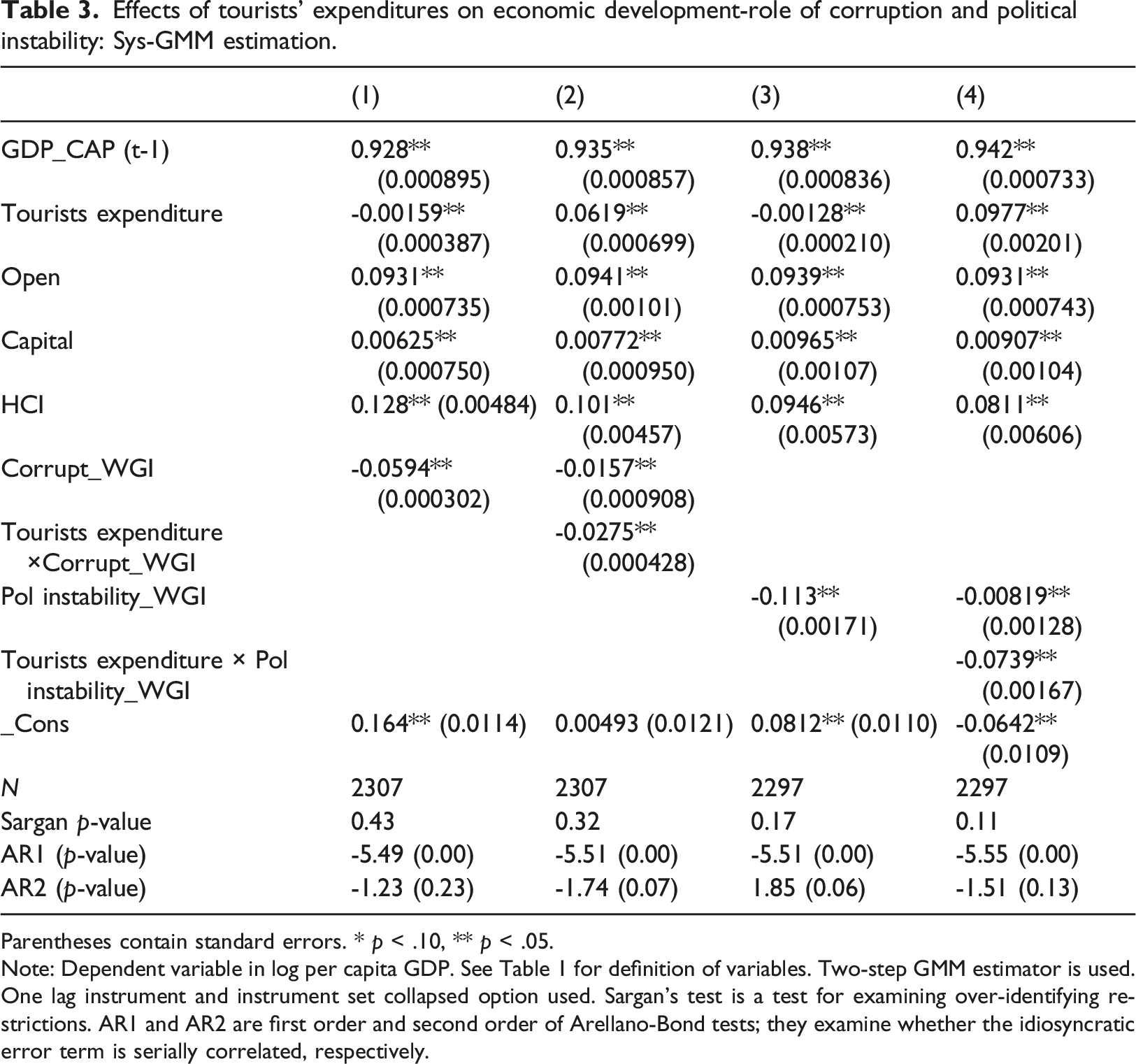
Parentheses contain standard errors. * p < .10, ** p < .05.
Note: Dependent variable in log per capita GDP. See Table 1 for definition of variables. Two-step GMM estimator is used. One lag instrument and instrument set collapsed option used. Sargan's test is a test for examining over-identifying restrictions. AR1 and AR2 are first order and second order of Arellano-Bond tests; they examine whether the idiosyncratic error term is serially correlated, respectively.
Effects of inward tourists’ arrival on economic development-role of corruption and political instability: Panel quantile estimation.
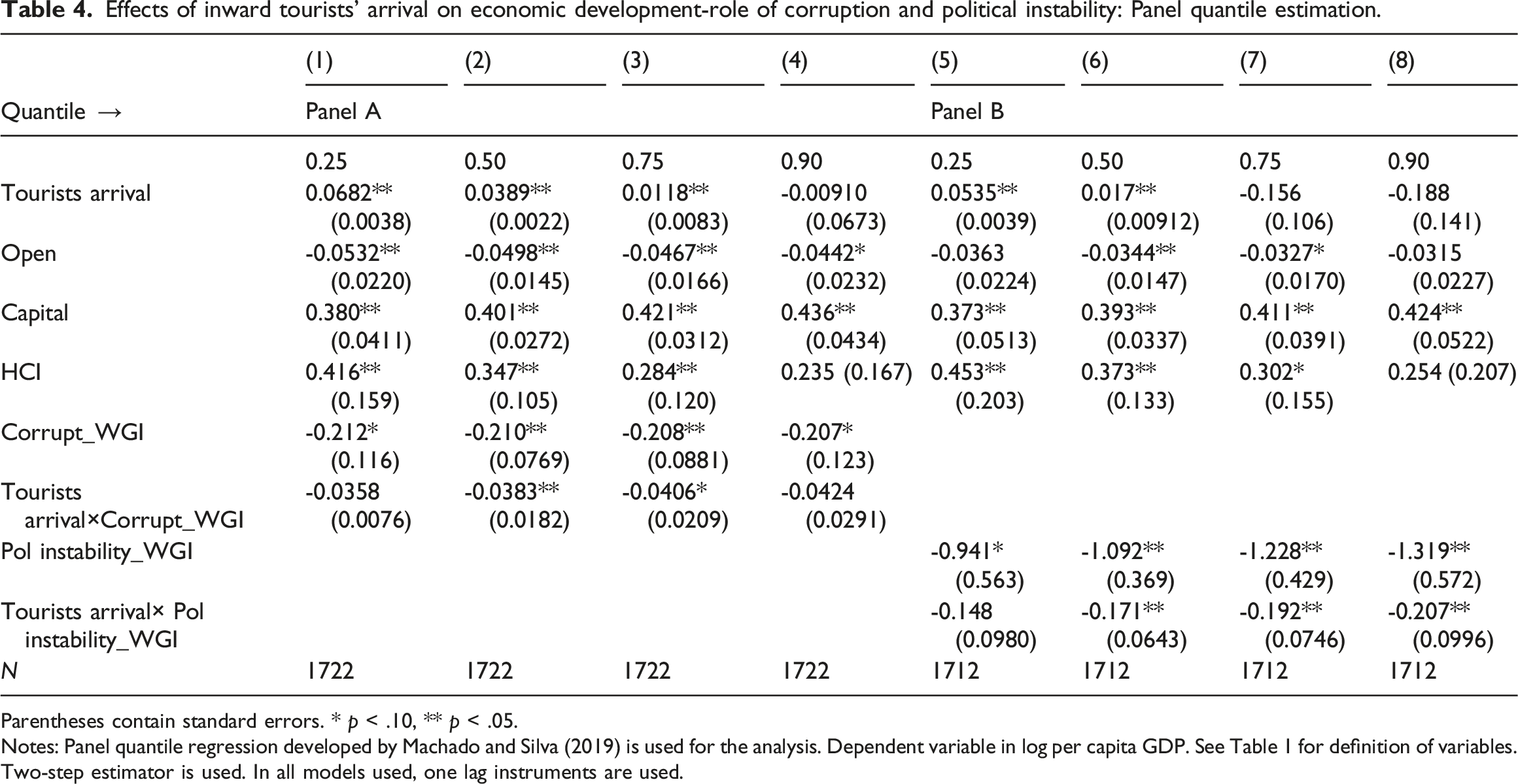
Parentheses contain standard errors. * p < .10, ** p < .05.
Notes: Panel quantile regression developed by Machado and Silva (2019) is used for the analysis. Dependent variable in log per capita GDP. See Table 1 for definition of variables. Two-step estimator is used. In all models used, one lag instruments are used.
Effects of tourists’ expenditures on economic development-role of corruption and political instability: Panel quantile estimation.
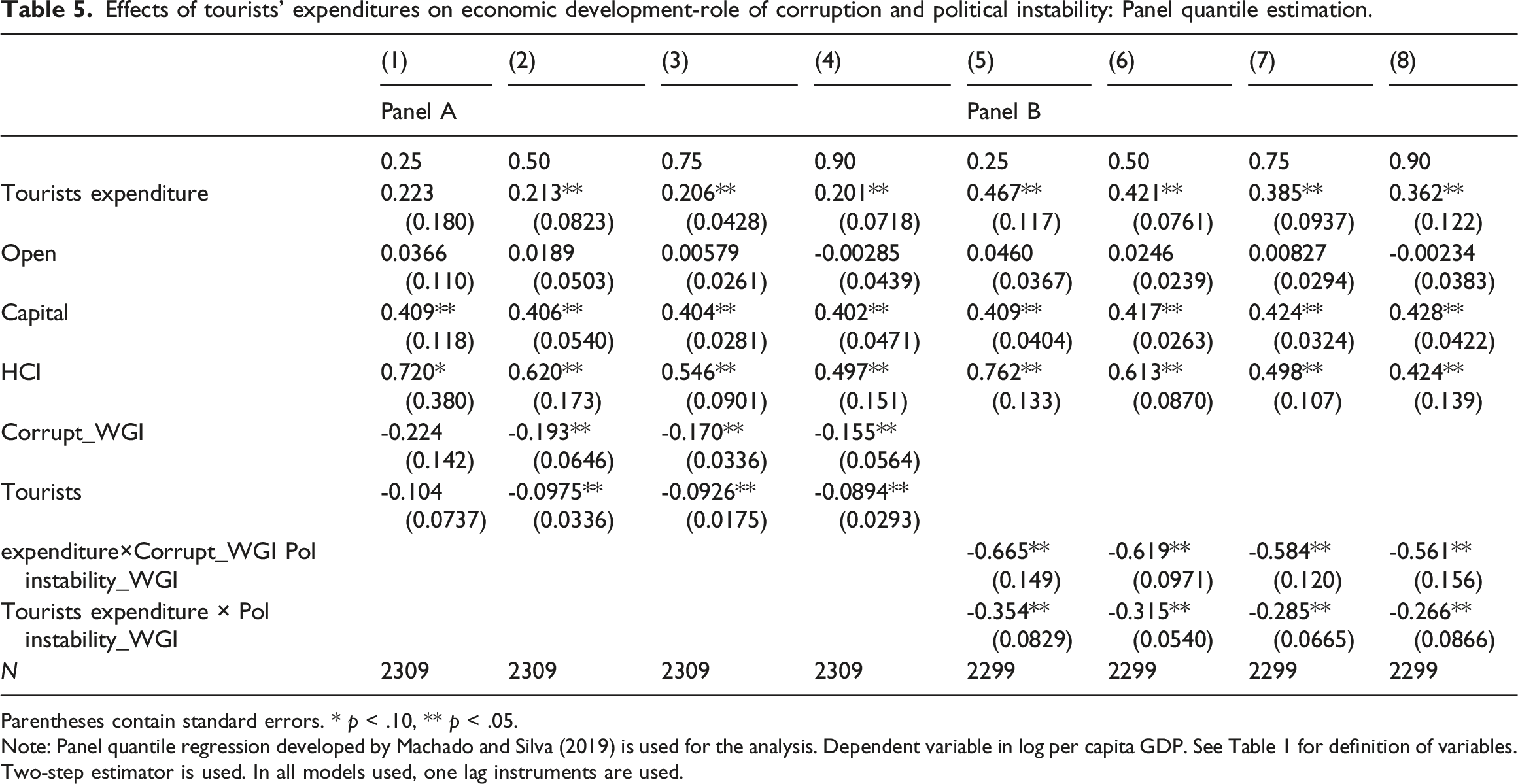
Parentheses contain standard errors. * p < .10, ** p < .05.
Note: Panel quantile regression developed by Machado and Silva (2019) is used for the analysis. Dependent variable in log per capita GDP. See Table 1 for definition of variables. Two-step estimator is used. In all models used, one lag instruments are used.
We then concentrate on the models that use tourism spending as a measure of tourism. Columns 1–8 of Table 5 display the outcomes of various models. With the exception of one case, all tourism expenditures are shown to be positive and statistically significant. This shows that tourism plays a beneficial function in accelerating the growth of the nation. Political unrest and corruption, as previously mentioned, have a negative impact on economic expansion. The interaction of institutional and tourism-related elements provides insightful information. The findings indicate that corruption and tourism combination have a detrimental influence on growth, with the adverse effect being comparatively greater for nations that are developing. Similar outcomes are also shown when uncertainty regarding politics and tourism are coupled. Furthermore, the cumulative effect coefficients are fairly large, demonstrating that political unrest and violence pose a considerable barrier to global tourism-led expansion. The findings also demonstrate that low- and middle-income economies are the subject of comparatively more worry due to the increased size of lower quantile coefficients. To check the consistency of these results, we also conduct sys-GMM-based results for different income groups countries. These results are presented in Supplementary Table S2A of appendix. Broadly these results all follow the line of results of quantile-based analysis.
Discussion
Many distinct and varied direct and indirect pathways have been identified as means by which tourism positively contributes to economic growth. The last two decades have seen an upsurge of scholarly work addressing the links between economic development and tourism (see Nunkoo et al., 2020). The results of these studies give evidence in favour of the TLGH and report positive estimates with statistical significance. However, the impact of institutions is largely overlooked in the standard literature. In addition, numerous recent research studies have given less weight to channels of effects in favour of using the recently advancement in econometrics methods, such as new generations of causality and cointegration techniques. Through the use of two robust estimators and an analysis of the role of institutions in the tourist and growth nexus, the present research strived to add to the empirical research concerning the connection between tourism and economic growth. We concentrate on the role that corruption and political uncertainty serve as conditional effects in the nexus.
Our research suggests that international tourism has a net beneficial effect on global economic progress. We employ different methods to ascertain the link, as the results are sensitive to the use of tourism indicators, empirical methodology, and specification (see Brida et al., 2016; Nunkoo et al., 2020). Our results offer substantial evidence in support of the hypothesis that tourism contributed to economic expansion. Therefore, we agree with the conclusions stated by Ertugrul and Mangir (2015), Tang and Tan (2013), Liu and Song, (2018), Dogru and Bulut (2018) Mitra (2019) and Pérez-Rodríguez et al. (2021). Our research demonstrates that tourism's favourable effects on the economy become readily apparent after methodological hurdles like a limited sample size and endogeneity are overcome. Several prior studies have yielded inconclusive or even negative results when we analyse individual countries, using a limited sample size, or use a shorter time horizon in the panel context (see Castro-Nuño et al., 2013; Brida et al., 2016). Furthermore, many earlier research studies have overlooked endogeneity issue in estimating, leading to biased conclusions due to the possibility of reverse causality. Our empirical strategy deals around these problems. Overall, we find evidence supporting the original TLG hypothesis (Hypothesis 1).
Our research also lends credence to the ‘sand the wheels’ or ‘grabbing hand’ explanation of corruption, which holds that graft discourages productive activity. Corruption is a barrier to development, as shown by our findings, which corroborate those of Sharma and Mitra (2015, 2019), Martins et al. (2017), and Lu et al., (2021). A few scholars (Méon and Weill, 2010; Saha and Sen 2021) have argued that corruption plays a ‘greasing wheels’ role in economic activities, but we contest this on the basis of our empirical evidence. We also notice that countries with a high level of corruption do not reap the benefits of tourism. Corruption dampens the tourism-fueled growth process, as shown by the evidence. Therefore, we agree with Adedoyin et al. (2022), who demonstrated that tourism's positive effect on economic growth is counteracted by the prevalence of corrupt practices in the economy due to weak institutions. Our evidence also lends credence to the claims of Das and Dirienzo (2010), Saha and Yap (2015), and Tang (2018), who contend that the degree to which a country regulates corruption is a critical factor in assessing the nature of the economic impact of tourism. As a result, we find that Hypothesis 2 is valid.
The growth literature generally agrees that a state of political instability is detrimental to economic growth. Instability in government and political outcome can cause officials to make ill-considered choices about the economy and the economy as a whole. More frequent policy shifts can increase volatility and harm macroeconomic performance (Aisen and Veiga, 2013). Hall (1994), Seekings (1993), and Belgodere et al., (2022) are only few of the authors in the tourist literature who have noted the significance of a country's political condition in shaping the industry's growth. Many different actors have a role in the tourism industry, which is often interwoven with national and international politics. According to Seekings (1993), political and legislative decisions frequently lead to unintended consequences in the tourism industry. Our research supports the propositions made by both the proponents of direct and indirect effects of political instability and violence on economic growth (through tourism, for example). In other words, we reach the conclusion that stable political systems and institutions facilitate TLG. Our research confirms the validity of our third hypothesis (Hypothesis 3), which hinged on the work of others like Chingarande and Saayman (2018) and Adedoyin et al., (2022). 7
Several prior research studies have shown considerable apprehensions regarding the validity of TLGH and the potential for biased estimation resulting from several factors. For example, Fonseca and Sánchez-Rivero, (2020) show that the observed effect tends to be more pronounced when a shorter time horizon is employed. Brida et al. (2020) asserted that due to the fact that diverse foundations of market segments may have varied features, in terms of dynamics, trends and seasonality, results on the TLG often biased. The topic of simultaneity in the creation and consumption of tourism products and services was brought up by Croes and Vanegas (2008). In their paper, Song and Wu (2022) have addressed concerns with the utilization of tourism indicators and the application of Granger Causality. According to their perspective, the causality analysis suggests a simple sequential relationship between the variables. De Vita and Kyaw, (2017) and some others have raised the issue of conditional effects. Our analysis attempted to address the majority of these difficulties. For example, we employ a production function that incorporates inclusivity and a broad time horizon within the framework of panel data. We utilize estimation methods that account for simultaneity and asymmetric concerns, and we employ different indicators of tourism and institutions to gain insights into the sensitivity of the results. Furthermore, the issue of conditional effect is properly taken care of. Hence, it is likely that our findings are unbiased and resilient, accurately portraying the association.
Conclusion
The objective of this study is to assess the veracity of the tourism-led economic growth hypothesis in the context of corruption, political uncertainty and violence. Our research has shown that tourism-led growth is a phenomenon, but this is contingent on institutional factors. Precisely, high levels of corruption, political instability and violence pose a significant barrier to the beneficial correlation between tourism and economic growth.
Our findings regarding models that employ foreign tourist arrival as a tourism indicator indicate that tourism may contribute to economic growth under low levels of corruption, but the effect turns negative as corruption levels rise. Also, countries with political stability and low levels of violence see tourism-driven prosperity. The quality of institutions appears to be the determining factor in shaping whether or not tourism has a favourable effect on economic growth. Models that utilize the tourism spending indicator confirm the hypothesis and its postulate. However, in comparison, the relationship appears to be weaker in these models.
We conclude by presenting findings of quantile regression that helped us to understand TLG in different income-level economies. High levels of corruption and political unpredictability prevent countries with relatively low incomes from benefiting from tourism, as tourism is predominantly positive and the interaction terms are negative. However, positive tourism interactions indicate that corruption and political instability do not impede growth in the advanced world to the same extent as they do in the developing world.
Thus, our findings validate the results of Tang and Tan (2013), Liu and Song, (2018), Salifou and Haq, (2017), Mitra (2019) and others which have found reality of tourism-led development or growth in different forms. As our results critically show the institutional factors such as corruption and political stability, we also validate findings of Aisen and Veiga (2013), Ivanov et al. (2017), Adedoyin et al. (2022) and Tang (2018). Furthermore, the findings also indicate that traditional drivers of economic growth and development, such as the allocation of resources towards physical and human capital investment, have the ability to augment productivity and stimulate overall economic growth. One potential policy implication that can be derived from this study is that nations, particularly those with developing and underdeveloped economies, have the opportunity to enhance their economic growth by not only focusing on conventional drivers of growth, such as investments in physical and human capital, exports and foreign direct investment (FDI), but also by strategically leveraging the potential of the tourism industry and enhancing their governance effectiveness. For this purpose, countries, especially developing economies, need to prepare better tourism-related infrastructure and law and order in tourist centres. Lin et al. (2019) argued that through multiplier effects, tourism has many indirect beneficial effects as well. For instance, regions and industries not directly involved in tourism also benefit from tourism-related spillover effects (see Liu et al., 2022). Integrating this argument with our results implies that augmenting tourism efforts can bring prosperity to whole domestic economies through direct and indirect channels.
Our results eventually demonstrate that tourism to prosperity path is not easy, and several catalysts and weakeners play out their role in the journey. This includes institutional factors, level of development and current state of dependency on tourism. Obviously, policymakers have some constraints beyond a threshold when drafting tourism-related policies to promote growth. Nevertheless, our findings imply that controlling corruption, bureaucracy efficiency and making the system transparent and stable have numerous economic benefits, including more flows of tourists and tourism-related income and growth. Since we lack sufficient data as of now to conduct and comprehend the disruptions created by the pandemic-related limitations and stringencies, therefore, we have avoided studying the time period of the Covid pandemic. Future research on the issue needs to consider this nuance and understand how this fundamental link has evolved during and after the pandemic. Finally, our analysis used macro-level evidence but offered less insight into interlinkages between different industries. Njoya and Seetaram (2018) suggested the use of DCGE model that appropriately incorporates dynamic relationship between tourism and economy at micro-level; future studies may extend their work for multiple countries.
Supplemental Material
Supplemental Material - Good and bad effects of corruption and political uncertainty on tourism-growth linkage: World-wide evidence
Supplemental Material for Good and bad effects of corruption and political uncertainty on tourism-growth linkage: World-wide evidence by Chandan Sharma in Tourism Economics
Footnotes
Acknowledgements
Author thanks Dr Albert Assaf, editor of this journal and two anonymous referees for their valuable comments and helpful suggestions on the previous version of this paper. Any errors or omissions are solely of the author’s. Financial help from IIM Lucknow (SM-278) is greatly acknowledged.
Declaration of conflicting interests
The author(s) declared no potential conflicts of interest with respect to the research, authorship, and/or publication of this article.
Funding
The author(s) disclosed receipt of the following financial support for the research, authorship, and/or publication of this article: This work was supported by the Indian Institute of Management Lucknow (SM-278).

Supplemental Material
Supplemental material for this article is available online.
Notes
Author biography
References
Supplementary Material
Please find the following supplemental material available below.
For Open Access articles published under a Creative Commons License, all supplemental material carries the same license as the article it is associated with.
For non-Open Access articles published, all supplemental material carries a non-exclusive license, and permission requests for re-use of supplemental material or any part of supplemental material shall be sent directly to the copyright owner as specified in the copyright notice associated with the article.
