



Abstract
This paper investigates the impact of psychological factors of Canadian and Mexican tourists on the US tourism sector. Using the data of 1996–2019, the study uses vector autoregression models and the spillover analysis to perform the investigation. The paper discovers that high insecurity of tourists significantly reduces tourist arrivals, passenger fare receipts, and expenditure of tourists in the US. Also, tourist inflows are highly influenced by insecurity during terrorist attacks, natural disasters, and the financial crisis of the US. It is found that high sentiment of Canadian and Mexican tourists increases their outbound travel to the US, but the impact of sentiment is relatively stronger for the Canadian tourists. Results show that the tourist inflows from Canada and Mexico are influenced by low sentiment during recessionary periods of Canada and Mexico, respectively. The paper finds no robust evidence of mood and nationalism-based retaliation of tourists for traveling to the US.
Introduction
The diversity of the population, tons of museums, scenic views, and unique history have made the US the third most popular destination (after France and Spain) in the world. Canada and Mexico are the two-top tourist-generating countries in the US. According to the website of the US travel association (see Endnote #1), 79.3 million international tourists arrived in the US in 2019 and 49% of them arrived from Canada and Mexico. Some regional events like the 9/11 attack, renegotiating NAFTA, uncertainty regarding the workings of the USMCA agreement, and slow economic growth of Canada and Mexico after the financial crisis of 2007–2009 may have a negative impact on the tourist inflows from Canada and Mexico. A plethora of studies has used economic factors to explain outbound tourism. Besides the economic factors, the non-economic factors, especially the psychological factors are also important for tourism decisions. For example, a wealthy person who can afford to spend a lot on tourism will cancel travel plans if he does not feel secure to travel. This background offers a motivating research question: What is the impact of psychological factors of foreign tourists on the US tourism sector? This paper deals the research question by investigating the effects of different psychological indicators of Canadian and Mexican tourists on some key US tourism indicators.
Tourism is an important source of export revenue for the US. According to the US travel association, 1 total passenger fare receipts and total expenditure of international tourists were $41.465 billion and $157.467 billion, respectively, in 2018. As tourism is an important revenue-earning sector of the US economy, whether economic and psychological factors affect the US tourism sector is an important research topic. The current literature mostly investigates the impact of economic factors like GDP, unemployment rate, and money supply on outbound tourism, see Smeral (2012), Eugenio-Martin and Campos-Soria (2014), and Seetaram et al. (2016), among others. Ongan and Gozgor (2018) find that higher economic policy uncertainty (EPU) reduces the Japanese tourist inflows in the US. There is a recent study by Işık et al. (2020), which shows that Canadian and Mexican EPU significantly reduces tourist arrivals from Canada and Mexico, respectively. Besides the economic factors, some other non-economic factors are important determinants for tourism like political instability (Dhariwal, 2005), terrorist attacks (Arana and León, 2008; Bonham et al., 2006), weather (Cazanova et al., 2014; Goh et al., 2008; Lorde et al., 2016), and habits (Lorde et al., 2016).
Among the non-economic factors, psychological factors like mood and sentiment may affect the tourism decisions because these factors influence spending behavior, see Carroll et al. (1994), Ludvigson (2004), Nofsinger (2005), and Weber and Johnson (2009), among others. The current research is closely related to two important studies (Dragouni et al., 2016; Yap and Allen, 2011) that investigate the impact of consumer sentiment and mood on tourism demand. Using Australia as a case study, Yap and Allen (2011) use consumer sentiment, consumer confidence, and business confidence as potential psychological factors of domestic tourism. Dragouni et al. (2016) use the sentiment and mood of American tourists as potential psychological factors of domestic tourism. Besides the psychology of domestic tourists, the psychology of foreign tourists is important because the spending of foreign tourists is a part of export earnings for the domestic country. As almost half of the foreign tourists arrive in the US from Canada and Mexico, the psychology of Canadian and Mexican tourists may have a big influence on the US tourism sector. A good research is demanded to conduct this investigation. This study tries to perform this task by investigating the impact of insecurity, mood, retaliation, and sentiment of Canadian and Mexican tourists on the inflow of tourists, passenger fare receipts, and expenditure of international tourists in the US tourism sector.
This research is essential because the dearth of accurate knowledge regarding the association between psychological factors and the tourism sector may create a mismatch between demand and supply of factor allocation in the tourism sector. Therefore, policymakers may allocate more than optimal factors of production in the tourism sector. So, to achieve efficiency, the impact of foreign psychological factors on the US tourism industry should be properly investigated.
The empirical findings of the structural VAR (SVAR) model show that there is no significant robust evidence of mood and nationalism-based retaliation of Canadian and Mexican tourists for traveling to the US. On the other hand, the paper finds that the insecurity of Canadian and Mexican tourists has a significant robust adverse impact on the US tourism sector. Results show that domestic consumer confidence has a significant robust positive impact on tourist arrivals from Canada. It is found that domestic consumer confidence has a significant positive impact on tourist arrivals from Mexico, but this result is not robust to some specifications of the SVAR model. The research also uses the time-varying spillover approach of Diebold and Yilmaz (2012) to show that the tourist inflows from Canada and Mexico are highly influenced by insecurity during the period of terrorist attacks, natural disasters, and financial crisis of the US. Moreover, the spillover approach indicates that the tourist inflows from Canada and Mexico are greatly influenced by low sentiment during the recessionary periods of Canada and Mexico, respectively.
This research is unique in many dimensions. First, to the best of the knowledge, this is the only study that investigates the impact of psychological factors of foreign tourists on the US tourism sector. The paper is a part of the comparatively new spillover literature because it examines the influence of insecurity, mood, retaliation, and sentiment of Canadian and Mexican tourists on the US tourism sector.
Second, according to the argument of Istiak (2021), a US domestic proxy of insecurity (rather than traditionally used geopolitical risk or political risk) has been used to represent the insecurity of the US tourism sector. This paper uses the US security uncertainty index to represent the insecurity feelings of foreign tourists. Moreover, the notion of nationalistic retaliation as a barrier for tourism is introduced in this paper. The US trade policy uncertainty index is proposed as a proxy of nationalistic retaliation of Canadian and Mexican tourists. The impact of these two new indices (the US security uncertainty index and the US trade policy uncertainty index) has never been used in the tourism literature.
Third, the paper investigates the impact of psychological factors of tourists from Canada and Mexico on passenger fare receipts and expenditure of international tourists in the US tourism sector. These two indicators are important because they are related to the export earnings of the US. So, this study discovered the traditionally overlooked connection between psychological factors of foreign tourists and national income accounting analysis of the domestic country.
Finally, this study applies the impulse response functions of the SVAR model to investigate the research question. This approach is different from most other papers that use fixed-effect models (Demir and Gozgor, 2018; Gozgor and Demir, 2018), the error correction models (Gozgor and Ongan, 2017), panel three-stage least squares model (Yap and Allen, 2011), and the ARDL models (Muzindutsi and Manaliyo, 2016; Saayman and Saayman, 2015; Işık et al., 2020) to evaluate the influence of different economic indicators on the tourism sector by studying the regression coefficients. The wavelet analysis is used in some papers (see, Balli et al., 2019 and Tiwari et al., 2019) to inspect the association between different economic and tourism variables. Through the impulse response function analysis, this current paper uses a graphical approach to represent how the psychological factors influence the tourism indicators over time. So, this approach is helpful for the policymakers to prepare appropriate policies for the improvement of the tourism sector in both the short and long run.
The rest of the paper is organized as follows. The next section describes the literature review and the formation of the hypothesis. The methodology and data section discusses the SVAR model and some key characteristics of the data. The empirical findings section explains the results from the SVAR model. The robustness section examines the robustness of the results from different specifications of the SVAR model. The time-varying response of tourist arrivals section describes how the psychological indicators influence the inflow of tourists over time. The economic analysis section explains the economic clarifications of the empirical findings. Finally, the last section concludes.
Literature review and formation of hypothesis
Insecurity and tourism
Domestic risk discourages foreign tourists to visit the country because tourists are always concerned about their security. There are some papers indicating that domestic risk can affect the tourism sector of a country. Muzindutsi and Manaliyo (2016) used the monthly data of 2007–2015 and the ARDL model to investigate the relationship between political risk and tourism revenue of South Africa. The authors found no short-run relationship between the two variables, but they found that political risks have a long-run effect on the real revenue of the tourism industry. The geopolitical risk (GPR) is a broadly applied barometer of risk. The GPR index is based on military-related tensions involving large regions of the world with a US involvement, nuclear tensions, war threats, terrorist attacks, the beginning of a war, etc. Using the monthly data of 1990–2017, Balli et al. (2019) applied the wavelet analysis to examine the influence of GPR on tourism in some South-East Asian countries, Mexico, South Africa, South Korea, and Turkey. The authors found that, for some countries, the GPR shocks have only a short-term impact, but for other countries, the shocks are observed over longer periods. Tiwari et al. (2019) argue that when GPR increases, tourists feel insecure and try to escape destinations involving war, terrorist attacks, political threats, etc. The authors used the monthly data of 2003–2017 and the wavelet analysis to show that the GPR has an adverse influence on tourist influxes in India.
The GPR index is formed from the number of articles linked to geopolitical risk in 5 British, 1 Canadian, and 6 US newspapers. Istiak (2021) finds that this international or global form of risk may not be a good proxy for a regional or country level domestic risk. When tourists make travel decisions, they are concerned about local risks, not about international risks related to the areas thousands of miles apart. So, when Canadian and Mexican tourists visit the US, they are more concerned about the US domestic risk compared to GPR, which is a proxy of global risk.
The current paper proposes the US security uncertainty index better represent the US domestic risk and this security index could be a proxy of insecurity of the tourists from Canada and Mexico. This index is formed from the Access World News database of over 2000 US newspapers. So, this index better reflects the security status within the US compared to GPR, which is based on both international and US newspapers. The travel plans of Canadian and Mexican tourists to the US should be influenced by this US security uncertainty index, which is a local measure of risk.
To compare the relevance of GPR and the US security uncertainty index in the present context, the cyclical components (the deviation from the trend) of each of the risk indicators and the cyclical components of the number of arrivals from both countries are calculated. The Hodrick-Prescott filter (Hodrick and Prescott, 1997) is used to calculate the cyclical components. The correlation between the cyclical component of GPR and the cyclical component of arrivals from Canada is found as −0.02. The correlation between the cyclical component of the US security uncertainty and the cyclical component of arrivals from Canada is found as −0.14. The numbers indicate that, compared to GPR, the US security uncertainty has a greater negative impact on tourist arrivals from Canada. Moreover, the correlation between the cyclical component of GPR and the cyclical component of arrivals from Mexico is found as −0.05, and, the correlation between the cyclical component of the US security uncertainty and the cyclical component of arrivals from Mexico is found as −0.10. The correlations indicate that, compared to GPR, the US security uncertainty has a greater negative impact on tourist arrivals from Mexico. One of the main contributions of this paper is to propose the US security uncertainty as a better measure of local risk for the US tourism sector (compared to the widely used GPR index) and explore its impact on the US tourism sector.
The US security uncertainty index counts the words that create a feeling of apprehensiveness and anxiety, like “terrorism”, “terror”, “9/11”, and “police action”. When these words are frequently used in the newspapers, Canadian and Mexican tourists feel insecure to travel to the US and they may cancel/delay their travel plans. Actually, high US security uncertainty discourages Canadian and Mexican tourists to visit the US because they like to avoid unknown potential outcomes under an insecure environment. So, the proposed first testable hypothesis is:
A positive shock (increase) to the US security uncertainty may reduce tourist inflows from Canada and Mexico to the US.
Mood and tourism
Mood is an emotional feeling over a short period of time. Mood can be affected by emotional events like natural disasters and war (Frijda, 1994) and even weather (Schwarz and Clore, 1983). Mood can affect the expenditure behavior of an economic agent (Gardner, 1985). People with positive moods take optimistic decisions and spend more (Murray et al., 2010; Schwarz and Clore, 1983).
Mood can affect the travel plans of tourists. A study based on Austria, New Zealand, and South Africa by Gnoth et al. (2000) shows that mood has a positive impact on the tourists to travel. Chuang (2007) finds that tourists with a good mood like to spend more by purchasing a full packaged tour. As mood is an emotional criterion, it is difficult to find a suitable proxy of mood. Interestingly, Prechter (1999) suggested that social mood (a collective level of mood for a group of people) has some relationship with the performance of the stock market. Later, Nofsinger (2005) found that a higher S&P500 index increases social mood, which has a spillover consequence on tourism. Dragouni et al. (2016) also use S&P 500 to represent the mood of the US tourists. In a recent study, Kudryavtsev (2018) finds that the VIX index 2 is negatively associated with mood. In fact, the proverb “If the VIX is high, it’s time to buy” indicates that high stock market volatility is associated with lower stock prices and that should negatively affect social mood.
Kliger and Kudryavtsev (2013) suggest that the changes in the value of VIX (which is calculated from the prices of S&P 500 Index options) may be negatively correlated with investors’ mood. Because of the lack of financial literacy, the mood of an average economic agent may not be directly influenced by the complex VIX index. But, the social (collective) mood, which is the aggregate mood of individuals, may be affected by the large fluctuation or volatility of the stock market. As Cohen-Charash et al. (2013: 2) put it, “We view collective mood as a population-level variable, in that it represents the mood of large groupings, such as nations, professions, and the pool of active investors in the stock market. Similar to group emotion, collective mood can be created by processes such as contagion, vicarious affect, and shared affective experiences.” So, when the stock market volatility is high, only the mood of investors may turn bad, but eventually the social mood or the mood of average economic agents may turn bad through the contagion effect. During this time people feel halfhearted and may postpone/cancel their travel plans, especially foreign travel (which is a luxury good).
An interesting issue in this regard is to determine the duration (time span) of the effect of a bad mood. Dragouni et al. (2016) argue that mood is an emotional criterion that affects human behavior over short horizons. Andrade and Ariely (2009: 1) put it, “Most of the emotional changes experienced in our daily lives are relatively mild and short-lived.” When the stock market volatility is high, the mood of an economic agent may turn bad and (s)he most likely postpones travel plans. This is the short-term impact of mood supported by the existing literature. Eventually, the high market volatility may reduce the income/wealth of investors in the medium or long-term and agents may postpone travel plans in the medium and long terms. But, these medium and long-term impact on travel plans originates mostly due to the income/wealth effect. The mood should not change medium and long-term travel decisions of economic agents because mood influences human behavior over short horizons only.
So, the proposed second testable hypothesis is:
A positive shock (increase) to the volatility of stock markets in Canada and Mexico may reduce tourist inflows in the short-term from these countries to the US.
Retaliation and tourism
Retaliation is simply an act of revenge. Retaliation is a common action in international economics when the home country imposes tariffs or other trade barriers on a foreign country and the foreign country retaliates by the same or some other policies. Generally, the retaliation is in the form of tariff-retaliation by the foreign government. This current paper proposes that, besides the tariff retaliation, there may be psychological-retaliations by the foreign tourists. This notion of psychology-based retaliation from foreign tourists is never discussed in the literature. The foreign tourists, motivated by nationalism, may lose their interest to visit a home country if the home country imposes a tariff on the foreign country or cancels a trade agreement with the foreign country. For example, Poon (2019) finds that the trade tension after 2017 between the US and China resulted in a “bleed into the travel arena”. As a result, the number of Chinese tourists in the US declined by 5.7% in 2018 compared to 2017. When the home country imposes trade barriers or follows a restricted trade policy, its trade policy uncertainty may increase because of the chance of retaliation from the foreign countries. So, the trade policy uncertainty of a home country is possibly associated with the nationalistic retaliation of the tourists of foreign countries.
The trade policy uncertainty index of the US is calculated based on the words like “import tariffs”, “import duty”, “import barrier”, “trade treaty”, “trade agreement”, “trade policy”, and “trade act”. So, when the US imposes a tariff on other countries or cancels a trade agreement, there is a chance of retaliation in terms of tariff or fewer tourist arrivals from the affected countries that may be associated with higher US trade policy uncertainty. The US trade policy uncertainty started to rise quickly after 2017 when the “America First” trade policy was introduced. This conservative US trade policy included the US-China trade war, renegotiating NAFTA, the US withdrawal from the Trans-Pacific Partnership (TPP), initial tariff hikes on US steel, iron, and aluminum imports from Canada and Mexico. As Canada and Mexico are members of NAFTA and TPP, the bilateral trade of the US with these two countries was heavily influenced by all these nationalistic trade policies. The US trade policy uncertainty jumped high after 2017 with the possibility of retaliation from China, Canada, and Mexico. It is very interesting to investigate whether the Canadian and Mexican tourists (besides the Chinese tourists) follow a retaliation and cancel their travel plans to the US when the US trade policy uncertainty is high. So, the US trade policy uncertainty could be a potential proxy of retaliation of the foreign tourists. Therefore, the proposed third testable hypothesis is:
A positive shock (increase) to the US trade policy uncertainty may reduce tourist inflows from Canada and Mexico to the US.
Sentiment and tourism
The words “sentiment” and “mood” are often used in the same way, but they are very different because of their origin and duration of consequences, see Ekman and Davidson (1994). As Dragouni et al. (2016: 83) put it, “mood as an emotionally motivated, pre-rational force of the human psyche spanning over short horizons.” On the other hand, sentiment is defined as (in Dragouni et al. (2016), p. 83), “sentiment represents a cognitively motivated, rationalized expression of social disposition.” Dragouni et al. (2016) also put it (in p. 83), “sentiment tends to last for relatively longer periods and does not change instantaneously.” It is discussed in the literature review and formation of hypothesis section that the volatility of the stock market can be a potential proxy for mood. This argument also supports Dragouni et al. (2016), who put it (in p. 85), “due to the fact that stock market decisions are made very quickly, the stock market itself reflects social mood rather than sentiment.”
Consumer sentiment reflects the rational thinking of an economic agent about the future prospect of the economy. Sentiment has a positive correlation with consumption and spending of the economic agents (see, Bryant and Macri, 2005; Easaw et al., 2005; Ludvigson, 2004, among others). Consumer confidence/sentiment surveys reflect the outlook of people about the business conditions and their opinion about the prospect of the overall economy. Higher consumer confidence is associated with economic growth when consumers spend more for consumption and leisure. Consumer sentiment also affects tourism decisions. When consumers are hopeful about their future wealth prospects, their expenditure rises for tourism purposes, see Kim et al. (2012). Katona (1975, 1980) finds that when consumers are optimistic about the future economy, their sentiment rises and they spend more on tourism. According to Frijda (1986, 1994), the sentiment is related to cognitive involvement and judgment. When people express their opinions in a survey, the opinions can be used to prepare a sentiment index because the opinions are based on the rational judgment of the consumers. Crotts et al. (1993) use Michigan’s Index of Consumer Sentiment as a proxy of consumer sentiment and find that it could be used as a proxy for leisure travel. Dragouni et al. (2016) also use this index as a proxy of sentiment to explore the spillover effect of sentiment on the American outbound tourism.
The data of consumer confidence indicator of Canada is used as a proxy of consumer sentiment of Canada. The index is formed based on the Canadian consumer’s confidence about their current and expected financial positions and their short-term employment outlook. Their confidence about the economy is also judged by asking whether the survey period is a good time to purchase big-ticket items like a house or a car. Similarly, the data of consumer confidence indicator of Mexico is used as a proxy of consumer sentiment of Mexico. The index is formed based on the Mexican consumer’s confidence about purchasing durable consumer goods and their response about the current and future economic status of the country. Guizzardi and Mazzocchi (2010) find that tourism is sensitive to the economic cycle. So, when people expect a strong economy in the near future (sentiment is high), their willingness to travel increases and they spend more on tourism-related activities.
Although theoretically there should be a positive association between sentiment and tourism-related activities, the empirical evidence shows mixed results. For example, Gholipour and Tajaddini (2018) find this relationship positive across 22 European countries and Gholipour et al. (2021) get this relationship positive for Canada, China, France, Japan, Russia and the UK for outgoing travel to 25 African countries. But, Gounopoulos et al. (2012) find that the consumer confidence indices of France, Germany, Italy, the Netherlands, Japan, the UK, and the US have no significant impact on inbound tourism in Greece. Currently there is no study exploring the impact of the sentiment of Canadian and Mexican tourists to the US tourism sector. One of the objectives of the current paper is to investigate this interesting topic. According to the US Travel Association, “each overseas traveler spends approximately $4200 when they visit the U.S. and stays on average 18 nights” (see Endnote #2). As traveling to the US is expensive, when people of Canada and Mexico have high consumer confidence because of a strong economy (sentiment is high), their expectation of future income increases and eventually they may find them more capable of traveling to the expensive US. Therefore, the fourth testable hypothesis is:
A positive shock (increase) to consumer confidence of Canada and Mexico may increase tourist inflows from these countries to the US.
Methodology and data
Research method
A structural VAR (SVAR) model is applied to examine the influence of foreign psychological factors on the US tourism sector. This model is widely used in economics because it examines the reaction of a variable to a shock of another variable, see inter alia, Bloom (2009), Colombo (2013), Istiak and Serletis (2018, 2020), Istiak and Alam (2019), and Alam and Istiak (2020).
The SVAR is formed with a set of endogenous variables collected in an n×1 vector

In equation (1),
Modeling the structural VAR
Following the models of Svensson (1997), Bjørnland and Leitemo (2009), Istiak and Serletis (2017), Istiak (2019), and Istiak and Alam (2020), the SVAR model of this current paper uses stationary variables. The model uses four group of stationary variables—the monthly change of psychological factors (pt), the monthly change of inflow of international tourist arrivals in the US (at), the monthly change of passenger fair receipts in the US (ft), and the monthly change of total spending of the international tourists in the US (s t ).
According to Kilian (2013), the ordering among the variables of the structural VAR should be based on institutional knowledge and economic theory. Economic intuitions are used to determine the ordering of the variables in the SVAR model. It is innocuous to assume that the fluctuations of psychological factors of foreign tourists are initiated by some factors that are directly unrelated to the US tourism sector. So, the psychological factors are positioned in the first place of the ordering in the SVAR model. If the foreign psychological factors deteriorate, tourism inflow may decrease in the US. So, tourism inflow is placed in the second place of the ordering in the SVAR model. The amount of passenger fare collection directly depends on the number of tourist arrivals. So, passenger fair receipts are treated as the third variable in the SVAR. Moreover, the amount of total spending in the tourism sector directly depends on the number of tourist arrivals. Therefore, total spending of the tourists is placed as the fourth variable of the SVAR. So, the ordering of the four variables of the SVAR model is consistent with the economic theory.
The above ordering indicates that the

It can be noted that many other variables may be correlated with the existing variables of the SVAR model. But, this model includes four variables because of the following reasons. First, as the SVAR model uses 285 observations with 4 lags, the paper uses four variables to keep the degrees of freedom high in the model. Second, as Kilian (2013) argues that including additional variables produces overfitting problems, the model uses only the necessary four variables to retain the reliability of the SVAR model. Third, the current SVAR model captures any omitted effect of the missing variables (if any) through the lags of the four dependent variables. So, the current form of the SVAR model is sufficient to capture the dynamics of the relevant variables.
No autocorrelation is detected in the model. The endogenous variables jointly are found nonzero at all equations for all the lags. The stability condition is satisfied by the model. As the model is stable, following the argument of Lütkepohl (2006) and Johansen (2006), the Error Correction model is not used in this paper. The widely used Cholesky decomposition approach is used for the identification of the SVAR model. The theoretical background of the Cholesky decomposition approach is not discussed here to keep the paper short. Interested readers may see Kilian (2013) for the requirements and structural identification process of the SVAR model.
The lag selection process of the VAR model, the outcome of the model, and the stability condition of the model are represented in the Supplemental Appendix.
Data description
The news-based security-related economic policy uncertainty (EPU), as a proxy of insecurity of the foreign tourists, is collected from the website of Economic Policy Uncertainty (see Endnote #3). The national security-based uncertainty is calculated based on the words like “national security”, “war”, “military conflict”, “terrorism”, “terror”, “9/11”, “police action”, “naval blockade”, “military invasion”, and “saber-rattling”. When these words are frequently used in the US newspapers (indicating high US security uncertainty), Canadian and Mexican tourists feel insecure to travel to the US.
The stock market volatility of Canada and Mexico are used as proxies of the mood of Canadian and Mexican tourists, respectively. The data of Canada S&P/TSX Toronto Stock Market Index and IPC Mexico stock market index are collected from the yahoo finance website (see Endnotes #4 and #5, respectively). The volatility formula of Gujarati (2004: 857) is used to find the volatility of the two stock market indices. If the index of the stock market is z
t
at time t, the growth rate during that time is ln(z
t
/z
t-1
). If
The trade-related EPU, as a proxy of nationalistic retaliation, is collected from the website of Economic Policy Uncertainty (see Endnote #6). This index is calculated based on the words like “import tariffs”, “import duty”, “import barrier”, “world trade organization”, “trade treaty”, “trade agreement”, “trade policy”, “trade act”, “GATT”, and “dumping”.
The data of the consumer confidence indicator of Canada, as a proxy of consumer sentiment of Canada, is collected from the Economic Research Dataset of the Federal Reserve Bank of St. Louis (see Endnote #7). The data of the consumer confidence indicator of Mexico, as a proxy of consumer sentiment of Mexico, is collected from the website of the National Institute of Statistics, Geography and Informatics (INEGI) (see Endnote #8).
The data of monthly arrival of tourists from Canada and Mexico are collected from the official US Government site maintained by the National Travel &Tourism Office (NTTO) (see Endnote #9). The passenger fare receipts, and travel spending data are also collected from the same website (see Endnote #10).
Summary statistics of the variables, January 1996-September 2019.
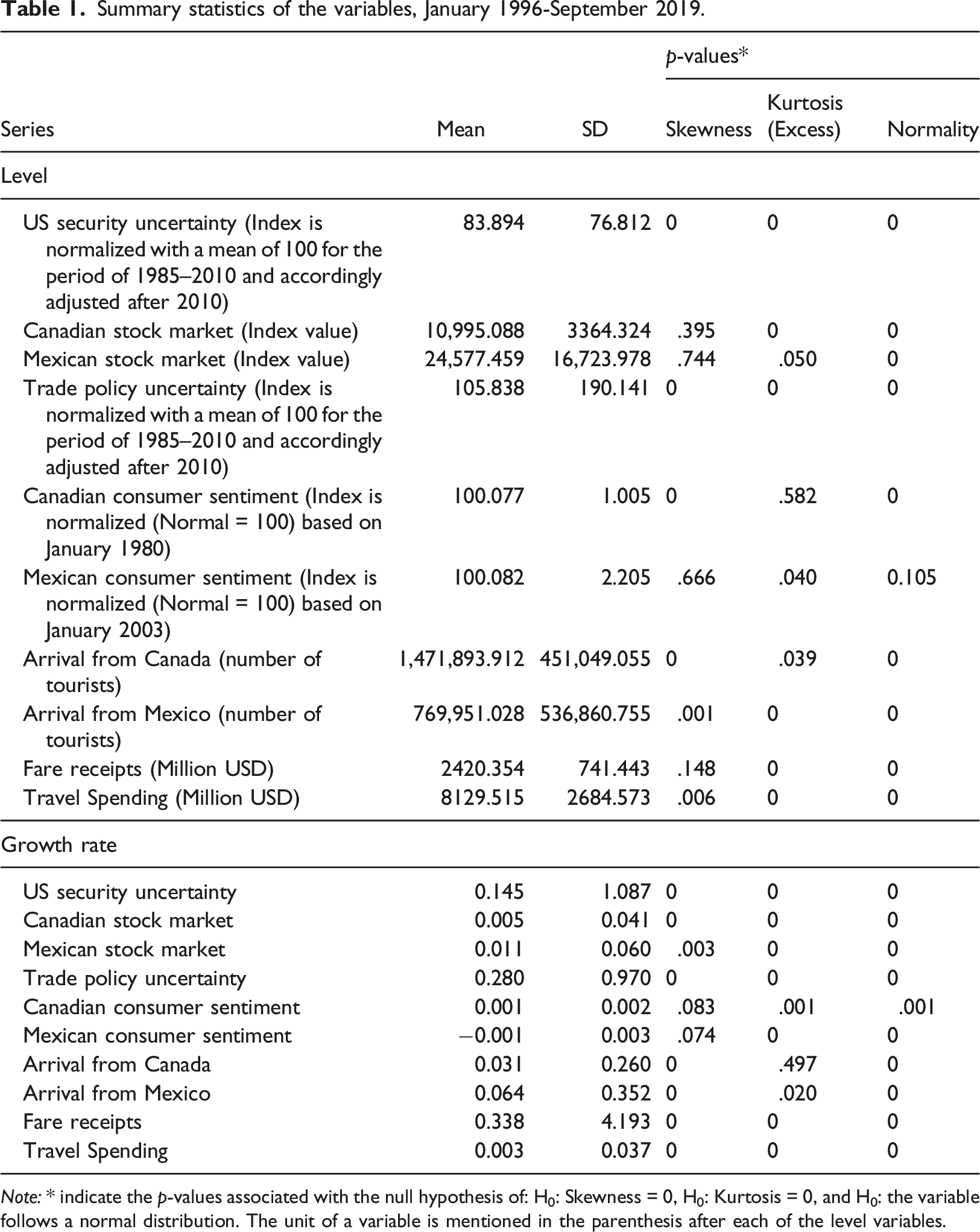
Note: * indicate the p-values associated with the null hypothesis of: H0: Skewness = 0, H0: Kurtosis = 0, and H0: the variable follows a normal distribution. The unit of a variable is mentioned in the parenthesis after each of the level variables.
Findings from the structural VAR
Impact of insecurity of foreign tourists on the US tourism sector
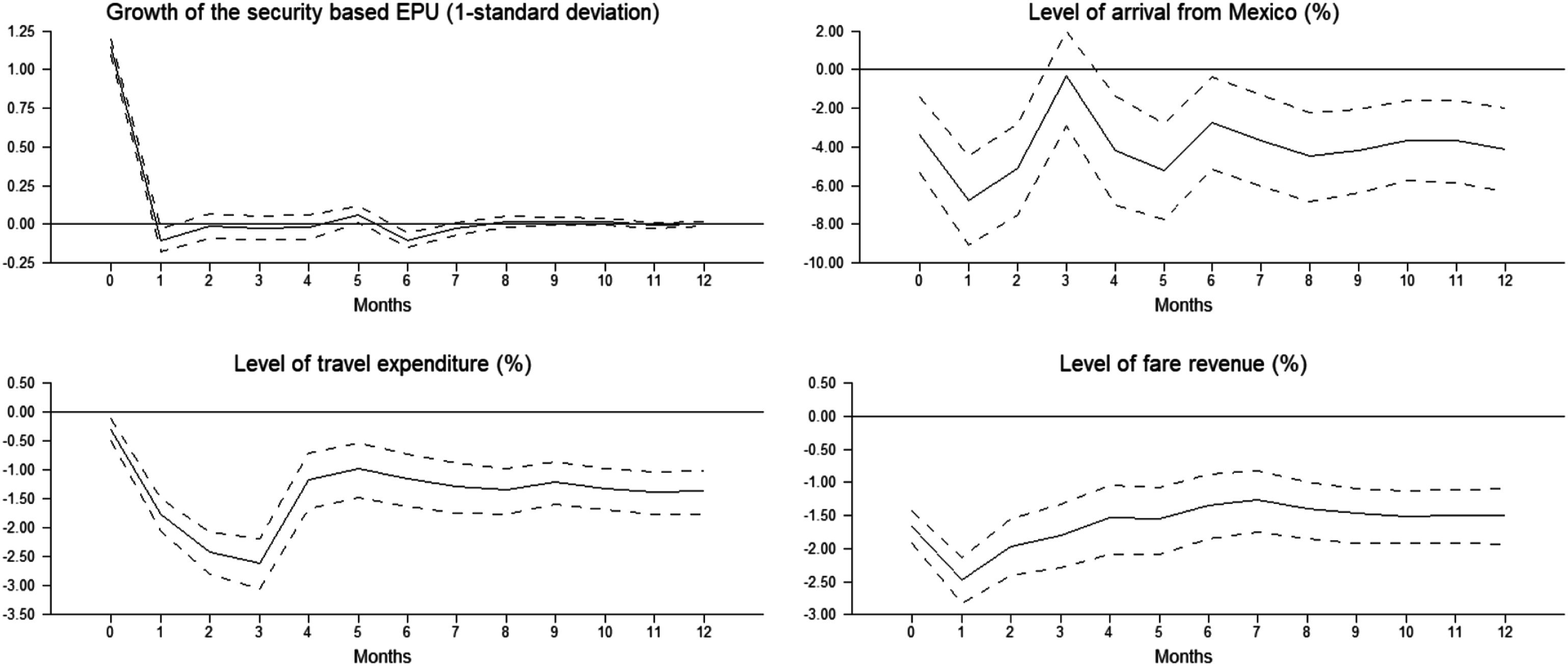
Figure 1 shows that a US national security-based uncertainty shock significantly decreases tourist arrivals from Canada and the effect remains significant in the long run. Figure 2 shows that the same shock significantly decreases tourist arrivals from Mexico and the effect remains significant in the long run. The results from the upper-right graphs of Figures 1 and 2 support hypothesis 1. The figures represent that insecurity significantly reduces fare receipt and travel expenditure in the long run. Responses to a US national security based uncertainty shock in a SVAR with tourist arrivals from Canada. Responses to a US national security based uncertainty shock in a SVAR with tourist arrivals from Mexico.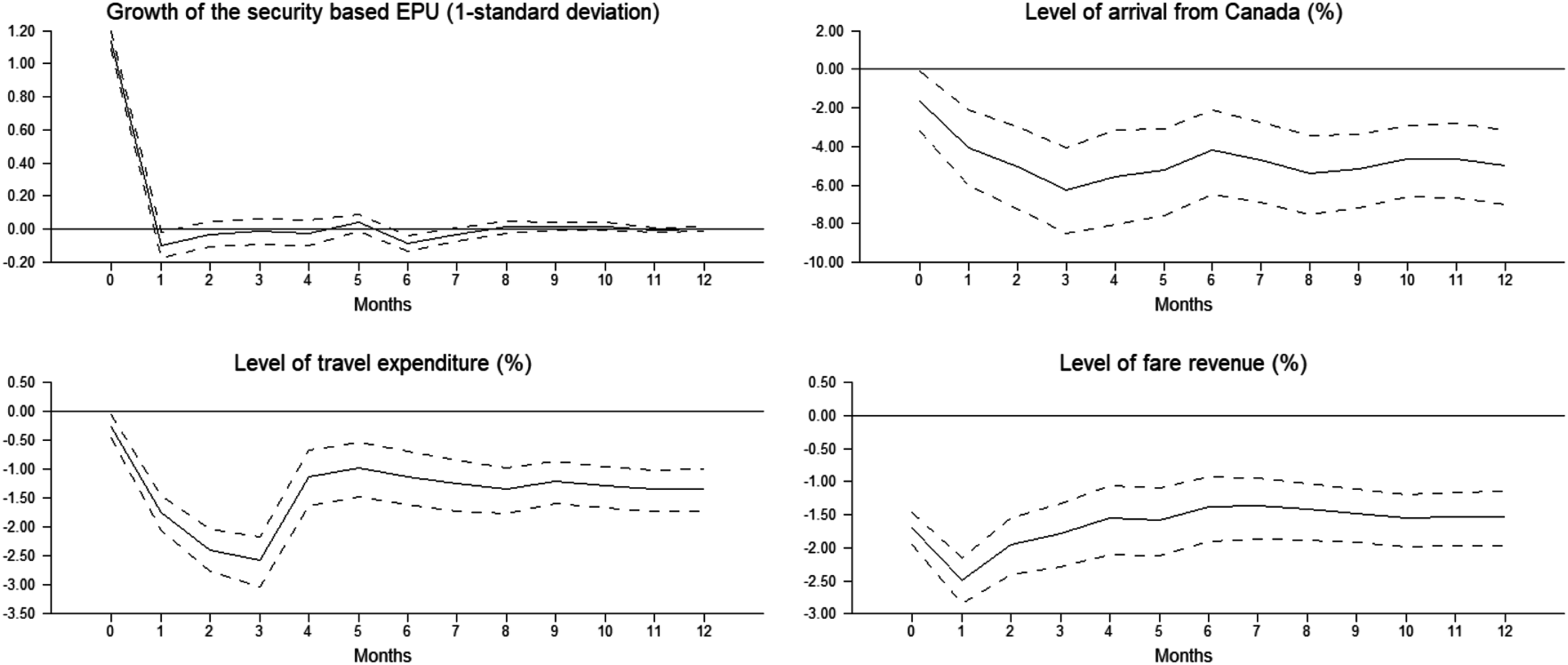
Impact of mood of foreign tourists on the US tourism sector
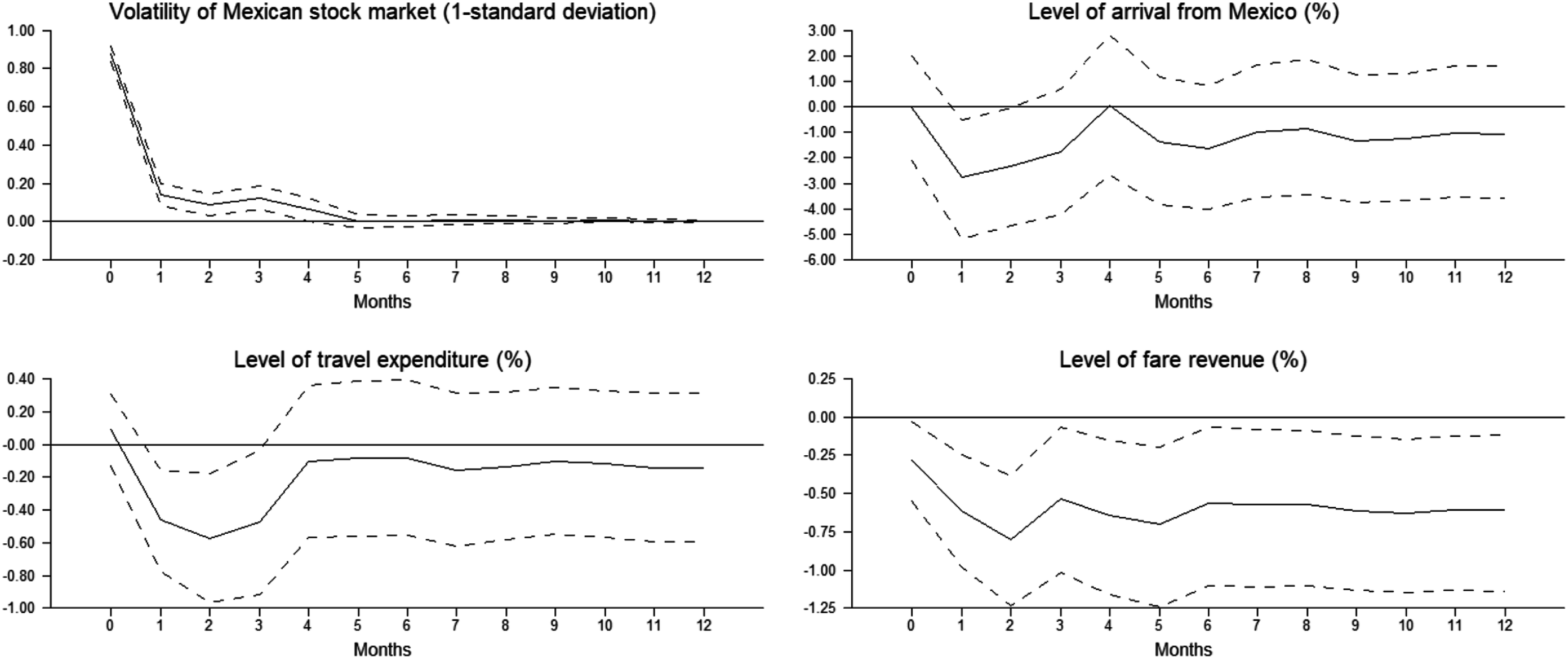
As mentioned earlier, the current literature supports that mood has a short-term impact on human behavior. So, a volatile stock market may affect social mood in the short term. When mood is bad, people feel lackadaisical and may postpone or cancel foreign travel. This is the short-term impact of a volatile stock market on tourism via bad mood. A volatile stock market ultimately decreases people’s wealth, and therefore, reduces the money available to travel. This is the medium or long-term impact of a volatile stock market on tourism via the income effect. These medium or long-term effects are not originated by mood because mood affects human behavior in the short-term only. Therefore, to find out the impact of mood on tourism, one needs to explore the effect of a volatile stock market on tourism for the short term only (usually for 1–2 months).
Figure 3 shows Canadian stock market volatility, which is a proxy of mood of Canadian tourists, does not have a significant negative impact on tourist arrivals from Canada in the short term (for the first 2 months), see the note of Figure 3. The fare receipt is affected in the short term. The volatility of the Canadian stock market does not show strong evidence of influencing travel expenditure in the short-term, see the note of Figure 3. Figure 4 shows Mexican stock market volatility, which is a proxy of mood of Mexican tourists, has a significant negative impact on fare revenue in the short-term. It also has a short-term significant negative impact on travel expenditure, but, overall, it does not show a strong evidence of influencing the tourist arrivals from Mexico in the short-term (see the footnote of Figure 4 for the explanation). The results from the upper-right graphs of Figures 3 and 4 do not support hypothesis 2. Overall, it is found that the mood of Canadian and Mexican tourists does not have a remarkable influence on the US tourism sector in the short-term. Responses to a volatility of Canadian stock market shock in a SVAR with tourist arrivals from Canada. Responses to a volatility of Mexican stock market shock in a SVAR with tourist arrivals from Mexico.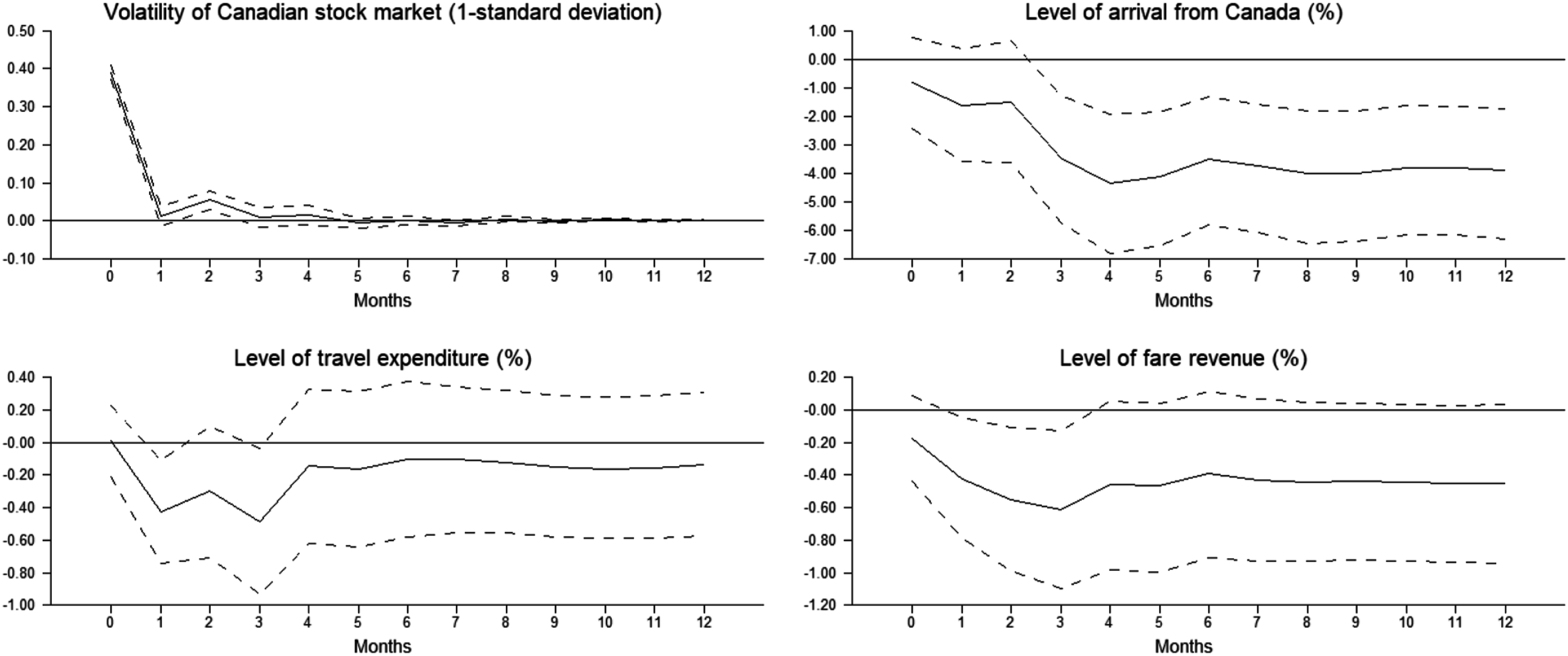
Impact of retaliation of foreign tourists on the US tourism sector
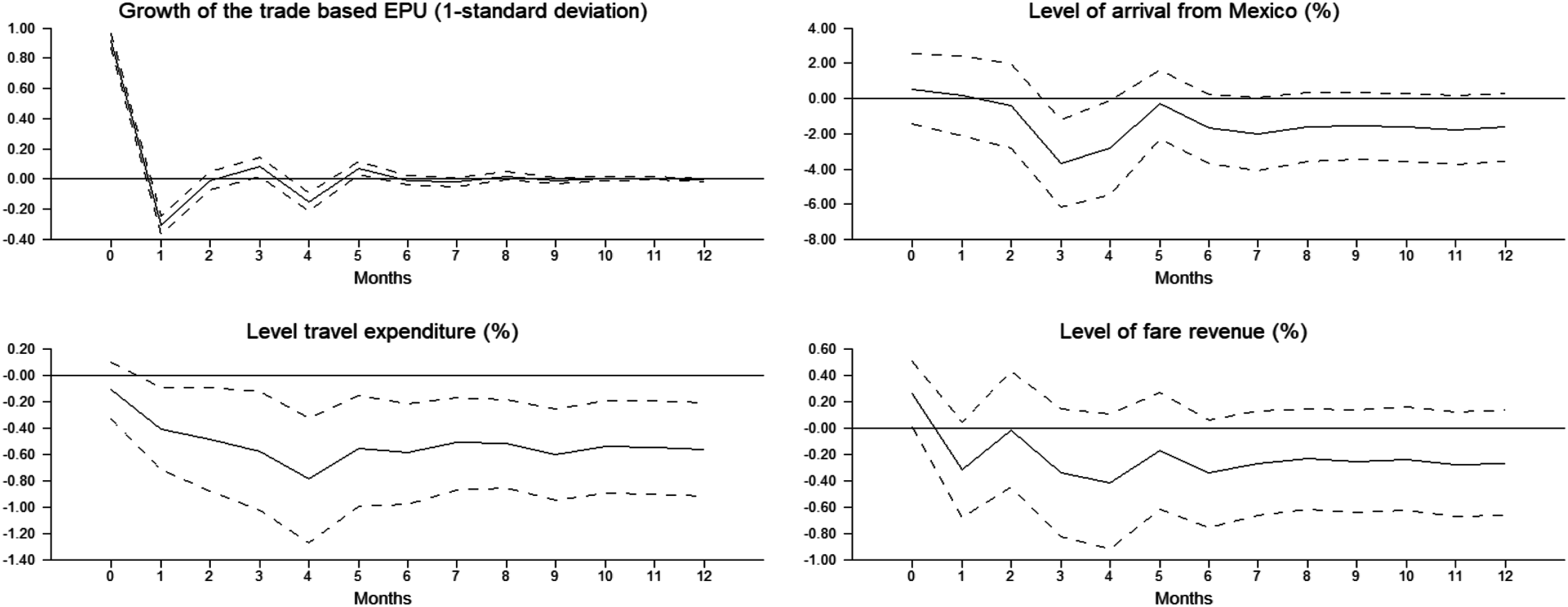
Figures 5 and 6 show that a trade-based uncertainty shock has a significant negative impact on travel expenditure only. It does not have any significant impact on fare revenue and tourist arrival from Canada and Mexico. Overall, it is evident that the nationalism-based retaliation of Canadian and Mexican tourists does not have a significant influence on the US tourism sector. The results from the upper-right graphs of Figures 5 and 6 do not support hypothesis 3. Responses to a trade policy uncertainty shock in a SVAR with tourist arrivals from Canada. Responses to a trade policy uncertainty shock in a SVAR with tourist arrivals from Mexico.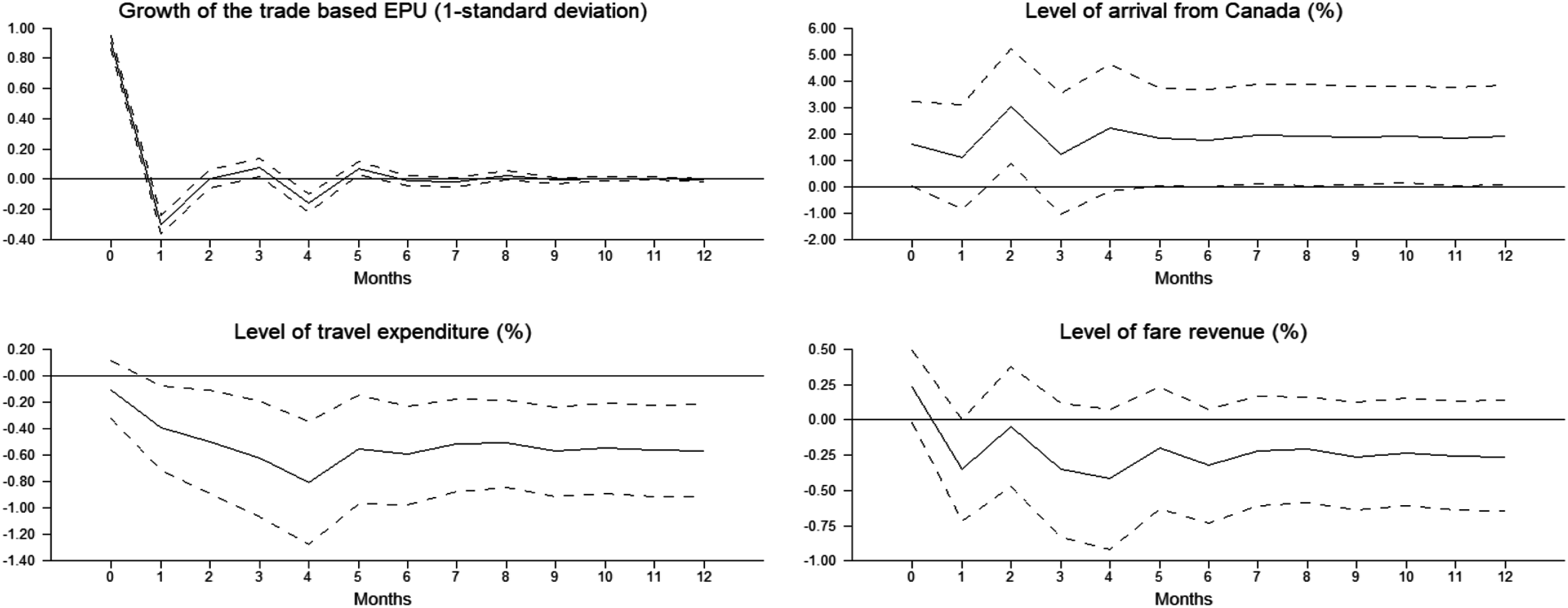
Impact of sentiment of foreign tourists on the US tourism sector
Figure 7 shows that a Canadian consumer confidence shock significantly increases tourist arrivals from Canada and the effect remains significant in the long run. Canadian consumer confidence also increases fare revenue and travel expenditure significantly in the long run. Figure 8 shows that a Mexican consumer confidence shock significantly increases tourist arrivals from Mexico in the long run. The results from the upper-right graphs of Figures 7 and 8 support hypothesis 4. Mexican consumer confidence does not have a remarkable impact on fare revenue and travel expenditure of the US. Responses to a Canadian consumer confidence shock in a SVAR with tourist arrivals from Canada. Responses to a Mexican consumer confidence shock in a SVAR with tourist arrivals from Mexico.

A summary of the impact of the psychological factors of Canadian and Mexican tourists in the US tourism sector.
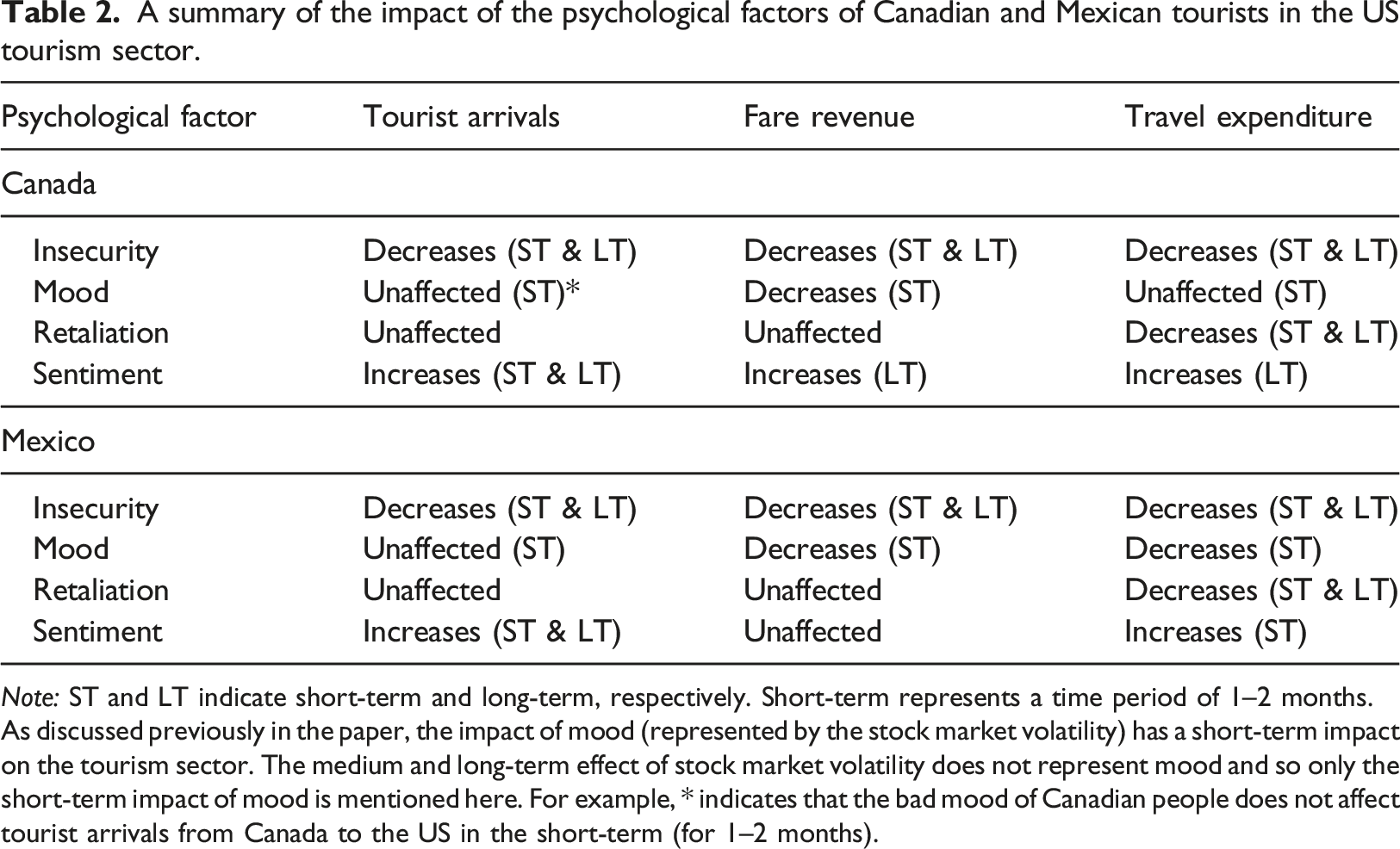
Note: ST and LT indicate short-term and long-term, respectively. Short-term represents a time period of 1–2 months.
As discussed previously in the paper, the impact of mood (represented by the stock market volatility) has a short-term impact on the tourism sector. The medium and long-term effect of stock market volatility does not represent mood and so only the short-term impact of mood is mentioned here. For example, * indicates that the bad mood of Canadian people does not affect tourist arrivals from Canada to the US in the short-term (for 1–2 months).
Robustness of the results from the VAR model
Different number of lags of the SVAR model
As the impulse responses may be sensitive to the number of lags of the SVAR, the SVAR model (2) is estimated with the lag length of 12 (k = 12). The resulting impulse responses are very similar to those found with k = 4. To save space, only the responses originating from the Canadian consumer confidence shock are shown in Figure 9. It is noticed that the qualitative nature of the responses of Figures 7 and 9 is very similar. So, the responses of the SVAR model are not sensitive to the number of lags. Responses to a Canadian consumer confidence shock in a VAR with tourist arrivals from Canada with a SVAR model with 12 lags.
Alterative orderings of the SVAR model
As the impulse responses may be sensitive to the orderings of the SVAR, the SVAR is run with a different ordering. Following Colombo (2013) and Moore (2017), the SVAR model (2) is estimated when the psychological factors are placed last in the ordering of variables. The resulting impulse responses are very similar to those in section 4. To save space, only the responses originating from the national security uncertainty shock are shown in Figure 10. It is found that the qualitative nature of the responses of Figures 1 and 10 is very similar. So, the responses of the SVAR model are not sensitive to the orderings of the model. Responses to a US national security based uncertainty shock in a VAR (when the uncertainty is the fourth variable in the ordering) with tourist arrivals from Canada.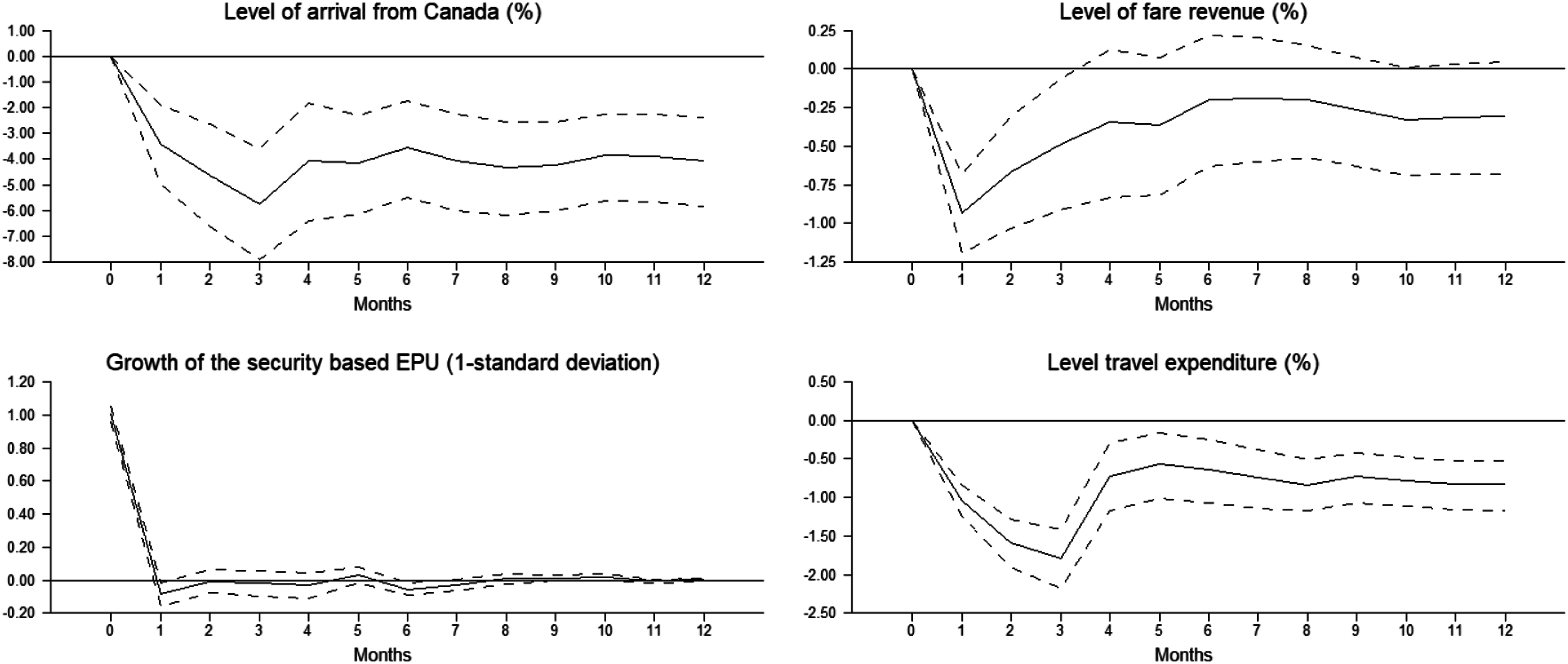
Sign restricted SVAR model
The sign restrictions approach of Canova and De Nicolo (2002) and Uhlig (2005) is used to find out the impact of foreign psychological factors on the US tourism industry.
3
To keep this paper short, only the responses originating from the national security uncertainty shock are shown in Figure 11. Under this approach, it is found that an unexpected increase in the US security uncertainty is associated with lower tourist arrivals from Canada, lower fare revenue, and lower travel expenditure in the US. So, the finding that psychological factors can influence the US tourism sector is still valid with an alternative VAR identification approach. Responses to a US national security based uncertainty shock in a VAR with tourist arrivals from Canada in a sign restricted VAR model.
Adding a new control variable
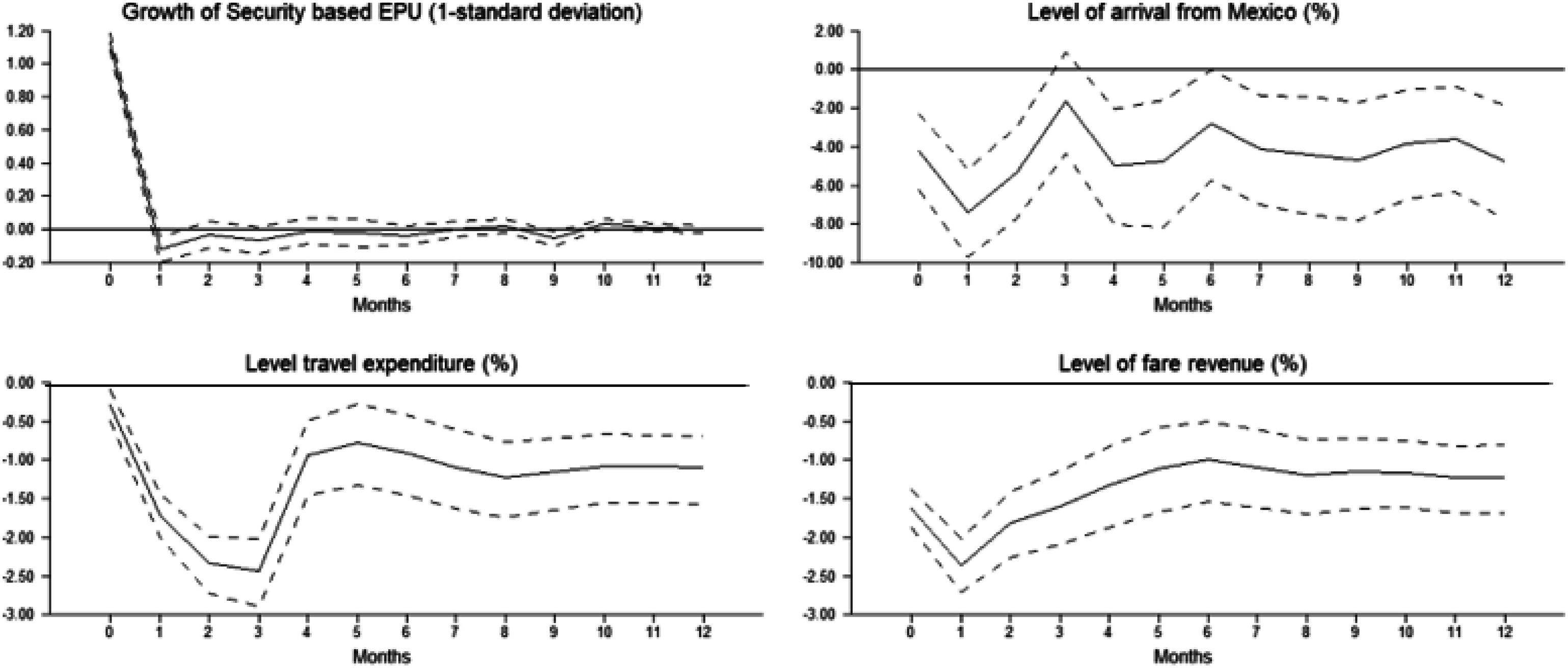
To explore any potential spurious relationship among the variables of the SVAR, this paper uses the total industrial production of Canada and Mexico as control variables in the model. The variables are collected from the Fred website (See Endnotes #11 and #12, respectively). To save space, only the responses originating from the national security uncertainty shock are shown in Figures 12 and 13. The responses of Figures 12 and 13 are very close to those of Figures 1 and 2 indicating the absence of a potential spurious relationship among the variables of the SVAR. As the model uses stationary variables (see the first paragraph of subsection 3.2), no spurious relationship is found in the model. Responses to a US national security-based uncertainty shock in a VAR with tourist arrivals from Canada when industrial production of Canada is used as a control variable. Responses to a US national security-based uncertainty shock in a VAR with tourist arrivals from Mexico when industrial production of Mexico is used as a control variable.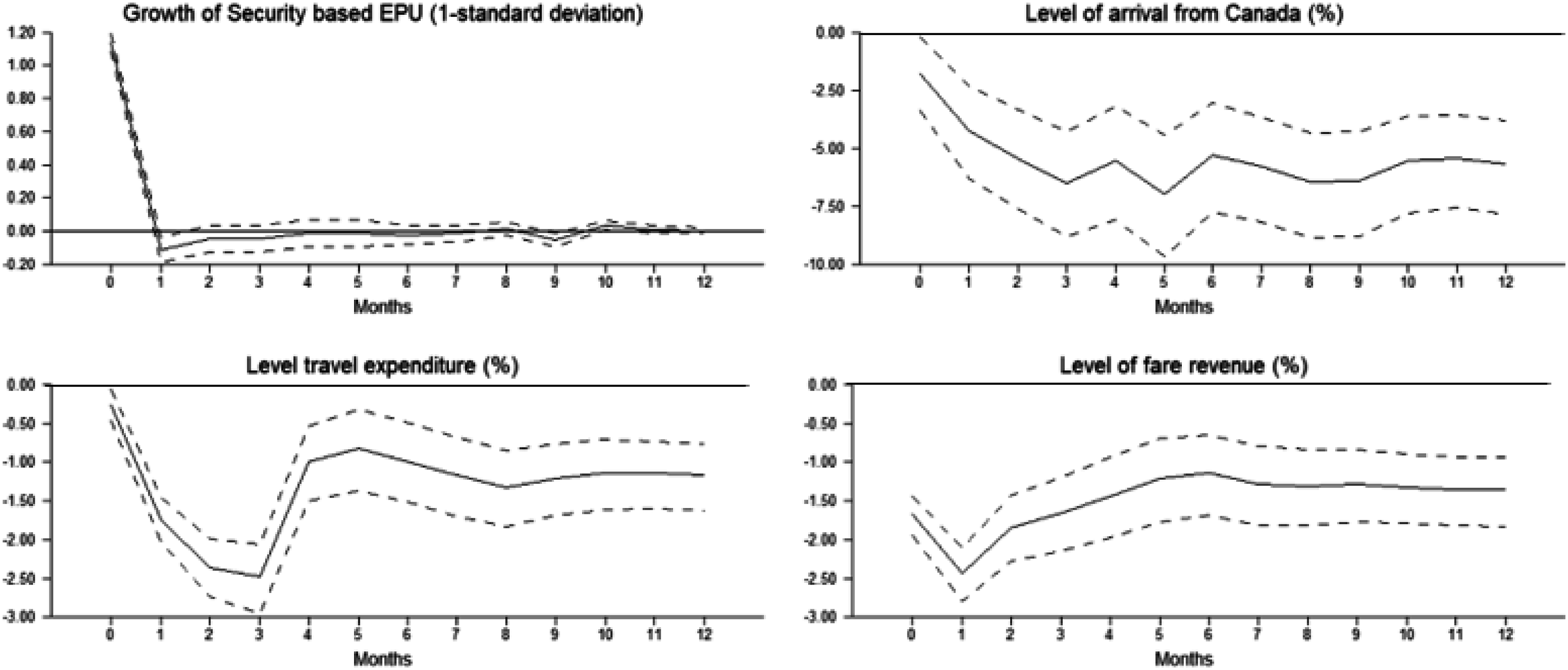
To further check the robustness of the results, the impact of insecurity, mood, retaliation, and sentiment on the US tourism sector are examined for a SVAR model with 12 lags and also with a SVAR model when each of the psychological factors is the fourth variable in the ordering. The results are shown in the annex. Some of the results are interesting. For example, results show that, compared to Figure 8, the positive magnitude of the response of fare revenue is stronger originating from a Mexican consumer confidence shock in a SVAR with 12 lags. It is also found that, compared to Figures 5 and 6, the negative magnitude of the responses of fare revenue is stronger originating from a trade policy uncertainty shock in a SVAR when uncertainty is the fourth variable in the model. So, there is some evidence that fare revenue in the US may be positively influenced by an increase in Mexican consumer confidence but negatively influenced by an increase in trade policy uncertainty. Moreover, it is noticed that, compared to Figure 8, the positive magnitude of the responses of tourist arrivals from Mexico is weaker originating from a Mexican consumer confidence shock in a SVAR with 12 lags and also when uncertainty is the fourth variable in the model. So, it is found that the positive impact of Mexican consumer confidence on tourist arrivals from Mexico to the US is conditional on the structure of the SVAR model. The other results of the annex are broadly consistent with those found so far in this paper.
The time-varying response of international tourist arrivals
The previous two sections show that the insecurity and sentiment of Canadian and Mexican tourists significantly affect the tourist arrivals in the US (from both Canada and Mexico), which is the most important barometer for the US tourism industry. Whether and to what extent the insecurity and sentiment indicators influence the inflow of Canadian and Mexican tourists over time is an interesting topic. The current paper explores this topic by using the time-varying spillover approach of Diebold and Yilmaz (2012).
Diebold and Yilmaz (2012) use variance decompositions of a generalized VAR framework (Pesaran and Shin, 1998) to assess the spillover among a set of variables. In a generalized VAR framework, the outcome of the model is independent of the ordering of the variables. The variance decomposition approach calculates how much the forecast-error variance of one variable can be explained by exogenous shocks to the other variables in a VAR model. The directional spillovers (cross variance shares) are the fractions of the H-step-ahead forecast-error variances of a variable z
i
directional (originating) from shocks to z
j
for all i ≠ j. Following the approach of Diebold and Yilmaz (2012), this paper examines the time-varying directional spillover from insecurity and sentiment indicators to international tourist arrivals in the US. The results are shown in Figure 14 with a 50-month rolling window (prior observations) and 10 periods of generalized forecast-error variance decomposition. Time-varying directional spillover from insecurity and sentiment to international tourist arrivals in the US.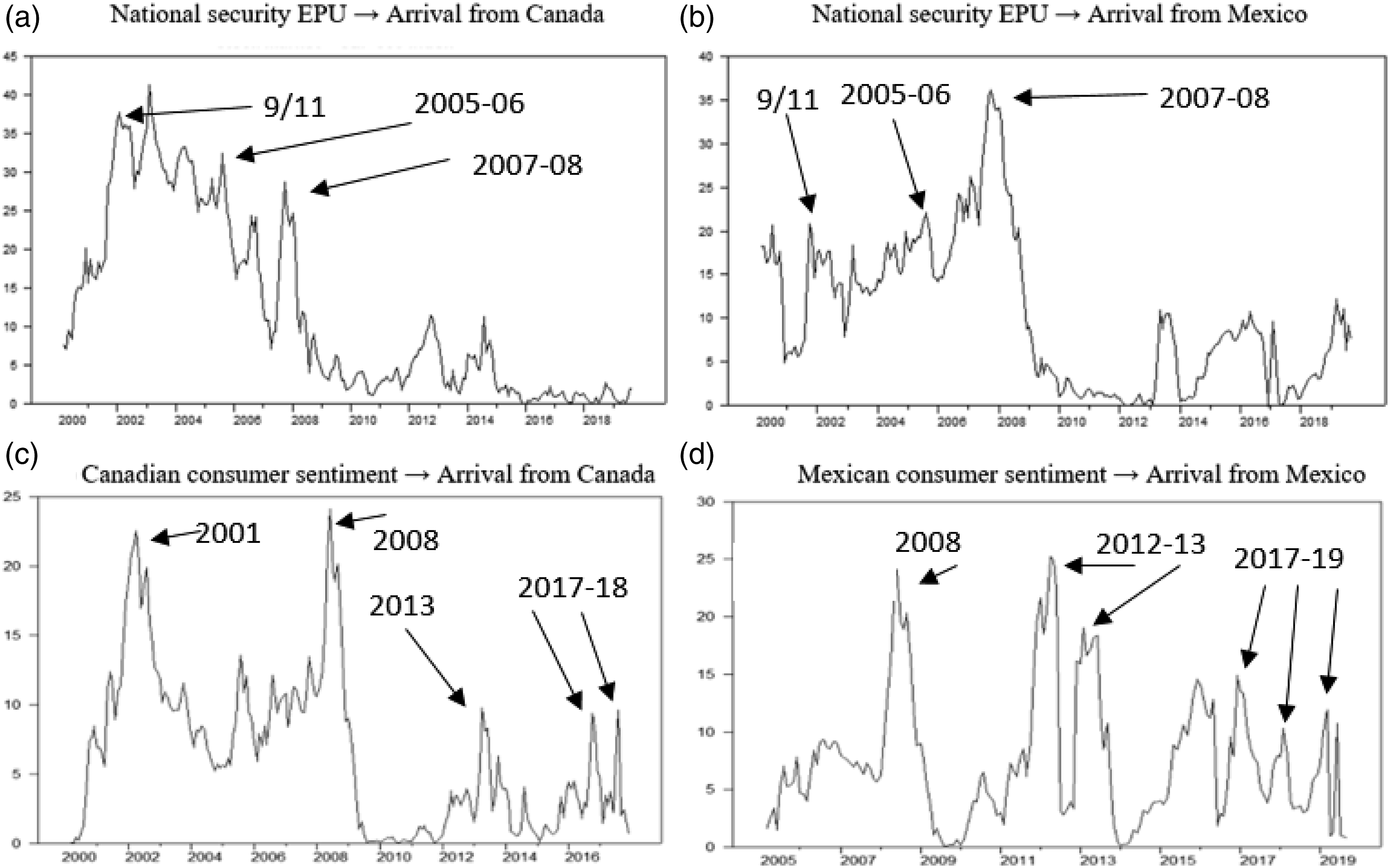
Figure 14(a) and (b) indicate that the US security uncertainty has a high spillover effect on tourist arrivals from Canada and Mexico around the 9/11 period of 2001, 2005-2006, and during the financial crisis of 2007-08. Figure 14(c) indicates that the Canadian consumer sentiment has a high spillover effect on tourist arrivals from Canada during 2001, 2008, 2013, and 2017-18. Figure 14(d) represents that Mexican consumer sentiment has a high spillover effect on tourist arrivals from Mexico during several occasions within the periods of 2008, 2012-13, and 2017-19.
Overall, Figure 14 shows that the impact of insecurity and sentiment indicators on the inflow of Canadian and Mexican tourists vary across different time periods.
Economic analysis of the findings
This section provides the economic clarifications of the empirical results by applying economic theories and comparing the results with other relevant studies.
Figures 1 and 2 and Figures 10 and 11 represent that national security-based uncertainty, as a proxy of insecurity, has a strong negative impact on the US tourism sector. It is found that both Canadian and Mexican tourists seriously consider safety issues when traveling to the US. Figure 14(a) and (b) show that the spillover effect of insecurity was high in 2001 due to the 9/11 incident. This evidence supports Bonham et al. (2006), who find that safety issues of destination places are an important factor for tourism. Figure 14(a) and (b) show that the effect of insecurity was high during the 2005-06 period because of the four category 5 hurricanes (Emily, Katrina, Rita, and Wilma) that created huge causalities in the US. This finding supports the existing tourism literature showing that natural calamities discourage tourism (Sharpley, 2005) and create indecision to travel (Wang, 2009). Figure 14(a) and (b) also show that the effect of insecurity was also high during the financial crisis of the US. As financial crisis is related to unemployment, some bad professions like theft, hijacking, robbery, and burglary may increase during a financial crisis. This could be one possible reason why Canadian and Mexican tourists might be unwilling to travel to the US if they were concerned of the US domestic insecurity issues during the financial crisis period. This argument is consistent with Dragouni et al. (2016), who find that the insecurity of international tourists was affected during the financial crisis. Therefore, the spillover effect of insecurity on tourist arrivals from Canada and Mexico was high during the period of 2008.
Figure 3 represents that an increase in the volatility of the stock market of Canada, as a proxy of the mood of Canadian tourists, does not have a significant negative impact on tourist arrivals from Canada and on the travel expenditure in the US in the short-term (1–2 months). Figure 4 shows that an increase in the volatility of the stock market of Mexico, as a proxy of the mood of Mexican tourists, does not have a significant negative impact on tourist arrivals from Mexico in the short-term (1–2 months). As the effect of mood on human behavior lasts for the short-term [see Dragouni et al. (2016) and Andrade and Ariely (2009)], this study finds that the mood of Canadian and Mexican tourists does not have a remarkable adverse impact on the US tourism sector.
Figures 5 and 6 represent that the US trade policy uncertainty, as a proxy of nationalistic retaliation for Canadian and Mexican tourists, does not have a significant negative impact on tourist arrivals from the two countries to the US. The evidence indicates that tourists from Canada and Mexico in the US are not influenced by any nationalistic feelings related to trade and tariff policies. The long friendly relationship of the US with Canada and Mexico is the main factor behind this cordial behavior of Canadian and Mexican tourists.
Figures 7–9 represent that high Canadian and Mexican consumer confidence indicators, as proxies of sentiment, have a significant positive impact on the tourist expenditure in the US and tourist arrivals from Canada and Mexico. 4 The figures indicate that low consumer sentiment in Canada and Mexico should be associated with lower tourist arrivals from these countries to the US. As consumers are pessimistic during recessions, their sentiment should be low during recessions and they cut down tourism plans at this time. 5 So, the effect of sentiment should be high on tourism during recessionary periods. This prediction is reflected in the second row of Figure 14. Figure 14(c) indicates that the Canadian consumer sentiment had a high spillover effect on tourist arrivals from Canada during the Canadian recessionary periods of 2001, 2008, and 2017–2018. Figure 14(d) shows that the Mexican consumer sentiment had a high spillover effect on tourist arrivals from Mexico during the Mexican recessions of 2008, 2013, and 2018–2019. 6
The current paper contradicts the findings of Gounopoulos et al. (2012) who find that the consumer confidence indices of France, Germany, Italy, the Netherlands, Japan, the UK, and the US have no significant impact on inbound tourism in Greece. Gounopoulos et al. (2012) argue that as Greece is a relatively cheap destination, the tourists from these seven countries like to travel to Greece even when the economic situation is bad in the origin countries. On the other hand, high airfare, lack of sufficient public transport, high parking fee, high entry fee in amusement parks, high cost of dining in the tourist spots, etc. made the US a relatively expensive tourist destination in the world. Therefore, when recessions hit Canada and Mexico, tourists of the two countries have lower consumer confidence and they try to save money by canceling the plan of visiting the expensive US.
Conclusion
International tourism has a significant contribution to the development of the US economy. According to the website of the Department of Commerce of the US (see Endnote #15), travel and tourism contributed to 11% of all US exports and nearly 32% of all US services exports in 2017. International visitors spent $251 billion in the US in 2017. The Department of Commerce projects that the US will attract 95.5 million international visitors annually by 2023. As Canada and Mexico are the two most important sources of international tourists to the US, how and to what extent economic and psychological factors influence the inflow of tourists from these countries is an interesting research question. But, most of the current literature investigate tourism demand by using economic factors. Against this backdrop, the current study investigates the impact of psychological factors of Canadian and Mexican tourists on the US tourism sector.
Using the monthly data of 1996–2019, this paper investigates the impact of insecurity, mood, retaliation, and sentiment of Canadian and Mexican tourists on tourist inflows in the US from Canada and Mexico. The paper also investigates the impact of these psychological factors on passenger fare receipts and expenditure of international tourists in the US tourism sector. These two economic variables are important for the US economy because they have a large impact on the overall economy through the multiplier effect. The paper uses the US security-based EPU, volatility of foreign stock markets, the US trade policy EPU, and foreign consumer confidence indicators as the proxies of insecurity, mood, retaliation, and sentiment, respectively of the foreign tourists traveling to the US. This is the first study proposing nationalistic retaliation as a potential determinant of tourism demand. The study also proposes US security-based EPU as a better indicator of insecurity compared to the geopolitical risk for the tourists arriving from Canada and Mexico. The research is an addendum to the relatively new psychological factors spillover literature when it investigates the influence of foreign psychological factors on the domestic US tourism.
The results from the SVAR model indicate that nationalism-based retaliation of Canadian and Mexican tourists does not have any significant robust impact on tourist arrivals from these two countries to the US. It is found that the bad mood of Canadian and Mexican tourists does not significantly reduce tourist inflows from these two countries to the US in the short-term (1–2 months). The impulse responses show that the insecurity of Canadian and Mexican tourists have a significant robust negative effect on the US tourism. Results show robust evidence that high consumer confidence of Canadian tourists significantly increases tourist arrivals from Canada, fare revenue, and travel expenditure. There is also robust evidence that the high consumer confidence of Mexican tourists significantly increases travel expenditure. The positive association between consumer confidence of Mexican tourists and tourist arrivals from Mexico is found weak for some specifications of the SVAR model. The research also uses the time-varying spillover approach of Diebold and Yilmaz (2012) to investigate the time-varying impact of insecurity and sentiment on tourist arrivals from Canada and Mexico to the US. The results show that the tourist inflows from Canada and Mexico to the US are highly influenced by insecurity during the period of terrorist attacks, natural disasters, and financial crises of the US. Besides, the tourist inflows from Canada and Mexico to the US are greatly influenced by low sentiment during the recessionary periods of the respective country of origin.
The study suggests the US policymakers consider the psychological factors like insecurity and sentiment of the tourists of Canada and Mexico to forecast the US tourism demand. A combination of economic and psychological factors is helpful for making a long-term plan for tourism management and tourism growth strategies. When the insecurity is high or the sentiment is low for Canadian and Mexican tourists, a discounted price of the hotel rooms or discounted ticket prices of attractive destinations can be offered so that the domestic US tourists can avail these opportunities. Moreover, as it is found that high insecurity and low sentiment are associated with lower revenue collection from the tourism sector 7 , it may contribute to the budget deficit and have future corresponding fiscal implications. Lower tourist arrivals from Canada and Mexico associated with high insecurity and low sentiment may hamper domestic tourism-based employment in the US. So, the jobless rate in the tourism sector may go up. Moreover, a shrinking tourism sector may attract less investment, which reduces the contribution of the tourism sector to the GDP in the long run. Overall, the total cost of high insecurity and low sentiment of Canadian and Mexican tourists may be pretty large for the US tourism sector. A possible extension of this study could be investigating whether the relationship between each of the psychological factors and the tourist arrival from Canada and Mexico is symmetric.
Endnotes
Supplemental Material
Supplemental Material - Psychological factors of Canadian and Mexican tourists and the US tourism sector
Supplemental Material for Psychological factors of Canadian and Mexican tourists and the US tourism sector by Khandokar Istiak in Tourism Economics
Footnotes
Declaration of conflicting interests
The author(s) declared no potential conflicts of interest with respect to the research, authorship, and/or publication of this article.
Funding
The author(s) received no financial support for the research, authorship, and/or publication of this article.

Supplemental Material
Supplemental Material for this article is available online.
Notes
Author biography
Khandokar Istiak is an Assistant professor of Economics at the University of South Alabama, Mobile, Alabama, United States. The primary areas of his research are macroeconomics, monetary economics, and uncertainty. The author published around 19 papers in different international journals including Macroeconomic Dynamics, Economic Modeling, The North American Journal of Economics and Finance, Applied Economics, Quarterly Review of Economics and Finance, among others.
References
Supplementary Material
Please find the following supplemental material available below.
For Open Access articles published under a Creative Commons License, all supplemental material carries the same license as the article it is associated with.
For non-Open Access articles published, all supplemental material carries a non-exclusive license, and permission requests for re-use of supplemental material or any part of supplemental material shall be sent directly to the copyright owner as specified in the copyright notice associated with the article.
