



Abstract
A comprehensive and accurate assessment of the policy effect of national tourism days is of great significance to further promote urban inbound tourism. Based on the panel data of 59 cities in China from 2000 to 2017, this paper evaluates the local and spatial spillover effects of the China Tourism Day policy on urban inbound tourism using a spatial difference-in-differences model based on the establishment of the China Tourism Day as a quasi-natural experiment. The study found that the China Tourism Day policy significantly increased the number of foreign tourists in cities but significantly reduced their average length of stay, with a positive spatial spillover effect on inbound tourism in surrounding cities.
Keywords
Introduction
Tourism has become one of the largest industries leading strong global economic development (Shieh et al., 2014). Especially given the globalization process, the inbound tourism industry has become one of the pillar industries for the economic development of various countries (Dwyer et al., 2000; Tang, 2021). Benefiting communities and residents through sustainable global tourism development is an important way to achieve the Millennium Development Goals and Sustainable Development Goals (Buzinde et al., 2014; Gao et al., 2021). Against the background of the sluggish world economic recovery and a slowdown in the growth of international trade, international tourism still maintains a relatively high growth rate and has become an important force in driving global economic development (Cortes-Jimenez and Pulina, 2010). However, at the same time, it must be acknowledged that inbound tourism has not yet recovered well, so there is still a great deal of room for improvement. For many countries, improving and strengthening inbound tourism has become a long-term goal, which can significantly contribute to their economic recovery.
In recent years, studies on inbound tourism have exploded (Li et al., 2021; Tang, 2021). From the perspective of tourist destinations, the existing literature suggests that the determinants of inbound tourist arrivals include per capita income (Geng et al., 2021; Serra et al., 2014), cost of living (Garín-Muñoz and Montero-Martín, 2007), and real prices (Garin-Munoz and Amaral, 2000). These are the main factors affecting the economic level of a tourist destination country. Additionally, recent studies have shown that country branding is important for inbound tourism (Lozynskyy and Kushniruk, 2020; Papp-Váry, 2019). To attract more international visitors, many countries, such as the United States (U.S.) (Zavattaro and Fay, 2019), New Zealand (Lodge, 2002; Vatsa, 2020), Spain (Fiona, 2002; Vicens-Colom et al., 2021), Finland (Aho, 2014; Vento et al., 2020), and Scotland (Melis and Chambers, 2021; Olins, 2000), not only promote their natural attractions but also distinguish their destinations through branding strategies that establish their unique positions. A few developing countries, such as Romania (Platon et al., 2021), Iran (Hakimipour and Bozorgkho, 2012), Malaysia (Chi et al., 2018), and Brazil (Ferreira et al., 2022), are actively exploring strategies for building national tourism brands. However, the lack of such research is clearly inconsistent with the global pattern, with developing countries accounting for 80% of the global population.
To effectively shape national or local tourism brands, some countries or regions have established national or regional tourism days or tourism weeks to attract foreign tourists. In 1965, Japan designated August 1 of each year as “Tourism Day.” In 1970, South Korea decided to hold an annual “tourism day” event on an unfixed date. In 1983, a National Tourism Week was designated by the U.S. Congress to draw public attention to the importance and benefits of the U.S. travel and tourism industry. Switzerland began holding “Tourism Day” activities in 1998, selecting one city each year during the months of April and May. Georgia and Tunisia both have “Tourism Days.” In the Caribbean, November 3 is “Caribbean Tourism Day.” The “Paris Tourism Day” is celebrated annually on July 9. Other European cities such as Hamburg, Germany, also have their own “Tourism Days.” Some Southeast Asian countries attract domestic and foreign tourists by actively organizing short “festival” tourism with local characteristics, such as night markets (Aziz and Yeng, 2011; Bamrongpol et al., 2020; Iqbal, 2017). However, there is still a lack of relevant research on the effect of these tourism days on the promotion of inbound tourism. Moreover, there is even less empirical evidence in this area.
Since 2011, China has designated May 19 as China Tourism Day. As an annual milestone, China Tourism Day plays a critical role in promoting China’s overall tourism construction and attracting foreign tourists. In January 2022, the State Council of China issued the “14th Five-Year Plan for Tourism Development,” which laid out a blueprint for developing China’s tourism industry with the goal of building a tourism powerhouse. In this process, China Tourism Day festivals play an important role. However, certain problems were revealed during the implementation process. In terms of attracting foreign tourists, the effect was not as good as expected. Therefore, it is necessary to conduct a systematic study on the influence mechanism of China Tourism Day. This not only is beneficial for building a national tourism brand through the establishment of China Tourism Day but also helps cities to use China Tourism Day festivals to build their urban tourism image, thereby attracting more foreign tourists.
This study establishes China Tourism Day as a quasi-natural experiment and uses the spatial difference-in-differences (SDiD) method to empirically examine the actual effect of the establishment of China Tourism Day on the development of inbound tourism in Chinese cities. Since the publication of Dube et al. (2014)’s seminal paper, SDiD has been used in many fields, such as public health (Chagas et al., 2016), commerce (Han et al., 2018), and real estate (Qiu and Tong, 2021). In the difference-in-differences model (DiD), the classic assumption is the stable unit treatment value assumption (Jin et al., 2022; Schwartz et al., 2012; Yeon et al., 2022). However, this assumption no longer holds when spatial spillover effects exist between different spatial units (Jia et al., 2021). SDiD can effectively compensate for the deficiencies of DiD, accommodate spatial spillover effects, and avoid biased estimates (Gu, 2021; Guo et al., 2021).
In comparison with the existing literature, the theoretical contributions of this study include the following three aspects. First, the spatial impact of national tourism day festivals on urban inbound tourism expands the theory of tourism destination marketing in inbound tourism (Ketter, 2018; Kim and Lee, 2016; Wilopo et al., 2020). Second, taking the China Tourism Day policy as a quasi-natural experiment, an SDiD model is established to systematically evaluate the effect of the policy on inbound tourism, which provides a new research method in the field of tourism policy effect evaluation. To the best of our knowledge, this study is the first to use SDiD to conduct tourism research, and its significance in tourism research is self-evident. Finally, the dual impact of the national tourism day policy on urban inbound tourism was confirmed, which provides a reference for the formulation of urban tourism policies.
The rest of the paper is organized as follows: Section 2 presents the literature review and theoretical background; Section 3 introduces China Tourism Day; Section 4 presents the data and methods; Section 5 presents the empirical results; Section 6 discusses the results; and Section 7 concludes.
Theory, hypothesis development, and analytical framework
Tourism destination marketing
Tourism destination marketing for foreign tourists promotes inbound tourism by transmitting tourist destination information to foreign tourists through publicity, attraction, and persuasion (Ketter, 2018; Kim and Lee, 2016; Wilopo et al., 2020). Tourism destination marketing includes strategies, systems, and methods (Rathee and Rajain, 2022). Specifically, tourism destination marketing can be divided into four dimensions: marketing objects (tourists), marketing subjects (tourist destinations or related organizations), marketing key points (tourist destinations’ image and brand), and marketing strategy (Matiza and Slabbert, 2019). Tourism destination image, as a hotspot and a key area of international tourism research, refers to the sum of tourists’ beliefs, opinions, and impressions of tourism destinations (Chen et al., 2021; Chen and Li, 2018; Hosany et al., 2006).
Among the various tourism destination marketing programs, national tourism destination marketing programs are receiving increasing attention. As early as 1997, an evaluation of the effect of some countries’ activities on promoting tourism development through the establishment of national tourism administrations was proposed (Faulkner, 1997). In international tourism research, national tourism destination marketing programs have been systematically evaluated in 24 destination countries and 21 origin countries (Smeral and Witt, 2002). In Hong Kong and South Korea, government-supported national tourism organizations (NTOs) play an active role in implementing tourism destination marketing (Kim, 2015). The same is true for some South Pacific island countries (King et al., 2000). To better promote their country’s tourism resources to foreign tourists, NTOs often use new publicity channels, such as social media on the Internet (Hays et al., 2012; Mariani et al., 2017). Tourism destination products are jointly provided by the public and private sectors and are, therefore, to some extent, characterized as “public goods,” which makes the government play an important role in the tourism destination marketing process (Woodside and Sakai, 2008). Although an increasing number of countries are carrying out national tourism destination marketing programs, the impact of these programs, such as national-level tourism festivals, on inbound tourism has not been systematically studied and evaluated.
Hypothesis development
Tourism festivals are an important way to establish a good image of a destination. For example, the Nakoda people have successfully established a good tourism image through the Banff Indian Days tourism festivals and have promoted the development of the local tourism economy (Mason, 2015). In Ghana, the “Easter Festival” held by the Kwahus has established a strong local tourism image, which has taken a national and international dimension, attracting a large number of tourists (Kate, 2013). Thailand has established a destination tourism image by hosting the Songkran Water Festival, which has attracted a steady stream of foreign tourists (Intason et al., 2021). Judging from the quantity and content of the relevant literature on tourism destination marketing research, it covers a wide range and is highly comprehensive, but some aspects, such as national tourism initiatives or festivals, of this research still need to be deepened. There is a lack of research on the promotion of tourism marketing activities by national governments through the establishment of national tourism days. In this regard, some scholars have called for strengthening research on mega festivals or events, including national tourism day festivals, and believe that there is a strong urgency to conduct research in this area (Gil-Alana et al., 2019; Goh et al., 2022; Li et al., 2020; Luo, 2014). Achieving this goal would be a major breakthrough in the theory of tourism destination marketing.
Brand management research has been a hot topic in tourism destination marketing research in recent years and has introduced a lot of new knowledge (Ceylan et al., 2021; Jeong and Kim, 2020; Kovačić et al., 2022). Festivals are the main form of building the cultural and entertainment connotations of modern travel brands within tourism destination marketing (Kozlovska, 2021). Therefore, the importance of festival tourism in brand building for destination tourism increases with each passing day (Picard and Robinson, 2006). In recent years, various “cultural festivals, tourism festivals, and folk festivals” have sprung up in an endless stream in various countries and cities, reaffirming the vital role festivals play in promoting the tourism market (Boo and Busser, 2006; Zhang et al., 2013). However, many tourism festivals have no life after a short-lived period. Not only do these festivals fail to establish a good tourism brand but they are also laborious and costly. This has led academia to question the appropriateness of the concept of “festival tourism” (Bernadette, 2006). The promotion of sustainable tourism festivals is gradually becoming a common voice (Musgrave and Okech, 2013; Pirnar and Celebi, 2020).
An important part of tourism destination marketing is the creation of a national brand (Matiza, 2021). A study based on 39 NTOs in Europe showed that governments play an important role in creating the brand image of national tourism destinations (Marczak and Borzyszkowski, 2020). As a type of national tourism festival, establishing a national tourism day also plays an important role in promoting national tourism brands. Most tourism destination marketing systems and operation modes in various countries are built based on NTOs (Vila et al., 2017). For cities, the celebration of a national tourism day can effectively promote the development of local tourism and attract more domestic and foreign tourists. Given the above discussion, the following hypotheses were derived:
Analytical framework
The existing literature has the following limitations: first, most of it is qualitative studies (Intason et al., 2021; Kate, 2013; Mason, 2015), and empirical studies are lacking; second, the effect of mega festivals, such as national tourism festivals, on tourism, is mainly explained in evaluations by comparing the changes before and after the festival. Notably, merely comparing the differences before and after the festival can at best illustrate the correlation of this initiative with attracting tourists. However, it cannot form causal inferences about the effect of this initiative because some other policies occurring at the same time as the national tourism day (such as visa-free policies) may also induce changes in inbound tourism, leading to a “pseudo-correlation” between the implementation of the national tourism day and the attraction of foreign tourists. In evaluating the effect of the national tourism day through experimental methods, the existing empirical research generally ignores the impact of spatial spillover and produces biased estimates, which lead to the overestimation of the effect of the implementation of the national tourism day (Butts, 2021).
To fill the gap in the existing research, it is necessary to evaluate the impact of national tourism days on inbound tourism using a quasi-experimental research approach. In this way, hosting a China Tourism Day festival constitutes a natural quasi-experiment for a city. At the city level, cities can be divided into experimental and reference groups to explore the impact of hosting national tourism day festivals on urban inbound tourism. Additionally, inbound tourism is affected by each city’s own factors and the inbound tourism of neighboring cities. Therefore, it is necessary to consider the spatial spillover of neighboring cities in inbound tourism. The analytical framework for understanding the determining mechanism of inbound tourism is illustrated in Figure 1. This study examines the impact of the national tourism day on inbound tourism at both the local and neighborhood levels. Finally, this study is based on an integrated local and neighborhood hierarchy from a holistic perspective, which is an emerging field that has received relatively little attention from scholars in the field of tourism research (Gu, 2022b). Conceptual framework.
The study of tourism using a DiD approach that does not take into account the influence of neighbors mainly originated in 2017. Eleven representative papers studying tourism with DiD were selected from 2017 to the present, and the relevant information is summarized in Appendix 1. All of these papers invariably adopted the DiD approach without considering the influence of neighbors. To the best of our knowledge, this paper is the first to study tourism using an SDiD approach that takes into account the influence of neighbors. As shown in Figure 1, this study incorporates neighborhood-level effects into the overall analytical framework, which is the first of its kind in an experimental study of tourism.
China tourism day
Since the United Nations World Tourism Organization designated September 27 as “World Tourism Day” in 1979, many countries and cities have established their own tourism days (Mason, 2015; Tien, 2007; Yeoman, 2011). This approach has proven beneficial in improving national tourism awareness, promoting government emphasis on the tourism industry, and thus, promoting tourism development (Whitaker, 2004).
Since its reform and opening up, China’s tourism industry has rapidly developed and has made remarkable achievements, attracting worldwide attention (Vongsaroj, 2019). It has entered the ranks of the major tourism countries in the world. However, the proportion of tourism in the total domestic economy is relatively low, especially concerning the national per capita tourism consumption, which is still quite small. Since 2011, May 19 of each year has been China Tourism Day, which is also the opening day of “Xu Xiake’s Travel Notes,” a prose travelogue written by Xu Xiake, a Chinese traveler during the Ming Dynasty (Liu, 2016). The establishment of China Tourism Day not only revitalized the economy and stimulated domestic demand but also improved national tourism awareness and quality of life.
Considering China Tourism Day as an opportunity, the tourism industry in various places has launched measures such as free tickets, discounted tickets, and preferential tourist routes to promote “all-round tourism.” Simultaneously, preferential measures have attracted many international tourists (Geng et al., 2021). The promotion of inbound tourism is an important way for foreigners to understand China’s tourism resources. Focusing on China Tourism Day, major cities have increased their efforts to promote the marketization of inbound tourism, combining traditional Chinese culture with the development characteristics of the new era to achieve a real integration of culture and tourism. Relying on China Tourism Day, a city pays more attention to promoting cultural connotation, quality of life, and commercial elements, to more accurately impress the target market of foreign tourists and gradually establish a unique city image and tourism brand characteristics. Some cities celebrate China Tourism Day with a series of colorful activities such as civilization parades, food festivals, and cultural tourism exhibitions for international tourists, attracting a large number of Chinese and foreign tourists to watch parades, taste food, and participate in tourism exhibitions.
The reasons for choosing Chinese cities as samples are mainly based on the following three aspects. First, since China joined UNESCO in 1985, it has become a major tourist country because of its rich tourism resources. The importance and value of studying China Tourism Day in promoting the development of tourism in China and the world are self-evident. Second, China is currently the world’s largest consumer of outbound tourism, which not only means that it has exported a large number of tourists overseas, but, more importantly, the views of foreign tourists in China have also changed accordingly. Against this background, China Tourism Day is not only China’s but also the world’s and is a part of the “World Tourism Day Festivals.” Therefore, the research on China Tourism Day will not only help the world understand China better but also provide important support for the prosperity of world tourism culture and international tourism. Finally, China has been successful in organizing China Tourism Day festivals, achieving its intended purpose and, thus, gaining a wealth of experience. These experiences can provide a reference for countries worldwide, especially for tourism development in developing countries and emerging economies.
Samples, data, and methods
Samples and data sources
This study uses panel data from 59 major tourist cities in China from 2000 to 2017 for empirical analysis, which can solve the endogeneity problem caused by missing variables to a certain extent. The time period of similar previous studies was from 2000 to 2015 (Gao and Su, 2019, 2021; Gao et al., 2019). Referring to the practice of these studies, the data from 2000 to 2017 were chosen because 2000 was the beginning of the new millennium, while 2017 was the last year the Chinese government disclosed the relevant data. The sample comprised 60 tourist cities in China that are monitored by the China National Tourism Administration. One city was deleted because of missing data, and, thus, the final sample consisted of 59 cities. The data used for the analysis were obtained from a variety of statistical sources. Inbound travel-related data such as the number of inbound tourists and the average length of stay in each city were obtained from the China Tourism Statistical Yearbook. Data for other variables were obtained from the China City Statistical Yearbook, prefecture-level city statistical yearbooks, and the Statistical Bulletin of National Economic and Social Development. Panel data can overcome the problem of multicollinearity within time series analysis and can provide more information, more variation, less collinearity, a higher degree of freedom, and a higher estimation efficiency. Since this study needs to assess the changes in inbound tourism before and after the implementation of the national tourism day, panel data must be used.
Variable setting
Response variable
This study measures inbound tourism from two dimensions: the number of inbound tourists (Arrival) and their average length of stay (Stay). The number of tourist arrivals is an important indicator of tourism development at tourist sites (Zhang and Wen, 2013). In the international tourism market, the number of inbound tourist arrivals is an important indicator of a country or region’s ability to attract foreign tourists (Bamrongpol et al., 2020; Karimi et al., 2018). Therefore, this practice is continued here, and this indicator is used as one of the response variables. Additionally, the length of stay of tourists is an important indicator of inbound tourism research (Ryu, 2010). The length of stay is a core factor in tourism research and a key aspect of destination planning (Prebensen et al., 2015; Salmasi et al., 2012), hospitality management (Peypoch et al., 2012), visitors’ decision-making processes (Alen et al., 2014), and international tourist attraction (Aguilar and Díaz, 2019; Chaiboonsri and Chaitip, 2012). The length of stay of foreign tourists is an important factor that influences their daily expenditure (García-Sánchez et al., 2013), which has important repercussions on tourism destinations’ occupancy rates and economic incomes (Alegre and Pou, 2006) as well as post-consumption variables such as satisfaction and loyalty (Pérez-Cabañero et al., 2017). Therefore, this study also considers this indicator as another response variable. In this study, the logarithms of the two variables were first calculated and then entered into the regression model as response variables to investigate the effects of China Tourism Day. The logarithmic transformation of these variables has the following three main benefits. First, the estimated coefficients can be interpreted as elasticity. For example, gross domestic product (GDP) is also logarithmically transformed in this study. Then, the regression coefficient of GDP is the elasticity of inbound tourism to GDP. Second, it can reduce the degree of sample heteroscedasticity. Finally, it can reduce the volatility of variables.
Independent variable
In order to evaluate the effect of the national tourism day, a core independent variable of the policy evaluation variable (DiD) is constructed here (Falk and Hagsten, 2017; Zhou and Li, 2018). The DiD variable can be constructed according to the standard SDiD procedures (Gu, 2021; Guo et al., 2021). DiD is the product of the two dummy variables and is calculated as follows:
Control variable
Descriptive statistics and correlation coefficients for variables.
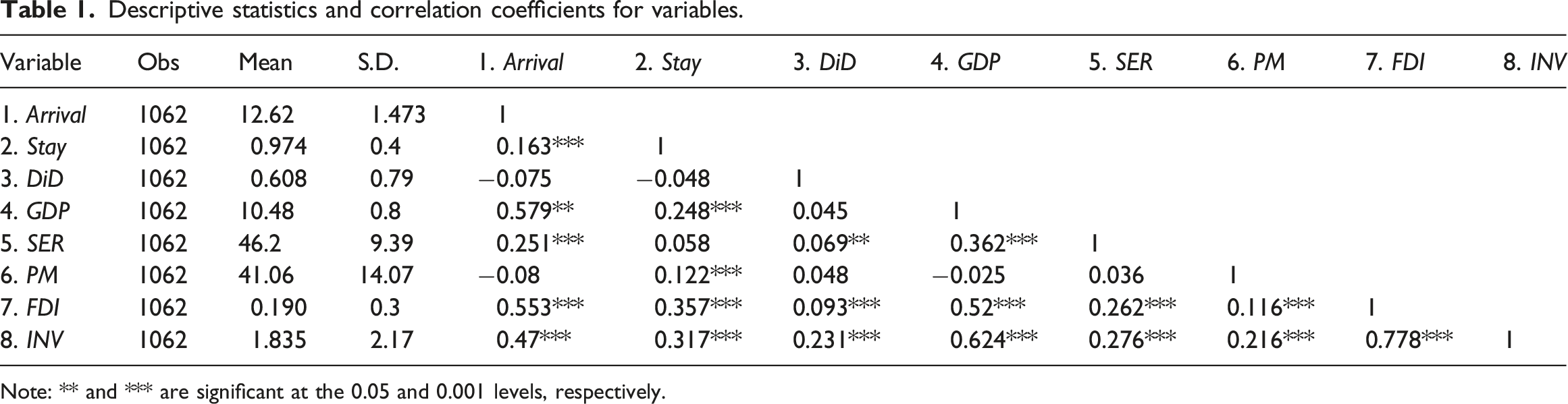
Note: ** and *** are significant at the 0.05 and 0.001 levels, respectively.
Empirical methods
Before conducting empirical research on the SDiD model, it is necessary to examine whether spatial autocorrelation exists in inbound tourism (Bechard, 2020; Lee, 2022; Yeon et al., 2020). If there is no spatial autocorrelation in inbound tourism, it implies that there is no spatial spillover effect either. In this case, the DiD model can be used to conduct empirical research without adopting the SDiD model (Huang et al., 2020; Song et al., 2022; Zhang and Zhang, 2021). If spatial autocorrelation exists in inbound tourism, an empirical study using the DiD model will produce errors, so the SDiD model should be used in this case (Gu, 2021; Guo et al., 2021).
A commonly used method to test spatial autocorrelation at the global level is the Moran’s I index method (Yu and Chang, 2021). The global Moran’s I is calculated as follows
If Moran’s I index shows the existence of spatial autocorrelation in inbound tourism, an empirical study using the SDiD method is necessary. According to the SDiD method (Gu, 2021; Guo et al., 2021), the models are constructed as follows, while controlling for the effects of city and year:

In the model,
Referring to the procedure of SDiD analysis performed by previous scholars (Gu, 2021; Guo et al., 2021), the SDiD empirical test in this study is divided into three steps: the first step is carrying out an empirical test on the baseline model of the DiD effect; the second step is a placebo test, assuming that the implementation time of China Tourism Day is ahead by 1 year (2010) or behind by 1 year (2012); the third step is performing a robustness check.
Results
Analysis of spatial spillover
Diagnoses and tests for spatial autocorrelation.
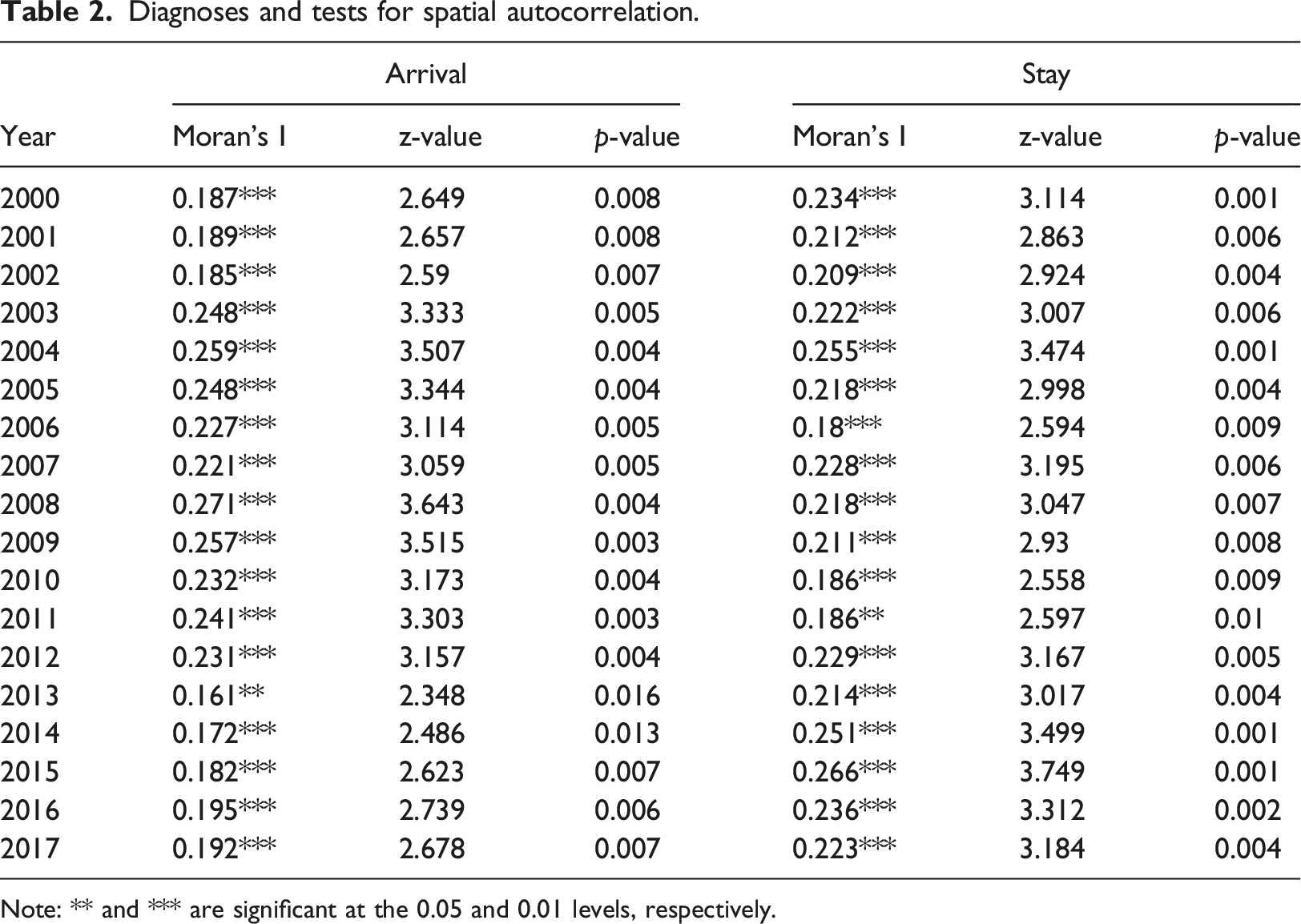
Note: ** and *** are significant at the 0.05 and 0.01 levels, respectively.
As can be seen from Table 2, the Moran indices of both Arrival and Stay are significantly positive from 2000 to 2017, showing an obvious spatial autocorrelation relationship. This indicates that in China, the spatial differences in the development of inbound tourism between cities are obvious. Cities with developed inbound tourism tend to be adjacent to each other, forming a spatial cluster of inbound tourism. Cities with less developed inbound tourism tend to be adjacent to each other, forming the so-called “low-lying land” of inbound tourism. This is consistent with previous findings (Yang and Wang, 2014; Zhang et al., 2020). This shows a spatial spillover effect of inbound tourism exists, so it is necessary to conduct an empirical test using the SDiD method.
SDiD analysis
Results of SDiD models and placebo tests.

Note: ** and *** are significant at the 0.05 and 0.01 levels, respectively.
According to Model 1, the regression coefficient of DiD is significantly positive. In the case of fixed year and city effects, at the 5% significance level, the implementation of China Tourism Day has a positive effect on the number of inbound tourists; that is, the policy significantly promotes the number of inbound tourists. Thus, Hypothesis 1 is confirmed. This policy resulted in a 3.1% increase in foreign tourist arrivals. The findings of this study are in line with previous research and theoretical expectations (Intason et al., 2021; Kate, 2013; Mason, 2015). Since implementing China Tourism Day, cities in China have renovated old scenic spots in terms of cultural connotations, modern tourism awareness, and management mechanisms. In addition, an increasing number of cities are vigorously supporting the construction of tourist attractions with local and cultural characteristics, increasing the participation of foreign tourists, and continuously creating famous urban-brand tourism products. In response to the overseas tourism market situation, an increasing number of Chinese cities rely on the China Tourism Day policy to promote overseas tourism in a focused, comprehensive, and multi-leveled manner. Some cities have gradually opened overseas offices in foreign countries and regions and organized overseas city tourism promotion groups to promote tourism products in major overseas tourism-source markets. These practices undoubtedly promote the arrival of foreign tourists.
The effect of the China Tourism Day policy on attracting foreign tourists may also be the result of other factors between the experimental control groups; that is, the China Tourism Day policy variable may be a proxy variable for inherent differences between the two groups of cities. Therefore, a placebo test is required. According to the results of Models 2 and 3, the regression coefficients of DiD are not significant. This indicates that the implementation of the China Tourism Day policy has a significant effect on the number of inbound tourists in the experimental group and is not affected by any omitted variables. In other words, the policy variable of China Tourism Day is not a proxy variable for the other variables in the two groups of cities. Therefore, the increase in the number of foreign tourists in the experimental group can be attributed to the implementation of the China Tourism Day policy.
According to Model 4, at the 1% significance level, there is a significant negative effect between the China Tourism Day policy and the average length of stay of foreign tourists. Although Hypothesis 2 does not hold, the effect of the China Tourism Day policy on the average length of stay of foreign tourists is still significant, only in a negative way. In other words, this policy will shorten the average length of stay of foreign tourists. The policy reduced the average length of stay for foreign tourists by 5%. One reason for this situation is that China Tourism Day is celebrated for a relatively short period of time, usually only a week at most. As soon as the relevant festivities in the city are over, various discounts on travel and other offers cease. As a result, foreign tourists will usually leave immediately after and will not stay for a longer time. According to the results of Models 5 and 6, the regression coefficients of DiD were insignificant. Thus, the effect of the China Tourism Day policy on shortening the average length of stay of foreign tourists does not exist. This effect has been ignored in previous studies. This confirms the dual impact of the China Tourism Day policy on urban inbound tourism: a promotional effect on the number of foreign tourists and an inhibitory effect on their length of stay.
Figure 2 shows the impact of the establishment of China Tourism Day on inbound tourism. According to the left panel of Figure 2, before the establishment of China Tourism Day, there was no significant difference in the number of inbound tourists between the experimental and control groups, which satisfies the parallel trend hypothesis. After the establishment of China Tourism Day, the difference between the two groups increased, and the number of inbound tourists in the experimental group was significantly higher than in the control group. According to the right panel of Figure 2, before the establishment of China Tourism Day, there was no significant difference between the experimental group and the control group for the average length of stay of foreign tourists, which satisfies the parallel trend hypothesis. After the establishment of China Tourism Day, the difference between the two groups increased, and the average length of stay of foreign tourists in the experimental group was significantly lower than in the control group. The impact of the establishment of China Tourism Day.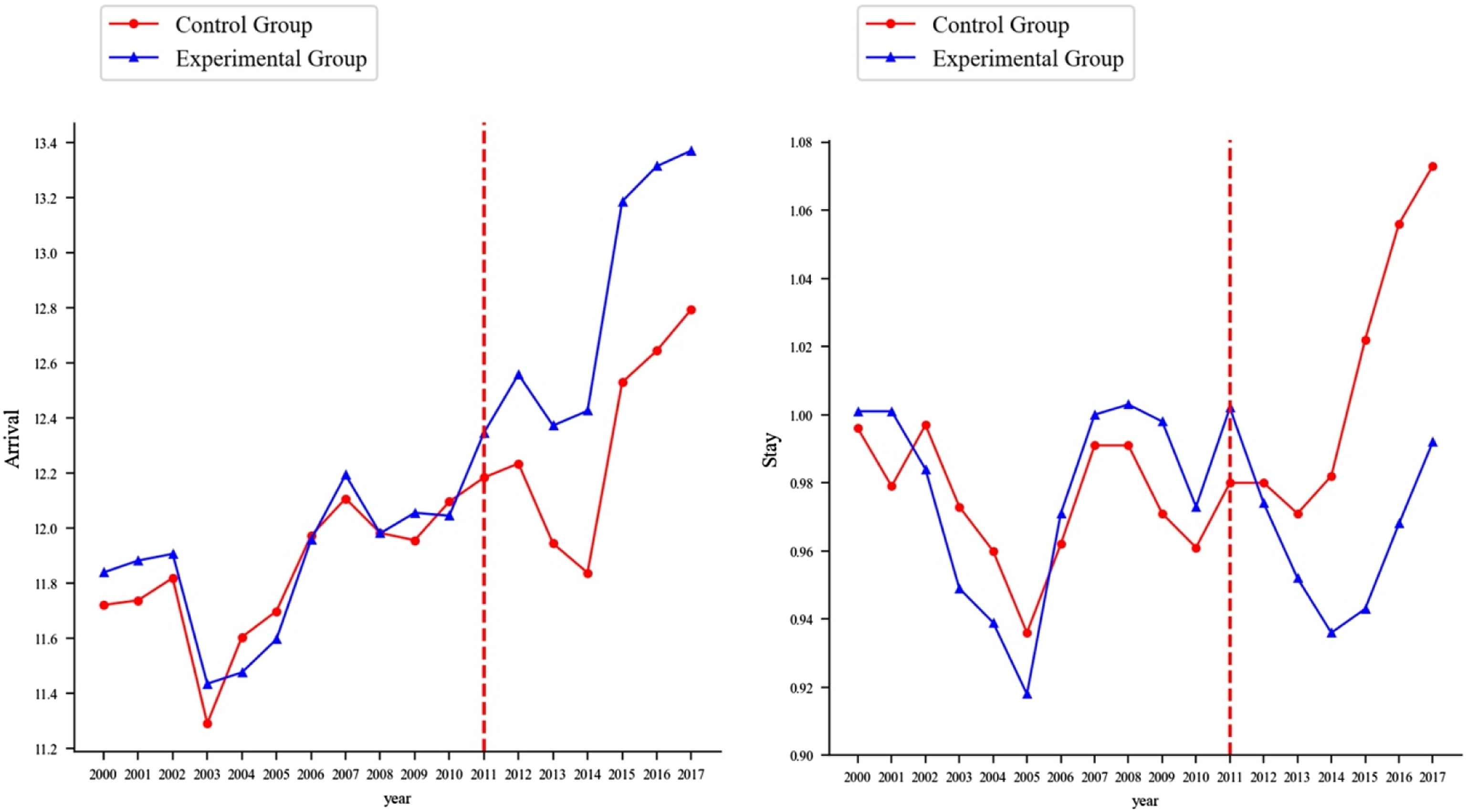
According to Model 1, the coefficient of the spatial lag term (
Robustness check
Empirical results with a spatial contiguity inverse distance matrix.

Note: *, **, and *** are significant at the 0.1, 0.05, and 0.01 levels, respectively.
Empirical results with a time span from 2005 to 2017.
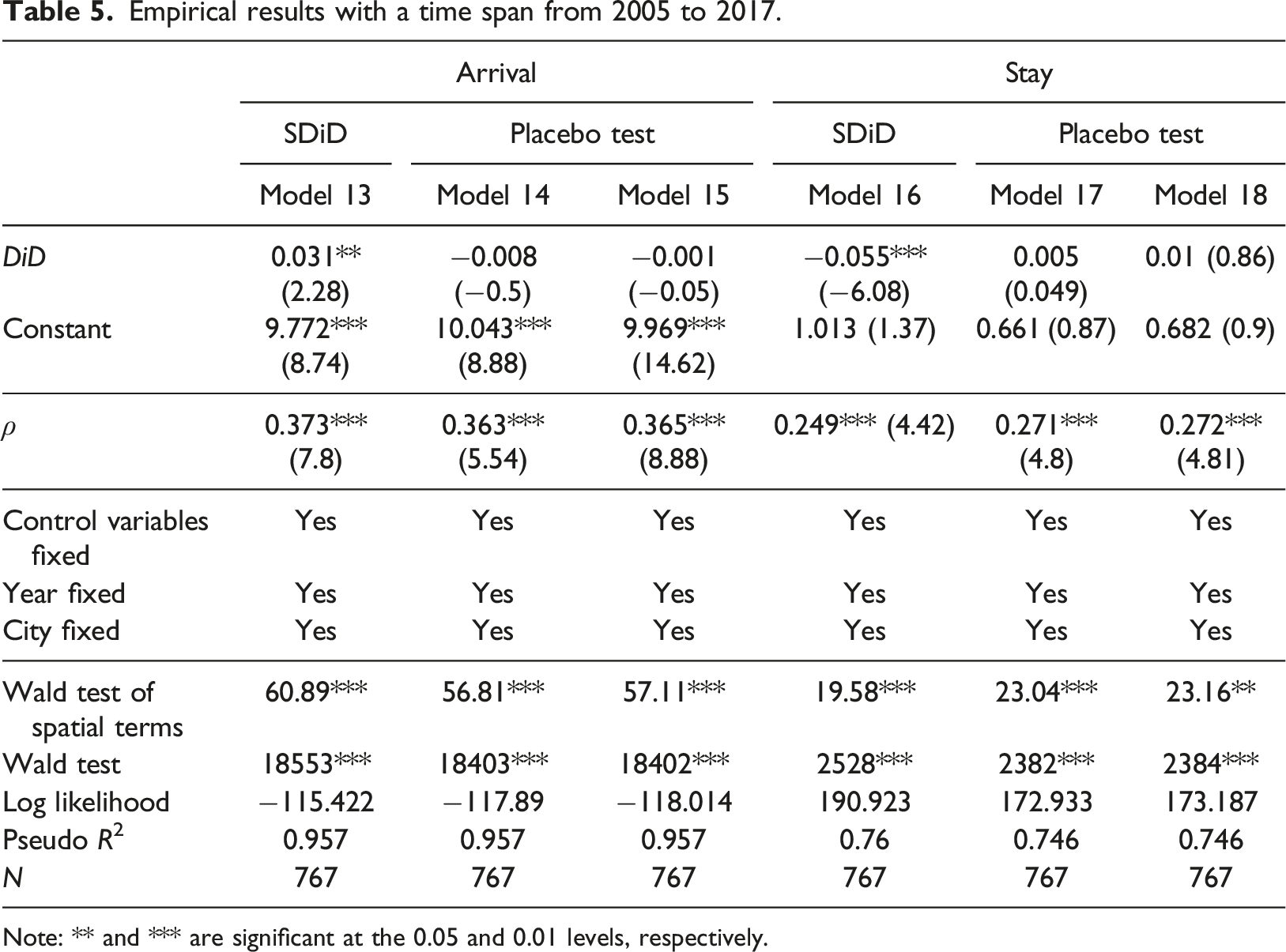
Note: ** and *** are significant at the 0.05 and 0.01 levels, respectively.
Discussion
Theoretical implications
This study has several important theoretical implications. First, it makes an important contribution to the theory of tourism destination marketing in inbound tourism (Ketter, 2018; Kim and Lee, 2016; Wilopo et al., 2020). This study shows that celebrations of national tourism festivals have an impact on inbound tourism at the city level. Specifically, celebrations of national tourism festivals have two effects on urban inbound tourism: they promote the arrival of foreign tourists to a city, and they shorten the average length of stay of foreign tourists in that city. Hence, this study sheds light on the relevance of national tourism festival celebrations and of building a city’s tourism brand image in promoting subsequent inbound tourism at the city level. This has important theoretical implications for destination tourism brand management and impression building and can effectively expand related theories in these fields, such as the tourism destination image theory (Chen et al., 2021; Chen and Li, 2018; Hosany et al., 2006) and the brand management theory of tourist destinations (Ceylan et al., 2021; Jeong and Kim, 2020; Kovačić et al., 2022).
In the existing research on tourism destination marketing in inbound tourism, the main focus is on mega events, such as hosting the Olympic Games (Ferreira and Giraldi, 2020; Schroeder et al., 2013) or the G20 summit (Cui et al., 2017). However, the impact of national tourism festivals has often been underestimated. This study shows that national tourism festivals can effectively attract international tourists, which is of great significance in promoting the development of urban tourism. As a mega event in tourism, national tourism day festivals can serve not only as a means for a country (and, thus, a city) to display its economy, politics, and culture but also as a symbol that it occupies an important position in the international tourism market (Mason, 2015; Pirnar and Celebi, 2020; Zhang et al., 2013). By hosting national tourism day festivals, a city can attract foreign tourists in the following ways: First, national tourism day festivals serve as the driving force for promoting tourism and local development and strengthen the awareness of tourism and development. Second, national tourism day festivals, as a shaper of tourism image and local image, enhance a city and its reputation. Third, national tourism day festivals constitute an organic part of the urban tourism system. Fourth, national tourism day festivals serve as a catalyst to enhance the status of tourist attractions and stimulate local infrastructure construction. Thus, this study enriches and expands the theory of tourism destination marketing in inbound tourism (Ketter, 2018; Kim and Lee, 2016; Wilopo et al., 2020).
In addition, this study contributes to the literature on national tourism destination marketing programs by dialectically and comprehensively assessing the impact of national tourism festivals (Hays et al., 2012; Kim, 2015; Mariani et al., 2017; Seeler, 2017; Snowball and Webb, 2008). Previous studies have emphasized the role of tourism festivals in promoting the number of foreign tourists, while ignoring the impact on the length of stay of foreign tourists (Intason et al., 2021; Kate, 2013; Mason, 2015). This can easily lead to one-sidedness in evaluating the effects of tourism festivals. This study remedies this deficiency. On the one hand, this study affirms the positive role of tourism festivals in promoting the development of tourism, which was emphasized by previous studies (Kozlovska, 2021; Picard and Robinson, 2006; Zhang et al., 2013). On the other hand, this study also confirms the possible negative effects of tourist festivals, such as reducing the length of stay of foreign tourists. This negative impact may be due to the inconsistent pace of different levels of government (Therkelsen and Gram, 2010). Therefore, this study expands the scope of existing NTO theories and enriches their connotations from the perspective of the design and implementation of national tourism destination marketing programs (Hays et al., 2012; Marczak and Borzyszkowski, 2020; Mariani et al., 2017).
Moreover, by testing and evaluating the spatial spillover effects of inbound tourism, we delve more deeply into how the number of foreign tourists arriving in a city and the length of their stay affect inbound tourism in neighboring cities. Several studies showed that spatial spillover effects exist for inbound tourism (Geng et al., 2021; Yang and Wang, 2014; Zhang et al., 2020). However, previous studies mainly focused on the spatial spillover effect of the number of foreign tourists, while ignoring the spatial spillover effect of the length of stay of foreign tourists. The results of this study fill the gap in the existing theories on the spatial spillover effects of foreign tourists’ stay times. Indeed, this study reveals the spatial spillover effects of inbound tourism and the impact of neighborhood-level factors on urban inbound tourism, which is an emerging field that has received relatively little attention from scholars of tourism research. In other words, we constructed a spatial spillover theory of urban inbound tourism from a holistic view, based on the integration of local and neighborhood hierarchies (Gu, 2022c).
Finally, in terms of research methods, the China Tourism Day policy is implemented as a quasi-natural experiment, and the SDiD model is established to comprehensively measure the impact of the policy on urban inbound tourism, providing a new research method for the field of policy effect evaluation in tourism management. DiD estimation produces biased estimates when a spatial spillover effect is present (Butts, 2021). However, the SDiD method used in this study could effectively overcome the problem of biased estimates.
Practical implications
This study has several important practical implications, notably that the establishment of national tourism days can effectively attract foreign tourists. Therefore, major cities need to further develop characteristic urban tourism products and services around the theme of national tourism days to attract more foreign tourists. In addition, it is necessary to extend the stay time of foreign tourists by extending tourism promotion activities related to national tourism days as much as possible. Another important way to prolong the stay of foreign tourists is to actively expand the connotation of national tourism days, so that more foreign tourists can experience the joy brought by tourism with Chinese characteristics and culture. These are all effective measures that cities can use to promote the local characteristics of tourism during national tourism days, which is conducive to developing local inbound tourism. Cities should also allocate special tourism promotion funds, expand publicity activities for foreign tourists, and enable more foreign tourists to learn about a city’s unique tourism products. In other words, cities should take national tourism days as an opportunity to continuously enrich existing urban tourism products, improve their connotations and quality, and vigorously support foreign tourist attractions with urban, natural, and cultural characteristics.
Additionally, promoting a city’s economic development level and increasing its opening to the world are important measures to attract foreign tourists. These are the bases for the sustainable development of urban festival tourism. Therefore, from the perspective of promoting urban development, cities should establish a link between national tourism day festivals and festivals with local characteristics. One of the basic goals of a city’s festival tourism development strategy is to promote the city’s branding through the holding of national tourism day festivals. For cities, starting from the integration of different festival resources, under the relatively unified “national tourism day” festivals theme, a series of multi-cycle and multi-level urban festivals should be held to attract foreign tourists from all over the world. This is an important way to integrate urban festivals and achieve sustainable development and destination branding of urban festivals.
Therefore, cities should deepen the concept of whole-area tourism development and focus on the overall unified planning of and cooperation within the regional economy and tourism development. On this basis, cities need to give full play to the characteristics and advantages of each place and promote the deep integration of tourism and other industries. In order to promote the in-depth development of whole-area tourism, cities must have a vision of global tourism construction and governance and work together to promote whole-area tourism planning. At the same time, cities need to make efforts to build their local brands by improving the level of tourism services in the whole area, based on the characteristics of the local resources. Cities need to integrate multiple channels, innovate marketing methods on the basis of traditional media marketing, become better at creating exciting, attractive events with sensational effects, and pay particular attention to the full use of new media marketing.
Conclusions
The establishment of a national tourism day profoundly impacts the development of urban inbound tourism. Based on the panel data of prefecture-level and above cities in China from 2000 to 2017, this study used the SDiD method to test the impact of the establishment of the China Tourism Day on urban inbound tourism. This study shows that urban inbound tourism has an obvious spatial spillover effect. It also shows that the establishment of a national tourism day has a significant effect on promoting the number of foreign tourists arriving in a particular city but has a significant inhibitory effect on the average length of stay of foreign tourists. The placebo test suggests a causal relationship, as described above. This finding remains robust when the spatial weight matrix and time span are varied.
Although this study provides a theoretical basis and practical guidance for cities to promote inbound tourism, it also has the following limitations. First, since official data on inbound tourism at the city level were available only through 2017, it was unfortunately not possible to study the impact of the coronavirus outbreak on inbound tourism. Second, due to the large amount of data, this study did not distinguish the origins of international tourists. In the future, we can analyze the impact of relevant policies on foreign tourists from different countries and regions by distinguishing the origins of foreign tourists. Third, the sample of this study comprises 59 prefecture-level and above cities. In China, there are approximately 300 prefecture-level cities. In the future, the scope of this study can be expanded to include all prefecture-level cities. Finally, due to data limitations, this study was unable to distinguish between foreign visitors arriving for the China Tourism Day and those arriving for other purposes. In the future, further distinctions and research on this issue could be conducted if the data allow.
Supplemental Material
Supplemental Material - The impact of national tourism day festivals on inbound tourism: A spatial difference-in-differences approach
Supplemental Material for The impact of national tourism day festivals on inbound tourism: A spatial difference-in-differences approach by Jiagfeng Gu in Tourism Economics
Footnotes
Declaration of conflicting interests
The author(s) declared no potential conflicts of interest with respect to the research, authorship, and/or publication of this article.
Funding
The author(s) disclosed receipt of the following financial support for the research, authorship, and/or publication of this article: This work was supported by the National Social Science Foundation of China (17BSH122).

Supplemental Material
Supplemental material for this article is available online.
Author biography
References
Supplementary Material
Please find the following supplemental material available below.
For Open Access articles published under a Creative Commons License, all supplemental material carries the same license as the article it is associated with.
For non-Open Access articles published, all supplemental material carries a non-exclusive license, and permission requests for re-use of supplemental material or any part of supplemental material shall be sent directly to the copyright owner as specified in the copyright notice associated with the article.
