




Abstract
With three years having elapsed since the pandemic onset, a comprehensive assessment of the adaptation process and its extent becomes crucial. In this research note, we provide evidence in this regard by analyzing the tourism resilience determinants of the Spanish provinces throughout the entire 2020–2022 period. The results show that some determinants have played a time-varying role during shock absorption in 2020, adaptation in 2021, and market recovery in 2022. Although the previous equilibrium has been partially reached, there are still persistent effects that remain in 2022. These include the tourist preferences for natural tourism in front of the urban product or the incomplete recovery of distant markets. These insights provide valuable perspectives on the dynamics of the tourism industry and inform strategies to achieve a complete rebound.
Introduction
The recovery of the tourism sector from the COVID-19 shock has been characterized by varying degrees of success, contingent on the destination, period, and applied policies (Burhan et al., 2021; Duro et al., 2022; Li et al., 2021; Souza et al., 2021). Notably, 2022 marks a significant milestone as it is considered the first year in which certain destinations, like Europe, witnessed a return to “normality,” with almost 80% of international demand restored (UNWTO, 2023).
This research note aims to delve into the dynamic role of determinants influencing resilience and recovery, seeking to ascertain whether destinations are reverting to their previous equilibrium or possibly moving towards a new one. Our analysis focuses on hotel travelers to Spanish provinces from 2020 to 2022. Spain offers an intriguing case study due to its traditional leading position in the international market and the immense demand drop it faced during the pandemic.
The diverse responses of Spanish provinces during this period enable the conduct of econometric analyses to gain initial insights into these questions. Our findings indicate that 2022 remains a year of mixed conditions, where typical pandemic variables, such as the prevalence of specific tourism products, coexist with a transition towards the previous “normality.” The note is structured as follows: Next, methodological aspects are presented; subsequently, main results and discussion are displayed. Finally, conclusions are summarized.
Data and methods
We use a panel dataset encompassing Spanish provinces over the period 2020 to 2022. Our focal variable is hotel traveler resilience, quantified by the ratio of hotel travelers in each province relative to the 2019 value, serving as a proxy for the portion of pre-pandemic demand retained by the province. 1 Based on existent literature we consider a set of determinants related to market size (Batista e Silva et al., 2018; Rogerson and Rogerson, 2020; Watson and Deller, 2022), distance to the source (Calgaro et al., 2014; Gössling et al., 2021; Gallego and Font, 2019), income profile (Ridderstaat, 2021; Shin et al., 2002; Boto García and Baños-Pino, 2023), seasonality (Koo et al., 2016; Batista e Silva et al., 2018), and pandemic incidence (Duro et al., 2021, 2022).
Additionally, we augment our analysis with categorical variables representing different product types. Specifically, we include provinces with densely populated (or world heritage) capitals to capture urban tourism, provinces situated in the northernmost part of Spain known as “Green Spain,” associated with nature tourism, and provinces along the Mediterranean coast (or islands) specialized in the Sun and Sand product.
Determinants of resilience.

Notes: All the variables, except pandemic Incidence, are based on 2019 data to avoid simultaneity bias. (C): categorical variable. ND: not defined effect.
We consider a general dynamic (log-log) model to identify the resilience determinants and their possibly asymmetric effect
As we do not know a priori which determinants present time-varying effects, we rely on the Bayesian model average (BMA) method to address model uncertainty (see e.g., Magnus et al., 2010). The basic idea of BMA is to estimate the parameters in (1) conditional on each possible model specification for
Results and discussion
Hotel traveler resilience: BMA approach.
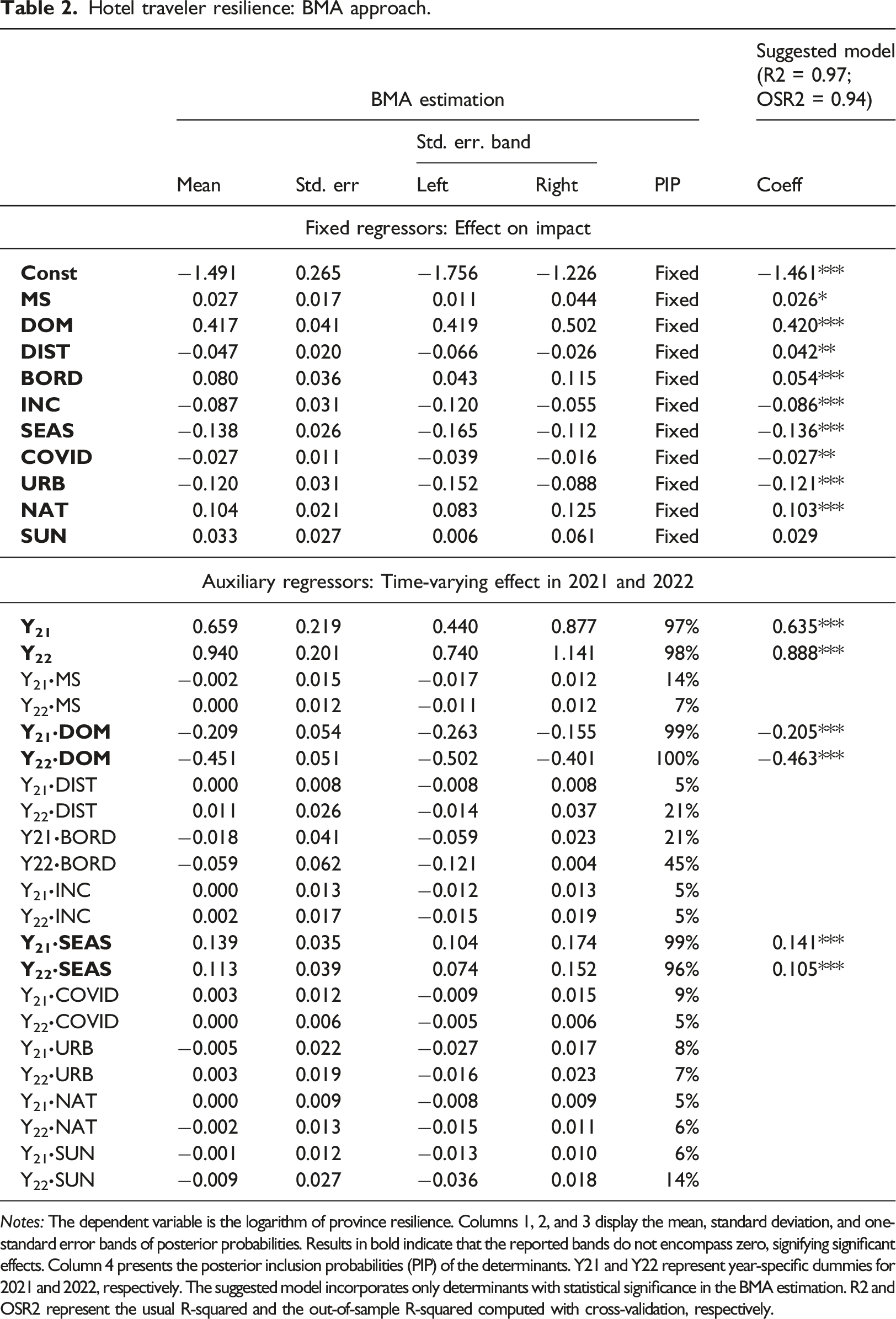
Notes: The dependent variable is the logarithm of province resilience. Columns 1, 2, and 3 display the mean, standard deviation, and one-standard error bands of posterior probabilities. Results in bold indicate that the reported bands do not encompass zero, signifying significant effects. Column 4 presents the posterior inclusion probabilities (PIP) of the determinants. Y21 and Y22 represent year-specific dummies for 2021 and 2022, respectively. The suggested model incorporates only determinants with statistical significance in the BMA estimation. R2 and OSR2 represent the usual R-squared and the out-of-sample R-squared computed with cross-validation, respectively.
As shown in the first part of Table 2, the estimated parameters for the 2020 response are all significant and align with the expected signs from Table 1. Notably, the elasticity associated with the pre-pandemic weight of the domestic market is significantly larger, indicating that provinces with a prior emphasis on domestic tourism demonstrated greater resilience in the context of a decline in international demand. Conversely, provinces heavily reliant on the international market struggled to attract domestic tourists to offset the downturn. Among these, those with a historically higher proportion of tourists from distant markets experienced more significant challenges, likely due to different policy regulations and greater dependence on airline transport for non-EU tourism. Conversely, provinces sharing borders with France and Portugal exhibited better resilience, benefiting from the ease of access for tourists traveling by road from these neighboring countries.
Although theoretically ambiguous, we observed a negative and significant coefficient for the variable proxying the income profile of the demand. This likely reflects the higher average purchasing power of international tourists, particularly from distant markets such as Asia and Russia. The second-highest elasticity pertains to seasonality. Provinces characterized by strong seasonal patterns presented significantly lower resilience, primarily due to the impact of COVID-19 on the 2020 summer flows (Duro et al., 2022). Notably, pre-pandemic market size and COVID-19 incidence also display significant coefficients (positive and negative, respectively), but their effects are notably smaller, indicating that they were not the primary drivers of the observed heterogeneity.
Regarding the categorical regressors proxying product type, we observe a substantial negative effect associated with urban tourism, indicating lower resilience in such areas. In contrast, provinces traditionally associated with nature tourism display higher resilience, likely due to the increased demand for social distancing during the pandemic (Li et al., 2021). Finally, there is evidence to suggest that sun and sand tourism offers greater resistance to the challenges posed by the pandemic compared to other interior provinces of similar characteristics.
Overall, there is compelling evidence linking the set of considered determinants to resilience in 2020. To investigate whether their impact differed in subsequent years, we tested the dynamic transition hypothesis. The second part of Table 2 presents potential time-varying effects. The coefficients estimated for the year-specific dummies in 2021 and 2022 are both positive and significant, with the latter being larger, indicating an overall average recovery across all provinces.
However, it is noteworthy that only the pre-pandemic weight of the domestic market and seasonality, the most critical determinants of 2020 resilience, present robust time-varying effects. The elasticity of the domestic market with resilience declines from 0.417 in 2020 to 0.208 in 2021 and even reverses in sign in 2022 (-0.034) when international tourism rebounds. Similarly, the negative effect of seasonality in 2020 becomes negligible in the following years as summer flows return. Regarding other determinants, we find no evidence that their impact in 2021 and 2022 differs from that in 2020. Figure 1 provides a summary of coefficient values over time for variables showing significant time-varying effects. Time-Varying BMA Coefficients: DOM and SEAS. Notes: The figure displays the estimated coefficients for DOM and SEAS over the years 2020, 2021, and 2022, derived from BMA analysis. These two determinants are the only ones showing robust time-varying effects on resilience.
Finally, the last column of Table 2 reports the estimation of the panel specification suggested by BMA, together with measures of in-and-out-of-sample fit. The estimated coefficients are generally significant and conform to those obtained with the BMA. More importantly, the model not only fits the three years of data almost perfectly but also has an enormous capacity to predict new observations, thus favoring our variable selection.
Conclusion
Overall, our findings suggest a partial reversion to the pre-pandemic normal, aligning with the partial recovery in international flows. Consequently, being specialized in domestic tourism ceased to provide a comparative advantage. Nevertheless, the evidence also indicates that certain pandemic-related patterns persist into 2022. Factors such as the evolving COVID-19 situation in Asia and the ongoing Ukraine-Russian conflict continue to influence flows from distant markets, making a specialization in this type of tourism a hindrance to recovery. This, in part, may explain the negative effects observed for the income profile and urban tourism variables.
However, these negative effects might also indicate a shift in travelers’ preferences towards other products, such as nature tourism, which was initially driven by the COVID-19 situation but appears to have a lasting impact. Monitoring the evolution of international flows will be crucial to ascertain whether this pattern continues, potentially leading to a different equilibrium in the tourism industry.
Our results may provide valuable insights applicable to similar countries also dealing with pandemic-related challenges. Additionally, they may open up promising opportunities for future research. By understanding how international travel patterns and traveler preferences are changing, policymakers and industry stakeholders can develop adaptive strategies to support a sustainable recovery and growth in the tourism sector.
Supplemental Material
Supplemental Material - Are destinations reverting to the pre-pandemic ‘normal’?
Supplemental Material for Are destinations reverting to the pre-pandemic “normal”? by Juan Antonio Duro, Antonio Osorio, and Alejandro Pérez-Laborda, and Jaume Rosselló-Nadal in Tourism Economics.
Footnotes
Declaration of conflicting interests
The author(s) declared no potential conflicts of interest with respect to the research, authorship, and/or publication of this article.
Funding
The author(s) disclosed receipt of the following financial support for the research, authorship, and/or publication of this article: This work was supported by the Agencia Estatal de Investigación (PID2019-106738GB-I00/MCIN/AEI/10.13039/50110001103), Euroregion Pyrenees Mediterranean (Vulnerabilitat turística a la regió EPM: anàlisis i estratègies de resiliència futura).

Supplemental Material
Supplemental material for this article is available online.
Notes
Author biographies
References
Supplementary Material
Please find the following supplemental material available below.
For Open Access articles published under a Creative Commons License, all supplemental material carries the same license as the article it is associated with.
For non-Open Access articles published, all supplemental material carries a non-exclusive license, and permission requests for re-use of supplemental material or any part of supplemental material shall be sent directly to the copyright owner as specified in the copyright notice associated with the article.
