




Abstract
This Note examines the effectiveness of a regional policy centered around offering discounted vouchers to tourists. It specifically studies the case of Sicily, which, unlike other Italian regions, implemented this policy between 2021 and 2023 in response to the aftermath of the COVID-19 shock. Difference-in-differences estimates reveal that this intervention has failed to significantly affect tourism.
Introduction
This Note contributes to the growing body of literature exploring recent public interventions in various countries aimed at supporting tourism through the distribution of complimentary vouchers, particularly following the COVID-19 lockdowns. Notable examples of such research include the studies by Toubes et al. (2021) on the Basque regions in Spain, Alba and Popescu (2023) on Romania, and Matsuura and Saito (2022) investigating Japan. 1 These studies emphasize the crucial role of holiday vouchers or price subsidies in reviving the tourism industry. Apart from Matsuura and Saito (2022), they predominantly focus on evaluating the used vouchers, overlooking the evident recovery of the tourism sector post-lockdowns. However, assessing the impact of subsidies introduced to stimulate post-COVID-19 tourism faces challenges, particularly in distinguishing the specific effects of the subsidy from the overall growth observed following the relaxation of restrictions.
This study examines the specific case of the Sicilian Region, which, unlike other regions in Italy, implemented a voucher system for tourists. Employing a difference-in-differences (“diff-in-diff”) approach—where the subsidy represents the treatment administered in certain destinations and not in others—allows us to evaluate the genuine impact of the voucher on the recovery of tourism.
Specifically, in Autumn 2020, the Sicilian region in Italy approved the “SeeSicily” program to boost tourism following the COVID-19 lockdown. This program provides a complimentary third night’s accommodation through a voucher for visitors booking a minimum two-night stay in an accommodation facility, such as a hotel or other lodging, within the region. Tourists can also choose one additional service like excursions, guided tours, diving experiences, or museum visits. The program includes a 50% refund on transportation tickets. This incentive extends to domestic and international tourists, regardless of their income, occupation, age, or other factors. To benefit, tourists must buy a package from a registered provider, such as a travel agent or tour operator, listed as part of an agreement between the Region and these agencies.
The incentives apply to stays from September 2021 onwards, through 2022 (excluding July and August, and until September 2023 (still excluding July and August). Clearly, the promotion aims to contribute to de-seasonalizing tourism, which typically peak during the sea&sun months, and to increase average stays. 2
The initiative was funded with 75 million euros (approximately 37 million for accommodations, 20 million for guided tours, excursions, and museum visits, 13 million for transportation, and 5 million for advertising and promotion). At present, official figures regarding the number of tourists benefiting from this promotion are unavailable, sparking political debate over the scale and impact of public spending.
Nevertheless, official data on tourist arrivals and stays—sourced from ISTAT, the Italian Statistics Office—are already accessible, even for 2022. These data can provide pieces of evidence, allowing us to assess the effectiveness of this public policy measure in stimulating tourism. To achieve this objective, a diff-in-diff model is employed, using data of tourist flows to municipalities in Sicily before and after the campaign’s implementation (the treatment group), compared with the data from municipalities in regions where the promotion was not introduced. We use here the municipalities of Sardinia as the control sample, where such an incentive has not been introduced; however, the evaluation exercise can be replicated using other regions as controls. We present the results when comparing Sicily and Sardinia, for the obvious reason that these are the two Italian island regions, sharing common challenges related to insularity and their reliance on sea&sun tourism.
We consider both arrivals and overnight stays, both domestic and international tourists. The year in which the policy takes effect (i.e., the treatment is operative) is 2022. This year’s data are compared with that of 2019, which serves as the pre-treatment period. The results are striking: in no case does the policy measure appear to be effective according to diff-in-diff models. This holds true for arrivals and stays, for both domestic and international tourism.
Model and data
We estimate a basic diff-in-diff model,
3
with the variable under consideration in level:

Variable
We also resort to the dataset consisting of joint-repeated data only, that is, retaining in the sample only those municipalities for which data are available both before and after the treatment; in this scenario, the regression equation is:

Number of municipalities in the sample.

Note. The Table displays the number of municipalities from Sardinia and Sicily observed in each year under consideration.
Statistics.
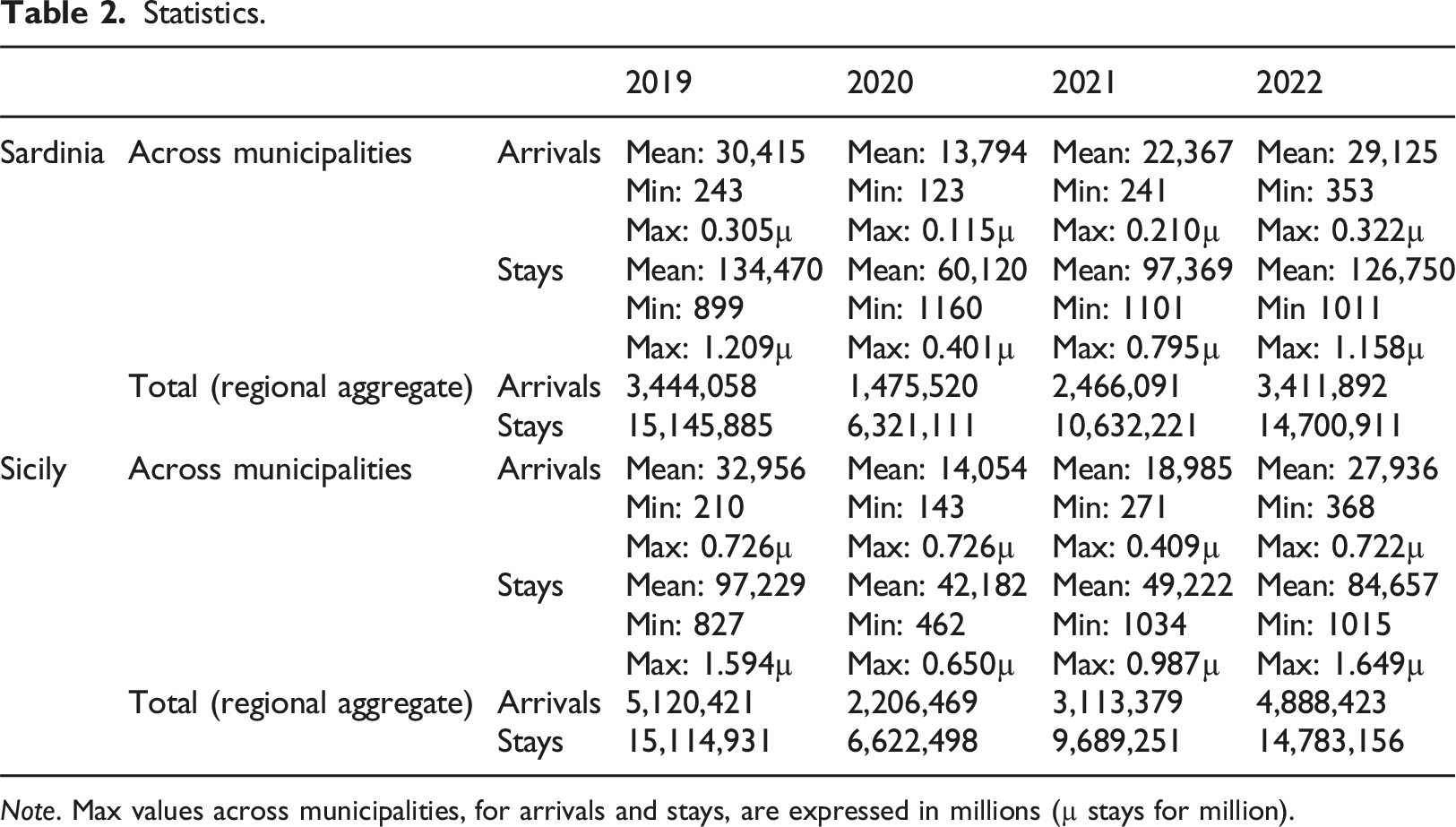
Note. Max values across municipalities, for arrivals and stays, are expressed in millions (µ stays for million).
Results
Regression results of model 1.
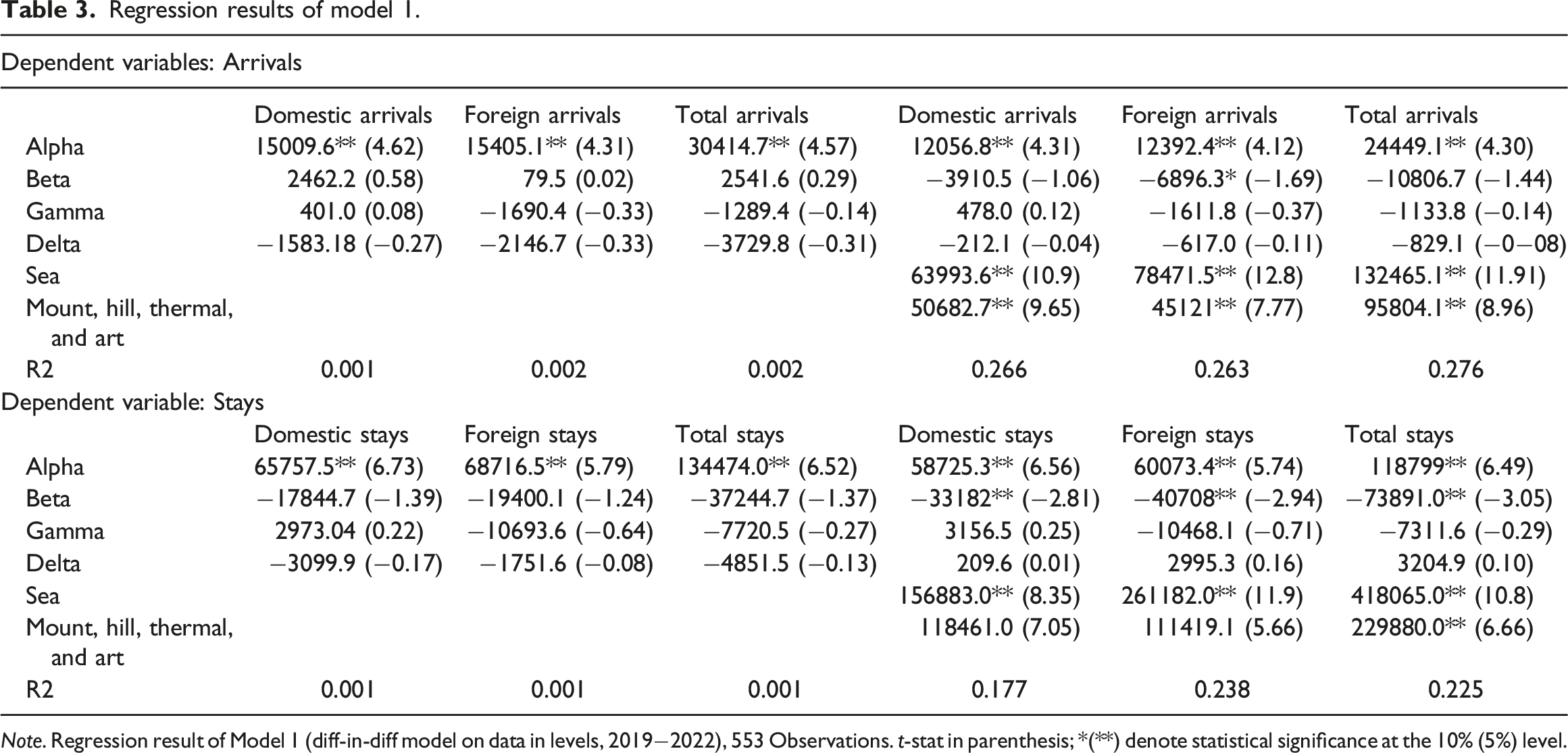
Note. Regression result of Model 1 (diff-in-diff model on data in levels, 2019−2022), 553 Observations. t-stat in parenthesis; *(**) denote statistical significance at the 10% (5%) level.
Regression results of model 2.
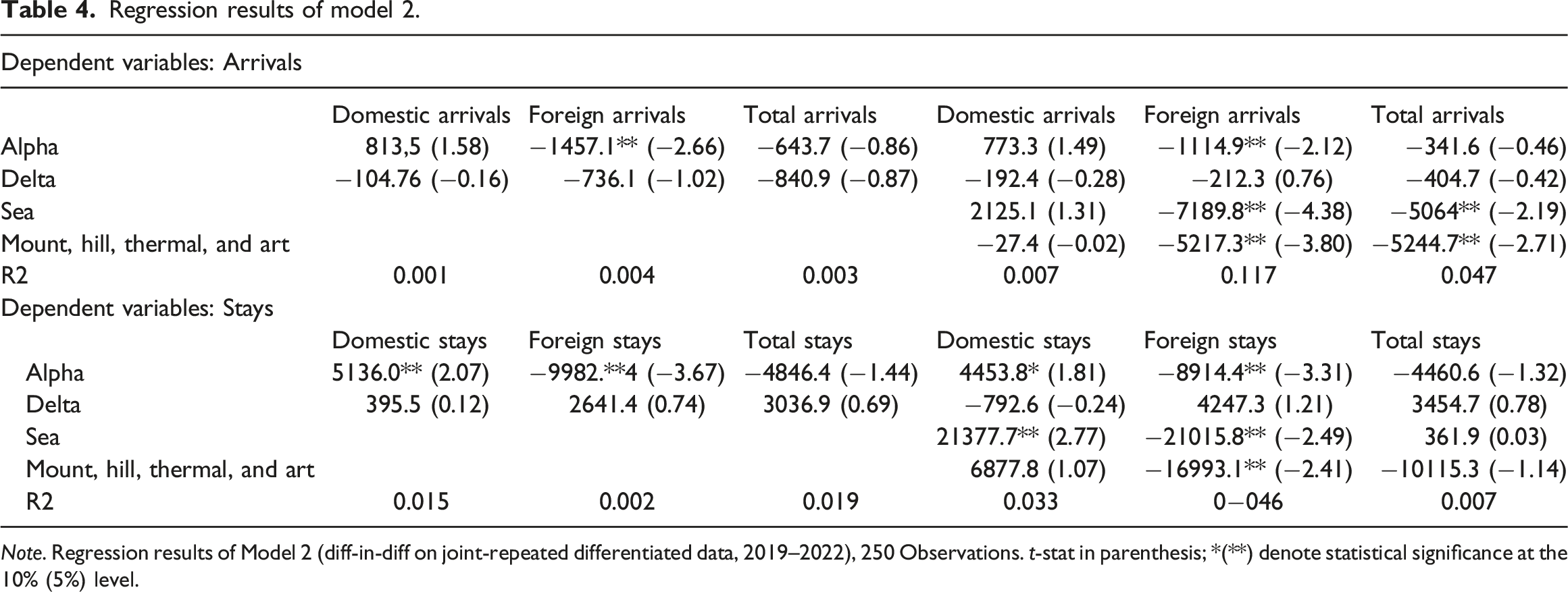
Note. Regression results of Model 2 (diff-in-diff on joint-repeated differentiated data, 2019–2022), 250 Observations. t-stat in parenthesis; *(**) denote statistical significance at the 10% (5%) level.
Concluding remarks
Our results lead to conclude that Sicily’s policy, centered around granting vouchers, appears to be ineffective in influencing observed tourism flows, no matters how many tourists have benefitted from the promotion. We can reflect on potential reasons for this outcome.
Firstly, an intensive advertising campaign with well-known figures and diverse media channels, both online and traditional, was conducted; hence, poor communication doesn’t seem to be the issue. Instead, the requirement to book through tour operators or agents may have discouraged many potential users. Modern tourists prefer customized experiences, and those who use agents may be less price-sensitive, making price incentives ineffective.
Secondly, the promotion is operative outside the peak season. Typically, people traveling in shoulder seasons are not sea&sun tourists. Once again, these travelers tend to be less price-elastic than the average tourist (see Tisdell, 2013, various contributions in Baum and Lundtorp, 2011; and also Matsuuma and Saito, 2022).
Thirdly, a “one-size-fits-all” policy might not effectively address the different motivations of tourists and their diverse responses to the COVID-19 shock (Alvarez-Diaz et al., 2023; Duro et al., 2023b). Moreover, this policy has neither influenced operators’ strategies nor encouraged product innovation, such as the adoption of digital tools to enable tourists to personalize their tourism experience.
Of course, as a cautionary note, consider that the effects of the incentive might not have been immediately visible and could require a longer timeframe for a comprehensive evaluation. However, though warranting further examination and a longer-term perspective, our analysis demonstrates that the effectiveness of offering price subsidies as a decisive tool to sustain the tourism industry in the post COVID-19 era can be far from convincing.
Footnotes
Acknowledgments
The authors are grateful to the Editor and an anonymous reviewer for helpful comments. The research also contributes to the EU GRInS (“Growing Resilient, Inclusive, and Sustainable”) project. The responsibility for the content rests solely with the authors.
Declaration of conflicting interests
The author(s) declared no potential conflicts of interest with respect to the research, authorship, and/or publication of this article.
Funding
The author(s) received no financial support for the research, authorship, and/or publication of this article.
