




Abstract
The case of the 2010 municipal elections in Calgary, Canada, is used here to explore the discursive construction of social media in relation to political engagement. This article examines the way in which 59 undergraduate students at the University of Calgary discuss political engagement through Facebook and Twitter. Participants enthusiastically constructed a vision of ‘engagement’ fostered by social media’s alleged intrinsic features. Social media, it was argued, create a feeling of community, provide access to information as well as the ability to share it, and open up new means of building personal connections between politicians and citizens. In this articulation, social media appeared as both the tool that produced engagement and the space where this engagement unfolded. The focus of the article is on questioning the implications of this discursive construction by asking what political possibilities are opened up or closed down in this articulation? The construction of social media as the solution to the problems of democracy remains highly problematic, yet also indicative of a deep preoccupation with the conditions of modern life, and particularly the desire to find solutions to the increased complexity of the social systems.
Keywords
As more and more political candidates include a social media presence in their electoral campaigns, the impact of applications such as Facebook and Twitter on youth engagement has become an increasingly relevant question. The 2010 mayoral race in Calgary, Canada, constitutes a rich case study for this relationship. With these elections, an independent and virtually unknown candidate rose to fame and won the mayoral seat in what appeared to be a social media–led electoral campaign. The story has been quickly labeled a ‘success’ in terms of both youth engagement and voter turnout. Where scholars have deplored decreasing voter turnout rates and chronic disengagement of Canadian youth from politics, this election advanced the seductive promise that social media may put such worries to rest.
This promise, however, rests on an ideological construction of democratic politics and citizen engagement as a function of new media. Social media, it is argued, enable a more efficient information exchange and a more egalitarian structure of communication between politicians and citizens. The ability to successfully campaign online becomes envisaged as the ‘new’ winning card in electoral races. Discursive constructions of technologically enabled democracies are indeed part of larger modern discourses on the alleged capacity of information and communication technologies (ICTs) to alleviate the social problems. Such discourses, argues Vincent Mosco, prey upon unfulfilled and unfulfillable collective hopes and dreams of equitable social structures, ‘The myths of cyberspace work partly because people genuinely want power and community. People desperately want to control their lives and want to inhabit a larger social totality that provides them with emotional and intellectual support’ (Mosco, 1996: 123). Yet the ideological dimension of these discourses works precisely by effacing (rather than addressing) the structural inequalities characteristic of our late capitalist societies. The relationship between engagement through social media and socioeconomic class, for instance, completely disappears, as new media become positioned as universally available, accessible, and convenient. Furthermore, these discourses reproduce a civic culture where technological determinism continues to legitimize proposals for social action and modes of explanation of social phenomena and identities (Wyatt, 2008). When technology comes to be regarded as the solution to the woes of democracy, our attention is lured away from a critical interrogation of the problems intrinsic to democratic decision-making mechanisms, leaving us unable to recognize the impact of structural inequalities on the ability to join the field of politics and unprepared to deal with the conflictual (sometimes irreconcilable) nature of democratic processes.
This article engages in a critique of the discursive articulation of social media and civic engagement, using the case of the 2010 mayoral elections in Calgary. The goal here is to map the ideological dimension of young people’s talk about political engagement through social media. Young people describe social media such as Facebook and Twitter as ‘technologies of engagement’, where engagement is seen as a result of the perceived features of these technologies, suggesting that the source of engagement resides in the use of technology rather than the individual citizen. Participants’ unrestrained enthusiasm for the alleged power of social media to improve politics remains a two-edged sword; on the one hand, it is clear that young people understand and challenge the inequality of contemporary politics, particularly the perception that politicians remain inaccessible and aloof from citizens’ concerns. On the other hand, the faith in social media’s ability to improve politics is simplistic and fails to critically investigate both the impact of existing power relations on democratic configurations and the very idea of ‘democracy’ as a form of collective self-government (for more on unpacking the notion of democracy and enlarging the ‘democratic imagination’, see Cairns and Sears, 2012).
Social media and engagement
This article starts from the assumption that the ways in which we come to imagine engagement through social media illustrate unspoken yet shared expectations of politics, framing our relation to democratic decision-making arrangements. Rather than focusing on the details of social media use in the 2010 electoral campaign in Calgary, the focus here is on the discursive construction of these technologies in relation to political engagement. This approach is not common in the literature dealing with new media and engagement. In the tradition of political communication, engagement is often a priori defined as consisting of a limited set of actions through which citizens seek to influence the course of politics. One of the most influential definitions of engagement goes back to the study of electoral participation undertaken by Sidney Verba and his colleagues, ‘By political participation we refer to those legal acts by private citizens that are more or less directly aimed at influencing the selection of governmental personnel and/ or the actions that they take’ (Verba, Nie, and Kim, quoted in Ekman and Amnå, 2009: 5). This view is heavily skewed toward voting behavior, along with campaigning, communal activities, and contacting elected officials and politicians (Rusk, 1976). Studies in this tradition often try to identify the demographic and subjective factors most likely to influence engagement. Their interest in social media focuses primarily on their effects on political participation (e.g. Kushin and Yamamoto, 2010; Lee, 2006) or on their potential to predict electoral participation (e.g. Campus et al., 2006; De Zúñiga et al., 2006; Tumasjan et al., 2011; Vitak et al., 2011; Weinberg and Williams, 2006).
With this notion of engagement in mind, the question of the relationship between media and engagement becomes more complicated. Two different approaches – Robert D Putnam’s (2000) argument of the dilution of social capital as a result of media consumption and Jurgen Habermas’ model of communication and media as sites of democratic praxis – have attempted to clarify it. Following Putnam, some scholars have looked into how ICTs affect social capital (e.g. De Zúñiga and Valenzuela, 2011; Ellison et al., 2011; Hampton et al., 2011; Pasek et al., 2009; Shah et al., 2001; Smith et al., 2009; Valenzuela et al., 2009, 2012; Vitak et al., 2011; Wellman et al., 2001). The rapid popularization of MySpace, Facebook, or Twitter effectively renders mundane social networks more visible. Researchers are now able to observe not only the formation but also the everyday use of the ‘bridging’ (across groups) and ‘bonding’ (within the group) social ties (Putnam, 2000). A common way of studying these ties and their relation to political participation is by measuring the statistical correlation between social media use and other factors such as political knowledge, trust in others, participation in civic life (e.g. volunteering), and political cynicism. Studies in this theoretical tradition often find that the use of social media has various facets, from leisurely to political consumption (e.g. Shah et al., 2001; De Zúñiga and Valenzuela, 2011; Valenzuela et al., 2009). Social media appear as an important source of (political) information as well as a site of political discussions and some forms of participation. Finally, online political involvement seems to be correlated to political engagement off-line (Smith et al., 2009). Thus far, the empirical research on social media does not seem to support Putnam’s (2000) suggestion that the Internet consumption leads to social isolation and disengagement (Gibson et al., 2000; Uslaner, 2004).
In the ‘public sphere’ model, the emphasis is placed on the existence of communicative spaces where citizens can engage in rational deliberation over matters relevant to the common good. The question asked of social media is to what extent they are able to provide that ideal communicative space (e.g. Bohman, 2004). Zizi Papacharissi (2010) argues that the distinction public/private is no longer tenable, as social media blur the boundaries between these spheres, mixing personal lives and politics. People are immersed in their everyday lives; yet, by being networked, seemingly banal, personal conversations and actions on social media come to have political power. This power is directly connected to the aggregation and public visibility that social media add to these quasi-private spaces. Chadwick calls these spaces ‘granular’, suggesting that they encourage ‘small scale forms of political engagement through consumerism and propagation of political content across multiple applications’ (2009: 23). For Bennett (2008, 2012), these forms of political engagement are part of a wider social transformation, where personalized politics is on the rise. Personalized politics involves an understanding of engagement as consisting of personal choices and lifestyle values, often shared with an individual’s social network (Bennett, 2012). Consequently, it is important to understand just what these new forms of political engagement consist of; the corollary, of course, is whether these forms of political engagement are indeed significant in terms of their capacity to affect politics (e.g. Bakardjieva, 2011; Bennett, 2008). Overall, however, empirical research has been ambivalent on the issue of impact, suggesting that researchers need to recognize that ‘at least some online spaces are in fact capable of hosting salutary democratic communication’ (Freelon, 2010: 1173).
Attention to these granular public spheres also brings under scrutiny Habermas’ emphasis on rational debate. Dahlgren (2009) points out that political engagement requires cognitive but also affective involvement. From this perspective, we need to recognize the role of ‘proto-political’ or ‘latent’ political activities (Ekman and Amnå, 2009: 8); things such as ‘liking’ a politician on Facebook, re-tweeting the link to a newspaper article, or commenting on a friend’s wall may coalesce into political engagement. On the other hand, an array of practices of use and of structural constraints shapes these latent political activities involving social media. One of the most discussed emergent practices of use is that of homophily (e.g. De Choudhury et al., 2010; Kwak et al., 2010; Yardi and boyd, 2010; Thelwall, 2009). If indeed social media users tend to relate to like-minded people, 1 then we may be faced with isolated, perhaps even ideologically antagonistic public spheres. It remains unclear whether homophily is indeed widespread and whether its impact is as severe as it may appear (De Choudhury et al., 2010).
Lincoln Dahlberg (2001) reminds us that these online spaces are permeated by a culture of consumption which may result in a population generally disinterested in politics or engaged in a consumerist form of participation. He concludes that the ‘marginalization of online rational-critical deliberations will occur as long as consumerism and other non-critical private modes of interaction dominate cultural participation and individualized interaction dominates politics’ (Dahlberg, 2001: 628). Yet, again, although consumption culture and a neoliberal ethic emphasizing individual action are indeed important structural constraints of participation through social media, their significance (and perhaps their effect) is not at all straightforward (e.g. Canclini, 2001). We may ‘consume’ politics through social media, thus prompting new forms of engagement; but at the same time, our own practices of social media use position us, as both citizens and consumers, within particular networks of power, controlled by commercial interests whose goal remains the monetization of our online lives. Participation through social media, argues Greg Goldberg, remains thorny because it takes place within the confines of profit-oriented spaces, that is, this ‘marriage of convenience between participation and profit’ (2011: 748) may not always work toward the same democratic goals espoused by Habermas.
The chatter and clutter of social media may be seen as part of the ‘civic culture’ of our times understood as ‘the taken for granted orientations – factual and normative – as well as other resources for collective life’ (Dahlgren, 2009: 103). In a similar vein, Mark Deuze speaks of the expectations embedded in the current digital culture, that is, the possibility of remixing different forms of cultural texts, our roles as bricoleurs engaged in the ‘assembly, disassembly, and reassembly of mediated reality’ (2006: 66) and the necessity of participation. Participation, he concludes, ‘is what people have come to expect from those aspects of society they wish to engage in’ (2006: 68). This may not be the form of participation that political scientists have envisaged but a messy and dispersed mode of engaging with the routines and confines of everyday life, where resisting the Facebook’s changes to the interface, faking politicians’ Twitter accounts, or making online cultural texts available by translating them in other languages, becomes inseparable from politics (Kann et al., 2007; Pérez-Gonzaléz, 2012; Wilson, 2011).
The form of this participatory, civic culture needs to be further investigated; examining the ways in which we imagine the role of social media in spurring political engagement helps us bring to the vocabularies and the systems of evaluation through which we make sense of our own relation to politics (Dahlgren, 2009: Ch 5). Yet attention to the ways in which our civic responsibilities and technology become articulated in everyday life is surprisingly missing from the literature. Such everyday understandings are the sites of ideological struggle, where our individual meaning-making processes, relying on the existing civic culture, reinscribe or resist contemporary structures of power.
Canadian youth and electoral engagement: The case of the 2010 Calgary municipal elections
In Canada, youth turnout has often been described as worrisome; the numbers indicate a sharp decline in the number of young people casting their votes in federal and provincial elections (Adsett, 2003; Blais and Loewen, 2011; O’Neill, 2007; Stolle and Cruz, 2005; Taras and Waddell, 2012). On average, around 37% of people in the 18–24 age-group and around 46% of those in the 25–29 age-group have participated in the federal elections held between 1997 and 2008; importantly, this marks a 40% decline in the number of first-time young voters since the 1960s (Blais and Loewen, 2011).
Various explanations have been attempted for this phenomenon: the impact of television, youth mobility, rising cynicism, decline in political knowledge, and socialization effects have all been invoked as factors contributing to the turnout decline among young people (Stolle and Cruz, 2005). Adsett (2003) has argued that this decline may derive from the marginalization of youth in politics, as a result of the shift of the Canadian state toward neoliberal ideologies and of the decline of the welfare state. On the other hand, the investigation of the alleged decline in youth turnout is limited by the same a priori reduction of political engagement to voting noted previously. In her review of literature focused on youth engagement in Canada, O’Neill remarks that ‘rather than being indifferent or apathetic, [Canadian youth’s] engagement is merely different’ (2007: iii; also Stolle and Cruz, 2005). Young Canadians are involved in volunteering activities and tend to prefer ‘individualized results-oriented political action’ (O’Neill, 2007: iv).
Research on social media and youth political engagement in Canada remains scarce. The few published works take a political communication approach to the role of the Internet in party politics, focusing on electoral campaigns (e.g. Chen and Smith, 2010; Koop and Jansen, 2009; Small, 2001, 2008; Verville and Giasson, 2011; Ward, 2011). This may be a result of the fact that the use of social media in elections is of recent origins and its efficacy as an electoral campaign tool remains unclear, at least for politicians (e.g. Small, 2008). Previous research on the potential of the Internet to affect electoral outcomes in Canada was skeptical (e.g. Chen and Smith, 2010; Koop and Jansen, 2009; Ward, 2011). In one of the few studies of social media in local elections in Canada, Verville and Giasson (2011) note that the use of social media by politicians tends to remain envisaged as a one-way message transmission system. However, as political parties increasingly devote resources to online campaigns, the use of social media to encourage political engagement is likely to change (e.g. Elmer et al., 2012). Similarly, Taras and Waddell (2012) note that in spite of the excitement of journalists and political junkies with the role of social media in the 2011 federal elections (dubbed the first Twitter campaign in Canada), ‘the limited number of people who are active social media participants, the narrow range of issues those people highlighted during the campaign, the lack of impact on the issues they raised, and the paucity of uses that were found for social media during the campaign’ (Taras and Waddell, 2012: 96) call for a sober evaluation of the role of Twitter and Facebook in electoral contexts.
In this context, the case of the 2010 municipal elections in Calgary, Alberta, is particularly interesting. The fact that social media have been rhetorically constructed as the ‘winning card’ may indicate a shift in the way social media are imagined as an electoral tool; this, however, should not be taken as saying that social media were the winning card. A young and booming city, Calgary has traditionally been characterized by political and cultural conservatism. In recent years, Calgary has experienced a dramatic demographic change, with ensuing cultural tensions over the struggle of the city to define itself. The demographic dynamics have resulted in the second youngest metropolitan populations across Canada; in 2010, Calgary’s median age was 35.8, ahead of Toronto, Ottawa, Vancouver, and Montreal (Statistics Canada, 2011). Politically, however, ever since the first provincial elections of 1905, the governing parties in Alberta have obtained the bulk of the votes and have stayed in power for lengthy periods of time. In Calgary, the previous two mayors have stayed in power for 11 and 9 years, respectively. Furthermore, voter turnout in municipal elections has been generally low (see Table 1).
Voter turnout in Calgary municipal elections (Government of Alberta, n.d.).
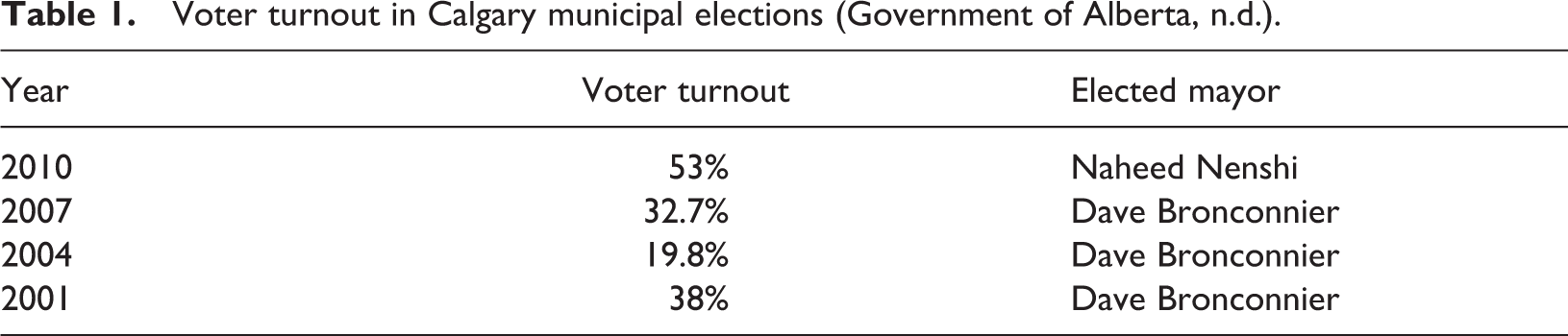
Upon the announcement that the long-standing mayor of Calgary was retiring from politics, all eyes turned toward the most well-known incumbents entering the mayoral race. Among the 15 mayoralty candidates was Naheed Nenshi whose candidature was initially ignored. 2 By the end of the race however, journalists had become increasingly interested in Nenshi’s online presence, consisting of a Twitter account, a Facebook profile, and a series of videos uploaded on YouTube. They compared the number of Facebook ‘followers’ for each of the candidates, suggesting a direct relationship between Nenshi’s success and his ability to capitalize on social media (e.g. Britten, 2010). 3 These elections were marked by one of the highest turnouts in the history of the city (see Table 1). Although precise data are missing, many speculated that the increase was the result of Nenshi’s ability to use social media to engage young people. On the other hand, it should be acknowledged that Nenshi ran on a nonpartisan and generally positive campaign, focusing on the idea of urban change. Against the background of worries about voting turnouts in general and about the perceived political apathy of young people, Nenshi’s campaign brought along the promise that youth disengagement could, in fact, be addressed simply by making use of the latest ICTs.
Methodology
This article presents the results of a thematic analysis of 59 student essays engaging with the following question: ‘In your opinion, what was the role of social media (e.g. Facebook, Twitter) in the 2010 mayoral elections in Calgary?’ The essays have been contributed by undergraduates at the University of Calgary as part of their course assignments in three different courses in the Department of Communication and Culture (see Table 2). Informed consent to use the essays as research data was done by an independent third party (ethics file #7017). The essays were introduced as the opinion section of a more comprehensive assignment and students were instructed that no further research or integration of course material was required or expected in this context. In addition, they were told that the grade for this section depends solely on their ability to make their opinions – and the thought process behind them – as explicit as possible (the length for this opinion section was five double-spaced pages).
Respondents by gender, age, faculty, and year of study.

The use of student essays as data for qualitative research is more common in the field of education, where researchers are interested in bringing to light the specific discursive repertoires through which students talk about specific topics (e.g. Collyer, 2010; Roth and Lucas, 1997). In approaching data, qualitative researchers are interested in three things – data should provide in-depth and emic accounts, data should be generated by people who are part of the phenomenon under study, and data are understood as co-constructed by the researcher and the participants (Kirkevold and Bergland, 2007: 69). The essays used here match these expectations; they are in-depth, personal accounts of students’ opinions, in response to a topic introduced by the researcher.
Several methodological implications of this type of data should be recognized here. First, general expectations of academic writing as a genre impacted the structure of these contributions, although not necessarily in a way that disqualifies them as data (e.g. Roth and Lucas, 1997; Zimmerman et al., 2004). Academic writing is seen as ‘reasoned, measured argument’ (Read et al., 2004: 218). Students try to explain their position and to anticipate counterarguments; yet this is what often happens in the context of any conversation, interview, or public statement. An essay may be more thought through and elaborate than an oral contribution, as students naturally draw from the course material (in this case, communication theories as well as the science and technology literature) but also from other sources (such as personal experience, newspaper stories, or academic literature) to provide a detailed account of the event under discussion. As with other qualitative contributions, such data are taken here not as a reflection of students’ inner beliefs or content knowledge but rather in terms of ‘the interpretive repertoires on which students drew’ to explain themselves (Roth and Lucas, 1997: 146). Not unlike an interview setting, classrooms have to be understood as ‘ecologies that involve social and cultural forces exemplified by students and teachers; the development of these ecologies are not entirely predictable’ (Roth and Lucas, 1997: 146). In other words, just as in everyday exchanges, there is no reason to assume that a communicative interaction is entirely determined by (and thus can be explained solely through) the institutional setting within which it takes place.
In using student essays as data, this article subscribes to Roth and Lucas’ description of student talk as reflective of ‘communities and language games’ (1997: 147). While students draw from the material they learn through their coursework, there’s little reason to assume they only do so within assignments. Furthermore, while student contributions are tailored by the expectation of a grade, we cannot assume that the assignments will simply mirror the instructor’s views or teachings. Collyer (2010) acknowledges that students’ writing is often shaped by the anticipation of the teacher/reader; consequently, students seek to persuade and to reconcile with the reader by explaining their positions. However, the nature of the student/teacher interaction in this context provides students with a ‘feedback loop’, which ‘makes available to the writer an increased interlude with which s/he may deliberate more deeply before producing utterance’ (Collyer, 2010: 178).
Again, this is in no way radically different from the context of communicative interactions traditionally seen as ‘legitimate’ qualitative data (i.e. in-depth, semi-structured interviews, autobiographical letters, or even policy documents). In all cases, as researchers, we are dealing with co-constructed accounts whose context of production needs to be acknowledged. In all cases, both researchers and participants select from available linguistic resources, participate in language games, and make context-dependent choices when speaking or writing about something. The crucial assumption in the methodological approach of this article is that such choices are also indicative of and contributive to wider discourses about social media and democratic politics. Thus, the student essays in this sample were analyzed in terms of how students talked about engagement, mobilization, or participation. The researcher first identified the paragraphs in which students referenced these words. These paragraphs were subsequently reread and coded thematically. The researcher did not seek to link a specific statement with the demographic details of the speaker, as this was seen as less relevant. The focus was on how ‘engagement’ and ‘social media’ were temporarily brought together (see Stuart Hall on articulation; Hall and Grossberg, 1986). The ability to generalize from the discursive analysis of these essays remains, however, limited. This sample consists of undergraduate students talking about engagement in a specific context (see section above outlining the case). Although no further demographic data was collected, the fact that respondents are part of the higher education system uniquely positions them as part of the new, professional elite. This, I argue, is significant: this group is not only proficient in using ICTs, but, to a great extent, student life in Canada inevitably makes ICTs a central part of the everyday life of these participants. Students like the ones included in this sample will go on to become the next political communication specialists, journalists, politicians, computer engineers as well as citizens.
The discursive construction of engagement through social media
In this project, participants talked about engagement as driven by three factors, namely the feeling of being part of a community, the ability to access and share information, and the possibility of engaging in personal communication with politicians and other citizens. Within this frame, social media were described as both an engagement-spurring technology and a social space where this engagement unfolds.
The influence of friends: communities lead to engagement
For the participants in this study, Facebook and Twitter were social spaces where they interacted with others. The feeling of being part of a ‘community’ made political endorsements within a network of Facebook friends compelling: I did find myself looking up Nenshi’s Facebook page due to the amount of Facebook statuses that I saw regarding his campaign. All of the hype that was created heightened my level of curiosity and pushed me to become more engaged in the political race. (Respondent 39)
In line with the social capital literature, political engagement appears to be driven by strong social ties, that is, the respondent’s online network of friends spurred their curiosity and interest in politics. That also means, however, that engagement becomes a consequence of social practices/fashions – social media buzz drives the individual’s assessment of the issue in question as important. When it comes to youth, electoral politics can be, to a large extent, an entirely new thing, and many of the participants in this sample were first-time voters in these elections. It is clear that their social network’s attention to the elections opened up their appetite as well: one’s friends often have a strong influence on an individual.…Throughout the 2010 election, many people were posting and tweeting their thoughts on the election platform issues and candidates. For many individuals, seeing that it was important to their friends made it important to them. (Respondent 34)
This vision of social media-enabled engagement suggests that tapping into networked communities is useful in mobilizing young people. Yet it also casts youth engagement as a result of technologically driven mobilization processes rather than the result of the internalization of civic duties. In other words, engagement becomes understood as a consequence of processes exogenous to the individual rather than a personal commitment/responsibility that the individual assumes as part of her/his civic identity.
This is further problematic as the notion of community depicted here consists mainly of the respondents’ online friends and acquaintances, reminiscent of the literature’s emphasis on the dangers of homophily. Who is part of this social media network and what is the relation between its nodes? Respondents did not bring up this question, as for them social media represent a connection to a larger, global society. When on social media, young people felt connected not only to their friends but to their friends’ friends or even complete strangers brought together by the features of the technological platform (e.g. through the use of hashtags on Twitter). This framing of social media satisfies the cosmopolitan element of Canadian identity (Kymlicka and Walker, 2012), cementing the belief that the Internet allows one’s community to escape the confines of parochialism. Perhaps it is relevant here that most respondents readily resorted to Habermas’ public sphere as a metaphor for social media, 4 reminiscent of Chadwick’s (2009) granular spaces of engagement created through the consumption of political content. Respondents felt that networked individuals are within ‘two degrees of separation’ from each other; thus, social media appeared to them as organic spaces of global interconnections. As Respondent 13 explains, the interaction with people that you do not personally know but are somehow connected to your network ‘gives a sense of community’.
Yet not everyone is online and citizenry cannot be simply reduced to the social media ‘fan base’. A pervasive belief that everyone in Calgary is present on social media (or, in some cases, is able to, should they choose to do so) ran across the sample. Although more data on Canadian social media users are needed, the question to be asked here is whether the marginalized or excluded from democratic decision making are indeed present on and able to contribute to social media trends. Recuperating the question of who is excluded or absent from social media is important: the respondents in this sample imagined social media as intrinsically egalitarian spaces. On the other hand, respondents were silent on the question of disagreements or conflicts within social media; while the 2010 elections in Calgary gave off the sense of a community galvanized by Nenshi’s candidature, the apparent ‘consensus’ on the role of social media in these particular elections has less to do with the politician’s platform and more with the perception that he recognized the importance of youth in politics. For respondents, social media were the quintessential youth ‘hangout’ (boyd, 2007), and Nenshi’s presence in this space was decoded as a long-awaited recognition of the important political role of youth.
The powerful articulation of social media, on the one hand, and community, cosmopolitanism, equality, and recognition of youth, on the other, effectively invests technology with meaning. Social media become positioned as the solution to the problems of political disenfranchising of youth and of social inequality at large. The conflation of social media with strong community ties and democratic politics works, however, ideologically. First, what happens when the issues or candidates that become popular online are not necessarily factually correct or liberal (in terms of their ethics)? Second, under what conditions can a candidate mobilize social networks? Is this mobilization in fact reflective of widespread sentiments off-line? Third, how can peer pressure and critical thinking be reconciled, so that individuals still have room to make up their own minds, particularly when going against the ‘prevailing norm’ among friends and family? Fourth, in the context of democratic decision making, what are the consequences of a social media-driven agenda setting? For, if citizens become engaged as a result of the electoral buzz on these platforms, what happens when such spaces remain silent on crucial political matters, become manipulated, or reach saturation with electoral matters?
Popularity and relevance: information breeds engagement
Access to information was the second frame used in talking about the role of social media in spurring engagement; as the social capital literature suggests, social media become an important source of information for political discussions. Respondents spent a lot of time explaining the importance of social media as sources of information, yet they rarely engaged in an explicit way with the question of what this information consists of. Anything that was shared through social media appeared to be ‘information’, such as re-tweets, shares, ‘friends telling friends about political positions’ (Respondent 2), messages from campaign teams and politicians. To some extent, the increased personalization of politics (Langer, 2011) has further expanded the notion of ‘politically relevant information’, as the details of a politician’s life are an expected political action, spurring citizens’ affective involvement in the elections.
Two major meanings of information emerge from the data: first, information referred to the content shared by one’s social media network; second, information referred to online content circulated by the politician and his team. On social media, actions such as liking the politician’s Facebook page or updates endorsing the politician were often depicted as information made visible by the technological platform itself. Respondent 13 explained that the mere act of joining a Facebook group is instantly made known to his friends, which in turn ‘lets everyone on my friends list know every interest of mine I post on Facebook. Doing this…makes the campaign’s page more noticeable to my friends and therefore increases their chances of them joining and participating in the community’. Respondent 15 describes this as a process whereby friends keep their friends ‘informed and involved’. Respondents typically emphasized the trustworthiness of this type of information; this information was ‘objectively’ rendered visible to the individual courtesy of the algorithm of the platform. Respondents did not feel that they were pressured or persuaded by others, but rather that they were merely ‘provided’ with the ‘facts’ about the political choices and comments of their online social network. Importantly, respondents were completely silent on the mechanisms through which Facebook and Twitter make information visible to users. It is this perceived objectivity of technology that leads one respondent to argue that social media had a gatekeeping effect on electoral campaigns: Voters can go on sites like Facebook and Twitter and see how other voters feel about the candidates, their ideas, and their policies. This can reveal both positive and negative qualities of these policies that one would not see if they were to read about it without discussing it further. This ease of access to information forces the candidates themselves to run a cleaner, smarter as people are more likely to expose their flaws and weaknesses. People will also not be so easily swayed by the false slander and mudslinging of the candidates. (Respondent 40)
Information was also used to talk about messages originating from the politician’s social media accounts. The convenience of accessing this information through social media was often highlighted as an important aspect of engagement: Social media has become one of the most affluent forms of transmitting information. […] With the majority of Calgarians having a Facebook and Twitter account, the information regarding Nenshi’s campaign was readily accessible. People constantly check and update their Facebook using mobile devices, promoting transport and relay of information. […] Many people have access to the information published on these forms of social media and it is easily spread. (Respondent 46)
If indeed, students get their political information mostly from the Internet (Respondent 13), then the question of what this information actually consists of becomes crucial. Interestingly enough, almost none 5 of the respondents indicated that they had relied on expert commentary or analysis (whether associated with traditional media or with political blogs) to make their decisions. However, the fact that in their own essays, students did rely on news stories to develop their arguments may indicate that such sources have not necessarily been rendered obsolete; however, throughout the sample, traditional news media were depicted as biased and manipulative. This is interesting, as re-posting and re-tweeting news, editorials, or other expert contributions is common practice among Facebook and Twitter users. When considered in conjunction with the quote above, the information posted by a politician and his campaign team on social media appears as not only ‘honest’ but also directly relevant to social media users. This view of social media use resonates with the vision of the Internet as a space of ‘personalized information’ (often depicted in opposition to the ‘mass’ aspect of traditional media), where the burden of sifting through massive amounts of information is alleviated by picking and choosing the news sources that one considers valid (Sunstein, 2001).
But, how should we assess content we consume through social media? The articulation of information and ‘personal networks’ or ‘direct communication’ between citizen and politician is easily conducive to the conclusion that we now possess ‘all the relevant political information’. Relevance, in this case, stems out of the nature of social media, allowing for the filtering of information through one’s networks. Interestingly, unlike the literature, respondents do not recognize this behavior as a form of homophily – consequently, they do not seem to worry over the consequences of selectively exposing oneself to sources of information that merely reinforce one’s own attitudes, values, and views (e.g. De Choudhury et al., 2010; Kwak et al., 2010; Sunstein, 2001; Yardi and boyd, 2010).
Furthermore, respondents emphasized the convenience aspect of information retrieval through social media: information was not only at their fingertip, but it was already distilled and reliable, by virtue of coming from one’s friends or from politicians themselves (versus the ‘biased’ media). This, in turn, spurred political engagement casted here as a lack of access to ‘relevant’ information. But what exactly does this type of information consist of? What sets of norms and rules make it relevant: for instance, what happens with information that is relevant to groups that are not part of one’s social network? What skills do we need in order to assess the credibility and usefulness of this information in a manner that recognizes the conflictual (sometimes irreconcilable) nature of democratic negotiations? For instance, Respondent 13 swiftly moved from talking about political parties ‘marketing’ their values and ideas through social media, to explaining how these social media profiles ‘inform [voters] about [the politician’s] political position’. In this discursive slippage, the thorny question of ‘intent’ and ‘agenda’, particularly in the context of electoral communication, becomes effaced. But if democracy is conflictual, then intent and agenda are crucial, as they advance specific interests while ignoring others. In this sample, for instance, although some respondents recognized that Nenshi’s presence on social media was part of an electoral campaign aimed at ‘swaying voters to your cause’ (Respondent 33), only very few actually engaged with the candidate’s position on policy issues. 6 It is hardly news that emotional involvement leads to engagement, but how do we move from such latent forms of engagement to more nuanced understandings of democratic politics?
Unmediated communication: recalibrating the balance of power
The ability of social media to enable an allegedly unmediated relation between citizens and politicians was the third theme through which social media were constructed as tools fostering democracy. Among this sample, Nenshi’s success was often depicted as a consequence of his presence on and availability through social media. Interaction through social media was often depicted as horizontal communicative links between voters and candidates as well as between voters. The personal nature of political communication became the ultimate form of gatekeeping, as respondents believed that it is fairly easy for them, as technologically savvy individuals, to assess the authenticity of a politician (for a discussion of this authenticity, see Dumitrica, 2014). Respondents thus saw themselves as in control of their own opinions about politicians: as Respondent 14 explained, the – allegedly – unmediated interaction with a politician via Facebook or Twitter means that ‘people…have the ability to take the message and redirect it in different paths, in other words, the public interprets it the way it sees fit’ (Respondent 4). Respondent 51 added that by re-tweeting or commenting on a politician’s Facebook or Twitter updates, ‘citizens felt empowered by this movement and I believe this led to decreased voter alienation’.
The articulation of social media and direct communication advances, however, a simplistic view of the problems of democratic decision-making mechanisms as merely barriers in the transmission of information between political elites and citizens. However, as already mentioned, the real hardships of democracies have to do with reaching decisions in cases of conflicting (and often insurmountable) interests in a manner that is equitable at least in some respects to most groups and particularly to the ones most affected by these decisions. Furthermore, the image of direct communication needs to be further unpacked; as the previous section shows, we need to question exactly what is communicated by the politician and for what purposes.
The politician engaging with social media users like them appeared to these respondents as a quintessential democratic practice: citizens express concerns, politicians address them. It engaged them emotionally, creating the opening for political engagement. Yet it is important to differentiate between the act of answering a citizen’s social media question and the act of policy making with which politicians are entrusted via the electoral process. Overall, respondents were more enthusiastic about the first while remaining oblivious to the latter. For instance, Respondent 34 argues: On Facebook, voters were able to become friends with mayoral candidate […]. No longer was that particular candidate just a figure in a suit standing behind a podium, but they were now a friend who voters wanted to see win.
The same thoughts are echoed by Respondent 33: Since Nenshi himself ran his own Twitter account, and carried a Blackberry everywhere he went, every citizen of Calgary essentially had Nenshi’s phone number. Any John Doe could tweet him their own questions at their heart’s content, and it seems that he answered as many [sic] as possible.
The perception of ‘befriending’ the candidate left respondents feeling empowered. In turn, this feeling of being taken into account, of being heard led to greater interest in the campaign. On the other hand, without belittling the importance of this affective dimension of engagement (Dahlgren, 2009), we have to question the implications of this discursive articulation of social media and direct communication. As with the preceding themes, technology becomes envisaged as the mechanism that not only enables but also guarantees the genuineness of the relation between politicians and citizens. However, we should not conflate a politician’s availability to citizens with the act of democratic decision making. The fact that a politician engages with citizens does not mean the decision-making process is democratic. While it is important for politicians to be in touch with citizens in order for the latter to remain invested in politics, the question of who is represented on social media (i.e. what groups of citizens is the politician in contact with via Facebook or Twitter) is also of uttermost importance; so is the question of what a politician will do with citizens’ social media input.
Discussion
By looking at how a sample of undergraduate students discursively construct the role of social media in the 2010 electoral campaign in Calgary, this article explored the ways in which technology is imagined as the solution to the question of civic engagement in democratic electoral processes. The discursive articulations explored here have been considered as sites of ideological struggle, for social arrangements are sustained ‘by a mobilization of meaning which legitimates, dissimulates, or reifies an existing state of affairs’ (Thompson, 1984: 132). In other words, while these articulations speak to respondents’ desire for a different form of democratic politics and suggest a salutary potential of using social media to spur civic engagement, they are also problematic in terms of masking inequalities and reducing democracy to a simple message transmission act.
The stories of the role of Facebook and Twitter in the 2010 mayoral elections in Calgary provided by participants constitute strategic meaning-making efforts through which individuals draw from existing discourses to both make sense of the world around them and perform their identity as the new intellectual elite (also Bakardjieva, 2011: 66). Embracing and criticizing technology to talk about politics is one of the symbolic strategies through which these young people insert themselves into the social fabric, performing the roles of responsible, cosmopolitan, and liberal citizens. Technology presents itself to respondents as not only a tool and a space of political engagement but also a guarantor of a better democratic setting, where the distance between young people and politics is bridged. Yet this view of technology can equally be seen as a legitimizing mechanism: the responsibility for and the capacity to address social issues is placed in the hands of technocrats, technologists, and technology users. As Respondent 28 asserts, leaving no room for resistance to the reign of technology, ‘the digital age is upon us’.
What exclusions are operated by such discursive articulations? In spite of the widespread adoption of ICTs in Canada (with the latest statistics indicating that almost 80% of households are connected to the Internet), the seamless embeddedness of new media into the fabric of everyday life remains a privileged, middle-class experience. Many of the participants in this study, often against some of the lectures and class discussions to which they had been exposed, took for granted the power of social media to improve the relation between young voters and politicians. For the young people in this sample, new media are crucial to their daily existence and central to their professional life; as such, for this group, new media may indeed open up new avenues for political engagement. Latent forms of engagement, such as liking a candidate or re-tweeting a political statement may coalesce into engagement; yet the conditions under which this happens as well as their political efficacy remain unclear. Within the case under discussion here and given the limitations of this data, it is impossible to distinguish between the role of social media in spurring engagement and the mobilizing influence of the media coverage of these elections (particularly in terms of their labeling of these elections as social media driven). Looking at the role of social media in the 2011 federal elections in Canada, Taras and Waddell (2012) suggest that traditional media found social media use for political communication purposes newsworthy, but the evidence of the impact of social media on elections is hard to assess. They point out that although around 16,000 tweets were produced daily during this federal election, this number is less impressive when compared to the 24 million Canadians eligible to vote.
What can we make of the persistent belief that ‘everyone is present on social media’? To a certain extent, this discursive element encapsulates a genuine desire to be part of a community of friends, to live in a democratic society where politicians are accountable to citizens, and to have unmediated access to relevant information. To put it differently, this belief represents the much desired ‘happy ending’ in the context of democratic politics. Motivated by such dreams and hopes, the respondents hailed the ‘revolutionary’ potential of social media to alleviate social imbalances and civic apathy. There is as much wishful thinking as democratic ethos in such discursive constructions!
Yet these discursive constructions legitimize a particular distribution of resources and of power. If political engagement is spurred by and through social media, then technology becomes the solution to voter apathy. In the three themes discussed above, engagement appeared constrained by convenient access to information, lack of relevant and ‘comprehensible’ information, the absence of affective ties to politics, and, most importantly, the lack of real opportunities to be heard and make a difference. Social media seem able to alleviate these problems as they promise convenience and connection as well as complete information. As politicians migrate to these spaces, there is also the promise that citizens will have an avenue to voice their opinions and be taken into account during the decision-making processes. This, of course, is highly the issue of how decision making in a democratic setting can take place in the context of a plurality of interests and agendas remains largely ignored.
Furthermore, in these discursive articulations, engagement appears prompted by either technology per se or its proper use. This raises an important issue in legitimizing the distribution of resources, for instance, if we accept this premise, then it makes sense to argue that resources previously devoted to fostering political engagement should be redirected toward developing technical skills and technical solutions, with little attention to the role of civic education or of a democratic media system, fulfilling a gatekeeping function (rather than a commercial mandate). As much as respondents rejoiced the opportunity to talk to politicians directly, such encounters cannot produce the same knowledge outcomes as investigative reporting and political analyses. Taras and Waddell echo this point when they argue that: candidates, political parties, the media and even social media devotees all seem most interested in using the technology as a new, instantaneous way to tell people what they think or what they should think. In the [2011 federal] election, it was sometimes used to offer live tweeting play-by-play of speeches or events, such as the leaders’ debates. It is not clear, though, that such stenography, with no context or analysis, serves any broad purpose in enhancing the public’s understanding of events or positions taken by politicians and parties. (2012: 101)
In this project, respondents were most enthusiastic about the possibility of directly talking to politicians. Yet although this use of social media was different from what Taras and Waddell discuss, it nevertheless remains problematic. To what extent does this personal connection helps us understand the broader context, particularly when it remains an act of political marketing?
On the one hand, it is important to remember that elections remain a game of gaining voters’ trust. In this context, one respondent’s confession is problematic: I was unaware of the speeches Nenshi gave or the ideas and opinions of the other candidates, but I based my vote upon the tweets supporting him, and what they said about him. I actually did not follow Nenshi on Twitter until after he won the election, so I was unaware of what he was saying about his views. (Respondent 43)
While this was not a wide-shared view, it raises important questions about the construction of social media as the ‘solution’ to political engagement. If our engagement with social media reproduces ‘consumer politics’, by relegating citizens to the passive role of waiting to be courted by politicians within the comfort of their online social spaces, then this type of engagement remains highly problematic.
On the other hand, even this consumer politics needs to be recognized as part of a wider ‘participatory culture’ (Deuze, 2006). The new forms of engagement through social media may often be ‘incoherent, and perhaps solely fueled by private interests’ (Deuze, 2006: 68). But a priori judging them as useless or irrelevant does not work either. The conditions under which our ‘likes’, ‘shares’, and ‘re-tweets’ become part of processes of mass mobilization off-line remain unclear and outside the scope of this article. Yet this recognition should not prevent us from questioning the discursive effects of this conceptualization of engagement through social media. Of interest here is the ways in which such discursive constructions of engagement through social media operate a simplification of the complex reality of the unequal setting of political environments. Befriending a political candidate online inevitably shapes our conceptualization of politics and politicians; political engagement becomes an act of individual consumption, consisting of disparate actions such as consuming Facebook updates, a politician’s tweets or your friends’ likes of a particular candidate. The linguistic and conceptual slippage from ‘politician’ to ‘friend’ can divert us from questioning how this politician actually protects and promotes the public good and whose ‘public good’ she/he is actually representing. As users, our understanding of the social media landscape is inescapably shaped by our particular context; we ‘see’ the networks and their activities through the vantage point of our screen, our list of friends, our tweeter feed. It becomes too easy, I contend, to lose sight of the structural inequalities of our societies; it is even easier to evaluate everything in terms of individual choice, control, and will. Our discursive construction of social media as the solution through which power imbalances can be recalibrated resonates with our own experience as users. Failure to acknowledge what such discursive constructions make ‘possible’ and what they marginalize remains a grave danger; it is important that we question how these discourses about social media and political engagement prompt us to imagine technical spaces as sufficient in and of themselves for the realization of a democratic polis.