




Abstract
Whilst social media like Twitter and Facebook carry with them the potential for the practice of journalism, novelties like these are also associated with adaptation difficulties – perhaps especially when it comes to the interactive capabilities that services like these afford. This study employs a multi-method approach to study the different uses of Twitter and Facebook by one media company – the Swedish public service broadcaster (PSB) Sveriges Television – during the 2014 election year. Utilizing both quantitative and qualitative data, we find that Twitter was used more extensively and in a comparably more interactive fashion than Facebook. Hence we suggest Twitter, used more for interaction, functions as a ‘chat room’; whilst Facebook, used more for broadcasting messages, can be viewed as functioning like a ‘showroom’. As Twitter is often associated with societal elites in the Swedish context, it raises a question about the suitability for a PSB to engage to such a degree on this particular platform.
Keywords
Introduction
The view of the Internet as a changing agent for journalism is indeed a well-rehearsed one. Whether our focus is on the business aspects of media organizations (e.g. Siles and Boczkowski, 2012) or on the day-to-day work practices of those employed by such enterprises (e.g. Himelboim and McCreery, 2012), journalism has ‘always been shaped by technology’ (Pavlik, 2000: 229) – at least to some extent. One way in particular that such technological influence has been thought of as shaping journalism is through what is perhaps the defining character of the Internet – its potential for interactivity (e.g. Steensen, 2011). Whilst letters to the editor and similar opportunities did indeed allow such practices in a predigital era as well (e.g. Brecht, 2001 [1932]), the Internet has arguably contributed to an increase in both the speed with which interactions between journalists and audience members take place and an upsurge regarding the expectations to engage in such exchanges (Deuze, 1999). Whilst empirical research has largely found opportunities like these to be underutilized by both senders and receivers (e.g. Fortunati et al., 2009; Larsson, 2012a; Mitchelstein and Boczkowski, 2009), the recent influx of the so-called social media services like Twitter and Facebook has renewed a similar rhetoric regarding increased interactivity as heard previously.
Employing a multi-method approach, the current article seeks to critically assess the uses of Twitter and Facebook by Sveriges Television (SVT), the Swedish Public Service Broadcaster (PSB), during the election year of 2014. Given the aforementioned interactive capabilities of the Internet, we are primarily interested in how and to what degree such interactive practices were employed. Beyond quantitative analyses of such activities, the study also features interviews with key SVT personnel which helps us uncover the rationales and prioritization of PSB journalists working in novel environments. Featuring two elections – for the European and the national parliaments – the selected time period saw the employment of the SVT Din Röst brand (Swedish for ‘Your Voice/Vote’) across a series of contexts, including the two platforms studied here. Taking the complexity of studying two different platforms into account (e.g. Larsson, 2015), the present study provides much-needed comparative insights into journalistic social media use, moving beyond a singular focus on the often-studied Twitter platform. Furthermore, Sweden could be regarded as a suitable context in which to study such journalistic practices, as use of the Internet is consistently measured at high levels (e.g. Findahl, 2013; Nordicom, 2013) – as are levels of participation in elections. As such, the country could be regarded especially interesting to study for insights into PSB use of social media during periods of heightened political interest.
Interactivity in the newsroom
The concept of interactivity is a multi-faceted one and can as such take on many meanings and indeed operationalizations (e.g. Downes and McMillan, 2000; Jensen, 1998; McMillan, 2002). Moving beyond what is sometimes labelled as technical definitions of the concept, often detailing user-to-system-type perspectives (e.g. Gerpott and Wanke, 2004; Larsson, 2012b; Song and Zinkhan, 2008), our present efforts instead adopt what is sometimes described as a user-to-user or human (Stromer-Galley, 2000) approach to online interactive features. In our current context of journalists using social media, such a conceptual delimitation directs our analyses towards assessing the degree to which such actors engage with their audiences – and to uncover the rationales behind such engagement. Based on this reasoning, the present study differentiates between broadcasting and interacting practices, where the former refers to a primarily one-way rationale of communication, and the latter suggests journalists reaching out to their audiences in a user-to-user-type fashion, following a more conversational ideal (Schudson, 1978).
Work routines like these have of course been detailed in previous research regarding online journalistic practices. Indeed, early research on Internet adoption among such professionals suggested that adaptation to the new media format often had the characteristics of shovelware, suggesting that content and work practices were transferred from off- to online formats with little or no adaptation to the possibilities afforded by the new medium (e.g. Schultz, 1999; Tankard and Ban, 1998). Later research, primarily covering US contexts, has largely found broadcasting approaches adopted by media practitioners, with some tendencies for change towards more interactive advances in relation to audience members (e.g. Chung, 2004; Greer and Mensing, 2006; Mitchelstein and Boczkowski, 2009; Robinson, 2010).
More recent developments towards utilization of social media platforms, such as the two under scrutiny here, have led to similar research findings to the ones reported above. Indeed, whilst earlier online undertakings by journalists were mostly performed on web pages maintained and operated by their employers, the popularization of blogs, the derived micro blog format and social networking services brought to light a series of challenges primarily related to platform control. Given the regulatory aspects pertaining to public service broadcasting in the European context (e.g. Moe, 2008), such challenges are especially poignant in the current study. For instance, the fact that services like Twitter and Facebook are commercial entities could make it unsuitable for PSB practitioners to employ such channels in their line of work (Moe, 2013; Van Dijck and Poell, 2015). Such potential policy issues aside, the argument is sometimes put forward that since the audience is present on commercial platforms like these, PSB personnel need to likewise engage with services like these in order to secure outreach (Cola and Prario, 2012; Storsul, 2011). Or, as Van Dijck and Poell (2015: 151) put it, ‘avoiding Twitter or YouTube entirely on account of their proprietary algorithms and business models would be disastrous because it would surely result in the loss of particularly a younger generation of viewers’.
Much like research on social media in other scholarly contexts, the broader field of journalism studies has primarily featured research on the role of Twitter. Given our current empirical focus, our article provides much needed comparative insights into the uses of Twitter and Facebook. With this starting point in mind, early studies on blog use – a format that Twitter is often considered a derivative of – have suggested a potential to engage journalists in interactive rather than broadcasting practices (e.g. Matheson, 2004; Singer, 2005). However, more often than not, these studies suggest that ‘interactivity is counterintuitive with the principles of traditional journalistic culture’ (Domingo, 2008: 698). As such, whilst Twitter – and Facebook, supposedly – could serve as useful journalistic tools for news gathering and other rather traditional journalistic practices (Hedman and Djerf-Pierre, 2013; Hermida, 2010), the utilization of these services for interactive over broadcasting rationales appears as somewhat rare (see also Larsson, 2013).
The comparative aspect of the study at hand is perhaps especially valid in the current context, detailing the social media use patterns and rationales of a Swedish PSB actor. This is primarily because of the differing roles that Twitter and Facebook have in the Swedish context. As previously mentioned, Sweden is generally characterized by high levels of Internet penetration and daily use among the populace. For Twitter, then, studies have suggested that between 4% and 6% of Swedes make use of its services on a day-to-day basis, whilst the competing Facebook platform enjoys considerably larger popularity – 45% of the population have reported visiting the site daily (Wadbring, 2015). Considering socio-demographic factors, as previous research has found Twitter users to be a somewhat urban, highly educated, media-savvy segment of the population (Christensen, 2013; Larsson, 2013), comparing employment of the two services by SVT will arguably provide insights into the priorities regarding different types of audiences online.
SVT, social media and the #dinröst project
SVT is Sweden’s public service television (TV) company financed via license fees paid annually by residents of Sweden. The Swedish TV market was one of the last in Europe to be re-regulated, with the first terrestrial commercial competitor being introduced as late as 1991. Whilst viewing figures have dropped dramatically over the past 25 years as a myriad satellite and cable alternatives have been introduced, SVT has succeeded in maintaining relevance in the Swedish media market. In commissioned surveys, SVT remains one of the most popular and trusted publicly subsidized organizations in the country (Friberg, 2015). One of the core components of the SVT organization is news and public affairs programming, and the two main SVT news programs, Rapport and Aktuellt, have remained relevant and influential. SVT is generally regarded as one of the more forward-thinking public service organizations in Europe in relation to the utilization of the Internet and social media for the sharing of news and information (Sveriges Television, 2014).
That said, the relationship between SVT and social media has not been entirely unproblematic. A series of cases involving SVT and its radio counterpart, Sveriges Radio (SR), have illustrated the regulatory tightrope the public broadcaster must walk in relation to commercialization as discussed briefly earlier. In 2010, two local SR programs and a regional SVT news program were found guilty by the Swedish regulatory authority for improperly promoting commercial interests when listeners/viewers were encouraged to comment on associated SR and SVT Facebook pages. According to one of the decisions, ‘the repeated encouragement in the relevant programs to go to Facebook created a focus on the forum that went beyond actions in the interests of information and entertainment’ (Granskningsnämnden, 2010a). Interestingly, in a third case, SVT’s coverage of the 2010 Olympics was also investigated for promoting commercial social media platforms but was found not guilty because viewers were not actively encouraged to go to Facebook, but, rather, were made aware of the presence of SVT accounts (see Moe, 2013; Granskningsnämnden, 2010b).
Despite these concerns, given the track record of SVT in relation to utilization of new technology, it was no surprise that 2014 was an important year for the use of social media platforms. With the combination of elections to the European Parliament in May and national elections in September 2014 was dubbed a ‘Super Election year’, and SVT responded with the creation of the previously mentioned #dinröst (Your Voice/Vote) hashtag campaign. Launched in early 2014, #dinröst was described by SVT as a platform to: find out about your experiences and to let them play an important role in our journalism (…) During the entire election campaign #dinrost will be there as your contact on Twitter, Instagram and Facebook, and a place where we can show out everyday journalism and invite you to contribute to different parts of our election coverage. (Ekman, 2014a
).
Thus, in the lead-up to the 2014 elections, and based on research indicating the issues Swedish voters considered to be most important, SVT would invite comments and feedback on topics such as healthcare, immigration and education. Such a given topic would be ‘live’ for a fixed period of time, after which a period of discussion on said topic would begin. It is worth noting, however, that the presence of these predetermined topics did not preclude the posting of (or commenting on) other material, but rather that an effort was made to direct the general conversation via social media. As such, it would appear that the rationales provided by SVT staffers have a clear focus on interactive practices as employed on social media. Such a focus is, at least seemingly, mirrored in other studies focusing on the uses of primarily Twitter as a ‘second screen’ or a ‘backchannel’ through which interested media consumers can potentially comment on what is being broadcast through diverse media content such as the yearly Eurovision song contests (Highfield et al., 2013) or indeed during election campaign coverage (Kalsnes et al., 2014). Using both quantitative and qualitative methods, we seek to uncover if such rationales were indeed put to practice during the 2014 ‘Super Election’ year. The following section details our methodological approach.
Method
As suggestions have been made that much previous research into online journalism has mainly utilized qualitative design (e.g. Bergström and Wadbring, 2014), we opted for a different approach as described briefly earlier. Taking the intricacies of combining different methods into account (Creswell, 2014), the study employed both quantitative and qualitative data. By combining methods in this way, we are not only able to detail the activity undertaken – the selected approach also provides us with the opportunity to gather insights from those responsible for it. As such, the two modes of data collection clearly relate to one another and allow for a comprehensive examination of PSB social media prioritizations.
For the quantitative part, the activity by the official Din Röst accounts on Twitter and Facebook were collected between 1st January and 17th September 2014. This time period saw two elections take place in the Swedish context – the 25th May election for the European parliament and the 14th September election for the national parliament.
For Twitter, data were collected using a version of the YourTwapperKeeper software installed on a university server. The service provides access to Twitter’s search and stream application programming interfaces, and whilst free approaches such as this are potentially limiting when applied within large-scale projects, it has shown to be suitable for comparably smaller scale, clearly delimited projects like the present one – tracking the activities of one specific account during a specified period of time (e.g. Driscoll and Walker, 2014; Morstatter et al., 2013).
For data collection from Facebook, a self-developed service largely similar to the Netvizz application (Rieder, 2013) was employed. Much like Netvizz, the service allows for extraction of post content as well as various metadata pertaining to each post. For our current purposes, the service allowed us to differentiate between posts made in response to some other users’ activity on the Din Röst Facebook Page, and posts made without such tendencies of two-way communication. As mentioned above, the Twitter activity of SVT circled around the Din Röst account. Besides the official accounts, a hashtag – a thematic keyword allowing users to tag their tweets so as to place them in specific context – was also employed by the organization who encouraged their viewers to take part in this way. Our specific focus on the activities by the organization itself, however, merited a focus on the accounts on both services, rather than using the hashtag as a rationale for data collection.
Whilst the services under scrutiny differ substantially with regard to a series of technical aspects and usage characteristics, they can be considered similar in that they allow for comparable affordances (e.g. Larsson, 2015). Given our current focus on the tendencies of interacting practices shown by SVT on both services, such practices are made possible on Twitter through the so-called @mentions (where @USERNAME signals a willingness on behalf of the sender to interact with some other, mentioned user). On Facebook, we can point to the possibility to comment on posts made by other users as a similar mode of use. As such, mentioning another user in a comment, or commenting on a post made by some other user, is interpreted as a willingness to interact. Such interactive practices are then to be compared with other practices on each platform – such as undirected tweets, retweets (for Twitter) and shares (for Facebook). Whilst these signal a redistribution of content originally made available by some other user, they do not necessarily entail an interactive approach to the platforms studied (Larsson, 2015). In sum, our current interest in how the interactive practices of the SVT Din Röst staff differ on Twitter and Facebook makes it feasible to focus specifically on how frequently specific modes of use – @mentions for Twitter, comments for Facebook – are employed in comparison to other types of behaviours.
In addition to the quantitative analyses, three semi-structured interviews were conducted with key SVT staff in order to get a better understanding of how the #dinröst project was conceptualized as well as information on the day-to-day running and decision-making processes for the social media platforms used. The first interview was conducted with Eva Landahl, head of programming for SVT News and also responsible for the entirety of SVT’s 2014 election coverage (including aspects such as web-based coverage, regional news and even children’s programming). The second interview was conducted with Karin Ekman, head of the SVT News social media activities. During the 2014 elections, Ekman had editorial responsibility for social media with a specific operational responsibility for the #dinröst project – planning what would happen on the different platforms as well as doing a large proportion of the work to put that material online. The final interview was conducted with Åsa Edlund Jönsson who was the project leader for cross-platform election coverage at SVT: a position that involved coordinating the integration of election content across all SVT outlets (including social media but also TV, web pages, etc.).
The interviews with Landahl and Ekman were conducted at the SVT head offices in Stockholm, whilst the interview with Edlund Jönsson was conducted over the telephone. All of the interviews took place after the September 2014 elections. Interview questions were grouped into three categories: (1) the value of social media platforms during election campaign coverage, (2) the rationale and operation of the #dinröst campaign and (3) platform-specific questions (primarily regarding Facebook and Twitter) in relation to effectiveness, types of use and organizational goals. It is worth noting that the three respondents held all of the operational responsibility for the #dinröst project (in addition to other components of election coverage). The purpose of the interviews was to learn the operational details of the project, in addition to management rationale in relation to platforms, engagement and interaction. Methodologically, therefore, all senior news staff at SVT responsible for overseeing the organization of social media use and curation of social media content during the 2014 elections were interviewed. As such, the data based on these interviews are comprehensive when it comes to assessing the management rationales and priorities behind social media use and the #dinröst project.
Results
The results section presents quantitative and qualitative findings in tandem, detailing the results in relation to two themes – the overarching activity by SVT and types of engagement (broadcasting or interacting) that was featured.
Activity
Starting with the quantitative data, Figure 1 provides an overview of Din Röst activity during the studied time period.

Twitter (grey line) and Facebook (black line) activity by SVT Din Röst between 1st January and 17th September 2014. SVT: Sveriges Television.
Figure 1 presents a timeline graph, detailing the month-by-month activities by SVT on their specified accounts. Whilst the grey line, representing Twitter activity, suggests a quite varied pattern of activity, the black line depicting the use of Facebook appears as rather inactive in comparison. This initial result is a clear indication of the prioritization of Twitter over Facebook for election-themed social media activity at the hands of the Din Röst project personnel. Nevertheless, the graph is characterized by a series of peaks visible primarily in the grey but to some extent also the black line. Much like for previous, similar research findings (e.g. Bruns and Burgess, 2011; Jungherr, 2014; Larsson and Moe, 2013), these fluctuations are often the result of high-profile-mediated political events. Whilst the two election days and the build-up periods just before them, visible at the end of May and mid-September, mark the clearest examples of such increases, we can also point to a series of other events that yielded spikes primarily with regard to Twitter traffic. For example, the month of July sees an increase in relation to the Almedalen week taking place on the island of Gotland off of the east coast of Sweden. An annual event in Swedish politics since the 1960s, this week sees societal elites gather for a week of political meetings, seminars and other events – all heavily covered by various media outlets (Wendt, 2012). Moreover, for Twitter, the month of April saw two debates – on the 9th and the 16th – organized by SVT take place on the platform (Ekman, 2014b, 2014c). Featuring leading politicians and political journalists taking questions and debating each other on Twitter, the debates dealt with educational and European issues, respectively. These debates, and others like them, were publicized on Facebook – but it would appear that SVT never arranged such debate sessions on this latter platform. In sum, the results presented in Figure 1 would appear to further strengthen the claim made by Lilleker and Jackson that ‘the Internet reflects and amplifies other events, activities and debates, rather than starting them’ (2010: 93) – a claim that holds especially true for Twitter, it would seem.
When interviewed about the use of social media during the 2014 elections, the SVT staff emphasized the importance of social media platforms for the (potential) uptake of issues to be converted into ‘regular’ news stories. Such a potential for social media services as a journalistic ‘beat’ has indeed been touched upon by journalists in other contexts, primarily focusing on Twitter (e.g. Broersma and Graham, 2012
; Hermida, 2010). As the data presented in Figure 1 show a clear preference in the use of Twitter (at least in terms of volume of posted material) over Facebook, such a slant towards the former platform was visible also in the case at hand. However, what became clear during the interviews was a perception that Twitter had been ‘misused’ during the 2010 elections and that a shift was needed: In 2010 we came up with the idea that it would be a good idea to send out news on Twitter. In 2014 we came up with the idea that it would be a good idea to start a dialogue on Twitter, and to then do something with that dialogue. (Karin Edlund, Head of SVT News social media) It’s a calmer tempo on Facebook. It’s a much, much calmer tempo. Facebook is not a live broadcast medium. Facebook is like a magazine: a daily newspaper or a weekly magazine. Some go in a few times a day. Some go in once a day. Some go in once a week. You go into Twitter if you have another pulse. If you scan through Twitter I don’t think you can get the depth that you get on Facebook. Twitter is fantastic for connecting to live programming, and that’s what we have done with the election programs. (Åsa Edlund Jönsson)
The dinröst account was not used to tweet out straight news links, it was [used for] a constant dialogue. But while the #dinröst hashtag was big, we only got up to 9000 followers. Pretty small.
So you didn’t put a lot of time into Twitter?
No. I’d say we put a lot of time into Twitter. Even if the number of followers was small. I think that we had the political elite among our followers. It was worth the effort. But we never became big players in terms of followers.
So that idea was there? That the number of followers was few but that they were opinion leaders?
Yes, we were aware of that on Twitter, that it was the ‘political class’ that was following us. But the important thing for us was that, when the hashtag grew … the hashtag grew because we were very active. We brought people in. That didn’t necessarily mean that people started to follow us. But when we encouraged people to go in and give their opinions via the hashtag during our election programs, then it became very big because you could see it on TV. It was then that it became very important that we owned the account, because then we could go in and talk: ‘You are using the hashtag Din Röst. We are Din Röst!’
These comments, also confirmed by Åsa Edlund Jönsson, confirm the heavy use of Twitter during events such as election programs and debates, where users are encouraged to participate on Twitter, and, thus, the SVT account holders are also likely to become more engaged in terms of volume of tweets. Importantly, however, debates and news on Twitter did not stay on Twitter alone but were then converted into output placed on SVT websites for non-social media users: We wanted our audience to have the possibility for a non-commercial offering. That’s what we stand for. So, whenever we did journalism in Twitter, for example, a Twitter debate, then we always made sure that, from that, we did journalism on our own platform for those who did not want to be on Twitter. (Åsa Edlund Jönsson)
Engagement
Beyond the overarching activity depicted in Figure 1, Figure 2 presents an overview of the degree to which SVT engaged in interactive uses of Twitter and Facebook as part of the Din Röst project.
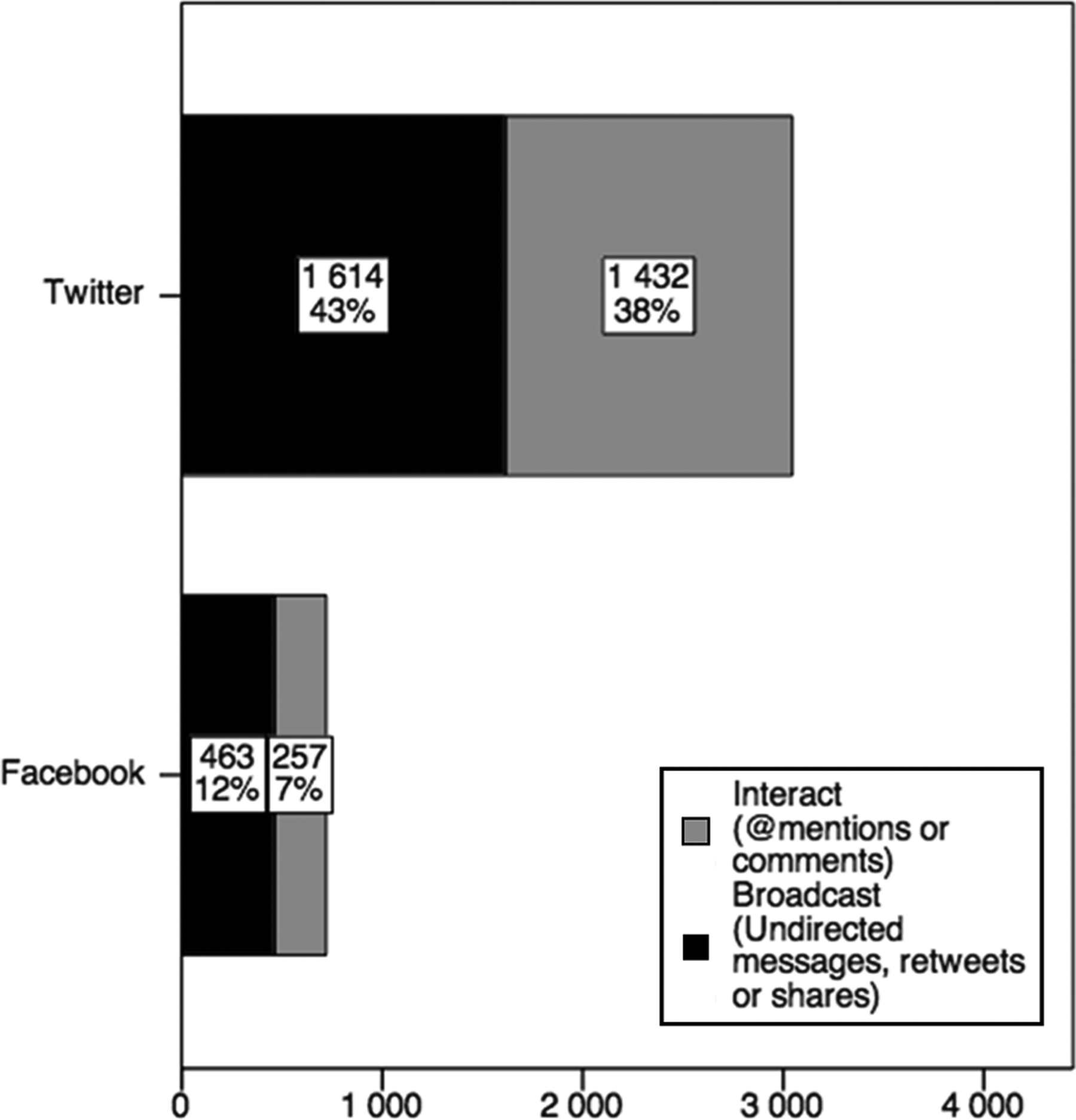
Interactive and broadcasting engagement on Twitter and Facebook by SVT Din Röst between 1st January and 17th September 2014. Raw numbers indicate activity on both services. Percentages shown indicate the share of the total amount of activity on both services. SVT: Sveriges Television.
The bar sizes in Figure 2 reflect the results presented in Figure 1 – Twitter was indeed used to a much larger extent. More importantly, though, Figure 2 allows us to assess the degree of interactive activities by SVT on the platforms under scrutiny. As the percentages reported in it suggest, whilst about 38% of the total amount of activity by Din Röst was devoted to interacting on Twitter, that same practice on Facebook amounted to 7% of the engagement on the two services. As shown previously, whilst Facebook is the more popular service of the two among the viewers, the Din Röst project appears to have been focused extensively on Twitter – especially, it would seem, when it came to interacting.
As discussed in the previous section on social media activity, the informants from SVT did not see any single platform as de facto more important than any other. When both informants were asked how ‘success’ in the use of social media could be measured in organizational terms, both responded by citing a study commissioned by SVT on the extent to which the #dinröst hashtag project was known and/or used by the Swedish population. Both Eva Landahl and Karin Ekman noted that the project had wide recognition. For both, high scores on metrics from the platform were less markers of impact than knowledge of the broader #dinröst campaign. When examining the figures regarding engagement, however, it is clear that Twitter dominated. Based on the information obtained via the interviews, two factors impacted this facet.
First, as discussed earlier, Twitter was used more during and around specific programs. The platform was used to promote as well as discuss: Twitter was the channel in which the major election programs were discussed while they lasted. And there #dinröst was the usual tag. We regularly pushed our audience to discuss using the the #dinröst tag – but we never suggested a specific channel. Facebook was for #dinröst more of a discussion forum via the #dinröst Facebook page. (Karin Ekman) Facebook was a lot more audience dialogue (…) we actively tried to find other Facebook groups. If we talked about the conditions for pensioners in Sweden, and had journalism about that, then the #dinröst Facebook group talked with PRO’s [Swedish National Pensioner’s Association] Facebook group in order to get closer to those who were interested.
The second factor that appeared to impact the volume and type of interaction on both Facebook and Twitter was the availability of resources (in the form of staff and time). When asked about SVT’s use of resources on social media platforms with (relatively) little spread, Eva Landahl responded: I don’t think that you can describe it that way. We had two people working with social media during the elections, and that was too few. Now, after the elections, we have three social media editors. We have a mandate to reach the entire Swedish population. You won’t reach everyone with TV today, and if are going to do this we have to use social media. There are fewer people there, but they are different groups. Of course, even if Twitter and Facebook are natural dialogue machines, we didn’t have the resources to dialogue with those who spoke to us. There you wind up in a bottleneck. You sit there, as one person, for large portions of the election coverage, responsible for taking care of the dialogue, and to develop it [the dialogue]. Yes, limited resources.
Discussion
It would seem from previous, similar research projects that PSBs have always been accused of proposing what could be referred to as ‘elitist’ values – placing more focus on educational or bildung-related content than on that of the entertaining variety (e.g. Enli, 2008). With this in mind, the degree to which a PSB actor such as SVT – the focus of our current study – made use of different types of social media platforms might seem a far cry from such suggestions of pandering to elites. Nevertheless, as dealt with earlier, the platforms studied here – Twitter and Facebook – are very different in terms of user demographics, with the former of the two being characterized as an urban, elite media format. Whilst these tendencies deal with rather different aspects of the broadcasting reality, a slant towards the elites appears as tangible also in the results presented in the present work.
Indeed, one of the most striking results to emerge from the quantitative portion of the study was the extent to which, comparing Facebook and Twitter, the latter was the dominant platform for both types of engagement traced in this study – broadcasting and interacting. As noted throughout this article, the gap between Facebook and Twitter in Sweden in terms of use by the general population is very large, yet it is also worth noting that the gap between the number of followers of the @SVTdinrost Twitter account and the dinröst Facebook page, whilst not insignificant, was not large (8000 vs. 6000). Naturally, with a far larger number of users in Sweden, the number of potential recipients of information via Facebook is much higher. The use of Twitter outlined in the quantitative data, however, when combined with the recognition on the part of senior staff that Twitter users in Sweden (whilst small in number) are influential opinion leaders, suggests that raw number of potential followers does not necessarily drive use, but that the type of follower is also a key factor.
As a research conclusion, it would be attractive to ascribe the predominance of Twitter use over Facebook to a desire or perhaps even strategy to connect with the ‘elite’ in Swedish society. Such a conclusion would not only speak to the specific nature of Twitter in the Swedish context as discussed previously but also raise questions regarding this type of social media utilization in relation to the SVT public service remit to operate in the interests of the entire Swedish population. As such, the degree to which SVT were active on Twitter in comparison to the much more popular Facebook platform could be construed as a communicative mismatch of sorts between the media professionals involved and their broader audience. Yet, such a line of reasoning is tempered by the discussions with SVT staff regarding the relationship between their social media output and their ‘legacy media’ (radio and TV) output as well as the political economy of news organizations.
Regarding the first issue (social media in organizational context), the interviewees made it clear that social media must be seen in relation to the entirety of SVT output and not cut off and examined as a stand-alone product. Thus, whilst the numbers presented regarding Twitter use may seem out of proportion to the impact of the platform, this perspective is considered short-sighted by SVT informants who see Twitter as but one component of their work. Postings to Facebook, whilst lower in volume, were seen as more in-depth and made with an eye towards a much broader audience and longer term connections. Moreover, the respondents insist that their Facebook and Twitter activity as presented in this article should be considered in relation to the material resources dedicated to the social media division responsible for the 2014 election coverage. What was clear from the interviews was that there were very few staff (only one or two, in fact) who dealt with the social media output on a practical, day-to-day basis. Given the relative ease with which tweets are posted (particularly via mobile technology), it is worth considering the extent to which this factor played a role in the dominance of Twitter. Such practical considerations might also be at play when one considers the dominance of Twitter – as a Facebook Page can be controlled for hate speech and the likes to higher degrees than hashtagged discussions on Twitter allow for, this would arguably make the latter platform more agreeable when one considers the responsibilities associated with hosting online discussions.
The questions discussed above are a component of the issue of the political economy of news: how resources are allocated, and how that allocation impacts both the production (and eventual distribution) of the final news product. The quantitative and qualitative data in this article also suggest that the imperative of reaching the largest possible number of users is not always the driving factor behind how certain social media platforms are utilized. The heavy use of Twitter by SVT – despite the fact that the platform has a very low number of regular users – was explained by SVT staff as (at least in part) a targeting of elite opinion leaders (journalists, politicians, think tank members, etc.). Thus, the Din Röst project (in social media terms) was also an important branding platform for SVT as a whole. Whilst a great deal of the literature on the political economy of media deals almost exclusively with commercial media, public service media such as SVT also operate under market pressures, and must justify their license fee income to regular citizens, politicians and opinion leaders. This can be achieved by popularity (viewing figures) but also by perception, and it is here that the use of Twitter is perhaps an example of simultaneously ‘reaching the public’ and reminding key opinion leaders of SVT’s relevance and professional capital. At the same time, the fact that SVT content generated on Twitter was converted into content for non-social media users speaks to a keen awareness on the part of SVT management to a public service commitment to non-commercialism and also suggests that criticism of content only targeting elites neglects to account for how such content is repackaged for wider exposure on the SVT website, away from potential commercial interests, after it appears on social media sites. That being said, future research might find it fruitful to assess the degree to which such repackaging actually takes place – and the amendments performed to make it suitable for other channels or platforms.
Although a specific case of one public service news organization, the numerical data combined with the interviews suggest that whilst Twitter is seen as the ‘on the spot’ and ‘instantaneous’ platform, Facebook is a more fixed venue for sporadic updates and in-depth user commentary. Such tendencies are visible also in the trade literature geared towards online journalists and media professionals more broadly – where Twitter is often seen as suitable for far more frequent updates and Facebook as fitting for a less rapid agenda (e.g. Lee, 2014). With this in mind, and with the results presented above fresh in our memories, we can perhaps consider Facebook as the news ‘showroom’ – used mostly for broadcasting messages – whilst Twitter is the news ‘chat room’ – used more for interaction. The relative ubiquity of tweets in relation to Facebook postings, as well as the more regular level of engagement on Twitter versus on Facebook is, it would appear, linked to the use of Twitter during televised events (such as debates and interviews). Again, here the architecture of the Twitter platform – with the promotion of short, instantaneous comments – lends itself to such events, whilst Facebook is better suited to more evolved thoughts, commentary and debate over an extended period (at least in relative social media terms). In short, the numerical preference for Twitter on the part of SVT cannot, it would appear, be divorced from the way(s) in which the platform dovetails with the promotion and use of televised material. The question is, however, how well such a focus on Twitter lends itself to the overall goal of SVT as a PSB.