




Abstract
We examined the utility of distinguishing between appearance- and competition-focused approach and avoidance performance goals to our understanding of motivation in physical education. Four achievement goals were tested composed of approach–avoidance and appearance–competition components. Three hundred and two pupils, aged 11–14 years, completed measures of appearance–competition approach–avoidance goals at the start of a football or gymnastics unit of work in physical education. Teacher-rated effort and National Curriculum attainment levels were recorded at the end of the unit of work as markers of performance in physical education. Confirmatory factor analysis supported the delineation of four goals in terms of the approach–avoidance and appearance–competition elements. Regression analyses subsequently revealed differences in the predictive utility of the four goals to performance in physical education. Thus, our understanding of motivational processes in physical education may be enhanced by utilising a more differentiated conception of normative achievement goals.
The extant achievement motivation literature has consistently documented the beneficial effects of mastery goals on cognitions, affect and behaviour (see Biddle et al., 2003; Duda and Hall, 2001). However, the empirical pattern concerning the effects of performance goals on achievement processes and outcomes is rather more ambiguous (see Elliot, 1999, 2005 for a discussion). This mixed empirical pattern has, to a certain extent, been clarified by attending to the approach–avoidance distinction of performance goals (Elliot, 2005; Rawsthorne and Elliot, 1999). The bifurcation of performance goals to represent approach striving (PAp), in which individuals strive to achieve a positive outcome (i.e. doing better than others), has been associated with higher levels of graded performance, less effective self-regulation and use of less effective learning strategies, and greater reports of avoiding seeking help when needed. On the other hand an avoidance striving (PAv), where individuals strive to avoid a negative outcome (i.e. not doing worse than others), has been associated with higher levels of anxiety, worry, emotionality and use of self-handicapping strategies, and lower levels of graded performance, intrinsic motivation and self-regulation (Elliot and Church, 1997; Middleton and Midgley, 1997; Midgley and Urdan, 1995; Ommundsen, 2004, 2006).
Despite that the bifurcation of performance goals was anticipated to clarify the empirical pattern of performance goal striving (Elliot, 2005; Rawsthorne and Elliot, 1999), a recent meta-analytic review of achievement goal measures in the educational domain revealed that inconsistencies were evident in the empirical pattern of PAp goals (Hulleman et al., 2010). In several studies (Elliot and McGregor, 1999; Midgley et al., 1996; Ryan and Pintrich, 1997), PAp goals have been associated with maladaptive processes and outcomes, suggesting that the approach–avoidance distinction does not fully explain the empirical pattern of PAp goals (Hulleman et al., 2010). Hulleman and colleagues (2010) identified that when PAp goals were linked to maladaptive processes and outcomes the measures of PAp goals did not differentiate between a competition (or normative) component and an appearance component. Furthermore, in a qualitative analysis of performance goal adoption, the reasons for performance goal pursuit were categorised according to both the approach–avoidance and appearance–competition distinctions (Urdan and Mestas, 2006). For example, the reasons reflected concerns with appearing academically able or competent to others (appearance–approach), a desire to avoid appearing academically unable or incompetent to others (appearance–avoidance), a desire to do better than others (competition–approach) and a desire to avoid doing worse than others (competition–avoidance). This suggests that further differentiation of performance goals is warranted to fully understand the effects on achievement-related cognitions, affect and behaviour.
Competition and appearance components of performance goals
It is apparent in the early work on the performance goal construct by Nicholls (1984) and Dweck and Elliott (1983) that in addition to trying to do better than others (competition or normative comparison), trying to look good to others (appearance, approval or self-presentation) is also a key component of the definition of performance goals. In more recent theorising on the achievement goal construct, Elliot (1999, 2005) has attempted to clarify the role of these two components so that a more precise definition of performance goals can be achieved. For Elliot and his colleagues (Elliot, 1999, 2005; Elliot and Thrash, 2001; Thrash and Elliot, 2001), a performance goal represents a normative aim of an individual’s behaviour, that is, trying to do better than others or trying to avoid doing worse than others, that can be energised by a range of different reasons such as wanting to look good to others or seeking approval from others.
Two reviews of the content and focus of measures of performance goals in the educational domain found, however, that rather than separating the two aspects in terms of reason and aim of behaviour to create a more precise definition of performance goals, the measurement and manipulation of performance goals within the approach–avoidance framework has either ignored or confounded the competition and appearance components within the measurement of the goals themselves (Elliot and Murayama, 2008; Hulleman et al., 2010). Some measures of PAp and PAv goals contain items that focus on both the appearance and the competition components, whereas other measures include items that focus explicitly on one or other of these components (Elliot and Murayama, 2008; Hulleman et al., 2010). This inconsistency in focus has resulted in some mixed empirical patterns being reported for PAp and PAv goals on achievement-related outcomes (Hulleman et al., 2010). Of particular interest for performance goals is the relationship with performance. In their meta-analytic review, Hulleman and colleagues found that when PAp goals were assessed using normatively-focused items the relationship with performance was positive, but when appearance-focused items were used the relationship was negative. Similarly, relationships between PAv goals and performance outcomes were significantly more negative with normatively-focused items than with appearance-focused items.
These differences may be a consequence of the emphasis that competition and appearance concerns place on performance. For example, appearance concerns focus the individual on wanting to appear competent to others or wanting to avoid appearing incompetent to others. As such, this may lead the individual to have little concern for performance outcomes in relation to others (Hulleman et al., 2010) and to engage in behaviours that may be potentially detrimental to motivation and performance and distract pupils from the learning process (Elliot, 1999). On the other hand, competition concerns may focus the individual on performance outcomes in terms of wanting to be better than others or wanting to avoid being worse than others and may therefore be beneficial to motivation and performance. In order to satisfy this form of goal striving, these concerns may encourage individuals to exert effort and perseverance towards tasks, which consequently brings about increases in competence and higher levels of performance.
In order to address these issues, it would be appropriate to consider the integration of the appearance–competition distinction into the measurement of the performance goal construct itself. This would create a more specific aim of achievement behaviour (Elliot and Thrash, 2001) and potentially result in differential effects on the cognitions, affect and behaviour of individuals in achievement situations (Elliot, 1999, 2005; Urdan and Mestas, 2006). Furthermore, each of the specific aims may be underpinned by different or similar reasons, leading to differential effects on outcomes due to the different specific aims of the performance goal. Urdan and Mestas (2006) identified that the same reason could be used for pursuing different performance goals. For example, the desire to make family members proud underpinned appearance–avoidance, competition–approach and appearance–approach goals. This suggests that examining performance goals with different specific aims within the context of the hierarchical model of approach–avoidance motivation will enable the antecedent and consequence profile of each type of goal striving to be identified and considered in relation to the existing approach–avoidance literature and help to provide a more nuanced insight into goal striving in achievement settings.
Competition and appearance components in the physical domain
Despite the prevalence of the competition and appearance components as a theme in recent theorising and research in the educational domain (Elliot, 1999; Elliot and Murayama, 2008; Hulleman et al., 2010; Urdan and Mestas, 2006), no research has examined this distinction in the physical domain. The issues concerning the measurement of approach–avoidance performance goals in the classroom are also applicable to the sport and physical education (PE) measures of achievement goals. These measures, for example, the Achievement Goal Questionnaire for Sport (AGQ-S; Conroy et al., 2003) and the 2 × 2 Achievement Goals in Physical Education Questionnaire (2 × 2 AGPEQ; Wang et al., 2007) were developed from the 2 × 2 Achievement Goal Questionnaire (AGQ; Elliot and McGregor, 2001) in the educational domain. Consequently, an analysis of the PAp and PAv items in these PE and sport questionnaires reveals a focus on the competition component of performance goals (i.e. outperforming others or avoiding performing worse than others) with no reference to the appearance component of performance goals. Furthermore, relatively few studies in the physical domain have incorporated performance as an outcome when using achievement goals as a central construct (Duda, 2007), particularly when drawing upon the approach–avoidance distinction in the PE context.
The focus on the competition component of performance goals and the limited use of performance as an outcome, when coupled with the range of abilities in PE classes, may not have been sufficiently sensitive to account for all types of performance goal striving in previous research in PE. It is possible that in PE a pupil could pursue any of four types of performance goal based on both approach–avoidance and appearance–competition distinctions. Systematically attending to these two distinctions may help to elucidate and clarify the intricacies of performance goal adoption and its effects in contexts such as PE.
The present study
The purpose of the present study was two-fold: 1) to establish whether appearance- and competition-focused performance-approach and avoidance goals could be distinguished by pupils in the PE setting and 2) to provide a test of the four goals in relation to two measures of performance in PE (National Curriculum level and effort). Specific hypotheses were formulated based on the meta-analysis of Hulleman and colleagues (2010). It was expected that there would be positive relationships between competition-focused PAp goals and the two measures of performance, and negative relationships between appearance-focused PAp goals and the measures of performance. The relationships between competition-focused PAv goals were expected to be more negative than the relationship between appearance-focused PAv goals and the measures of performance.
Method
Participants and procedures
Male (N = 179) and female (N = 123) pupils from PE classes in years 7 (47.4%), 8 (29.5%) and 9 (23.2%) from two state comprehensive high schools in East England, UK participated in the research. At both schools the large majority of pupils were White British and spoke English as a first language, with one school having approximately 20% of the pupils from minority ethnic backgrounds (Office for Standards in Education, 2010a, 2010b). Participants were aged between 11 and 15 years (M = 12.68, SD = 0.83 years) and were predominantly White (92.1%).
Procedures followed the ethical guidelines of the British Psychological Society and were approved by the ethical advisory committee at the second authors’ institution. Permission for conducting the research was sought from the head teacher at each school and parental consent was obtained through distribution of letters prior to data collection. Following an introduction to the purpose of the research, informed assent was given by all participants through the completion of a ‘willingness to participate’ form. Any child who did not have parental consent or give their informed assent for participation in the research was withdrawn from all data collection procedures. Participants were assured by the researcher responsible for data collection that all information collected would be anonymous and would remain confidential. They were provided with the opportunity to ask any questions before the questionnaire was administered. Items were read aloud to the participants by teachers. The administration of questionnaires took place prior to normal curriculum PE lessons. Each participant completed six or eight lessons in the chosen activity (football or gymnastics), depending on the secondary school attended. The student questionnaire was administered before lesson three (Time 1) and teachers completed measures of pupil effort and recorded the National Curriculum level for each pupil after the last lesson (Time 2), approximately three weeks apart. Data collection procedures took approximately 30 minutes at each time point.
Measures
At Time 1, each participant completed a measure of their goal adoption and recorded their personal details while at Time 2 measures of pupil performance were completed. Reliability and descriptive statistics for each measure are presented in Table 3 and reported in the results section.
Personal details
This section contained items pertaining to tutor group (class), date of birth, gender and ethnicity and allowed participants to be matched at each measurement occasion.
Goal adoption
Pupils’ goal adoption was assessed using 12 items which drew on items from the Patterns of Adaptive Learning Survey (Midgley et al., 2000) and integrated the qualitative work of Urdan and Mestas (2006) into the AGQ-S (Conroy et al., 2003). The items were measured on a seven-point Likert scale that ranged from not at all like me (1) to very much like me (7). Each subscale reflected a different pattern of goal striving combining approach–avoidance and appearance–competition elements. Three items assessed each type of goal. The competition–approach goal focused on striving to demonstrate norm-referenced competence, the appearance–approach goal focused on wanting to appear competent to others. The competition–avoidance goal focused on avoiding demonstrating norm-referenced incompetence, while the appearance–avoidance goal focused on wanting to avoid appearing incompetent to others. The stem ‘My aim in this football/gymnastics unit of work is to…’ preceded each item. Sample items included, ‘Do better than most others’ (competition–approach), ‘Show others how good I am at football/gymnastics’ (appearance–approach), ‘Avoid being worse than everyone else’ (competition–avoidance), and ‘Not show everyone else how bad I am at football/gymnastics’ (appearance–avoidance) 1 . Results of the confirmatory factor analysis and multi-group invariance analysis are presented in Tables 1 and 2 respectively and are discussed in the results section.
Confirmatory Factor Analysis models of performance goals.


CI: confidence interval; App–Ap: appearance–approach goals; Comp–Ap: competition–approach goals; App–Av: appearance–avoidance goals; Comp–Av: competition–avoidance goals; CAIC: Consistent Akaike's Information Criterion; NNFI: Non-Normed Fit Index; SRMR: Standardised Root Mean Square Residual; RMSEA: Root Mean Square Error of Approximation.
*p < .05
Multigroup analysis of gender for appearance and competition four factor performance goal structure.
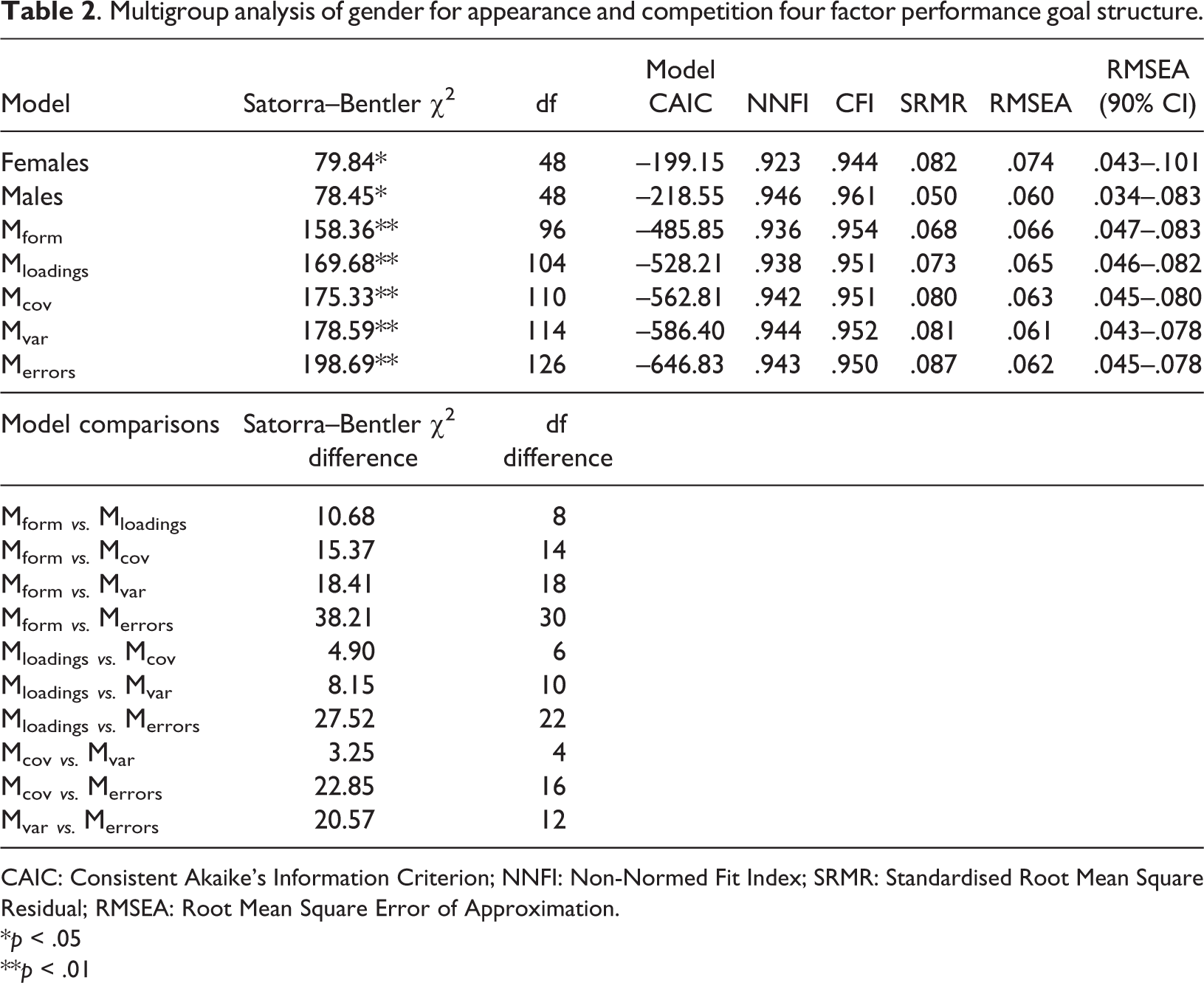
CAIC: Consistent Akaike's Information Criterion; NNFI: Non-Normed Fit Index; SRMR: Standardised Root Mean Square Residual; RMSEA: Root Mean Square Error of Approximation.
*p < .05
**p < .01
At Time 2, two indicators of performance were collected.
Effort
The teacher rated each pupil’s effort during the unit of work on a five-point Likert scale which included the following descriptors unacceptable (1), poor (2), satisfactory (3), good (4) and excellent (5).
Achievement
Using the attainment targets set out in the National Curriculum for Physical Education (NCPE; Department for Education and Employment/Qualification and Curriculum Authority (DFEE/QCA), 1999), teachers provided ratings for each pupil across each of the four areas: Acquiring and Developing Skills; Selecting and Applying Skills, Tactics and Compositional Ideas; Evaluating and Improving Performance; and Knowledge and Understanding of Fitness and Health. Pupils were rated as being in the top, middle or bottom of the attainment target they achieved; for example, a pupil at the top of level 4 would be graded as 4c, in the middle of level 4 as 4b and at the bottom of level 4 as 4a. These levels were converted to a scale ranging from level 1a (1) to level 7a (19). The scores for each pupil in each of the four areas were averaged to form an overall National Curriculum level.
Data analysis
We conducted Confirmatory Factor Analysis (CFA), using EQS 6.1 software (Bentler and Wu, 2002), of the goal adoption items to test whether the hypothesised factor structure of four separate goals based on the approach–avoidance and appearance–competition distinctions represented the best fit to the data. Four alternative models were examined: 1) A uni-dimensional model which did not distinguish between either the approach–avoidance or appearance–competition elements; 2) a model based on approach–avoidance goals which made no distinction between appearance–competition elements; 3) a model distinguishing between appearance–competition goals but taking no account of the approach–avoidance element; and 4) a four factor model in which the goals were separated by both approach–avoidance and appearance–competition elements. Model fit was assessed and compared using both relative and absolute fit indices.
Furthermore, the confirmed measurement model from the first analysis was examined for evidence of multigroup invariance across gender. After establishing that the baseline models for males and females were equivalent, a series of progressively more constrained models were examined beginning with the factor loadings and progressing to the covariances, variances and errors (Joreskog, 1971). Model fit was assessed and compared using both relative and absolute fit indices and scaled chi-square difference tests were used to assess which nested model provided a better fit to the data (Satorra and Bentler, 2001).
Finally, two hierarchical regression analyses were conducted to examine whether appearance- and competition-focused performance goals were significant predictors of the two measures of performance. In all analyses gender was entered in step 1 to control for its effects, and the four appearance- and competition-focused performance goals were entered in step 2.
Results
Factorial validity and invariance across gender
The fit indices of the CFA are presented in Table 1 and revealed that the hypothesised factor structure (four correlated performance goals separated by both approach–avoidance and appearance–competition distinctions) exhibited the best fit to the data. In this model, each standardised item–factor regression coefficient exceeded .55 and each item loaded significantly only on its specified latent variable. All subsequent analyses therefore utilised a four factor conceptualisation of performance goals. Significant correlations between latent factors emerged for competition–approach goals with appearance–approach (.83) and competition–avoidance (.61) goals, for appearance–approach goals with competition–avoidance (.62) goals, and for competition–avoidance goals with appearance–avoidance (.56) goals. Table 2 presents the results of the multi-group analysis and shows the invariance of the measurement model across gender. All subsequent analyses were conducted on the whole sample.
Descriptive statistics
Table 3 presents the descriptive statistics, internal consistency estimates and bivariate correlations among each of the study variables. Mean scores for all variables were above the scale mid-point. Competition–avoidance goals had the highest mean score and appearance–avoidance goals the lowest mean score in the sample. Internal consistency estimates exceeded 0.70 for all of the four types of goal.
Descriptive statistics, internal consistency and bivariate correlations.
*p < .01
**p < .05
aGender: females = 0, males = 1.
Zero-order correlations
Appearance–approach, competition–approach and competition–avoidance goals were positively associated with one another. Only competition–avoidance goals were positively associated with appearance–avoidance goals. The measures of performance were positively associated with one another. Appearance–approach, competition–approach and competition–avoidance goals were positively associated with the two measures of performance, with stronger associations for both types of approach-based goals. Avoidance–appearance goals were negatively associated with overall National Curriculum level.
Predicting performance
As shown in Table 4, adding the four performance goals to the model in step 2 accounted for a significant proportion of the variance in the two measures of performance. Competition–approach goals were a significant positive predictor of both overall National Curriculum level and effort. Appearance–avoidance goals were a significant negative predictor of overall National Curriculum level. Finally, gender was a significant predictor of effort, with females scoring higher on effort.
Predicting performance from appearance- and competition-focused performance approach and avoidance goals.
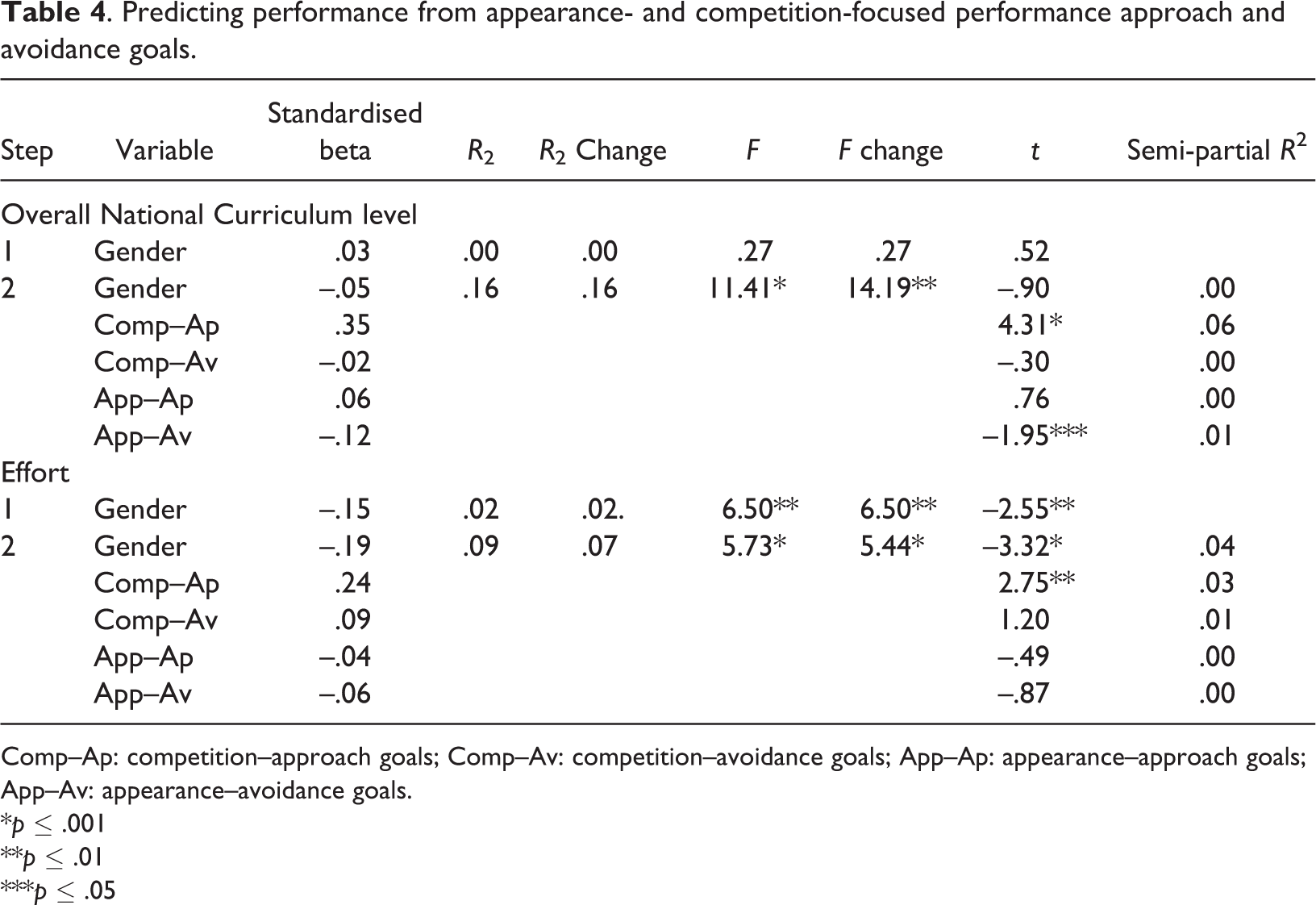
Comp–Ap: competition–approach goals; Comp–Av: competition–avoidance goals; App–Ap: appearance–approach goals; App–Av: appearance–avoidance goals.
*p ≤ .001
**p ≤ .01
***p ≤ .05
Discussion
Across achievement domains, the empirical pattern concerning the effects of performance goal adoption on the cognitive, affective and behavioural outcomes experienced by individuals in achievement situations has been mixed (Elliot, 2005). Although this mixed pattern has, to a certain extent, been clarified by attending to the approach–avoidance components of performance goals (Elliot, 1999, 2005), another key distinction in performance goals exists, namely appearance- versus competition-focused striving. A meta-analytic review in the educational domain revealed that when measures of PAp and PAv goals failed to take account of this distinction, a mixed empirical pattern of relationships was exhibited, particularly in relation to performance (Hulleman et al., 2010). The measures of performance goals in the physical domain are exclusively competition-focused, consequently there is little understanding of whether a more nuanced conception of performance goals utilising the appearance–competition distinction can aid our understanding of motivational processes in PE. Therefore, the present study sought to establish whether appearance- and competition-focused performance approach and avoidance goals could be distinguished by pupils in the PE setting and examined the relationships between the four types of performance goals in relation to performance in PE.
Results supported the delineation of four goals in terms of the approach–avoidance and appearance–competition components in that pupils were able to distinguish between the four types of performance goals in PE settings. Furthermore, this was supported across genders, providing further evidence that no clear pattern of gender differences operates for pupils’ achievement goal adoption (Meece et al., 2006). In line with previous research in PE, competition–avoidance goals had the highest mean score in the sample (Wang et al., 2007; Warburton and Spray, 2008, 2009). This is somewhat worrisome given the range of negative outcomes associated with this type of achievement goal striving. Furthermore, appearance–approach goals had a higher mean score than competition–approach goals, which is surprising given the tendency of PE research to use competition-focused measures of performance goals. The public nature of the PE context, whereby it is easy to observe and evaluate pupils’ ability at any moment in time, may heighten the salience of appearance-focused goals to pupils’ experiences in PE. The desire to appear able to others becomes increasingly important to the pupil, rather than their desire to perform better than others, suggesting that research which has focused on competition-focused performance goals may be providing an incomplete understanding of pupils’ performance goal adoption in PE.
The high correlation between appearance–approach and competition–approach goals suggests that further research is needed to establish whether clearer differentiation of the performance goal construct can aid our understanding of motivational processes in PE. Such work should include both prospective and experimental designs which consider both the antecedents and consequences of the four performance goals, to help to determine whether Elliot and colleagues’ (Elliot, 2005; Elliot and Thrash, 2001; Thrash and Elliot, 2001) view that motivational concerns, such as self-presentation, self-assessment and impression management, are antecedents of and therefore energise normative competence-based goal adoption rather than are a part of the goal itself in settings such as PE. This work should also seek to establish whether multiple performance goals are pursued within PE settings and the independent and interactive effects of pursuing a combination of these performance goals. Moreover, the present study highlights the difficulty with promoting performance goals in PE. The results indicate that performance in PE can be facilitated through the adoption of competition–approach goals. However, the high correlations between goals indicate that teachers may risk promoting the adoption of appearance–approach and competition–avoidance goals when attempting to promote competition–approach goals and these other goals may be associated with a range of negative outcomes and be detrimental to future motivation in PE. Further research is needed to explore the effects of these different goal strivings and the combination of these goal strivings on pupils’ motivation and behaviour in PE.
Performance goals and performance
In the present study, two measures of performance in PE were used to explore the relationships with the four performance goals. Partial support was found for the effects of the appearance–competition distinction of approach and avoidance goals in predicting performance. In line with previous findings in education (see Hulleman et al., 2010), pupils who were focused on outperforming others (competition–approach) achieved higher performance scores. On the other hand, those who were focused on avoiding appearing incompetent to others (appearance–avoidance) achieved lower performance scores. These were the only results congruent with those reported in the meta-analysis from the educational domain. However, research in education has either measured goals that focus predominantly on appearance or competition concerns or confounded both within an omnibus performance goal (Hulleman et al., 2010). It has not attempted to delineate the specific simultaneous effects of appearance and competition concerns on performance as in the present study.
The lack of congruence between findings in education and those in PE with regards to performance-focused goals is not uncommon. For example, in the educational domain low perceptions of competence have been associated with performance–avoidance goal adoption (Elliot and Church, 1997; Elliot and McGregor, 2001), while in PE high perceptions of competence have been associated with performance–avoidance goal adoption (Wang et al., 2007; Warburton and Spray, 2008, 2009). These differences in relationships may be attributable to the nature of the PE context with its public evaluation and participation in activities that are inherently competitive. It therefore appears that PE may provide a unique educational setting that requires further research to fully explore the specific motivational processes that are operating. Although current results suggest that pupils in PE can distinguish between appearance- and competition-focused goals, further research is required to fully explore whether our understanding of motivational processes in PE may be enhanced by distinguishing between appearance and competition components within normative achievement goals.
Measuring performance in physical education
Performance is one of the key behavioural indicators for motivation so it is surprising that the use of performance as an outcome in research on achievement goals within the physical domain is limited (Duda, 2007). However, this may be reflective of the difficulty in establishing clear indicators of performance in physical contexts. Previous research in PE, which has utilised measures of performance in relation to achievement goals, has focused on skill performance in specific tests, such as running (Xiang, Bruene and McBride, 2004) or motivation-related behaviours such as effort, task choice and persistence (Biddle et al., 2003; Guan et al., 2006). This approach is in contrast to research in the educational domain where graded performance such as exam scores, overall grade point average (GPA), or semester GPA are regularly used to assess the effects of achievement goals on performance (see Elliot and McGregor, 2001; Elliot and Moller, 2003). These types of performance measures used in education research are often drawn from standardised tests that form part of the normal assessment strategy of the curriculum subject. However, the use of similar standardised tests is not prevalent within the normal assessment strategies in PE. This provides a challenge for achievement goal research that wishes to incorporate performance as an outcome. The present study attempted to draw parallels with measures of performance in education through using the National Curriculum levels that teachers assign to pupils at the end of a unit of work. Although the NCPE provides descriptors to guide teachers with assigning levels, there is an opportunity for subjectivity to enter this measurement of performance that may not be so apparent in the measures of performance in other educational settings. This issue of subjectivity could also be applied to teacher-rated effort as an indicator of performance. Greater objectivity in performance measures in PE, such as through a skills test, may allow the four goals to reveal unique relationships with performance in PE. The measurement of performance in PE therefore requires attention and consideration in future research in order to adequately assess normative goal striving in PE and the contribution of appearance and competition concerns to settings beyond those in the classroom.
In conclusion, present results suggest that the appearance–competition distinction provides greater sensitivity than the approach–avoidance distinction alone in aiding our understanding of motivational processes in PE. However, there are some limitations to the present study which should be addressed in future research endeavours, most notably the issues with regards to the measurement of performance in PE. In addition, a wider range of outcomes, for example, anxiety, intrinsic motivation, self-handicapping, help-seeking, or use of meta-cognitive and cognitive regulation strategies, should be examined in relation to these appearance- and competition-focused goals. This research agenda should extend to different age groups and different physical and educational settings to explore whether appearance or competition concerns become more or less salient depending on age and context. Future research may also include the antecedents of these appearance- and competition-focused goals to determine those that elicit appearance- as opposed to competition-focused aims. This may be valuable as appearance–approach goals had a higher mean score than competition–approach goals in the present sample and appearance–avoidance goals were a negative predictor of pupils’ levels of attainment. Moreover, research may wish to focus attention on the antecedents of need for achievement and fear of failure, since they have consistently emerged in educational research as associated with performance–approach goals (Elliot and Church, 1997; Elliot and McGregor, 2001). These antecedents may help to explain the high correlations between the goals in the present study. Finally, the measurement of appearance-focused goals in PE requires further research attention. In education, the data on appearance-focused goals are typically derived from research which has utilised the Patterns of Adaptive Learning Survey (Midgley et al., 2000), an established and validated questionnaire. Although evidence for a four factor structure of performance goals, which was invariant across gender, was provided in the present study, further research should validate and refine the measurement of appearance-focused goals in PE settings.
The present investigation provides an initial insight into the complexity of normatively-focused competence concerns in the physical domain. However, further studies are necessary to validate current findings and to pursue additional research questions. Such questions may include identifying the environmental cues that give rise to appearance- and competition-based strivings and the consequences of pursuing these goals to pupils’ attitudes towards physical activity both within and beyond the school curriculum. Consequently, future work could have important implications for professional practice in school physical education.
Footnotes
Appendix
All items were answered on a Likert scale ranging from ‘Not at all like me’ (1) to ‘Very much like me’ (7) and preceded by the stem ‘My aim in this football/gymnastics class is to……….’.
Funding
This research received no specific grant from any funding agency in the public, commercial, or not-for-profit sectors.