




Abstract
The purpose of this study was to explore the effect of two landmark spectrum styles, practice and inclusion, on students’ basic psychological needs satisfaction and self-determined motivation. Twelve classes of college-aged students (n = 149) participated in two badminton lessons taught under the conditions of the practice and inclusion styles. The basic psychological needs for physical education scale (BPN-PE) and situational intrinsic motivation scale (SIMS) were administered prior to the implementation of the two style-specific lessons and following each lesson. Students’ perceptions of fun, learning, and motivation and experience with the two teaching styles were examined through a post-study questionnaire. One-way ANOVAs with repeated measures were used to determine whether the interventions (teaching styles) had an effect on student psychological needs satisfaction, motivational behavioural regulation, perceptions of fun, learning, and motivation, and experience with the teaching experiences. Findings revealed that the students’ perceptions of autonomy and competence (BPN-PE) and identified regulation motivation (SIMS) in badminton increased as a result of the teaching styles intervention. No between style differences were found. Instruction delivered under the conditions of both the practice and inclusion styles was found to be equally effective in positively influencing students’ basic psychological need satisfaction and level of self-determined motivation.
Spectrum teaching styles
Mosston and Ashworth’s (2002) spectrum of teaching styles is a framework of diverse instructional strategies governed by decision-making. Within each individual teaching style, the teacher and learner have differentiated roles (decisions to make) specific to subject matter and behaviour which are intended to lead to the realization of a unique set of learning outcomes. According to spectrum theory: No teaching style is inherently better or worse than another. Rather each, because of the unique learning conditions it fosters, is either more or less appropriate given the purposes, the context in which it is presented, and the learners involved (Goldberger et al., 2012: 268).
In the practice style of teaching, students learn to perform a task as explained and demonstrated by the teacher or surrogate (Mosston and Ashworth, 2002). The students then perform the task at the prescribed level of difficulty while making decisions about the pace at which they practice, where they locate in the practice setting, and when they start and stop practising. While practising, the teacher offers individual task-related feedback to help the students reproduce the modelled task. According to research, most instruction in physical education takes place under the ‘canopy’ of the practice style of teaching (Hodges Kulinna and Cothran, 2003; Jaakkola and Watt, 2011).
In the inclusion teaching style, in addition to making the same decisions as in the practice style about pace, location, and start and stop time, the students perform the presented tasks at a self-selected level of difficulty and assess their own performance with the help of a task sheet that includes critical skill elements (Mosston and Ashworth, 2002). These two powerful defining characteristics of the inclusion style of teaching set it apart from the practice style of teaching. Within the inclusion style, the teacher creates a plan to challenge or motivate a class of students with varying degrees of skill so that each can engage in optimal practice (Byra and Jenkins, 1998; Chatoupis and Emmanuel, 2003). This is not the case in the practice style, where all students perform the task at the same teacher-prescribed level of difficulty.
The literature on self-determination (SDT) indicates that students are influenced by the way teachers interact and communicate with their students (Reeve, 2006; Reeve and Jang, 2006). In the physical education setting, Perlman (2013) found that students taught in an autonomy-supportive learning context were more physically active (i.e. moderate-to-vigorous) than students taught within a non-autonomy-supportive learning context. Lonsdale and colleagues (2009) found that self-determined motivation and opportunity to make choices were associated with higher levels of physical activity in secondary level students. Mandigo and colleagues (2008) found that using autonomous supportive instructional strategies like giving students time to practice on their own, praising quality of performance, and listening to students in game lessons fostered feelings of intrinsic motivation in upper elementary-aged school children. Findings from other SDT research studies have been found to be similar (Lim and Wang, 2009; Perlman, 2015; Ward et al., 2008).
Although both teaching styles under investigation fall within the reproduction cluster of spectrum styles, comparatively, the inclusion teaching style is a much more student-centred instructional approach than the practice style because of the decision-making proffered to learners. Teacher behaviours related to autonomy-supportive social contexts (i.e. SDT) seem to be more readily associated within the inclusion style of teaching than the practice. Because of these differences, the inclusion and practice styles of teaching were chosen for investigation in this study. In addition, the practice and inclusion styles of teaching were chosen because teachers, student teachers, and students have consistently reported these teaching styles within their top three to five selections of spectrum styles used/experienced in physical education (Cothran et al., 2000, 2005; Curtner-Smith et al., 2001; Hodges Kulinna and Cothran, 2003; Jaakkola and Watt, 2011; Syrmpas and Digelidis, 2014).
Student motivation
The impact of being favourably motivated in school physical education lessons has received considerable attention over the past few decades as a result of the research findings that tie motivation to level of student engagement in learning tasks (Perlman, 2010, 2011; Perlman and Goc Karp, 2010; Spittle and Byrne, 2009; Wallhead and Ntoumanis, 2004). A theoretical framework that has been consistently used in the educational domain to examine student motivation is self-determination theory (SDT) (Deci and Ryan, 1985, 2000). According to SDT, an individual’s type and level of motivation is the result of satisfaction of three fundamental psychological needs: autonomy, competence, and relatedness (Deci and Ryan, 2000). Autonomy relates to an individual’s freedom to self-organize, regulate, or choose behaviours, activities, or responsibilities that are consistent with that person’s goals and values. Competence is demonstrated when an individual engages in optimal challenges and strives for accomplishment and mastery by exploring, learning from, and adapting to his or her environment. Relatedness is explained as an individual’s involvement or sense of belonging within an activity or group of people, which creates a feeling of security or attachment (Baumeister and Leary, 1995). How individual motivation evolves through one’s perceptions of autonomy, competence, and relatedness is characterized along a continuum from intrinsic to extrinsic to amotivation (Deci and Ryan, 1985).
Intrinsic motivation is associated with behaviour that is initiated and regulated autonomously (Deci and Ryan, 1985, 2000). An intrinsically motivated individual acts out of pure interest in or enjoyment of an activity; feelings of competence are often high and contingencies for the behaviour are non-existent. Oppositely, amotivation occurs when people don’t engage in an action often because they don’t see a connection between the behaviour and goals they deem to be important; individuals may also experience amotivation when they feel incompetent to successfully execute a task. Between those two ends of the motivational continuum, extrinsic motivation is demonstrated when a person exhibits a behaviour as a result of either internal or external forces and can be further divided into external, introjected, identified, and integrated regulations. An individual who engages in an action to earn a reward or to avoid punishment embodies external regulation, while a person who acts to avoid self-imposed pressures or feelings of guilt exemplifies introjected regulation. Together, these two types of motivation are considered non-self-determined because the actor’s perception of autonomy and often competence are limited or non-existent. Identified regulation represents behaviour that one engages in because it will help the individual obtain another, related goal, while integrated regulation is expressed when a person acts in a manner that is consistent with her or his values and identity. Identified and integrated regulations are collectively described as self-determined because the actor perceives some degree of autonomy and can generally demonstrate competence in executing the behaviour. As such, intrinsic and self-determined extrinsic forms of motivation are thought to produce more optimal cognitive, affective, and behavioural outcomes because they represent a higher degree of basic psychological need fulfilment (Deci and Ryan, 1985, 2000).
According to research conducted in physical activity settings, feelings of autonomy and self-regulation/self-determination are reflective of individuals who show interest and desire to engage in physical activity. For example, Goudas and colleagues (1994) found that middle school-aged students who perceived autonomy showed greater intrinsic interest in gymnastics (individual sport) and soccer/netball (team sport) activities. Perceived student competence was also found to be positively associated with intrinsic interest in physical activities that provided feelings of self-determination. Biddle and colleagues (1999) also found that in children aged 12–16 years, self-determined forms of motivation best predicted intentions to be physically active. Overall, researchers who have employed self-determination theory in studies of students in physical education have found intrinsic motivation to be positively related to students’ level of participation (Sun and Chen, 2010; Van den Berghe et al., 2014), ability to attend to tasks (Ntoumanis, 2005; Standage et al., 2005), desire to participate in optional physical education (Ntoumanis, 2005), and intention to engage in physical activity outside of the school setting (Ntoumanis, 2001, 2005; Standage et al., 2003).
Research suggests that the types of instructional models and strategies employed by teachers in physical education can impact students’ motivation. In particular, teachers who employ instructional strategies that nurture feelings of autonomy, competence, and relatedness can enhance a student’s intrinsic motivation (Perlman, 2010, 2011; Perlman and Goc Karp, 2010; Spittle and Byrne, 2009; Wallhead and Ntoumanis, 2004).
Student motivation and spectrum teaching styles
Studies have emerged that have used student motivation as a lens to examine the outcomes of different teaching styles. Goudas and colleagues (1995) examined the impact of the practice and the inclusion styles of teaching on middle school students’ motivation during track and field lessons. When being taught under the conditions of the practice style, the students were shown a task and told what to do and then given time to practice the task while receiving skill-related feedback from the teacher (teacher-centred teaching). When being taught under the conditions of the inclusion style, the students were also shown a task, told what to do, and then given time to practice the task; however, the students chose the pace at which they wanted to practice, the level of difficulty at which to perform each task, and whether they wanted the teacher to assess their performance (provide skill-related feedback) or self-check their own performance. Making decisions about pace, level of difficulty, and who assesses performance are reflective of more autonomy-supportive teaching behaviours (Reeve and Jang, 2006). Students reported higher levels of intrinsic motivation and perceived autonomy when receiving instruction under the inclusion style of teaching. When asked about the two teaching styles (interviews), the students reported preferring the inclusion style of teaching over the practice style because of less perceived difference between the more- and less-skilled learners in the class and being able to work at their own pace, reasons that are thought to align with perceived autonomy and competence.
Salvara and colleagues (2006) examined the effects of several different teaching styles on sixth grade students’ goal orientations in physical education. Two of the four instructional treatments in this study included some instructional practices that aligned with the practice (reproduction group) and inclusion (assimilation group) styles of teaching. The students in the assimilation group were found to be more task/learning driven than those in the reproduction group. More specifically, the perceptions of the learners in the reproduction group were much more aligned with characteristics of the ego/performance motivation orientation.
Chatoupis (2005) also examined fifth-grade learners’ perceptions of athletic competence while participating in lessons conducted under the conditions of the inclusion and practice teaching styles. Results revealed that the students who participated in different volleyball, basketball, and football activities in the inclusion style lessons perceived their athletic competence to be significantly higher than those participating in the practice style lessons.
Morgan and colleagues (2005) examined the effects of three spectrum teaching styles, command/practice, reciprocal, and guided discovery, on teaching behaviours that influence motivational climate in physical education. Results revealed that the students perceived the teacher behaviours associated with the reciprocal and guided discovery teaching styles to be significantly more mastery-related than performance, and the behaviours for the command/practice style to be significantly more performance-related than mastery. Overall, in the reciprocal and guided discovery styles (more student-centred teaching styles), the teachers’ behaviours were found to be supportive of student autonomy and perceived competence.
This literature suggests that the pedagogical structures teachers select to drive their instructional practices impact student motivation and basic psychological need satisfaction. More specifically, when teachers use instructional practices that provide students with greater responsibility and autonomy over their learning, it enhances their self-determined motivation. A limitation of the studies reviewed is that SDT, and specifically the forms of behavioural regulation, were not used as a framework for examining student motivation. Recent studies have shown SDT to be a more robust framework for understanding student motivation in physical education (Perlman, 2010, 2011; Perlman and Goc Karp, 2010). In addition, little is still known of how autonomy-supportive strategies of the inclusion style influence students’ autonomous motivation, particularly in comparison to the more teacher-directed practice style. Given that one of the primary goals of physical education is to promote lifelong physical activity (Corbin, 2002; Mosston and Ashworth, 2002; Rink, 2014), and that interest and motivation for continued participation in and outside of the school setting is central to remaining physically active for a lifetime (Ntoumanis, 2001, 2005), it is critical that researchers continue to examine spectrum teaching styles as they relate to student motivation.
Thus, the purpose of this study was to explore the effect of two landmark spectrum styles, practice and inclusion, on students’ basic psychological needs satisfaction and self-determined motivation. Two research questions were posed: (a) how does teaching style affect autonomy-supportive opportunities for perceived competence, relatedness, and autonomy? and (b) how does teaching style affect self-determined forms of behavioural regulation?
Method
Participants
A total of 149 college-aged students, 91 males and 58 females, from one university in the Rocky Mountain region of the US, participated in this study. The participants were aged between 18 and 26 years; the majority (75%) fell between 18 and 21 years. Individuals were recruited from three class sections of a university-wide physical activity and health course that was a component of their general education programme. Approximately 80% of the participants were White Americans; the remaining were Hispanic (6%), Black (4%), Asian (5%), and American Indian (5%), representative of the university population. Freshman and sophomore level students were selected as the participants for this study because of their closeness in age to secondary school level students (16–18 years) and because of their opportunity to voluntarily participate in the study.
All lessons were taught by one male instructor who had over 30 years of experience teaching physical education and 20 years of experience employing spectrum teaching styles in physical education settings. The students were not familiar to the instructor who taught the lessons. Having one teacher provide all of the instruction helped control for variability in the delivery of the teaching styles (Byra and Jenkins, 1998; Goldberger and Gerney, 1990; Sanchez et al., 2012).
Research design
Permission to conduct the study was obtained from the university’s institutional review board. Consent for data collection procedures was provided by the students prior to data collection. The participants were divided into 12 classes of nine to 15 learners. For the purpose of the study, the students in each class met once per week for a total of three 50 minute sessions. The first session was devoted to introducing the participants to the study protocols. The students in each class then engaged in two 50-minute lessons; one was taught under the conditions of the practice style of teaching, and one under the conditions of the inclusion style of teaching (Mosston and Ashworth, 2002). A quasi-experimental design was utilized for the two lessons (Thomas et al., 2011). In the first lesson, six of the 12 classes were randomly assigned to the conditions of the practice teaching style, while the other six classes received instruction under the inclusion teaching style. The treatments were reversed for each class during the second lesson, which was delivered one week later. Badminton was selected as the subject matter for this study as it was perceived to be non-gender biased. Pre-intervention survey data also revealed that most of the participants had little to no experience playing badminton (novice activity), with the majority having practised and/or played it in a few lessons during middle school and/or high school physical education classes (70%), in the backyard/park (12%), or not at all (18%). All lessons were audio-recorded and video-taped.
Data collection procedures
At the start of the first badminton lesson, the students practised striking a shuttlecock over the net with a partner for two minutes. No instruction was provided. Immediately following this two minute practice period, the students completed the basic psychological needs for physical education scale (BPN-PE) (Vlachopoulos et al., 2011) and the situational intrinsic motivation scale (SIMS) (Guay et al., 2000). These data represented pre-intervention student scores for the two instruments. At the end of the first and second badminton lessons, the students once again filled out the BPN-PE and SIMS instruments. After having completed the two psychometric scales at the end of the second lesson, the students responded to four statements regarding their participation in the two style-specific lessons in a post-study questionnaire. Students were assigned a confidential code such that survey responses could be matched across the three phases of completion.
Basic psychological needs for physical education scale (BPN-PE) (Vlachopoulos et al., 2011)
The BPN-PE is a 12-item instrument which was administered to measure the students’ basic psychological needs of autonomy, competence, and relatedness specific to participating in badminton. The students were required to respond their agreement with four items for each of the three psychological needs subscales of competence, autonomy, and relatedness by circling a number ranging from one to seven (1 = not at all true and 7 = very true) in relation to their perception of support for that psychological need. The students responded to items like: (a) I felt that I improved even in the tasks considered difficult by most students (competence); (b) We did things that were of interest to me (autonomy); and (c) I felt that I had a close bond with my classmates (relatedness). Vlachopoulos et al. (2011) demonstrated the three subscales to be valid and reliable across three different education levels (elementary school, middle school, and high school).
Situational intrinsic motivation scale (SIMS) (Guay et al., 2000)
This 16-item instrument was administered to measure students’ situational intrinsic and extrinsic motivation when participating in badminton. The SIMS instrument is divided into four behavioural regulation subscales: amotivation, external regulation, identified regulation, and intrinsic motivation (Deci and Ryan, 1985, 1991). Participants responded their agreement to four items for each of the behavioural regulation subscales on a 1 to 7 Likert scale (1 = not at all true and 7 = very true). Example items included: (a) I think that badminton is interesting (intrinsic motivation); (b) I am doing badminton for my own good (identified regulation); (c) I am supposed to do badminton (external regulation); and (d) There may be good reasons to do badminton, but personally I don’t see any (amotivation). Guay and colleagues (2000) have provided evidence that the SIMS instrument supports the simplex pattern of the SDT continuum and has adequate internal reliability and construct validity when utilized in physical activity settings with college-aged students.
Post-study questionnaire
A post-study questionnaire was administered at the conclusion of the second lesson. The students responded to four statements about their perceptions of each teaching style (Cothran et al., 2000): (a) I had a physical education teacher that taught this way; (b) I think this way of teaching makes class fun; (c) I think this way of teaching helps students learn skills and concepts; and (d) I think this way of teaching helps motivate students to learn. The participants responded to these four statements after having been prompted with ‘answer the following four statements based on your participation in the practice as demonstrated lesson’, and ‘answer the following four statements based on your participation in the choose your own level of difficulty lesson’. The students used a seven-point Likert-type scale (1 = never/strongly disagree to 7 = always/strongly agree) when responding to each of these statements.
Practice and inclusion style badminton lessons
The badminton content tasks were common across the two teaching style lessons. During the first lesson the students performed three basic badminton tasks. In the first task, the students performed three sets of shuttle ups (striking the shuttle upward): 10 using the forehand side of the racquet, 10 using the backhand side of the racquet, and 10 switching from the forehand to backhand side of the racquet. The second task involved performing the forehand underarm stroke against the wall, and in the final task the forehand underarm stroke was utilized on court with a partner. During the second lesson the students engaged in four stroke-specific tasks. In the first task, they practised the high-deep underarm serve on court. In the second task, they performed the overhead clear against the wall and in the third task the overhead clear was used on court within a cooperative partner rally. In the final task, the students performed the high-deep service and overhead clear in combination with a partner on court.
Each of the two badminton teaching lessons consisted of an introduction, explanation/demonstration of the tasks, practice time, and a short closure. During the introductory phase of each lesson the teacher explained to the students what they were going to do, what their role was specific to the teaching style being used, and what the teacher’s role was specific to the teaching style being used. For the practice style lesson, the teacher emphasized that the students replicate the teacher-demonstrated tasks during practice time while providing congruent feedback. For the inclusion style lesson, the teacher demonstrated each task at various levels of task difficulty. Students were then asked to select the level of task difficulty that they thought best matched their ability level and assess their own performance of the tasks using a given task sheet. During each task practised in the inclusion style lesson, the teacher moved around the class providing question prompts to students regarding their learning. At the end of each lesson, the teacher gathered the students for closure. During closure the main points of the lesson were summarized and role- and task-related feedback provided to the class.
Teaching style fidelity
Teaching style implementation in this study was verified through systematic observation. Style analysis checklists (Sherman, 1982) for the practice and inclusion teaching styles were employed to ascertain the level of fidelity between the teacher’s instructional behaviours and style-specific behaviours. Each checklist includes 27 style-specific teacher/student behaviours, such as: (a) describes the roles of the teacher and learner; (b) demonstrates levels of difficulty for each task; (c) demonstrates a single level of performance; (d) self-assesses performance; and (e) provides individual feedback. Of the 24 badminton lessons taught, two trained observers coded 12 randomly selected lessons (six practice and six inclusion style) to determine the level of inter-observer agreement. In addition, the two observers coded six of the 12 lessons twice to determine the level of intra-observer agreement. Inter-observer agreement percent scores ranged between 82 and 100 for the practice and inclusion lessons (M = 94 for practice style; M = 89 for inclusion style) while intra-observer agreement percent scores ranged between 82 and 96 (M = 91 for practice style; M = 89 for inclusion style). These scores indicate that the fidelity between the teacher’s instructional behaviours and style-specific behaviours was high. The inclusion style checklist items specific to students selecting level of task difficulty and students assessing task performance confirmed that instructional differences were observed between the inclusion and practice style lessons. These behaviours were only demonstrated in the Style E (inclusion) lessons.
Data analysis
Data derived from three sources: the 12-item BPN-PE instrument, 16-item SIMS instrument, and post-study questionnaire were analysed. Cronbach alpha coefficients were used to calculate reliability of the two psychometric instruments (BPN-PE and SIMS). Descriptive statistics (means and standard deviations) were computed for all subscales across the three instruments. One-way analysis of variances (ANOVA) with repeated measures were then used to determine whether the interventions (teaching styles) had an effect on psychological needs satisfaction (BPN-PE), motivational behavioural regulation (SIMS), and perceptions of fun, learning, and motivation (post-study questionnaire). Follow-up univariate tests using the Tukey criterion were used to explore and interpret significant interactions. A probability level of .01 was identified as the criterion for acceptance of statistical significance for the two psychometric instruments and post-study questionnaire statements. A more stringent alpha of .01 was selected to correct for potential test-wise error rate. More specifically, BPN-PE contained three comparisons, SIMS four comparisons, and the post-study questionnaire four comparisons; as such, an initial alpha of .05 divided by four is approximately .01 and that criterion for statistical significance was used across all three questionnaires for consistency.
Results
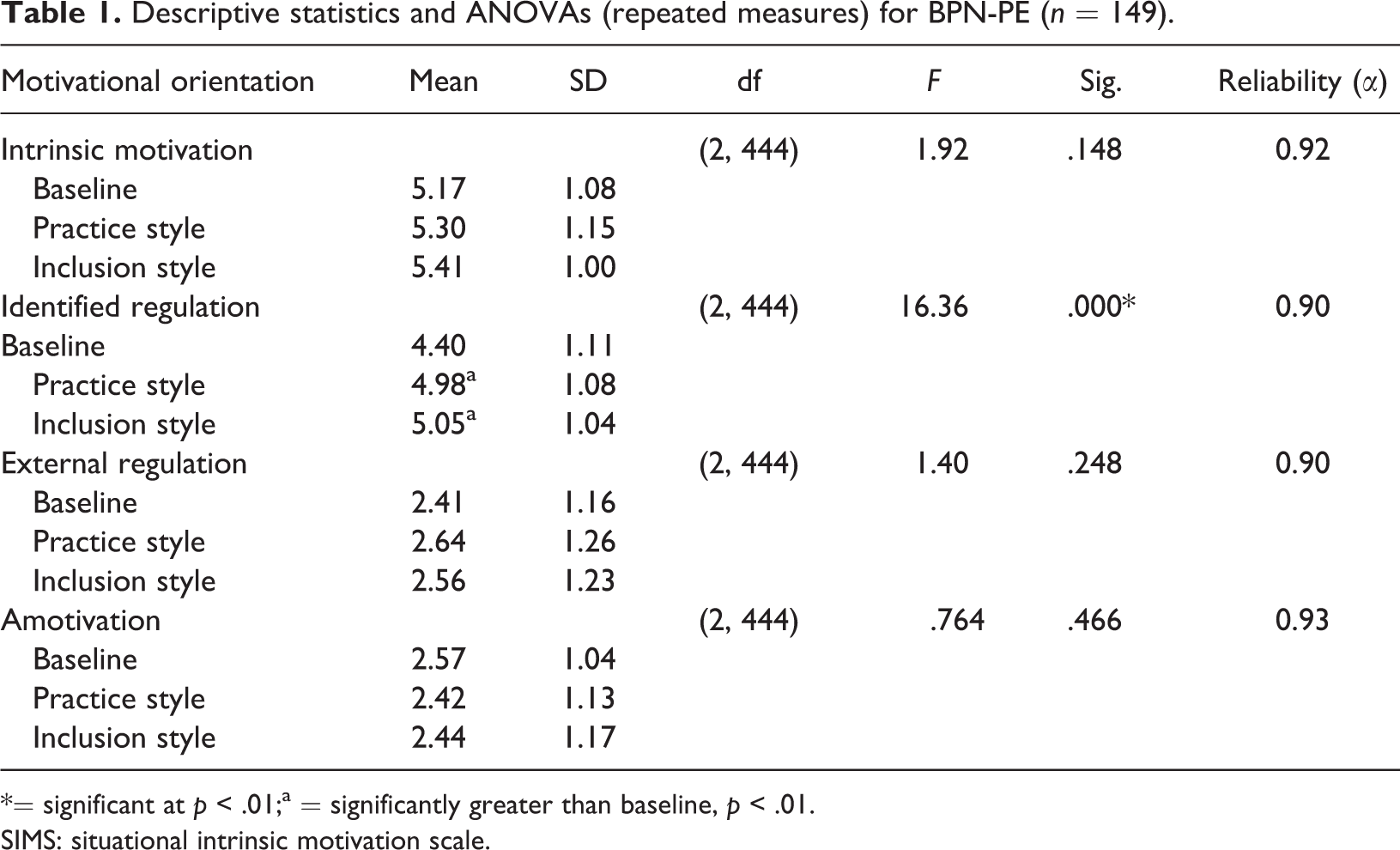
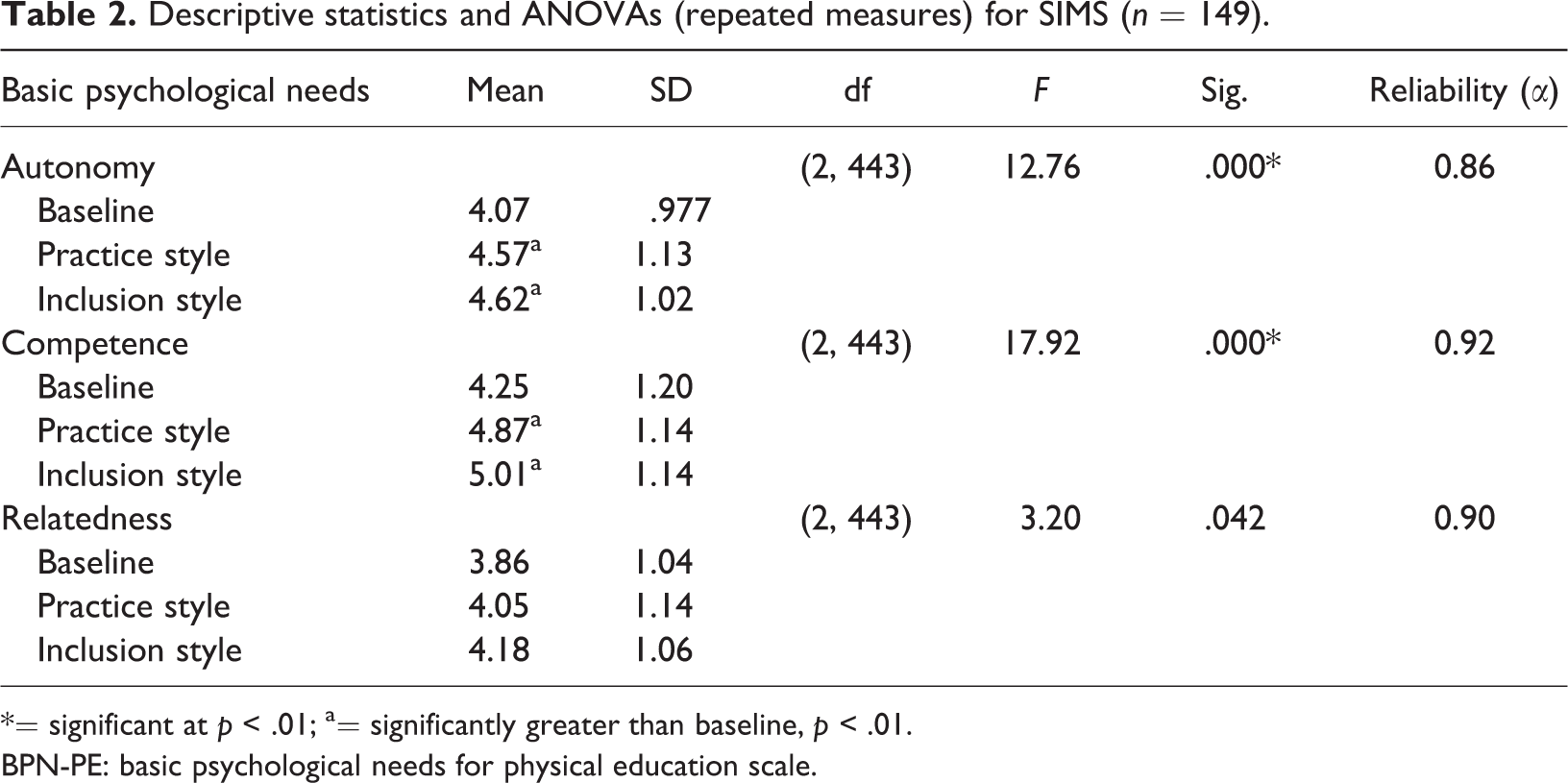
Descriptive and inferential statistics and internal reliability estimates for the BPN-PE and SIMS variables at baseline (prior to interventions) and at the end of the practice style and inclusion style lessons are reported in Tables 1 and 2. To assess potential ordering effects of the teaching styles, ANOVA tests were used to compare students who completed Style B (practice) first and Style E (inclusion) second to those who completed Style E first and Style B second. Results indicated there were no statistically significant differences between the two groups in SIMS and BPN-PE variables at baseline, following Style B, or Style E (see Appendix A). Given the lack of an ordering effect, data from the two groups were collapsed into a single data set for the remainder of the analyses.
Descriptive statistics and ANOVAs (repeated measures) for BPN-PE (n = 149).
*= significant at p < .01;a = significantly greater than baseline, p < .01.
SIMS: situational intrinsic motivation scale.
Descriptive statistics and ANOVAs (repeated measures) for SIMS (n = 149).
*= significant at p < .01; a= significantly greater than baseline, p < .01.
BPN-PE: basic psychological needs for physical education scale.
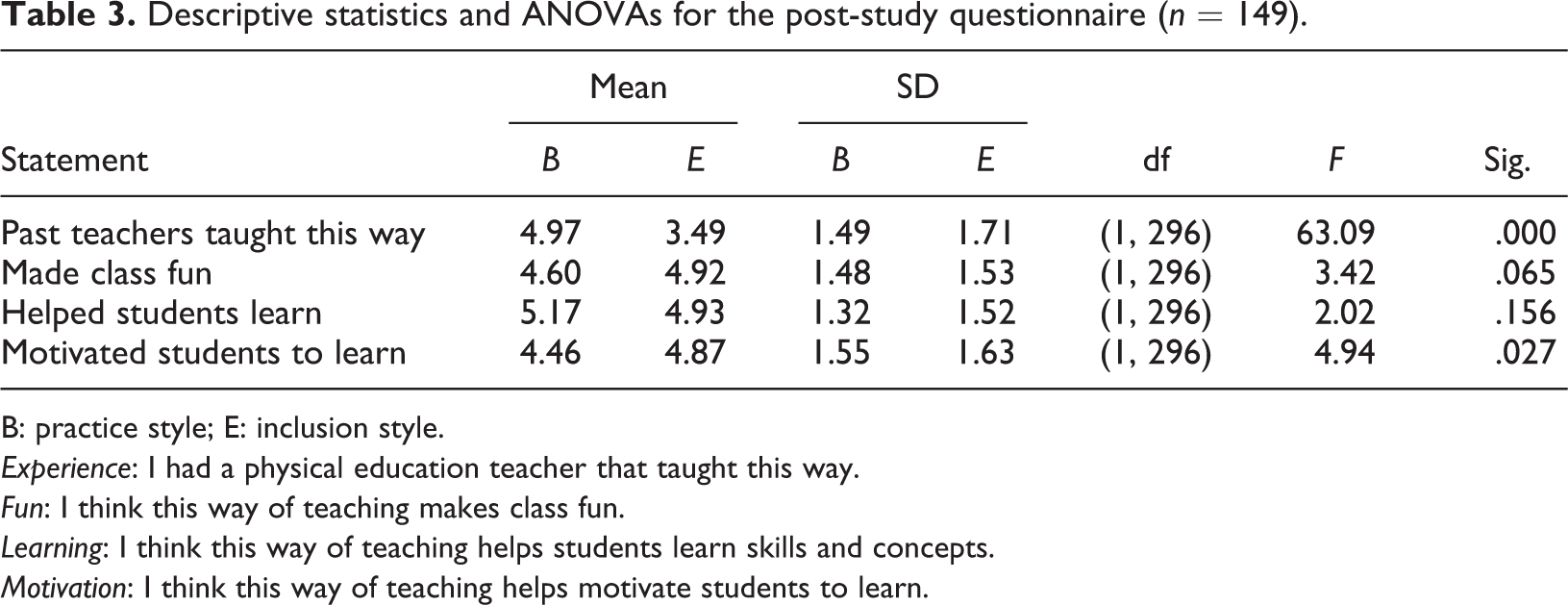
Psychometric testing of the BPN-PE and SIMS revealed acceptable reliability estimates above the coefficient cut-off criterion of .70 (Nunnally, 1978) for all scales. Correlation matrices for the BPN-PE and SIMS variables at baseline, following Style B, and following Style E, indicate that the relationships between variables were theoretically consistent with the prediction of SDT (see Appendix B). Descriptive and inferential statistics for the post-study questionnaire statements completed at the end of the practice style and inclusion lessons are presented in Table 3.
Descriptive statistics and ANOVAs for the post-study questionnaire (n = 149).
B: practice style; E: inclusion style.
Experience: I had a physical education teacher that taught this way.
Fun: I think this way of teaching makes class fun.
Learning: I think this way of teaching helps students learn skills and concepts.
Motivation: I think this way of teaching helps motivate students to learn.
Descriptive and inferential statistics and internal reliability estimates for the BPN-PE and SIMS variables at pre-intervention and at the end of the practice style and inclusion style lessons are reported in Tables 1 and 2. Results revealed acceptable reliability estimates above the coefficient cut-off criterion of .70 (Nunnally, 1978) for all scales in the BPN-PE and SIMS instruments. Descriptive and inferential statistics for the post-study questionnaire statements completed at the end of the practice style and inclusion lessons are presented in Table 3.
Basic psychological needs satisfaction (BPN-PE)
The scores in Table 1 show that all psychological needs had means above the mid-point of their respective scale for both teaching style lessons. Statistically significant main effects (repeated measures) were found for the students’ perceptions of autonomy (F [2, 443] = 12.76, p < .01) and competence (F [2, 443] = 17.92, p < .01). Tukey post-hoc tests revealed a statistically significant increase in the students’ perceptions of autonomy and competence between the pre-intervention and both teaching style lessons. Specifically, autonomy scores at the end of the practice style (M = 4.57) and inclusion style (M = 4.62) lessons were greater than pre-intervention (M = 4.07), a difference consistent with a moderate effect size (Cohen’s d = .47 and .55, respectively). Similarly, competence scores at the end of the practice style (M = 4.87) and inclusion style (M = 5.01) lessons were greater than pre-intervention (M = 4.25), with a moderate effect size (Cohen’s d = .53 and .65, respectively). No significant difference was found in the mean autonomy and competence scores between the practice and inclusion style lessons. Finally, the findings for relatedness revealed no statistically significant differences. No significant effect was found for order of treatment for the BPN-PE variables.
Psychological behavioural regulation (SIMS)
Mean scores for the internalized behavioural regulations (intrinsic and identified) were found to be above mid-point of their respective scales at baseline and at the end of the practice and inclusion lessons, while those for the externalized behavioural regulations (extrinsic and amotivated) remained below the mid-point of their respective scales across all three phases of data collection (see Table 2). A statistically significant main effect (repeated measures) was found for identified regulation (F [2, 444] = 16.36, p < .01). Tukey post-hoc tests revealed a statistically significant increase in identified regulation motivation between pre-intervention and both teaching style lessons. Specifically, identified regulation scores following both the practice (M = 4.98) and inclusion style (M = 5.05) lessons were greater than pre-intervention (M = 4.40), a difference that equates to a moderate effect size (d = .53 and 60, respectively). No significant main effects (repeated measures) were found for the other three behavioural regulations. No significant effect was found for order of treatment for the SIMS variables.
Post-study questionnaire
One of the four post-study questionnaire statements related to the students’ previous experience with the practice and inclusion styles, while the other three related to their perceptions of fun, learning, and motivation specific to each teaching style. Descriptive statistics are reported in Table 3. A statistically significant effect was found for students’ experiences with the practice and inclusion styles (F [1, 296)] = 63.09, p < .01). The majority of the students reported that their previous physical education teachers used the practice style far more frequently than the inclusion style. No significant differences were found in the students’ perceptions about fun, learning, and motivation across styles.
Discussion
The findings of this study provide a significant addition to extant literature on how researchers and practitioners can better understand the impact of the spectrum landmark practice and inclusion teaching styles on student basic psychological needs satisfaction and motivation. Instruction delivered under the conditions of both the practice and inclusion teaching styles was found to be effective in positively influencing students’ basic psychological need satisfaction and level of self-determined motivation. Opportunities for students to make decisions about their learning environment were explicitly presented under the conditions of both teaching styles, and students perceived a level of control over their learning under the conditions imposed by both styles of teaching. Both lessons were delivered as landmark teaching styles, which meant that teacher decisions associated with the logistical expectations surrounding task performance were shifted to the students in both styles, and decisions about level of task difficulty and self-checking performance shifted to the students in the inclusion style. Even though the students comparatively were making a greater number of decisions in the inclusion than practice style lesson, the power of making the logistical decisions about task performance under the conditions of the practice style seemed to be sufficient to positively influence the students’ perceptions of autonomy.
A potential rationale for why both teaching styles fostered perceptions of competence may be tied to the students being given explicit demonstrations, ample time to practice, and supportive task-related feedback as provided by the teacher or self. These are key ingredients of each spectrum reproduction teaching style, which are meant to contribute to a student’s growth in psychomotor skill performance (Mosston and Ashworth, 2002). Given the focus on improved skill performance, it seems plausible that the instructional components of demonstration, time to practise, and feedback, in combination, positively influenced the students’ perceptions of their effectiveness in executing the lesson tasks (feelings of competence). Alongside autonomy, competence is a primary psychological need that has been shown to positively influence self-determined motivation in students (Perlman, 2010, 2011; Perlman and Goc Karp, 2010; Wallhead and Ntoumanis, 2004).
The third basic psychological need that has been shown to influence student motivation is relatedness (Deci and Ryan, 1985, 2000). Relatedness is identified as an individual’s perception of sense of belonging to an event or activity, which creates feelings of attachment that are positive in nature (Baumeister and Leary, 1995). The authors postulate that a more neutral perception of relatedness was reported because the majority of tasks in both lessons were performed individually and the study consisted of only two lessons for each participant; as such, the students’ sense of belonging may not have developed as it might with more interaction over a longer period of time. This result may also be reflective of the participants not having been together for a long period of time prior to the study (it was conducted during the first part of the semester) and the large classes (100 students in each class) from which the students were recruited.
The results of this study revealed a significant increase in identified regulation following both badminton lessons, while amotivation, external regulation, and intrinsic motivation did not significantly change. Given the amount of decision-making power students are afforded in both the practice and inclusion teaching styles, it is logical that the autonomy provided would result in increased experiences of self-determination (represented in this study by identified regulation and intrinsic motivation). Moreover, students’ skill improvement was not assessed with respect to a class grade in the course; rather, they could earn a small incentive toward their overall course mark if they elected to participate. As such, while the novel skills associated with badminton may not have been experienced as intrinsically interesting, the relative contingencies present in the lessons (students participating to enhance the likelihood they perform well in the course overall, an important goal for many college students) seemed to direct learners toward identified regulation. Consistent with SDT, had the incentive been provided only if students demonstrated badminton skill improvement, their external regulation would have likely increased, which was not the case. Practically, this suggests that affording students meaningful opportunities to make decisions in the instructional environment, as per the practice and inclusion styles of teaching, may foster more internalized forms of behavioural regulation. These choices may be related to pace and difficulty of learning as well as how individuals fulfil the overall learning objectives of the course. Such decisions and the resulting sense of autonomy may lead learners to elect for activities in which they feel competent and which they are favourably motivated to complete.
Why was it that the practice style of teaching, a more teacher-centred or direct instructional approach, enhanced students’ identified regulation, autonomy, and competence as much as the inclusion style of teaching, a more student-centred, indirect instructional approach? Goudas and colleagues (1995) and Morgan and colleagues (2005) found that the conditions of the practice style of teaching imposed within their studies did not impact students’ motivation in the same way as did the more student-centred teaching styles, specifically the inclusion style and reciprocal and guided discovery styles. To better understand this difference in findings, one needs to examine the descriptions of the practice style of teaching used in these two studies and compare them to the description of the practice style of teaching used in the current study. Under the conditions of the practice style employed in Goudas and colleagues’ study (referred to as the direct style of teaching), the teacher decided which tasks the students would do and for how long they would practise. All students performed the task at the same level of difficulty, although on occasion, with some tasks, they were given the opportunity to work at their own pace. As such, none of the decisions shifted to the learner under the landmark practice style of teaching (Mosston and Ashworth, 2002) were transferred to the learner under the conditions of the direct style used. Somewhat similarly, in Morgan and colleagues’ study, the practice style of teaching was described as a hybrid between the spectrum command and practice styles of teaching, and aptly referred to as command/practice. The command style was defined as the ‘teacher makes all of the decisions’ (261) and practice style as ‘pupils practice teacher-prescribed tasks’ (261). Within the command/practice intervention, students had little opportunity to make any decisions.
In the practice style of teaching used in the current study, multiple decisions made during the impact phase of the lesson were shifted from the teacher to the student. These decisions relate to the logistical expectations related to task performance and are always made within the parameters established by the teacher. They are the actions students fulfil once they have been shown a model of the task. Decisions made by the students during the practice style lesson included selecting a partner of their choice in paired activities, finding their own location to practise each task, starting the task when ready to do so, practising at the pace and rhythm that reflected their level of skill, stopping a task when they felt they had completed it (i.e. independent of others completing the task), and asking questions for clarification. These decision opportunities were explicitly presented to the students. For example, the students were told the following prior to completing the first task: ‘Are there any questions? Now find some self-space (no one within an arm/racquet’s reach of you) and try to do 10 in a row using the forehand side of the racquet. Work at your own pace. Begin when you are ready’. The conditions imposed under the practice style of teaching in the current study reflected Mosston and Ashworth’s (2002) landmark practice style of teaching.
As such, while the additional post-impact decisions available in the inclusion style may have further contributed to students’ perceptions of autonomy and competence (all BPN-PE scale scores for the inclusion style were greater than those for the practice style), the effect may have been dampened by the overlap in autonomy already provided by the practice style. Research indicates that autonomy is supported when students are provided with and perceive some level of control over task performance (Deci and Ryan, 2002), a quality present in both styles. In comparison, according to spectrum theory (Mosston and Ashworth, 2002), the practice styles used by Goudas and colleagues (1995) and Morgan and colleagues (2005) would fall under the ‘canopy’ of the landmark practice style because of the design variations from the landmark style. Yet there was a meaningful difference in the delivery of the practice style between the current study and previous studies. Given the lack of a more supportive social context, it is not surprising that the students reported lower levels of intrinsic motivation when participating in lessons conducted under the conditions of these two iterations of the practice style of teaching.
Despite the potential veracity of these findings the study is not without its limitations. With each participant only receiving one lesson under each condition there is a possibility that the students may not have experienced the practice and inclusion teaching styles for a sufficient period of time to accurately differentiate between the two styles. Evidence from two previous teaching styles studies on student motivation and involvement indicate that even under single lesson treatments between-style differences are revealed (Morgan et al., 2005; Sanchez et al., 2012); however, some caution should be applied to the generalizability of the study findings. Given the limitation, it may be beneficial to increase the number of lessons (intervention) in future research (Chatoupis, 2009). This would better match unit lengths used within middle and secondary school physical education programmes and provide the study participants a greater amount of time to experience each intervention. More time for practice, which has the potential to lead to greater skill gains, may positively contribute to the students’ amount of physical and social involvement in the lessons and lead to potentially higher levels of self-determined motivation and basic psychological need fulfilment. A further limitation of this study is the lack of measure of student perceptions of the degree of need support provided by the teacher. It is possible that the teacher offered more needs support in one style than the other.
Summary
Deci and Ryan (1985, 1991, 2000), Ryan and Deci (1987), as well as other researchers, indicate the importance of creating learning environments that are more autonomy supportive than controlling and support a student’s basic psychological needs (Reeve et al., 2004; Shen et al., 2010; Vlachopoulos et al., 2011; Zhang et al., 2011). The findings from this study suggest that lessons taught under the conditions of the landmark practice and inclusion teaching styles provide this same type of environment: one in which students experience more needs-supportive behaviours from the educator than controlling behaviours where less optimal motivation is fostered. More precisely, giving students the opportunity to make decisions, those specifically associated with the practice style and inclusion style, may contribute to developing a more needs-supportive environment. Giving students these opportunities may also help them maintain more self-determined behaviours in future movement activities outside of school physical education.
Practitioners must take note of how the research findings from this study, and those from other studies on student motivation in physical education, may be applied to their own instructional practices. If physical educators want to foster student motivation, they must employ teaching styles, methods, and practices that lead to the fulfilment of learners’ psychological needs of autonomy, competence, and relatedness. Autonomy-supportive environments may be enhanced by giving students decision-making power. The landmark practice and inclusion styles of teaching are designed to give students opportunities to make decisions. Here are a few examples of the decisions that may be shifted to students under the conditions of the practice style of teaching: allow students to choose where they would like to locate in the gym for practice; allow students to select their own partner in paired activities; allow students to select between a competitive and cooperative setting when participating in gameplay; allow students the opportunity to ask questions for task clarification; and allow students to work at a pace that is reflective of their skill level. Under the conditions of the inclusion style of teaching, allow students to choose a level of task difficulty that matches their skill level, and allow students to self-check performance, have performance checked by a peer, or have performance checked by the teacher. If the physical educator wants to combine the decision-making that students are proffered in the practice and inclusion styles, then she or he may create a new combined teaching style where students choose level of task difficulty, as in the inclusion style, and receive skill performance feedback from the teacher, as in the practice style, in addition to making some or all of the listed decisions provided above. All of these example decisions for students should be made within parameters/standards set by the teacher. For example, in terms of students selecting a location to practise, the teacher might say, ‘I have set cones up around the gym to represent practice spaces; now you need to choose where you want to locate yourself for practice’.
To conclude, the finding that both the practice and inclusion styles of teaching seem to foster characteristics that are supportive of self-determined motivation and basic psychological need fulfilment is ecologically valuable. Physical education instructors who have a preference for one teaching style over another can utilize their favoured style to more optimally support learners’ physical and psychological development. This confidence should empower educators to broaden their use of strategies that allow students more meaningful involvement in the learning environment as well as inspire creativity in designing hybrid teaching styles that are developmentally and contextually appropriate. For example, teachers in the primary setting might allow students to make more basic decisions (e.g. where to practice) while those in secondary schools can provide chances for more complex decision-making (e.g. choice of activities to develop a student’s self-assessed need for improvement). As a society, if we value people’s ability to take autonomous action in remaining physically active throughout their lives, the opportunity and appropriate reinforcement for such decisions must be an integral component of how physical education is delivered; the continued use of the spectrum practice and inclusion styles may be an effective step toward attaining that goal.
Footnotes
Appendix A
Appendix B
Funding
This research received no specific grant from any funding agency in the public, commercial, or not-for-profit sectors.