



Abstract
This paper describes how improving a teacher’s content knowledge changes his teaching practices and its subsequent effects on student learning during a middle school volleyball instructional unit. The study was designed to challenge teacher educators’ thinking about the importance of in-depth content knowledge for effective teaching by demonstrating the effects of a content knowledge workshop on a teacher’s teaching practices and student learning. A mixed-method research design was adopted with one male physical education teacher’s qualitative teaching data and his 24 eighth-grade students’ quantitative learning data. Two separate classes of volleyball were observed for 5 days before and after the content knowledge workshop (n = 20 lessons total). Audio and videotaped recordings were made of each lesson. Descriptive and constant comparative analyses were used to analyze the data. The results of the study indicated that the teacher used more task progressions, integrated skill practices, small-sided games, content adaptations, and diverse verbal instructional repertoires after developing content knowledge. These changes ultimately impacted the students’ game performance and involvement as well as cognitive understanding of content. The findings verify that there are strong relationships among the teacher, content, and student learning by showing how the other components are changed when the teacher’s level of content knowledge is altered. The research effort may guide teacher educators’ professional development efforts aimed at increasing pre-service and in-service teachers’ professional knowledge for teaching.
Keywords
Introduction
Volleyball has been one of the most common content areas offered by middle school physical education (Roslow Research Group, 2009) since it helps students develop competency in net sport-specific motor skills and movement patterns. In teaching volleyball, teachers may emphasize not only vertically developing fundamental skills in isolated learning conditions (e.g. self toss-pass or toss-pass-catch) for lower elementary, but also relationally developing skills or tactics by incorporating them into game plays (e.g. pass-set-spike in a triad) for upper elementary and secondary (Ward et al., 2015). Considering that the technical demands in volleyball are relatively high, students must have basic ball control skills to participate in games (Rink et al., 1996). Teachers’ emphasis on teaching discrete skills in isolation rather than in the game-like context has long been a problematic issue in teaching physical education (Launder and Piltz, 2013). To provide more authentic and rich learning experiences that allow students to refine and apply skills or tactics in game situations, several instructional approaches (e.g. Sport Education, Teaching Games for Understanding, Tactical Game Model (TGM), and Play Practice (PP)) have been employed in physical education. Studies reported positive learning outcomes of these instructional approaches in terms of increasing student skill level, game play, activity level, competence level, positive interaction, and on-task behaviors (Browne et al., 2004; Carlson, 1995; Hastie, 1998; Hastie and Trost, 2002; Wallhead and Ntoumanis, 2004; Zang et al., 2012).
For physical education teachers, more in-depth understanding of the content is required to use the sequential and interconnected tasks moving toward the game-like context in teaching physical education (Ward et al., 2015). For example, making a consecutive pass-set-hit pattern as a novice player is a demanding skill in volleyball. In starting game play, allowing students to use a free ball rather than using a regular service rule might provide students with more opportunities to perform the combined skills (e.g. toss-pass-set). Similarly, allowing students to catch the ball if the ball is not settable and then set the ball to the hitter by self-tossing up might increase students’ learning opportunities to develop a combined set-hit pattern in this task configuration. Currently, we know little about the teaching and learning process during secondary volleyball instruction in terms of teaching effectiveness. With the recognition of the importance of teachers’ in-depth and relational knowledge of content, research efforts are needed to examine the ways to facilitate effective teaching in volleyball.
Teachers’ content knowledge (CK) has been considered as one of the robust teacher variables in teaching effectiveness from the perspective that teachers achieve outcomes corresponding to what they teach (Ward, 2013). Many teacher educators who review the physical education literature have contended teachers’ lack of CK as a main reason for low quality instruction of physical education (Bechtel and O’Sullivan, 2006; Stroot and Ko, 2006). A few studies have been conducted to directly measure teachers’ CK (e.g. in health-related fitness) and recognized a problem of pre-service and in-service teachers’ lack of CK in physical education (Disch et al., 2012; Miller and Housner, 1998). Possible explanations for this problem are: (a) pre-service teachers exit their teacher preparation programs short of preparation for developing in-depth CK (Kim et al., 2015; Ward et al., 2012), and (b) in-service teachers’ professional development programs mainly focus on management, pedagogy, and policies (Richards and Templin, 2011; Rikard and Banville, 2006; Stroot and Ko, 2006).
Relative to teachers’ CK, another prevalent issue is the lack of conceptual clarity of what CK is in teaching physical education. Borrowing Ball et al.’s (2008) concepts of CK in mathematics education, Ward (2009) classified CK into common content knowledge (CCK), which is needed to perform an activity (i.e. knowledge of rules, techniques, and tactics) and specialized content knowledge (SCK), which is uniquely needed to teach the activity (i.e. knowledge of errors, tasks, and task representations). Under this framework, CK courses were examined in physical education teacher education (PETE) programs and it was found that fewer CK content courses were required in the curriculums and less focus of SCK development was prevalent in the movement content courses (Kim et al., 2015; Ward et al., 2012). Focused ways to teach CCK or SCK were suggested, emphasizing that SCK mostly influences changes on teachers’ teaching practices (Ball et al., 2008; Kim et al., 2015; Sinelicov et al., 2015; Ward, 2009; Ward et al., 2012).
To determine teachers’ in-depth understanding of content (i.e. SCK), the quality of teachers’ instructional tasks should be examined, but this is frequently missing in research conducted on CK (Ward, 2013). It is evident that teachers need in-depth CK for organizing high-quality tasks that allow students to acquire more knowledge and skills. Thus, it seems crucial to define and examine the quality of instructional tasks in which students engage during instruction (Ball et al., 2008; Ward, 2013). In addition, Ward et al. (2014a) suggested using a CK packet as an effective way to develop teachers’ in-depth CK or SCK. The CK packet includes a scope and sequence of the unit as well as detailed information on each instructional task (e.g. a purpose/description of the task, a link to a video that models the task, a motivation focus of the task, a list of the needed equipment, specific teaching points, and a description of common errors) (Ward et al., 2014a).
With the recognition of the importance of in-depth CK or SCK, CK has been considered as key knowledge for developing teachers’ pedagogical content knowledge (PCK) (Ayvazo and Ward, 2011; Rovegno et al., 2003; Siedentop, 2002; Ward, 2009). Ward et al. (2012) conceptualized PCK as a focal point, a locus, defined as contextually specific event in time where teachers decide content according to their understanding of other knowledge bases (e.g. knowledge of curriculum, pedagogy, student, and context). For example, PCK is described as a form of CK where a teacher transforms the content (e.g. the forearm pass) in a way that helps students learn and understand the content (e.g. using an underhand toss when performing the forearm pass forming a triad formation) in teaching volleyball (Ward et al., 2014b). Ward and his colleagues identified several observable teaching behaviors that represent PCK (e.g. task representation, task selection, and task adaptation) under the behavior analytic theoretical framework. Several empirical studies that examined the relationships between teachers’ CK and PCK and the resultant impact on student learning were conducted using these observable teacher PCK variables (Ayvazo and Ward, 2011; Sinelicov et al., 2015; Ward et al., 2014b). The studies found that teachers’ strong CK positively influences developing teachers’ PCK in the instructional process. In addition, the studies indicated that the change of teachers’ teaching practices (i.e. PCK) according to improved CK through a developed knowledge packet influences the subsequent changes of students’ success of learning. These research efforts supported the previous contention that teaching effectiveness can be differentiated by different levels of teachers’ knowledge and skills for teaching, different levels of content in which students engaged, and different levels of student success (City et al., 2010). In order to further discuss variation in physical education teachers’ teaching effectiveness, we need more empirical evidence that there would be differences in the effectiveness of teachers as a function of the instructional cores (i.e. teacher, content, and students).
Despite its relevance to the interrelationships among these instruction cores, lack of empirical evidence hinders guiding the practice of teacher education. Therefore, this study was used to critically explore how a teacher’s teaching practices used to teach the content are transformed by improving CK, and how these transformed teaching practices influence student learning in a real teaching setting. The specific research questions were as follows: How does a teacher’s teaching practice differ between pre-and post-intervention lessons? How do the students’ game performance and daily content quiz differ between pre-and post-intervention classes?
Methodology
Participants
The study was approved by the Kent State University Institutional Review Board and all signed consent forms were obtained from the selected district, school, teacher, students, and parents. The participant for this study was one male physical education teacher and 24 eighth-grade students (12 girls and 12 boys; 22 Caucasian and two African American) in a middle school located in the northeast suburban area of Ohio.
The physical education teacher, James (pseudonym) was purposefully selected in this study for several reasons. First, volleyball was not considered as his expert content area though James has taught volleyball for 7 years at this level. He desired to improve his volleyball CK by participating in this study. Second, James agreed upon teaching two separate 5-day volleyball units with different students by willingly adjusting his original teaching schedule. Third, James agreed upon attending the 3-hour volleyball CK workshop after completing his first volleyball unit by spending his extra time and work for this study. He was interested to learn an innovative way to teach volleyball content through the one-on-one workshop since he had never had any learning opportunities designed to develop his CK after exiting the teacher preparation program.
James typically organized his physical education class with 5–10 minutes of warm-up, 10–20 minutes of skill practice, and 10–15 minutes of game play within 45 minute lessons. James had adequate amounts of equipment for each student to have a ball and ample space during volleyball instruction. The average class size was 22 (range = 20–24).
Four intact classes were randomly selected for completing either pre-intervention or post-intervention volleyball units. James was requested to rate the level of his students’ sport performance on a 1–3 scale (i.e. 1 = low, 2 = medium, and 3 = high) through his overall class observations in teaching physical education classes. In each class, six target students were randomly selected from stratified skill level groups (i.e. n = 2 high skilled, n = 2 middle skilled, and n = 2 low skilled, one of each sex) to be class representatives.
Research design
A mixed-method design, which involved the use of qualitative and quantitative research data, was utilized to explore how James’s teaching practices and student learning differed before and after the CK workshop (Tashakkori and Teddlie, 2003).
Research procedure
The study consisted of three consecutive research phases (Figure 1).
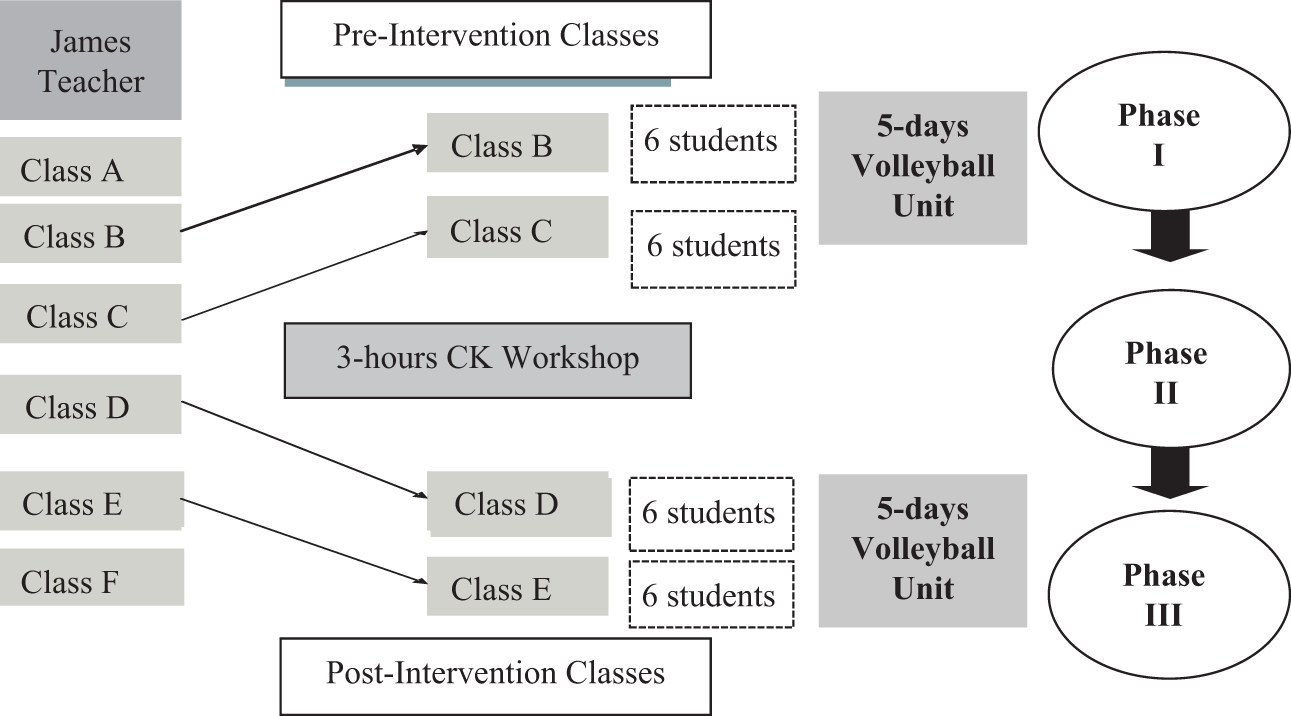
Diagram of research design of the study.
Phase 1: James taught 5-day volleyball lessons with two pre-intervention classes without any assistances or interruptions.
Phase 2: A 3-hour volleyball CK workshop was implemented at the school site with a developed volleyball knowledge packet and video resources.
Phase 3: James taught further 5-day volleyball lessons with two post-intervention classes. A semi-structured interview was conducted at the end of each pre-and post-intervention unit.
Volleyball content knowledge workshop intervention
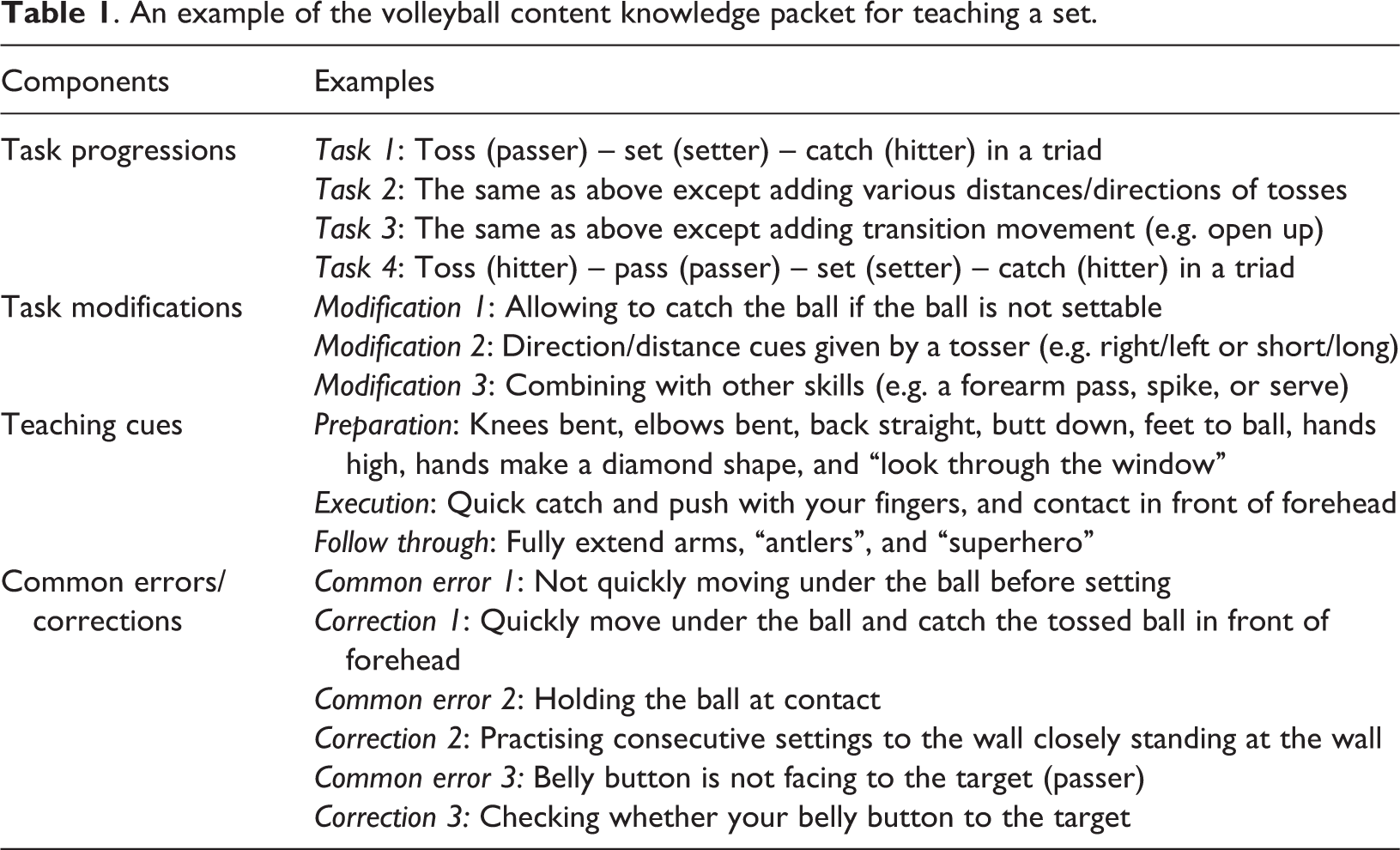
To develop James’s CK, predominately SCK of volleyball, a CK packet was developed by the investigator (who taught volleyball for 9 years as a middle school physical education teacher, and for 3 years as an instructor in PETE) incorporating a play practice approach (Launder and Piltz, 2013) and a tactical games approach (Mitchell et al., 2013). Two volleyball experts (i.e. a volleyball coach from a Division I college volleyball team with at least 20 years’ coaching experience and a teacher educator who taught volleyball for at least 15 years in PETE) were requested to qualitatively review the appropriateness of the CK packet designed to develop teachers’ CK. The CK packet primarily emphasized teaching four on-the-ball skills (i.e. forearm pass, overhead pass (set), spike, and serve) and three off-the-ball movements (i.e. base in receiving serve or free ball, open up in setting up to attack, and transition in winning the point). Specifically, it included: (a) a set of task progressions; (b) a list of possible task modifications; (c) a list of teaching cues; (d) a list of common errors and possible error corrections; and (e) a task diagram that shows a task organization (See Table 1 and Figure 2). Both experts verified the validity of the CK packet. The CK packet was utilized to develop James’s CK by requiring him to thoroughly review the content before the CK workshop.
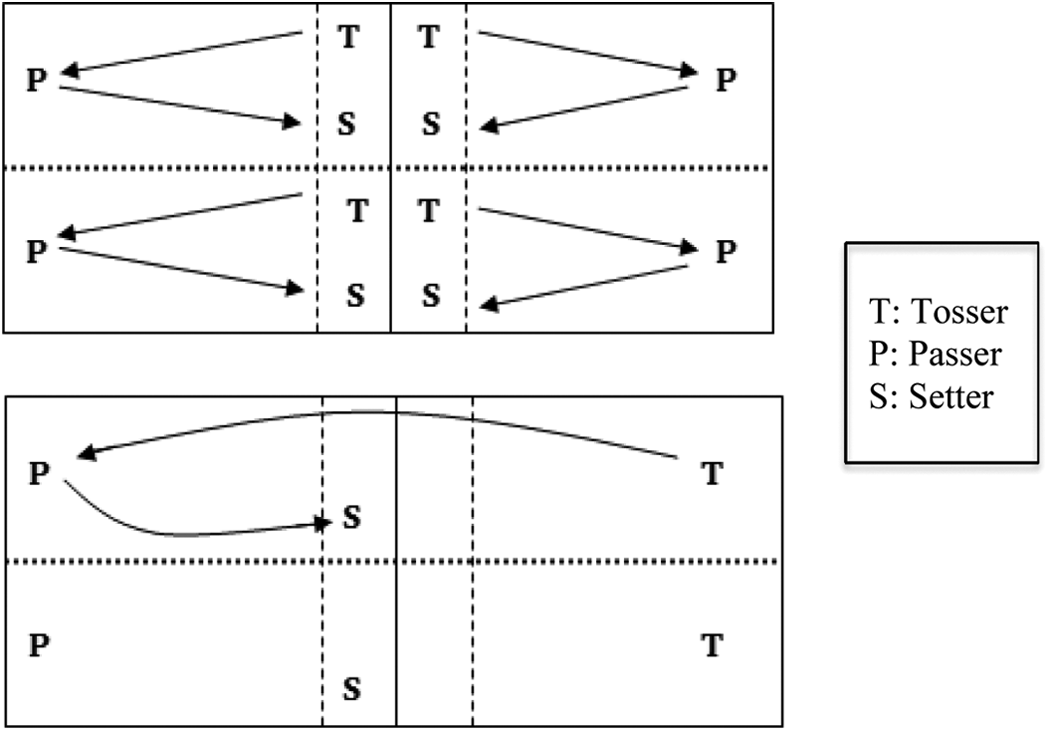
Task diagram of a set in triad. This figure illustrates a task organization designed to teach the set in a triad formation.
An example of the volleyball content knowledge packet for teaching a set.
The 3-hour CK workshop was implemented at the school site using the following procedures. Step 1: The investigator introduced the purpose of the study, expectations, and discussion of the principles of both play practice and tactical games approaches. Step 2: James watched the workshop video clips that demonstrate the correct performances of on- and off-the ball skills, sequenced task progressions, task organizations, and possible task modifications. Step 3: James’s full understandings of the content were evaluated throughout the workshop, and the workshop was completed when James met the pre-determined criterion (i.e. 95% correct answers/demonstrations to 1–3 questions for evaluating individual objectives in each task or skill).
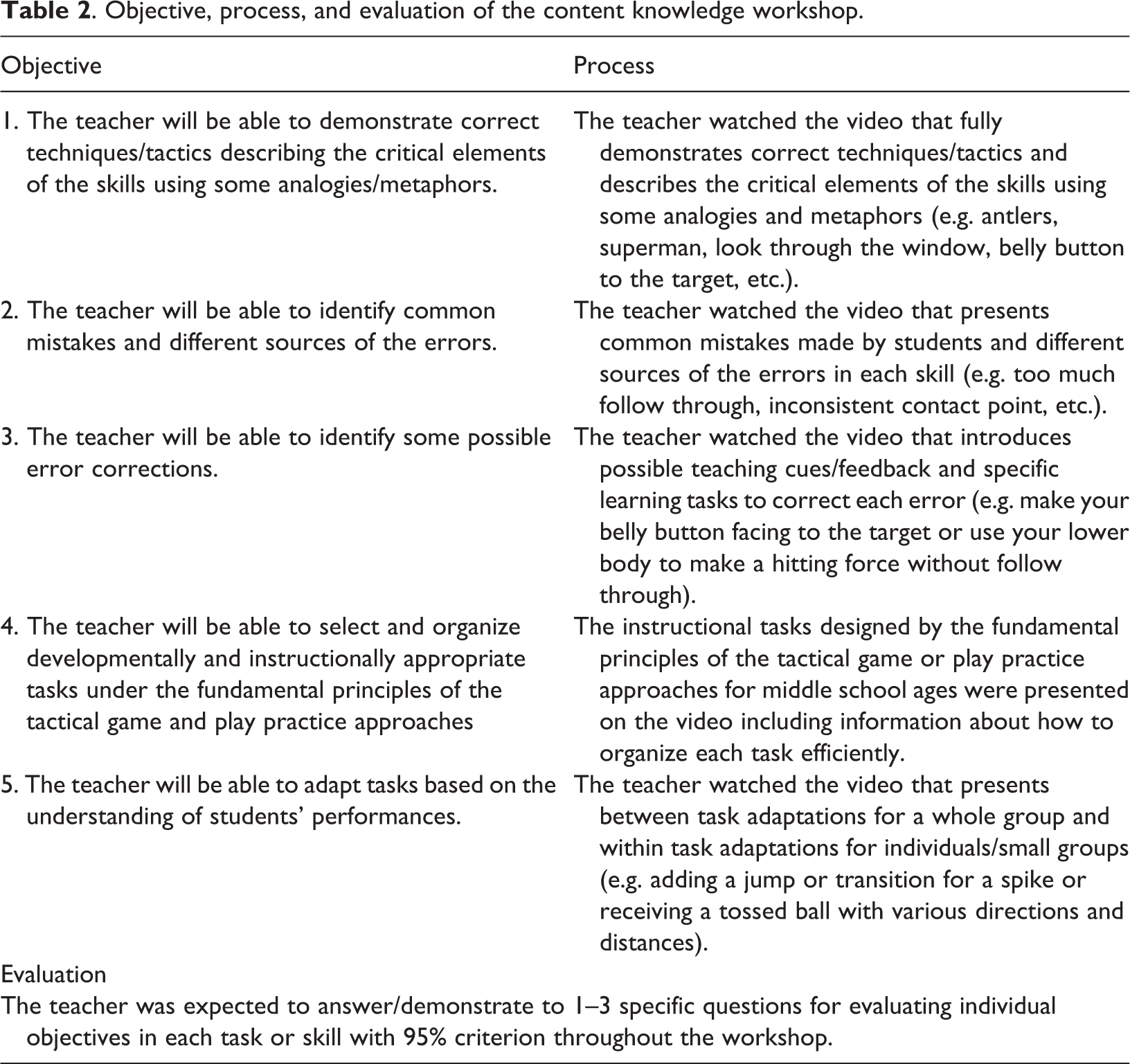
A description of the workshop objectives, processes, and evaluations of understanding of the delivered content are presented in Table 2.
Objective, process, and evaluation of the content knowledge workshop.
Data collection
Data collection occurred in three phases (pre-intervention unit, intervention, post-intervention unit) during 5 weeks of the spring semester of the 2012–2013 academic year. First, four teaching and learning data sources: (a) teaching lessons, (b) teacher interviews, (c) student game performance, and (d) student daily content quizzes were collected during the pre-and post-intervention units. Second, James’s intervention fidelity data were collected during the CK workshop intervention. Third, inter-observer agreement (IOA) data were collected after completing data coding for student game performance.
Teaching lessons
Videotaped records were made of each of the 20 volleyball lessons (i.e. 10 pre-intervention lessons (5 days × 2 classes) and 10 post-intervention lessons (5 days × 2 classes)). To obtain as comprehensive a view as possible of the teaching and learning process, two digital camcorders were placed in elevated positions in the two corners of the gym. The teacher’s voice was captured using a wireless microphone as well. All audiotaped lessons were transcribed verbatim. In addition, field notes were taken during lessons.
Teacher interviews
Semi-structured interview questions (Patton, 2002) were used to conduct two formal interviews with James at the conclusion of each pre-and post-intervention volleyball instructional unit. The interview questions focused on his rationale for the progression of instructional tasks and reflections on his instructional strategies in relation to student learning. Each interview was conducted face to face and lasted less than 20 minutes. Interviews were recorded using a digital voice recorder and transcribed verbatim.
Student game performance
The Game Performance Assessment Instrument (GPAI) developed by Mitchell et al. (2013) was used to collect the students’ game performance data during the last 10–15 minutes of game play while watching the videotaped lessons. Three distinct categories of behaviors: (a) decision-making (DM), (b) skill execution (SE), and (c) support movement (SM) were coded as either appropriate (A) or inappropriate (IA) with a guide of appropriate/inappropriate coding variables in each category. Using the tally system, each coder has the responsibility to code individuals’ every trial. The amounts of appropriate and inappropriate performances were summed, and then in each case a category or index score was calculated (e.g. DM, SE, or SM = A/(A + IA)) and converted to a percentage by multiplying by 100.
From the scores of three individual indices as above, two overall indices of performance: (a) Game Performance (GP) and (b) Game Involvement (GI) were calculated. GP was calculated by summing the three individual indices together and dividing by the actual number of indices used (i.e. GP = (DM+SE+SM)/3). A percentage score for GP was also calculated by multiplying by 100. In addition, the GI was calculated by simply summing all of the numbers of appropriate/inappropriate decision-makings and skill executions, and appropriate support movements, only excluding inappropriate support movements, which indicate a lack of game involvement.
Coder training and IOA
Two observers were trained to code student performance data with a written test of GPAI variables and practice of coding variables while watching a 30-minute training video. Observer training was completed when they met an 85% correct agreement criterion with the investigator. For the reliability of the data, IOA was conducted on the student variables in seven out of 20 lessons. The acceptable criterion for IOA was set to 85% (Cooper et al., 2007). The percentage of agreement was calculated according to the following formula: agreement divided by total trials (i.e. agreement plus disagreement) and then multiplied by 100. The mean IOAs obtained for student data was 87.2% (range = 84.5–94.0%).
Student daily content quizzes
Two or three multiple choice or short answer questions regarding on-and off-the ball skills and movements (e.g. listing at least three critical elements of a spike, describing body parts’ movements when executing the forearm pass, or selecting the best way to receive the serve or free ball) were provided to the students at the end of every class. Two volleyball experts who helped the content validity of the CK packet were involved in the process of the content validity of the student daily content questions as well. In this process, one expert reviewed the questions and helped edit the original questions in order to enhance the content clarity. The other expert then reviewed the revised questions and ensured the validity of the questions intended to measure students’ cognitive understanding of volleyball content. The mean percentages of the correct answers on the content quizzes per unit in both pre-and post-intervention classes were calculated and reported in this study.
Intervention fidelity
To ensure that James fully understood the content that was delivered, 35 evaluation questions or tasks regarding on- and off-the-volleyball techniques, error detections/corrections, and task representations/progressions/adaptations were addressed to James throughout the workshop. To ensure that James used the tasks presented in the workshop, we used a checklist, which included four levels (i.e. level 1 = as taught, level 2 = partially correct, level 3 = different task but consistent with workshop, level 4 = different task and not consistent with workshop) developed by Ward et al. (2014b). Using this checklist, the intervention fidelity data were collected and calculated using the following formula: number of tasks (n) in each level divided by the total (t) amount of tasks and then multiplied by 100. The total percentage of level 3 and 4 tasks are reported in this study.
Data analysis
Teacher qualitative data
Teacher data were analyzed by a constant comparative method (Patton, 2002). First, preliminary coding was used to sort an entire data set by looking for similar units of meaning (e.g. paragraph or sentence, etc.) and labeling ideas were completed. Second, the initial coding categories were refined and reorganized by comparing units of meaning across categories. Third, using the refined categories, a subset of the data (e.g. interview transcripts, lesson transcripts, and field notes) was coded and the relationships and patterns across categories were explored. Finally, the identified themes that demonstrate the teacher’s quality of teaching practices for each pre-and post-intervention unit were compiled. To maintain trustworthiness and credibility of the findings, peer review and debrief and triangulation across data sources were completed (Patton, 2002).
Student quantitative data
Student data were analyzed descriptively using the SPSS 18.0 statistical software (SPSS, 2012). The means, ranges, and percentages of the students’ game performance components and correct daily content quizzes per unit were analyzed descriptively in each pre- and post-intervention unit. Cohen’s d effect sizes (Cohen, 1988) were reported to indicate the standardized difference between two groups’ means.
Results
James completed the CK workshop with 95% procedure fidelity, achieved by the number of correct answers to the evaluation questions throughout the workshop. In addition, James implemented the workshop with 100% fidelity, which means that all of the tasks delivered by James during the post-intervention unit were aligned with the tasks taught in the CK workshop. Findings are presented in relation to two dimensions directly linked to the research questions: changes in a teacher’s teaching practices and changes in student learning before and after the CK workshop intervention. Teacher qualitative data findings are reported first and then student quantitative learning data findings follow.
Changes in a teacher’s teaching practices before and after the CK workshop
Theme 1: Less task progression with repetition versus more task progression with focus
James taught the four fundamental volleyball skills (i.e. forearm pass, overhead pass (set), spike, and serves) and the three off-the-ball movements (i.e. base, open up, and transition) to both pre- and post-intervention classes. Before the volleyball CK workshop, James taught all of the four basic volleyball skills using nine instructional tasks during the first and second days. He repeatedly used those instructional tasks throughout the pre-intervention unit without any modifications. During the interview conducted after he completed the pre-intervention unit, James stated that he was teaching the skills during the initial lessons of the unit and moved toward playing more games at the end of the unit, which is a traditional teaching approach in physical education.
When James was teaching an individual skill or tactic, he rarely used sequenced instructional tasks. In other words, James frequently changed the tasks intended to teach different skills rather than to teach a certain skill with some task progressions within a lesson. For example, the students were allowed to practice an underhand serve by hitting the ball over the net as an initial task. Then, they were requested to move to the next task designed to practice an overhead serve, and then moved to a spike. In this instructional configuration, the students were not allowed to practice the same skill under different conditions.
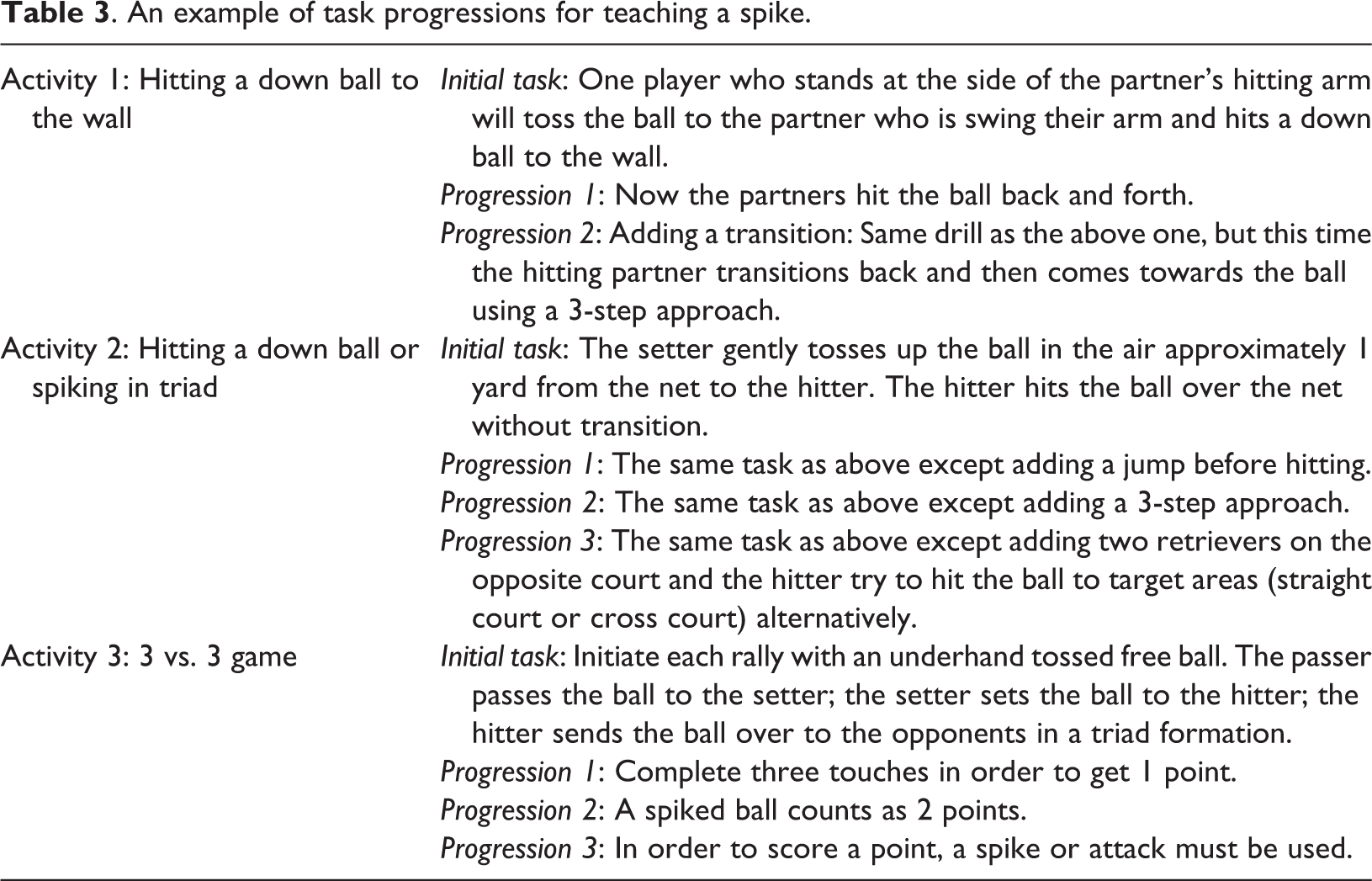
On the other hand, James started teaching all of the four volleyball skills with a focused skill each day after developing his CK through the workshop (e.g. day 1: forearm pass, day 2: overhead pass, day 3: spike, and day 4: serve). For teaching an individual skill, James started to use many extending tasks suggested through the workshop by modifying small portions of the existing tasks (e.g. space, distances, directions, targets, players, rules, and skills). In other words, James was able to provide the interconnected tasks designed to improve students’ appropriate skill execution, off-the-ball movement, and decision-making through the game-like activities. For example, James progressively increased the difficulty of the initial task through a series of extending tasks during the post-intervention unit to develop the students’ spiking skill confidence as follows (See Table 3).
An example of task progressions for teaching a spike.
Theme 2: Isolated practices versus integrated practices
Before the CK workshop, James tended to teach a set of skills discretely. For example, when he was teaching the overhead pass, he had the students practice the skill within the isolated practice condition (e.g. consecutively performing forearm or overhead passes with a partner or hitting the tossed ball over the net). Prior to the start of game play, the students had never had a chance to receive the oncoming ball from an opposite court using the forearms nor to set the ball passed by a forearm passing player. Students in the pre-intervention classes were able to perform the skills successfully in the static context where the environment is anticipatory, whereas they had difficulty performing the skills in the dynamic game context where the environment is frequently changed (e.g. direction, speed, spin, height, and placement of the ball) due to their lack of game-like learning experiences. In considering that an ultimate goal of volleyball drills is to incorporate the skills in an order (i.e. pass-set-spike) into game play, the isolated practice conditions did not provide the students who were in the pre-intervention classes with an opportunity to learn how to use the skills in the game. In addition, James failed to teach off-the-ball movements (e.g. base, open up, and hitting transition) combining with the execution of the on-the-ball skills during the pre-intervention unit. For example, when teaching the set, James did not use any practices that allowed the setter to perform the set accompanied by a transition movement such as opening up the body from the net to the target. James verbally taught the importance of the off-the-ball movements during instruction, but he failed to provide the learning tasks designed to practice those movements during the pre-intervention unit. With a lack of game-like learning experiences, the students were then required to play regular volleyball games at the end of each lesson during the pre-intervention unit.
Following the CK workshop, James taught a set of skills collectively in the integrated practice conditions. James taught the forearm pass through several isolated task conditions initially (e.g. tossing the ball directly or with various directions/distances to a partner and then the partner performs the forearm pass). When the students were confident in performing the forearm pass within these isolated task conditions, James started to provide several tasks that allowed the students to integrate the skills into a game-like condition (e.g. the tosser tosses the ball from the opposite side of the court to the forearm passer, the forearm passer passes the ball to the setter, the setter catches/sets the ball to the hitter, and the hitter catches/hits the ball over the net in a triad formation). Students had multiple learning opportunities to execute the volleyball skills within the game-like conditions prior to starting game play during the post-intervention unit. In addition, James learned the value of game-like learning experiences in ways to enhance the combination of both on-the-ball skills and off-the-ball movements through the workshop. During the post-intervention unit, James started to emphasize teaching both on-the-ball skills and off-the-ball movements at the same time. For example, in the triad pass-set-hit task, James requested each player (e.g. passer, setter, hitter) to perform off-the-ball movements (e.g. passer: quickly moving under the ball by anticipating where the ball lands, setter: facing to the net and then quickly opening up the body to the passer, and hitter: starting from the net and then quickly moving back to the side of the court for hitting transition) just before executing appropriate skills. These learning experiences allowed the students to practice off-the-ball movements within the game-like context before putting them into real game plays during the post-intervention unit.
Theme 3: Full-sided games versus small-sided games
During the pre-intervention unit, James used 6 vs. 6 full-sided games each day using two whole volleyball courts throughout the unit. The students were expected to follow the regular volleyball game rules (e.g. starting with a serve using either underhand or overhead from the service line, three hits, and serve rotations) from the first day of the pre-intervention unit. Since James used two volleyball courts, all students were able to participate in games without waiting time. Most full-sided volleyball games were like a “serving game” that made only servers move, but caused others to stand still in the court because the serve rarely made it over the net and into court, and if it did the ball was rarely returned.
During the post-intervention unit, James started to use small-sided games throughout the post-intervention unit. Through the workshop, James had a chance to understand some benefits of the small-sided games (e.g. more control over technique, more game involvement, higher success rate, and less peer pressure), and learned some ways to organize the small-sided games by modifying practice variables (e.g. the number of players, positions of each player, game rules, and court dimensions). For 3 vs. 3 or 4 vs. 4 games, James used a half court by shortening the court length/width from the net and modified court boundaries were marked with small cones. James initiated the first two post-intervention lessons with 3 vs. 3 games and then moved to 4 vs. 4 games for the rest of the unit. James emphasized teaching the pass-set-hit pattern, with appropriate on-the-ball skills and off-the-ball movements, by positioning three players on a team with the roles of passer, setter, and hitter forming a triad formation in 3 vs. 3. On the other hand, James emphasized teaching the pass-set-hit pattern with appropriate decision-making by positioning four players on a team forming a diamond formation (i.e. one passer who positions at the middle of the back court, one setter who positions at the middle of the front court, and two hitters who position at both sides of the middle court) in 4 vs. 4. James marked the students’ anticipatory locations of each player on each side of the court. In addition, he modified the game rules for volleyball (e.g. using a free ball (underhand tossing) for a game start, no side and end line boundaries to play, allowing one bounce and hit for the first hit, more than three hits, and double points only when successfully making a pass-set-hit pattern or only when successfully making down hit or spike) during the small-sided games. The use of small-sided games with modified game rules allowed the students to be involved in more game plays with success and provided more opportunities to touch the ball during game plays.
Theme 4: Trial-errors versus content adaptations
During the pre-intervention unit, James requested that students who frequently failed to hit the balls with success should learn from their trial-errors. During his pre-interview, James reported his belief that the students were able to find ways to handle their mistakes by exploring repetitive trial-errors. No observations were found to change the task conditions for students who have different learning needs. James continuously encouraged the students to take risks and learn from their mistakes during the pre-intervention unit.
Following the CK workshop, James started using a lot of content adaptations for the students who had different skill levels. James allowed the students to choose their comfortable distances during a triad toss-pass partner activity or choose appropriate distances and targets during a serving activity. In addition, the students were able to choose either receiving the served ball or gently tossed ball from the opposite court when starting game plays in the post-intervention classes. When teaching a spike, James modified an initial down-ball hitting task by adding a jump and transition for the high-skilled students and decreased hitting distances for the low-skilled students. These content modifications for students who have different learning needs were frequently observed during the post-intervention unit.
Theme 5: Using verbal descriptions versus using analogies or metaphors
During the pre-intervention unit, James often used both verbal and visual representations when introducing a new skill or task. James depended on using verbal descriptions, which are the verbal explanation or illustration about what a particular skill looks like accompanied by his full correct demonstrations. For example, when he was teaching the forearm pass with a 90-degree angle to a partner on day 2, his verbal description was as follows: I’m popping it up and I’m dropping my shoulder. Look at my legs when I’m passing. I’m using my legs to guide a little with power. We don’t necessarily want to swing our arms, ok, with just a little bit of a push. Go head, toss it. (from a lesson 2 transcript during the pre-intervention unit)
After the CK workshop, James continuously used his correct and clear verbal/visual task representation skills. However, changes of his task representations occurred during the post-intervention unit, when he started to incorporate more analogies using examples or metaphors that describe the content in imaginative ways while he was explaining the skills. For example, when teaching the forearm pass on the first day of the post-intervention unit, James’s verbal representation was changed as below. I’m just gonna put my hands together like I’m cupping water, and now my thumbs are gonna touch, extending my arms, we don’t want to bend elbows and we’re gunna get a nice flat platform. Alright? Thumbs together, 45-degree angle, medium position like you’re sitting on the chair with your back straight, square up and your belly button toward the target. Stiff like statue—not so good. (from a lesson 1 transcript during the post-intervention unit)
Changes in student learning before and after the CK workshop
Student game performance
The descriptive analysis of the student GPAI data indicated that the students in the post-intervention classes demonstrated more appropriate decision-making (e.g. passing the ball over the net on the second or third hit), skill execution (e.g. making legal contact on the ball passed to a teammate or over the net on the third hit), and support movements (e.g. attempt to move to the ball in receiving serve or free ball, open up in setting up to attack, or transit in hitting a down ball or spiking without ball possession) during volleyball game play than those in the pre-intervention classes (Figure 2). The mean percentages of decision-making and skill execution were 42.9% (range = 12.5–85.4%) and 42.0% (range = 12.5–85.4%) in the pre-intervention classes, but 57.4% (range = 19.6–88.8%) and 63.7% (range = 19.6–93.8%), respectively, in the post-intervention classes. The ranges of the mean percentages indicated that there was a variation of student performances within a class and between the classes. In terms of support movement, the students’ appropriate support movements were frequently observed in the post-intervention classes (87.0%, range = 39.2–100%), whereas the students’ support movements were observed only from dominant players who had previous learning or playing experiences in the pre-intervention classes (46.5%, range = 0–81.9%).
Overall game performance data showed that the students in the post-intervention classes performed better (69.4%, range = 26.1–91.3%) than those in the pre-intervention classes (43.8%, range = 8.3–83.3%). In addition, overall game involvement scores indicated that the students in the post-intervention classes had more opportunities to get involved in game play (58.3, range = 25.0–81.0) than those in the pre-intervention classes (25.0, range = 6.0–56.0) (Figure 3). The effect size for the students’ overall game performance was d = 1.15 and the students’ game involvement was d = 2.21, which exceeds Cohen’s (1988) convention for a large effect (d = 0.80).

Comparison for mean percentages of students’ game performance components. This figure illustrates differences of mean percentages of game performance components per unit between pre-and post-intervention classes.
Student daily content quizzes
The descriptive analysis of correct daily content quizzes indicated that the students in the post-intervention classes demonstrated more correct answers on the daily content quizzes than those in the pre-intervention classes (Figure 4). The means and ranges of the percentage of the correct answers on the content quizzes per unit were 58.6% (range = 20.6–92.6%) in the pre-intervention classes and 83.5% (range = 51.3–97.5%) in the post-intervention classes. No students who achieved below 50% of the content quiz scores were observed in the post-intervention classes. The effect size for the students’ daily content quiz was d = 1.44, which exceeds Cohen’s (1988) convention for a large effect (d = 0.80).
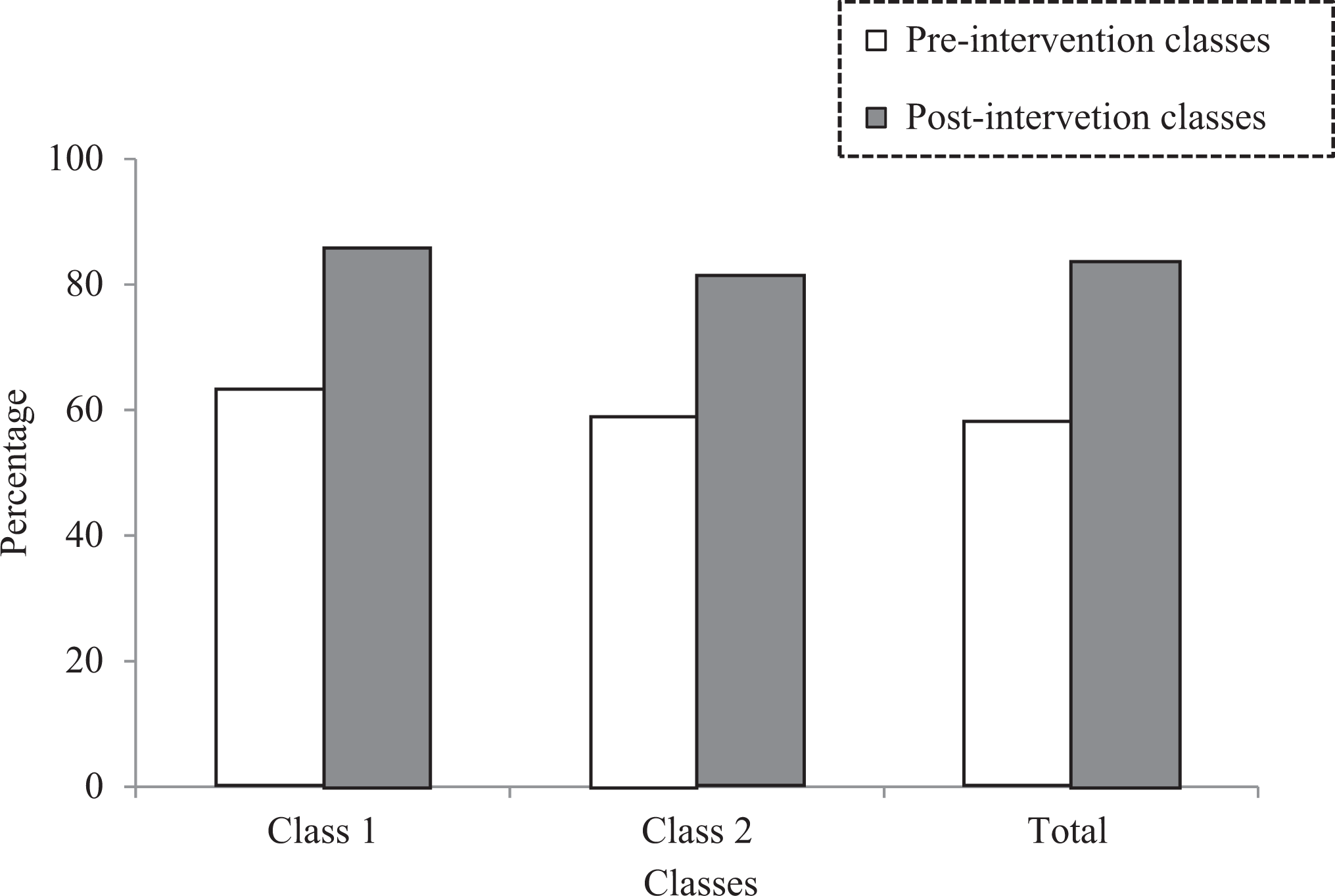
Comparison for percentage of students’ correct content quizzes across classes. This figure illustrates differences of mean percentages of students’ correct answers to the content quizzes across classes per unit between pre-and post-intervention classes.
Discussion
In the physical education literature on teaching, a prevalent conclusion is that CK is highly related to PCK (Chen, 2004; Jenkins and Veal, 2002; McCaughtry and Rovegno, 2003; Rovegno, 1995; Schempp et al., 1998; Siedentop, 2002). The results of this study supported this contention by demonstrating not only the effectiveness of the 3-hour CK workshop on changing a teacher’s PCK behaviors, but also the resultant impact on student learning with larger Cohen’s effect sizes. By improved CK through the workshop, James changed his enacted teaching practices: (a) from less content progression to more content progressions; (b) from fewer content adaptations to more content adaptations; (c) from isolated practices to integrated practices; (d) from full-sided games to small-sided games; and (e) from less diverse verbal repertoires to more diverse verbal repertoires. Changes of James’s enacted PCK by improving his level of CK verified the previous contention that a teacher’s PCK can be situated from weak/immature to strong/mature in a continuum as a function of CK (Ayvazo and Ward, 2011; Chen, 2004; McCaughtry and Rovegno, 2003; Rovegno, 1995; Ward et al., 2014b). According to these changes, better student learning gains in terms of appropriate decision-making, skill execution, and support movements during volleyball game plays as well as cognitive understanding of techniques and tactics were observed in the current study. These findings support the previous results that physical education teachers can be shifted from ineffective (i.e. less student learning) to effective (i.e. more student learning) by increasing the level of CK (Ayvazo and Ward, 2011; Kim et al., 2015; Ward et al., 2014b).
Teacher quality can be determined by its impact on student learning through the creation of a quality learning environment (Darling-Hammond, 2001). Therefore, teachers must create quality learning environments that facilitate student learning by developing knowledge and skills of teaching. In this study, James had taught volleyball content for 7 years at the current middle school, but he did not consider volleyball as his expert content area. James reported a lack of learning opportunity to improve his CK throughout his teaching career as well. According to Ward and O’Sullivan (1988), teaching experience is necessary to develop both competence and expertise in teaching content, but there should be more activities beyond mere teaching opportunities in developing content expertise. Acts of reflection, mentorship by others, and professional development should be accompanied with multiple teaching experiences (Ward and O’Sullivan, 1988). In addition, DuFour and Eaker (1998) suggested three emphases of professional development: (a) student learning, (b) collaborative culture, and (c) outcomes using the term of professional learning communities in teacher education. Regardless of the form of professional development, it must be operationalized in ways to support pre-service or in-service teachers’ actual teaching practice and the resultant impact on student learning.
Besides their CK, teachers’ knowledge of instructional approaches might influence the creation of unique learning environments. Metzler (2011) has argued that learning environments created by distinct instructional approaches produce different learning outcomes. James used the traditional instructional approach during the pre-intervention unit, which is characterized by progression from sport skill instruction during initial sessions of a unit to full games at the end of the unit. When closely examining the quality of the instructional tasks, several detrimental consequences of this traditional teaching approach were noticed, such as lack of connection between skill instruction and sport game context, and lack of student game involvement through full-sided game play. In addition, others reported that students lose interest very quickly within the traditional approach, especially those who cannot play the sport or game effectively (Himberg et al., 2003; Siedentop and Tannehill, 2000). For this study, two alternative instructional models (i.e. TGM and PP) were incorporated in developing the volleyball CK packet. Following the workshop, James used the small-sided games with the belief that both tactical and technical competences can be acquired through game play as Rink et al. (1996) noted. In addition, James prioritized technical demands of volleyball ahead of tactics by providing sequential tasks in the form of challenges under the PP instructional pedagogy during the post-intervention unit. The results of the current study reported some noticeable changes in both quantity and quality of instructional tasks and the resultant impact on student learning after developing knowledge of alternative instructional approaches through the workshop. This successful use of a CK packet that incorporates new teaching approaches may change our focus on the way in which we approach the preparation of pre-service and in-service teachers (Ward et al., 2014b).
Limitations and recommendations
Several limitations should be considered in interpreting the results of the current study. This study was conducted with one teacher’s qualitative teaching data, so the results cannot be generalized to other populations. In addition, the teacher had multi-teaching experiences for both pre-and post-intervention volleyball units with different students in this study. It might limit the produced effects if he learned something from the first teaching unit through his teaching reflections. However, the short length of the instruction unit might be a remedy.
As a direction for future research, examining the products of longer instructional units in other content areas would be worthwhile. It might also be worthwhile to examine the efficacy of a CK intervention on both teachers’ teaching practices and student learning as a result of longer involvement in professional development programs.
Footnotes
Funding
The author(s) received no financial support for the research, authorship, and/or publication of this article.