




Abstract
As an alternative to the direct instructional model, Metzler proposed a range of pedagogical models that include second generation models such as teaching games for understanding (TGfU) and sport education (SE). These pedagogical models have key design features that can promote high levels of autonomous motivation for both boys and girls. Consequently, the purpose of this study was to investigate the motivational outcomes of elementary boys and girls as they participated in an invasion game unit through two pedagogical models: a hybrid TGfU/SE unit or a direct instruction unit. Participants were 292 elementary school students (mean age = 10.41, standard deviation age = 0.49), who were taught through a hybrid TGfU/SE unit or a more traditional teacher-centred format within a pre-intervention/post-intervention quasi-experimental design. The hybrid unit was designed according to the characteristics of SE, while learning tasks were designed to integrate the pedagogical principles of TGfU. A 2 (pedagogical model) × 2 (test-time) × 2 (gender) multivariate analysis of variance was performed to detect between-groups and within-group differences. Significant differences in student motivation were observed for both boys and girls who participated in the hybrid TGfU/SE unit in both analyses across all motivational outcomes. Despite the existence of social stereotypes in terms of physical activity, teachers’ use of hybrid TGfU/SE units promotes an autonomy-supportive, inclusive, and equitable learning environment where all students, regardless of their gender and/or content focus of the unit and have opportunities to increase their engagement, enjoyment, and social interactions within physical education lessons.
Introduction
Recent research findings suggest that fostering high levels of autonomous motivation in students has a positive effect on their propensity to engage in physical education (PE; Chanal et al., 2019). A theoretical framework that has been used to examine student motivation in the educational context is self-determination theory (SDT; Ryan and Deci, 2017, 2020). The proposed SDT sequence suggests that social factors (e.g. autonomy support from the teacher) nurture the basic psychological needs (BPNs) of the students that, in turn, will positively develop more self-determined behaviours and various cognitive, affective, and behavioural outcomes (Vasconcellos et al., 2019).
A unifying construct within SDT relates to the degree to which a social agent (e.g. the PE teacher) satisfies the three innate, universal, and essential BPNs for human behaviour of autonomy, competence, and relatedness (Vansteenkiste et al., 2020). Autonomy refers to a student’s need to experience a sense of willingness in their actions, which is satisfied when they perceive that their actions are consistent with their integrated sense of self. In terms of competence, SDT posits that students have the fundamental need to develop a feeling of mastery through interacting with their environment to reinforce their sense of being capable individuals. Regarding relatedness, SDT holds that humans feel a need to interact with, be connected to, and cared for, by other individuals and is fulfilled when students experience positive interactions with their classmates (Ryan and Deci, 2017).
In previous studies, emphasis has been placed on the degree of autonomy support provided during instruction to identify and develop students’ inner motivational resources (Núñez and León, 2015; Reeve and Cheon, 2016), which leads to more adaptive patterns of responses such as enjoyment, effort, friendship goals, and PE satisfaction (Ryan and Deci, 2020; Vasconcellos et al., 2019). An autonomy-supportive environment is created when a PE teacher takes the students’ perspective into account, provides a sense of choice that can engage students’ interests, and acknowledges their feelings (Deci and Ryan, 2008). Examples include teachers transferring decision-making responsibilities to students for initiative taking within the teaching–learning process and teachers being receptive to the thoughts, questions, and ideas of the students (Mageau and Vallerand, 2003). Conversely, a controlling approach is more oriented to pressure students to think or behave in particular ways without responsiveness to their perspectives. This approach restricts students’ autonomy and choice through the use of controlling language (e.g. must, need, and have to) and overly critical feedback (Chang et al., 2016; Reeve et al., 2014). Likewise, a controlling style avoids the active involvement of students in their own learning and can generate negative consequences such as anxiety and boredom and result in extrinsically motivated or amotivated students (Haerens et al., 2018; Reeve and Cheon, 2016).
Although SDT posits that boys and girls have the same psychological needs, previous studies have suggested that students of different genders may react differently to the same learning environment (Xiang et al., 2018) and should, therefore, be considered within future research studies and their design (Chalabaev et al., 2009). For example, Chu et al. (2019) found that the need for relatedness was a stronger predictor in adaptive cognitive outcomes among girls than boys. Cairney et al. (2012) reported several barriers faced by girls that affect their enjoyment of and engagement in PE when compared to boys (e.g. low competence, low autonomous motivation, and lack of autonomy). In addition, van Aart et al. (2017) found that perceived competence for girls and classmate relatedness for boys were significant predictors of autonomous motivation.
Despite psychosocial variables being important factors in improving students’ experiences of PE (Cheon et al., 2014), teaching has traditionally been undertaken via a direct instruction pedagogical model (Metzler, 2011). Not only has the direct instruction model been criticized by researchers due to its narrow focus on “physical education-as-sports-techniques” (Kirk, 2013), but students also report low levels of autonomous motivation, satisfaction, and learning when their PE teachers use this pedagogical model (Morgan et al., 2005). In addition, the direct instruction model and its “one size fits all” design has also contributed to the reproduction of unbalanced power relations and gender stereotypes. Likewise, students’ experiences of PE are likely to be influenced by their perceptions of the gender appropriateness of the activity (Chalabaev et al., 2013). Consequently, greater consideration of the gender-stereotyped context of PE within studies examining alternative pedagogical models will provide teachers with information that can be used to enhance boys’ and girls’ motivation in PE settings (Chu et al., 2019).
As an alternative to the direct instructional model, Metzler (2011) proposed a range of pedagogical models that can be used by PE teachers, which include second generation models such as teaching games for understanding (TGfU) and sport education (SE) underpinned by constructivist learning theory (Dyson et al., 2004). These pedagogical models have key design features that promote opportunities for both boys and girls to problem solve, make decisions, and demonstrate their leadership capabilities, all of which can potentially lead to higher levels of autonomous motivation in PE classes (Metzler, 2011).
In the direct instruction model skills are learned first and prior to gameplay. In contrast, in TGfU, students learn to play the game and its associated tactics first therefore prioritizing learning in the cognitive domain (e.g. the “what”) before the psychomotor domain (e.g. the “how”). To facilitate this game first approach, games are modified to be developmentally appropriate through teachers using the pedagogical principles of representation (simplified and/or small-sided) and exaggeration (modified/conditioned). Technical skills are developed alongside tactics in the contextualized situations of the small-sided and/or modified/conditioned games, and/or are practiced when needed within “skill drills” (Harvey and Jarrett, 2014). In addition to designing and manipulating the learning environment, students are engaged in the process of inquiry through the teachers’ use of questioning. Consequently, using TGfU for games teaching, the PE teacher may develop an autonomy-supportive learning environment leading to students of both genders reporting high levels of autonomous motivation and more adaptive outcomes (e.g. perceived competence; Butler, 2006; Gray et al., 2009; Jones et al., 2010; Mandigo et al., 2008).
With its aim to produce competent, literate, and enthusiastic students (Siedentop et al., 2011), SE allows the teacher to provide a potentially meaningful sport experience that is fair and equitable (Hastie and Curtner-Smith, 2006). Specifically, all participants have the opportunity to value social interactions, and particularly girls and less skillful students will feel that they can make valuable contributions to their teams (Harvey et al., 2014). This occurs through the generation of an autonomy-supportive social context where students have opportunities to make their own autonomous decisions (e.g. game play strategies and tactics) and perform non-playing roles, which require social interaction and group work between and among students (Chu and Zhang, 2018). However, despite research showing enhanced student motivation when teachers skillfully employ SE (Perlman and Goc Karp, 2010; Wallhead et al., 2014), other studies have shown that boys report higher social status, social recognition goals, and level of enjoyment than girls when participating in SE (Wallhead et al., 2013).
Although TGfU and SE have different features, both pedagogical models share several common pedagogical processes. For example, students are perceived as creative, social, and active learners who build their own knowledge and identify what they need to improve during the learning process (Dyson et al., 2004). Likewise, one of the major common features for both pedagogical models is the shift of the teacher’s role to one of facilitator of learning, and the related increase in responsibility and decision-making away from the teacher to the students (Stran et al., 2012). Moreover, it has been advocated that hybridization of these models allows for a broader and deeper scope of learning than that which can be achieved through using a more traditional teacher-centred pedagogical approach as well as each model in its own isolated format (Casey and MacPhail, 2018; Farias et al., 2017). Consequently, hybridizations could be an effective mechanism for achieving higher quality learning outcomes within innovative multi-model PE curriculums (Casey, 2014; González-Víllora et al., 2019).
This current study provides insight into the effect of a hybrid model of TGfU/SE on student motivation in an elementary PE context, with an additional focus on student gender and more adaptive outcomes. Although researchers recently reported significant improvements in motivational outcomes (e.g. autonomy support, autonomy and competence satisfaction and enjoyment) when 55 Spanish secondary school students participated in a hybrid unit of TGfU/SE in either volleyball or ultimate frisbee within a cross-over design study (Gil-Arias et al., 2017, 2020), to the authors’ knowledge, only one previous hybrid TGfU/SE study has been conducted in an elementary PE context (Hastie and Curtner-Smith, 2006). In addition, while Hastie and Curtner-Smith (2006) gained data on student perceptions of a 22-lesson season on batting and fielding games using various reflective and interview data collection techniques, they did not examine motivational outcomes or the impact of student gender. The lack of follow-up hybrid model studies in an elementary context is therefore surprising given that recent research suggests the level of students’ autonomous motivation in PE aged between 8 and 12 years is declining (Chanal et al., 2019) and student gender can significantly influence students’ engagement in and attitude towards PE (Cairney et al., 2012). Finally, the current study expands our understanding of how PE teachers’ use of hybrid models may assist students in realizing more adaptive response patterns (e.g. friendship goals and satisfaction in PE; Méndez-Giménez et al., 2020) that have not been the focus of previous hybrid TGfU/SE studies in an elementary PE context.
Consequently, the purpose of this study was to investigate the impact of a basketball unit taught using either a hybrid TGfU/SE or direct instruction model on perceived autonomy support, perceived needs satisfaction, autonomous motivation, and adaptive outcomes. Two hypotheses were examined: (a) boys and girls taught through the hybrid TGfU/SE model would report higher scores on all variables post-intervention compared to students taught through the direct instruction model; and (b) boys and girls taught through the hybrid TGfU/SE model would report higher scores on all variables post-intervention compared to pre-intervention than boys and girls taught through the direct instruction model.
Method
Participants and design
Participants were 292 elementary school students (mean age (Mage ) = 10.41, standard deviation age (SDage ) = 0.49). 148 students from six classes in two different schools (Mage = 10.39, SDage = 0.48, n = 71 female and n = 77 male) and 144 students from six classes in two different schools (Mage = 10.43, SDage = 0.49, n = 69 female and n = 75 male) were taught basketball via a TGfU/SE and a direct instruction unit, respectively. Students were in their fifth year of elementary school and were members of 12 elementary PE classes from four south-eastern Spanish public, urban schools. A pre-intervention/post-intervention quasi-experimental design was used. Students had no prior experience with SE. However, all participants had previous experience in other team sports (e.g. handball), which they were taught through TGfU. The schools in which the study took place had enough equipment and space of a good quality, so that each group of students could have balls, a basket, and cones for both team practices and multiple small-sided competition games.
Six PE teachers participated in this study (Mage = 45.66, SDage = 17.29, n = 2 female and n = 4 male) with a range of 10 to 20 years of elementary school teaching experience. All teacher participants had taught basketball through direct instruction in the last six academic years to elementary school children. Three applied the hybrid TGfU/SE basketball unit and three others direct instruction.
Before carrying out the research, the first author approached the PE teachers to discuss the purpose of the study. Thereafter, prospective participants were informed about the background of the study and the procedures that the researchers were going to follow, placing emphasis on the fact that their participation was voluntary. Ethical clearance was approved from the university human research ethics committee at the first author’s university. Informed written consent was obtained from all teacher and student participants and, in the case of students, their parents/guardians.
Instruments
Questionnaire items were anchored on a Likert scale ranging from one (strongly disagree) to five (strongly agree). The first author was present when the instruments were administered and answered any questions that arose from participants. All participants completed the questionnaires in a 20–25-minute period in the absence of the PE teachers. Given that each of the instruments had not been previously employed in the elementary PE context, it was necessary to validate the scales through a confirmatory factor analysis (CFA) using data generated from this current study, testing the same theoretical model presented in the Spanish versions. Cronbach’s alpha values were used to verify the reliability of all questionnaires.
Autonomy support
The Spanish version (Conde et al., 2010) of the Autonomy-Supportive Coaching Strategies Questionnaire (Conroy and Coatsworth, 2007) was used to measure autonomy support, with item stems modified for the current PE context. All items began with the question stem, “in my PE classes…” and included nine items distributed into two dimensions. Five items measured interest in students’ input (e.g. “my teacher asks me what I want to do in physical education class”) and four items measure praise for autonomous behaviour (e.g. “my teacher values my attitude in physical education class”). Although this instrument was initially validated for sporting contexts, previous research in a PE context demonstrated acceptable reliability (García-González et al., 2015; Gil-Arias et al., 2020). However, the results of the CFA reported adequate adjustment of the data to a two-factor structure for the current PE context, both in the pre-intervention and post-intervention data (pre: Chi-Square (χ2) = 69.82, χ2/df = 2.68, comparative fit index (CFI) = 0.948, Tucker–Lewis Index (TLI) = 0.927, root mean square of approximation (RMSEA) = 0.076; post: χ2 = 52.68, χ2/df = 2.02, CFI = 0.995, TLI = 0.993, RMSEA = 0.059). Cronbach’s alpha values were adequate (pre/post interest in students’ input: 0.85/0.92; pre/post praise for autonomous behaviour: 0.81/0.91).
BPNs satisfaction
To assess BPNs satisfaction, the Spanish adaptation of the BPNs in exercise scale (Vlachopoulos and Michailidou, 2006), specific for the PE context was used (Moreno-Murcia et al., 2008). All items began with the question stem, “in my PE classes…” and included 12 items (four items per factor) distributed into three dimensions: autonomy (e.g. “I have the opportunity to choose how to perform the exercises”); competence (e.g. “I carry out the exercises effectively”); and relatedness (e.g. “I feel very comfortable when I do exercise with other colleagues”). The results of the CFA reported adequate adjustment of the data to a three-factor structure, both in the pre-intervention and post-intervention data (pre: χ2 = 92.48, χ2/df = 1.84, CFI = 0.997, TLI = 0.992, RMSEA = 0.040; post: χ2 = 74.54, χ2/df = 1.47, CFI = 0.999, TLI = 0.999, RMSEA = 0.051). Again, Cronbach’s alpha values were adequate (pre/post autonomy: 0.79/0.87; pre/post competence: 0.81/0.89; pre/post relatedness: 0.87/0.90).
Autonomous motivation
The Spanish version (Ferriz et al., 2015) of the Perceived Locus of Causality Questionnaire was used to provide composite scores for autonomous motivation (Goudas et al., 1994). All items began with the question stem “I participate in the PE classes…” and consisted of 24 items. Autonomous motivation was calculated through the mean score of intrinsic regulation (e.g. “because I enjoy learning new skills”), integrated regulation (e.g. “because I believe that physical education is according with my values”) and identified regulation (e.g. “because I can learn skills that could be used in other areas of my life”; Haerens et al., 2010). The results of the CFA reported adequate adjustment of the data to a one-factor structure, both in the pre-intervention and post-intervention data (pre: χ2 = 106.86, χ2/df = 1.97, CFI = 0.997, TLI = 0.996, RMSEA = 0.058; post: χ2 = 67.01, χ2/df = 1.24, CFI = 0.998, TLI = 0.998, RMSEA = 0.029). Cronbach’s alpha values were adequate (pre/post autonomous motivation: 0.95/0.96).
Friendship goals
The Spanish adaptation (Méndez-Giménez et al., 2014) of the relationship goals questionnaire-friendship version was used (Elliot et al., 2006). All items began with the question stem, “in my PE classes I try to…” and included eight items distributed into two dimensions. Four items measure friendship-approach goals (e.g. “share many fun and meaningful experiences with my friends”) and four items measure friendship-avoidance goals (e.g. “stay away from situations that could harm my friendship”). The results of the CFA reported adequate adjustment of the data to a two-factor structure, both in the pre-intervention and post-intervention data (pre: χ2 = 27.09, χ2/df = 1.42, CFI = 0.998, TLI = 0.996, RMSEA = 0.038; post: χ2 = 38.59, χ2/df = 2.03, CFI = 0.998, TLI = 0.997, RMSEA = 0.059). Cronbach’s alpha values were adequate (pre/post friendship-approach goals: 0.87/0.91; pre/post friendship-avoidance goals: 0.85/0.91).
PE satisfaction
The Spanish version (Sicilia et al., 2014) of the Physical Activity Class Satisfaction Questionnaire (Cunningham, 2007) was used. All items began with the question stem, “show your satisfaction level in PE…” and included 45 items distributed into nine dimensions. In this study, only four dimensions were measured: fun and enjoyment (e.g. “the pleasant experiences I had in the class”); interaction with others (e.g. “the interaction I had with others in the class”); mastery experiences (e.g. “the opportunity to learn new skills”); and diversionary experience (e.g. “how I feel exhilarated during the class”). The results of the CFA reported adequate adjustment of the data to a four-factor structure, both in the pre-intervention and post-intervention data (pre: χ2 = 70.32, χ2/df = 1.19, CFI = 0.999, TLI = 0.998, RMSEA = 0.026; post: χ2 = 81.93, χ2/df = 1.38, CFI = 0.999, TLI = 0.999, RMSEA = 0.022). Similar to the previous questionnaires, Cronbach’s alpha values were adequate (pre/post fun and enjoyment: 0.90/0.89; pre/post interaction with others: 0.80/0.84; pre/post mastery experiences: 0.81/0.79; pre/post diversionary experience: 0.88/0.91).
Procedures
The current study was conducted in a school setting where PE teachers had traditionally been using direct instruction. The intervention was conducted throughout the second quarter (11 weeks) of the 2017–2018 academic year, with the aim of exposing the teachers to alternative, democratic approaches to teaching that challenge established beliefs and practices and reposition their role as teacher to one of facilitator (Harvey et al., 2010). For this purpose, PE teachers gradually acquired knowledge to challenge beliefs about learning, what good teaching is, and learned pedagogical skills to apply the TGfU and SE models in their local context. Before the intervention, and over a period of six lessons (three weeks), a team sport (e.g. handball) had been taught using the TGfU model. While none of the teachers who applied the hybrid TGfU/SE unit had any experience in applying SE, they completed a course of training about this pedagogical model, which was developed in the four weeks prior to the intervention.
The first author led the training process, which lasted four weeks. During the first two weeks, the PE teachers spent approximately 10 hours reading papers about SE (e.g. Hastie et al., 2013), papers about SE and SDT in PE (e.g. Perlman, 2012), and papers related to hybrid models in PE (e.g. Gil-Arias et al., 2017). These documents were important because they helped orientate the teachers to the philosophical background of SE as well as the importance of emphasizing psychosocial variables in PE. When the teachers read the documents, the first author conducted two meetings with the teachers lasting for three hours each to discuss their content. In these meetings, the first author and the PE teachers began discussions about planning a unit using a hybrid TGfU/SE model. In week three, the first author and PE teachers designed the hybrid TGfU/SE unit focused on the team sport of basketball following the structures outlined in previous research (Gil-Arias et al., 2017). In this phase, unit objectives and content were established as well as the learning tasks for each session. In week four, each PE teacher carried out three TGfU/SE hybrid 50-minute lessons with classes that comprised students not included in the final study. These sessions were observed by the first author and a post-lesson reflection meeting was held to discuss strengths and areas in which both the teacher and first author felt the sessions could be improved. These reflections were linked to the TGfU/SE model benchmarks outlined below. In contrast, the teachers who applied direct instruction did not complete any course of training, given that this pedagogical approach was their typical way of teaching in PE.
Once the teacher training process was completed, pre-intervention measurements were conducted, after which the intervention began. The intervention was conducted over a period of 16 lessons (eight weeks), which were scheduled for 50 minutes twice a week. When the intervention phase was completed, post-intervention data were collected.
Intervention
Hybrid unit
The unit had three phases: (a) a learning phase (lessons 1–7); (b) a formal competition phase (lessons 8–15); and (c) a final event (lesson 16). The unit was designed according to the characteristics of the SE model (affiliation, seasons, formal competition, record keeping, culminating event and festivity). In the first lesson, and for each class, students were divided into four teams of six or seven students. The teachers configured mixed-gender, mixed-ability and persistent teams, after which students developed their team identity (name, image, colour, and teddy).
During the learning phase, students selected the role that best fit their interests (photographer, captain, coach, fitness leader, and statistician). Each lesson in the unit learning phase was designed according to the TGfU lesson structure and began with an initial game form after which teachers used questioning to help team members solve different tactical problems among their group. Learning tasks were modified to students’ developmental needs and competence levels using the pedagogical principles of modification representation and tactical complexity. For example, modification representation (e.g. smaller formats such as 1 vs. 1 or 2 vs. 2 and 3 vs. 3) was used to increase the students’ game involvement and, alongside numerical superiority (e.g. 2 vs. 1 and 3 vs. 2) tasks, were presented in progressive “layers” so that tactical complexity was increased based on the developmental progression of the students.
Moreover, modification exaggeration was used by teachers to modify game rules to emphasize specific tactical learning objectives and help students learn the tactics and strategies of game play in tandem with technique development (e.g. a maintaining possession game where the baskets were removed emphasized students moving to get open and using different types of passes to move the ball between team members). Additional rules were included to regulate the students’ learning according to their developmental needs. For example, a “cold defence” rule was introduced during shooting at the basket where direct opponents were required to stay at least one arm’s length away when a student received possession of the ball. In this learning phase, the teacher also provided feedback to the students that emphasized individual improvement regulating the students’ learning according to their personal capabilities.
Once the learning phase was completed, all teams participated in different competition matches (3 vs. 3). The formal competition schedule was modified to be developmentally appropriate. For example, equitable participation of all students was enabled by ensuring equal playing time for all students, irrespective of gender. In this competition phase, the students maintained their already established roles from the learning phase. For example, the fitness leader conducted the teacher-supervised warm-up, and the statistician collected data on the number of games won, rule infringements, etc. In addition, the PE teachers gathered data on team organization, team festivity, team originality, and fair play and were added to the points that the teams accumulated during the competition phase. These records were made public so that each team could see its progress.
After the formal competition phase, a culminating event was carried out to decide the champions, followed by an awards ceremony. Based on the data obtained by the PE teachers, the following awards were presented: winning team; most original team; most festive team; most organized team; a fair play award; and an award for the most valuable player. To summarize, the lesson content for the hybrid TGfU/SE unit is presented in Table 1.
Season plan for the hybrid TGfU/SE unit.
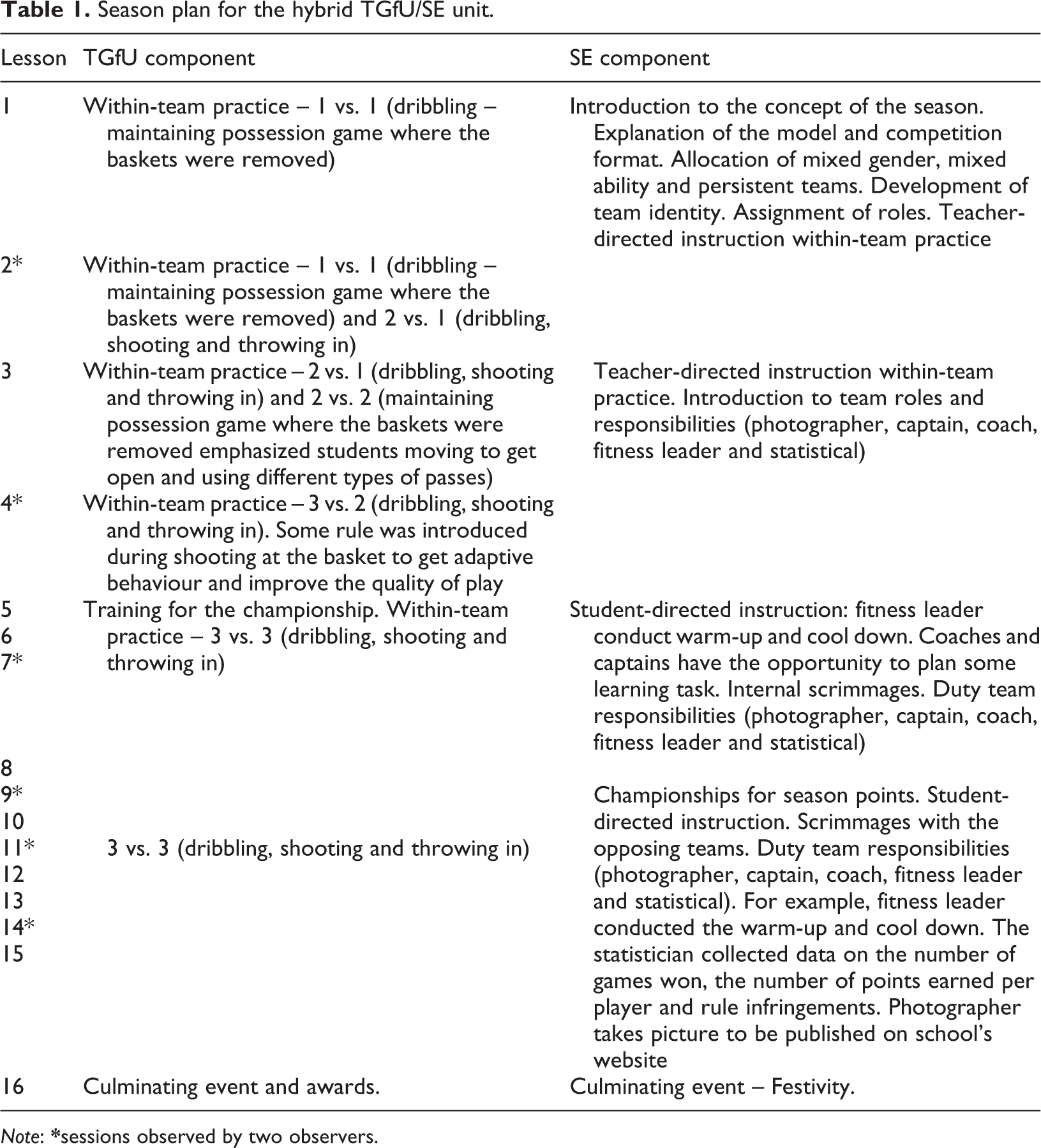
Note:
Direct instruction
The 16-lesson direct instruction unit was conducted within a non-team-based format where students mostly followed the teachers’ directions. Lessons were designed to promote very high rates of opportunities for students to respond in the hopes of maximizing “correct” technical motor responses on individual skills such as dribbling, shooting, and passing interspersed by the teacher’s delivery of positive and corrective feedback.
Direct instruction lessons were delivered using the following format: (a) content selection, task presentation and structure, instructional interaction and evaluation, all of which were controlled by the PE teachers; (b) the PE teachers were the instructional leaders of the unit, monitored practice and presented students with a model of desired movement; (c) sessions were highly structured and based on the repetition of technical skills; (d) students’ learning tasks took place in segmented blocks of time, and teachers controlled the rhythm of the activities and the timing between task progressions; (e) cooperative tasks of two or three people were utilized with the purpose of repeatedly practicing technical skills (groups were not persistent across lessons); (f) decontextualized tasks where content was unlikely to generalize to actual game conditions; and (g) mastery criteria provided to the students was based on successful technical skill execution (Metzler, 2011).
Instructional and treatment validity
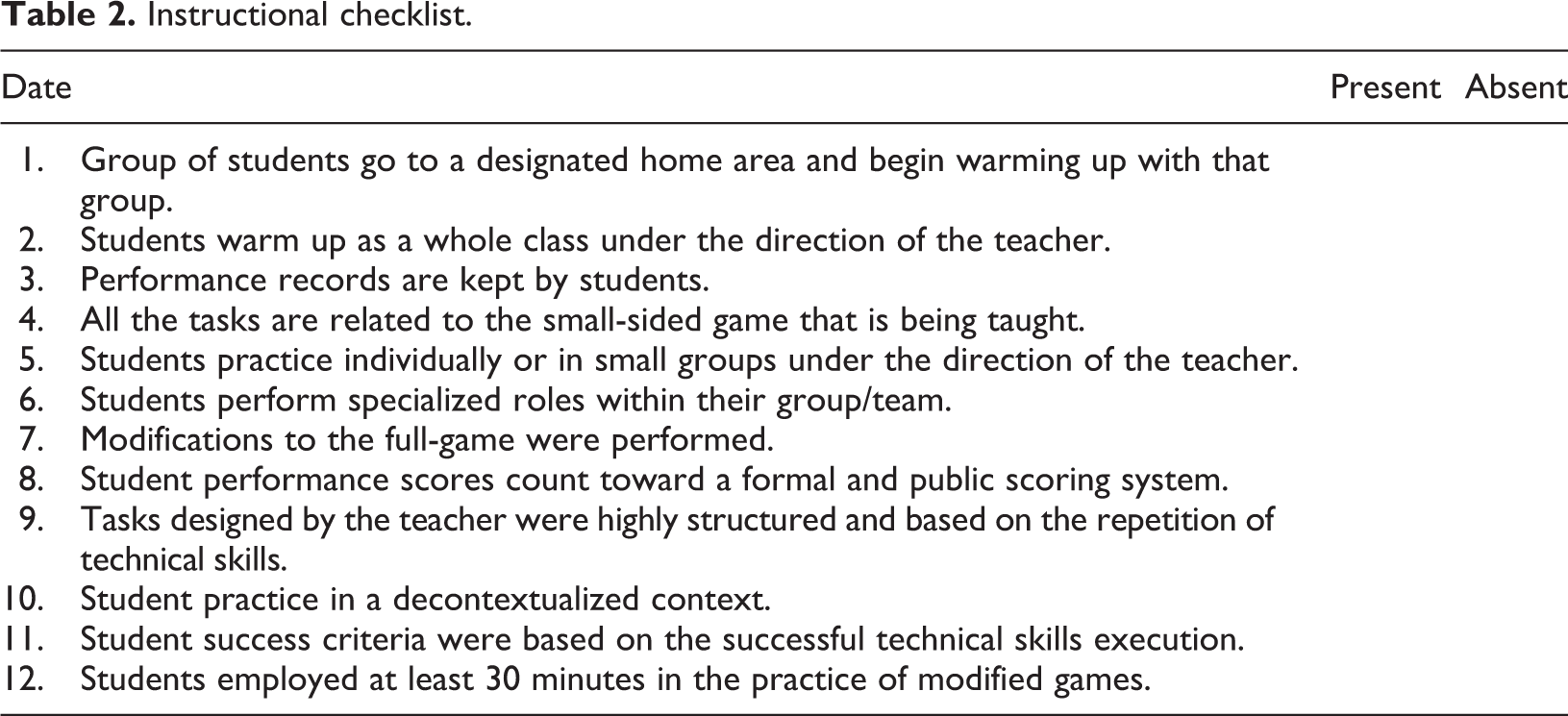
The fidelity of the hybrid TGfU/SE unit and direct instruction lessons was assessed using a checklist (Table 2; Hastie and Casey, 2014). Based upon the instructional checklist of Hastie et al. (2013), checklist items 1, 3, 6, 8 and 2, 5, 9, 10, 11 enabled researchers to measure teacher fidelity to the characteristics of SE and direct instruction, respectively, while items 4, 7, 12 helped researchers to examine teacher fidelity to TGfU using similar criteria employed by Harvey et al. (2010). The first author and one additional observer with experience in pedagogical models in PE observed a sample of six sessions for each pedagogical approach and teacher, more than 12.5% of the total sample (Tabachnick and Fidell, 2013). Table 1 shows the sessions that were observed. 100% agreement was reached between the two observers. Each observer therefore confirmed that all key aspects included in the instructional checklist were performed by the teachers in each of the observed lessons using the two pedagogical models.
Instructional checklist.
Data analysis
The statistical programmes Mplus (Version 7.4; Muthén and Muthén, 2010) and IBM Statistical Package for Social Sciences (Version 24.0) were used for data analysis. First, to analyse the psychometric properties of the instruments, a CFA was conducted, in which the following indices were used: χ2; degrees of freedom (df), CFI, TLI and RMSEA. Values less than five for χ2/df and approaching 0.90 for the CFI and TLI were indicative of acceptable, while values of 0.06 or less for the RMSEA were deemed satisfactory (Hu and Bentler, 1999; Marsh et al., 2004). Second, preliminary assumption testing was conducted to check for homogeneity of variances and normality. Levene and Kolmogorov–Smirnov tests were performed to confirm the assumptions of homogeneity of variances and normality of distribution, respectively (p > 0.05).
For each group and gender at each of the two different time points, means and standard deviations were calculated. To compare between-groups and within-group differences, a 2 × 2 × 2 pedagogical model (hybrid TGfU/SE model and direct instruction) × test time (pre-intervention and post-intervention) × gender (boys and girls) multivariate analysis of variance was conducted. A Bonferroni correction factor was used for these analyses to control for Type 1 errors due to using multivariate comparisons. If an overall multivariate effect was significant, the univariate analyses of variance were interpreted for both genders to examine which specific constructs contributed to the overall multivariate effect. Effect sizes were calculated using the partial eta-squared statistic (η p 2) which provided an insight into the magnitude of the differences found. Effect sizes above 0.01 were considered small, above 0.06 medium, and above 0.14 large (Cohen, 1988). The level of statistical significance was established at p ≤ 0.05 (95% confidence interval).
Results
Between-group post-intervention analysis
A significant multivariate effect was found, with a large effect size for both boys (Wilks’ lambda = 0.84, F (12, 277) = 4.09, p <0.001, η p 2 = 0.15) and girls (Wilks’ lambda = 0.84, F (12, 277) = 4.24, p < 0.001, η p 2 = 0.15). In the pairwise comparisons, boys and girls taught under the hybrid TGfU/SE unit had significantly higher post-intervention scores on all the dependent variables when compared to boys and girls taught through direct instruction (see Table 3).
Descriptive statistics, between-group post-intervention and within-group pre-post-intervention analysis of each dependent variable.
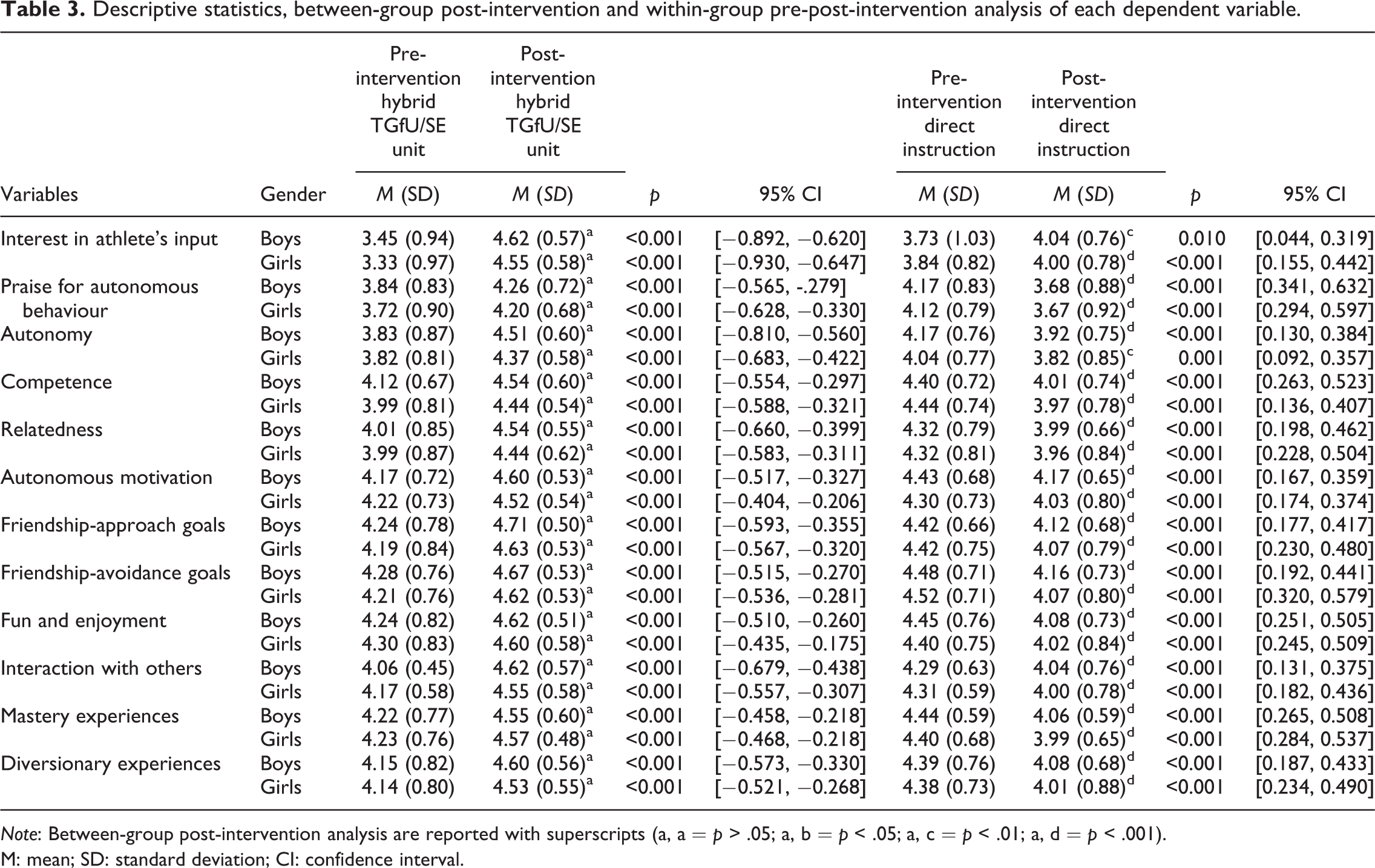
Note: Between-group post-intervention analysis are reported with superscripts (a, a = p > .05; a, b = p < .05; a, c = p < .01; a, d = p < .001).
M: mean; SD: standard deviation; CI: confidence interval.
Within-group pre-post-intervention analysis
Within-group multivariate contrasts showed a significant effect with a higher effect size in boys (Wilks’ lambda = 0.59; F (12, 277) = 15.88, p <0.001, η p 2 = 0.40) than girls (Wilks’ lambda = 0.65, F (12, 277) = 11.94, p <0.001, η p 2 = 0.34) taught under the hybrid TGfU/SE unit. In the pairwise comparisons, both boys and girls reported significantly higher values on all the dependent variables in the post-intervention compared to the pre-intervention. Moreover, a significant multivariate effect was found, with a large effect size, for both boys (Wilks’ lambda = 0.82, F (12, 277) = 4.98, p < 0.001, η p 2 = 0.17) and girls (Wilks’ lambda = 0.81, F (12, 277) = 5.38, p < 0.001, η p 2 = 0.18) taught through direct instruction. In contrast to the students taught under the hybrid TGfU/SE unit, pairwise comparisons revealed that both boys and girls had significantly lower values on all the dependent variables in the post-intervention compared to the pre-intervention, except for the interest in athlete’s input variable (see Table 3).
Discussion
The purpose of this study was to investigate the impact of a basketball unit taught using either a hybrid TGfU/SE or direct instruction model on perceived autonomy support, perceived needs satisfaction, autonomous motivation, and adaptive outcomes. Two hypotheses were examined: (a) boys and girls taught through the hybrid TGfU/SE model would report higher scores on all variables post-intervention compared to students taught through the direct instruction model; and (b) boys and girls taught through the hybrid TGfU/SE model would report higher scores on all variables post-intervention compared to pre-intervention than boys and girls taught through the direct instruction model.
In response to our first hypothesis, results showed that boys and girls who participated in the hybrid TGfU/SE unit reported higher levels of autonomy support compared to boys and girls who participated in the direct instruction unit. At the beginning of the hybrid TGfU/SE unit, students of both genders worked together to autonomously generate their own team identity and choose a team role that best fit their interests. Additionally, in the learning phase, teams had to solve different tactical problems presented by the PE teachers. Students made independent decisions to find solutions to the different tactical tasks in which they engaged. Similarly, the members of each team had to agree on the strategy to apply to improve their performance in each match against other teams, which was also applied in the formal competition phase. These results demonstrate that a learning environment that encourages student choice and initiative taking, and further promotes their confidence in, and commitment to, their learning in PE can be created through PE teachers’ use of a hybrid TGfU/SE unit. These findings are consistent with previous studies on TGfU (Mandigo et al., 2008), SE (Perlman, 2012) and a hybrid TGfU/SE model (Gil-Arias et al., 2020).
Despite this, it is important to highlight that teachers’ adoption of an autonomy-supportive style in PE lessons is not enough, since it is additionally necessary that students perceive that their teacher supports their autonomy (Núñez and León, 2015). In this regard, emphasis should be placed on including specific teaching strategies that favour autonomy support, given its effect on the more volitional profiles in boys and girls in PE classes. In this current study, boys and girls who participated in the hybrid TGfU/SE unit reported higher scores in both needs satisfaction and autonomous motivation when compared to boys and girls who participated in the direct instruction unit. Findings from previous studies support the notion that pedagogical models such as TGfU and SE provoke satisfaction of students’ BPNs and, consequently, high levels of autonomous motivation (Mandigo et al., 2008; Perlman, 2012). A high level of student autonomous motivation is important because students pay more attention to the teaching–learning process and they concentrate more on the tasks to be performed (Ntoumanis, 2005).
In this study, teachers used the design features of TGfU to deliver learning tasks that were meaningful and authentic to the reality of the game and promote positive learning experiences for the students (Light and Harvey, 2017). In addition, the key design features inherent in SE (e.g. affiliation and festivity) meant that the hybrid TGfU/SE unit teachers created an environment where students, regardless of their gender, could realize the aims of SE and develop their competence, enthusiasm, and literacy about basketball (Chu and Zhang, 2018). Moreover, the hybrid unit teachers used different strategies to promote student effort and personal progress (e.g. social recognition, positive feedback, membership, responsibilities, etc.), which are associated with the development of a mastery-orientated learning climate (Barkoukis and Hagger, 2013).
In our second hypothesis, boys and girls taught through the hybrid TGfU/SE model would report higher scores on all variables post-intervention compared to pre-intervention than boys and girls taught through the direct instruction model. Our findings showed that students of both genders taught through a hybrid TGfU/SE unit reported significantly higher post-intervention scores on all the dependent variables when compared to the pre-intervention. These results suggest that boys and girls responded equally to the hybrid TGfU/SE unit, providing support to previous studies that have documented the positive effect in boys and girls of student-centred pedagogical models on student motivation in PE (Sevil et al., 2016).
Despite the intervention being focused on a competitive team-sport activity (basketball) that previous research has shown can potentially favour boys (Chalabaev et al., 2013; Mitchell et al., 2015), it is our contention that the teachers’ use of a hybrid TGfU/SE unit in this current study promoted a more equitable learning environment (Farias et al., 2017). Throughout the hybrid model, the hybrid unit teachers used several strategies to ensure that boys and girls had similar motivational experiences: (a) learning tasks were designed according to students’ needs and game rules were effectively used by the teachers to regulate students’ learning commensurate with their competence level; (b) students were provided with opportunities to perform non-playing leadership roles that best fit their interests, which allowed them to make autonomous decisions; (c) teachers delivered positive feedback that emphasized task mastery and individual improvement; (d) face-to-face interaction was stimulated among team members by asking them to collaborate with peers to solve tactical problems, thus increasing students’ engagement in cooperative team dynamics; and (e) teachers ensured equal playing time for both boys and girls in the formal competition phase of the unit. In addition, we would like to note that our findings contrast with those in previous SE studies that report boys taking on more of the leadership roles, controlling game play and decision-making within the team, which undermines girls’ engagement and social interactions in PE (Brock et al., 2009). Therefore, the effectiveness of this hybrid TGfU/SE unit provides PE teachers with some of the teaching strategies that they can use to be able to implement a similar sport-based unit of content in their own context.
There were several strengths of the current study. First, our sample was drawn from 12 different PE classes in four elementary schools and six teachers were enrolled in the study, which provides more statistical power to generalize our results. Second, data were collected using valid and reliable instruments, which also underwent additional analyses (e.g. CFA and Cronbach’s alpha) to confirm the robustness of the data we generated. Third, teacher fidelity to the hybrid pedagogical model was measured and established. Finally, our analysis focused on student gender, which to our knowledge has not been previously studied when examining the effects of hybrid pedagogical models in an elementary PE context.
Despite the aforementioned strengths, several limitations and future research directions should be considered. First, the effects of only one hybrid TGfU/SE season was examined in this study. Consequently, it would be valuable to replicate the current study and investigate the effect on psychosocial variables over a more longitudinal time frame with the application of consecutive hybrid TGfU/SE units. Second, researchers could capture game performance and physical activity data and investigate the extent to which students’ motivation predicates these outcome variables. Third, including data generated from qualitative methods (e.g. interviews) will allow researchers to obtain more in-depth insights into students’ motivational processes in PE beyond those possible by collecting only quantitative data. Finally, future studies that compare the effects of the TGfU and SE models in isolation to that of a combined hybrid TGfU/SE unit could offer a more robust assessment of the success of the hybrid model.
Conclusion
This study provides initial evidence that a hybrid TGfU/SE unit can be implemented in an elementary PE context to provoke significant improvements in students’ self-determined motivation when compared to a direct instruction unit that did not. Findings from the current study showed that despite the existence of social and cultural stereotypes in terms of physical activity, teachers’ use of a hybrid TGfU/SE unit promotes an autonomy-supportive, inclusive, and equitable PE learning environment where all students, regardless of their gender and/or content focus of the unit, have opportunities to increase their engagement, enjoyment, and social interactions within PE lessons.
Footnotes
Declaration of conflicting interests
The author(s) declared no potential conflicts of interest with respect to the research, authorship, and/or publication of this article.
Funding
The author(s) received no financial support for the research, authorship, and/or publication of this article.
