



Abstract
Sport and physical education are considered important platforms for introducing people from refugee backgrounds to their new environment. However, studies dealing with the specific role of physical education in this context are scarce, although it is often the first and sometimes only setting in which people from refugee backgrounds come into contact with sport in the host country. To this end, this study attempts to shed light on how teachers—considered key actors in the resettlement process—perceive students from refugee backgrounds and their integration in physical education. In this study, teachers’ perceptions are defined as individually constructed truths influenced by biographical circumstances (migration experiences), socio-demographic characteristics (gender) and the environment (school type). We used integration theories to operationalise teachers’ perceptions, from which we derived a three-dimensional structure: cultural, structural-positional and communicative-interactive dimensions. Drawing on this theoretical foundation, quantitative data from a questionnaire administered to 491 physical education teachers in Germany were analysed using exploratory factor analysis, t-tests and variance analysis. The factor analysis resulted in a three-factor solution. The mean value comparison of the factors on the descriptive level revealed that the communicative-interactive dimension had slightly higher values than the other two dimensions. Furthermore, there were significant differences in perceptions in terms of gender and school type. Based on our findings, we suggest that teachers should be made aware that their views on students are never neutral and are shaped by various factors, especially gender and school type.
Keywords
Introduction
The consequences of military conflicts, environmental disasters and other developments are forcing a growing number of people to flee their homes. At the end of 2019, the estimated number of displaced persons worldwide reached a new record of 79.5 million (UNHCR, 2020). Although most displaced individuals seek protection in their homelands or neighbouring countries, they often encounter conditions that are similarly unstable, leading many to take the difficult route to more distant places, such as Europe or other Western parts of the world. Many of those looking for protection are under 18 years old; in 2019, they constituted around 40% of all refugees (UNHCR, 2020). As a consequence of this increased migration, questions of integration have been raised in many Western societies—particularly in the field of education, which is acknowledged as vital for the resettlement of young people from refugee backgrounds and for building meaningful relationships with the host country (Uptin et al., 2013).
In the educational sector, physical education (PE) is ascribed a special role in the orientation of young people from multicultural backgrounds to their new surroundings, as it is the only physical and movement-related subject in school with a high degree of embodied interactions and interpersonal encounters (Anttila et al., 2018). These interactive processes, in which young people come together in motion, are widely discussed in the sociology of sport as well as in sport policies, where sport is seen in part as ‘a marker and means of refugee integration’ (Spaaij et al., 2019: 10).
Taking this as a starting point, the present study aims to understand how teachers perceive students from refugee backgrounds and their integration into PE. We aim to shed light on the perspectives of educators and their experiences in teaching students from refugee backgrounds, as they are assumed to have enormous potential to (positively) affect the new life of their students and are, therefore, considered key actors and sources of stability in the host country (Richardson et al., 2018). PE teachers also have a guiding function in the sport-related socialisation of young learners from refugee backgrounds and their sport experiences in the reception context (Doherty and Taylor, 2007). Teachers’ attitudes, beliefs and perceptions regarding young people from refugee backgrounds thus shape the everyday experiences and interactions with these young people in PE, framing the way they are treated, accepted and welcomed in schools. Further, it is likely that the way in which teachers perceive students from refugee backgrounds not only affects PE and school but also the students’ general capacity to develop a sense of belonging (Lewis, 2005). As role models, teachers also have a decisive influence on the understanding of integration (reciprocal and cooperative vs one-sided and assimilative) and the image that learners at school develop about people seeking protection (Soriano and Cala, 2019). Consequently, teachers can be influential forces in the integration process of young people from refugee backgrounds and can foster their social recognition in the new country. To better understand how teachers perceive students from refugee backgrounds and their integration in PE, we present quantitative data from a questionnaire-based survey.
State of research
The social science of sport has long focused on migration, in general, without specifically addressing the issue of forced migration (Spaaij et al., 2019). In the context of PE, most research has concentrated more broadly on ethnic minority students or second-language learners, demonstrating that PE in Western societies—in contrast to the general belief that sport is an important promotor in integration processes—has difficulty including these groups (e.g. Elliott and Hoyle, 2014; Walseth and Strandbu, 2014). This shortcoming has been partly attributed to PE teachers and their stereotyped perceptions concerning their students (Benn and Pfister, 2013). Various studies have revealed that PE teachers in the Western world—who are usually part of the majority culture and, thus, occupy privileged social positions (Anttila et al., 2018)—have negative perceptions of students who do not fully correspond to Western ideals and regard PE as a place to initiate assimilation processes (Barker, 2019; Van Doodewaard and Knoppers, 2016). Even though PE teachers claim that they treat all students equally, Flintoff and Dowling (2019) have pointed out how they reproduce a white and hegemonic discourse in PE that is supported by the subject matter. Students who do not meet these expectations are considered insufficient and deviating from the standard (Azzarito et al., 2017). Similar practices that construct young people from migrant and refugee backgrounds as deficient and urge them to adapt to the social structures and values of the majority society have also been observed in out-of-school sport (Dukic et al., 2017; Jeanes et al., 2015). This underlines that sport in general, despite all its integrative demands, is a setting in which hegemonic power relations, expressed for example in racism and exclusion, persist.
Moreover, a survey conducted in the USA found that female PE teachers had a more positive attitude and felt more comfortable about dealing with students from diverse backgrounds than their male colleagues (Columna et al., 2010). This is in line with the results of more general surveys, which suggested that attitudes and perceptions towards people from refugee and migrant backgrounds are influenced by the personal characteristics of the respondents, such as gender and educational level (Bešić et al., 2020; Soriano and Cala, 2019). More specifically, there are indications that women and people with higher educational levels tend to have a more positive attitude towards people from migrant and refugee backgrounds (Bešić et al., 2020; Soriano and Cala, 2019). Personal experiences of migration are also believed to be an important factor (Becker, 2019). However, more general large-scale surveys come to ambivalent results regarding the role of one’s own migration biography (Becker, 2019; Zick and Preuss, 2016). The findings indicate that a person’s own migrant background does not always dictate or systematically influence attitudes towards immigration. This is particularly the case for people who did not immigrate themselves, but rather their parents or grandparents (Becker, 2019).
To date, only a few papers have focused specifically on teachers’ perceptions of students from refugee backgrounds in PE, who are often faced with very specific challenges, such as uncertain future prospects regarding the duration of their stay, the fear of being deported, being alone in a new country without the support of parents, language barriers and meagre economic resources. The existing studies revealed that school sport has integrative potential and is a place where young people from refugee backgrounds can experience a sense of belonging (Doherty and Taylor, 2007; Harwood et al., 2021; Uptin et al., 2013). However, this potential is not fully experienced by all students and is particularly denied to young women from refugee backgrounds (Harwood et al., 2021; Uptin et al., 2013). Newly arrived students also reported that they sometimes face discrimination and prejudice from teachers or their classmates in PE (Doherty and Taylor, 2007). Additionally, there is initial evidence from a qualitative study that male teachers and those working with older students in secondary schools in particular perceive students from refugee backgrounds in a stereotypical way (Bartsch and Rulofs, 2020). These first indications concerning gender- and school type-related differences in teachers’ perceptions of students from refugee backgrounds need to be examined more closely.
Of the few studies on PE teachers’ perceptions towards students from refugee backgrounds conducted so far, almost all have used qualitative methods, which are undoubtedly of great importance and provide essential insights into the personal experiences of individuals. Nevertheless, supplementing this with quantitative research could increase knowledge on the subject and help draw conclusions regarding larger groups.
Theoretical framework
This article investigates PE teachers’ perceptions of students from refugee backgrounds. The theoretical concept of perception is commonly referred to as a process in which individuals generate mental images of the world and the people around them. It captures ‘how we see things’ and ‘is an individual’s access to experience and interpretation in the world’ (Munhall, 2008: 606). This complex process, which underlies various mechanisms, is always subjective, context-dependent and socially constructed (Friedman, 2011). Although perceptions are based on individual experiences and interpretations, they are shaped and framed by social expectations and structures (Friedman, 2011). Therefore, we expect perceptions to be influenced by the perceivers’ biographical experiences (e.g. own migration experiences), socio-demographic characteristics (e.g. gender) as well as the environment (e.g. school type). We assume that these factors combine to contribute to the personal lens of teachers and how they view learners from refugee backgrounds in PE.
Given that perception is a broad construct, our study also employs integration theories to capture and concretise teachers’ perceptions of students from refugee backgrounds. Integration is the key concept in the debates on the settlement of people from refugee backgrounds. However, the concept of integration, its objectives and when it is considered to be successful are highly controversial and ‘there is no single, generally accepted definition, theory or model of immigrant and refugee integration’ (Castles et al., 2002: 12). Spaaij (2012) argued that, according to a modern understanding, integration is a cooperative and reciprocal process involving both the host society and the newly arrived. It aims to ensure that newcomers have ‘the ability to participate fully in economic, social, cultural, and political activities while maintaining one’s cultural identity’ (Spaaij, 2012: 1519). In the context of sport practice in the field, however, integration is often considered assimilation, whereby only people from refugee and migrant backgrounds are required to adopt the culture of the host society, while the latter is not obliged to change (Jeanes et al., 2015).
A very influential concept of integration in Germany, which is also applied in (international) sport sociological research (Elmose-Østerlund et al., 2019; Kleindienst-Cachay et al., 2012), originated from the sociologist Esser (2009). In this model, four dimensions are used to describe integration in more detail: culturalisation, placement, interaction and identification. According to Esser (2009), ‘culturalisation’ refers to the idea that individuals need certain cultural knowledge and competences to interact meaningfully with each other. It involves the acquisition of social norms, values and socially desirable skills that are predominant in the host country (in particular language skills). ‘Placement’ refers to the occupation of social positions (e.g. in working life) and is closely linked to the acquisition of opportunities for participation, such as citizenship and the right to vote (Esser, 2009). ‘Interaction’ focuses on communication and social actions, in which people orient themselves towards each other in a reciprocal process. It implies the development of social relationships and networks (e.g. friendships, neighbourhood relations), which Esser (2009) described as a central component of a person’s social capital. ‘Identification’ refers to the process of bonding to a social system and the development of emotional attachment to the members of this system (Esser, 2009).
Esser’s approach is well established in Germany and offers a structured access to the analysis of integration in society. However, the frame of reference of our study is not integration in society but in PE and, moreover, Esser’s concept has been criticised for conveying Eurocentric ideas (Kleindienst-Cachay et al., 2012). For more robust perspectives, we adapted Esser’s approach in our study for PE and incorporated elements from other theoretical approaches that emphasise the reciprocal nature of integration (Anhut and Heitmeyer, 2008; Elling et al., 2001). This modified framework, through which we aim to explore how teachers perceive students from refugee backgrounds and their integration in PE, comprises three dimensions: cultural, structural-positional and communicative-interactive dimensions, which will be explained in more detail regarding PE.
In the cultural dimension, we connect Esser’s (2009) ‘culturalisation’, which emphasises the importance of cultural values and norms for integration. Following Esser in this dimension and applying it to the setting of PE, we seek to understand how PE teachers perceive students from refugee backgrounds with regard to relevant cultural elements of PE—for example, gender roles and coeducational teaching, physical closeness and Western games. These issues are essential for PE in the Western world, and at the same time, they are closely connected to stereotypes about people from migrant backgrounds (Elling et al., 2001). Structural-positional integration in our study addresses Esser’s (2009) category ‘placement’ and is primarily concerned with democratic decision-making and participation processes in PE. We are particularly interested in the extent to which teachers are aware of whether students from refugee backgrounds are given the opportunity to contribute their sport-related prior knowledge and interest and whether they have opportunities to take on tasks and relevant positions in PE (Anhut and Heitmeyer, 2008). Within the communicative-interactive dimension, we draw on Esser’s (2009) ‘interaction’ category. Within this dimension, we focus on interpersonal interactions, which are considered particularly important for building social contacts (Anhut and Heitmeyer, 2008). These processes receive attention because sport and PE presumably hold special opportunities for interpersonal encounters (Elling et al., 2001). The focus within this dimension is whether teachers perceive that students from refugee and non-refugee backgrounds work together and benefit from each other or whether conflicts arise. Moreover, emphasis is placed on flight-related aspects that may influence interaction and communication between students (e.g. whether students who have fled appear distracted or worried). We do not address Esser’s (2009) ‘identification’ category in our study, as we believe that this would require surveying or interviewing students from refugee backgrounds instead of our chosen participants—teachers.
Against this background, this article aims to answer the following research questions: (a) Are the theoretically derived dimensions suitable to describe PE teachers’ integration-related perceptions and how relevant are they for teachers’ perceptions of integration? (b) Do the teachers’ integration-related perceptions differ according to their personal characteristics (gender, migrant background, school type)?
Methods
In this article, we draw on data from a larger research project. The project included a survey of PE teachers in Germany using a questionnaire on the topic of heterogeneity and inclusion in PE, which also covered items on the teachers’ perceptions of students from refugee backgrounds. These items were addressed because a large number of people sought refuge in Germany in the months before the survey started. In the years 2015 and 2016, a total of 1,222,194 asylum applications were recorded in Germany, a third of which included minors (Bundesamt für Migration und Flüchtlinge, 2017).
Development of the survey instrument
To develop these items, we screened existing studies on integration and sport (e.g. Braun and Finke, 2010; Kleindienst-Cachay et al., 2012). As none of the existing instruments seemed appropriate to answer our research questions, a new instrument was developed on the basis of the existing work and the theoretical framework outlined above. This instrument was discussed and adapted with current PE teachers and within the extended research team, which also included experts with teaching experience in PE. The overall result was a total of 19 items, which the respondents were asked to rate on a five-point Likert scale (1 = I do not agree; 2 = I rather do not agree; 3 = Half and half; 4 = I rather agree; and 5 = I fully agree). In the following section, these items are presented in their English translation (the original questionnaire was in German) and structured along the three dimensions of integration from which they were theoretically derived to operationalise teachers’ perceptions. In the original questionnaire, the items were not arranged along this three-dimensional structure; rather, they were arranged in randomised order that could be reconstructed from the numbers in brackets.
Cultural level: (3) Coeducational PE is an unfamiliar experience for students from refugee backgrounds (abbreviated as ‘RB’). (14) In PE, students from RB present different views on gender roles compared to students from non-RB. (15) Dealing with physical contact or closeness in PE is an unfamiliar experience for students from RB. (17) Students from RB learn unfamiliar sports and forms of movement in PE.
Structural-positional level: (6) Students from RB incorporate previous sport-related knowledge from their countries of origin into PE. (7) Students from RB are involved in decision-making processes in PE. (10) Students from RB can incorporate their wishes and needs into PE. (19) Students from RB take on tasks and functions in PE (e.g. team captain, helping and securing and organising).
Communicative-interactive level: (1) Students from both RB and non-RB learn from each other in PE. (2) Students from RB are afraid of contact with students from non-RB in PE. (4) Students from RB and non-RB support each other in PE. (5) Students from RB improve their language skills in PE. (8) Students from RB appear distracted or unfocused in PE. (9) Communication difficulties arise in PE between students from RB and non-RB. (11) In PE, students from RB are accepted by students from non-RB. (12) Students from RB are motivated to participate in PE. (13) Students from RB tend to keep to themselves in PE. (16) Students from RB express concerns about their future in PE. (18) In PE, conflicts arise between students from RB and non-RB.
Procedure and sample
After obtaining permission from the university’s ethics committee, the data were collected throughout 2017. The survey was conducted in Germany and focused on the federal state of North Rhine-Westphalia (NRW). Potential participants were recruited via email correspondence to schools and through personal contacts. The district government also made it possible to survey PE teachers during official meetings in which PE teachers from various schools participated. The participants came from six types of school, representing the German school system (Grund-, Haupt-, Real-, Gesamt-, Berufsschule and Gymnasium). Since these types cannot be directly transferred to school forms in other countries, the German-language forms are retained and explained in Table 1. It is important to consider that the school system in Germany is highly selective, which means that after the fourth grade of primary school, students are separated into different types of secondary schools based on their performance and abilities. The different types of secondary schools are characterised by different cultures and informal processes. The so-called Gymnasium is the secondary school with the highest grade of selection. In general, teachers’ own school biographies are based on experiences from Gymnasium.
Explanations of the different school types.

References: MSB (2020); MSW (2017).
Teachers who agreed to participate in the survey received questionnaires, informed consent forms and prepaid envelopes by post. They were also made aware that participation in the study was anonymous and voluntary. The sample size amounted to n = 958 PE teachers. As the participants did not all have experiences with students from refugee backgrounds, the final number of cases for the present study was reduced to n = 491 PE teachers (mean age (M) = 39.17 years, standard deviation (SD) = 10.28, min = 23, max = 65). Of those surveyed, 197 (40.1%) worked in Grundschule, 143 (29.1%) in Gymnasium, 55 (11.2%) in Gesamtschule, 40 (8.1%) in Hauptschule, 37 (7.5%) in Berufsschule and 19 (3.9%) in Realschule. The relative distribution of PE teachers per school type in our sample was comparable to their distribution in NRW, with marginal differences: of the 29,373 teachers in NRW who had a teaching qualification for PE in the school year 2016/2017 and worked within one of the above-mentioned school types, 31.6% worked in Grundschule, 24.8% in Gymnasium, 18.3% in Gesamtschule, 9.8% in Realschule, 9.5% in Berufsschule and 6% in Hauptschule (MSW, 2017). With regard to gender, our sample (male: 201 (40.9%), female: 288 (58.7%)) corresponded to the gender distribution in NRW (male: 41.8%, female: 58.2%) (MSW, 2017).
Data analysis
The data were analysed using IBM SPSS Statistics, version 26. To prepare the data for the main analysis, we first reversed the negatively formulated items (Field, 2009). Subsequently, the internal consistency of the 19-item scale was determined using Cronbach’s α. In cases of low selectivity (< .30), individual items were examined in detail and removed if necessary (Bühner, 2011). In the next stage, the data were subjected to a factor analysis to determine whether the items could be reduced to a small set of latent variables that captured the multidimensional structure of perceptions of integration (Field, 2009). As the survey instrument was newly developed and not previously field-tested, an exploratory factor analysis was employed (Bühner, 2011). Principal axis analysis was used to extract the factors (Bühner, 2011). To determine the number of factors, a parallel analysis was carried out. Furthermore, a scree plot and the theoretical assumptions were included in the process (Bühner, 2011). Because the identified factors were unlikely to be completely uncorrelated, oblique rotation (promax) was applied to clarify the data structure (Bühner, 2011). The extracted factors were tested for reliability using Cronbach’s α before they were named and interpreted according to the theoretical conceptualisation.
Thereafter, a factor-based score was calculated for each factor, which was used instead of the original variables in subsequent analyses (Bühner, 2011). To obtain this score, the respective items of a factor were added and divided by the number of variables in the factor. In a follow-up analysis, the factors were explored for differences in mean values between the groups. Visual checks were conducted using Q–Q plots to ensure that the data were suitable for this procedure and approximately normally distributed (Field, 2009). All factors were examined with regard to gender, migrant background and school type. The group comparisons were performed using t-tests for independent samples and single factor variance analysis (ANOVA) (Field, 2009). To concretise the group differences that became apparent in the ANOVA, the post-hoc test GT2, which is based on Hochberg’s method, was carried out due to different group sizes and variance homogeneity (Field, 2009).
Results
The check for reliability indicated that the internal consistency of the 19-item scale was satisfactory (α = .82). However, for three items (6: sport-related previous knowledge; 16: concerns about the future; 17: unfamiliar sports and forms), low discriminatory power (< .3) was detected, which led to their removal from the scale (Bühner, 2011). The common tests proved that the data were suitable for the factor analytical models (Kaiser-Meyer-Olkin (KMO) = .83; Measure of Sampling Adequacy (MSA) > .66; Bartlett’s test: χ 2 = 1840.602, df = 120; p < 0.000) (Bühner, 2011). A main axis analysis, with oblique rotation (promax), was performed for the remaining 16 items (Bühner, 2011). An initial analysis was run to obtain the scree plot and a general impression of the data. Given the slight ambiguity of the scree plot, a parallel analysis was carried out (Bühner, 2011). The corresponding three-factor solution proposed was finally pursued. Items with a low charge (< .40) were successively removed from the analysis, as the assumption was that only higher charges represented substantial values (Field, 2009). Consequently, four items could not be considered for further analysis (2: afraid of contact; 9: communication difficulties; 13: tend to keep to themselves; 18: conflicts).
The final analysis revealed that the three factors explained 43.85% of the item variance. The factors correlated as follows: factors one and two: r = .44; factors one and three: r = .41; and factors two and three: r = .21. Table 2 shows the factor loadings.
Sample matrix of the exploratory factor analysis.

Note: extraction method = main axis analysis; rotation method = promax with Kaiser normalisation, rotation converged into five iterations. Items marked with (r) were reversed prior to the analysis.
The resulting three-dimensional factor matrix corresponded to the theoretically derived structure. The first factor comprised six items representing the communicative-interactive dimension. Three items corresponding to the cultural dimension loaded onto the second factor. The third factor consisted of three items relating to the structural-positional dimension. The mean values and reliabilities of the subscales defined by the three factors are reported in Table 3. The comparison of the mean values of the three factors on the descriptive level showed that the communicative-interactive dimension had slightly higher values than the other two dimensions.
Factors with mean values, standard deviations and reliabilities.
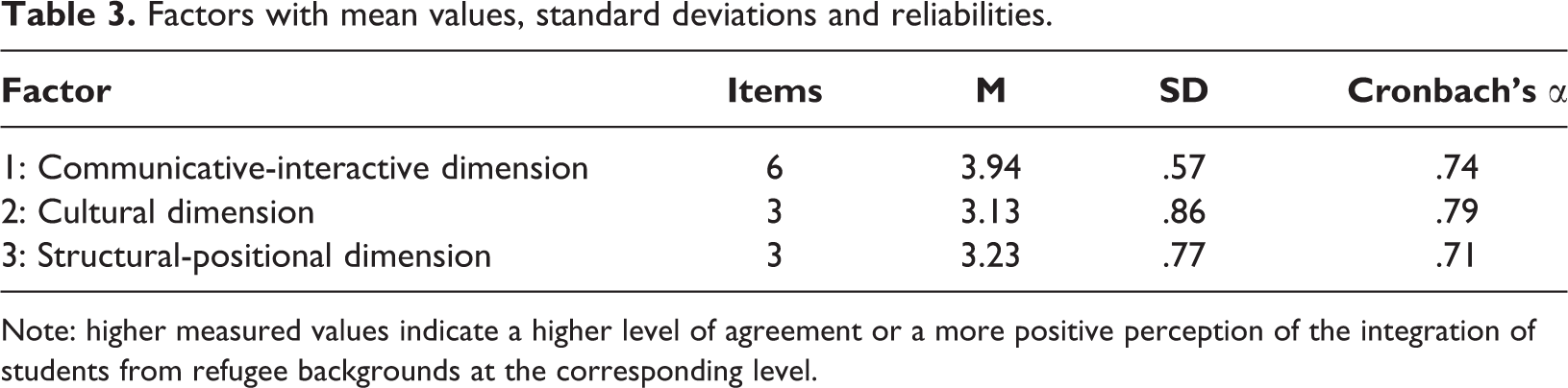
Note: higher measured values indicate a higher level of agreement or a more positive perception of the integration of students from refugee backgrounds at the corresponding level.
In the following section, we report on the results of the t-tests and ANOVA. The comparison, via t-test, concerning the teachers’ gender showed significant differences with regard to two factors (see Table 4). Female PE teachers perceived the integration of students from refugee backgrounds in PE significantly more positively than male PE teachers in the first and the second dimensions. The effect strength corresponded to a small-to-medium effect (Cohen, 1988). With regard to the third factor, there were no significant gender differences. However, women showed higher values.
Scale values by gender.

p: significance; d: effect strength according to Cohen (1988) (d = .2: weak effect; d = .5: medium effect; d = .8: strong effect). The N in Tables 4–6 varies because there are different numbers of valid cases for the different dimensions.
A comparison of the mean values of PE teachers from migrant and non-migrant backgrounds did not reveal significant effects (see Table 5).
Scale values by migrant backgrounds.

p: significance; d: effect strength according to Cohen (1988) (d = .2: weak effect; d = .5: medium effect; d = .8: strong effect).
An ANOVA, performed to determine possible differences between school types, returned significant differences with regard to all three factors (see Table 6). Concerning the first factor, the post-hoc test based on Hochberg’s method (Field, 2009) revealed that the perception of PE teachers in Grundschule differed significantly from those in all other school types. PE teachers from Grundschule perceived students from refugee backgrounds and their integration in PE at this level significantly more positively than their colleagues in Hauptschule (p = .007), Realschule (p = .000), Gymnasium (p = .001), Gesamtschule (p = .000) and Berufsschule (p = .000). Regarding secondary schools, the views of teachers in Realschule and Gymnasium (p = .012) and Gymnasium and Berufsschule (p = .003) differed significantly. With regard to the cultural dimension, the post-hoc test showed significant differences between PE teachers in Grundschule and their colleagues in Gymnasium (p = .000), Gesamtschule (p = 0.000) and Berufsschule (p = 0.000). PE teachers in Hauptschule perceived integration at this level significantly more positively than those from Berufsschule (p = .042). Concerning the third factor, PE teachers in Berufsschule showed significantly higher values than their counterparts in Realschule (p = .006) and Gymnasium (p = .000).
ANOVA of factors related to the school type at which the respondents were employed.

p: significance; η 2: effect strength according to Cohen (1988) (η 2 = .01: weak effect; η 2 = .06: medium effect; η 2 = .14: strong effect).
Discussion and conclusion
This article explored how teachers, who are considered ‘frontline agents of integration’ (Anttila et al., 2018: 609), perceive students from refugee backgrounds and their integration in PE. Based on the factor analysis, the dimensions described in the theory section were reflected in the data that addressed the first research question, which focused on the suitability of the theoretically derived dimensions and the relevance of the dimensions. The dimensions based on Esser’s (2009) concept therefore appear to be suitable for capturing integration-related perceptions of PE teachers. In this respect, the items presented here, and the underlying model, also appear to be useful for future research in this area. Furthermore, the results indicate that the three dimensions had mean values that were relatively close to each other and thus suggest a similar relevance for the perception of integration. However, the communicative-interactive dimension showed slightly higher values than the other two dimensions. This might be due to the fact that PE is generally characterised by social interaction and togetherness. It takes place in a class community, with fellow players who can be exercise partners or competitors. Interactions are an essential part of PE and at the same time very important for integration processes (Esser, 2009), which might explain their relevance in the present study. The cultural dimension was rated most negatively by the teachers. The comparatively lower value for this dimension may be related to the prevailing image within European societies of people from refugee backgrounds. Their values and culture are often seen as incompatible with those of the West, not least because of the gender stereotypes ascribed to them (Bartsch and Rulofs, 2020). Research also clearly demonstrates that teachers have internalised such stereotypes (Benn and Pfister, 2013; Van Doodewaard and Knoppers, 2016), which may have influenced response behaviour.
Overall, however, the results indicate that the respondents had a rather positive view of the integration situation in PE across all three dimensions. This aligns with the existing evidence that people with a high level of education (e.g. university-graduated teachers) are generally positive about integration and migration issues (Bešić et al., 2020). The positive opinions of the teachers promise a high potential for the actual integration process of new students. However, it is also possible that the respondents were overly optimistic about the situation or that the positive views were due to teachers’ attempts to present themselves or their class in a positive light in terms of social desirability. A more critical assessment of the situation would, therefore, not be unfavourable per se but could indicate a high level of awareness and increased ability of teachers to reflect.
The second research question examined whether teachers’ integration-related perceptions differed with regard to their personal characteristics (gender, migrant background, school type). Concerning gender, significant differences in the teachers’ perceptions were observed. More specifically, the findings show that female teachers were generally more optimistic about students from refugee backgrounds and their integration in PE than their male colleagues. This is consistent with the findings of previous research (Bešić et al., 2020; Columna et al., 2010). According to Columna et al. (2010), this finding may be explained by the fact that women have historically been subject to oppression in patriarchal society, particularly in education, and based on this personal experience of discrimination, may therefore be more sensitive to the situation of students from minority backgrounds.
Significant differences in perception also emerged with regard to school type. PE teachers from Grundschule perceived students from refugee backgrounds and their integration in PE on the communicative-interactive and cultural levels more favourably than their counterparts from other school types. On the structural-positional level, teachers from Berufsschule recorded the highest values. Depending on the school type, the different perceptions could be related to the different ages of the students attending these schools. It seems plausible that teachers from Grundschule were more optimistic about integration, possibly because they assumed that children of younger ages encounter each other more openly. Conversely, secondary school teachers might have already been disillusioned by their experiences with older students, especially because value orientations, gender role models, etc. are already more rigidly developed in adolescence than in childhood (Priess and Lindberg, 2011). It can also be assumed that the teachers’ perceptions were influenced by their expectations and demands of their students, which likely varied according to the school type. Grundschule is mainly about personality development and teaching basic skills, whereas teachers in Berufsschule are faced with the task of preparing students for their forthcoming entry into working life. These prospects and the advanced age of students, which already allow or require more responsibility in class, may explain the high values of teachers in Berufsschule with regard to the structural-positional level. Among the secondary schools, the teachers from Hauptschule assess the integration situation comparatively positively across all dimensions. This might be due to the fact that students from migrant backgrounds attend this school type with above-average frequency and that teachers there have presumably developed routines for dealing with cultural diversity.
No statistically significant differences were found with regard to the teachers’ migrant backgrounds. This is in line with earlier observations, which indicated that people’s own migration experiences do not necessarily play a role in the general perception of people from refugee backgrounds (Zick and Preuss, 2016). Nevertheless, it is important to point out that only 33 teachers (6.7%) in our sample reported being from migrant backgrounds. This contrasts with statistics on the general population, according to which 26% of the population in Germany were from migrant backgrounds in 2019. Among the teachers who taught at general schools in Germany in 2019, the percentage of those from migrant backgrounds was 11% (Statistisches Bundesamt, 2020). This discrepancy with the small number of participants from migrant backgrounds in our sample suggests that the response behaviour in our study was strongly characterised by monocultural and monolingual expectations.
The present analysis is a first attempt at systematically capturing teachers’ perceptions of students from refugee backgrounds and their integration in PE. However, the study is not free of limitations. One point that needs to be critically discussed is that we focused on the perceptions of PE teachers, thus excluding the perspectives of students from refugee backgrounds. On the one hand, this makes it possible to learn more about the views of teachers, who are in a powerful position to influence the integration process in PE (Doherty and Taylor, 2007). Dealing with their perceptions is, therefore, an important way of understanding and counter acting integration-related issues in PE. Moreover, direct research with people from refugee backgrounds poses many ethical and moral challenges—for example, in terms of informed consent and translation arrangements. It may also cause re-traumatisation and trigger feelings of exploitation among people from refugee backgrounds (Mackenzie et al., 2007; Pittaway et al., 2010). On the other hand, the voices of students from refugee backgrounds recede into the background through our procedure. By giving priority to the opinions of mainly white, European teachers, research runs the risk of reproducing hegemonic power relations. We as authors might also contribute to these hegemonic structures, because like many other academics researching forced migration, we are also white and European (Spaaij et al., 2019).
Although the study has its limitations and the results may not be generalisable to other countries because of the specific characteristics of the German school system, the study can be seen as a significant extension of the existing research body, as it manages to capture the perceptions of integration in a large group of PE teachers. It thus adds an important quantitative perspective to the already existing body of qualitative research on this topic (e.g. Barker, 2019; Van Doodewaard and Knoppers, 2016).
To differentiate the findings and to provide further insight into the extent to which PE teachers can contribute to integration, further studies are needed. Future studies on this topic could, for example, take up and further develop the items presented in this paper. This could help to collect and compare integration-related perspectives from other countries. Future investigation could also try to capture the students’ perceptions of their situation in PE and compare them with the teachers’ responses.
Based on our findings, we suggest that teachers should be made more aware of their own personal lens and that their views on students from refugee backgrounds are never neutral or completely unbiased. They are affected by various factors, especially, according to our data, gender and school type. These factors influence how teachers perceive and treat students in PE and thus determine whether the students may be affected by exclusion and oppression (Munhall, 2008). Teachers’ perceptions should, therefore, be understood as a powerful frame that shapes the way teachers interact with their students and the integration opportunities they grant them.
Footnotes
Declaration of conflicting interests
The authors have no conflicts of interest to declare.
Funding
The authors disclosed receipt of the following financial support for the research, authorship, and/or publication of this article: The project on which this article is based (Schulsport2020) was funded by the German Federal Ministry of Education and Research (grant number FKZ 01JA1622). The project is part of the ‘Qualitätsoffensive Lehrerbildung’, a joint initiative of the German Federal Government and the federal states that aims to improve the quality of teacher training.
