



Abstract
Based on user-generated content from a social media website, this study investigated the impact of a popular film in China—Lost in Thailand—on tourist behavior at the destination. The authors analyzed tourist volumes and conducted social network analysis and content analysis to explore the spatiotemporal behavior patterns of Chinese tourists visiting Thailand before and after the release of the film. This study investigated changes in tourist behavior at a destination in three dimensions: total tourist volumes, the structure of tourism flow networks, and the spatiotemporal patterns of tourists. The results revealed that film productions substantially influenced the behavior of tourists visiting the destination.
Introduction
Research on popular culture-driven tourism has been rich, and the format of popular culture media includes films, novels, comics, and games (Beeton, 2006; Lee and Bai, 2016; Reijnders et al., 2015; Sugawa-Shimada, 2015). Scholars named this phenomenon content tourism (Seaton and Yamamura, 2015), media tourism (Reijnders et al., 2015; Reijnders, 2016), or pop-culture tourism (Lee and Bai, 2016). Before the advent of films, stories and artistic representations of exotic places have long influenced people’s desire to visit new places and experience new or different cultures. Pocock (1992) believed that both literature and films could stimulate tourism demand by creating images and expectations of a destination. Literature can be transformed into films or television series with three-dimensional movement and the help of lighting, sound effects, and film technologies (Zhao and Liu, 1993). It is to be expected that textual and audiovisual expression stimulates the viewer’s imagination in different ways, that they appeal to different groups of people, and that they lead to different forms of media tourism (Reijnders et al., 2015). Beeton (2006) has argued that films have played a vital role in destination development and could be a driver for social construction, destination marketing, and community relation building. Beeton (2006) also suggests that businesses could respond to emerging opportunities by constructing theme parks and tours on films locations.
In the historical background, the world’s first film was invented by the Lumière brothers in France and the first public screening appeared in Paris in 1895. By the end of 1986, the film industry had emerged in the United States and the United Kingdom (Jun, 2004). In 1911, the first film studio appeared in Hollywood, Los Angeles. During the next 20 years, the technology of movie-making improved dramatically and going to a movie theater became one of the most popular cultural activities.
The growing popularity of films has also led to the emergence of tourist visitations based on film locations. For example, in the 1970s, 1 year after the release of the film, Close Encounters of the Third Kind, the number of tourists traveling to the Devils Tower National Monument increased by 74% (Riley and Van Doren, 1992). In the 1980s, the Beijing Grand View Garden was built for the movie Dreams of the Red Mansions. It later stored the movie’s props and equipment until later it became a tourism hotspot (Ryan et al., 2008). After the release of two Korean television dramas, Winter Sonata and Daejanggeum, Nami Island, a location for romantic scenes in the two popular dramas, became the most popular destination on the Korean peninsula and attracted millions of tourists from China, Japan, Hong Kong, Taiwan, Singapore, and Thailand (Kim, 2012). Similarly, the film the Lord of the Rings has dramatically increased tourism visitation to New Zealand.
Research on film tourism began in the 1980s (Cohen et al., 1986) and has drawn the attention of many researchers since then (Butler, 2014; Cirer-Costa, 2016; Connell, 2012; Karpovich, 2010; Li et al., 2017; Özdemir and Adan, 2014; Riley and Van Doren, 1992; Riley et al., 1998; Tooke and Baker, 1996). With the rapid growth of film productions in Asia, research on film tourism in this region has been gradually increasing (Fu et al., 2016; Han and Lee, 2008; Kim et al., 2010; Shim, 2006, 2007). Survey research has been the dominant research methodology for film tourism (Fu et al., 2016; Han and Lee, 2008; Kim et al., 2010; Shim, 2006, 2007). However, with the development of Internet technology, Internet users have transformed from passive readers to active content creators. They formed online virtual tourism communities and their online communication produced so-called user-generated content (UGC). This has led to openly shared travel experiences that not only become a new research topic but also provide a new data source for tourism research (Sparks et al., 2013).
Among existing research on film tourism, there are many studies on cross-sectional tourism, but diachronic research is rare (Li, 2012). Collection of longitudinal destination data is the biggest obstacle for the diachronic study on film tourism. However, with the rise of sharing of UGC communities, it is possible to analyze online data and especially online travel blogs, to study diachronic changes in tourist behavior due to the release of a film. This is important for measuring the impact of a film on a destination and for informing a destination’s marketing strategies.
For the context of this study, China is now the third-largest box-office market and the fastest growing in the world. By the end of 2016, the total number of screens in China has reached more than 41,000 (China Industry Information Website, 2017). The film and television industry has become the most common form of popular culture in China (Shiel and Fitzmaurice, 2008; Urry, 2011). A very popular film in China, Lost in Thailand, was filmed in the eponymous country. This study collected online travel blogs on social media websites and investigated the influences of the film on the spatiotemporal behavior of Chinese tourists through shared travel experience. The results provide insights for the marketing and route planning of tourism destinations.
Literature review
The concept of film tourism
Early scholars defined ‘media-induced tourism’ as tourism activities stimulated by movies, TV series, books, or other media forms (Butler, 2014). The term ‘movie-induced tourism’ began to appear with the development of the film industry and the flourishing of film tourism (Busby and Klug, 2001; Kim and Richardson, 2003; Riley et al., 1998). The word ‘movie’ literally means ‘moving image’, a term used in early American cinema. Similarly, ‘television-induced tourism’ refers to TV series-induced tourism activities (Riley et al., 1998). When movies and TV are both included, the phenomenon is referred to as ‘screen-induced tourism’ (Li et al., 2017; Tooke and Baker, 1996). Some scholars intended to distinguish between different viewing channels and argued that ‘film-motivated tourism’ or ‘film-induced tourism’ is more accurate (Beeton, 2005; Macionis, 2004; O’Connor, 2011). Here ‘film’ not only includes movies, dramas, and TV shows but also includes film festivals, film celebrity, and other film-related activities. Other scholars have used terms such as media-induced tourism (Evans, 1997), film-induced tourism (Busby and Klug, 2001; Kim and Richardson, 2003; O’Connor, 2011), television-induced tourism (Riley et al., 1998), and screen-induced tourism (Tooke and Baker, 1996). As a broader term, content tourism is a concept that originated in Japan (Seaton and Yamamura, 2015). Its closest counterpart in the English-language literature is film-induced tourism or media-induced tourism. Content tourism focuses not on the media format but primarily on the contents—namely, the narratives, characters, and locations. However, some scholars realized that tourists participate in film and television activities not necessarily due to a film or television program on its own. Most tourists may happen to visit film locations or participate in film and television activities by chance. Thus, the word ‘induced’ is too narrow (Buchmann et al., 2010; Croy, 2010; Heitmann, 2010; Kim, 2012; Rittichainuwat and Rattanaphinanchai, 2015). Some scholars have determined that the term ‘film tourism’ more accurately describes such phenomena (Buchmann et al., 2010; Kim, 2012; Rittichainuwat and Rattanaphinanchai, 2015).
Evans (1997) defined film tourism destinations simply by referring to the outdoor shooting locations for those productions. Beeton (2005) indicated that locations relevant to films include those of film studios, the settings for film plots, film festivals, film premieres, famous film actors and actresses, and the part of the tourism industry that aims to attract public attention to films (Andereck, 2006).
We can better understand film tourism from the demand and supply side. First, from the demand side, Urry (2011) thinks that tourists make decisions on tourism destinations based on their desire to be entertained by fulfilling their dreams and participating in certain activities. The desire probably includes nontourism factors (Urry, 2011), such as films, TV, literary works, or magazine articles. From the supply side, Beeton (2005) divided film tourism into ‘on-location travel’, ‘commercial travel’, ‘mistaken identities travel’, ‘off-location travel’, ‘one-off events’ such as film festivals or premieres, and some other forms based on different ways of generating attractions. Other Chinese scholars, such as Dai (2006) and Wang (2007), have also defined film and television tourism in a similar vein.
This study defines film tourism as the activities of tourists who go to places related to a film or TV series. Film tourism activities include taking a film studio tour, visiting a movie theme park, and participating in a film festival premiere and other related activities.
Film tourists
Different classifications of film tourists have emerged. For example, Riley and Van Doren (1992) studied the film Crocodile Dundee as a case. They termed movie tourists as ‘film pilgrims’. Couldry (1998) called tour group members who took part in the British TV series Coronation Street ‘film tourists’. Mordue (2009) as well as Young and Young (2008) have adopted the same definition in their respective studies. They state that ‘film tourists can take the movie and TV shoot as a short distance traveler in their multi-day tour’.
On the other hand, Australian scholars Jewell and McKinnon (2008) further defined film pilgrims as ‘people who inspire nostalgia and local identity motivation for film and television works’. Young and Young (2008) further divided film tourists into ‘film and non-film tourists’, and Kim et al. (2009) argued that ‘screen tourists’ are more accurate by including movies, TV series, and TV shows.
Finally, Macionis (2004) categorized film tourists into three types. Serendipitous film tourists visit filming locations but their travel decisions are not influenced by film productions. General film tourists are not completely influenced by relevant film productions because films are merely one of their numerous stimuli. Specific film tourists are motivated by film productions and they actively search for relevant scenes or locations that have appeared in these films. Accordingly, these tourists have relatively higher demands for film-related experiences. Connell and Meyer (2009) proposed a special type of specific film tourists called ‘elite screen tourists’. The only purpose of these film tourists is to visit the shooting sites related to movies, and they are more likely to buy souvenirs and repeat their visits. The study also found that most of the tourists who visited children’s programs were specific film tourists. Such programs successfully shaped the destination of the family tour as a ‘must-play destination’. In addition, Croy (2011) also proposed another name, namely ‘purposeful film tourists’, who have great interest in film and television works. Croy and Heitmann (2011) also pointed out that most film tourists are the incidental type, the casual type, and the serendipitous style. Purposeful film tourists account for only a small portion of film tourists.
Scholars have studied the influence of film productions on tourist experiences (Roesch, 2009). Kim and Richardson (2003) used an experimental method to analyze the film Before Sunrise and reported that the film has significant effects on the cognitive and hedonic perception of Vienna, and it further stimulates an interest among moviegoers to visit this destination. Li et al. (2017) adopted the cases of the Lord of the Rings and The Hobbit and analyzed the economic impact of on-screen tourism. Macionis (2004) defined three types of motivation factors: personal factors, novel experience, and fame achieved from visiting the film location. However, some researchers suggest that ‘film production’ is not the main motivation, and the associated tourist market is very small. For example, only 5.3% of the tourists visiting Notting Hill were motivated by the film of the same name during the study period (Busby and Klug, 2001). Studies on film tourists—whether on image, motivation, or typologies of tourists—have mostly focused on tourists visiting one film production location, and they have paid less attention to tourists’ spatial behavior at the destination.
This research collects a large quantity of film-themed travel data from an online travel community platform, and adopts a broad definition of film tourists, including serendipitous, general, and specific film tourists, and investigates the changes of their behavior.
The impact of films on tourists and tourism
Consumer behavior research in travel and tourism states that tourists begin to understand a place they are visiting through a variety of media-based exposure. Beeton (2015) discussed various relationships that one type of specific media consumers—moving image viewers—have with travel and tourism. Cohen et al. (1986) were the first scholars to explore the influences of film productions on tourism destinations. They determined that film productions can promote tourism demands and suggested that film marketing should serve as one type of strategy for destinations’ tourism marketing. Beeton’s work (2005) is broadly acknowledged as the first definitive work about film-induced tourism. Beeton (2006) concludes that film has a powerful influence on destinations, such as film as a driver of social construction, destination marketing through film, community relations with film-induced tourism, business responses to emerging opportunities (including film studio theme parks and on-location tours), and filmic tourists’ motivation. Urry (2011) believed that tourists’ mental images of a destination will be affected by nontourism factors, including films and television series. Butler (2014) indicated that film productions could invoke tourism motivation and stimulate travel among a film’s audience. Riley and Van Doren (1992) discovered that, 1 year after the release of the film Close Encounters of the Third Kind, the number of tourists traveling to the Devils Tower National Monument increased by 74%. After the release of the TV series of the same name, tourist volume to the destination experienced a 39% growth. Tooke and Baker (1996) analyzed British TV’s influence on tourist visits and validated its positive impact. Riley et al. (1998) selected 12 films and their respective sites for an in-depth analysis and reported that, 1 and 5 years after the films’ release, the number of tourists increased from 10% to 77%. However, Macionis (2004) reported that, of the total study sample, only 4% cited films as the main reason for their visit during the studied period. Li et al. (2017) used both econometric and computable general equilibrium (CGE) models to capture the relationship between changes in demand and the impacts of films and found the Hobbit Trilogy had a significant positive impact on the tourism and the economy of New Zealand. Mitchell and Stewart (2012) found a positive and statistically significant relationship between successful films and tourism and the film’s diversion effects. The diversion effects refer to tourists who divert from other destinations in New Zealand and travel to the filming locations. These results focus mainly on the influence of film productions on economic development and tourist visits but not on detailed tourist visitation behavior at the destination (Heitmann, 2010).
Some scholars have paid more attention to the role of marketing in attracting film productions at various destinations. Hudson and Ritchie (2006) developed a model and analyzed four factors that affect destination marketing related to film-induced tourism. Among them, ‘encouraging film productions activities’ has the strongest effect on film tourism. In addition, Croy et al. (2003) emphasized highlighting the shooting locations of films to attract more film productions. Croy (2010) also emphasized the need for a specific marketing strategy that corresponds with the destination and its image management plans, including activities such as constructing a film tourism website and organizing a film media campaign. However, Beeton (2005) highlighted that all marketing activities should be adjusted according to local conditions and cautioned against the possible negative effects of excessive marketing. Overall, studies on film tourism marketing have focused on attracting film productions and presented appropriate and effective marketing strategies for film tourism.
Research on the spatiotemporal behavior of tourists
Studies on the spatiotemporal behavior of tourists include two types: those using conventional data and those using the digital footprints of tourists (Girardin et al., 2008). In relation to this study, we specifically investigated studies using digital footprints.
By examining digital footprints, Girardin et al. (2008) obtained 85,910 photographs produced by 3348 users within a 2-year period from the website Flickr. Using a visualization method, they reveal the spatiotemporal patterns of tourists in Florence, Italy. Vaccari et al. (2009) employed tourists’ photographs, call records, and text messages—from 2006 to 2008, to explore their temporal distribution features at different tourist attractions in New York. Leung et al. (2012) examined 500 online trip diaries about trips in Beijing and posted on Yahoo! and other websites between January 2001 and April 2009. They also compared variations in overseas tourist movement patterns versus domestic tourists in Beijing. Zhang et al. (2014) obtained 24,171 photos in 510 travel blogs of 490 users through the social sharing site, Mafengwo, and extracted time-and-space travel information. Wang (2014) also used Yododo (http://www.yododo.com) to obtain travel itineraries and chose nine stops on the Beijing–Shanghai high-speed railway to analyze tourists’ spatial behavior, destinations, and travel time. The research results showed that the flow of high-speed railway tourists has an obvious ‘Matthew effect’, ‘aisle effect’, and ‘urban integration effect’. Jin (2006) chose Ctrip (http://www.ctrip.com) to collect online travel blogs and took Hangzhou, China, as a case study to analyze the impact of Hangzhou’s tourism product’s structural change and its impact on the spatial structure of tourist flows.
Given the results of these efforts, studying tourists’ spatiotemporal behavior from digital footprints could be a reliable and effective way of investigating the impact of film tourism, though studies on film tourism have not adopted this data source.
Research methodology
Research design
The comic film Lost in Thailand served as a case for the study. The main plot set in Thailand with Chiang Mai and Pai County as the two main filming locations. The film was first released in Mainland China on December 12, 2012. The first week’s box office revenue reached ¥310 million RMB and set the first week’s box office record for Chinese cinema. As of January 27, 2013, the film had accumulated a box office of ¥1.3 billion RMB in Mainland China and had attracted 39 million moviegoers, making it the highest-grossing Chinese-language film in China’s history at that time (National Film Ticketing integrated information management system, 2013).
The tourism industry is an important pillar of Thailand’s national economic growth and its largest source of foreign income. The number of foreign tourists traveling to Thailand in 2012 was 22.3 million person-trips, an increase of 16.8% compared to 2011. This includes 2.8 million tourists from Mainland China. In 2013, the number of Chinese mainland tourists exceeded 4.7 million—an increase by 68.7%—after the film’s release in December of 2012. Given this growth, China became the largest inbound market for Thailand (Ministry of Tourism and Sports in Thailand, 2014).
Data collection
To investigate Mainland Chinese tourists’ behavior before and after the film’s release, the researchers visited a few mainstream travel social media sites in China, including Baidu Tourism (http://lvyou.baidu.com), Lvmama (http://www.lvmama.com), Mafengwo (http://www.mafengwo.cn), Qyer (http://www.qyer.com), Tuniu (http://www.tuniu.com), and others. Mafengwo was selected as the data source because it possesses the best quality in its blog content and boasts the largest user base.
Data were collected in three phrases. In the first phase, blog data from December 2011 to December 2013, a total of 2090 blogs on Thailand, were retrieved. A follow-up survey was sent to the authors of 2039 travel blogs for validation of their authenticity. Among the blogs’ authors, before the film’s release, there were 861 people who published 894 blogs (one traveler could publish two or three blogs); after the film screening, 1178 users published 1196 blogs. Among them, 87.8% are independent travelers, while the rest are group travelers. In the second phase, the researchers randomly extracted 35 travel blogs in each month in those downloaded blogs, and 420 travel blogs were imported into ROST Content Mining software. All the vocabulary and text mentioning the film Lost in Thailand were stored for subsequent analysis.
To ensure authenticity and quality, we adopted the following four screening criteria to collect travel blogs: (1) Each travel blog has been viewed more than 700 times, (2) travel blogs contain both text and travel photos to ensure the authenticity of spatiotemporal data, (3) travel blog texts or photographs must contain a timestamp, and (4) the travel blogs should contain the traveler’s travel itineraries.
Analysis methods
In this study, tourist itineraries were reconstructed from manual coding of travel blogs along with date and timestamps. Tourist volume analysis, social network analysis, and content analysis were adopted to investigate tourists’ spatiotemporal behavior.
In the tourist volume analysis, Chinese tourist arrivals in 2012 and 2013 were graphed to determine changes in volume before and after the film was released. UCINET, a social network analysis software, was adopted to analyze the interconnected destination cities in tourists’ travel itineraries (Liu et al., 2010). The keyword frequency in travel blogs about Thailand was also analyzed, and the classification method proposed by Macionis (2004) and Croy (2010) was adopted to investigate the critical role of film production in influencing film tourists. ROST Content Mining software was used to analyze high-frequency keywords and phrases to further investigate the detailed influence of the film on tourists.
Results
Tourist volume change
Overall, the number of tourists increased significantly after the release of the film and the monthly pattern changed dramatically (Figure 1). Before the release of the film, the number of Chinese tourists visiting Thailand peaked in September. After the release of the film, the peak month moved to February and accounted for 13.4% of the total volume of Chinese tourists in 2013.
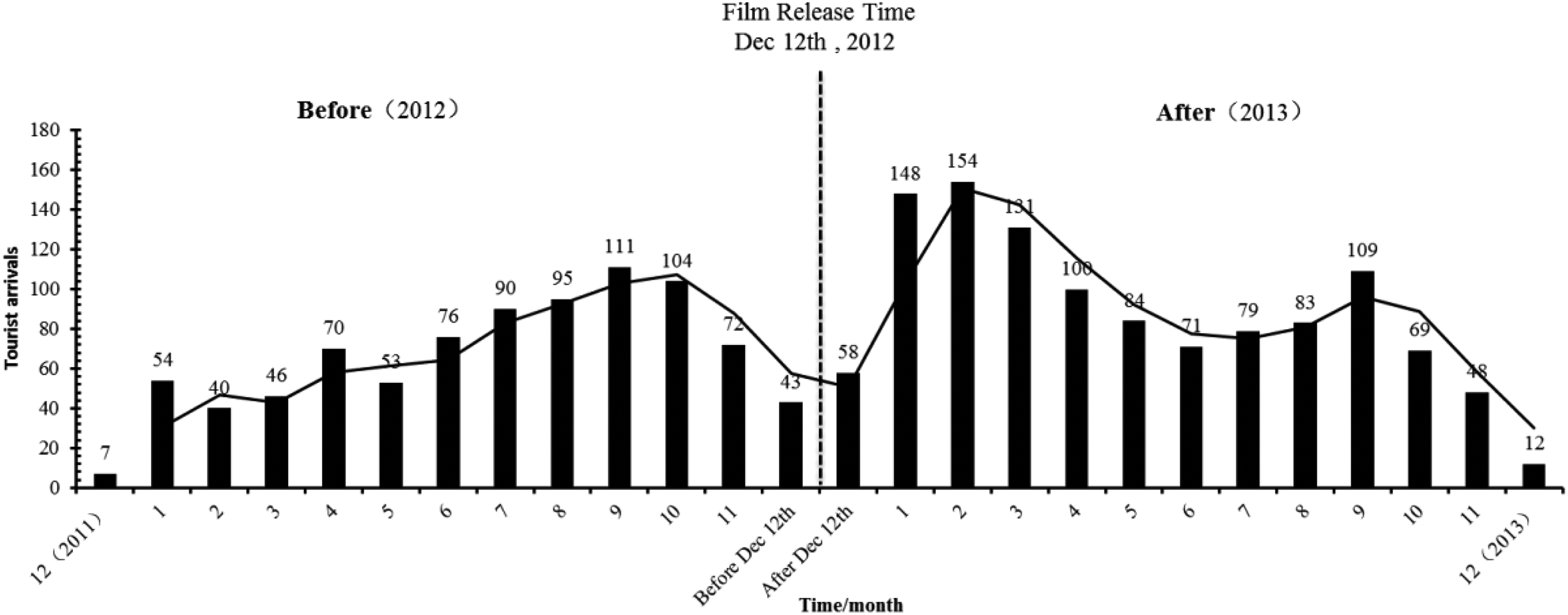
Temporal comparison of tourist volumes before and after the release of Lost in Thailand.
The number of Chinese tourists visiting Thailand increased by 66.4% from the year 2012 to 2013 (Table 1). China Tourism News (2013) reported that Thailand had become the top outbound tourism destination from January to February 2013. According to the Department of Tourism of the Ministry of Tourism and Sports of Thailand (Wang, 2013), the number of Chinese tourists visiting Thailand during the first 3 months of 2013 was 1.12 million—an increase of 93% compared to that in the same period in 2012. China became the first country from which the number of inbound tourists visiting Thailand exceeded one million within 3 months. Anecdotally, data obtained from Tuniu.com indicated that, after the release, the number of people inquiring about or making reservations to Thailand increased by 150% in December 2013 (Fawan, 2013).
Chinese tourists to Thailand from 2009 to 2013.

Source: The Department of Tourism of the Ministry of Tourism and Sports; unit: per 1000 people.
In conclusion, after the release of the film, the seasonality of Chinese tourists to Thailand changed from that of previous years, and the number of tourists increased significantly immediately after the release of the film.
Content analysis of travel blogs
An in-depth examination of the blog content revealed that tourists were also adopting words and phrases from the film in their postings. In December 2012, some tourists began using relevant words and phrases—a trend that peaked during January to February 2013. The frequency and quantity of relevant words to the film title peaked in February. Thus, the impact of Lost in Thailand on Chinese tourists occurred mainly in the first 2 months after its release.
In addition, the analysis also showed that (1) the movie’s name Lost in Thailand appeared among the first 150 high-frequency words; it was mentioned 317 times in the 420 travel blogs analyzed; (2) the filming locations and their surrounding scenic spots have become tourist hotspots in the blogs, such as Pai County; (3) transportation modes in the main filming locations are also frequently mentioned. ‘Motorcycle’ and ‘bicycle’ are the most common self-service tourist transportation method in Chiang Mai. Thus, the film plays a certain role in the travelers’ experience in Thailand.
Anecdotally, as two travel blog authors stated: …After the crazily high box office of the film Lost in Thailand, the volume of Chinese tourists to Thailand has reached an unprecedented height…(York, 2013)
It has to be said that Thailand has been decisively occupied by the Chinese people because of the influence of Lost in Thailand…10 days in Thailand, I feel I have seen more Chinese people than Thai people…(Carine, 2013)
Following Macionis (2004), this research categorized film tourists into three types: specific film tourists, general film tourists, and serendipitous film tourists. Text content analysis was used to extract words and descriptions related to the film (shooting locations, film plots, and film characters) from the travel blogs and then sentences or keywords were extracted from these, such as ‘finally we decided to visit Thailand…my colleagues and I had just finished watching the film Lost in Thailand’ and ‘watched Lost in Thailand, then decided to go to Chiang Mai’.
The results show that more than 22% of tourists were influenced by the film. These include 6% of specific film tourists and 16% of general film tourists. The rest are serendipitous film tourists. These results are in sharp contrast to Busby and Klug (2001)’s report of approximately 9% of tourists to a destination as film tourists and Macaronis (2004)’s result of 4% of total tourists as film tourists. This indicates that this film has had a significant influence on destination choice of Thailand among Chinese tourists.
Analysis of spatial variations
The researchers also sampled an average of 35 travel blogs each month, totaling 420 blog articles. They adopted ROST Content Mining software to analyze high-frequency words and phrases. Thirteen words showed significant changes during the pre- and postrelease periods; seven of these words and phrases were relevant to Lost in Thailand, and most appeared as new high-frequency words and phrases (Table 2). The film title, Lost in Thailand, appeared among the top 150 high-frequency words and phrases, and it was mentioned 317 times. The main forms of transportation in these cities were also frequently mentioned in travel blogs.
Typical changes in high-frequency words after the release of Lost in Thailand.

Note: The symbol ↑ refers to an increase of the number of tourists.
The 2039 travel itineraries included 861 trips during the prerelease period of the film and 1178 for postrelease. They were mapped on cities in Thailand as nodes in the network of destinations. The researchers also found that the surrounding scenic areas of the cities where the film was shot had become new tourism destinations (Table 3). The number of tourists to Chiang Mai and Pai—the main filming locations—demonstrated the greatest increase during the postrelease period: the number of visits increased by around 70% and 250% visits, respectively.
Comparison of tourist arrivals in the main tourism nodes of Thailand.

Note: The symbols ↑ and ↓ refer to an increase and decrease of the number of tourists, respectively.
The spatial node data were employed to construct a bivariate matrix. For example, if one tourist visited Bangkok and then Chang Mai, the value of the row of Bangkok and the column of Chang Mai was increased by one. The authors chose 3 as the cutoff value: the matrix only contains the city pairs where three or more tourists made the sequential visits. The matrix was imported into NetDraw software to construct a directed tourist flow network graph for the pre- and postrelease periods.
Network density and network centrality were calculated to measure the overall network characteristics. First, the number of network modes increased from 15 to 17 and network density increased from 0.058 to 0.092. These indicate an increase in the number of network nodes and a decrease of aggregation level in the whole travel network.
More specifically, a spatial network is a directed network, and the degree of centrality of individual nodes is divided into in- and out-degree centrality. Nodes with high in-degree centrality serve as the clustering nodes in destination networks. Those with a high out-degree centrality serve as diffusion nodes. Nodes with both high in- and out-degree centrality serve as the core nodes (Liu, 2004). Betweenness centrality measures the degree of control of a node on tourist flow and serves as a bridge for communicating with other nodes. Nodes with high betweenness centrality exert higher control over other nodes in the network.
Figure 2 and Table 4 indicate the decline in the central role of Bangkok and the increase of betweenness and centrality of all the other destination nodes. The destination, Pai, shows the most significant change: the connected nodes increased from two in the prerelease period to five in the postrelease period; the betweenness also increased from 0 to 7.5. In addition, an analysis of the bivariate matrix revealed that the destinations of Bangkok, Chiang Mai, Phuket, Pattaya, and Pai formed five pairs of the most frequent tourist flows (Table 5). Variations in tourism flow in Chiang Mai and Pai, which were the main filming locations, possess the most substantial changes—suggesting the film’s significant impact.

Comparison of tourism flow network before and after the release of Lost in Thailand.
Comparison of centrality indicators for the main tourism nodes.

Tourism flow quantity between travel nodes.

Conclusions
The authors employed the film, Lost in Thailand, as a case study for investigating the impact of films on tourist behavior and collected travel blogs from a travel-sharing community. All the evidence shows that the release of Lost in Thailand had an important impact on Chinese tourists to Thailand. Thailand witnessed a large increase in the number of Chinese tourists; some destinations became hotspots and diffusing centers after the release of the film; tourists’ temporal and spatial behavior patterns changed after the film’s release.
The analysis of tourist volumes, as well as high-frequency words and phrases used in travel blogs, indicated that the film exerted a substantial influence on Chinese tourists who traveled to Thailand. The number of tourists, who visited Thailand, increased by 80%. Variations were observed in the high- and low-tourist seasons throughout the year. Among the top 13 highest-frequency words, 7 were related to filming locations, and most of them emerged after the film’s release.
Thus, the results confirmed previous studies in that films can play a significant role in attracting tourists (Beeton, 2006; Butler, 2014; Cohen et al., 1986; Li et al., 2017; Mitchell and Stewart, 2012; Riley and Van Doren, 1992; Riley et al., 1998; Tooke and Baker, 1996). However, this study found that the proportion of tourists affected by the film Lost in Thailand during the study period is more than 22%, significantly higher than the results reported by Busby and Klug, and Macaronis and Sparks (Busby and Klug, 2001; Macionis, 2004). These results indicate that the Chinese film had a significant influence on the choice of destination by Chinese tourists.
This study offers more in-depth analysis on tourists’ behavior than previous research on this topic. Evident spatial clustering effects were observed in tourist flows in Thailand. An analysis of the tourism flow network indicated that the spatial transfer and diffusion capability of filming destinations had increased substantially. After the film screening, the network space of the destination network contained more nodes, and the distribution capacity of each node was more evenly distributed. The transfer control ability of some nodes was enhanced, and the film and television shooting places have a significant agglomeration effect and driving effect on the surrounding regional tourism nodes. The film has motivated travel to the destination and affected tourists’ spatial behavior.
Limitations and future research
This case study falls in the category of a natural experiment in the typology of case studies proposed by Welch et al. (2011). The authors intended to reveal casual relationships between the release of a film and the spatial behavior changes of Chinese tourists. Through a rich array of evidence and data, the casual relationship is highly plausible. However, as a nonexperimental study, the impact of the film is not directly proven. It may take a few studies to prove or at least strengthen this causal relationship. For example, future research could focus on more detailed analysis, for example, researchers can analyze the origins of tourists during different time periods with the corresponding time and place of film release. These analyses could add to the internal validity of the results. In addition, the chosen film is one of the most popular one in recent years and the film location happens to be an attractive and already-popular tourist destinations. Thus, the readers should be cautious in generalizing the significance of the impact of the film.
Another limitation of this study is that we focused on the tourists’ temporal and spatial behavior patterns while paying little attention to other aspects, such as economic and industrial influences, cultural interactions, and environmental impacts. As film tourism is an interdisciplinary research area that involves work from different research fields, future studies may consider various film types using these combined approaches.
Discussions and implications
To put the study in the context of Thailand tourism, the Thai political crisis occurred between November 2013 and May 2014 and overlapped with the study period. The unrest’s impact on the image of the destination should have been enormous (Baidu Encyclopedia, 2018). The impact of the film could have been more significant since tourist volumes started to drop toward the second half of 2013, obviously because of the two crises.
The results of this study show that the full understanding of behavioral changes of film tourists is of practical significance for the film development and tourism promotion. The film Lost in Thailand was very successful with its record-breaking box office. The successful tourism marketing impact of the film is based on the success of the film itself. A successful film has a large audience and can even lead a cultural trend. The tourism image of the film shooting location can be enhanced and reshaped since the film influences its audience. When a destination wants to create a strong and positive destination image through films, it needs to fully investigate its tourism resources and discover destination characteristics.
Through a film, tourists begin to understand the place they are visiting and develop an emotional attachment to the place. The current study indicates that film locations and plots and even lines of dialogue from the film will be repeatedly mentioned by tourists and local residents. As Kim (2012) pointed out, the more emotional involvement an audience develops through viewing media programs, the greater the likelihood of them visiting film tourism locations. Thus, tourists receive a better emotional experience. The experiences of service in films also promote the tourism experience.
After films have been well-received, tourist destinations should adopt marketing strategies to further enhance the attraction of the destination, such as adopting offline communications, hiring the actors and actresses in the film as tourism ambassadors, and expanding tourist infrastructure around the film shooting sites. Thus, studying film tourists’ spatiotemporal behavior through Internet platforms has important guiding significance for tourism destination development and tourism marketing.
Footnotes
Declaration of conflicting interests
The author(s) declared no potential conflicts of interest with respect to the research, authorship, and/or publication of this article.
Funding
The author(s) disclosed receipt of the following financial support for the research, authorship, and/or publication of this article: This work was supported by the National Natural Science Foundation of China under grant number 41571135 and Key Research and Development Program of Shaanxi under grant number 2019ZDSF07-04.
