



Abstract
Despite mixed emotions about COVID-19 vaccination as a precondition for international travel, COVID-19 vaccination is being advocated as one of the instruments that could facilitate safe free movement during the COVID-19 pandemic. Accordingly, the purpose of the present research is to distinguish the underlying mechanisms that could predict individuals’ intentions to take the COVID-19 vaccine as a precondition for international travel. The conceptual framework was built on the extended theory of reasoned action (TRA), which incorporates mass media coverage, travel motivations, and previous travel experience. An online purposive sampling technique was utilized in this study, and 1188 responses were collected. Subsequently, structural equation modeling was utilized to test the proposed model. The originality of the present study lies with unraveling the mechanisms that affect the intention to take the COVID-19 vaccine as a precondition for international travel. In addition, the discussions are presented in subsequent sections of the paper.
Keywords
Introduction
The COVID-19 pandemic is changing the fabric of modern society, while travel and leisure as important threads are fraying (Huo, 2021; Liu-Lastres et al., 2021). Tourism, which is the world's third-largest export category, is experiencing annihilation (Chi et al., 2021; Qi and Li, 2021). Due to the COVID-19 pandemic, government-enforced lockdowns led to a loss of USD 1.3 trillion in export revenues as international arrivals dropped 74% compared to 2019 (UN World Tourism Organization, 2021a). In 2021, various attempts to restart international travel on a global scale have been unsuccessful thus far due to the consecutive COVID-19 waves (Cher et al., 2021). Even though the COVID-19 vaccine is not a silver bullet that will end the COVID-19 pandemic and reboot international travel (Teo, 2020), a growing number of countries are easing international travel restrictions for individuals who have been vaccinated against COVID-19 (Baran, 2021). Moreover, in recent studies on the impact of the COVID-19 pandemic on cruise tourism, a mandatory COVID-19 vaccination as a precondition to resume cruise operations was strongly recommended (Radic et al., 2021a; Radic et al., 2021b), which is outlined in the Centers for Disease Control and Prevention (CDC)'s technical guidance for the cruise ship operator's phased-in approach to a large degree (CDC, 2021a). However, implementing regulations that allow free movement without any travel restrictions for individuals who have been COVID-19 vaccinated can cause discriminatory consequences (Phelan, 2020).
Mandatory vaccination as a precondition to travel is strongly advocated in many countries across the globe (Radic et al., 2021a). However, there is a lack of knowledge, understanding, and perception of an individual's intention to take the COVID-19 vaccine as a precondition for international travel. To the best of the authors’ knowledge, only one empirical study was conducted that relates to the individual's intentions. In a recent study, Radic et al. (2021a) concluded that the ascribed responsibility to adopt emotionally driven pro-social behavior is affected by the awareness of consequences. Furthermore, the authors outline that ascribed responsibility positively affects the personal norm towards altruistic and pro-mandatory vaccination-friendly behavior (Radic et al., 2021a). The study by Radic et al. (2021a) is founded on one premise of the extended Norm-Activation Model (NAM model). Accordingly, certain aspects of travel behavior, such as previous travel experience, travel motivation, attitude toward behavior, and subjective norm were not taken into consideration.
The study described here aims to broaden and deepen the knowledge, understanding, and perception of the intention to take the COVID-19 vaccine as a precondition for international travel. In addition, this research intends to extend the Theory of Reasoned Action (TRA) (Ajzen and Fishbein, 1980) by examining the interrelatedness between previous travel experience and the intention to take the COVID-19 vaccine as a precondition to travel, the relationship between mass media coverage and the motivation to travel, and the attitude toward behavior. In this regard, the following research question is generated:
What are the mechanisms affecting the intention to take the COVID-19 vaccine as a precondition for international travel?
In pursuit of expanding the academic literature on the topic of behavioral intentions towards traveling amidst the COVID-19 pandemic, the authors propose four main research objectives, which includes (1) testing if the TRA could explain the intention to take the COVID-19 vaccine as a precondition for international travel, (2) analyzing the effect of mass media coverage and the travel motivation on the attitude toward a COVID-19 vaccine certificate, (3) exploring the effect of previous travel experiences on the intention to take the COVID-19 vaccine as a precondition to travel, and (4) unearthing the moderating role of gender. The present research provides a valuable theoretical contribution, which is to the best of the authors’ knowledge, the intention to take the COVID-19 vaccine as a precondition for international travel is still a vastly unexplored topic. Lastly, this study can be beneficial because it provides practical implications for the policymakers to promote the COVID-19 vaccination rate followed by COVID-19 vaccine passports/certificates for international travel, thereby contributing to the restart of international travel.
Literature review
Theoretical background
This study builds on the seminal work of Martin Fishbein and his well-known expectancy-value model that was founded on the theory of attitude, which has managed to progress into what is today known as the TRA due to its wide acceptance. The TRA is a conceptual framework suitable to explain, foresee, and impact individuals’ behavior under complete volitional control (Ajzen, 2012). The theoretical framework of the TRA does not assume the complete rationality of human beings, but it contemplates that people are both deliberative and spontaneous during their decision-making process (Han, 2021). Furthermore, Fisbein and Ajzen (2011) argue that the behavioral intentions of human beings start from their beliefs, which evolve through rational, orderly, and often unconscious fashions towards the creation of the cognitive base of attitude toward behavior and the subjective norm toward behavior. Attitude refers to a positive or negative assessment of a specific behavior (Abrahamse and Schuitema, 2020). The individuals’ subjective norm is her/his perception of social pressure that is related to her/his significant other or the designated social group that she/he belongs to (Van Raaij, 2016).
Considering the foundations of the TRA, we argue that once an intention towards taking the COVID-19 vaccine is shaped under the direct influence of attitudes and the subjective norm (Radic et al., 2021a; Ward et al., 2020) with substantial assurance, it can be expected that based on suitable conditions, such as the availability of the COVID-19 vaccine, the behavior of interest will be initiated. Moreover, Hu et al. (2021) argue that Chinese citizens’ positive attitude towards the acceptance of the COVID-19 passport was influenced by national pride and loyalty, while the subjective norm has a positive effect on acceptance of COVID-19 passport due to Chinese citizens collectivistic orientation. Similarly, Garrett et al. (2021) conducted the study in regards to COVID-19 passport acceptance across Australia, Japan, Taiwan, Germany, Spain, and the United Kingdom – during the 2020 COVID-19pandemic. The authors concluded that attitudes towards the COVID-19 passport were moderate-to-low, ranging from 51% in the UK and Germany down to 22% in Japan (Garrett et al., 2021). Furthermore, Hall and Studdert (2021), in their study on 1315 U.S. respondents, discovered that 45.2% of participants had a positive attitude towards the COVID-19 passport acceptance; however, only gender showed significant differences where analyzes demonstrated less support among women. In the aforementioned study, other socio-demographic factors such as age, political orientation, and employment status did not significantly affect attitude towards the COVID-19 passport acceptance (Hall and Studdert, 2021). Looking at the subjective norm, the collective experience of previous epidemics was the driving force behind the subjective norm's positive effect on COVID-19 passport acceptance for people from South Korea and Hong Kong (Huang et al., 2021).
Similarly, vaccine passports are not a novel idea in Africa; hence, people of Africa have a strong belief in regards of subjective norm and robust motivation to comply with COVID-19 passports, as they understand that it is a pathway to open the economy and return to normal life (Chitungo et al., 2021). The positive effect of travelers’ attitude and subjective norm on COVID-19 passports was influenced by the International Air Transport Association (IATA) Travel Pass Initiative, a mobile app that can receive and verify COVID-19 digital vaccines certificates (IATA, 2021). Furthermore, COVID-19 vaccine certificates will cover 74 countries, representing 85% of global traffic, by the end of November 2021 (IATA, 2021). Hence, it appears that international travelers’ positive attitude and subjective norm towards COVID-19 passports are evident as there is a surging number of travelers utilizing these COVID-19 passports for international travels and visits to tourist attractions and restaurants (UN World Tourism Organization, 2021b).
Hypothesis development
Mass media coverage, travel motivation, and attitude
Mass media is an instrument of the mass communication process, which intends to inform, interpret, entertain, educate, and sell (Hiebert and Gibbons, 2017). In this study, the mass media coverage construct is founded on the multi-step flow theory. The multi-step flow theory proposes that ideas flow from the mass media to the opinion leaders who further deliver the information to a broader population (Katz and Lazarsfeld, 1955). Looking at the COVID-19 pandemic, the function of mass media is of the utmost importance (Hussain, 2020). Mass media plays a critical role in delivering the public message through a stream of communication that guides the audience's attitude towards the COVID-19 vaccination (Wang et al., 2020) and their attitude towards a COVID-19 vaccine certificate (Spisak and McNulty, 2021). Reiter et al. (2020) argue that public opinion leaders influence attitudes towards accepting the COVID-19 vaccine. The authors mentioned earlier concluded that the communications context must transparently address the vaccine efficacy issues for the populations ready to receive the COVID-19 vaccine while mitigating the concerns about the vaccine side effects for the people who are less prepared to be vaccinated (Reiter et al., 2020).
Similarly, Deshpandé et al. (2021) argue that the public opinion leaders, influencers, celebrities, governments, and health authorities possess a pivotal influence on the people's attitudes towards the COVID-19 vaccination and the COVID-19 vaccine certificates. Hence, the public opinion leaders’ engagement through mass media can educate people and therefore reduce uncertainty and ambiguity, strengthen social responsibility and solidarity, and inspire the fear of a missed opportunity (FOMO) of the personal and social benefit of being COVID-19 vaccinated and having a COVID-19 vaccine certificate for travel purposes (Deshpandé et al., 2021). Accordingly, Xi Jinping, the President of China, stated that China would use its COVID-19 vaccines as a global public product for the worldwide community and the benefits of humanity (Zhou, 2020). Based on this philosophy, Xi Jinping, the President of China, has announced that COVID-19 vaccines developed by China will be used as a global public product. Lastly, people rely on mass media and opinion leaders to provide them with valuable information, so they can be well-informed citizens who are confident to take their destinies into their own hands (Hiebert and Gibbons, 2017).
Travel motivation combines forceful internal psychological factors that can cause anxiety and disbalance within individuals (Crompton and McKay, 1997). This study adopted the push and pull theory and the cognitive dissonance theory as cornerstones for the travel motivation construct. The theory of push and pull motivation for travel was introduced by Dann (1977). Its essence relies on two factors: push factors that motivate people to travel and pull factors that encourage people to travel. The cognitive dissonance theory relates to the condition created when people develop ways to reduce their discomfort after facing specific facts that challenge their beliefs, principles, and thoughts (Festinger, 1957). In a recent study by Radic et al. (2021a), the authors concluded that even though international travelers would accept the COVID-19 vaccination followed by a COVID-19 vaccine certificate as a precondition for international travel, they feel agitated due to being stripped of the freedom of choice. Government-declared travel bans and introducing a COVID-19 vaccine certificate in Denmark created uncomfortable feelings for some people induced by cognitive dissonance. They caused 600 angry citizens to take to the streets of Copenhagen (Euronews, 2021). Similarly, more than 200,000 people in the UK signed a petition urging the government not to introduce COVID-19 vaccine passports as a precondition for British public travelers. This decision would create a two-tier society (BBC News, 2021). In recent studies on the scientists’ attitudes towards COVID-19 immunity passports conducted among 12,738 participants, Aranzales et al. (2021) pointed that out that only 19.1% of participants disagreed that immunity passports would be suitable for public health, and 15.4% of participants disagreed that immunity passports would be beneficial to the economy. 36.5% of the participants raised concerns about immunity certification over fairness to others, and 45.5% raised concerns regarding the social inequality that could be created by immunity certification (Aranzales et al., 2021).
Similarly, while citizens of India are craving for international travel, they also openly protest, oppose and stand firm on their stance against the idea of COVID-19 vaccine certificates (Kapur, 2021a). It could be arguable that the COVID-19 crisis is a “Black Swan” (Taleb 2010) event for international travel and tourism, as the COVID-19 crisis is an unpredictable incident beyond the normal, coupled with severe consequences. Moreover, when travel motivation cannot be fulfilled due to mandated COVID-19 certificates, travelers might experience various forms of distress, confusion, fear, despair that could lead to unusual behavior. This is supported by Foucault et al. (1991), who argue that governmentality as a system of power within society could change individuals’ previously held attitudes. Subsequently, obstructed motivation could also lead to change of previously held attitude (Lacan, 2009). Hence, a contradictory process between travel motivation and attitude towards behavior is possible in the event with great rarity and extreme impact. This is supported by Hegel (1807)'s dialectics, where opposing sides are in different relationships of logical concepts. As a result, the following hypotheses were postulated.
Attitude and behavioral intentions
Attitude is a sentiment and opinion towards the approval or disapproval of certain things (Liao et al., 2021). Crane et al. (2019) conclude the attitude-behavior gap is distinguished by the disjoint between the individuals’ expressed ethical issues and their genuine behavior. The importance of the attitude concerning behavioral intentions amid the COVID-19 pandemic was outlined by Han et al. (2020). They argue that government and tourism officials hold decisive roles in delivering information related to the perceived knowledge of COVID-19, which guides travelers’ decisions to choose safe travel options (Han et al., 2020). Furthermore, a positive attitude towards the hedonic consumption of leisure and hospitality products, which are combined with a craving for pleasurable social interactions and escapism from the unbearable toll of the COVID-19 pandemic, holds significant influence on the acceptance of the COVID-19 vaccination and a COVID-19 vaccine certification (Radic et al., 2021c). Piccinelli et al. (2021) argue that air travelers’ attitudes are changing during the COVID-19 pandemic, and to avoid unpleasant feelings that are related to flight cancelations and issues with air ticket compensations, air travelers might comply with a COVID-19 vaccination certificate to ease their travel anxieties (Piccinelli et al., 2021).
Gursoy et al. (2020) noticed that approximately 14% of customers would feel more comfortable patronizing a sit-down restaurant. About 17% of customers would travel to a destination and stay at a hotel after the COVID-19 vaccine becomes available to them. In a recent study by Hu et al. (2021), the authors have outlined that the Chinese people have a robust positive attitude towards accepting COVID-19 passports due to personal benefits and intense nationalism. Similarly, the positive attitude towards a COVID-19 vaccination certificate was discovered in a recent survey in Israel where Avraham (2021) outlines that among the 21% of the respondents who did not intend to be vaccinated soon, 31% of them said they would possibly or could be persuaded to get vaccinated due to the benefits associated with the Green Pass, which led to positing the following hypothesis.
Subjective norm and behavioral intentions
Subjective norm is the perceived social pressure to accomplish or not to accomplish specific behavior (Gosetto et al., 2020). It is reflected through individuals’ social influence norms and self-representation norms (Brouwer, 2018). People grasp onto the normative beliefs of their partner, appointed social groups, government officials, and general practitioners who possess the authority to affect their subjective norm (Radic et al., 2021c). The subjective norm significantly mediated the behavioral intention towards non-contact tourism in South Korea during the first wave of the COVID-19 pandemic (Bae and Chang, 2020). Furthermore, the subjective norm was influenced by the cognitive risk perception from the social pressure to conform to the social norm (Bae and Chang, 2020). Accordingly, Chu and Liu (2021) argue how individuals’ social groups positively influence the intention to take the COVID-19 vaccine. Furthermore, they outline that government public health campaigns have a robust positive effect on the individuals’ subjective norms if they are transparent regarding the COVID-19 vaccines’ safety and effectiveness (Chu and Liu, 2021).
In a recent survey conducted by the Business Traveler Sentiment Survey, the subjective norms of business travelers showed a positive effect on their intention to take the COVID-19 vaccine, and 39% of business travelers believe that vaccination is of the utmost importance for traveling (Clarke, 2021). Similarly, there is a growing belief shared internally and externally across various communities around the globe that if people take the COVID-19 vaccine, their life will return to normal to some degree, and they will be able to travel (Markowitz, 2021). This type of belief is positively affected by the social pressure from governments. For example, the CDC (2021b) has recently announced that fully vaccinated people can freely resume international travel. Also, they do not need to get tested before international travel unless it is required by the destination or self-quarantine once they arrive back in the United States. Looking at China, a study by Hu et al. (2021) revealed that nationalism and collectivism-oriented values were driving forces behind the individuals’ subjective norm related to COVID-19 passports, where the subjective norm further positively influenced the COVID-19 passports acceptance. Based on a review of the academic literature and the relevant empirical studies, the authors proposed the following hypothesis.
Previous travel experience and behavioral intentions
The topography of the human experience relates to the profoundly transformative understanding of the nature of one's consciousness (Harris, 2015). Human beings crave experiences, and leisure and travel products provide them with the changes that awaken something deep inside them. Accordingly, travel experiences encompass learning, enjoyment, escapism, and the visual astonishment of sophisticated travelers during their dynamic interactions with places and local cultures (Kolb, 2017). This study adopted the experience economy theory as a foundation for the previous travel experience construct. The experience economy was introduced by Pine and Gilmore (1999). The experience economy theory is based on the four realms of experience, including education, escapism, aesthetics, and entertainment, providing the sweet spot for a transformative experience in a perfectly balanced composition. People recall through feelings, so the travel experience offers valuable memories, whereas the authenticity of the memories lies in the strength of the experienced emotions (Radic et al., 2021b).
A recent study by Shayak et al. (2021) argues that if at least 80% of the people in specific populations are COVID-19 vaccinated, the location would immediately open the avenues for the preferential relaxation of travel restrictions for the vaccinated people with that particular population. Accordingly, Smith-Schoenwalder (2021) noticed that more and more people are taking the COVID-19 vaccine due to this type of behavior, providing them with the window of opportunity towards a return to normalcy and benefits such as comfortable international travel. The effects of previous travel experiences regarding the behavioral intention to take the COVID-19 vaccine are supported by Read (2021). Read recognizes what may be the new normal for vaccination vacations. For example, Seychelles is open only to travelers who have been fully COVID-19 vaccinated and possess a COVID-19 vaccine certificate. Time is the most precious commodity in the universe (The Wachowskis, 2015) and making up for a lost time while engaging in vacation retaliation drives catchphrases, such as revenge travel (Farr, 2021). The recent data shows that 1.357 million people passed through US airports, which marks this day as the highest single-day tally since the World Health Organization declared the COVID-19 pandemic in March 2020 (Read, 2021). The urge for travel led many vaccinated Chinese higher-end travelers to restart their overseas travel planning (Chen et al., 2021), while the search for international travel by vaccinated travelers from India is experiencing exponential growth (Kapur, 2021a, 2021b). Consequently, the following hypothesis is proposed.
Moderating role of gender
Gender is socially established where societies determine the definition and meaning of gender (Carroll, 2019). In this study, the gender construct is founded on Bem (1981)'s gender schema theory, which proposes that individuals’ knowledge about gender is accumulated through her/his development, where each stage of development is culturally determined. Thus, opinion leaders can reshape citizens’ attitudes, but their effectiveness differs between male and female audiences (O’Brien and Piscopo, 2019). Moreover, while opinion leaders impact an individuals’ attitude towards the COVID-19 vaccine and a vaccine certificate (Green et al. 2021), an individual's gender shows a robust moderating influence on their attitude towards the COVID-19 vaccine and a vaccine certificate (Funk and Tyson, 2021). Accordingly, for the COVID-19 vaccination/certification campaign to be successful, Di Resta et al. (2021) suggest that the opinion leaders should strengthen gender equality in their COVID-19 vaccination/certification campaigns.
Travel motivation is equally strong among all human beings regardless of travelers’ gender (Fan et al., 2021). However, Wenham (2021) argues that travelers’ gender poses a strong moderating effect on the attitude towards a COVID-19 vaccine certificate because this type of certificate would narrow the women's public possibilities and strengthen gender norms. Similarly, Mudge (2021) outlines that a travelers’ attitude towards a COVID-19 vaccine certificate is moderated by gender, as pregnant women might be excluded if this type of certificate was introduced. Furthermore, Latkin et al. (2021) and Baum et al. (2021) argue that gender holds a strong moderating impact on the attitude towards a COVID-19 certificate and the behavioral intention to take the COVID-19 vaccine. Furthermore, Latkin et al. (2021) state that the female gender demonstrates a superior behavioral intention to take the COVID-19 vaccine. In contrast, Baum et al. (2021) demonstrate that men (31%–39%) are more supportive of the COVID-19 vaccine passports than women (19%–25%).
Family, friends, and significant others are influential in shaping individuals’ subjective norm, which poses a robust influence that favors the COVID-19 vaccination uptake (Zhang et al., 2021). Furthermore, in a recent meta-analysis of large nationally representative samples on the intended uptake and the refusal of COVID-19 vaccines, Robinson et al. (2021) outline that gender has a strong moderating effect between individuals’ subjective norm and their uptake and refusal of the COVID-19 vaccines. In addition, previous travel experiences affect the behavioral intention to take the COVID-19 vaccine with individuals who wish or need to travel abroad (Power, 2021). Moreover, previous travel experiences are moderated by gender (Radic et al., 2021b) because women show a favorable behavioral intention to take the COVID-19 vaccine under the influence of past travel experiences (Steinhauer, 2021). Consequently, the authors postulate the following hypotheses.
Figure 1 presents the theoretical framework for this study.

The conceptual model based on extended theory of reasoned action model (TRA).
Methods
Research design
This study adopted a post-positivistic paradigm, which Barnes (2019) argues is suitable for temporary interconnections within the set of truths, and it can be quantitatively estimated and explored. The post-positivistic paradigm is ideal for social science because it characterizes well-grounded social conduct models and elucidates them with reference to the interpretation and the motivation of the people of interest (Gamlen, 2019). The action research strategy was adopted in this study because it is suitable to address a knowledge gap in the research literature (Manfra, 2020). A cross-sectional survey and covariance-based structural equation modeling (CB-SEM) were applied to evaluate the research model. CB-SEM is an extension of the concept of the multiple regression method (Akgül, 2019), and it is a suitable instrument to evaluate and support the current theories and the comparisons of the different theories (Hair et al., 2017). Summarily, this study used a deductive approach accompanied by a cross-sectional time horizon and quantitative data collection techniques.
Sampling and data collection procedure
The data was collected via the self-administrated online survey cloud-based software between December 2020 and January 2021 to assess travelers’ behavioral intention to take the COVID-19 vaccine as a precondition for international travel. A purposive sampling technique was applied in this study. Ricci et al. (2019) argued that purposive sampling techniques could comprehensively interpret the research question. The possible participants were invited to participate in the survey via various social media groups, shown in Table 1.
List of social media groups from where participants were recruited.

A short explanatory section was included in the survey to introduce the potential participants to the purpose of the study. Once the participants acknowledged the purpose of the study and chose to agree, they became eligible to continue with the screening question of the questionnaire. Also, the purpose of the screening question was to verify only the tourists who had traveled internationally before the COVID-19 pandemic. Therefore, a nominal scale, which included yes or no, was used to assess the following question that was presented to the participants:
Have you traveled internationally in the last 24 months?
A total of 1188 completed questionnaires were collected, and the average time taken by respondents to complete each questionnaire was 8 min.
Measures
The self-administered survey questionnaire was comprised of five multiple item constructs and one dual item construct. While it is true that in the confirmatory factor analysis (CFA), it is advisable to have at least three items per factor, scales with more than one factor may be identified with as little as two items per factor (Meredith, 1993; Raubenheimer, 2004). For constructs that are narrowly defined, such as mass media coverage, in the case of our study, growing evidence suggests that even single-item measures may suffice (Bergkvist and Rossiter 2007; Wang et al. 2019). The scale items used to assess the study variables were adopted from the validated measurement items found in the current literature. Also, all the measurement items were assessed using a 5-point Likert scale except for attitude, which was evaluated using a 7-point Likert scale, since Podsakoff et al. (2012) argue that removing the common scale properties will mitigate the common method bias.
The measurement items for the constructs of the TRA, attitude, and subjective norm were adopted and slightly adjusted from the Han et al. (2020) scale, and the intention to take the COVID-19 vaccine before international travel was adopted from the Radic et al. (2021a) scale. The mass media coverage construct with two measurement items was adopted from the Juschten et al. (2019) scale. The travel motivation with six items was measured with a scale that was taken from Bayih and Singh (2020). In contrast, the previous travel experiences with four items were measured using a scale from Manthiou et al. (2014). The shared variance, which is the common method variance, among the measured constructs that could result from applying the common assessment method was minimized by following the guidelines of Griga (2017), which included the questionnaire should be designed and tested objectively to maximize motivation and reduce the task difficulty. The questions that are related to the variables should be separated into different question blocks. Furthermore, the method of Elman et al. (2020) was used to avoid the replication of the hypothesis structure by following a robust statistical procedure.
Data screening
Before analyzing the collected data, a data screening was conducted to detect the outliers. First, the univariate outliers were checked using the z-scores that exceeded an absolute value of 3.29, and no univariate outliers were detected. Second, the multivariate outliers were scanned using the Mahalanobis distance (MD) and the data, so the probability of having an MD that was below 0.001 was removed (MD (25) > 62.505, and p < 0.001). Lastly, the common method variance (CMV) was tested by conducting a Harman's single-factor analysis and common latent factor analysis (Podsakoff et al., 2003). The results revealed that the total variance was less than 50.00%. Furthermore, there was no difference between the confirmative factor analysis with the common latent factor and without the common latent factor. Thus, the common method variance may not be a critical issue in this study. After the data screening, 1188 responses from the data collection were used for further statistical analysis.
Results
Results of the demographic information
The analysis results from the demographic information show that 48.5% of the respondents were male and 51.5% were female, which indicates that data was evenly collected from both genders. In terms of the age groups, over 70% of the respondents were between 20 and 40 years old. Most of the respondents have a university-level education, including 16.3% of the respondents with graduate degrees. Lastly, the data was collected from various places, which ensured the generalizability of the sample population. In detail, over 20% of the respondents were from America, almost 10% were from Europe, over 50% were from Asia, and nearly 20% were from Africa. Table 2 shows the results of the demographic information.
The results of demographic information (n = 1188).

Results of the measurement model
In this study, lavaan, which is an R package for structural equation modeling, was utilized as a data analysis tool to test the proposed model (Rosseel, 2012). In detail, a covariance-based structural equation modeling (CB-SEM) with a maximum likelihood (ML) estimation method was used. CB-SEM is an extension of the concept of the multiple regression method (Akgül, 2019). It is a suitable instrument to evaluate and support the current theories and comparisons of the different theories considering that using CB-SEM is to test a theory by specifying a theoretical model with the appropriate observed variables (Hair et al., 2017). The first phase is the test of the measurement model, which allows the examination of the relationships between the latent variables and the measurement items and ensures that the proposed model and the data fit into the researcher's understanding of the theory (Kline, 2016).
The measurement model was first evaluated to determine how well the indicators represent the theory-based latent variables. The indicator reliability was checked to ensure the proportion of indicator variance explains well the latent variables. While there is no universal cut-off, the standardized factor loading values should be higher than 0.70 to meet convergent validity criteria and be less susceptible to Heywood cases (Kline, 2016). Item 3 in motivation travel was removed from the model because it appeared to have a low factor loading (λ = 0.647).
The measurement model was tested again without item 3, and the results of the goodness-of-fit indices indicate that the global fit of the model is satisfactorily acceptable (χ2 (174) = 663.024, p < 0.001, RMSEA = 0.049 [0.045,.053], CFI = 0.981, TLI = 0.977, and SRMR = 0.021). The local fit of the model also indicates that all the standardized factor loadings are greater than 0.700, which ranged from 0.781 to 0.955.
The validity and reliability were tested next to check the quality of the data, which ensures the accuracy and consistency of the measurement items and latent variables. The validity was checked by calculating the value of the average variance extracted (AVE). Fornell and Larcker (1981) recommend that AVE values exceed the minimum value of 0.50 to meet convergent validity. In addition, the square root of AVE should be greater than its highest correlation with other constructs to fulfill discriminant validity. The results show that AVE values range from 0.689 to 0.866, which meets the recommended criteria, and all the square root of AVE also exceed the pairs of correlations. Next, the internal consistency of the measures was checked using Cronbach's alpha and the composite reliability (CR). All the values were greater than the recommended cut-off of 0.700, ranging from 0.846 to 0.965 (Bagozzi and Yi, 1988). Based on these values, the reliability and validity of the construct measures are supported. In other words, the measurement model successfully represented the researcher-generated theory. Table 3 and Table 4 indicate the details of the measurement model.
The results of measurement model (n = 1188).

Note. All factor loadings are statistically significant at p < .001; MOT3 is deleted due to low factor loading (λ = .647).
The results of model fit and factor correlations (n = 1188).

Note 1. All correlations are statistically significant at p < .001.
Note 2. Goodness-of-fit indices: χ2 (174) = 663.024, p < .001, RMSEA = .049 [.045,.053], CFI = .981, TLI = .977, SRMR = .021.
Note 3. MCO = Mass media coverage; MOT = Motivation to travel; ATT = Attitude toward the behavior; SUN = Subjective norm; PTE = Previous travel experience; BHI = Behavioral intentions.
Results of the fully latent structural regression model
The structural model tested the structural relationships between the variables, which included the hypotheses. Before identifying the results of the hypotheses testing, the global fit of the model indicated that the model possessed acceptable results (χ2 (176) = 1852.424, p < 0.001, RMSEA = 0.090 [0.086, 0.093], CFI = 0.935, TLI = 0.923, and SRMR = 0.148). Moreover, 84.5% of the variance in the behavioral intentions is successfully explained by the predictors.
The results from the parameters in the structural path indicate that mass media coverage has a positive influence on attitude toward behavior, which supports Hypothesis 1 (H1: β = 0.523, and p < 0.001). Motivation to travel negatively affected attitude toward behavior (H2: β = - 0.199, and p < 0.001). Thus, Hypothesis 2 is supported. The results also illustrate that attitude toward behavior (H3: β = 0.434, and p < 0.001) and subjective norm (H4: β = 0.701, and p < 0.001) positively influenced behavioral intention. Therefore, Hypothesis 3 and Hypothesis 4 are supported. Lastly, previous travel experiences significantly affect behavioral intention (H5: β = 0.137, and p > 0.001), which supports Hypothesis 5. Table 5 shows the results of the fully latent structural regression model.
The results of fully latent structural regression model (n = 1188).

Note 1. *p < .05, **p < .01.
Note 2. Standardized values are in parentheses.
Note 3. Goodness-of-fit indices: χ2 (176) = 1852.424, p < .001, RMSEA = .090 [.086,.093], CFI = .935, TLI = .923, SRMR = .149.
Note 4. Total variance explained (R2): ATT = .268; BHI = .845.
Note 5. MCO = Mass media coverage; MOT = Motivation to travel; ATT = Attitude toward the behavior; SUN = Subjective norm; PTE = Previous travel experience; BHI = Behavioral intentions.
Lastly, a multi-group analysis was conducted to identify the moderating effect of gender in the proposed model. The multi-group analysis consisted of two steps, including a measurement invariance test and a structural invariance test Testing for measurement invariance is essential in a multi-group analysis to ensure that the indicators and constructs share the same meaning in the different groups (Kline, 2016). The data were divided into two groups, which include the male and female groups.
In detail, the goal of the measurement invariance is to meet the equality of the unstandardized loadings, intercepts, and residual across the groups, and there are four sequential steps to achieve its goal. The first step tests the configural invariance, so each group is tested without restriction. The results show that the configural invariance is achieved with a satisfactory model fit (χ2 (348) = 1018.591, p < 0.001, RMSEA = 0.057 [0.053, 0.061], and CFI = 0.974).
The next step is to establish the metric (weak) invariance, constraining the factor loadings to be equal across the groups and comparing the chi-square difference to the configural model. The results indicate that the metric invariance is achieved with a satisfactory model fit (χ2 (363) = 1026.196, p < 0.001, RMSEA = 0.055 [0.051, 0.059], and CFI = 0.974), and there is no significant chi-square difference between the two invariance models (Δ 7.605 (15), and p > 0.05). Thus, the metric invariance is supported.
The third step is to build the scalar (strong) invariance, which constrains both factor loadings and intercepts across the groups and compares the chi-square difference to the metric invariance. The results show that scalar invariance is achieved with a satisfactory model fit (χ2 (378) = 1041.480, p < 0.001, RMSEA = 0.054 [0.050, 0.058], and CFI = 0.974), and there is no significant chi-square difference between the two invariance models (Δ 15.284 (15), and p > 0.05). Thus, the scalar invariance is supported.
The last step in the measurement invariance test is to establish the strict invariance, which constrains the factor loadings, intercepts, and residuals across the groups and compares the chi-square difference to the scalar invariance. The results show that the strict invariance model shows a satisfactory model fit (χ2 (399) = 1176.198, p < 0.001, RMSEA = 0.057 [0.053, 0.061], and CFI = 0.970), but there is a significant chi-square difference between the two invariance models (Δ 134.72 (21), and p < 0.001). To meet the strict invariance, eight residuals are released, which include e1, e2, e6, e14, e15, e16, e20, and e21, to be free by using the Lagrange multiplier (LM) test, which is a function of finding the equality constraints by comparing the fit of the restrictive to the less restrictive models. The results indicate that the partial strict invariance is achieved with a satisfactory model fit (χ2 (391) = 1061.815, p < 0.001, RMSEA = 0.054 [0.050, 0.058], and CFI = 0.974), and there is no significant chi-square difference between the scalar and the partial strict invariance models (Δ 19.336 (13, p > 0.05). Thus, the measurement invariance is supported.
Finally, the structural invariance was tested to identify the moderating effect of gender in the proposed model. The structural model with partial strict invariance was first tested without constraints in the structural paths. The results show that the model possesses an acceptable fit (χ2 (395) = 1914.342, p < 0.001, RMSEA = 0.080 [0.077, 0.084], and CFI = 0.941). The unconstrained model was then compared to the model where all the structural weights were constrained to be equal. The constrained model also contains an acceptable fit (χ2 (402) = 2276.861, p < 0.001, RMSEA = 0.089 [0.085, 0.092], and CFI = 0.927), and there is a significant chi-square difference between the two structural invariance models (Δ 362.520 (7), and p < 0.001). Thus, the moderating effect of gender is supported by proving the significant structural invariance between the two groups. Table 6 summarizes the results of the measurement and the structural invariance model for the gender group.
Results of measurement and structural invariance model for gender group (n1 = 576, n2 = 612).

Note 1. Eight residuals are released (e1, e2, e6, e14, e15, e16, e20, e21).
Note 2. n1 = male, n2 = female.
Each pair of structural parameters was compared to the structural model without constraints in the structural paths to identify what structural path possesses the moderating effect. The results indicate that the influence of mass media coverage on attitude toward behavior is significantly moderated by gender (H6a: Δ 308.86 (1), p < 0.001), which supports Hypothesis 6a. Even though the moderating effect by the chi-square difference is not found in other paths (p > 0.05), noticeable differences in the relationships between the attitude toward behavior and the behavioral intentions and between subjective norm and the behavioral intentions are found based on the structural path analysis. Furthermore, there was stronger predictability in the female group than in the male group with both relationships, insinuating meaningful differences between the two groups. In summary, the result of the multi-group analysis corroborates the difference between the male and female groups. Table 7 shows the results of the multi-group analysis for the gender group, and Figure 2 shows the structural model results.
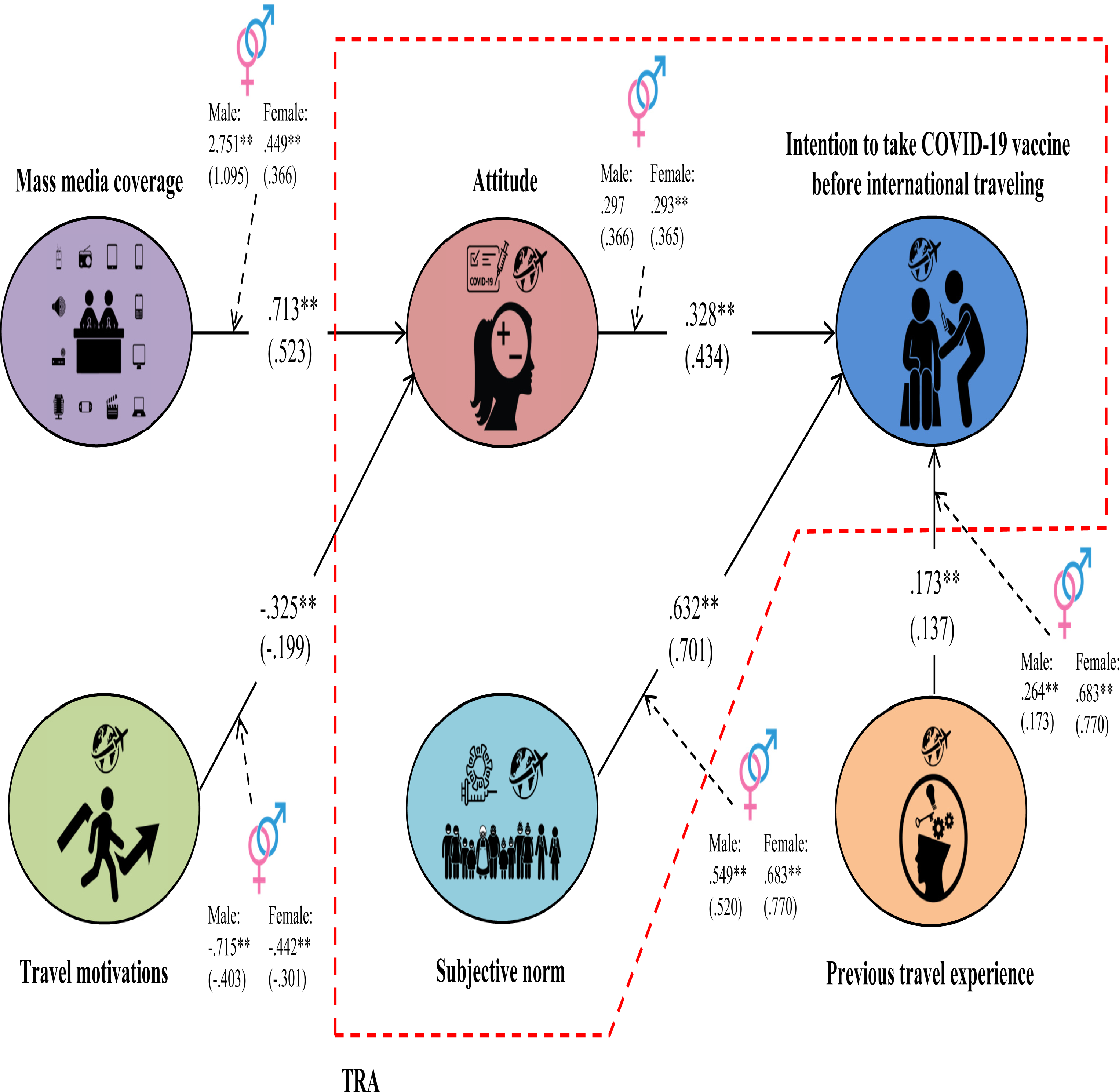
Results of the structural model estimation (n = 1188).
Results of the multi-group analysis for gender group.

Note 1. *p < .05; **p < .01.
Note 2. Goodness-of-fit statistics for the baseline model: χ2 (395) = 1914.342, p < .001, RMSEA = .080 [.077,.084], CFI = .941, TLI = .937, SRMR = .101.
Note 3. MCO = Mass media coverage; MOT = Motivation to travel; ATT = Attitude toward the behavior; SUN = Subjective norm; PTE = Previous travel experience; BHI = Behavioral intentions.
Discussion
This study aimed to broaden and deepen the knowledge, understanding, and perception of the intention to take the COVID-19 vaccine as a precondition for international travel. Likewise, the authors have assessed the likelihood of the TRA model by incorporating constructs, such as mass media coverage, travel motivation, and past travel experiences. The conceptual model showed a good fit to the data and the strength to forecast travelers’ intention to take the COVID-19 vaccine as a precondition to international travel. The hypothesized relationships between the study constructs were all supported, and the noteworthy capacity of attitude, subjective norm, and previous travel experiences to set the behavioral intention was evident.
Theoretical implications
The originality of the present study lies in unraveling the mechanisms that affect the intention to take the COVID-19 vaccine as a precondition for international travel. The base of the research was the Ajzen and Fishbein (1980)'s TRA, which was extended with constructs that were extracted from the multi-step flow theory (Katz and Lazarsfeld, 1955), the theory of push and pull (Dann, 1977), the cognitive dissonance theory (Festinger, 1957), and the experience economy (Pine and Gilmore, 1998). Combining these approaches, we provided a model that can explain the mechanisms that affect the intention to take the COVID-19 vaccine as a precondition for international travel.
From the findings of this study, there are essential theoretical implications that can be extended to the tourism and hospitality literature. First, our conceptual model successfully extended the TRA by introducing the theoretical foundation of constructs such as mass media coverage, travel motivation, and previous travel experiences. This study demonstrated that the TRA model could be used as an open-source platform where various constructs from different theories can be introduced to predict peoples’ behavioral intentions. Accordingly, Ajzen (1991)'s benchmark to enhance the theory was successfully achieved because our study managed to extend the original TRA, contributing to the body of the current level of knowledge.
Second, attitude has been validated as an essential predictor of individuals’ intention (Fishbein and Ajzen, 2011; Ward et al., 2020), and our results indicate that the significant association between attitude and intention exists in the same way for the acceptance of the COVID-19 vaccination. Gursoy et al. (2020) discussed the effect of the various precautionary measures against COVID-19 in the hospitality and tourism industry. Their argument suggested a need for more empirical evidence to determine the impact of the preventive strategies on individuals’ attitude and its influence on their willingness. In this respect, our study provides evidence to support the significant effect of attitude on the behavioral intention toward a mandated COVID-10 vaccine for international travel.
Lastly, the results from our study offer crucial insights into the behavioral intention to take the COVID-19 vaccine as a precondition for international travel, so this research provides a novel perspective into the context that is described by Perugini and Bagozzi (2001) regarding reinforcing and broadening the social theory in the tourist behavior literature. It is not surprising that the COVID-19 pandemic has become the dominant topic in everyday conversations between individuals within social groups. During these interactions, people positively frame each other's behavioral intentions to take the COVID-19 vaccine before international travel. Subsequently, the significant other, social groups, health practitioners, and government officials become the strongest advocates of accepting the COVID-19 vaccine as a precondition to international travel. In this respect, our study provides evidence to support the significant influence on the behavioral intention toward a mandated COVID-19 vaccine for international travel.
Practical implications
A broad range of communities would support no new rules and regulations without a prior understanding of the public appreciation and the drivers and hinders of individuals’ particular behaviors. This present study is critical for various parties, including policymakers, governments, and tourism and hospitality stakeholders, to prepare to implement digital health passes, such as vaccine passports or vaccine certificates, to facilitate international travel. The following managerial implications are specifically extricated from the findings of this research.
First, authorities, such as public health organizations, should collaborate with the opinion leaders who spread positive influences and ensure their messages related to the COVID-19 vaccination are circulated by utilizing the mass media. Also, their messages are needed across different media types and in various languages to affect large numbers of people. In addition, media messages regarding the COVID-19 vaccination should be continuously monitored to ensure the conveyance of accurate and truthful information. The media carries a substantial number of false claims and distorted news, which it disseminates to people worldwide (Hiebert and Gibbons, 2017). The false claims and negative information regarding the COVID-19 vaccination exist, and they can be the major disincentive regarding the attitude toward the COVID-19 vaccination. Therefore, world organizations and government officials are recommended to monitor the countless types of media and track down the source of the fake news that misleads the public. Meanwhile, it would be wise to utilize media that appeal to a male audience based on the outcome denoting the more substantial link between mass media coverage and attitude toward a COVID-19 vaccine certificate for the male group than the female group. Therefore, the careful selection of male-targeted media channels and types, including newspaper and broadcast ads and TV debates, is suggested for the COVID-19 vaccination campaign.
Second, this study identified the need for solutions that alleviate public anxiety from the finding of a contradictory process between travel motivation and attitude towards a COVID-19 vaccine certificate. A possible solution is that government can provide staycation program that are more suitable for the current pandemic. For example, local bureaus may introduce hidden attractions where residents discover new things and relieve stress, or promote things to do at home, such as online experiences by taking advantage of innovative technologies. Moreover, instead of enforcing the COVID-19 vaccination for international travel across the world, which may offer a very forceful impression (Radic et al., 2021a), the policymakers may consider whether a COVID-19 vaccine certificate can be implemented with a condition. For instance, countries that have established a travel bubble may not require the mandated COVID-19 vaccination to travel between these countries. On the other hand, countries that receive international travelers from places that are not successfully controlling COVID-19 may demand that travelers be vaccinated before the entrance.
Third, it is needed to create a social climate where the COVID-19 vaccination is a norm and has become a requisite for overseas travel. In this regard, a series of experts’ forums and a massive campaign in local communities would effectively build the individuals’ beliefs. Vaccine passports or certificates are perhaps initiated as one of the critical vehicles for a rapid return to growth with international travel. Still, it is more critical for the protection of oneself. Also, forums and campaigns should illustrate accordingly how the COVID-19 vaccination could aid the common interest of all. The policymakers are suggested alternatively to actively promote the positive outcomes based on the increased rate of vaccination. For instance, a business recovery at the places due to the high vaccination rate would be helpful to improve subjective norms.
Lastly, making efforts to remind people of their previous travel experience is necessary to maximize the intention to take the COVID-19 vaccine before international traveling. The tourism stakeholders are advised to ceaselessly promote their products and services despite the low demand amidst COVID-19. Tourism bureaus and destination marketing organizations should arrange on- and off-line tourism fairs. They may also consider dronography to film scenes, making it easier for individuals to stroll down memory lane at their previous travel experience. They may also take this opportunity to appraise what other features have been added since the COVID-19 outbreak, such as new facilities or programs and any enhancements related to safety and security. Marketing schemes, such as hosting an online contest to encourage travelers to post photos or videos of their previous travels, would be helpful. These endeavors would remind the travelers of their memories, activating their previous travel experience and subsequently inducing their intention to take the COVID-19 vaccine as a precondition for international traveling.
Limitations and future research
This study has certain limitations that provide opportunities for future research. The first limitation is the focal point because this study is based on specific constructs and theories related to Ajzen and Fishbein’s (1980) TRA. However, our study demonstrated that the TRA model possesses the characteristics of an open-source, which various constructs from different theories can be introduced to predict peoples’ behavioral intentions. Additionally, further studies could include other constructs and concepts that are compatible with this network. Specifically, there is no equal access to the COVID-19 vaccines worldwide (Ward et al., 2020), and the current research failed to take social inequality into account. The scholars may consider adopting the theory of planned behavior (TPB), which extends the TRA, the health belief model, or the protection motivation theory. However, they could examine the perceived behavioral control or self-efficacy role, which is perhaps helpful to predict individuals’ COVID-19 vaccination intention better.
The second limitation is related to the study design, which was cross-sectional. Studies such as Carlson and Morrison (2009) argue a gap in the time-related correlation between exposure and the outcome. Furthermore, the data were collected during the relatively high imbalance in COVID-19 vaccine supply around the world. People's perceptions have changed significantly since then, and we uncover fresh evidence related to the COVID-19 vaccine, and new rules are released continuously. Thus, future studies should employ a longitudinal study design to overcome the limitation of the present study.
The third limitation is related to the interpretation of COVID-19 vaccination intention across the nations/continents as there might be cultural differences related to the acceptance of COVID-19 vaccination/certificates. Hence, future studies should perform comparisons between cultures/nations or even between continents in order to discover and address potential differences. The fourth limitation is related to the moderating effect of gender. Because of this, our study results should be taken with caution and cannot be generalized. Additionally, further studies could include other sociodemographic factors as moderators such as place of residence, age, religion, political orientation, and type of government. The distinction or comparisons between cultures or nations or continents should be conducted to highlight their differences.
Footnotes
Declaration of conflicting interests
The author(s) declared no potential conflicts of interest with respect to the research, authorship, and/or publication of this article.
Funding
The author(s) received no financial support for the research, authorship, and/or publication of this article.
