



Abstract
This study aimed to identify the interaction actors, experiences, and results of tourists during their travels. Latent Dirichlet Allocation theme analysis was used to identify different themes in 9254 TripAdvisor items of user-generated content (UGC) and 15600 items of Sina Weibo UGC. A content analysis of 2000 UGC items was conducted using NVivo 11 software to uncover the details of tourist interactions. The study results showed that tourists preferred to share reviews on TripAdvisor and emotions on Sina Weibo. Seven types of tourist interaction actors were found: city, attractions, natural environment, companions, other tourists, residents, and service personnel. Seven emotions were generated in positive or negative interactions: joy, happiness, missing, awe, belonging, disappointment, and anger. Our findings provide insights for tourism managers and marketeers.
Keywords
Introduction
Tourists play an essential role in promoting the economic development of the tourism industry. In 2021, the total number of global tourists reached 6.6 billion, and the entire global tourism revenue reached US$3.3 trillion (World Tourism Cities Federation, 2022). Moreover, tourist interactions with the environment, service employees, and other tourists positively affect the tourism industry (Xie et al., 2022; Yang, 2015). Scholars usually use empirical methods to explore tourist interactions (e.g., Chen et al., 2022; Kim et al., 2022). For example, Stylidis (2020) verified the impact of tourists’ interactions with residents and with tourism employees on tourist destination image based on 750 valid samples. This way of exploring tourist interactions based on a predetermined scale means that respondents rate only the attributes contained in the scale. However, these attributes are not necessarily the most important considerations for tourists (Toral et al., 2018). User-generated content (UGC) provides researchers with reliable and effective data sources for exploring tourist interactions (Llodrà-Riera et al., 2015; Lu & Stepchenkova, 2015). UGC reflects the most authentic tourism experience, as expressed by tourists in their own way (Bigne et al., 2020). UGC conveys tourists’ interaction actors, experiences, emotions, and attitudes in detail (Li et al., 2017; Wang et al., 2020). For example, Philander and Zhong (2016) built low-cost, real-time measures of hospitality customer attitudes using 31,550 tweets. Previous studies have shown that UGC valence and topics vary by platform (Ren & Hong, 2017; Yan et al., 2018). The differences in UGC across platforms therefore need to be identified. In an era of information explosion, potential tourists can effectively reduce effort costs by querying information on different platforms according to their needs (Ukpabi & Karjaluoto, 2018). Tourism managers can also develop marketing strategies based on UGC on various platforms.
Our research aimed to investigate tourist interactions based on the following research questions: What are the differences between interaction topics on integrated travel websites and social media platforms? Which actors do tourists interact with, what memorable interaction experiences do they have, and what emotions do interactions generate? To address the above questions, we first crawled UGC from TripAdvisor (an integrated travel website) and Sina Weibo (a social media platform) using a crawler program written in Python. Then, the Latent Dirichlet Allocation (LDA) was used to identify the UGC topics of TripAdvisor and Sina Weibo. Finally, 2000 pieces of UGC were analyzed to discover interaction actors, experiences, and emotions.
Literature review
Tourist interaction
Tourist interaction actors can be classified as human and non-human (Matteucci et al., 2022). Human actors mainly include other tourists, residents (Joo & Woosnam, 2020), and service employees (Stylidis, 2020). Tourist–tourist interactions can be classified into intragroup and intergroup interactions (Huang & Hsu, 2009). The former refers to interactions between tourists and their friends and family, while the latter refers to interactions between tourists and unfamiliar tourists encountered while traveling (Huang & Hsu, 2009). Scholars have explored the impact of both positive (e.g., Lee et al., 2021) and negative interactions (e.g., Yang, 2015) between tourists on experience evaluations and emotions. For example, positive tourist–tourist interaction shapes tourists’ perceived cognitive images and influences the affective images of a destination (Yang, 2015). Positive tourist–friend interaction experiences are associated with positive outcomes, such as strengthened friendship ties and personal growth (Matteucci et al., 2019). Negative tourist–tourist interactions, such as other tourists’ rudeness, queue jumping, smoking, and littering, negatively influence value, memorability (Adam et al., 2020), satisfaction, and post consumption behavioral intentions (Adam, 2021). Positive tourist–resident interactions not only improve residents’ well-being (Chen Cottam et al., 2020) and contribute to the development of tourism (Xiong et al., 2021) but also enhance tourists’ pleasant experiences and destination loyalty (Nam et al., 2016). Positive tourist–employee interactions can increase tourists’ affective and conative images (Stylidis, 2020). In contrast, taxi service dishonesty and inhospitality lead to tourists’ negative emotions regarding destinations and to negative online reviews (Xu et al., 2021).
Non-human actors mainly include transportation facilities, hotels, activities, local cuisine, history, and weather/climate (Cao et al., 2021; Gannon et al., 2017). Tourists’ perceptions of interaction experiences with destinations, such as infrastructure and entertainment activities, positively impact their attitudes, intentions to visit, and recommendation intentions (Souiden et al., 2017). Tourist–scenery interactions promote tourists’ sharing behavior on mobile social media (Wong et al., 2020). Tourist–culture interaction enhances tourists’ destination attachments (Li & Liu, 2020) and leads to revisiting and recommendation intentions (Chen & Rahman, 2018). Polluted air and low or high temperatures negatively affect tourists’ emotional experiences (Wang et al., 2021). In addition, climate also impacts the tourist experience (Scholl-Grissemann et al., 2020).
Previous studies have explored tourist interactions with different actors and the effects of interaction experiences on tourist attitudes and emotions. However, these studies are piecemeal and do not systematically delineate tourist interaction actors and emotions triggered by different interactions. Most of these studies used predetermined scales to measure tourist interactions. However, the attributes of these scales are not necessarily the most important ones considered by tourists (Toral et al., 2018). We therefore aimed to objectively explore tourist interaction actors, experiences, and outcomes based on UGC.
User-Generated content in tourism
User-generated content (UGC) is considered to be spontaneous, insightful, and passionate feedback from consumers, which can be widely used, free, or low-cost, and easily accessible anytime, anywhere (Guo et al., 2017). UGC is presented in various forms, such as text, pictures, and videos (Cheng et al., 2019; Pourfakhimi et al., 2020). UGC describes experiences (Bigne et al., 2020; Wang, 2012), incitement events, results/assessments (Chen, Mak et al., 2020), and emotions (Gunasekar et al., 2021; Taecharungroj & Mathayomchan, 2019). Compared to marketeer-generated content, UGC is less biased (Filieri et al., 2019), more persuasive (Sparks & Browning, 2011), and more credible and trustworthy (Sparks et al., 2013). Consumers rely on the experiences of former tourists to make decisions to travel because tourism is intangible, experiential, and heterogeneous (Hwang et al., 2018; Taecharungroj & Mathayomchan, 2019). About 80% of travelers claim that they would read hotel comments before traveling, and 53% said they would not book hotels without reading comments (Tsao et al., 2015). UGC provides reliable information for potential tourists’ decisions (Bigne et al., 2020; Cheung et al., 2022). Compared to researcher-led interviews, UGC provides more objective information and is full of personal emotions and feelings, which respondents may not be willing to show in face-to-face interviews (Bosangit et al., 2015). In addition, UGC records emotions, from happiness and love to sadness and disappointment, which are natural reactions in tourist interactions (Ahmad & Laroche, 2015; Kim et al., 2022). Therefore, UGC is credible and effective first-hand data for research (Llodrà-Riera et al., 2015; Lu & Stepchenkova, 2015). For example, Boo and Busser (2018) analyzed 693 online comments about 173 hotels and found that critical concepts of meeting planners’ online reviews included staff, hotels, work, recommendations, and amenities. Taecharungroj (2022) identified 11 tourist experiences from an analysis of 75,500 TripAdvisor reviews of 247 beaches in Thailand. Wang et al. (2021) extracted tourist emotions from UGC with geographical markers, confirming the negative nonlinear impact of air pollution on tourists’ feelings and the inverted U-shaped effect of temperature on tourists’ emotions. UGC provides adequate data for mining tourists’ unforgettable experiences (Bigne et al., 2020) and satisfaction (Narangajavana et al., 2019). In addition, UGC has informed the construction of satisfaction dimensions (Guo et al., 2017), the measurement of hotel customers’ attitudes (Philander & Zhong, 2016), and service performance indices (Li et al., 2017).
UGC valences and topics vary by platform (Ren & Hong, 2017; Yan et al., 2018). Tourists prefer to share positive emotions on social media platforms and negative emotions on integrated tourism websites (Yan et al., 2018; Zhou et al., 2019). They tend to share hotel-related features on Booking.com, experiences on TripAdvisor (Borges-Tiago et al., 2021), and suggestions on Ctrip.com (Ren & Hong, 2017). UGC on different types of social media expresses various topics (Smith et al., 2012), although they are about the same brand (Smith et al., 2012). Specifically, UGC on YouTube has the most consumer promotional self-presentation, while UGC on Twitter has the highest brand-centricity trend (Smith et al., 2012). We believe that it is of theoretical and practical significance to identify differences in tourist interactions on UGC from different platforms and to mine valuable and more detailed tourist interactions from UGC.
Methodology
Data collection and preprocessing
We chose TripAdvisor as a representative integrated tourism website and Sina Weibo as a representative social media platform (Yan et al., 2018; Zhou et al., 2019). TripAdvisor is a leading global integrated tourism website that mainly provides reviews, travel planning, and reservations for hotels, scenic spots, and restaurants. As of January 1, 2022, the reviews and opinions on the TripAdvisor platform numbered 1 billion (TripAdvisor, 2022). Sina Weibo is a social media platform based on user relations and is the largest and most popular portal blog in China (Chen, Cottam et al., 2020). In March 2022, Sina Weibo had 582 million monthly active users and 252 million daily active users (Sina Finance and Economics, 2022). UGC on TripAdvisor and Sina Weibo has often been used as research data by scholars (e.g., Mirzaalian & Halpenny, 2021; Wang et al., 2020). We first selected the top 10 hot cities according to the “China tourism city popularity ranking” on the TripAdvisor website. We chose the top 10 tourist attractions in each city that were popular with tourists (see Appendix). Next, a web crawler program was written to crawl 57023 UGC items on these 100 scenic spots on TripAdvisor. A total of 59168 UGC were obtained from Sina Weibo with a data-crawling method using the names of these 100 scenic spots as keywords. To ensure the representativeness of the data, we eliminated repetition, white spaces, advertisements, and short words (with fewer than 10 characters). After processing, 9254 TripAdvisor (Trip_data) UGC and 15600 Sina Weibo (Weibo_data) UGC were left. Finally, we preprocessed the data text through regular expressions by removing the following types of noise: (1) user ID, (2) non-Chinese characters, such as English, Japanese, etc., and (3) text attached to Weibo, such as “Weibo links,” “put away more,” “load more,” “expand full text,” etc. A UGC corpus with a simpler language structure was obtained.
Research method
Latent dirichlet allocation topic analysis
Latent Dirichlet Allocation (LDA) is a generative probabilistic model introduced by Blei et al. (2003) for topic modeling. Blei et al. (2003) proposed that by setting the number of “bags of words,” the probability distribution among text topic feature words could be calculated. Then, the text can be transformed into a combination of topics without considering word order and syntactic structure. Essentially, the model enables the aggregation of unstructured text data into structured data by dividing text or text sets into different sets of topics and feature words. LDA, an unsupervised machine learning technique, is widely used to identify topics from unstructured data, especially UGC (Guo et al., 2017; Taecharungroj & Mathayomchan, 2019). For example, in Taecharungroj and Mathayomchan's (2019) study, five topics (i.e., beaches, islands, temples, a pedestrian street, and markets in Phuket, Thailand) and the dimensions of each topic were extracted with the LDA algorithm from TripAdvisor reviews.
In our study, LDA topic extraction was implemented using the Python program. The Jieba package, a third-party library commonly used in Chinese information processing, was used for word segmentation (Liu et al., 2020). To improve the accuracy of the topic analysis and reduce the impact of noise words, we built a user-defined stop word list by referring to the stop word list of Dalian University of Technology. The topic analysis steps were as follows: (1) reading the UGC line by line, segmenting words, and putting them into the initial corpus; (2) reading the user-defined stop word list and establishing a word vector that did not contain stop words; (3) counting the word frequency information from the UGC; (4) setting parameters, such as the number of topic extractions and the number of iterations to extract LDA topics; and (5) outputting several words with a high to low probability of occurrence under each topic, as well as the related topic of each UGC.
Content analysis
We further investigated tourist interactions through content analysis after the LDA topic analysis. Content analysis is a systematic and objective research method for describing and quantifying phenomena, making reproducible and valid inferences from data, and providing knowledge and new insights (Krippendorff, 1980). The two types of content analysis are inductive and deductive (Elo & Kyngäs, 2008). The approach used depends on the purpose of the study. If there is insufficient knowledge about the phenomenon or if that knowledge is fragmented, the inductive type is recommended (Elo & Kyngäs, 2008). The inductive content analysis process includes open coding, interpretive coding, and abstraction (Elo & Kyngäs, 2008). NVivo software is often used for inductive content analysis. For example, Dolan et al. (2019) used NVivo software to analyze the complaint content about an airline on Facebook and to determine the purpose of the customer complaints. NVivo 11 was used to analyze the UGC in this paper.
This study focused on three core themes—interaction actors, interaction experiences, and emotions—to analyze the text. Research by Stylidis (2020) shows that tourists first interact with different interaction actors of a destination, and then these interaction experiences arouse tourists’ feelings toward the destination and lead to word of mouth. This is similar to the views of Agapito et al. (2013), who believe that tourists will experience changes in internal perception after being stimulated by external factors, such as products (i.e., tangibles, intangibles, and souvenirs) and humans (i.e., staff, other tourists, and residents), and finally convey perceptual images through advertising, websites, or social networks. Therefore, we analyzed the UGC of the two platforms according to the three themes of interaction actors, interaction experiences, and interaction results (i.e., emotions). After inputting 1000 randomly sampled UGC items each from Trip_data and Weibo_data into NVivo 11 software, three steps were performed. First, line-by-line open coding was performed to avoid missing any critical information. To ensure the reliability and validity of the coding, two researchers coded the text separately. The coders communicated in a three-day cycle to ensure the quality of the coding. After coding 2000 UGC, we randomly selected 50 UGC from each platform to test the saturation of the constructed framework until the coding category no longer changed. Second, interpretive coding entailed classifying the free codes. It was mainly based on the literature review results, constant comparisons, and analysis of the connections between the codes. Third, the abstraction step identified three core themes: interaction actors, interaction experiences, and emotions. These themes usually covered most cases and revealed each core theme's elements.
Results
Interaction actors are the actors with whom tourists interact while traveling. Interaction experiences describe detailed positive or negative interactions between tourists and interaction actors. Emotions result from interactions between tourists and actors (Hallmann et al., 2015).
Latent dirichlet allocation topic analysis results
Topic identification: tripadvisor vs. Weibo
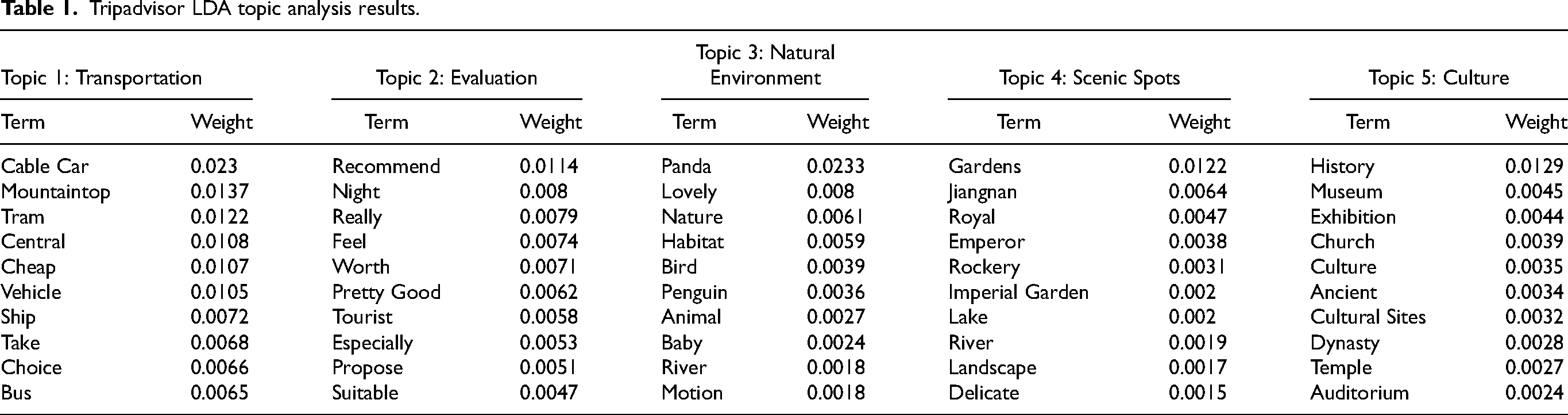
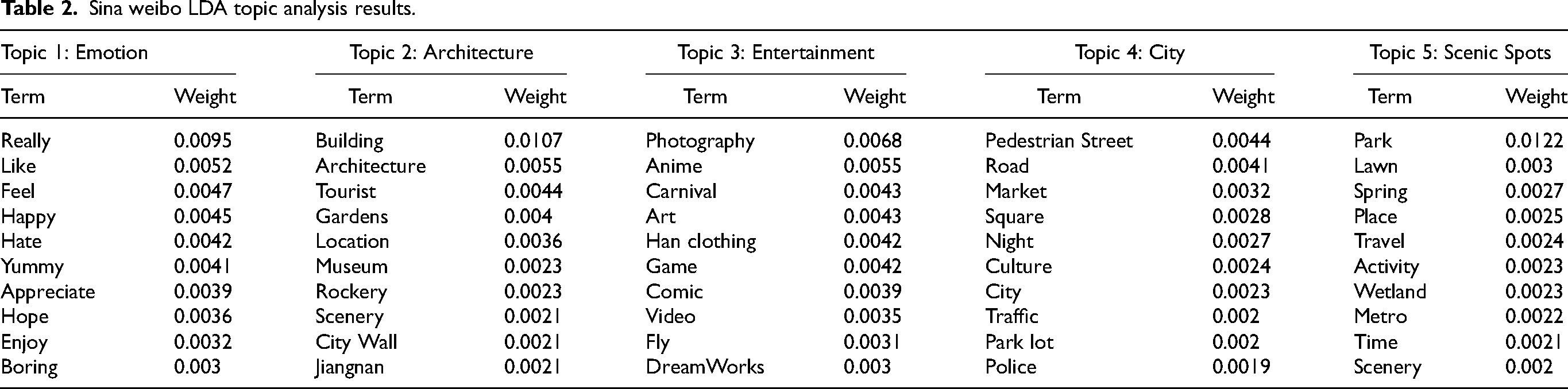
We sampled five topics from the UGC for each platform (see Tables 1 and 2). Each topic shows the top 10 high-frequency keywords. The numbers in the table represent the probability of a particular word appearing in the topic: the larger the number, the more influential the word is.
Tripadvisor LDA topic analysis results.
Sina weibo LDA topic analysis results.
The five topics extracted from Trip_data were transportation, evaluation, natural environment, scenic spots, and culture. The proportions of these topics were 33.10%, 24.48%, 19.11%, 15.9%, and 7.41%, respectively (see Table 1). On the TripAdvisor platform, tourists not only recorded their interaction experiences with the four interaction actors of transportation, natural environment, scenic spots, and culture but also shared their evaluations of the interactions. Their evaluations summarized their interaction experiences, which are constructive and useful for potential tourists, including words like “recommend,” “worth,” “pretty good,” “suitable,” etc.
The five topics extracted from Weibo_data were emotion, architecture, entertainment, city, and scenic spots. The proportions of these topics were 35.84%, 24.56%, 15.47%, 13.96%, and 10.17%, respectively (see Table 2). On the Sina Weibo platform, tourists not only recorded their interaction experiences with the four interaction actors of architecture, entertainment, city, and scenic spots, but they also shared their emotions after their interaction experiences with words such as “happiness,” “enjoyment,” “boredom,” etc.
When we extracted five topics from the database of each platform, we found that the topics of the UGC on different media had different focuses. Tourists preferred to post evaluations and reviews of transportation on the TripAdvisor platform and to express emotion and post reviews of architecture on the Sina Weibo platform.
Discussion
The UGC topics on the TripAdvisor and Weibo platforms included the following: (1) tourist interaction actors in travel: city, transportation, scenic spots, architecture, culture, and entertainment; (2) evaluations of tourist interaction experiences, such as “pretty good,” “suitable,” etc.; and (3) the results of tourist interactions: emotion. The topics extracted by LDA are not comprehensive. From the perspective of interaction actors, previous studies have shown that tourists enjoy food and hotel services while traveling (Chi et al., 2015). In addition, tourists also interact with humans, such as residents (Joo & Woosnam, 2020). In contrast, the interaction actors in the LDA results were mainly non-human. Moreover, from the LDA topic analysis results, we cannot know the detailed interaction experiences between tourists and different interaction actors. Different interaction experiences induce different interaction results (Adam et al., 2020; Yang, 2015). Previous studies have shown that tourists’ interaction experiences are both positive and negative (Chi et al., 2015; Taecharungroj & Mathayomchan, 2019). Positive interaction leads to joy (Banerjee & Chua, 2016), while negative interaction leads to unpleasantness (Koç et al., 2022). Therefore, we next used NVivo 11 software to analyze the UGC to comprehensively identify the interaction actors, experiences, and results.
Content analysis results
Interaction actors and experiences
Tourist–city interaction
As essential tourism hubs (Chi et al., 2015), cities are one of the most important non-human interaction actors. We found that tourists attached importance to cities’ tourism infrastructure and transportation accessibility, since they are closely related to the necessities of travel, affecting tourists’ affective and conative impressions of the destination (Stylidis, 2020). Tourism infrastructures includes accommodation, restaurants, shops, and other city facilities. Pleasant ambient conditions and accommodation, delicious restaurant food and atmospheres, and shopping bring tourists joy and satisfaction (Sun et al., 2021). Transportation accessibility includes local transportation options and route planning rationality. More alternative means of transportation and good transportation routes give tourists good interaction experiences. However, not every city's infrastructure and transportation can satisfy tourists. Besides, homogeneous food and chaotic traffic can disappoint tourists. The coding examples are listed below.
Liberation Monument Square is in the bustling commercial center of Chongqing. Shopping here is convenient. (UGC about a positive tourism experience on TripAdvisor, hereafter TP) There are many famous local snacks here, and it is a good place for shopping. (TP) A fresh and excellent homestay located directly opposite the Wenshu Monastery in Chengdu. The room has floor-to-ceiling windows and a 100-inch projection. (UGC about a positive tourism experience on Sina Weibo, hereafter WP) There are many local specialty stores on Southern Song Imperial Street. (WP) The stairs are too high to climb. The elevator is too crowded and hard to find. (UGC about a negative tourism experience on TripAdvisor, hereafter TN) It is disappointing that the snack bars on Hefang Street are all chain stores and Internet celebrity shops. (TN) It is convenient to see tulips in Taiziwan Park by public transport. (TP) Transportation is convenient. The bus can go directly to Chunxi Road, Yanshikou, Wuhou Temple, Jinli, and so on. (WP) This is the most prominent tourist spot in Macao, but the surrounding traffic is very chaotic. The bus is full of passengers, forcing tourists to pay to take a taxi. (TN) The Metro West Suburban Line has proven to be a complete failure and can even be expected to be dismantled someday. (UGC about a negative tourism experience on Sina Weibo, hereafter WN).
Tourist–attraction interaction
An attraction can be described as an individual site or a visibly delineated, small geographical space that can be accessed and inspire people to travel (Adam et al., 2020). Our results showed that attraction includes scenic spots, activity, culture, and architecture. Travel is often perceived as an outlet for relaxation, education, and a chance to escape pressure (Durko & Petrick, 2013). Our results showed that tourist–scenic spot interaction experiences relaxed tourists and calmed their minds. However, tourists were disappointed at scenic spots’ crowdedness, commercialization, and homogenization.
Research by Taecharungroj and Mathayomchan (2019) revealed that activity in Phuket, Thailand, helped tourists evade excessive commercialism, enabling tourists to experience the wilderness. Our results are consistent with their findings that tourist–activity interaction impacts tourists and provides them with an incredible and memorable experience. Previous research has proved that tourist–culture interaction enhances tourists’ experiences, cultural memories, and destination attachments (Li & Liu, 2020). Our findings also confirmed that tourists pay attention to historical culture. Tourists were amazed by the charm of a long history and culture. They thought that historical and cultural knowledge in attractions, especially museums, could broaden their horizons and knowledge. In addition, we found that tourists also recorded their experiences interacting with architecture on the platform. The architecture included Chinese and Western architecture. Tourists were impressed by the grandeur of Chinese architecture and its deep sense of history while being interested in Western architecture's charm. The coding examples are listed below.
After several days of continuous busy work, I feel exhausted. Ocean Park is an excellent place to relax. (TP) Hong Kong Ocean Park is excellent. Here, you can also learn some knowledge about marine organisms. (TP) After seeing the cute little panda, I felt the poetic and sudden sense of Du Fu's thatched cottage, experienced the love between monarchs and ministers in Wuhou Temple, and enjoyed the excitement and leisure in the Jinli night. (WP) I climbed the Juyongguan Great Wall, the steepest wall in the world. I highly recommend this scenic spot for its non-commercialization. (WP) It is hard to feel the atmosphere of ancient Macau here, as it is already very commercialized and full of chain stores. (TN) When I came to Ciqikou, I was disappointed. Like most ancient towns in China, this historic old town is gradually commercialized. (TN) Tongli ancient town in Suzhou is a commercial scenic spot that is not attractive. (WN) Ciqikou Ancient Town, which is highly commercialized, has no cultural characteristics. (WN) Although the light and shadow show lasted only five minutes, the scene was very eye-catching and impressed everyone. This is a stunning performance. (TP) The face-changing performance in Sichuan is excellent. (TP) The dolphin show in the Qujiang Ocean Polar Park Aquarium is the most astonishing. (WP) There are many unearthed cultural relics in the small museum of this garden. (TP) I appreciated the charm of ancient Shu culture in Sanxingdui Ruins. (TP) Behind each cultural relic is a story of its own. There are quite a few exquisite treasures in the Shaanxi Museum that deserve our further study. (WP) Culture, history, humanities, and food come from the A-Ma Temple, Sanjie Guild Hall, or St Anthony's Church. (WP) The Royal Garden is so magnificent that its reputation is well-deserved. (TP) The Suzhou Humble Administrator's Garden can be considered the first of China's four gardens. The garden's architecture integrates various styles from the Ming and Qing dynasties. (TP) Stroll along the Bund and appreciate the charm of the century-old Western architecture. (TP) We are seeing those classical houses and feeling the messiness of history. (WP) The Ruins of St Paul's, whose official name is the Ruins of St Paul's Cathedral, is the site of the front facade of the Church of Our Lady of God in Macau. (WP)
Tourist–natural environment interaction
Tourists interact with the natural environment during travel, including the scenery and climate (Stylidis, 2020). Scenery and climate/weather conditions stimulate tourists’ sensations (Agapito et al., 2013), affecting tourists’ physical and mental feelings, such as perceived comfort (McKercher et al., 2014). Beautiful scenery allows tourists to relax (Wong et al., 2020). Our results also show that beautiful scenery, such as flowers and trees, a blue sky and white clouds, a pleasant climate, and a comfortable temperature, make tourists happy and relaxed. At the same time, dirty water sources and stormy weather cause tourist disappointment. The coding examples are listed below.
Green trees, grass, blue sky, and white clouds are so harmonious, living under the current fast pace and pressure. (TP) Jindal gorge has good natural scenery and green water, making people feel nature's charm. (TP) The moon began to penetrate the hazy, soft light from the patches of clouds. I long for this kind of life too much. (WP) I imagined that there was no pressure of work and housing in the world when I was lying carefree on the harbor and watching the clouds floating in the air. (WP) The beach was littered with rubbish. (TN) The water quality is indescribably poor. (TN) I was sweating all over when I climbed the mountain. It was cool when the calm wind blew. (TP) It was cloudy, with clouds and light rain. This kind of weather has a unique flavor. (TP) I want to recommend Hong Kong! Not only is the climate pleasant, but the transportation is convenient. There is a Disneyland that children love best (WP) The weather was perfect on the day of climbing the Mutianyu Great Wall. I’m thrilled! (WP) The weather is gray. You can hardly see anything except a dark cloud. So that trip was a waste of money and time. (TN) The haze was getting worse when I walked out of the Shaanxi History Museum. (TN) On the first day, we didn't go to the Hongyadong cave because of the rain. (WN)
Tourist–companion interaction
The results showed that companions, including family, partner/spouse, and friends, are the human actors with whom tourists interact directly the most. Travel can benefit an individual and enhance the relationship between tourists and their companions (Durko & Petrick, 2016). We found that tourists’ emotions were entirely different when interacting with different companions. When traveling with family, tourists may pay more attention to communication, which promotes a harmonious family atmosphere. Traveling with a partner/spouse can be sweet and heartwarming. The coding examples are listed below.
It's excellent to drink tea with the family and enjoy the night. (TP) We all climbed to the top of the Great Wall in winter. Mom is thrilled. (TP) I’m walking while listening to the elders discussing their lives near West Lake when they were young. The older we are, the more we cherish the emotional bonds with families. (WP) We were so happy to go to Xuedou Mountain in Fenghua. I photographed my mother looking like a girl. (WP) I went to Tongli ancient town with my girlfriend. We took many satisfactory photos. (TP) I drank milk tea and ice cream with my boyfriend by the river and had a romantic candlelight dinner in the open-air restaurant. In the evening, we went shopping along the Bund hand in hand. (TP) I traveled with my boyfriend and took many photos, which are precious memories for us. (WP) To have more experiences and memories, my boyfriend and I visited Xiangshan Park yesterday. (WP) That time, I went with my friends to climb the Great Wall. (TP) The first time I went hiking with my friends, I was tired but also very happy. (TP) I went to Lin-yin Temple with friends I hadn't seen for a long time and wished for my family's well-being. (WP) Climbing the Great Wall with different people makes me feel different. Climbing with friends, I feel like I’m just exercising with them. (WP)
Tourist–tourist interaction
Tourist–tourist interaction is an essential factor in the tourism experience (Koç et al., 2022). Importantly, tourist–tourist interaction does not necessarily require direct contact, as it can happen through indirect interaction (Adam et al., 2020; Koç et al., 2022). Positive tourist–tourist interaction includes mutual help, communication, and sharing among tourists. However, most tourist–tourist interactions recorded on the two platforms were negative. For example, some tourists’ disobedience of rules, such as making a noise, queue jumping, littering, spitting, and leaving graffiti, has seriously damaged the environments of scenic spots. These misbehaviors affect tourists’ experiences (Dolan et al., 2019). The coding results showed that a negative tourist–tourist interaction experience was the main influencing factor of tourists’ anger. Some tourists even feel uncomfortable with the presence of others, since they see them as competitors trying to benefit from the destination's facilities (Koç et al., 2022). The coding examples are listed below.
While watching the night scene in Victoria Harbor, I came across a person from Hunan Province. We had a good chat. (TP) When we climbed the Great Wall, we helped each other, although we were strangers. (TP) I met a woman on the high-speed train. She talked about her entrepreneurial and travel experiences. (WP) The young and warm couple took pictures for me. (WP) Some tourists lack environmental awareness. They should clean up their garbage. (TN) All kinds of queue jumping often occur, and the situation is even more complex on holidays. (TN) The tourists in the tour guide group were boisterous, which made me uncomfortable. (TN) The male passenger closed the door very impolitely. (WN) Some stone tablets were carved “I was here.” (WN)
Tourist–resident interaction
Residents actively serve as information providers because of their familiarity with the destination (Stylidis, 2020). Our coding results showed that tourist–resident interaction mainly included purchasing goods, seeking help, establishing host–guest relations, etc. Although tourist–resident interaction is not the purpose of travel, this unexpected interaction enables tourists to experience local life, understand local customs, enjoy genuine hospitality, and enhance the destination image (Decrop et al., 2017; Yang, 2015). The coding examples are listed below.
It's best to listen to the suggestions of residents. On advice from Storm (resident), I decided not to go to the Great Wall until New Year's Eve. (TP) Residents are kind and answer patiently when we are asking for directions. (TP) The aunt and uncle who added water were very enthusiastic. (TP) Maybe the vast land and abundant resources in the north of China have created the heroic personalities of residents. They heard that we came from Shenzhen and greeted us very warmly. (WP) Prison Zhazi is restricted today. Therefore, I followed the resident down the path. (WP) I took the bus in the opposite direction. An older woman showed me the way. (WP) Chongqing taxi drivers chat with me. (WP)
Tourist–service personnel interaction
The results showed that service personnel, including docents, waiters, and scenic spot employees, interacted with tourists. Previous research has widely acknowledged service personnel's critical role in tourism (Barnes et al., 2020; Yang, 2015). Positive tourist–employee interactions result in significant positive improvements in customer satisfaction (Barnes et al., 2020). Tourist–employee interaction, which results in learning and knowledge creation in encounters, is argued to facilitate tourists’ experiences (Barnes et al., 2020). Our findings confirmed these views. Tourists recorded their interactions with docents in the UGC and learned history and culture from the docents’ introductions in tourist–docent interactions. Stylidis (2020) reported that pleasant tourist–employee interaction contributes to tourists’ cognitive and affective image of a destination. Our analysis also found that the enthusiasm, kindness, caring, and smiles of service personnel and excellent services contributed to tourists’ destination images. However, tourist–service personnel interactions were not always positive. For example, tourists were angry about service staff's ignorant, rude, and nasty attitudes. The coding examples are listed below.
It was enjoyable to listen to the gentle voice of the docent on the boat. (TP) I saw many things I hadn't seen before and learned a lot from the docent's introduction. (TP) We visited magnificent historical artifacts under the docent's guidance. (TP) I chose a beautiful library docent, which is worth the experience. (WP) The docent was so exciting and competent. (WP) There is an experienced grandfather as a docent, attracting many tourists to stop and listen. (WP) The monks and temple staff are very kind. (TP) When the staff of Hanshan Temple spoke, I felt very calm and forgot all my troubles. (TP) The sanitation worker introduced us to a more reasonable and practical garden route. (WP) Ticket aunt's Xi’an dialect is funny. I could tell from her enthusiasm and the smile on her face how happy she was. (WP) The staff gave us the cold shoulder when we asked for directions. (TN) It's unbelievable that the employees not only don't raise their heads but also roll their eyes at us during the feedback. (TN) Happy Valley's staff has a lousy service attitude. (WN)
Interaction emotions
Previous research has shown that experiences create emotions (Barnes et al., 2020). Positive emotions, such as joy, love, and pleasantness, and negative emotions, such as unpleasantness, anger, sadness, and fear, have been explored in some empirical articles (Al-Msallam, 2020; Koç et al., 2022; Sun et al., 2021). Our analysis found that tourists gave seven different emotional responses to different interaction experiences. Positive emotions included joy, happiness, missing, awe, and belonging, while negative emotions included disappointment and anger. The coding examples are listed below.
Joy
We tried almost everything at Hong Kong Disneyland. Tired but delighted! Looking forward to another crazy day next time. (UGC about emotion on TripAdvisor, hereafter T)
We are having much fun! Friends who travel to Suzhou must not forget to go here. (T)
I had a great time with my friends. (T)
I admire those guys who bungee jump. It's a joy to sit and watch them. (T)
I rode with my friends for three hours. We were tired but delighted. (UGC about emotion on Sina Weibo, hereafter W)
It's a pity I haven't climbed the tower at night, but I’m delighted and satisfied. (W)
Happiness
I felt happy at that moment. I was delighted to fulfill my mother's wish. (T)
I was sitting on the city wall, and watching the sunset will make people feel pleased. (T)
I feel so happy because of the beautiful scenery, delicious food, good friends, and mom and dad around me. (T)
It was the most peaceful feeling I’ve ever felt. To be able to sit there is very contenting and happy. (W)
No matter where you are, it is always pleasant to enjoy delicious food with lovely people. (W)
Missing
I sit in front of a bar and café, listening to music and missing some of the past time. (T)
As we walk by the lake, my thoughts come to mind. (T)
Listening to the waves and enjoying the breeze, I realized I missed you so much. (T)
In the eyes of two old ladies from Taiwan, there are memories of their elders and homesickness. (W)
Standing on the Great Wall, I unconsciously picked up the phone and wanted to call someone. (W)
You came with me, but now you’re gone. (W)
Awe
Exotic buildings in the Shanghai Bund are still so solemn and majestic, even after the changes. I felt awe when I stood near the buildings. (T)
Tea fields and sunflower gardens will inspire your awe of nature. (T)
I am in awe of Qinshihuang. (T)
Awe-inspiring history needs to be preserved and developed. (T)
Each time I go to a museum, my experience is different, but I am always awed by the wisdom of our ancestors and the messiness of history. (W)
Belonging
When you climb the wild goose pagoda, you will have honor and belonging. (T)
Traces of history triggered my belonging. (T)
It is a city full of a classical atmosphere, which makes people feel a quiet belonging. (T)
For the first time, I belonged to this city. (W)
The green trees and bamboo forest make the air full of negative oxygen ions, so I don't want to leave. (W)
It seems that one week is not enough for me. This is a city that you don't want to leave when you come here. (W).
Disappointment
The design of toilets in the scenic area is very disappointing. (T)
I am very disappointed that the ancient towns are becoming more and more commercialized. (T)
There are so many tourists that the experience is common. (T)
I just want to get out of here. (T)
It's disappointing that Ciqikou's ancient town commodities were seriously homogenized. (W)
I ate Hangzhou trickled pastry at noon, which was not delicious. (W)
There are not many exciting sights on the mountain. (W)
The light show is not so impressive. (W)
Anger
His service has brought disgrace to Macau residents. (T)
It was annoying to be charged for photos. (T)
Seeing such carved characters all over the Great Wall made me angry. (T)
The most unsatisfying thing about this trip is that there were too many tourists. (W)
I am angry with the scenic spot ticket seller for her lousy service attitude. (W)
I was frustrated that the security guard warned uncivilized tourists, but they still lay on the lawn. (W)
Discussion
The content analysis results (see Figure 1) showed that tourists’ interaction actors were both non-human and human. Non-human interaction actors were cities, attractions, and the natural environment. Human interaction actors included companions, other tourists, residents, and service personnel. Both positive and negative interactions were found. Positive interactions came from tourist–attraction interaction (i.e., activities, culture, and architecture), tourist–companion interaction (i.e., family, partner/spouse, and friends), tourist–resident interaction, and tourist–service personnel interaction (i.e., docents). However, tourist–city interactions (i.e., infrastructure and transportation), tourist–attraction interactions (i.e., scenic spots), tourist–natural environment interactions (i.e., scenery and climate/weather), tourist–tourist interactions, and tourist–service personnel interactions (i.e., other service personnel) were not always positive.

Tourists’ interaction actors, interaction experiences, and emotions.
Tourists’ interactions with different actors generated positive emotions (i.e., joy, happiness, missing, awe, and belonging) and negative emotions (i.e., disappointment and anger). Tourists’ joy was mainly affected by their interaction with the city, attractions, and the natural environment. Their happiness came from their interactions with families and their partner/spouse. Missing was affected by tourists’ interactions with scenic spots, and their awe was affected by their interactions with architecture and culture. Tourists’ belonging was affected by their interaction with infrastructure, while their disappointment was mainly affected by the commercialization and homogenization of scenic spots. Tourists felt anger at service personnel's lousy service, excessive passenger flow, and other tourists’ uncivilized behaviors.
General discussion
Theoretical contributions
This paper's findings make several theoretical contributions. First, our findings expand the research on tourism UGC. Tourism UGC records tourists’ experiences that carry cognition, emotion, and behavior (Barnes et al., 2014). Most previous tourism studies have analyzed the topics of UGC on a single platform or the same type of platform (e.g., Smith et al., 2012; Taecharungroj, 2022). Following the classification of tourism platforms by Yan et al. (2018) and Zhou et al. (2019), we studied the differences between tourism UGC topics on TripAdvisor and Sina Weibo. We found that tourists preferred to share evaluations and suggestions on TripAdvisor and emotions on Sina Weibo. Second, the current study offers a new perspective on understanding tourist interactions through UGC. Previous studies on tourist interaction have mostly used empirical methods (e.g., Lee et al., 2021; Wong et al., 2020). However, the attributes of a pre-specified scale are not necessarily what tourists care about during travel (Toral et al., 2018). This paper used the content analysis method to systematically delineate the interaction actors, interaction experiences, and emotions from UGC. We confirmed that the interaction between tourists and different actors was positive and negative, leading to positive or negative emotions accordingly. This finding differs from the traditional opinion that the Chinese prefer to share positive emotions or positive travel experiences through Weibo and negative emotions or negative travel experiences through TripAdvisor (Zhou et al., 2019). One possible reason for this difference is that, compared with a data collection method of interviews, using anonymous UGC as a data source is more helpful in revealing hidden emotions, especially the negative aspects of the tourism experience in the Chinese context.
Managerial implications
Our findings also provide managerial insights. First, tourists tend to post UGC on different topics on different platforms. We suggest that potential tourists search efficiently for information on different platforms according to their needs, thus reducing search costs. We found that tourists preferred to post UGC about evaluations on the TripAdvisor platform. Positive UGC is a powerful and effective tool for promoting destinations (Taecharungroj & Mathayomchan, 2019). Although negative UGC is useful for potential tourists, it is disastrous for destinations (Taecharungroj & Mathayomchan, 2019). We propose that tourism marketeers encourage tourists to post positive evaluations. For negative evaluations, tourism marketeers should respond promptly on the TripAdvisor platform to alleviate tourists’ negative emotions. To some extent, the valences of emotion indicate tourists’ attitudes. Therefore, travel marketeers should pay attention to the sentiments posted by tourists, especially internet influencers, on UGC platforms because of their significant influence.
Second, our findings offer pointers for how to attract tourists and augment tourist experiences. Although the interaction experiences with non-human actors (i.e., cities, attractions, and the natural environment) are tourists’ intentions, tourists inevitably interact with human actors, such as residents and service personnel. Tourists’ joy can also be influenced by human actors. Therefore, tourism marketeers can advertise residents’ enthusiasm, and attractive customs. In addition, tourists learn about history and culture from introductions by docents. We propose that scenic spots with cultural and historical origins, such as museums, increase the number of professional docents. Our findings also provide pointers for alleviating customers’ disappointment and anger. Excessive commercialism by some vendors, homogenization of scenic spots, and destruction of the natural environment repelled and upset many tourists. We suggest that destinations need to balance the relationship between the commercial development of scenic spots and cultural heritage or natural environment protection. In addition, transportation inaccessibility also disappointed tourists. We suggest that cities’ transportation and tourism management departments launch tourist shuttle buses for famous tourist lines. Tourists were angry about the lousy service of some service personnel, excessive passenger flow, and other tourists’ uncivilized behaviors. Enterprises should standardize services, establish a reward and punishment system, and encourage tourists’ feedback to improve service quality. For excessive passenger flow problems, reservation policies at scenic spots should be implemented with a visitor cap and staggered access. For other tourists’ uncivilized behaviors, publicity about ecological civility and supervision should be strengthened.
Limitations and future research
Our work has some limitations. First, this study focused only on UGC in Chinese, which cannot reflect various tourist interactions worldwide. As a result, the findings might not be generalizable to non-Chinese populations. Future research could extend the current study to international review websites to improve the external validity and examine the differences across heterogeneous social and cultural segments. Second, our research analyzed only textual UGC. UGC can be presented in text, audio, video, and pictures (Cheng et al., 2019; Pourfakhimi et al., 2020). A single form of data set inevitably has certain limitations. In future research, we could analyze various forms of data (such as short videos and pictures) to mine rich and comprehensive tourist interactions.
Footnotes
Acknowledgments
This work was supported by the grant from the National Social Science Foundation of China (No. 17AGL026) and the New Liberal Arts Program of the Ministry of Education in China (No. 2021090003).
Author's note
Simin Zhou, Southern Power Grid Digital Grid Group Co., Ltd, Guangzhou China.
Author's specific contribution
Qiang Yan: Conceptualization, critical revision of the manuscript for important content, obtained funding.
Ting Jiang: Methodology, Writing-Original draft preparation, data curation, analysis and interpretation of data.
Simin Zhou: Data curation, software, Writing- Reviewing and Editing.
Xiaoyan Zhang: Acquisition of data, Software, Data curation.
Declaration of conflicting interests
The author(s) declared no potential conflicts of interest with respect to the research, authorship, and/or publication of this article.
Funding
The author(s) disclosed receipt of the following financial support for the research, authorship, and/or publication of this article: This work was supported by the the New Liberal Arts Program of the Ministry of Education in China, the National Social Science Foundation of China, (grant number 2021090003, 17AGL026).

Appendix
One hundred scenic spots were selected for the study.